Did Syria’s new leaders fake an ‘ISIS plot’ to attack the Sayyeda Zainab shrine?

Sayyida Zainab Shrine (January 2025)
The Cradle | January 17, 2025
Syria’s new interim government, led by former Al-Qaeda in Iraq leader Ahmed al-Sharaa (previously known as Abu Mohammed al-Julani) has claimed its security services thwarted an attempt by ISIS to bomb the Sayyida Zainab shrine in the southern suburbs of Damascus.
The shrine, attributed to the granddaughter of the Prophet Mohammed and daughter of Imam Ali Ibn Abi Talib is an especially revered site for Shia Muslims worldwide. Known as the Heroine of Karbala, this year, her martyrdom anniversary was commemorated on 15 January, coinciding with the Islamic date 15 Rajab.
According to news website Shia Waves, “Local sources reported a noticeable decrease in the number of visitors to the shrine compared to previous years, attributed to Syria’s ongoing security challenges and political turmoil.”
However, a closer analysis of the details provided by Syrian state media suggests the plot to bomb the shrine was fabricated. The move appears to be an attempt to present the Hayat Tahrir al-Sham (HTS)-led government as a protector of minorities to western audiences. This portrayal contrasts sharply with its ongoing sectarian cleansing campaigns in Alawite areas of the country.
The would-be false flag also serves the interests of the new Syrian government’s external sponsors. By exaggerating the ISIS threat, it provides the US with a pretext to maintain its illegal military occupation in Syria. Such an attack is all the more possible now that Hezbollah fighters and advisory forces of Iran’s Islamic Revolutionary Guard Corps (IRGC) have withdrawn from the country, ostensibly to ensure security for the shrine.
US forces currently occupy key oil fields in the north and east of the country and maintain a strategic base at Al-Tanf on the Syria-Iraq-Jordan border. The narrative of an ISIS threat ensures continued justification for these deployments and the exploitation of Syria’s resources.
Additionally, the conspiracy helps establish a narrative of ISIS culpability in advance. This could pave the way for blame to be assigned to the group if any party—whether elements within the Syrian government pursuing the Wahhabi project of targeting Shia and Sufi shrines, or foreign intelligence agencies seeking to destabilize Syria—decides to destroy the Sayyeda Zainab shrine. Such an event would create further chaos, deepening sectarian divides and serving the interests of those looking to fragment and destabilize Syria.
A staged plot
On 11 January, an unnamed official in Syria’s General Intelligence Service claimed four members of the ISIS cell planning an attack on the shrine were arrested.
Syria state TV showed images of the men, blindfolded and standing against a wall in casual civilian clothes, claiming the group consisted of Lebanese nationals and Palestinian-Lebanese. Images also showed a number of grenades and an anti-tank mine that were allegedly to be used for a suicide attack.
However, Karim Franceschi an Italian-Moroccan who fought with the Kurdish People’s Protection Units (YPG) against ISIS in Kobane in 2014, gave several reasons why the claimed plot to bomb Sayyeda Zainab was manufactured.
Franceschi observed that ISIS attacks on Sayyida Zaynab in Damascus in the past have used parked vehicles—plastic bags, cars, or motorcycles to plant bombs, rather than suicide bombers.
Further, the TM-57 anti-tank mine allegedly meant to be used in the suicide attack was rigged with the wrong fuse.
“Instead, a crude cord and igniter setup—meant for a suicide vest—is shown. This makes no sense. Using a full mine, with its specific anti-tank explosion radius, is inefficient. HTS knows this, making it clear this setup was staged for propaganda. There is no way ISIS or HTS with their extensive knowledge expertise with explosives would make something this sloppily,” Franceschi writes.
Previous ISIS attacks were not so sloppy. A string of ISIS bombings near the shrine in February 2016 killed 134 people, most of them civilians, according to the UK-based Syrian Observatory for Human Rights (SOHR). In January 2016, another attack on the shrine claimed by ISIS killed 70 people.
Julani’s PR offensive
One reason for faking the plot is clear based on the statement issued by the unnamed Syrian intelligence official. He told state media the intelligence service is seeking to protect the country’s minorities, by “putting all its capabilities to stand in the face of all attempts to target the Syrian people in all their spectrums.”
The AP promoted this narrative further, reporting that although HTS leader Sharaa was a former leader in Al-Qaeda, which was notorious for calling for committing massacres against Shia in Iraq, he “has preached religious coexistence since assuming power in Damascus.”
Sharaa needs to preach co-existence and protection of minorities to have economic sanctions lifted. Crippling sanctions were imposed on Syria by the US and EU to strangle the economy and impoverish millions of Syrians in an effort to topple the previous government of Bashar al-Assad. Yet even with Assad gone, the “pointlessly cruel” sanctions remain.
Sharaa has admittedly introduced several reforms to improve life for average Syrians, including ending mandatory military service for Syrian men (which at times lasted up to eight years for meager pay), reducing draconian customs fees on imported products such as cell phones, and removing the checkpoints which slowed travel and forced Syrians to pay bribes or risk being arrested and disappearing into the prison system for arbitrary reasons.
But the lifting of the sanctions and allowing for normal economic activity is crucial for Sharaa to maintain popular support, especially given the unpopularity of his and his government’s efforts to establish a fundamentalist Islamic State in the country.
Maintaining leverage through sanctions
Just as the US and EU used sanctions for leverage against Assad, they are doing the same against Sharaa. The Intercept noted that just hours before Assad fell, and when it was obvious Sharaa and HTS would take power in Damascus, the US Congress moved to extend sanctions, rather than simply let them expire.
“Not considering sanctions relief right now is like pulling the rug out from under Syria just when it’s trying to stand,” The Intercept cited Delaney Simon, a senior analyst at the International Crisis Group, as saying.
Now, EU governments cite the threat to minorities from Sharaa’s security forces, which are comprised of multiple formerly Al-Qaeda linked groups with records of committing massacres against Syria’s Alawites, Druze, and Christians, as an excuse to keep sanctions in place or to reimpose them as “snapback” sanctions in the future.
Considering that the members of the US Congress most responsible for imposing the sanctions, such as French Hill and Joe Wilson, are also rapid pro-Israel supporters, it can be assumed that Sharaa will be asked in the future to sign a peace deal with Israel giving up the occupied Golan Heights to the Zionist entity in exchange for the sanctions being lifted completely and the possible return of recently occupied Syrian territory under Sharaa’s watch.
The spate of sectarian killings
By preaching religious coexistence and claiming to protect the Sayyeda Zainab shrine, Sharaa is also achieving another goal: providing cover for the ongoing campaign of sectarian cleansing that is taking place in Alawite areas of the country, including parts of Homs and the Hama and Latakia country sides.
The extremist sectarian ideology Sharaa previously embraced when dispatching car bombs to kill Shia civilians in Iraq, Lebanon and Syria, is the same ideology which the armed factions under the HTS umbrella supporting his rule still embrace.
Militants affiliated with the new Syrian government, including many foreign jihadists from Uzbekistan, Chechnya, and China (Turkmenistan), are kidnapping and murdering members of Syria’s Alawite community based on their religious identity in various parts of Syria.
As a result, reports of sectarian killings by HTS or affiliated militants in Homs, Latakia, and Tartous continue to flood social media.
Syria expert Joshua Landis wrote on X that “Alawites have been attacked, many who have no history of wrongdoing in military or military service whatsoever. Today, there were demonstrations in the Sunni district of Latakia, cursing Alawites.”
Some Alawites are therefore demanding international protection, Landis notes, which further opens the door to the partition of Syria, a key Israeli goal.
To provide just one example, an Alawite man, Sheikh Ali Deeb, and his wife were killed in rural Salamiyah in the village of Dniba during an HTS search operation on 8 January. Their bodies were found on a side road connecting the village of Dniba to the neighboring village of Snida.
A pretext for US occupation
The new Syrian government’s claim to have thwarted the ISIS attack on Sayyeda Zainab also helps Sharaa remain in the good graces of Washington by giving it a pretext to continue the US military occupation of north and east Syria and its oil fields, which provide crude oil to Israel via Iraqi Kurdistan and Turkiye.
In Iraq, the US perfected the strategy of supporting and even creating Al-Qaeda groups (with Kurdish assistance), to justify its invasion and military occupation of the country.
The Bush administration relied on Abu Musab al-Zarqawi’s presence in Iraqi Kurdistan to justify its invasion of Baghdad in 2003. Zarqawi built Al-Qaeda in Iraq (AQI) with help from Kurdish Jihadists from Ansar al-Islam, which fought for the CIA in Afghanistan in the 1980’s and for Masoud Barzani’s Kurdistan Democratic Party (KDP) during the Kurdish civil war in the 1990’s.
Zarqawi’s car and suicide bombs targeting Shia pilgrims continued to justify the US occupation after the pretense of Saddam Hussein’s possession of WMDs collapsed.
A decade later, the US military provided weapons to ISIS to conquer large swathes of western Iraq, including Mosul, the country’s second largest city. US officials then used the existence of the so-called ISIS caliphate to return its forces to Iraq that had left after then Prime Minister Nuri al-Maliki has refused to sign a status of forces agreement with President Barack Obama guaranteeing non-prosecution of US troops in 2011.
Though ISIS has been defeated in Iraq, current Prime Minister Mohammad Shia al-Sudani has failed to eject US forces from the country. US officials continue to claim they are still needed to fight ISIS, even though Sudani has repeatedly claimed the terror group no longer poses a threat that Iraqi forces cannot deal with on their own.
The Israeli/Wahhabi project
In a more extreme scenario, it is possible that Sharaa and/or his backers in foreign intelligence agencies may facilitate the destruction of the Sayyida Zainab shrine itself, while blaming it on ISIS. By claiming to thwart fake attacks on the shrine now, HTS is establishing a convenient narrative to claim innocence in the future if an attack does take place.
Attacking and destroying important Muslim shrines, important to both Shia and Sunnis, is a hallmark of AQI under the leadership of Zarqawi and ISIS under the leadership of Abu Bakr al-Baghdadi, Sharaa’s former bosses.
Zarqawi’s AQI is widely viewed as responsible for destroying the golden dome of the Al-Askari Shrine, home to the 10th and 11th Shia Imams, in Samarra in Iraq.

Al Askari shrine (January 2025)
To the delight of the Israelis and neoconservatives in the Bush administration—who sought the partition of the country, as outlined in the Yinon Plan and Clean Break documents—the 2006 attack almost ignited a full-blown sectarian war between Iraq’s Sunni and Shia communities. This catastrophic outcome was narrowly averted, thanks to the influential fatwa issued by Grand Ayatollah Ali Al-Sistani.
Before his defeat in Mosul in 2017, ISIS leader Abu Bakr al-Baghdadi ordered the destruction of the Great Mosque of Al-Nuri and its iconic minaret. ISIS also destroyed the Al-Nabi Yunus Mosque, home to a tomb thought to belong of the Prophet Jonah, claiming that revering the shrine was idolatrous.
Blowing up the Sayyeda Zainab Shrine in Damascus, whether for fundamentalist religious goals or for the sake of creating strategic chaos, would help ensure that the sectarian violence that engulfed Iraq and threatens to engulf Syria now, becomes a reality.
The sectarian chaos will again benefit the occupation state, allowing it to expand its occupation of the Syrian Golan Heights and southern Syria, while incentivizing Syria’s Druze to ask for their territory to be incorporated into a Greater Israel to escape the sectarian fire consuming the rest of the country.
Alawites on Syria’s coast may turn north to Turkiye to request protection, or even annexation, if the extremist threat continues. Ankara will in turn be happy to incorporate Syrian territory, along with its offshore gas fields, as part of its ambitions to advance its neo-Ottoman ambitions and become an energy hub and transit point for West Asia gas headed to Europe.
Above all it is crucial to keep in mind that Israel, the US, Turkiye and others that orchestrated the HTS conquest of Syria do not have the well being of Syrians in mind. Many Syrians are happy to have Assad gone, but the future remains fragile and the risk of sectarian war and partition now looms large.
Biden worked ‘tirelessly around the clock’ — to prevent a ceasefire
Time to acknowledge that the president chose the circumstances that led to US complicity
By Trita Parsi | Responsible Statecraft | January 16, 2025
There is little doubt that President-elect Donald Trump’s posture vis-a-vis Israel is a key reason why a ceasefire in Gaza has finally been achieved. According to a diplomat briefed on the matter, this was “the first time there has been real pressure on the Israeli side to accept a deal.”
This means that for 15 months, Israel has dropped American bombs on children in tents, on refugees sheltering in schools, and on patients seeking help in hospitals without President Joe Biden exerting any “real pressure” on Israel to stop.
And once the mere posture of pressure was exerted on Israel by an envoy representing a man who isn’t even President yet, lo and behold, a ceasefire was secured.
All these senseless deaths, all the American credibility lost, all the Biden voters who stayed home in protest on November 5 could have been avoided.
The truth of the matter is that every day for the past year, Biden could have secured a ceasefire by using America’s vast leverage.
And every day for the past year, from all the evidence we have today, Biden chose not to.
That is the crux of the matter. It is precisely the fact that Biden chose this path that will damage America for years to come. It wasn’t that he lacked the ability or strength to stop the carnage. It’s not that he really wanted to stop it but sadly couldn’t. It wasn’t that his hands were tied. It wasn’t that Congress forced him. Or that polls showed that he or Kamala Harris would lose the elections if they pressed Israel. It wasn’t any of that.
Biden was simply in on it. He was on board with Prime Minister Netanyahu’s war plans. He even attended the war cabinet where the plans were adopted.
In an exit interview with the Times of Israel, Biden’s outgoing ambassador to Israel even bragged about the Biden administration never exerting pressure on Netanyahu to halt the killing. “Nothing that we ever said was, Just stop the war,” Ambassador Jack Lew proudly declared.
By willingly making America complicit, Biden’s decisions will have profound and long-lasting strategic repercussions for the American people on par with the damage George W. Bush’s illegal invasion of Iraq inflicted on America’s standing, credibility, and security, as well as on the region’s stability.
Biden’s own acting Director of the National Counterterrorism Center (NCTC), Brett Holmgren, told CBS that “anti-American sentiment fueled by the war in Gaza is at a level not seen since the Iraq war.” Terrorist groups such as Al Qaeda and ISIS are recruiting on these sentiments and issuing the most specific calls for America in years, according to Holmgren.
So every bomb Biden provided Israel to drop on children in Gaza was not only morally monstrous; it also made Americans less safe.
It will take years for America to recuperate from the damage Biden has inflicted on our standing, our moral compass, our credibility, and on our security. America is still recovering from the sins of the Iraq invasion.
But there will be no healing at all, no bouncing back, unless we admit the errors, hold those responsible accountable, and learn to do better. Just as Bush’s Iraq invasion and Global War on Terror gave birth to the strongest anti-war sentiments among Americans seen in decades, made war-mongering bad politics, and the epithet “neocon” an insult, Biden’s bearhug strategy on and blind deference to Israel must forever be remembered as the original sin that led America down the path of complicity in what most likely amounts to genocide.
Trita Parsi is the co-founder and Executive Vice president of the Quincy Institute for Responsible Statecraft.
Israel making ‘no effort’ to investigate Gaza war crimes allegations: ICC
Press TV – January 17, 2025
International Criminal Court Prosecutor Karim Khan says Israel has not properly investigated war crimes allegations brought against the regime over its barbarism in the besieged Gaza Strip.
The chief ICC prosecutor in remarks on Friday defended his decision to issue the arrest warrant for Benjamin Netanyahu and his former war minister Yoav Gallant.
Khan emphasized that Israel had made “no real effort” to investigate into the 15-month-long campaign of death and destruction in the besieged Palestinian territory itself.
“We’re here as a court of last resort and … as we speak right now, we haven’t seen any real effort by Israel to take action that would meet the established jurisprudence,” he added.
“The question is have those judges [in Israel], have those prosecutors, have those legal instruments been used to properly scrutinize the allegations that we’ve seen in the occupied Palestinian territories, in the State of Palestine? And I think the answer to that was ‘no’,” Khan said.
Elsewhere in his remarks, Khan also strongly criticized the US House of Representatives’ vote last week to sanction the ICC for issuing an arrest warrant against Netanyahu.
The chief prosecutor says it “is a matter that should make all people of conscience be concerned”.
The US earlier this month approved a bill to sanction the ICC officials in response to the arrest warrants that the tribunal has issued against Israeli authorities for war crimes in the blockaded Palestinian territory.
The chief prosecutor recently submitted his formal response this week to Israel’s appeal challenging the court’s jurisdiction.
Khan noted that the ICC court has jurisdiction over the most serious crimes facing the international community as a whole, namely genocide, crimes against humanity and war crimes.
Last year, the ICC, based in The Hague, issued warrants for the arrest of Netanyahu and Gallant for crimes against humanity and war crimes in Gaza. Israeli authorities are also accused of using hunger as a weapon in Gaza.
ICC judges are expected to deliver a decision on the matter in the coming months.
In January 2024, the international court of justice (ICJ) ruled that Israel must take all measures within its power to prevent genocide in Gaza. However, the regime has ignored the court’s verdict.
In December 2023, South Africa initiated legal proceedings against Israel, accusing it of breaching the Genocide Convention in its treatment of Palestinians in Gaza.
Cuba has now become the 14th country to join South Africa’s case against Israel at the ICJ.
Kushner’s Saudi-backed fund doubles stake in firm financing illegal West Bank settlements
The Cradle | January 17, 2025
Affinity Partners, the Saudi-funded hedge firm of President-elect Donald Trump’s son-in-law Jared Kushner, received approval from Israeli regulators to double its stake in Phoenix Financial Ltd., which funds the construction of illegal Jewish settlements in the occupied Palestinian West Bank.
Bloomberg reported on 17 January that Affinity could buy an additional 4.95 percent stake in the financial services firm at 37.5 shekels ($10.3) a share.
Phoenix’s share price has surged over 50 percent to around 58.5 shekels apiece since mid-July, when Kushner’s Miami-based firm announced the $128.5 million deal to buy its initial 4.95 percent stake, Bloomberg noted.
Kushner has held up the deal as a sign of his company’s confidence in the war-racked country’s economy.
“Investing in Phoenix in July 2024 was a decision rooted in my belief in Israel’s resiliency and the fundamentals of Phoenix’s business,” Kushner said in a statement to Bloomberg.” Six months later, the increased value of our shares, reaffirms my conviction – both in Israel’s strength and the growing promise of Phoenix.”
Kushner founded Affinity, which has other investments in Israel, including a stake in S Shlomo Holdings’s car and credit division, with $2 billion in Saudi funding after leaving his role as senior White House advisor during the first Trump administration.
Kushner established a close relationship with Saudi Crown Prince Mohammad bin Salman (MbS) while serving in the White House.
Kushner is the son-in-law of US President-elect Donald Trump and served as his senior White House advisor in his first term. Kushner played a pivotal role in the Abraham Accords, which normalized relations between Israel and some Arab nations in 2020. Trump is now expected to try bringing Saudi Arabia into the accords.
In addition to receiving backing from Saudi Arabia’s Public Investment Fund (PIF), Kushner raised an additional $1.5 billion from the Qatar Investment Authority and Abu Dhabi-based Lunate, bringing its assets under management to $4.6 billion.
Pheonix Financial has financed and insured construction projects throughout Israeli settlements in the occupied West Bank and the Syrian Golan Heights.
According to the NGO watchdog Who Profits, Phoenix owns an 80 percent stake in a large shopping mall in an illegal East Jerusalem settlement and stakes in various companies operating throughout other settlements.
Phoenix has also helped finance wind and solar projects in illegal Israeli settlements and provided financial services to the local councils of settlements, including the Beitar Illit and Oranit settlements in the West Bank.
Kushner’s investment in Pheonix comes just days before Trump is set to take office once again.
Israeli settler leaders celebrated Trump’s election and anticipate permitting them to annex the West Bank and greatly expand building settlements for Israeli Jews there.
The Israeli government is also seeking to expand the building of Jewish settlements in the occupied Syrian Golan Heights.
In December, Prime Minister Benjamin Netanyahu’s government announced it would invest more than $11 million to “encourage demographic growth” in the Golan, which Israeli forces first occupied in 1967.
Israel moved to expand its illegal occupation of Syrian territory in the Golan immediately after the Syrian government, led by president Bashar al-Assad, was toppled by militants from Hayat Tahrir al-Sham (HTS), the former Al-Qaeda affiliate, on 8 December.
Biden’s ’empty threats’ let Israel get away with horrors in Gaza: Prominent US journalist
Press TV – January 16, 2025
An investigative American journalist says the Biden administration repeatedly undermined international institutions and damaged US credibility in a desperate attempt to shield Israel during the regime’s aggression against the people of the besieged Gaza Strip.
Brett Murphy, a Pulitzer Prize finalist in 2018 for his investigative reporting series, said in a recent article published on ProPublica that Biden’s record of repeated empty threats had given the Israelis a sense of impunity.
The reputed journalist spoke with scores of current and former officials throughout the year and read through government memos, cables and emails, many of which have not been reported previously.
The records and interviews shed light on why Biden and his top advisers refused to adjust his policy even as new evidence of Israeli abuses emerged.
The author maintains that almost none of the US’s demands that Israel improve conditions in the besieged Palestinian territory had been met.
Biden’s failure to follow through led to impunity for widespread human rights abuses, including blocking aid deliveries, even after explicit US warnings, he wrote.
In October, US Secretary of State Antony Blinken and the administration delivered their most explicit ultimatum yet to Israel, demanding the army allow hundreds more truckloads of food and medicine into Gaza every day.
The October red line was the last one Biden laid down, but it wasn’t the first. His administration issued multiple threats, warnings and admonishments to Israel.
Soon after, when the 30-day deadline was up, Blinken made it official and said that Israelis had begun implementing most of the steps he had laid out in his letter. The top US diplomat’s position was immediately called into question.
In the month that followed, the Israeli military was accused of roundly defying the US, its most important ally.
The Israeli military tightened its grip, continued to restrict desperately needed aid trucks and displaced 100,000 Palestinians from North Gaza, humanitarian groups found, exacerbating what was already a dire crisis “to its worst point since the war began.”
On Nov. 14, a UN committee said that Israel’s methods in Gaza, including its use of starvation as a weapon, were “consistent with genocide.”
The international rights groups went further and concluded a genocide was underway.
The International Criminal Court also issued arrest warrants for Israeli prime minister Benjamin Netanyahu and his former war minister Yoav Gallant for the war crime of deliberately starving civilians, among other allegations.
Time and again, Israel crossed the Biden administration’s red lines without changing course in a meaningful way, according to interviews with government officials and outside experts.
Last spring, the president vowed to stop supplying offensive bombs to Israel if it launched a major invasion into the southern city of Rafah.
The Biden administration told Netanyahu the US was going to rethink support for the war unless he took new steps to protect civilians and aid workers after the Israeli military blew up a World Central Kitchen caravan.
And Blinken signaled that he would blacklist a notorious Israeli unit for the death of a Palestinian-American in the West Bank if the soldiers involved were not brought to justice.
The southern city of Rafah was supposed to be a haven for hundreds of thousands of Palestinians who the Israeli military had forced from their homes in the north at the start of the war.
“It is a red line,” Biden had said, marking the first high-profile warning from the US.
Netanyahu invaded in May anyway. Israeli tanks rolled into the city and the Israeli soldiers dropped bombs on residential areas, including a refugee camp, killing dozens of civilians.
Biden responded by pausing a shipment of 2,000-pound bombs but otherwise resumed military support.
In late May, the International Court of Justice ordered Israel to stop its assault on the city, citing the Geneva Conventions.
Behind the scenes, State Department lawyers scrambled to come up with a legal basis on which Israel could continue smaller attacks in Rafah.
Several experts told the author that international law has been effectively discretionary for some states or entities.
Each time, the US yielded and continued to send Israel’s military deadly weapons of war, approving more than $17.9 billion in military assistance since late 2023, by some estimates. The State Department recently told Congress about another $8 billion proposed deal to sell Israel munitions and artillery shells.
“It’s hard to avoid the conclusion that the red lines have all just been a smokescreen,” said Stephen Walt, a professor of international affairs at Harvard Kennedy School and a preeminent authority on US policy in the region. “The Biden administration decided to be all in and merely pretended that it was trying to do something about it.”
Throughout the contentious year inside the State Department, senior leaders repeatedly disregarded their own experts.
They cracked down on leaks by threatening criminal investigations and classifying material that was critical of Israel.
Some of the US top Middle East diplomats complained in private that they were sidelined by Biden’s National Security Council.
The council also distributed a list of banned phrases, including any version of “State of Palestine” that didn’t have the word “future” first.
Two human rights officials said they were prevented from pursuing evidence of abuses in Gaza and the occupied West Bank.
During a series of internal State Department meetings, top regional diplomats voiced their frustrations about messaging and appearances. Hady Amr, one of the government’s highest-ranking authorities on Palestinian affairs, said he was reluctant to address large groups about the administration’s Israel policy.
US Ambassador to Israel Jack Lew told the Times of Israel he worried that a generation of young Americans would harbor anti-Israel sentiments into the future.
The repercussions for the United States and the region will play out for years.
Protests have erupted outside the American embassies in Muslim-majority countries like Indonesia, the world’s third-largest democracy, while polls show Arab Americans grew increasingly hostile to their government stateside.
By the summer, State Department analysts in the Middle East sent cables to Washington expressing concerns that the Israeli military’s conduct would only inflame tensions in the West Bank and galvanize young Palestinians to take up arms against Israel.
On Wednesday, after months of negotiations, Israel and Hamas reached a ceasefire deal.
Early reports suggest if the Biden administration had followed through on its tough words, a deal could have been reached earlier, saving lives.
“Netanyahu’s conclusion was that Biden doesn’t have enough oomph to make him pay a price, so he was willing to ignore him,” said Ghaith al-Omari, a senior fellow at The Washington Institute.
“Part of it is that Netanyahu learned there is no cost to saying ‘no’ to the current president,” Omari said.
Over the past 15 months, Israeli soldiers have videotaped themselves burning food supplies and ransacking homes. One Israeli military group reportedly said, “Our job is to flatten Gaza.”
Israel’s defenders within the US administration acknowledge the devastating human toll but contend that American arms have helped Israel advance Western interests in the region and protect itself from other enemies.
Houthi: Israel ‘failed miserably’ in onslaught on Gaza Strip
Press TV – January 16, 2025
The leader of Yemen’s Ansarullah resistance movement says Israel “failed miserably” in the Gaza Strip, and that the US and the Tel Aviv regime were forced to accept the ceasefire agreement with Hamas after committing horrific crimes for months.
“The announcement of a ceasefire agreement in Gaza is an important development. The Israeli enemy and the US were forced to agree to the deal after months of horrendous atrocities,” Abdul-Malik al-Houthi said in a televised speech on Thursday evening.
“The Israeli enemy, with full American complicity, continued its efforts to exterminate the Palestinians in Gaza, committing more than 4,050 massacres,” the Ansarullah chief said.
Houthi said the Israeli military indiscriminately targeted all Palestinians in Gaza, attacking all sections of the society in a barbaric manner.
“The Israeli enemy subjected prisoners and captives to the most heinous forms of torture, violating human dignity. The plight of Gaza marks a gross injustice that can neither be denied nor ignored.
“The steadfastness of resistance fighters in Gaza, under the most challenging circumstances and with the most basic means, is truly praiseworthy,” Houthi stated.
The Ansarullah leader emphasized that the Israeli army failed in Gaza despite possessing sophisticated weapons and extensive intelligence operations aimed at ending the resistance front and eliminating all its fighters.
“The Israeli enemy failed in Gaza even though it employed all tactics to decisively win the battle, with full US support. The Palestinians in Gaza stood firm despite being subjected to daily extermination and all forms of terror that many other nations cannot endure.”
The Ansarullah leader said the Americans had no option but to accept an agreement after a major failure.
Many Israeli leaders, media figures, and research centers were in a state of despair and frustration as well, he said.
“The Israeli enemy failed to achieve any of its declared objectives, and dismally could not release its captives without a prisoner exchange deal. It also failed to displace Palestinians from the Gaza Strip.
“What the Israeli enemy achieved in Gaza is an enormous record of unprecedented crimes within a limited expanse of land,” Houthi pointed out.
He also noted that the Palestinian nation was not protected by international organizations, which represent themselves as so-called advocates of justice and human rights.
“The United Nations was mocked and ridiculed by Israelis, with criminal [Benjamin] Netanyahu at its very platform. The world body, however, took no concrete action against the Israeli enemy.
“At the very least, the UN should have rinsed out the deep shame of recognizing Israel and granting it membership. The international community did not intervene to impose a no-fly zone over occupied Palestinian terrorists and establish safe zones, as is the case with other regions,” he said.
Houthi criticized Arab governments for their inaction, as well as their abject failure to politically and economically boycott the Zionist regime and support the Palestinian nation.
Elsewhere in his speech, Houthi stated that Yemeni forces have conducted operations to support Gaza under very difficult conditions, emphasizing that such strikes have significantly affected Israel.
“We carried out 1,255 operations involving ballistic, cruise and hypersonic missiles, drones as well as unmanned underwater vehicles. We worked diligently to do everything possible in support of Gaza, continuously developing our capabilities and escalating our operations,” he said.
Houthi stressed that the US, from the onset of the Gaza genocidal war, sought to provide full protection to Israel, threatening regional countries against taking any action in support of Palestinians.
“The US deployed its naval fleets and provided military and technological protection, intercepting any attacks targeting the Israeli-occupied lands. Certain regimes even collaborated with the US in intercepting missiles and drones launched towards the occupied lands.
“American aircraft carriers and warships initially intercepted some missiles; but now they can barely shoot them down and often resort to retreat,” the Ansarullah leader said.
Houti emphasized that Yemen will continue its pro-Palestinian military operations in case the Israeli enemy insists on its genocidal campaign and reneges on implementing the ceasefire agreement.
He said a total of 106 Yemenis have been killed and another 328 wounded in the course of aggression carried out by the US, Britain and Israel against Yemen.
The Ansarullah leader finally called upon all Yemeni people to participate in mass pro-Palestinian rallies across the country on Friday, reaffirming their unflinching support for Palestinians to the entire world.
In Israel, ADL Chief Jonathan Greenblatt Appears to Call for Using Terrorism to Murder Me and My Friends
By Andrew Anglin | The Daily Stormer | January 15, 2025
The head of the Israeli lobbying group the Anti-Defamation League was in Israel last week, where he appeared to call for using Israeli terrorist tactics to maim and murder “antisemites” who criticize Jews on the internet.
Speaking before the Israeli Knesset, Jonathan Greenblatt bemoaned the fact that people are complaining about Jewish behavior online, saying that Jews are “losing the battle” against “antisemitism.” He framed the fight to silence critics of Israel on the internet as the “eighth front” of Israel’s “seven-front war.” He then said that last year’s terrorist attack against Lebanon, which involved explosives being implanted into pagers which were detonated to mutilate and murder Lebanese people, should be the inspiration for silencing people on the internet.
It would have been bad enough if he had said this as a joke, but based on the context and the way he spoke, there is no indication he was joking.
“We need the kind of genius that manufactured Apollo Gold Pagers and infiltrated Hezbollah for over a decade to prepare for this battle,” Greenblatt said.
He went on to state that terrorism is a characteristic of Jewish people: “This is the kind of ingenuity and inventiveness that have always been a hallmark of the State of Israel, that have always been a characteristic of the Jewish people. I know we can do it.”
You can watch the video above to get the full context of the statement, and see if you think he is saying something different. The most generous interpretation would be that he is saying that it took a certain kind of cunning to do the terrorist attack against Hezbollah and that this type of cunning is needed to silence critics of the Jews. It is seemingly unfathomable that he would want to leave people with the impression he was calling for terrorism against internet critics, and furthermore, he calls on the Israeli Defense Force to form a group to shut down these online critics, which definitely implies he is talking about real violence being used.
However, even if we give him the benefit of the doubt and suppose he is calling for some kind of metaphorical terrorism, we must ask what exactly it is he is talking about doing to prevent people from holding opinions he opposes.
Believing that Jews should not slaughter children in Gaza, or that they shouldn’t push child transsexualism, mass immigration, pornography, abortion, and other socially deleterious schemes in the West is an opinion. How can you stop people from having an opinion, other than by killing them? What are the other options?
The ADL is primarily a censorship group, which lobbies governments to pass laws criminalizing the criticism of Jews, and lobbying Silicon Valley to silence critics of Jews online. This is obviously anti-American, fundamentally, but the ADL is one of many Jewish groups which engages in this activity. Internet censorship is ubiquitous, and even the supposed “free speech absolutist” Elon Musk has recently begun silencing his critics on Twitter.
Jewish groups successfully lobbied for TikTok to be banned in America due to the fact that the Chinese owners feel that Americans have a right to criticize Israel in a way that no American company allows them to.
However, none of this has to do with the government of Israel. If Greenblatt was suggesting that Israel should engage in more active lobbying for internet censorship and hate speech laws, he could have simply said that. Instead, he invoked terrorism and called for the IDF to fight people who criticize Jews online.
Being on the frontlines of criticism of Israel and the collective behavior of individual Jews, I have personally had an adversarial relationship with the ADL for more than a decade, regularly being a target of slander and hate from Jonathan Greenblatt and others in the organization, so this call for the Israeli military to use terrorism to silence people like me is particularly disturbing.
At this point, there is so much criticism directed at Israel, and to some extent also the behavior of diaspora Jews, that it would be virtually impossible to censor all of it. Twitter and Facebook would have to ban tens or hundreds of millions of people, and banning that many people would definitely result in those who weren’t banned criticizing Jews for getting all of those people banned.
However, if the Jews began assassinating critics, that may prove to be a significant deterrent.
Although I’ve said it many times, I want to put it on the record again that I am in very good health, I did not take the coronavirus vaccine so I am not at risk of dying suddenly, and I would never, under any circumstances, kill myself.
The video linked above is a week old and has fewer than 100 views. I have not seen this story reported anywhere else. I hope that others will clip the relevant portions and spread them on Twitter and elsewhere. I would like to see Tucker Carlson, Glenn Greenwald, Judge Napolitano, and others with large platforms addressing these statements by Greenblatt and demanding that he explain what exactly it is he is calling for when he says that terrorism needs to be used to silence people whose opinions he does not like.
The Jewish agenda to shut down freedom of speech was already extreme enough, but calling for violence to be used as a solution to internet posts takes this into a whole new realm. If America was a serious country, traveling to a foreign country and calling for state terrorism against American citizens would be grounds for serious criminal charges.
Support for Gaza Genocide Top Reason Biden Voters Did Not Support Harris
By Kyle Anzalone | The Libertarian Institute | January 15, 2025
A new poll shows that the Israeli onslaught in Gaza was the top reason that Americans who turned out for Joe Biden in 2020 did not vote for Kamala Harris in 2024.
The poll, conducted by YouGov and the Institute for Middle East Understanding Policy Project, “found “what few in the Democratic Party have been willing to admit: Vice President Harris lost votes because of the Biden administration’s support for Israel’s genocide of Palestinians in Gaza.”
A press release on the IMEU explains, “29% of voters nationally who voted for Biden in 2020 and did not for Kamala Harris in 2024 say “ending Israel’s violence in Gaza” was the top issue affecting their vote choice.” The economy ranked second at 24%.
After the October 7 Hamas attack on Israel, the Biden administration flooded Israel with weapons and other military aid that was used by Tel Aviv to cause mass death and destruction in Gaza. A recent Lancet study found that at least 64,000 Palestinians have been killed by Israel over the past 15 months.
Among the dead are tens of thousands of children, many of whom died when Israel dropped American-made bombs from American-made planes. The Lancet study did not count those killed from illness and deprivation caused by the Israeli siege of Gaza. In recent wars, the number of indirect deaths from conflicts is often many times higher than those killed by direct violence.
Before dropping out of the presidential race last summer, President Biden was regularly confronted on the campaign trail by protesters labeling him “genocide Joe.” Several top international aid agencies have determined the Israeli military operations and blockade of Gaza constitute genocide.
The support for Israel, which included at least $22 billion in military aid during the first year of the onslaught, may have cost Kamala the election. YouGov found that the war was the top reason voters did not cast their ballot for Harris in Arizona (38%), Michigan (32%), Wisconsin (32%), and Pennsylvania (19%). Biden won all four states in 2020.
That Democrats viewed the war in Gaza as a genocide should not have come as a surprise to the Harris campaign. In May, a poll found over half of Democratic party voters believed Israel was conducting a genocide.
Still, in the waning days of the 2024 election season, the Harris team refused to say she would cut arm transfers to Israel after taking office. Instead, the campaign notoriously embraced GOP ultra-hawks such as Dick and Liz Cheney.
Gaza Ceasefire: What to expect?
Al-Manar | January 14, 2025
As the Israeli enemy’s war on Gaza enters its 466th day, the besieged enclave stands as a symbol of resilience against an unprecedented campaign of destruction and genocide, carried out with global complicity and silence.
Despite relentless attacks, Gaza has refused to surrender. The Palestinian resistance has engaged the Israeli occupation forces at close range, inflicting heavy losses and proving that its resolve cannot be broken. Over 46,000 Palestinians—children, women, men, and fighters—have been martyred, yet the resistance continues to strike back. Every time Israeli occupation forces believe they’ve secured a foothold, new resistance emerges, keeping them locked in a costly cycle of attrition.
Northern Gaza: A Testament to Failure
In northern Gaza, the Israeli enemy’s aim of “zero confrontation” through systematic genocide and forced displacement has also faltered. Last week in Beit Hanoun, the Israeli occupation forces faced significant setbacks, acknowledging their failure even as they tried to regroup their forces.
The Question of Prisoners
One of the Israeli enemy’s primary objectives has been the retrieval of its captives. However, its strategy of annihilation has failed to achieve this. Any resolution remains contingent on agreements dictated by the Palestinian resistance, which, despite enduring immense hardship, has maintained its strength and thwarted the Zionist entity’s attempts to establish full control, even over small areas of the enclave.
Ceasefire Talks Spark Internal Tensions
As reports emerge of a potential ceasefire agreement in the coming hours or days, tensions within the Zionist government are boiling over. Far-right ministers Itamar Ben Gvir and Bezalel Smotrich are threatening to resign if the agreement moves forward.
Ben Gvir criticized the deal as a “surrender,” urging Smotrich to join him in pressuring Zionist Prime Minister Benjamin Netanyahu. Meanwhile, Israeli Channel 12 reported that Smotrich is consulting with senior rabbis over the prisoner exchange deal.
The right-wing minister, who previously called the agreement a “disaster for Israel’s national security,” hinted at issuing an ultimatum to Netanyahu in the coming hours. He condemned the proposed terms, which reportedly involve releasing high-profile Palestinian prisoners, ending the war, and nullifying Israel’s so-called achievements.
Admission of Defeat
Through the voices of its leaders, the Zionist entity has effectively acknowledged its failure. The narrative of invincibility is crumbling as the war shifts from conquest to survival for an occupation increasingly entangled in its miscalculations.
Positive Progress in Doha Negotiations
Spokesman for the Qatari Foreign Ministry, Majed bin Mohammad Al-Ansari, announced today that discussions in Doha have entered the final stages. He described the talks as “productive and positive,” focusing on the last remaining details, and hinted that an official announcement of the agreement is imminent.
“We have overcome the primary obstacles in the disagreements between the parties,” Al-Ansari stated, adding, “When the agreement is announced, it will also mark the start of the ceasefire implementation.” He further noted that draft agreements have been submitted, and negotiations are now centered on resolving the final details regarding the Gaza ceasefire.
Urging both sides to finalize the deal, Al-Ansari emphasized the need to end the humanitarian tragedy in Gaza.
Latest Developments in Negotiation Talks
Amid these updates, US President-elect Donald Trump, in an interview with Newsmax, expressed optimism, saying he believes a deal on hostages and a Gaza ceasefire could be finalized by the weekend. Observers have noted that the negotiations are now entering critical hours.
Additionally, the deputy foreign minister of the Israeli occupation entity confirmed that Trump has pushed for the agreement to be concluded before his inauguration on January 20. “I cannot disclose details of the deal, as we want to avoid statements that could affect the morale of the hostages’ families,” she said.
A Closer Look at the Proposed Gaza Ceasefire Agreement
According to leaks from Israeli enemy sources, the initial phase of the agreement will see the release of 33 Zionist prisoners, including women, children, and the wounded. In exchange, Palestinian prisoners will be freed according to a specific mechanism, and a ceasefire in Gaza will be enacted.
Second Phase to Begin After 16 Days
An official from the Israeli occupation revealed that, 16 days after the agreement is implemented, negotiations will begin for the second phase. This will include the release of remaining live hostages—male soldiers and men of military age—along with the return of the bodies of those who died during captivity.
Gradual Israeli Withdrawal and Security Arrangements
The agreement outlines a gradual Israeli withdrawal, though forces will remain near the border. It also includes security arrangements for the “Philadelphi Corridor” (Salah Al-Din) on the southern edge of Gaza, with Israeli enemy withdrawal from parts of the area within days of the agreement’s enactment.
Return of Civilians and Restrictions
Civilians from northern Gaza will be allowed to return, with mechanisms in place to prevent weapon transfers. The Israeli enemy will also withdraw from the “Netzarim” area in central Gaza, which had previously been rejected in negotiations.
Prisoner Release Details
The deal includes the release of Palestinians convicted of killings or attacks resulting in death, although the number will depend on the number of remaining live hostages—still unknown. However, prisoners involved in the Operation Al-Aqsa Flood on October 7, 2023, will not be included in the release list. This marks a significant victory for the resistance, as the Israeli occupation had previously refused to release those it categorized as “convicted murderers” or sentenced to life imprisonment.
Progress Towards Final Agreement
These developments coincide with reports from inside Gaza that Zionist forces have begun dismantling some of their positions in the Netzarim area. Sources from the “Jerusalem Post” suggest that, barring last-minute changes, an announcement on the deal could come today.
Recent Diplomatic Efforts
Earlier on Monday, Axios reported that Zionist Prime Minister Benjamin Netanyahu had agreed to concessions regarding withdrawals from the Philadelphi and Netzarim corridors and new terms for releasing Palestinian prisoners. This comes as Netanyahu consults with security leaders.
Meanwhile, US President Joe Biden spoke with Qatari Emir Tamim bin Hamad Al Thani, reaffirming that a deal is imminent. Qatar’s emir also met with a Hamas delegation, who expressed their positive stance on the ongoing negotiations in Doha.
Palestinian Resistance: No Compromise on Red Lines
A Hamas official told CNN on Monday that several points of contention remain in the ongoing negotiations. Key issues include Hamas’s demand for the Israeli occupation’s withdrawal from the Philadelphi Corridor and a call for a permanent ceasefire instead of a temporary halt to military operations.
Qatar Presents Final Draft
An informed source involved in the prisoner swap negotiations in Doha stated that Qatar has delivered a “final draft” of the ceasefire and prisoner release agreement aimed at ending the war. According to Reuters, a breakthrough occurred in Doha after midnight, following talks between Israeli intelligence chiefs, US President-elect Donald Trump’s Middle East envoy, Steve Witztkopf, and Qatari Prime Minister Mohammed bin Abdulrahman Al Thani.
Al Mayadeen obtains terms of Gaza ceasefire deal
Al Mayadeen | January 15, 2025
Al Mayadeen has obtained details of the Gaza ceasefire agreement with the Israeli occupation. The agreement, which outlines an eleven-clause framework, marks a significant step toward resolving the ongoing war and addressing the humanitarian crisis in the region.
Key terms of the agreement
- Israeli forces are required to fully withdraw from all areas of the Gaza Strip and return to the pre-war borders.
- The Rafah crossing must be reopened, with Israeli forces withdrawing entirely from the area.
- “Israel” is mandated to ease the travel of injured individuals for treatment abroad.
- “Israel” must permit the daily entry of 600 aid trucks, as per a humanitarian protocol backed by Qatar.
- “Israel” must facilitate the entry of 200,000 tents and 60,000 caravans for immediate shelter.
- A large-scale prisoner exchange will occur, including the release of 1,000 prisoners from Gaza and hundreds of detainees serving lengthy sentences.
- “Israel” is to release all women and children under the age of 19 from its prisons.
- Israeli forces must gradually withdraw from the Netzarim corridor and the Philadelphi Route.
- Displaced residents must be allowed to return to their homes, with guaranteed freedom of movement throughout the Gaza Strip.
- Hostile aircraft must vacate Gaza’s airspace for 8 to 10 hours daily.
- All hospitals in Gaza must be rehabilitated. Field hospitals, medical equipment, and surgical teams must be permitted entry.
Implementation phases
The first phase of the agreement, lasting six weeks, will involve the release of 33 Israeli captives, both living and deceased. This phase also includes the immediate return of displaced persons from southern Gaza to the north, facilitated by the withdrawal of Israeli forces from al-Rashid Street to the depths of the Netzarim corridor.
Subsequent phases will address the release of the remaining 66 captives held by Palestinian resistance factions.
If the deal succeeds, the gradual ceasefire could mark the end of more than a year of sporadic negotiations and result in the largest release of Israeli captives since the early stages of the war, when Hamas released roughly half of its captives in exchange for 240 Palestinian detainees.
In further detail, an Israeli official stated that negotiations were in advanced stages for the release of 33 of the remaining 98 Israeli captives, marking the first phase of the deal. In exchange, “Israel” will release 1,000 Palestinian detainees, according to a Palestinian source close to the talks, who added that the first phase would last for 60 days.
Meanwhile, Hamas fighters allegedly involved in Operation al-Aqsa Flood would not be released.
The Israeli official mentioned that the first stage of the agreement would involve the release of 33 captives, including “children, women, female soldiers, men above 50, and the wounded and sick,” as well as a gradual, partial withdrawal of invading Israeli units.
Commenting on the number of detainees, The Times of Israel considered, citing a copy of the agreement obtained by The Associated Press, that “Israel” will pay a steep price to secure the release of female soldiers being held captive.
Among the 33 would be five female Israeli soldiers, each of whom would be released in exchange for 50 Palestinian prisoners, including 30 convicted security prisoners who are serving life sentences.
Featured Video
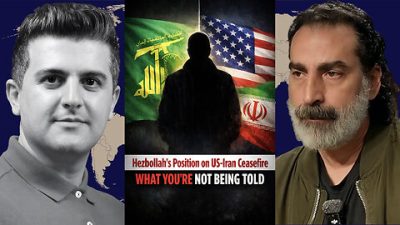
Laith Marouf: Hezbollah’s position on US-Iran ceasefire
or go to
Aletho News Archives – Video-Images
From the Archives
The Dirty Little Secret behind the “Global Terrorism Index”
The Omission of Israeli Terrorism in the Occupied Palestinian Territories
By Karin Brothers | Global Research | December 6, 2014
… The Israeli settlements — all of which are illegal – have been identified as a major impediment to peace. The refusal of a major “global” terrorism report to name the Israeli settlers as one of the groups most responsible for terrorism not only misrepresents a major source of regional violence but exposes the Global Terrorism Index as a propaganda tool that supports a U.S. agenda.
In recent years, governments have been attempting to thwart terrorism by blocking supportive fund-raising. When it comes to Israeli settlements, however, the US and Canada actually encourage fund-raising by giving organizations (such as Christian Friends of Israeli Communities (CFOIC) and the Jewish National Fund) financial support in the form of donor tax-deductions.
Charities which provide funds for the Israeli settlements should be regarded as terror-financing organizations. They should not only lose their tax-deductible status, but they should be banned because they support the violation of international humanitarian law. The terror-financing laws that are being strictly enforced for Muslim charities should be applied to Christian and Jewish charities as well. … Read full article
Blog Roll
 Aletho News
- Trump Administration Moves To Automate U.S. Military Draft Registration
- Spain orders reopening of Tehran embassy, condemns Israel’s carpet bombing of Lebanon
- Israel faces ‘unsustainable’ strategic crisis following 40-day war against Iran: Analyst
- Iran restricts Hormuz access to 15 vessels per day under ceasefire terms: Report
- The ‘Opposition Party’ Has Done Nothing to Stop the Iran War and Much to Goad Trump Into Continuing It
- Moscow backs Tehran on status of Lebanon in US-Iran deal
- How UK Regulator Ofcom Quietly Bypassed International Law to Police American Speech
- The Black Cube Files: How Former Mossad Operatives Flipped a Nation
- Laith Marouf: Hezbollah’s position on US-Iran ceasefire: What you’re not being told
- Israel’s priority lies in destroying chances of peace between Iran, US: Ex-UN nuclear chief
- If Americans Knew
- Amnesty: Urgent – Protect Lebanese civilians from brutal escalation in Israeli attacks
- Is The War Against Iran Over?
- Inside the Israeli army’s propaganda wing
- Hundreds of Gaza Amputees Stranded in Legal Limbo
- The gallows law: Israel moves toward executing Palestinian children
- Tucker Carlson: The Path to Peace requires ending ‘special alliance’ with Israel
- This is ceasefire? Israel’s biggest massacre yet in Lebanon, another journalist killed in Gaza – Daily Update
- Tucker Carlson on Israel: This Is the Behavior of an Ally? Really?
- Gazans face a triple crisis: severe shortages of water and bread, healthcare in tatters
- NY Times reports how Netanyahu took the US into Iran War
- No Tricks Zone
- An Inconvenient Tree: Uncovered In Alps… Europe Much Warmer Than Today 6000 Years Ago
- New Study Reports A 60% Slowdown In Greenland’s Ice Loss Rate In The Last Decade
- Low Intensity Tornado Wrecks Major Solar Farm, Creating A Potential Toxic Dump
- New Study Finds Warming Saves Lives…Cold Temperatures 12 Times More Deadly Than Excess Heat
- German Science Blog Accuses PIK Climate Institute Of Hallucinating Climate Tipping Points
- Devastating Assessment Of Comirnaty Vaccine By Former Senior Pfizer Europe Toxicologist
- New Study: CO2 Is ‘Effectively Negligible’ As An Explanatory Climate Change Factor Since 2000
- Former Pfizer Toxicologist Dr. Helmut Sterz Tells Bundestag Hearing Pfizer Vaccine Should Have Never Been Approved
- Energy Expert: Germany’s Nuclear Phaseout Was A “500 Billion Euro Mistake”
- New Research: South Australia’s Mid-Holocene Sea Surface Temperatures Were 4°C Warmer Than Today
 Aletho News