Israel’s collateral killing of civilians is finally in the spotlight
The New York Times’ recent “bombshell” presents facts that have been known for a long time – and does its best to sanitize them
By Robert Inlakesh | RT | December 30, 2024
The New York Times recently published a piece admitting that an unprecedented amount of “collateral damage” was permitted by the Israeli military. However, it omits key statistics that were previously revealed in order to sanitize the revelations it claims to be uncovering.
Presented as a bombshell piece, the December 26 article reveals that Israel had sent through an order that permitted killing up to 20 civilians for each low-level Hamas target. “The order, which has not previously been reported, had no precedent in Israeli military history,” the article reads.
However, in early April of 2024, an Israeli media outlet called +972 Magazine had not only published this fact, citing sources within Israel’s military, but uncovered much more damning figures detailing what was to be considered “acceptable” collateral damage.
The +972 article revealed that the Israeli airstrike that killed Hamas’ Shujaiya Battalion Commander, Wisam Farhat, was authorized to kill 100 civilians. Even more shocking was the infamous case of Ayman Nofal, the commander of Hamas’ Central Gaza Brigade, where, according to the sources, “the army authorized the killing of approximately 300 civilians.”
The +972 report was mentioned in passing by The New York Times, with the caveat that Israel’s military had denied it. However, +972 Mag’s investigative work on this topic did not begin in April. In fact, a piece published in November of 2023 cited a source who claimed the following:
“The numbers increased from dozens of civilian deaths [permitted] as collateral damage as part of an attack on a senior official in previous operations, to hundreds of civilian deaths as collateral damage.”
So, while a big deal is made of the fact that such high numbers of collateral damage have “no precedent in Israeli military history,” the IDF has been knowingly writing off civilians as collateral damage for years. One need only look at literally any UN report on Israel’s past military conduct to see it.
It isn’t only in Gaza that such horrendous “collateral damage” has been normalized, it has also been the case in Lebanon. When Israel carried out the assassination of Hezbollah’s Secretary General Seyyed Hassan Nasrallah, it openly announced that it estimated the total death toll to be around 300, as a result of leveling a number of civilian buildings in southern Beirut.
There is literally nothing in the article published by The New York Times that is new; all it does is affirm what has already been reported, yet it is done in a way that works to water the killings down by omitting key facts and repeating old tropes.
For example, it repeats as proven fact the widespread allegation that Hamas purposely embeds itself amongst civilians to use them as human shields, a point that has been found at least questionable before.
What is undeniable however, is that Israel uses Palestinians as human shields, as has been copiously documented throughout the war and used to be an accepted part of Israel’s military doctrine.
“From November 2023 onward, amid a global outcry, Israel began to conserve ammunition and tighten some of its rules of engagement, including by halving the number of civilians who could be endangered when striking low-ranked militants who posed no imminent threat” states the NYT. The question here is, where did this information come from? According to the article itself, the sources are all Israeli soldiers and officials.
The only evidence presented is the words of the Israelis. Was there any analysis done or examples cited to prove that the IDF would only kill ten civilians on average for every low-ranking Hamas fighter? Absolutely not, because not even Israel can present this information to the public, nor the names of the thousands of supposed “Hamas fighters” it has targeted.
If we go by Israel’s official figures for the number of alleged Hamas militants killed, they rise at such a rate that it doesn’t match the death toll figures accepted by the United Nations. While the official death toll in Gaza is nearly 46,000, with 10,000 missing and presumed dead, the only way Israeli “Hamas fighter” figures make sense is if the toll is much higher. However, accepting a higher death toll in order to give Israel’s claims about Hamas fighters more legitimacy would mean that The New York Times would face another issue: they would then have to wrestle with the fact that the killing only escalated in November of 2023.
In addition to this all, the +972 article from April 3 provides a much more in-depth insight into the artificial intelligence systems used by the Israeli army and points out that the targets it generated were highly inaccurate. The investigation discovered that when the Lavender system chose junior Hamas targets, the Israeli army would actually use its more lethal unguided munitions, because “you don’t want to waste expensive bombs on unimportant people.”
Furthermore, +972 noted that while a human has to verify targets chosen by the AI before a strike is ordered, eventually this boiled down to simply making sure the target is male – spending about 20 seconds on average before pulling the trigger.
Nowhere in the New York Times article is there any mention of the slaughter of civilians where no military target is located, there is no mention of the mass torture, sexual abuse, or demolition of homes for the pure vanity of soldiers. Everything is framed as a military that went a little overboard after the Hamas-led October 7 attack.
Robert Inlakesh is a political analyst, journalist and documentary filmmaker currently based in London, UK. He has reported from and lived in the Palestinian territories and currently works with Quds News. Director of ‘Steal of the Century: Trump’s Palestine-Israel Catastrophe’.
More than Dozen Martyred in Israeli Strike on Syria’s Adra
Al-Manar | December 30, 2024
At least ten people were martyred on Sunday in an Israeli strike on Syria’s Adra Industrial City in rural Damascus, Syrian and Arab media reported.
Reports said there was an explosion in the city of Adra, on the eastern outskirts of the capital.
An Israeli drone had reportedly fired two missiles at a building in the vicinity Adra industrial zone.
Arab media outlets reported that 11 people were killed, while other reports put the death toll at 17, with a number of others being injured.
A video shared on social media showed the aftermath of the attack. The video showed a building reduced to rubble with several bodies scattered among the debris.
The Zionist entity has been taking advantage of the former Syrian regime’s fall earlier this month, with the occupation military launching hundreds of strikes in the last weeks on several areas across the Arab country, and seizing positions including the summit of a mountain with an uninterrupted sightline to the capital Damascus.
Syria’s terrorist rulers committing ethnic cleansing in Christian town: Rights group
Press TV – December 29, 2024
A rights advocacy organization says Christians have been threatened by the Hayat Tahrir al-Sham (HTS) militant group to evacuate the southwestern Syrian town of Maaloula, in what has been decried as an act of ethnic cleansing.
“Syrian Christians in the ancient Christian town of Maaloula, Syria, are being threatened to leave the town by the AlQaeda/ISIS terrorists that have taken over Syria,” the Iraqi Christian Foundation said in a post on X on Sunday.
“An ethnic cleansing is happening in this ancient Christian town where Aramaic is still spoken. Pray for the Christians of Syria,” the rights organization added.
The mission of the Iraqi Christian Foundation is to advocate for the human, legal, and political rights of Iraqi Christians and other Christians across the West Asia region.
The organization also provides humanitarian aid to Iraqi and Syrian Christian genocide victims.
Other rights activists earlier warned about the lack of Internet access or communication and the unfolding of a massacre in Maaloula, the last town in Syria where Aramaic — Jesus Christ’s language — is still spoken.
The HTS administration, which led the onslaught that toppled Syrian President Bashar al-Assad and his government earlier this month, has repeatedly claimed to respect the beliefs and rights of all sects and religions in Syria.
Tens of thousands took to the streets in Latakia, Tartus, Homs, Hama, and Qardaha in condemnation of the militants’ desecration of an Alawite shrine in Aleppo last week, but the HTS violently attacked them, leading to deadly confrontations.
The HTS is among the militant organizations that have taken on Syria over the past dozen years with massively deadly and devastating effects on the country’s people.
Since March 2011, Syria has been gripped by a campaign of militancy and destruction sponsored by the US and its allies.
US, British jets rain fire on Yemeni capital in new late night attack
The Cradle | December 28, 2024
US and UK warplanes launched a new round of airstrikes on the Yemeni capital late on 27 December, targeting the 21 September park in the Maeen district of Sanaa, according to Yemen’s Al-Masirah TV.
No photos or videos of the attack have been released or circulated on social media. US Central Command (CENTCOM) has not claimed responsibility for the attack.
The latest western aggression came one day after Israeli warplanes launched massive airstrikes on Sanaa and the coastal province of Hodeidah in retaliation for continued drone and hypersonic missile attacks by the Yemeni Armed Forces (YAF) in support of Palestinians in Gaza.
Earlier on Friday, hundreds of thousands of Yemenis marched through the streets of Sanaa, Saada, Hodeidah, Hajjah, and Al-Mahwit, proclaiming, “We firmly stand with Gaza, the glory… without limits and without red lines.”
Demonstrators also called on the YAF to intensify their operations in support of Palestine.
The mobilizations started soon after YAF spokesman Brigadier General Yahya Saree confirmed that Sanaa conducted drone and missile attacks targeting Israel’s Ben Gurion airport, “a vital target” south of Tel Aviv, and an Israeli-linked ship in the Arabia Sea, in response to Israel’s aggressions on Yemen and Gaza.
At least six people were killed and 40 others injured when Israel bombed Sanaa International Airport, Red Sea ports, and power stations on Thursday.
“[Ansarallah] are more technologically advanced than perceived by many [and should not be] underrated,” an Israeli official told the Washington Post on Friday, speaking on the condition of anonymity.
He claimed that with support from Iran, Yemen has been able to take “practical steps” in fighting a war against Israel and its close allies.
“Because it’s so cheap for them to try to get a drone or a missile every few days or weeks into Israel, they can win this,” Yoel Guzansky, a former official on Israel’s National Security Council and senior fellow at the Institute for National Security Studies in Tel Aviv told the US daily.
The US and UK launched an illegal war on Yemen at the start of the year, seeking to protect Israeli trade interests and shield the country from the pro-Gaza operations of the Axis of Resistance.
Yemeni operations have been ongoing since November 2023, and Sanaa has vowed not to stop until the genocide in Gaza comes to an end. The daring operations by the YAF against Israel and its allies have forced several US aircraft carriers and European warships out of West Asia.
Iraq’s Sudani walks a tightrope after Syria’s fall
By Khalil Harb | The Cradle | December 27, 2024
In the aftermath of significant strategic setbacks for West Asia’s Axis of Resistance, Iraq has emerged as the focal point of an escalating regional crisis. But for many Iraqis, the scale of the brewing storm has not been immediately apparent.
The trajectory has been unmistakable: from the assassination of Hezbollah secretary-general Hassan Nasrallah on 27 September, to Israel’s ominous “threat message” to Iraq on 18 November, culminating in the fall of the Syrian government and its far-reaching repercussions.
The challenges Iraq faces today extend far beyond its borders. Iraqi Prime Minister Mohammed Shia al-Sudani is proceeding with extreme caution, akin to crossing an active minefield. His administration is weighed down by internal pressures, security threats, and regional dynamics while also contending with foreign demands, including resisting calls from the US and its allies to dismantle the Popular Mobilization Units (PMU) – the Iraqi military backbone in the fight against ISIS.
These forces are seen as a key pillar of Iraq’s security architecture and a counterweight to Iranian influence in the region, despite the support some of the factions within the PMU umbrella receive from Tehran.
Dr Hussein al-Moussawi, a senior media official with the PMU’s Al-Nujaba Movement, tells The Cradle that both the Shia religious authority and Iraqi people “did not and will not accept any compromise on the dissolution of the Popular Mobilization Units,” accusing the US “occupation” of trying to extend its presence in Iraq, which “[they] will not accept.”
Baghdad’s regional role
An Iraqi government source also reveals to The Cradle that Iraq shares its deepening concerns with neighbors such as Saudi Arabia, Jordan, the UAE, and Egypt. Following the upheaval in Gaza, Lebanon, and Syria, many Iraqis fear their country might be next in the chain of regional destabilization.
According to the source, Washington conveyed a message to Tehran through Swiss intermediaries, warning of a major strike – potentially targeting a nuclear facility – in early 2025.
Meanwhile, a UN official based in Paris shared with The Cradle that the Axis of Resistance underestimated the scale of the current offensive against the region, failing to comprehensively initiate the Unity of Fronts strategy.
Initially viewed as a reckless Israeli gambit, the attacks on Gaza and Lebanon have since revealed themselves as being part of a broader, opportunistic, western-backed strategy to reshape the balance of power in West Asia.
In Iraq, the signs of heightened tension are visible everywhere. Along the 600-kilometer border with Syria, the Iraqi army and PMU maintain a vigilant presence, deploying armored brigades, thermal cameras, and watchtowers to prevent a repeat of the 2014 ISIS invasion.
A PMU leader confirms to The Cradle that its leadership decided early on that it would not cross the border to support Syrian forces – first, because the Syrian army itself was not deployed for the fight, and second, because then-president Bashar al-Assad had restricted the activities of allied forces in recent years. Those restrictions increased as the Gaza war escalated and as Assad began to mortgage his country’s fate to both the Russians and his newfound Gulf state relationships.
The vigilant Iraqi presence on the Syrian border is matched with Baghdad’s close monitoring of Turkiye’s force build-up in the Suruj area near Kobani (Ain al-Arab) accompanied by tanks and heavy artillery. They are also watching the incursion of Israeli forces into Syria’s Quneitra governorate, descending from the Golan Heights to reach the Yarmouk Basin in Deraa governorate, along the opposite side of Rashaya, Hasbaya, and the Lebanese western Bekaa, toward the Masnaa Crossing – the only currently operating border crossing between Syria and Lebanon.
Compounding this are revelations that the actual number of US troops in Iraq and Syria is significantly higher than previously disclosed, with thousands stationed in the region to counter Iranian influence and provide logistical support to their Kurdish allies. Worse yet are the unconfirmed leaks that Sudani is not only prepared to accept the extension of US troops’ presence in Iraq beyond the 2026 withdrawal deadline, but may also allow Americans to enhance their Iraq–Syria border monitoring missions.
While the Pentagon officially reported a total of 3,400 US soldiers in the two countries – 900 in Syria and 2,500 in Iraq – it now states the figure is at least 4,500, with 2,000 soldiers in Syria as a rear operations base to support US forces in Iraq.
Sudani’s defensive diplomacy
Sudani’s recent diplomatic maneuvers underline the gravity of the situation. An informed Iraqi source discloses to The Cradle that following the Israeli threat, Sudani convened leaders from Iraq’s Coordination Framework and the State Administration Coalition to discuss potential responses.
The same source adds that US intermediaries later delivered a second Israeli message, listing targets that might be struck if drone attacks launched from Iraq were not halted. Although opinions within Iraq’s political and security circles diverged, the PMU leadership leaned toward de-escalation, prioritizing Iraq’s stability.
Despite this, Iraqi resistance factions have carried out several operations, often aligning with attacks by Yemen’s Ansarallah-aligned armed forces. These acts of defiance, however, have not deterred Baghdad from seeking a delicate balance.
For instance, the Iraqi government has resisted Iranian requests to transit forces through Iraq to Syria, citing the risks of further destabilization. According to sources close to the PMU, this approach reflects a calculated effort to shield Iraq from the spiraling Syrian crisis and preserve its fragile sovereignty.
As one Iraqi politician close to the resistance factions explains to The Cradle:
“Sudani’s performance is good, and the Iraqi opinion is present in the decision, and we are trying to spare Iraq the repercussions of what is happening in Syria. We certainly do not want the same fate, and Iraq is strong. We are with the government in all its decisions because they are in the interest of Iraq, and we have authorized it to take what steps are necessary. We are following Sudani’s movements, and we see that Iraq has begun to regain its regional health, and has become present in the region, and we support him in this.”
On 11 December, Sudani landed in Amman to meet with Jordan’s King Abdullah II, one of the most apprehensive Arab leaders regarding the situation in Syria. Shortly after, he traveled to the Al-Mualla resort to meet Saudi Crown Prince Mohammed bin Salman.
By 13 December, US Secretary of State Antony Blinken made an unannounced visit to Iraq, emphasizing US priorities in controlling Iraq’s borders with Syria and preventing the continued flow of Iranian arms to Lebanon. This flurry of diplomacy illustrates Iraq’s central role in regional and foreign security calculations.
PMU as a ‘wall of defense’
Sudani’s diplomatic outreach extended beyond these high-profile meetings. According to an Iraqi source, before the opposition’s attack on Syria escalated, the Iraqi prime minister dispatched PMU head Faleh al-Fayyadh to Ankara and Damascus to mediate between the two sides. However, this effort failed, leaving Sudani with no leverage to pacify armed factions or mitigate potential Iranian pressure.
An Iraqi government source denies any formal assurances or threats from the US regarding Syria but confirms to The Cradle that prior warnings had been issued to resistance leaders. For example, Qais Khazali, the Secretary-General of Asa’ib Ahl al-Haq, has reportedly relocated to Iran as a precaution.
But other sources say that Sudani’s government did receive US warnings for Iraqi forces to stay out of the Syrian battle in support of the former Assad government, a position that was ultimately supported by Iraq’s main political forces and blocs, including maverick Sadrist Movement leader Muqtada al-Sadr.
However, this support will have its limits and red lines; one of these is the PMU, and the other is the US occupation. Al-Nujaba’s Moussawi emphasizes that the PMU, alongside other Iraqi forces, remains an essential bulwark against both internal and external threats and rejects any compromise on the PMU’s existence, describing it as a “wall of defense” for Iraq amid escalating regional tensions.
Moussawi also reiterates Iraq’s continued support for the Palestinian cause and accuses the US of prolonging its occupation under dubious pretexts. He warns that Iraqis, particularly the resistance factions, are fully aware of these tactics and remain resolute in opposing any foreign military presence:
“The resistance remains stronger than ever and will adapt to the evolving challenges to defend Iraq’s sovereignty and interests.”
The stakes for Iraq could not be higher. For Sudani, the mission is not just to shield Iraq from the chaos engulfing its neighbors but also to establish it as a stabilizing force in an increasingly turbulent region. Achieving this will demand diplomacy and resilient leadership, as well as an unyielding defense of Iraq’s sovereignty against relentless geopolitical pressures and the unquenchable ambitions of the expansionist, US-backed Israelis – a task in which the continued existence of the PMU remains non-negotiable.
Russia making military advances as Ukraine insists on “Christmas” propaganda while refusing to negotiate
By Uriel Araujo | December 28, 2024
A recent Newsweek story comments on the advances Russia has made across the border of the Moscow-controlled land, in the towns of Velyka Novosilka, Pokrovsk, Shevchenko, and Vuhledar, as reported by the Institute for the Study of War (ISW), a Washington-based think-tank. Russian forces took Dachenske around December 22, and, the next day, made advances in Novovasylivka and Ukrainka, which reportedly was seized on the 24th.
Russian strikes have been badly damaging the Ukrainian power grid, a problem which, as I wrote, is aggravated by Ukrainian corruption, which has been destroying its energy infrastructure. Besides that, we know there is an ongoing battle over numbers in Ukraine, with Zelensky disputing Western intelligence agencies death figures for Ukrainians amid a conscription crisis.
On December 24 Russian Federation Council Speaker Valentina Matviyenko stated that Moscow is ready to seek some degree of compromise in negotiations with Ukraine, but that it will adhere strictly to the conditions laid out during the March 2022 Istanbul talks. The Istanbul talks, she added, “laid the very foundation, the basis of our approaches.” Earlier this month, the press Secretary of the President of the Russian Federation, Dmitry Peskov, said that Russia is seeking not just a truce (in Ukraine) but rather peace – which can come “after our conditions are met.”
The Istanbul negotiations were of course the talks that “could have ended the war in Ukraine”, according to Samuel Charp (RAND Corporation scholar) and Sergey Radchenko (a Professor at Johns Hopkins University School of Advanced International Studies in Europe). The treaty being discussed back then would have declared Ukraine to remain a neutral state, and would put an end to NATO membership plans. We now know that by April 2022 those very negotiations were making a lot of progress when both the UK and the US pressured Zelensky into abandoning them, which he did, thereby aborting what could have been a successful peace plan.
The Western media in general has made so much about Christmas having “not prevented” Russia from continuing its aforementioned advances that it is worth delving into this issue, for it reveals other less mentioned aspects of the crisis. Biden, for one, has condemned an “outrageous” Christmas attack, and Zelensky talked about timing having been a “conscious decision” by Moscow. Such statements are part of a war of narratives, of course. Just two days earlier Ukraine struck residential buildings in a major drone attack in the Russian city of Kazan. In addition, recently, Ukraine intelligence services have admitted to being behind the terrorist attack that killed senior Russian General Igor Kirillov, by means of a bomb blast in a residential area in Moscow.
Still on the Christmas angle, most Westerns do not realize this, but it should be noted that in the predominantly Christian Orthodox Eastern Slavic world, Christmas is celebrated not on December 25 but rather on January 7. This is due to them adopting the Julian calendar for liturgical purposes rather than the Western Gregorian calendar: December 25 thus falls around two weeks later. This is so despite most Orthodox Slavic countries employing, outside of church cycles, the “international” Gregorian calendar for everyday civic life.
In fact, last year (2024) was the very first time Ukraine celebrated Christmas according to the Western Gregorian calendar, that is, on December 25, at least officially. Ukrainian President Volodymyr Zelensky changed the law in July of that same year, so as to further “abandon Russian heritage” – which does not make much sense, since the Julian calendar is also traditionally used by the Orthodox Churches in Greece, Romania, the Levant and most of Eastern Europe. In other words, the official holiday in Ukraine used to coincide with the date as observed in the Church.
Today, in practice, most Ukrainians just anticipate the Christmas commemorations, making it last until January 7 (which is December 25 on the Julian calendar). In his Christmas message last year, Zelensky said that (now for the first time) “we all celebrate Christmas together. On the same date… as one nation.” This is clearly a state attempt to interfere in religious life, as part of a cultural westernization campaign.
In line with that same spirit, the newly created independent church called the Orthodox Church of Ukraine (OCU) also changed its Christmas date to December 25 (of the Western Gregorian calendar). The OCU is a partially recognized Eastern Orthodox Church in Ukraine, which came into being (as an “autocephalous”, that is, independent church) in 2019.
The traditional Ukrainian Orthodox Church of the Moscow Patriarchate (UOC-MP) has been banned by the Ukrainian government, in accordance with the Law of Ukraine “On the Protection of the Constitutional Order in the Sphere of Activities of Religious Organizations.” Even the US Commission on International Religious Freedom expressed its concern about the measure, with US Ambassador saying on 7 October that the US is concerned by the law’s potential to collectively punish entire religious communities which is rather ironic considering the role played by the US in the whole “autocephaly affair” from the beginning, the topic being a divisive issue within the Orthodox world.
The UOC, one of the largest denominations in the country, has indeed been the target of a crackdown, with holy sites having been seized (even years before 2022) and clergymen being judicially harassed. This is part of the very civil rights issue which relegates Russian minorities to “second class” status, according to Nicolai N. Petro, a professor of political science at the University of Rhode Island. All of that is hardly surprising considering the fact that neo-Nazism and the far-right have played a large part in the (US-backed) 2014 Maidan ultra-nationalist revolution in Ukraine. They still are major players in shaping national politics to this day, which often causes diplomatic problems with neighboring Poland.
The way the narrative about these issues is often pushed forward in the West (simply omitting the facts I mentioned above) can hardly be described as anything other than Western propaganda war and that pretty much is the case with regards to the Russian advances “on Christmas”.
Be it “on Christmas” or not, the fact is that a Ukrainian military victory remains a scenario outside of the realm of realistic options as Russia keeps on making further advances. When such is the case, peace talks and cease-fire talks must follow, for humanitarian reasons and out of pragmatic realistic decision-making. While the aforementioned civil rights issue (including religious persecution and the campaign against Orthodox churches) plus the matter of NATO expansion remain out of the subject of any talks, there will hardly be any progress in the political and diplomatic sphere.
Uriel Araujo, PhD is an anthropology researcher with a focus on international and ethnic conflicts.
IOF storm Kamal Adwan Hospital in northern Gaza, set fire to premises
Israel detonated explosive-laden robots, destroyed hospital facilities
Al Mayadeen | December 27, 2024
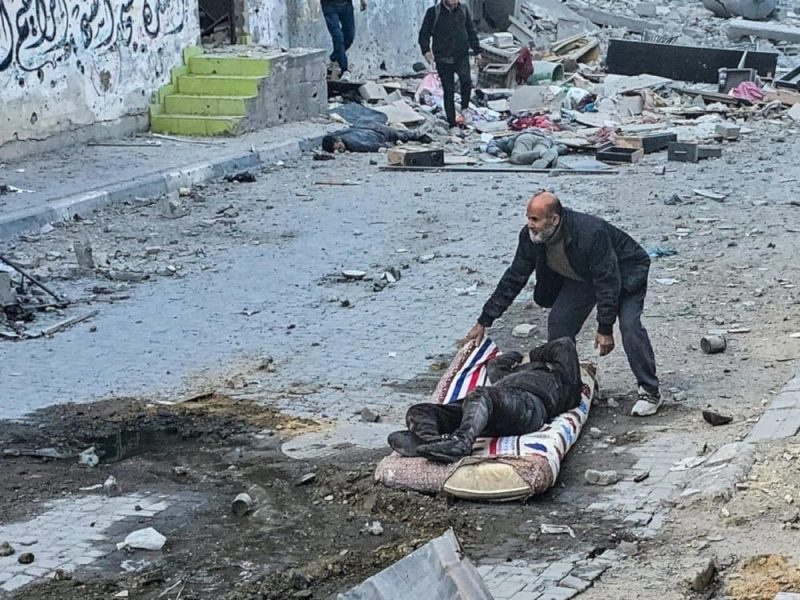
Israeli occupation forces (IOF) conducted Friday a harrowing assault on Kamal Adwan Hospital in northern Gaza, setting five of its sections on fire after raiding it, abducting patients and medical staff, and forcing them to strip.
The Ministry of Health in Gaza said that the fire had begun spreading to all buildings of the hospital, adding that the occupation forces burned the operations and surgery sections, as well as the laboratory, maintenance, and emergency units.
In an alarming escalation, the IOF launched an airstrike in the vicinity of the hospital, after storming its premises and forcibly displacing 300 patients. Many of these patients, who were dependent on life-saving medical devices, were left in the open, exposed to the harsh cold, further endangering their fragile health.
IOF also thoroughly searched the patients and medical staff, adding to the trauma.
After forcibly displacing the patients and hospital staff, the IOF abducted the patients, along with residents from surrounding areas, and gathered them in the yard of al-Fakhoura School amid harsh weather conditions.
The move has been condemned as a grave violation of international humanitarian law, highlighting the Israeli military’s disregard for the sanctity of medical facilities and the welfare of the vulnerable in Gaza.
Inevitable fate of northern Gaza people will be death
Al Mayadeen’s correspondent in Gaza noted that with the targeting of Kamal Adwan Hospital, all hospitals in the northern Gaza Strip have gone out of service.
On his part, the director of hospitals in the Gaza Strip underlined that “the free world must intervene immediately to stop the Israeli war on the Gaza Strip,” pointing out that medical staff are being subjected to abuse by Israeli forces in various hospitals across the strip that they are storming.
The suspension of services at Kamal Adwan Hospital deprives the people of northern Gaza of medical care, the director said, warning that under the current situation, the inevitable fate of the people in the area will be death.
The Ministry of Health in Gaza said that the director of the Kamal Adwan Hospital, Dr. Hussam Abu Safiya, received a clear threat from the occupation that he will be arrested this time.
Hamas condemns the attack as a war crime
In response to the latest Israeli assault, Hamas condemned the actions as a “war crime” added to a growing list of atrocities committed by “Israel” against the Palestinian people. The group slammed the international community for its continued inaction on protecting civilians and medical facilities.
It further accused the US of complicity in the ongoing aggression, calling the Israeli military’s actions “Zionist war crimes” committed amid global silence.
The movement held the Israeli occupation and the US administration fully responsible for the lives of patients, the injured, and the medical staff working in the hospital. This follows their complete isolation from means of communication and reports of abuse, the arrest of several individuals, and their transfer to an unknown location.
Hamas urged the international community, including the United Nations, to break its silence and take immediate action to halt the Israeli ongoing genocide in Gaza. The group called for measures to ensure accountability for the Israeli entity’s atrocities, demanding that Israeli officials face justice for their crimes against humanity.
IOF target al-Awda Hospital with direct gunfire
In yet another attack on hospitals in Gaza, IOF fired on the al-Awda Hospital and its surrounding areas in northern Gaza earlier today. The bombardment followed the detonation of a remote-controlled explosive device near the facility in the early morning hours.
Concurrently, the Ministry of Health in Gaza has confirmed the death of Dr. Ahmed al-Zaharneh, a physician at the European Gaza Hospital, who passed away due to the extremely cold conditions in Gaza, with his body discovered in his tent in the Mawasi area, west of Khan Younis in southern Gaza.
Over 10 Palestinians killed in ongoing Israeli airstrikes
Al Mayadeen’s correspondent reported that more than 10 Palestinians have been killed, with at least 30 others injured, most of them women and children, in a series of Israeli airstrikes on Gaza since the early hours of Friday morning, amid intensified attacks on the northern part of the Strip.
Among the targeted areas was the Halawah land in Jabalia al-Balad, northern Gaza, where several Palestinians were injured. Additionally, Israeli forces targeted a home in the al-Sabra neighborhood of Gaza City, killing five Palestinians and injuring three others.
In the al-Zaytoun neighborhood, southeast of Gaza City, another home was hit. However, Civil Defense teams were unable to reach the site to rescue the injured, as the occupation had previously and categorically refused any coordination with the Red Cross.
The scale of destruction and loss of life continues to escalate as the humanitarian crisis in Gaza deepens, with medical and civilian facilities increasingly under attack.
In America It’s Another Week to be Proud of!
By Philip Giraldi • Unz Review • December 26, 2024
Something good happened in Washington last week, suggesting that the year might actually end on a high note without Joe Biden starting World War 3 and opening up all the country’s prisons for the on-the-street rehabilitation of the inmates where they will undoubtedly learn new skills. The good thing was the signing by Biden of a bill, perhaps with a little bit of help from his friends to make sure he spelled his name correctly, to make the Bald Eagle the official bird of the United States of America. The Eagle has been around the American Republic virtually since its foundation, appearing on the Great Seal and on various documents and even on currency, but it has never been officially dubbed the national bird.
All honor of place is due to the great bald eagle, but one might recall that Benjamin Franklin once suggested that the best choice for the national bird would be the wild turkey. And Biden still has time for mischief, including possibly ennobling turkeys or even the issuance of a pardon to himself for ignoring the United States Constitution for four years. And Joe might well choose to go preemptive by pardoning Hillary Clinton for all those classified emails and other documents that somehow disappeared from her home and office ten years ago. But apart from that, it is somehow reassuring to be able to keep repeating “only three more weeks of Biden and Harris” even though the potential for more damage to the Bill of Rights remains enormous.
Joe is well remembered for his open borders invitation which has produced huge crowds of happy American voters who were clearly not delighted to share the burden of millions of uneducated and unskilled foreigners who have demonstrated their ability to burn to death women sleeping on subway trains in New York City just to see what a flaming human body looks like. Oh, and the new Americans have to be housed and fed by the existing population as the process grinds on, but that is what the Democrats running nearly all the major US cities have come to expect from a cowed population that now understands that opposing government policies puts one on the FBI enemies list.
Joe and his stalwart band of liars have also connived in pulling together two wars in which the United States had no actual interest, arming and funding both Ukraine and Israel. Israel has said thank you by adroitly engaging in genocide against the Palestinian people while Kiev is somewhat clumsily occupied in trying to draw the US and NATO into open warfare against Russia, which would become a nuclear World War 3, so there is still time Joe! And then there is the new war going on in Syria where the US armed and trained militias are fighting similarly armed and trained militias controlled by the Turks, who are poised to divide what once was a place called Syria with the Israelis. The Zionists have for many years been planning to exterminate Lebanese and Syrians as well as Palestinians to create a Greater Israel.
But Joe and his buddies apparently are not satisfied with having started two wars when there are so many other places that need a stern dose of the old “rules based international order” to get their houses in order. China is number one on the list as it is outperforming the United States and the Europeans economically. And one can always use the excuse that it is threatening good old Taiwan to crank up a shooting war. And then there is Iran, everyone’s favorite when it comes to “who is next on the list?” Israel has eliminated Hezbollah and Syria, with US connivance and approval, to open the door to destroying the Iranian non-existent nuclear weapons program. Both Biden and Israeli Prime Minister Benjamin Netanyahu have been openly discussing that option as it would mean bombing Iran’s military bases as well as its technical research facilities. Donald Trump has been involved in similar discussions with Netanyahu.
How the attacks on Iran might play out is interesting to contemplate and might follow something like the model of what happed to Syria. Recent reports indicate that something unexpected took place during an Israeli bombing attack directed against a Syrian strategic military site located near the city of Tartus. Israel has been bombing Syria constantly since the government of Bashar al-Assad fell and it has particularly targeted any sites or weapons warehouses that the new government can use to defend itself or establish its territorial integrity. The bombing in question used what many suspect to be a tactical nuclear weapon in an effort to completely obliviate the Syrian military installation that houses scud surface-to-surface missiles among other high-level ordnance. A huge explosion was noted on seismographs located five hundred miles away, as far as Iznik in Turkey. The blast might have been caused by the detonation of the many weapons stored in the facility, but the suspicion grows that Israel, protected as always by Washington even when it commits mass murder or defies international conventions on banned weapons, continues to believe that it can do and get away with anything.
Even if Biden does not open any new doors to further deploy the US military, there is considerable danger that he will succeed in locking new President Donald Trump in the conflicts currently going on. Trump is not averse to using force when it is what he considers the best option. He has lately said some ridiculous things, arguing that the United States considers the “ownership and control of Greenland” to be an “absolute necessity” for maintaining American “national security” and “freedom throughout the world.” This has naturally riled the people who actually live in Greenland who now are wondering how they are blocking freedom globally.
The statement on Greenland came after Trump in a conversation at Mar-a-Lago demoted Prime Minister Trudeau of Canada by giving him the title of “Governor”, calling Canada the 51st State of the United States “union,” which would “save on taxes and military protection.” Trump also has threatened to take over the Panama Canal and tweeted “we’ll see about that!” in response to the President of Panama’s declaration that every inch of the Panama Canal belongs to Panama. Trump then posted up a graphic on his website featuring “Welcome to the United States Canal!” above a picture of the American flag flying over a lock in the Panama Canal. Trump has also allegedly privately considered invading Mexico in order to combat the drug cartels on the US border and using American soldiers to block illegal immigrants seeking to cross.
Trump’s ignorance over who is doing what in the Middle East is astonishing but largely derives from his own personal and family attachment to Zionism and more particularly to his reliance on billionaire Jewish donors. The serial appointments of pro-Israel nominees to the key cabinet posts where decisions impacting Israel will be made for the next four years both will shape policy and guarantee that Trump stays on track with Israel, just as Joe Biden did when surrounded by his own Jewish neocons. Trump has already vowed that there will be “hell to pay” in the Middle East if the remaining Israeli hostages held in the Gaza Strip are not released by his January 20th inauguration.
Likewise, Israeli government officials, including Netanyahu, cannot wait for current Secretary of State Antony Blinken to be replaced by Florida congressman Marco Rubio. Blinken has been a complete tool of Israel but he projects a certain timidity. Rubio shows no such restraint and is very clear on what he believes to be true. He recently called Hamas “animals” and made clear that they are “100% to blame” for everyone killed in Israel and in Gaza during the current war. The moment he assumes control, there will be the “maximum pressure” that Trump often cites on Hamas to surrender or face the consequences. The Trump administration will supply Israel with bunker-busting bombs and whatever else is needed to kill anyone perceived to be an enemy of the Jewish state. Trump’s nominee for defense secretary, Pete Hegseth, has said, “If you love America, you should love Israel.” He will back that up by delivering on Israel’s military needs as defined by Netanyahu.
So there you go! The old year is ending on both a bang and a whimper. Joe Biden still has plenty of opportunity to raise hell and tie Trump to certain policies, particularly when it comes to continuing “useless” wars. Trump for his part will enter office owned by Israel and led by the nose by his belligerent cabinet. The actual needs and interests of the American people will be, as usual, invisible to the politicians and lost in the shuffle.
Philip M. Giraldi, Ph.D., is Executive Director of the Council for the National Interest, a 501(c)3 tax deductible educational foundation (Federal ID Number #52-1739023) that seeks a more interests-based U.S. foreign policy in the Middle East. Website is councilforthenationalinterest.org, address is P.O. Box 2157, Purcellville VA 20134 and its email is inform@cnionline.org.
Alawites Are Syrians Too
By Peter Ford | 21st Century Wire | December 27, 2024
Alawites in their towns and villages in the Tartous and Lattakia provinces of Syria are being subjected to hideous pogroms under the new Islamist dispensation in Syria. And the world turns its back. The Alawites are just too inconvenient for the emerging preferred narrative.
While Christians, Kurds, Armenians and women have their vocal champions in the West, Alawites have no-one. Abandoned by Asad, the Russians and even the Iranians, the Alawites are all alone.
Historically despised in Syria for poverty, backwardness and ‘superstition’, not accepted until recently even by Shia as fellow Muslims, the Alawites are now anathematised for having allegedly been the backbone of the fallen Assad ruling system.
Ravening wolves descend on Alawite villages
Since Day 1 of the new jihadi era Alawites have been hounded, intimidated, beaten up, killed, mutilated, raped and pillaged. Gangs of gunmen have rounded up surrendering Alawite soldiers for roadside executions. Alawite judges have been murdered. Alawite householders have been expelled from their houses to make way for jihadi families. Thousands have been put to flight into the mountains or across the Lebanese border. Shrines have been desecrated. Armed gangs roam the streets flaunting ISIS and Al Qaida flags.
If any of this gets reported at all in Western or Middle Eastern media it is always alongside claims by the new HTS junta in Damascus that these incidents are aberrations and that perpetrators are being called to order. But they are not. The instances multiply. And how unsurprising is that when the slogan of the so-called Islamist revolution was “Christians to Beirut, Alawites to the grave”? What the world would see if it would just open its eyes is visceral bloody sectarianism. This goes way beyond the score-settling that inevitably occurs when one side wins a conflict. It is in the DNA of the fundamentalist pro tem winners.
Myths about Alawite power
Some of the hatred of Alawites arises from the myth that the Alawites ruled Syria in the Assad era. It is true that the Alawites as a community saw their position in Syrian society improve after the Alawite general Hafez Al Asad became President. Young Alawite men from impoverished families had since the days of the French mandate seen career opportunities in the army when other communities with opportunities in business or elsewhere in the state spurned such careers. A cadre of Alawites made their way up the ladder, culminating in Hafez Al Asad’s coup.
But Alawites never dominated Assadist Syria as much as was alleged. The business sector remained firmly in the hands of Sunnis and Christians. Alawites rarely held key positions in government cabinets. In the army, while a disproportionate segment of officers were Alawites, the top generals were almost always Sunnis. As were most of the rank and file. Alawites held key positions in the security apparatus, but even there the pinnacle was usually occupied by Sunnis.
In their heartlands of coastal Syria Alawite social life was much like that of the related Alevi community just up the coast in Turkey: more liberal, more emancipated than predominantly Sunni areas.
For this, and for their links to Assad, the Alawites are now being punished. Even those links to Assad were often strained: Alawites, perhaps because they were less likely to be accused of disloyalty, were often more vocal in their criticisms of the government and the security services than others. Alawites suffered as much as anybody from the impoverishment brought on by the war and by Western sanctions, blocking of reconstruction and deprivation of the oil and gas in the US/Kurdish area.
Persecution of Alawites doesn’t fit the narrative
Western powers and media look away from the vile torment of the Alawites. They can hardly disguise their glee at having had their Christmas come early with the toppling of Assad and the discomfiture of Russia and Iran. They prefer to revel in the new genre of ‘Assad porn’: stories, rarely fact-checked, of mass burials of political prisoners (mostly war dead, in fact), increasingly sensational claims about the notorious Sednaya Prison, as well as fake prisoners stumbling out of torture chambers, ‘liberated’ by CNN star reporters, and of course – chemical weapons somehow not quite yet found etc, etc.
Western governments and UN agencies lose all dignity rushing to kiss the feet of the erstwhile terrorist now moderate new Sultan of Damascus. They mouthe platitudes about the need for ‘inclusion’ as though all that was at stake was a corporations’ DEI (Diversity, Equity and Inclusion) score, rather than very lives of terrified Alawites and others, just over the hill. They want to lift sanctions and get on with cementing the new regime into the Western system. Human rights come way down the list of priorities now that the West has what it wants.
The new Badlands
But the Alawites are brave. They are fighting back. They are resisting the Islamist gangs who come to confiscate their weapons, without which they and their families fear they will be butchered. And how is this presented in the media? Ah, these are ‘Assadist forces’.
Well let me tell you this. The new jihadi overlords may rule but they will not have control in areas like the Alawite and Kurdish heartlands, where they fail to respect communities and try to impose their jihadi system out of the barrel of a gun. These will be the jihadis’ Badlands, just as the Eastern areas bordering Iraq were the ISIS-spawning Badlands for the Assad government.
Author Peter Ford is a geopolitical and global affairs analyst, and former British Ambassador to Syria (2003-2006) and Bahrain (1999-2002). See more of Peter’s work here.
Convicted US spy worked on ‘genetic screening’ of Russians – FSB
RT | December 27, 2024
US national Eugene ‘Gene’ Spector, who was found guilty of espionage earlier this week, had been collecting “biomedical” data in the country, Russia’s Federal Security Service (FSB) has said. The authorities believe these materials could have been used by the US government to develop a genetic screening system for analyzing Russia’s population.
Over the past several years, there have been a number of high-profile cases in which Russian security services have accused American citizens of espionage. Since the escalation of the Ukraine conflict in February 2022, Moscow and Western nations have also increasingly expelled each other’s diplomats, claiming they are spies.
In a press release on Friday, the FSB alleged that the “American national, acting in the interest of the Pentagon and a commercial organization affiliated with it, gathered and handed over to a foreign party various biotechnological and biomedical data, including classified materials, with the aim of creating a high-speed genetic screening system of Russia’s population by the US.”
On Monday, a court in Moscow sentenced Spector to 15 years in prison as well as a 14 million-ruble ($135,000) fine.
The former chair of the board of Russia’s Medpolymerprom Group, a supplier of disposable medical items, was handed the punishment in conjunction with his previous sentencing for acting as an intermediary in a bribery case. In 2022, the US citizen of Russian origin was sentenced to 3.5 years behind bars after being found guilty of providing an aide to former Russian Deputy Prime Minister Arkady Dvorkovich with free trip vouchers from 2015 to 2016. The judge ruled at the time that Spector had thus remunerated the woman for promoting the products of several pharmacy companies.
Last August, a court separately ordered his arrest on suspicion of espionage, though the details of the case were not made public.
Earlier this year, Russia and the US exchanged a total of 26 individuals held in several countries, in the largest prisoner swap of this kind since the end of the Cold War. Among those sent to the US were Wall Street Journal correspondent Evan Gershkovich and former US Marine Paul Whelan – both of whom had been convicted of espionage in Russia. In return, ten Russian nationals who Washington accused of being intelligence agents and cybercriminals were sent to Moscow.
In September, Moscow declared six British diplomats persona non grata, claiming that their activities in the country “showed signs of intelligence and subversive work.” The UK Foreign Office dismissed the accusations as “completely baseless.”
Iran FM: China visit marks ‘new chapter’ in strategic ties, heralds ‘golden’ era
Press TV – December 27, 2024
Iran’s Foreign Minister Abbas Araghchi says his visit to China will open a “new chapter” in strategic cooperation between the two countries and herald a “golden” era for bilateral relations.
Araghchi made the remarks in an article published by China’s official People’s Daily newspaper on Friday, on the day that he was to head to Beijing at the invitation of his Chinese counterpart, Wang Yi.
“The next golden 50 years of Iran-China relations will demonstrate that this visit marks the beginning of a new chapter of strategic cooperation between the two countries,” he wrote.
The top Iranian diplomat also noted that Iran and China have long engaged in “practical cooperation” to promote multilateralism and develop indigenous values, adding that both sides have defended each other’s fundamental interests in international forums.
He also hailed “pragmatic” Iran-China ties, citing close political and defense coordination, exchange of high-level delegations, as well as cooperation in the Belt and Road Initiative (BRI), the Shanghai Cooperation Organization (SCO), the BRICS group of emerging economies, and the Beijing-brokered deal between Iran and Saudi Arabia in March 2023.
“Iran and China share common interests and concerns not only at bilateral and regional levels, but also at the trans-regional and international levels,” he emphasized.
“While firmly believing in the significance of multilateralism and the benefits of joint cooperation towards the prosperity of human society, both countries keep cooperating closely in multilateral mechanisms, including the SCO and the BRICS.”
China is Iran’s largest trade partner. Both states are subject to different levels of illegal sanctions imposed by the US.
The two countries signed the long-term strategic partnership deal in March 2021 to reinforce their long-standing economic and political alliance.
In his article, Araghchi said that West Asia is facing numerous challenges, the core of which is the Palestine issue.
The humanitarian crisis in Gaza, caused by the Israeli genocide and supported by some world powers, has been exacerbated by the inaction of the international community and irresponsible behavior of some parties, he noted.
Iran and China believe that an immediate ceasefire in Gaza and the delivery of humanitarian aid are now the most important priorities, he said.
The Iranian foreign minister further referred to the recent developments in Syria, urging respect for the country’s unity, national sovereignty, and territorial integrity.
Tehran, he pointed out, believes that the Syrian people should decide the future of their country without destructive intervention or external imposition.
“We are witnessing unprecedented changes in the world that have simultaneously created complex “opportunities” and “challenges” and put countries at a historical crossroad, where they must choose between confrontation/cooperation, exclusion/inclusion, closeness/openness, chaos/peace,” he said.
“Some states are trying to restrict and force others to choose their desired values and interests by distorting the facts, falsely dividing the world into democratic and non-democratic, and resorting to sanctions, pressure and double standards. However, Iran and China will always stand on the right side of history and by the side of development, prosperity, cooperation, and friendship between the countries of the Global South in a bid to counter unilateralism and bullying.”
Featured Video

US IRAN TALKS: Who Are the Crazy Ones Here? /Lt Col Daniel Davis
or go to
Aletho News Archives – Video-Images
From the Archives
Wartime internment camps in Australia
National Archives of Australia
World War I
During World War I, for security reasons the Australian Government pursued a comprehensive internment policy against enemy aliens living in Australia.
Initially only those born in countries at war with Australia were classed as enemy aliens, but later this was expanded to include people of enemy nations who were naturalised British subjects, Australian-born descendants of migrants born in enemy nations and others who were thought to pose a threat to Australia’s security.
Australia interned almost 7,000 people during World War I, of whom about 4,500 were enemy aliens and British nationals of German ancestry already resident in Australia.
Records of World War I internment camps
World War II
During World War II, Australian authorities established internment camps for three reasons – to prevent residents from assisting Australia’s enemies, to appease public opinion and to house overseas internees sent to Australia for the duration of the war.
Unlike World War I, the initial aim of internment during the later conflict was to identify and intern those who posed a particular threat to the safety or defence of the country. As the war progressed, however, this policy changed and Japanese residents were interned en masse. In the later years of the war, Germans and Italians were also interned on the basis of nationality, particularly those living in the north of Australia. In all, just over 20 per cent of all Italians resident in Australia were interned. … continue
Blog Roll
 Aletho News
- Diplomats slam US negotiators’ performance in Iran talks
- Trump Refuses Exit Ramp, War with Iran will Continue
- Trump Says US Naval Blockade in Strait of Hormuz Will Begin Shortly
- US, Iran end 21-hour talks without agreement
- US IRAN TALKS: Who Are the Crazy Ones Here? /Lt Col Daniel Davis
- Talks with the US end without a deal over excessive US demands: Iran
- Feeling Better, Getting Worse: How Psychiatric Drugs Create the Illusion They Cure
- ‘Nobody Told Me’: Former Mental Health Patient Calls Out Dangerous Side Effects of Psychiatric Drugs
- Dr. Abu-Sitta: Beirut ‘felt like a day in Shifa Hospital’
- Iran Has Won the War, It Will Be Up to the US to Secure the Peace: Mohammad Marandi
- If Americans Knew
- US-Iran ceasefire negotiations make zero progress – Daily Update
- Pro-Israel ‘Thinktanks’ and Individuals who Influence U.S. Foreign Policy
- Mearsheimer reveals how Israel dictates US policies on Iran, Gaza – video
- After killing 350+, Israel still has a “score to settle” with Lebanon before ceasefire – Daily Update
- Military aid to Israel emerges as the latest political litmus test for Democrats
- The only Palestinian children’s rights organization closes following years-long Israeli campaign against it
- ‘I Can’t Forget the Smell’: Lebanese Reel After Israel Kills Over 300 in Single Day
- DNC Shoots Down Resolutions Calling Out AIPAC and Limiting Arms to Israel
- TCN: Is Israel Blackmailing President Trump?
- Israel killed at least 303 Lebanese yesterday – who were they? Daily Update
- No Tricks Zone
- German Expert: Heat Dome Led To Record Temps In Western USA…Warmer In 1934, 1936
- New Study: No Linear Warming Or Glacier Retreat Along Northern Antarctic Peninsula Since 1980s
- An Inconvenient Tree: Uncovered In Alps… Europe Much Warmer Than Today 6000 Years Ago
- New Study Reports A 60% Slowdown In Greenland’s Ice Loss Rate In The Last Decade
- Low Intensity Tornado Wrecks Major Solar Farm, Creating A Potential Toxic Dump
- New Study Finds Warming Saves Lives…Cold Temperatures 12 Times More Deadly Than Excess Heat
- German Science Blog Accuses PIK Climate Institute Of Hallucinating Climate Tipping Points
- Devastating Assessment Of Comirnaty Vaccine By Former Senior Pfizer Europe Toxicologist
- New Study: CO2 Is ‘Effectively Negligible’ As An Explanatory Climate Change Factor Since 2000
- Former Pfizer Toxicologist Dr. Helmut Sterz Tells Bundestag Hearing Pfizer Vaccine Should Have Never Been Approved
 Aletho News