Tied and beaten: Freed Gaza detainees say abuse ended as it began
Al Mayadeen | October 15, 2025
Gaza resident Naseem al-Radee was released from Israeli prisons, partially blind and physically broken, only to learn that his wife and children had been killed during “Israel’s” genocide in Gaza.
Before his release, Israeli prison guards decided to send Naseem al-Radee off with what they called a “farewell”. They tied his hands, forced him to the ground, and beat him brutally, ending his 22-month imprisonment the same way it began: with brutality.
When al-Radee finally caught sight of Gaza again after nearly two years, his vision was blurred from a boot to the eye, leaving him partially blind for days. The 33-year-old government worker from Beit Lahia said his eyesight problems were just one of many injuries he sustained during his detention.
Israeli occupation forces had arrested al-Radee on December 9, 2023, from a school-turned-shelter in Gaza. Over the next 22 months, he was shuffled between several Israeli detention centers, spending 100 days in an underground cell, before being released with 1,700 other Palestinian detainees on Monday.
‘Beating us mercilessly’
Like the others released, al-Radee had never been charged with a crime. His account, marked by physical torture, starvation, and medical neglect, mirrors the testimonies of many others released under similar conditions.
Al-Radee’s ordeal, he said, reflected what the Israeli human rights organization B’Tselem has described as a systemic policy of abuse targeting Palestinian detainees.
“The conditions in the prison were extremely harsh, from having our hands and feet bound to being subjected to the cruelest forms of torture,” al-Radee told The Guardian, describing his time in Nafha prison in al-Naqab desert, his final place of detention.
He explained that the beatings were not random but a daily routine enforced with military precision. “They used teargas and rubber bullets to intimidate us, in addition to constant verbal abuse and insults,” he said.
“They had a strict system of repression; the electronic gate of the section would open when the soldiers entered, and they would come in with their dogs, shouting ‘on your stomach, on your stomach,’ and start beating us mercilessly.”
Tortured, starved, and caged in conditions unfit for human life
According to al-Radee, up to 14 Palestinian detainees were packed into cells meant for five. The unhygienic conditions caused widespread skin and fungal infections, which went untreated. Another recently released detainee, 22-year-old university student Mohammed al-Asaliya, said he contracted scabies while imprisoned in Nafha.
“There was no medical care. We tried to treat ourselves by using floor disinfectant on our wounds, but it only made them worse,” Asaliya said. “The mattresses were filthy, the environment unhealthy, our immunity weak, and the food contaminated.”
He described a notorious section of the prison known as “the disco”, where guards blasted loud music for two days straight as a form of psychological torture. “They also hung us on walls, sprayed us with cold air and water, and sometimes threw chili powder on detainees,” Asaliya added.
Weight loss; a common result
Both men lost significant weight during their detention. Radee said his weight dropped from 93 kilograms to 60, while Asaliya fell from 75 to 42 kilograms at one point.
Palestinian health officials confirmed that many detainees released on Monday arrived in critical condition.
“The signs of beating and torture were clearly visible on the prisoners’ bodies, such as bruises, fractures, wounds, marks from being dragged on the ground, and the marks of restraints that had bound their hands tightly,” said Eyad Qaddih, the public relations director at Nasser Hospital in southern Gaza, which received several of the released detainees.
He added that many had to be rushed to the emergency room and appeared to have been deprived of food for extended periods.
‘Israel’ transformed abuse into official policy
According to the Public Committee Against Torture in “Israel” (PCATI), around 2,800 Palestinians from Gaza remain in Israeli detention without charge. The practice of mass incarceration, rights groups say, has been enabled by legislative changes introduced after 7 October 2023.
An amendment passed in December 2023 to “Israel’s” Unlawful Combatants Law allows for indefinite administrative detention based solely on “reasonable grounds” that a detainee is an “unlawful combatant.”
Israeli human rights advocates argue that the surge in arrests has coincided with a steep deterioration in detention conditions, transforming abuse into an official policy.
“Generally, the amount and scale of torture and abuse in Israeli prisons and military camps has skyrocketed since 7 October. We see that as part of the policy led by Israeli decision-makers such as Itamar Ben-Gvir and others,” said Tal Steiner, executive director of PCATI.
Ben-Gvir, “Israel’s” far-right police minister, has openly boasted of providing detainees with “the minimum amount of food.” In July, he wrote on social media, “I am here to ensure that the ‘terrorists’ receive the minimum of the minimum.”
‘My joy went with her’
For many of the released detainees, however, the greatest pain awaited them at home. Upon returning to Gaza, al-Radee tried to call his wife, only to discover that her phone was disconnected. He later learned that his wife and all but one of his children had been killed during his imprisonment.
“I was very happy to be released because the date coincided with my youngest daughter Saba’s third birthday on 13 October,” he said. “I had planned to make her the best gift to make up for her first birthday, which we could not celebrate because the war had started.”
“I tried to find some joy in being released on this day,” al-Radee added softly, “but sadly, Saba went with my family, and my joy went with her.”
Israel to resume Gaza onslaught once all captives repatriated, threatens war minister
Press TV – October 15, 2025
Israeli minister of military affairs Israel Katz has declared that the occupation army will resume its military onslaught on the besieged Gaza Strip once the remaining captives are returned, marking an open defiance of the newly agreed ceasefire agreement between the Hamas resistance movement and the Tel Aviv regime.
In a post on the social media platform X on Wednesday, Katz said that once the first phase of the deal is ended with the release of all captives, the Israeli military will resume its offensives to destroy Hamas.
“Israel’s great challenge after the phase of returning the captives will be the destruction of all of Hamas’s tunnels in Gaza, directly by the army and through the international mechanism to be established under the leadership and supervision of the United States,” he added.
“This is the primary significance of implementing the agreed-upon principle of demilitarizing Gaza and neutralizing Hamas of its weapons.
“I have instructed the Israeli army to prepare for carrying out the mission,” Katz said.
The remarks came less than a day after Israel and Hamas agreed to a ceasefire framework brokered by Qatar, Egypt and the United States, and intended to end Israel’s two-year-long genocide in Gaza.
Katz’s statement made it clear that Israel views the truce not as a step towards ending the military assault on the Gaza Strip, but rather as a temporary pause before re-launching its military offensive.
Israel killed at least nine Palestinians on Wednesday as the regime’s military warned Gaza residents to stay away from the areas it still occupies.
Additionally, Israeli tanks fired at Palestinians in the town of Bani Suheila and the Sheikh Nasser neighborhood, east of Khan Younis. There were no immediate reports of possible casualties and the extent of damage caused.
At least 67,913 Palestinians have been killed, mostly women and children, and another 170,134 individuals injured in the brutal Israeli onslaught on Gaza since October 7, 2023, according to the health ministry of Gaza.
Kamala Harris: We Should Ask If Israel Committed Genocide in Gaza
By Kyle Anzalone | The Libertarian Institute | October 15, 2025
Former Vice President Kamala Harris said we should all ask if Israel committed genocide in Gaza. She made the remarks after serving in the administration that funded and armed the Israeli military to slaughter civilians.
On MSNBC’s The Weekend, Harris was asked by Eugene Daniels, “A lot of folks in your party have called what’s happening in Gaza a genocide. Do you agree with that?” She said we should all ask the question, but refused to answer, saying it was for the courts to decide.
She said, “Listen, it is a term of law that a court will decide. But I will tell you that when you look at the number of children that have been killed, the number of innocent civilians that have been killed, the refusal to give aid and support, we should all step back and ask this question and be honest about it, yeah.”
While Harris presented herself as unqualified to make a determination on genocide, she is a lawyer who served as a district attorney and Attorney General of California.
According to the Gaza Health Ministry, at least 67,000 Palestinians have been killed by the Israeli onslaught. The likely death toll is significantly higher, as it does not count access deaths and Palestinians who were killed by Israelis but whose bodies were not recovered.
Data from the Israeli military shows that at least 83% of the dead are innocent civilians. Israel has prevented enough food from entering Gaza, creating a famine. Hundreds of Palestinians have starved to death.
Israel’s genocide in Gaza began while Harris was serving as Joe Biden’s Vice President. While Biden and Harris were criticized by their base over their support for Israel’s destruction of Gaza, the White House refused to pressure Tel Aviv to end the assault.
Biden was dubbed “genocide Joe,” and Kamala “Holocaust Harris.” While running for president in 2024, the two were often heckled by left-wing activists over their support of the Israeli genocide.
A poll released earlier this year found that Harris’ refusal to diverge from Biden’s Israel policy was the most common reason why Americans who voted for Biden in 2020 but did not vote for Harris in 2024.
Jailed Palestinian leader Marwan Barghouti suffers rib fractures after assault in Israeli prisons

MEMO | October 15, 2025
Jailed Palestinian leader Marwan Barghouti sustained rib fractures after being beaten in Israeli prisons, the Prisoners’ Media Office said Wednesday, Anadolu reports.
The Hamas-run office said on Telegram that Barghouti was beaten by Israeli prison guards while being transferred from Ramon Prison in southern Israel to Megiddo Prison in the north in mid-September.
The imprisoned leader lost consciousness and suffered a fracture in four ribs, it added.
Barghouti, 66, a senior leader of President Mahmoud Abbas’ Fatah group, is one of the most prominent and popular figures in Palestinian politics.
He has been serving five life sentences in Israeli prisons since 2002 on charges related to the Second Intifada, which began in 2000.
Last week, US President Donald Trump announced that Israel and Hamas had agreed to the first phase of a plan he laid out on Sept. 29 to bring a ceasefire to Gaza, release all Israeli captives in exchange for Palestinian prisoners, and a gradual withdrawal of Israeli forces from the entire Gaza Strip. The first phase of the deal came into force on Friday.
Phase two of the plan calls for the establishment of a new governing mechanism in Gaza, without Hamas’ participation, the formation of a multinational force, and the disarmament of Hamas.
Since October 2023, Israeli attacks have killed nearly 68,000 Palestinians in the enclave, most of them women and children, and rendered it largely uninhabitable.
UK antisemitism training body under fire for links to Israeli military
Al Mayadeen | October 14, 2025
The Union of Jewish Students (UJS), the organization contracted to deliver hundreds of “antisemitism awareness sessions” for university staff across the United Kingdom, is facing renewed scrutiny following the resurfacing of a video in which its former president praised the group’s alumni serving “in senior positions in the Israeli government, the IDF, and even the President’s office.”
The footage, filmed during a meeting with Israeli President Isaac Herzog, shows then-UJS President Nina Freedman telling him that former members occupy high-ranking roles across Israeli entity institutions. The clip has sparked widespread concern over the impartiality of UJS’ government-funded training, particularly amid the International Court of Justice’s ongoing genocide case against “Israel” over its atrocities in Gaza.
Under a program led by the UK Department for Education (DfE) to address antisemitism in schools and universities, UJS was awarded a £998,691 ($1.27 million) contract to deliver antisemitism training across British higher education institutions.
According to the contract published on the government’s Contracts Finder portal, the organization is responsible for helping staff “recognise and respond to incidents of antisemitic abuse” and for leading discussions on “antisemitism, including related topics such as the Israel/Palestine conflict.”
Wider context
The award forms part of the DfE’s Tackling Antisemitism in Education initiative, funded through a £7 million ($8.9 million) government scheme announced in 2024 to combat what it designates as antisemitism in the education sector.
However, critics have long questioned UJS’ political neutrality, given its constitutional commitment to “inspiring Jewish students to make an enduring commitment to Israel” and its longstanding ties with the Israeli Embassy in London. The union has previously hosted Israeli emissaries with military backgrounds on its executive team and facilitated pro-“Israel” campus initiatives, including “birthright trips” and visits by Israeli diplomats.
During her address to Herzog, Freedman described UJS as being “on the frontline of the fight against antisemitism, anti-Zionism and anti-Israel bias,” adding that the group seeks to “shine a positive light on Israel’s successes” and encourage students to defend the entity through advocacy and online engagement.
“I feel so lucky to have gone through the UJS machine,” she said, referring to it as an incubator for “young Jewish activists.”
The remarks have amplified growing concerns about conflicts of interest in the UK government’s decision to outsource “anti-Semitism education” to an organization so closely linked with the Israeli entity.
How Zionist Influence in New York Gave Rise to Zohran Mamdani
By Matt Wolfson | The Libertarian Institute | October 14, 2025
Coverage of Zohran Mamdani’s run for New York City mayor is focused on the outsized politics at play in the race: democratic socialism, Islam, state-owned grocers, former Governor Andrew Cuomo, until recently incumbent Mayor Eric Adams, and President Donald Trump. But this risks missing the real story in New York, which is the decades-long creation and maintenance of a financialized, factionalized city of free market distortions and middle class displacement at the hands of powerful Zionists and their allies that led to backlash and Mamdani’s rise. Rewinding Mamdani’s catapault to politcal stardom reveals that New York’s current situation—its transition from a city hospitable to the working and middle classes and genuine free exchange of goods and services to a feudal one of government-backed financiers and service workers—is in many ways the work of a little more than a dozen Zionist financiers who twisted government to their ends.
Zionism in New York was part of a shift in the city begun by establishment-connected WASPs away from government by wards and organizers and toward rule by government-connected finance. The originator was Nelson Rockefeller, John D. Rockefeller’s grandson and the governor of New York from 1959 to 1973, who floated New York City’s bills by arranging for banks like Chase Manhattan (run by his brother David) to buy bonds. These new bonds covered the old bills even though the bonds were not backed by actual assets of the city’s but by anticipated returns; e.g. “tax anticipation bonds,” “bond anticipation notes,” and “moral obligation bonds.” This meant the city borrowed from the bankers, paid a portion of the interest, and borrowed again, while having no long-term way to pay back the full amount of ever-increasing debt.
The fix to this problem created by financiers came from financiers: a consortium set up in 1975 by Nelson Rockefeller, now vice president, to “solve” the city’s $6 billion debt. The consortium operated through various vehicles with names like the Municipal Assistance Corporation and the Emergency Financial Control Board and it achieved this “fixing” in a predictably self-interested way. It cut out of influence the city’s old political power brokers—Jewish, Irish, Italian, Puerto Rican, and black politicians with connections to their communities. It then executed a bait-and-switch. It cut city funds from supporting welfare and unions in the name of small government while actually redirecting those funds to support financial development via investing in a real estate boom driven by a handful of connected players that attracted new “talent” to the city.
The main beneficiaries were rising Wall Street power brokers, the most notable ones Zionist, for whom the 1980s was a kind of heyday. The roster included Laurence and Robert Tisch, Maurice “Hank” Greenberg, Michael Steinhardt, the Bronfmans, Michael Milken, Stephen Schwarzman, and high-end retailers like Victoria Secret’s Leslie Wexner and Leonard and Ronald Lauder, the sons of Estee Lauder and heirs to her fortune. One difficulty of critiquing a cohort like this is that the conflation of “Jewish power” and New York is an old trope, in part because New York has been, since the early twentieth century, a Jewish city. So it should be emphasized that this cohort was small and highly specific. It was distinct from older generations of New York Jews—not just Jewish ward players like Abraham Beame, New York’s last mayor under its old power dispensation, but Jewish financiers like Felix Rohatyn, who played a major role in stabilizing the city’s debt in the 1970s.
Players like Beame and Rohatyn had planted their stakes firmly in America and nowhere else. Having experienced the rise of the Nazi Party in an economically cratered Germany as a childhood reality, they were committed to creating the conditions for what they hoped would be lasting social peace. Zionists, by contrast, had their eye on the military-corporate apparatus and its ties to Israel, and they were not especially concerned with the effects of their actions on the ground. They also rejected what would become the mores of the majority of Jews and especially Jews of a later generation: intermarriage, mixing, diverse assimilation. Their style was self-consciously distinctive and gloves off, and beginning in the 1980s they executed an aggressive reinvention not just of the financial markets but of New York.
Part of this reinvention was done, much as the Rockefellers’ rise to influence in New York had been done, through philanthropy, but at a much greater scale. Among these Zionist players’ direct bequests were the Steinhardt Conservatory at the Bronx Botanic Gardens, the NYU Steinhardt School of Culture, Education, and Human Development, the NYU Tisch School of the Arts, NYU Langone’s Tisch Hospital, the Tisch Galleries at the Metropolitan Museum, the Tisch Children’s Zoo in Central Park, the Leonard Lauder Galleries at the Metropolitan Museum and the Museum of Modern Art, Ronald S. Lauder’s Neue Museum, and the NYU Bronfman Center.
Another part of this reinvention was done through real estate, which, like Wall Street, was increasingly dominated by Zionists. Perhaps most notable among them was Lawrence D. Ackman of Ackman-Ziff, the firm which redeveloped West 34th Street, West 42nd Street, and Madison Avenue on the Upper East Side in the 1970s and 1980s and turned portions of 9th Avenue into the high-end Chelsea market in the 1990s.
So far, government had been indirectly incentivizing development; then, in the 2000s, government got directly involved. Philanthropy and real estate became direct tools of government with the mayoralty from 2002 to 2014 of Michael Bloomberg, the billionaire financial services provider and the man most connected to this class by Zionism and finance. Bloomberg’s projects pushed in one direction: using government policy and finance capital to redevelop the city to create a tourist and tech mecca. His opening gambit was re-zoning 40% of the city. He then filled those rezoned spaces with public-private projects—parks, high-rises, high-end department stores—displacing middle and working class New Yorkers and driving up rents for everyone else.
This was not a free market experiment, where the best contractor gets the development job or the philanthropic bequest. This was explicitly a project of wealthy and connected Zionists with ties to the mayor. As Leonard Lauder told it to The New York Times some years later, “When Mike Bloomberg was the mayor, he was the ultimate power broker. He would call me up on the phone and say, ‘I need this and this and this, OK?’” Hollywood Zionists who came East were mobilized too, notably the media executive Barry Diller and his wife, the designer Diane von Furstenburg, and the music producer David Geffen. So was a new generation of real estate Zionists like Steven M. Ross of Related Companies, the developer of Columbus Circle, and Gary Barnett of Extell Development Company, the son of a rabbi and former diamond trader with significant holdings in Israel. So, finally, was a new generation of Zionist financiers like the hedge fund operators Daniel Loeb and Bill Ackman, Lawrence Ackman’s son.
Development proceeded from there. Bill Ackman’s first wife Karen Herskovitz and Laurence Tisch’s niece Laurie Tisch were major backers of the public park The High Line and the High Line’s anchor building, the relocated Whitney Museum of American Art. This was Bloomberg’s pioneer re-development project: a park built on former railway lines that cut through the Lower West Side to Midtown West, from 4th to 34th Street. Barry Diller and Diane von Furstenberg provided the funds for Little Island off West 13th Street west of the High Line, which “replace[d] the dilapidated Pier 54, envisioning an extraordinary new pier combining public Park and performance space.” Stephen M. Ross, facilitated by Bloomberg and later backed by an infusion from the Saudi Public Investment Fund, developed Bloomberg’s culminating project: the mega-mall Hudson Yards on West 34th Street at the top of the High Line. Stephen Schwarzman donated $100 million to the New York Public Library. David Geffen donated $100 million to refurbish the New York Philharmonic, with the help of Leonard Lauder and Bloomberg confidante (and Zionist) Barbara Walters.
Then there was real estate. A bevy of “supertall” skyscrapers which cast shadows over the surrounding buildings and streets were developed by Gary Barnett’s Extell, among the most prolific developers in Manhattan. (The occupants of Extell’s and other supertall developments were mostly financial workers and Saudi princes, who complained when the buildings leaked from the inside and swayed in the wind.) Smaller versions of Extell’s developments appeared in Brooklyn neighborhoods, built with cheap materials and generally agreed by locals to be eyesores meant for purchase by out-of-towners. Imitators of these projects abounded, thanks to Bloomberg’s largesse via not just re-zoning but also his provision of incentives to developers and his personnel intercession to make some projects happen. During his mayoralty, seven of the twenty tallest buildings in the city were built, along with smaller towers in areas ranging from downtown Manhattan and Brooklyn to Harlem.
In all of these spaces, the natural circulation of neighborhoods, which depends on small businesses and schools and places of worship, was replaced by “excursion destinations” constructed with enormous capital investment from powerful financiers with access to government. These high rises, parks, and cultural centers and the luxury apartments surrounding them also functioned as surveillance spaces, with manicured lawns for “relaxation” flanked by buildings which were easy to watch and patrol. And they functioned as class filters, siphoning from Manhattan the middle income earners priced out by rising rents and replacing them with finance workers or wealthy foreign nationals looking for second apartment homes. These new arrivals, in turn, relied for their needs on a growing number of service workers working low-wage shifts in restaurants or at Doordash—many of them undocumented.
This finance-and-philanthropy-based surveillance-and-extraction model is quite similar to the fundamentals of the “Raze-and-Rebuild” program being pushed by prominent Zionists for Gaza: a space meant to be serviced by undocumenteds and inhabited by financiers and tourists once the “locals” are “relocated.” It is also quite similar to the cities of authoritarian regimes in West Asia and the Gulf States that rose in the 2010s. And there is past precedent for it in the developments of Paris and Berlin at the hands of authoritarian regimes of the nineteenth century—developments which immiserated the working and middle class of these cities and seeded the ground for the cycle of revolt and reaction that created fascism.
But these explicitly feudal parallels have gone almost completely unremarked on in New York, probably because Zionist financiers have also assumed positions at the helms of the city’s education system and media nexus.
At the hands of Laurence Tisch’s daughter-in-law Merryl Tisch, as Chair of the Board of Regents (in charge of education in New York state) she and her allies Andrew Cuomo and Michael Bloomberg put a focus on standardized testing in the name of “merit.” This functioned to place “high achieving” outer borough students into private or “special” schools in Manhattan rather than giving outer borough schools the resources to help these students represent their communities. At the hands of the longtime presidents of New York University and Columbia, the city’s two most powerful universities have expanded their footprints off the real estate boom and muted critiques of the crony corporatism behind it. Successive Zionist executives and op-ed editors of The New York Times and Conde Nast, which is owned since the 1980s by the Zionist Newhouse Family and publishes Vogue and Vanity Fair and The New Yorker, media coverage of New York has celebrated expansion, “modernization,” modernizers, and the celebrities and fashion innovations these shifts bring to the city. So has CBS News, owned by first the Tisches in the 1980s and 1990s and then the Redstones, another Zionist family, from the 1990s to the 2020s. Despite the quiet admonitions of older players like Felix Rohaytn against the dangers of this insularity, the fantasy of empire management has turned New York into something closer to nineteenth century Europe than anything Americans might recognize.
This project only continues faster today. Zionists like New York Times columnists Thomas Friedman and Ezra Klein are backing the “Abundance Agenda,” a spate of policies to fast-track building permits in urban areas across the nation to combat housing scarcity, which will accrue to the benefit of governmentally connected developers and financiers able to manage large-scale projects. Academics from MIT, the site of lavish donations from New York Zionist financiers like Jeffrey Epstein and Stephen Schwarzman, have been calling for New York to become a “leisure city” catering to tourists and younger workers in the finance industry.
Of course, just as there is backlash to colonization abroad, there is backlash to it at home. In the 1980s and 1990s, the backlash came in the form of crime, boycotts, and riots, and protests from leftwing activists and the leadership of black and Hispanic communities whose influence had waned after the 1970s. In the 2010s, these marginalized figures received a new infusion of outside energy from political progressives who had built up their power in universities and the arts using state grants, in effect commandeering parts of the institutions Zionists had funded to enhance their own control. These players brought media sophistication and an ideological agenda to the on-the-ground communal left which had been rudderless. Meantime, the on-the-ground left brought to the table a close connection to the communities at the stick end of Zionists’ policies. The realization of the success of this synthesis was the mayoralty of the progressive Bill De Blasio, who within three months of beginning his first term was publicly criticized by allies of Zionist philanthropists for failing to give them the attention they felt they were due.
Then, in the 2020s, came De Blasio’s successor, Zohran Mamdani, a more effective progressive (as De Blasio freely admits) on every level. Where De Blasio talked about a “tale of two cities” and universal Pre-K, Mamdani talked, over and over and in original ways, about affordability, and took direct aim at the enemies of affordability in New York, finance, and Zionism. Historically, as I have reported elsewhere, socialism and its ideological cousin redistributionism have occurred in America after long periods when finance twisted around the state and distorted its functions. At a certain point in these processes, Americans respond to a program pushing for government money to flow not toward financial firms or weapons contractors but directly to them. Indeed, Mamdani’s victory speech when he won the primary, which emphasized returning the city to serve the interests of the working people who make New York run, was an emblem of exactly what New Yorkers appear to be looking for.
Bill Ackman, Dan Loeb, and other members of the club of Zionist financial elites have sounded the alarm of creeping socialism since Mamdani’s victory, but they have not blamed themselves for creating the distortive conditions that led to it. In fact, they’ve done the opposite. They’ve turned to a characteristically Zionist—which is to say colonialist—solution to rising discontent. This is a solution which they’ve slowly been developing since the 1990s and which had its antecedents or parallels in nineteenth century Europe and the twenty-first century Middle East: techno-military law enforcement to control “restive populations.” As I will show in a coming report, if Andrew Cuomo wins on November 4, the militarist play being run by Zionists will continue without any meaningful check, since Cuomo is both a close Zionist ally and not known for his concern for civil liberties. If Mamdani wins, there may be checks on this militarism, but these checks will not be absolute. Instead, some measure of militarized law enforcement will coexist with socialist government expansion. Together, these could lead New York on a path toward government control across sectors: security, economy, politics, society.
Max Blumenthal: The Gaza peace deal that never was
The Grayzone | October 13, 2025
The Grayzone’s Max Blumenthal explains how the Biden administration refused to pressure Netanyahu into a ceasefire, leaving the perceived diplomatic win to Trump, who happens to be the most malleable vehicle for Israeli influence in US history. Max explains how Israel is already violating the ceasefire agreement while unleashing its extremist proxies in Gaza, and highlights extremely revealing statements Trump made during his Jerusalem speech in which he casually joked about Israel’s control over his own policies.
Obama faces backlash for ‘bothsides-ing’ Israel’s genocide in Gaza
The New Arab | October 10, 2025
Former US President Barack Obama has come under fire for comments about the Gaza ceasefire for equating victims and aggressors and erasing Palestinian suffering.
The remarks, which many saw as Obama framing Israel with empathy and stripping Palestinians of their humanity, came after the announcement of an agreement between Israel and Hamas.
“After two years of unimaginable loss and suffering for Israeli families and the people of Gaza, we should all be encouraged and relieved that an end to the conflict is within sight; that those hostages still being held will be reunited with their families; and that vital aid can start reaching those inside Gaza whose lives have been shattered,” Obama posted on X.
He added that it now fell on “Israelis and Palestinians, with the support of the US and the entire world community, to begin the hard task of rebuilding Gaza – and to commit to a process that, by recognizing the common humanity and basic rights of both peoples, can achieve a lasting peace”.
Media critic Sana Saeed described Obama’s phrasing as “a masterclass in seven words on how Palestinians are rendered faceless and nameless when slaughtered, while Israelis are granted empathy, especially when they are the butchers”.
Palestinian-American human rights lawyer Noura Erakat said: “The ‘people’ of Gaza are Palestinians. They have survived a genocide and an ongoing attempt to eliminate them for over a century.” Others said his use of the word “conflict” to describe Israel’s assault on Gaza distorted the nature of the violence.
“It’s a genocide,” wrote historian Assal Rad. “There is no accountability without acknowledging it, and there is no justice without accountability.”
Obama has not addressed the criticism. He had previously faced similar criticism for statements on Israel and Palestine.
In October 2023, he defended Israel’s “right to defend itself” while urging restraint, a position slammed as “bothsidesism” Israel’s bombardment of Gaza and ignored the decades-long occupation.
He also drew condemnation for an October 2024 post marking the anniversary of Hamas’s attack that mentioned Israeli victims but not the more than 41,000 Palestinians killed in Gaza at the time.
Israel’s military attacks on Gaza have killed more than 67,000 Palestinians, including thousands of children, while displacing nearly the entire population and destroying much of the enclave’s infrastructure.
On Thursday, Israel and Hamas signed the first phase of a ceasefire and hostage-exchange agreement, brokered by the United States, Egypt, Qatar, and Turkey.
Who is Larry Ellison? And how does he tie digital ID, Trump, Blair and genocide in Levant?
By David Miller | Al Mayadeen | October 13, 2025
Larry Ellison is a tech billionaire who is the world’s second richest man. He is behind the takeover of TikTok, the purchase of Paramount which ownsCBS News and is bidding to take over Warner Bros. which owns CNN.
He runs a firm called Oracle which was started with funds from the CIA. The CIA effectively made Ellison a Billionaire.
Today, Oracle is the cloud provider for the British Home Office, the Ministry of Defence and the Foreign Office, storing national security data, as well as the National Health Service. The NHS is of particular note since it holds an incredible amount of population data going back to its formation in 1948. No wonder Ellison is desperate to get his hands on it: “The NHS in the UK has an incredible amount of population data,” though, he noted, it remains too “fragmented.”
Ellison is the largest recorded donor to the Friends of the Israel Occupation Forces and previously, reportedly, offered Benjamin Netanyahu directorship of the firm. Its longtime CEO is “Israel” born Safra Catz, who has also donated millions to the Friends of the IOF either directly or via Oracle itself.
In late 2024, she told an Israeli business news outlet, “For employees, it’s clear: if you’re not for America or Israel, don’t work here, this is a free country.”
A year ago, Ellison described a future where everyone will face regular surveillance. He predicted artificial intelligence would help process the vast amounts of footage recorded by cameras placed on everything from car dashboards and front doors to security systems and the police.
Ellison is the man behind the latest push for digital ID cards in the UK and has said that citizens “will be on their best behaviour” once they are introduced. “We’re going to have supervision,” Ellison said. “If there’s a problem, AI will report that problem… we are constantly recording and reporting everything that’s going on.”
An anonymous US official told reporters TikTok’s algorithm will be “fully inspected and retrained” by Ellison’s consortium.
The purchase of TikTok is certainly about winning the propaganda battle for the Zionist genocide, but it’s also about surveillance, monitoring and control.
Oracle had already, in February, taken control of some of TikTok’s day-to-day operations, had taken a firm pro-“Israel” stance and reportedly, clamped down on pro-Palestine activism inside the company.
Collaborations between the company and Zionist regime agencies have been wide-ranging, from direct technology work with the military to software intended to help “Israel” with public relations, including, according to internal company messages, on social media platforms like TikTok. Catz, herself, notes that “We were the first company to build a data centre in Israel serving the region.”
Netanyahu has said, “We have to fight with the weapons that apply to the battlefields on which we are engaged. And the most important ones are on social media.” And the most important, he said, is “TikTok, number one. Number one.”
One of President Trump’s advisers described Ellison, earlier this year, as a literal “shadow president of the United States,” if not necessarily the shadow president.
Larry Ellison and Tony Blair
Two elements of the Trump peace plan, which are clearly linked, are on the one hand, a plan for governing Gaza after the putative “defeat” of Hamas and, on the other, a plan for manipulating the media and social media in order to defeat Hamas in the propaganda war.
These two elements of the strategy have clearly been co-ordinated closely with Netanyahu, who has more or less taken up residence in the US. But they have also been closely co-ordinated with a man referred to as the shadow president – the tech billionaire Larry Ellison – and with the former Prime Minister of the UK, Tony Blair.
Blair has recently emerged as “a potential Gaza interim consul and member of Donald Trump’s ‘board of peace.'”
Given that Ellison and Blair are both central to the Trump/Zionist plan, we might ask if they are also aware of each other? In fact, they are very closely intertwined.
According to Lighthouse Reports: Ellison invested $130 million in the Tony Blair Institute between 2021 and 2023, with a further $218 million pledged since then. The scale of funding took the TBI from a headcount of 200 to approaching 1,000. Blair himself takes no salary from TBI, but over this time, the institute has been able to recruit from bluechip firms like McKinsey and Silicon Valley giants Meta. In 2018, before the Oracle founder’s funding surge, TBI’s best-paid director earned $400,000. In 2023, the last year where accounts are available, the top earner took home $1.26 million.
Oracle has earned £1.1 billion in public sector revenue since the start of 2022, according to data collected by procurement analysts Tussell.
Here is Blair introducing Ellison in the UAE asking him about the use of data, including in Digital IDs. Note what he says about unifying data.
“The first thing a country needs to do is to unify all of their data so that it can be consumed and used by the AI model.”
Ellison and Blair are working together to open up huge data-mines for profit-making. The British NHS is a key prize since there are virtually no other population level data sources that go back so far. The NHS was created in 1948.
It’s obvious that the unification of data will enhance the ability of both Oracle and the Zionist entity to surveil and kill the Palestinians and to suppress all attempts to oppose genocide. This is how the control of TikTok and the Trump “board of peace” are connected.
Saleh al-Jafarawi, the Doghmush clan, and the illusion of ceasefire
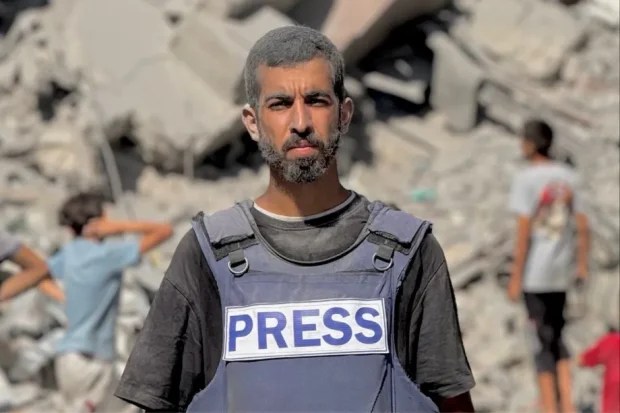
By Mohammad Aaquib | MEMO | October 13, 2025
Saleh al-Jafarawi was abducted and executed by members of the Doghmush clan—an anti-Hamas faction within Gaza. He was not killed in battle, but in a context of internal militias acting under external influence.
This stark fact deserves to be front and center, because it exposes a quiet architecture of violence that functions even in moments when a ‘ceasefire’ supposedly holds. This is the occupation’s most insidious form, a war fought not through tanks or jets but through collaborators and chaos, ensuring that Gaza never truly rests. In this architecture of endless war, ceasefires are illusions, fragile pauses that conceal the unbroken machinery of control, where Israel’s hand remains unseen but ever present, orchestrating violence even in silence.
Netanyahu’s June 2025 admission confirms what many analysts have long suspected: Israel has been “activating” clans that oppose Hamas, arming or supporting them at least tacitly, leveraging internal divisions in Gaza. In multiple statements, he claimed that, acting “on the advice of security officials,” the Israeli government has enabled certain Palestinian clans to operate against Hamas. “What’s wrong with that? It’s only good. It saves the lives of IDF soldiers,” Netanyahu declared.
One of the prominent clans so enabled is the Abu Shabab clan, based in Rafah, which Israel admits to having activated. The “Popular Forces,” linked to them, have been accused by Palestinians and aid workers of criminal behavior, including looting incoming humanitarian aid convoys. These clans are local players with complicated histories: some held influence before Hamas’s takeover of Gaza in 2007; some engaged in smuggling or informal power networks; some have been marginalized under Hamas rule. What Netanyahu has done is to take these existing internal cleavages and weaponize them—using clan rivalries as a tool of proxy warfare.
Against this background, the abduction and killing of Saleh al-Jafarawi by Doghmush clan members is more than an individual tragedy. It’s a case study: how collaborators or clan-militias are used to silence voices loyal to the resistance, to undermine local governance, and to sow fear. Al-Jafarawi was known for his coverage of destruction, displacement, and civilian suffering—aligning him clearly with Hamas’s movement of resistance. That he was taken and killed by a clan opposed to Hamas points to targeted violence, not random crime. It shows how Israel’s support for these clans is more than just logistics or rhetoric; it makes them dangerous internal agents.
The idea of a ceasefire is deeply compromised in this model. Even when shelling or open military operations between Israel and Hamas pause, the war continues in shadow. Militia violence, kidnappings, assassinations: these are not paused by ceasefire agreements. The killing of al-Jafarawi during a period when hostilities at the border were reduced shows that ceasefire does not guarantee safety. It merely shifts some forms of warfare from open battlefields to intra-Palestinian rivalries and clandestine operations. This makes peace an illusion for many civilians, who cannot distinguish between external assaults and internal betrayals.
This is not a failure of policy but its intended outcome. Israel has long understood that total military victory in Gaza is unattainable; they have seen countless defeats. What is attainable is permanent incoherence. The tactic amounts to a form of entropic warfare: the deliberate creation of chaos to prevent reorganization. Rather than occupying territory directly, Israel governs through collapse. The breakdown of social cohesion performs the same function as a garrison. When Palestinians no longer trust their own institutions or each other, Israel’s strategic goals are met without the need for visible control. The killing of Saleh Al-Jaafrawi illustrates this invisible war.
Moreover, this use of clan proxies weakens governance in Gaza in fundamental ways. Hamas enjoys a degree of popular legitimacy: it won the 2006 elections, and many Gazans still see it as a symbol of resistance against occupation and as the de facto government providing social services amid blockade and war. When opposing clans act—and are backed or enabled by Israel—they do not just challenge Hamas militarily; they undermine its ability to govern. They create parallel sources of power, insecurity, and unpredictability. For citizens that means nobody is fully safe, nobody is fully accountable, and public institutions become weaker because they must not only fend off external pressure but internal sabotage.
This strategy reflects patterns seen elsewhere: in Lebanon, for example, Israel has historically supported militias and local factions hostile to dominant groups such as Hezbollah in order to fragment power, reduce unified resistance, and create zones of distrust. These tactics often lead to long-term instability, cycles of violence, social fragmentation, and a human cost that lingers long after any overt war is over.
What emerges is a pattern: Israel’s strategy is not limited to confronting Hamas militarily; it includes enabling internal enemies of Hamas to degrade support for it, destabilize its governance, terrorize its supporters, and silence its voices. Al-Jafarawi’s killing becomes emblematic. He was not killed at the border, not during an Israeli airstrike, but through internal betrayal—abducted and executed by anti-Hamas actors. This highlights a grim truth: even with ceasefires, peace is not restored unless the structures that enable proxy violence and mobilize collaborators are dismantled.
This form of warfare carries the advantage of plausible deniability. When Palestinians fight among themselves, Israel can posture as a bystander, lamenting “internal chaos” while benefiting strategically from it. The spectacle of disorder reinforces the narrative that Palestinians are incapable of self-rule, thereby justifying continued external control.
The clans that turn against their own people under the lure of Israeli support are not merely opportunistic criminals; they are instruments of a much darker political project. By accepting money, arms, or protection from the occupation, they become extensions of a state built on apartheid and domination. Their betrayal corrodes the moral fabric of Palestinian society from within, achieving what bombardments and blockades alone cannot: the dismantling of solidarity, the erosion of trust, and the quiet assassination of resistance.
The defeat of Israel and the rebirth of Palestinian agency
By Ramzy Baroud | MEMO | October 13, 2025
For decades, the prevailing notion was that the ‘solution’ to the Israeli occupation of Palestine lay in a strictly negotiated process. “Only dialogue can achieve peace” has been the relentlessly peddled mantra in political circles, academic platforms, media forums, and the like.
A colossal industry burgeoned around that idea, expanding dramatically in the lead-up to, and for years after, the signing of the Oslo Accords between Yasser Arafat’s Palestine Liberation Organization (PLO) and the Israeli government.
The unmaking of ‘peace’
The problem was never with the fundamental principle of ‘dialogue,’ ‘peace,’ nor even with that of ‘painful compromises‘ — a notion tirelessly circulated during the ‘peace process’ period between 1993 and the early 2000s.
Instead, the conflict has largely been shaped by how these terms, and an entire scaffolding of similar terminology, were defined and implemented. ‘Peace’ for Israel and the US necessitated a subservient Palestinian leadership, ready to negotiate and operate within confined parameters, and entirely outside the binding parameters of international law.
Similarly, ‘dialogue’ was only permissible if the Palestinian leadership consented to renounce ‘terrorism’ — read: armed resistance — disarm, recognise Israel’s purported right to exist as a Jewish state, and adhere to the prescribed language dictated by Israel and the US.
In fact, only after officially renouncing ‘terrorism’ and accepting a restricted interpretation of specific UN resolutions on the Israeli occupation of the West Bank and Gaza did Washington agree to ‘dialogue’ with Arafat. Such low-level conversations took place in Tunisia and involved a junior US official — Robert Pelletreau, Assistant Secretary of State for Near Eastern Affairs.
Not once did Israel consent to ‘dialogue’ with Palestinians without a stringent set of preconditions, driving Arafat to a unilateral series of concessions at the expense of his people. Ultimately, Oslo yielded nothing of intrinsic value for Palestinians, apart from Israel’s mere recognition, not of Palestine or the Palestinian people, but of the Palestinian Authority (PA), which, over time, became a conduit for corruption. The PA’s continued existence is inextricably linked to that of the Israeli occupation itself.
Israel, conversely, operated unchecked, conducting raids on Palestinian towns, executing massacres at will, enforcing a debilitating siege on Gaza, assassinating activists, and imprisoning Palestinians en masse, including women and children. In fact, the post-‘dialogue,’ ‘peace,’ and ‘painful compromises’ era witnessed the largest expansion and effective annexation of Palestinian land since the 1967 Israeli occupation of East Jerusalem, the West Bank, and Gaza.
Gaza as the anomaly
During this period, there was a widespread consensus that violence, meaning only Palestinian armed resistance in response to unconstrained Israeli violence, was intolerable. The PA’s Mahmoud Abbas dismissed it in 2008 as ‘useless,’ and subsequently, in coordination with the Israeli military, devoted much of the PA’s security apparatus to suppress any form of resistance to Israel, armed or otherwise.
Though Jenin, Tulkarm, Nablus, and other regions and refugee camps in the West Bank continued to forge spaces, however constrained, for armed resistance, the concerted efforts of Israel and the PA often crushed or at least substantially reduced these moments.
Gaza, however, consistently stood as the anomaly. The Strip’s armed uprisings have persisted since the early 1950s, with the emergence of the fedayeen movement, followed by a succession of socialist and Islamic resistance groups. The place has always remained unmanageable — by Israel, and later by the PA. When Abbas loyalists were defeated following brief but tragic violent clashes between Fatah and Hamas in Gaza in 2007, the small territory became an undisputed center of armed resistance.
This event occurred two years after the Israeli army’s redeployment out of Palestinian population centers in the Strip (2005), into the so-called military buffer zones, established on areas that were historically part of Gaza’s territory. It was the start of today’s hermetic siege on Gaza.
In 2006, Hamas secured a majority of seats in the Palestinian Legislative Council, an unexpected turn of events that infuriated Washington, Tel Aviv, Ramallah, and other Western and Arab allies.
The fear was that without Israel’s PA allies maintaining control over the resistance inside Gaza and the West Bank, the occupied territories would inevitably result in a widespread anti-occupation revolt.
Consequently, Israel intensified its suffocating siege on the Strip, which refused to capitulate despite the horrific humanitarian crisis resulting from the blockade. Thus, starting in 2008, Israel adopted a new strategy: treating the Gaza resistance as an actual military force, thereby launching major wars that resulted in the killing and wounding of tens of thousands of people, predominantly civilians.
These major conflicts included the war of December 2008-January 2009, November 2012, July-August 2014, May 2021, and the latest genocidal war commencing in October 2023.
Despite the immense destruction and the relentless siege, let alone external international and Arab pressures and isolation, the Strip somehow endured and even regenerated itself. Destroyed residences were rebuilt from the salvaged rubble, and resistance weaponry was also replenished, often utilizing unexploded Israeli munitions.
The 7 October rupture
The 7 October Hamas operation, known as Al-Aqsa Flood, constituted a significant break from the established pattern that had endured for years.
For Palestinians, it represented the ultimate evolution of their armed struggle, a culmination of a process that commenced in the early 1950s and involved diverse groups and political ideologies. It served as a stark notification to Israel that the rules of engagement have irrevocably shifted, and that the besieged Palestinians refuse to submit to their supposed historical role of perpetual victimhood.
For Israel, the event was earth-shattering. It exposed the country’s vaunted military and intelligence as deeply flawed, and revealed that the country’s leadership assessment of Palestinian capabilities was fundamentally erroneous.
This failure followed the brief surge of confidence during the normalisation campaign initiated by the US and Israel with pliable Arab and Muslim countries during Trump’s first term in office. At that time, it appeared as though the Palestinians and their cause had been rendered irrelevant in the broader Middle Eastern political landscape. Between a co-opted Palestinian leadership in the West Bank and besieged resistance movements in Gaza, Palestine was no longer a decisive factor in Israel’s pursuit of regional hegemony.
The centerpiece of Israeli Prime Minister Benjamin Netanyahu’s strategy, and his aspiration to conclude his long political career with the ultimate regional triumph, was suddenly obliterated. Enraged, disoriented, but also determined to restore all of Israel’s advantages since Oslo, Netanyahu embarked on a campaign of mass killing that, over the course of two years, culminated in one of the worst genocides in human history.
His methodical extermination of the Palestinians and overt desire to ethnically cleanse the survivors out of Gaza laid bare Israel and its Zionist ideology for their inherently violent character, thus allowing the world, especially Western societies, to fully perceive Israel for what it truly is, and what it has always been.
Resistance, resilience, and defeat
But the genuine fear that unified Israel, the US, and several Arab countries is the terrifying prospect that resistance, particularly armed resistance, could re-emerge in Palestine, and by extension across the Middle East, as a viable force capable of threatening all autocratic and undemocratic regimes. This fear was dramatically amplified by the ascent of other non-state actors, such as Hezbollah in Lebanon and Ansarallah in Yemen, who collectively with the Gaza resistance managed to forge a formidable alliance that required direct US involvement in the conflict.
Even then, Israel failed to achieve any of its strategic objectives in Gaza, owing to the legendary resilience of the Palestinian people, but also the prowess of the resistance that managed to destroy over 2,000 Israeli military vehicles, including hundreds of the pride and joy of the Israeli military industry, the Merkava tank.
No Arab army has managed to exact this scale of military, political, and economic cost from Israel throughout the country’s violent existence of nearly eight decades. Though Israel and the US — and others, including some Arab countries and the PA — continue to demand the disarming of the resistance, such a demand is rationally nearly unattainable. Israel has dropped over 200,000 tons of explosives over Gaza over the course of two years to achieve that singular objective, and failed. There is no plausible reason to believe that it can achieve such a goal through political and economic pressures alone.
Not only did Israel fail in Gaza, or, more accurately in the words of many Israeli historians and retired army generals, was decisively defeated in Gaza, but Palestinians have managed to reassert Palestinian agency, including the legitimacy of all forms of resistance, as a winning strategy against Israeli colonialism and US-Western imperialism in the region. This explains the profound fear shared by all parties that Israel’s defeat in Gaza could fundamentally alter the entire regional power dynamics.
Though the US and its Western and Arab allies will persist in negotiating in an attempt to resurrect the almost 90-year-old Palestinian leader Abbas and his Oslo paradigm as the only viable alternatives for Palestinians, the medium and long-term consequences of the war are likely to present a starkly different reality, one where Oslo and its corrupted figures are definitively relegated to the past.
Finally, if we are to speak of a Palestinian victory in Gaza, it is a resounding triumph for the Palestinian people, their indomitable spirit, and their deeply rooted resistance that transcends faction, ideology, and politics.
All of this considered, it must also be clearly stated that the current ceasefire in Gaza cannot be misconstrued as a ‘peace plan’; it is a mere pause from the genocide, as there will certainly be a subsequent round of conflict, the nature of which depends heavily on what unfolds in the West Bank, indeed the entire region, in the coming months and years.
Featured Video

NEW FAUCI EMAILS EXPOSE ATTACK ON NATURAL IMMUNITY
or go to
Aletho News Archives – Video-Images
From the Archives
Fourteen Incredible Facts About 9/11
By Kevin Ryan | Dig Within | August 8, 2015
… What is known about 9/11 is that there are many incredible facts that continue to be ignored by the government and the mainstream media. Here are fourteen.
- An outline of what was to become the 9/11 Commission Report was produced before the investigation began. The outline was kept secret from the Commission’s staff and appears to have determined the outcome of the investigation.
- The 9/11 Commission claimed sixty-three (63) times in its Report that it could find “no evidence” related to important aspects of the crimes.
- One person, Shayna Steiger, issued 12 visas to the alleged hijackers in Saudi Arabia. Steiger issued some of the visas without interviewing the applicants and fought with another employee at the embassy who tried to prevent her lax approach.
Blog Roll
Recent Comments
Bill Francis on European leaders’ shift in the… seversonebcfb985d9 on Villains of Judea: Philip Esfo… loongtip on Report warns that ‘Jewish terr… Craig Nelms on New study shows that toxic gas… loongtip on A Funny Thing Happened on the… loongtip on EU free trade pact on hold as… John Edward Kendrick on Regime Change In Iran Is The F… Bill Francis on Australia Passes New Hate Spee… seversonebcfb985d9 on Australia Passes New Hate Spee… Bill Francis on Britain’s AI Policing Plan Tur… loongtip on Miami Beach Resident Questione… loongtip on Israeli agricultural export co…


 Aletho News
- From Proxy to Disposable: The US Betrayal of the Syrian Kurds
- Six injured in stabbing spree at Kurdish rally in Antwerp, victims stabbed ‘indiscriminately’
- US pledges to ‘starve’ Iraq of oil revenue if pro-Iran parties join new government
- Is China a threat to Greenland?
- South Korea’s Prime Minister Proposes US Send Special Envoy to North Korea — Report
- Pentagon downgrades China threat, shifts focus to homeland, hemisphere
- Ireland Moves to Legalize Spyware Use by Police
- NEW FAUCI EMAILS EXPOSE ATTACK ON NATURAL IMMUNITY
- Why is the US using Jordan as the main base in possible Iran attack?
- American Academy of Pediatrics Hit With Federal RICO Lawsuit for Vaccine Safety Fraud
- If Americans Knew
- Another Gaza baby freezes to death on Netanyahu’s watch – Not a ceasefire Day 106
- Oppose Israel’s Abuses While You Still Can
- UNRWA Heads Tell Ha’aretz: ‘We Don’t Radicalize Palestinians – Their Lived Existence Does’
- Plans Call for “New Rafah” Built in Israel’s Image — Without Palestinians
- Posing as priest, reporter is spat at many times, highlighting anti-Christian sentiment in Israel
- Leaked Documents: “Planned Community” in Rafah Would Force Palestinians Into Israeli Panopticon
- ‘Permits of Humiliation’: How Israel Strangles Christian Education in Jerusalem
- “The world sees death, destruction and injustice – and they see dollar signs” – Not a ceasefire Day 105
- War criminal Netanyahu kills 11 in Gaza, joins Board of Peace – Not a ceasefire Day 104
- Another baby dies of cold in Gaza, as Rafah crossing remains locked down – Not a ceasefire Day 103
- No Tricks Zone
- Polar Colding…Antarctica Saw Its Coldest October In 44 Years!
- New Study: Sea Levels Rose 20 Times The Modern Rate During The Roman Warm Period
- As German Gas Storage Dips Dangerously Low…Shortage Hardly Avoidable
- New Study: Brazil’s Relative Sea Level Was 2+ Meters Higher And SSTs 3-4°C Warmer 6000 Years Ago
- Philosopher Schopenhauer: Climate Science Certainty Stems From Stupidity, Ignorance
- New Study: Species Extinction Rates Declining Since 1980 – ‘Climate Change Is Not An Important Threat’
- Denmark Places Climate Protection Above Animal Welfare, Poisoning And Culling Cows
- New Study: Greenland Was 3-7°C Warmer And Far Less Glaciated Than Today 6000-8000 Years Ago
- German Media Report That Current Frigid Weather Can Be Explained By Arctic Warming!
- Berlin Blackout Shows Germany’s $5 Trillion Green Scheme Is “Left-Green Ideological Pipe Dream”
 Aletho News