Israel wants broader security agreement with US – Axios
RT | November 13, 2025
Israel wants to strike a 20-year security agreement with the US, doubling the duration of the previous one and emphasizing “cooperation” between the two nations rather than one-sided reception of military aid, Axios has reported, citing officials familiar with the matter.
The current 10-year framework agreement for long-term security assistance to Israel is set to expire in 2028. The $38 billion deal was signed under the Obama administration, making it the third in a string of ever-growing security packages for Israel. The two previous deals were worth some $21 and $32 billion, respectively.
The US poured additional military aid into Israel during the conflict with the Palestinian militant group Hamas. According to recent estimates by the Costs of War project at Brown University’s Watson School of International and Public Affairs, the additional assistance amounted to nearly $22 billion. Moreover, the Pentagon spent up to $12 billion to prop up Israeli operations across the Middle East during the conflict.
West Jerusalem would like to sign the deal next year and has reportedly added unspecified ‘America First’ provisions to appease the Trump administration.
“This is out-of-the-box thinking. We want to change the way we handled past agreements and put more emphasis on US-Israel cooperation. The Americans like this idea,” an unnamed Israeli official told the outlet.
Israel reportedly proposed using some of the funds allocated under the pact for joint research and development, rather than funneling it all into direct military aid. The research areas could involve AI-related defense tech, as well as the Golden Dome missile defense initiative, an Israeli official told Axios.
US President Donald Trump announced his Golden Dome initiative, whose name is reminiscent of the Israeli Iron Dome anti-aircraft system, early this year. The system is envisioned as a space-integrated shield capable of intercepting missiles from anywhere in the world and is expected to involve space-based components and options for preemptive strikes. The Congressional Budget Office has projected the program’s cost could exceed $542 billion over two decades.
The Heritage Foundation Goes Woke
By James Rushmore | The Libertarian Institute | November 13, 2025
It’s been two weeks since Kevin Roberts found himself in the Israel lobby’s crosshairs, but you’d be forgiven for thinking that it’s been much longer. The controversy kicked off on October 30, when the Heritage Foundation’s president released a video defending Tucker Carlson’s interview with Nick Fuentes. But Roberts’ real crime was arguing that American Christians have a right to criticize Israel without being accused of anti-semitism. He said that conservatives “should feel no obligation to reflexively support any foreign government, no matter how loud the pressure becomes from the globalist class or from their mouthpieces in Washington.” What’s more, he condemned the “venomous coalition” attacking Carlson and seeking to “cancel” anti-semitic voices like Fuentes.
Roberts’ initial statement represented a precise articulation of the conservative movement’s traditional attitude towards identity politics and cancel culture. But because it sought to maintain some level of consistency and apply those principles to pro-Israeli grievance politics, it provoked a frenzy. The terminally shrill Ben Shapiro, who devoted an entire episode of his podcast to denouncing Carlson’s interview with Fuentes, said that Roberts’ statement constituted a “betrayal of the Heritage Foundation’s history and principles.” Bloated neoconservative John Podhoretz issued a tweet calling Roberts a “rancid wretch of an amoeba.” Sentient Halloween decoration Laura Loomer, responding to a clip from Roberts’ subsequent apology tour, called him a “total hypocrite” and a “liability for the GOP.”
Last Wednesday, footage leaked of Roberts addressing his peers at the Foundation. He opened his remarks with the following: “I made a mistake, and I let you down, and I let down this institution, and I am sorry for that. Period. Full stop.” What followed was a full-blown struggle session. A steady stream of Heritage employees rose to humiliate their superior. Roberts responded with a series of groveling apologies and increasingly masochistic attempts to atone for his wrongthink. But it was no use.
Senior Legal Fellow Amy Swearer, claiming that Roberts had “shown a stunning lack of both courage and judgment,” called on him to resign. IDF veteran Daniel Flesch, who serves as a senior policy analyst at the Foundation, bemoaned how difficult the past week had been for him. He demanded that Roberts issue a statement calling Carlson an anti-semite, citing the latter’s view that Americans who serve in the IDF should be stripped of their citizenship. Meanwhile, Roberts advisor Evan Myers was castigated by Victoria Coates, the co-chair of Heritage’s National Task Force to Combat Antisemitism, after expressing fears that the Foundation would use staff attendance at Shabbat dinners as an ideological litmus test. (Soon afterwards, the Task Force severed ties with Heritage.)
The following day, Roberts tweeted out a hostage video in which he expressed gratitude to his “amazing colleagues” for showing him the error of his ways. He also expressed regret for his use of the phrase “venomous coalition” and reaffirmed his commitment to combating anti-semitism, even when “[his] friend Tucker Carlson needs challenging.” Roberts stopped short of offering reparations to the Anti-Defamation League or attending a sensitivity training seminar with Rabbi Shmuley. But his desperate attempts to appease the mob call to mind the hundreds of videos in which perpetually aggrieved college students demand apologies from professors and administrators who express sentiments they deem offensive. Indeed, there are striking parallels between the mainstream right’s hysterical response to Roberts’ statement and the racial reckoning America bore witness to in 2020.
For more than a decade, the American right has coalesced around its opposition to woke identity politics, particularly in relation to race, sex, sexual orientation, and gender identity. The rise of Trumpism was, in large part, a product of the American public’s rejection of political correctness. But ever since Israel began its genocide in the Gaza Strip, the conservative movement has sought to carve out exceptions for pro-Israel, Jewish, and Zionist identity politics. Many on the mainstream right regard Israel as a bulwark against the barbarian forces that seek to destroy Western civilization. They rightfully view the woke left’s embrace of the Palestinian cause with suspicion. After all, the left’s insistence on viewing that issue through the prism of Black Lives Matter-style racial politics is solipsistic in the extreme. The same principle applies to the left’s insistence on fusing pro-Palestinian sentiment with pro-LGBT activism, a cause that few Palestinians support. But the right fails to hold proponents of Israeli identity politics to the same standard. Rather than reject both the intersectional logic that undergirds the left’s embrace of Palestine and the ethnonationalist logic that undergirds the Israeli project, they celebrate the latter and ignore the resulting cognitive dissonance.
The right-wing backlash against Roberts is instructive precisely because it illustrates how conservatives are willing to adopt woke tactics when they benefit Israel. Many on the right see through the left’s attempts to weaponize accusations of racism, sexism, and homophobia against their adversaries. But when it comes to anti-semitism, such individuals are more than happy to emulate the left. They’ll argue that Roberts and Carlson are endangering vulnerable populations by challenging the Israeli stranglehold on American discourse and “platforming” anti-semitic figures. By interviewing an anti-semite like Fuentes, Carlson is guilty of amplifying anti-semitic narratives, and Roberts’ defense of Carlson amounts to an endorsement of Fuentes’ pro-Hitler views. The only way for Roberts to atone for his sins is to beg forgiveness from the demographic he offended. But no matter how many struggle sessions Roberts takes part in, he can only hope to reduce the harm he’s caused. He can never achieve total purity.
The Heritage Foundation’s commitment to all things Israel, as well as its insistence on pandering to offended Jews and Zionists, mirrors the woke lunacy that’s become a defining feature of life on American college campuses. The heckler’s veto reigns supreme, and prostrating oneself before aggrieved victim groups is the default response to the raising of pitchforks. The existence of special committees to address the concerns of those groups isn’t even questioned. The fact that Heritage had a National Task Force to Combat Antisemitism should raise alarm bells. Conservatives rightly regard both the “anti-racism” and broader DEI industries with great scorn. So why don’t they recognize the deceit at the heart of the anti-anti-semitism racket? Indeed, the only thing such conservatives seem interested in conserving is wokethink.
Ironically, the Israeli project represents the culmination of intersectional logic. When a historically persecuted demographic is given free rein to do as it pleases, it should come as no surprise when it feels emboldened to brutalize its opponents. Nor should it strain credulity when it feels entitled to U.S. military and financial support. But much in the same way that the right seeks an Israel exception to its anti-identitarian doctrine, the left seeks to preserve the institutional architecture of wokethink, even as it seeks to deny Israel supporters the ability to capitalize on that framework. Look no further than Tel Aviv’s campaign to criminalize Hollywood boycotts of Israel, citing U.S. civil rights law as the appropriate predicate. The left may regard such efforts as a perversion of the underlying legislation, but nobody on the activist left would dare propose that the solution is to reform, let alone abolish, the prevailing civil rights bureaucracy. After all, that bureaucracy still benefits their preferred demographic cohorts.
The left refuses to question the many ways in which their preferred brand of woke activism parallels the hasbara tactics deployed by their pro-Israel counterparts. Case in point, over at The Nation, the Canadian writer Jeet Heer uses the Roberts controversy as an opportunity to tar Carlson as an anti-semite. He also takes issue with Roberts’ invocation of “globalism.” Heer feigns concern for the Palestinians, but his professed concern is outweighed by his pathological need to police other people’s language. Implicit to his piece is the assumption that the left should maintain something of a monopoly on Israel criticism. Sure, the left can tolerate certain conservative critiques of Our Greatest Ally™. But in Heer’s mind, any critiques that threaten to become unruly should invite a prolonged discourse on the dangers of “violent rhetoric.” Heer spends much of the piece arguing that genuine anti-semitism is a right-wing phenomenon, all while defending left-wing anti-Zionists from that spurious charge. Of course, he’s more than happy to deploy those same bogus charges against his opponents. It’s the fact that the left is finally getting a taste of its own medicine that bothers him. But what more do you expect from the man who earnestly defends art vandals?
The same week that Roberts embarked on his apology tour, Sydney Sweeney sat down for an interview with GQ’s Katherine Stoeffel. What followed was the conversation that launched a million memes. But putting aside the sheer entertainment value of the exchange, Sweeney’s refusal to apologize for her American Eagle ad campaign provides an object lesson in the value of standing one’s ground.
What does it say when a 51-year-old think tank president shows less courage under fire than a starlet nearly half his age? Roberts could learn a lot from Sweeney, who has spent the past few months being subjected to the dumbest attacks imaginable. One of those attacks came from Sweeney’s fellow White Lotus alum, Aimee Lou Wood, who responded to an Instagram post about the GQ interview with a vomiting emoji. Wood recently signed a petition vowing to boycott Israeli film institutions complicit in the Palestinian genocide. But her willingness to deviate from the politically correct script on that front is superseded by her compulsion to maintain the party line when it comes to “anti-racism.” Wood and her ideological bedfellows believe that the only problem with cancel culture is that it’s wielded against them. They’re more than content to weaponize it against those who make inoffensive pronouncements with which they take umbrage. In the same vein, conservative institutions like the Heritage Foundation are happy to abandon their commitment to free speech and employ cancel culture against those who question America’s Israel-centric foreign policy.
Fuentes is a hateful, charismatic moron who would gladly celebrate the election of a President Gavin Newsom. He ought to be ignored. But the Heritage Foundation seems more than content to give Fuentes the attention he so clearly craves. And in doing so, it is willing to embrace the very same logic that has animated wokethink for the past decade. None of this should come as a surprise. Woke activists may claim solidarity with Palestine, but at the end of the day, the collectivist spirit that drives Israel’s genocide is indistinguishable from the mob mentality that undergirds woke ideology. Roberts initially seemed to understand this point, but he lacked the fortitude to stand his ground. And so the Heritage Foundation will no doubt become the latest America First institution to be sacrificed at the Israeli altar.
Further evidence emerges of Israel’s Mossad links to sex offender Jeffrey Epstein
MEMO | November 12, 2025
In what many view as further evidence of links between convicted sex offender Jeffrey Epstein and Mossad, leaked emails show Israeli spy stayed in his Manhattan home. Newly leaked emails reveal that a senior Israeli intelligence officer with ties to the Israeli military and Mossad stayed at Epstein’s Manhattan residence on multiple occasions between 2013 and 2016.
The documents, reported by Drop Site News, add to growing evidence that Epstein was a key facilitator of sexual exploitation, elite political access and international espionage on behalf of Israeli intelligence interests.
According to the investigation, Yoni Koren—a long-time aide to former Israeli Prime Minister and Defence Minister Ehud Barak and a figure with deep ties to Israeli military intelligence—was hosted by Epstein for weeks at a time.
Koren, who remained active in Israeli intelligence networks long after his formal retirement, was engaged in brokering cybersecurity ventures and coordinating high-level meetings involving former CIA Director Leon Panetta and US defence officials.
Among the documents released are emails showing Barak instructing Epstein to wire funds to Koren’s personal bank account and later coordinating an unusual hand-off of a package involving a bank card. Koren also arranged private access to the Pentagon and White House for Barak’s family, allegedly via his contacts with former CIA and Department of Defence officials.
The revelations form the fourth instalment in a series published by Drop Site News, which has previously reported on Epstein’s alleged involvement in brokering security agreements between Israel and Mongolia, Russia and Côte d’Ivoire. These reports challenge the long-maintained narrative that Epstein’s vast network was confined to financial elites and celebrities, instead pointing toward his role as an informal operator for Israeli intelligence interests.
While speculation around Epstein’s connections to intelligence services has long circulated, including earlier claims that he was protected due to those affiliations, the new material offers a rare glimpse into how deeply embedded he may have been in Israeli intelligence circles. The emails include direct communication between Barak and Epstein, discussions of bank transfers, and requests for covert operational assistance. They also show that Barak used Koren as an intermediary to share information with AMAN, Israel’s military intelligence directorate.
Notably, the US Congress has so far failed to release the full Epstein files. Republican Rep Anna Paulina Luna, who has led efforts to declassify these documents, has accused House Speaker Mike Johnson of deliberately delaying a vote under pressure from President Donald Trump. The files are believed to contain material implicating powerful figures across governments, financial institutions and intelligence networks.
Koren, who passed away from cancer in 2023, was described by Barak in a eulogy as a “talented intelligence officer… with endless loyalty to the state.” Barak has refused to comment on the latest allegations, as has Jeremy Bash, former CIA Chief of Staff and frequent point of contact in Koren’s email correspondence.
Zionists target Taiwan in the push for a Zionist empire
By David Miller | Al Mayadeen | November 12, 2025
On October 27, President Lai Ching-te of Taiwan made a speech welcoming the first ever AIPAC delegation to the Island. “I extend a warm welcome to the first ever delegation to Taiwan from the American Israel Public Affairs Committee. AIPAC is a prominent nonprofit, dedicated to advancing US-Israel relations.” He said that “Israel” is a model for Taiwan to learn from in strengthening its defences, and he cited the Biblical story of David versus Goliath on the need to stand up to authoritarianism. He said AIPAC was “highly prestigious and infuential.”
The delegation comprised over 200 people and included CEO Elliot Brandt, Board Chair Michael Tuchin, and Board President Bernie Kaminetsky. AIPAC is playing an increasingly international role in the pursuit of a Zionist empire and in recent years has sent delegations to the Persian Gulf, India, and Europe.
AIPAC presented the president with a rather gaudy memento – a model of the US Capitol building in Washington DC – a tribute to US power. But it refrained from naming any of the rest of their delegation.
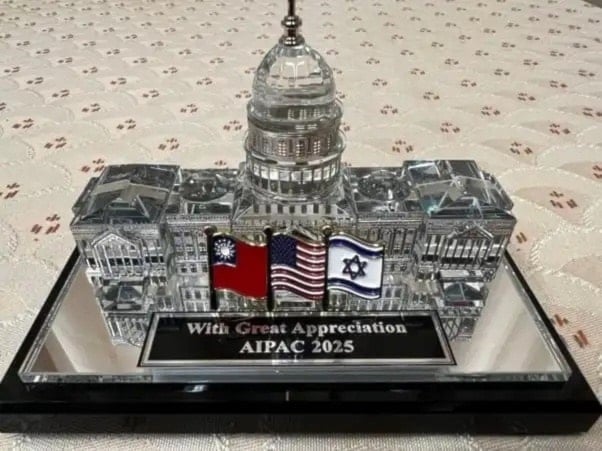
Reuters reports that “Taiwan has been a strong backer of Israel” since the launch of Al-Aqsa Flood, though “Israel, like most countries, has no formal diplomatic relations with Taipei.”
The president went on to say that “Taiwan is one of the very few countries that holds International Holocaust Remembrance Day events each year”.
Taiwan is a geopolitical anomaly, formerly known as Formosa in colonial times. It should obviously be part of China. However, it was the last bolthole of the counter-revolutionaries of the Kuomintang under Chiang Kai-shek after they were defeated by the Chinese revolution in 1949. They set up a statelet and grandly called it the Republic of China. They then declared martial law, which was only lifted in 1987.
Since then, there has been the much vaunted economic miracle in Taiwan, which has been accomplished under the tutelage of US financial and military aid, labour exploitation and dependent capitalist development, shaped by and serving the interests of global imperial powers and a local exploiting class.
Now, with the emergent Zionist empire – Pax Judaica – we can see the expansion of Zionist influence and involvement in countries as far away from West Asia, as Taiwan.
In his comments, President Lai Ching-te emphasised the ambition to “deepen collaboration in such fields as semiconductors, ICT, and cybersecurity.” He also said it is “very willing to enhance cooperation with Israel under President Trump’s AI Action Plan.” This was launched by Trump in January, where he was flanked by two Zionist billionaires, Larry Ellison of Oracle and Sam Altman of OpenAI. Ellison is, of course, central to the Trump Gaza plan, which intended to smash the Palestinian Resistance and also to win the so called ‘8th front’ information war being waged by the Zionist entity in part via Ellison’s takeover of TikTok, CBS and potentially CNN.
Taiwan is another node in the emergence of Pax Judaica. However, Zionist movement infiltration in Taiwan is relatively recent.
The genocidal Haredi cult, Chabad, first sent Shluchim (or emissaries) to the Island in 2011. Their base is called the Taipei Jewish Center, which provides one of the two Synagogues on the island. Chabad also has a presence in China (including Hong Kong) with more than 10 offices in Beijing, Shanghai, and other places.
According to Chabad, there are 1,500-2,000 Jews in Taiwan of a total population of 24 million, less than 0.001%.
In the 1970s, there were around 50 families of mainly Russian Jews. But it is reported that the community declined to a total of “no more than 150” people around 2007.
Chabad has also been involved in the creation of a new center called the Jeffrey D. Schwartz Jewish Community Center, costing some $16 million. It is named for its main benefactor, who is an American Zionist who has been living in Taiwan since the 1970s. Schwartz was instrumental in the recent AIPAC delegation to the island and was publically thanked by the Taiwanese President for his help.
Schwartz is also a supervisor at the other Synagogue in Taiwan, known as Congregation Lev HaMizrach. It is a Zionist Synagogue and offers up solidarity for the Zionist colony and prayers for the genocidal occupation forces
In 2024, the Synagogue sent a delegation to the BBYO Asia Pacific Conference. BBYO, the Bnai B’rith Youth Organisation, is one of the largest global Zionist youth groups, affiliated to the World Zionist Organisation, which functions to radicalise Jewish youth for genocide.
There is also a Taiwan-Israel Congressional Association, which fosters collaboration with the Knesset and oversees parliamentary delegations and exchanges. In July, for example, a total of 72 Knesset members from coalition and opposition parties signed a joint statement “condemning Taiwan’s exclusion from international forums as ‘unjustified and irresponsible.’”
The Zionist colony is unable to have full diplomatic relations with Taiwan because of its relations with China.
However, it maintains the Israel Economic and Cultural Office in Taipei. Its representative, Maya Yaron, was involved in planning the AIPAC delegation meeting in October.
Also, because of this, much of the interaction between the Settler colony and Taiwan is covert or secret. What is known is that Taiwan secretly bought Israeli missiles in the 1970s.
However, direct arms sales to Taiwan ceased around 1992 as “Israel” established formal diplomatic relations with the People’s Republic of China.
Today at least eight Taiwanese companies are involved in supplying components for drones and armaments to “Israeli” arms firms, including Elbit, Rafael, and IAI.
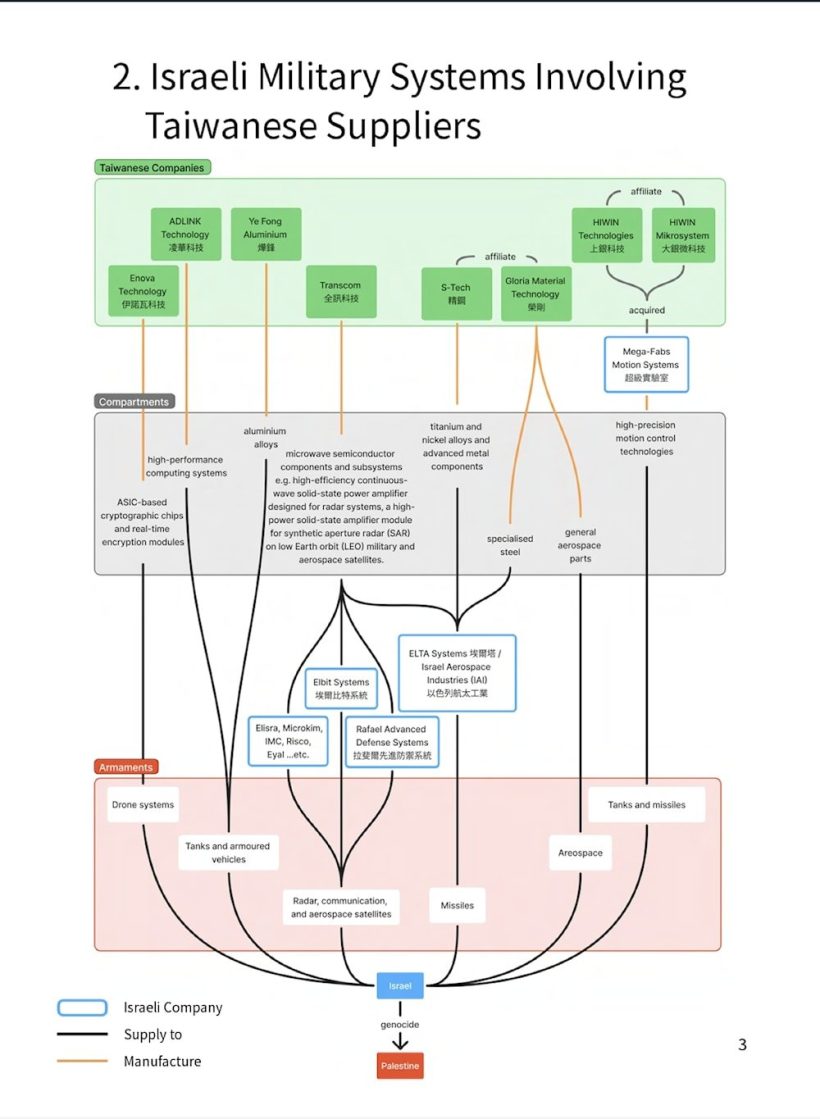
And significant numbers of Israeli firms are active in Taiwan, including in the area of tech firms and cybersecurity, which has a strong Zionist intelligence component.
In addition, the Zionist regime appears to be giving Taiwan a “helping hand” with the development of its own so called “Iron Dome”. Most notably, it is now clear that Taiwan played a role in supply chains for the Zionist pager attacks in Lebanon in 2024.
In July this year, Taiwan became the first foreign government to provide funding for a medical center in an illegal Israeli settlement in the occupied West Bank.
Taiwan is fully on board with the genocide of the Palestinians and the push for a “Greater Israel”. And the Zionist regime is penetrating more deeply in Taiwan than before, as it is in very many places in South and East Asia.
Washington’s pro-Israeli think tanks drumming up excuses for new Iran war
By Robert Inlakesh | Al Mayadeen | November 12, 2025
Since the conclusion of the Iranian-Israeli war this June, pro-war think tanks responsible for influencing US government policy have been signalling the need for a second round of attacks against Iran and its nuclear program. Now they are picking up the heat.
Despite the boisterous and triumphant remarks coming from officials within the Trump administration, confidently claiming the complete destruction of Iranian nuclear facilities, behind the scenes Washington’s key think tanks appear to uphold a consensus view that the job is not done.
Think tank panels, analysis, and policy recommendations for the US government’s next steps towards Iran have centred around the understanding that, short of an agreement which spells Iran’s declaration of regional defeat, another round of direct warfare will eventually be necessary. Yet, they often caveat this with the disclaimer that the next round must close the conflict for a long time and not drag things out until another round occurs.
In the interim period between wars, the role of these think tanks is crucial to shaping Washington’s understanding of the tasks at hand. Although by nature, what they are saying is always going to be propagandistic and pursuing a specific agenda; segments of their analyses and certain statements from conference panelists are far more useful than most stories published about Iran in the corporate media. If you pay attention to these think tanks, reading between the lines, it makes the logic behind US and Israeli policy make more sense.
On November 5, Kenneth M. Pollack and Reuel Marc Gerecht recently spoke at a panel hosted by the Washington-based pro-“Israel” Foundation for the Defense of Democracies (FDD) think tank, where they addressed the issue of linking US lessons from Iraq, in the post-Gulf War setting, to Iran after the 12-day war.
A few takeaways here were that while regime change should be a target, they also commented on the differences in confronting Iran, drawing key distinctions between Iranian leader Ayatollah Khamenei and former Iraqi President Saddam Hussein. Gerecht, a resident FDD scholar, makes it clear that Khamenei’s strategic thinking is much more complex, intelligent, and hence difficult to deal with.
Instead of advocating a repeat of the invasion of Iraq, they focus on strategies to weaken and isolate the Islamic Republic, including the aggressive pursuit of disarming Hezbollah in Lebanon and getting heavily involved in Iraq through the upcoming election cycle.
A policy brief published by the FDD on November 7 specifically looks at the potential opportunities for the United States inside Iraq, framing the election as an influence battle between Tehran and Washington. It is clear that the ultimate goal is to pursue the disarmament of the Hashd al-Shaabi.
Interestingly, despite the propaganda often produced for think tanks like the Heritage Foundation, depicting the Islamic Republic as being at the brink of collapse and that the Iranian public will play a key role in this, the FDD’s Gerecht paints a starkly different picture. It appears as if his calculation is built on the assumption that the anti-government Iranian diaspora are not to be relied upon to achieve regime change.
Gerecht also labels the son of the deposed Iranian dictator, Shah Reza Pahlavi, “Baby Shah”, as neither of the panelists appear to put great faith in the pro-regime change Iranian opposition, expressing the frustrations that often come along with working with them.
Meanwhile, the Washington Institute for Near East Policy (WINEP) has argued that Iran must be confronted over its growing confidence following the June war with “Israel”. The policy analysis entitled “Iran’s Self-Confidence Returns?” lays out the argument that Tehran’s ballistic missile program appears to be the backbone of its defense strategy over that of using its allies.
This article centres around the public statements of Khamenei and the post-war assessments offered by senior Iranian officials, in addition to factoring in the strength and rebuilding process of Tehran’s ballistic missile program.
Without openly stating it, the WINEP piece appears to be getting at the idea that Iran must again be militarily punished due to its growing confidence and that a political deal, which Donald Trump voices interest in, is not a possibility. Overall, the piece makes a number of mistakes in its framing of Iranian confidence over the months, but also is a sober enough analysis to admit that Iran managed to land significant and damaging blows against the Israelis.
It is clear that the Israelis are currently in a difficult spot when it comes to carrying out a new series of attacks against Iran, and this comes down to the number of potential cards that Tehran has to play. This is especially the case in the event that the conflict expands and becomes regional.
Therefore, at least outwardly, the Israelis themselves appeared poised to target Lebanon next, an attempt to weaken the Lebanese Resistance significantly and thus isolate Iran in the event of a future prolonged confrontation.
Meanwhile, think tanks based in Washington are busy forging arguments as to why the United States must get involved in any future Israeli-Iranian war, understanding that this is necessary for “Tel Aviv” to achieve any kind of victory against an enemy that is too powerful for it to deal with alone.
Universities in West are “occupied by Zionist/Jewish supremacist lobby groups,” repress speech against genocide
By Syed Zafar Mehdi | Press TV | November 11, 2025
Over the last two years, universities across the West have gone out of their way to repress speech against the ongoing genocide in Gaza and against Zionism, says a university lecturer who was forced to leave his university due to a Zionist witch-hunt.
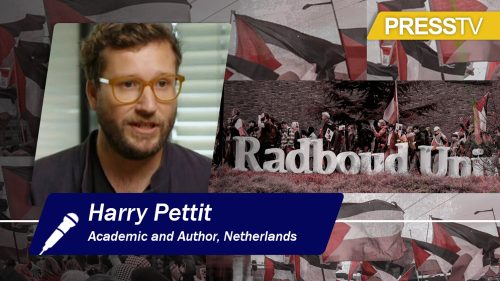
In an interview with the Press TV website, Harry Pettit, the former Assistant Professor of Human Geography at Radboud University, the Netherlands, said any speech in support of the Palestinian resistance has been criminalized in Western academic circles.
Pettit, who holds a PhD from the London School of Economics and Political Science and is the author of The Labor of Hope: Meritocracy and Precarity in Egypt (2023), has been hounded at his university over his strong advocacy for Palestinian rights.
His social media posts, in which he unequivocally condemned the genocide in Gaza and the complicity of Western governments, sparked controversy as Zionist lobby groups in the Netherlands campaigned for his ouster from Radboud University.
In a statement on Monday, Pettit said the university had monitored his X account and he was pressured to retract his statements on Palestine.
He was even warned by the university administration and threatened with dismissal at the behest of influential Zionist lobby groups such as the Center for Information and Documentation on Israel (CIDI), the Netherlands Committee for Israel and the Jewish People (NCAB), as well as media outlets like De Telegraaf and Education Minister Gouke Moes.
“Over the last two years, universities across the West have gone out of their way to repress speech against the genocide, against Zionism, and in support of the Palestinian resistance,” Pettit told the Press TV website only hours after announcing he was leaving the university.
“They have done this because they are occupied by Zionist/Jewish supremacist lobby groups that want to shut down any critique of ‘Israel’. We have no choice but to fight back against this.”
He said the pro-Israel lobby is powerful in the Netherlands, which is evidenced by the data.
“If you look at data, the Netherlands has by far the biggest economic relationship with Israel in the whole of Europe. Therefore, there is a big incentive to squash critique,” he noted.
“CIDI is the main lobby group and it acts in similar ways to other countries, targeting individuals who speak out and trying to destroy their livelihoods. It also has links to political parties, the media, and student groups like Standwithus, and together they apply pressure on universities.”
Pettit, however, was not alone in this fight. He received tremendous support from his colleagues and students, who defended his freedom of speech.
“I have received a lot of support from colleagues and students who have also been taking risks to speak out against the genocide and Zionism, and the students have been incredible at engaging in disruptive protest over the last two years that has forced the university to cut ties with Israeli universities,” he told the Press TV website.
Unfazed by the threats, he vowed to continue speaking for the Palestinian cause and against the ongoing genocide in the Gaza Strip.
“I have every intention of continuing to use my platform to advocate for Palestinian liberation. That is why I left Radboud to go to a more supportive environment that enables me to keep doing that,” he asserted.
Pettit had been vocal not only on his own social media handles but also had been giving media interviews to raise awareness about the plight of Palestinians.
In one of his interviews in October, he told Volkskrant that he wants to raise awareness in the Netherlands that Palestinians “as an oppressed people have the right to armed resistance.”
“Calling October 7th a legitimate resistance operation doesn’t mean I condone everything that happened that day. But Israel wants us to see Hamas as barbarians who hate Jews. That’s a racist frame that serves to legitimize the genocide. It also obscures decades of oppression,” he said at the time.
His defense of the Palestinian resistance and the historic Operation Al-Aqsa Storm on October 7, 2023, irked Zionist lobby groups that aggressively pushed for his ouster.
Amid the genocide in Gaza, students in many universities across Europe and the US have been suspended and even arrested at the behest of Zionist lobby groups.
Out of 270 journalists, ‘Israel’ killed 44 in Gaza displacement tents
Al Mayadeen | November 10, 2025
44 Palestinian journalists were killed inside displacement tents in the Gaza Strip, out of more than 270 media workers slain by Israeli occupation forces since October 2023.
According to a new report by the Freedoms Committee of the Palestinian Journalists Syndicate, many of the journalists were sheltering near hospitals and United Nations-run facilities when occupation forces launched airstrikes or opened sniper fire directly at displacement tents.
The report pointed to the systematic campaign targeting Gaza’s media infrastructure, citing the destruction of news offices and the deliberate killing of journalists in their homes, workplaces, and temporary shelters.
Deliberate targeting and legal violations
The Syndicate stressed that targeting journalists constitutes a war crime under Article 79 of the First Additional Protocol to the Geneva Conventions, which guarantees civilian protection to media workers. It further noted that attacks on displacement tents near hospitals and schools represent a serious breach of the protections granted to humanitarian zones.
Investigators confirmed that no military activity was detected in or around the targeted tents, refuting Israeli claims of accidental strikes. The group argued that the use of precision weaponry in densely populated civilian zones “reflects a calculated intent not only to cause death, but to silence witnesses and obstruct documentation of events.”
Call for international accountability
The Palestinian Journalists’ Syndicate urged the formation of an independent international commission to investigate the targeting of journalists and called for the activation of International Criminal Court mechanisms to pursue accountability for war crimes.
It also appealed for cooperation with UNESCO and the International Federation of Journalists to establish safe corridors and protected zones for displaced media workers, while maintaining a comprehensive legal archive to support future judicial proceedings.
Previous incidents
Earlier in August, six journalists, including Al Jazeera’s correspondent Anas al-Sharif, were killed when an Israeli airstrike targeted a tent sheltering reporters outside the main gate of Gaza City’s al-Shifa Hospital. The deliberate attack, which targeted al-Sharif, drew international condemnation and renewed calls for investigations into “Israel’s” criminal action.
The Syndicate’s latest report adds to growing evidence from press freedom organizations, including the Committee to Protect Journalists (CPJ) and Reporters Without Borders (RWB), that “Israel’s” war on Gaza has become the deadliest conflict for journalists in modern history, raising urgent alarms about systematic violations of international humanitarian law.
Israeli soldiers recount indiscriminate killing of Palestinian civilians in Gaza
The Cradle | November 10, 2025
In a new documentary film, Israeli soldiers have described a “free-for-all” in Gaza, in which they killed civilians “without restraint” with the encouragement of politicians and rabbis, The Guardian reported on 10 November.
“If you want to shoot without restraint, you can,” stated Daniel, the commander of an Israeli tank unit.
He and other soldiers gave testimony about killings they perpetrated during combat tours in Gaza for the film ‘Breaking Ranks: Inside Israel’s War,’ which will be broadcast in the UK on ITV on Monday night.
The soldiers who agreed to talk confirmed they routinely used Palestinians as human shields and opened fire unprovoked on civilians seeking aid at militarized distribution points set up by the US-Israeli-backed Gaza Humanitarian Foundation (GHF).
Captain Yotam Vilk, an Israeli armored corps officer, said that in basic training, they were taught to only fire at a target that has the means, shows intent, and has the ability to cause harm.
But in Gaza, “there’s no such thing as ‘means, intent and ability,’” Vilk stated in the film.
“No soldier ever mentions ‘means, intent, and ability.’ It’s just a suspicion of walking where it’s not allowed. A man aged between 20 and 40,” he explained.
Another soldier, identified in the film as Eli, says individual commanders had the freedom to determine who was killed and who was allowed to remain alive.
“Life and death aren’t determined by procedures or opening fire regulations. It’s the conscience of the commander on the ground that decides,” Eli said.
“If they’re walking too fast, they’re suspicious. If they’re walking too slow, they’re suspicious. They’re plotting something. If three men are walking and one of them lags behind, it’s a two-to-one infantry formation – it’s a military formation,” he added.
Eli describes an incident in which a senior officer ordered a tank to destroy a residential building, crushing civilians to death inside, because a man was hanging laundry on the roof.
“The officer decided that he was a spotter. He’s not a spotter. He’s hanging his laundry. You can see that he’s hanging laundry,” he said.
“Now, it’s not as if this man had binoculars or weapons. The closest military force was 600–700 meters away. So, unless he had eagle eyes, how could he possibly be a spotter? And the tank fired a shell. The building half collapsed. And the result was many dead and wounded.”
The Guardian notes that according to the Israeli military’s own intelligence data, 83 percent of those killed in Gaza were civilians, a historic high for modern conflicts. More than 69,000 Palestinians have been killed since the war started, according to the Gaza Health Ministry, with tens of thousands more likely not counted as they remain buried under the rubble of destroyed buildings.
The Israeli military publicly claims its forces seek to protect civilians. However, some of the soldiers interviewed for the film said they were influenced by genocidal language used by Israeli politicians and religious leaders who claimed that no Palestinians in Gaza were innocent after the Hamas attack of 7 October 2023.
For example, a UN commission pointed to comments made by Israeli President Isaac Herzog, who claimed after 7 October that, “It is an entire nation out there that is responsible. It is not true, this rhetoric about civilians not aware, not involved, it’s absolutely not true.”
Roughly 1,200 Israelis and foreign nationals were killed in the Hamas attack. Israel blamed all these deaths on Hamas; however, the military itself killed hundreds with attack helicopters, drones, and tanks, per a special order known as the Hannibal Directive.
The order was given for Israeli pilots to fire on their own civilians to prevent them from being taken to Gaza as captives that Hamas could use to liberate Palestinians in a prisoner exchange.
Israeli Prime Minister Benjamin Netanyahu publicly referred to Palestinians in Gaza as “Amalek,” citing a story from Jewish scripture in which the Hebrews were ordered to exterminate the entire Amalekite nation, killing every man, woman, and child – even babies.
Daniel, the tank unit commander, said that this type of rhetoric influenced the behavior of soldiers in his unit. “You hear that all the time, so you start to believe it,” he stated.
Jewish rabbis in the Israeli army also advised soldiers to exterminate Palestinians in Gaza.
“One time, the brigade rabbi sat down next to me and spent half an hour explaining why we must be just like they were on 7 October. That we must take revenge on all of them, including civilians. That we shouldn’t discriminate, and that this is the only way,” said Major Neta Caspin.
Rabbi Avraham Zarbiv, who participated with his unit in the genocide in Gaza, stated in the film that, “Everything there is one big terrorist infrastructure.”
Zarbiv personally drove military bulldozers and boasted about destroying Gaza, stating that the army spent “hundreds of thousands of shekels to destroy the Gaza Strip. We changed the conduct of an entire army.”
The soldiers speaking in Breaking Ranks also confirmed their use of Palestinians as human shields, known as “Mosquitos,” to clear tunnels and homes where booby traps may be present. That way, a Palestinian would be killed rather than an Israeli soldier.
“You send the human shield underground. As he walks down the tunnel, he maps it all for you. He has an iPhone in his vest, and as he walks, it sends back GPS information,” said Daniel, the tank commander.
“The commanders saw how it works. And the practice spread like wildfire. After about a week, every company was operating its own mosquito.”
A private contractor, identified as Sam, confirmed that Israeli soldiers opened fire on and killed unarmed civilians seeking food at GHF distribution sites.
He described witnessing Israeli soldiers murder two Palestinian men.
“You could just see two soldiers run after them. They drop onto their knees, and they just take two shots, and you could just see … two heads snap backwards and just drop,” Sam explained.
In another case, he saw a tank destroy “a normal car … just four normal people sat inside it.”
At least 1,889 Palestinian civilians were killed by Israeli soldiers while seeking food in Gaza between 27 May and 18 August 2025, according to UN figures.
Israel demands Lebanese army raid civilian homes in south: Report

Smoke and debris rise after an Israeli airstrike on the southern Lebanese village of Teir Debba on Thursday
The Cradle | November 10, 2025
Israel is pressing for the Lebanese Armed Forces (LAF) to launch raids into civilian homes in south Lebanon in search of weapons belonging to Hezbollah, Lebanese sources told Reuters on 10 November.
The report coincided with new drone strikes on southern Lebanon, and came hours after an Israeli army force raided near the Lebanese town of Hula and blew up two homes.
“Israel is pressing Lebanon’s army to be more aggressive in disarming … Hezbollah by searching private homes in the south for weaponry,” three Lebanese security sources said.
The demand “has been rejected” by the LAF, the sources added. Army leadership fears such a move could trigger civil strife and derail its overall disarmament plan, which the Lebanese military views as “cautious but effective.”
Israel requested these “raids” indirectly in October via the ceasefire mechanism, which includes Washington, Tel Aviv, Beirut, Paris, and the UNIFIL.
The request was followed by an increase in Israeli attacks and ground operations in the south, where Israeli forces have established an occupation in violation of the ceasefire deal.
The escalation was seen “as a clear warning that failure to search more intrusively could prompt a new full-blown Israeli military campaign,” the sources went on to say.
“They’re demanding that we do house-to-house searches, and we won’t do that … we aren’t going to do things their way,” one of the officials told Reuters. “Residents of the south will see house raids as subservience to Israel.”
Since the start of the year, the Lebanese army has been dismantling Hezbollah infrastructure and confiscating arms south of the Litani River in line with the ceasefire deal reached in November 2024.
But Israel is accusing Lebanon of “dragging its feet,” and says Hezbollah is rearming faster than the Lebanese army is dismantling.
The US is pressuring Lebanon to establish direct channels of communication with Israel, a violation of the country’s own laws.
Washington has also threatened Lebanon with a new Israeli war if Hezbollah is not disarmed immediately.
The resistance says it would eventually be willing to discuss incorporating its arms into the Lebanese military as part of a defensive strategy that would keep the weapons available for use if Lebanon is attacked.
However, it rejects any discussion of the matter while Israel continues to attack Lebanon and occupy several areas along the southern border.
The Reuters report on Monday coincided with new Israeli attacks.
An Israeli drone strike targeted the outskirts of the town of Hmayri in the Tyre district in south Lebanon.
Earlier, an Israeli drone strike on a vehicle in Bisariyeh, on the Sidon–Tyre highway, claimed the life of Lebanese citizen Samir Faqih.
The night before, Israeli troops raided an area near the southern Lebanese town of Hula, rigging and detonating two homes.
“Israeli soldiers entered the Subeih hill in northeast Hula (south Lebanon), planted explosives in two homes, and detonated them. The hill is near a Lebanese army checkpoint, where several soldiers stand with one or two vehicles,” Lebanese journalist Khalil Nasrallah wrote.
“It is the only checkpoint. The army personnel are not to be blamed under any circumstances. Believe me, those who know the area know what I mean. The army personnel are not weak, and their blood is not cheap to us, but precious. The blame lies with those who gave the army orders to confront without reinforcing it and strengthening its presence in many sensitive areas near the border,” he added.
Over 40 Lebanese people have been killed by Israel in the past month and a half. Tel Aviv has vowed to continue escalating.
How Cyprus became first European partner in ‘Israel’s’ gas theft crime
Al Mayadeen | November 9, 2025
British energy company Energean, which operates natural gas reservoirs of Karish, Tanin, and Katlan in the occupied Palestinian territories in favor of “Israel”, is preparing to build a $400 million pipeline to transport natural gas from an offshore rig in disputed Palestinian waters to Cyprus.
According to media reports, the project requires only governmental approval, with Cypriot energy company Cyfield having already endorsed the initiative. If finalized, Cyprus would become the first European nation to import gas from Israeli-occupied maritime territory, raising questions about the project’s legality and its breach of the Boycott, Divestment, and Sanctions (BDS) campaign and international law.
Critics argue that the pipeline reinforces “Israel’s” control over resources in occupied waters while providing financial and strategic benefits to both “Israel” and its corporate partners.
“Our proposal offers a practical and efficient solution to reduce Cyprus’s energy isolation by providing direct access to natural gas from a neighbouring source, thereby enhancing regional energy cooperation and supporting the transition to cleaner, more sustainable energy,” said Energean CEO Mathias Rigas.
Not first case of complicity
This isn’t the first example of Britain and Cyprus working together in support of Israeli operations. During the ongoing genocide in Gaza, the UK has reportedly used territory it still controls in Cyprus to launch surveillance missions that aid “Israel” in gathering intelligence over the Strip.
RAF Akrotiri has served as the main base for these flights, and in some periods over the past two years, Britain has conducted more such missions than “Israel” itself. This level of coordination goes beyond mere complicity; it reflects direct involvement.
DropSite News even cited senior British military sources confirming that Israeli F-35 jets are capable of receiving “technical assistance” at the RAF Akrotiri base in Cyprus.
‘Israel’-Cyprus energy axis: Pipeline plans, historical controversies
“Israel’s” betrothal with Cyprus is not a recent development. Zionist thinkers, including Theodore Herzl, historically regarded the island as a potential site for settlement and strategic influence. Ancient Hebrew communities were cited as historical precedents justifying a long-term presence beyond Palestine.
At the turn of the 20th century, the Jewish Colonization Association established settlements in Cyprus for Jews fleeing Russia. While small, these colonies set a precedent for expansionist ambitions, often disregarding local populations’ rights.
While Cyprus historically aligned with Palestinian solidarity, hosting refugees and resisting Israeli encroachment, relations with “Israel” have warmed over the past 15 years, driven by energy and strategic interests. Critics argue that modern Israeli projects on the island, including property acquisitions and intelligence operations, reflect a continuation of expansionist policies that undermine Palestinian rights and international law.
Cyprus ‘is no longer ours’
This recent sharp rise in Israeli real estate acquisitions across Cyprus has sparked growing concern over national sovereignty and affordability, with political debate intensifying after a recent congress by AKEL, Cyprus’ second-largest party, where criticism of the purchases was quickly met with accusations of antisemitism, a familiar Israeli tactic to silence legitimate scrutiny.
In July 2025, Party leader Stefanos Stefanou warned of what he called a growing “national security threat,” citing Israeli land purchases near sensitive sites and highlighting a coordinated effort, led by the buyers, to establish closed communities, Zionist schools, and influence over key economic sectors.
“If we don’t take effective action now, one day we’ll find that this country is no longer ours,” he stressed, urging government intervention.
Stefanou rejected claims of xenophobia following his reference to historical parallels with how Israelis settled the land of Palestine after occupying its territories. This instantly drew backlash, with critics waving the antisemitic card, again, though supporters argue his comments reflected concerns over sovereignty, not ethnicity, and were aimed at highlighting patterns of unregulated land acquisition.
Media reports further suggest Israeli property investments in Cyprus, often in high-end “gated communities” and Mossad safehouse operations, raise ethical and legal questions.
Viral clips of ‘promised land’ dissected
At the time, one viral clip shows a man impersonating an ultra-Orthodox Jew, declaring in Hebrew: “God promised us Cyprus after Israel,” while saying that Israelis are buying up property “non-stop”. Another shows him replying to a question about “stealing homes” with the line: “If we don’t steal them, someone else will,” as Hava Nagila plays in the background. A third video features the same character in a prayer shawl, stating, “Cyprus was promised to us 3,500 years ago; finally, I’m home.”
The statements in the viral Cyprus videos mirror patterns seen in occupied Palestine, where some settlers justify taking land and homes through historical or religious claims, often framing settlement expansion as a competitive or preemptive act, and invoking biblical or ancestral narratives to legitimize their presence on Palestinian territory.
Moreover, these posts tap into a growing online grievance that Israeli investors are driving up real estate prices and displacing locals, with one widely shared claim asserting, “Cypriots can’t afford homes for themselves or their children anymore. The Israelis are buying everything.”
Official statistics count about 2,500 Israelis in Cyprus, though many enter using European passports, making true figures difficult to track. Some estimates suggest the number could be as high as 15,000, with many purchasing property reportedly for investment purposes rather than residence, as per Israeli media.
Strategic, defense cooperation
“Israel” and Cyprus have significantly deepened their strategic and military cooperation, often in close alignment with Greece. This trilateral partnership has included joint military exercises, intelligence-sharing, and advanced interoperability programs, positioning Cyprus as a key player in regional security coordination. Notably, Cyprus has hosted multiple training sessions centered on maritime security, urban warfare, and “counter-terrorism”, frequently involving Israeli occupation forces.
Media reports have pointed to specific acquisitions by the Cypriot military, including Israeli-made air-defense systems and Tavor assault rifles, further signaling an expanding defense relationship.
The trilateral partnership, reinforced by US engagement, underscores “Israel’s” intent to consolidate influence in the Eastern Mediterranean, creating a corridor of strategic depth extending from Cyprus to its Mediterranean borders.
Energy projects, economic ties
Offshore gas discoveries have made energy cooperation a central feature of “Israel”–Cyprus relations. These resources are seemingly recognized as strategically important for regional security and international markets.
Last week, Israeli Energy and Infrastructure Minister Eli Cohen emphasized the strategic importance of such projects. “Selling gas to Cyprus will strengthen Israel’s diplomatic standing in the region and among European countries, contribute to greater stability and prosperity in our area, and generate billions of shekels in revenue for the state. I intend to continue advancing the expansion of Israeli gas export targets,” he said.
The Energean pipeline, which would link the Karish gas field to Cyprus, sits within contested maritime territory, once a subject of disputes between “Israel” and Lebanon. However, an agreement brokered by the United States in 2022 resolved the dispute, with “Israel” gaining rights to Karish and Lebanon’s rights to the nearby Qana field being recognized.
Accepting the state’s deal, especially after long declining to directly participate in any negotiations between Lebanon and “Israel” regarding the maritime border demarcation issue, Hezbollah, protecting Lebanon’s oil rights and expecting foul play from “Israel”, announced that it would target energy fields if Lebanon was prevented from extracting gas. It expressed readiness to intervene the minute “Israel” violated the agreement.
Gas theft from disputed fields ongoing
Natural gas began flowing from the Karish North field on February 22, 2024, roughly sixty miles off the northern coast of occupied Palestine, to the Energean Power, a massive floating production and storage vessel (FPSO) operated by Energean. The gas is processed onboard before being piped ashore near Haifa, while gas liquids, essentially oil, are stored for export to international markets. This operation allows “Israel” to exploit resources from disputed maritime areas, further consolidating control over offshore energy fields at Lebanon’s expense.
The Karish and Karish North fields, though smaller than the Leviathan and Tamar fields, are being used strategically to secure “Israel’s” energy supply, including during the genocide in Gaza when production from Tamar stalled.
Corporate involvement, controversy
Critics argue that companies such as Energean and British BP p.l.c. play a role in sustaining “Israel’s” occupation. Energean has partnered with “Israel” since 2012 on projects including the Tanin Field and Karish facility. BP has expanded exploration in Palestinian maritime zones, which critics say are illegally exploited.
In July 2025, Francesca Albanese described such corporate involvement as part of the “economy of genocide,” insisting that there were firms and people “that have profited from the violence, the killing, the maiming, the destruction in Gaza and other parts of the occupied Palestinian territory”.
“One people enriched, one people erased,” she said.
“Clearly, for some, genocide is profitable,” Albanese declared.
Regional geopolitics
“Israel’s” energy and strategic projects have broader regional implications. Agreements to supply gas to Egypt and Cyprus not only generate revenue but also consolidate “Israel’s” influence in neighboring countries with weak economies.
Palestinian authorities and rights groups maintain that Israeli energy projects in disputed waters violate Gaza’s maritime zones, underscoring the intersection of strategic, economic, and human rights concerns. The Eastern Mediterranean is a seemingly complex legal and political landscape, but specific legal challenges to projects such as the Energean pipeline remain largely documented by NGOs and media outlets.
Looking ahead
The “Israel”–Cyprus axis is set to deepen, encompassing defense, energy, and economic cooperation.
For Palestinians and Lebanese, these developments are more than geopolitical maneuvering; they reflect the ongoing dispossession and resource exploitation inherent in “Israel’s” occupation.
The Energean pipeline, along with the corporate and governmental actors enabling it, exemplifies the broader challenges to Palestinian and Lebanese sovereignty in the Eastern Mediterranean.
Featured Video

Bombing Hitler’s Hometown
or go to
Aletho News Archives – Video-Images
From the Archives
The Biggest Threat to Peace in Middle East
By Dr. Elias Akleh* | Sabbah Report | May 24, 2010
A build up of heightened tension in the Middle East is escalating in the last few weeks. American and Israeli postures towards Lebanon, Syria, and Iran have become more threatening. Listening to speeches of political leaders one hears talks only about war not peace. Iranians and Israelis are continuously training hard for a possible showdown. Both sides are conducting extensive war games every month. This led Syrians to claim that Israel is preparing for a soon-to-come another war. The Jordanians also are warning that current stalemate of the peace process is an indication of a war breaking out this summer. The Russian President and his army chief hinted, a few months ago, that the US and Israel were planning for an attack on Iran.
Indeed Iran is, as it has been for last few years, the target of most of the threats and accusations of supporting terrorism. Escalating incitement against Iran the American Defense Department sent last month (April) to Congress a report on Iran’s military claiming Iran could develop intercontinental ballistic missiles capable of reaching the US by 2015.
Ignoring the fact that N. Korea, India, Pakistan, and Israel are proven to have nuclear weapons while Iran does not, the US Secretary of State Hillary Clinton chose in her speech, to the nuclear Non-Proliferation Treaty review conference at the UN, to focus on Iran’s alleged nuclear ambitions putting the whole world at risk as she put it. According to Clinton Iran’s acquisition of nuclear weapons, rather than Israel’s more than 200 nuclear bombs, is destabilizing the Middle East. She called on the world’s nations to rally around US efforts to hold Iran, not other nuclear countries, to account.
The accusation that Usama Bin Laden is living comfortably in Iran had received a boost after the broadcast of a documentary called “Feathered Cocaine”. This echoed the June 2003 claims of the Italian newspaper Corre de la Sierra that Bin Laden was in Iran according to some intelligence report, and according to Richard Miniter’s book “Shadow War”. … continue
Blog Roll
 Aletho News
- Bombing Hitler’s Hometown
- German journalist threatened with homelessness as German court upholds EU sanctions in landmark free speech case
- US Tells Allies That Ukraine-Bound Arms Could be Sent to Middle East
- Organized terrorism: Iran condemns killing of its diplomats in Lebanon
- Why could Gaza enter the regional war?
- Hamas official rejects Mladenov Plan linking disarmament to Gaza reconstruction
- Two Primary Elections for the Soul of ‘America First’
- Japan Clings to US Vassalage Despite Energy Crunch Caused By Iran War
- US Seeks Control Over Global Energy Infrastructure – Kremlin
- US senators target Orban government for standing up to Zelensky
- If Americans Knew
- Researchers at Human Rights Watch Resign Over Blocked Report on Palestinian Refugee Return
- Jewish Groups Are Backing a War Americans Don’t Want
- Eric Fingerhut Thinks He’s the President of the Jews
- Top Jewish Philanthropists, Rabbis Urge Israeli President to Take Action Against ‘Jewish Extremists’
- Don’t Be Fooled. Zionist Leaders Have Always Wanted to Control Southern Lebanon
- Israel’s widespread use of torture is a core element of its genocide against the Palestinian people
- In Israel’s War on Iran, Many Middle East US Bases Rendered “All But Uninhabitable”
- ‘Burn the lawn’: Israel pursues ‘Rafah model’ in southern Lebanon
- A genocide here, an amputation there
- Reports: Iran mobilizing 1M fighters, Israel-US run low on ammo, Israeli army faces shortage – Not a ceasefire Day 168
- No Tricks Zone
- Devastating Assessment Of Comirnaty Vaccine By Former Senior Pfizer Europe Toxicologist
- New Study: CO2 Is ‘Effectively Negligible’ As An Explanatory Climate Change Factor Since 2000
- Former Pfizer Toxicologist Dr. Helmut Sterz Tells Bundestag Hearing Pfizer Vaccine Should Have Never Been Approved
- Energy Expert: Germany’s Nuclear Phaseout Was A “500 Billion Euro Mistake”
- New Research: South Australia’s Mid-Holocene Sea Surface Temperatures Were 4°C Warmer Than Today
- Storing Green Energy To Last Germany 10 Days Would Require A 60-Million Tonne Battery
- New Studies: UK Sea Levels Were 4 Meters Higher Than Today During The Mid-Holocene
- Destructive Green New Deal: German Energy And Metal Group Warns Of Drastic Crisis
- New Study Documents A 20-Year Pause In Arctic Sea Ice Decline – Driven By Internal Variability
- Wake-up Call: Survey Shows Majority Of Germans Now Favor Postponing Climate Targets!
 Aletho News