Corporate Media Go All Out To Support The US-Israeli War on Iran
By Alan MacLeod | MintPress News | March 6, 2026
Corporate media of all stripes have rushed to support the U.S./Israeli attack on Iran, throwing objectivity and accuracy by the wayside in order to manufacture consent for regime change.
On February 28, the U.S. and Israel launched a joint attack on Iran, bombing cities across the country, assassinating its supreme leader, Ali Khamenei, and openly stating their goal was overthrowing the government.
Despite this, media have gone out of their way to present the actions as the U.S. protecting itself, describing them as “defensive strikes,” and to frame Iran as the aggressor. “Iran chooses chaos” ran the headline of the New York Times’ newsletter, portraying the Islamic Republic as the primary actor.
The Free Press used similarly Orwellian concepts. “War is Iranians’ best chance at peace,” presenting U.S./Israeli crimes as an act of mercy on its long-suffering population.
Meanwhile, under the new leadership of self-described “Zionist fanatic” Bari Weiss, CBS News has transformed itself into a mouthpiece for the Israeli Defense Forces, interviewing IDF Brigadier General Effie Defrin, and uncritically presenting Israel’s war as “aimed at preventing a wider global threat.”
Across the West, corporate media have employed the same tactics of using the passive voice and not naming the perpetrator when describing U.S./Israeli aggression. A perfect encapsulation of this was the BBC’s headline, “At least 153 dead after reported strike on school, Iran says,” that made it sound as if the children died in a lightning strike or a labor dispute, rather than that they were bombed by hostile foreign powers.
Israeli casualties were given more sympathetic coverage than their Iranian counterparts, while media regularly toned down the language used to describe Israeli actions to make them sound more reasonable, and did the opposite with Iran. The Washington Post, for example, wrote (emphasis added) “Israel urges evacuation of south Beirut suburbs; Iran threatens revenge on U.S. over warship.” Thus, Israel was treated as making a good faith attempt to reduce civilian casualties, while the Iranian response to their ship being attacked and sunk in international waters was presented as menacing.
Another common tactic of delegitimization media use is to describe the Iranian as a “regime” (e.g., Bloomberg, Washington Post, Wall Street Journal, Financial Times, CNN, NBC News). The word “regime” immediately discredits a government, and cues the reader to oppose it. The phrase “Israeli regime” is virtually never used, unless in a quote from Iranian officials.
Earlier this week, large numbers of Israeli troops re-invaded southern Lebanon. Media attempted to find ways to present the operation as legitimate, including euphemistically using the phrase “cross over into Lebanon” to describe the invasion, or even blaming Hezbollah for the violence. CNN, for instance, wrote that, “Hezbollah is dragging Lebanon into the war on Iran,” and that “Hezbollah just restarted the fight that Israel was waiting to finish,” thereby flipping the realities of who was attacking whom.
There have also been a number of fawning profiles of Israeli leaders. “Benjamin Netanyahu’s long career was built on conflict avoidance—then, October 7 transformed and radicalized him,” wrote The Atlantic. In Britain, the coverage from some quarters was even more positive. “Netanyahu is the great war leader of our age” The Daily Telegraph stated, describing the prime minister as a “genius.”
The Daily Telegraph’s Monday front page headline read “Britain backs war on Iran,” with a picture of diaspora Iranians cheering on the bombing of their country. The reality, however, is far less jingoistic. A YouGov poll published the same day found that only 28% of U.K. citizens support U.S./Israeli actions, with 49% expressing their opposition to them. Nevertheless, BBC anchor Nick Robinson suggested, on air, that protests against the U.S./Israeli attacks should be banned across the U.K.
This sort of mentality should come as no surprise, given BBC leadership’s stated positions on Israel. The corporation’s Middle East editor, Raffi Berg, is a former CIA operative and Mossad collaborator who has a signed letter of recommendation from Netanyahu on his office wall.
Anonymous BBC employees speaking to Drop Site News claimed that Berg’s “entire job is to water down everything that’s too critical of Israel.” They went on to allege that he holds “wild” amounts of power at the British state broadcaster, that there exists a culture of “extreme fear” at the BBC about publishing anything critical of Israel, and that Berg himself plays a key role in turning its coverage into “systematic Israeli propaganda.” The BBC has disputed these claims.
If true, the sort of top-down pro-Israel bias at the BBC closely mirrors that of American outlets. A leaked 2023 New York Times memo revealed that company management explicitly instructed its reporters not to use words such as “genocide,” “slaughter,” and “ethnic cleansing” when discussing Israel’s actions. Times staff must refrain from using words like “refugee camp,” “occupied territory,” or even “Palestine” in their reporting, making it almost impossible to convey some of the most basic facts to their audience.
CNN employees face similar pressure. In the wake of the October 7 attacks, the company’s C.E.O. Mark Thompson sent out a memo to all staff instructing them to make sure that Hamas (and not Israel) is presented as responsible for the violence, that they must always use the moniker “Hamas-controlled” when discussing the Gaza Health Ministry and their civilian death figures, and barring them from any reporting of Hamas’ viewpoint, which its senior director of news standards and practices told staff was “not newsworthy” and amounted to “inflammatory rhetoric and propaganda.”
German media conglomerate Axel Springer, meanwhile – owner of outlets such as Politico and Business Insider – requires its employees to sign what amounts to a loyalty oath to support “the trans-Atlantic alliance and Israel.” The company fired a Lebanese employee who, through internal channels, questioned the requirement.
American newsrooms are also filled with former Israel lobbyists. A MintPress News investigation found hundreds of former employees of Israel lobbying groups such as AIPAC, StandWithUs and CAMERA working in top newsrooms across the country, writing and producing America’s news – including on Israel-Palestine. These outlets include MSNBC, The New York Times, CNN, and Fox News.
There are even ex-Israeli spies writing our news. Another MintPress report revealed a network of former agents of IDF intelligence outfit, Unit 8200, working in America’s newsrooms, including at CNN and Axios.
Therefore, with American newsrooms presided over and staffed in no small part by pro-Israel zealots, it is far from a surprise that their coverage closely mirrors the outlook and biases of Washington and Tel Aviv.
And now, with CNN, CBS News, and TikTok owned by CIA asset Larry Ellison, the IDF’s largest private funder and a close personal friend of Benjamin Netanyahu, we should only expect the propaganda to be dialed up to eleven.
When Tel Aviv decides, Washington fights
By Jamal Kanj | MEMO | March 9, 2026
American taxpayers are still hemorrhaging from the made-for-Israel war in Iraq, a war audaciously offered as one that would “pay for itself.” Instead, it was paid in Iraqi and American blood, ruins and financed by American debt. The promised democracy was a broken state, regional chaos, and the afterbirth of terror and resistance that continues to metastasize across the Arab world. Marketed as a short, decisive campaign, Iraq became a two-decade-long disaster with no exit in sight. Trillions were burned on lies manufactured by Israel-first Zionists in Washington, while generations of Americans—many not even born when the invasion began—were conscripted into inheriting the debt, the interest, and the moral stain.
The real balance sheet of that war is etched into nearly 5,000 American tombstones and the endless corridors of veterans’ hospitals. Before that blood-soaked bill is even paid, the very same architect, using the same lies, has succeeded again in dragging the U. S. into another made-for-Israel war, this time against Iran. Iraq was not an aberration; it was a rehearsal. Yet, Iran doesn’t appear to be the final act on the Israeli menu. In recent weeks, former Israeli prime minister Naftali Bennett declared that Turkey is next. And it is the U.S., not Israel, that is expected to keep paying for wars, America neither needed nor chose.
The evidence of who set the clock of this war is unmistakable. The most revealing admission did not come from Tehran, Moscow, or Beijing, but from the U.S. State Department. In an unguarded moment, the U.S. Secretary of State admitted that the timing of this war was not an American choice. This became painfully clear when the State Department was caught unprepared to help evacuate tens of thousands of Americans from the war zone.
As U.S. ambassadors hurried to evacuate their staff and families, desperate citizens were told their government could not assist and were advised to arrange their own departures, after airports had already closed.
This is not a minor detail. It’s a government that is willing to sacrifice the well-being and security of its citizens by joining a war decided by someone else. It goes to the heart of sovereignty and democratic accountability. A nation that chooses to go to war prepares its people, its diplomacy, and its logistics. A nation that is dragged into war improvises and hopes for the best.
Iran, for its part, is not the caricature often presented by the American Secretary of War and Donald Trump. It is a country prepared for drawn-out conflict and strategic patience. During the nearly eight-year Iran-Iraq War, Tehran fought a grinding, no-win war against a better-armed adversary. Against the expectations of Western military analysts, Iran endured. In a grim irony, it even committed the greatest of all sins: purchasing weapons from Israel, falling into Tel Aviv’s cynical strategy to weaken both Baghdad and Tehran simultaneously. Israel was willing to arm its supposed arch-enemy as part of its broader calculus of exhaustion and division.
That history matters today. Iran has demonstrated, repeatedly, a willingness to absorb punishment, and extend conflicts over time. At the end of the day, and by all means necessary, Iran is unlikely to surrender. In a protracted war of attrition to bleed the world economy, Tehran could move to close the Strait of Hormuz, an oil blood line for world economies. Iran may be economically battered, and it has been for decades under severe sanctions, but that very weakness reduces its restraint. A country with little left to lose is more inclined to impose pain on others, including Western and neighboring welfare oil economies dependent on uninterrupted energy exports.
Meanwhile, regional instability in the Gulf and prolonged American entanglement create the perfect parasitic symbiosis for Israel: a state that flourishes in the shadows of regional chaos like a scavenger thriving on the scrap of a landfill.
President Trump has suggested escorting oil shipments in the Strait to keep the oil flowing. The macho bravado may play well on television or for the stock market, but history, old and recent, offers daunting realities. The same was attempted during the Iraq-Iran war in the 1980s but failed. More recently, the U.S., the EU, and Israel combined failed to force a much smaller and poorer country—Yemen—to open the Red Sea. After months of bombardment, siege and naval pressure, Washington was forced into negotiations, and even then, Yemeni forces continued to block vessels linked to Israel until Gaza ceasefire.
The comparison is useful. The shorelines area under the Houthi control of the Red Sea (green map in the link) in the north of Yemen, is a much wider maritime passage. The Strait of Hormuz, by contrast, is so narrow in a clear day each shore is visible from the other. To borrow a simple image, in the Houthi area the width of the Red Sea is an Amazon River and where Hormuz is a stream. The narrowness of the Hormuz Strait makes control easier for Iran and exposes the vulnerability of U.S. naval ships. Before promising to escort commercial shipping, a responsible administration should ask a basic question: if a small, impoverished Yemen could not be subdued by the world’s most powerful militaries, how exactly will American warships be safer under the reach of fire in the narrower Strait?
There is another question Washington refuses to entertain: How will Americans feel when they realize they are risking lives, ships, and economic stability largely to advance Israel’s sole strategic objectives?
This is not an abstract question. It is a political and economic reckoning, purposefully delayed. Especially since Americans are still reeling from the cost of previous Israeli wars, and now, they are asked to take on a new national debt—$200 billion—to bankroll yet another war, especially made for Israel.
The made-for-Israel wars may have begun in Iraq but will not end with Iran. Israeli false flags are poised to provoke further escalations designed to entrap even states traditionally friendly to Tehran, such as Oman. For Israel, victory remains incomplete unless it drags Gulf Arab states into open confrontation with Iran, hardening divisions that may last generations. Iranian mistrust of the Gulf Arabs would likely endure even in the event of regime change. In this calculus, Israel “wins” not only on the battlefield, but by entrenching lasting hostility between Iran and the Arab world, ensuring a permanently fragmented region.
More than two decades ago, the illegal war against Iraq was cooked in the dens of the Pentagon by Israel-first ideologues and sold to the American public through the managed media, ruse and weapons of mass deception. The current war is, in some ways, even more brazen. It was exclusively designed in the war ministry offices of Tel Aviv, and Trump obliged.
This is not America’s war. The decision was made elsewhere, and timed elsewhere, fought on behalf of someone else to serve the strategic objectives of a foreign country. Washington has subordinated the American national interest to the tribal agenda of Israeli-firsters inside the Beltway. Simply put: Tel Aviv chooses the war, and Washington pays the bill.
Top official: Iran ready for a long war with US, no more diplomacy
Press TV – March 9, 2026
The head of Iran’s Strategic Council on Foreign Relations says the United States has proved that it does not know the language of diplomacy, and that Tehran is ready for a long war.
“I no longer see any room for diplomacy. Because [US President] Donald Trump deceives others and does not keep his promises, and we experienced this in two rounds of negotiations. While we were negotiating, they attacked us,” Kamal Kharrazi said in an interview with CNN.
However, he noted that the economic pressure could increase to the extent that other countries take action to guarantee the end of the US-Israeli aggression against Iran.
“The Persian Gulf Arab countries and other countries must put pressure on the United States to end the war,” Kharrazi stated.
Noting that this war has created a lot of economic pressure on others, in terms of inflation and energy shortages, he said: “If it continues, this pressure will increase, and thereby others will have no choice but to intervene.”
The US and Israel started a fresh round of aerial aggression on Iran on February 28, some eight months after they carried out unprovoked attacks on the country.
The attacks led to the martyrdom of Leader of the Islamic Revolution Ayatollah Seyyed Ali Khamenei.
The aggression was launched as Tehran and Washington had held three rounds of indirect negotiations in the Omani capital of Muscat and the Swiss city of Geneva and planned to open technical talks in Vienna, Austria.
Iran began to swiftly retaliate against the strikes by launching barrages of missiles and drone attacks on the Israeli-occupied territories as well as on US bases in regional countries.
How Iran’s Toxic Rain Reveals US-Israel Discord
By Ekaterina Blinova – Sputnik – 09.03.2026
The main Israeli goal is to cause as much chaos as possible and draw the US even deeper into the war, security expert Dr Simon Tsipis tells Sputnik.
US Energy Secretary Chris Wright accused Israel of bombing Iranian fuel depots, insisting the US targets no energy facilities.
Axios reports that the US was informed ahead of the Israeli attacks, but the huge scale of damage shocked Washington. The attack caused an environmental disaster with black acid rain in Tehran.
This situation reveals a divide between the allies, Tsipis said:
- Israeli forces behind Prime Minister Benjamin Netanyahu want to trigger a full-scale war in the Persian Gulf
- The US realizes it has been drawn into a project that has nothing to do with its own goals
“Israel has effectively set a trap for its long-time allies among American Christian evangelicals,” Tsipis says. “A strong opposition is growing within the US, openly declaring that the current course does not serve the nation’s interests.”
The US is taking most of the blame with Israel’s role forgotten, the pundit says.
“This creates enormous reputational risks for the US, turning it into a hostage of someone else’s strategy,” Tsipis says, “one that brings no benefit to the White House while forcing it to bear all the costs of supporting the conflict.”
Consequences:
- A regional conflict escalates into a global threat
- The US is caught in a strategic trap
- US allies in Europe are caught in a deepening crisis
- A rift is growing inside the US
- The reputational damage will have long-term consequences for US influence in the world
Trump Admits He Is Destroying Iran For Israel
The Dissident | March 9, 2026
In an interview with the Times of Israel, Donald Trump – in his usual fashion- said the quiet part out loud, and admitted that his goal is to destroy Iran on behalf of Israel.
He said, “Iran was going to destroy Israel and everything else around it… We’ve worked together. We’ve destroyed a country that wanted to destroy Israel.”
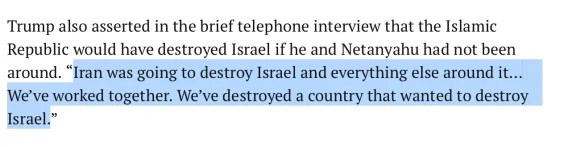
Trump has admitted that his real goal is to “destroy Iran”, the real motive behind the U.S. and Israeli attacks on Iranian civilian infrastructure.
As Mondoweiss noted , “ultimately, replacing the Islamic Republic is not the main objective, or even a desirable one. Rather, the goal in Iran is ethnic balkanization and a failed state. They don’t want to change the regime in Iran; they want to collapse the state itself. The purpose of military strikes is to disintegrate the state’s institutions, fueling ethnic tensions and secessionist movements, leaving Iran deeply divided and marred by civil war and sectarian violence — a parallel to 2015 Syria.”
However, despite admitting this, Trump is still lying.
Trump claimed that “Iran was going to destroy Israel”, but in reality, the only thing Iran was “destroying” was Israel’s bloodthirsty quest for Middle East dominance and the greater Israel project.
The bloodthirsty Neo-Con Senator Lindsay Graham, one of the lead architects of this war, who apparently coached Benjamin Netanyahu, “on how to lobby the president for action” admitted the real motive behind the war was to destroy all opposition to Israel, saying, “If we can pull this off, it would be the biggest change in the Mid East in a thousand years: Hamas, Hezbollah gone, the Houthis gone, the Iranian people an ally not an enemy, the Arab world moving towards Israel without fear, Saudi-Israel normalize, no more October the 7th”.
As the former UK diplomat, Craig Murray put it , “Iran has provided, directly and through proxies, the only military opposition to the creation of Greater Israel. This war is for Greater Israel.”
In reality, Trump is attempting to destroy Iran and turn it into a failed state because it was the last thing standing in the way of Israeli dominance over the Middle East and the greater Israel project.
Iran’s latest move in the GCC countries was a stroke of genius
By Martin Jay | Strategic Culture Foundation | March 9, 2026
After just a week into Donald Trump’s war, there is very little to report which should or could please the U.S. president. Much of America’s infrastructure in the Middle East has been destroyed with U.S. soldiers now housed by hotels in GCC countries as there is nothing left of their bases. The stocks that these countries have as part of their air defence systems is almost depleted as military chiefs argue about how quickly they can be replaced (some THAAD and Patriot systems are being shipped from Japan and South Korea) and Iran is hitting Israel harder and harder each day.
Of course, due to the new draconian rules which Israel has imposed — that no military strikes that Iran succeeds in carrying out can be ‘reported’ on by journalists or even citizens who wish to post it on social media — as well as the comically corrupt, partisan way U.S. news outlets are covering the war, very little bad news gets seen by the public, if any.
Under this set up, it is hardly surprising that Trump went to war, given that he must have factored in a great deal of support from U.S. media, whom he claims to despise. In this regard, we can conclude that media itself is complicit in war crimes, given that it has played a huge role in the decision to go to war and also the day to day reporting of events on the ground.
A good example of the few points of the war which are reported, but done in such a distorted way, is the news that Iran has stopped its bombing of GCC Gulf states. This has been presented as a victory by the U.S. and a climb down by Iran. The truth though is that it is a considerable victory for Tehran as what is not being reported or even examined is the deal that Iran has struck with those countries. None of those countries will allow any kind of military activity now by U.S. forces there, which means the thousands of U.S. soldiers in hotels in these GCC countries might as well head back home as their role there is redundant. Of course it’s unlikely that Trump will move them out as such an event will be captured by many on social media and will look like a great defeat. But some analysts are going further and speculating that there is more bad news for Israel and the U.S. with this latest move. Not only has Iran insisted on no activity at all in these countries by U.S. forces but they have also said that when the war is over, all the bases must be completely shut down.
Sadly, the gesture didn’t hold for long as it is rumoured that Iran’s elite guard was angered by Trump’s response and so the missile attack on the GCC countries continued.
Against a backdrop of rumours spreading throughout the middle east that Saudi Arabia, UAE and Qatar were considering jointly to completely pull out their investment in the U.S., this move, even as a gesture, couldn’t have come at a worse time for Trump.
His media machine is working overtime in spewing out so many fake news reports, like the recent one that the U.S. has total air superiority over Iran, that it will be interesting to see how this is spun in the coming days. But there is nothing but lies from the Trump camp and as a complicit western media scrum is happy to pump out these lies, people are obviously turning to social media or international news channels in the global south, like CGTN and Russia Today. For many Americans, they are simply too dumb to know how to even question the narrative. Where is the video footage to support these preposterous claims that American has air superiority over Iran? Within 24 hours of Trumps B2 bombers hitting nuclear sites in Iran last year in June, media were given video clips of the satellite imagery. So far, the claims by Trump’s people about air superiority, have not been matched with any evidence. None the less U.S. media reports it more or less like it is fact.
It’s a similar story with the claims about the U.S. navy sinking 20 Iranian vessels. Where’s the evidence? If we are to take into account completely defenceless ships like the unarmed frigate that was sunk in international waters after it returned from a joint exercise with India, it would seem that America is on the losing side. Not even Japanese naval strikes in the WWII would blow up enemies’ ships and not then pick up survivors. The Americans left 80 sailors to drown, the same seamen who posed with photos days earlier with Prime Minister Modi, who, it should be pointed out often claims that India is the “guardian of the Indian ocean”, a patently absurd claim. Many believe Modi sold the Iranians out and disclosed its position to the Americans, leaving many to question just how much he can be trusted with his present allies. Will Russia still sell its oil to India after such a betrayal?
It’s clear that the Iran war is already WWIII in many respects. Certainly each side has its partners and media have made much of Russia’s intelligence support to Iran pointing out American positions, while China has given Iran considerable military support both in state of the art radar systems and ground to air missile systems. The sinking of the Iranian ship shows us all the depth of the desperation of America, that it needs to go as far as hunting for Iranian ships thousands of miles away and sinking them, even if they are unarmed as this ship was. Does that look like the act of a confident aggressor on a victory role? Hardly.
It isn’t just that America can barely hold the high moral ground for even a brief, ephemeral media moment, but more that the number of shocking tactical errors by Trump are piling up and having an impact. The failure to see that killing the supreme leader, who has been replaced by a hard liner who has always wanted Iran to have a nuclear deterrent, was a major act of stupidity. Nearly all U.S. wars follow the same pattern of America underestimating its enemy and overestimating its own capabilities and this one is no exception. The move to bring GCC states closer to Iran and turn them against the U.S. is smart and what we could expect from Iran who has had years to prepare for this attack and has been given so many free lessons by America’s blunders — the best one being the June attack which resulted in Iran upping its game and identifying all the weak spots which needed work. The biggest miscalculation probably of all is going to war in the first place believing that regime change would be inevitable in days and therefore no longer-term plans, in terms of military stocks, need to be addressed. America is about to run out of ammo. For the GCC countries, it’s quite possible that the deal might be reinstated in the coming days as a new truth emerges from the war. While Donald Trump tells reporters on Air Force one that Iran was responsible for bombing its own school, GCC leaders will have to wake up to a new reality which is summed up by Henry Kissinger. “It may be dangerous to be America’s enemy, but to be America’s friend is fatal.”
Israel threatens to kill Iran’s new leadership
RT | March 9, 2026
The Israel Defense Forces (IDF) has threatened to assassinate anyone who replaces the slain Ayatollah Ali Khamenei as Iran’s supreme leader.
Khamenei and several other senior Iranian officials were killed in the first wave of US‑Israeli airstrikes launched on February 28. After a week of deliberations, the Assembly of Experts, a body of clerics tasked with vetting and selecting the new supreme leader, announced on Monday that Khamenei’s son, Mojtaba, has been chosen to succeed him.
In a statement posted to the IDF’s Farsi account hours before the Assembly announced its decision, the Israeli army issued a warning to its members.
“The hand of the State of Israel will continue to pursue every successor and every person involved in his appointment,” the IDF said, adding that it “would not hesitate to target” the clerics attending the assembly’s meetings.
Last week, Israel struck the Assembly’s headquarters in Qom, but the attack failed to derail the selection of a new leader. Ali Larijani, Iran’s top security official, said Mojtaba Khamenei’s appointment demonstrates that the US and Israel failed to use Ali Khamenei’s death to sow chaos in the country.
US President Donald Trump and Israeli Prime Minister Benjamin Netanyahu both cited regime change as one of their war goals.
Trump has demanded unconditional surrender and said the next supreme leader will not “last long” unless Iran bows to his demands. Iranian officials and the military have vowed to continue their resistance.
Possible Scenarios for the Middle East
By Yuriy Zinin – New Eastern Outlook – March 9, 2026
The US and Israeli aggression against Iran has pushed the Middle East to the verge of exploding. It has ignited regional media discourse, which presents various assessments of the situation and its consequences.
According to a major regional portal, Middle East Online, these assessments can be divided into two categories. One group tends to support the idea of Israel’s overwhelming superiority and its control over the region’s key institutions. They also believe the predictions of the Lebanese astrologer Layla Abdel Latif. The other group offers alternative scenarios, including those pointing to an Iranian victory and the collapse of the Trump-Netanyahu alliance.
Who is to blame for the war and how long it will last
Two main themes are of particular interest to commentators: who is responsible for this operation and how long will the confrontation between the two antagonistic sides last? One of the mediators, Omani Foreign Minister Badr bin Hamad Al-Busaidi, speaking on CBS television, revealed that Iran had accepted the zero enrichment condition and was ready to move its stockpiles outside its territory. However, this effort was in vain; Washington did not hear it.
It is clear that the adversaries’ balance of potential and military arsenals are disproportionate and favor the aggressors. Nevertheless, according to many experts, technological superiority does not guarantee a swift victory for the US. Trump left Tehran no chance for retreat, and Iran is acting in accordance with the logic of attrition, not traditional doctrine. Iran’s arsenal of ballistic missiles and drones, as well as the use of allies on Arab bridgeheads, allows it to open several fronts and turn the war against it into a costly and prolonged endeavor. Therefore, Tehran is betting on dragging things out until the military pressure becomes a political burden for its opponents.
Western intelligence services were too slow
Analyzing the situation, an Arab newspaper claims that Western intelligence services failed to properly assess Iran. Their attack plans were based on the assumption that “decapitating” the leadership would deprive Tehran of the will to launch retaliatory strikes. But events have shown that these intelligence agencies overlooked the quiet restoration of Iran’s potential, which began in 2025.
In addition, Iran’s opponents did not take into account the fact that, in Islamic tradition, the killing of a spiritual leader is often perceived not as his end, but as a transition to martyrdom. Usually such losses do not disorganize society but, on the contrary, mobilize it and give it strength.
Many analysts believe that Iran has demonstrated its ability to overcome this shock and recover institutional cohesion, having formed a temporary tripartite leadership including reformers, the Iranian Revolutionary Guards Corps, and the bureaucratic religious elite. Despite limited capabilities compared to the US, Iran retains significant regional influence. At the same time, some fear that an Iran weakened by the US and Israel could strategically destabilize the countries that rely on Tehran for security purposes.
Countries in the region reject US military involvement
This war was unleashed by Washington for the sake of Israel and for goals that are not accepted by the countries of the region, concludes the Arab As-Sabil newspaper. Washington ignored all calls, efforts, and negotiations aimed at preventing it. According to analysts, this places Arab states at the epicenter of pressure, requiring high political acumen in matters of national security demands in order to avoid being drawn into axes that could lead to a larger confrontation. America’s investment in its military assets has actually damaged regional stability and the interests of the countries of the region. Military assets, including bases and partnerships, have become nothing less than a curse for the countries in the region and a cause of undermining its security.
“Trump’s noble mission for the future” – rhetoric repeated at the White House – is nothing more than a grand gamble based on the assumption that overseas power is capable of changing history. This may provoke unforeseen reactions from other international powers, which perceive such behavior as a dangerous American unilateral approach to the demands and fate of global energy and logistics.
Not just a war, but a deep transformation
Regional analysts find that part of society is shocked as the predictions they hear in the evening are irrelevant by the morning, with multiple new scenarios spawning. Today a massive new war looms in the region. This war is not a traditional conflict between two sides, but rather a brief moment that will determine the region’s landscape for decades to come. An Arab author fears that it is not just a clash; it is a deep strategic transformation that is turning the region into a quagmire where blood, chaos, and miscalculation are constant.
Yuri Zinin, PhD in History, Senior Research Fellow at the Institute of International Studies, Moscow State Institute of International Relations (University), Ministry of Foreign Affairs of the Russian Federation
Follow new articles on our Telegram channel
Ted Postol: Fraud of Missile Defence Exposed in Iran War
Glenn Diesen | March 8, 2026
MIT Professor and Pentagon advisor Ted Postol explains why the missile defence systems are failing in the war against Iran, and why the US and Israel will not win this war.
Follow Prof. Glenn Diesen:
- Substack: https://glenndiesen.substack.com/
- X/Twitter: https://x.com/Glenn_Diesen
- Patreon: / glenndiesen
Support the research by Prof. Glenn Diesen:
- PayPal: https://www.paypal.com/paypalme/glenn…
- Buy me a Coffee: buymeacoffee.com/gdieseng
- Go Fund Me: https://gofund.me/09ea012f
- Books by Prof. Glenn Diesen: https://www.amazon.com/stores/author/…
Calls for the reconfiguration of military arrangements in the Gulf region
By Thembisa Fakude | MEMO | March 8, 2026
The former Qatari Prime Minister Sheikh Hamad bin Jassim bin Jaber Al Thani called for the formation of a strategic defence alliance bringing together Egypt, Saudi Arabia, Turkiye and Pakistan. Al Thani has described it as an “urgent need” in light of developments and changing regional and international dynamics. He made this call weeks before the attack on Iran by Israel and the US on 28th February 2026. It is not the first time Israel attacked Iran whilst in negotiations.
In June 2025 Israel attacked Iran whilst it was it was negotiating its nuclear program with the US. Iran retaliated with hundreds of missiles and drones targeting Israeli cities and the US military base in Al Udeid in Doha, Qatar. Al Udeid is the largest US military base in the Gulf region. In September 2025 Hamas leadership was attacked in Qatar by Israel whilst meeting to consider a ceasefire proposal from the US on the war on Gaza.
Qatar has spent billions of US dollars on US’s weapons and military hardware including a huge investment at the Al Udeid military base. It is estimated that Qatar has spent over 19 billion USD over time in Al Udeid. Notwithstanding, Qatar has remained vulnerable from external military attacks and its sovereignty has been compromised over the past months.
On 28 February 2026, the US and Israel started launching unprovoked attacks on Iran. They killed the Supreme leader of Iran, Ayatollah Khamenei and over 180 school girls at the Tayyebeh girls’ elementary school in the city of Minab in the early stages of the attack. Iran retaliated to the attacks by firing hundreds of drones to Israeli cities and US military installations in the Gulf.
The US and Israel have called for a regime change in Iran. Speaking to the media on 5th March 2026, Donald Trump said “he wants to be involved in picking up the next leadership in Iran”. Iran has vowed not to allow foreign interference in their politics including how its leadership is elected. Such rhetoric from the president of the US presents a threat to the political process in Iran. Moreover, Trump’s hope and ambition that the US can come into Iran, impose its political will and preference and still have a stable Iran is farfetched and dangerous. It could lead to political instability in Iran and indeed the region. Iran has suffered tremendous infrastructural and leadership devastation already in this conflict. However, its government has vowed to continue fighting and judging by how it has resisted over the past couple of days since the start of this war, it is unlikely to collapse.
Secondly, the Prime Minister of Israel Benjamin Netanyahu has said repeatedly that he wants to eliminate all threats to Israel in the region including obliterating Hamas in Gaza and Hezbollah in Lebanon. Hamas and Hezbollah have refused to disarm and are both showing signs of recovering from the devastating war on Gaza. The recent attacks of Israel by Hezbollah in retaliation to the killing of Ayatollah Khamenei, caught Israel and many in the world by surprise. After heavy bombardment and killing of its leadership by Israel over the past 24 months, they are still capable of sending missiles and drones hitting their targets in Israel. Likewise, Hamas – who got praised by Trump – for their great work in helping to allocate the dead bodies of the Israeli captives in Gaza – are still governing Gaza.
Notwithstanding the devastation of Iran and the killing of its leadership, its political infrastructure is likely to endure. However, as long as the government of Iran continues to function, with all its current political infrastructural framework, it will continue to be targeted by Israel. Moreover, Hamas, Hezbollah have not disarmed. The Houthis in Yemen continue to attack US and Israeli interests in the Red Sea. Basically, notwithstanding the military attacks on these organisations and Iran, they are still standing albeit weaker. This means the “threats” to Israel remain, it also means that future conflicts between Israel and the US on one hand and Iran will continue as long as both Israel and the US refuse to accept the status quo. This reality brings us back to what the former prime minister of Qatar raised i.e., the strategic defence alliance in the region. Second, a need for the reconfiguration of the military arrangement in the region. The recent unprovoked attacks on Iran and its subsequent retaliation have added a momentum to these discussions. The attacks have also raised questions about the significance of the presence of US’s military bases in the region. Particularly, whether countries in the region should continue having strategic military partnerships with the US? Iran has insisted that US military bases in the region are legitimate targets and it will continue targeting them in retaliation and in defense of their people and sovereignty.
The conclusion therefore is that unless there is a reconfiguration of the security arrangements in the region, the US and Israel are likely to attack Iran again. Iran is likely to retaliate in the manner it is currently doing, targeting both Israel and US’s bases and infrastructure in the region. Iran has repeatedly said “it is not targeting its friendly neighbors rather the interests and assets of the US and Israel in the region”. Consequently, Gulf countries hosting these bases will continue to be targeted by Iran.
Openly Pro-Israel Tech Group Now Has Control over UK’s Most Sensitive National Security Data
By Alan Macleod | MintPress News | February 7, 2023
This is the story of how a multibillionaire who has dedicated his life to advancing the cause of the Israeli national security state is now in control of Great Britain’s most sensitive public and military data.
In 2020, software giant Oracle won a gigantic contract with the United Kingdom’s Ministry of Defence (MoD) to provide it with cloud infrastructure, digital assistance, data visualization software, mobile hub and development tools. The military is far from the only British institution entrusting its most sensitive data to the Texas-based firm, however. The Home Office, Office of National Statistics and National Health Service, among others, also rely on Oracle databases to function.
For years before signing the MoD agreement, Oracle founder Larry Ellison had been ingratiating himself with the British establishment, employing all manner of well-connected individuals at his foundation. Among these included media executive and father-in-law of former Prime Minister Boris Johnson, Matthew Symonds, who earned over $600,000 per year as the executive director of the Larry Ellison Foundation. Richard Meredith, a longtime director of the U.K.’s Foreign and Commonwealth Office, was also snapped up at a similar salary to become deputy executive director.
Many other well-connected British government officials, including Vel Gnanendran, went straight from the Larry Ellison Foundation into the Foreign and Commonwealth Office and worked there at the time that the body signed off on the lucrative Oracle contracts. For years, the Larry Ellison Foundation also bankrolled the Tony Blair Institute for Global Change, the former U.K. prime minister’s new political project.
Yet, just after as the partnership with the Ministry of Defence was secured, Ellison abruptly shut down his foundation, prompting speculation that it had fulfilled its purpose.
“Our mission to support Israel”
Why this should be of concern is that both Ellison and key Oracle figures have made clear that their business model is less about making money, and more focused on furthering the interests of the Israeli national security state.
Furthermore, few people realize how important Oracle is to the functioning of the modern world. It is the third-largest software company globally. Yet because it sells its products to businesses and governments rather than consumers, it is far less known than competitors such as Microsoft or Amazon. Nevertheless, it is as important to the modern hi-tech economy as its rivals, its software and databases powering the likes of Netflix, Zoom, financial corporations such as JPMorgan Chase, as well as a myriad of educational institutions.
While opening a new data center in Jerusalem in 2021, the company’s Israeli-American CEO, Safra Catz, laid out Oracle’s purpose, stating,
We are not flexible regarding our mission, and our commitment to Israel is second to none. This is a free world and I love my employees, and if they don’t agree with our mission to support the State of Israel, then maybe we aren’t the right company for them. Larry [Ellison] and I are publicly committed to Israel and devote personal time to the country, and no one should be surprised by that.”
Catz made the comments in response to a question about Israel’s poor human rights record and the rebellion of Silicon Valley employees refusing to facilitate the country’s war crimes. In 2017, Catz was offered the position of U.S. Director of National Intelligence.

Safra Catz, Oracle’s CEO, poses with Alon Ben (left), CEO of Tel-Aviv-based Oracle data partner, Bynet
Ellison, if anything, is even more forthright in his support for the Israeli government and its agenda. The billionaire – currently the fourth-richest individual in the world – has bankrolled the Israeli Defense Forces (IDF) for years, giving tens of millions of dollars to the Friends of the IDF, including the largest single donation the organization has ever received. In 2017 alone, he pledged $16.6 million to build a new training facility for IDF soldiers defending, in his words, “our home”. As Ellison explained:
Through all of the perilous times since Israel’s founding, we have called on the brave men and women of the IDF to defend our home. In my mind, there is no greater honor than supporting some of the bravest people in the world, and I thank Friends of the IDF for allowing us to celebrate and support these soldiers year after year. We should do all we can to show these heroic soldiers that they are not alone.”
This was far from his first donation to the organization. Three years previously, he gave $9 million at a star-studded gala – the largest donation on a record-breaking night for the FIDF.
The big tech mogul also has a direct hand in furthering the Israeli settlement project. In 2007, he met with then-Foreign Minister Tzipi Livni to pledge half a million dollars in support to the Israeli border town of Sderot.
But if Ellison can count Livni as a friend, then Benjamin Netanyahu is virtually family. The pair have been close for many years; Ellison even flew Netanyahu out to his private Hawaiian island to vacation together. There, he offered the embattled prime minister a seat on Oracle’s board, replete with a salary of $450,000.
Netanyahu had previously gone to Ellison, encouraging him to buy out the struggling Yedioth Ahronoth newspaper in an attempt to change the outlet from an adversary of his political project into a mouthpiece for his Likud Party.
Unsurprisingly, Oracle has signed numerous deals with the Israeli national security state.
“The Israelis think they control the Foreign Office. And they do!”
In recent years, Israel and pro-Israel groups have managed to amass considerable influence over U.K. government policy. A measure of this is the fact that, by 2021, one-third of the cabinet – including then-Prime Minister Boris Johnson – were directly funded by the Israeli government or pro-Israel organizations. Chief amongst these groups is the Conservative Friends of Israel, who have claimed that 80% of Tory members of parliament belong to their organization.
The Israel lobby has been able to shape government policy, to the point where they blocked Boris Johnson’s appointment of Alan Duncan to the post of Middle East Minister. Johnson, according to Duncan, was “indignant”. “They shouldn’t behave like this”, the prime minister reportedly said about the Israelis, but acquiesced to their demands. “The Israelis think they control the Foreign Office. And they do”, Duncan later wrote. Home Secretary Priti Patel (a longtime champion of the apartheid state) also secretly flew to Israel for “off the radar” talks with Netanyahu – a huge breach of ministerial codes, for which she later resigned.
The Israeli Embassy also played a key role in the coordinated smear campaign demonizing Labour leader Jeremy Corbyn, an operation that helped to ensure Johnson’s electoral victory in 2019.
In addition to this, there have also been national security questions raised about the extent to which Israeli businessmen have bought up key British industries. Last year, for example, Patrick Drahi’s attempt to purchase 18% of BT, the formerly state-owned telecoms giant that owns and controls much of the country’s telecommunications infrastructure, was put on hold due to concerns over national security.
That a company like Oracle that defines itself so explicitly as pro-Israel raises serious concerns over the nature of the work they do for the United Kingdom or any other nation. How can the Ministry of Defence or the Home Office’s data be considered uncompromised in these hands?
The CIA in all but name
“The Oracle database is used to keep track of basically everything,” Ellison once said, adding,
The information about your banks, your checking balance, your savings balance, is stored in an Oracle database. Your airline reservation is stored in an Oracle database. What books you bought on Amazon is stored in an Oracle database. Your profile on Yahoo! is stored in an Oracle database.”
This should be of concern to everyone, as Oracle itself started off as a project for the Central Intelligence Agency. Indeed, Ellison named his company after Project Oracle, a 1970s CIA operation he worked on.
“Our very first customer was the Central Intelligence Agency,” Ellison boasted, telling the story of how, in 1977, the CIA commissioned his firm to build them a database. From there, Ellison immediately began pitching to other wings of the national security state, and within months had secured contracts with Navy Intelligence, Air Force Intelligence and the NSA. The bottomless pit of money available for the military has helped turn Oracle from a tiny operation to a $46 billion dollar per year behemoth.
One of Oracle’s largest deals came in 2020, when it was part of a consortium that won a 15-year contract with the CIA and the other 16 U.S. intelligence agencies said to be with tens of billions of dollars.
Part of the reason the CIA trusts Oracle is that the company’s upper echelons are filled with ex-CIA executives. A case in point is former CIA Director and Defense Secretary Leon Panetta, who was appointed to the company’s board in 2015. David Carney, who spent 32 years at the agency, rising to become its third-in-command, also joined Oracle, heading up its information assurance center.
Indeed, on its own website, Oracle aggressively recruits CIA agents, sharing stories of former spooks who have gone on to succeed in its ranks. One of those is Senior Technical Program Manager Andrew C. “As an Intelligence Officer in the US Navy, as well as in the CIA, Andrew has had to lead, build teams, and work on fast-breaking projects, all things Oracle requires on a regular basis,” Oracle writes, before actively encouraging other agents to apply,
Now that you’ve heard about Andrew’s experience, are you ready to join Oracle National Security Region team? If you hold a U.S. Government Top Secret SCI or higher clearance, click here to check out our latest opportunities. Once you’ve found an opening that fits your talent, passion, skills, and background, apply for us to consider you. Create the future with us.”
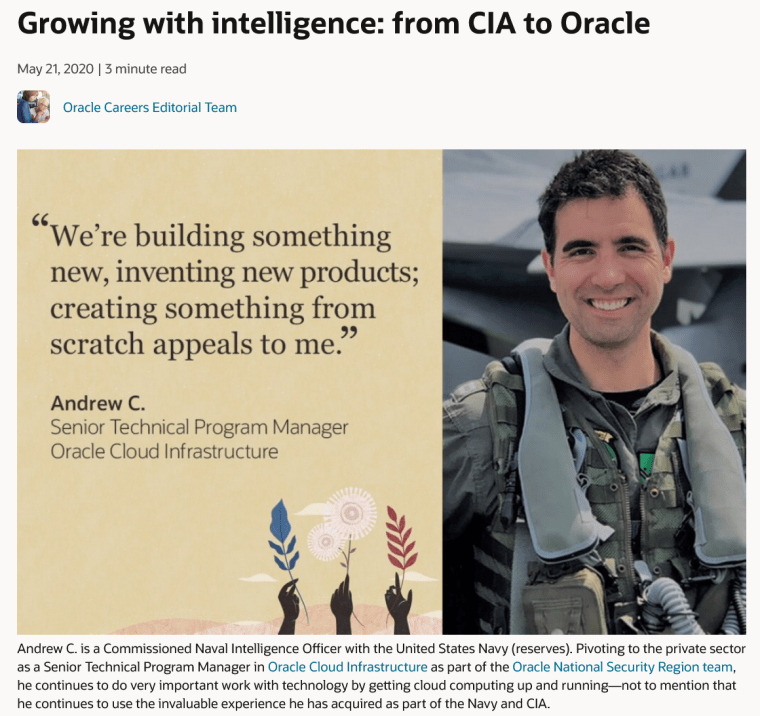
Oracle, a firm that stores reams of your sensitive data, openly boasts of its cozy ties to the CIA
The revolving door between Oracle and the CIA also swings the other way, with Oracle staff finding employment in Langley, VA.
The Silicon Valley giant also works closely with the U.S. military. “Oracle Cloud is advancing Department of Defense mission success”, it boasts on its website. Oracle notes that it is “delivering real-time intel to warfighters”, thereby “securing command and control at the tactical edge.” Thus, by the company’s own telling, it is a centerpiece of both the military-industrial-complex and the national security state. Big media outlets agree: “Larry Ellison is a billionaire today thanks to the CIA” concluded Business Insider.
Surveillance State
If Ellison had his way, however, Oracle would be an even more crucial part of a greatly expanded national security state. In the immediate wake of the September 11 attacks, he flew in for a series of meetings with top Bush-era officials, including NSA chief Michael Hayden and Attorney General John Ashcroft. There, he likely pitched an idea he had been promoting for some time: a single, comprehensive national security database that collected every piece of information possible to identify someone, from thumbprints and iris scans to medical history and social security details. “The single greatest step we Americans could take to make life tougher for terrorists would be to ensure that all the information in myriad government databases was copied into a single, comprehensive national security database,” he insisted.
In the end, even the Bush administration balked at such a sweeping project. Nevertheless, Oracle has deeply ingratiated itself into the world of policing and surveillance. In 2012, at the height of an anti-NATO demonstration, U.S. law enforcement used Oracle’s Endeca software to match protestors’ tweets with data about their criminal records, 911 calls and other information to pre-arrest demonstration leaders before the action took off.
Since then, Oracle has sold the same or similar software to authorities in Europe, South America, the Middle East and China. Job listings for developers at Guantánamo Bay also note that familiarity with Endeca and Oracle software is a desired trait.
Oracle is far from the only Silicon Valley giant with questionable ties to intelligence. Here at MintPress, we have exposed how Facebook’s top ranks are filled with former FBI and CIA agents, how ex-Israeli spies have found roles working for Microsoft and Google, and uncovered what we termed a “NATO to TikTok pipeline.”
Yet the openness with which Oracle and Ellison work with the Israeli state to further its interests should be highly concerning to those working in national security. Israel already has a long history of using its tech industry to surveil and eavesdrop on foreign governments.
Can it really be a wise idea for the United Kingdom to entrust its most sensitive government, health and defense data to a company with such close ties to the Israeli government?
So far, Great Britain has overlooked the potential grave national security threat this poses. Surely this cannot continue indefinitely.
Alan MacLeod is Senior Staff Writer for MintPress News. After completing his PhD in 2017 he published two books: Bad News From Venezuela: Twenty Years of Fake News and Misreporting and Propaganda in the Information Age: Still Manufacturing Consent, as well as a number of academic articles. He has also contributed to FAIR.org, The Guardian, Salon, The Grayzone, Jacobin Magazine, and Common Dreams.
Lowkey is a British-Iraqi hip-hop artist, academic, political campaigner, and a MintPress video and podcast host. As a musician, he has collaborated with the Arctic Monkeys, Wretch 32, Immortal Technique, and Akala. He is a patron of Stop The War Coalition, Palestine Solidarity Campaign, the Racial Justice Network, and The Peace and Justice Project founded by Jeremy Corbyn.
Hezbollah Foils Israeli Landing in Lebanon’s Bekaa
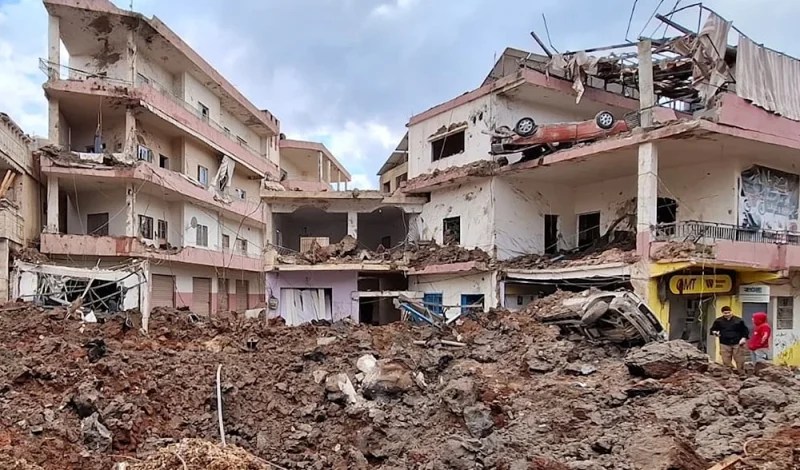
Al-Manar | March 7, 2026
Hezbollah foiled an Israeli landing in the town of Nabi Sheet in the eastern Lebanese region of Bekaa before dawn overnight on Friday-Saturday.
Hezbollah’s Military Media said Islamic Resistance fighters observed four Israeli enemy helicopters infiltrating from the Syrian direction and landing an Israeli infantry force at the mountainous triangle linking the towns of Yahfoufa, Khraibeh, and Maaraboun.
“The enemy unit then advanced toward the eastern neighborhood of Nabi Sheet, (Al-Shukr). At 11:30 AM, upon reaching the cemetery area, the Israeli force was engaged by a group of resistance fighters using light and medium weapons, triggering a fierce clash after the infiltrating force was exposed,” the Military Media’s first statement for Saturday read.
As the confrontation intensified, the Israeli enemy unleashed heavy firepower, launching around forty airstrikes by warplanes and helicopters, to cover the withdrawal of its troops from the engagement zone, according to the statement.
Meanwhile, Hezbollah resistance artillery delivered concentrated fire with appropriate weapons on the perimeter of the battlefield and along the enemy’s withdrawal route, while residents of nearby villages joined in providing supporting fire, the first statement added.
The video shows exchange of fire between resistance fighters and Israeli enemy forces in Nabi Sheet.
In another statement, the third one on Saturday, Hezbollah’s Military Media said: “In response to the enemy’s landing in the Bekaa region, the Islamic Resistance fighters targeted the evacuation area in the outskirts of Nabi Sheet with rocket barrages at 04:15 on Saturday.”
Hebrew media reported that Israeli forces attempted to withdraw after resistance forces revealed the military activity in eastern Lebanon, and that Israeli warplanes and helicopters eventually retreated from the area after the failed airborne landing attempt.
Another video shows heavy destruction in the town of Nabi Sheet after the Israeli landing.
Lebanese Heaslth Ministry announced that the Israeli assault on Nabi Sheet led to martyrdom of 16 people and the injury of 53 others.
Featured Video

Alon Mizrahi: ‘Israel Must Be Dismantled’
or go to
Aletho News Archives – Video-Images
From the Archives
Allies Don’t Need Lobbies
By Jay Knott | Dissident Voice | September 24, 2013
In a recent article on Counterpunch, Rob Urie defended the traditional Marxist analysis of US policy in the Middle East. He argues that support for Israel is driven primarily by economic interest, not the Jewish lobby.
He starts by paying tribute to the idea that Western societies are uniquely racist. He says that the “Western narrative” claims there is an “Arab character”, and that this is “antique racist blather”. He gives no definition of these terms. Further, he establishes his credentials as part of the dominant current in the American left by claiming that “over a million people in Iraq died so ‘we’ in the West can drive SUVs.”1
When he tries to criticize bourgeois economics, he makes it clear he doesn’t understand the developments it has made since Marx’s day, using the mathematical discipline known as “game theory”. He dismisses the basic abstraction of economic theory, the idea of the rational individual, on the grounds that it is “devoid of history, culture and political context”. But abstractions are always devoid of something.
He defends a more concrete economic theory, mostly Marxist, with some input from another theorist of capitalist crisis, Hyman Minsky. This concrete theory leads him to the view that US activity in the Middle East is primarily driven by rational capitalist motives, the need to secure a supply of oil.
“Taking the totality of circumstance — former oil company executives launching war on an oil rich nation on a pretext they publicly proclaimed they didn’t believe shortly before taking office — and that upon launching their war proved to be non-existent, requires a willingness to overlook the obvious — that the war on Iraq was for oil, that is difficult to support.”1
Perhaps I’ve misunderstood him, but based on what he says in the rest of the article, this convoluted sentence seems to argue that, because president Bush and vice-president Cheney attacked Iraq on false premises, and they also said it was all about oil, and they are former oil executives, and Iraq has a lot of oil, it’s difficult to deny US attacks on Iraq are all about oil.
In fact, it’s not hard at all. As Urie points out, at times Bush and co. said that attacking Iraq was “protecting the world’s supply of oil.”1 But, as he also points out, they are congenital liars. Why should we believe them when they say they are trying to “protect” the oil supply? Protect it against what? When politicians “admit” attacks on Middle Eastern countries are wars for oil, they are parroting the neo-con party line, feeding the public, both left and right, with a plausible-sounding pretext. For right-wingers, “it’s a war for oil” is a reason to support war, and for leftists, it’s a way to feel better by complaining impotently about corporate greed. Both approaches help the war drive. … continue
Blog Roll
 Aletho News
- Zelensky unnecessarily involves Ukraine in the Middle East crisis
- Turkish tanker blacklisted by Ukraine hit in drone attack – media
- Canada, the U.S., and NATO: the inescapable trap
- Villains of Judea: Leonid Radvinsky
- Alon Mizrahi: ‘Israel Must Be Dismantled’
- Former Head Of MI6 Admits That The U.S. And Israel Are Losing The Iran War
- Scattered Thoughts on War and Peace
- Iran Threatens to Close Red Sea to Shipping in Response to Invasion
- Iran in excellent position to prevail in war with US, Israel: John Mearsheimer
- Iran warns US: Do not call your retreat an agreement
- If Americans Knew
- In the West Bank, life is a constant battle – 3 articles
- Jacob Reses, one of the most powerful pro-Israel operatives in Trump’s Washington
- Israeli-US assaults kill or injure 87 children a day – Not a ceasefire Day 166
- ‘Forever live by the sword’: Understanding Israelis’ massive support for Iran war
- UN’s special rapporteur on human rights says Israel is systematically torturing Palestinians
- Trump White House plagiarized Iran war manifesto from Israel-aligned think tank
- Gaza says 6–10 patients die daily waiting for treatment abroad as Israel blocks medical evacuations
- ‘Substantial evidence’ of double-tap strike in killing of Gaza’s Hind Rajab
- ‘Do Not Want To Die For Israel’: Doubts About Trump’s Iran Strategy Spread Among Troops
- Instead of taking Joe Kent’s claims seriously, the media is disregarding him as an antisemite
- No Tricks Zone
- Devastating Assessment Of Comirnaty Vaccine By Former Senior Pfizer Europe Toxicologist
- New Study: CO2 Is ‘Effectively Negligible’ As An Explanatory Climate Change Factor Since 2000
- Former Pfizer Toxicologist Dr. Helmut Sterz Tells Bundestag Hearing Pfizer Vaccine Should Have Never Been Approved
- Energy Expert: Germany’s Nuclear Phaseout Was A “500 Billion Euro Mistake”
- New Research: South Australia’s Mid-Holocene Sea Surface Temperatures Were 4°C Warmer Than Today
- Storing Green Energy To Last Germany 10 Days Would Require A 60-Million Tonne Battery
- New Studies: UK Sea Levels Were 4 Meters Higher Than Today During The Mid-Holocene
- Destructive Green New Deal: German Energy And Metal Group Warns Of Drastic Crisis
- New Study Documents A 20-Year Pause In Arctic Sea Ice Decline – Driven By Internal Variability
- Wake-up Call: Survey Shows Majority Of Germans Now Favor Postponing Climate Targets!
 Aletho News
