Do You Condemn October 7? China Says “No”

By Mike Whitney • Unz Review • May 25, 2025
China has never explicitly condemned the attacks of October 7. In China’s view, October 7 can’t be separated from the more than seven decades of Israeli brutality, apartheid and occupation. Naturally, this has drawn harsh criticism from Israel which expressed its “deep disappointment” over China’s refusal to repudiate Hamas. Even so, China has not caved in to Israeli pressure or softened its rhetoric. Quite the contrary, on February 22, 2024, Ma Xinmin—a legal advisor to China’s Foreign Ministry and a member of the International Law Commission—summarized China’s views of Hamas’ activities during a presentation to the International Court of Justice at The Hague. Here’s part of what he said:
The Palestinian-Israeli conflict stems from Israel’s prolonged occupation of Palestinian territory and Israel’s longstanding oppression of the Palestinian people. The Palestinian people fight against Israeli oppression and their struggle for completing the establishment of an independent state on the occupied territory are essentially just actions for restoring their legitimate rights. The right to self-determination served as the precise legal foundation for this struggle. MEMRI
The fact that China chose a legal scholar—who is a member of the International Law Commission—to argue their case, underscores the importance China places on the broader legal issue of whether the Hamas attack was justifiable under international law. Ma concludes that the attack was not only justifiable, but that the militants involved in the attack had an “inalienable right” to conduct operations that were aimed at ending the Israeli occupation. Here’s Ma:
“The Palestinian people’s use of force to resist foreign oppression and complete the establishment of an independent state is an inalienable right …. The struggle waged by peoples for their liberation, right to self-determination, including armed struggle against colonialism, occupation, aggression, domination against foreign forces should not be considered terrorism.” MEMRI
Ma’s statement should not be construed as support for the injuring or killing of innocent civilians. It is, however, a powerful defense of the right of persecuted people to participate in armed struggle against their oppressors.
Most readers don’t know that China resisted Israel’s coercion and defended international law as it relates to the October 7 attacks. They don’t know that China took a stand on a matter of principle and never flinched. Of course, most people don’t realize that of the 195 countries in the world, only 13 officially designate Hamas as a “terrorist organization”. Many believe that the terrorist moniker is applied universally and that the rest of humanity see the world through the same distorted lens as people in America. But they don’t. They see Hamas as a national liberation movement that was duly elected to govern Gaza in 2006 following “free and fair” elections that were forced on the Palestinians by the Bush administration. Now Hamas is being used as the pretext for the slaughter women and children in Gaza on an industrial scale. Most Western leaders have expressed their support for Israel’s 18-month bloodbath, while China has not only opposed it but also defended the Palestinians right to armed struggle. Here’s Professor Richard Falk, a leading scholar in international law and former UN Special Rapporteur for Palestine:
“The right of resistance was affirmed during the decolonization process in the 1980s and 1990s, and this included the right to armed resistance. However, this resistance is subject to compliance with international laws of war.”
Even the preamble to the Universal Declaration of Human Rights states that “whereas it is essential, if man is not to be compelled to have recourse, as a last resort, to rebellion against tyranny and oppression, that human rights should be protected by the rule of law”.
Israel does not comply with international laws of war—for example, the entire situation in Gaza is one of the most flagrant violations of Israel’s complete disregard, not only for the laws of war, but for the entire apparatus of international and humanitarian laws.
Palestinians, on the other hand, who are in a permanent state of self-defense, are driven by a different set of values than Israel. One is that they are fully aware of the need to maintain moral legitimacy in their methods of resistance….
“To the extent that there is real evidence of atrocities accompanying the October 7 attack, those would constitute violations, but the attack itself is something that, in context, appears entirely justifiable and long overdue,” Falk said. Palestine Chronicle
This is why Israel has fabricated so many stories about beheaded babies, mass rape and the killing of innocent civilians. The intention is to persuade the public that October 7 was not a legitimate expression of political resistance but a wanton act of terror aimed at ordinary people. Western analysts typically focus on fake atrocities that are used to drown out any reasonable discussion about historic oppression or political realities. Here’s Falk again:
One of the tactics used by the West and Israel has been to almost succeed in decontextualizing October 7 so that it appears to have come out of the blue... The UN Secretary-General was even defamed as an antisemite for merely pointing out the most obvious fact—that there had been a long history of abuse of the Palestinian people leading up to it,” he added, referring to Antonio Guterres’ simply stating that October 7 “did not happen in a vacuum”. (Palestine Chronicle)
“Decontextualizing October 7”?
Precisely. The case for genocide is made on the basis that October 7 can be removed from its broader historical “context” and seen as a “stand alone” event that requires a particularly violent response. But October 7 is not a stand-alone event; it is the unavoidable explosion of collective resistance to decades of ethnic hatred and brutality aimed at a particular people who have been stripped of their civil rights and left to languish in an apartheid state. Here’s Ma again:
“Our state is obliged to promote the realization of the right to self-determination and to refrain from any forceful action, which deprives people of that right. In pursuit of their right to self-determination, these people have the right to engage in struggles, seek and receive support on the basis of that right….
“Numerous UN General Assembly resolutions recognize the legitimacy of struggle by all available means, including armed struggle, by peoples under colonial domination or foreign occupation, to realize the right to self-determination.
MEMRI
Naturally, Ma’s speech has largely been blacked out in the western media where anything that doesn’t jibe with the Israeli narrative (that October 7 was an act of terrorism) winds up “on the cutting room floor”. We are confident that if Ma’s powerful moral statement was more widely circulated, Israel’s support in the US would crumble.

China Offers To Rebuild Gaza
China has supported every UN Resolution aimed at providing humanitarian relief to the people in Gaza. They have been staunch supporters of Palestinian statehood and the two-state solution from the beginning. They have repeatedly called for an end to the fighting and an immediate ceasefire. They have even met with leaders of Hamas and Fatah (in April and July 2024) to see if reconciliation between the two groups was possible in order to promote Palestinian unity. Finally, China has repeatedly offered to “rebuild Gaza” following the end of hostilities which underscores Beijing’s commitment to an independent Palestinian state living side-by-side with Israel.
At every opportunity, China has supported policies aimed at de-escalation, reconciliation and peace. They have exhibited the type of ‘moral clarity’ and moral leadership we would like to see from the United States but never do. It is China’s moral clarity that “guides its decisions, even in complex or ambiguous situations, without being swayed by competing interests or relativism. It’s about aligning actions with a consistent moral framework, often rooted in universal values like honesty, fairness, or compassion.”
Israel’s savagery in Gaza suggests that the West is in a state of irreversible moral collapse. We should be grateful that China is stepping in to fill the void and lead the world into the next century.
On one of the most consequential issues of our time, China has come down on the side of decency and humanity.
Israel’s deadly aid plan for Gaza delayed due to ‘logistical issues’
The Cradle | May 25, 2025
The Israeli and US-led aid distribution mechanism, which was meant to be launched on 25 May, has been delayed, as UN agencies continue to reject participation in the controversial plan.
Correspondent for Israel’s Channel 12, Tamir Morag, confirmed the new postponement of the Gaza Humanitarian Foundation (GHF). He also accused Hamas of looting humanitarian aid, a claim repeated by Israel, which the UN says there is no evidence for.
Security sources cited in other Hebrew media reports say the UN has doubled down on its rejection of the aid distribution plan, and that “logistical issues” have delayed its launch.
This comes after Israeli media cited suppliers as saying last week that nobody is able to fulfill the plan’s “huge” requirements.
GHF was conceived at the very start of Israel’s genocidal war on Gaza. While US ambassador to Israel Mike Huckabee said when the plan was unveiled this month that it would be “inaccurate” to call it an “Israeli plan,” the project has its roots in Tel Aviv.
According to the New York Times, the details of the plan were first discussed by a group of officials and businesspeople with ties to the Israeli government, called the Mikveh Yisrael Forum, who came up with an idea that aims to bypass the UN and all other humanitarian groups in Gaza.
The Washington Post reports that the initiative’s planning documents anticipated the widespread condemnation and likening of the plan’s distribution centers to “concentration camps with biometrics.”
Even some within the Israeli military establishment have questioned whether the plan could potentially lead to chaos, the report says.
GHF relies on the use of private US contractors who will be in charge of several distribution centers in south and central Gaza. Palestinians in other areas who have had their homes destroyed and have already been displaced multiple times will have to travel across the strip under bombardment to secure aid, while forfeiting the right to return home.
The UN has said the mechanism is designed to reinforce Israel’s plan to displace Gaza’s entire population southward.
It has also condemned Israel’s plan to employ facial recognition technology aimed at screening Palestinians in exchange for humanitarian aid.
“It appears the design of a plan presented by Israel to the humanitarian community will increase ongoing suffering of children and families in the Gaza Strip … The use of humanitarian aid as a bait to force displacement, especially from the north to the south, will create this impossible choice: a choice between displacement and death,” UNICEF spokesperson James Elder said earlier this month.
Gaza’s Government Media Office warned on Saturday that the levels of aid currently entering the strip are less than one percent of what the population needs.
Meanwhile, Israel continues to target Palestinian security officers guarding aid and preventing it from being looted by Israeli-backed gangs.
According to multiple reports, ISIS-linked gang leader Abu Shabab, responsible for the looting of aid under Israeli protection throughout the war, has now “established a fortified base in an Israeli-controlled zone in Rafah.”
From Betar to Shomrim, re-emergence of Zionist private militias in the West
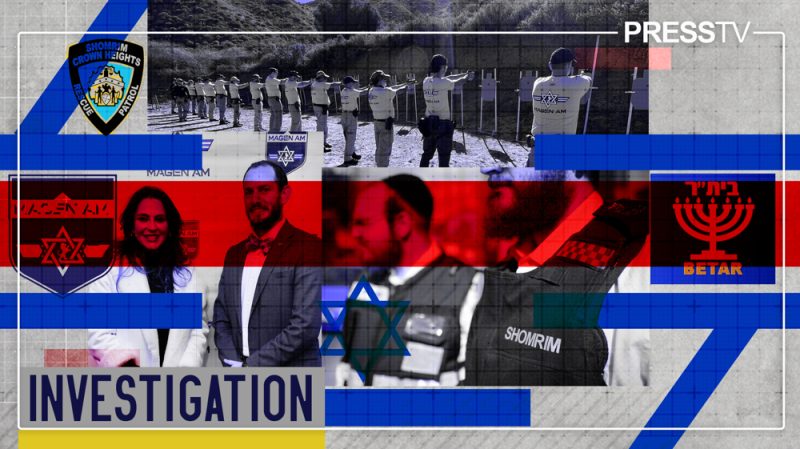
By David Miller | Press TV | May 25, 2025
In April of this year, anti-Zionist Jewish writer Alon Mizrahi claimed that Israeli Prime Minister Benjamin Netanyahu and his network of international Zionists are working to establish a policing force with powers surpassing those of national law enforcement agencies.
Mizrahi described this as the beginning of overt Jewish-Zionist policing of Western societies.
He was referring specifically to the ever more egregious statements from Betar in the US, an ultra-Zionist group affiliated with the far-right Revisionist Zionist movement founded by Vladimir Jabotinsky.
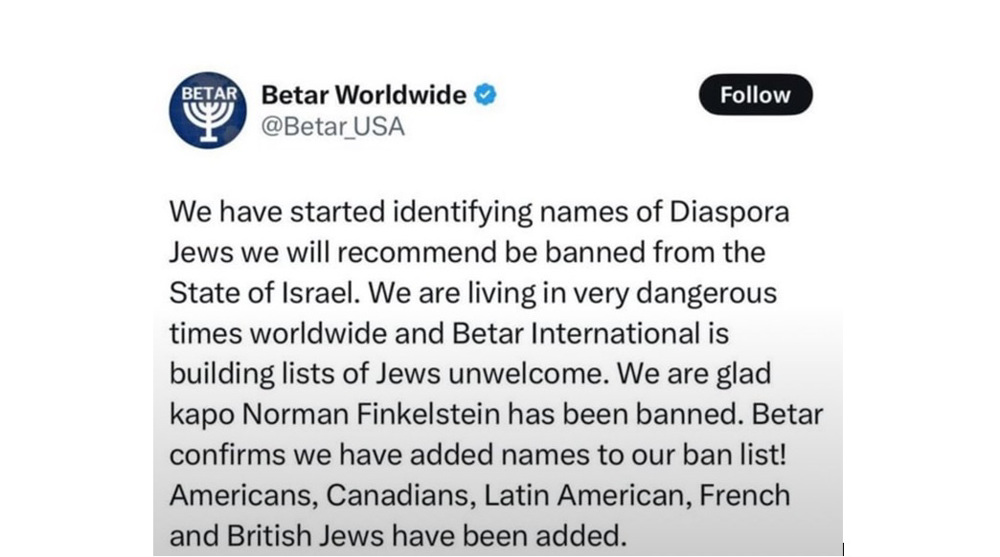
They have threatened to compile lists of Jews to be banned by the Zionist entity across North and South America, as well as Britain and France.
Mizrahi warned, “They start with Jews as a deception: all of you are next.”
However, the situation may already be far worse than what Mizrahi suggests.
Since its founding in 1923, Betar has trained as a paramilitary force. The photo below shows Menachem Begin wearing a Betar uniform in Poland in 1932.
Below it is another photo from Berlin in 1936, taken after the Nazis enacted laws outlawing other political groups in 1933.

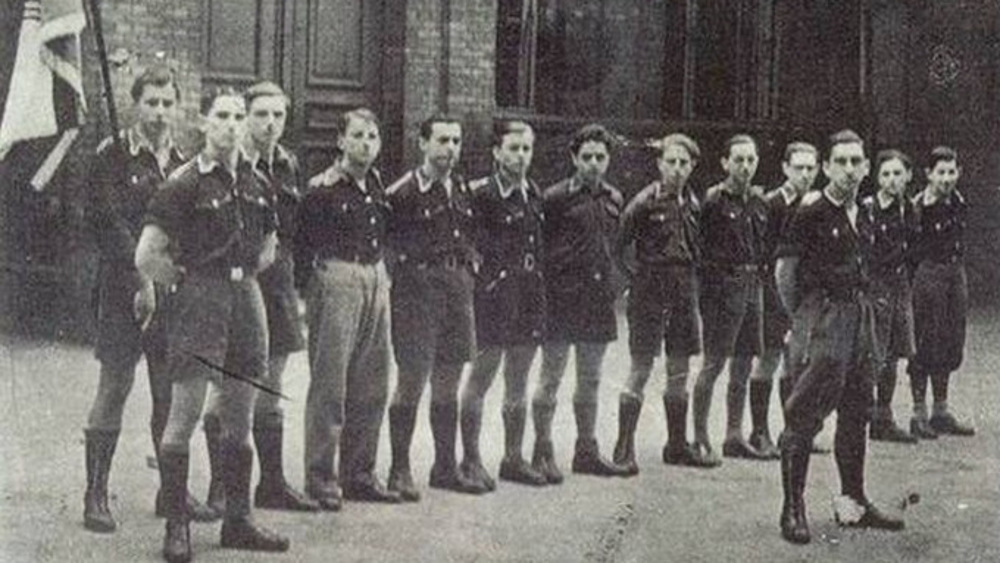
Betar was so closely aligned with the Nazis and Mussolini’s fascists that they were regarded as collaborators. By 1934, Jabotinsky and his Betar youth movement had reportedly “allied with Il Duce,” establishing a naval base north of Rome.
Late that year, Mussolini reportedly expressed support for Zionism and Jabotinsky in particular, stating: “For Zionism to succeed, you need to have a Jewish State with a Jewish flag, and Jewish language. The person who understands that is your fascist, Jabotinsky.”
This remark was made “during a private conversation with Nahum Goldman, founder of the World Jewish Congress, in November 1934,” as reported by Lenni Brenner in Zionism in the Age of Dictators.
Many senior Betar members served in the collaborationist police overseeing the Vilna Ghetto in Lithuania and were involved in betraying Jews in hiding to the Nazis.
One such member, Lotek Salzwasser, was eliminated by Jewish partisans in 1943 for his collaboration, according to Israeli press reports.
Betar and military training
One of the seven core principles of the Betar “Oath” is Magen, meaning “Protection.”
One of Betar’s ideological principles is military preparedness. Betar demands that all its members complete military seminars and know how to use weapons, in order to be ready at any time and to respond personally to a call for defense.
Betar has functioned as a militia since its inception. Here is a film of one of the French branches recorded in 2014 conducting paramilitary training exercises.
In the UK, Betar operated as a registered charity (Brit Tumbledor of Great Britain – Betar) between 1984 and 2004. It was closed down by the Charity Commission in 2004, on the grounds that it had been “Registered in error.”
In March 2025, Betar threatened to murder UN Special Rapporteur Francesca Albanese. On the very same day, the group relaunched its UK branch with a post on Instagram, claiming London “has become, with the time, an epicenter for radical Islam, for hate, for terror.” Their proposed solution?
Today, after more than 30 years, a bunch of strong young leaders stand up to say HERE WE ARE, to defend the Jewish population and to tell them that now we have a solution for the current situation, JEWS ARE NOT AFRAID ANYMORE!
Make no mistake – these threats are part of a deliberate effort to revive Jewish supremacist militias in the UK and the US.
Magen Am
The term Magen also appears in the name of a US-based private Zionist militia called Magen Am, which is currently active in Los Angeles, Orange County, and Phoenix.
Magen Am played a notably violent role in attempts to dismantle the student encampment at UCLA. The group frequently boasts about its close ties to the LAPD, sharing numerous photos of friendly interactions with police officers.
Reports indicate that Magen Am has collaborated directly with law enforcement, including working closely with the LAPD to intimidate and attack student protesters on the UCLA campus.
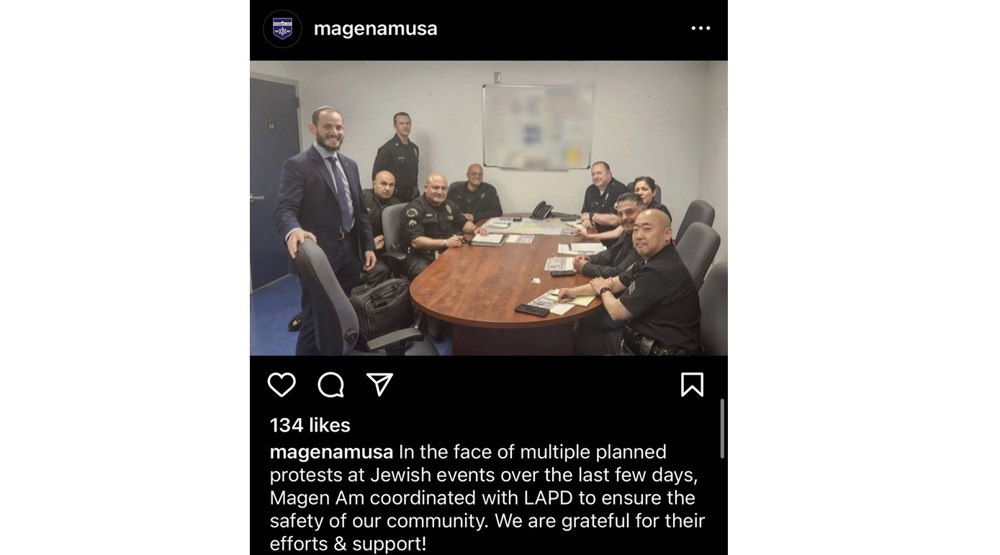
Magen Am, of course, recruits veterans of the occupation forces’ Lone Soldier programme and some then return to “serve” in the genocide as they proudly boast.
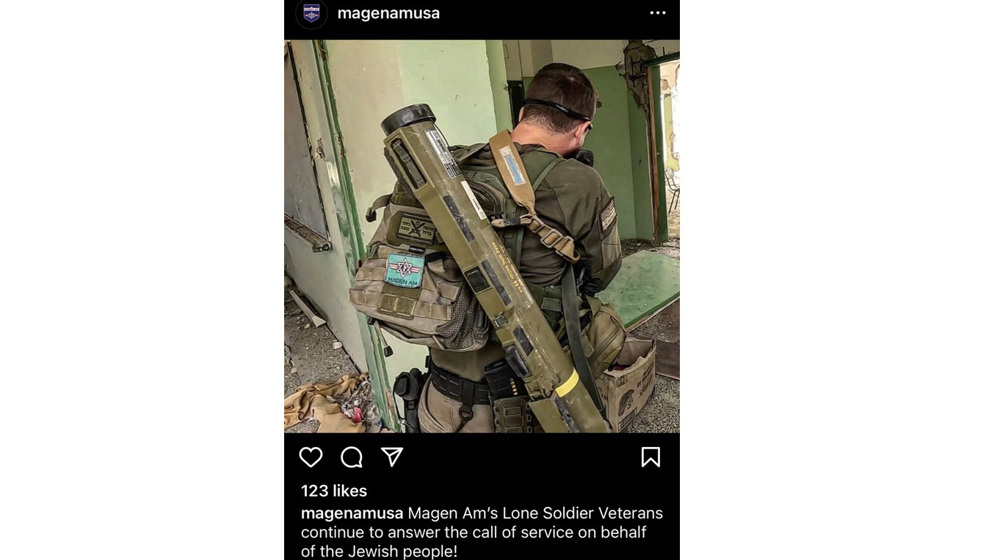
Magen Am was founded in 2017 by Yossi Eilfort, an MMA fighter-turned-Chabad rabbi. The flag of the genocidal Chabad cult was flown by the attackers on campus in Los Angeles.
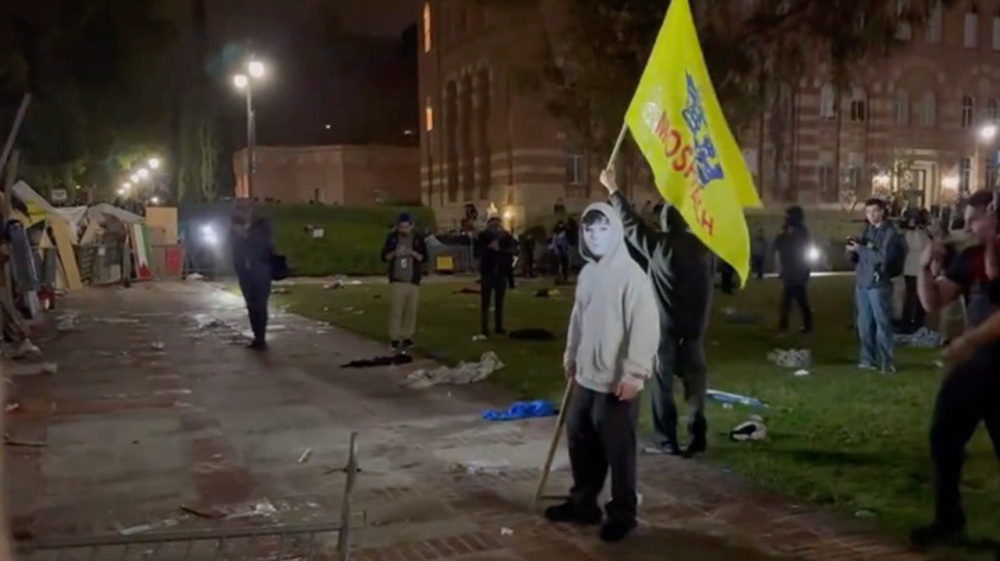
Chabad has many followers in the so-called Hilltop Youth in occupied Palestine, which the Zionist intelligence agency Shin Bet says are responsible for the overwhelming majority of so-called ‘price-tag’ revenge attacks on Palestinians.
The rise of Jewish supremacism in Western societies is becoming increasingly visible, though many continue to deny or downplay its existence.
While Zionist militias and private security firms openly collaborate to suppress student protests in the US, there is a more subtle infiltration of police forces by Zionist Jewish supremacists.
Shomrim: The Private Jewish Patrol
Shomrim is a private Jewish police force operating in parts of the US, UK, Australia, and Belgium. It is reported that “over 20 Shomrim organisations exist worldwide.”
In London, the Shomrim North West Community Patrol operates in the Borough of Barnet. Founded in 2008 by Gary Ost as a registered charity, it acts as a “mobile neighbourhood watch” and acts as eyes and ears for the Metropolitan Police.
Shomrim claims that all “Volunteers have completed training from the Metropolitan Police Counter Terrorism Command (SO15) in assisting to identify potential security threats and suspicious activity. “
One blogger notes that the genocidal cult Chabad also has a ‘nasty tendency to normalize sexual abuse and protect serial sexual predators in its ranks.” But it’s not only Chabad; there is a similar tendency throughout the Zionist movement.
No surprise, then, to find that the founder of Shomrim in London has been implicated in this.
In 2013 Police dropped their investigation into Ost, who had been arrested on suspicion of perverting the course of justice in relation to an investigation of an alleged child sexual abuser, Rabbi Chaim Halpern.
Indeed, charges against the alleged sexual predator were dropped back then, too. Yet new allegations against Rabbi Halpern have resurfaced a decade later, and the trial for these offences is still pending.
Shomrim abuses
In New York, Shomrim has faced criticism for “using excessive force against non-Jewish suspects.”
In 2014, two Shomrim members were charged as part of a group of five Hasidic men for assaulting 22-year-old Black student Taj Patterson as he walked home from a party.
Additionally, Shomrim organizers in New York have reportedly withheld information on suspected Jewish criminals. The NYPD has openly criticized the group for not always notifying police when calls come in, raising concerns about accountability and cooperation.
Given Shomrim’s protected status with law enforcement and the documented culture of sexual abuse in some ultra-Orthodox communities, credible allegations of abuse within these groups are unsurprising.
On October 11, 2023, the United States Department of Justice issued a press release that Jacob Daskal, former head of the Boro Park Shomrim Society—a private Orthodox Jewish crime-patrol group associated with the NYPD—was sentenced to 210 months in prison and fined $250,000 for transporting a minor with intent to engage in criminal sexual activity.
Daskal pleaded guilty to the charge in July 2023. As part of the sentence, Daskal is required to register as a sex offender.” The statement notes that Daskal was introduced to a 15 year old girl “as a result of his position with the Shomrim”, who he then “groomed” for sexual abuse. According to the Department of Justice statement:
“Throughout the abuse, Daskal instructed the victim to delete their communications and warned her not to tell anyone about their sexual relationship. He also used his position as a community leader to silence the victim, bragging about his law enforcement connections and warning her that disclosure would ruin her life. The victim was expelled from her religious school after revealing the relationship to the school principal.”
This case raises troubling questions: How many other abusive situations are currently unfolding within Shomrim and other Jewish militia groups?
Shomrim protects genocide
What is it that Shomrim are protecting? One illustrative example is the Crown Heights Shomrim branch, which in January this year provided security protection for the genocidal President of Israel, Yitzchak Herzog and for the leadership of the genocidal cult Chabad, as shown in the image below.

If Shomrim really wants to protect Jews in the US and UK, they should start by apprehending the entire leadership of Chabad and members of the genocidal Zionist regime.
Police reluctance toward Shomrim in the UK
Initially, UK police were resistant to Shomrim’s activities. In 2008, Chief Superintendent Steve Bending, then Hackney’s borough commander, stated, “I do not support the concept of any community having its own form of patrol service. There is a risk of other communities feeling intimidated by this course of action.”
As late as 2015, Metropolitan Police Commissioner Sir Bernard Hogan-Howe expressed his preference that Shomrim volunteers avoid uniforms resembling those of official officers.
Shomrim, however, rejected this, saying “its volunteers should not drive marked cars or wear uniforms similar to those of the police.” Gary Ost, chief executive of Shomrim in Golders Green, north-west London, stated, “Our uniforms look nothing like the police and are marked from every angle with clear wording saying ‘Shomrim’.”
Yet a glance at their uniforms and liveried vehicles often gives a very different impression.
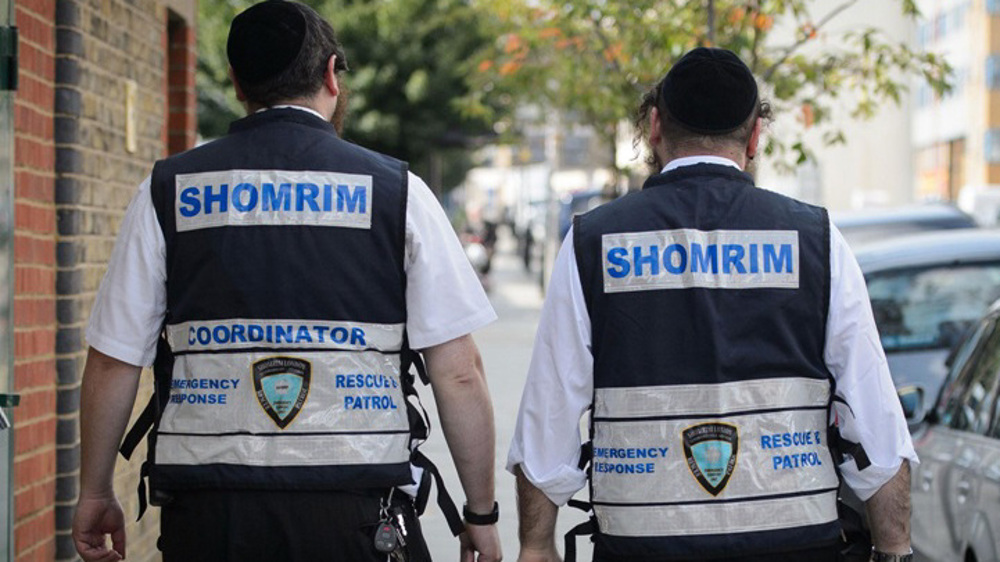

But the penetration of the police is now much more advanced and cooperation is the name of the game. There are numerous examples of apparent cordial relations between the two on the internet.
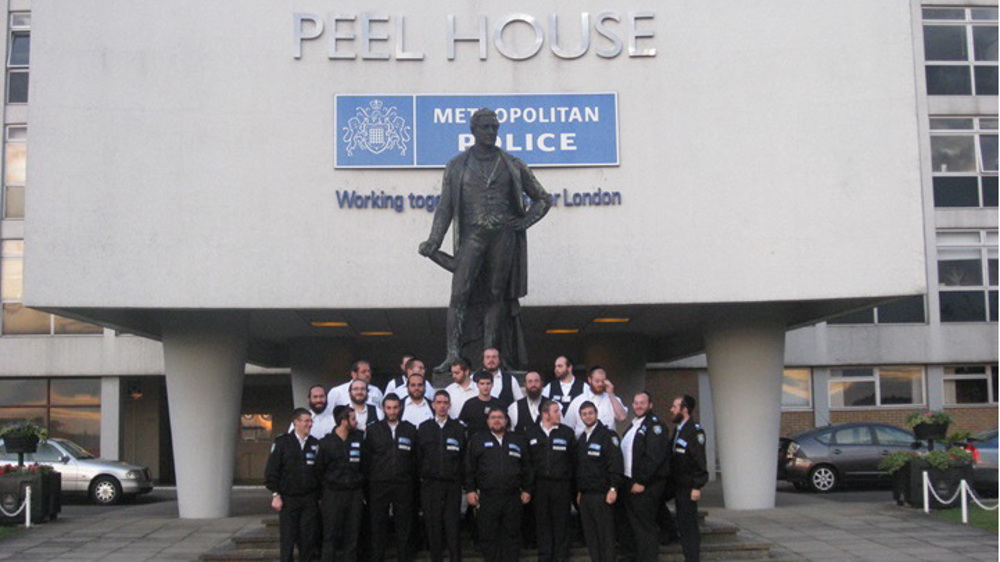
Shomrim members even posed outside Peel House, the headquarters of the Metropolitan Police.
Below is a photo of a prize giving for Shomrim members commended for their “bravery” and “exemplary service to the community” in 2020.
Shomrim chief executive Gary Ost, the one arrested in 2013, is one of the three.

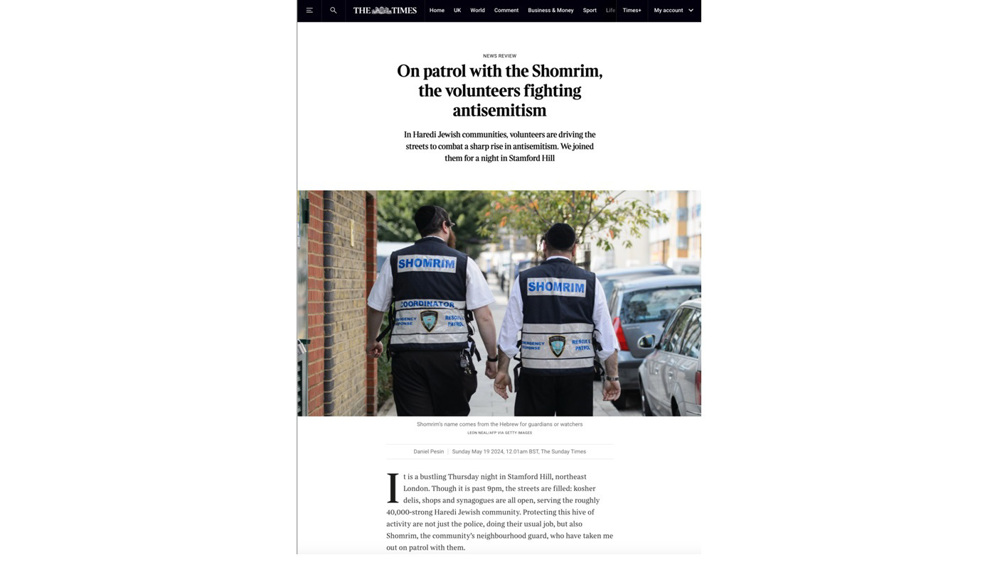
Shomrim plays a key role in shaping the narrative around the widespread antisemitism claims that Israel relies on to justify its genocidal actions.
The pressing question is: What happens when members of Shomrim break the law or commit wrongdoing? Would the police be able—or even willing—to enforce the law against them?
Alon Mizrahi, whom we cited earlier, shared his perspective in a conversation with me:
“They are pretending to be defending themselves in the most friendly country to Jews in history. While committing genocide. In a country that is so hateful of Jews that we need a private police force for Jews only in the US.
“And I have no doubt that if they can normalise this, with the kind of status that Zionist Jews have managed to create for themselves in the US; If this Jewish police force uses violence against black people, black organisers in communities who oppose the genocide, or other migrant groups or any other group, are American police going to be able to charge them?
“To use the law against them? I don’t think so. If you are in the American system, if you have a role in any part of the American system of government, in the police or any other agency, I think that at this point it is clear to you that Zionist Jews are above the law.
“The law doesn’t apply to them. So they don’t have the philosophical or legal means to deal with this. And the Zionists know this.”
Given the current climate, his assessment may well be accurate.
Israeli settlers escalate violence, forced displacement across occupied West Bank

Photo credit: AFP via Getty Images
The Cradle | May 25, 2025
The last few days have witnessed a dangerous escalation of violence, theft, and vandalism against Palestinians by illegal Israeli settlers in the occupied West Bank.
Settlers attacked Palestinians in the Al-Auja Waterfall area in Jericho on 25 May for the third time in one day, as part of ongoing efforts to displace families who have lived in the area for decades and establish a new illegal settlement outpost.
This came a day after settlers, under the protection of the Israeli army, cut off the water supply to the area.
In the Salim plain east of the occupied city of Nablus, settlers also continued to set fire to wheat fields on Sunday, coinciding with separate attacks on Palestinian livestock herders in the northern Jordan Valley area.
On Saturday, at least 40 dunams of wheat fields in the village of Sebastia near Nablus were set ablaze by illegal settlers.
“The colonists came from the Shavei Shomron settlement and a newly established outpost in the area. The arson targeted farmland in the village’s plain, destroying crops owned by local Palestinian residents,” Mohammad Azem, head of the Sebastia municipality, told WAFA news agency on 24 May.
Large amounts of crops were totally destroyed, decimating the livelihoods of the local Palestinian landowners.
At least 70 olive trees belonging to a Palestinian farmer in Hebron were uprooted by settlers on the same day.
The attacks on Saturday came as Israeli occupation troops carried out a large-scale arrest campaign across the West Bank.
Last week, around 150 Palestinians were forced by settlers to leave the village of Mughayyir al-Deir east of Ramallah, following the establishment of a new illegal outpost there and five days of attacks and intimidation.
Settlers harassed Palestinian men while they were dismantling the metal and wooden frameworks of their houses and preparing to evacuate. One of the attackers was Elisha Yered, a member of the extremist Hilltop Youth group who is subject to UK and EU sanctions for numerous crimes against Palestinians.
“This is what redemption looks like! This is a relatively large outpost that contained about 150 people from the enemy population, but it was broken,” he boasted.
Just four days ago, settlers under army protection attacked Palestinians and set fire to homes and vehicles in the town of Bruqin in the northern West Bank. Bruqin and the nearby village of Kafr al-Dik have been under a tight army siege and continuous attacks since the killing of a settler in a shooting on a settlement in the area earlier this month.
Illegal land grabs and expansion of settlements have continued brazenly by the Israeli government, in stark violation of international law.
The UN Human Rights Office noted in a report in March that there has been a significant expansion of illegal settlements in the occupied territory, citing reports from Israeli NGOs indicating that tens of thousands of new housing units are scheduled to be built in new or existing settlements.
Since the start of this year, Israeli occupation forces have been been carrying out a deadly military operation and siege against several West Bank cities. The operation began on 21 January and was dubbed Iron Wall.
According to the UN, at least 40,000 Palestinians have been displaced from their homes, as Israel continues to systematically demolish Palestinian houses in the refugee camps of Jenin and Tulkarem.
Will the international community rethink its support for Israel’s security narrative?
By Ramona Wadi | MEMO | May 24, 2025
Earlier this week, Israel fired warning shots at an international diplomatic delegation in the occupied West Bank. According to the Israeli military, the delegation “deviated from the approved route and entered an area where they were not authorised to be”. The delegation was visiting the Jenin refugee camp, which both Israel and the Palestinian Authority have targeted in a bid to extinguish the Palestinian anti-colonial resistance. Over 22,000 Palestinians have been displaced from Jenin.
The diplomatic delegation was targeted just a day after the EU said it would be reviewing the EU-Israel Association Agreement. In response to the Israeli military’s actions, several governments spoke up immediately, condemning the threat to the diplomats’ lives and asking for immediate investigations. Diplomats, after all, have diplomatic immunity, as UN spokesperson Stephanie Dujarric swiftly reminded. “Diplomats who are doing their work should never be shot at, attacked in any way, shape or form,” Dujarric stated.
But what governments and UN representatives are leaving out is the fact that diplomats witnessed Israel’s security narrative in action against them. Israel’s action was not a mere breach of diplomatic immunity. It was a taste of what the settler-colonial entity feels entitled to impart to anyone who oversteps its imagined boundaries.
The question is, therefore, how far has the international community normalised Israel’s security narrative? The answer will give an idea of how far reaching Israel perceives its security narrative to be.
When the international community upholds Israel’s purported right to defend itself, it automatically applies Israel’s security narrative against the Palestinians who have the right to resist colonisation by all means. The same warped politics was applied to the genocide in Gaza since October 2023.
But Israel internationalised its security narrative. It exported the narrative to all corners of the world, marketed it when the US embarked on its War on Terror, and consolidated the principle through the sales of military and surveillance technology. The UN endorsed it at a global level; individual countries followed suit. Diplomacy became beholden to Israel’s security narrative, as did the Palestinian right of return, the two-state paradigm and even mere symbolic recognition of a Palestinian state. The EU’s illusory state-building, associated with the PA and the occupied West Bank, was also controlled by Israel’s security narrative. As were the EU’s infrastructure and development projects, many of which were destroyed by Israel under the pretext of security. When diplomats and UN personnel were refused entry by Israel, international condemnation was softer than a lullaby. And when Israel’s targeted assassinations involved violating other nations’ sovereignty, Israel’s security narrative took precedence. After all, Israel had a reason that the international community pledged to support – the complete colonisation of Palestine.
Through complicity and silence, the international community enabled a colonial ideology to shape all political and humanitarian initiatives. By enabling and being complicit in colonisation, the international community assumed immunity from Israel’s bullets. But nothing and no one is immune in a colonial framework.
Of course, the countries whose diplomats were targeted in Jenin are expected to take care of their own. But have world leaders paused to realise that ignoring or normalising the consequences of Israel’s security narrative can spill out to endanger the entire world?
Unlike the limits within which Palestinian anti-colonial resistance fights its battle, Israel has embroiled the entire world in its colonial violence and genocide. Israel presented Palestinians as a threat to its colonial establishment that must be annihilated. To promote its security narrative, Israel equated the Palestinian people with international terror. It sold genocide in Gaza as moral and the world acquiesced. After Gaza, does the international community really think that Israel will shy away from firing at diplomats?
We must also take note of the fact that Israel fired warning shots at diplomats in the occupied West Bank, which is the international community’s playground when it comes to its donor funding schemes. Far removed from Gaza, the international community would have us believe, simply because of its investments which create an illusion of prosperity. It only took a few Israeli bullets targeting international diplomats for governments to shatter the illusion they promote.
Will the international community now pause to at least rethink who Israel considers an enemy? Alongside Palestinians, UN personnel have been killed in Gaza, as have humanitarian workers. Yet even in these cases, the international community was more concerned with enabling Israel to continue its genocide. Besides normalising Israel’s genocide of Palestinians in Gaza, the deliberate, targeted killing of international aid workers, despite the initial outcry, was also normalised as collateral damage.
Without safeguarding Palestinians from genocide and all forms of Israel colonial violence, the international community’s safety will be breached over and over again. And while international safety is gradually eroded, Palestinians are being murdered, forcibly displaced and ethnically cleansed, in the name of security.
Israel’s security narrative is a dangerous spectrum that must be seen as a whole. To see the entirety of it, the international community must turn its attention to the colonised Palestinian population, who have been beaten, shot at, detained, tortured and murdered, merely for inhabiting their own land. Not by sending delegations on exploitative tours that do nothing to end colonialism, but by protecting Palestinians and their anti-colonial resistance.
Can the international community at least acknowledge that, despite the support it has given to Israel, it finds itself in a position where power and vulnerability meet in a space that is still controlled by Israel and its colonial violence? How profitable is it to support the colonisation of Palestine and the genocide of its people, when Israel’s aggression against the international community remains unacknowledged except through stale condemnations?
A breach of diplomatic immunity is an offence. Genocide is a war crime. This is the spectrum that Israel’s security narrative dominates, financed by the same governments who paid money into colonisation and genocide. The only difference is that the international community endorses the illusion of a single enemy as fabricated by Israel – the Palestinians – even though Israel targets anything and anyone standing in its way. Israel is a threat to security, but unfortunately for Palestinians and the rest of the world, it doesn’t stand alone.
‘Sadistic pattern’ of genocide: UN condemns Israeli killing of Gaza doctor’s nine children
Press TV – May 24, 2025
UN Special Rapporteur Francesca Albanese has condemned Israel’s Friday airstrike on the home of Palestinian doctors Alaa and Hamdi Al-Najjar, which killed nine of their ten children.
Alaa Al-Najjar, a paediatrician at Nasser Hospital in Gaza, was on duty treating young patients when she learned nine of her children—aged 2 to 16—had been killed in an Israeli bombardment of their Khan Yunis home.
Rescue teams later retrieved the children’s bodies, eight of which were mutilated beyond recognition by the blast.
Commenting on a video published by Mads Gilbert, a Norwegian physician who volunteers in Palestine, Albanese said the attack represented a “distinguishable sadistic pattern of the new phase of the genocide”.
The attack reduced the family’s residence to rubble and ignited fires across the surrounding area.
Alaa’s husband and one surviving child sustained injuries in the attack.
Israeli military forces systematically target civilian families, medical facilities, and healthcare personnel as part of its ongoing Genocide in Gaza.
Muneer Alboursh, director general of the Palestinian health ministry in Gaza, says Israel has killed 12 health workers in the past week, many of them in targeted attacks on their homes.
He said Israel is “systematically” targeting medical staff and facilities, especially in the northern areas of Gaza, to destroy the health care system there and push people further south.
His remarks come days after Israel’s finance minister declared that the regime is now “finally” targeting what he called the “civilian structure of Hamas.”
Israel launched the campaign of genocide in Gaza on October 7, 2023. It has killed at least 53,800 Palestinians there so far, according to the health ministry of Gaza.
Crazy shopping in Tel Aviv
By Lorenzo Maria Pacini | Strategic Culture Foundation | May 23, 2025
If you are still wondering what Italy’s position is in the Israeli-Palestinian conflict, don’t worry: for the umpteenth time, Prime Minister Giorgia Meloni has reiterated that Italy stands with Israel, always, at any cost.
In front of an international court, such a statement would automatically be condemned as ‘complicity in genocide’, on a par with what was decreed in Nuremberg after the Second World War. However, since mere statements by politicians are not enough, evidence of this ‘participation’ in a crime against humanity must be provided. There are several pieces of evidence, including the recent shopping spree that the Italian government went on in Tel Aviv and the surrounding area.
While Israeli bombing continues in the Gaza Strip, Italy is preparing to purchase military technology to equip itself with a new fleet of reconnaissance aircraft. It should be noted that military cooperation between the two countries is not a new development, far from it. On 15 April, Defence Minister Guido Crosetto sent Parliament a draft ministerial decree (SMD 19/2024) aimed at the ‘gradual implementation of multi-mission multi-sensor (MMMS) operational suites on a shared Gulfstream G550 platform’. By 26 May, the Senate Defence Committee will have to give its opinion: it may approve, reject or request amendments to the measure. Meanwhile, on 6 May, the Chamber of Deputies’ Budget Committee gave the green light to the decree in just five minutes and without discussion. According to the Military Code, if the parliamentary committees express a negative opinion, the executive is obliged to refer the decree back to the Chambers accompanied by counter-arguments. If the negative opinion is confirmed by an absolute majority and justified by non-alignment with the Multi-Year Defence Programme, the programme cannot be implemented.
The measure represents the third phase of a long-term project to convert Gulfstream G550 civil jets (known as ‘green’ in military circles) into surveillance and intelligence aircraft, thanks to technology provided by Elta Systems Ltd, an Israeli company part of the Israel Aerospace Industries (IAI) group. The total value of the entire programme exceeds three billion euros. The first two phases have already been approved and implemented.
Elta Systems’ technologies, specialising in surveillance, electronic warfare and target identification, are used worldwide and supplied to regular armies and paramilitary forces. These same technologies are also widely used by the Israeli armed forces against the Palestinian people and other entities considered “enemies”. The link between Elta and the Israeli army is very close: many employees come from special units of the Israeli Defence Forces (IDF) or are still serving there.
In 2016, Italy received its first two G550 CAEW (Conformal Airborne Early Warning) aircraft from Israel, equipped by the company with advanced surveillance and command capabilities, currently operational at the 14th Wing in Pratica di Mare.
As part of a bilateral agreement, in addition to the spy planes, Italy also purchased the OPTSAT 3000 optical military satellite from Israel, while in exchange Tel Aviv bought thirty Alenia Aermacchi M-346 training jets from Italy, supplied by Leonardo Spa.
Decree SMD 3/2020 marked the start of the next phase of the programme: the purchase and conversion of eight more aircraft to Full Mission Capable (FMC) configuration, integrating CAEW capabilities with electronic warfare, interception and intelligence systems. Six civilian Gulfstream aircraft were purchased for conversion and two were already equipped for military use. Cost: €1.223 billion. The courier has already delivered the package to Pratica di Mare.
The 2020 decree explicitly refers to intergovernmental agreements (Gov to Gov) between Italy and Israel, the Memorandum of Understanding and agreements between Italian companies (primarily Leonardo), Israeli companies (Elta System) and US companies (L3 Harris), with the possibility of involving additional Israeli companies. If the deal is good, shopping works.
The next phase, SMD 37/2021, provided for the conversion of four of the six civilian aircraft already purchased into military aircraft. This part of the programme was also carried out using Elta technology, at an additional cost of €925 million.
The third and current phase of the project, defined in decree SMD 19/2024, has gone from an initial estimate of €994 million to an updated cost of €1.632 billion. It includes the military conversion of the last two civilian Gulfstreams, the purchase of an eleventh aircraft for testing and experimentation, and the construction of the ISTAR citadel in Pratica di Mare, equipped with hangars, operational facilities and satellite connection to support the fleet. As in previous decrees, this one also provides for intergovernmental cooperation based on existing schemes.
Business is business
Let’s face it: wars have always existed and the world cannot stop in the face of conflict. Nor can the commercial business that follows. This is the logic of the double game that Italy continues to play with Israel: arms sales behind the scenes, controversy over respect for international law in front of the cameras.
According to Italian law, the sale of arms to states involved in armed conflicts is prohibited. Israel falls into this category, which is why exports should be suspended. The law in question is No. 185 of 1990. Italy ranks third among the main suppliers of arms to Israel, with a share of 4.7%, behind the United States (65.6%) and Germany (29.7%). However, data from the Customs Agency (Agenzia delle Entrate, in italian) show that between December 2023 and January 2024, Italy exported arms and ammunition worth more than €2 million to Israel. The government justified this in 2024, specifying that the business of blood and destruction continues under old licences that were signed before 7 October 2023.
Nevertheless, considering the preliminary decision of the International Court of Justice on alleged violations of the Convention on the Prevention of Genocide and the request for an arrest warrant for Prime Minister Netanyahu, arms exports to Israel after 7 October could expose Italy to the risk of being held jointly responsible for violations of international law attributed to Israel.
This is the political rhetoric of Italy, which leads the way in relations with Israel for the whole of Europe, as the main commercial hub for the IMEC, the Cotton Road, which is multilateral in nature and represents, from the US point of view, an alternative to the Chinese ‘New Silk Road’. It should be remembered that the initiative was presented during the G20 summit held in New Delhi, India, on 10 September 2023. On that occasion, India, the United States (Biden administration), the European Union, France, Germany, Italy, Saudi Arabia and the United Arab Emirates signed a memorandum of understanding for the creation of an economic corridor linking India, the Middle East and Europe (IMEC).
The ambitious plan focuses on infrastructure development and has two main components: a railway line connecting Europe with the Gulf (involving the United Arab Emirates, Saudi Arabia, Israel and Jordan), and a maritime route connecting India with the Gulf region. The initiative is supported by the Partnership for Global Infrastructure and Investment (PGII), created by the G7 in 2022, and by the European Global Gateway program, which has earmarked up to €300 billion for investment in international infrastructure between 2021 and 2027.
For Italy, the initiative is also of strategic importance due to its geographical position between the Mediterranean and the Indo-Pacific, and it is from Israel and its ports that it will receive the goods that Israel will always need to build its business. It does not matter if this means perpetrating genocide, the important thing is that the economic interests of the two countries are protected. Capital wins over Man, the logic of interest prevails over that of humanity.
Peru opens criminal probe into Israeli soldier accused of ‘methodical destruction’ in Gaza
The Cradle | May 24, 2025
Authorities in Peru have opened a criminal investigation against an Israeli soldier accused of committing war crimes in the Gaza Strip during 2023–2024, according to the Hind Rajab Foundation, a Brussels-based NGO focused on taking legal action against Israeli soldiers committing rights violations.
The investigation was initiated following a complaint filed by prominent human rights lawyer Julio César Arbizu González. The complaint alleges that the individual, whose name has not been released, served as a combat engineering soldier and took part in the “methodical and systematic destruction of civilian neighborhoods in the Gaza Strip.”
Footage shared on social media showed the soldier celebrating while detonating a civilian building.
The Hind Rajab Foundation says the suspect could face charges including “war crimes, crimes against humanity, and acts of genocide.”
It praised Peru’s “adherence to the principles of international humanitarian and criminal law.” The principle of universal jurisdiction obliges countries to prosecute serious crimes regardless of where they were committed or the nationality of the suspects.
The foundation stated that the Combat Engineering Corps in which the soldier served was a “core operational arm of destruction, systematically reducing civilian areas to rubble, erasing entire communities, and rendering large swathes of Gaza uninhabitable.”
“Justice is not optional. Justice is imperative,” said Dyab Abou Jahjah, chairman of the Hind Rajab Foundation. “This investigation marks a decisive step in the dismantling of Israeli impunity,” he added.
In February, Jahjah told The Cradle, “There are two kinds of cases we are fighting. You have the cases against dual nationals who have been participating in the genocide in Gaza. And then you have cases against visiting soldiers, of whom we don’t know whether they have other nationalities, but we know that they have been committing war crimes, and they travel abroad mostly for tourism.”
Earlier this month, Prime Minister Benjamin Netanyahu told the Knesset’s Foreign Affairs and Defense Committee yesterday that Israel is “destroying more and more houses [in Gaza and Palestinians accordingly] have nowhere to return,” according to quotes from the session leaked to the media.
“The only obvious result will be Gazans choosing to emigrate outside of the Strip,” Netanyahu continued. “But our main problem is finding countries to take them in.”
Founded in September 2024, the Hind Rajab Foundation is named after a Palestinian girl who was brutally murdered, along with several members of her family and first responders seeking to rescue her, by Israeli tank gunners in Gaza.
The organization gathers open-source intelligence on Israeli soldiers, including details of their military service, aiming to facilitate prosecutions abroad.
Israeli strike kills six aid security workers in Deir al-Balah
MEMO | May 23, 2025
Six members of a security aid team were killed early Friday in Deir al-Balah, central Gaza, due to an Israeli air strike, as reported by the Government Media Office.
The statement, sent to Safa news agency, described the incident as “a horrific massacre” and accused the Israeli military of deliberately targeting the team as part of a strategy to “engineer starvation and obstruct humanitarian relief”.
The office condemned the attack, reporting that the Israeli army carried out eight air strikes in the area. Several victims remain at the scene, which has become difficult to access due to continued shelling and ongoing gunfire from Israeli aircraft.
“These individuals were performing purely humanitarian duties,” the statement added, “by securing two trucks carrying vital medicines and medical supplies for the health sector, to ensure their delivery to hospitals in devastated areas. Targeting them is a full-fledged crime that exposes the true intent of the occupation to disrupt the flow of humanitarian and medical aid and to create chaos and insecurity in line with its plan to starve the population and deny treatment to the sick.”
The office further stressed that the Israeli military is systematically enabling the looting of aid and medical convoys by attacking those responsible for coordinating and protecting safe delivery routes.
US roadmap for Syria sanctions removal includes Israel normalization, expulsion of Palestinian factions
The Cradle | May 23, 2025
A State Department proposal circulated among officials lays out “sweeping conditions for future phases of relief or permanent lifting of sanctions” on Syria, including normalizing relations with Israel by signing the Abraham Accords, AP reported on 23 May, citing an anonymous US official familiar with the matter.
US-imposed sanctions have devastated the Syrian economy, plunged millions into poverty, and blocked post-war reconstruction. They were imposed as part of the US and Israeli effort to topple the government of former Syrian president Bashar al-Assad.
Assad was ousted in December by militants from Hayat Tahrir al-Sham (HTS), the former Al-Qaeda affiliate, with US, Israeli, and Turkish assistance. HTS leader Ahmad al-Sharaa is now the de facto Syrian president.
However, the US is not yet ready to remove sanctions.
A document issued last week by the State Department’s policy and planning staff has proposed a three-phase road map for sanctions relief, starting with short-term waivers. Permanent lifting of sanctions would only be given after several conditions are met.
According to the document, “Palestinian terror groups” must be removed from Syria to get to the second stage.
The Syrian government must also take control of detention facilities housing ISIS fighters in northeast Syria and carry out a recent deal to incorporate the US-backed, Kurdish-led Syrian Democratic Forces (SDF) into the Syrian army. The SDF currently controls the prisons housing ISIS members and their families, as well as much of Syria’s oil fields.
Phase three would require Damascus to normalize relations with Tel Aviv by joining the Abraham Accords, as well as prove that it had destroyed all of the previous government’s chemical weapons.
If normalization happens, Syria would de facto acknowledge Israel’s annexation of the occupied Syrian Golan Heights.
Israeli Prime Minister Benjamin Netanyahu has previously pushed for US President Donald Trump’s administration not to lift sanctions on Syria.
President Trump raised expectations that all Syria sanctions would quickly be removed when he announced in Saudi Arabia last week that he would “be ordering the cessation of sanctions against Syria in order to give them a chance at greatness.”
“We’re taking them all off,” Trump said a day before meeting the Syrian president, a former deputy of ISIS leader Abu Bakr al-Baghdadi.
“Good luck, Syria. Show us something special,” he went on to say.
However, when asked what sanctions relief should look like overall, Secretary of State Marco Rubio said relief would be “Incremental.”
Washington has levied sanctions against Syria since 1979 for its foreign policy opposing Israel.
To block Syria’s post-war reconstruction, the harshest sanctions were imposed in 2019 by Congress through the passage of the Caesar Syria Civilian Protection Act.
As a result, a new law in Congress must be passed to remove the Caesar sanctions. Trump is only able to issue six-month waivers, which is not enough to encourage investors to return to doing business in the country.
On Friday, two Palestinian sources told AFP that the leaders of Palestinian resistance factions have left Syria under pressure from the new authorities in Damascus.
The leaders include Khaled Jibril, son of Popular Front for the Liberation of Palestine-General Command (PFLP-GC) founder Ahmad Jibril, as well as Palestinian Popular Struggle Front Secretary-General Khaled Abdel Majid and Fatah al-Intifada Secretary-General Ziad al-Saghir.
Heavy Israeli strikes hit south Lebanon ahead of final vote in municipal elections
The Cradle | May 23, 2025
The Israeli army unleashed a violent wave of airstrikes across southern and eastern Lebanon on the evening of 22 May, striking what it claimed were Hezbollah weapons sites.
The attacks were preceded by an evacuation order for a building in the town of Toul, in the Nabatieh district of southern Lebanon north of the Litani River, citing the presence of Hezbollah facilities.
Following a “warning strike,” Israel bombed and destroyed the building – which had already been struck during the war last year, according to Al-Manar.
Israel then proceeded to carry out airstrikes in several southern regions, including the Iqlim al-Tuffah region, Mahmoudia, Jabal al-Rafi, and Jabal Safi. The vicinity of a school in the town of Tulin were among the areas bombarded.
Additionally, Israeli ground troops opened fire at the southern town of Aitaroun as the strikes were happening.
An airstrike also hit the town of Boudai in the eastern Baalbek region of Lebanon. The Israeli army said in a statement that it “attacked a military site containing rocket launchers and weapons in the Bekaa Valley with fighter jets,” as well as “terrorist infrastructure, rocket launchers, and missiles” in the south, accusing the resistance of violating the ceasefire and attempting to reconstitute its forces.
According to Lebanese media, these were some of the heaviest strikes on the country since the war ended last year.
Lebanese Prime Minister Nawaf Salam condemned the attacks and said they came at a “dangerous” time. They occurred just two days before the final round of municipal elections in south Lebanon – the first to be held since the ceasefire agreement was reached in November 2024.
“Prime Minister Salam stresses that these violations will not thwart the state’s commitment to holding the elections and protecting Lebanon and the Lebanese,” Salam’s office said in a statement.
Despite the devastating war that ravaged southern and eastern Lebanon and the southern suburb of Beirut last year, Hezbollah has retained significant popular support.
During the first rounds of voting two weeks ago, Hezbollah-backed lists won in the Shia-inhabited towns of Ain al-Ghuwaybah, Hajoula, Ras Asta, Bashtlida, Fidar, Mishan, Almat al-Sawaneh, Lassa, Afqa, al-Maghiri, and al-Husun.
The final round of voting will be held on 24 May in Nabatieh and other southern governorates, which have endured brutal Israeli strikes during the war and even after the ceasefire.
“This year’s municipal and elective elections come as a challenge of resilience, steadfastness, and commitment to the land – rebuilding it with its people, orchards, houses, and all elements of life,” Hezbollah Secretary-General Naim Qassem said on Thursday.
Qassem also stressed that “the continued Israeli occupation of any inch of our land and homeland will not be accepted.”
Tel Aviv’s violations of the ceasefire agreement reached in November last year have continued unabated.
Over 200 people have been killed in the more than 3,000 Israeli violations of the US-sponsored deal since the end of 2024.
Israeli troops also occupy five locations along the border in the south, where they established themselves following the ceasefire deal in violation of the agreement. This is aside from the Lebanese land that Israel has already been illegally occupying for decades, including the Kfar Shuba hills and Shebaa Farms.
Featured Video

America Racing to Strategic Defeat in Iran
or go to
Aletho News Archives – Video-Images
From the Archives
Should Europeans ‘Thank’ the Americans for Destroying Nord Stream?
By Robert Bridge | Strategic Culture Foundation | September 29, 2022
With an investigation continuing into the destruction of the Nord Stream gas pipeline that provided energy supplies to Europe from Russia, there appears to be just one prime suspect, and that should surprise nobody.
Following the sabotage of the Nord Stream 1 and 2 gas pipelines, former Polish Foreign Minister Radoslaw Sikorski already seemed to know the identity of the perpetrator when he tweeted out: “Thank you, USA.”
At first glance, it seemed that Sikorski was speaking sarcastically, berating Washington for carrying out an attack that will have severe repercussions for the people of Europe. After all, how could anyone see any good coming from the termination of Europe’s primary source of gas reserves with winter just around the corner? It was Sikorski’s homeland of Poland, after all, that urged its citizens to collect firewood in the face of dwindling gas reserves.
In fact, the Polish diplomat was speaking one-hundred percent literally… continue
Blog Roll
 Aletho News
- Growing insecurity, soaring prices fuel protests in north as regime bans evacuation: Sources
- Iran denies responsibility for ‘depraved’ attack on Kuwait desalination plant
- Bring The Troops Back. End This War Now!
- Can we please stop calling Israel the ‘only democracy in the Middle East’ now?
- US should start removing its troops for Germany, proposes AfD co-leader Chrupalla
- Iran Red Crescent: 600 educational centers attacked in US-Israeli ‘war crimes’
- Russian Oil Tanker Arrives in Cuba Amid U.S. Blockade
- America Racing to Strategic Defeat in Iran: Lt Col Daniel Davis
- FTC Warns Visa, Mastercard, PayPal, Stripe Over Political Debanking
- Russian tanker approaches Cuba despite US oil blockade
- If Americans Knew
- Israeli police block Catholic cardinal from entering Church of the Holy Sepulchre on Palm Sunday
- Israel is assassinating journalists again, more than any other nation, anywhere, ever – Not a ceasefire Day 170
- Over 300 US service members wounded, majority have brain injuries – Not a ceasefire Day 169
- Researchers at Human Rights Watch Resign Over Blocked Report on Palestinian Refugee Return
- Jewish Groups Are Backing a War Americans Don’t Want
- Eric Fingerhut Thinks He’s the President of the Jews
- Top Jewish Philanthropists, Rabbis Urge Israeli President to Take Action Against ‘Jewish Extremists’
- Don’t Be Fooled. Zionist Leaders Have Always Wanted to Control Southern Lebanon
- Israel’s widespread use of torture is a core element of its genocide against the Palestinian people
- In Israel’s War on Iran, Many Middle East US Bases Rendered “All But Uninhabitable”
- No Tricks Zone
- New Study Finds Warming Saves Lives…Cold Temperatures 12 Times More Deadly Than Excess Heat
- German Science Blog Accuses PIK Climate Institute Of Hallucinating Climate Tipping Points
- Devastating Assessment Of Comirnaty Vaccine By Former Senior Pfizer Europe Toxicologist
- New Study: CO2 Is ‘Effectively Negligible’ As An Explanatory Climate Change Factor Since 2000
- Former Pfizer Toxicologist Dr. Helmut Sterz Tells Bundestag Hearing Pfizer Vaccine Should Have Never Been Approved
- Energy Expert: Germany’s Nuclear Phaseout Was A “500 Billion Euro Mistake”
- New Research: South Australia’s Mid-Holocene Sea Surface Temperatures Were 4°C Warmer Than Today
- Storing Green Energy To Last Germany 10 Days Would Require A 60-Million Tonne Battery
- New Studies: UK Sea Levels Were 4 Meters Higher Than Today During The Mid-Holocene
- Destructive Green New Deal: German Energy And Metal Group Warns Of Drastic Crisis
 Aletho News