IRGC decries attack on US embassy in Riyadh, says executed by ‘Israel’
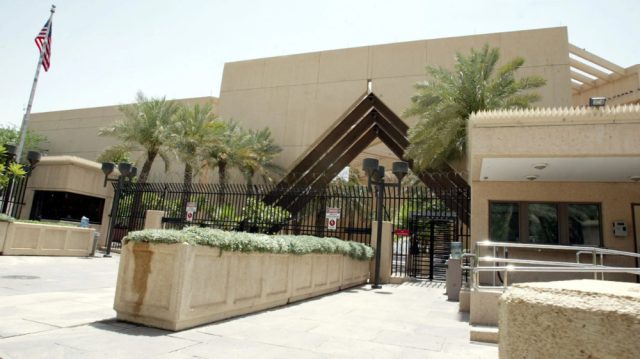
The US Embassy in Riyadh, Saudi Arabia (File photo by AFP)
Al Mayadeen | April 4, 2026
The Islamic Revolution Guard Corps’ (IRGC) has rejected accusations that it was responsible for an attack on the US Embassy in Riyadh, Saudi Arabia, emphasizing instead that it was a false flag operation carried out by the Israeli entity.
In Statement No. 54 of Operation True Promise 4, the IRGC’s Public Relations Department condemned the attack on the embassy, which was reported by The Wall Street Journal, stressing that, recalling the Israeli occupation’s regional strategies, “this action was certainly carried out by Zionists.”
The IRGC confirmed that the Iranian Armed Forces’ target list has been clearly identified, adding that Iran had already informed neighboring countries of the necessary warnings to “prevent further escalation.”
The IRGC also warned that West Asia “must remain vigilant against provocations from the American–Zionist current,” which aims to destabilize and destroy the region.
A series of false flags
Iran has repeatedly stressed that its operations target US-Israeli military assets and affiliated infrastructure in the region and across the occupied territories in Palestine, quickly pointing out false flags and highlighting ongoing enemy attacks that seek to disturb regional harmony.
It has also delineated target lists for its tit-for-tat retaliations for attacks on its civilian infrastructure, including US assets in the region. The US embassy in Riyadh was not among them.
Only yesterday, the IRGC condemned the targeting of water desalination plants in Kuwait, asserting that the Israeli entity “is behind this cowardly act of aggression aimed at sowing discord.” On Monday, a Kuwaiti power and desalination plant was also struck, killing an Indian worker and causing significant material damage.
Kuwaiti authorities were quick to attribute the attack to Iran, but Tehran squarely denied involvement and blamed “Israel,” with the spokesperson for Iran’s Khatam al-Anbiya Central Headquarters describing the incident as “evidence of the enemy’s depravity and malice,” saying it forms part of broader efforts to inflame tensions and undermine regional stability.
Similarly, following a fire at Saudi Aramco’s Ras Tanura refinery in early March, an Iranian military source told Tasnim News Agency that the attack was “an Israeli false flag operation” aimed at distracting regional countries from “Israel’s” strikes on civilian sites inside Iran, stressing that “Aramco facilities have not been among the targets of Iranian attacks so far.”
Iran accuses adversaries of false flags to strain Turkey ties
Al Mayadeen | March 31, 2026
Iranian Foreign Minister Abbas Araghchi categorically denied reports claiming that Iranian missiles had been launched toward Turkish territory, describing them as “completely baseless.”
During a phone call with his Turkish counterpart Hakan Fidan, Araghchi warned of attempts by regional adversaries to undermine the atmosphere of peace and friendship between the two neighboring countries.
Araghchi also discussed the repercussions of the ongoing US-Israeli aggression against Iran, reaffirming Tehran’s commitment to the principles of good neighborliness and respect for Turkey’s national sovereignty.
The Iranian foreign minister expressed his country’s full readiness to cooperate in verifying any such claims.
In his remarks to Fidan, Araghchi stressed the need for the international community to condemn US and Israeli aggression targeting schools, universities, energy infrastructure, and residential areas. He added that “the American rhetoric openly threatening to attack Iranian production facilities constitutes a criminal threat and a clear disregard for international law and humanitarian principles.”
He concluded by emphasizing that US violations require a decisive response from all states and governments to prevent further escalation and to stop aggressive powers from violating the resources of the region’s peoples and destroying their infrastructure.
It is worth noting that the Turkish president has repeatedly affirmed that his country will not be drawn into the ongoing US-Israeli war on Iran.
Araghchi calls on Caspian states to take a firm stance against aggression
In the same context, Araghchi told his Azerbaijani counterpart Jeyhun Bayramov that Iran is taking defensive measures against the aggressors’ military bases and installations located in countries across the region.
He further noted that the countries bordering the Caspian Sea must adopt a firm position regarding the recent aggression on certain coastal areas of the Caspian Sea.
Iran warns against potential false-flag attacks framing Iran
The Islamic Revolution Guard Corps lately condemned the drone strike targeting the residence of the president of the Iraqi Kurdistan Region in Duhok, Nechirvan Barzani, describing it as an “act of terrorism” linked to recent attacks against Iranian officials.
Earlier, Iranian officials and sources repeatedly warned of false flag attacks, indicating that “Israel” and the United States have been intending to expand false flag operations to target regional actors and frame Iran for the attacks.
On March 15, late Iranian Secretary of the National Security Council Ali Larijani warned of a potential large-scale false flag attack on United States soil allegedly designed to frame Iran. In a post on X, Larijani claimed, “I’ve heard that the remaining members of Epstein’s network have devised a conspiracy to create an incident similar to 9/11 and blame Iran for it.”
Shahed-136 drone copied into LUCAS
Earlier on March 15, the spokesperson for Khatam al-Anbiya Central Headquarters warned neighboring countries and Muslim populations in the region that Iran’s enemies have replicated the Shahed-136 drone, renaming it the LUCAS drone and using it to strike illegitimate targets across the region.
The statement accused “Israel” and the United States of resorting to deception after their failures on the military and political fronts against Iran. By copying the Shahed-136 drone, the spokesperson said the “enemy aims to carry out attacks while falsely attributing them to Iran.”
“This malicious tactic is designed to sow doubt, direct accusations at the Islamic Republic of Iran, and create division between Iran and its neighbors,” the statement said, adding that such actions seek to discredit what it described as the lawful defensive measures of the Iranian Armed Forces.
Larijani emphasized that Iran “fundamentally opposes such terrorist schemes,” underlining that the country has no conflict with the American people. “We have no war with the American people,” he wrote, asserting that Iran is merely defending itself against aggression launched by the United States and “Israel”. He added that Iran “stands tall in doing so in order to teach the aggressors a lesson.”
‘Israel’ working to expand false flag operations across Middle East
On March 8, a regional security source told Al Mayadeen that “Israel” is working to expand false flag operations across West Asia and in several European countries, citing what the source described as confirmed intelligence information.
According to the source, recent attacks targeting Cyprus, Azerbaijan, and Riyadh were carried out by “Israel”.
The source also said there is “reliable information” suggesting that similar security and military operations could occur. These incidents, the source said, may be falsely attributed to Iran or to the Axis of Resistance.
Separately, an informed official in Iran’s Ministry of Intelligence warned on March 7 of a potential Israeli scheme to target the Al-Aqsa Mosque in occupied al-Quds in an attempt to blame Iran and Resistance movements.
According to the Iranian Tasnim News Agency, the official said the alleged plan could involve a false flag operation using drones or missiles aimed at the mosque compound.
Iran denies responsibility for ‘depraved’ attack on Kuwait desalination plant
The Cradle | March 30, 2026
The Iranian military denied on 30 March the recent attack, which hit a desalination plant in Kuwait, labeling the strike a US-Israeli false-flag operation aimed at “destabilizing and destroying the region.”
“The brutal aggression by the Zionist regime against the desalination facility in Kuwait, carried out in recent hours under the pretext of accusing the Islamic Republic of Iran, is a sign of the vileness and depravity of the Zionist occupiers,” the Khatam al-Anbiya Central Headquarters of the Iranian army said in a statement.
“We declare that US bases, personnel, and their interests in the region, as well as the military, security, and economic infrastructure of the Zionist regime in the occupied Palestinian territories, remain powerful targets for us,” it added.
The Iranian military went on to urge “countries of West Asia must remain vigilant against the sedition of the US–Zionist axis aimed at destabilizing and destroying the region.”
Regional states “must put an end to the presence of the criminal US army and occupying Zionists in the region,” it stressed.
The attack on the desalination plant took place on Sunday.
“A service building at a power and water desalination plant was attacked as part of the Iranian aggression against the State of Kuwait, resulting in the death of an Indian worker and significant material damage to the building,” said a spokesperson for the Kuwaiti Electricity Ministry.
This is not the first attack Tehran has labeled a false flag.
Iran has also denied recent strikes on fuel tankers in Oman and a refinery in Iraq’s Erbil, as well as one that targeted an Aramco facility in Saudi Arabia at the start of the month.
US journalist Tucker Carlson reported earlier in March that Mossad agents were detained in Gulf states for planning bombings.
Iran’s Foreign Minister Abbas Araghchi said on 15 March that the US has been using its new Lucas drone – modeled after the Iranian Shahed – to carry out false-flag attacks in the region and attribute them to the Islamic Republic.
Tehran has said only US and Israeli-linked military and economic assets in the Gulf will be struck by its forces.
Iran is warning Gulf governments against allowing Washington to use their bases for attacks on the Islamic Republic.
Iranian drone and missile strikes targeted the Prince Sultan Air Base in Saudi Arabia on 27 March, wounding at least 12 US troops and damaging aircraft and buildings.
A senior Iranian intelligence official told The Cradle on 26 March that the Islamic Republic is preparing a “strong response” against the UAE due to the “active role” it has played in the US-Israeli war on it.
“A decision has been made at the leadership level to end the weeks-long tolerance toward this country. In addition to US military barracks and bases in the UAE, which were targeted in Iran’s defensive attacks, the Emiratis also provided some of their own air bases to the US to be used in attacking Iran,” the intelligence officials went on to say, citing security reports.
“The UAE is considered a foothold for Israel in the region,” the source continued, adding that Abu Dhabi has “carried out misleading operations against Oman and other countries” – likely a reference to false-flag operations pinned on Iran.
The London Ambulances Attack: Of Course It Was A False Flag
By Craig Murray | March 24, 2026
The notion that the Iranian state would discredit itself by choosing to attack an ambulance service in London is crazy. Iran has not even attacked any hospitals or ambulances in Israel. Iran has absolutely zero record of attacks on healthcare facilities. That is of course in stark contrast to Israel which specifically targets them in Gaza and Lebanon. The obvious revulsion of a UK public, that has been opposed to the war on Iran, at the destruction of the ambulances would far outweigh any possible gain. What precisely is the gain that Iran is supposed to have sought?
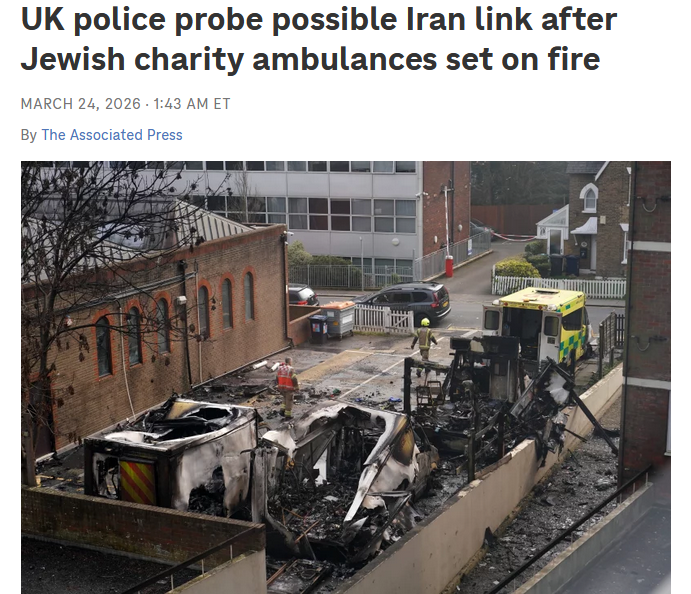
The organisation that, conveniently for the Zionist narrative, immediately claimed responsibility for the attack is Harakat Ashab al-Yamin al-Islamia. This is a group which simply did not exist until the US and Israeli attack on Iran, when it suddenly appeared fully formed and started causing small incidents of property damage to Jewish communities in Belgium and the Netherlands. From day one of its appearance, Israeli-backed think tanks and security groups instantly claimed to have linked it to Iranian militias.
These Israeli claims were first surfaced by regular Israeli security service outlet Joe Truzman of the “Foundation for Defending Democracy”, who makes a living from fronting Israeli claims that all the deaths in Gaza were Hamas.
The first online “evidence” of the existence of the group was on 9 March. On 16 March the entire Israeli Hasbara machinery in coordination went into overdrive on Harakat Ashab al-Yamin. Israel’s Diaspora Ministry issued a statement. So did Israel’s MFA. So did the Institute of National Security Studies. So did BICOM – the Britain Israel Communications Centre.
All on the same morning. At a time when Harakat Ashab al-Yamin had done nothing except allegedly start a small fire in Rotterdam. This frenzied publicity activity about this, by that point practically non-existent, group was prioritised by the Israeli state on the morning of some of the most intense missile and bombing attacks by Israel, the USA, Iran and Hezbollah of the war.
There are some real red flags about its appearance. The first, as eloquently exposed by Lowkey, is that in its manifesto it uses the term “The Land of Israel” to refer to Palestine. No Islamic group, ever, referred to “The Land of Israel” and the phrase in Arabic is not even what complicit Gulf Arab elites use – they use just “Israel” or “The State of Israel”. “The Land of Israel” is unnatural in Arabic and evidently written by a Zionist and translated into Arabic.
The other strange thing is that this allegedly Iranian group doesn’t use Farsi. Iranians don’t speak Arabic. Nor would any Iranian government-aligned group ever talk of “The Land of Israel” in Farsi.
To add further to this, the group’s published logo appears to be AI-generated and the Arabic lettering on it is wrong. “Islamic” is rendered incorrectly and some of it doesn’t mean anything coherent at all – it is gibberish, presumably constructed by AI asked to produce a shield with Arabic lettering.
Unlike the Zionist propaganda-pumping UK media, Dutch media asked real experts and was openly sceptical of the claims about the group:
“Political anthropologist Younes Saramifar from Amsterdam’s VU university said the group was “completely unknown” until this month. “Based on what I have seen, this is absolutely not an organised and coherent group,” he told NOS before the Zuidas explosion.
Saramifar said language mistakes in statements accompanying the videos suggest the makers are not native Arabic speakers and may not be part of a trained militant network.”
It is another remarkably happy coincidence that the group chose to attack the London ambulances just hours before Metropolitan Police Chief Commissioner Sir Mark Rowley was due to address a fundraising event for the Community Services Trust, the group which receives enormous payouts from the British Treasury for consistently exaggerating the scale of antisemitism in the UK.
Thankfully, nobody has ever been hurt in any of the “attacks” by “Harakat Ashab al-Yamin”. Isn’t that fact in itself a bit strange for a state-backed terror group? The ambulances in London were the worst damage ever done in the name of the alleged group.
To believe this is a false flag, it is not in any way necessary to believe that the ambulance organisation itself was complicit. Whether or not the ambulances were new, old or decommissioned is irrelevant to the bigger picture. It is certainly true that the ambulance service has for years done a good job, and does not only help Jewish people. There is nothing sinister or wrong about the existence of the ambulance service.
I am unhesitating in condemning all attacks on the Jewish community in the UK. Including those perpetrated by Mossad.
Trump’s bombardment of fake news so far is working quite well. But where is it heading?
By Martin Jay | Strategic Culture Foundation | March 23, 2026
Trump’s latest move in Iran, to consider mobilizing a second larger tranche of troops, might be the act of a lunatic who genuinely believes there can be a positive outcome for America and Israel in the Iran War. What we may be witnessing is a new, more desperate, extreme strategy after he has come to terms that virtually all of the first strategy has ended in disastrous consequences. Certainly we can assess that he is considering such a move.
Yet despite all the hype from U.S. media, it is important to stress that Trump has not yet acted. He is looking at the possibility of a deployment of 8,000 troops with the view of taking Kharg Island in combination with an 800-mile stretch of the Iranian coastline, heavily fortified with troops and missiles aimed at both the choke point of the Straits of Hormuz and also beyond it.
Any military strategist will surmise that this idea is even more whacky than the initial plan, which, it has transpired, was carried out with no planning or assessment whatsoever.
The assumptions are simply preposterous. To take Kharg Island, it would mean that any amphibious landing would have to come from a U.S. battleship which would pass through the Straits of Hormuz. And secondly, the island itself is heavily fortified as you would expect it to be, given that it produces [transfers] most of Iran’s oil. Even if a ship could by some act of a miracle reach it, the resistance by the Iranians who would be ready and waiting would be intense and might well result in all of the U.S. marines sent there being wiped out. The present 2,200 marines who are on their way to the region from Asia are not airborne, which means they can only land by boat. This idea is madness on a level that we have never seen before, with some military experts comparing it to Gallipoli in 1915, where British, French, Russian and Australian navies lost 250,000 men as they failed over almost a year to take the peninsula — resulting in the rise to prominence of the Turkish commander at the time, Mustafa Atatürk, who finally became president of the new republic of Turkey later in 1923.
What is more likely is that Trump is panicking and constantly creating media fodder for journalists to report on, while he buys time to work out how to get out of the hellhole that he has created for himself. Practically begging allies via social media or press conferences to help gives a clue to the level of desperation. But Trump’s ability to create fake news to distract U.S. media away from the reality is impressive.
When U.S. bombers left UK bases and dropped their load over a few days on the island, this threw the spotlight on the island and created a new subject to focus on. But what U.S. journalists did not look too closely at was the impact of the bombing. All the bombers did was to put a crater exactly halfway up the runway of the main airstrip, depriving planes from landing or taking off. It was hardly a great military victory. In fact, it actually deprives the Americans themselves of landing huge air transport military aircraft there, suggesting that they have no real intention of ever taking the island.
The truth is that the snake island is just media chaff which has been thrown up in the air to cause a distraction. If we examine a number of stories in the press in recent days, in fact, there have been a number of such stories to distract journalists away from asking tougher questions to Trump.
Fake story number two: allies “supporting” Trump. Barely 48 hours after France, UK, Germany and others all sent a very quick “no” back to Trump after he asked them for help in securing the straits, it would seem they all did a U-turn. A statement which the UK government issued seemed to say that they were all ready to help Trump, which shocked many. So why wasn’t this story put on the front pages of all major UK and U.S. newspapers as an extraordinary event in itself, as a drastic change to the crisis? Because journalists were sceptical and read the small print. They also read Reuters’ sceptical interpretation of it and noticed that those world leaders didn’t take to social media and announce the new initiative to “support” Trump. This word “support” was buried in the text, but the interpretation was only in the sense that these countries — including Japan — were sympathetic to Trump, similarly to your neighbour coming to the wake of one of your loved ones, eating your sandwiches and taking your drink, but then leaving while muttering condolences — without making any contribution to the funeral expenses.
But there’s more fake news.
Fake news #3 was the Japan stunt. Almost immediately we saw the arrival of the Japanese Premier at the White House who, when getting out of her car, embraced Trump for the whole world to see. What a spectacle! But what was this hug all about? Yes, of course the Japanese needed to quickly sign an energy deal to stabilize their own economy, but the compliments that the Japanese PM paid on Trump during the press conference would have some believe that Trump’s own people wrote the script. Praising Trump as a world leader on a level that none other can match left the buffoon in the White House stumbling on his own words, with him finally blabbing out a poor taste joke about Pearl Harbour. What was behind this banal performance? Was it real?
Of course it was not. EU leaders, probably led by Sir Keir Starmer’s media experts, had no doubt staged the whole thing and prepared her speech and her behaviour, as they too are panicking, knowing only too well that Trump isolated could possibly drag America into a Vietnam-type war which could go on for years. Their reckoning was: ’We can’t support him, but let’s at least issue a statement and get the Japanese PM to give him a hug.’ All Trump needs is a hug and a few absurd compliments which would leave most Americans pushing fingers down their own throats.
But of course such vomit-inducing sycophancy can’t keep relations warm for very long.
With both American aircraft carriers far from the Straits of Hormuz now (one damaged by an Iranian missile) and no real options for Trump to turn to, to settle world oil prices and come down hard on the Iranians, he’s looking like the greatest loser America has ever had as a president. It is not inconceivable that he will send ground forces to the region if the situation gets worse. This decision is more or less taken for him as his own rationale must constantly come up with media fodder which keeps him in the news as the main story. Sending troops to the region though is not the same as sending them in, although the bombing which is now going on along Iran’s coastline would suggest that he believes U.S. marines could control and contain those Iranian military installations, which is worrying as a second colossal failure of joined-up thinking seems to be heading our way.
But what is even more worrying is the extent of how much Trump lies both to journalists in press conferences and to the American people about his victory in Iran. In a country which sometimes feels like an irony-free zone, you would think he would be more ridiculed for this, but this is not the case. The real worry here is how naïve and frankly stupid Americans are, as one option that Trump has, other than using nuclear weapons in Iran, is creating a false flag attack on U.S. home soil. Not only would that allow him to announce a ’state of war’ which would justify cancelling the midterms, but it would also force EU countries and Japan to ramp up their ’free hugs’ policy to a whole new level. Free hugs are not free, by the way.
Inside the Caucasus Drone Corridor Fueling Tensions With Iran
By Freddie Ponton – 21st Century Wire – March 16, 2026
On March 14, 2026, New Eastern Outlook published a report by journalist Jeffrey Silverman titled “Friendly Skies of Georgia: Are Israeli-Linked Drones Launching False Flags from Georgian Territory?”
“Reports about the possible use of Georgian territory for drone operations…”
In his report, Silverman suggested that the March 5 drone strike on Nakhchivan airport, which was swiftly blamed on Iran before any public forensic record was produced, may have originated from a covert base in Georgia. Even if that specific allegation remains unproven, it points to a darker and more consequential reality in which Israel is deeply embedded in a regional drone and air-defense architecture spanning Georgia and Azerbaijan, one that could be used to manufacture confusion, direct blame toward Tehran, and draw another exposed frontier into Washington and Tel Aviv’s widening war against Iran.
Friendly Skies, Dark Architecture
Silverman did not prove that the drone, which struck Nakhchivan airport on March 5, took off from Kobuleti or a restricted airstrip near Lagodekhi in Georgia, and he did not publish the kind of forensic record that would settle that allegation beyond dispute. What matters more is the architecture his report exposes. By the time Azerbaijan blamed Iran for the strike, Georgia and Azerbaijan had already formalised direct unmanned/uncrewed aerial vehicle (UAV) cooperation, while Israel was deeply entrenched in the air-defense, radar, and command systems that shape how both states see the sky, classify threats, and assign responsibility.
That is why this story matters. It is not really about one secret runway or one speculative launch site. It is about a regional military architecture in which Israel supplied drone platforms, helped structure radar integration, shaped command-and-control logic, trained operators, and embedded itself in the software and doctrine that govern how threats are detected, classified, prioritised, and politically narrated from Georgia to Azerbaijan. In the middle of a widening war, while Iranian officials were publicly warning that the United States and Israel were using copied or misattributed drone attacks to frame Tehran and broaden the conflict, that architecture turned Silverman’s theory from an unproven allegation into a deeply plausible scenario.
The March 5 public record only sharpens that concern. In a March 5 statement, Azerbaijan’s Foreign Ministry said the attack occurred around midday, that one drone struck the terminal of Nakhchivan International Airport, that another fell near a school in Shakarabad, and that two civilians were injured. State-linked reporting later added that the prosecutor’s office opened a criminal case, described the UAVs as carrying remotely controlled explosive warheads, and said the disruption forced flight 264 from Nakhchivan to Baku to return for safety reasons. Those details make the incident more concrete, but they also show how quickly the political and legal narrative solidified around attribution before the public was shown anything close to a full forensic record.
Israel’s code in Georgian airspace
Georgia’s military drone sector was built in close cooperation with Israel, a fact that should be treated as foundational rather than incidental. Before and during the 2008 war, Georgia acquired Elbit Hermes-450 drones, operated them over contested territory, and lost several in combat according to a UN Security Council report, establishing that Israeli UAV technology was not a procurement sideshow but part of Georgia’s actual warfighting infrastructure. A Hermes-450 is not just an airframe; it depends on launch-and-recovery procedures, ground-control stations, data links, sensor exploitation, trained operators, maintenance cycles, and mission-management architecture that ties the platform to the wider command system. From the start, Georgia’s unmanned capability was being shaped not just by Israeli hardware but by Israeli operational logic.
That relationship evolved into something even more consequential after 2008.
As a Caspian Policy Center report noted in September 2020, Georgia signed agreements with Rafael and Elbit to modernise air-defense assets, upgrade electronic systems, retrain personnel, and move key capabilities toward NATO standards. Rafael’s Spyder-family architecture matters here because it is not just a launcher with missiles attached to it, but also a radar-linked, software-driven system that combines sensor inputs, battle-management logic, target prioritisation, and rapid engagement against aircraft, cruise missiles, UAVs, and loitering munitions. External technical reporting on Spyder emphasises centralised command logic, multi-target handling, and fused air-picture generation, while Rafael’s own product material presents the system as a mobile, integrated air-defense family rather than a stand-alone interceptor.
That technical detail is not window dressing. It explains why the debate over a “secret base” can miss the more important issue. Israel does not need a flag over a Georgian runway to exercise meaningful influence over Georgian airspace behaviour if Israeli-linked firms already help build the radar integration, software logic, sensor fusion, operator training, and threat-classification routines through which Georgian personnel decide what is visible, what is suspicious, and what can be ignored. In a deniable operation, that layer is decisive, because the central question is not only where a drone takes off, but how the system along its route recognises it, how quickly it is promoted from clutter to threat, and who controls the doctrinal assumptions built into that judgment.
This architecture did not emerge overnight. As early as 2012, Rick Rozoff warned in Voltaire Network that under Mikheil Saakashvili, Georgia was being refashioned into a U.S.-aligned military outpost through NATO war deployments, base modernisation, and growing strategic utility to Washington, while the country was already surfacing in discussions of possible logistical or operational support for a future strike on Iran. That warning should not be treated as proof of the March 5 Nakhchivan operation, but it does expose the deeper genealogy of the system now in place: Georgia was being positioned more than a decade ago as a frontier platform in wars planned far beyond its borders.
Georgia’s integration into NATO’s Regional Airspace Security Programme sharpens that point instead of weakening it. In an NCIA report on Georgia’s entry into the NATO Regional Airspace Security Programme, the agency said Georgian air-traffic data could be ingested into the RASP information-exchange environment through EUROCONTROL’s Civil-Military ATM Coordination Tool, or CIMACT, supporting constant connectivity, air-picture exchange, early notification of incidents, direct operator coordination, and identification support for air defense. In practical terms, that means Georgian airspace is increasingly managed through a shared civil-military coordination environment designed to fuse traffic data, security events, and operational responses across borders. But systems like CIMACT do not abolish the physics of drone detection. Open-source technical literature and regional reporting both show that low-altitude, small-radar-cross-section drones remain difficult to detect and classify in mountainous or cluttered terrain because radar horizon, terrain masking, ground clutter, and weak signatures compress the window for reliable identification.
That is precisely what creates a false-flag-friendly environment. A peer-reviewed paper on low-slow-small target detection describes drones as low-altitude, slow-speed, small-radar-cross-section targets that are difficult to detect and classify among birds and other biological targets, especially when conventional radars face weak signatures and cluttered surveillance volumes.
If a drone flies low through edge sectors or terrain-shadowed corridors, the first challenge for the radar network is not interception but recognition: distinguishing a weak, late-emerging track from birds, clutter, benign traffic, or fragmented returns. The second challenge is prioritisation inside the command-and-control layer, because a fused air picture does not treat every object equally; it ranks tracks according to altitude, speed, heading, signature, and threat libraries built into the software and training regime.
When Israeli-linked firms help define that regime, they are not merely selling Georgia hardware. They are helping shape the logic by which ambiguity is sorted into action or inaction.
Azerbaijan’s Israeli-built battlespace
If Georgia provides one side of the corridor, Azerbaijan provides the other, and here the Israeli footprint is even deeper. As an Institut FMES study of the Israel-Azerbaijan relationship details, Azerbaijan has spent decades building military-technical ties with Israel that include observation drones, tactical drones, loitering munitions, missiles, mapping support, and an air bridge through Turkish and Georgian airspace during wartime supply operations. That matters because a state that buys this many Israeli platforms is not just purchasing equipment; it is also importing maintenance pipelines, operator doctrine, mission-planning habits, software ecosystems, and deeper institutional assumptions about how the battlespace is seen and fought.
Two Israeli systems are central to the Nakhchivan story. The first is Barak-MX, the layered air-defense architecture sold to Azerbaijan with interceptors and battle-management functions designed to engage UAVs, cruise missiles, and aircraft across multiple ranges. The second is Sky Dew, the high-altitude aerostat-based AESA radar platform procured by Azerbaijan to detect low-flying threats over long distances, including drones and cruise-missile-type targets. Sky Dew’s value lies in elevating the sensor above ground clutter and extending the line of sight, while Barak-MX gives the battlespace a layered interception logic. Together, they form more than a shield. They form an Israeli-coded interpretation system for airspace.
And yet even this system is not all-seeing. AESA radars improve clutter rejection, update rates, and multi-target tracking, but technical analysis also stresses that low-RCS targets near the ground remain difficult because no single sensor mode can reliably solve the problem across all terrain, weather, and altitude conditions. Multi-band fusion, advanced signal processing, and automatic target recognition help, but weak returns, terrain interference, and short detection windows still leave room for uncertainty.
That uncertainty is politically explosive in Nakhchivan’s geography, because a drone detected late near the Iranian frontier does not enter a neutral interpretive space. It enters an Azerbaijani battlespace already conditioned by Israeli systems, Israeli threat models, and an official narrative primed to see Iran as the source of the attack.
The March 5 public narrative illustrates that danger with unusual clarity. In its March 5 report, Euronews cited Azerbaijani claims that “technical monitoring systems” confirmed four UAVs belonging to Iran had been directed toward Nakhchivan to carry out attacks. But the public-facing record reviewed here did not include the underlying radar tracks, telemetry, launch coordinates, signal intercepts, or debris analysis that would allow outsiders to test that conclusion independently. Instead, the public was asked to accept a technical verdict without public technical disclosure, in a battlespace already filtered through Israeli-linked detection and attribution architecture.
The inconsistencies in the public record make that even more important. Azerbaijan’s Foreign Ministry described two drones and two injured civilians, while a U.S. Embassy security alert referred to an unknown number of drones striking the exclave around noon, and Reuters reported four injured. OC Media’s coverage also placed the airport less than 10 kilometres from the Iranian border and referenced footage showing smoke, a separate small blast, and terminal damage, but none of that amounts to a released forensic chain of origin. The issue, then, is not whether every radar return was fabricated. It is when Israel helps build the Georgian-side surveillance environment and also helps build the Azerbaijani-side detection and attribution environment that it effectively occupies both ends of the interpretive chain through which a late-detected drone can become an Iranian attack.
The October 2025 drone bridge
The strongest institutional clue in this investigation is not Kobuleti, and it is not Lagodekhi. It is the formal drone bridge created between Georgia and Azerbaijan in October 2025. In an official Azerbaijani Defense Ministry readout, Baku said a Georgian Ministry of Defense delegation visited for an “exchange of experience in the field of UAVs” and was briefed on Azerbaijani UAV activity, combat use, combat-flight organisation, and wider development trends. Those are not vague diplomatic pleasantries. They are the language of direct operational transfer. “Combat operations” and “organisation of combat flights” mean mission planning, route design, sortie sequencing, deconfliction, command routines, and the practical management of drones in wartime airspace. Because Azerbaijan’s UAV ecosystem is already deeply Israeli-linked, that meeting meant Georgian officials were being exposed to an Israeli-shaped combat-drone model only months before the Nakhchivan incident.
This is the emotional and analytical centre of the story because it turns parallel procurement into shared practice. Once that bridge existed, the regional picture changed. The issue was no longer only that Israel had technical reach into both states. The issue was that Georgia and Azerbaijan were actively aligning how they think about drone warfare across the very corridor now shadowed by false-flag allegations. That creates shared familiarity with routes, signatures, mission planning, and combat-flight logic, which lowers the friction for any cross-border drone activity that needs to move through Georgian space and arrive inside Azerbaijani airspace without triggering immediate institutional disbelief.
Corridor politics and verdict
Turkey completes the corridor. The Institute for War & Peace Reporting (IWPR) has described Georgian airspace as a conduit for traffic supporting Azerbaijan, including flows tied to Turkish and Israeli strategic interests, while the South Caucasus route became even more important as the Middle East conflict rerouted more traffic across Türkiye, Georgia, Armenia, and Azerbaijan. Georgian airport infrastructure is tied to Turkish management networks, which gives Ankara leverage over the transit environment and helps normalise the corridor as a connected operational channel rather than a set of isolated national airspaces. In wartime, normalisation is half the game. What moves routinely moves invisibly.
The wider war context makes that normalisation more dangerous. Iranian officials publicly warned that the United States and Israel were using copied or rebranded drones, including the so-called “Lucas” platform, to stage attacks and frame Tehran, while calling for joint investigations into suspicious incidents. Whether one accepts those allegations in full is not the point. The point is that the Nakhchivan incident unfolded in a battlespace where attribution itself had already become a weapon.
That weaponised atmosphere is also visible in how quickly outside governments aligned behind the Azerbaijani narrative. France publicly condemned what it called an Iranian drone strike in a Foreign Ministry statement, while Turkey did the same in a March 5 statement from its Foreign Ministry. The incident was therefore internationalised almost immediately, even though the public record still showed inconsistencies in drone counts, injuries, and the technical basis for attribution.
Jeffrey K. Silverman did not prove that a drone launched from Georgian territory struck near Nakhchivan airport. His most specific launch-site claims remain unproven. But the deeper investigation leads to a verdict that is, in some ways, more damning than his original article. Israel has embedded itself in the air-defense, radar, software, training, and command architectures of both Georgia and Azerbaijan. Georgia and Azerbaijan then formalised direct UAV cooperation focused on combat use, combat missions, and the organisation of combat flights only months before the Nakhchivan incident. Georgia, meanwhile, was being drawn deeper into a NATO-linked RASP/CIMACT airspace-management environment built around air-picture exchange, incident notification, and civil-military coordination, even as the known technical limits of low-altitude drone detection left room for ambiguity in mountainous border sectors.
That does not close the criminal case. It closes the plausibility argument. Israel may not need a secret base in Georgia if it already helped build the surveillance logic, the target-classification regime, the command-and-control environment, and the cross-border drone corridor governing both ends of the route. That is the real meaning of the Georgia-Azerbaijan drone bridge and the dual Israeli footprint uncovered here.
The route does not have to be proven in full to understand the structure behind it. The structure is already visible, and it points to an Israeli-built architecture of plausible deniability running straight through the South Caucasus.
Friendly Skies of Georgia: Are Israeli-Linked Drones Launching False Flags from Georgian Territory?
By Jeffrey Silverman – New Eastern Outlook – March 14, 2026
Reports about the possible use of Georgian territory for drone operations amid the escalation around Iran once again raise longstanding questions about hidden military infrastructure, regional security, and the role of external actors in the South Caucasus.
With over three decades of on-the-ground experience in Georgia, I offer institutional memory that provides a lens for scrutinizing recent claims that Georgian territory has served as a base for drone strikes or false-flag operations—allegations coming from neighboring states.
Similar claims have surfaced over the years in outlets like PanArmenian.net, Azerbaijan’s Trend News Agency, the former Voice of Russia, and other sources. Today, Georgian experts and officials face questioning by the State Security Service over openly circulating information in publications, including possibilities of terrorist attacks or false flags potentially to be blamed on Iran.
Looking back, a notable October 2008 article in The Hindu titled “Why a war against Iran was not inevitable” suggested the Georgia crisis influenced U.S. and Israeli military planning toward Tehran. The war’s results—boosted Russian sway and curtailed Western access—helped delay immediate attack plans on Iran, though such ideas have resurfaced amid recent escalations.
As I recently conveyed in correspondence with a longtime source and collaborator on several past articles and journalistic investigations.
Are you still active? Do you remember the earlier plans of attacking Iran from Georgia?
I remember those old talks about Georgia potentially being eyed as a launchpad for strikes on Iran—way back before the 2008 mess even kicked off.
- I dug through my files after your last message, but no luck on that original Hindu piece from October 2008 (“Why a war against Iran was not inevitable”). It’s vanished from easy access, probably archived or paywalled into oblivion.
- That said, I did come across this solid piece Rick Rozoff put up back in 2012: “U.S. Prepares Georgia for New Wars in Caucasus and Iran” (still live).
It lays out a lot of what we were chewing over right after the 2008 war—how U.S. and NATO training programs turned Georgian forces into something more expeditionary, with bases like Vaziani and Krtsanisi getting upgrades that could support bigger ops.
Institutional Memory
Georgia had purchased numerous Hermes 450 UAVs and other drones from Israel’s Elbit Systems, with Israeli technicians and trainers—some former senior IDF officers—on the ground to assist with commando units, system upgrades, and integration. Israel reportedly halted further sales under Russian pressure after 2008, but the established infrastructure, expertise, and relationships remained.
Reports have circulated of drone strikes near Nakhchivan’s airport just days ago—Azerbaijan attributed them to Iran, while Tehran dismissed the claims as an Israeli provocation designed to escalate tensions.
Similarly, around 30 drones were detected over Abkhazia on March 4. Some sources suggested Ukrainian origin, while others implied staging from Georgian-controlled areas targeting the breakaway region.
I also recently shared relevant information live on a podcast with Victor-Hugo Vaca II, who is another Georgian-based American journalist, thus bringing the matter back into public view.
Moreover, the very same day, I contacted longtime colleagues from the Georgian media landscape—people I worked alongside as editor-in-chief of the Georgian Times and later as an English-language reporter and editor for Public TV (the state broadcaster) during the 2008 war. I first presented these latest concerns to both public and private Georgian media, including Georgian State Security:
The time feels right to dig deeper!
A fellow journalist, Victor-Hugo Vaca II, going on Redacted with Clayton Morris live, sent me this message:
On Wednesday, March 11th, 2026, at 12:25 PM, Victor-Hugo Vaca II wrote:
Our podcast show was seen by producers of Redacted with Clayton Morris, who will be reporting on this development, so the cat is out of the bag, and you might as well publish the story sooner than later. It will get international attention today, March 11, 2026, when the show goes live at 4pm EST. If you are not able to publish the story, you are welcome back on my show to read the article should you not be able to publish the article in a timely manner.
That being said, I’m not afraid because the truth is on our side. Can you publish the story today so that I can forward the report to producers before the show is aired and they can give you credit for your journalism?
About drone bases in Georgia!
It is being reported in the Georgian media that Gia Khukhashvili, a military expert, has been pretty vocal lately, warning that Georgia could become a target for terrorist attacks amid the wider regional mess (he’s even been summoned by the State Security Service for questioning over his comments on Iran-related stuff).
However, nothing is being mentioned about any active “Kobuleti drone base” or Israeli ops launching strikes from there. Kobuleti pops up in old military contexts (like an ELINT battalion back in the day or general defense ties), but nothing current ties it directly to a drone launch site, let alone recent incidents.
On the Israeli side, the story runs deep: pre-2008.
Photos and insider chatter from back then confirmed technicians at MoD sites, and it wasn’t subtle—Israel was a key supplier until Russian pressure kicked in post-2008, freezing further deals and even leading to that infamous alleged code swap (Israel handing over Georgian drone data links to Moscow in exchange for intel on Iran’s Tor-M1 systems). That compromised a lot of the gear Georgia had bought.
My source said, “Your hunch about launches from Georgian territory (Kobuleti or that restricted airstrip near Lagodekhi) feels plausible given the proximity, and Lagodekhi is right on the Azerbaijan border in Kakheti, just a few km from where you’re living, and it’s in a sensitive zone that could host discreet ops without too many eyes.”
But publicly, the recent drone stuff points elsewhere:
- The March 5 strikes on Nakhchivan’s airport (and nearby civilian sites) got blamed squarely on Iran by Baku—drones launched from Iranian territory, per Azerbaijani MoD statements, with injuries reported and strong condemnations (Georgia’s PM even called Aliyev to express solidarity and concern). Iran denied it, calling it a possible setup, but no fingers pointed at Georgia in mainstream reporting.
- The Abkhazia incident (up to 30 drones spotted March 4) saw Abkhaz/Russian defenses claim most were downed; experts (including Russian ones) largely ruled out Georgian involvement, pinning it on Ukraine or sea-launched ops tied to the broader U.S.-Israel-Iran conflict spillover. Some debris scattered, but again, no official link to Tbilisi-controlled areas.
In the political talk show 360 Degrees of PalitraNews TV, Khukhashvili said:
“It’s a very precarious situation. I cannot provide the details. I have information from open sources, and the information is quite convincing, and therefore, I think the threat is real. A series of terrorist attacks could begin.”
It is plausible that very few folks in the current Georgian government—or even back in 2008—had real visibility into any dedicated Israeli-linked drone facilities or activities. Whether it was a formal “base” in Kobuleti (which has a long military history but no recent public ties to active UAV launches), or discreet use of abandoned/restricted strips in an environmentally protected area, or the big peat bog right behind the tourist town, a Redbook Environmental Area.
The airstrip near Lagodekhi, the setup likely stayed handled through defense ministry channels, foreign contractors, and maybe even off-books arrangements to keep plausible deniability. If higher-ups knew anything sensitive, they’d almost certainly clam up—national security, foreign relations, avoiding Russian/Abkhaz blowback, you name it.
My insider edge from those 2008+ visits is worth something now; not many can claim direct observation. If anything bubbles up from other media contacts (or if Gia Khukhashvili or others start hinting at more), it will be worth sharing with a larger and larger audience.
Meanwhile, I’m keeping tabs on any fresh reports tying Lagodekhi/Kobuleti to UAV activity—nothing solid yet in open sources, but the silence itself is telling. My shovel’s still turning.
Live Program about Drones
On Thursday, March 12th, 2026, at 2:09 AM, Victor Hugo -Vaca II wrote:
I left them speechless and gave you credit. They asked me to send them your article when you publish it, so please send it to me ASAP. No promises, but that may lead to you being on their show too. I’ve been on their show before, and the producers reached out to me, so that’s how I got on again. The show features Colonel Douglas Macgregor, and it is trending on Rumble and Bitchute and will reach over a million views on several social media platforms in under 24 hours.
It is clear that for Israel and the US to achieve their objectives in Iran, whatever they may be, it is necessary to draw in other countries: the UK, Azerbaijan, Armenia, Turkey, and Georgia. An opportunity for that happening would be a perfect storm for a concentrated attack on Iran, which borders Azerbaijan and Armenia.
Jeffrey K. Silverman is a freelance journalist and international development specialist, BSc, MSc, based for 30 years in Georgia and the former SSR
Follow new articles on our Telegram channel
The Strategic Folly of a (Serious) US Ground Invasion of Iran
It simply can’t be done
Ashes of Pompeii | March 12, 2026
Tucker Carlson recently spoke of a potential false flag operation designed to manufacture consent for a US ground invasion of Iran. Tucker is no longer an “insider” in Washington but he still likely has his sources. Therefore this talk deserves serious examination, not because an invasion is feasible, but because the gap between political rhetoric and military reality has never been wider. Twelve days into the current conflict, with US bases being degraded under sustained attack and Iranian missile barrages continuing unabated, the notion of a ground invasion collapses under the weight of logistical, technological, and geographical constraints that no amount of political will can overcome.
The war in Ukraine has fundamentally altered the calculus of conventional warfare, demonstrating that drones have radically changed the battlefield. Mechanized armor columns, the backbone of American land warfare doctrine since World War II, have proven devastatingly vulnerable to cheap, ubiquitous unmanned systems. What took billions in sophisticated weaponry to accomplish in previous eras can now be achieved with commercially available drones costing mere thousands of dollars. The US military is only now scrambling to adapt to this reality, while Iran are already drone masters, having made drone warfare one of the foundations of its defensive doctrine. Iranian forces have not merely acquired drones; they have built an entire asymmetric warfare architecture designed to exploit the vulnerabilities of conventional mechanized forces. And make no mistake, the Chinese would be thrilled to supply Iran with all the drones and components necessary.
This technological shift is particularly catastrophic for invasion planners when combined with Iranian geography. Unlike Iraq’s vast desert expanses, Iran is characterized by narrow mountain passes, constricted valleys, and limited corridors of approach through the Zagros and Alborz ranges. These geographic chokepoints are perfect killing zones for drone swarms and precision missile strikes. Any US mechanized column attempting to advance would be funneled through predictable routes, stripped of air support by Iranian air defenses, and systematically destroyed by loitering munitions and anti-tank drones. The Ukraine war has shown that even forces with extensive drone warfare experience suffer devastating losses in such conditions; the United States, still adapting its doctrine and procurement, would face an even steeper learning curve under combat conditions.
The logistical foundation required for invasion simply does not exist. Operation Desert Storm required six months of uncontested buildup in 1991. Today, US forward bases across the region are under active bombardment, with mounting casualties and degraded operational capacity. The notion that America could amass the hundreds of thousands of troops, thousands of armored vehicles, and millions of tons of supplies needed for an Iranian invasion while its regional infrastructure is being systematically struck is fantasy. Compounding this is the seriously degraded state of US strategic sealift capacity, which has suffered decades of underinvestment. The ships needed to transport heavy armor and sustainment cargo simply do not exist in sufficient numbers, and those that do are vulnerable to Iranian anti-ship missiles in the confined waters of the Persian Gulf.
Air power cannot compensate for these limitations. The current aerial campaign, despite causing significant destruction, has not broken Iranian morale or degraded its capacity to launch heavy ballistic missile retaliations. If anything, the surprise attack has unified the Iranian population behind the regime, demonstrating the counterproductive nature of aerial coercion against a nationalist population with deep historical memories of foreign intervention. Meanwhile, Israel is absorbing punishing strikes, undermining narratives of effortless dominance. Nor is air transport any sort of logistical substitute for sealift for an operation of this nature. The quantities required are far, far beyond what the USAF can sustain.
And this is to say nothing of manpower restraints. About 700,000 US troops particpated in Desert Storm. Presumably an even larger invasion force would be required for Iran, given its size, geography and demographics. Does anyone in their right mind imagine anywhere up to a million US soldiers being available for this sort of endevour?
This does not mean the conflict will not escalate. The danger Tucker Carlson identified, a false flag or manufactured incident, remains real precisely because it could justify limited actions short of invasion. What is most likely is some form of limited incursion: a raid on a coastal facility, a seizure of an island in the Gulf, or a special forces operation designed to create the appearance of decisive action. Such an operation would allow President Trump to project strength domestically, to pound his chest before an American audience hungry for demonstrations of power. It would generate headlines and temporary political capital.
But such theatrical gestures would not alter the strategic equation. They would not degrade Iran’s missile capacity, break its will to resist, or secure US interests in the region. They would likely provoke further retaliation, deepen Iranian resolve, and expose the limits of American power rather than its strength. A limited incursion is not an invasion; it is a political performance that leaves the fundamental constraints of geography, technology, and logistics untouched.
The hard reality is that a US ground invasion of Iran is not merely inadvisable, it is militarily impossible under current conditions. The logistics are impossible, drones have changed warfare where Iran has adapted and America has not, and geography ensures that any mechanized advance would be suicidal. Trump and Hegseth can plot all the invasions they want, but even the current obsequious Pentagon, would push back very hard against the suicidal folly of a ground invasion.
The conflict will continue, but its resolution will not come through fantasies of conquest that belong to a bygone era of total American hegemony.
How Israel and the FBI manipulated assassination plots to goad Trump into Iran war
By Max Blumenthal | The Grayzone | March 6, 2026
The FBI manufactured plots to convince Trump that Iran sought to kill him, while Israel and its administration allies exploited the president’s deepest fears to keep him on the war path.
“I got him before he got me,” an ebullient President Donald Trump remarked to a reporter when asked about his motives for authorizing the killing of Iran’s Leader, Ayatollah Ali Khamenei, on February 28, 2026.
With his off-the-cuff remark, Trump revealed that anxiety about his own assassination at the hands of Iranian agents influenced his decision to initiate a US-Israeli regime change war that has already resulted in American casualties, the bombings of schools and hospitals inside Iran, devastating Iranian retaliatory strikes on US military bases and embassies, and a spiraling global economic crisis.
Trump’s generalized fears of assassination were well-founded. He was nearly killed in Butler, Pennsylvania on July 13, 2024 by a 20-year-old engineering student named Thomas Crooks who managed to fire eight rounds at the former president from a rooftop, slicing his ear and missing his head by a hair’s breadth. Two months later, a drifter named Ryan Routh was arrested after hiding for hours in the shrubbery outside the former president’s Mar-a-Lago estate in West Palm Beach, Florida. Routh had been spotted after pointing an assault rifle toward a Secret Service agent as Trump played golf 400 yards away.
Officials have yet to produce any evidence that Iran played a role in either of these attempts on Trump’s life. Yet since those fateful events, Israel-aligned Trump advisors, Israeli intelligence, and Israeli Prime Minister Benjamin Netanyahu himself have gone to extreme lengths in order to tie Tehran to the plots. More shocking still is the fact that the FBI has manufactured a series of assassination plots, successfully convincing Trump that Iran was hunting him on US soil with highly sophisticated teams of hit men.
The man accused of leading the most significant of these operations, Asif Merchant, is currently on trial in a Brooklyn, NY federal court. After the US granted him a visa despite his presence on a terror watchlist, Merchant was in the constant company of an FBI confidential informant who ultimately steered the contrived plot to its conclusion. He never stood a chance of realizing his plans, and did not appear serious about doing so.
Independent journalist Ken Silva puts it succinctly in his forthcoming investigative book, “The Trump Assassination Plots”: “A closer look at the Merchant case reveals that at the very least…it was a highly controlled FBI sting operation that never posed a threat to Trump. More nefariously, records and whistleblower disclosures indicate that Merchant may have been the patsy in a case totally fabricated by the undercover agents.”
Authorities arrested Merchant on July 12, 2024 – just one day before Crooks attempted to kill Trump in Butler. Hours after the failed Butler assassination, FBI agents interrogated Merchant about whether it was in fact Iran that had Crooks under its control.
At that point, Trump was still campaigning to be a “President of Peace. On the campaign stump, he warned that his opponent, Kamala Harris, “would get us into World War III guaranteed.” Trump vowed to resolve the war between Ukraine and Russia in one day, and distanced himself from pro-war Republicans who sought regime change in Iran.
Pro-war elements in Trump’s coterie exercised multiple points of leverage to reverse the president’s anti-interventionist instincts. Ultra-Zionist billionaires supplied vital and well-documented influence over Trump’s policies by keeping his campaign war chest flush. But Trump remained an erratic personality whose petty grievances kept his aides in a perpetual state of uncertainty.
It was only by exploiting Trump’s deepest psychological vulnerability – his fear of an assassin’s bullet – that Israel and its cutouts in his administration were able to secure their influence over the president, keeping him on the warpath against Iran.
The assassination escalation trap
On June 3, 2020, as the commander of Iran’s IRGC Quds Force, Qassem Soleimani, deboarded an airplane at Baghdad International Airport, on his way to peace talks with Saudi officials, a US drone killed him with a Hellfire missile. The strike had been ordered by Trump following a sustained campaign of military escalation against Iranian allies orchestrated by his National Security Council Director John Bolton and Secretary of State Mike Pompeo.
As journalist Gareth Porter reported for The Grayzone, by the time Trump authorized Soleimani’s assassination, Netanyahu was planning unilateral strikes on Iran aimed at drawing the US into direct conflict. Trump issued orders to kill the general under sustained pressure by Pompeo and Bolton, two pro-Israel hardliners. Both former Trump officials have lobbied for the Israeli and Saudi-funded Mojahedin El-Khalk (MEK), a cult-like exiled militia that has carried out numerous assassinations of Iranian officials at the behest of Israel’s intelligence services.
By killing Soleimani, Trump set the US on a collision course for all-out war with Iran – just as Netanyahu had hoped. What’s more, the president invited the prospect of violent retaliation against himself and his national security advisors.
So long as Trump feared the specter of IRGC agents lurking behind every corner, it stood to reason that he was more likely to authorize a regime change war on Iran. And so the FBI went to work, concocting a series of plots that helped forge Trump’s belligerent attitude toward Tehran.
Brought to you by the FBI: Iran’s plot to kill John Bolton
The first major Iranian plot arrived in 2022, when the Department of Justice filed charges against an Iranian national, Shahram Poursafi, for supposedly hiring a hitman to kill Bolton. However, the hitman turned out to be an FBI informant, and the plot was largely contrived by the Bureau. Poursafi, for his part, could not be arrested because he lived in Iran.
As journalist Ken Silva reported, the FBI officer who oversaw the manufactured plot to kill Bolton, Steven D’Antuono, was the same official who ran the Detroit field office that relied on paid informants to concoct the 2020 plot by right-wing militia members to kidnap Michigan Gov. Gretchen Whitmer. In a 2025 federal appeal court ruling, the judge acknowledged that defendants in that case “are correct that the government encouraged them to settle on a plan” to kidnap Whitmer. The FBI’s D’Antuono also oversaw the probe into the suspicious planting of pipe bombs at Republican and Democratic Party headquarters in Washington on January 6, 2021. In the course of his failed investigation, he misled Congress about having received “corrupted” evidence.
Though Bolton was never in danger from Iran, the FBI-contrived plot began to fuel paranoia among Trump administration veterans. Pompeo now believed that he too was being targeted by Iranian assassination teams. In his 2023 campaign memoir, “Never Give an Inch,” the former CIA director claimed Poursafi had also paid $1 million to a hitman to kill him.
However, Pompeo provided no additional details on the plot, which was never mentioned in DOJ documents charging Poursafi for attempting to kill Bolton. According to those affidavits, Poursafi sent just $100 to the FBI’s confidential human source before the DOJ concluded its investigation.
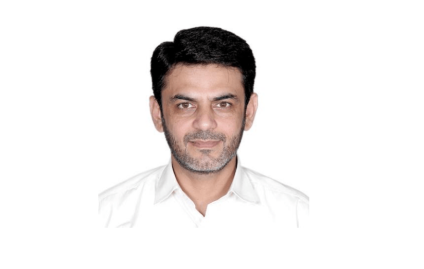
Asif Merchant, accused ringleader of an FBI-managed Iranian plot to assassinate Trump
Iran’s hapless hitman granted special visa, introduced to FBI informant
In April 2024, as Trump launched his comeback presidential campaign, an itinerant salesman named Asif Merchant arrived from Pakistan to George Bush Intercontinental Airport in Houston, Texas. He was quickly flagged as a “Qualified Person of Interest” who’d been placed on a Department of Homeland Security watchlist. Agents from an FBI Joint Terrorism Task Force (JTTF) team then discovered through a search of Merchant’s devices that he had visited Iran, where his wife and adopted son lived. Whether they’d received a tip from Israel, which furnishes reams of intelligence to the FBI on foreign Muslim visitors to the US, remains an open question.
According to JTTF documents obtained by pro-Trump reporter John Solomon, Merchant was “released without incident” and designated as “free to travel to desired destination.” In fact, the FBI had granted him a “Special Public Benefit Parole,” which, as Solomon explained, “would allow agents to try to flip Merchant as a cooperator or try to determine why he was coming to the United States and who he might be working with.”
The FBI whistleblower who provided Solomon with the documents on Merchant’s airport interview compared the “Special Public Benefit Parole” to the scandalous “Fast and Furious” program, in which President Barack Obama’s Department of Justice facilitated the delivery of automatic weapons from US gun dealers to Mexican cartels in order to supposedly surveil the gangs’ criminal activities.
Almost as soon as Merchant entered the US, the FBI introduced him to a confidential informant posing as a potential business partner and operating under the alias, Nadeem Ali. The informant had served as translator for the US military during its occupation of Afghanistan.
Though Merchant did not propose any crimes, the FBI wiretapped a meeting between him and the informant, Ali, in a hotel room on June 3, 2024. There, Merchant was taped making a supposed “finger gun” motion while mentioning an unspecified “opportunity.” This grainy minute-long hidden camera recording is presented as the linchpin of the DOJ’s indictment of Merchant.
According to the FBI, Merchant had outlined a highly complex plot which required the hiring of two hitmen, “twenty five people who could perform a protest after the distraction occurred, and a woman to do ‘reconnaissance.”
For the elaborate flash mob-style assassination extravaganza, Merchant was asked by the informant to fork over a mere $5000. The Pakistani visitor had no means of scrounging up the fee, however, raising further questions about the seriousness of the plot. “I did not think I was going to be successful,” Merchant would later state in court.
Virtually penniless, Merchant was forced to gather the cash from an anonymous “associate,” according to the DOJ indictment. Next, the FBI informant took him on a winding journey from Boston to New York City, where he allegedly handed the money to two other FBI informants posing as hit men. The DOJ claims Merchant made plans to fly to Pakistan on June 12, but was arrested in his residence that day.
Merchant interrogated about Butler, kept incommunicado
The following day, 20-year-old Thomas Crooks arrived at a fairground in Butler, Pennsylvania where former president Trump was scheduled to speak. He flew a drone in the air for 15 minutes, surveying the area as he finalized plans to assassinate the candidate. In an odd coincidence, the Secret Service’s anti-drone system was offline all morning and into the afternoon — until roughly 15 minutes after Crooks flew his drone. When Trump took the stage, Crooks climbed atop a slanted rooftop 130 yards away and fired eight shots at the president, missing his head by an inch, until a local police officer fired back. He was killed by a Secret Service sniper who had inexplicably hesitated to fire for a full 15 seconds.
Thirty hours later, FBI agents flew to Houston to interrogate Merchant in his jail cell about a possible Iranian connection to the assassination attempt in Butler. An FBI source told the Washington Post the Bureau “took the extraordinary step of interviewing him without his lawyer to determine whether he knew Crooks.”
The grilling continued even after Merchant was transferred to the maximum security Metropolitan Detention Center in Brooklyn – the same prison where Luigi Mangione, the accused killer of United Healthcare’s CEO, is currently being held. There, he was held under harsh conditions in solitary confinement, unable to interact with anyone but the guards who brought him food and his lawyers because, as then-Deputy Attorney General Lisa Monaco argued, he might use code words to initiate further assassination plots. “It appeared they thought I was some kind of super spy,” Merchant later reflected.
Not only was Merchant prevented from calling his family in Pakistan, he was blocked from reviewing recordings of conversations he held with undercover FBI informants, as the DOJ had marked them “Sensitive.” In March 2025, his lawyer protested that US Marshals repeatedly refused to allow him to meet with this counsel and review discovery at the courthouse. This, too, was justified on the basis of specious national security grounds.
However, as the journalist Ken Silva discovered, an internal memo by the Bureau Of Prisons Director Colette Peters confirmed that Merchant had no contact with any Iranian intelligence assets in the US. “Law enforcement has not identified any IRGC associates of Merchant operating in the United States who could continue to orchestrate violent acts,” Peters wrote.
Indeed, the only Iranian assassins with whom Merchant appeared to have interacted inside the US were undercover informants working for the FBI.
Merchant “had never been close to realizing” Trump assassination
During his trial this March 4, Merchant’s lawyer, Avraham Moskowitz, took the highly unusual step of allowing his client to take the stand. Merchant proceeded to present a version of events that contrasted sharply with the account he provided in his initial FBI proffer. For example, the defendant claimed he had been coerced into the plot by an IRGC agent, and went forward with a plan “to maybe have someone murdered” only because he feared for his wife and adopted son back in Iran.
After his arrest by the FBI, Merchant said he engaged in discussions with federal authorities about becoming an informant himself, but they ultimately broke down for unknown reasons.
“I was not wanting to do this so willingly,” he insisted in Urdu, adding, “I did not think I was going to be successful.”
In its coverage of the trial, the New York Times concluded Merchant “had never been close to realizing the vision of his Iranian handler.”
But back in 2024, as word spread of Merchant’s arrest, Israel-adjacent figures in Trump’s inner circle exploited the case to exacerbate the candidate’s anxiety about the Ayatollah’s wrath.
Israel-aligned forces blur Butler with Iran
Just three days after Trump’s campaign was nearly ended by a lone American assassin’s bullet in Butler, officials burrowed within the architecture of the national security state took measures to shift the focus to Iran.
“The Biden administration obtained intelligence in recent weeks about an Iranian assassination plot against former President Donald Trump, and the information led the Secret Service to ramp up security around the former president, according to three U.S. officials with knowledge of the matter,” reported NBC’s Ken Dilanian on July 16, 2024. (Dilanian had been fired from his previous gig at the LA Times after he was exposed for allowing the CIA to review his reports before publication).
The unnamed officials were clearly referring to the plot which the FBI manufactured for Merchant. The revelation not only seemed like a cynical attempt to obscure the reality of the near-assassination in Butler, which was conducted by a friendless American man who had never left the country. It also suggested the FBI had been so focused on concocting Iranian plots on American soil that it ignored the years-long trail of YouTube comments left by the would-be assassin bluntly declaring his intention to kill US politicians and police officers, and his hopes to instigate a civil war.
Though FBI leadership misled the public about the nature of the Butler plot, falsely claiming, for instance, that Crooks was not communicating with others online, they were never able to connect it to Iran. This clearly frustrated Rep. Mike Waltz, a close Trump ally seated on the House committee to investigate the Butler plot.
“These plots from Iran are ongoing. And when Biden says nothing, Harris says nothing, the DOJ tries to bury it, what message does Iran get? They get that we can keep trying to take Trump out and have no consequences,” Waltz fulminated on Fox News in August 2024.
Referencing the FBI-manufactured Merchant operation, Waltz thundered, “You have multiple assassination plots from the Iranians. This Pakistani national was recruiting females as spotters. He had recruited hit men and had made a down payment. He was even recruiting protesters as a distraction.”
By this point, Waltz was on his way to a short stint as Trump’s National Security Council Director, where he would help direct a failed war on Iran’s allies among the Ansurallah movement in Yemen. (Waltz was demoted to US ambassador to the UN after he accidentally included the Atlantic Magazine editor-in-chief and former Israeli prison guard Jeffrey Goldberg in a private administration Signal chat where classified information about US attack plans on Yemen was shared).
Throughout his career, the Israel lobby and Netanyahu’s allies had quietly propelled his rise. As AIPAC CEO Elliot Brandt remarked in private comments exclusively revealed by The Grayzone, Waltz was one of Israel’s “lifelines” inside the Trump administration, as he had been groomed by the Israel lobby since he first ran for Congress.
For Waltz and other Israel-aligned figures close to Trump, connecting the Butler incident to Iran appeared to offer a direct path to conflict with Iran. As an unnamed high-level US official told the Washington Post, if Tehran had been found responsible for Crooks’ attempt to kill Trump, “it would mean war.”
Certain foreign actors were also working to steer the US toward blaming Iran for Butler. In the late summer of 2024, the Justice Department received an urgent alert from abroad which connected Crooks directly to IRGC plots to kill Trump. According to the Washington Post, the tip arrived through a “confidential human source overseas” – almost certainly Israeli intelligence.
After a thorough investigation, DOJ officials decided the tip was not credible. “Nothing credibly connected him to Iranian plots,” one official told the Post.
But in the wake of the shooting in Butler, the constant chatter about looming Iranian threats had indelibly altered Trump’s outlook. Reporters who followed Trump on the campaign trail described a palpable sense of panic from the candidate and his inner circle about IRGC-directed hitmen stalking them at every stop.
“Ghost flights” for Trump triggered by imaginary Iran missile threats
With the Trump campaign already consumed with anxiety, the FBI delivered an alert that sent them spiraling into the depths of paranoia.
According to the Bureau, Iran had placed operatives inside the country with access to surface-to-air missiles. This dubious warning prompted Trump’s already militarized security team to take an extraordinary step. Fearing that Iran would down the famous “Trump Force One” airliner at any moment, Trump was placed on a “ghost flight” owned by his golf buddy, real estate tycoon Steve Witkoff, while the rest of his campaign traveled on the main jet.
Joining Trump on the secret decoy plane was his campaign manager, Suzie Wiles, who would go on to become White House chief of staff, controlling access and the flow of information to the president. Unbeknownst to the public, Wiles had served as a paid advisor to Israel’s Netanyahu during his 2020 re-election campaign, consolidating her role as a key point of contact between Tel Aviv and Trump.
Journalist Ken Silva has revealed that the FBI alert which prompted Trump’s use of a “ghost plane” was based on a cynical deception. As Silva explains in his forthcoming book on the assassination plots surrounding Trump, federal investigators had discovered that Routh, the would-be assassin at Mar-a Lago, had attempted to purchase a rocket launcher, and may have been in contact with Iranian nationals during his time in Ukraine. The Bureau likely massaged that information into the bogus report it provided the Trump campaign, conjuring up imaginary Manpad-toting IRGC operatives to exacerbate the candidate’s fears.
Once he entered the Oval Office, Trump was encircled by Israel-aligned advisors and staunchly committed to the belief that Iran had attempted to eliminate him on the campaign trail. As commander-in-chief of the US military, he was hellbent on revenge.
Netanyahu nudges Trump with Butler plot
On June 15, 2025, days after launching an unprovoked war on Iran, Netanyahu took to Fox News to manipulate Trump into joining the assault. The Israeli leader appeared to know exactly which psychological vulnerabilities to exploit.
“These people who chant death to America, tried to assassinate President Trump twice,” Netanyahu declared, asserting without a shred of evidence that Iran was behind both the Butler assassination attempt and the one at Mar a-Lago.
“Do you have intel that the assassination attempts on President Trump were directly from Iran?” a visibly startled Fox News host Bret Baier asked.
“Through proxies, yes. Through their intel, yes. They want to kill him,” stated Netanyahu with a cocksure gaze.
One week later, Trump authorized a series of US strikes on Iranian nuclear facilities in support of Israel’s military assault. Though Trump arranged a ceasefire soon after the attack, Israel’s influence over his administration – and over his psyche – guaranteed that another, much more violent round of conflict was just over the horizon.
In a graphic promoted by the White House’s official Twitter/X account on July 21, 2025, Trump implied that he had begun to turn the tables on his would-be Iranian assassins: “I was the hunted, and now I’m the hunter,” he declared.

Israel claims to eliminate would-be Trump assassin in Iran
By March 2026, Trump was back to war with Iran. Within four days, the US-Israeli joint assault had predictably expanded into an open-ended regional war following the failure of an opening series of decapitation strikes to induce regime change.
On the afternoon of March 4, the glowering US “Secretary of War” and former Fox News personality Pete Hegseth appeared before a lectern at the Pentagon and vowed to unleash “death and destruction from the sky all day long” over the people of Iran.
As his cartoonishly violent screed built to a crescendo, Hegseth issued a dramatic announcement: “The leader of the unit who attempted to assassinate President Trump has been hunted down and killed. Iran tried to kill President Trump, and President Trump got the last laugh.”
Though Hegseth did not name the figure, an Israeli journalist who functions as one of Netanyahu’s favorite stenographers, Amit Segal, revealed that Israel had assassinated an IRGC official named Rahman Mokadam who was supposedly responsible for directing a plot to kill Trump. But once again, the details of the plot revealed layers of FBI chicanery, confidential informants masked as “co-conspirators,” and a compromised witness.
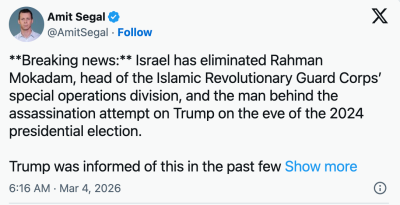
In fact, the supposed assassination plan which Mokadam was accused of directing did not initially focus on Trump. Instead, the target was said to be Masih Alinejad, an Iranian expat and regime change activist on the US government payroll. The only evidence that Trump was a possible target at all came from the claims of a convicted drug dealer and con man named Farhad Shakeri, who had also been a defendant. Shakeri spoke to the FBI by telephone from Iran, providing dubious information in exchange for a reduced prison sentence for an unnamed associate in the US.
It was during these remote interviews that Shakeri seemingly claimed he had an IRGC handler who had directed him to kill Trump. But according to the FBI’s criminal complaint against him, that handler’s name was “Majid Soleimani,” not Mokadam.
The FBI agent who interviewed Shakeri clearly recognized his penchant for fabulism, writing that “certain of Shakeri’s statements appear to be true and others appear to be false.” Shakeri had indeed lied throughout his interviews, yet the agent still concluded that “it appears” he was planning to kill Trump. He did not explain why he considered the confession credible, and the allegation about a plot to kill Trump was notably absent from the grand jury indictment filed a month later.
After killing Mokadam on March 4, the Israelis went straight to the president to boast of their supposed achievement – and reignite his anxiety about Iranian assassins.
As Amit Segal noted, “Trump was informed of this in the past few hours by Israel.” In doing so, the Israelis reinforced Trump’s sense that he had been hunted by Iran – and that by fighting their war, he was saving his own skin.
As it had in the past, the White House posted a video on its official Twitter/X account proclaiming Trump’s triumph over Iranian assassins: “I WAS THE HUNTED, AND NOW I’M THE HUNTER.”
Thomas Crooks may have narrowly missed Trump’s cranium in Butler, Pennsylvania, but Israel had found a way into the president’s head.
Iran denies attacking Azerbaijan, suggests Mossad involvement
Al Mayadeen | March 5, 2026
Iran’s armed forces denied on Thursday that they launched drones toward Azerbaijan after Baku accused Tehran of carrying out UAV attacks in the Nakhchivan Autonomous Republic.
The statement was issued by the General Staff of the Iranian Armed Forces and carried by the Iranian state broadcaster IRIB.
Azerbaijan reports drone attack
Earlier in the day, Azerbaijan’s Foreign Ministry claimed drones launched from Iranian territory struck targets in the Nakhchivan Autonomous Republic, leaving two people injured.
Tehran rejected the claim and emphasized that Iran respects the sovereignty of neighboring countries, particularly regional Muslim states.
“The Islamic Republic of Iran, respecting the sovereignty of all neighboring states, especially brotherly Muslim countries, denies the launch of UAVs by the Iranian Armed Forces toward Azerbaijan,” the General Staff said in the statement.
Tehran blames Israeli involvement
The Iranian military suggested that “Israel” may have launched a drone toward Azerbaijani territory in an attempt to blame Iran and escalate tensions between the neighboring countries.
The accusation comes as regional tensions have intensified following the US and Israeli attacks on Iran and Tehran’s retaliatory operations.
Claims of covert Israeli activity in the region
The allegations also emerge amid claims of covert Israeli operations in several Gulf countries.
Speaking on The Tucker Carlson Show, American journalist Tucker Carlson said authorities in Qatar and Saudi Arabia had arrested Mossad agents accused of planning bombings in those countries. Carlson described the development as unusual and questioned the logic behind such operations.
He suggested the alleged plots could be part of broader efforts to destabilize multiple countries in the region while escalating pressure on Iran.
Iranian Armed Forces say no missile fired from Iran into Turkey
Press TV – March 5, 2026
Iran’s Armed Forces say they did not fire any missiles into Turkey, stressing Tehran’s respect for the neighboring country’s territorial integrity.
“The Armed Forces of the Islamic Republic of Iran dismiss firing any missile into Turkey,” the Chief Staff of the Armed Forces said in a statement on Thursday.
It added that the Iranian Armed Forces respect the sovereignty of the neighboring and friendly country of Turkey.
The statement came after Turkey’s Ministry of National Defense claimed that NATO air defense systems had destroyed a ballistic missile fired from Iran and heading into Turkish airspace.
The ministry announced on Wednesday that the missile was shot down after passing over Syria and Iraq. The target of the missile has not been determined.
Incirlik Air Base, located in Turkey, is under the control of the country’s air force and operates as a joint Turkish-US airbase.
It is used by foreign military forces, mainly the US and other NATO allies.
Incirlik was a key logistics and air support site for US-led operations in Iraq during the 1991 Persian Gulf War and later as a cargo hub for Iraq and Afghanistan operations.
Iran is defending itself against an uprovoked US-Israeli aggression that started last Saturday. Iranian armed forces have launched multiple drone and missile operations against US military assets across the region since the start of the war.
Iran denies attacks on Oman as it warns of US-Israeli ‘false-flag’ ops
Press TV – March 3, 2026
The General Staff of the Armed Forces of Iran has denied any involvement in military strikes against the territory or ports of the Sultanate of Oman, following reports of drone attacks at the Duqm and Salalah ports.
In a statement released via its Communications Center, the General Staff categorically rejected claims of aggression against its “friend and neighbor,” Oman. The denial comes as regional energy infrastructure reportedly faces a wave of unexplained aerial strikes.
According to the Oman News Agency, a fuel tank at the Duqm commercial port was struck by several unmanned aircraft on Tuesday.
While authorities confirmed the damage was contained with no casualties, it marked the second such incident at the port this week; two drones targeted the facility on Sunday, leaving one worker injured.
Further north, the Omani government reported that two additional drones were intercepted over the Dhofar Governorate on Tuesday, while a third crashed near the port of Salalah.
Tehran points to ‘Zionist plot’
The Khatam al-Anbiya Central Headquarters, Iran’s primary joint military command, issued a response, characterizing the attacks on Muslim nations as a “desperate act” by the US and Israel to tarnish Iran’s image.
“The aggressor Zionists and Americans … are seeking to attack diplomatic centers and the interests of Muslim countries in the region with the aim of blaming the Islamic Republic of Iran,” the Headquarters stated.
It said Iran’s military operations are strictly disciplined. “We explicitly declare that the offensive of the Armed Forces of the Islamic Republic of Iran is exclusively directed against the Zionist regime and the locations of the criminal US aggressor army and their military and security infrastructure and interests.”
The Khatam al-Anbiya Headquarters said the strikes on neutral neighbors were designed to help the US and Israel escape their current impasse.
On Monday, Qatar halted production of liquefied natural gas (LNG), representing roughly 20% of global supply, while Saudi Arabia said it suspended operations at its largest domestic refinery.
In the United Arab Emirates, the Abu Dhabi government confirmed a fire at the Musaffah fuel tank terminal following a drone strike on Monday, though operations were reportedly not impacted.
Iran maintains that it holds no hostility toward neighboring Muslim countries and remains committed to the security of the region. It says the retaliatory attacks are only directed against US and Israeli assets in the region.
Featured Video
Laith Marouf: Hezbollah’s position on US-Iran ceasefire
or go to
Aletho News Archives – Video-Images
From the Archives
The Dirty Little Secret behind the “Global Terrorism Index”
The Omission of Israeli Terrorism in the Occupied Palestinian Territories
By Karin Brothers | Global Research | December 6, 2014
… The Israeli settlements — all of which are illegal – have been identified as a major impediment to peace. The refusal of a major “global” terrorism report to name the Israeli settlers as one of the groups most responsible for terrorism not only misrepresents a major source of regional violence but exposes the Global Terrorism Index as a propaganda tool that supports a U.S. agenda.
In recent years, governments have been attempting to thwart terrorism by blocking supportive fund-raising. When it comes to Israeli settlements, however, the US and Canada actually encourage fund-raising by giving organizations (such as Christian Friends of Israeli Communities (CFOIC) and the Jewish National Fund) financial support in the form of donor tax-deductions.
Charities which provide funds for the Israeli settlements should be regarded as terror-financing organizations. They should not only lose their tax-deductible status, but they should be banned because they support the violation of international humanitarian law. The terror-financing laws that are being strictly enforced for Muslim charities should be applied to Christian and Jewish charities as well. … Read full article
Blog Roll
 Aletho News
- Trump Administration Moves To Automate U.S. Military Draft Registration
- Spain orders reopening of Tehran embassy, condemns Israel’s carpet bombing of Lebanon
- Israel faces ‘unsustainable’ strategic crisis following 40-day war against Iran: Analyst
- Iran restricts Hormuz access to 15 vessels per day under ceasefire terms: Report
- The ‘Opposition Party’ Has Done Nothing to Stop the Iran War and Much to Goad Trump Into Continuing It
- Moscow backs Tehran on status of Lebanon in US-Iran deal
- How UK Regulator Ofcom Quietly Bypassed International Law to Police American Speech
- The Black Cube Files: How Former Mossad Operatives Flipped a Nation
- Laith Marouf: Hezbollah’s position on US-Iran ceasefire: What you’re not being told
- Israel’s priority lies in destroying chances of peace between Iran, US: Ex-UN nuclear chief
- If Americans Knew
- The gallows law: Israel moves toward executing Palestinian children
- Tucker Carlson: The Path to Peace requires ending ‘special alliance’ with Israel
- This is ceasefire? Israel’s biggest massacre yet in Lebanon, another journalist killed in Gaza – Daily Update
- Tucker Carlson on Israel: This Is the Behavior of an Ally? Really?
- Gazans face a triple crisis: severe shortages of water and bread, healthcare in tatters
- NY Times reports how Netanyahu took the US into Iran War
- A sigh of relief over Iran, but Gaza and Lebanon in dire straits – Daily Update
- Thousands dead and neighborhoods razed to the ground: Aid agencies fear southern Lebanon is becoming the new Gaza
- The war the US is fighting for Israel could cost trillions
- ‘Cigarette Burns, Nail Wounds’: Toddler Tortured in Gaza to Coerce Father
- No Tricks Zone
- An Inconvenient Tree: Uncovered In Alps… Europe Much Warmer Than Today 6000 Years Ago
- New Study Reports A 60% Slowdown In Greenland’s Ice Loss Rate In The Last Decade
- Low Intensity Tornado Wrecks Major Solar Farm, Creating A Potential Toxic Dump
- New Study Finds Warming Saves Lives…Cold Temperatures 12 Times More Deadly Than Excess Heat
- German Science Blog Accuses PIK Climate Institute Of Hallucinating Climate Tipping Points
- Devastating Assessment Of Comirnaty Vaccine By Former Senior Pfizer Europe Toxicologist
- New Study: CO2 Is ‘Effectively Negligible’ As An Explanatory Climate Change Factor Since 2000
- Former Pfizer Toxicologist Dr. Helmut Sterz Tells Bundestag Hearing Pfizer Vaccine Should Have Never Been Approved
- Energy Expert: Germany’s Nuclear Phaseout Was A “500 Billion Euro Mistake”
- New Research: South Australia’s Mid-Holocene Sea Surface Temperatures Were 4°C Warmer Than Today
 Aletho News