BBC News Arabic evacuated its press crew from the Gaza Strip through the Rafah land crossing, after the crew covered the ongoing war there for over four months.
The Egyptian authorities facilitated the crossing of the nine-member press crew through the Rafah Crossing after their families left the Strip through the crossing weeks ago.
The Rafah crossing is the gateway that connects Gaza to the world and is used for the entry of humanitarian and relief aid and the exit of individuals wounded in Israel’s genocidal war for treatment in Egypt and other countries.
On Sunday, flouting the provisional ruling of the International Court of Justice (ICJ), Israel launched an air campaign on Rafah, killing more than 65 Palestinians. The city had been declared a “safe zone” by occupation forces and over a million Palestinians had taken shelter there after being forced out of their homes in the northern areas of the Strip since 7 October.
The Israeli offensive has left 85 per cent of Gaza’s population internally displaced amid acute shortages of food, clean water and medicine, while 60 per cent of the enclave’s infrastructure was damaged or destroyed, according to the UN.
The UN, Egypt, and several other countries, including the US, warned Israel against launching an attack on Rafah, as it could cause what they described as a “disaster” in the city crowded with more than half of the two million displaced civilians from across Gaza.
GAZA – The Government Media Office (GMO) in Gaza condemned in the strongest terms the Israeli targeting of the Al-Jazeera Arabic news crew for the fifth time, leading to the serious injury of the channel’s correspondent and cameraman in Khan Yunis, in southern Gaza Strip.
The GMO said, in a statement on Tuesday, Israeli airstrikes targeted Al-Jazeera’s reporter Ismail Abu Omar and cameraman Ahmed Matar, stressing that “the Israeli occupation army has deliberately targeted the channel’s teams for the fifth time in a row in a complete crime in violation of the international law.”
Journalist Abu Omar has had his right leg and some fingers amputated, in addition to other various wounds. His colleague Matar sustained various injuries, as well.
The GMO pointed out that since October 7, the Israeli occupation army has killed 128 journalists, arrested 10, and injured many others, stressing that this indicates that journalists have become targets of the Israeli occupation army.
The GMO called on press unions, media agencies, and human rights groups to denounce this crime and to pressure Israel to stop targeting journalists and to halt its genocidal war against civilians.
There has been much written and said about Tucker Carlson’s interview with Russian President Vladimir Putin last week. As of this writing the video on Twitter alone has been viewed nearly 200 million times, making it likely the most-viewed news event in history.
Many millions of viewers who may not have had access to the other side of the story were informed that the Russia/Ukraine military conflict did not begin in 2022, as the mainstream media continuously reports, but in fact began eight years earlier with a US-backed coup in Ukraine. The US media does not report this because they don’t want Americans to begin questioning our interventionist foreign policy. They don’t want Americans to see that our government meddling in the affairs of other countries – whether by “color revolution,” sanctions, or bombs – has real and deadly consequences to those on the receiving end of our foreign policy.
To me, however, perhaps the most interesting aspect of the Tucker Carlson interview with Putin was the US mainstream media reaction. As Putin himself said during the interview, “in the world of propaganda, it’s very difficult to defeat the United States.” Even a casual look at the US mainstream media’s reporting before and after the interview would show how correct he is about that. In the days and weeks before the interview, the US media was filled with stories about how horrible it was that Tucker Carlson was interviewing the Russian president. There was the danger, they all said, that Putin might spread “disinformation.”
That Putin might say something to put his country in a better light was, they were saying, reason enough to not interview him. With that logic, why have journalism at all? Everyone interviewed by journalists – certainly every world leader – will attempt to paint a rosy picture. The job of a journalist in a free society should be to do the reporting and let the people decide. But somehow that has been lost. These days the mainstream media tells you what to think and you better not dispute it or you will be cancelled!
What the US mainstream media was really worried about was that the “other side of the story” might start to ring true with the public. So they attacked the messenger.
The CNN reporting on Tucker’s interview pretty much sums up the reaction across the board of the US mainstream media. Their headline read, “Tucker Carlson is in Russia to interview Putin. He’s already doing the bidding of the Kremlin.”
By merely doing what used to be called “journalism” – interviewing and reporting on people and events, whether good or bad – one is “doing the bidding” of the subject of the interview or report?
No wonder fellow journalist Julian Assange has been locked away in a gulag for so many years. He dared to assume that in a free society, being a journalist means reporting the good, the bad, and the ugly even if it puts those in power in a bad light.
In the end, the massive success of the Tucker Carlson interview with Vladimir Putin demonstrates once and for all that the American people are sick to death of their mainstream media propagandists and liars. They are looking not for government narratives, but for truth. That’s the really good news about this interview.
Israel supporters have become a leading fascist force in Canada. They are pushing to restrict civil liberties, dismantle democratic organizations and increase policing.
Since I wrote about the phenomenon a month ago Zionist groups and journalists have deepened their ties to fascist groups and escalated their anti-democratic rhetoric in a bid to defend the genocide in Gaza. Israel lobby groups and commentators have repeatedly taken their cues from the former head of the thuggish and racist Jewish Defence League (JDL). They’ve repeatedly circulated long-time JDL head Meir Weinstein’s videos depicting anti-genocidal protesters as a threat and in a sign of this deepening alignment arch-Israeli nationalist reporter Joe Warmington recently quoted Weinstein in a story tarring protesters. In a Toronto Sun article spurred by the former JDL head’s X post headlined “Security threat against Trudeau all of Canada’s concern”, Warmington quotes Weinstein labelling Palestine solidarity protesters a “risk.”
As they deepen their ties to Khanist fascists, Zionist lobby groups have repeatedly called for marches to be banned, individuals to be fired and talks canceled. To suppress criticism of Canada’s contribution to Israel’s genocide Liberal MPs Anthony Housefather, Marco Mendicino and Ya’ara Saks have repeatedly taken up the call to suspend democratic rights. A month ago Saks posted, “As I stated last week, & will repeat again – protests within largely Jewish neighbourhoods like the ones in our riding of #YorkCentre is completely unacceptable. Targeting an overpass in an area that is known to be local Jewish community is a form of intimidation.”
In response to pressure from Saks, Weinstein, B’nai Brith, CIJA and others, the Toronto police barred protests on an overpass of Highway 401. They then arrested three people for asserting their right to assemble. The Canadian Civil Liberties Association (CCLA) condemned the police’s move and CCLA executive director Noa Mendelsohn Aviv pleaded in the Canadian Jewish News against the Zionists’ push to suppress civil liberties. (A B’nai Brith suit to expand the anti-protest zone was rejected.)
As part of this push to supress demonstrations, Israeli nationalist city councillor James Pasternak pushed Toronto representatives to develop a “policy and framework for the management and monitoring of rallies and protests.” In mid-January Pasternak declared, “It does not take much to see the [Palestinian] gatherings taking place downtown are not Charter-protected.”
In a similar bid to shut down basic democratic rights B’nai Brith called for suppressing the public’s rights to ask questions at city council meetings. Reportedly, on December 21 a handful of members of the public showed up at a meeting of the Agglomeration Council of Montreal in response to Hampstead mayor Jeremy Levi telling me he would support Israel even if they killed 100,000 Palestinian children since “good needs to prevail over evil”. Apparently, they asked about Levi’s genocidal apologia and a Hampstead law to send money raised from fines for ripping down posters of hostages to Israel, which led B’nai Brith to file a complaint with the Quebec Municipal Commission (The Commission rejected it). When members of the public asked questions at the January meeting B’nai Brith filed a second complaint (also rejected). The arch Zionist Suburban newspaper/website has published three stories on the matter and a week ago the Montreal Gazette put the Zionists complaints on its front page in a story headlined “Agglomeration council won’t act on antisemitism complaint, Montreal mayor says”.
CIJA and B’nai Brith recently succeeded in pressuring Concordia and Carleton universities to cancel their stops on a national speaking tour with British commentator Sami Hamdi, organized by the Canadian Muslim Political Affairs Council. A recent Zionist sponsored lawsuit also called for the Concordia administration to block students from funding their union. In a similar vein, Conrad Black penned a commentary last week headlined “SHUT CUPE DOWN” due to their Palestine solidarity and in the same National Post newspaper lawyer Howard Levitt called on Zionist members to decertify the Canadian Union Public Employees union.
Fascists have long targeted labour unions. Ditto for books. Montreal’s Jewish Public Library recently pulled the books of Quebec’s most prominent children’s author, Elise Gravel, from their displays because she posted against genocide. A councillor in Côte-St-Luc, Mike Cohen, called for his municipality to do the same.
On X Israel supporters regularly respond to videos of large numbers protesting Canadian complicity in genocide by calling for protesters to be deported. In a similar vein, JSpace board chair Joe Roberts recently called protesters “fifth columnists” whose “real enemy has always been the liberal democracies of the west.”
To supress the “fifth column”, the establishment Jewish groups are campaigning for increased police funding. On January 18 CIJA instigated a letter writing campaign demanding “Reverse the police cuts” in Toronto. Two weeks later, the advocacy agent for Canada’s Jewish Federations wrote, “We continue to urge Council to take action to prevent any shortfall in funding for the Toronto Police Service, so that our police have the tools they need to enforce the law and safeguard the Jewish community and all Torontonians from the threat of hate-motivated and all other types of crime.”
B’nai Brith recently called for increased funding to Montreal police and a slew of Zionist voices have called for the provincial government to allow security guards at schools to carry guns. City councillor Sonny Moroz, who previously worked for arch Zionist federal MP Anthony Housefather, submitted a motion calling for greater police presence in part of Montreal.
CIJA, B’nai Brith and Friends of Simon Wiesenthal Center have extensive ties to police forces across the country. Recently it was reported that the RCMP’s controversial Community-Industry Response Group (C-IRG), which has spied on indigenous and pipeline protests, has been targeting Palestine solidarity protests. In internal budgetary documents C-IRG labelled one protest a “Hamas Day of Action”.
Zionists have long sought to criminalize support for Palestinians. In a bid to promote the slaughter in Gaza, they’ve become cheerleaders for authoritarianism, cancel culture and other forms of intimidation historically associated with fascism.
The Palestinian Prisoners’ Society (PPS) confirmed, Sunday, that the Israeli army exiled a Palestinian female journalist from the occupied West Bank to the devastated and destroyed Gaza Strip, after abducting her earlier this month.
The PPS said the army abducted the journalist, Seeqal Yousef Qaddoum, 51, after stopping her at a military roadblock near Ramallah, in the central West Bank, on February 1st.
While the detained journalist was born in the Gaza Strip, she has been living for many years in the Shiokh Palestinian town, east of the southern West Bank city of Hebron.
The PPS added that the army transferred the detained journalist from one of its prisons to the Kerem Shalom Crossing, in the southern part of the Gaza Strip, before exiling her to the devastated and destroyed coastal enclave.
Seeqal works for the official, government-run Palestine TV, and was abducted by the soldiers on February 1st after they stopped her at a military roadblock near Ramallah.
She was first taken to HaSharon Israeli prison and then to the Damoun prison, and was interrogated but was never facing charges.
The PPS said the number of female Palestinian detainees in Damoun Israeli prison is more than 45, and added that it doesn’t have any available data on the number of detainees, who were abducted in the Gaza Strip since October 7, 2023, due to Israel’s restrictions on such information, even to international human rights groups, and added that many detainees are subject to “forced disappearances.”
On Sunday morning, the PPS said the number of Palestinian political prisoners has exceeded 6,950 Palestinians, including many elders, women, and children, mostly from their homes, and the dozens who were taken prisoner at military roadblocks, across the occupied West Bank.
Since October 7, the Israeli army began a massive abduction campaign in the West Bank, targeting women, men, and children, and dozens of Palestinians, including laborers from the Gaza Strip who have been living and working in the West Bank, including occupied Jerusalem.
The Palestinian Detainees’ Committee said the abductions have seriously escalated, and include massive searches and destruction of homes and property across the West Bank, including in and around occupied Jerusalem.
It added that while not all of the abductees remain imprisoned, most are either in interrogation facilities, and various prisons and detention camps and dozens were slapped with arbitrary Administrative Detention orders, held without charges or trial for renewable periods that generally vary between three and six months each time.
On February 5, 2024, the Ad-Dameer Prisoner Support and Human Rights Association said the number of political prisoners held by Israel reached 9,000, including 70 women and 200 children, in addition to 3,484 Palestinians held under Administrative Detention orders.
In a piece published by Politico, a German-owned publication infamous for attempts to whitewash Nazism, Sergey Goryashko claimed that Putin supposedly “lied”. Among several propaganda claims he used to, as he says, “debunk” Putin’s points was that the Neo-Nazi junta frontman Volodymyr Zelensky “only signed a decree banning negotiations specifically with Putin, not Russia as a country”. Such ludicrous claims aren’t only false, but are even childish. Pushed by the United States, United Kingdom and NATO, the Kiev regime certainly broke the March 2022 peace deal that could have ended the special military operation (SMO) in less than a month. What’s more, it even publicly promotes its so-called “10-point peace plan” that boils down to Russia’s unconditional capitulation, a fantasy that the political West wholeheartedly supports and even promotes through some sort of absurd unilateral “peace talks”. In doing so, the Neo-Nazi junta effectively codified the impossibility of a peaceful settlement.
So much for Putin “lying”. However, that’s only the tip of the iceberg when it comes to frenzied attacks by the mainstream propaganda machine. In a piece for The New Yorker, Masha Gessen, the infamous “woke” ideologue obsessed with Putin, called the interview “boring”. She (although Gessen insists her pronouns are “they/them”, a request I earnestly refuse to comply with) obviously loathes historical facts, so the trouble she has with going through the entire interview, a problem most likely exacerbated by her two-second attention span (tends to happen to a lot of people staring at reels all day), perfectly explains her rather poor judgment of Putin’s points. Then came the “fact-checkers” such as Charlie Hancock of the Amsterdam-based Moscow Times who essentially repeated several of Goryashko’s long-debunked claims and added a few of his own. After all, what would the mainstream propaganda machine ever do without “fact-checkers“?
Of course, Hancock wasn’t the only one. The UK’s state-run BBC also published its own version, “fact-checking Putin’s nonsense history“. It would seem Masha Gessen isn’t the only one who skipped history classes in primary school, as the BBC’s Ido Vock quoted several self-styled “experts” and “pundits” to supposedly “debunk Putin’s rambling”, as he called it, clearly implying that he was also bored by the interview, which further indicates just how much he actually knows about the topic he covered for the UK’s state-run news agency. And of course, there’s also the Radio Free Europe/Radio Liberty (RFE/RL), claiming that Carlson’s Putin interview supposedly serves as a “propaganda platform”, which is quite rich coming from a literal CIA front formed to spread Washington DC’s state-sponsored propaganda. The Economist insists that “Russia’s president is not a man to be trusted, still less to emulate or admire”, because, luckily, they “know Putin’s real message” better than he himself does.
Newsweek’s Brendan Cole quoted Oleksandra Matviichuk, the Kiev regime’s “human rights activist”, who also slammed Carlson. Comically enough, Cole insists that Matviichuk’s opinion “matters” because she’s a Nobel Peace Prize winner. Is it even necessary to explain just how politicized that vaunted “peace prize” is when laureates include people like Barrack Obama and Al Gore? The Obama administration came to power criticizing the previous government run by George W. Bush for its aggression across the Middle East. Obama promised to end these wars, which is why he got the once-prestigious award in the first place. However, as soon as Bush left the White House, Obama expanded his aggression from two countries (Iraq and Afghanistan) to another five (Libya, Syria, Yemen, Somalia and Pakistan), seven in total. Worse yet, during Obama’s presidency (2009-2017), Washington DC launched ten times more airstrikes than under Bush, killing millions of innocent civilians in the process.
Putin’s intellect and encyclopedic knowledge of history, law, intelligence and several other key fields are a massive boost to Russia’s already world-class diplomacy. This stands in stark contrast to the US and its current administration. Could anyone imagine Joe Biden giving an unscripted, two-hour-long interview to a foreign journalist, much less one conducted with near-scholarly precision? Regardless of whether one adores or loathes President Putin, the fact is that the increasingly unpopular and impotent leaders of the political West are simply no match for him, which is why we never see any of them giving remotely similar interviews to journalists of Tucker Carlson’s caliber. And while he might be among the most prominent journalists to ever interview Putin, Russia’s president is well-known for hours-long discussions with hundreds (if not thousands) of journalists from all over the world, without any papers, cliff notes or scripted questions. He simply doesn’t need them.
Drago Bosnic is an independent geopolitical and military analyst.
Cracks are forming in the World Health Organisation’s plans to secure a vast expansion of its powers and resources. Presented as a necessarily urgent response to the empirically unsupported assertion that pandemics are increasing in frequency and severity, negotiations for a broad package of amendments to the International Health Regulations (IHR) and a new parallel Pandemic Treaty had been expected to be over by the end of 2023. Having missed that deadline, in late January the Director-General Tedros Adhanom Ghebreyesus pleaded for WHO member states to give ground so that the negotiations could be completed at all. In the same comments he sought to apportion blame for the unexpected headwinds on those who had misconstrued, or misrepresented, the benign intentions of the WHO and its key supporters (which include China and some wealthy private organisations).
Reading between the lines, it appears that Mr. Ghebreyesus and his supporters may finally have realised that the game could soon be up: the strength of opposition to the ambitions of this unelected technocratic administration has compounded rapidly in recent weeks. That opposition has become more evident not only in smaller less influential countries, but in countries which are major contributors to the WHO. Significantly this has included groups of politicians in the U.K. and the U.S. who are seriously alarmed by the vision of a WHO-centred ‘command and control’ public health system, and by the constitutional and public spending implications of these two proposed international agreements.
The Director-General has perhaps realised that his blind ambition has not only put at risk the negotiations that might have elevated his unelected advisory organisation to the status of a supra-national rule-making authority, but is also now starting to jeopardise the future status, funding and membership of the WHO.
Secrecy, opacity and delay
The original timeline presented by the WHO had envisaged a final text of the proposed IHR amendments – where many of the most contentious proposals reside – being published before January 27th 2024, with a view to their adoption taking place at the World Health Assembly meeting scheduled from May 27th to June 1st 2024, alongside adoption of the proposed new Pandemic Treaty. That timeline, although tight, would have allowed four months for negotiators to brief domestic stakeholders, for national legislatures to debate the combined proposals and for any necessary pre-adoption formalities (approvals, technical scrutiny, cost/benefit analyses, etc.) to be completed prior to a vote at the WHA meeting in May.
Yet, on its own initiative, in October 2023 the Working Group for the negotiation of the IHR amendments unilaterally moved its own goalposts so that in place of publishing a final draft text to be scrutinised well in advance of that WHA meeting, it instead committed to circulate by the end of January a copy of the original set of proposed amendments and an interim ‘working draft’ text showing the current state of play. Negotiations would then continue between February and April 2024. It was – and remains – ambiguous whether this move was compatible with the procedural legal requirements already enshrined in the International Health Regulations, but perhaps member states quietly agreed with the WHO secretariat not to look too hard at that issue.
Notwithstanding this commitment, no interim working draft of the IHR amendments appears yet to have been published, and the U.K. officials involved in the negotiations have been inexplicably reluctant to reveal the current position of the text. Indeed, to date all demands for transparency by U.K. parliamentarians have been ignored or deflected by the ministers responsible for the U.K.’s relationship with the WHO. Astonishingly the U.K. Government has refused even to confirm who is negotiating on the U.K.’s behalf.
We understand that the IHR Working Group anticipates a final text being settled only during April or possibly even into May, but there remains no official deadline for it to publish that final text. It refuses to confirm what the documents say, and it refuses to say when it will reveal those documents. If any further evidence were needed of the disregard and disrespect for democratic process and the sovereignty of national parliaments now alleged of the WHO, then surely this is it.
Out of time
That corrosive secrecy, opacity and delay has left a vanishingly narrow window for domestic public health organisations and parliamentarians to review or comment meaningfully on what may become generationally-significant changes to the U.K.’s relationship with the WHO, with other countries and with the public health business community. It means Parliament will have scant opportunity to scrutinise the IHR amendments and the new international funding and resource-sharing commitments enshrined in the parallel Pandemic Treaty. Yet these are documents with the potential to impact materially on the U.K.’s ability to act autonomously, on freedom of speech and opinion, on health security and on the nature of U.K. democracy itself. They also have the potential to commit future generations to very significant public spending obligations.
Given their significance, the IHR proposals and the parallel Pandemic Treaty require a commensurate degree of examination by Parliament. The current nature of the WHO’s funding, 85% of which now comes from private commercially-interested organisations, creates an additional imperative for rigorous, investigative scrutiny. In November 2023, Human Rights Watch wrote that:
The draft [treaty] reflects a process disproportionately guided by corporate demands and the policy positions of high-income governments seeking to protect the power of private actors in health including the pharmaceutical industry.
Without sight of any working drafts of the revised IHRs, nor of the current state of the draft treaty, scrutiny is completely frustrated. At this late stage in the process, after repetitive calls for transparency seemingly have been ignored, one is left to wonder whether this is precisely the intent of the officials involved.
Deferral is the rational solution
As the window for full, fair, candid appraisal by national democratically-elected legislatures is now all but shut, the logical and necessary solution is for member states to demand that any vote to adopt either of these two international accords is held over to the next WHA meeting in May 2025. This will allow ample time both for the conclusion of the negotiations and for member state-level scrutiny of the proposals served up by the negotiating teams.
If it is truly the case that the WHO and its member officials do not intend for national legislatures to cede rule-making sovereignty to an enlarged WHO technocracy, they will surely accept the need for state-level legislatures to control the timing of this process. Calls for deferral have begun, but more voices will be needed to press relevant political leaders and officials to accept that deferral is the only legitimate response to this situation.
A turning point
Even now, in the face of a chorus of rational legally-grounded concerns raised by U.K. parliamentarians about the substance of the proposed amendments and the opacity of the negotiations, the Government has remained steadfastly unwilling to comment on its negotiating intent and objectives, beyond vague platitudes. Efforts by members of the public, legal experts and parliamentarians to understand the current state of negotiations, and even just the arrangements within the U.K. Government to conduct the negotiations, have been stonewalled. The WHO equally has remained virtually mute and offered no meaningful evidence to support claims that its ambitions have been misunderstood.
This has served only to fuel distrust in this process, in the Government and its senior officials, in the U.K.’s relationship with the WHO, and in the WHO’s relationship with its influential funding providers.
Behaviour of this overtly undemocratic nature indicates that the WHO project has long since lost sight of its noble foundations in post-war benevolent multilateralism, and indeed of its reason for being: health for all in pursuit of global peace and security. Unfortunately, the WHO is now a symbol of all that is wrong with what has become a system of global public health patronage. This shamelessly undemocratic and chaotic power grab is also indicative of an organisation which has reached the end of its useful life, at least in its current guise. We suggest that this sorry episode should become the impetus for the U.K. to revisit its relationship with the WHO, and the relationship of the WHO with its funding providers.
The U.K. will not be an outlier if it does so, but rather a role model and – judging by the breadth and strength of international expressions of antipathy for the WHO’s ambitions – a leader of fast followers. This may well be the U.K.’s best post-Brexit opportunity to be an actor of global significance on the international stage.
Molly Kingsley is a founder and Ben Kingsley is the Head of Legal Affairs at children’s rights campaign group UsForThem. Find UsForThem on Substack. Ben and Molly’s new book (co-authored with Arabella Skinner) The Accountability Deficitis available now at Amazon and other book stores.
A German research institute has terminated the contract of a pro-Palestine professor of anthropology after criticizing the Israeli regime’s ongoing war on the Gaza Strip.
The Max Planck Society said they had severed their relationship with “highly acclaimed” academic Ghassan Hage over a set of social media posts that they said were “incompatible” with the society’s values, media reported this week.
The leading German research institution added that “racism, Islamophobia, anti-Semitism, discrimination, hatred, and agitation have no place in the Max Planck Society.”
The Lebanese-Australian Melbourne University professor, who had posted a series of pro-Palestine posts on social media condemning the Israeli regime forces’ months-long genocidal war on Palestinians in Gaza, criticized the Max Planck Institute for its decision to sever its ties with him over his support for peace.
He said he could live with being characterized as having “incompatible values” with the German institution; however, “implying that I am a racist, I cannot accept.”
Since the Israeli regime launched the genocidal war on Gaza in early October, Germany has seen an escalating crackdown on pro-Palestinian advocacy, with rallies and Palestinian flags banned in many parts of the country.
Events and rallies where pro-Palestinian speeches were held have been banned in schools, and the traditional keffiyeh scarfs are also barred.
Samidoun, a group that advocates for Palestinian prisoners, was banned in the immediate aftermath of the 7 October attack.
Pro-Palestinian voices have also been widely silenced with cultural institutions reporting pressure to cancel events featuring groups critical of Israel.
The Frankfurt Book Fair canceled a planned award ceremony for the Palestinian author Adania Shibli in October.
Oyoun Cultural Institution’s state funding was cut in November after hosting an event for a Jewish-led organization that supported the BDS movement against Israel, a movement that Germany’s Bundestag classified as anti-Semitic in 2019.
Also, pro-Palestine British playwright, Caryl Churchill, was stripped on October 31 of the European Drama Prize she had received in April in recognition of her life’s work, over her support for Palestine.
The Daily Wire hit piece targets Gustavo Espada, the financial and systems coordinator for Harvard’s Department of East Asian Languages and Civilizations. According to the Wire, Espada “has been active in pushing 9/11 conspiracy theories for 18 years, according to a 2006 piece in The Lowell Sun which reported he spends 10 hours a week ‘handing out literature,’ Web logging and talking with people on the street about his views on 9/11.”
The thrust of the Wire hit piece is that Espada should be fired from his university job because he wants to debate 9/11. Reading the story brought back memories of a my own experience in 2006. While teaching subjects including Folklore, African Studies, and Islamic Studies at the University of Wisconsin-Madison, I had begun doing 9/11 teach-ins on campus in 2004, and then gotten involved in the national and global 9/11 truth movements. In 2006 I became the focus of a concerted pushback campaign sparked by Lynn Cheney’s group ACTA and its acolytes in the Wisconsin Republican Party.
Like Espada, I repeatedly challenged my detractors to meet me in a formal debate. In September 2006, while I was under fire from the State Legislature, the UW-Madison Debate Club sponsored what was supposed to be a debate on 9/11. They arranged for me and Jim Fetzer to argue against the 9/11 Commission’s official story, and told us that a history professor and a political science professor (Donald Downs, as I recall) had agreed to defend it. But at the last minute, the two pro-official-story professors backed out. So Jim Fetzer and I were left “debating” two empty chairs.
I reiterated my debate challenge. The university Provost, Patrick Farrell, told me that he would try to have the university set up some sort of formal panel discussion or debate after the media furor died down. Student newspapers at UW-Madison and UW-Oshkosh published op-eds plaintively begging for some knowledgable professor to debate and refute me. But nobody stepped forward to defend the 9/11 Commission.
Six months of media hoopla (July through December 2006) made me unemployable at the University of Wisconsin. I was denied a tenure-track Islam-Humanities job at U.W.-Whitewater purely due to my views of 9/11, according to whistleblowing then-Dean of Humanities Howard Ross. And I was told by the late Professor Muhammad Umar Memon, then a member of the UW-Madison hiring committee for its Islam classes, that the committee was informed by the University administration that I must not be rehired for my Islam 101 teaching job for the same reason.
Rendered unemployable due to my views of 9/11, but with nobody willing to debate me and explain why my views were wrong (privately most of my colleagues I knew personally thought my views were likely right or at least plausible) I offered a $1000 honorarium to any University of Wisconsin instructor, whether professor or TA, who was willing to defend the 9/11 Commission in a formal debate. There were no takers. Years later, the offer was raised to $2000. Still no takers.
Similar debate challenges were issued at other universities. A 9/11 truth group at the University of Michigan sent letters to every professor in the Engineering department seeking someone to defend the FEMA and NIST positions on the destruction of the World Trade Center in a debate with me and Underwriters Labs whistleblower Kevin Ryan. Most didn’t respond. The few who did told the organizers, off the record, that Ryan and I were right.
Could a 9/11 Debate Have Prevented Genocide?
According to the tenets of liberal democracy, all important matters are supposed to be debated on the basis of logic and evidence, and the truth that emerges becomes the touchstone of public policy. Had a real debate on 9/11 ever transpired, the truth that would have emerged—9/11 was orchestrated not by al-Qaeda, but by the state of Israel and its American neoconservative allies—would have prevented the series of wars that has devastated the Middle East, including the ongoing Israeli genocide of Gaza.
People resist debate when they know that logic and facts are not on their side. When would-be debaters like Espada are smeared, and their livelihoods threatened, it’s obvious that those doing the smearing know that their victims are right.
Can We Debate the Ukraine War?
Another topic that’s off-limits to debate is the US war on Russia through Ukraine. As with 9/11, the neoconservative propaganda talking points—the enemy is pure evil, “they” attacked “us” for no reason, and so on—are inflated to the status of sacred public myths, and anyone who wants to debate them is a damnable heretic. Merely for exposing us to Putin’s point of view, Tucker Carlson has been attacked by the whole mainstream media. As with 9/11, the neocon Establishment’s refusal to debate on logic and evidence, and its preference for shrill vituperation and ad-hominem attacks, suggests that it knows it couldn’t win a real debate with the likes of Putin.
Cancelled Candidates
Elections are a form of public policy debate. When the side with power knows that it can’t win a fair debate—as with the Pakistani military’s stand-off with Imran Khan—it may try to cancel the candidacy…or the candidate. Khan, who was very nearly assassinated by the Pakistani establishment, currently languishes in prison despite his overwhelming popularity among the vast majority of his countrymen. The Pakistani junta’s attempt to rig last week’s elections failed, because it’s impossible to convincingly rig an election when your opponent has such high levels of support. So the man who is the people’s choice and the rightful Prime Minister, targeted by ludicrous legal assaults including an attack on the legitimacy of his marriage, remains in prison… for now.
Imran Khan’s plight, we might imagine, is typical of tinpot third world military dictatorships, but irrelevant to the affairs of advanced Western democracies. But in both the US and Germany, pro-immigration Establishments are working overtime to keep anti-immigration parties and personalities off the ballot. Like the Pakistani Establishment vis-a-vis Imran Khan, the US and German Establishments don’t want to have to debate anti-immigration populist movements. So the Democrats in the US, and the ruling elites in Germany, are using various underhanded means to try to keep Trump and the MAGA movement, and the anti-immigration party AFD, off the two nations’ respective ballots.
Donald Trump, like Imran Khan, might very well end up winning an election from a prison cell. Like Khan, Trump has been targeted by a lawfare campaign expressly designed to torpedo his political chances. And Trump’s party, like Khan’s, views itself as the victim of widespread election fraud, and those who try to raise and debate the issue are deplatformed. Though the two cases aren’t fully comparable—Khan is overwhelmingly popular while Trump is controversial, Khan’s complaints are fully justified while Trump’s are only partly so, and Khan is completely honest and ethical while Trump is not—there are enough similarities to raise questions about whether American “democracy” is any healthier than Pakistan’s.
Undebatable COVID
The notion that the truth emerges through free and fair debate took a huge hit during COVID. We were told to “trust the science” and wear masks everywhere, even though the science suggests that there is no convincing evidence that masks significantly slow the spread of respiratory viruses. The debate about COVID origins was unceremoniously quashed, and people were deplatformed for even mentioning the issue. And arguments about whether highly experimental vaccines should be mass-tested on entire populations were likewise suppressed. Only one position—the Establishment’s—was allowed.
One More Question for Debate
So in light of all the signs that liberal democracy is dead and free and fair debate no longer effectively exists, I propose one last subject for debate: Should debate itself be legal? Or to rephrase that in debate-ese: “Resolved: Debate should be criminalized, and would-be debaters should be imprisoned or executed.”
Here is the text of the expert report on Mann v. Simberg/Steyn in 2020 that I prepared at the request of Mark Steyn’s counsel.
My report, along with all other expert reports from both sides except for Abraham Wyner, were not admitted into evidence.
In my opinion, my report provides some much needed context for the trial. Here is a formatted pdf of my complete expert report [Curry Steyn Mann]
Report of Judith Curry, Ph. D.
I submit this report under D.C. Superior Court Civil Rule 26(a)(2)(B) & (C) as both fact and expert witness to address the subject matter on which I expect to present evidence and to summarize the facts and opinions on which I expect to testify. This report includes my observations and opinions as a lay and expert witness concerning three principal topics: (I) the nature of the scientific and public controversy concerning the Hockey Stick graph; (II) whether the Hockey Stick graph can be regarded as ‘fraudulent’; and (III) Michael Mann’s role in the downward spiral of climate science discourse. I present sections (I) and (III) mostly in my capacity as a fact/lay opinion witness and section (II) in my capacity as an expert witness.
SUMMARY
This report addresses the issue of whether it is reasonable to refer to the Hockey Stick graph as ‘fraudulent’ in the course of the public debate on climate change.
What is the nature of the scientific and public controversy concerning the Hockey Stick?
It is my opinion that the Hockey Stick has generated a dynamic and heated debate about its significance and its flaws. Since its publication, Mann’s Hockey Stick has been the subject of intense and often polemical comment and argument in: (a) peer-reviewed, scientific publications critical of the Hockey Stick; (b) analyses of the science behind the Hockey Stick on technical climate blogs; (c) published books on the Hockey Stick controversy; (d) articles by leading science journalists in the mainstream media; (e) online encyclopedia entries on the ‘Hockey Stick Controversy’; (f) Congressional hearings and investigations related to the Hockey Stick; and (e) the personal controversy surrounding Michael Mann in his efforts to defend the Hockey Stick and to thwart his critics.
2. Is it reasonable to regard the Hockey Stick as ‘fraudulent’?
It is my opinion that it is reasonable to have referred to the Hockey Stick in 2012 as ‘fraudulent,’ in the sense that aspects of it are deceptive and misleading:
Image falsification: Mann’s efforts to conceal the so-called “divergence problem” by deleting downward-trending post-1960 data and also by splicing earlier proxy data with later instrumental data is consistent with most standards of image fraud.
Cherry picking: Evidence shows that Mann engaged in selective data cherry picking to create the Hockey Stick, and that this cherry picking contributes to the perception of a “fraudulent” Hockey Stick by journalists, the public and scientists from other fields.
Data falsification (the ‘upside-down’ Tiljander proxy): Substantial evidence shows that Mann inverted data from the Tiljander proxies in a version of the Hockey Stick published in 2008. Mann did not acknowledge his mistaken interpretation of data. Even after published identification of the mistake, this mistake has propagated through subsequent literature including the IPCC 4th Assessment Report.
3. What is Mann’s role in the downward spiral of climate science discourse?
It is my opinion that the scientific discourse surrounding climate change in general, and the Hockey Stick in particular, has deteriorated in civility and professionalism, and that Mann has played a significant and active role in this corrosion and unprofessional degradation of tone. Mann’s approach to public discourse about his work and broader topics in climate change has contributed much to the hostility and animosity that characterize and mark these exchanges. My opinionis based on: (a) the norms of science and scientific discourse; (b) Mann’s withholding of data from his peers; (c) Mann’s efforts to stifle skepticism; and (d) Mann’s attacks on scientists who disagree with him.
THE SCIENTIFIC AND PUBLIC CONTROVERSY SURROUNDING THE HOCKEY STICK
The Hockey Stick is a graph of global temperatures for the last 600 to 1000 years, reconstructed from tree rings and other so-called proxy data. Its name comes from its shape – a long flat ‘handle’ representing comparatively stable temperatures in earlier centuries, followed by a dramatic uptick – the ‘blade’. The Hockey Stick graph was originally published in two papers co-authored by Michael Mann, Raymond Bradley, and Malcolm Hughes (MBH98, MBH99)[1]. MBH98 included a 600-year reconstruction and MBH99 included a 1000-year reconstruction.
Although Mann had only recently received his Ph.D., he was named as a lead author for a chapter in the Intergovernmental Panel on Climate Change (IPCC) Third Assessment Report (TAR), published in 2001. The Hockey Stick graph appeared seven times in the IPCC TAR, and appeared as the backdrop in the IPCC press conference announcing the findings of the report. Rather than displaying all of the long-term temperature reconstructions considered by the IPCC TAR, the opening figure of the Working Group 1 Summary for Policymakers highlighted a graph of temperature reconstructions based only on the MBH99 paper.
Following the public release of the IPCC TAR, the Hockey Stick was regarded as central to the IPCC’s case for global warming. The Hockey Stick was, for a time, arguably the most important graph in the world. Its message of unprecedented warmth at the end of the twentieth century was a vital part of the campaign to persuade the public that mankind had changed the world’s climate.
Since publication of the Hockey Stick in Mann’s paleoclimate reconstructions of temperatures (MBH98/99) and its prominence in the IPCC Third Assessment Report (TAR; 2001)[2], there has been substantial scientific controversy over the methods that Mann and his co-authors used in this research. The controversy extends to the results of their analysis, which contradicted existing geological and historical knowledge of the Medieval Warm Period and the Little Ice Age.
Of particular note are two papers published by McIntyre and McKitrick in 2005 that challenged the MBH98/99 analyses (section IIA). These papers motivated two Congressional investigations and hearings in 2006 (section IIE).
In November 2009, the unauthorized release of emails from the Climatic Research Unit at the University of East Anglia (UK) (“Climategate”) revealed that several scientists (including Mann) had evaded Freedom of Information Act requests for data, manipulated the peer review process, downplayed uncertainty about their research and attempted to squash disagreement and dissent from ‘skeptics.’ The publicity surrounding Climategate (Sections IIB, IIC) brought the Hockey Stick controversy back into the public debate on climate change, largely vindicating a range of concerns that had been raised by McIntyre and McKitrick.
The analysis presented in this section documents the controversy surrounding the Hockey Stick, without passing judgment on the merits (or not) of the original research or the criticisms.
As an active participant in the debate over climate change and the Hockey Stick, I recall the development of this debate.
I summarize this controversy by considering the following sources:
Scientific journal publications critical of the Hockey Stick
Critical analyses in technical climate blogs
Published books on the Hockey Stick controversy
Articles by leading science journalists in the mainstream media
Online encyclopedia entries on the ‘Hockey Stick Controversy’
Congressional Hearings and investigations related to the Hockey Stick
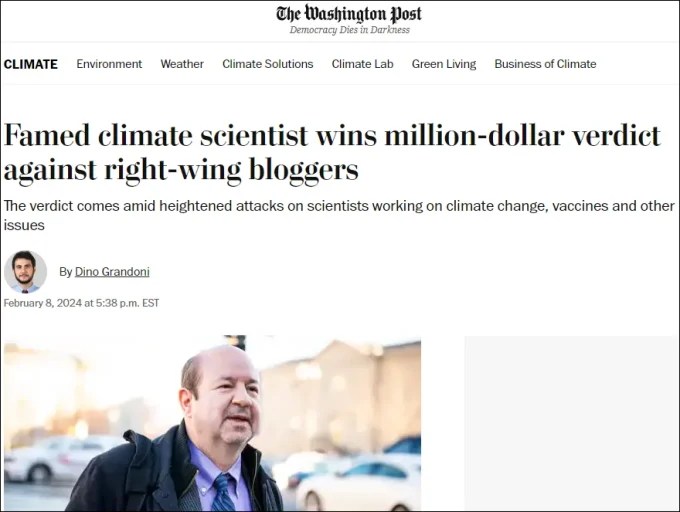
Yesterday, a jury in Washington, DC awarded renowned climate scientist Michael E. Mann more than $1,000,000 in damages in a defamation lawsuit he brought against two bloggers.1 I was a witness in the case and testified on Tuesday.2 Here, I’ll offer my thoughts on the case and some personal reflections on my experience.
Mann’s case alleged that he was defamed by statements made the bloggers more than a decade ago, which harmed his reputation and career (I won’t rehash the details here, but you can get a full accounting of the trial at this comprehensive podcast).3
The defense built their case around making three points to the jury.
One was to bring in experts to testify that Mann’s methods in producing the so-called “Hockey Stick” graph were manipulative, and thus critics of the Hockey Stick were factually correct in saying so. The second point was to demonstrate that the debate over climate during the time that the blog posts were written was intense and vitriolic, with Mann saying things about others that were worse than what the defendants said about him.4 Finally, the defense argued that Mann hardly put on a case — he provided no evidence or witnesses supporting his claims of damage to reputation or career.
In contrast, the prosecution was — in the words of the court, “disjointed” — and was reprimanded on multiple occasions by the judge, most notably for knowingly providing false information to the jury on alleged damages suffered by Mann.5 When I was cross-examined, Mann’s lawyer had considerable trouble getting basic facts right like timelines and who said what.6
Even so, in a trial that most neutral observers would surely see as favoring the arguments of the defense, Mann walked away with a resounding, comprehensive victory.7 How did that happen?
In my view, there were two absolutely pivotal moments in the trial.
One occurred when Mann was testifying and he explained that he felt that the bloggers were not just criticizing him, but they were attacking all of climate science, and he could not let that stand. As the world’s most accomplished and famous climate scientist, Mann intimated that he was simply the embodiment of all of climate science.
For the jury, this set up the notion that this trial was not really about Mann, but about attacks on all of climate science from climate deniers.
The second pivotal moment occurred when in closing arguments Mann’s lawyer asked the jury to send a message to right-wing science deniers and Trump supporters with a large punitive damage award.
Here is how an advocacy group called “DeSmog” accurately reported these dynamics:
Mann sued Simberg and Steyn for defamation, but the trial proved to be about much more than statements that harmed the scientist’s reputation — the entire field and validity of climate science was under scrutiny.
In closing arguments, Mann’s lawyer John Williams compared the climate deniers in this case to election deniers overall. “Why do Trumpers continue to deny that he won the election?” he asked the jury. “Because they truly believe what they say or because they want to further their agenda?”
He asked the jury to consider the same question about Steyn and Simberg: Did they believe what they wrote was the truth, or did they just want to push their agenda? . . .
“Michael Mann is tired of being attacked,” Williams told the jury. “You have the opportunity to serve as an example to prevent others from acting in a similar way” to Simberg and Steyn.
An underlying current throughout this trial has been that climate denialism, like what the two defendants practice, isn’t really about the science. It’s more about politics and policy that drives organizations and individuals to “attack the science and confuse the public . . .
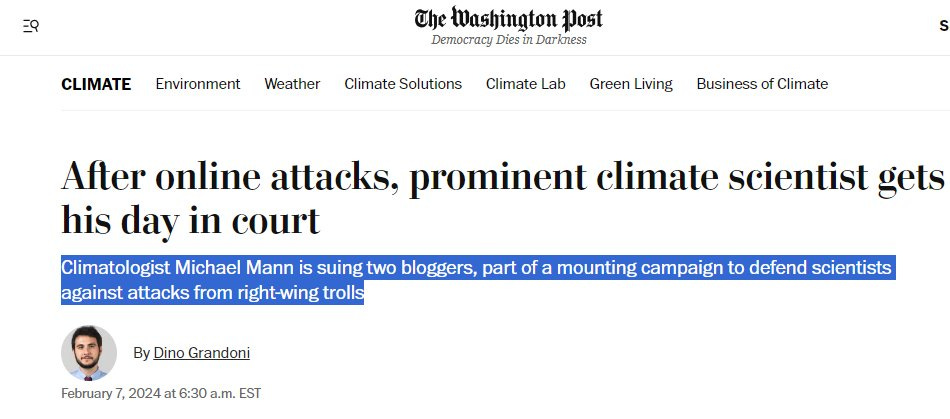
This framing — climate deniers versus climate science — has also characterized mainstream media coverage. For instance, The Washington Post announced, on the day that the case went to the jury, that this case was part of a “mounting campaign” against “right-wing trolls” (below).
Prominent climate scientist or right-wing trolls? Which side are you on?
The case was formally about defamation, but in reality it was not at all about defamation.
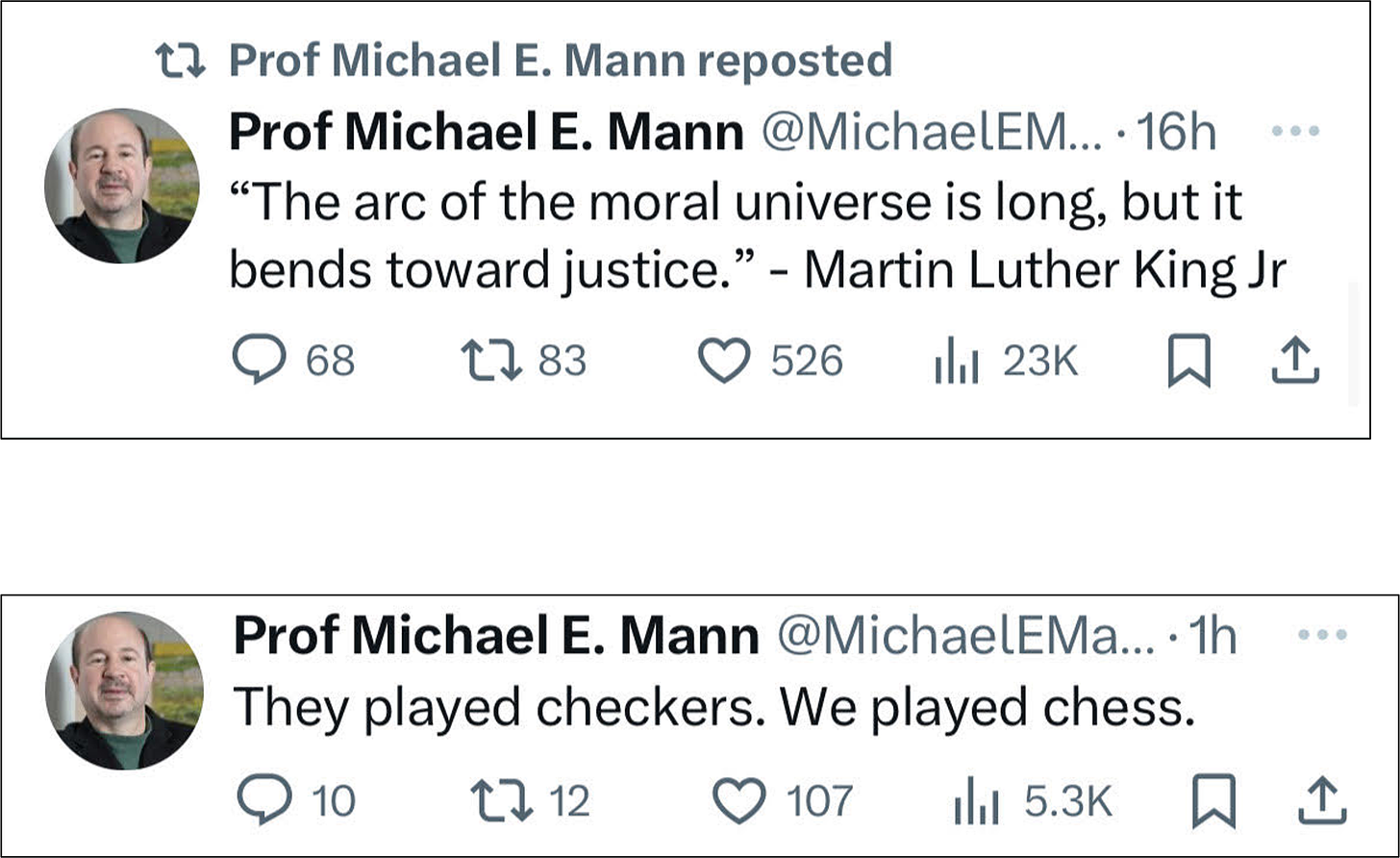
As Michael Mann stated after the verdict, the case was really about politics and ideology:
Take a victory lap, Dr. Mann
This is about the defense of science against scurrilous attacks, and dishonest efforts to undermine scientists who are just trying to do our job … whose findings might prove inconvenient to certain ideologically driven individuals and outlets. It’s about the integrity of the science and making sure that bad actors aren’t allowed to make false and defamatory statements about scientists in their effort to advance an agenda.
The defense made a big mistake in thinking that it would be sufficient to win by proving their case while Mann chose not to put one on. That was wrong.
There is no equivalence here between the “renowned” Michael Mann and the “right-wing trolls” who deny climate science and support Donald Trump. The case, at least in this particular venue, was simply unwinnable no matter what cases were put on by the prosecution and the defense. Mann simply had to show up.
The fact that the jury awarded him only $2 in actual damages and $1,001,000 in punitive damages (send a message!) supports this interpretation — The defense won on merits, and Mann won on the framing and the politics.
What does the case mean for discourse about politically contentious issues that involve science? Science magazine reports that it means that we now need to be circumspect in how we engage these issues:
In a statement, Mann said, “I hope this verdict sends a message that falsely attacking climate scientists is not protected speech.”8
At the same time, the ruling could end up having a chilling effect on necessary public criticism of science, says Gene Policinski, a senior fellow at the Freedom Forum, a nonpartisan foundation focused on First Amendment protections. People will need “to be more judicious in commentary. They might be more vague or circumspect.” And that could be to the detriment of the public, he says. “It’s important in today’s world for people to be aware of research that’s going on and having people both praise and criticize it openly.”
For Mann’s part, he signals that he is just getting started in his legal campaign against his opponents:
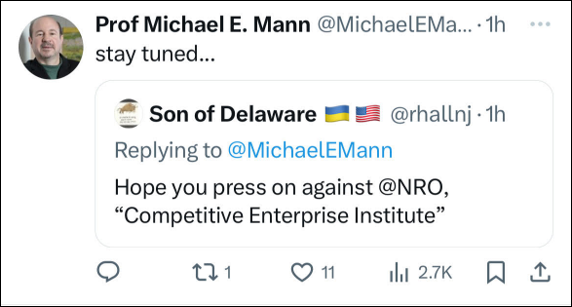
Asked about Competitive Enterprise Institute and National Review, [Mann’s lawyer] John Williams said, “They’re next.”
I would not be surprised to now see a flurry of lawsuits against people who have been critical of climate science or climate scientists. Such legal action may not be limited to climate — debate over Covid-19 also presents a target-rich environment for unwanted speech to silence. Watch this space.
Finally, let me offer some personal reflections on my experiences.
Form the start, my view was that this entire lawsuit was unnecessary and a waste of everyone’s time. People who I still would not recognize on the street said some mean things about Michael Mann on the internet. Welcome to public discourse in the 21st century. People say mean, false things about me on the internet every day — it goes with the many privileges of having outsized impact and voice. The case was never about the integrity of science or the political impact of right-wing trolls — it was always about Michael Mann.
As I stood in line with dozens of other people on Tuesday waiting to go through security to enter the courthouse, I wondered how we got here — how leading scientists and institutions of climate science became totally consumed with a battle against minor bloggers and political boogeymen.
When I entered the courtroom, I had a profound sense of sadness for Mann. He was alone with his lawyer — no family, no friends, no university officials, no adoring fans, no mainstream media. Totally alone. There were just a handful of observers in the room. As I said at the trial, Mann has not been the best colleague to me, but I am fine even so. Who knows what demons haunt him and why he behaves the way that he does. I do hope he can find peace at some point.
The larger issues here are not about Mann, but rather the continued failures within the climate science community to uphold fundamental norms of conduct among its own ranks. For instance, in the trial we learned that Penn State’s committee looking into Mann’s conduct following Climategate wanted to censure him for his behavior — apparently that was overturned upon the intervention of the Penn State president. There have been so many similar opportunities for leaders to take the off-ramp from escalated conflict and politicization, and the community instead chose to further conflict.
Like I said, it is just sad. And it is not over yet.
Representative Jim Jordan, along with 44 other Congressional members, joined forces with America First Legal (AFL) to submit a crucial brief to the US Supreme Court. This brief supports Missouri, Louisiana, and private plaintiffs in the significant case of Murthy v. Missouri. The case centers on allegations of the federal government’s unconstitutional suppression of free speech on social media platforms.
The AFL, in collaboration with co-counsel Christopher Mills, has been actively combating what they perceive as a growing censorship crisis. The brief presented to the Supreme Court contends that the federal government has been exerting undue influence on private tech companies. This influence, the brief argues, has led to the suppression of First Amendment-protected speech concerning COVID-19, the Biden family’s alleged influence peddling, and various election-related issues.
These arguments were previously raised in the Fifth Circuit, where AFL represented Representative Jordan and other members of the House Judiciary Committee and the Select Subcommittee on the Weaponization of the Federal Government.
The involvement of these bodies stemmed from their investigative work, which unearthed the extent of federal pressure on private entities, compelling them to censor speech. This was notably highlighted through disclosures in The Facebook Files and The Twitter Files.
“The First Amendment is first for a reason,” Rep. Jim Jordan said in a statement. “Through our constitutional oversight, we have uncovered evidence that the Biden Administration directed and coerced Big Tech companies to censor content online and even books. With the Supreme Court set to hear one of the most important free speech cases in years, 45 Senators and Representatives filed this brief to share Congress’s findings and urge the Court to uphold the free speech rights of American citizens.”
By Mahdi Darius NAZEMROAYA | Strategic Culture Foundation | 30.03.2015
The United States and the Kingdom of Saudi Arabia became very uneasy when the Yemenese or Yemenite movement of the Houthi or Ansarallah (meaning the supporters of God in Arabic) gained control of Yemen’s capital, Sanaa/Sana, in September 2014. The US-supported Yemenite President Abd-Rabbuh Manṣour Al-Hadi was humiliatingly forced to share power with the Houthis and the coalition of northern Yemenese tribes that had helped them enter Sana. Al-Hadi declared that negotiations for a Yemeni national unity government would take place and his allies the US and Saudi Arabia tried to use a new national dialogue and mediated talks to co-opt and pacify the Houthis.
The truth has been turned on its head about the war in Yemen. The war and ousting of President Abd-Rabbuh Manṣour Al-Hadi in Yemen are not the results of «Houthi coup» in Yemen. It is the opposite. Al-Hadi was ousted, because with Saudi and US support he tried to backtrack on the power sharing agreements he had made and return Yemen to authoritarian rule. The ousting of President Al-Hadi by the Houthis and their political allies was an unexpected reaction to the takeover Al-Hadi was planning with Washington and the House of Saudi. … continue
This site is provided as a research and reference tool. Although we make every reasonable effort to ensure that the information and data provided at this site are useful, accurate, and current, we cannot guarantee that the information and data provided here will be error-free. By using this site, you assume all responsibility for and risk arising from your use of and reliance upon the contents of this site.
This site and the information available through it do not, and are not intended to constitute legal advice. Should you require legal advice, you should consult your own attorney.
Nothing within this site or linked to by this site constitutes investment advice or medical advice.
Materials accessible from or added to this site by third parties, such as comments posted, are strictly the responsibility of the third party who added such materials or made them accessible and we neither endorse nor undertake to control, monitor, edit or assume responsibility for any such third-party material.
The posting of stories, commentaries, reports, documents and links (embedded or otherwise) on this site does not in any way, shape or form, implied or otherwise, necessarily express or suggest endorsement or support of any of such posted material or parts therein.
The word “alleged” is deemed to occur before the word “fraud.” Since the rule of law still applies. To peasants, at least.
Fair Use
This site contains copyrighted material the use of which has not always been specifically authorized by the copyright owner. We are making such material available in our efforts to advance understanding of environmental, political, human rights, economic, democracy, scientific, and social justice issues, etc. We believe this constitutes a ‘fair use’ of any such copyrighted material as provided for in section 107 of the US Copyright Law. In accordance with Title 17 U.S.C. Section 107, the material on this site is distributed without profit to those who have expressed a prior interest in receiving the included information for research and educational purposes. For more info go to: http://www.law.cornell.edu/uscode/17/107.shtml. If you wish to use copyrighted material from this site for purposes of your own that go beyond ‘fair use’, you must obtain permission from the copyright owner.
DMCA Contact
This is information for anyone that wishes to challenge our “fair use” of copyrighted material.
If you are a legal copyright holder or a designated agent for such and you believe that content residing on or accessible through our website infringes a copyright and falls outside the boundaries of “Fair Use”, please send a notice of infringement by contacting atheonews@gmail.com.
We will respond and take necessary action immediately.
If notice is given of an alleged copyright violation we will act expeditiously to remove or disable access to the material(s) in question.
All 3rd party material posted on this website is copyright the respective owners / authors. Aletho News makes no claim of copyright on such material.


 The Palestinian Prisoners’ Society (PPS) confirmed, Sunday, that the Israeli army exiled a Palestinian female journalist from the occupied West Bank to the devastated and destroyed Gaza Strip, after abducting her earlier this month.
 Aletho News
 Aletho News