Parents in Scotland to face 7 years in jail for refusing to appease children’s gender identity
BY THOMAS BROOKE | REMIX NEWS | JANUARY 10, 2024
Parents in Scotland could soon be sentenced to seven years in prison if they refuse to allow their children to change their gender under plans proposed by the Scottish government.
A public consultation was launched on Tuesday on legislation designed to end conversion practices for both sexual orientation and gender identity and includes widespread measures to criminalize parents who refuse to engage in their children’s desire to not just undergo gender transitions but to identify as another gender by, for example, dressing as the opposite gender.
The consultation proposed by Equalities Minister Emma Roddick would criminalize “coercive” behavior by parents that intends to “change or suppress” a child’s gender identity and consequently causes “harm” to the child.
“Coercive” behavior is broadly defined in the plans and ranges from “violent, threatening, or intimidating” behavior towards the victim to “controlling the victim’s day-to-day activities” or “pressuring the victim to act in a particular way.”
It states the behavior needs to be sustained but subsequently explains that such behavior need only happen “on at least two occasions” to meet this criteria.
Harm is also defined loosely as either “physical or psychological,” and the latter must be shown to have caused the child “fear, alarm, and distress.”
The draft legislation includes a defense if the parent can prove their actions were objectively reasonable.
For Women Scotland, a campaign seeking to protect women’s and children’s rights in the country, expressed their concerns about the draft legislation.
“We have grave concerns that these plans will criminalize loving parents, who could face years in jail simply for refusing to sign up to the gender ideology cult,” spokesperson Marion Calder said.
“They will also hand activists and social workers unprecedented powers to meddle in family life, while having a chilling impact on therapists and counselors.
“If the SNP and Greens insist on pushing this through, it is likely to go the same way as the toxic self-ID and named person laws and be blocked in the courts,” she added.
The left-wing Scottish National Party (SNP) has come under fire for pushing through several controversial progressive policies relating to transgender issues, the most recent being last year’s decision to remove the requirement for a medical diagnosis of gender dysphoria in order to apply for a gender recognition certificate to legally change one’s gender.
The reforms also slashed the time an applicant must live in their preferred gender before legally changing it from two years to three months and lowered the minimum age at which a person can apply for a gender recognition certificate from 18 to 16 years.
The American Psychological Association Wants (More) Federal Funding To Curb Online “Misinformation”
By Didi Rankovic | Reclaim The Net | January 9, 2024
The American Psychological Association (APA) is among those organizations enlisted to join the “war on misinformation” back in 2021, when APA took a $2 million grant from the Centers for Disease Control and Prevention (CDC) to help push the Covid narratives of the time.
APA’s particular task there was to come up with “a scientific consensus statement on the science of misinformation.”
Now, APA is clamoring for even more federal money as it declares psychology to be “leading the way on fighting misinformation” and advertises psychologists as the right people to research the problem (as it has been presented over the last years), and also be “part of the solution.”
An article on APA’s site doesn’t shy away from using terminology that spreads a sense of alarm, such as “the scourge of misinformation” and asserting that clinicians now have to treat patients “subsumed” by conspiracy theories, while institutions and communities are all allegedly suffering unspecified “harm.”
And APA also doesn’t shy away from mentioning the US presidential election, or from positioning that event as something that makes combating misinformation “messier and more important than ever.”
Messy it is, alright. To position itself properly among all those vying for funding/influence by exaggerating the threat posed by misinformation as a new phenomenon, APA actually states that, with the election in mind, fighting misinformation is “one of the top trends facing the field (physiology) in 2024.”
Really, APA? Maybe the author meant – a top trend faced by the organization itself, since it has had to show something in return for the $2 million 2021 CDC grant given to it to research “the science of stopping misinformation.”
(Spoiler: that “science” is already well-developed and applied; it’s called censorship.)
Beside the general alarmist tone, APA also came up with “recommendations.”
First, shut up – “don’t repeat misinformation.” Next, leverage “trusted sources to share accurate information.” At this point APA is pretty much parroting Big Tech’s various “guidelines” that have justified a lot of legitimate information getting obliterated over the past years as (never precisely and objectively defined) “misinformation.”
The “recommendations” address fellow physiologists, urging them to become “literate” in this newly crafted “science” – in order to be able to take active part in “the solution.”
According to APA’s current standards, helping people (as psychology professionals) should now include the total of eight recommendations (prominent and fairly ominous, free speech-wise, among which is – “collaborate with social media companies to understand and reduce the spread of harmful misinformation”).
And practitioners should do this everywhere – “(in) our labs, our communities, or our families.”
Several Large Accounts That Criticized Israel and Musk Banned from X
By Kyle Anzalone | The Libertarian Institute | January 9, 2024
A group of journalists and political commentators with large followings were banned on X without notice. The owners of the banned profiles pointed to criticisms of Israel and Elon Musk.
On Tuesday morning, the accounts of Alan MacLeod, Ken Klippenstein, Rob Rousseau, the True Anon Podcast, Steven Monacelli, and an anonymous account @Zei_Squrill, were all banned on the platform owned by Musk.
MacLeod, who had over 200,000 followers on X, posted on Telegram that the suspension came without warning. “Today, without warning or explanation, Twitter suspended my account, @AlanRMacLeod. They told me to check my email for a reason, but no email has been forthcoming,” the journalist wrote. “I have never even remotely been involved in any controversy/been reported/been stuck in Twitter jail before, so I assume the real reason is political, especially as high-profile leftist accounts like Rob Rousseau and Zei_Squirrel were also targeted today.”
In a statement provided to The Libertarian Institute, MacLeod said, “I’m deeply concerned about Twitter banning a host of influential anti-war accounts today, including my own. It is a sign that Elon Musk’s supposed passion for free speech might not be all that it seems.”
Musk acquired Twitter in October of 2022 and later renamed the platform X. At the time, he said he aimed to make Twitter a “platform for free speech around the globe.”
In one of his first acts as owner of Twitter, he allowed Matt Taibbi and other journalists to access the business communications of the company’s leadership. In the Twitter Files, Taibbi exposed a coordinated effort between the government and Twitter to censor speech that countered the establishment narrative on the election, covid, and the war in Ukraine.
However, as America has entered an election year, Musk-owned X is stepping up its censorship efforts.
Last month, Klippenstein wrote an article on his Substack explaining that Musk had discussed artificial intelligence with Prime Minister Benjamin Netanyahu when he traveled to Israel. He highlights the discrepancy between Musk’s public warning about the threats posed by AI while supporting Israel as it uses AI as the backbone of its targeting selection process for its war in Gaza.
The account @Zei_Squirrel, which had 200,000 followers, explained in a Substack post that it was suspended over criticisms of Israel and Bill Ackman but was also not provided with an explanation from X. “If they don’t unban me, it will prove beyond all doubt that Twitter and Elon Musk are just explicitly doing the bidding of the genocidal Israeli regime and its deranged supporters like Bill Ackman.” The post continues, “There is no possibility that anything I have posted rises to the level of being ban-worthy, but nothing that Zionists posts constantly, explicit calls for genocide and mass killing of Palestinians, isn’t.”
The author then points to the posts that call for violence against Muslims and Palestinians, while the accounts are not banned for their calls to violence.
The True Anon Podcast account, which had nearly 150,000 followers, was also taken down. Co-host of the show Liz Franczak posted on her personal account, “Why did Elon ban my podcast account what about free speech why is the woke mob coming after hard working American small businesses.”
She added in a second post, “Podcasts are the backbone of the Twitter economy podcasts create two out of every three new tweets podcasts drive innovation support small business hard working podcasts.” She tagged the accounts of Musk, Ackman, and Israel in the post.
Monacelli is a special investigative correspondent with the Texas Observer. In a post on Threads, he wrote, “I have to actually start using Threads because Elon Musk was awake at 3am thinking about me,” referring to his early morning ban. He included an image in his post that pointed to recent reporting on the right-wing movement in Texas upsetting the owner of X.
X has not issued a statement on why the accounts were banned. MacLeod and Zei_Squrril believe the best way to get the accounts restored is for users to tag Musk and demand reactivation. “Probably the only chance I have to get the account back is if enough people object to this/kick up a stink. This should probably include messaging/tagging Twitter support and telling them to unban us all,” MacLeod wrote.
Update: Musk said he plans to investigate the suspensions. “I will investigate. Obviously, it is ok to be critical of anything, but it is not ok to call for extreme violence, as that is illegal,” he posted.
Update: Klippenstein’s account has been restored.
Facebook and YouTube Censored Victims of AstraZeneca COVID Vaccine
By Christina Maas | Reclaim The Net | January 8, 2024
Those who have experienced serious health issues following their Oxford-AstraZeneca Covid vaccination are raising more concerns about censorship on social media platforms. These individuals, who consider themselves victims of the vaccine, report that their attempts to share their experiences and symptoms online are being stifled.
Among these is a father of two who suffered a life-altering blood clot, leading to permanent brain damage, after receiving the vaccine in spring 2021. He is currently pursuing legal action against AstraZeneca in the High Court in London. Similarly, a lawsuit has been filed by the husband of a woman who tragically died following her vaccination.
Others who believe they have suffered adverse reactions to the jab, yet are not involved in any legal battles, have expressed frustration over the suppression of their voices on platforms like Facebook.
They claim that they are being pushed towards using cryptic language and self-censorship to evade group shutdowns, as reported by the Telegraph.
UK CV Family, a private Facebook group founded by Charlet Crichton, serves as a support network for over 1,000 members who feel they have been harmed or bereaved by the Covid vaccines. Crichton, who experienced a severe reaction to the AstraZeneca vaccine, had to abandon her 13-year-long Sports Therapy business due to prolonged bed rest. The group, which was established in November 2021, has earned the status of core-participant in the Covid Inquiry, allowing members like Crichton, who claims to have suffered myocarditis post-vaccination, to testify in the inquiry.
Crichton revealed that her comments had been blocked to prevent misuse, and she even faced a temporary ban from Meta for allegedly not meeting their standards.
She also noted that some members have experienced shadow banning, where their posts are obscured from public view.
Further, YouTube attempted to censor a video featuring lawyers discussing vaccines at the Covid Inquiry, citing a breach of their medical misinformation policy. A video of Stephen Bowie, a Scottish Vaccine Injury Group member who suffered a spinal stroke and blood clots post-vaccination, received a similar warning.
Biden: Vote for Me or Hitler Wins
By James Bovard | January 8, 2023
“Endless hysteria will keep you free,” said none of the Founding Fathers. But President Joe Biden missed that message before his absurdly overheated speech last Friday near Valley Forge, Pennsylvania. Biden draped himself in Revolutionary War virtue as he demanded that Americans quiver in fear at the prospect of his reign ending. Biden invoked the third anniversary of the January 6 Capitol clash to effectively call for canceling the 2024 presidential election.
At a minimum, Biden wants to turn the November election into a referendum on Adolf Hitler. Biden boasted, “We are still a nation that gives hate no safe harbor.” A few minutes before that uplifting assertion, Biden accused Donald Trump of “echoing the same exact language used in Nazi Germany.” CNN reported last week that Biden campaign aides plan to go “full Hitler” on Trump, making “a direct comparison to the Nazi leader rather than couching their attacks by saying Trump ‘parroted’ him.” A few weeks ago, the Biden campaign posted a graphic on Twitter comparing Trump and Hitler’s rhetoric.
Biden continually equated democracy with freedom. And whatever is good for democracy is “close enough for government work” to freedom. Biden declared, “Democracy means having the freedom to speak your mind.” Unless Team Biden disapproves of your thoughts, of course.
Biden neglected to explain why his vision of democracy justifies the near-total suppression of freedom of speech for his opponents. On July 4, Federal Judge Terry Doughty condemned the Biden administration for potentially “the most massive attack against free speech in United States history,” and a federal appeals court condemned Team Biden for “suppressing millions of protected free-speech postings by American citizens”—mostly by conservatives and Republicans.
“If only Uncle Joe had known about that abuse,” right? Like hell. Biden’s Justice Department is fighting tooth and nail at the Supreme Court to preserve his power to secretly censor anyone the feds claim is spouting disinformation, perhaps including denying that Biden is God’s gift to America.
Another key to Biden’s vision of democracy is that the president is entitled to imprison peaceful protestors who opposed him. Biden proved the villainy of Trump supporters by touting case numbers from January 6: “Since that day more than 1,200 people have been charged for the assault on the capitol, and nearly 900 of them have been convicted and they have been sentenced to more than 840 years in prison.”
Biden neglected to quote the bombshell Washington Post report today revealing that vast numbers of the January 6 charges have been crap cases. Federal judges have rejected Biden Justice Department sentencing demands in almost 90% of the January 6 cases—an astounding record. If those cases were not being tried by juries overstocked with federal employees and NPR devotees, the prosecutions would have crashed and burned long ago.
The Supreme Court may obliterate many of the cases. More than 320 of the convictions against J-6 protestors hinge on a bizarre contortion of the 2002 Sarbanes-Oxley law enacted after corporations destroyed documents sought by the Securities and Exchange Commission.
“The average sentence for those convicted of obstructing an official proceeding has been 39 months,” the Post reported. Former federal prosecutor Gene Rossi warns that the Supreme Court taking that case is a “red flag and a loud gong” because that law was the “North Star” used by prosecutors. If the Supreme Court strikes down the Biden twist of the 2002 law, that will make the January 6 prosecutions look like one of the worst witch hunts in American history.
Yet, according to Team Biden, the real problem is that not enough lives have been ruined for sinful thoughts on January 6. Last Thursday, Matthew Graves, Biden’s chief prosecutor for the District of Columbia, issued a warning of potentially thousands of more January 6 indictments: “If a person knowingly entered a restricted area [near the U.S. Capitol on January 6, 2021] without authorization, they already committed a federal crime. Make no mistake: Thousands of people occupied that area that they were not authorized to be present in in the first place.” Talking about hounding people who merely were in the general vicinity of the Capitol confirms that for Team Biden, “Trespassing plus thought crimes equals terrorism.”
Actually, Biden’s FBI already classifies all the people arrested for January 6 Capitol clash offenses as domestic terrorists—even people busted for “parading without a permit.” The FBI presumes that any American suspected of supporting the January 6, 2021 protests forfeited his constitutional rights. An FBI whistleblower revealed in congressional testimony in May 2023 that FBI headquarters pressured FBI agents to treat anyone who attended the January 6 protests as a criminal suspect. Roughly 2,000 pro-Trump protestors (including an unknown number of undercover agents and informants) entered the Capitol that day. But an FBI analyst exploited the Foreign Intelligence Surveillance Act to unjustifiably conduct warrantless searches on 23,132 Americans citizens suspected of January 6 offenses “to find evidence of possible foreign influence, although the analyst conducting the queries had no indications of foreign influence,” according to FISA Chief Judge Rudolph Contreras.
Biden assured the audience that “we still believe that no one, not even the president, is above the law.” Okay, but what if the president or the vice president uses the names Robert Peters, Robin Ware, and JRB Ware as email aliases to hustle business deals for a family member? Is it OK for them to slip the law then?
The only way to assume that Biden is not “above the law” is to assume that his decrees alone are the law. The Supreme Court struck down his COVID vaccine mandate, his moratorium for evicting deadbeat renters, his $500 billion federal student loan forgiveness scheme, and numerous other Biden policies.
Biden spent half an hour fearmongering and then closed by promising “freedom from fear.” This is the famous Biden two-step—demagoguing to his heart’s content and then closing with a few schmaltzy uplift lines, entitling the media to re-christen him as an idealist.
Biden castigated Trump as the “Election Denier in Chief,” a new offense not yet been codified in the statute book. Biden endlessly warned that Trump posed a deadly threat to both freedom and democracy. Biden campaign masterminds were clever enough to permit an unknown local politician to deliver the “takeaway” from the day’s events. Biden was preceded at the podium by Dauphin County commissioner candidate Justin Douglass, who proclaimed that “Donald Trump represents a clear and present danger” to democracy. Since Trump is the ultimate enemy of the Constitution, anything that Biden and his campaign does to banish Trump from the ballot will be pro-democracy.
Obviously, if Americans value democracy, then the presidential candidate favored by the most voters in recent polls must not be allowed on the ballot. Team Biden favors a version of “Guardian Democracy” where voters are only permitted to cast ballots for candidates that the ruling class approves. This is part and parcel with the Democratic Party’s plan to let all future elections be determined by ballot harvesting and tsunamis of unverified mail-in ballots.
Why should we believe that democracy dies unless Biden gets four more years to violate the Constitution, censor and jail his opponents, and domineer practically every aspect of Americans’ lives (“step away from that gas stove before we have to hurt you”)? As Thomas Jefferson declared long ago, “An elective despotism is not the government we fought for.”
SEC Determines Apple Must Allow Free Speech Resolution Proposed by Shareholders To Proceed
By Cindy Harper | Reclaim The Net | January 7, 2024
This week, the US Securities and Exchange Commission (SEC) refuted Apple’s plea to veto a “free speech resolution” proposed by shareholders that were concerned about Apple, as a dominant Big Tech giant, to suppress speech.
This proposal, advanced by the American Family Association (AFA), pushes Apple to scrutinize its processes of content curation and to publish a report addressing fears that the corporation’s policies may inadvertently inhibit speech based on differing views.
The SEC dismissed Apple’s attempt to omit the resolution from the discussion during its 2024 Annual Meeting of Shareholders, effectively setting the stage for a vote on the resolution in spring.
Apple is known for its strict terms of use policy for all apps on the App Store. As Apple’s own App Store is the only way to get apps on its platform, this means that Apple’s is the judge, jury, and executioner when it comes to what the public is allowed to say and see.
In November of 2023, concerned about potential Apple censorship, the ADF sent a letter to the SEC insisting that Apple should not be allowed to block the resolution, as it is seen as an area of potential misuse.
Following the SEC’s decision, Jeremy Tedesco, ADF Senior Counsel and Senior Vice President for Corporate Engagement, voiced his approval, referring to the development as a “much-needed step toward transparency.”
He urged Apple to regain the trust of its shareholders and customers by clearly stating its stance on not using its power to discriminate against user’s speech and beliefs – irrespective of their political or even religious persuasion.
Day 93: Israeli Assault Claims Two More Journalists

Al-Manar | January 7, 2024
Gaza Strip is witnessing a sharp escalation in violence, with Israeli military operations in last night’s onslaught in Al-Faluga and Khan Yunis leaving at least 20 Palestinians martyred, a toll that tragically includes civilians seeking refuge and victims from an attack on a United Nations Relief and Works Agency (UNRWA) school in the Mughazi refugee camp.
In the southern Gaza Strip, at least two journalists, Hamza Wael al-Dahdouh, son of al-Jazeera Gaza bureau chief Wael Al-Dahdouh, and Mustafa Thuraya, were killed in an Israeli airstrike that targeted and blew up their vehicle in Khan Younis on Sunday.
The journalists, including Hamza, were en route to the Moraj area northeast of Rafah, designated a “humanitarian zone” by the Israeli army but reportedly subject to recent bombings. Their intention was to report on the situation and aftermath of bombings in the area, where many displaced Gazans sought refuge from bombardment in other regions of the territory.

Bureau chief for Al-Jazeera Arabic in Gaza, Wael Dahdouh, stands over the body of his son Hamza
Wael al-Dahdouh, Hamza’s father and Al-Jazeera’s bureau chief in Gaza, was recently wounded in an Israeli strike. His wife and two children had been killed by a separate Israeli strike in the initial weeks of the aggression.
The media office of the Hamas resistance movement strongly condemned the “heinous crime” committed by the “Israeli occupation army against journalists.” The Zionist entity aims to “intimidate journalists in a failed attempt to obscure the truth and prevent media coverage,” the office added.

The media office called “on all press unions, human rights and legal bodies to condemn this crime and denounce its repeated commission by the occupation.” It also called for pressuring “the occupation to stop the genocidal war against our defenseless people in the Gaza Strip.”
20 Palestinians lost their lives during the night as the Israeli occupation forces launched airstrikes on Al-Faluga in the Jabalia refugee camp, situated in the northern Gaza Strip. Among the targeted locations was a building belonging to the Abu Alba family in Al-Faluja. Concurrently, air strikes pounded Tal Al-Zaatar in the northern Gaza Strip, further exacerbating the already dire situation.
Adding to the toll, 16 Palestinians were martyred in the bombing of the central Gaza Strip since evening.
Deir al-Balah witnessed 11 casualties due to Zionist attacks, while in Khan Yunis, located in the southern part of the Gaza Strip, the death toll rose to 17. Artillery shelling intensified in the neighborhoods of the city’s center, west, and north.
Rafah also bore the brunt of the occupation’s aggression, with several areas being targeted. The toll rose to 7 as a result of an Israeli bombing that specifically aimed at a building housing displaced people. Disturbingly, reports emerged of injuries resulting from an air strike on a house belonging to the Al-Ajez family in the Al-Zuhur neighborhood, situated in the northern part of Rafah.
According to reports from the official Palestinian news agency WAFA, the Israeli military targeted a residence in Khan Yunis, where a significant number of displaced individuals sought refuge. Tragically, this resulted in the loss of at least 12 civilian lives and injuries to 50 others.
Furthermore, Israeli warplanes struck a school operated by the United Nations Agency for Palestinian Refugees (UNRWA) in the Mughazi refugee camp in the central Gaza Strip, leading to the death of at least four individuals, including a woman.
The report indicates that the Israeli military employed drones and engaged in intensive firing at homes and streets in the Mughazi camp. Simultaneously, Israeli warplanes launched a fire attack near Sekka Street west of the camp, accompanied by heavy artillery fire from the army.
Eyewitnesses reported a fire breaking out east of the neighboring Nuseirat camp due to sustained Israeli airstrikes.
The Israeli aggression extended to Tel al-Zaatar and the city of Deir al-Balah, where fierce airstrikes resulted in additional casualties, according to the report.
The grim statistics underscore the severity of the ongoing Israeli aggression on Gaza, with the death toll reaching at least 22,700 Palestinians, the majority of whom are women and children. Additionally, 7,000 individuals are reportedly missing under the rubble, presumed to be casualties of the conflict. The international community faces an urgent call to address the escalating humanitarian crisis and seek a sustainable solution to the longstanding conflict in the region.
Display of Resistance
Palestinian forces thwarted the advances of the Zionist enemy, effectively dealing heavy blows and preventing any consolidation of occupation across various regions of the Gaza Strip.
Despite the passage of two and a half months since the commencement of the ground operation, the relentless efforts of the Palestinian resistance have led to successive defeats for the occupying forces, compelling their withdrawal from the majority of areas in the northern Gaza Strip—an accomplishment of significant magnitude for the steadfast resistance fighters.
A notable triumph unfolded today as the Al-Qassam Brigades orchestrated the complete destruction of a Zionist personnel carrier situated in Al-Maghazi camp in the central Gaza Strip, employing the formidable “Al-Yassin 105” shell. Scenes depicting the obliteration of the personnel carrier were released by Al-Qassam, symbolizing a powerful stance against the occupiers.
The resilience of Al-Qassam forces further manifested as they obliterated enemy forces that had penetrated Al-Maghazi camp, utilizing a barrage of heavy-caliber mortar shells. Simultaneously, the Al-Quds Brigades announced the successful missile salvoes targeting strategic locations, including “Nahal Oz,” “Sufa,” and “Hulit.”
In another commendable operation, the Brigades revealed their precision and efficacy by targeting an occupation army force entrenched in a house in Tal al-Hawa, Gaza, with an OG-7V anti-personnel missile. This precise strike resulted in casualties within the force, and the Mujahideen successfully seized the soldiers’ equipment.
Reporters without shame: Top ‘media rights’ organization ignores rampant killings of Gaza journalists
By Eva Bartlett | RT | January 7, 2024
At the end of 2023, Reporters Without Borders (Reporters sans Frontieres, RSF), the international organization ostensibly advocating for freedom of information, released its annual report. The paper massively downplays the widespread and deliberate targeting of Palestinian journalists in the Israel-Gaza war.
The report’s announcement, titled, “Round-up: 45 journalists killed in the line of duty worldwide – a drop despite the tragedy in Gaza,” excludes most of the Palestinian journalists killed by Israel in 2023, particularly in the past few months. It claims 16 fewer journalists were killed worldwide in 2023 than in 2022. This doesn’t reflect reality.
The report claims that (as of December 1, 2023), only 13 Palestinian journalists were killed while actively reporting, noting separately that 56 journalists were killed in Gaza, “if we include journalists killed in circumstances unproven to be related to their duties.”
Other sources put the overall number of Palestinian journalists killed in the enclave much higher. The UN’s Office for the Coordination of Humanitarian Affairs (OCHA) reported on December 1 that 73 journalists and media workers had been killed, citing to the Palestinian Journalists’ Syndicate (PJS).
While The Committee to Protect Journalists’ (CPJ) December 20, 2023 numbers are lower (at least 61 Palestinian journalists killed since October 7), CPJ at least didn’t disregard dozens of slain Palestinian journalists like RSF did.
In fact, in contrast to RSF’s cheerful “things are much better for journalists than previous years” tone, CPJ emphasized that in the first 10 weeks of Israel’s war on Gaza, “more journalists have been killed than have ever been killed in a single country over an entire year.” It voiced its concern about, “an apparent pattern of targeting of journalists and their families by the Israeli military.”
It isn’t clear how RSF discerns which circumstances were “unproven to be related” to the duties of slain Gazan journalists, nor who is “actively reporting” when Gaza is under relentless Israeli bombardment and suffers frequent internet cuts. In fact, given the nonstop Israeli bombing (and sniping) throughout the strip, it would be nearly impossible to discern whether journalists were reporting (including from their homes) at the time of their death.
However, in the methodology section near the end of its more detailed report, RSF notes it “logs a journalist’s death in its press freedom barometer when they are killed in the exercise of their duties or in connection with their status as a journalist.”
Many Palestinian journalists in Gaza have received death threats from officers in the Israeli army precisely due to their status as journalists. And many of those threatened have subsequently been killed, along with family members, when Israeli airstrikes targeted their homes or places of shelter.
We also have the precedent in prior wars (in 2009, 2012, 2014, and 2021) of Israel bombing Gazan media buildings (including one I was in in 2009) with varying severity, damaging and finally destroying two major media buildings in 2021. This is clearly intended to stop the flow of reports from Gaza under Israeli bombs, and so is the killing of journalists.
On December 15, the Palestinian Journalists’ Syndicate criticized the RSF report, going as far as accusing RSF of complicity with Israel’s war crimes against Palestinian journalists through whitewashing.
This is the same PJS whose statistics the UN’s OCHA cites, statistics which PJS says are “accurate and based on professional and legal documentation that follows the highest standards in documenting crimes against journalists.” This documentation includes journalists who Israeli airstrikes targeted in their homes, killed precisely because they are journalists.
In response, RSF claimed it, “did not yet have sufficient evidence or indications,” to state that any more than 14 journalists in the Gaza Strip (as of December 23, the date of its response) “had been killed in the course of their work or because of it.”
RSF called the PJS accusations “inane,” complaining that they “damage our organisation’s image,” and chastised the PSJ to not “impugn our motives,” or “quarrel” over numbers. “Quarreling over numbers” is a pretty cavalier objection from an organization espousing concern over journalists being targeted.
At least three journalists were shot dead, at least three killed by an Israeli airstrike on media outlets in central Gaza City, and many more were killed by Israeli airstrikes on “safe” areas – areas south of Wadi Gaza, which Israel had commanded civilians to flee to for their “safety.” In spite of this command, Israeli bombings continued all over the strip, including all the way south to Rafah.
Still many more – in Gaza City, as well as to the north and to the south of it – were killed at home with their families, including one journalist in Khan Younis, killed along with 11 members of his family when an Israeli airstrike targeted his home on November 2. On November 23, a journalist was killed in an Israeli airstrike on his home in Nuseirat refugee camp in central Gaza, along with 20 family members.
The Cradle reported that, “The Israeli army sent a letter to legacy news outlets, Reuters and AFP.” The letter said, “The [Israeli Army] is targeting all Hamas military activity throughout Gaza. Under these circumstances, we cannot guarantee your employees’ safety.”
One Israeli bombing of a journalist’s home on November 7 killed him and 42 family members. Like many of his slain colleagues, he was a journalist for Palestinian Authority-run Wafa news. Many of the other murdered journalists worked for: Palestinian Authority-run Palestine TV, independent news agencies, local TV and radio programs, and larger outlets like al Jazeera. Others worked with Hamas-affiliated media and radio. Still others were freelancers.
On November 5, PJS reported that at least 20 of the journalists killed (since October 7) “were intentionally targeted by strikes on their homes or during their work covering Israel’s attacks.” This tally is already greater than RSF’s reported total of 13 journalists killed at work or because of their work, even though the RSF report covers a period of almost a month more.
Israel threatens journalists, kills family members
Many Gaza journalists report being threatened by the Israeli army. CPJ noted it is “deeply alarmed by the pattern of journalists in Gaza reporting receiving threats, and subsequently, their family members being killed.”
One such incident followed a threat to Al-Jazeera Arabic reporter Anas Al-Sharif. CPJ noted he had received multiple phone calls from officers in the Israeli army instructing him to cease coverage and leave northern Gaza. Additionally, he received voice notes on WhatsApp disclosing his location. His 90-year-old father was killed on December 11 by an Israeli airstrike on their home in the Jabalia refugee camp.
On November 13, CPJ noted, “eight family members of photojournalist Yasser Qudih were killed when their house in southern Gaza was struck by four missiles. Qudih survived the attack.”
On October 25, an Israel airstrike on the Nuseirat refugee camp in the center of Gaza killed the wife, son, daughter, and grandson of Al-Jazeera’s bureau chief for Gaza, Wael Al Dahdouh.
The popular young independent journalist, Motaz Azaiza, reported receiving multiple threats from anonymous numbers urging him to cease his coverage, CPJ reported, noting that another Al-Jazeera correspondent, Youmna El-Sayed, said her husband received a threatening phone call from a man who identified himself as a member of the IDF and told the family “to leave or die.”
RSF bias: Not only in Palestine
Whereas RSF only reluctantly, as an afterthought, mentioned Palestinian journalists killed in “circumstances unproven to be related to their duties,” in a 2021 report on Syria, it stated, “at least 300 professional and non-professional journalists have been killed while covering artillery bombardments and airstrikes or murdered by the various parties to the conflict,” since 2011, going on to say, “this figure could in reality be even higher.”
It cited a report by the Syrian Network for Human Rights (SNHR) claiming the number could be up to 700. While endorsing these numbers, the RSF also gave a caveat, albeit a much meeker one than the one about Gaza journalists: “Confirming such estimates is not currently possible because of the difficulty of accessing information.”
Aside from reporting numbers it could not confirm, RSF cited a body in no way impartial or credible. As an investigative article noted, the SNHR is “based in Qatar… funded by foreign governments and staffed by top opposition leaders,” and “has openly clamored for Western military intervention.”
In 2017, Stephen Lendman wrote of RSF’s attempt to shut down a panel sponsored by the Swiss Press Club in which British journalist Vanessa Beeley would be participating. “An organization that defends freedom of information is asking me to censor a press conference,” the club’s executive director Guy Mettan said at the time. He refused to cancel the event.
RSF’s 2023 roundup also didn’t include two Russian journalists killed this year, one by a Ukrainian cluster bomb strike and the other by a Ukrainian drone attack (targeting journalists).
Sputnik pursued the matter and reported that RSF, “refused to give any comments to Sputnik ” citing “editorial policy.”
Journalist Christelle Neant likewise noted RSF’s glaring omission of the Russian journalists. She wrote about the body’s funding from various governments, and more notably from regime change agencies: the Open Society foundation, The Ford Foundation, and the National Endowment for Democracy, funded by the US Congress.
RSF’s notorious funders explain why it cherry picks or inflates its reports. The borderless organization has lines it won’t cross. It reports a grain of truth but otherwise whitewashes the crimes of Israel and Washington.
Eva Bartlett is a Canadian independent journalist. She has spent years on the ground covering conflict zones in the Middle East, especially in Syria and Palestine (where she lived for nearly four years).
While Gaza Burns, Media Zionists Still Portray Israel as Victim
By Niall McCrae | 21st Century Wire | January 7, 2024
In words often wrongly attributed to Voltaire, Kevin Alfred Strom asserted that ‘to learn who rules over you, simply find out who you are not allowed to criticise’.
Since the Hamas attack on 7th October, this has been made very clear. Influential Zionist activists, who exert phenomenal influence on western politics, governments, and media, have ensured that only the one version of events, the Israeli version, is socially acceptable. This political reality was demonstrated in grave detail in Al Jazeera’s multi-part investigative documentary, The Lobby -Britain and The Lobby – USA. Of course, a different truth is known by any objective observer, especially millions of Palestinian people, and also by the millions who march worldwide against the brutal military bombardment and massacre of civilians in Gaza. But the BBC and The Daily Mail still refuse to broadcast or publish the widespread and justified disgust at the actions of the Israeli government.
Disturbingly, the British mainstream media have been actively shilling for the Israeli government, as their Prime Minister Benjamin Netanyahu insists on continuing the annihilation of Gaza. A prime asset of the campaign to cast Israelis as the oppressed, and the Palestinians as the oppressor is British media pundit Douglas Murray. Writing in the Spectator, Why I’m considering a life of crime, Murray denounced posters at Heathrow Airport inviting travellers from the ‘Israel/Palestinian territories’ who have ‘witnessed or been a victim of terrorism, war crimes or crimes against humanity’ to report to it police, in potential pursuance of a case by the International Criminal Court. This call for international justice deeply offends Murray, who asserts that ‘there is no country called Palestine’. Why not, Douglas? My old atlas from the 1930s clearly shows a land of this name, on the eastern edge of the Mediterranean Sea and bordering on Trans-Jordan.
Curiously, Murray is not sure what status to give the remaining Palestinian area. As he explains, ‘there is the disputed territory of the West Bank and there is Gaza, which was handed over to the Palestinians in 2005 and which promptly became a ‘terror state’. Hold on, Douglas, don’t you deny such statehood? It seems that Murray wants Gaza to have responsibility without any sovereign recognition or power, and the inverse for Israel.
But their journalists and commentators are not only concerned with what’s happening in a narrow strip of land invaded by Israeli troops. They portray all Jews living in Britain as victims of hate, because supporters of the Palestinian cause are railing against the murderous exploits of a state that claims to represent Jewish people worldwide. Meanwhile our police and judiciary appear bent on protecting a foreign jurisdiction two thousand miles away; for example, arresting UK protestors with placards likening the Knesset to the Third Reich.
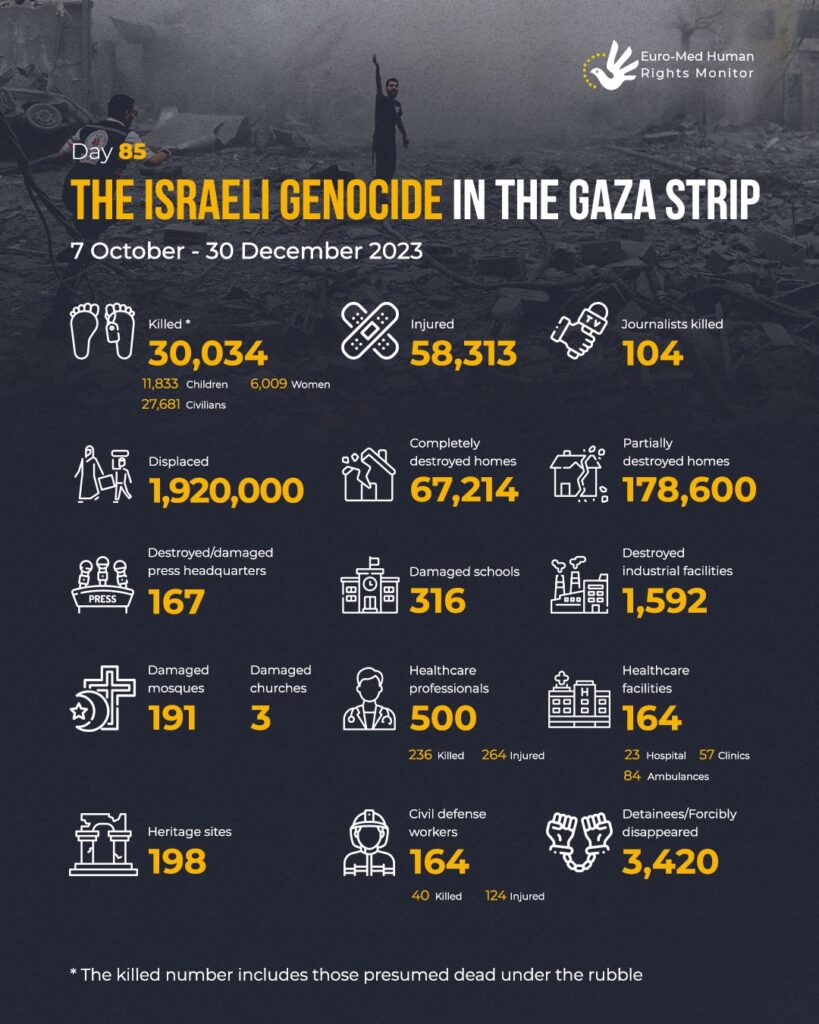
INFOGRAPHIC: Latest number in Israel’s ongoing genocide of the native Palestinian population in Gaza (Source: EuroMed)
The lead opinion piece in the Daily Express (4th January 2024), by the chairman of Glasgow Friends of Israel, shows the way that the wind is blowing. According to Sammy Stein, anti-Zionism is nothing but rebranded anti-Semitism. Although Stein acknowledges the right to criticise Israel and its leaders (as do many Israelis), he smears the regular large pro-Palestinian rallies in Glasgow as “anti-Semitic,” based on his experience in running a market stall in the city centre adorned with Israeli flags. He believes that flying a national flag (of a country that is clearly committing crimes against humanity) is somehow defending the rights of Jews. Within reasonable limits, criticism of his stall is an expected and justifiable act of free speech, a fundamental right in a free society.
Stein confines the concept of anti-Semitism to dislike of Jews, despite the broader meaning of Semitic peoples (including the Semitic Palestinian people, the targets of Israeli bombs and bullets). He claims that this ‘is a term established specifically for the hatred of the Jewish people and not, as some believe, hatred against people who can be described as Semites, such as Muslims’. The expanding scope of anti-Semitism, as determined by the International Holocaust Remembrance Alliance (IHRA), is now sufficiently wide enough to quell any opprobrium towards Israel, while there is no equivalent protection for the native Palestinian people and their diaspora. Shamefully, nearly all major Western political parties have signed up to this blatantly one-sided censorship.
Despite the efforts of these Western institutions to impose an arbitrary definition of what constitutes a ‘hate crime,’ the fact remains that Jews are not the same as the state of Israel, and both of which is not the same as the ideology known as Zionism. But the distinction between Zionists and the Israeli leadership is becoming blurred. As the Palestinians and their supporters chant of ‘From the river to the sea, Palestine will be free’, treated by many Western authorities as a potentially hateful message, Netanyahu’s administration seems to be aiming for that very same outcome – capturing the whole land for Israel and evicting the Palestinians from their homeland. Stein notes that ‘today, Zionism refers to support for the continued existence of Israel, in the face of regular calls for its dissolution’. The Israelis have a right to self-determination, Stein believes, but not the Palestinian inmates trapped in the world’s largest concentration camp.
Stein also reminds us that ‘Jesus was a Jew,’ who, ironically, was persecuted by the Jews, leading to his crucifixion under the aegis of Roman authority at the time. But for Stein and Zionists, the land of historic Palestine belongs to the Jews because some Jews have continuously inhabited the area for thousands of years, after having first established their presence thousands of years ago. Also, they believe that this homeland was supposedly promised to them as a fulfilment of God’s covenant with Abraham. This is a simplistic and convenient reading of history. There is no straightforward link between Judah of the Bible and present-day Zionists. Regardless, should Israel really be allowed to run an exclusionary ethno-nationalist and inhumane Apartheid state (as Western societies simultaneously promote multiculturalism, diversity, equity and inclusion)?
Stein regards anti-Zionism as ‘unique in demanding the dismantling of an existing state after over seventy years of independence.’ Palestinians would splutter over such hypocrisy. For Stein, anti-Semitism and anti-Zionism are now the same thing, being slightly different ‘ways of saying that Jews have no right to exist collectively as Jews with the same rights as other humans’. Perhaps Stein should spend a few days on the Gaza strip to learn whose hate is most powerful – that of desperate, bombed-out Palestinians or that of the American-backed Israeli branch of the military-industrial complex.
***
Niall McCrae is a researcher and educator, and author of ‘The Moon and Madness’ (Imprint Academic, 2011), and ‘Moralitis: a Cultural Virus’ (Bruges Group, 2018).
‘Ballot Cleansing’: How Democrats are pushing US to political chaos
By Ekaterina Blinova – Sputnik – 07.01.2024
Democrats have resorted to nothing short of “ballot cleansing” as they try to bar Republican candidates for Congress under the 14th Amendment theory, writes renowned American legal expert Jonathan Turley, warning against placing the US on a slippery slope to political chaos.
Several US voters in Illinois and Massachusetts have filed motions seeking to remove former President Donald Trump from each state’s primary ballot for the 2024 election. Earlier, Colorado and Maine moved to disqualify the ex-president.
Jonathan Turley, a renowned US legal scholar, raised the red flag over Colorado’s Supreme Court decision to bar Trump from the 2024 election last month, stressing that the state’s justices “put this country on one of the most dangerous paths in its history.”
The unusual initiative is driven by Democrat politicians who decided to utilize Section 3 of the 14th Amendment, which says that any candidates who have engaged in acts of insurrection after vowing to defend the US Constitution should be barred from holding political office. The amendment was ratified in 1868. Now, the Dems are arguing that the January 6 riots were a full-fledged “insurrection” and that the law could be applied to the former president.
“In December 1865 many in Washington were shocked to see Alexander Stephens, the Confederacy’s onetime vice president, waiting to take the same oath that he took before joining the Southern rebellion,” Turley wrote on December 22. “So Congress declared that it could bar those ‘who have engaged in insurrection or rebellion against the same, or given aid or comfort to the enemies thereof.’”
According to the legal expert, the January 6 events – no matter how bad they were – cannot be compared to the US Civil War (1861-1865) and qualified as an “insurrection.”
“It was a protest that became a riot, not a rebellion,” Turley highlighted, arguing that the Civil War-era amendment should not be used in this case.
He warned that the Colorado court’s undemocratic decision and clear defiance of the First Amendment could result in a domino effect “where red and blue states could now engage in tit-for-tat disqualifications.”
Turley’s concerns aren’t unjustified given that Democrats have decided to bar not only Trump, but all Republican candidates for Congress who have dared to question the fairness of the 2020 elections. Some Democratic lawmakers have called for the disqualification of up to 126 Republican colleagues as “insurrectionists.” What is especially chilling is that many have supported them.
Thus, on December 11, US Rep. Bill Pascrell, Jr. (D-NJ) called on House leaders to remove congressional lawmakers who were “supporting Donald Trump’s efforts to invalidate the 2020 presidential election.”
“Stated simply, men and women who would act to tear the United States government apart cannot serve as Members of the Congress. These lawsuits seeking to obliterate public confidence in our democratic system by invalidating the clear results of the 2020 presidential election undoubtedly attack the text and spirit of the Constitution, which each Member swears to support and defend,” claimed Pascrell, citing Section 3 of the 14th Amendment.
Rep. Cori Bush (D-Mo.) introduced a similar initiative which was supported by 63 Democratic co-sponsors, including Reps. Alexandria Ocasio-Cortez, Jamaal Bowman, Ritchie Torres, Ilhan Omar, and Rashida Tlaib.
Meanwhile, Turley drew attention to an obvious double-standard approach exercised by Democrats: previously, some of them have openly challenged and even sought to block certification of election results.
“Former Speaker Nancy Pelosi (D-Calif.) and Senate Judiciary Committee Chairman Dick Durbin (D-Ill.) praised the effort then-Sen. Barbara Boxer (D-Calif.) organized to challenge the certification of President George W. Bush’s 2004 re-election,” the legal scholar recalled on January 5, adding that Rep. Jamie Raskin (D-Md.) sought to block certification of the 2016 election result.
According to Turley, Democrats are increasingly using labels of “insurrectionists” and “Putin lovers” to cancel their political rivals, opponents, and even journalists. However, if the trend turns into some sort of a legal precedent, nothing would stop overzealous lawmakers from expanding this cancellation spree, according to the expert.
“That is why the [US] Supreme Court needs to take up this issue and put this pernicious theory to bed once and for all,” Turley concluded.
Twitter Blocked Vaccine Injury/Death Hashtags to Boost Acceptance
By Peter A. McCullough, MD, MPH | Courageous Discourse | January 5, 2024
I have always wondered about how many people rely on hashtags to search for topics on social media and whether they have any impact.
The use of hashtags was first proposed by American blogger Chris Messina in a 2007 tweet.[3][4] Messina felt that “they were born of the internet, and owned by no one”.[5][6] Hashtags became entrenched in the culture of Twitter[7] and soon emerged across Instagram, Facebook, and YouTube.[8][9] In June 2014, hashtag was added to the Oxford English Dictionary as “a word or phrase with the symbol # in front of it, used on social media websites and apps so that you can search for all messages with the same subject”.[10][11]
Meghana and Chavali studied vaccine sentiment over time and found that Twitter was actually suppressing tweets with certain hashtags in order to influence public perception of COVID-19 vaccination. You could imagine that sentiment has a balance, some people feel benefited and others are harmed. If those harmed have their hashtags blocked then the overall profile of vaccination would look favorable.
Based on this report, I can tell you I am not excited about using hashtags in the future. They seem like they are easy targets for censorship and content moderation.
Featured Video

Seyed M. Marandi: Toward Total War in the Middle East
or go to
Aletho News Archives – Video-Images
From the Archives
The Geopolitics behind the War in Yemen (I)
By Mahdi Darius NAZEMROAYA | Strategic Culture Foundation | 30.03.2015
The United States and the Kingdom of Saudi Arabia became very uneasy when the Yemenese or Yemenite movement of the Houthi or Ansarallah (meaning the supporters of God in Arabic) gained control of Yemen’s capital, Sanaa/Sana, in September 2014. The US-supported Yemenite President Abd-Rabbuh Manṣour Al-Hadi was humiliatingly forced to share power with the Houthis and the coalition of northern Yemenese tribes that had helped them enter Sana. Al-Hadi declared that negotiations for a Yemeni national unity government would take place and his allies the US and Saudi Arabia tried to use a new national dialogue and mediated talks to co-opt and pacify the Houthis.
The truth has been turned on its head about the war in Yemen. The war and ousting of President Abd-Rabbuh Manṣour Al-Hadi in Yemen are not the results of «Houthi coup» in Yemen. It is the opposite. Al-Hadi was ousted, because with Saudi and US support he tried to backtrack on the power sharing agreements he had made and return Yemen to authoritarian rule. The ousting of President Al-Hadi by the Houthis and their political allies was an unexpected reaction to the takeover Al-Hadi was planning with Washington and the House of Saudi. … continue
Blog Roll
 Aletho News
- Israeli lobby seeks to bind US fate to ‘Israel’: Araghchi
- Pakistan-Iran talks secure LNG shipment to Islamabad through Hormuz
- Black Sea grain crisis puts global wheat supplies under pressure
- IRGC air defenses destroy another US MQ-1 drone over Strait of Hormuz
- Imran Khan’s entire immediate family detained in Pakistan ahead of mass protest demanding his release
- EU nation detains former presidential frontrunner
- Leaked: Britain’s Sham Conviction Of Hashim Thaci
- Seyed M. Marandi: U.S. Strike Imminent – Toward Total War in the Middle East
- Russia Voted Under Fire. Washington Is Loading the Tankers.
- 12 Things Your Oncologist Was Trained Not to Tell You
- If Americans Knew
- Israeli Attacks in Gaza Kill at Least Seven Palestinians Over Three Days, including Woman and Child
- Trump’s militarization of Washington DC as he pursues Israel’s war against Iran
- Why Israel Fears This Searing New Documentary
- Huckabee aide solicited cash gifts from Israelis
- This isn’t sci-fi, AI is already killing people
- ‘The Most Brutal Thing’: Investigation Reveals Execution of Elderly Woman in Rafah
- Inside Israel’s ‘soft’ ethnic cleansing plan for Gaza through the eyes of its victims
- New online database tracks pro-Israel political donations in the United States
- Israeli president pardons soldier convicted for killing wounded Palestinian
- Singer Ed Sheeran says his ‘heart broken’ by Gaza devastation, addresses Macklemore controversy
- No Tricks Zone
- 2025 Nature Paper Claiming Worsening Global Drought Gets RETRACTED …Heavily Flawed
- New Study: ‘Global Drought Shows No Detectable Recent Acceleration Under Climate Warming’
- Economic Masterminds: German Socialists Suggest Taxing Productivity Gains Stemming From Using AI
- The South China Sea Has Not Been Cooperating With The Climate Change Narrative
- Energy Crisis: Germany Enters Heating Season With Historically Low Gas Reserve Fill Levels
- New Study: The Antarctic Ice Sheet Gained Mass From 2020-2024 Due To Staggering Snow And Ice Accumulation
- Study: Ocean Heating Rates From Thousands Of Years Ago ‘Dwarf’ Modern Ocean Heating Rates
- Climate Extremists Target, Attack Large-Scale Power Grid Infrastructure In Germany!
- New Study: Antarctic Ice Melt Has Contributed Less Than 1 Centimeter To Sea Level Rise In The Last 30 Years
- Fear Of Debate: Alarmist German Climate Scientist Calls On Mainstream Media To Discredit Skeptic Voices
 Aletho News