UK Government Secretly Tracked 25 Million People as Potential EV Owners
By Cindy Harper | Reclaim The Net | March 2, 2026
The UK government spent two years tracking 25 million mobile devices to build a picture of who drives electric cars. Not suspects or criminals. Just ordinary people whose browsing history mentioned EVs often enough to flag them as worth following.
The Department for Transport paid telecoms company O2 £600,000 ($809,000) to run the operation. According to the Telegraph, O2 trawled through its customers’ web browsing histories and app records, flagging anyone who visited an EV-related site at least once a month across two or more months.
That pool extended beyond O2’s own customers to include people on Tesco Mobile, GiffGaff, and Virgin Mobile, networks that run on O2’s infrastructure and whose users had no idea their data was being packaged and sold to a government agency.
Once flagged as a “potential EV owner,” your physical movements were traced across the country. London, the North-West, and the East of England received particular attention.
The techniques are standard in serious organized crime investigations. The DfT applied them to people buying environmentally friendly cars.
Andy Palmer, former executive at Nissan and Aston Martin, put it plainly: “I’m told it’s anonymized and aggregated, and that may well satisfy legal thresholds. But legality and legitimacy are not the same thing.” He added: “If you erode public trust in how that data is gathered, you undermine the very transition you are trying to accelerate.”
The idea of “anonymized” data means very little.
The surveillance ran for two years before the DfT quietly admitted defeat in April 2024, conceding that “mobile data cannot directly be used to provide information around charging behaviour or travel time.”
The program ended not because anyone questioned whether mass tracking of innocent people was appropriate, but because the data turned out to be useless for its stated purpose.
Civil servants from the DfT and Treasury were simultaneously exploring new EV taxes to replace fuel duty revenue. The people being surveilled were doing exactly what government policy encouraged them to do.
Conservative MP Sir David Davis drew the obvious conclusion: “It’s an object lesson in why you can’t trust the state with unfettered access to people’s information, because they’ve obviously taken this information without people’s permission with the objective of disadvantaging them, either by tax or other policy matters. If they’ll do it on this, with people who are doing what the government wants in policy terms, namely, pursuing green policies, what on Earth will they do elsewhere?”
The EV surveillance program wasn’t a one-off. During the earlier days of the COVID saga, the government ran a parallel operation, this time tracking people who showed up to get vaccinated.
Researchers funded through the Scientific Pandemic Influenza Group on Behaviors used mobile phone location data covering one in ten British people, without their knowledge or consent, to analyze behavioral changes after vaccination.
From that pool, they selected over 4,200 vaccinated individuals and tracked their movements through call data records, analyzing how far they traveled on vaccination day and whether they went straight home afterward.
The government was monitoring where citizens went after receiving a government-administered medical intervention, and chose not to tell anyone.
Von der Leyen warns Hungary: We have ways of making you talk
By Finian Cunningham | Strategic Culture Foundation | February 26, 2026
European Commission President Ursula von der Leyen arrived in Kiev this week empty-handed, and she was pissed. She had been planning to mark the fourth anniversary of the Ukraine war on February 24 with a new €90 billion loan to prop up the corrupt Kiev regime.
At the last minute, Hungary announced that it was vetoing the “Ukraine Support Loan.” So, von der Leyen, the former German defense minister and arch Russophobe, had nothing to show the puppet regime. The big anniversary occasion was an embarrassing flop. Hungary was accused of “betraying” European solidarity.
Putting a brave face on the debacle, von der Leyen made a promise, with menacing tone, about delivering the €90 bn “one way or another.” She said: “Let me be clear, we have different options, and we will use them.”
Those options would seem to include inciting regime change in Budapest. Hungary is going to the polls on April 12 for parliamentary elections. It is no secret that the European Union leadership would dearly like to see incumbent Prime Minister Viktor Orbán being turned out of office, and replaced by Péter Magyar, of the opposition Tisza party, who is more amenable to Brussels’ policy of supporting the Kiev regime in the proxy war against Russia.
Orbán’s government vetoed the €90 bn loan – 60 per cent of which is for military aid – because it accuses the Kiev regime of blocking vital oil supplies to Hungary. Slovakia has also joined Budapest in making the accusation. Both countries claim that Ukraine is using energy “blackmail” simply because they refuse to discontinue buying oil supplies from Russia, and because they are opposed to the ongoing war.
On January 27, Russian oil supplies to Hungary and Slovakia transiting Ukraine via the Drushba pipeline were suddenly stopped. The Kiev regime claims that the pipe was hit by a Russian drone.
However, Hungary’s Foreign Minister Péter Szijjártó has bluntly accused Ukraine of lying. He disputes that a Russian attack on the infrastructure even took place. It doesn’t make sense that Russia would harm its customers.
The suspicion is that the Ukrainian regime is using a purported Russian strike as a pretext to cut off the oil supply. The suspicion is deepened by the fact that the Kiev regime has refused requests by Hungary and Slovakia for their inspectors to assess the alleged technical damage. And neither is the EU leadership putting any pressure on Kiev to prove its claims of Russian sabotage.
Ukraine’s nominal president, Vladimir Zelensky, who is mired in allegations of massive fraud, financial corruption, and racketeering, has for a long time been threatening to cut off Russian oil supplies to Hungary and Slovakia. He accuses Budapest and Bratislava of supporting Russia’s war machine by buying its oil. Hungary and Slovakia say that it is their sovereign right to continue obtaining vital energy imports from Russia. The Soviet-era Drushba (“Friendship) pipeline has been supplying Europe since 1964.
The European Union has also been pressuring Hungary and Slovakia to terminate the purchase of Russian crude oil and get in line with the rest of Europe to source alternative, more expensive American energy exports.
Last year, Zelenksy delivered on his threats when the NATO-backed Kiev regime bombed sections of the Drushba pipeline in Russian territory. Those attacks temporarily disrupted supply to Hungary and Slovakia. At the time, the European Union leadership did not condemn the Ukrainian attacks. In other words, Von der Leyen and the Brussels administration were effectively siding with a non-EU member that was harming the interests of two member nations. That indifference was tantamount to greenlighting more sabotage attacks.
The Kiev regime has a record of using attacks on energy as a political weapon against Hungary and Slovakia. It is therefore logical that it has taken such practice to a new level by blocking infrastructure that it can easily control on its own territory. There is no need to bomb the Drushba pipeline in Russia, hundreds of kilometers away. The Kiev regime can handily turn off the pumps of the pipeline section running through its territory – and then blame Russia for “drone strikes”.
Hungary and Slovakia have both accused Zelensky of “slow-walking” the alleged repairs to the pipeline. Zelensky claims that the repairs can’t be carried out because Russia keeps attacking the repair crews.
The Kiev regime has a habit of lying. It has been claiming that Russia is shelling the Zaporozhye Nuclear Power Plant under its control, when in reality it is the Kiev regime that has been carrying out the attacks, which Moscow has condemned as “nuclear blackmail”. Again, the European Union has indulged Kiev’s lies by ignoring the blatant evidence.
On the energy blackmail against Hungary and Slovakia, the knock-on effect has been a growing shortage of fuel and increasing prices for energy and transport.
Hungary’s European Affairs Minister Janos Boka has accused Ukraine and the European Union of deliberately disrupting oil supply to influence the upcoming election. He said: “Ukraine has clearly been reaching for the energy weapon for political reasons, interfering in the ongoing Hungarian elections… to create uncertainty and chaos, and thereby helping the [opposition, pro-EU] Tisza party to power.”
At a closed-door summit in Brussels this week for EU foreign ministers, it was notable that Ukraine’s top diplomat, Andrii Sybiha, was afforded the extraordinary privilege of being permitted to join the conference via video link. How is it that a non-EU member is allowed to participate in a private ministerial summit?
Hungary’s Foreign Minister Péter Szijjártó reportedly complained that EU foreign policy chief, Kaja Kallas, prevented him from grilling the Ukrainian on the specific damage to the Drushba pipeline. Szijjártó said that the “mumbling response” from the Ukrainian official and his abrupt disconnection from the summit demonstrated guilty responsibility.
What the whole saga illustrates is the dictatorship that has emerged in the European Union. Countries like Hungary and Slovakia are not allowed to have independent positions on their energy trade or their opposition to the war in Ukraine.
The Kiev regime is using the disruption of vital energy supply to EU members as a form of blackmail to coerce those members into handing over tens of billions of euros to prolong a bloody conflict, a conflict that could spiral into a nuclear world war. And the EU leadership is effectively supporting this terrorist tactic against its own members to enforce subordination.
When von der Leyen warns that “we have other options,” the inimical image conjured up is that of a Gestapo interrogator twirling pliers in hand.
The strategic defeat of Russia is paramount for the European Russophobic elites, even if it means gouging out the democratic rights of its own member states and endangering international peace.
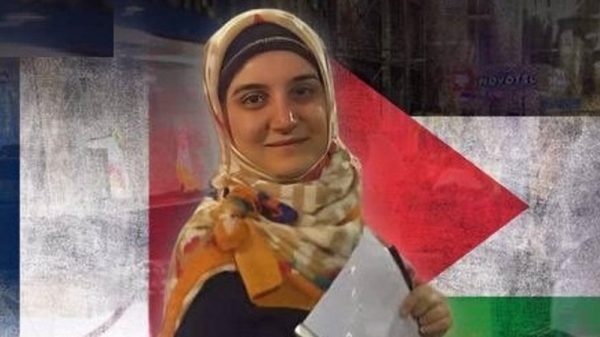
Female Iranian academic sentenced to 4 years in prison in France over protesting Israel’s genocide in Gaza
Press TV – February 26, 2026
An Iranian academic woman in France has been sentenced to four years in prison after she protested Israel’s genocide in the besieged Gaza Strip, with a permanent ban on her entry into the European country.
A court in France on Thursday, sentenced Iranian citizen Mahdieh Esfandiari, who had been detained on alleged charges of “public defense of terrorism,” to four years in prison, France 24 reported.
According to the court ruling, Esfandiari, a linguist and French language graduate, received a four-year sentence, three years of which were suspended and one year to be served.
The 39-year-old Iranian citizen had previously spent eight months in pretrial detention before being released under conditional terms.
The court also permanently barred Esfandiari from entering French territory.
Esfandiari graduated from Lumière University, where she worked as a professor, translator, and interpreter. She has also been a prominent pro-Palestinian activist with a significant online presence.
Her arrest last year came amid a crackdown in the United States and other Western countries targeting scholars, students, and activists who opposed Israeli genocide and advocate for peace, both on campuses and in public spaces.
The Paris Prosecutor’s Office charged the Iranian academic with “apologie du terrorisme” over Telegram posts that allegedly supported the Hamas-led Operation Al-Aqsa Flood against Israel in October 2023.
US university cancels Palestine conference citing sanctions concerns
Al Mayadeen | February 26, 2026
The University of Southern Maine has withdrawn permission to use a campus venue for a conference centered on Palestine, just days before it was scheduled to begin, triggering a dispute over sanctions law and First Amendment protections.
The event, titled “Consequence of Palestine,” had drawn more than 300 registrants and was organized by the Maine Coalition for Palestine, Maine Voices for Palestinian Rights, and the university’s department of criminology and sociology. It was expected to feature virtual remarks by Francesca Albanese, the United Nations special rapporteur for the occupied Palestinian territories, who has been under US sanctions since last year.
University officials said the decision was based on federal sanctions law. Samantha Warren, chief external and governmental affairs officer for the University of Maine system, told The Guardian in an email that “hosting a conference that is being actively promoted as including a speaker sanctioned by the US government would put our public university in violation of federal law”. She said organizers should have obtained authorization from the Treasury Department before proceeding.
Sanctions regulations prohibit US entities from providing “any goods or services” to individuals designated under sanctions regimes. Violations can carry severe penalties, including heavy fines and potential prison time. However, legal scholars argue that the scope of what constitutes a “service” remains ambiguous.
Campus rights clash
In December, the Treasury Department’s Office of Foreign Assets Control (OFAC) clarified in correspondence with the Middle East Studies Association that “no authorization” was required to include Albanese in an academic event, provided that she did not receive payment, reimbursement, or “training or assistance”. That clarification emerged after concerns were raised about the impact of sanctions on academic exchange.
Xiangnong Wang, a staff attorney at the Knight First Amendment Institute who had sought clarification from OFAC, said the cancellation reflects broader concerns about the chilling impact of sanctions on constitutionally protected speech. “It’s very concerning that sanctions continue to have such a broad deterrent effect on speech that is undoubtedly protected by the First Amendment,” he said.
Organizers said they were caught off guard by the abrupt cancellation. Abigail Fuller, a sociology professor involved in planning the conference, stressed the constitutional implications of the decision. “We’re a public university; the university system is subject to First Amendment laws,” she said. “We feel we have a very, very strong case that they are suppressing our free speech.”
According to organizers, they attempted to clarify that federal guidance did not require special permission to include Albanese. They even proposed removing her from the program in an effort to preserve the event. They were subsequently told there was insufficient time for administrators to evaluate the conference’s “risk”.
Speech under pressure
The dispute comes amid reports that Republican lawmakers had written to the system’s chancellor requesting “information on steps the university is taking to ensure the safety and well-being of its Jewish students”. Organizers believe such political pressure contributed to the reversal and said administrators had also expressed concern about possible federal funding consequences.
Albanese was sanctioned last July, with US authorities accusing her of “unabashed antisemitism, expressed support for terrorism, and open contempt for the United States, Israel, and the West”. She has previously rejected those allegations and criticized the move as politically motivated, describing the United States as “a country of contradictions, full of ideals and principles and still, plotting against democratic values”.
The Treasury Department did not immediately respond to requests for comment on the university’s interpretation of sanctions law.
Despite losing access to their campus venue, conference organizers say they are seeking an alternative location and are exploring possible legal action. Fateh Azzam, a member of the Maine Coalition for Palestine, said canceling the conference outright was not an option.
“That would mean that they have effectively silenced an open and public debate on the issues,” he said. “This controversy will probably bring in more people.”
Project Artichoke: 70 Years Ago, CIA Discussed Hiding Mind-Control Drugs in Vaccines
By Michael Nevradakis, Ph.D. | The Defender | February 24, 2026
In the 1950s, the CIA brainstormed ways to secretly perform mind control on humans — including concealing drugs in vaccines and widely consumed food products, a newly unearthed CIA document revealed. The Daily Mail first reported the story on Monday.
The seven-page document, “Special Research for Artichoke,” is dated April 23, 1952. It describes a series of ideas for how to develop chemicals designed to alter human behavior and thought.
The proposals contained in the document were part of the CIA’s top-secret Project Artichoke, which ran from 1951 to 1956, according to the Daily Mail.
The document, declassified in 1983, recently circulated on social media. However, it was not published in the CIA’s online reading room until last year.
“Some of the suggestions are controversial,” the document states. The proposals included administering drugs in secret as part of a “long-range approach to subjects.”
According to the document:
“This study should include chemicals or drugs that can effectively be concealed in common items such as food, water, coca cola, beer, liquor, cigarettes, etc.
“This type of drug should also be capable of use in standard medical treatments such as vaccinations, shots, etc.”
CIA experimented on humans as part of Project Artichoke
The document also included a special field of research for “bacteria, plant cultures, fungi, poisons of various types, etc.,” that are “capable of producing illnesses which in turn would produce high fevers, delirium, etc.”
This included “species of the mushroom” that “produce a certain type of intoxication and mental derangement.”
Also among the proposals was a suggestion to research “diet” or “dietary deficiencies” on prisoners and on people undergoing interrogation, including using “specially canned foods having elements removed.”
The document included proposals for both short-term and long-term use on humans. Drugs deemed most suitable for long-term use would be designed to produce an “agitating effect (producing anxiety, nervousness, tension, etc.) or a depressing effect (creating a feeling of despondency, hopelessness, lethargy, etc.).”
According to The Daily Mail, the CIA experimented on humans as part of Project Artichoke. The experiments often involved “vulnerable subjects, including prisoners, military personnel and psychiatric patients.” The experiments were usually performed “without informed consent.”
According to Ben Tapper, a Nebraska chiropractor who was included in the “Disinformation Dozen” list in 2021 for questioning vaccine safety, the document exposes “a disturbing reality that government agencies have historically explored ways to manipulate human behavior through chemical and biological means, including concepts involving food and medical interventions.”
“This is not speculation or conspiracy, and it should deeply concern every American who values bodily autonomy and informed consent,” Tapper said.
Precursor to the CIA’s MK-Ultra mind control experiments?
The Daily Mail cited CIA documents suggesting that U.S. intelligence agencies were concerned that enemy nations had developed their own mind and behavioral control techniques. This led the agency to prioritize the development of its own methods.
Project Artichoke “served as a precursor” to the MK-Ultra program, which the CIA launched in 1953. That program “broadened mind-altering experiments on a larger scale,” the Daily Mail reported.
Many of the documents related to this type of experimentation were destroyed in 1973, “leaving the full extent of the research and how far it progressed unknown.”
Naomi Wolf, Ph.D., CEO of Daily Clout and author of “The Pfizer Papers: Pfizer’s Crimes Against Humanity,” told The Defender that the documents further confirm a long history of intelligence agency research targeting human thought and behavior.
“Sadly, it’s long been established that our intelligence agencies, and those of our enemies, have sought to alter human consciousness and behavior, often without the subjects’ consent. The existence of MK-Ultra, the clandestine project into which Project Artichoke evolved, is well documented,” Wolf said.
John Leake, vice president of the McCullough Foundation and author of the forthcoming book, “Mind Viruses: America’s Irrational Obsessions,” said, “Researchers have long suspected that the Church Committee’s revelation of the CIA’s notorious MK-Ultra mind control experiments, mostly using LSD, had the effect of obscuring the agency’s much larger Project Artichoke.”
Leake cited evidence suggesting that a 1951 mass poisoning in Pont-Saint-Esprit, France, in which 250 residents experienced severe hallucinations and seven people died, was a Project Artichoke experiment. The outbreak was officially attributed to contaminated bread from a local bakery.
Leake said the 1952 document is “consistent with the suspicion that the CIA was seeking to discover mind control methods for even large populations.”
In 2024, a Reuters investigation revealed that the CIA operated a secret propaganda campaign involving vaccines in the Philippines. The campaign attacked what the agency perceived as China’s “growing influence” in the country by targeting the Chinese-made Sinovac COVID-19 vaccine through the use of phony online accounts spreading “anti-vax” messaging.
Michael Rectenwald, Ph.D., author of “The Great Reset and the Struggle for Liberty: Unraveling the Global Agenda,” said the Project Artichoke revelations “make it clear that the CIA has posed an enormous threat to U.S. citizens, in addition to the horrors it unleashes on non-U.S. target governments and populations.”
Project Artichoke wanted to enlist help from Army’s Chemical Warfare Service
The 1952 Project Artichoke document also included a recommendation to involve the U.S. Army Chemical Warfare Service in the project’s efforts, citing its experience with “exhaustive studies along these lines.”
This proposal bears a resemblance to recent suggestions that COVID-19 — and the response to the pandemic — were coordinated at high levels of government, military and intelligence agencies.
Last year, former pharmaceutical research and development executive Sasha Latypova and retired science writer Debbie Lerman released the “Covid Dossier,” presenting evidence of the “military/intelligence coordination of the Covid biodefense response in the US, UK, Australia, Canada, the Netherlands, Germany, and Italy.”
According to Latypova and Lerman, “Covid was not a public health event” but “a global operation, coordinated through public-private intelligence and military alliances and invoking laws designed for CBRN (chemical, biological, radiological, nuclear) weapons attacks.”
Leake said “it is far from clear” that the Church Committee hearings of 1975 “put a complete end to CIA covert programs.” He cited the possible laboratory development of the SARS-CoV-2 virus as an example.
“The laboratory creation of SARS-CoV-2 with gain-of-function techniques developed at the University of North Carolina-Chapel Hill, and the U.S. military’s involvement in developing and distributing of mRNA COVID-19 vaccines, should … be regarded as possible outgrowths or even continuations of Project Artichoke,” Leake said.
Experts question similarities between Project Artichoke, COVID vaccines
In a Substack post today, epidemiologist Nicolas Hulscher drew a potential connection between Project Artichoke and the development of COVID-19 vaccines. Hulscher cited recent peer-reviewed studies that identified the vaccines’ adverse impact on neurological health and “surging rates of cognitive decline.”
Hulscher wrote:
“Disturbingly, since 2021, over 70% of humanity received a neurotoxic agent masquerading as a ‘vaccine.’ The same goals outlined in the CIA document (vaccines/drugs capable of covertly inducing anxiety, depression, and lethargy) are now being observed in COVID-19 vaccinated populations. …
“… If the CIA was secretly discussing covert methods to alter human behavior in the 1950s, it would be no surprise if similar classified projects emerged in the decades that followed.”
A 2024 paper published in the journal Molecular Psychiatry investigated psychiatric adverse events among over 2 million people in South Korea. The study found that “COVID-19 vaccination increased the risks of depression, anxiety, dissociative, stress-related, and somatoform disorders, and sleep disorders while reducing the risk of schizophrenia and bipolar disorder.”
A 2025 study published in the International Journal of Innovative Research in Medical Science found “alarming safety signals regarding neuropsychiatric conditions following COVID-19 vaccination, compared to the influenza vaccinations and to all other vaccinations combined.”
This included increases in schizophrenia, depression, cognitive decline, delusions, violent behavior, suicidal thoughts and homicidal ideation.
“The fact that mRNA vaccines were designed to cross the blood-brain barrier and inflame the brain — or at least, they were known to do so, during their manufacture and distribution — should give us pause in light of this news,” Wolf said.
Wolf said the latest revelations, “while shocking, provide all the more reason for us to be critical of opaque, coercive or untested vaccination programs, additives in food and water, and toxic or opaque geoengineering programs.”
Tapper said the revelations reinforce “the urgent need to protect individual liberty, medical freedom, and ethical boundaries in science and public health.”
“The lesson here is simple: vigilance is necessary when governments claim authority over the human body and mind,” Tapper said.
This article was originally published by The Defender — Children’s Health Defense’s News & Views Website under Creative Commons license CC BY-NC-ND 4.0. Please consider subscribing to The Defender or donating to Children’s Health Defense.
Israel designates five Palestinian media outlets as ‘terrorist organizations’
The Cradle | February 23, 2026
Israel’s Defense Ministry has designated five Palestinian news platforms in occupied East Jerusalem as “terrorist organizations,” alleging “incitement” and links to the Palestinian resistance movement Hamas, Israel’s Channel 12 reported on 22 February.
“Defense Minister Israel Katz signed an order designating these platforms as terrorist organizations, and the Attorney General confirmed that there is no legal obstacle,” Channel 12 reported, adding that the outlets “are accused of incitement by focusing on developments in (East) Jerusalem and Al-Aqsa Mosque,” it added.
The order targets Alasima News, M3raj Network, Al-Quds Albawsala Network, Maydan Al-Quds, and Plus Quds Network, none of whom maintain offices in occupied East Jerusalem.
Alasima News said it was suspending all media activities until further notice, while the other four platforms issued no immediate comment.
“In a new step added to Israel’s record of repression and gagging, the occupation has banned the work of several Jerusalem-based news networks in an attempt to isolate Jerusalem and Al-Aqsa, monopolize them, and suppress their news from the world,” Alasima said in a statement.
The outlet expressed pride in “what it has achieved over the past years,” stressing that its motto “has always been to make Jerusalem the focus and compass of the (Palestinian) cause.”
“The Israeli ban will not hide the truth. Silencing the camera will not silence Jerusalem. The narrative written in blood and resilience is stronger than any prohibition,” it added.
Rights groups have identified Israel as the single deadliest country for journalists in recent years, with more than 250 media workers killed since the start of the Gaza genocide across Israel’s various theaters.
Meanwhile, independent foreign reporters remain barred from entering Gaza except through the Israeli military.
Israel’s crackdown on Palestinian freedoms has intensified in parallel with a marked rise in violent settler attacks across the occupied West Bank.
Over the past year, Israeli attacks and crackdowns have displaced around 25,000 Palestinians from the Tulkarem and Nour Shams refugee camps in the occupied West Bank, according to local authorities, with raids, infrastructure destruction, and prolonged closures forcing families from their homes.
The broader campaign of aggression, launched in January 2025 and centered on refugee camps in Jenin and Tulkarem, has uprooted roughly 40,000 people across the occupied West Bank this year alone, while satellite imagery shows nearly half of Nour Shams Camp buildings damaged or destroyed since early last year.
The most recent settler attack saw part of the Abu Bakr al-Siddiq Mosque in the village of Tell, near Nablus, set ablaze and defaced with racist graffiti.
Since 7 October 2023, more than 1,000 Palestinians have been killed by settlers and soldiers in the West Bank.
Official data cited by the Times of Israel shows that over 99 percent of complaints filed by Palestinians against Israeli soldiers in recent years were closed without indictment, with just 23 indictments out of 2,427 complaints recorded between 2016 and 2024.
Israel’s security cabinet approved on 8 February new measures aimed at drastically overhauling the occupied West Bank’s legal and civil framework, allowing Tel Aviv to further expand illegal settlements and strengthen its grip on the territory.
During the month of Ramadan, Israeli authorities greatly restricted the entry of West Bank Palestinians to Jerusalem to 10,000 worshippers for the first Friday prayers at Al-Aqsa mosque, far below the 250,000 seen in previous years, enforcing age and permit restrictions that left hundreds stranded at checkpoints.
What is Zionism? And what is anti-Zionism?
By David Miller | Tracking Power | January 25, 2026
I am asked to give definitional answers to this question quite often. So, here, for the record are the key extracts from my witness statement written in August 2023 (some weeks before the launch of Al Aqsa Flood by the Palestinian Resistance ion 7 October of that year.
Glancing over the statement at this distance I am struck by how long and detailed it is – 97 pages – and how, even then I was naive about malevolence of Zionism. If you look below you will see that I refer to Zionism as being inherently genocidal. This was not a popular view then, but it has certainly been more than amply borne out by the events since.
I should note that it was on the basis of my statement and my testimony under cross examination that the Tribunal determined that my anti-Zionist views were worthy of respect in a democratic society which is the legal test for philosophical beliefs to be protected under the Equality Act 2010. The definition of Zionism I have used is thus of greater import than just my own views and beliefs it has been accepted by the court as satisfying the five key elements of the so-called ‘Grainger’ test of which being worthy of respect is the fifth.
For a belief to be protected under Section 10 of the Equality Act, it must:
- Be genuinely held: It cannot be a fictitious or insincere claim.
- Be a belief, not an opinion: It must be more than a viewpoint based on the “present state of information available”.
- Relate to a weighty and substantial aspect of human life and behavior: It must concern significant matters rather than trivial or minor ones.
- Attain a certain level of cogency, seriousness, cohesion, and importance: The belief must be intelligible and internally consistent.
- Be worthy of respect in a democratic society: This has three components
a. The belief must not be akin to Nazism or totalitarianism. It does not have to be a popular or mainstream belief; even beliefs that are shocking or offensive to others may still be worthy of respect. The belief must be consistent with the principles of a pluralist society.
b. Not incompatible with human dignity: It must not dehumanize or degrade others.
c. Not in conflict with the fundamental rights of others: The belief must not seek to destroy the basic freedoms and rights of other individuals.
Here are some key excerpts from my statement including, first of all, a declaration of my anti-racism and then a very short and neutral definition of Zionism, and why I oppose it, which I have italicised. (The statement was in the form of numbered paragraphs which I reproduce here)
_________________________________________________________________
PHILOSOPHICAL BELIEFS
7. I believe it self-evident that racism, imperialism and colonialism are offensive to human dignity and that each of those interconnected phenomena should be opposed. Human beings are all equal and are of equal value. The arrogance and supremacism of racism and racist systems and practices – which assert that it is acceptable for one group of people to dominate others on racial or ethnic lines – can in my view never be tolerated.
8. I believe that Zionism, an ideology that asserts that a state for Jewish people ought to be established and maintained in the territory that formerly comprised the British Mandate of Palestine, is inherently racist, imperialist, and colonial. I consider Zionism to be offensive to human dignity on that basis, and I therefore oppose it.
9. These beliefs, and the work (academic and political) which I have done in consequence of them, are at the heart of the case before the Tribunal. It is because I believe the things I do about Zionism, and because I have been prepared to say them out loud and without apology, that I have lost my job. It is therefore important that I explain in some detail why I believe the things that I do about Zionism, and to be more precise as to what Zionism is, and what I believe about it.
…
24. By the late 1990s, my beliefs in relation to Zionism were fully formed. I have at all times since that date believed Zionism to be a settler-colonial and ethno-nationalist movement that seeks to assert Jewish hegemony and political control over the land of historic Palestine.
…
31. I believe Zionism to be a form of racism because it necessarily calls for the displacement and disenfranchisement of non-Jews in favour of Jews, and it is therefore ideologically bound to lead to the practices of apartheid, ethnic cleansing, and genocide in pursuit of territorial control and expansion. This is not just a matter of historic observation: my belief concerns the nature of Zionism itself. Nor is it of only historic interest. Zionism remains, today, a colonial project which necessitates the oppression of the Palestinian population that remain within the territory that formerly comprised the mandate of Palestine (that is, modern-day Israel and the Occupied Palestinian Territories in the West Bank and Gaza Strip).
32. Crucially, Zionism requires not only the oppression of Palestinians, but also coercion of non-Palestinians who oppose the racist practices of the State of Israel. Zionism has implications that go beyond the territory of Palestine. A central facet of my research has been the identification of a transnational Zionist movement as a key supporting element of the continued ethnic cleansing in Palestine. This movement, and its allied constellation of organisations, seeks to pressure, censor and suppress critics of Israel, which is evident in my case and many others.
33. For example, Israel’s Law of Return, which was passed by the Knesset in 1950, allows Jews from outside of Israel, who have no material or ancestral ties to historic Palestine, to migrate to the State of Israel, at the expense of indigenous Palestinians who were expelled from their homes in the war of 1948 (or since) who are not permitted to return (and whose return was, in fact, prohibited by law in 1952). All of this flows directly from the logic of Zionism.
…
36. Anti-Zionism stands as the antithesis of the racist Zionist movement, calling for an end to the practises of apartheid, ethnic cleansing, and genocide against the Palestinian people, and calling for the liberation and decolonisation of Palestine. As someone who is fervently opposed to racism and colonialism, it is only natural for me to believe in anti-Zionism. Indeed, it is my strong belief in the repudiation of the racist values that Zionism exists to promote that make anti-Zionism an irrevocable part of my personal worldview, identity, and belief system.
…
39. … Zionism is, as I have described, a belief that a Jewish ethno-state should be established in historic Palestine: a land that has at all times since Zionism’s inception had a very substantial non-Jewish population (indeed, when Israel was created in 1948, the non-Jewish population of Palestine was the overwhelming majority of historic Palestine). Zionism is inherently and necessarily racist for that reason, and it is inherently and necessarily settler-colonial in its nature. The racist and colonial logic that sits at the very heart of Zionism necessitates the racist practices that have had, and continue to have, severe consequences for indigenous Palestinians, beginning with the forced expulsion of the majority of the Palestinian population from their homeland in 1948.
40. The idea of a non-racist Zionism is, however, hypothetical: it is outside the realm of actual history and at odds with existing Zionist ideology. Herzl said openly in The Jewish State that the state he wished to conceive was for European colonists and must be created somewhere that is comfortable for their sensibilities rather than a wild expanse of land. He suggested that were a patch of suitable land to be found, for example, “natives” might be put to work draining swamps and killing snakes on behalf of these European colonists with promises of future employment in a land to which they would later be deported.
41. What is at the heart of my anti-Zionist beliefs is an objection to – at least since the coming into prominence of Theodor Herzl’s views – Zionism as an inherently racist movement because of its ideological and practical commitment to settler-colonialism. This necessitates racist practices that have had, and continue to have, severe consequences for indigenous Palestinians.
…
47. There is nothing racist or “anti-Semitic” about anti-Zionism, and the Israeli-state-directed efforts to vilify anti-Zionism as a form of anti-Jewish hatred should be rejected. It is precisely because Zionism – on its own terms, as expressed through its chief ideologues and leaders – is a racist and settler-colonial movement, that so much effort is invested in defending Zionism and even rebranding it as so-called “Jewish self-determination”.
48. To be an anti-Zionist is, in my view, a moral and political duty as an anti-racist, and it has no relation to the “denial” of anyone’s “rights” or “self-determination”. On the other hand, it is Zionism that denies indigenous Palestinians their right to self-determination, among many other of their human rights.
___________________________________________________________________
I await the judgement in the appeal to my victory at the Employment Tribunal. The University of Bristol appealed to the Employment Appeal Tribunal (EAT) and there was a hearing in mid-November last year.
Here is the statement on it from my law firm Rahman Lowe. The judgement is supposed to appear within three months. However, the Judge, Lord Fairley, who is the President of the EAT, said that while he hoped to have the judgement ready within three months, he could not guarantee it. So, we wait.
Vermont advances bill letting unelected Health Commissioner decide which vaccines ctizens should receive
By Jon Fleetwood | February 19, 2026
The Vermont House of Representatives has passed House Bill 545, a sweeping law that grants the state’s unelected Health Commissioner the authority to issue official recommendations determining which vaccines children and adults in Vermont should receive, explicitly names influenza vaccines in statute—including future reformulations—and shields healthcare providers from civil liability for injuries caused by those injections.
The law also authorizes pharmacy technicians—personnel who historically served in support roles rather than frontline clinical injection roles—to administer influenza vaccines to children as young as five, dramatically expanding the range of individuals authorized under state law to deliver those shots.
You can see which representatives voted in favor of the bill here, with only nine voting against.
House Bill 545 is now advancing through the Vermont Senate, where it has already received favorable committee approval.
Taken together, the legislation embeds influenza vaccination directly into Vermont’s permanent statutory immunization infrastructure while placing vaccine recommendation authority in the hands of a single appointed official and protecting those administering the vaccines from lawsuits if harm occurs.
The bill’s passage comes as governments in the United States and internationally have poured billions of dollars into influenza pandemic preparedness, surveillance networks, and next-generation influenza vaccine development, with influenza repeatedly singled out in federal funding laws and global planning frameworks as a priority pandemic-capable virus.
It also comes as Kentucky Senator Rand Paul (R) has introduced federal legislation to strip vaccine manufacturers of their nationwide liability immunity, directly challenging the decades-old legal framework that shields the industry from civil lawsuits and reroutes injury claims into a federal compensation system.
This highlights a growing split between expanding liability protections for those administering vaccines at the state level and simultaneous federal efforts to remove liability protections for the manufacturers producing them.
Travelers Take a Pass on Visiting America
By Adam Dick | Peace and Prosperity Blog | February 20, 2026
Donald Trump, who started his second term as United States president a little over a year ago, likes to talk about how he is making America great again. But, for foreigners planning their trips abroad, it appears Trump has played a significant role in reducing their perception that America is great — at least as a travel destination.
Ceylan Yeğinsu reported Thursday at the New York Times that America stood alone among major destinations in having a drop in foreign visitors last year. She wrote:
Last year, as tourism grew worldwide, the United States was the only major destination to see a decline in foreign visitors, recording a 6 percent drop, according to the World Travel and Tourism Council, an industry group. January saw a continued decline in inbound visitors, down 4.8 percent from January 2025.
Why is America the loser in attracting foreign visitors? Yeğinsu points to several initiatives of Trump as contributing to the development, including current and planned Trump policies directly making traveling to America more burdensome:
The Trump administration has made it significantly harder for some travelers to enter the United States, barring visitors from more than a dozen countries and introducing a $250 ‘visa integrity fee‘ for nonimmigrant tourist and business visas designed to discourage visitors from overstaying. Visitors are also facing more rigorous vetting at the border, with increased searches of electronic devices, some resulting in detentions and denied entry. Citizens of countries who just need an electronic authorization to visit the United States may soon be required to provide up to five years of social media history to enter; that could result in a loss of up to $15.7 billion in visitor spending, according to the World Travel and Tourism Council.
Typical of Trump’s “make America great again” braggadocio, in July the president declared in a “Made in America Week” proclamation:
Together, we are rebuilding our Nation with American heart, hands, and grit. We are bringing back a culture of boldness and creativity that will empower the next generation of innovators, unleash the full strength of the American spirit, and ensure our economy, our culture, and our way of life remain the envy of the world. Above all, under my leadership, we are proudly building, inventing, and creating in the United States of America once again.
“Envy of the world” or not, America is moving further from being the travel destination of choice of the world, and Trump appears to be largely to blame for that.
Friedrich Merz’s Push to End Online Anonymity Has a Troubling Subtext
Germany already has laws that let politicians prosecute citizens for insulting them online
By Christina Maas | Reclaim The Net | February 19, 2026
German Chancellor Friedrich Merz wants to end online anonymity.
Speaking Wednesday evening at an event held by his conservative Christian Democrats in Trier, he called for mandatory real names across social media and floated a potential ban on platforms for users under 16.
“I want to see real names on the internet. I want to know who is speaking,” Merz said.
The framing is the same as usual; protect democracy, protect children. What Merz left out is worth examining closely.
Section 188 covers the same offenses when directed at politicians. The penalties are steeper across the board: three years maximum for insults, mandatory prison time with a five-year ceiling for malicious gossip (minimum three months), mandatory prison time with a six-month floor and five-year ceiling for defamation. No fine option.
Politicians use these laws. Merz uses these laws. He has filed hundreds of complaints himself. CDU politicians and others flag thousands of posts to prosecutors annually, and German police conduct hundreds of raids each year for insults and alleged “hate speech.” The infrastructure for going after ordinary citizens who criticize their representatives already exists and is already in active use.
What a real name mandate does is remove the last barrier between a critical post and a knock on the door. Right now, authorities have to work to identify anonymous speakers. With real names required by platform policy, that step disappears.
Merz framed his position as symmetry. “In politics, we engage in debates in our society using our real names and without visors. I expect the same from everyone else who critically examines our country and our society.”
But politicians operate with institutional resources, legal teams, and parliamentary protections. A citizen posting a pointed criticism of a public official from their personal account has none of that. They do have something, for now: the option to do it without their name attached. Merz wants to take that away.
He also criticized those who defend anonymity, saying they are “often people who, from the shadows of anonymity, demand the greatest possible transparency from others.” The characterization treats pseudonymous speech as inherently suspicious, which is one way to frame it. Another is that people have historically needed cover to say true things about powerful people without facing retaliation.
Merz warned that “enemies of our freedom, enemies of our democracy, enemies of an open and liberal society” were using algorithms and AI to run targeted influence campaigns, and that he had underestimated how effectively these tools could manipulate public opinion.
Merz asked: “Do we want to allow our society to be undermined in this way from within and our youth and children to be endangered in this way?”
It’s a pointed question. A more uncomfortable one: do we want to hand politicians whose parties already file mass complaints under insult laws a system that automatically links every critical post to a verified identity?
Buck Dancing for Zion: Kenya’s and Nigeria’s Growing Love Affair With Israel
Israel has found new golems to exploit on the Dark Continent
José Niño Unfiltered | February 18, 2026
In October 2025, hundreds of Kenyans marched through Nairobi’s Central Business District carrying banners reading “Israel Belongs to God”. Bishop Paul Karanja declared to the crowd, “We are here to declare that Israel is not alone. We will continue to stand with them.” The demonstration commemorated the second anniversary of the October 7, 2023 Hamas attacks, but it represented something far more significant than a single day of solidarity. It revealed a geopolitical quirk that has left analysts scrambling for explanations.
According to a June 2025 Pew Research Center survey covering 24 countries, Kenya showed 50% favorable views toward Israel with 42% unfavorable. Nigeria registered 59% favorable and 32% unfavorable. These were the only two nations with majority positive sentiment toward Israel. In 20 of the 24 countries surveyed, majorities held negative views. Kenya and Nigeria, in addition to India, stand virtually alone in their enthusiasm for the Jewish state at precisely the moment when global opinion has turned sharply against it.
This pro-Israel shift among the populations in Kenya and Nigeria is not a sudden development born from the Gaza war. It represents years of cultivation, theological indoctrination, security partnerships, and strategic maneuvering that transformed two African nations into some of Israel’s most promising partners in the post-October 7 age.
The most fundamental explanation behind this rise in pro-Zionist sentiment lies in the explosive growth of evangelical and Pentecostal Christianity across both countries.
Nigeria houses one of the world’s largest evangelical populations, with Operation World estimating the country ranks either third or fourth globally in total evangelical numbers, trailing only the United States and potentially Brazil or China depending on methodology. Pew Research Center puts Nigeria’s total Christian population at 93 million as of 2020, a 25% increase from 2010, making it the sixth-largest Christian nation in the world and the largest on the African continent.
Pentecostalism has become deeply embedded in Nigerian Christianity, though its precise share remains debated. The U.S. State Department’s International Religious Freedom Report, citing the Christian Association of Nigeria, places Pentecostals at approximately 30% of the Christian population, with an additional 10% identifying as evangelical Christians in non-Pentecostal traditions and African-instituted charismatic churches accounting for another 5 to 10%. When Pentecostal and charismatic Christians across all denominations are counted together, researchers at the Center for the Study of Global Christianity at Gordon-Conwell Theological Seminary place the combined Pentecostal and charismatic share of Nigerian Christianity significantly higher, reflecting the deep penetration of charismatic practice even within mainline churches. That figure has exploded in recent decades, driven by aggressive evangelization, media expansion and the global reach of Nigerian-founded movements like the Redeemed Christian Church of God and Deeper Life Bible Church.
Kenya presents a different evangelical landscape but one equally conducive to pro-Israel theology. According to the 2019 national census, evangelicals comprise 20.4% of Kenya’s total population out of 47.6 million residents — roughly 9.6 million by the census’s strict denominational count. Broader estimates that apply a wider evangelical definition, including researcher Sebastian Fath’s figures cited by Lifeway Research, place Kenya’s evangelical population closer to 20 million. An estimated 30 to 35% of Kenya’s population identifies as Pentecostal, indicating significant overlap between evangelical and Pentecostal identities.
Together, Nigeria and Kenya account for approximately 78 million evangelicals under the broader definitional framework, representing over 42% of Africa’s estimated 185 million evangelical population. This concentration reflects broader patterns of African Christianity’s expansion and the global southward shift of Christian demographics.
The theological framework binding these believers to Israel rests on Christian Zionism, a dispensationalist interpretation that views the modern state of Israel as fulfillment of biblical prophecy. Genesis 12:3 serves as the foundational text. “I will bless those who bless you, and whoever curses you I will curse.”
The International Christian Embassy Jerusalem, a global evangelical organization, has actively cultivated ties with Nigerian churches, organizing pilgrimages and promoting pro-Israel narratives. Pastor Rex Ajenifuja of I Stand With Israel has mobilized grassroots campaigns emphasizing that “Nigeria loves Israel” and framing solidarity as a spiritual obligation. Prominent Nigerian pastors have explicitly connected pro-Israel theology to national prosperity. During visits to Israeli settlements in the Occupied Palestinian Territories, Adeboye explained, “The problems that we are seeing between the Jews and the rest of the world, is because they are the favorites of God. When you are special to God, then automatically the devil wouldn’t like you either.”
In Kenya, the theological stance intersects directly with political power. Current President William Ruto’s administration has deepened ties with evangelical leaders who have publicly endorsed Israel as part of their eschatological worldview. During prayer services, Ruto and First Lady Rachel Ruto — a devout evangelical known for her faith diplomacy program that enlists clergy in matters of state — have woven Israel into Kenya’s spiritual identity. Ruto himself prayed at Jerusalem’s Western Wall during a 2023 state visit, with the site’s rabbi noting it was the longest prayer by any world leader he had witnessed there. At a faith rally convened by Rachel Ruto, crowds waved Kenyan and Israeli flags together while praying for both nations. Influential evangelical figures have openly equated support for Israel with national blessing.
Bishop Dennis Nthumbi, Africa Director of the Israel Allies Foundation, has described Kenya’s bond with Israel as a “covenantal, long-standing relationship” that no politician can sever. Bishop Mark Kariuki, the presiding bishop of Deliverance Church Kenya and former chairman of the Evangelical Alliance of Kenya, has aligned himself with the broader conservative evangelical political theology that underpins pro-Israel sentiment across the continent. The Kenyan government provided active support for the October 2025 pro-Israel march. Speaking in a televised interview on Kenya’s Elevate TV ahead of the march, Africa-Israel Initiative president Bishop Joshua Mulinge confirmed that the government had granted permits and provided police escorts throughout the route. “The Kenyan government has been very supportive,” he said. “We thank God for our head of state and for the entire government.”
The Times of Israel reported that the October 2025 march aimed to call Kenyan Christians “out of the prayer closet and into the streets” to publicly express solidarity with Israel beyond private prayer. Speakers emphasized that “Christianity originated in Jerusalem and that the Church remains spiritually rooted in Israel.” A Norwegian representative of the Africa Israel Initiative stated, “I believe that anybody who blesses Israel, as the Bible says, is blessed. I think it should be in every Christian’s heart to support Israel.”
The political dimensions of evangelicalism in both countries reveal important patterns of religious influence on governance. In Nigeria, evangelical and Pentecostal movements have shaped political discourse around moral conservatism, prosperity theology, and spiritual warfare against corruption, even as the country’s Christian-Muslim demographic balance remains contested. Pew Research places Muslims at 56.1% and Christians at 43.4% as of 2020, though Afrobarometer surveys of adults have found Christians in the majority. Kenya’s evangelical community has achieved more direct political influence, particularly through President Ruto’s administration, which explicitly appeals to evangelical constituencies and employs religious rhetoric in governance.
A 2024 study by the French Institute for Research in Africa described Ruto as the first born-again president in what it called “the making of a born-again republic,” documenting how key evangelical leaders including Bishop Mark Kariuki of Deliverance Church Kenya, Bishop David Oginde of CITAM, and evangelist Teresia Wairimu of Faith Evangelism Ministries described Ruto as God’s appointed ruler during his 2022 campaign. This theological stance embraced by Ruto has been used to justify the suppression of pro-Palestinian activism, as evidenced by Kenyan police’s arrest of Kenyans displaying Palestinian flags in 2023.
Theology alone does not explain the depth of Kenya and Nigeria’s alignment with Israel. Strategic security cooperation provides pragmatic reinforcement for religious sentiment.
Nigeria’s fight against Boko Haram and Kenya’s struggles with al-Shabaab have led to intelligence sharing agreements and military training programs facilitated by Israel. These partnerships, while pragmatic, are often justified through evangelical rhetoric that conflates Islamist extremism with broader anti-Israel sentiment. Nigerian evangelicals have long portrayed Boko Haram’s insurgency as evidence of jihadist violence targeting Christians, reinforcing theological solidarity with Israel as a fellow victim of Islamist terrorism. That narrative, however, is contested by researchers including Brookings and conflict-monitoring group ACLED, which has found that the majority of Boko Haram’s victims have been Muslim, with religion-targeted attacks against Christians accounting for only 5% of civilian-targeting events recorded in its data.
In November 2011, Israeli Prime Minister Benjamin Netanyahu met with Kenyan Prime Minister Raila Odinga in Jerusalem and declared that “Kenya’s enemies are Israel’s enemies so we should be able to help,” pledging to build a coalition against fundamentalism that would bring together Kenya, Ethiopia, South Sudan and Tanzania. The meeting produced a memorandum of understanding on homeland security cooperation, with both Netanyahu and Israeli President Shimon Peres committing to help Kenya secure its borders against militant threats.
Similarly, Israeli ambassador Gil Haskel stated, “Israel is willing to send consultants to Kenya to help Kenya secure its cities from terrorist threats and share experience with Kenya because the operation in Somalia is very similar to Israel’s operations in the past, first in Lebanon and then in Gaza Strip.”
In February 2016, President Uhuru Kenyatta traveled to Jerusalem to strengthen counterterrorism cooperation, with discussions focused on combating al-Shabaab following the 2013 Westgate Mall attack and the 2015 Garissa University massacre. Nadav Peldman, Israeli deputy ambassador to Kenya, stated that Israel was “ready and willing to assist Kenya” in fighting terrorism, calling it “a heinous crime that should be confronted with the same force it projects.”
That defense relationship has since deepened under President William Ruto, who negotiated a $26 million Israeli government-backed loan in July 2025 to acquire the SPYDER surface-to-air missile system manufactured by Rafael Advanced Defense Systems. The system, delivered in December 2025, accounted for roughly 70% of Kenya’s Ministry of Defence development budget for FY2025/26. The partnership spans counterterrorism operations, cybersecurity infrastructure, intelligence sharing, and joint military training.
Israeli-Kenyan relations have an economic dimension to them as well. In Kenya, Israeli drip irrigation technology — including low-pressure systems distributed through MASHAV — has been deployed to boost food security, alongside a 2016 Jerusalem Declaration in which Kenya and Israel committed to a 10-point water and irrigation cooperation framework. On the digital side, Kenya and Israel launched the Cyber-Dome Initiative between Israel’s National Cyber Directorate and Kenya’s Communications Authority, and have held Cyberweek Africa in Nairobi annually since 2023 to expand cybersecurity capacity-building across the continent.
The Israel-Nigeria partnership followed a parallel trajectory, with Nigeria’s Ministry of Defence reaffirming in April 2025 its commitment to “enhancing military cooperation with the State of Israel” following a meeting between Permanent Secretary Ambassador Gabriel Aduda and Israeli Ambassador Michael Freeman. The two sides discussed joint operations, knowledge exchange, defense industry development, and plans to finalize a new bilateral defence agreement, with Aduda pledging that Nigeria would “engage in strategic initiatives to replicate successful Israeli military cooperation frameworks.”
Nigeria, meanwhile, hosts over 50 Israeli companies operating across construction, infrastructure, hi-tech, communications and IT, and agriculture and water management. Cultural ties have also deepened: in 2021 the Israeli ambassador to Nigeria and the country’s vice president initiated a collaborative film co-production between Israeli and Nollywood filmmakers to mark 60 years of diplomatic relations. Israel’s MASHAV agency, established in 1958, provides agricultural training, water management, and health programs across East Africa, with Kenya, Uganda, Tanzania, Malawi, and Seychelles identified as its primary African partners for capacity-building.
None of the growing pro-Zionist sentiment in Kenya and Nigeria is a coincidence. Well-funded pro-Israel organizations have systematically cultivated African Christian support through parliamentary lobbying, church mobilization, and faith-based diplomacy.
The Washington, D.C.-based Israel Allies Foundation maintains a global parliamentary network of more than 1,500 pro-Israel lawmakers, coordinating faith-based caucuses in Kenya, Nigeria, and across Africa. Bishop Scott Mwanza of Zambia served as the foundation’s inaugural Africa Director, coordinating existing caucuses across the continent. He was succeeded by Rev. Dennis Nthumbi, who currently oversees 16 Israel Allies Caucuses as Africa Director and has been a leading voice in mobilizing Christian parliamentary support for Israel across the region.
In September 2024, 25 African lawmakers from 19 countries gathered in Addis Ababa for the first Pan-Africa Israel Parliamentary Summit, where they signed the “Addis Ababa Declaration of Africa-Israel Cooperation and Partnership.” The declaration, which included lawmakers from Kenya and Nigeria among others, affirmed Jerusalem as “the legitimate, undivided, and eternal capital of the Jewish State of Israel,” condemned anti-Zionism as antisemitism, and called for strengthening bilateral ties and supporting Israel’s observer status at the African Union.
Key Kenyan organizations include the Africa-Israel Initiative, launched in Zambia in April 2012 by a coalition of African church leaders including Bishop Joshua Mulinge of Kenya, who now serves as its president and leads the movement across more than 20 African nations. The Israel Allies Foundation Africa Division is led by Rev. Dennis Nthumbi. King Jesus Celebration Church Worldwide, chaired by Bishop Paul Karanja, co-convened the 2025 “March for Israel” through Nairobi’s Central Business District alongside the Africa-Israel Initiative and the Israel Allies Foundation. The Evangelical Alliance of Kenya serves as the national umbrella body for evangelical churches.
Nigerian organizations include the Lagos-based I Stand with Israel International Friendship Organization, led by Pastor Rex Ajenifuja; Christians United for Israel Nigeria Chapter, part of the global CUFI network founded by American pastor John Hagee; and the Africa for Israel Christian Coalition, founded by South African Israel lobbyist Luba Mayekiso, whose Nigerian affiliates have mobilized over 3,000 pastors across 22 states.
Prominent Nigerian evangelical leaders include Pastor Chris Oyakhilome, founder of Christ Embassy; Pastor Enoch Adeboye, General Overseer of the Redeemed Christian Church of God, who has visited Israel multiple times and donated two ambulances to Magen David Adom, Israel’s emergency blood services organization; and the late Prophet TB Joshua, founder of Synagogue Church of All Nations, who was named “Tourism Goodwill Ambassador for Israel” by Minister of Tourism Yariv Levin following a 2019 evangelical crusade in Nazareth.
Nigerian Christian pilgrimages to Israel have become a significant phenomenon. According to the Nigerian Christian Pilgrim Commission, approximately 18,000 Christian pilgrims from Nigeria travel to holy sites in Israel and Jordan each year on average, with the NCPC targeting around 10,000 pilgrims annually for its organized exercises. The NCPC organizes multiple pilgrimage cycles throughout the year — including Easter, Women’s, Youth, and General pilgrimages — with participants praying for Nigeria’s leaders and offering intercessory prayers at holy sites. The 84,000 figure in the original text is not supported by Israeli tourism data; Israel Central Bureau of Statistics figures show Nigerian tourist arrivals peaked at 12,700 in 2019, while a 2025 analysis of the decade from 2015 to 2025 estimated over 80,000 total Nigerian Christian pilgrimages over that entire ten-year span.
Former President Goodluck Jonathan — a practicing Pentecostal Christian who, as sociologist Ebenezer Obadare documented in Pentecostal Republic, cultivated strong ties with Nigeria’s Pentecostal constituency — played a pivotal role in what might be called “pilgrimage diplomacy.” In October 2013, he became the first sitting Nigerian president to undertake a pilgrimage to Israel, leading a delegation that included six state governors — including Governors Elechi of Ebonyi, Obi of Anambra, Akpabio of Akwa Ibom, Suswam of Benue, Jang of Plateau, and Orji of Abia — along with ministers and church leaders including CAN President Pastor Ayo Oritsejafor.
Initial pre-trip reports of 19 governors and 30,000 pilgrims proved to be overblown. Jonathan visited holy sites, met with President Shimon Peres and Defense Minister Bogi Ya’alon, and signed bilateral agreements on aviation. He made a second private pilgrimage in 2014, meeting Prime Minister Netanyahu with an entourage of about 20 political and religious leaders.
Jonathan expressed security solidarity when he wrote to Prime Minister Netanyahu during the search for three Israeli teens abducted by Hamas in 2014, stating, “I assure you that we are in solidarity with you, as we believe that any act of terrorism against any nation or group is an act against our common humanity.”
These visits had diplomatic consequences. In December 2014, when the UN Security Council voted on a Jordanian-tabled resolution calling for Israeli withdrawal from occupied territories and Palestinian statehood within three years, Nigeria abstained — a last-minute reversal that left the resolution one vote short of the nine needed to pass. The Guardian reported that both Israeli Prime Minister Netanyahu and U.S. Secretary of State John Kerry had phoned President Jonathan to ask him not to support the resolution. Nigeria’s abstention, alongside those of the UK, Lithuania, South Korea, and Rwanda, meant the US and Australia’s opposing votes were sufficient to defeat the measure without Washington needing to invoke its veto — a significant diplomatic victory for Israel given Nigeria’s historical support for the Palestinian cause.
Kenyatta played a particularly instrumental role in the diplomatic warming between Kenya and Israel. In February 2016, he visited Jerusalem for counterterrorism talks with Netanyahu. Netanyahu then reciprocated with a historic visit to Kenya in July 2016 — the first visit by an Israeli prime minister to sub-Saharan Africa in nearly 30 years. It was during that Nairobi press conference, not during Kenyatta’s Jerusalem visit, that Netanyahu declared: “Israel is coming back to Africa, and Africa is coming back to Israel.” Kenyatta in turn pledged to help Israel regain observer status at the African Union.
Following the October 7, 2023 Hamas attacks, President William Ruto posted on X that “Kenya joins the rest of the world in solidarity with the State of Israel and unequivocally condemns terrorism and attacks on innocent civilians in the country. The people of Kenya and their government hereby express their deepest sympathy and send condolences to the families of all victims… Kenya strongly maintains that there exists no justification whatsoever for terrorism, which constitutes a serious threat to international peace and security. All acts of terrorism and violent extremism are abhorrent, criminal and unjustifiable, regardless of the perpetrator, or their motivations.”
The statement also called for de-escalation and a ceasefire — context omitted from early reporting — and drew sharp criticism from Kenya’s Muslim leaders and some opposition figures. Ruto subsequently softened his position at a November 2023 Arab-African summit in Riyadh, where he stated that “terrorism cannot be an answer to any conflict; neither is occupation” and reaffirmed Kenya’s support for a two-state solution.
Based on post-October 7 trends, the trajectory of support for Israel augurs a distinctly melanin-enhanced future, as centuries-old European animus toward organized Jewry—now reactivated by the industrial-scale genocide in Gaza—diminishes traditional alliances on the Old Continent. Under these circumstances, Israel must pivot toward emergent partners in the Global South, where nations like Kenya and Nigeria, buoyed by decades-long philosemitic trends, can provide millions of new golems for world Jewry to tap into.
Concomitant with Israel’s burgeoning alliance with India—itself a bastion of Hindu nationalist affinity for the Jewish state—this reconfiguration signals that pro-Zionism will inexorably become brown-coded within mere decades, as the Global South’s burgeoning populations eclipse fading Euro-American sympathies.
‘Britain’s Index of Repression’ documents 964 incidents of anti-Palestinian crackdown
MEMO | February 18, 2026
A new report by the European Legal Support Centre (ELSC) has documented 964 verified incidents of anti-Palestinian repression across Britain between January 2019 and August 2025, identifying what it describes as a cross-sector pattern of institutional crackdowns on Palestine solidarity.
The findings form part of Britain’s Index of Repression, a searchable national database developed in collaboration with Forensic Architecture and launched today at the Frontline Club in London.
Documented incidents listed in the database include arrests, workplace dismissals, suspensions and event cancellations. The Index, originally launched in Germany in 2025, is now publicly available for Britain and is described as the first accessible database of its kind in the country.
The data indicates a marked escalation in incidents after October 2023, with the publication following what the press briefing describes as a significant post-Gaza rise in recorded cases.
The report identifies a broad range of actors involved in the repression of Palestine solidarity, with law enforcement and state-linked bodies featuring prominently. Police and security personnel were involved in 220 documented incidents, making them the single most frequent actor. Educational institutions were responsible for 192 incidents, while pro-Israel advocacy and lawfare groups were linked to 141 cases. Journalists and media actors were involved in 113 incidents.
The data also shows that repression disproportionately targets those embedded in public institutions and organising spaces. Students, academics and teachers were the most frequently targeted group, accounting for 336 incidents. Activists and organisers followed, with 229 cases. Public and private sector workers together faced 169 incidents, while 71 cases involved artists and cultural workers.
“From smear to sanction”
The report describes a recurring three-stage pattern in how repression unfolds.
It begins with what the authors term “smear and distortion”, accounting for 261 incidents involving censorship, disinformation campaigns and public accusations. These allegations are then taken up by institutions. In 136 cases there were threats of legal action, in 81 cases threats to employment or funding, and in 41 cases demonstration bans or event cancellations. A further 114 incidents involved formal disciplinary sanctions in schools, universities or workplaces.
The final stage involves direct enforcement. The report documents 131 arrests or law enforcement interventions, 111 cases of harassment, doxing or surveillance, and 90 incidents resulting in legal, financial or professional consequences.
The report argues that this architecture of repression is structured around two recurring allegations directed at Palestine solidarity movements: anti-Semitism and support for terrorism. It identifies the highly controversial IHRA Working Definition of Antisemitism and the Terrorism Act 2000 as central enabling instruments.
IHRA has been widely criticised, including by its lead drafter, Kenneth Stern. Stern has warned that the definition has been weaponised against critics of Israel and misused to suppress legitimate political speech.
The notorious legal firm, UK Lawyers for Israel (UKLFI) was mentioned in the report. The study found that UKLFI was involved in 128 incidents leading to institutional repression of Palestine solidarity.
Launch at the Frontline Club
At today’s press conference at the Frontline Club in London, organisers presented sector-by-sector breakdowns, post-October 2023 trends and the first public demonstration of the searchable database developed with Forensic Architecture.
The event included a panel discussion featuring ELSC research staff providing analysis of patterns identified in the data, as well as the first on-camera testimony from an ELSC client describing workplace repression.
Featured Video
Total War – Attacking Nuclear Plants, Desalination & Infrastructure
or go to
Aletho News Archives – Video-Images
From the Archives
Strike on Israel Shows US Bases Near Iran Are ‘Achilles Heel’
By Svetlana Ekimenko – Sputnik – 14.04.2024
Fears of a greater Middle East escalation were triggered after Iran launched a massive drone and missile attack against Israel, aided by Hezbollah and the Yemeni Houthis. Iran said the attack was in response to Israel’s bombing of the Iranian consulate in Damascus, Syria, which killed seven members of the elite Revolutionary Guard Corps.
Iran’s massive retaliatory attack on Israel from its own territory is a sign that the conflict could “escalate out of control.”
Michael Maloof, a former senior security analyst in the office of the US secretary of defense, told Sputnik that the first ever direct Iranian attack on Israel set a dangerous precedent.
“My concern is that this could easily escalate into something not only between Iran and Israel, but beyond the Middle East region,” he said.
Iran’s assault, which it stated was an act of “self-defense” after the Israeli strike on its consulate in Damascus, was originally intended to be a “limited” one, said Maloof.
Iran first sent in “swarms of drones with lights on as a sign of psychological warfare,” but sending in cruise and ballistic missiles by Tehran was a “distinct escalation,” said Maloof.
The scale of Iran’s attack on Israel suggests that Tehran was sending a message, demonstrating that it possesses “extraordinary capabilities,” said Maloof. … continue
Blog Roll
 Aletho News
- Pakistan PM backs Iran’s right to self-defense amid tensions
- Hungary blasts ‘fake’ EU accusation
- SAFE Debt Trap: Poland’s €43.7 Billion Bet on Unipolar Illusion
- War on Iran threatens global Gulf capital flows: FT analysis
- Mossad De Facto Admits To Inciting Riots In Iran
- Tehran: World grown thoroughly exhausted with US-Israeli ‘false flag storylines’
- Trump ‘stuck between a rock and a hard place’, lacks Iran war strategy: Ex-CIA chief
- Trump’s bombardment of fake news so far is working quite well. But where is it heading?
- Iran to Mine Sea Lanes in Persian Gulf in Case of Attack – Defense Council
- Barak blasts Netanyahu: ‘Stop lying – you can’t destroy Iran’s nuclear, missile capabilities’
- If Americans Knew
- From Sde Teiman, the truth about Israel’s military justice system has been set free
- Child denied life-saving bone marrow transplant by Israel ‘because he is from Gaza’
- Raffi Berg: BBC Middle East Editor Exposed as CIA, Mossad Collaborator
- Jerusalem Archbishop Rebukes Netanyahu’s Statements on Christianity
- US to embed Palantir AI across entire military: Report
- Israeli-US war on Iran to drag on “a few more weeks” – Not a ceasefire Day 164
- Lebanon deaths top 1,200; Palantir AI to be embedded across US military – Not a ceasefire Day 163
- Israel’s assassination game: Take all pragmatists off the board
- Food shortages return to Gaza as Israel tightens aid restrictions under the cover of its war on Iran
- Trump demands trillions in payments from Gulf countries, billions from Harvard – Not a ceasefire Day 162
- No Tricks Zone
- New Study: CO2 Is ‘Effectively Negligible’ As An Explanatory Climate Change Factor Since 2000
- Former Pfizer Toxicologist Dr. Helmut Sterz Tells Bundestag Hearing Pfizer Vaccine Should Have Never Been Approved
- Energy Expert: Germany’s Nuclear Phaseout Was A “500 Billion Euro Mistake”
- New Research: South Australia’s Mid-Holocene Sea Surface Temperatures Were 4°C Warmer Than Today
- Storing Green Energy To Last Germany 10 Days Would Require A 60-Million Tonne Battery
- New Studies: UK Sea Levels Were 4 Meters Higher Than Today During The Mid-Holocene
- Destructive Green New Deal: German Energy And Metal Group Warns Of Drastic Crisis
- New Study Documents A 20-Year Pause In Arctic Sea Ice Decline – Driven By Internal Variability
- Wake-up Call: Survey Shows Majority Of Germans Now Favor Postponing Climate Targets!
- Televised! Leading German Political Candidate Tells Schoolchildren CO2 Makes Sun Hotter!
 Aletho News