German farmer investigated over gift from Russia
RT | September 14, 2025
A farmer is facing criminal prosecution in Germany over receiving a small Easter gift from a Russian friend. The man is now accused of violating sanctions and could face up to five years behind bars.
A public prosecutor’s office in the northeastern German state of Mecklenburg–Western Pomerania confirmed on Friday that a criminal case had indeed been opened against a local man on suspicion of violating the restrictions.
The case dates back several months, to when a German customs office intercepted a small package which was sent to the farmer from Russia. According to the broadcaster NDR, the package contained a piece of soap, a wooden figurine, and a CD – worth less than €27 ($32) in total. All of the items were on the sanctions list, the report said, adding that the customs office had confiscated the package and a probe was opened into it.
The farmer, who has been identified as Rudolf Denissen by NDR, could face between three months and five years of imprisonment if found guilty. The prosecutor’s office also requested an official written statement from him, as well as “complete personal details and information on net monthly income.”
“I’m not a criminal, that’s ridiculous,” Denissen told NDR, commenting on the developments. According to the farmer, the package was an Easter gift from his long-time friend from Siberia. The man also said he expects the proceedings to be discontinued and the authorities to apologize to him. “I want to get my gift now, it was meant for me,” he said.
German authorities have been known for their rigorous observance of the sanctions. Back in 2023, its customs officials warned that they could take away the personal belongings of Russians who were subject to the measures, including even clothing and toiletries.
They have seized cars with Russian license plates, which travelers brought across the German border.
In December 2023, the German authorities specifically warned that they could confiscate gifts from Russia as well, since gift parcels are regulated by the same sanctions legislation as any imports.
Brazilian Judge Orders Global Deletion of X Posts in Civil Defamation Cases, Rejects Geoblocking as Insufficient

By Cindy Harper | Reclaim The Net | September 10, 2025
A Brazilian judge’s order demanding that posts on X be erased not just within Brazil but across the entire globe has caused concerns over national courts asserting control over international online speech.
The ruling, handed down by Judge Jeferson Isidoro Mafra in Blumenau, Santa Catarina, orders the platform to delete specific content worldwide, regardless of whether it violates laws in other countries.
The platform’s Global Government Affairs team publicly criticized the decision, calling it a direct threat to global freedom of expression.
“This means that even if the content is not unlawful in other countries, the Brazilian judiciary believes it has the power to issue orders that extend beyond its own jurisdiction and reach the entire world,” the statement read.
X also pointed out that the ruling runs counter to international law, which restricts a nation’s legal reach to its own territory. “This contradicts a basic principle of international law that limits jurisdiction to national territory and puts global freedom of expression at risk,” the platform added.
The ruling stems from two lawsuits filed by Leonardo Wagenknecht Utech, a business administrator, who accused other users of insulting him on the platform.
One of the disputes began after Utech mocked a pro-amnesty demonstration related to the January 8 riots.
His sarcastic comment drew a harsh reply from another user, which Judge Mafra determined was offensive and unlawful.
The judge ordered the response removed and instructed X to provide the IP address of the user in question, an order the platform followed.
But the most controversial element wasn’t the content of the posts. It was the court’s insistence that the deletion must apply globally.
X argued that enforcing Brazilian laws beyond Brazil’s borders sets a dangerous precedent, but Judge Mafra dismissed the jurisdictional challenge, declaring that full removal was non-negotiable.
He also claimed that there was no issue of overreach, saying the court’s order “removes Brazilian interest and is based on Brazilian standards.”
In a second case brought by Utech, the pattern repeated. After he made a comment critical of Pope Leo XIV’s alleged political leanings, another user responded with an insult.
Once again, the judge ruled in Utech’s favor and again imposed a global takedown order.
Mafra maintained that such posts exceeded the bounds of lawful expression, asserting that “freedom of expression is not unlimited” and must conform to notions of “honor, good faith, good customs.”
The judge imposed financial penalties for noncompliance, including a daily fine of one thousand reais ($183) capped at twenty thousand.
Two separate injunctions have been granted so far, both ordering global deletion of user posts.
Isabella Cêpa Wins Landmark Free Speech Case After Brazil Sought 25-Year Sentence for “Misgendering”
Courts forced to choose between identity politics and the constitution
By Cindy Harper | Reclaim The Net | September 10, 2025
Isabella Cêpa, a Brazilian feminist and outspoken women’s rights advocate, has defeated a legal campaign that once threatened her with up to 25 years in prison.
Brazil’s Supreme Federal Court issued a final, non-appealable ruling in her favor, concluding a high-profile case that began with a brief social media video and evolved into one of the most significant free speech battles in Brazil’s modern history.
After years of legal pressure and public silence from Brazilian institutions, Cêpa has not only escaped prosecution but has been granted full refugee protections in Europe.
The move marks the first time a Brazilian citizen has received asylum abroad for being persecuted over gender-critical beliefs. Her case has now become a legal precedent, one that free speech advocates say could help protect others facing similar repression.
The conflict began in 2020 when Erika Hilton, a politician who identifies as a woman, won a city council seat in São Paulo. The media widely described Hilton as “the most voted woman” in the city. This caught Cêpa’s attention and led to her making a video that she posted online.
“At the time I didn’t even know who this person was. I just saw a headline on an Instagram page celebrating that ‘the most voted woman in São Paulo is a transwoman,’” Cêpa said.
“Then, I shared a video with my followers saying I was disappointed to hear that the most voted-for woman in São Paulo, later found out that it was in the entire country, was a man.”
That single statement triggered a criminal complaint. Hilton reported her to police, which led to an investigation. In early 2022, authorities summoned Cêpa for questioning.
She was unaware of the extent of the charges until a major newspaper contacted her for comment.
It was only through that journalist that she learned prosecutors had charged her with five counts of “social racism,” a category invented by the Supreme Federal Court in 2019 to criminalize discrimination against the “LGBTQ community” under Brazil’s race-based hate crime laws.
Investigators reportedly combed through Cêpa’s social media history to gather posts that might be labeled “transphobic.” These were used to build a case portraying her as a repeat offender. The potential sentence added up to 25 years in prison.
While her legal fight in Brazil is now over, her victory has implications far beyond her personal safety. Cêpa’s successful asylum application may now serve as a blueprint for others whose gender-critical views place them at odds with increasingly aggressive speech laws.
Ireland’s Communications Minister Stands by “Disinformation” Plan, Citing Need to Tackle Online “Gossip”
Public consultation was billed as dialogue but ended up as window dressing

By Cindy Harper | Reclaim The Net | September 10, 2025
Despite overwhelming public resistance, Ireland’s government is pressing on with its national “disinformation” strategy.
Communications Minister Patrick O’Donovan has acknowledged that most responses to the public consultation opposed the plan, but said the State has a duty to tackle “gossip” circulating online.
The consultation, carried out ahead of the strategy’s launch, produced a clear result: approximately 83 percent of submissions were against the proposal, even objecting to the concept itself.
Still, the government moved ahead. When asked during a press conference what purpose the consultation served if the outcome was dismissed, O’Donovan avoided addressing the contradiction directly.
“Yeah, and we got responses from other people as well,” he said, adding: “What we have seen over the last number of years is that there has been, unfortunately, in some quarters, a move to believe gossip online as fact and run with gossip online as fact.”
The strategy, introduced earlier this year, outlines a range of state-backed efforts to counter what officials describe as disinformation, misinformation, and malinformation.
O’Donovan emphasized the importance of “trusted sources,” claiming the initiative will help the public separate truth from fiction.
“So look, it’s very important from a government’s point of view, from a democracy point of view, and from basically being able to disseminate what’s news and what’s fiction to have a national counter-disinformation and malinformation, and misinformation strategy,” he said.
According to O’Donovan, the government plans to increase its support for traditional media, including print, broadcast, and commercial radio. He also highlighted measures to aid new journalists entering the field. “It sets out a number of different actions, including supports for young journalists that are emerging out of university, how we make sure that they actually have a pathway for careers,” he said.
Yet the core issue raised by the public, freedom of expression, remains ignored.
When pressed by a reporter, O’Donovan offered no explanation for why the department failed to examine how the strategy might affect free speech.
His own department later confirmed in writing that it had conducted no analysis on that issue, even though it dominated the consultation feedback.
The Minister instead reiterated the need to protect news integrity. “I think what’s very justifiable in Ireland in 2025 is that what passes for news is actually news. What passes for fiction is actually fiction,” he said. “Because unfortunately, we have, notwithstanding the importance of free speech, an awful lot of what’s passing off as news at the moment is just mere gossip.”
Far from responding to concerns, the government appears intent on pushing ahead regardless. O’Donovan framed the consultation as just one piece of the broader strategy, which will continue to receive State investment and institutional support.
In his view, ensuring that citizens receive information from approved sources outweighs objections raised about censorship. “That’s what our department is doing. That’s what the strategy sets out,” he said. “And that’s what the misinformation, malinformation and disinformation strategy seeks to be able to support.”
But for those who took part in the consultation, the government’s course of action suggests their input carried no real weight.
No adjustments were made to reflect public concerns, no assessment was done on the potential risks to civil liberties, and no justification has been offered for ignoring a process that was billed as public engagement.
If Ireland’s disinformation strategy is meant to reinforce democratic values, its rollout has done the opposite. It has shut out dissent, refused transparency, and treated public opinion as a formality rather than a foundation.
Von der Leyen Unveils New EU Censorship Push, Online Digital ID Plans, in 2025 State of the Union Speech
Von der Leyen casts online “misinformation” as a contagion, folding speech regulation into the language of safety.
By Dan Frieth | Reclaim The Net | September 11, 2025
European Commission President Ursula von der Leyen used her 2025 State of the Union speech to unveil a raft of new regulatory measures that introduce new challenges for digital rights and freedom of expression across the continent and the world.
Framed as measures for public health, democracy, and child protection, the Commission is pushing the EU deeper into institutionalized censorship and online regulation.
Addressing the European Parliament, von der Leyen declared she is “appalled by the disinformation that threatens global progress on everything from measles to polio.”
Citing fears of a global health crisis, she introduced a “Global Health Resilience Initiative,” which she said the EU would lead.
This initiative is expected to tie online speech more tightly to global health narratives, laying the groundwork for broader suppression of dissenting views under the label of medical misinformation.
Another centerpiece of her address was the so-called “European Democracy Shield,” a program that we’ve covered in great detail, intended to streamline and centralize the Commission’s censorship machinery under the banner of fighting “foreign information manipulation and interference.”
Framing the internet as a battlefield, she said: “Our democracy is under attack. The rise in information manipulation and disinformation is dividing our societies.”
Expanding on that framework, she announced the creation of a new institution, the European Centre for Democratic Resilience.
According to von der Leyen, this center will allow the EU to scale up its ability “to monitor and detect information manipulation and disinformation.”
But the agenda didn’t stop there. She introduced the Media Resilience Program, which she claimed would support “independent journalism and media literacy.”
In practice, however, such efforts often result in government-approved messaging being amplified, while dissenting outlets don’t get funded.
Von der Leyen pointed to declining local journalism in rural communities and claimed: “This has created many news deserts where disinformation thrives…This is why we will launch a new Media Resilience Program – it will support independent journalism and media literacy.”
Despite the existing Digital Services Act already mandating age verification (and therefore digital ID) online, von der Leyen floated a new, even more restrictive direction for internet access among young people.
Drawing inspiration from Australia’s controversial 2024 Online Safety Amendment, which includes a social media ban for those under 16, she suggested the EU could move toward similar rules.
“Just as in my days, we as a society taught our children that they could not smoke, drink, and watch adult content until a certain age. I believe it is time we consider doing the same for social media,” she said.
The entire speech signals a continued consolidation of control over digital spaces by EU institutions, with a heavy focus on regulating speech and tightening access restrictions.
Zionist lawfare operation facing collapse?
By Kit Klarenberg | Al Mayadeen | September 13, 2025
On September 7th, notorious Zionist lobby group UK Lawyers For Israel published a joint letter, triggered by 86% of International Association of Genocide Scholars members backing a resolution declaring “Israel” is committing genocide in Gaza days earlier. The lengthy screed blamed Hamas for Tel Aviv’s mass slaughter of Palestinians since October 7th, and charged the Resistance group itself was in fact guilty of genocide, on the risible, purported basis that Operation Al-Aqsa Flood was intended “to destroy, in whole or in part, Jews and Israelis.”
UKLFI’s repulsive, inverted narrative of Tel Aviv’s 21st century Holocaust in Gaza was reportedly endorsed by close to 500 “legal, antisemitism, history, holocaust, and genocide scholars.” Yet, upon publication, multiple listed signatories angrily announced their names were included without consent, while denouncing the letter’s content in the strongest possible terms. Close inspection indicates several signatories are listed repeatedly, many are tied to Zionist lobby groups, and others – such as a professor of electrical engineering – are self-evidently not qualified to make any judgement on genocide whatsoever.
Such brazen fraud is par for the course for UKLFI. The group has a lengthy, deplorable history of targeting individuals and organisations via frivolous if not outright vexatious lawfare, falsely conflating criticism of the Zionist entity with antisemitism in order to neutralise Palestine solidarity in schools, universities, workplaces, hospitals, and elsewhere. UKLFI’s embarrassingly botched stunt is especially shameful this time round though, as the operation is presently embroiled in significant legal quandaries of its own. The situation is so dire that UKLFI could collapse.
As Al Mayadeen reported in August, a detailed complaint was filed against UKLFI by the Public Interest Law Centre and European Legal Support Center with Britain’s Solicitors Regulation Authority. The 114-page document accused the group of using the law for nakedly politicised intimidation purposes, and ostensibly operating as a legal body despite being unregulated and unaccountable. Adding to UKLFI’s woes, its charitable wing is concurrently under formal investigation by the Charity Commission For England and Wales, due to the pioneering research of advocacy group CAGE.
‘Validating Evidence’
Founded in 2010 – aptly following a “conference on lawfare” convened in an illegal Israeli settlement near Jerusalem [Al-Quds] – UKLFI quickly established itself at the forefront of a new, “more combative” strain of Tel Aviv’s lobbying in Britain. UKLFI’s website is entirely explicit about its rabid commitment to defending the Zionist entity by any means necessary. UKLFI avowedly provides “legal support including advocacy, research, advice and campaigning in combating attempts to undermine, attack and/or delegitimise Israel, Israeli organisations, Israelis and/or supporters of Israel.”
The organisation moreover aims “to contribute generally as lawyers to creating a supportive climate of opinion” in Britain towards the Zionist entity. CAGE forensically details how UKLFI’s stances are not only “fringe” within the legal profession, but reflect Zionism at its most extreme. For instance, the organisation’s representatives fervently argue the Occupied Palestinian Territories aren’t in fact in breach of international law. The UN has consistently found over many years these Israeli settlements are flagrantly illegal, and displaced Palestinians must be permitted to return home.
CAGE traces in forensic detail UKLFI’s intimate yet opaque ties with the Israeli government. In 2012, UKLFI jointly hosted a two-day seminar alongside the Zionist entity’s Ministry of Foreign Affairs and London’s Israeli embassy on lawfare strategies. This included presentations on strategies to cripple the Boycott, Divestment and Sanctions movement, and how British laws – including the Public Order Act, legislation on Hate Speech, and civil suits for defamation – could be used to the detriment of Palestine solidarity.
In 2019, UKLFI chiefs consulted senior Israeli Ministry of Justice officials, seeking “assistance in finding or validating evidence to help” the organisation in “potential legal actions” brought against it by two pro-Palestine charities, after UKLFI libelously charged the pair were linked directly to proscribed terrorist groups. The Zionist lobby group has lodged bogus complaints against countless organisations, including leading Palestinian aid organisations, to the Charity Commission, and other authorities since birth. This includes Amnesty International, for accusing “Israel” of practicing apartheid. None have been upheld.
In 2016, UKLFI established a charitable wing – the pair are effectively indivisible, sharing patrons and personnel. The charity claims to offer pro bono education and training services, but CAGE notes this invariably amounts to “apologia for racial segregation and apartheid.” Its events routinely host Zionist Occupation Force representatives, and hardline Zionist figures and groups. Some speakers deny uncontroversially proven historic Israeli atrocities and massacres against Palestinians. Others offer advice to audiences on how to weaponise the law to further Tel Aviv’s interests locally and globally.
In 2019, UKLFI’s charitable wing hosted Regavim, an Israeli NGO that actively advocates for the destruction of Palestinian homes in the West Bank. The organisation itself employs lawfare, and via regulatory loopholes, facilitates the destruction and dismantling of Palestinian homes and infrastructure. In the process, per CAGE, “entire communities” are left “without proper roads, houses, or even water systems.” Regavim was founded by Israeli Finance Minister Bezalel Smotrich, and is Zionist entity-funded. Even liberal Israeli lobby groups harshly condemned the event.
A common UKLFI tactic is to bombard British regulatory bodies and private entities “to disrupt any public displays of solidarity for Palestine” in any context, problematising even the most basic expressions of support as somehow antisemitic. This has prompted numerous organisations to ban wearing Palestine badges or other paraphernalia by staff or students, and in extreme instances, led to employees losing their jobs. CAGE records:
“There are manifold cases in both the public and private sector of UKLFI writing to organisations and attempting to ensure staff of those organisations do not wear anything that might indicate support for Palestine… [UKLFI] doesn’t appear to have any cogent case for why expressing solidarity for Palestine necessitates Jewish people to feel unsafe – especially when considering the widespread support that the Palestinian cause has among Jewish groups in the UK.”
‘Encouraging Hamas’
UKLFI’s noxious activities have become turbocharged since the Gaza genocide’s eruption. Along the way, it has taken credit for the suspension of pro-Palestine NHS doctors, among other things. Meanwhile, in April 2024, UKLFI charity wing chief Natasha Hausdorff – formerly an Israeli Supreme Court clerk – testified to parliament’s Business and Trade Committee on British arms exports to the Zionist entity. She argued the flow of weapons should continue, dismissed confirmed Palestinian death tolls as fraudulent, and unbelievably praised Tel Aviv’s “consistent upholding of international humanitarian law.”
The next month, UKLFI deployed perverse arguments to deny the Zionist entity was deliberately starving Gazans. In a letter to the Co-operative Group opposing a motion to boycott Israeli products, UKLFI chief Jonathan Turner condemned a Lancet estimate of 186,000 Palestinians murdered by Tel Aviv during the genocide to date. He sickeningly suggested “Israel’s” unconscionable assault in fact delivered health benefits that could increase local life expectancy, such as a reduction in obesity, due to constricted access to unhealthy food and cigarettes.
In September that year, UKLFI dispatched a formal letter to the British government threatening legal action in the form of a judicial review unless a partial, token suspension of 30 arms export licences to “Israel” was reversed. Three months later, the lobby group submitted complaints to the Bar Standards Board and International Criminal Court against ICC chief prosecutor Karim Khan for seeking arrest warrants against Israeli leaders. UKLFI alleged Khan had breached professional conduct rules, by making false statements and misleading the ICC.
The Court responded by warning UKLFI to be “alive to their own ethical responsibilities and their duty not to mislead.” Clearly undeterred, in April 2025, Hausdorff testified to Parliament’s Foreign Affairs committee. She used the opportunity to dodge charges that “Israel” was deliberately starving Palestinians, repeatedly dismiss Palestinian statehood as a “fantasy”, and accuse Western governments – including Britain’s own – of somehow “encouraging Hamas”. Her comments elicited audible objections of “delusional” from committee chair Emily Thornberry, not recorded in official transcripts.
The next month, Hausdorff led a counter-protest in London against a public commemoration of Palestine’s 1948 ethnic cleansing – known as the Nakba – declaring the event an antisemitic blood libel, and saying that “the lie of the Nakba” was part of a wider attack on Jews. This was despite the commemoration’s sizeable Jewish presence. Hausdorff published her address on social media – one of “innumerable” examples of public statements contrary to international law she has made collated by CAGE, which triggered the Charity Commission probe.
None of UKLFI’s work could plausibly be characterised as fulfilling legitimate charitable or legal objectives. It’s a bitter irony indeed that the organisation, which has for a decade-and-a-half sought to corrupt and distort British law in service of Tel Aviv’s repugnant settler colonial project, and ruined countless careers and lives in the process, now finds itself effectively in the dock. UKLFI’s latest faux pas, like “Israel’s” recent failed attempt at regime change in Iran, is unambiguously indicative of a flailing entity on the verge of extinction.
US lawmakers introduce ‘thought police’ bill to strip citizens of passports over Israel criticism

The Cradle | September 13, 2025
A US congressman is introducing a bill that could potentially be used to deny US citizens the right to travel based solely on their speech, including for criticism of Israel, the Intercept reported on 13 September.
Introduced by Florida Congressman Brian Mast, chair of the House Foreign Affairs Committee, the bill would grant Secretary of State Marco Rubio the power to revoke the passports of US citizens in the same way he has revoked the green cards and visas of foreign nationals in the US for criticizing Israel.
In March, Secretary of State Rubio revoked the visa of Turkish doctoral student Rumeysa Ozturk after she wrote an opinion piece critical of Israel in the Tufts University student newspaper in 2024.
The op-ed did not mention Hamas, but called for boycotting and divesting from Israel.
One section of the bill grants the Secretary of State the ability to deny passports to people determined to have “knowingly aided, assisted, abetted, or otherwise provided material support to an organization the Secretary has designated as a foreign terrorist organization.”
The reference to “material support” disturbs civil liberties advocates because it is vague and can be interpreted to include speech and anti-war activism.
The Anti-Defamation League (ADL), which functions as a front for Israeli intelligence in the US, and the Louis D. Brandeis Center for Human Rights Under Law suggested in a letter last year that Students for Justice in Palestine (SJP) was providing “material support” for Hamas by organizing campus protests against Israel’s genocide of Palestinians in Gaza.
The provision regarding material support to terrorism poses a threat specifically to journalists, The Intercept noted.
In 2023, Senator Tom Cotton of Arkansas demanded a Justice Department “national security investigation” of AP, CNN, The New York Times, and Reuters after they published photos taken by freelance photographers during the Hamas attack on Israeli settlements and military bases on 7 October 2023.
Charlie Kirk refused Netanyahu funding offer, was ‘frightened’ by pro-Israel forces before death, friend reveals
By Max Blumenthal and Anya Parampil | The Grayzone | September 12, 2025
A Trump insider and longtime friend of Charlie Kirk tells The Grayzone how the assassinated conservative leader’s turning point on Israeli influence provoked a private backlash from Netanyahu’s allies that left him angry and afraid.
The source said anxiety spread within the Trump administration after an apparent Israeli spying operation was uncovered.
Charlie Kirk rejected an offer earlier this year from Israeli Prime Minister Benjamin Netanyahu to arrange a massive new infusion of Zionist money into his Turning Point USA (TPUSA) organization, America’s largest conservative youth association, according to a longtime friend of the slain commentator speaking on the condition of anonymity. The source told The Grayzone that the late pro-Trump influencer believed Netanyahu was trying to cow him into silence as he began to publicly question Israel’s overwhelming influence in Washington and demanded more space to criticize it.
In the weeks leading up to his September 10 assassination, Kirk had come to loathe the Israeli leader, regarding him as a “bully,” the source said. Kirk was disgusted by what he witnessed inside the Trump administration, where Netanyahu sought to personally dictate the president’s personnel decisions, and weaponized Israeli assets like billionaire donor Miriam Adelson to keep the White House firmly under its thumb.
According to Kirk’s friend, who also enjoyed access to President Donald Trump and his inner circle, Kirk strongly warned Trump last June against bombing Iran on Israel’s behalf. “Charlie was the only person who did that,” they said, recalling how Trump “barked at him” in response and angrily shut down the conversation. The source believes the incident confirmed in Kirk’s mind that the president of the United States had fallen under the control of a malign foreign power, and was leading his own country into a series of disastrous conflicts.
By the following month, Kirk had become the target of a sustained private campaign of intimidation and free-floating fury by wealthy and powerful allies of Netanyahu – figures he described in an interview as Jewish “leaders” and “stakeholders.”
“He was afraid of them,” the source emphasized.
At TPUSA, the rift with Israel widens
Kirk was 18 years old when he launched TPUSA in 2012. From its inception, his career was propelled by Zionist donors, who showered his young organization with money through neoconservative outfits like the David Horowitz Freedom Center. He repaid his wealthy backers over the years by unleashing a relentless firehose of anti-Palestinian and Islamophobic diatribes, accepting propaganda trips to Israel, and sternly shutting down nationalist forces challenging his support for Israel during TPUSA events. In the Trump era, few American gentiles had proved more valuable to the self-proclaimed Jewish state than Charlie Kirk.
But as Israel’s genocidal assault on the besieged Gaza Strip drove an unprecedented backlash within grassroots right-wing circles, where only 24% of younger Republicans now sympathize with Israel over the Palestinians, Kirk began to shift. At times, he toed the Israeli line, spreading disinformation about babies beheaded by Hamas on October 7, and denying the famine imposed on the population of Gaza. Yet he simultaneously ceded to his base, wondering aloud if Jeffrey Epstein was an Israeli intelligence asset, questioning whether the Israeli government allowed the October 7 attacks to proceed in order to advance long-term political goals, and parroting narratives familiar to his most vociferous critic on the right, streamer Nick Fuentes.
This July, at his TPUSA Student Action Summit, Kirk provided a forum for the right-wing grassroots to vent its fury about Israel’s political hammerlock on the Trump administration. There, speakers from former Fox News stalwarts Tucker Carlson and Megyn Kelly, to the anti-Zionist Jewish comedian Dave Smith, denounced Israel’s blood-soaked assault on the besieged Gaza Strip, branded Jeffrey Epstein as an Israeli intelligence asset, and openly taunted Zionist billionaires like Bill Ackman for “getting away with scams” despite having “no actual skills.”

Following the confab, Kirk was bombarded with infuriated text messages and phone calls from Netanyahu’s wealthy allies in the US, including many who had funded TPUSA. According to his longtime friend, the Zionist donors treated Kirk with outright contempt, essentially ordering him to fall back into line.
“He was being told what you’re not allowed to do, and it was driving him crazy,” Kirk’s friend recalled. The conservative youth leader was not only alienated by the hostile nature of the interactions, but “frightened” by the backlash.
The friend’s account dovetails with those of multiple right-wing commentators with access to Kirk.
“I think, in the end, Charlie was going through a spiritual transformation,” Candace Owens, a conservative influencer who shifted decisively against Israel after October 7, reflected after her friend’s killing. “I know it, he was going through a lot. There was a lot of pressure, and it’s hard for me to watch the people who were pressuring him just say the things that they’re saying.”
She continued: “They wanted him to lose everything for changing or even slightly modifying an opinion. It’s very hurtful to me.”
Kirk appeared visibly outraged during an August 6 interview with conservative host Megyn Kelly, as he discussed the menacing messages he was receiving from pro-Israel bigwigs.
“It’s all of the sudden: ‘oh, Charlie: he’s no longer with us.’ Wait a second—what does ‘with us’ mean, exactly? I’m an American, okay? I represent this country,” he explained, before addressing the powerful Zionist interests harassing him.
“The more that you guys privately and publicly call our character into question—which is not isolated, it would be one thing if it were just one text, or two texts; it is dozens of texts—then we start to say, ‘whoa, hold the boat here,’” Kirk continued. “To be fair, some really good Jewish friends say, ‘that’s not all of us’… But these are leaders here. These are stakeholders.”
He went on to complain to Kelly, “I have less ability… to criticize the Israeli government than actual Israelis do. And that’s really, really weird.”
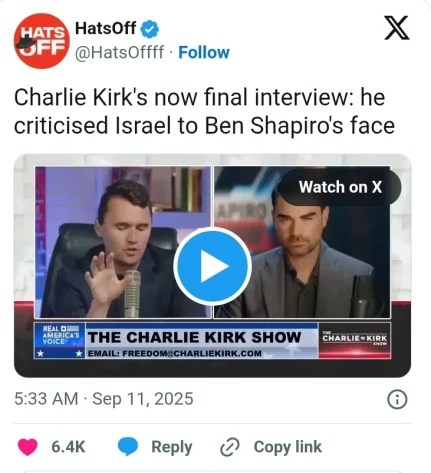
In one of his final interviews, conducted with Israel’s premier influencer in the United States, Ben Shapiro, Kirk once again tried to raise the issue of censorship of Israel critics.
“A friend said to me, interestingly: ‘Charlie, okay, we’ve pushed back against the media on COVID, on lockdowns, on Ukraine, on the border,’” Kirk told Shapiro on September 9. “Maybe we should also ask the question: is the media totally presenting the truth when it comes to Israel? Just a question!”
According to Kirk’s longtime friend, Kirk’s resentment of Netanyahu and the Israel lobby was spreading within Trump’s inner circle. In fact, they said, the president himself was terrified of Netanyahu’s wrath, and feared the consequences of defying him.
During the past year, the Trump insider was told by contacts in the White House that the Secret Service had caught Israeli government personnel placing electronic devices on its emergency response vehicles on two separate occasions.
While The Grayzone was unable to confirm the story with the Secret Service or White House, such an incident would not have been unprecedented. Indeed, according to a report in Politico citing three former senior US officials, a cellphone spying device was placed by Israeli agents “near the White House and other sensitive locations around Washington” toward the end of Trump’s first term in 2019.
Former UK Prime Minister Boris Johnson recounted a similar incident in his memoir, writing that his security team found a listening device in his bathroom soon after Netanyahu used his personal toilet.
The Israel-did-it theory
Kirk was killed this September 10 with a single shot fired by a sniper apparently positioned on a rooftop 200 meters away. He was shot while seated before a crowd of thousands at Utah State University in Orem, Utah on the first leg of his American Comeback Tour. The scene of Kirk collapsing from the impact of a gunshot to his neck just as he began answering a question about transgender mass shooters was perhaps the most shockingly vivid spectacle of assassination – and certainly the most viral – in human history.
There is currently no evidence of an Israeli government role in Kirk’s assassination. However, that has not stopped thousands of social media users from speculating that the pro-Trump operative’s shifting views on the issue contributed in some way to his death. By the time of publication, over 100,000 Twitter/X users have liked a September 11 post by libertarian influencer Ian Carroll declaring about Kirk, “He was their friend. He basically dedicated his life to them. And they murdered him in front of his family. Israel just shot themselves.”
Many advancing the unsubstantiated theory have pointed to a Twitter/X post by Harrison Smith, a personality at the pro-Trump Infowars network, stating on August 13 – almost a month before Kirk’s assassination – that he was told by “someone close to Charlie Kirk that Kirk thinks Israel will kill him if he turns against Israel.”
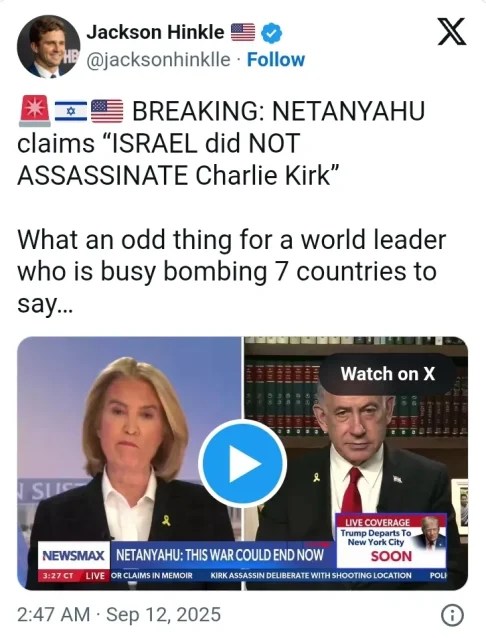
The frenzied speculation has set off shockwaves in Tel Aviv, where Netanyahu was compelled to explicitly deny that his government killed Kirk during a September 11 interview with NewsMax.
Netanyahu and his allies bury the Kirk crisis as “big tent” collapses
That appearance was just one of several interviews and statements the Prime Minister dedicated to Kirk in the wake of his killing in an effort to frame the late conservative leader’s legacy in a uniformly pro-Israel light. The major public relations push has occurred while Netanyahu wages a military campaign on seven fronts, punctuated by a regional assassination spree that most recently reached into the heart of Qatar, a US ally.
Netanyahu first tweeted prayers for Kirk at 3:02 PM in the afternoon on September 10, minutes after news of the shooting broke. He has since authored three additional posts about Kirk, even breaking away from the Israeli war cabinet to spend the afternoon of September 11 memorializing the conservative leader on Fox News.
During that interview, Netanyahu did his best to insinuate that Israel’s enemies were responsible for murdering Kirk, despite the fact no suspect was named or in custody at the time:
“The radical Islamists and their union with the ultra-progressives—they often speak about ‘human rights,’ they speak about ‘free speech’—but they use violence to try to take down their enemies,” the Prime Minister told Harris Faulkner.
In a September 10 Twitter/X post eulogizing the conservative leader, the Israeli Prime Minister described a recent phone conversation with Kirk.
“I spoke to him only two weeks ago and invited him to Israel,” Netanyahu declared. “Sadly, that visit will not take place.”

Left unmentioned was whether Kirk declined the invitation—just as he did with the Prime Minister’s offer to reload TPUSA’s coffers with donations from his coterie of wealthy American Jewish cutouts.
At the time of publication, a 22-year-old resident of Utah has been taken into custody after supposedly confessing to killing Kirk. The public may soon learn the true motives of the alleged assassin. Perhaps they will fuel the narrative which Trump and his allies advanced in the immediate wake of the shooting – that a leftist radical was responsible, and that a wave of draconian repression must follow.
But after the shooter’s initial escape and a series of federal law enforcement mishaps, a large sector of Americans will likely never believe the official story. Nor will they ever know where Kirk’s turning point on Israel would have taken the conservative movement.
Four days before the assassination, frustration among pro-Israel commentators bubbled over in public during a Fox News interview in which Ben Shapiro launched a chilling attack on Kirk without naming him.
“The problem with a ‘big tent’ is that you may end up with many clowns inside,” Shapiro told Fox host and fellow Zionist gatekeeper Mark Levin in an apparent critique of TPUSA.
“Just because you’re saying somebody votes Republican—that doesn’t mean that they ought to be the preacher at the front of the church, they’re not the person that ought to be leading the movement, if they are spending all day criticizing the President of the United States as ‘covering up a Mossad rape ring’ or ‘being a tool of the Israelis for hitting an Iranian nuclear facility.’”
When Kirk took his usual place at the “front of the church” four days later, he was cut down by a sniper’s bullet.
Within 24 hours of Kirk’s death, Shapiro announced that he would be launching his own campus speaking tour, vowing: “We’re gonna pick up that blood stained microphone where Charlie left it.”
Israeli Strikes on Media Offices Kill At Least 25 Journalists in Yemen
By Kyle Anzalone | The Libertarian Institute | September 12, 2025
An Israeli attack on Yemen hit the offices of two newspapers in Sanaa, killing dozens of journalists and civilians. The Yemeni Journalists Union condemned the attack, labeling it a heinous war crime.
According to the Yemeni Health Ministry, the Israeli strikes hit the offices of the 26 September newspaper and Al-Yemen newspaper, killing at least 25 journalists. 26 September is the military’s media outlet, and Al-Yemen is one of the most read newspapers in Yemen.
The Yemeni Journalists Union said it “strongly condemns the heinous war crime committed by the brutal Israeli aggression on Wednesday, 10 September 2025, through its direct targeting of the offices of 26 September newspaper and Al-Yemen newspaper in the capital.”
Yemeni authorities report that at least 46 people were killed in strikes across Sanaa. A military facility and a fuel station were targeted along with media offices. The death toll is expected to rise as rescue and recovery efforts are ongoing. More than 165 people were injured.
The majority of those killed, 38, died in the strikes on Sanaa, which targeted residential areas.
The latest Israeli strikes in Yemen are part of the ongoing conflict between Tel Aviv and Ansar Allah. Ansar Allah, or the Houthis, control most of Yemen, including the capital city. After Israel began its onslaught and siege of Gaza, Ansar Allah placed a blockade of Israeli-linked shipping in the Red Sea.
In response to the blockade, Israel and the US have repeatedly bombed Yemen, killing a large number of civilians. The strikes have failed to break the blockade, and Ansah Allah has responded by direct attacks on Israel with missiles and drones.
The blockade has caused significant Financial losses to Israel’s Red Sea port. In July, the head of the Port of Eilat warned that the facility may have to shut down without additional financial assistance from Tel Aviv.
Yemeni leaders opposed to Ansar Allah warned US Senators that the strikes in Yemen have only empowered the Houthis. The warning was sent following an Israeli attack that killed political leaders, including the prime minister.
PCHR Report Exposes Israel’s War on Journalists and Media Institutions in Gaza
21st Century Wire | September 9, 2025
Yesterday marked a devastating event for the Palestinian Centre for Human Rights (PCHR) as their headquarters in Al-Roya Tower, Gaza City, was obliterated by an airstrike from the Israeli Occupation Force. This attack is part of a disturbing pattern of systematic assaults on high-rise buildings throughout the city. Just following PCHR’s announcement of their new report, “Assassination of Truth: Killing of Journalists amid Genocide in Gaza,” Avichay Adraee, spokesman for the Israeli Occupation Forces, casually declared the intention to target and demolish Al-Roya Tower, home to PCHR’s vital work. The timing and intent behind these actions raise serious questions about the protection of human rights and freedom of expression in these turbulent times.
The PCHR office, perched on the 12th floor of the Al-Roya Tower, has unfortunately faced relentless bombardment and significant damage since the onset of the conflict. In addition, the Israeli Occupation Forces raided the premises, even converting it into a military base during their previous ground operations in Gaza City. As a result, the office has been rendered inoperable, highlighting the heavy toll on journalists working in Gaza. It is also important to mention that the PCHR offices located in Khan Younis and Jabalia were demolished last year.
PCHR’s new report paints a vivid and harrowing picture of the crimes committed, backed by compelling firsthand accounts from victims, witnesses, and their families, along with insights from legal experts and international sources. It shines a light on the shocking obliteration of 112 media institutions—ranging from TV and radio stations to newspaper headquarters—forcing journalists in Gaza to operate under extreme peril, often from makeshift tents, all while living with the constant threat of assassination.
The report reveals a troubling pattern: since October 7, Israel has actively targeted individuals who are brave enough to document the crisis in Gaza, effectively trying to suppress the truth and documented evidence of the Gaza genocide. Shockingly, during this period, Israeli Occupation Forces have killed 221 journalists, injured 415 more, and have arbitrarily detained at least 86 individuals. Many have faced torture and inhumane conditions, with 16 still in detention and 4 having mysteriously disappeared, according to PCHR. It’s a stark reminder of the dangers faced by those committed to reporting the realities on the ground.
The report calls on the global community to urge the Israeli authorities to promptly permit foreign journalists and international media representatives to access the Gaza Strip.
All messenger apps are ‘transparent’ to spy agencies – Kremlin
RT | September 7, 2025
Messaging apps are “absolutely transparent” to intelligence agencies and security services, Kremlin spokesman Dmitry Peskov has said. People who use them to share sensitive information should be aware of the risks, he added.
“All messengers are absolutely transparent systems, and people who use them should understand that they are transparent… to the security services,” Peskov told journalists on Friday at the Eastern Economic Forum in Vladivostok, Russia.
He added that it is particularly important to consider the risks when sensitive government or commercial data is shared through these apps, which can be accessed by foreign intelligence services.
Peskov was commenting on Telegram and WhatsApp in Russia, as well as the Russian government’s support for developing a domestic messaging platform.
Russian security services have accused Telegram and WhatsApp of using double standards for refusing to share data with the Russian authorities about fraud and terrorist plots while complying with similar requests from other countries.
In July, a member of the State Duma’s committee on information policy and technology, Anton Nemkin, called WhatsApp’s continued presence in Russia a “legalized breach of national security.”
Russian law enforcement officials have said that Ukrainian intelligence, along with other malicious actors such as swindlers and con artists, often relies on databases containing personal data obtained through WhatsApp and Telegram to recruit agents or identify targets inside Russia.
In December 2024, the US government also warned senior officials to switch to encrypted communications after a security breach in which a group of hackers stole data, including information stored under US government surveillance protocols as part of “legal” wiretapping of American suspects.
Australia Orders Tech Giants to Enforce Age Verification Digital ID by December 10
A safety law that reads like a blueprint for a surveillance state
By Cindy Harper | Reclaim The Net | September 8, 2025
Australia is preparing to enforce one of the most invasive online measures in its history under the guise of child safety.
With the introduction of mandatory age verification across social media platforms, privacy advocates are warning that the policy, set to begin December 10, 2025, risks eroding fundamental digital rights for every user, not just those under 16.
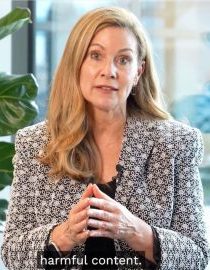 eSafety Commissioner Julie Inman Grant has told tech giants like Google, Meta, TikTok, and Snap that they must be ready to detect and shut down accounts held by Australians under the age threshold.
She has made it clear that platforms are expected to implement broad “age assurance” systems across their services, and that “self-declaration of age will not, on its own, be enough to constitute reasonable steps.”
The new rules stem from the Online Safety Amendment (Social Media Minimum Age) Act 2024, which gives the government sweeping new authority to dictate how users verify their age before accessing digital services. Any platform that doesn’t comply could be fined up to $31M USD.
While the government claims the law isn’t a ban on social media for children under 16, in practice, it forces platforms to block these users unless they can pass age checks, which means a digital ID.
There will be no penalties for children or their parents, but platforms face immense legal and financial pressure to enforce restrictions, pressure that almost inevitably leads to surveillance-based systems.
The Commissioner said companies must “detect and de-activate these accounts from 10 December, and provide account holders with appropriate information and support before then.”
These expectations extend to providing “clear, age-appropriate communications” and making sure users can download their data and find emotional or mental health resources when their accounts are terminated.
She further stated that “efficacy will require layered safety measures, sometimes known as a ‘waterfall approach’,” a term often associated with collecting increasing amounts of personal data at multiple steps of user interaction.
Such layered systems often rely on facial scanning, government ID uploads, biometric estimation, or AI-powered surveillance tools to estimate age.
Privacy campaigners warn that these approaches risk normalizing the constant collection of sensitive personal data, building infrastructure that could easily be repurposed for broader tracking or profiling.
To support enforcement, eSafety has launched a self-assessment tool for companies to determine whether their services are covered by the law.
The Commissioner noted that the tool would help companies figure out if “any of their services may be excluded” under the legislative rules issued by the Minister for Communications.
However, most major social media platforms such as Facebook, Instagram, TikTok, Snapchat, YouTube, and X are almost certain to be included.
eSafety is also developing regulatory guidance to clarify what “reasonable steps” will mean in practice.
The Commissioner has made it clear that platforms must already be preparing to prevent children from manipulating settings to bypass restrictions, ensure that complaint mechanisms are functional and accessible, and plan for full implementation ahead of the December deadline.
Citing consultations with over 160 organizations and more than 50 young people aged 13 to 23, the Commissioner claims there is “strong community support for measures to better protect children online.”
She added, “Australians have told us they want strong, practical protections that keep children safe without compromising privacy or fairness. We have listened, and this feedback is shaping the guidance we are putting in place for industry.”
However, many in the privacy and digital rights communities question whether such a balance is possible when the state’s approach is to compel private companies to verify the age of every user, regardless of whether they’re children.
The phrase “without compromising privacy” rings hollow for those who recognize that age verification at this scale often relies on intrusive surveillance methods that compromise anonymity for everyone, not just young users.
The government maintains that only services with core social networking features are affected.
Online games and basic messaging apps may be excluded. But messaging functions embedded in social media platforms, like DMs on Instagram or group chats on Snapchat, will fall under the new restrictions. The definition is broad enough that many widely used platforms could be swept into the regulatory net.
Although the Commissioner has publicly insisted that safety and privacy “do not have to be mutually exclusive,” the architecture required to meet the government’s demands suggests otherwise.
Once systems are in place to scan faces, verify IDs, or track user activity for the sake of age assurance, they can be leveraged for other purposes by platforms or the state.
Australia’s move places it at the frontier of a growing global trend where safety rhetoric is used to justify mass surveillance.
Privacy advocates argue that introducing mandatory identification online not only limits access but also normalizes tracking in digital spaces that once allowed for anonymity, freedom of expression, and private communication.
Despite these concerns, the Commissioner urged platforms not to delay. “This is the time for companies to start mobilizing and planning for implementation,” she said, adding that “children, parents and carers are counting on services to deliver on their obligations and prepare their young users and the trusted adults in their lives for this monumental change.”
Featured Video
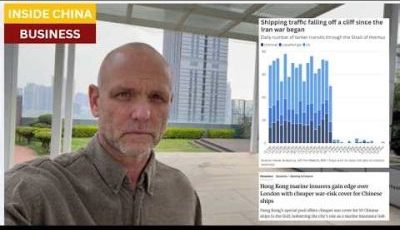
More Iran War fallout: Maritime insurance industry shifts from London to China
or go to
Aletho News Archives – Video-Images
From the Archives
Allies Don’t Need Lobbies
By Jay Knott | Dissident Voice | September 24, 2013
In a recent article on Counterpunch, Rob Urie defended the traditional Marxist analysis of US policy in the Middle East. He argues that support for Israel is driven primarily by economic interest, not the Jewish lobby.
He starts by paying tribute to the idea that Western societies are uniquely racist. He says that the “Western narrative” claims there is an “Arab character”, and that this is “antique racist blather”. He gives no definition of these terms. Further, he establishes his credentials as part of the dominant current in the American left by claiming that “over a million people in Iraq died so ‘we’ in the West can drive SUVs.”1
When he tries to criticize bourgeois economics, he makes it clear he doesn’t understand the developments it has made since Marx’s day, using the mathematical discipline known as “game theory”. He dismisses the basic abstraction of economic theory, the idea of the rational individual, on the grounds that it is “devoid of history, culture and political context”. But abstractions are always devoid of something.
He defends a more concrete economic theory, mostly Marxist, with some input from another theorist of capitalist crisis, Hyman Minsky. This concrete theory leads him to the view that US activity in the Middle East is primarily driven by rational capitalist motives, the need to secure a supply of oil.
“Taking the totality of circumstance — former oil company executives launching war on an oil rich nation on a pretext they publicly proclaimed they didn’t believe shortly before taking office — and that upon launching their war proved to be non-existent, requires a willingness to overlook the obvious — that the war on Iraq was for oil, that is difficult to support.”1
Perhaps I’ve misunderstood him, but based on what he says in the rest of the article, this convoluted sentence seems to argue that, because president Bush and vice-president Cheney attacked Iraq on false premises, and they also said it was all about oil, and they are former oil executives, and Iraq has a lot of oil, it’s difficult to deny US attacks on Iraq are all about oil.
In fact, it’s not hard at all. As Urie points out, at times Bush and co. said that attacking Iraq was “protecting the world’s supply of oil.”1 But, as he also points out, they are congenital liars. Why should we believe them when they say they are trying to “protect” the oil supply? Protect it against what? When politicians “admit” attacks on Middle Eastern countries are wars for oil, they are parroting the neo-con party line, feeding the public, both left and right, with a plausible-sounding pretext. For right-wingers, “it’s a war for oil” is a reason to support war, and for leftists, it’s a way to feel better by complaining impotently about corporate greed. Both approaches help the war drive. … continue
Blog Roll
 Aletho News
- More Iran War fallout: Maritime insurance industry shifts from London to China
- US-Israeli aggression on Iran triggers review of GCC countries’ investment pledges to Washington
- Russia slams UK plan to seize tankers suspected of carrying its oil
- Pakistan ramps up food exports to Persian Gulf nations as war deepens food insecurity
- Iran submits response to US plan, sets terms for war’s end: Tasnim
- US vs Iran: Kharg Island Talk — Bluff or Escalation? Ex-Military Officer Weighs In
- Zelensky unnecessarily involves Ukraine in the Middle East crisis
- Turkish tanker blacklisted by Ukraine hit in drone attack – media
- Canada, the U.S., and NATO: the inescapable trap
- Villains of Judea: Leonid Radvinsky
- If Americans Knew
- ‘No Innocent Children’: Far-right Israeli Lawmaker Defends Killing of Palestinian Family
- Mossad’s promises helped Netanyahu convince Trump that Iran could be toppled
- US Arms Control Official Refuses To Comment When Asked If Israel Has Nuclear Weapons
- Veterans warn US landing could be ‘more Gallipoli than Vietnam’
- Israel may be committing war crimes in Lebanon – Not a ceasefire Day 167
- In the West Bank, life is a constant battle – 3 articles
- Jacob Reses, one of the most powerful pro-Israel operatives in Trump’s Washington
- Israeli-US assaults kill or injure 87 children a day – Not a ceasefire Day 166
- ‘Forever live by the sword’: Understanding Israelis’ massive support for Iran war
- UN’s special rapporteur on human rights says Israel is systematically torturing Palestinians
- No Tricks Zone
- Devastating Assessment Of Comirnaty Vaccine By Former Senior Pfizer Europe Toxicologist
- New Study: CO2 Is ‘Effectively Negligible’ As An Explanatory Climate Change Factor Since 2000
- Former Pfizer Toxicologist Dr. Helmut Sterz Tells Bundestag Hearing Pfizer Vaccine Should Have Never Been Approved
- Energy Expert: Germany’s Nuclear Phaseout Was A “500 Billion Euro Mistake”
- New Research: South Australia’s Mid-Holocene Sea Surface Temperatures Were 4°C Warmer Than Today
- Storing Green Energy To Last Germany 10 Days Would Require A 60-Million Tonne Battery
- New Studies: UK Sea Levels Were 4 Meters Higher Than Today During The Mid-Holocene
- Destructive Green New Deal: German Energy And Metal Group Warns Of Drastic Crisis
- New Study Documents A 20-Year Pause In Arctic Sea Ice Decline – Driven By Internal Variability
- Wake-up Call: Survey Shows Majority Of Germans Now Favor Postponing Climate Targets!
 Aletho News
