Spain announces major social media crackdown
RT | February 3, 2026
Spain will ban social media use for children under 16 and hold tech executives personally accountable for “hateful content” spread on their platforms, Prime Minister Pedro Sanchez announced on Tuesday.
Speaking at the World Government Summit in Dubai, Sanchez said that his administration will implement five measures to regulate social media, with sweeping consequences for free speech.
“First, we will change the law in Spain to hold platform executives legally accountable for many infringements taking place on their sites,” he announced, explaining that executives who fail to remove “criminal or hateful content” will face criminal charges.
Most jurisdictions view social media sites as ‘platforms’ rather than ‘publishers’, meaning users themselves are responsible for the content they post. Sanchez’ proposed change goes beyond the scope of the EU’s Digital Services Act, which mandates fines for platforms that fail to remove “disinformation” after being alerted to it.
Sanchez did not explain what constitutes “hateful content,” while the text of the DSA does not explain the term “disinformation.”
Sanchez said that his government would also turn “algorithmic manipulation and amplification of illegal content” into a criminal offense, track and study “how digital platforms fuel division and amplify hate,” ban social media use for under-16s, and launch a criminal investigation into alleged offenses committed by Grok, TikTok, and Instagram.
During his speech, Sanchez personally singled out X owner Elon Musk, accusing the billionaire of spreading “disinformation” about his decision to grant amnesty to half a million illegal immigrants last week. On Sunday, Musk accused Spanish MEP Irene Montero of “advocating genocide” after she declared that she wants a “replacement of right-wingers” by migrants.
Sanchez said that five other European countries, which he called a “coalition of the digitally willing,” would pass similar legislation. France passed a much narrower bill banning under-15s from social media last week, while Greece is “very close” to announcing a similar ban, Reuters reported on Tuesday.
New York Bans Israel-Linked Terror Group
A Good Start, But…
By Kevin Barrett | American Free Press | February 2, 2026
On January 13, the State of New York set a small but significant precedent by banning the Jewish-supremacist terror group Betar. In a settlement with the state’s Attorney General, Betar agreed to stop terrorizing New Yorkers who disagree with the group’s pro-Israel, Jewish-supremacist agenda. Simultaneously with the agreement Betar dissolved its New York operations—but vowed to reconstitute itself and continue terrorizing Americans in other jurisdictions.
Though New York did not officially deem Betar a terrorist group, it’s clear that’s exactly what it is. The definition of terrorism is: “Using violence or the threat of violence against civilians to create fear for political purposes.”
Clearly, terrorism was and remains Betar’s central mission. New York’s Attorney General Letitia James wrote: “My office’s investigation uncovered an alarming and illegal pattern of bias-motivated harassment and violence designed to terrorize communities and shut down lawful protest.” Leaked messages show the group conspired to blind peaceful anti-Israel protesters with laser weapons and attack them with chemical weapons. Betar even plotted to car-bomb New York’s mayor. They delivered dozens of bomb threats to students, professors, and other Americans.
Betar’s members conspired to attack anti-Israel protesters with lasers, asking “can we burn their eyes out?” They routinely dispensed bomb threats by delivering Israeli-style (exploding?) pagers to people whose views they disagreed with. And they conspired to commit these and other acts of terrorism with “many people in various goverment (sic) offices including the prime ministers (sic) office, shin bet and other intelligence agencies in the state of Israel” according to their own leaked text messages.
The violence wasn’t just talk. On numerous occasions, pro-Palestine demonstrations have been brutally attacked by suspected Betar thugs, who typically wear face-masks to prevent identification. In just one of many examples, peaceful protesters at UCLA were attacked by Betar-aligned terrorists armed with explosives and chemical weapons last June. Unfortunately, since the pro-Zionist-terrorism Anti-Defamation League (ADL) and other organized crime syndicates have infiltrated and bribed local and national police agencies, Betar’s Jewish supremacist terrorists are rarely brought to justice.
If you’re still wondering whether Betar is really a terrorist group, try the following thought experiment: Imagine what would happen if radical Muslims plotted to blind Jews with lasers, attack them with explosives and chemical weapons, threaten them by delivering realistic-looking bombs, and joyfully envisioned murdering a Jewish mayor of New York by blowing up his car. Clearly such a group would be immediately slapped with a terrorist designation: All its assets would be confiscated, its members would be arrested and sent to Guantanamo, all their assets would be seized, and any remaining members would be hunted down and killed using US military drones.
And what would happen to the foreign nation that supported that wave of terrorism in the US? Our federal government would immediately sanction it, freeze and confiscate its assets, bomb it, and very possibly invade it and execute its leaders.
But when the terrorists are Jewish supremacists backed by the state of Israel, the rules suddenly change. The worst thing that can happen to them is a negotiated settlement with the state of New York in which the terrorists promise to stop terrorizing New Yorkers, while vowing to continuing terrorizing Americans in other states.
Maybe it’s time to start treating Betar and similar groups the same way we treat other terrorists. After all, the whole point of declaring a “war on terrorism” after the attacks on September 11, 2001 was to punish the people who committed that atrocity and remove their ability to commit future atrocities.
But we went after the wrong people. The real 9/11 terrorists were Israeli-backed Jewish supremacists, who orchestrated the false flag demolition of the World Trade Center to hijack America’s military and use it against their regional enemies. (For details, read “9/11 Was an Israeli Job” by Laurent Guyénot; “American Pravda: October 7th and September 11th” by Ron Unz; and “Israel Did 9/11” by Wyatt Peterson.
New York’s polite closure of Betar’s local branch office is a good start. But Americans need to recognize that Betar and its state sponsors are terrorists—and treat them accordingly.
It would be logical, not to mention poetic justice, for the US government to use the extraordinary powers it seized after 9/11 to punish the real perpetrators of the demolition of the World Trade Center and the attack on the Pentagon, and to ensure that they will never again commit such an act. By recognizing that Betar and other Jewish supremacist groups are terrorists, and that the world’s worst terrorism-supporting rogue nation is the so-called state of Israel, Americans could finally do what is necessary to win the war on terror that was declared in the wake of Israel’s controlled demolition of the World Trade Center.
British journalism hits rock bottom with latest shocking revelations
By Martin Jay | Strategic Culture Foundation | February 2, 2026
From the truth about who really killed Diana to the depraved world of government officials sexually abusing children and the subsequent cover-up, it is now clear that nearly all major stories are either blocked from publication or rewritten by Soviet-style propaganda agents working for the British deep state.
Virtually nothing you read in British newspapers about security, defense, and wars is honest journalism. Instead, it is propaganda crafted by a new secret UK military department tasked with rewriting journalists’ copy or, in some cases, simply ensuring their articles never see the light of day.
That is the shocking conclusion of a new investigation by The Grayzone, which obtained secret documents exchanged between the UK and Australian governments over Canberra’s plans to adopt Britain’s “off-the-shelf” operation and incorporate it into its own government practice for handling journalists.
The impressive reporting by Kit Klarenberg and William Evans reveals, in short, that the UK military has created its own censorship department. It either blocks journalists from exposing major stories of public interest or, more commonly, redrafts the thrust of journalists’ pieces to present a different version to the gullible public.
A trove of secret communications reveals how the secretive Defence and Security Media Advisory (DSMA) Committee censors the output of British journalists while categorizing independent media as “extremist” for publishing “embarrassing” stories. What sounds like an account of secret police operations in Eastern Europe during the Soviet era, the documents show that this army intelligence department regularly blocks journalists from continuing to investigate a subject through a formal system called “D Notices” – which, remarkably, journalists almost always respect.
“The DSMA imposes what are known as D-Notices, gag-orders systematically suppressing information available to the public,” The Grayzone report states.
The files provide the clearest view to date of this underground committee’s inner workings, exposing which news items the state has sought to shape or keep from public view over the years. These include “the 2010 death of a GCHQ codebreaker, MI6 and British special forces activity in the Middle East and Africa, the sexual abuse of children by government officials, and the death of Princess Diana,” the report reveals.
British media, it seems, is in a crisis it never anticipated. Its journalists are, in reality, no longer working as journalists but as propaganda agents of the state. Under this system, which nearly all journalists sign up to, when a reporter wants to pursue a story, they must consult this department, which then effectively controls both the journalist and the story from that point forward. The absurd practice of ‘copy approval’ – where journalists send their final draft before submitting for publication – is routinely enforced.
This practice, a milestone in the death of British journalism, comes as no surprise to me. For decades, I have sent questions to the UK’s Foreign Office and Ministry of Defence, only to become a victim of the comical, if not pathetic, game that follows. A spokesperson asks for your deadline and then, mysteriously, 30 minutes before that time, you receive a “response” meant to serve as a quote from a senior official. It not only looks computer-generated but is often irrelevant to the subject. This is Britain – a country once seen by the whole world as a beacon of freedom and democracy, now operating like a cheap West African dictatorship, pumping out lies and manufacturing consent on an industrial scale.
That such a secret censorship department exists and flourishes should shock no one. In 2023, my own investigation discovered that UK and US weapons were being resold on the dark web. It wasn’t exactly a great scoop, but the hard work lay in substantiating the story with expert opinions and forensic analysis of photos and website postings. I was amazed as weeks passed while I badgered the Daily Mail’s absurdly young Defense Editor to run the story. He played every trick in the book to avoid it until finally he and others agreed to publish – but watered it down so much, removing all the top quotes from hardcore military and political experts that supported the story’s thrust. Clearly, he and others were under the control of these DSMA censor agents, who could not allow a piece alleging that shoulder-mounted rocket systems used by both the US and UK armies were being openly sold on the black market.
A second, much more detailed investigation – which supported the belief that barely a third of all UK military kit was actually reaching frontline Ukrainian soldiers – I didn’t bother sending to the Daily Mail but published on Patreon. One of its chief findings was that a senior Conservative MP admitted to me in a WhatsApp exchange that the UK had, in fact, installed tracking devices in some of the more expensive equipment, like Armoured Personnel Carriers (APCs), but at a certain point these devices were simply switched off and disappeared from the screens. It also revealed the bombastic stupidity of the then–UK Defence Minister, Ben Wallace, who conveniently chose to ignore a UN report identifying the influx of cheap Western-made assault rifles into the Libyan arms bazaar as a main reason for the spike in terrorism in the Sahel region – while insulting the Nigerian president who had made the claims, saying he “probably watches RT television.” When I suggested to Mr. Wallace that a simple way to verify these claims would be to send agents to Libya to conduct their own surveillance, his reply was, “Why don’t you do that?” before blocking me.
Wallace’s extraordinary rudeness shocked me at the time. But it was clear he was used to a much more servile, sycophantic manner from UK journalists who didn’t ask difficult questions – and that I was obviously breaking from tradition. Clearly, the DSMA department controls all those Westminster-based hacks, their stories, and even their story ideas, so it’s understandable that his rage boiled over.
The Grayzone’s findings make for depressing reading for anyone old enough to remember when British journalism was the finest in the world. But they also raise other questions, chiefly: Who is actually behind British titles? Or more specifically, who is funding them? Most UK newspapers don’t make any money, so it’s understandable that a new relationship with the deep state might help them remain relevant – especially now that the news is being baked for them, ready to be served. This has changed the role of the British journalist: no longer the baker, but relegated to the delivery boy on the moped.
Yet where the big titles get their revenue to stay in business remains a mystery. Is part of the same deal on censorship and copy control that the state funds them through surreptitious, murky channels – perhaps via companies with close links to the heart of power? Follow the money.
From Iraq war crimes to Gaza’s ‘board of peace’: Why Tony Blair belongs in The Hague
By David Miller | Press TV | February 1, 2026
In the grotesque circus of international power plays, few performers rival Tony Blair for sheer audacity. The former British Prime Minister (1997-2007), once celebrated for his “Cool Britannia” sheen and Third Way politics, is now indelibly stained by the Iraq War debacle, a war built on deception that claimed hundreds of thousands of lives and shattered the region.
Yet in January 2026, Donald Trump appointed him to the Board of Peace, a White House-created entity chaired indefinitely by Trump himself to oversee Gaza’s “reconstruction” under a controversial 20-point plan.
The board’s founding executive includes heavyweights like Marco Rubio, Jared Kushner, Steve Witkoff, Marc Rowan, Ajay Banga, and Robert Gabriel—figures tied to Trumpworld and Zionist interests, with no Palestinian representation.
Blair’s role is lending “statesmanlike” cover to what is seen as a colonial oversight mechanism that could facilitate displacement and control in Gaza. This isn’t redemption; it’s impunity on steroids.
Blair belongs in The Hague facing charges for aggression and complicity in atrocities—not jet-setting as a “peace” architect. This article lays bare his record, his Zionist alliances, his profit-driven institute, his billionaire backer, and why his latest gig risks making him complicit in Gaza’s ongoing nightmare.
Blair’s war crimes: Lies, invasion, and bloodshed
Blair’s gravest sin remains the 2003 Iraq invasion, sold on bogus claims of weapons of mass destruction (WMDs) and Saddam Hussein’s imminent threat.
The Chilcot Inquiry (2016), an exhaustive British investigation, demolished his case: “We have concluded that the UK chose to join the invasion of Iraq before the peaceful options for disarmament had been exhausted. Military action at that time was not a last resort.”
It highlighted “flawed intelligence” that went “unchallenged” and Blair’s overestimation of his influence on George W. Bush. The infamous “dodgy dossier” asserted Iraq could deploy WMDs in 45 minutes—a claim later exposed as hyped and unreliable.
Under the Rome Statute, Blair could face ICC charges for:
- Crime of aggression: Planning and executing an illegal war without UN Security Council approval, violating the UN Charter.
- War crimes: Complicity in detainee abuses, including British forces’ role in cases like the death of Baha Mousa in custody.
- Crimes against humanity: Contribution to systematic civilian harm via indiscriminate tactics, with excess Iraqi deaths estimated in the hundreds of thousands. For example, studies estimated over 650,000 by 2006, as reported by The Guardian, citing a study in The Lancet medical journal. Later estimates put the toll at over a million.
What has been Blair’s response? “I did not mislead this country, I made a decision in good faith,” as he stated post-Chilcot. Prosecutors have tried—private attempts failed due to political barriers, as reported by the BBC on the High Court’s rejection of a 2017 bid by an Iraqi general—but the evidence mounts: the war was unnecessary, illegal, and devastating.
Blair’s Zionist ties: PM to quartet envoy, always ‘Israel First’
Blair’s pro-Israel stance is longstanding and blatant. As the British PM, he cultivated ties with Labour Friends of Israel (LFI) and accepted funding from Zionist-linked donors. He defended Israel’s actions during the Second Intifada, prioritising “security” while downplaying occupation and settlements.
Blair’s inner circle was riddled with pro-Israel influencers. Take Lord Michael Levy, a former record producer, dubbed “Lord Cashpoint” for his fundraising prowess: Introduced to Blair in 1994, Levy raised millions for New Labour, including from pro-Israel sources, and became Blair’s Middle East envoy post-2007.
Levy praised Blair’s “solid and committed support of the State of Israel,” as reported by Mishpacha Magazine. Another key figure was Sir Trevor Chinn, a major donor to Blair’s campaigns and LFI, who also funded Conservative Friends of Israel—showing cross-party Zionist commitment.
Chinn donated six-figure sums to keep Blair in power, as Lobster Magazine detailed. Then there’s Peter Mandelson, Blair’s spin master and a self-proclaimed pro-Israel advocate with family ties to the Jewish Chronicle—his father was the paper’s advertising manager as the Chronicle itself reported.
Mandelson revealed in his memoirs his “pro-Israel sentiments”, and close alliance with Levy in shaping Blair’s foreign policy. Most recently, in September 2025, Mandelson was sacked as British Ambassador to the US by Prime Minister Keir Starmer because of the disclosure of new information on his closeness to paedophile financier and Zionist intel asset Jeffrey Epstein.
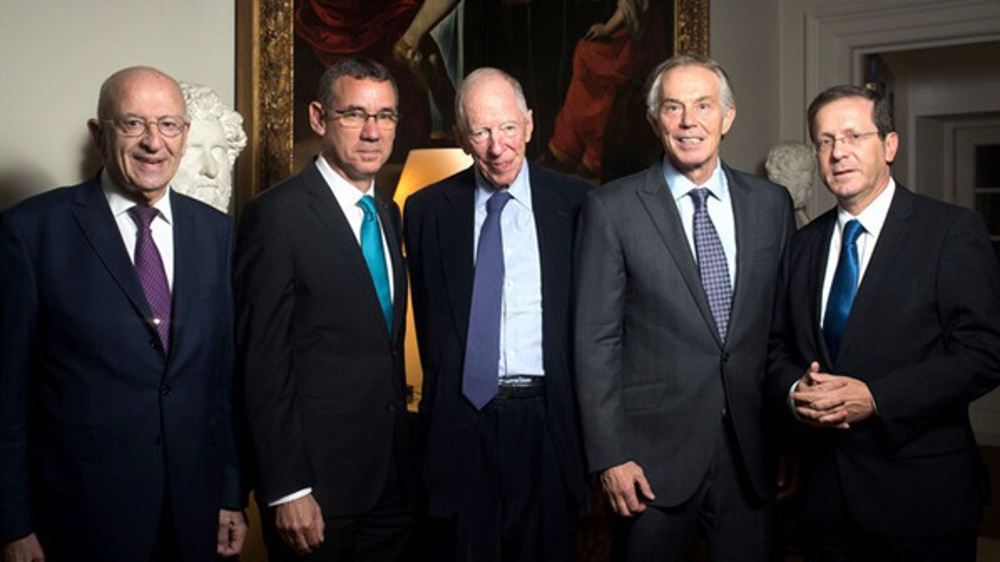
The Genocide Alliance: Chinn, Mark Regev, Jacob Rothschild, Blair and Isaac Herzog (2018)
This network fuelled scandals, like the 2006-2007 cash-for-honours affair, where Levy was arrested (though not charged) over allegations of selling peerages for donations, many from pro-Israel businessmen. The probe destabilised Blair, exposing how Zionist money influenced Labour.
Enter Lord Jon Mendelsohn: As Labour’s chief fundraiser in 2007, Mendelsohn was embroiled in a donations row involving illegal third-party contributions from property developer David Abrahams, who funnelled funds through proxies.
Mendelsohn admitted knowing about the scheme but claimed ignorance of its illegality, according to The Guardian. Fast-forward: Mendelsohn now directs Abraham Accords (UK) and co-chairs the APPG for the Abraham Accords.
Both promote normalisation between the Zionist colony and Arab states—essentially “Zionising” West Asia by embedding Zionist influence in economies and politics.
In a 2023 House of Lords speech, Mendelsohn hailed the Accords as a “historic opportunity,” ignoring Palestinian erasure. This evolution from Blair-era lobby scandals to regional normalisation underscores how Zionist networks persist, repackaging occupation as “peace.”
Blair’s fingerprints are all over the Abraham Accords, the sham “peace” deal normalising Israel’s apartheid with some regional countries while burying Palestinian rights.
In 2015, Blair brokered the first secret meetings between Benjamin Netanyahu and UAE officials in London, planting the seeds for the 2020 agreements. He attended the White House signing ceremony, gushing in a statement: “This is a momentous day… a new pathway is opening up for the Middle East.” Netanyahu later credited him with the Accords’ success, per reports from 2025.
As Quartet Envoy, Blair’s “economic peace” mantra—focusing on the occupied West Bank development while sidelining Gaza and sovereignty—paved the way for these deals, which critics slam as economic bribes to Arab states to ignore Israel’s horrendous war crimes.
Blair’s involvement wasn’t altruistic; it burnished his “peacemaker” image while entrenching Zionist hegemony, bypassing UN resolutions and Palestinian self-determination. His denial of Palestine, as Le Monde put it, is complete—treating the occupied as economic pawns in a Zionist game.
As Quartet Envoy (2007–2015), tasked with advancing the peace process, Blair faced repeated accusations of bias. Palestinian officials called him an “Israeli diplomat” in all but name; he focused on Palestinian “reform” while rarely challenging Israeli policies like Gaza’s blockade or settlement expansion.
The Guardian reported in 2011: Palestinian critics attacked him for favouring Israeli “security” needs over Palestinian rights. During Israel’s 2008-2009 Gaza offensive (1,400+ Palestinian killings), Blair echoed Israeli narratives blaming the Hamas resistance movement without addressing root causes.
A Source News analysis labelled him a “complete failure” for perceived one-sidedness. He resigned in 2015 amid conflicts of interest, but his record shows transactional Zionism—aligning with power to maintain influence.
Tony Blair Institute: Policy peddler with a dark side
The Tony Blair Institute for Global Change (TBI), launched in 2016, poses as a nonprofit promoting “good governance” and tech-driven reform. Before Larry Ellison’s funding in 2021, TBI had about 267 staff in 2020, per its annual accounts.
Post-Ellison, it ballooned to over 800 by 2023, nearing 1,000 in 45+ countries by 2025, with plans for 1,000+ by end-2026, as Ellison’s $375M+ pledges fuelled explosive growth, per POLITICO. Turnover jumped from $81M in 2021 to $121M in 2022, then over $150M, enabling global ops.
Beyond AI and digital IDs, TBI advises on climate policy, net-zero transitions, and governance—often to countries like Saudi Arabia and the UAE, drawing fire for whitewashing abuses.
It pushes “tech for good” like surveillance systems and economic reforms, but critics see neocolonialism. In Africa and the Global South, TBI embeds in governments, promoting privatisation and AI integration that favours Western tech giants.
Controversies pile up: TBI has consulted for many governments while raking in fees – including Saudi Arabia, the UAE, and Bahrain. Most damningly, reports linked TBI discussions to Gaza “reconstruction” plans condemned as ethnic cleansing blueprints, including ideas of “paying Palestinians to leave” or redeveloping Gaza as a “Riviera.”
Middle East Eye revealed TBI’s involvement in talks evolving into proposals critics slam as displacement schemes. The Guardian noted staff participation in such calls.
TBI pushes surveillance tech and net-zero policies, often funded by questionable sources, turning “global change” into elite profit. A 2024 Consultancy.uk critique ridiculed its AI studies as overhyped, while UnHerd questioned its opacity—meaning a lack of transparency in operations and funding that raises concerns over accountability and potential conflicts of interest.
Blair and Larry Ellison: Cash for influence, Zionism, and security risks
Oracle founder Larry Ellison, a staunch Zionist lobbyist and one of the world’s richest men, has poured at least £257 million ($375M+) into TBI since 2021 via his foundation.
Lighthouse Reports exposed how this cash transformed TBI into an Oracle sales and lobbying arm—pushing cloud tech, AI, and government contracts (for example, UK NHS data deals). Ellison gets policy access and favourable regs; Blair gets funding to sustain his empire and personal brand.

Larry Ellison and Blair
Ellison’s Zionism runs deep: He’s donated over $26M to Friends of the Israel Defense Forces (FIDF), including a record $16.6M in 2017—the largest single gift ever—and $10M in 2014.
At a 2017 gala, he declared: “Since Israel’s founding, we’ve called on the brave men and women of the IDF to defend our home,” as reported by The Times of Israel.
In videos and speeches, Ellison emphasised: “For two thousand years, we were stateless. Now we have our own country, defended by the brave men and women of the IDF,” as shared on Instagram. Oracle execs echo: CEO Safra Catz once told staff to “love Israel or maybe this isn’t the job for you”.
Ellison reportedly vetted Marco Rubio for Israel loyalty as revealed in leaked emails, and Oracle built a massive underground data center in Israel amid Gaza ops.
Oracle’s ties to the Israeli military are insidious and extensive, embedding the company as a pillar of Israel’s military machine. Since 2006, Oracle has held multi-year contracts with the Israeli military affairs ministry, supplying databases, Fusion middleware, and cloud services integral to its operations.
Oracle’s complicity in occupation and genocide includes training Israeli military personnel and providing tech that bolsters military logistics and intelligence.
Post-October 7, 2023, Oracle declared “We stand with Israel,” donating $1M to Magen David Adom, sending supplies to Israeli soldiers, and inscribing “Oracle Stands with Israel” on company premises at Catz’s demand.
Oracle’s ERP systems, databases, and IT infrastructure fuel the Israeli military’s genocidal campaigns. Oracle “married the IDF,” with employees embedded in military training and cloud services enabling real-time warfare.
Palantir’s role
This rot extends to Palantir, another Zionist tech behemoth that Blair’s orbit intersects via shared pro-Israel ecosystems. Palantir, co-founded by Peter Thiel ( who “defers to Israel” on AI ethics), signed a strategic partnership with the Israeli regime in 2024 for battle tech, meeting with military officials to deploy AI platforms.
Palantir provides militarized AI to Israeli intelligence, including Unit 8200’s Data Science and AI Center, enabling automated targeting in Gaza—essentially AI-generated kill lists amid genocide.
Palantir— fueled by Jeffrey Epstein funds and Thiel’s backing—has treated Gaza as a testing ground for surveillance tech that spies globally. The tech company, alongside Google and Amazon, arms Israel’s genocidal atrocities, with AI systems predicting and facilitating mass killings.
Blair’s TBI, Oracle-infused, echoes this by designing “data-driven” Gaza plans that could integrate such tech, turning “reconstruction” into perpetual occupation.
Infiltrating British intelligence cloud services
This alliance raises alarms: Oracle holds UK national security contracts. The Ministry of Defence (MoD) signed a 2026 cloud deal for AI and legacy migration. The Foreign, Commonwealth & Development Office (FCDO) uses Oracle Fusion for HR and finance. The Home Office inked a £54M ($72M) cloud pact in 2025.
These departments house most of the British intelligence community, like MI6 and GCHQ (FCDO), MI5 and the Homeland Security Group (Home Office), and Defence Intelligence and the Intelligence Corps (MoD). In 2021, the Cabinet Office terminated a specific procurement plan to migrate its own on-premises Oracle ERP system, so it is the only department housing British intelligence groups (including the Joint Intelligence Organisation, National Security Secretariat, National Security Council and Joint Intelligence Committee) that is not supplied by Oracle.
With Ellison’s Israeli military ties and Oracle’s Israel operations (potentially involving Unit 8200 cyber spies), backdoors pose risks—data leaks to Israeli intel could compromise UK security.
In the real world, such back doors are known to exist in the products of Israeli/Zionist firms like NSO Group with Pegasus spyware, exploited by intelligence to hack phones worldwide, as reported by The Guardian, and Cellebrite, whose tools unlock devices for surveillance as detailed by The New York Times.
Critics speculate Ellison wants Blair’s clout to secure more contracts, while Blair eyes Ellison’s billions for global sway.
Their shared obsession with digital IDs amplifies the menace, forging an Orwellian nightmare where surveillance becomes the new chains of empire.
In a World Government Summit discussion, Ellison told Blair: “The first thing a country needs to do is to unify all of their data so it can be consumed and used by the AI model,” advocating biometric IDs to replace passwords for total, inescapable control. Blair’s TBI relentlessly pushes digital IDs as “essential for modern governance,” per a September 2025 report, estimating UK implementation at £1.4 billion—but this is sinister code for dystopian tracking.
This convergence isn’t benign; it’s a blueprint for genocidal domination. In Gaza and the Levant, digital IDs could entrench Israel’s ethnic cleansing by enabling granular, AI-fuelled surveillance of Palestinians, restricting movement like digital cattle brands, and feeding into Oracle and Palantir’s targeting systems that have already slaughtered thousands.
Byline Times reported Blair’s institute designed Gaza recovery plans on “data-driven lines echoing Oracle-Palantir war systems,” potentially turning bombed-out ruins into a panopticon of apartheid, where every breath is monitored to crush resistance.
For pacification, these IDs would “identify” survivors in “humanitarian zones,” as in Blair’s Gaza International Transitional Authority proposal, which includes “digital government services and identity systems” for civil registry and permits—euphemisms for logging dissenters, enforcing starvation sieges, and facilitating forced expulsions under the veneer of “peace.”
Oracle’s Lebanon deal risks similar exposure, with data vulnerabilities amid Israel’s invasions, turning the Levant into a testing lab for Zionist tech tyranny. Blair and Ellison’s digital dystopia isn’t progress; it’s a genocidal wet dream, pacifying Gaza through algorithmic oppression while they rake in blood-soaked billions from the rubble.
It is difficult to imagine this techno-dystopia will not be enforced everywhere else the Zionists want, if they can get away with it, as they push forward with their so-called “Greater Israel” and “Pax Judaica” hews into view.
“Board of Peace”: Colonial control, potential complicity
Trump’s so-called “Board of Peace,” formalised in January 2026, vests sweeping authority in Trump (no term limit, veto power) to implement Gaza’s “humanitarian zones,” stabilisation force, and reconstruction—excluding Hamas and NGOs with “ties.”
Blair, credited with shaping elements, joins a roster heavy on Trump allies and pro-Israel figures. Al Jazeera critiqued it as putting “rights abusers in charge.”
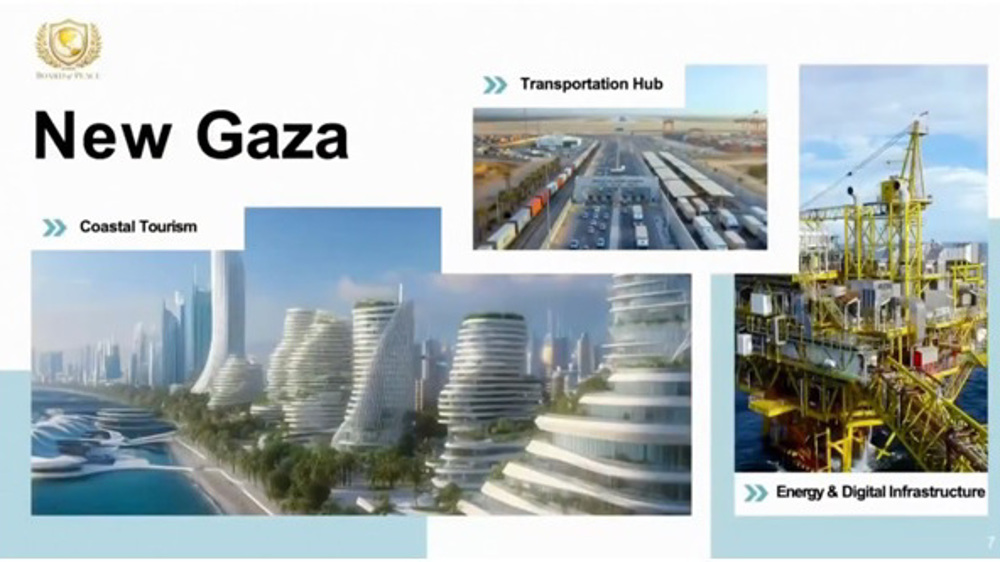
Kushner’s vision for Gaza
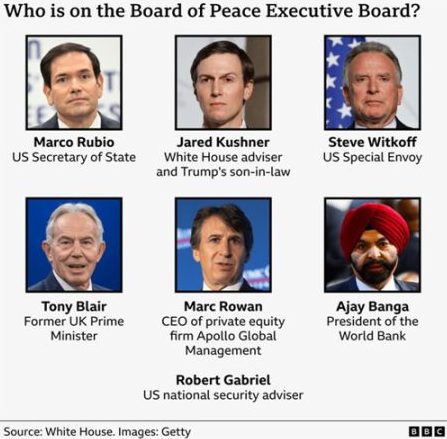
The Executive Board of the Board of Peace
Key members of the board
- Jared Kushner: As an Orthodox Jew, mega donor to the genocidal ultra-Orthodox Chabad-Lubavitch cult and architect of the Abraham Accords, Kushner has described Gaza as “valuable waterfront” property, suggesting redevelopment that critics argue implies ethnic cleansing. His role on the board aligns with his history of prioritising Israeli interests, having facilitated normalisation deals that sidelined Palestinian rights, as detailed by CNBC. Kushner’s Affinity Partners firm has ties to Middle Eastern sovereign wealth funds, raising concerns over conflicts of interest in Gaza’s reconstruction, as noted by the European Council on Foreign Relations.
- Steve Witkoff: This Jewish real estate mogul and mega Trump donor is a staunch pro-Israel advocate, serving as US Special Envoy to the Middle East (West Asia), where he has emphasised close US-Israel partnership on Gaza as reported byThe Times of Israel. Witkoff, described as having a “warm Zionist Jewish heart,” has been instrumental in delivering messages to Netanyahu and advancing Trump’s Gaza plan, as highlighted by OnePath Network. His background in property development fuels speculation that he views Gaza’s rebuilding as a business opportunity, aligning with pro-Israel policies that prioritise security over Palestinian sovereignty.
- Marc Rowan: The Jewish CEO of Apollo Global Management is a major AIPAC donor and led donor revolts against universities over perceived antisemitism, including boycotting the University of Pennsylvania for hosting a Palestinian literary festival, as reported byThe New York Times. Rowan’s anti-Palestine activism includes calling for the resignation of university leaders amid pro-Palestinian protests, as detailed byThe American Prospect. On the board, his financial expertise is poised to oversee investment in Gaza’s reconstruction, but critics argue his pro-Israel stance will entrench Zionist control, as noted by the BBC.
- Martin Edelman: This Jewish lawyer with pro-Israel ties specialises in international real estate transactions and has shaped US-UAE relations, facilitating deals that align with Zionist interests as reported by Watan. Edelman’s involvement in West Asia diplomacy includes roles that support normalisation efforts, bypassing Palestinian rights as highlighted by JNS.org. His position on the board likely focuses on legal frameworks for Gaza’s redevelopment, raising concerns over favouring Israeli interests as discussed by the Jerusalem Center for Foreign Affairs.
- Benjamin Netanyahu: As Israel’s Prime Minister and the chief architect of the Gaza genocide, Netanyahu embodies ideological Zionism, adhering to the “Iron Wall” doctrine of military dominance over Palestinians as explained byThe Conversation. His unwavering expansionism has led to policies even the New York Times calls apartheid. On the Board, Netanyahu’s inclusion ensures Israeli veto power, despite fuming at the presence of Turkish and Qatari officials, as reported by CNN.
- Tony Blair: As detailed throughout this article, Blair’s transactional Zionism and history of enabling Israeli policies make him a fitting but hypocritical addition to the board.
- Marco Rubio: This evangelical Christian is a fervent pro-Israel advocate, viewing support for Israel as biblically mandated as stated in his 2015 speech to the Republican Jewish Coalition. Rubio has pushed sanctions against Hezbollah and legislation to move the US embassy to occupied al-Quds, as reported by Liberty University. His role on the board aligns with Trump’s hardline stance, emphasising US-Israel alliances as critiqued by Sojourners.
- Susie Wiles: Wiles is reportedly an Episcopalian, but is not clearly a Christian Zionist. This is despite being aligned with Mike Huckabee through Florida politics and Trump’s circle, as noted by the Sarasota Herald-Tribune. She consulted for Likud in 2020, as detailed by The Washington Post. Despite her role on the BOARD, she has been described as a stabilising force who reportedly looked “alarmed” or shot “daggers” at Trump during press conferences where he proposed the genocidal mass relocation of Gaza’s inhabitants, as reported byThe Daily Beast.
- Ajay Banga: This Indian-American Sikh has not publicly taken a position on BDS or Zionism; however, Mastercard and Citigroup under his leadership opposed BDS and reportedly maintained operations in the occupied Palestinian territories. Banga described his board role as a “once-in-a-lifetime opportunity” to rebuild Gaza. Typically, he tried to ‘both-sides’ the genocide by condemning “unbelievable loss of life” on both sides as “unconscionable,” but critics like Ghada Karmi argue his participation aligns with a pro-Western, Zionist-adjacent framework, sidelining Palestinian self-determination.
- Robert Gabriel: As Deputy National Security Advisor since May 2025, Gabriel has served in Trump’s administration with a focus on policy, having worked as a special assistant to Stephen Miller, as reported by Wikipedia. His consulting firm, Gabriel Strategies, and closeness to Miller and Susie Wiles underscore his role in advancing hardline pro-Israel policies as detailed by LegiStorm. Gabriel’s background in Trump’s campaign positions him as a key enforcer of Zionist-aligned security measures in Gaza, as noted by the Brookings Institution.
Gaza’s death toll is in excess of 70,000 since 2023, according to the Palestinian Health Ministry, which even the Zionist military accepts. Academic studies suggest around 400,000 deaths or disappearances. With the ongoing crippling blockade, the board risks enabling further atrocities—restricted access, forced compliance, displacement under “redevelopment.”
Blair’s involvement lends false legitimacy, potentially making him an accessory to crimes if the plan entrenches occupation or ethnic cleansing. As the BBC reports, no Palestinians are on the board, though some Arab/Muslim leaders have joined, such as Bahrain’s Isa bin Salman Al Khalifa, Morocco’s Nasser Bourita, Jordan’s Ayman Al Safadi, UAE’s Reem Al Hashimy, Egypt’s Hassan Rashad, Qatar’s Ali al-Thawadi, and Turkey’s Hakan Fidan, as listed by CNBC.
Despite optimism from some quarters and claims that Netanyahu was not fully informed, as CNN reported, these figures are Zionist collaborators, with Turkey as a NATO member and most notably the UAE facilitating normalisation that sidelines Palestinian rights.
Does Trump see himself as “King of the World”? Chairing for life with vetoes, the Board positions him as a global arbiter. We might ask who, upon his death, would inherit the crown? Kushner, his Zionist son-in-law, is an obvious suspect, reinforcing Zionist control over Palestine’s fate.
Arrest Blair: End the impunity
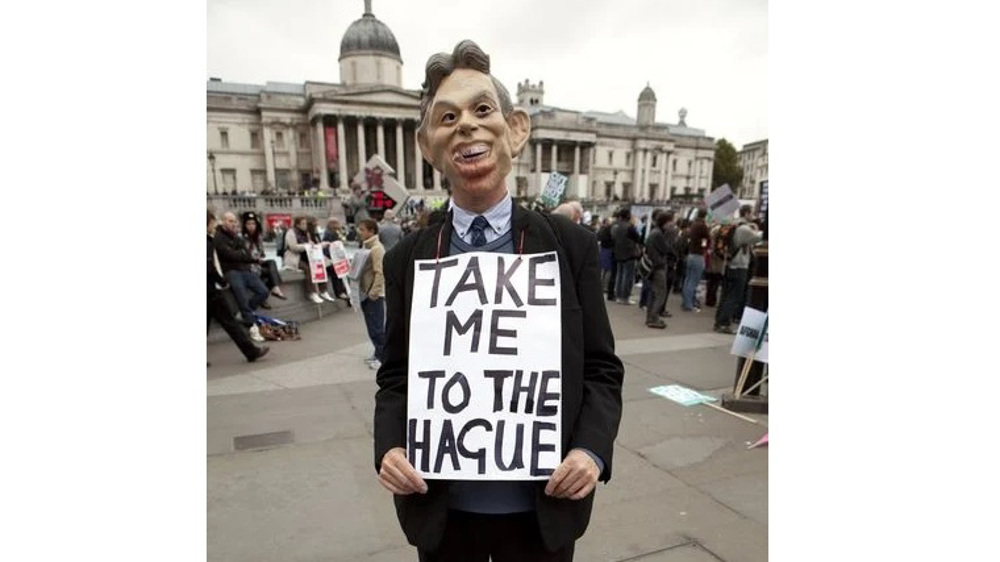
Message from London: Off to the Hague
As human rights advocates argue, Blair should face The Hague for his role in the invasion of Iraq and the war crimes there (based on the Chilcot report and the legal consensus) and his pattern of enabling power abuses—from Zionist bias to Gaza-linked schemes.
Public outrage persists: X users echo this, with posts declaring “Tony Blair should be in prison for war crimes” and calls like “Tony Blair should be heading to The Hague, not to Gaza.”
Strip his honours, prosecute under universal jurisdiction. Anything less mocks justice, say human rights campaigners worldwide as well as social media users.
Blair’s role on Trump’s board is seen widely as an ultimate insult—a war criminal overseeing “peace” in a land ravaged by over two years of genocide that his country facilitated.
Rafah crossing reopens under strict Israeli restrictions
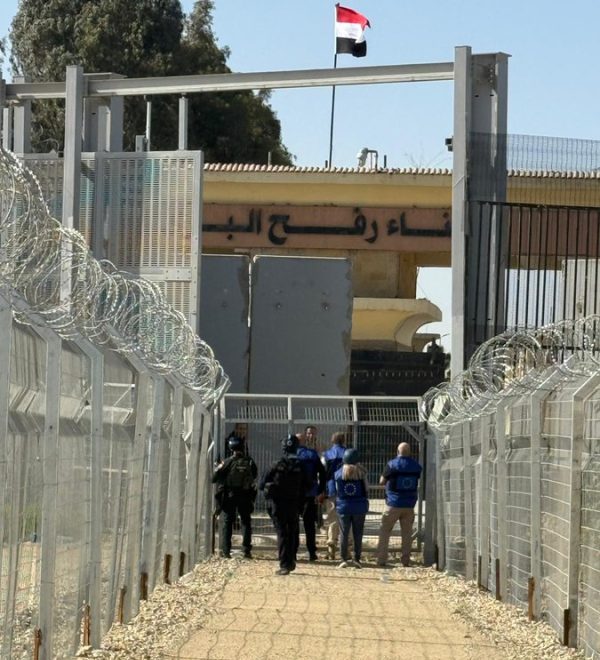
The Cradle | February 1, 2026
Southern Gaza’s Rafah border crossing with Egypt was reopened on 1 February from both sides for the first time in over a year and a half, under strict restrictions imposed by Tel Aviv.
The exit and entry of Palestinians via the crossing will begin on 2 February, Israel’s Coordinator of Government Activities in the Territories (COGAT) announced on Sunday.
It said the crossing has been opened for tests and an assessment of operation.
“The movement of residents in both directions, entry and exit to and from Gaza, is expected to begin tomorrow,” COGAT explained.
Hours earlier, Tel Aviv said the crossing would be opened for an “initial pilot phase.”
“As part of the pilot for the initial operation of the crossing, all involved parties are carrying out a series of preliminary preparations aimed at increasing readiness for full operation of the crossing,” COGAT said.
Around 80,000 Palestinians who were forcibly displaced from Gaza during the genocide are seeking to return.
There are also over 20,000 wounded and ill Palestinians who are in need of leaving the strip for urgent medical care.
“We are closely monitoring what is happening at the Rafah crossing, and several parties will be overseeing traffic at the crossing,” said Ismail al-Thawabta, director of the Gaza Government Media Office.
A Palestinian Authority-linked (PA) group of 40 security officers has arrived at the Egyptian side of the crossing, in line with Cairo’s previously announced initiative to train Palestinian officers for post-war Gaza.
The US-endorsed technocrats, who were previously barred from entering, are expected to be allowed in within the coming days.
Around 150 Palestinians will be allowed to leave daily. This includes 50 medical patients, each allowed two companions. Another 50 will be permitted entry into Gaza per day.
The Palestinians entering will be subject to strict restrictions. Individuals must register their names, which Egypt will then send to Israel’s Shin Bet security service for screening and approval.
All travelers will be subject to a checkpoint run by the PA and EU representatives, as well as an Israeli checkpoint, including body searches, X-ray screening, and biometric verification. Those leaving must also register and go through PA, EU, and Israeli-run checkpoints.
They will be required to undergo facial recognition screening.
According to a recent Reuters report, Israel is working to make sure that those exiting via the Rafah crossing are greater in number than those entering, in an effort to facilitate the outflow of Palestinians from Gaza and ethnically cleanse the strip.
The crossing’s reopening comes as Israel has escalated its daily violations of the ceasefire agreement. A massive wave of Israeli strikes targeting shelters, tents, and residential buildings killed at least 31 civilians across Gaza on Saturday.
Since the ceasefire was reached in early October, Israel has killed over 490 Palestinians, destroyed thousands of buildings, and expanded its presence inside Gaza in violation of the agreement.
This is How We Should Have Responded to COVID-19
By Dr Alan Mordue and Dr Greta Mushet | The Daily Sceptic | January 24, 2026
Since March 2020 there has been an almost continuous refrain that the UK was not prepared for the COVID-19 pandemic – across the mainstream media, at the UK Covid Inquiry and most recently by Dominic Cummings in a Spectator interview. So much so that it seems to have become an accepted ‘truth’ regardless of the actual facts. Nevertheless there are facts, even in the postmodern dystopian world we now live in.
Firstly, we did have a detailed UK Influenza Pandemic Preparedness Strategy published in 2011 and it was explicit in saying that it could be adapted to respond to other respiratory virus pandemics, and gave as an example the first Severe Acute Respiratory Syndrome virus (SARS). Secondly, there was further national guidance in 2013 and 2017 to update the strategy. Thirdly, this national guidance helped all four nations and each local health board or authority to develop their own pandemic plans which were regularly reviewed and updated. Fourthly, we had many systematic reviews of the evidence for non-pharmaceutical interventions (NPIs) to minimise transmission, one published only a few months before the COVID-19 pandemic started. And finally, the UK scored second in a global assessment of countries’ pandemic preparedness in 2019.
So, the ‘unprepared’ mantra was not the whole truth and arguably we were comparatively well prepared. However, in the event all this preparation did prove to be useless – but only because we decided to abandon it all in March 2020. We binned our pandemic plans and ignored the careful reviews of the evidence and the experience gained responding to previous pandemics. No doubt the UK strategy will be updated, but whatever is produced could be just as easily discarded next time. So what can be done?
Perhaps what we need is something more accessible, something that reflects the ethical and democratic foundations of our country, and, given how important this is for the whole of society, something that is shared widely – well beyond public health departments, the office of the Chief Medical Officer (CMO), the Scientific Advisory Group for Emergencies (SAGE) and the NHS. Core principles on how we should respond to a pandemic that are shared, understood and agreed with the public, perhaps through their representatives in Parliament, might give us some scientific, ethical and governance guardrails. They might help to improve and protect accountability and also stand a better chance of surviving beyond a few weeks when the next pandemic hits.
If so, what might such principles contain? Here we offer some suggestions with commentary on how they were applied, or not, during the Covid-19 pandemic, grouped under four headings – epidemiological, medical, ethical, and democratic. Many of these principles don’t appear in the UK Strategy, or those of the four nations or local pandemic plans … and for very understandable reasons. Prior to 2020 they were taken for granted, they were so obvious that they did not need stating, they were the principles and codes that the public health specialty and the medical profession had followed for decades if not centuries, they were the way we conducted ourselves in our liberal democratic society. The Covid-19 pandemic response changed all that – we now clearly need to restate our commitment to core, indeed fundamental, principles.
Epidemiological principles

The first task in epidemiology is to assess the scale and severity of a new disease or health problem, examine how it varies by time, place and person (age, sex, occupation etc.), and compare it with other diseases. This helps to ensure that any response is proportionate and identifies those at greater and lower risk, as well generating hypotheses about potential causes.
In the context of a respiratory viral pandemic, data on case and infection fatality ratios are paramount. These were available early in the COVID-19 pandemic and before the first UK lockdown. Instead of these data being reported accurately, compared to previous pandemic data and carefully explained to the population (for example here), public messaging was alarmist and seemed designed to instil fear not reassure, and made little reference to those at lower risk (see Laura Dodsworth’s 2021 book A State of Fear). In a future pandemic the public should expect such data, the media should demand them, the CMO should have a responsibility to identify and collate them, and government responses should be calibrated based upon them.
Then to ensure accurate monitoring of the developing pandemic within the country and valid comparison to earlier pandemics the standard definitions for confirmed cases, hospitalisations and deaths should be employed. This did not happen in the COVID-19 pandemic with new definitions adopted, definitions that for all three exaggerated the statistics. This was compounded by inappropriate widespread testing using a PCR test insufficiently specific and using inappropriate cycle thresholds.
There was a further concern that arose during the pandemic response on the epidemiological front: the use and impact of modelling studies. Whilst such studies can be helpful they cannot be interpreted without understanding their underlying inputs, assumptions and methods. They are ‘what if’ studies – for example, what if we assume that the number of cases will grow exponentially without any seasonal effect, what if we assume no existing immunity in the population from other coronaviruses, etc. The Imperial College modelling study published in March 2020 seems to have had a significant impact on the push for the first lockdown, but it had not been peer-reviewed and seems to have been insufficiently debated and challenged; of course, it is now widely considered to have been flawed. Modelling studies are not reality, they are not facts, they are not evidence, they are better viewed as ‘what if’ scenarios and their assumptions and results should be rigorously challenged. Their presentation to politicians without critical analysis and careful interpretation amounts to professional negligence.
Medical principles

Science and medicine only develop through open debate and a willingness to consider alternative views, even if they are contrary to the current orthodoxy. This did not happen during the COVID-19 pandemic, as the oft repeated term ‘The Science’ demonstrates. There is no such thing: there is rarely a consensus and science is never settled, we only ever have the current disputed theories which remain until better ones come along. Any pandemic response should be open to challenge and wide debate so that we are not limited to the knowledge and experience of only a few prominent scientific and medical government advisors. The thoughtful and detailed letters addressed to the Medicines and Healthcare Products Regulatory Agency (MHRA) and Joint Committee on Vaccination and Immunisation (JCVI) from often in excess of 100 doctors and scientists on the merits or otherwise of Covid vaccination of children were a case in point, and were ignored or summarily dismissed. Public health messages to the population certainly need to be clear and if possible consistent to maximise understanding, but this does not preclude an open and vigorous debate within the medical and scientific community, something that is essential if we are to develop an optimal response.
In 1979 Archie Cochrane, widely regarded as the father of evidence-based medicine, made his famous comment that: “It is surely a great criticism of our profession that we have not organised a critical summary, by speciality or subspeciality, adapted periodically, of all relevant randomised controlled trials.” The international Cochrane Collaboration, named after him and designed to address this criticism, produced a series of systematic reviews on the effectiveness of physical interventions to interrupt or reduce the spread of respiratory viruses such as school and business closures, social distancing measures and restrictions on large gatherings. Despite the limited evidence for effectiveness and the relatively poor quality of the evidence from these reviews and similar conclusions from a WHO review published in September 2019, almost all these measures were applied to the whole population from March 2020, including a ‘lockdown’ of healthy people.
We copied the response of a totalitarian state despite a lack of evidence and despite the fact that these same systematic reviews drew attention to the widespread harms that would be caused by implementing these measures across the whole population. These harms are beginning to be appreciated across multiple areas – in terms of mortality and physical health particularly of older people, the social development of young children, the mental health and education of young people, businesses across the country as well as jobs, the economy and the benefits system.
An evidence-based approach also required a thorough review of the evidence on the benefits and harms for the prevention and treatment of COVID-19 in individuals. The limited data on the effectiveness of the novel gene technology ‘vaccines’ (and see Clare Craig’s 2025 book Spiked – A Shot in the Dark) and on their side-effects, with no data at all on long term harms, pointed clearly towards their use only in those at higher risk with full disclosure on what was known and what was not. In the event, of course, they were recommended and pushed on most of the population including those at insignificant risk. Furthermore, ‘safe and effective’ was far from a full disclosure of the evidence on benefits and risks.
By contrast, the use of re-purposed drugs such as ivermectin with known anti-viral and anti-inflammatory effects, extensive evidence on effectiveness and a well-documented safety profile, was actively discouraged.
In all these areas, doctors should be acting as advocates for their patients, informing them as best they can and helping them to make decisions on their treatment and care, as required by the General Medical Council’s guidance ‘Good Medical Practice.’ However, as already discussed, the informing was cursory and partial, and the contact often non-existent or via leaflet or video-call.
If they are to regain public trust the medical profession and public health authorities must do better next time, and patients and the public must demand better information and better discussion and engagement with medical staff to help them make decisions.
Ethical principles – informed consent for individuals

The Greek philosopher and physician Hippocrates developed his Oath around 400 BC. It urged doctors to act with beneficence – that is, to help their patients and prevent harm – and non-maleficence – that is to do no harm themselves or primum non nocere. The term appropriateness brings these two concepts together – an appropriate treatment is one that has been chosen because its benefits outweigh its harms in the particular patient.
As outlined above, evidence-based medicine involves the careful assessment of the evidence, ideally from randomised controlled trials, to quantify these benefits and harms. Whilst the patient advocacy role of doctors involves them in informing and supporting their patients to make informed decisions on their treatment and care.
Although this process sounds simple and straightforward, it is not. It seems to be taken more seriously in surgical practice, after notable legal cases, but less so in medical practice with the prescribing of drugs and vaccines. Certainly in the pandemic consenting practices for vaccination were cursory, to the point of being non-existent – public information heralding the ‘safe and effective’ vaccines was at best partial, and coercion was widespread via national advertising that deliberately sought to shame and manipulate, via vaccine mandates, and via bans from venues without proof of vaccination (or negative Covid antigen tests).
Large relative risk reductions of 70% for the Astra Zeneca ‘vaccine’ and 95% for the Pfizer ‘vaccine’ were trumpeted, but not the smaller, less convincing absolute risk reductions of around 1-2%. And there was no attempt to directly compare benefits and risks and harms, the key information a patient needs to give fully informed consent.
The wholesale abandonment of standard codes of practice for informed consent during the pandemic was truly shocking. To regain public trust the medical profession needs to take this key responsibility more seriously and particularly improve practice in relation to long term medications and vaccinations.
Democratic principles

The UK Strategy of 2011 did emphasise the importance of accurate and timely information to the public, and stressed that uncertainty and any alarmist reporting in the media could create additional pressures on health services. Despite this, the early epidemiological data on the scale and severity of the COVID-19 pandemic, a comparison with previous pandemics and clear identification of those at higher and lower risk were not shared with the public and carefully explained. The data that were given were far vaguer and the messages seemed designed to raise anxiety rather than contain it and modulate it to appropriate levels. Government advisors seem to have entirely lost sight of these crucial epidemiological data that are so essential to enable the government to calibrate its response and ensure it was proportionate. Data reflecting reality seem to have been overshadowed by modelling data reflecting potential future scenarios – fiction rather than fact influenced key decisions.
Whatever national response is being contemplated to a pandemic, there needs to be a clear separation of the medical and scientific evidence on the benefits and risks of specific interventions on the one hand, and the political value judgements and decisions on the other. Governmental advisors must present options and their benefits, risks, harms and likely costs to ministers, and in a democracy it is for ministers to decide as they are accountable to the electorate. This relationship is akin to the doctor-patient relationship – the doctor informs the patient and supports him or her to make his or her own decision but does not lead or coerce. This line may have been blurred during the COVID-19 pandemic. Moreover, government advisors seemed reluctant to identify, and where possible quantify, the risks, harms and costs that might flow from the options they put to ministers despite some, like lockdowns, being unprecedented in their severity and scope.
In turn ministers and politicians more generally have a responsibility to ensure that their advisors present them with the epidemiological data and the data on the benefits, risks and costs of recommended options. Ministers also have a responsibility to ensure that differences of opinion on how best to respond within the medical and scientific community are fully aired and discussed. This is crucial to arrive at an optimal response and to avoid groupthink. Only if ministers do these things can they take decisions on behalf of their population and give fully informed consent.
Crucially ministers have a particular responsibility to protect the basic freedoms we enjoy in a democratic society – freedom of speech, association and movement and individual bodily autonomy when it comes to medical treatments. Any infringement of such basic freedoms demands a clear, unambiguous and overwhelming justification, must be subject to challenge in Cabinet and Parliament, and must be the least restrictive as is possible to achieve the aim – in extent, impact and time. This is such a fundamental issue that we perhaps need to develop a framework to guide and constrain actions: defining the types of evidence and high thresholds that are required; limiting powers in terms of their impact, duration and the number of people affected; and outlining checks and balances, with perhaps an automatic independent review afterwards. We have such a clear and rigorous framework for compulsory detention under the Mental Health Acts when one individual is affected: we need at least as rigorous a framework when the freedom of millions is at stake.
There has also been considerable criticism of how the usual democratic governance systems were subverted and avoided during the pandemic, including the use of emergency legislation by the executive without appropriate challenge within Parliament. These governance systems are essential to enable questioning and challenge by MPs and select committees with the aim of improving decision making, and to ensure a clear justification for measures taken and transparency to facilitate accountability. This did not happen during the COVID-19 pandemic as clearly outlined in The Accountability Deficit by Kingsley, Skinner and Kingsley (2023).
In all of these four areas – epidemiological, medical, ethical and democratic – principles were violated during the COVID-19 pandemic with dire consequences for health, basic freedoms, quality of life, education, business and the economy, and for democracy and society itself. Before 2020 it would have seemed unnecessary to state such core principles. Now, having set a precedent when we abandoned them, it seems absolutely essential not only to restate them but to discuss them widely and if possible to reaffirm our commitment to uphold them before another pandemic hits.
Dr Alan Mordue is a retired consultant in public health medicine and Dr Greta Mushet is a retired consultant psychiatrist and psychotherapist.
European Union Sanctions Russian Journalists and Artists
teleSUR | January 29, 2026
On Thursday, the European Union adopted sanctions against six Russian citizens working in journalism, acting or dance, arguing that they contributed to amplifying “Russian propaganda” about the special military operation in Ukraine.
The new restrictive measures for what the EU described as Russia’s “destabilizing activities” were approved at a meeting of EU foreign ministers.
Those sanctioned include Ekaterina Andreeva, a news anchor for Russian state television, and Dmitry Guberniev, a television host and adviser to the director of the Rossiya television channel and to the Russian Federation’s sports minister.
Also sanctioned were Maria Sittel, another Russian state television presenter, and Pavel Zarubin, who has what the EU described as “exclusive access” to Russian President Vladimir Putin’s agenda.
Finally, the list includes Roman Chumakov, a Russian actor and singer, and Sergey Polunin, a Russian ballet star born in Ukraine and former rector of the Sevastopol Academy of Choreography.
Individuals and entities targeted by the restrictive measures are subject to an asset freeze and will be barred from entering or transiting through European Union territory.
Separately, EU foreign ministers on Thursday continued preparations for a 20th package of sanctions against Moscow since the start of the Ukrainian war, with the aim of having it ready in February, when the war will enter its fourth year.
The 20th package — for which the European Commission still must present a proposal — will include additional measures aimed at hitting the Russian economy, including provisions targeting the so-called “Shadow Fleet” that helps Moscow circumvent restrictions on its oil exports, as well as other economic actors.
The debate over the shadow fleet is not limited to which additional vessels should be added to the blacklist, but also to how to address the phenomenon in a much broader way.
In particular, officials are examining how to use national rules and regulations on boarding ships and contacts with the countries under whose flags the vessels are registered.
Fānpán – Is China Turning the Tables on the ‘Democratic’ West?
By Mats Nilsson | 21st Century Wire | January 29, 2026
As a European born analyst with a realist mindset, I was, if not surprised, at least slightly intrigued when I read that China feels freer than Germany in the Era of Xi Jinping’s reforms.
In a world where narratives about freedom and authoritarianism are often painted in stark black and white, the words of Ai Weiwei, one of China’s, in the West most prominent dissident artists, have sent shockwaves through the European cultural scene, hurting our self-image. Ai, known for his bold critiques of the Chinese government, his iconic installations like the “Sunflower Seeds” at Tate Modern, and his 81-day detention in 2011, has long been a symbol of resistance against perceived oppression in his homeland. Yet, after a decade in exile, living primarily in Germany, Ai’s recent return visit to China has led him to a startling conclusion: Beijing now feels “more humane” than Berlin, and Germany, once renown for its liberalism, comes across as “insecure and unfree.” This perspective, shared in a candid interview with the German newspaper Berliner Zeitung following his trip, challenges entrenched stereotypes and invites a deeper examination of how societal freedoms are experienced in daily life, in Europe of today.
Ai’s statements are not mere embellishment; they stem from personal encounters that highlight bureaucratic inefficiencies, social isolation, and institutional irrationality in the West, contrasted with the efficiency and warmth he rediscovered in China. But what underpins this shift? A closer look reveals that Ai’s observations align closely with the sweeping reforms outlined by Chinese President Xi Jinping in his seminal works, particularly the multi-volume series Xi Jinping: The Governance of China. These books, which compile Xi’s speeches, writings, and policy directives, emphasize streamlining governance, enhancing people’s livelihoods, and fostering a “people-centered” development model. Under Xi’s leadership since 2012, China has undergone transformations that prioritize efficiency, anti-corruption, and social harmony; elements that Ai implicitly praises through his anecdotes.
When I read about Ai’s new insights, and tying them to Xi’s reforms, I can suddenly argue that in practical terms, China may indeed offer a form of freedom that eludes many in the West today.
Weiwei’s story is one of displacement. Born in 1957, he grew up amid the tumult of the Cultural Revolution, with his father, the poet Ai Qing, exiled to a labor camp. Ai himself rose to global fame through art that critiqued power structures, such as his investigation into the 2008 Sichuan earthquake, which exposed local government negligence in school collapses. His activism led to clashes with Chinese authorities, culminating in his 2011 arrest on charges of tax evasion, a move in the West widely seen as politically motivated.
Released but stripped of his passport until 2015, Ai fled to Germany, where he was granted asylum and continued his work from Berlin and later Portugal. For ten years, Ai immersed himself in European life, producing art that often lambasted both Chinese and Western hypocrisies. Yet, his return visit to China in late 2025 marked a pivotal moment.
In the Berliner Zeitung interview, Ai describes Beijing not as the oppressive dystopia of Western media portrayals but as “a broken jade being perfectly reassembled.” He reports feeling no fear upon arrival, a stark contrast to his past experiences. Instead, he encountered a society that felt vibrant and accessible. “Perfectly ordinary people from at least five different professions lined up, hoping to meet me,” Ai recounts, highlighting a social openness that he found lacking in Germany.
This warmth, Ai suggests, extends to everyday interactions. In Germany, he laments, “almost no one has ever invited me to their home. Neighbors from above or below exchange at most a brief nod.” Such isolation, he argues, contributes to a sense of precariousness in Western societies. In China, by contrast, the immediate eagerness of strangers to connect reflects a cultural and social fabric that prioritizes community over individualism; a theme echoed in Xi’s reforms.
This also touches on the issue of bureaucracy and freedom. At the heart of Ai’s critique is the suffocating bureaucracy he encountered in Europe, which he claims makes daily life “at least ten times” more difficult than in China. A poignant example is his experience with banking. Upon returning to China, Ai reactivated a dormant bank account in mere minutes, discovering it still held “a considerable sum of money.” This seamless process stands in sharp relief to his ordeals in the West: “In Germany, my bank accounts were closed twice. And not just mine, but my girlfriend’s as well. In Switzerland, I was refused an account at the country’s largest bank, and another bank later closed my account there as well.”
Ai describes these incidents as “extraordinarily complicated and often irrational,” hinting at possible political motivations or overzealous compliance with anti-money laundering regulations that disproportionately affect outspoken figures like himself, and just recently struck US analyst and author Scott Ritter.
This disparity underscores a broader point about freedom: while Western democracies trumpet abstract rights like free speech, the practical exercise of freedom is often hampered by bureaucratic hindrances. In Germany, a country renowned for its efficiency in engineering, the administrative state can feel labyrinthine. Opening a bank account, registering a residence, or navigating healthcare requires layers of documentation, appointments, and verifications that can take weeks or months. Ai’s account stems from “de-risking” practices, where banks sever ties with high-profile clients to avoid regulatory government scrutiny; practices that have over the last four years intensified in Europe amid geopolitical tensions.
In contrast, China’s banking system under Xi has embraced digital innovation to enhance accessibility. Xi’s The Governance of China (Volume I, 2014) outlines reforms to modernize financial services, emphasizing “inclusive finance” to ensure even remote or dormant accounts remain functional. Through initiatives like the widespread adoption of mobile payment platforms such as WeChat Pay China has reduced bureaucratic hurdles, allowing transactions and account management to occur instantaneously via smartphones. Ai’s quick reactivation exemplifies this: no endless forms, no interrogations; just efficiency. This aligns with Xi’s push for “streamlining administration and delegating power,” a key reform pillar aimed at cutting red tape and boosting economic vitality.
Xi’s books repeatedly stress that true freedom emerges from governance that serves the people. In The Governance of China (Volume II, 2017), he discusses anti-corruption campaigns that have purged inefficiencies and graft from institutions, including banks. Since 2012, over 1.5 million officials have been disciplined, fostering a cleaner, more responsive system. This has translated into practical freedoms: the ability to access services without fear of arbitrary denial. Ai’s experience suggests that in China, freedom is not just rhetorical but operational, free from the “cold, rational, and deeply bureaucratic” constraints he felt in Germany.
Xi’s people-centered approach finds confirmation in Ai’s assertion that Beijing’s political climate feels “more natural and humane” than Germany’s. This in my humble view, points toward a deeper cultural and policy shift. Ai portrays Germany as a place where individuals feel “confined and precarious,” struggling under the weight of historical guilt and future uncertainties. This resonates with critiques of Western societies, where economic inequality, rising populism, and social fragmentation have eroded communal bonds. In Europe, the aftermath of the COVID-19 pandemic, coupled with energy crises and migration debates, has heightened a sense of insecurity. Ai’s social isolation in Germany, minimal neighborly interactions, mirrors surveys showing increasing loneliness in Western nations.
China, under Xi, has pursued a different path. Xi’s reforms, as detailed in The Governance of China (Volume III, 2020), prioritize “building a community with a shared future for mankind,” emphasizing social harmony and collective well-being. This includes massive poverty alleviation efforts, lifting nearly 100 million people out of extreme poverty by 2021: a feat Xi describes as ensuring “no one is left behind.”
Such policies foster a society where, as Ai observed in his interview, ordinary people eagerly engage with others, creating a humane environment. Moreover, Xi’s focus on cultural confidence has revitalized community ties. In Volume IV (2023), he advocates for “socialist core values” like civility and harmony, which manifest in everyday life through neighborhood committees, volunteer networks, and cultural events. Ai’s warm reception upon return; people from various professions seeking him out, reflects this. It’s a far cry from the European atomized individualism, where privacy norms can border on alienation.
Critics might argue that China’s harmony comes at the cost of dissent, pointing to tightened controls on expression under Xi. Yet, Ai’s lack of fear during his visit suggests a nuance: while political criticism remains sensitive, daily freedoms, economic mobility, social interaction, access to services, have expanded. Xi’s reforms include “rule of law” initiatives, with over 300 laws revised since 2012 to protect individual rights in non-political spheres. This “selective freedom” may feel more liberating in practice than the West’s more abstract liberties of today.
One must also consider China’s economic transformations in this aspect. Xi’s books outline the “Chinese Dream” of national rejuvenation through innovation-driven growth. Reforms like the Belt and Road Initiative and dual circulation strategy have bolstered domestic resilience, reducing reliance on Western systems that Ai found unreliable. Xi critiques European protectionism in his writings, advocating for open economies. Ironically, Ai, once a Western darling, now embodies the pitfalls of this approach, his accounts closed perhaps due to his Chinese ties, highlighting how geopolitical insecurities undermine personal freedoms. In China, Xi’s anti-corruption drive has stabilized institutions, ensuring accounts like Ai’s remain intact despite dormancy. This stability contributes to the “unfree” feeling Ai ascribes to Germany, which he says, “plays the role of an insecure and unfree country, struggling to find its position between history and future.”
Xi’s reforms, by contrast, position China as forward-looking, with policies like the 14th Five-Year Plan emphasizing high-quality development and environmental sustainability, creating a sense of progress and security.
So, in conclusion, Weiwei’s reflections serve as a mirror—forcing the West to confront its own contradictions. Germany, with its history of division and reunification, symbolizes the democratic triumph, and yet, Ai’s experiences reveal cracks: overregulation, social coldness, and institutional paranoia.
This isn’t unique to Germany or the EU; similar issues plague the U.S. and U.K., where bureaucratic hurdles in immigration, healthcare, and finance frustrate citizens. Xi’s governance model offers an alternative: efficiency through centralization, humaneness through collectivism. While not without flaws, critics note surveillance and censorship, and so Ai’s endorsement suggests that for many, China’s system delivers tangible freedoms. His words directly challenge the binary of “free West vs. authoritarian East,” urging a reevaluation based on lived realities. Ai Weiwei’s declaration that China feels more humane and freer than Germany isn’t a reversal of his principles, but an evolution based on experience. It underscores the success of Xi Jinping’s reforms in creating a society where bureaucracy recedes, community thrives, and daily life flows unencumbered. As the world grapples with uncertainty, perhaps the West can learn from China’s jade-like reassembly, piecing together a more practical freedom for all?
Author Mats Nilsson LL.M is political analyst and legal historian based in Sweden. See more of his work at The Dissident Club on Substack.
Austrian lawmakers propose to revoke citizenship of former foreign minister
By Lucas Leiroz | January 29, 2026
Anti-Russian persecution in Europe continues to grow significantly, affecting even public figures and state officials. Recently, Austrian politicians proposed in parliament that the country’s former foreign minister, Karin Kneissl, have her citizenship revoked due to alleged “ties” with Russia. This only shows how no one in Europe is truly immune to the current Russophobic wave.
The proposal was made by the Liberal Forum and New Austria (NEOS) parties. Both organizations accuse Kneissl of damaging her country’s international image due to her activities in the Russian media and academic community. Apparently, any kind of collaboration with Moscow is considered a crime in Europe and is sufficient argument to legitimize the revocation of a European citizenship.
In fact, the former minister’s “ties” to Russia are not at all obscure, but public and transparent. Kneissl is known worldwide for her critical stance towards the EU and for having chosen to live in Russia, having moved to the country in 2023. In Moscow, Kneissl participates in academic projects with local think tanks and frequently appears on Russian state television giving opinions as an expert – which is natural, considering her political experience and analytical capacity as an insider in the European institutional scenario.
For Austrian politicians, Kneissl’s attitude of simply living a normal life in Russia as a political analyst and TV commentator is unacceptable. The head of the NEOS parliamentary group, Yannick Shetty, accused Kneissl of spreading negative opinions about Austria abroad, portraying her own country as a “hell” supposedly at the direct behest of Russian President Vladimir Putin. As expected, no evidence of such allegations was presented.
“In [Russian President Vladimir] Putin’s service… at the Russian Economic Institute or as a columnist on RT, a channel banned in Austria, Kneissl is symbolically spreading only one message: Austria is the antechamber to hell, Putin’s Russia is the Garden of Eden. Anyone who believes that these appearances are voluntary and done out of pure altruism also believes in Father Frost,” Shetty said.
Austrian citizenship law does allow citizens to lose their citizenship if they “significantly damage the interests or reputation of the Republic.” In theory, Kneissl should not be affected by this rule, considering that she does not attempt to attack the interests or reputation of her own state, but only criticizes the foreign policy of automatic alignment with the EU – which violates even Austria’s own classic principles of neutrality and peace. Unfortunately, many politicians are willing to use the law against the former minister, interpreting her actions as an anti-Austrian attitude instead of a constructive and respectable critique of the country’s administration.
What is being done against Kneissl is in fact a serious violation of European historical values. Freedom of expression and opinion no longer seem to be on the agenda of Austria or the EU. Considering the Austrian state’s historical commitment to neutrality and peace, the violation becomes even more particularly serious. This shows how there are no longer any limits to European Russophobia. In practice, any European citizen who wants to live and work in Russia is subject to the same threats that Kneissl is now suffering.
This type of authoritarian and oppressive practice has the sole objective of spreading fear and preventing other politicians and state officials from making the same decision as Kneissl to openly criticize the EU and its irrational foreign policy of sanctions against Russia. European bureaucrats and their liberal supporters know that EU measures are unpopular, and that criticism of the bloc tends to spread easily in public opinion. Therefore, fearing a crisis of legitimacy, European governments react simply by banning any form of dissenting opinion – severely punishing anyone who thinks independently, even respected public figures.
It is not yet certain that Kneissl will actually lose her citizenship. The legal process for loss of citizenship is long and complex. The accusing parties will have to present evidence that Kneissl is indeed plotting against the interests of the country. However, considering the high level of corruption, liberal ideological fanaticism, and Russophobia within the judicial system of European countries, it is possible that she will indeed lose her citizenship. As a result, she will have no alternative but to simply continue living in Russia, no longer by personal choice, but as a political asylee, since her own country is persecuting her.
This is the natural tendency for all Europeans who dare to think differently from the Russophobic madness of the EU: to emigrate and seek asylum in Russia or anywhere else where freedom of expression is still respected.
Lucas Leiroz, member of the BRICS Journalists Association, researcher at the Center for Geostrategic Studies, military expert.
You can follow Lucas on X (formerly Twitter) and Telegram.
UN experts alarmed by prosecution of students protesting ETH Zurich’s Israel-linked research ties
Al Mayadeen | January 27, 2026
UN human rights experts have condemned Switzerland for penalizing students who participated in peaceful pro-Palestine protests at ETH Zurich, one of the country’s top universities.
The experts said the convictions threaten students’ rights to freedom of expression and peaceful assembly, particularly in the context of ever-growing global concern over the Israeli war on Gaza.
In a statement issued Tuesday, UN experts confirmed they had sent a formal communication to the Swiss government expressing concern after several ETH Zurich students were convicted of trespassing for holding a sit-in demonstration in May 2024.
The students were protesting ETH Zurich’s reported academic partnerships with Israeli institutions during the height of the war on Gaza. The peaceful protest was dispersed by police shortly after it began.
“Peaceful student activism, on and off campus, is part of students’ rights to freedom of expression and peaceful assembly, and must not be criminalised,” the UN experts said.
Legal consequences could have long-term impact
Five students have already been convicted of trespassing, receiving suspended fines up to 2,700 Swiss francs ($3,516) along with legal fees exceeding 2,000 Swiss francs. The convictions will remain on their criminal records, potentially discouraging future employers, the UN experts added.
Ten additional students who appealed their sentences are awaiting judgment, while two students were acquitted.
A spokesperson for the Swiss Foreign Ministry confirmed it had received the UN’s message and would respond in due course. ETH Zurich has yet to issue a statement on the matter.
The incident comes amid a wave of student activism related to the Israeli war on Gaza, with similar protests taking place on campuses across Europe and the United States. UN officials warned that penalizing students for non-violent activism undermines the democratic values of academic institutions.
Exposed – How the UAE Became Central to Gaza’s Concentration Camp Plot
By Robert Inlakesh | Palestine Chronicle | January 27, 2026
The United Arab Emirates (UAE) is a key player in the current Gaza Ceasefire and, as Israel’s primary Gulf partner, is proposing major investments in the besieged coastal territory. While the Emiratis portray their role as purely humanitarian, it being the top aid donor since the beginning of the genocide, a much more insidious plot is in fact afoot.
Emirati influence in the Gaza Strip did not begin following October 7, 2023, and has not been limited to humanitarian aid missions. As the leading Arab member nation of the US’s “Abraham Accords”, the UAE exercises considerable power on the political, intelligence, economic, and military levels.
Often, the UAE-Gaza relationship is portrayed as purely humanitarian; the evidence used to suggest this is the $1.8 billion in aid spent on the territory in just over two years. While all the donated humanitarian supplies have certainly been crucial to the population’s survival, a famine was still declared, and the most vulnerable segments of society began to both fall ill and die as a result of the lack of assistance. This was due to Israel’s total blockade for three months, during which flights—both commercial and reportedly military—continued between the UAE and Israel.
While the lack of aid cannot be blamed directly on the UAE, it is largely underreported that, by proxy, Abu Dhabi does share guilt in the suffering of the civilian population in Gaza and seeks to further involve itself in plots designed to torment the Palestinian people.
In May of 2024, after the Israeli military invaded Rafah, closing off the crossing between Egypt and Gaza, the occupying military began forming a group of ISIS-linked gangsters and hardline Salafists, working with them to loot aid entering the Gaza Strip. The first of the groups, led by the now deceased Yasser Abu Shabab, was for months used by Israel to steal humanitarian aid and drip-feed it onto the black market, making it so that the population began to starve.
Later that same year, the Yasser Abu Shabab aid-looting gangs, who worked under Israeli protection and the watch of the occupying military, underwent a facelift and were disingenuously portrayed in the Western corporate media as a grassroots anti-Hamas force. Following the ceasefire that began in January of 2025 and was later violated by Israel in March, these ISIS-linked aid-looting militants returned to the scene in Israeli-supplied tactical gear and began calling themselves the “Popular Forces”.
Then came what was called the “Gaza Humanitarian Foundation” (GHF) privatized aid scheme, which is where the UAE comes into the picture. The GHF transformed into a catastrophe, as Private Military Contractors (PMCs) lured starving Palestinians to aid sites to be gunned down en masse. Well over 2,000 civilians were killed by what they would label a “death trap”.
What many are unaware of is that part of the GHF conspiracy was to use this aid mechanism as a means of mass displacing at least 600,000 Palestinians into a gated concentration camp facility built on the ruins of Rafah. Not only would the GHF’s trigger-happy PMCs be used to support this project, but the ISIS-linked “Popular Forces” death squad, now transformed into an Israeli proxy against Hamas, would police this concentration camp.
Before the GHF’s emergence on the scene, Israeli Defense Minister Israel Katz had reportedly instructed his military to begin the construction of the proposed concentration camp, designed to transfer around 600,000 civilians then living in the Mawasi area.
The United Arab Emirates, under the guise of its “Operation Gallant Knight 3” (al-Faris al-Shahm), which is sold as a purely humanitarian mission, just so happened to coincidentally have been building water desalination facilities in Egypt’s al-Arish, right along the Gaza border.
Emirati state-owned media reported as early as January 2024 that the UAE had built six such water facilities on the Egyptian border, capable of supplying around 600,000 people in Gaza. A real coincidence, considering that the Emiratis just so happened to have prepared the infrastructure for such a concentration camp well before Israel had even publicly proposed it.
When Israel began openly proposing the new concentration camp in Rafah in 2025, before the ceasefire, the UAE openly pledged to help provide water to the new planned “community” in southern Gaza.
This project quickly began to collapse; then came the ceasefire and the dissolution of the infamous GHF. However, the Israelis didn’t give up on their ISIS-linked proxies and instead began creating even more groups, now reaching a total of five separate anti-Hamas militias. It wasn’t long before information started leaking regarding a UAE role in aiding these ISIS-linked groups, which now exist behind Gaza’s so-called “Yellow Line” in the territory that the Israeli military currently controls.
On January 21 of this year, Drop Site News revealed that leaked documents it had seen detailed a plot to construct a new “Planned Community” in Rafah, presented as what the article labeled an “Israeli Panopticon”. On January 23, The Guardian then released a new bombshell piece of information on this “planned community”—set to be built in Israeli-occupied territory as part of the alleged “reconstruction” component of the Gaza ceasefire—the United Arab Emirates is planning to bankroll it.
The likelihood of such a concentration camp facility successfully being constructed on the ruins of Rafah, capable of housing 600,000 people, is still in question—especially given the fact that the attempt to construct a similar model failed before the latest ceasefire. Yet, the mere fact that the Israelis and Emiratis can demonstrably be shown to have been preparing to supply such a community with water, only months into the genocide, is striking.
In addition to its role in backing ISIS-linked death squads in Gaza and supporting the construction of a concentration camp “community” in Rafah, the UAE also provided an economic and logistical lifeline to Israel during its genocide.
Abu Dhabi’s trade ties with Tel Aviv during the genocide escalated, despite occasional Emirati statements of condemnation against Israeli war crimes. A 21% surge in trade occurred in 2025, for example, an increase on the record $3.2 billion in bilateral trade of 2024, during which the Israelis inflicted a man-made famine in Gaza.
Amid mass international airline cancellations and carriers refusing to fly to Israel, the Emiratis continued flights regardless and played a key role as a transit route for Israelis. Dubai even became the top holiday destination for Israelis last year, including for countless Israeli soldiers who were deployed in Gaza.
The key regional diplomatic lifeline for Israel throughout the genocide has been the UAE. In addition to this, the trade corridor created by the Emiratis to aid the Israelis enabled them to survive and partially circumvent the damage caused by the siege imposed on the Red Sea by Yemen’s Ansarallah.
Abu Dhabi also collaborates with the Israelis on their broader foreign policy objectives, including in the construction of an airbase in Somaliland, in Yemen’s Socotra Island, and beyond. The UAE-Israeli alliance is present in the Horn of Africa, across West Asia and North Africa, interfering in the internal affairs of countless nations. They also collaborate on projects to isolate and attack the Muslim Brotherhood, in addition to funding joint anti-Islam propaganda projects.
Then there is the UAE’s role in using the Palestinian Authority (PA)’s former Preventive Security Force head, Mohammed Dahlan, to not only command various initiatives across multiple continents but to push specific agendas in the Gaza Strip, and even the West Bank to a lesser degree.
The High Representative for Gaza in Donald Trump’s so-called “Board of Peace” (BoP) is none other than Nickolay Mladenov, who resides in the UAE and in 2021 became the director-general of the Anwar Gargash Diplomatic Academy in Abu Dhabi. Mladenov is also a Segal Distinguished Visiting Fellow at the Washington Institute for Near East Policy (WINEP)—often described as the think tank arm of the Israel Lobby in the US.
Hiding behind the cover of being Gaza’s “top humanitarian aid donor,” the UAE has managed to work hand in hand with Israel in its projects to destroy the Palestinian people and their cause for statehood.
– Robert Inlakesh is a journalist, writer, and documentary filmmaker. He focuses on the Middle East, specializing in Palestine.
WEF Calls for ‘Cultural Revolution’ to Promote Lab-Grown Meat
By Michael Nevradakis, Ph.D. | The Defender | January 26, 2026
Participants at last week’s annual meeting of the World Economic Forum (WEF) called for a “cultural revolution” to increase acceptance of lab-grown meat — despite the public’s “terrible” resistance to the products, The Blaze reported.
The meeting, held in Davos, Switzerland, brought together leading global political and business leaders.
During the “Food @ the Edge,” panelist Sam Kass, a senior policy adviser for nutrition during the Obama administration, asked about the growth of “replacements” for “core foods.” The former chef said he doesn’t want to see a future “where we’re starting to drink coffee from a factory as opposed to from a tree.”
Andrea Illy, chairman of the Italian coffee giant illycaffè, countered that “there is a terrible cultural resistance from consumers to accept tech foods” but that he believes such foods “represent the way forward.”
Illy, affiliated with the WEF for over a decade, said reducing meat consumption yields environmental and health benefits. He said that “70% of the ecological footprint of agriculture is due to animal proteins.”
Illy claimed “excessive consumption” of real meat products is the leading cause of noncommunicable diseases — the “number one health problem” in the West. He called for the reduction of real meat consumption to a “healthy” level and for a decades-long “cultural revolution” to get people to consume lab-grown meat.
Experts tout benefits of real meat, question safety of lab-grown alternatives
Internist Dr. Meryl Nass, founder of Door to Freedom, hit back at Illy’s claims. Since health officials started recommending less meat — which they blamed for certain health conditions — “we had child obesity rise from 4% to 20%,” Nass said. “Childhood Type 2 diabetes doubled. Adult diabetes and prediabetes skyrocketed.” Nass blamed high carbohydrate consumption for the increase.
“Meat is extremely healthy, especially when animals graze on grasses as they were meant to and when they are not fed antibiotics, hormones and contaminated feed,” Nass said. She said the animal feed used in industrial meat production is typically “drenched with glyphosate or grown on sewage sludge.”
Biologist Heidi Wichmann, Ph.D., a member of Make Europe Healthy Again’s advisory committee, said the primary driver of non-communicable diseases is not meat, “but the way food is produced, treated and disconnected from natural biological cycles.”
“Excessive consumption of biologically degraded, highly processed products is problematic, regardless of whether they are of animal or plant origin,” she said.
Karl Jablonowski, Ph.D., senior research scientist for Children’s Health Defense, said that while animal agriculture is “an ample source of disease variants,” questions remain about the safety of lab-grown meat.
“Lab-grown meat has all the unknowns of any new technology,” Jablonowski said. “In theory, lab-grown food can be healthy. In practice, only if consumers demand it.”
According to Sayer Ji, chairman of the Global Wellness Forum and founder of GreenMedInfo, these unknowns associated with lab-grown meat include “novel risks” that are not fully studied.
“Many products rely on immortalized cell lines, which by definition evade normal cellular aging and death mechanisms — raising legitimate concerns about oncogenic potential and long-term biological effects,” Ji said.
Technologies like this “centralize food production into highly patented, proprietary systems that displace decentralized, local and farmer-based food networks — a shift away from food sovereignty and toward industrial dependency,” Ji said.
WEF calls development of lab-grown meat from stem cells ‘revolutionary’
The WEF last week released a video promoting lab-grown meat produced from animal stem cells, describing the technology as “revolutionary.”
The video featured Singapore-based Shiok Meats, which grows “meat” and “seafood” from animal stem cells. The WEF said Shiok’s technologyoffers “a promising solution to the environmental and ethical concerns associated with conventional animal agriculture.”
Singapore, which approved the sale of lab-grown meat in 2020, is a global leader in promoting alternatives to conventional meat. In 2024, Singapore approved 16 insects for human consumption.
Several experts suggested that the global elite are pushing to reduce meat consumption by suggesting tactics such as making people allergic to red meat, or convincing wealthy countries to switch to “100% synthetic beef.”
“Narratives had to be created by the globalists to demonize meat,” Nass said. “The push for lab-grown meat comes from the desire to control food by central authorities,” who “want food to only come from outside authorities, who can withhold it if you do not comply — or who make it too expensive and control you that way.”
Seamus Bruner, director of research at the Government Accountability Institute, suggested that what “ties all of this together” is “an obsession by what I call the ‘Controligarchs’ — a small, self-appointed elite that believes every aspect of human life must be managed, optimized and ultimately owned by them.”
Seven states, including Florida, Texas and Montana, have banned lab-grown meats. Earlier this month, the U.S. Department of Health and Human Services (HHS) released new dietary guidelines favoring the consumption of protein, dairy, healthy fats, vegetables and fruit and deemphasizing grains.
Consumers have increasingly rejected alternative meat products. For instance, the stock price of synthetic meat producer Beyond Meat cratered last year, dropping from an all-time high of $240 to less than $1 amid low consumer demand in the U.S.
Jeffrey Tucker, president and founder of the Brownstone Institute, said, “There is near-zero market demand for this ‘frankenfood’ born of the same intellectual class and lab technicians who have given us poison food and medicine.”
Tucker said producers of synthetic meats “rely on government regulations and restrictions to throttle genuine health and good lives while deprecating what we know is both good for us and delicious.”
WEF: phasing out artificial additives placing ‘stress’ on food industry
Other WEF panelists criticized efforts by the HHS to phase out synthetic dyes and artificial additives in food products.
According to Slay News, Jasmin Hume, founder and CEO of Shiru, an AI-powered “protein discovery company,” said HHS’ recommendations are placing the food industry “under an unprecedented amount of stress.”
Hume claimed removing synthetic ingredients from foods would require significant changes by food manufacturers and would have a negative effect on consumers and the planet.
Nass noted that approximately 10,000 artificial food additives have been approved in the U.S. compared with only about 400 in the European Union. “Companies already know how to produce food without most such additives,” she said.
Slay News reported that Hume’s remarks came as the Trump administration “ramps up its Make America Healthy Again (MAHA) crackdown on ultra-processed junk, synthetic additives, and added sugars,” leaving WEF members “scrambling to defend” synthetic food that faces growing public and political resistance.
Mass vaccinations or culls of livestock linked to lab-grown meat agenda
Politico Europe reported Jan. 16 that authorities in Greece are responding to a nationwide sheep pox outbreak with mass culls of sheep flocks — but are facing increasing pressure to engage in mass vaccination of sheep instead.
According to Politico Europe, many Greek farmers are “begging for vaccines to save their flocks.” Mass vaccination was among the demands of farmers who recently protested against Greek government policies by blocking highways throughout the country.
“Sheep pox is so infectious that global farming regulations require whole herds to be slaughtered immediately after even a single case is detected,” Politico Europe reported. The outbreak has resulted in over 470,000 sheep and goats being culled, and the closure of over 2,500 farms in Greece.
The European Union’s Animal Welfare Commissioner Olivér Várhelyi told Greek authorities last year that vaccination is the only new measure that can stop new sheep pox outbreaks.
The Greek government and its advisers have “repeatedly rejected this option, citing the steep financial consequences and damage to exports” and the fact that no sheep pox vaccine has been approved in Greece or the EU, Politico Europe reported.
Regenerative farmer Howard Vlieger, a member of the board of advisers of GMO/Toxin Free USA, said choosing between mass culling and mass vaccination ignores a tried-and-true method in which farmers “let the ones die that are going to die” and use the surviving animals as the “genetic base for building your seed stock.”
“Vaccine-induced immunity does not replicate the breadth, durability, or ecological integration of naturally acquired immunity, which is what inspired the creation of vaccination but has never been effectively replaced by it,” Ji said.
Bruner, author of “Controligarchs: Exposing the Billionaire Class, Their Secret Deals, and the Globalist Plot to Dominate Your Life,” said lab-grown meat and mass culling or vaccination of livestock are part of the “Controligarch worldview.” This includes “centralized control over natural systems in the name of efficiency, safety and sustainability.”
“They seek to replace organic, decentralized life with systems that can be surveilled, patented and governed from the top down,” he said.
This article was originally published by The Defender — Children’s Health Defense’s News & Views Website under Creative Commons license CC BY-NC-ND 4.0. Please consider subscribing to The Defender or donating to Children’s Health Defense.
Featured Video

or go to
Aletho News Archives – Video-Images
From the Archives
Israel Would Have No Qualms About USS Liberty-Style FALSE FLAG If Iran Campaign Falters – Analysts
By Ilya Tsukanov – Sputnik – 18.06.2025
Donald Trump is mulling whether or not to join Israel’s aggression against Iran as Tel Aviv faces problems sustaining its defenses against growing counterstrikes, and apparently lacks a realistic game plan for an end to hostilities after failing to achieve its goals. Analysts told Sputnik how the US could be ‘nudged’ into the conflict.
“The US is already assisting Israel with supplies, intel, refueling support, etc. One of the many US posts in the region could be attacked for a casus belli,” former Pentagon analyst Karen Kwiatkowski explained.
“If Trump doesn’t comply with Israel’s demand” and join its aggression voluntarily, “a false flag may be needed” to drag the US in, Kwiatkowski, retired US Air Force Lt. Col.-turned Iraq War whistleblower, fears.
Netanyahu has a diverse array of options at his disposal, according to the observer, including:
- a false flag against US assets abroad blamed on Iran or one of its Axis of Resistance allies, like the Houthis
- a US domestic attack or assassination blamed on Iran
- Iranian air defenses ‘accidentally’ hitting a civilian jetliner carrying Americans
- use of a dirty bomb or nuclear contamination somewhere in the region blamed on Iran
- even blackmailing by threatening to use nukes against Iran if the US doesn’t join the fight
Kwiatkowski estimates that Israel probably has “enough blackmail power” against President Trump and Congress to avoid the necessity of a false flag operation, but a “USS Liberty-style” attack, targeting the soon-to-be-retired USS Nimitz supercarrier that’s heading to the Middle East, for example, nevertheless cannot be ruled out entirely, she says. … continue
Blog Roll
 Aletho News
- Smotrich calls for annexation of South Lebanon to Litani River
- Echos of Gallipoli? Hormuz and the Geography of Hubris
- Pakistan PM backs Iran’s right to self-defense amid tensions
- Hungary blasts ‘fake’ EU accusation
- SAFE Debt Trap: Poland’s €43.7 Billion Bet on Unipolar Illusion
- War on Iran threatens global Gulf capital flows: FT analysis
- Mossad De Facto Admits To Inciting Riots In Iran
- Tehran: World grown thoroughly exhausted with US-Israeli ‘false flag storylines’
- Trump ‘stuck between a rock and a hard place’, lacks Iran war strategy: Ex-CIA chief
- Trump’s bombardment of fake news so far is working quite well. But where is it heading?
- If Americans Knew
- From Sde Teiman, the truth about Israel’s military justice system has been set free
- Child denied life-saving bone marrow transplant by Israel ‘because he is from Gaza’
- Raffi Berg: BBC Middle East Editor Exposed as CIA, Mossad Collaborator
- Jerusalem Archbishop Rebukes Netanyahu’s Statements on Christianity
- US to embed Palantir AI across entire military: Report
- Israeli-US war on Iran to drag on “a few more weeks” – Not a ceasefire Day 164
- Lebanon deaths top 1,200; Palantir AI to be embedded across US military – Not a ceasefire Day 163
- Israel’s assassination game: Take all pragmatists off the board
- Food shortages return to Gaza as Israel tightens aid restrictions under the cover of its war on Iran
- Trump demands trillions in payments from Gulf countries, billions from Harvard – Not a ceasefire Day 162
- No Tricks Zone
- Devastating Assessment Of Comirnaty Vaccine By Former Senior Pfizer Europe Toxicologist
- New Study: CO2 Is ‘Effectively Negligible’ As An Explanatory Climate Change Factor Since 2000
- Former Pfizer Toxicologist Dr. Helmut Sterz Tells Bundestag Hearing Pfizer Vaccine Should Have Never Been Approved
- Energy Expert: Germany’s Nuclear Phaseout Was A “500 Billion Euro Mistake”
- New Research: South Australia’s Mid-Holocene Sea Surface Temperatures Were 4°C Warmer Than Today
- Storing Green Energy To Last Germany 10 Days Would Require A 60-Million Tonne Battery
- New Studies: UK Sea Levels Were 4 Meters Higher Than Today During The Mid-Holocene
- Destructive Green New Deal: German Energy And Metal Group Warns Of Drastic Crisis
- New Study Documents A 20-Year Pause In Arctic Sea Ice Decline – Driven By Internal Variability
- Wake-up Call: Survey Shows Majority Of Germans Now Favor Postponing Climate Targets!
 Aletho News