Le Pen slams warmongering Franco-German axis, warns of EU elites’ suppression of dissent across continent
By Thomas Brooke | Remix News | May 12, 2025
Marine Le Pen used a visit to Rome on Saturday to denounce what she called a growing “democratic scandal” within the European Union, following her recent conviction that has barred her from running in France’s next presidential election.
Speaking alongside Italian Deputy Prime Minister Matteo Salvini, the French nationalist leader warned that her case was part of a wider pattern of political suppression aimed at silencing sovereignist movements across Europe.
“I have an African friend who told me that there are countries where there are no elections, and countries where candidates are prevented from running,” Le Pen said in an interview with Corriere Della Sera during the visit. “I believe that my conviction is really a democratic scandal: I was prevented from running for election, despite having appealed and am therefore still presumed innocent.”
Le Pen drew a direct comparison between her own legal troubles and what she described as systematic efforts by the European establishment to neutralize opposition voices. “I can’t help but think of what happened to Salvini, what happened in Romania with Călin Georgescu, and what the European Union wants to do with Orbán,” she said. “The EU does not like defeats, but it is ready to go against the people to crush those who bother it.”
Her remarks came during a joint appearance with Salvini at the League’s School of Political Formation following a religious observance in honor of Pope Leo XIV. The two leaders, longtime allies in the European nationalist movement, presented a united front against what they view as Brussels’ overreach and ideological rigidity. “His political ideas are practically the same as mine,” Le Pen said of Salvini. “And I want to add that he is a brave, faithful man with great willpower. He really is a friend.”
Le Pen also used her Rome trip to criticize ongoing EU defense integration efforts, particularly the Readiness 2030 initiative, which she claimed is another vehicle for centralizing power in Brussels. “Whenever there is a crisis, the EU takes advantage to push integrated policies that override national sovereignty,” she said. “Today, it does so with Ukraine and tries to build a European army. It does so in an absolutely cynical way, to impose its ideological agenda on the European people.”
With French President Emmanuel Macron and other EU leaders visiting Kyiv for meetings with his Ukrainian counterpart, Volodymyr Zelensky, and the so-called “Coalition of the Willing,” Le Pen questioned the coalition’s true aim. “Does it want to reach an agreement for peace, or will it end up fomenting war?” she asked. “Macron has put himself in the shoes of the warrior. France should do the opposite: devote all its efforts to acting as a mediator in the direction of peace.”
Though Patriots for Europe, the nationalist parliamentary group Le Pen co-founded, is now the third-largest bloc in the European Parliament, she acknowledged that uniting with Italian Prime Minister Giorgia Meloni’s European Conservatives and Reformists (ECR) could elevate their influence further. “I do not lose hope that the sovereigntists can evolve into a single formation,” she said. “After all, we already vote together on many amendments. Certainly, there is more that unites us than separates us.”
On Meloni herself, Le Pen insisted she has “an important diplomatic role, and that’s no surprise. We have differences — especially her support for the election of Ursula von der Leyen — but she’s achieved results, both externally and for Italy’s economy.”
Despite tensions between the French and Italian governments, Le Pen advocated for a revival of the bilateral relationship. “France and Italy are the two most similar countries in Europe,” she said. “I support a true Renaissance in relations between them.”
In contrast, she dismissed the longstanding Franco-German axis. “That axis is a choice of the current French government,” she said. “Germany has always pursued its own policies. I believe Europe needs rules that apply equally to all.”
Zio-Populism: The New Alliance Between Israel and Europe’s Nationalists
By Jose Alberto Nino • The Occidental Observer • May 10, 2025
The present populist era is rife with all manner of odd realignments.
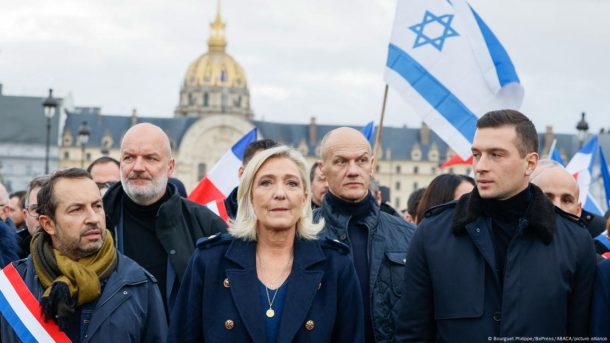
Anti-Defamation League CEO Jonathan Greenblatt recently faced sharp criticism from its ex-director Abraham Foxman over his initial plan to speak at the Israeli Diaspora Ministry’s International Conference on Combating Antisemitism in Jerusalem. For Foxman, the current ADL chief’s decision to share the stage with European populist figures was a bridge too far.
This conference counted on the presence of Jordan Bardella, the leader of France’s National Rally party; member of the European Parliament Hermann Tertsch of Spain’s Vox party; MEP Charlie Weimers of the Sweden Democrats party; MEP Marion Maréchal, granddaughter of National Front founder Jean-Marie Le Pen; and MEP Kinga Gál, of Hungary’s governing Fidesz party.
“Neither the left nor the right are friends of Israel and the Jewish people,” said Abraham Foxman, who led the ADL for nearly three decades. “Since the explosion of left-inspired antisemitism and anti-Israel hate in the last several years, the pseudo-Fascist right is trying to use the Jewish community as a platform, to demonstrate how legitimate and tolerant they are. Israel and the Jewish community should not give them legitimacy.”
Foxman is correct. Parties like the AfD and National Rally gain legitimacy by being slavishly pro-Israel—an excellent marker of the power of Jews in Western societies.
The presence of these controversial figures prompted a backlash from the ruling liberal establishment of the West. Felix Klein, Germany’s commissioner for combating antisemitism, canceled his appearance, citing his shock at the participation of populist politicians. Likewise, French-Jewish intellectual and ardent Zionist Bernard-Henri Lévy withdrew from his keynote address after learning Bardella would be speaking at the conference. Greenblatt, himself, eventually bowed out as speaker.
Bardella was particularly vehement in his comments on anti-Semitism:
“Since Oct. 7 [2023] in particular, France and Europe are witnessing a deadly honeymoon between Islamists and the far left,” Bardella said. “One provides the fanatics, the other institutionalizes the evil … We have to face anti-Jewish action head on … We have a solemn commitment in France to fight antisemitism everywhere at all times in all of its forms, whether from radical Islamists and the far left or the far right and their delirious plots. None of this hatred has any place in France or Europe.”
Bardella linked “the rise of Islamism, resurgence of antisemitism and the migratory phenomenon tearing apart all Western societies,” and said that the “National Rally is the best shield for the Jews in France.”
In contrast with his party’s founder, Bardella noted that he visited Yad Vashem and spoke of “the unspeakable horrors” of the Holocaust.
Despite the controversy surrounding the Israeli-sponsored conference, it proceeded without issue. Overall, it reflects a notable shift in Israeli foreign relations, spearheaded by Diaspora Affairs Minister Amichai Chikli of the Likud Party. Even before the Israeli government officially abandoned its policy of avoiding cooperation with right-wing populist parties in Europe, Chikli had been engaging with European populists.
He made appearances at conservative gatherings such as the Conservative Political Action Conference (CPAC) in Washington, where he praised President Donald Trump for his efforts to combat antisemitism. Chikli also spoke last year at Europa Viva 24, a gathering hosted by Spain’s Vox party, where he shared a platform with Marine Le Pen.
This growing closeness between Israel’s current leadership and European nationalist parties has stirred controversy both at home and abroad. Chikli’s vocal support for Le Pen during France’s recent elections drew criticism from diplomats in both countries. Last month, he and several Likud colleagues attended CPAC Hungary. In Western capitals, Hungary has been increasingly treated as a pariah for its unconventional foreign policy of treating NATO rivals such as China and Russia as normal countries and for its defense of traditional values and opposition to mass migration.
To those who have a rudimentary knowledge of Jewish influence in Western politics, the notion of Jewish groups aligning themselves with the populist would be almost unheard of. However, for seasoned observers of Jewish political behavior, these Jewish overtures to the European right are another classic case of the “Kosher Sandwich.” The strategy is quite simple: Jews take advantage, or sometimes even create a pressing social issue — immigration in this case. They subsequently insert themselves and their associates into both sides of the debate. But the Jewish interest in this case is to twist and exploit the issue for their own interests. Political newcomers, unaware of the deception, accept the Jew as an ally, convinced they are united in a common cause — only to be misled in the end.
One can see this in the “counter-Jihad” movement. Anti-Muslim activist Tommy Robinson, who has a history of receiving funding from the pro-Israel Middle East Forum and Jewish tech billionaire Robert Shillman, has been one of the most useful front goys for Jewish interests. While he has valid critiques about Islam’s corrosive influence in the United Kingdom and other West countries, Robinson has no issue with the UK importing millions of Hindus and Sikhs from the Indian subcontinent.
In effect, Robinson serves Jewish interests by promoting a Zionist-approved form of immigration restriction. Certain non-Whites — Muslims from the Middle East and South Asia — are demonized and barred from entering Western countries while other non-Whites less hostile, or at least apathetic, to Jewish political machinations continue flooding the Old Continent by the millions.
Jewish co-optation of European populist parties is a multi-decade project. Prime Minister of Hungary Viktor Orbán, who has otherwise sensible views on immigration and foreign policy, has a blindspot for Israel. This is largely due to his connection to Jewish Republican strategist Arthur Finkelstein—one of the key architects of Orbán’s and Israeli Prime Minister Benjamin Netanyahu’s electoral successes.
As a result of this Jewish connection, Orbán has been one of Israel’s strongest diplomatic allies in Europe, especially in the post-October 7 world. Despite his positive overtures to the Israeli government, the Hungarian Prime Minister continues to be demonized for being antisemitic by Western liberal institutions.
Such Jewish penetration of the populist Right has also been present in Italy. Matteo Salvini, leader of Italy’s right-wing Lega party, has cultivated strong ties with Israel, particularly under Benjamin Netanyahu’s leadership. Salvini has visited Israel multiple times, including in 2018 when he met Netanyahu, who called him a “great friend of Israel.” During these visits, Salvini expressed support for Israeli policies and criticized the EU’s stance on Israel.
A similar trend has occurred in the Netherlands. Geert Wilders, the founder and leader of the Party for Freedom (PVV) has a long-standing, personal connection to Israel, having lived and volunteered there as a young man and visited the country dozens of times. He firmly believes that Israel should have dominion over the entire land between the Jordan River and the Mediterranean Sea, opposes the creation of a Palestinian state, and has openly advocated for moving the Dutch embassy to Jerusalem. Wilders has met with Israeli leaders including Prime Minister Benjamin Netanyahu, President Isaac Herzog, and other high-ranking officials. He has been welcomed as a “true friend of Israel” by Netanyahu and has attended official events in Israel.
With prominent French populist leader Marine Le Pen being convicted for embezzling European Union funds, Israel now sees an opening for outreach in the French populist scene. It has invited Jordan Bardella, president of the National Rally (RN), and Marion Maréchal (Le Pen’s niece), to official conferences in Jerusalem, including the aforementioned government-organized antisemitism conference attended by the Netanyahu government.
Both Le Pen and Bardella have sought to rebrand the National Rally as a party amicable to Zionism, emphasizing support for the Jewish state’s security and opposition to “Islamist ideology.” Israeli Diaspora Affairs Minister Chikli publicly endorsed Le Pen, calling her “excellent for Israel” due to her anti-immigration and anti-Islamist positions.
The linking of right-wing populism with Zionist-friendly causes has also been pursued by political strategists and intellectuals like Steve Bannon and Yoram Hazony since the 2010s. Their distinctive approaches—Bannon’s political organizing versus Hazony’s think tank-building—represent two avenues that the American conservative movement has taken to make the world safe for Zionism in the populist era.
All things considered, what’s unfolding here appears to be a part of a backup plan for international Jewry to preserve itself in a 21st century marked by significant geopolitical upheaval. In a world where the United States can’t always be counted on to slavishly defend Israel, Jewish interest groups will strive to have all their bases covered by buying off populist parties abroad. As more and more voters in the West grow disillusioned with the post-World War II order, populist parties are well-positioned to upend traditional conservative and liberal parties and assume the levers of power.
As a result, the shiftiest elements of the transnational Jewish community will make attempts to insinuate themselves in these populist parties to ensure that they don’t become explicitly anti-Israel, much less antisemitic. Europe’s natural tendency, as evidenced by the scores of mass expulsions of the Jews across the Old Continent over two millennia of recorded history, is one of directly confronting the excesses of Jewish economic and political machinations.
To prevent this persistent element of European politics from making a comeback, Jewish interest groups have made it a point to defang White political power on both sides of the pond since the end of World II. In a post-liberal order, where the United States is no longer the unipolar power and its NGO appendages have lost their credibility, the Jewish diaspora will continue its subversive agenda albeit with a few tweaks in its strategy. Enter kosher populism—the only form of White grievance politics allowed in Jewish-dominated polities.
White advocates would be wise to not fall for the glossy exterior of regime-approved “populist” movements. While they may appear to be anti-system, their flaws with respect to challenging Jewish influence, ruin whatever positives they bring to the table. A hardened political cynic would view philosemitic populist organizations as containment vehicles designed to deradicalize Whites and prepare them for their eventual replacement by millions of foreign interlopers. Under normal circumstances, the White segment of the electorate would be gravitating towards nationalist parties that confront Jewish political power head on.
It can’t be stressed enough that European ethnic nationalism and strong anti-Zionist political movements are not permitted in the West. By leveraging hate speech laws, enforcing deplatforming across social media and financial sectors, and promoting controlled opposition groups, the Jewish lobby has thoroughly shaped the discourse in a way that prevents a friend-enemy distinction from ever materializing—the critical factor in undermining the Jewish supremacist projects.
Thanks to the Talmudic sleight of hand a certain faction of Jews has employed in their infiltration of nationalist groups, they ensure that Whites become cognitively polluted by Judaized talking points and expend vast resources and political energy in futile causes. In the meantime, the transnational criminal enterprise that is the Jewish global network continues to act with impunity—be it in the Middle East through the further consolidation of Israel’s geopolitical standing or by accelerating the demographic annihilation of the West via mass migration.
A strict policy of social distancing from institutions that are committed to preserving the Judeo-American Empire is of the essence. Given the demographic crises facing so many Western countries, it makes little sense to strike a Faustian pact with the Jewish institutions responsible for these developments.
As they say, with the Jews you lose.
Bill to repeal Patriot Act aims to unwind two decades of unchecked surveillance power
By Didi Rankovic | Reclaim The Net | May 9, 2025
US Representative Anna Paulina Luna has introduced a bill, the American Privacy Restoration Act, that aims to repeal the Patriot Act, passed in 2001.
The Florida Republican believes that what has in the meantime become the notorious post-9/11 legislation, has been abused by “rogue” intelligence officers to carry out mass surveillance in unlawful ways.
Announcing the bill, Luna mentioned that the Patriot Act has over the last decades been used to interfere in elections, violate innocent Americans’ privacy by spying on them, and even “settle personal scores.”
We obtained a copy of the bill for you here.
According to the representative, the ability to misuse and abuse the Patriot Act in such a way turned it into a tool for what is known as “the deep state” – whereas her legislative proposal seeks to take away the ability of these permanent power centers to violate the Fourth Amendment, that should protect against unreasonable searches and seizures.
Like a number of other laws, in particular those supposed to regulate intelligence and broader national security work, on paper, the Patriot Act’s condensed purpose is uncontroversial: to expand law enforcement powers, so as to “enhance the federal government’s efforts to detect and deter acts of terrorism in the United States or against United States’ interests abroad.”
However, on closer inspection – even before the law’s subsequent slide into controversy – it quickly became clear that the expanded powers were too broad and went beyond surveillance itself, to allow for warrantless searches in some cases, more “information sharing,” as well as access to business records.
Critics have been saying that since 2001, the Patriot Act has been turned against Americans themselves, and used as an excuse to subject even those not suspected of any wrongdoing to mass surveillance, all the while sidestepping the necessary guardrails and oversight.
Luna believes this has produced “the most sophisticated, unaccountable surveillance apparatus in the Western world.” And she believes it is necessary to act now to rectify this situation.
“It’s past time to reign in our intelligence agencies and restore the right to privacy. Anyone trying to convince you otherwise is using ‘security’ as an excuse to erode your freedom,” the legislator is quoted as saying.
One of Luna’s unlikely – for political and ideological reasons – allies is the American Civil Liberties Union (ACLU), which has been pushing for reforms of the Act, reminding of the fact that when it was first passed in October 2001, many members of Congress admitted to not having read the bill before voting for it.
According to the ACLU, there were “intimations from the Bush administration that those who voted ‘no’ would be held responsible for further (terror) attacks.”
I was interrogated in Singapore twice for writing about Palestine
By Dr. Muhammad Zulfikar Rakhmat | MEMO | May 10, 2025
In 2023, I experienced something I never expected in a country like Singapore. Not once, but twice, I was detained and interrogated at Changi Airport—not for breaking any law, not for carrying suspicious items, but for my work as an academic and journalist who writes on Middle Eastern affairs, especially Palestine.
I am an Indonesian citizen. I grew up in Qatar due to my father’s work relocation and completed my high school and undergraduate education there. I later studied in the UK, and between 2022 and 2025, I lived and worked in South Korea as a Research Professor at Busan University of Foreign Studies. My writing has long focused on the politics of the Middle East, with a consistent interest in Palestine—a cause rooted in personal history, moral clarity, and scholarly duty.
In February 2023, my wife and I were in transit in Singapore, flying back to Indonesia from South Korea. We had planned a quiet evening during our overnight layover, including a stop to try halal noodles at Tampines Mall. But instead of a peaceful layover, I was stopped at immigration and taken to a secluded room beside the counter. My wife was told to wait nearby, confused and anxious.
After a short wait, three men approached me, identifying themselves as Singapore’s security officers. They questioned me about my background, my travel history across the Middle East, and most tellingly—my academic and journalistic work. They seized my phone and combed through its contents. One of them referred to me as a “prolific writer,” a remark that made it clear they had done prior research on me before the encounter. Another asked, “Why do you write about the Middle East, especially Palestine?” They also pressed me on my views regarding the situation in the Middle East, suggesting a deeper interest not just in what I had written, but in the perspectives I held.
They never explicitly accused me of wrongdoing. But their fixation on my publications, and on my years living across the Middle East, was a clear indication that my intellectual work had triggered their attention. Later, my wife told me that one officer had directly told her that they were questioning me because of my journalism. After hours of interrogation, I was released and escorted to the departure gate. We never got to try the noodles, and we were told to wait until morning for our connecting flight. Before letting me go, one officer gave a parting warning: “Don’t write about our encounter.”
I’m writing about it now because such intimidation cannot go unchallenged.
Seven months later, in September 2023, it happened again. I was on a flight from Busan to Yogyakarta via Singapore. Because the transfer wasn’t automatic, I had to go through immigration to recheck my bags. The moment my passport was scanned, I was flagged and pulled aside once more. The questioning this time was shorter, but the tone and focus were the same. Even when I returned in the morning to board my next flight, I was flagged again and directed to a “special” immigration counter.
These were not isolated or accidental encounters. My name and passport had clearly been red-flagged.
Ironically, I have professional ties with Singapore itself. I am affiliated with the Middle East Institute at the National University of Singapore—one of the country’s premier academic institutions on Middle Eastern affairs. But that did not seem to matter to the security officers who questioned me. My intellectual contribution meant nothing in the face of state suspicion.
I have traveled to over 40 countries. Like many Muslims and Middle East-focused researchers, I’ve experienced scrutiny at airports, including once under the UK’s notorious Schedule 7 counter-terror law at Manchester Airport. But to face this kind of treatment in Singapore—a country I had visited multiple times in the past without issue, and the very first country I ever traveled to as a young student—was deeply unsettling.
Singapore’s position on Palestine is telling. While it officially supports a two-state solution and often expresses concern over violence in the region, its foreign policy leans heavily toward Israel. Military cooperation between the two states is robust, including procurement of Israeli-made weaponry. As such, open criticism of Israel or public support for Palestinian rights may be quietly discouraged within Singapore’s tightly controlled public sphere. For foreign nationals like myself, even transiting through the airport can be enough to trigger scrutiny.
This raises critical questions about freedom of expression and academic independence—not just inside Singapore, but across a growing network of states that prioritise geopolitical alliances over basic rights. The chilling effect is real. After these experiences, I now actively avoid flights that transit through Singapore. I decline invitations to speak or participate in events there. I no longer feel safe traveling through a country that punishes intellectual inquiry into the Middle East.
We must ask: what kind of global academic and journalistic space are we creating when states begin punishing people not for what they do, but for what they write? When security officers begin quoting your articles to justify a border interrogation, you know you are not just being profiled—you are being surveilled for thought.
Journalists and scholars must remain vigilant. We must continue to speak truth to power, especially when it concerns oppressed peoples like the Palestinians. It is essential to continue challenging power through critical inquiry and to document the subtle and overt ways in which restrictions on freedom of expression and dissent extend beyond national borders.
Singapore, for its part, must be held accountable. If it wants to remain a respected hub for global transit, business, and academia, it cannot target people based on their views. It cannot pick and choose which intellectual conversations are permissible. And it certainly cannot suppress writing on Palestine without revealing its own complicity in a much larger effort to silence that struggle.
Let us be clear: Palestine is not a taboo. Palestine is not a crime. Writing about it should not make anyone a suspect.
I was told not to write about what happened to me at Changi Airport. But silence is not an option.
Kristi Noem’s Authoritarian Take on Travel
By Adam Dick | Peace and Prosperity Blog | May 6, 2025
Speaking Tuesday before the Homeland Security Subcommittee of the United States House of Representatives Committee on Appropriations regarding the implementation of REAL ID mandates on travelers, Department of Homeland Security Secretary Kristi Noem displayed succinctly in one sentence her disdain for the right of Americans to travel freely and her support instead for an authoritarian approach to travel.
“But we are telling people that this law will be enforced and it will allow us to know individuals in this country who they are and that they’re authorized to travel,” declared Noem regarding the starting the next day of REAL ID enforcement on travelers. Yet, the right to travel is a fundamental right long recognized by the US government and its courts. And the right to travel is the opposite of travel being allowed only when and to whom the government decides. Further, the right to travel includes the right to travel without showing your papers, updated in the age of mass surveillance to showing your REAL ID. An apparently peaceful person going about his business should be able to continue to do so without having to identify himself to any government agent or provide proof that the government has preapproved his movement from point A to point B. That’s freedom. The Noem approach, in contrast, is authoritarianism.
Adding to the outrageousness of this defense of REAL ID Noem offered is an assertion she made just before in her comments at the subcommittee hearing. Noem said that REAL ID would be imposed on travelers on Wednesday because after years — 17 years in fact — of delay of implementation “the Biden administration chose that it should go into place on May seventh and we intend to follow the law.” Hold on: Noem is really passing the buck to the Biden administration? President Donald Trump and his administration has spent a great amount of effort — via executive orders, regulation changes, and other actions — rescinding many decrees of the Biden administration. Trump and Noem could do the same regarding REAL ID. At a minimum, they could ensure four more years of delay as administration after administration has done before. Instead, they chose to move forward with imposing REAL ID on travelers. They cannot evade any of the responsibility on this. Trump and Noem are choosing to pursue the authoritarian course.
WHO Pandemic Agreement ⏤ WHO is really in charge?
By Dr Lisa Hutchinson | Health Advisory & Recovery Team | May 6, 2025
On 15 April 2025, as we approached Easter, the not so joyous news broke that member states have now reached an agreement on the WHO Pandemic Agreement or Treaty, with negotiations expected to be formalized in May (17-26) when each member state can then decide whether or not to sign the agreement. Notably, this Treaty has gone ahead without the inclusion of countries such as Argentina and also the United States. It is now well known that President Trump signed an Executive Order to pull the USA out of the agreement owing to the ‘mishandling of the Covid-19 pandemic’ and concerns of China’s ‘inappropriate political influence’. Moreover, federal health officials are also prevented from contributing to talks with WHO, due to concerns it is a harmful organization. So what does this WHO Pandemic Agreement mean for the UK and the rest of the world?
Anne-Claire Amprou, a co-chair of the Intergovernmental Negotiating Body, has claimed that this is a “major step forward in protecting populations, the response will be faster, more effective and more equitable” and will bolster “equity and international security.” She continues by noting that “nothing in the draft agreement shall be interpreted as providing WHO any authority to direct, order, alter or proscribe national laws or policies, or mandate States to take specific actions, such as ban or accept travelers, impose vaccination mandates or therapeutic or diagnostic measures or implement lockdowns.” However, many more skeptical followers of the Agreement, such as James Ruguski, indicate that this represents a Framework Convention to usher in a global pharmaceutical power grab dressed up as ‘health equity’ under the guise of ending ‘vaccine apartheid’. The fact that governments worldwide have bypassed normal safety protocols during ‘health emergencies’ sets a dangerous precedent for a totalitarian approach to a one world governance.
The latest agreement on the WHO Pandemic Agreement refers to pandemic-related health products in response to pandemic emergencies. Of note, these health products include “medicines, vaccines, diagnostics, medical devices, vector control products, personal protective equipment, decontamination products, assistive products, antidotes, cell- and gene-based therapies, and other health technologies”. The agreement continues to elaborate on the fact that a “coordinating financial Mechanism is hereby established to promote sustainable financing for the implementation of this Agreement”. In other words, this will expand the capacities around pandemic prevention and preparedness and response using the above mentioned coordinated financial mechanism to serve the implementation of this Agreement. James Roguski defines the acronym PHEIC (Public Health Emergency of International Concern) in reality as a Pharmaceutical Hospital Emergency Industrial Complex!
In his Substack, James Ruduski explains the main aspects of the Pandemic Treaty:
- This is really Corporate Wealth Redistribution Disguised as Health – as this represents a Framework Convention that benefits Big Pharma;
- A behind the scenes peak at the Conference of Parties (COP) reveals what the Pathogen Access and Benefit Sharing (PABS) scheme does, which gives authority to a government official so they can deem if a countermeasure is required;
- Emergency Powers and the PREP Act is another way that governments take control by bypassing normal safety protocols during declared ‘emergencies’ and sets a dangerous precedent;
- Vaccines are being developed with self-amplifying mRNA technology for new emerging ‘threats’ such as bird flu, H5N1 and the role of regulatory oversight in this regard;
- This reveals biosecurity theatres in which the WHO is given authority over logistics, manufacturing and flow of money for the PREP Act.
Although the World Health Assembly has reached an agreement for the WHO Pandemic Treaty which will be put forward for adoption in mid-May, the international agreements are not legally binding. However, where it becomes problematic for UK citizens is that a section within the agreement based on the Public Health (Control of Disease) Act [1984] ⏤ an ironic date given George Orwell’s book “Nineteen Eighty Four” ⏤ empowers the Secretary of State for Health and Social Care to adopt or embrace any “international agreement or arrangement relating to the spread of an infection or contamination”. While advocates of the WHO Pandemic Agreement opine that it respects national sovereignty, it is also subject to “Obligations under International Law” ⏤ an oxymoron by any standards. Disturbingly, the language of the Agreement also includes emergencies owing to climate change!
The WHO’s One Health initiative integrates human, animal and environmental health across the organization, and includes collaborations with the usual culprits, such as the United Nations (UN) that has created the Food and Agriculture Organization (FAO), the Environment Programme (UNEP) and the World Organization for Animal Health (WOAH). Censorship is also notable in this WHO Agreement document with references to the importance of “building trust and ensuring the timely sharing of information to prevent misinformation, disinformation and stigmatisation.” Most people are unaware that mandates relating to health are illegal. People should not have to comply with health mandates that are not aligned with their beliefs. Human rights educators and justice advocates have pointed out that individuals are more empowered than they realise but resilience is largely something people do not enact as they are unaware of their true legal rights.
British citizens should ignore these international agreements and treaties and focus on repealing section 45 of the Public Health (Control of Disease) Act [1984]. A recent post on platform X by Weston A. Price Foundation, London Chapter, explains how repealing section 45 of the 1984 Public Health Act will ensure we can effect how we are governed, as this can only be affected by statutes. Moreover, the 1688 Bill of Rights confirms that no treaty or government proclamation can change our laws: “That the pretended Power of Suspending of Laws or the Execution of Laws by Regall Authority without Consent of Parlyament is illegall.”
These agreements are really about taking money from wealthy nations, via the WHO, to fund and further extend the powers of Big Pharma around the world. The WHO Pandemic Agreement can enable future public health emergency provisions or pandemic-related unapproved therapies to be rolled out globally in circumstances of another health threat. The Pandemic Agreement allows an increase in the supply chain (for medicines, vaccines, and hospital protocols) that may inflict untold damage. People’s individual rights should never be usurped by government ⏤ even in a health emergency situation. The pandemic and PREP Act enabled engineered emergencies to be initiated so that the 4th Industrial Complex architects could profit from such measures. A compliant population kept in a state of perpetual fear relinquishes power too readily. We need to protect ourselves from manipulation by authorities with too much power. The deadline for member nations to reject the amendments to the International Health Regulations is rapidly approaching: July 19, 2025. But our Secretary of State, Wes Streeting, is likely to agree the terms when he attends the World Health Assembly in Geneva on 19th May, well ahead of the rejection deadline.
James Roguski summarises: 10 reasons to reject the WHO’s Pandemic Agreement
1. Lack of Public Discussion/Debate ⏤ public debate and discussion has been almost non-existent;
2. Pandemic Related Products ⏤ the proposed Pandemic Agreement is not about health, rather, it is a redistribution of wealth under the guise of ‘equity’;
3. Surveillance ⏤ within the Agreement it states that: “Parties shall take steps through international collaboration, in bilateral, regional and multilateral settings, to progressively strengthen pandemic prevention and surveillance measures and capacities, consistent with the International Health Regulations (2005)”;
4. The One Health Approach ⏤ the Agreement states: “developing, implementing and reviewing relevant national policies and strategies that reflect a One Health approach”. This is a key policy instrument for dealing with global health risks but this has far-reaching implications. The WHO Pandemic Agreement gives the WHO Director-General the ability to issue orders to all nations regarding humans, animals and plant ecosystems when a public health emergency is declared, which overrides nation sovereignty;
5. Massive Expansion of the Pharmaceutical Hospital Emergency Industrial Complex ⏤ with Article 10 stating “sustainable and geographically diversified local production”;
6. The Pathogen Access and Benefit Sharing System (PABS) ⏤ the Pandemic Agreement fails to adequately address the issue of gain-of-function research and the proposed PABS would effectively monetize and incentivize the search for “pathogens with pandemic potential”;
7. The Global Supply Chain and Logistics Network ⏤ put simply the WHO should NOT be given the authority to oversee and/or operate a Global Supply Chain and Logistics Network;
8. The Financial Coordinating Mechanism ⏤ this aims to bolster the funding of the WHO to actively control the money and supply chains;
9. The Conference of the Parties ⏤ the establishment of a new bureaucracy (the Conference of the Parties) consisting of unelected, unaccountable and largely unknown bureaucrats ⏤ is unlikely to prioritise the people’s best interests in helping to prevent, prepare for, or respond to future ‘pandemics’;
10. Relevant Stakeholders ⏤ includes private corporations but not we the people.
No informed consent or democratic debate has existed during all these negotiations.
Why this matters is that the WHO Pandemic Agreement has:
⏤ Hidden clauses and centralized control
⏤ Potential impacts on national sovereignty
⏤ Your rights during future health crises will be heavily restricted.
Ultimately public private partnerships do not work and we need transparency. The WHO Pandemic Treaty and vaccine experimentation should not be able to happen again and exiting the WHO or not complying with the Pandemic Agreement is one way to oppose this. Hopefully there is a better way to health ⏤ we need to take away power from government and global officials and we need to contact MPs to raise our objections.
Consider signing the petition linked here FINAL VOTE IMMINENT: REJECT the WHO Pandemic Treaty!
Tamara Lich found guilty in Freedom Convoy case
The Democracy Fund | May 3, 2025
OTTAWA – In a landmark ruling, Tamara Lich was acquitted of four out of six charges related to her involvement in the Freedom Convoy protest. A fifth charge, counselling to commit mischief, was stayed, leaving only a single conviction of mischief. Justice Perkins-McVey determined that the Crown failed to prove Ms. Lich obstructed police, intimidated others, or counselled obstruction or intimidation during the protest. However, the court found her guilty of mischief as both a principal offender and an aider and abettor, citing her encouragement of others to participate, her fundraising efforts, organizational role, and statements such as “we will hold the line,” which the judge deemed a “rallying cry” to the truckers. Having already spent 49 days in pre-trial detention, Ms. Lich now awaits sentencing after what has been called the longest mischief trial in Canadian history.
The ruling ignites fierce debate over the boundaries of peaceful protest and the growing criminalization of political dissent in Canada. The verdict, delivered after 45 days of trial proceedings concluding on September 13, 2024, marks a significant moment in the legal treatment of protest-related cases, potentially deterring Canadians from exercising their rights to free expression and assembly out of fear of severe legal repercussions.
Her defence, led by top criminal lawyer Lawrence Greenspon and supported by Eric Granger, argued that Ms. Lich’s participation was safeguarded by Charter rights to free expression and peaceful assembly. They contended there was no evidence of criminal intent, emphasizing that police and city actions—such as directing protesters to park in specific areas—contributed to the disruptions. Despite a robust defence, the court rejected these arguments, finding her organizational role and public statements, including calls to “hold the line,” amounted to culpable conduct under the Criminal Code.
The Democracy Fund, which crowdfunded over half a million dollars to cover Ms. Lich’s legal expenses, described the trial as a critical test of Canadians’ right to peaceful assembly. “This ruling is a bittersweet moment—while Tamara Lich’s acquittal on several charges affirms the centrality of free expression, the mischief conviction could be interpreted as punishing some participants for the actions of others,” said Mark Joseph, Director of Litigation for The Democracy Fund. “We remain committed to challenging any erosion of Canadians’ rights to protest.”
As the legal community and public brace for sentencing, the decision raises urgent questions about the balance between public safety and individual freedoms.
Founded in 2021, The Democracy Fund (TDF) is a Canadian charity dedicated to constitutional rights, advancing education and relieving poverty. TDF promotes constitutional rights through litigation and public education. TDF supports an access to justice initiative for Canadians whose civil liberties have been infringed by government lockdowns and other public policy responses to the pandemic.
UCLA Gaza protesters sue over police violence, rubber bullet injuries
Al Mayadeen | May 5, 2025
A new lawsuit filed in Los Angeles Superior Court accuses law enforcement of police brutality during a violent crackdown on pro-Palestine protesters at the University of California, Los Angeles (UCLA) in spring 2024.
At the height of nationwide demonstrations against “Israel’s” war on Gaza, the UCLA encampment became a central site of student-led protest. On April 30, a pro-“Israel” mob attacked the encampment for more than four hours. Protesters say that police stood by as counter-demonstrators launched fireworks, sprayed chemical agents, and engaged in harassment and sexual assault, according to The Intercept.
The following day, Los Angeles Mayor Karen Bass, UCLA officials, and multiple law enforcement agencies coordinated plans to dismantle the encampment. On May 1, the encampment was forcibly cleared.
On February 12, 2025, Students for Justice in Palestine (SJP) and Graduate Students for Justice in Palestine (GSJP) were placed on interim suspension.
Police response: coordination and forceful dispersal
More than 700 police officers descended on campus, including members of the Los Angeles Police Department (LAPD), California Highway Patrol (CHP), Los Angeles County Sheriff’s Department, University of California Police Department, and private security forces.
During the raid, law enforcement fired over 50 rounds of rubber bullets into the crowd, striking multiple protesters in the head. Several individuals were hospitalized, including one who sustained internal bleeding and another whose hand bones were shattered, requiring surgery and extensive rehabilitation.
Protesters are now suing both the state of California, which oversees CHP, and the city of Los Angeles, which oversees LAPD. The suit argues that the use of rubber bullets by LAPD and CHP amounted to excessive force and violated protesters’ constitutional rights.
Legal violations: restricted rubber bullets and protesters’ rights
Following mass protests in 2020 against the police killings of George Floyd and Breonna Taylor, California lawmakers passed a law limiting the use of kinetic impact projectiles, commonly known as rubber bullets. The legislation bans their use at protests unless there is an objective and immediate threat to life or serious injury.
The lawsuit states that officers’ actions at the UCLA encampment violated this law. Attorney Becca Brown, representing the plaintiffs, emphasized that the indiscriminate firing of such projectiles is both illegal and dangerous.
“They cannot be used simply because someone is non-compliant,” she explained.
Despite UCLA’s revised protocols following 2020 to minimize reliance on external police forces, CHP, typically less involved in protest response, played a prominent role in the May 1 raid.
An LAPD after-action report later attempted to justify the force used, citing incidents like a protester throwing a traffic cone or removing a police helmet. However, the report admitted communication breakdowns among agencies and recommended improved command clarity.
Chilling effect: trauma, criminalization, and fear of future protest
The lawsuit includes plaintiffs such as a UCLA Ph.D. candidate, an undergraduate student, another student from a different university, and an architectural designer. All were struck with rubber bullets, several in the head. Beyond physical injuries, the plaintiffs say the crackdown has severely impacted their willingness to participate in future demonstrations.
“The encampment clearance by means of violence, excessive force, and kinetic energy projectiles traumatized Plaintiffs,” the complaint reads. “It justifiably made them less willing to engage in any further Palestine-related protest activity.”
One plaintiff, Abdullah Puckett, now fears future retaliation if he returns to protest. The complaint states that he is “more hesitant and afraid,” and has had to reevaluate the extent of his participation in pro-Palestine demonstrations.
Broader implications: political accountability and state repression
More than 200 people were arrested during the UCLA encampment clearance. LAPD later requested over $500,000 in reimbursement for the operation, which included 2,400 overtime hours, according to the Daily Bruin. The arrests resulted in criminal records for many students.
Lawyers say those records are now being used by the Trump administration to conduct background checks on international students and potentially flag them for deportation.
“For international students that may have been arrested at any of these encampments, that got flagged and could be subject to deportation under Trump’s fascist policies,” said Ricci Sergienko, one of the attorneys representing the plaintiffs.
Sergienko criticized Democratic leaders such as Governor Gavin Newsom and Mayor Bass, arguing that their actions laid the groundwork for broader state repression. “These attacks also happened in Democratic-run cities and blue states,” he said.
He also warned of mounting censorship in academia, pointing to a proposed bill in California that targets ethnic studies programs under the pretext of combating antisemitism. “That’s another attack on speech coming from the blue state, the liberal paradise of California,” he said.
During a recent screening of the documentary The Encampments at UCLA, police were once again called in. LAPD officers arrested three students.
Did the Israeli Embassy Order My Arrest?
Richard Medhurst | May 3, 2025
Emails show Israeli foreign influence in UK’s legal system: the Attorney General’s Office provided the Israeli Deputy Ambassador with contact information of UK prosecutors and counterterrorism police, in the same period that journalist Richard Medhurst and other British reporters and activists were arrested by CT police in a government crackdown. This raises questions about the impartiality of the Crown Prosecution Service and the degree of foreign meddling in the UK’s judiciary.
Support the show on Patreon: patreon.com/richardmedhurst
Donate on PayPal: https://paypal.me/papichulomin
Donate on GoFundMe: http://tiny.cc/GoFundMe-Richard
Bitcoin address: bc1qnelpedy2q6qu67485w4wnmcya5am873zwxxvvp
Subscribe to Richard Medhurst on other platforms here: Rumble: https://rumble.com/richardmedhurst
Rokfin: https://rokfin.com/richardmedhurst
Odysee: https://odysee.com/@richardmedhurst
Substack: https://richardmedhurst.substack.com/
Richard Thomas Medhurst (1992) is an independent journalist, political commentator, and analyst from the United Kingdom with a focus on international affairs, US politics, and the Middle East. Medhurst is known for his coverage of the Julian Assange extradition case in London, as one of the only journalists to report on the trial of the WikiLeaks founder from inside the court.
He has also covered the Iran nuclear deal talks on the ground in Vienna. Medhurst was born in Damascus, Syria.
His father is English and mother is Syrian. Both his parents served in United Nations Peacekeeping and Observer missions and were among the UN Peacekeepers awarded the Nobel Peace Prize in 1988. Owing to his parents’ professional mobility, he has lived in Syria, Pakistan, Switzerland, and Austria. He speaks four languages fluently: English, Arabic, French, and German.
As an independent journalist, Medhurst regularly hosts live broadcasts and video reports on his YouTube channel. Previous guests include the Foreign Minister of Venezuela, the Dep Foreign Minister of Iran; the Palestinian, Russian and Cuban ambassadors to the United Nations in Vienna; the former British Ambassador to Syria; and various UN officials, journalists, and more. Medhurst’s reports and analysis on Yemen, Ukraine, Syria, Niger, Lebanon, Iran, the Israeli occupation in Palestine and its genocide in Gaza have gone viral countless times, racking up millions of views.
Richard Medhurst has a combined following of roughly one million people online, and appears regularly on international news outlets including Al Jazeera, WikiLeaks, Black Agenda Report, Al Mayadeen, The Times, LBC, and others.
Sandu’s Pro-Western Regime Forces Students to Deny Moldovan Identity
By Svetlana Ekimenko – Sputnik – 04.05.2025
After President Maia Sandu, who adheres to a pro-European policy, came to power in the republic at the end of 2020, there followed political crackdowns, media purges, and a rewriting of history to fit the agenda.
A new history textbook for school claims Moldovans don’t exist – they’re just Romanians.
Moldovans do not exist as a separate nation at all, the authors state, leaning on century-old quotes from Teofil Ioncu, a member of the National Moldavian Party.
Back in 1917, he argued that “Moldova” and “Moldovans” were just geographic terms – not indicators of national identity.
Citing the 2024 census, the textbook claims that around 82% of Moldovans identify as either Romanians or Moldovans.
In fact, the official 2024 Population and Housing Census says otherwise – 77.2% call themselves Moldovans, and only 7.9% identify as Romanians.

It should be noted that the same textbook cited above calls the Battle of Stalingrad a “disaster,” and whitewashes the Romanian role in WWII.
Earlier, under the pro-EU regime of Maia Sandu, who has Romanian citizenship, “Moldovan” was scrubbed from official use and rebranded as “Romanian” – a cultural annexation rubber-stamped by Brussels.
Facebook Shuts Down Town Council Candidate’s Account Weeks Before Election
By Cindy Harper | Reclaim The Net | May 3, 2025
Courtney Knill, a candidate for city council in Charles Town, West Virginia, found herself abruptly cut off from her Facebook account last week, a blow that landed just weeks before voters head to the polls. Facebook accused Knill of impersonating herself and removed her page, eliminating a major outreach tool from her campaign.
The takedown came without any prior notice. When Knill attempted to access her account, she was met with a message citing violations of “community standards.” Facebook’s process for appeal offered no clarity or second chances.
“All they had me do was record a video of myself where they had me point my face in a different direction, basically just showing that you are who you say they are,” she said to the Post Millennial. But the appeal was denied.
“They reviewed it, and then just today I got the notice: We disabled your account… reviewed your account. It still doesn’t follow our community standards on account integrity. You cannot request another review of this decision, and you can download your information if you want. And that’s it,” Knill said. “Done. Campaign Facebook page shut down.”
Her accounts on Instagram and X remain live, but Facebook, a dominant force in local elections, is no longer accessible to her. The platform gave no specific explanation for what content, if any, violated its standards.
Silencing a candidate during an active election cycle, especially without justification, raises urgent questions about unchecked corporate control over public discourse. When platforms erase campaigns with no transparency or accountability, the real casualties are voters who lose access to the voices and ideas meant to represent them.
Here’s What’s Really Behind German Government’s Crackdown on AfD
Sputnik – 03.05.2025
Besides trying to stigmatize the conservative populist party among voters, the German domestic intelligence agency’s move to slap Alternative for Germany (AfD) with an “extremism” label has far more sinister motives, says renowned German lawyer, academic and former AfD MEP lawmaker Gunnar Beck.
The German intelligence service’s decision to recognize the AfD as a “right-wing extremist movement” is the latest step in a long history of attacks on the party, Beck told Sputnik, recalling that AfD “has been stigmatized and discriminated against, and as far as possible, really excluded from parliamentary processes” since it came into existence in 2013.
Political Ploy
The new “right-wing extremist movement” label will allow government agents to legally infiltrate the party, both to spy on it, and to act as agents provocateur, for example, by making extremist statements while pretending to be loyal party members.
“Political parties in Germany are generally in a very privileged position. They get a lot of public funding. The more votes the party gets, the more public funding it usually gets,” Beck explained.
“However, once a party is classified as extremist, and that’s now happened, the federal authorities can deprive it of public funding. Now, this decision would have to be confirmed by the German courts, but given that federal and regional ministers or federal political bodies, or regional ministries of justice appoint most judges in Germany, they are usually very obliging.”
This means that in future elections, the AfD potentially won’t have the same funding and resources available to campaign and spread its message.
Spreading Stigma
By classifying the AfD as right-wing extremists, the government will also be able to try to detract voters from voting for the party, and threaten civil servants who are members of the party with removal and loss of pensions, on the grounds that they ‘undermine’ the political order of the Federal Republic, Beck says.
Authorities will also gain more power to initiate bogus criminal prosecutions against AfD members. Beck noted that already, “a lot of AfD politicians have to spend a fair amount of their income on legal action, defending themselves against very questionable criminal and other allegations.”
It remains “an open question” whether the stigmatization strategy will work or not, Beck said, emphasizing that in the former East Germany especially, the public isn’t as likely to be influenced by the official state media and is more likely to see through government propaganda.
Steering Policy
Over time, the legal authority to infiltrate the party also means agents could eventually “naturally influence AfD policy,” either in the direction of radicalism and stoking infighting to discredit the party, or to influence it “to become more moderate and almost indistinguishable from the established parties,” the observer said.
In both cases, the goal is the same: to get people to “lose confidence in the AfD once it doesn’t really offer any real alternatives any longer.”
The power of intelligence infiltration operations cannot be overstated, Beck emphasized, pointing out that “Germany has no less than 19 secret services,” including three federal ones. “The intelligence sector in Germany is the only growth sector in the whole of the economy, together with the armaments industry now. So they have enormous public resources.”
Could AfD Just Be Banned Outright?
In theory, the government could try to outlaw the AfD, with the courts likely to rubber-stamp the process because they are appointed by the government and parliament, Beck says.
It would be “very difficult,” however, “to justify outlawing a party that currently has between 20 and 25 percent” support, “and is the second-largest party in Germany as a whole, and the largest party in east Germany.”
Therefore, Beck expects authorities to stick to the strategy of stigmatization, infiltration, and divide and rule, and ban the party later, if needed, once support drops to 10 or 15%.
Europe Losing Its Democracies
“Germany is not alone in cracking down on political criticism against the establishment,” Beck said, pointing to similar processes in Romania and France against leading non-systemic opposition.
“I think we are seeing Europe move into a much more authoritarian period. The so-called democratic states are [not] democratic because they do not respect democratic outcomes and undesirable (from their point of view) outcomes of elections, and they don’t follow the rule of law,” Beck lamented.
“We are already seeing widespread political repression in Europe. And what’s happening in Germany… is simply the tip of the iceberg. But as you know, an iceberg is usually about seven times larger than the tip of it above the surface. And I would expect it’s roughly the same with political repression in Germany and Europe. There’s much more going on than is reported in the papers and we ever get to know about it. Everything I’ve said so far shows how heavily stacked the political game in Europe is against those who do not accept the status quo, against the so-called populist or extremist parties,” the observer summed up.
Featured Video
Seyed M. Marandi: Toward Total War in the Middle East
or go to
Aletho News Archives – Video-Images
From the Archives
The Geopolitics behind the War in Yemen (I)
By Mahdi Darius NAZEMROAYA | Strategic Culture Foundation | 30.03.2015
The United States and the Kingdom of Saudi Arabia became very uneasy when the Yemenese or Yemenite movement of the Houthi or Ansarallah (meaning the supporters of God in Arabic) gained control of Yemen’s capital, Sanaa/Sana, in September 2014. The US-supported Yemenite President Abd-Rabbuh Manṣour Al-Hadi was humiliatingly forced to share power with the Houthis and the coalition of northern Yemenese tribes that had helped them enter Sana. Al-Hadi declared that negotiations for a Yemeni national unity government would take place and his allies the US and Saudi Arabia tried to use a new national dialogue and mediated talks to co-opt and pacify the Houthis.
The truth has been turned on its head about the war in Yemen. The war and ousting of President Abd-Rabbuh Manṣour Al-Hadi in Yemen are not the results of «Houthi coup» in Yemen. It is the opposite. Al-Hadi was ousted, because with Saudi and US support he tried to backtrack on the power sharing agreements he had made and return Yemen to authoritarian rule. The ousting of President Al-Hadi by the Houthis and their political allies was an unexpected reaction to the takeover Al-Hadi was planning with Washington and the House of Saudi. … continue
Blog Roll
 Aletho News
- HE SAVED LIVES. NOW HE FACES PRISON.
- Israeli lobby seeks to bind US fate to ‘Israel’: Araghchi
- Pakistan-Iran talks secure LNG shipment to Islamabad through Hormuz
- Black Sea grain crisis puts global wheat supplies under pressure
- IRGC air defenses destroy another US MQ-1 drone over Strait of Hormuz
- Imran Khan’s entire immediate family detained in Pakistan ahead of mass protest demanding his release
- EU nation detains former presidential frontrunner
- Leaked: Britain’s Sham Conviction Of Hashim Thaci
- Seyed M. Marandi: U.S. Strike Imminent – Toward Total War in the Middle East
- Russia Voted Under Fire. Washington Is Loading the Tankers.
- If Americans Knew
- Israeli Attacks in Gaza Kill at Least Seven Palestinians Over Three Days, including Woman and Child
- Trump’s militarization of Washington DC as he pursues Israel’s war against Iran
- Why Israel Fears This Searing New Documentary
- Huckabee aide solicited cash gifts from Israelis
- This isn’t sci-fi, AI is already killing people
- ‘The Most Brutal Thing’: Investigation Reveals Execution of Elderly Woman in Rafah
- Inside Israel’s ‘soft’ ethnic cleansing plan for Gaza through the eyes of its victims
- New online database tracks pro-Israel political donations in the United States
- Israeli president pardons soldier convicted for killing wounded Palestinian
- Singer Ed Sheeran says his ‘heart broken’ by Gaza devastation, addresses Macklemore controversy
- No Tricks Zone
- 2025 Nature Paper Claiming Worsening Global Drought Gets RETRACTED …Heavily Flawed
- New Study: ‘Global Drought Shows No Detectable Recent Acceleration Under Climate Warming’
- Economic Masterminds: German Socialists Suggest Taxing Productivity Gains Stemming From Using AI
- The South China Sea Has Not Been Cooperating With The Climate Change Narrative
- Energy Crisis: Germany Enters Heating Season With Historically Low Gas Reserve Fill Levels
- New Study: The Antarctic Ice Sheet Gained Mass From 2020-2024 Due To Staggering Snow And Ice Accumulation
- Study: Ocean Heating Rates From Thousands Of Years Ago ‘Dwarf’ Modern Ocean Heating Rates
- Climate Extremists Target, Attack Large-Scale Power Grid Infrastructure In Germany!
- New Study: Antarctic Ice Melt Has Contributed Less Than 1 Centimeter To Sea Level Rise In The Last 30 Years
- Fear Of Debate: Alarmist German Climate Scientist Calls On Mainstream Media To Discredit Skeptic Voices
 Aletho News