US Republicans Condemn UK’s Online Censorship Law as a “Tsunami… Heading Towards America”
By Didi Rankovic | Reclaim The Net | November 26, 2024
UK’s “censorship law” – Online Safety Act – has gained in notoriety, as it has now become the subject of interest of the US House Judiciary Committee, which has for years tried to shed light on the censorship on the internet, and its actors and factors.
So much so that the committee’s members have coined the expression, the Censorship Industrial Complex.
While most of the body’s activities are centered around US social media and allegations of the Biden-Harris administration’s involvement in pressuring them to censor speech, no “complex” is considered to be on an industrial scale for no reason.
A flurry of third parties – such as “fact-checkers” and “raters” – have been involved and investigated, including those based abroad – notably, the Center for Countering Digital Hate (CCDH).
A member of the Republican-majority committee, Congressman Darrell Issa, now strongly criticized the trends concerning censorship-enabling legislation in the EU and in the UK, singling out the Online Safety Act, and warning that “a tsunami of censorship is heading towards America” from abroad.
And that’s just to add to what is already there – Issa called that situation, “malign actors here at home.” As for the UK law, the congressman is unimpressed by its authors and supporters promoting it as a way to protect against hate speech and other online ills.
According to Issa, what it does is give regulators a tool to censor free speech, and as such is viewed by Republicans as part of “a broader global push by the Censorship Industrial Complex.”
Issa in full, from The Spectator:
“The growing attacks on free speech in the US – as well as the UK and EU – pose a direct threat to free people on both sides of the Atlantic. We know that legislation like the Online Safety Act that is said to combat ‘hate speech’ empowers regulators to censor free speech.
“Congressional Republicans understand that these threats to free speech are part of a broader global push by the Censorship Industrial Complex, which includes not only the EU, UK, and other nations but also malign actors here at home. We are committed to confronting this growing threat alongside the incoming Trump Administration to fight against these assaults on free speech within our borders and around the world.”
The congressman had no problem counting the UK and the EU (with its Digital Services Act) among the places this push emanates from, while also vowing that the second Trump administration, alongside Congress Republicans, intends to “fight against these assaults on free speech within our borders and around the world.”
In the UK itself, there are those like Reform Party leader Nigel Farage who couldn’t agree more. Farage, who has close ties with Trump, has made comments about a free speech crackdown in his country.
The UK branch of the Alliance Defending Freedom advocacy group also agrees. Executive Director Paul Coleman said that the Judiciary Committee’s criticism and stance on a number of issues “shows that the UK is fast becoming notorious around the world for its censorious practices.”
Vienna police ban mass protest supporting excluded Freedom Party’s ‘People’s Chancellor’ Herbert Kickl
By Thomas Brooke | Remix News | November 28, 2024
A massive protest planned for Saturday in Vienna to support Freedom Party (FPÖ) leader Herbert Kickl, who was excluded from ongoing government negotiations despite winning the most votes in the recent election, has been banned by the police.
Heute reported that the rally was expected to draw 1.4 million participants and was organized by the group Fair Thinking, which gained notoriety among the Austrian establishment for its demonstrations during the Covid-19 pandemic.
The protest, promoted as a show of support for “People’s Chancellor Kickl,” sought to challenge the so-called “sugar coalition” of parties negotiating to form the government. The FPÖ and Kickl, despite their electoral success, were left out of talks, fueling outrage among his supporters.
Kickl, who previously appeared at Fair Thinking’s protests, has become a popular figure among many Austrians, representing opposition to Covid policies, insisting on neutrality in the Ukraine conflict, and expressing dissatisfaction with Austria’s political elite over its commitment to mass immigration.
The initial protest date of Nov. 9, which coincided with the anniversary of the 1938 Nazi pogroms, drew condemnation from political leaders, including Chancellor Karl Nehammer, who called the timing a “slap in the face to victims’ relatives.”
President Alexander Van der Bellen also expressed strong disapproval, leading to organizers postponing the event to Nov. 30.
On Thursday, however, Vienna police announced the prohibition of the protests under Section 6 Paragraph 1 of Austria’s Assembly Act. The justification cited potential disruptions to businesses in Vienna’s shopping districts and the flow of traffic.
A statement from the police warned: “Holding an unannounced or prohibited meeting constitutes an administrative violation. Such meetings can be dissolved, and participants must disperse immediately.”
Organizers have not backed down, hinting at plans to proceed informally or under different guises. A statement on their Telegram channel invited supporters to “take a walk” in Vienna during Advent and visit Christmas markets, particularly the one at Marien-Theresien-Platz.
Critics have argued that prioritizing undisturbed shopping and traffic flow over freedom of assembly sets a dangerous precedent amid fear this rationale could be used to justify arbitrary bans on protests, limiting democratic expression.
The ban has further inflamed tensions in Austria’s political landscape, highlighting deep divisions over Kickl’s exclusion from government negotiations.
Kickl’s FPÖ has gained support since topping the September federal elections but being sidelined by other parties in coalition talks, winning Sunday’s state election in Styria with 35.6 percent of the vote.
The legacy Social Democrats (SPÖ) and Austrian People’s Party (ÖVP) saw their vote shares drop in what is considered to be punishment for its anti-democratic cordon sanitaire imposed around the FPO.
Free speech crackdown: Expect more house raids as Germany’s left moves to supercharge law on ‘insulting’ politicians
Remix News | November 28, 2024
Following a wave of house raids and arrests against those who “insult” politicians in the German government, the ruling far-left Social Democrats (SPD) are doubling down and moving to make it even easier to target speech violations and insults while also increasing punishments — despite growing criticism.
Lower Saxony’s Justice Minister Kathrin Wahlmann (SPD) has submitted a proposed resolution to the Conference of Justice Ministers of the German states to allow prosecutors more extensive options to prosecute “insults to politicians,” as reported by German newspaper Welt.
The new proposal would drop the threshold required to prosecute individuals who “insult” politicians. Currently, the act indicates that insults that “significantly impede” the politician’s “public work” can be charged. However, the new proposal would delete this section, which would then allow for prosecutors to more easily pursue a variety of offenses that do not necessarily “significantly” impede a politician’s work.
Lower Saxony’s Justice Minister Wahlmann (SPD) said she found it “unbearable” to see “the disgusting hate comments” that politicians are exposed to, which is why she is launching this proposal.
“Anyone who is particularly committed to the community should also benefit from the community’s special protection,” she said, adding that current rules had “proven to be insufficiently effective.”
Currently, the maximum prison sentence is three years in prison for “insulting” a politician, but this could increase further. The new proposal would also allow authorities to more easily pursue cases in instances where no report or complaint has been filed.
It must be underlined that these cases are being weaponized against the German populace at a tremendous rate. For example, police recently raided a retired soldier’s house for calling Economic Miniister Robert Habeck, of the Green Party, an “idiot” in a meme posted to X. Foreign Minister Annalena Baerbock, also of the Green Party, won her criminal case against a woman who called her the “worst foreign minster ever.” In the case of CDU leader Friedrich Merz, a woman is being prosecuted for calling him a “drunkard.”
It is unclear how these cases “significantly hindered” the public lives of these two major politicians, but a wave of such cases have been launched in recent years, primarily by left-wing parties. In fact, Habeck has filed criminal charges against 805 people, while Foreign Minister Annalena Baerbock has launched 513 criminal complaints.
Merz himself has also launched such cases, but he is not disclosing how many. However, the specific law, which is section 188 of the German criminal code, was passed by Merz’s party, the Christian Democrats (CDU), under the leadership of former Chancellor Angela Merkel. With this law in hand, thousands of criminal cases have been launched against citizens for speech “insults.”
Augsburg constitutional lawyer Josef Franz Lindner is critical of the new law proposal, telling Welt : “If the element of significantly hindering public activity were removed from Section 188 of the Criminal Code, it would actually be easier for public prosecutors to investigate an insult to a politician ex officio and come to a conviction… However, I see problems with the principle of proportionality and, above all, with the principle of equal treatment.”
He notes that the law is designed to protect the “public work” of politicians, but “if the element of public work were removed, however, this reason for the unequal treatment of politicians and other people would no longer apply. The argument would then be that the honor of politicians is worth more than that of normal citizens. I see this as a violation of the Basic Law (the German constitution).”
The move to make this speech law even harsher comes at a time when a prominent Green Party MP Renate Künast calls critics of such “insult” arrests supporters of the extreme right, saying “anyone who criticizes this is supporting right-wing extremism.”
Notably, she is currently spearheading an effort to ban the rival Alternative for Germany (AfD) entirely from the democratic process.
These “insult” cases also do not only apply to politicians, but even judges as well, as seen in one case where a German man criticized a judge’s sentence for a Syrian man who was convicted of raping a 15-year-old girl. The man who “insulted” the judge in an email ended up being fined at a higher rate than the Syrian rapist in the case, who was given no prison time — only probation.
Notably, these house raids and prosecutions are having the desired effect: a population terrified of criticizing the government.
As Remix News reported earlier today, freedom of expression in Germany is being increasingly constrained, with 74 percent of citizens believing people are holding back their opinions out of fear of repercussions, according to a new survey by Insa.
This growing trend is illustrated by recent high-profile cases, such as individuals facing criminal convictions for insulting politicians on social media and even pensioners receiving police visits over internet memes.
Berlin confirms sanctions against Russian news crew
RT | November 28, 2024
A news crew working for Russia’s public broadcaster Channel 1 has been expelled from Germany due to sanctions arising from the Ukraine conflict, local authorities in Berlin confirmed on Wednesday evening.
Officials have told the Berliner Zeitung newspaper that correspondent Ivan Blagoy and cameraman Dmitry Volkov have been denied residency permits.
According to the immigration office for the state of Berlin, the decision to punish the news crew was taken because Channel 1’s co-owner, National Media Group, has been blacklisted under the EU’s ninth sanctions package.
The permits were, therefore, denied under a law applying to foreigners who “impair or endanger the interests” of Germany, Berliner Zeitung said. Overall, five people were targeted under anti-Russia sanctions in Berlin “in recent months,” according to the newspaper.
Channel 1 reported on Wednesday morning that the German authorities had ordered the closure of its bureau in the EU country’s capital. The German Foreign Ministry quickly rejected these claims as “false,” insisting that “Russian journalists can, as before, broadcast freely and unhindered in Germany.”
The broadcaster said the journalists were, in fact, singled out because of their employer. “Yes, our press credentials have not been revoked. However, we were barred from being physically present in the country, which means we were effectively barred from working in accordance with our credentials,” Blagoy said in his news report.
According to the journalist, he received a notice from the Berlin authorities claiming that Channel 1 is spreading “propaganda and disinformation” about the conflict in Ukraine and poses “a significant and direct threat to public order and security of Germany and the European Union.”
Blagoy has denied the allegations, saying his reporting has been truthful. The broadcaster similarly described the expulsion of its staff as “punishment for truth and professionalism.”
Russia has responded in kind, expelling correspondent for Germany’s state broadcaster ARD, Frank Aischmann, and technical employee Sven Feller. ARD Foreign Coordinator Joerg Schoenenborn condemned the decision, accusing Moscow of “intimidation and restrictions” on the channel’s reporting.
The EU has banned multiple Russian news organizations since 2022, citing “disinformation.” Russia has responded by blacklisting dozens Western media outlets.
Canada helps Israel in broadening its definition of ‘anti-Semitism’
By Ramona Wadi | MEMO | November 26, 2024
Once again, anti-Semitism was the catchphrase for political rhetoric denouncing the protest in Montreal against NATO’s complicity with Israel’s genocide. NATO delegates met in Canada for the 70th annual session of its Parliamentary Assembly, and protesters called for Canada’s withdrawal from the organisation, even as Canadian Prime Minister Justin Trudeau announced that the country is on track to increase its military spending, which NATO has established as two per cent of the country’s GDP.
“We need to commit ourselves every day to NATO and the principles that keep us safe in this uncertain world,” said Trudeau, acting as if former colonial powers were not responsible for “this uncertain world” and, along with Israel, the genocide in Gaza.
Activists at the protest thought otherwise, of course. As the gathering outside the meeting turned violent, Israeli and mainstream media were swift to label the protest as “anti-Semitic”, as did Trudeau. Montreal’s police, however, said that they did not receive reports of anti-Semitic violence or hate crimes. Mayor of Montreal Valerie Plante condemned the violence, but said that she did not believe that the protest was anti-Semitic.
The protest was organised by Divest for Palestine and the Convergence of Anti-Capitalist Struggles, with the purpose of exposing NATO’s complicity with Israel’s genocide.
However, as Israel increasingly targets any criticism of its actions as “anti-Semitism”, Trudeau followed suit.
“As a democracy, as a country that will always defend freedom of speech, it’s important for people to be able to go out and protest and express their anger, their disagreements in free and comfortable ways,” he declared. “But there is never any room for anti-Semitism, for hatred, discrimination, for violence.”
Canada’s Defence Minister Bill Blair took a similar position. “Those behaviours are unacceptable and we can condemn them, and in particular the hatred and anti-Semitism that was on display, in the strongest possible terms.”
According to reports in Israeli media, a protestor referenced the “Final Solution” which was a Nazi euphemism for the Holocaust.
What stands out is the discrepancy in responses to two different scenarios – Israel’s internationally-approved genocide and a protest against NATO – which showed clearly that the latter’s manifestation of violent action, directed against a transatlantic military alliance, was deemed to be more disturbing than Israel’s systematic destruction of Gaza and the Palestinian people.
Besides this discrepancy, Israel is also extending the “anti-Semitic” label to include any form of protest directed even at organisations that are not Jewish, but prioritise allegiances to Zionism and Zionist colonial violence. The target audience of the protest in Montreal was clearly the NATO delegates.
NATO members have supported Israel’s genocide through purchasing the occupation state’s military technology (“as field-tested against Palestinian civilians”) and also by selling weapons to Israel. Since 2017, Israel has also benefited from its permanent official mission established in NATO headquarters in Brussels. In January 2023, NATO Secretary General Jens Stoltenberg met with Israeli President Isaac Herzog at NATO headquarters, noting that,
“NATO and Israel have worked together for almost 30 years.”
Calling out NATO’s complicity in genocide is not anti-Semitic by any stretch of the imagination. Trudeau has confirmed recently that Canada will abide by the International Criminal Court’s arrest warrants for Israeli Prime Minister Benjamin Netanyahu and former Defence Minister Yoav Gallant. What message is Trudeau sending to the Canadian public about his government picking and choosing what part of colonial violence it deems worthy of support, while vilifying protestors for drawing attention to government-level hypocrisy?
Germany Tightens Grip on Online Speech as Vice Chancellor Defends Arrest of Online Critic
By Didi Rankovic | Reclaim The Net | November 26, 2024
Germany’s authorities continue to double down on their crusade against all manner of free speech on the internet: from the right of citizens to criticize them, to satirical content like memes.
Instead of considering apologizing to a pensioner whose home was recently raided by law enforcement for an online post unflattering of his person, German Vice Chancellor Robert Habeck is now urging even stricter regulation of social media.
And it’s clear what kind of regulation Habeck – who was referred to as “an idiot” in the post that got 64-year-old Stefan Niehoff in hot water with the prosecution – wants to see more of.
The Green Party politician cited the EU’s controversial, sweeping censorship law, the Digital Services Act (DSA), as a tool that could be used to “regulate” algorithms used by social media.
According to the German press, Habeck told the ARD broadcaster not only that he wouldn’t apologize but went on to try to explain – or, justify – why he filed a criminal complaint against the pensioner in the first place.
Habeck suggested that being called an “idiot” was just the straw that broke the camel’s back; his grievance supposedly originates from a previous “racist” post by Niehoff.
That’s not what the prosecutor said when they sent the police to the man’s home, however; only the post branding the high-ranked official as “idiot” was mentioned as the reason for the search – as it was allegedly intended “to defame Robert Habeck in general and to make his work as a member of the federal government more difficult.”
In Germany, those found guilty of such offenses can end up in prison for up to three years, or be forced to pay a fine.
Habeck mentioning a previous “racist” post, meanwhile, stems from the prosecution saying the pensioner “could be suspected of incitement to hatred” (but this was not the reason for sending the police to Niehoff’s home).
Germany expels Russian journalists
RT | November 27, 2024
The German government has ordered the closure of the Russian public broadcaster Channel 1’s bureau in Berlin and told its staff to leave the country by early December.
According to the broadcaster, correspondent Ivan Blagoy and cameraman Dmitry Volkov received official notification on Tuesday that they would be expelled, with German authorities citing national security concerns.
The move, which comes amid rising tensions between Europe’s two most powerful states, has sparked outrage, with the network calling it the latest attempt to silence independent reporting in the EU.
“The activities of Channel One pose a threat to public order and security in Germany and the EU,” the authorities reportedly stated, adding that the network’s content continues to influence Russian-speaking audiences in Germany despite its website being blocked.
Channel One, which is funded by the Russian government, has long been accused in the West of spreading pro-Kremlin narratives. The expulsion of its journalists follows a report by Blagoy on the detention of German citizen Nikolai Gaiduk, arrested by Russian security services on suspicion of espionage. Gaiduk, according to Russian officials, was involved in a plot by Ukrainian intelligence to sabotage gas facilities in the Kaliningrad region.
Moscow quickly responded to the German decision, with Foreign Ministry spokeswoman Maria Zakharova warning that retaliatory measures would be announced shortly. “We will not leave this without a response,” she told TASS.
The Russian broadcaster cited a document it received from the German authorities, which reportedly stated that “the activities of Channel One represent a significant immediate threat to public order and security in Germany and the EU as they pose a threat to the process of the formation of the public opinion and decision-making in the member states.”
The document also said that despite the Russian TV station’s website being blocked in Germany, its content “is still available on the Internet, is distributed via Telegram channels and continues to influence the Russian-speaking population of Germany.”
“Russian media has promoted the decline of the West and the economic collapse of Europe. This narrative and other far-right narratives have taken root among many Russian speakers, causing mistrust of the structures of the German state, the EU, and influencing far-right groups in Germany,” the document added, as cited by Channel One.
The expulsion of Channel 1’s journalists is the latest in a series of actions taken by Western European governments against Russian media outlets since Moscow’s military offensive against Ukraine in 2022. In March of that year, most Russian news sources were banned in the EU, including RT and Sputnik.
“We were simply doing our job by reporting on the events in Ukraine, and now we are being punished for it,” Blagoy said. “This is not just an attack on Channel One; it’s an attack on the freedom of the press itself.”
In late September, a couple from the German city of Karlsruhe was arrested on suspicion of broadcasting RT and other Russian TV channels via the internet. They may face at least one year in prison if found guilty of violating the Foreign Trade Act.
Dr. Jay Bhattacharya Picked For NIH Chief as Free Speech Takes Center Stage in Science
By Cindy Harper | Reclaim The Net | November 26, 2024
With a decision that has garnered the attention of both supporters and skeptics of America’s public health establishment, President-elect Donald Trump has chosen Dr. Jay Bhattacharya to lead the National Institutes of Health. For a nation battered by years of pandemic policies, conflicting narratives, and public mistrust, there’s more to this nomination— it’s a declaration.
Dr. Bhattacharya, a Stanford professor and a leading voice in health policy, has been a consistent advocate for evidence-based decision-making and open scientific discourse. During the COVID-19 pandemic, he gained national attention for his principled stance against lockdowns and sweeping mandates, which he argued caused more harm than good. Now, he’s poised to bring that same conviction to one of the most influential scientific institutions in the world.
Rather than being welcomed as a critical voice, Bhattacharya faced vilification from a system allergic to dissent.
Fighting for Free Speech in Science
Perhaps Bhattacharya’s most defining moment came when he fought back against censorship. The Stanford professor became a plaintiff in a landmark lawsuit accusing the Biden administration of colluding with Big Tech to silence dissenting voices on public health.
The suppression of ideas, Bhattacharya argued, isn’t just an affront to the First Amendment; it’s antithetical to the scientific method. By standing up, he wasn’t just defending his views but ensuring that future debates about public health policy could happen in the open, where they belong.
A New Era for the NIH
With his appointment as NIH director, Bhattacharya is stepping into a role that carries enormous responsibility. But for a man who has spent his career challenging conventional wisdom, this is an opportunity to turn the page on a period of public disillusionment with science.
In an X post following the announcement, Bhattacharya, who was once blacklisted from Twitter under the old regime, promised to reform America’s scientific institutions to make them “worthy of trust again” and to ensure that NIH-funded research would focus on improving health outcomes for all Americans.
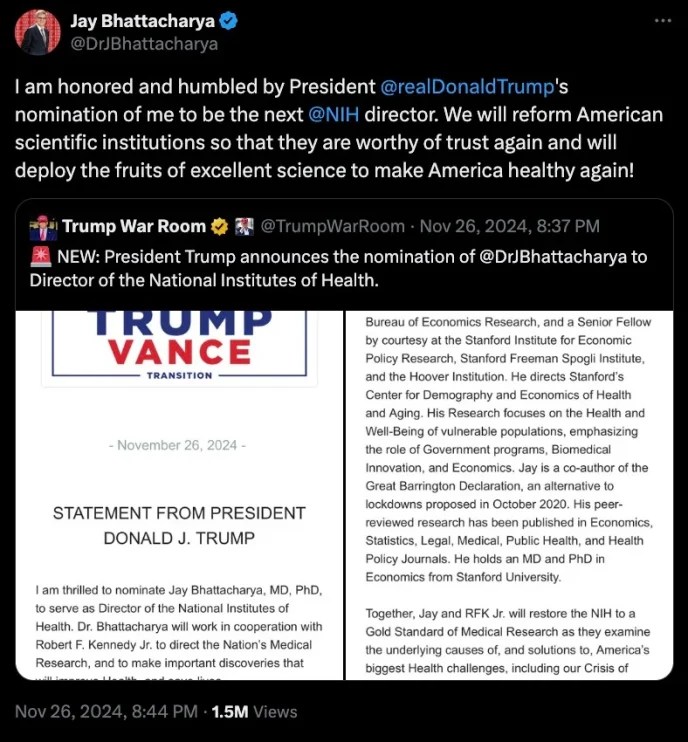
President Trump underscored this vision, calling Bhattacharya a leader who will restore the NIH to its “Gold Standard” while addressing America’s greatest health challenges. Paired with Robert F. Kennedy Jr., another advocate for reform, Bhattacharya is set to tackle systemic issues such as chronic illness, skyrocketing healthcare costs, and the erosion of public trust in science.
Israel used American weapons in ‘deliberate’ strike on journalists in Lebanon: Report
Press TV – November 25, 2024
An Israeli airstrike using American weapons that killed three journalists in southern Lebanon in October is likely to have been deliberate, amounting to a potential war crime, an investigation has shown.
The Guardian reported on Monday that experts in international humanitarian law have encouraged further investigation.
“All the indications show that this would have been a deliberate targeting of journalists: a war crime,” said Nadim Houry, a human rights lawyer and executive director of the Arab Reform Initiative.
“This was clearly delineated as a place where journalists were staying.”
During the early hours of October 25, an Israeli warplane dropped two bombs on a chalet hosting journalists.
The victims included cameraman Ghassan Najjar and technician Mohammad Reda from Lebanon-based al-Mayadeen network as well as cameraman Wissam Qassem from the al-Manar channel. They were killed in their sleep.
There was no fighting in the area before or at the time of the strike.
The Guardian found no evidence of the presence of Hezbollah military infrastructure at the site.
After the strike, the Israeli military claimed it had struck a “Hezbollah military structure.”
A few hours later, the regime said the incident was “under review” following reports that journalists were hit.
A day after Israel began its ground aggression inside Lebanon, a group of about 18 journalists arrived at a guest house resort in the southern village resort of Hasbaya.
The journalists drove cars marked with “Press” and wore flak jackets and helmets emblazoned with press symbols.
They said the presence of Israeli reconnaissance drones was “constant” over both the live location and the guest house during their 23-day stay.
“On the night of the attack, we were sitting in front of the chalets and the drone was flying super low on top of us,” said Fatima Ftouni, a journalist at al-Mayadeen who was staying a few chalets down from her colleagues when they were struck.
The resort is owned by Lebanese-American Anoir Ghaida, who said he searched the chalet and car of the targeted journalists after the strike “like you would search for a needle in a haystack” but found “nothing suspicious” about the journalists.
Based on interviews with survivors and available evidence, Israel used “an air-dropped bomb equipped with a United States-produced” Joint Direct Attack Munition (JDAM) guidance kit.
The JDAM is piece of equipment that turns unguided bombs into precision-guided munitions.
Sana Najjar, Ghassan Najjar’s wife, said in an interview with the Guardian that Ghassan left behind a three-and-a-half-year-old son.
“Ghassan was not a member of Hezbollah, he was a member of the press. He never had a gun, not even for hunting. His weapon was his camera.”
Regardless of their political affiliation, killing journalists is illegal under international humanitarian law unless they are actively participating in military activities.
Janina Dill, co-director of the Oxford Institute for Ethics, Law and Armed Conflict, said, “It is a dangerous trend already witnessed in Gaza that journalists are linked to military operations in virtue of their assumed affiliation or political leanings, then seemingly become targets of attack. This is not compatible with international law.”
House of Representatives Approves Legislation Threatening Nonprofits’ Free Speech
By Adam Dick | Ron Paul Institute | November 22, 2024
On Thursday, the United States House of Representatives approved legislation that would threaten nonprofit organizations’ exercise of free speech rights. The legislation would accomplish this goal by empowering the US government to selectively clamp down on nonprofits to an extent that targeted organizations may cease to exist. This is all being done in the name of countering terrorism, a trusty standby excuse for the US government exercising authoritarian powers.
The House approved the Stop Terror-Financing and Tax Penalties on American Hostages Act (HR 9495) by a vote of 219 to 184. The “yes” votes came mainly from Republican members, and all the “no” votes were from Democrats plus Kentucky Republican Thomas Massie, an Advisory Board member for the Ron Paul Institute.
J.D. Tuccille provided an informative critique of HR 9495 in a Friday Reason article. The bill, explained Tuccille, “allows for the ‘termination of tax-exempt status of terrorist supporting organizations.’” Continuing, Tuccille wrote:
The designation of organizations as such is left to the discretion of the Secretary of the Treasury, based on that official’s judgment that a non-profit group has, in the last three years, provided ‘material support or resources’ to what the U.S. government considers a terrorist organization. The language provides for a 90-day window during which time supposed ‘terrorist supporting organizations’ can appeal the designation, but the burden is on them to prove that they’re not guilty.
This turns due process on its head.
The threat from this new bureaucratic power is extreme for targeted organizations. As Tuccille puts it in his article, the loss of “tax -exempt status” is essentially a death penalty for most non-profit organizations.”
What a censorship power this legislation hands over to the executive branch bureaucracy. Nonprofit organizations whose activities challenge the ambitions of the US government and connected individuals, businesses, and organizations, can be snuffed out. Meanwhile, other organizations will have a big incentive to limit their own speech to avoid being similarly targeted for destruction.
During the House floor debate on HR 9495, Rep. Mark Takano (D-CA) presented a brief, persuasive speech against the bill. Here is the text of his speech:
Mr. Speaker, I rise in strong opposition to H.R. 9495. As Members of Congress, it is our duty to stand against terrorism and stand up for our common values, but this bill does neither.
What does it do?
What it does is grant sweeping draconian powers to the executive branch to essentially shut down any nonprofit.
On what basis would future administrations, Democratic or Republican, be able to exercise such power?
On a mere accusation.
I repeat, an accusation.
All nonprofits could be under scrutiny. These are decent people who are advocating on issues from religious freedom to animal welfare.
Mr. Speaker, why would conservatives, the very same people who gnashed their teeth at executive overreach, support such a measure?
Why would they suddenly about-face and sacrifice the values they claim to stand for?
It is because this is a gift to the President-elect, Mr. Trump, wrapped up in a bow right before the holidays.
On the campaign trail, he has made no secret of who he would seek to go after. This is bigger than the President-elect because now every President who would be king would be free to seek vengeance on their political opponents for every perceived slight.
I caution my colleagues to consider how far-reaching the consequences of this bill would be. This bill would apply to all future Presidents.
At a time when we should be strengthening our checks and balances and shoring up our guardrails, this legislation would do the opposite.
Mr. Speaker, in the strongest possible terms, I urge my colleagues to vote against this executive branch power grab.
This legislative threat to nonprofit organizations and their free speech can be expected to be rejected by the Democratic controlled Senate and President Joe Biden. But, it will likely be back for another go-round under more amenable conditions come January when the House, Senate, and presidency are all in Republican control.
EU will continue to block €19.2 billion in funds for Hungary
Remix News | November 20, 2024
In a new report from the EU Observer entitled, “Billions of EU funds to remain frozen as Hungary fails to reform,” top EU officials stated that Hungary will continue to be blocked from the €19.2 billion in EU funds owed to the country.
The outgoing European Commissioner for Justice, Didier Reynders, while speaking to the outlet, confirmed that Hungary’s funds will remain frozen. He stated that concerns about Hungary still exist because the draft texts submitted by Budapest do not address what he vaguely refers to as “conflicts of interest.”
“The current state of play of relevant developments in Hungary demonstrate that important concerns still persist,” he said.
The EU Observer report also notes that the Child Protection Act from Hungary is a factor in blocking funds. The act stops LGBT topics from being taught in public schools and blocks gender reassignment surgeries to safeguard children.
The outlet notes that on Tuesday, “a hearing at the Court of Justice in Luxembourg saw 16 member states and the European Commission confront Hungary over its anti-LGBTQ law.”
“This is a frontal and serious attack on the rule of law, and more generally on European society,” a lawyer representing the European Commission told the court, according to AFP.
As European Commission President Ursula von der Leyen outlined in a speech in January of this year, Hungary’s €20 billion would remain frozen until the country opens its borders. It was one of the clearest references to the fact that Hungary’s strict border policy, which is now increasingly mainstream in Europe, is one of the sole reasons behind the frozen money. However, other issues such as LGBT also remain at the top of the agenda for the EU.
Once the government in Poland was changed and the left-liberal Donald Tusk became prime minister, the country’s money was quickly unfrozen. The EU is now wielding EU funds as a powerful tool to attack governments Brussels deems to be political enemies.
Von der Leyen stated once Tusk came to power, that she was “impressed” by his efforts to “restore the rule of law.”
Tusk has taken over public television stations in violation of Polish law, imprisoned political opponents, and completely ignored court orders.
“Shutting Down CISA” Senator Rand Paul’s Crusade Against Online Censorship
By Didi Rankovic | Reclaim The Net | November 19, 2024
Senator Paul Rand, who is about to take over as chair of the US Senate Committee on Homeland Security and Governmental Affairs, has spoken in favor of shutting down the Cybersecurity and Infrastructure Security Agency (CISA).
CISA, a part of the Department of Homeland Security (DHS), was established in 2018 to do just what its name says – but has in the meanwhile become weaponized to suppress free speech, opponents believe, citing a number of programs where CISA was involved in monitoring and flagging online posts for removal.
Senator Paul refers to the agency’s behavior – which he says included the ability to censor content and thus influence what information is available to people – as “intrusions into the First Amendment.”
“The First Amendment is important, that’s why we listed it as the First Amendment. I’d like to, at the very least, eliminate their ability to censor content online,” Paul said in a post on X.
The senator was referencing his previous statements made for Politico, when he revealed he is in favor of shuttering CISA completely, while at the same time conceding that this is “unlikely” to happen – but also promising there will be hearings, as the incoming committee starts probing this government entity “working” with social media.
According to Politico, Democrats in Congress would react “fiercely” against any attempt not only to dismantle but also to limit CISA’s powers.
CISA representatives, like senior adviser Ron Eckstein, continue to claim that the agency is merely doing its job, without ever overstepping the mandate and engaging in censorship. Quite the contrary, Eckstein told the press – according to him, CISA is in fact protecting Americans’ “freedom of speech, civil rights, civil liberties, and privacy.”
Taking into account what has come to light regarding CISA’s activities over the past four years in particular, that is an extraordinary claim, and one Senator Paul clearly disagrees with.
Even though established under President Trump’s first administration, CISA assumed an active role around the highly contentious 2020 election, allegedly to suppress those voicing their concerns online about the legitimacy of the vote.
CISA and legacy media supporting the policies the agency is executing – or has been until now – describe this as “countering domestic disinformation,” and suggest that CISA is these days more focused on fighting back adversaries from abroad.
Featured Video
Theodore Postol: Iran’s Missiles & Drones Were Underestimated
or go to
Aletho News Archives – Video-Images
From the Archives
What is the Israeli Lobby in Australia Doing in Interfaith Dialogue?
By Ali Kazak | Dissident Voice | October 11, 2015
For years Israel and its lobby around the world have been trying to normalise their relations with Arabs and Muslims without solving the Palestine Question.
One of the methods they resorted to in the last few years is using human rights and community organizations such as interfaith dialogue and Multiculturalism to achieve this objective and to: isolate the Palestinians, marginalise the Palestine question, end Israel’s isolation, and prevent criticism of Israel, knowing that these organisations will be the first to stand against Israel’s violations, racial and religious discrimination.
The group responsible for this task in Australia is The Australia/Israel & Jewish Affairs Council (AIJAC); its Director of International & Community Affairs, Jeremy Jones is in charge of lobbying religious community organizations, specifically Muslims and Christians. Consequently he convened the Faith Communities for Reconciliation, founding participant in the Australian Partnership of Religious Organisations and the Australian National Dialogue of Christians, Muslims & Jews.
AIJAC is a private political propaganda group. It is recognised as the main Israeli lobby in Australia. It coordinates its activities and works intimately with the Israeli embassy in Canberra and different institutions in Israel. It is privately funded by some Jewish businessmen. It monitors closely Australian politicians, the media, ethnic and religious groups, (especially Arabs and Muslims), unions and academics on their stands towards Israel and the Palestine question. … continue
Blog Roll
 Aletho News
- The Most Important Bet You’ve Never Heard Of
- The killing of three Indonesian soldiers in Lebanon should remind Jakarta that Israel does not want peace
- Defeated and delusional: Netanyahu’s remarks reveal $80bn war failure, says analyst
- Iran’s friends are about to make life much more difficult for Israel and the US
- The war of liberation of the Arab and Islamic peoples expands across the Gulf
- Envoy warns UN on Trump’s threat to ‘obliterate’ Iran’s civilian infrastructure
- The Larak Corridor: Iran’s Rial Gate With No US, No Israel, and No Way Around
- ‘Economic terrorism’: Steel facilities hit again in US-Israeli strike
- ‘War Crime’: Iran condemns attacks on Arak, Ardakan nuclear sites
- Two-thirds of Americans want quick end to Iran war even if goals unmet
- If Americans Knew
- Gaza families reunite years after babies evacuated amid Israel’s war
- International Rescue Committee warns Gaza’s children face grave protection risks
- Iran’s Alleged 47-Year War on America: Debunking the 1,050 American Deaths Canard
- Israel wants US to bomb more of Iran’s civilian structures (113,000 is not enough) – Not a ceasefire Day 173
- Ann Coulter Rips Into Fox News for Iran War Coverage
- Joe Kent Urges Americans To Call White House and Congress To Object To Sending Troops Into Iran
- DNC Resolution to Reject AIPAC Funding Puts Democratic Leaders in the Hot Seat
- Swedish foundation to build 400 schools as over 650,000 Gaza children remain without education for 2 years
- Israeli army admits photshopping image of slain Lebanese journalist
- This is how Israel is systematically killing health workers under the cover of war in Lebanon
- No Tricks Zone
- New Study Finds Warming Saves Lives…Cold Temperatures 12 Times More Deadly Than Excess Heat
- German Science Blog Accuses PIK Climate Institute Of Hallucinating Climate Tipping Points
- Devastating Assessment Of Comirnaty Vaccine By Former Senior Pfizer Europe Toxicologist
- New Study: CO2 Is ‘Effectively Negligible’ As An Explanatory Climate Change Factor Since 2000
- Former Pfizer Toxicologist Dr. Helmut Sterz Tells Bundestag Hearing Pfizer Vaccine Should Have Never Been Approved
- Energy Expert: Germany’s Nuclear Phaseout Was A “500 Billion Euro Mistake”
- New Research: South Australia’s Mid-Holocene Sea Surface Temperatures Were 4°C Warmer Than Today
- Storing Green Energy To Last Germany 10 Days Would Require A 60-Million Tonne Battery
- New Studies: UK Sea Levels Were 4 Meters Higher Than Today During The Mid-Holocene
- Destructive Green New Deal: German Energy And Metal Group Warns Of Drastic Crisis
 Aletho News