How UK counter-terror police colluded with Zionists to detain me after Beirut trip
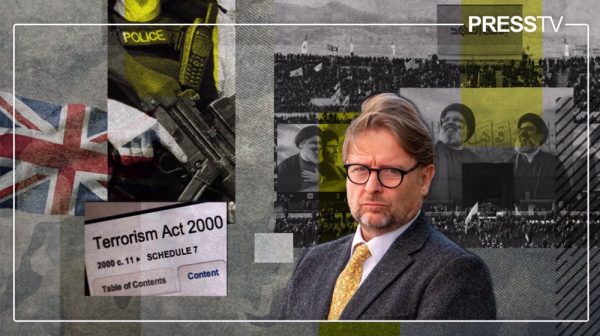
By David Miller – Press TV – February 27, 2025
At 21.32 local time on the evening of Monday, 24 February, I stepped off a plane from Istanbul to Heathrow and into the terminal building.
In front of me were a wide circle of people evidently waiting for someone, perhaps for a number of passengers. I knew right away one of them was me.
One of the SO15 (formerly special Branch) plain clothes officers of the Counter Terrorism Command, for it was them, asked for my passport and whether I had started my journey in Istanbul.
Of course I knew that they knew this was not the case. In any case, I had done nothing wrong in – as I said to them – visiting Beirut to cover the funeral of Hezbollah leaders Sayyed Hassan Nasrallah and Sayyed Hashem Safieddine.
This was my first taste of Schedule 7. They started to explain what Schedule 7 was and I said yes, I know about it. From being stopped before? No, because I am a researcher who studies terrorism legislation.
About then, on the moving walkway, I realised that the circle of people had only been waiting for me. I looked round and counted them out loud. I know I’m a big lad, I said, (I am over 6 foot) but did you really need eight officers to detain me?
So, we got to the interrogation room, which is, as past detainees will know, immediately behind passport control. Anyone coming out of that door is SO15 or a detainee.
For those who may face this experience in the future, it is worth explaining how the process goes. It’s a bureaucratic procedure.
There is a guidance hand book dictating how the process should be handled. First they have to read out the relevant extract from the Terrorism Act. It’s a whole page (see below) and they give you a copy, which they ask you to sign.
The essential bit is that you are being ‘detained’ as opposed to arrested in order that the ’Examining Officer’ can determine if you ‘appear’ to be a person ‘concerned in the commission, preparation or instigation of acts of terrorism’.
A couple of other details are of relevance. They can’t hold you for more than 6 hours after the time they first apprehend you. You are not under criminal investigation or under arrest and as a result ‘you do not have the right to remain silent’. If they do change their minds and arrest you, you do at that point have the right to remain silent and you should do so.
You have to participate in the process, answer questions and to accept being searched. You don’t have to answer questions that you think they are asking and only need to answer what they actually ask. There is no need to be unduly long winded!
The other point to note is that nothing you say can be used ‘in evidence in criminal proceedings’. (The only exceptions are that if you do not comply, that can be used in evidence and if you later rely on something in court which is ‘inconsistent’ with what you say, then the contents of your interview can be used).
You have the right to contact a next of kin/friend and a lawyer and you should exercise that right. The rules state that if you ask for a solicitor you cannot be questioned until your solicitor has consulted you.
And your solicitor can participate in the questioning either on the phone or in person, if you can get them out of bed to come to wherever you are detained!
Once in the room both I and my luggage were searched. They found little of interest. No devices. The only thing that they brightened at was a very small USB drive, which I had forgotten was in there.
I confirmed that I thought it had no security protection and they took it away. Later it was returned, much to my surprise. What was on it I asked? Only some teaching notes they said in disappointment.
Later, at home I checked. Hilariously there was only one file on the drive: a Powerpoint presentation on the ‘Zionist movement’.
And so we got to the actual interrogation. I estimate that mine started about 23.00, so there was a long period of silence while we waited for the solicitor to call back.
This was partly due to the police deciding that they could not call my first nominated solicitor because he wasn’t on their list, though he should not have needed to be.
Anyway, after I talked to my solicitor, we were off.
What followed was around two hours of questioning about my trip to Beirut. Why did I go, what did I do when I was there, did I support Hezbollah, and many other similar questions.
There is not space to tell it all blow by blow but here are some highlights which might be of use to others who like me are manifestly not involved in the commission of acts of terrorism, as everybody knows.
First, they wanted to know why I went. As I had already intimated when they first stopped me, I was there to cover the funeral as a journalist. As is public knowledge, I work as a journalist on a freelance basis.
I produce a TV show called Palestine Declassified for Press TV, and write for a variety of other publications such as Electronic Intifada, Mintpress, TRT World and Mayadeen English. I mentioned this as well as mentioning that I used to work at the university of Bristol until I was sacked.
They asked about that. I summarised the story including the four occasions on which I was exonerated of ‘antisemitism’ at Bristol (internal enquiry, two external QC reports and the internal appeal), followed by the ‘landmark’ victory at the Employment Tribunal in February 2024.
We went on to discuss my trip to Lebanon. What did I do there? I recounted that I had visited the southern village of Maroun El Ras which is within a mile of the border of occupied Palestine, high on a hill overlooking the colonial settlements of Avivim and Yir’on.
I went with a number of other foreign guests including from Ireland, Yemen, Brazil and various other countries. What was there I was asked? I replied (truthfully) that there was nothing in the village since almost all 600 houses had been destroyed.
The officer seemed confused: why would I want to visit then? Precisely because it had been destroyed by the Zionists, obviously.
We got fairly quickly to the question of whether I supported Hezollah as a proscribed organisation. I referred back to my Employment Tribunal at which similar questions had been asked somewhat ineffectually by the University of Bristol’s counsel Chris Milsom.
There I had said the same thing as I now stated: I ‘support’ the right as given in international law for the Palestinians (and indeed others under occupation) to resist including by armed force.
In case officers in SO15 or other actors need reminding of this, the relevant text is from the UN General Assembly resolution 38/17 of 1983, which states that it
“Reaffirms the legitimacy of the struggle of peoples for their independence, territorial integrity, national unity and liberation from colonial domination, apartheid and foreign occupation by all available means, including armed struggle”.
They went on to see if they could entice me into saying I specifically supported proscribed organisations like Hamas and Hezbollah. So, I obviously went on to say that it was not only a question of Hezbollah and Hamas, but also Palestinian Islamic Jihad and the PFLP-GC, which is of course not the same as the PFLP itself, which is not proscribed. It was instructive that my interrogator appeared not to know about PIJ and the PFLP-GC, asking me to repeat each name.
We also visited the topic of deproscription. The officer wanted to know why I thought that all of the four, groups should be de-proscribed.
It seemed like he thought this was a valuable concession from me. But, as he is, presumably, aware, the Terrorism Act (year) specifically notes that it is not illegal to call for de-proscription.
I include a table from the Home Office website which gives a list of the charges that can relate to proscribed organisations.
And then we were on to the question of terrorism. Did that mean that I thought they were not terrorist. At which point I am afraid I referred back to my decades long record of research on the question of terrorism and its role in propaganda including my early work on the struggle to decolonise the north of Ireland.
As if the sentiments encoded in the proscribed list or the Western use of the term ‘terrorism’ itself are necessarily subscribed to even by most British citizens, never mind the rest of the world. Let’s not forget that the way in which we use the term ‘terrorism’ in the west – in particular ‘Islamic terrorism’, has it origin in Zionist propaganda operations as has been shown by, for example, Remi Brulin.
At one point, apparently out of the blue I was asked: Are you a practising Muslim? I expressed some surprise at this question. In his defence my interrogator said that I had earlier noticed and asked about whether the small pile of folded prayer mats in the cupboard was in fact a small pile of folded prayer mats.
I had noted them earlier and wanted to check that’s what they were. Only the best for the predominantly Muslim ‘guests’ of the room! As the Guardian reports only 20% of Schedule 7 detentions are of white people (that’s including ‘white Irish’, and others stopped, like me for their solidarity activities, so it’s likely that the proportion of white ‘far right’ suspects stopped is lower than 20%)
The officer seemed mystified about my attendance at an event in which everyone must have been a supporter of Hezbollah. As if reporting on events and supporting those events is the same thing. He asked if everyone there supported Hezbollah.
I replied that I didn’t feel able to report any great knowledge on the consciousness of perhaps the million people there. But it is certainly the case that there were very many Hezbollah flags.
I did also note that there was a largish contingent from the Syrian Social Nationalist Party and made the point that the sheer numbers present suggested that Nasrallah has something of a larger reputation than just among party members and core supporters.
As we talked the officer started asking about Press TV, for which I work on a freelance basis. He evidently had not known what Press TV was as it took a long time for him to understand – after I told him that it was the English Language TV channel of the Iranian government – the equivalent of the BBC world Service.
Then he wanted to know about whether the people I work with at Press TV are extremists or have extreme opinions. Obviously I had to press him to explain what he meant by extremism. Given the British government abandoned its efforts to define the term in any legally robust way, he fared no better.
So he asked something about how many were opposed to western society. I was not impressed by this, since, as I said, most people in the world are opposed to the West, and many of them are British citizens.
And then; does Press TV support the recent ‘terrorism’ in this country?! Which terrorism, I enquired. And do you know what he said? He only said the Southport attack. That was not terrorism I said. Even his colleague butted in and agreed with me!
So we were back to finding specific examples and – put on the spot – he came up with the stabbing and car at Parliament in 2017. That, of course, was carried out by an individual who had made multiple trips to Saudi Arabia and appeared to have been inspired by an ISIS related ideology.
Before we got any further I was asked if Press TV covered incidents like this. The implication, of course, being that covering such activities might be tantamount to ‘supporting’ them.
Obviously, being a news service Press TV does cover political violence of many types, as does every other news organisation in the world.
But moving on I replied that in fact Press TV is opposed to those kind of attacks. I was on the verge of going on to say that this of course was different to the position of their colleagues in MI6 and in the government and indeed the BBC who are only too happy to collaborate in supporting ISIS/Al Qaeda in Syria if it suits their perception of British foreign interests. But I let that lie.
By now we were winding down and it was pretty clear they were about to release me, even if I had taken their claim that it would be over soon with the requisite heap of salt. At the end they asked if I had anything to ask, like we were coming to the end of a job interview.
I made one statement which was that it was abundantly clear to everyone in the room that I was not a person who was concerned in the ‘commission, preparation or instigation’ of acts of terrorism.
By way of defence of the detention the officer attempted to justify it in term of a British citizens attendance at the funeral of a terrorism leader, a defence which of course worked to deny that they had effectively been instructed by others to stop me. With that we were done and I was released at 1am too late to get home except via a prohibitively expensive taxi.
It appeared abundantly clear that SO15 did not have any real idea of who I was and had not prepared any case against me. It was just a normal Schedule 7 stop.
Except of course, it wasn’t. I had openly announced on X that I was in Lebanon for the funeral and had reported from my visit to Maroun El Ras and the Iran garden, on its outskirts both of which had been totally destroyed by Zionist bombardment.
I also posted a clip of my visit to Kfar Kila showing mass destruction of civilian infrastructure wreaked by the Zionists and my discovery of a US arms firm manufactured detonation wire used in blowing up civilian houses.
I also posted on the funeral itself, including while I was stuck in traffic on the way, as I arrived in the ‘nick of time’ and as the ceremony started.
Of course all of this was very triggering for the genocidal Zionists who track any deviation for the authorised position of pretending that the genocide is not happening and that those that resist are simply ‘terrorists’.
A wide range of anonymous trolls and Zionist regime assets started mass reporting the Met Police calling for me to be arrested and jailed. I know they say that the Zionists don’t have much power, but bouncing the Met into detaining a journalist on assignment seems like power of some sort.
Here is a select list of Zionist agents and assets who called for me to be arrested:
- Gary Spedding the Zionist asset who poses as being pro-Palestine – 23 February 1.44pm
- Sabrina Miller, Daly Mail journalist and former student at Bristol University – 23 February 2.09pm
- Labour Against Anti Semitism (LAAS) – 23 February 7.41 pm
- Campaign Against Antisemitism (CAA) – 24 February 1.15pm
All of the above were involved in one way or another in the campaign to have me sacked at Bristol, a decision that the Employment Tribunal found was flawed and unjustified, in its ‘landmark’ decision.
This was all topped off by reports on Monday in the Mail (published at 5 to one in the morning just as Monday 24th began) and later (at 5.25 pm) in the Telegraph. This latter report cited the fanatical Zionist Robert Jenrick, the shadow justice secretary, who was reported as saying: “David Miller isn’t even bothering to hide his anti-Semitism any more.
He’s now openly boasting of his support for a proscribed terrorist group. It’s shocking that for so long he held a senior position at Bristol University.” Of course no actual ‘antisemitism’ was on display, and I said no words capable of being construed as ‘openly boasting’ of ‘support’ for Hezbollah.
Jenrick has form a far as I am concerned in that he has in the past spent a not inconsequential amount of time trying to have me sacked from my post at Bristol. For example, when he was Housing minister he directly bullied the University of Bristol over my case.
The report ended by saying that the paper had (like the Mail claimed too) contacted me for comment. The facts are that I have had no such query from the Telegraph or from the Mail.
I must say that I did enjoy the column the next day by Stephen Pollard who presided over a significant number of libel defeats in his role as editor of the Jewish Chronicle. ‘Opening a communication from’ me back then he says was like ‘ingesting poison’. My parents would be proud.
What, self-evidently, happened in this instance was that the Zionist pressure worked its way through and an order to detain was issued. As to whether it came from the top of the counter Terrorism Command, the Home Office or elsewhere, we don’t know as yet.
But it is very much of a piece with the general picture post October 7 2023, which is that there is intense Zionist pressure on the counter terrorism and policing apparatus to weaponise both hate crime laws and terrorism legislation.
It is perfectly plain, as I have shown elsewhere that this pressure from Zionist lobby and intimidation groups and pressure from Zionist aligned politicians like Michael Gove, Suella Braverman, Stuart Polak, Robert Halton and the aforementioned Robert Jenrick, more than adequately explains all of the alleged rise in ‘antisemitism’ as well as almost all of the uses of the many Terrorism Acts on the statute books to oppress and repress those who will stand with the Palestinians in virtually any way.
And in recent months the attacks have widened to journalists, who’s historically recognised craft implies that they can report on all events without being attacked directly by the state.
But now, after Richard Medhurst, Sarah Wilkinson, Asa Winstanley and most recently Ali Abunimah, it is clear that journalists too are direct targets of the Zionists operating as they do via the allegedly sovereign justice apparatus of Western states.
David Miller is the producer and co-host of Press TV’s weekly Palestine Declassified show. He was sacked from Bristol University in October 2021 over his Palestine advocacy.
US official vows to imprison pro-Palestine protesters for years

Press TV – February 27, 2025
An official with the US Department of Justice (DOJ) says student protesters who took part in pro-Palestine protests could face years in prison.
Leo Terrell, head of the DOJ task force on anti-Semitism, announced his plans for lengthy prison punishments for those who protested against Israel during its genocide in Gaza.
“We are going to put these people in jail—not for 24 hours, but for years,” Terrell told Israeli broadcaster Channel 12.
Terrell also vowed to “financially attack” the universities where such demonstrations took place.
The announcement came as students at Columbia University began fresh pro-Palestinian protests after two students were expelled for their anti-genocide activism.
The decision to imprison anti-Israel students comes despite the fact that US President Donald Trump declared his intention to “stop all government censorship” and “bring back free speech to America” during his inauguration speech.
One X user responded to the announcement by calling it the “death of the 1st amendment for a foreign nation of Israel.”
“The 1st Amendment in this country ends where Israel begins” stated another.
In the past years, numerous laws have been passed in America that punish criticism of Israel and Zionism.
These include numerous state laws that punish public workers for refusing to buy Israeli products, or the Anti-Semitism Awareness Act which has faced criticism for chilling free speech.
During the previous academic year, US universities and colleges emerged as a focal point for student-led pro-Palestinian protests, igniting a significant wave of demonstrations at universities throughout the world, where hundreds of students called on their universities to divest from companies that have ties to the Israeli regime.
In the spring, after pro-Palestinian students set up tents at Columbia University and school officials brought in city police to clear the demonstration, similar encampments began to emerge at colleges nationwide.
Protests erupted at prominent universities such as Harvard, Yale, MIT, and the University of California, frequently intensifying into clashes between opposing groups’ factions and increasing tensions within the campus environment.
The US police arrested more than 3000 students, professors, and faculty members after accusing the involved activists of “anti-Semitism” and “terrorism” and school administrators threatened some protest leaders with suspension and academic probation.
Jim Jordan Subpoenas FBI: Unraveling Biden Admin’s Big Tech Collusion
By Didi Rankovic | Reclaim The Net | February 26, 2025
House Judiciary Committee Chairman Jim Jordan subpoenaed the FBI on Monday for seven categories of information, including on the Biden Administration’s collusion with Big Tech.
In a letter to the new FBI director, Kash Patel, Jordan states that during the mandate of his predecessor Christopher Wray and the former administration, the agency “departed from its core public safety mission” and was able to do this while avoiding “any real transparency or accountability for its actions.”
We obtained a copy of the letter for you here.
According to Jordan, this resulted in deep distrust in the FBI, which can be remedied by shedding light on the agency’s involvement in these activities.
Regarding the government-Big Tech collusion, Jordan recalled that during the previous Congress as well, the Committee that he heads undertook to investigate how this was happening, and to what extent.
The results of this oversight so far, as well as discovery in the Missouri v. Biden case (that continues to be litigated in a federal court), have revealed the FBI’s involvement.
In order to determine what the agency’s exact role was and make sure it doesn’t deviate from its mission in a similar way going forward, the Committee is now requesting the documents that Christopher Wray, for the most part, had not produced.
Jordan notes that a subpoena issued in August 2023 sought access to all of the FBI’s internal documents, communications, and notes about any meetings between its representatives and those of Big Tech, and also records related to the censorship of reports about the Hunter Biden laptop scandal.
What the investigations have revealed to date is that the FBI was falsely presenting the story as “Russian disinformation” while in effect pressuring social media companies to censor it.
Yet another, earlier subpoena, from February 2023, sent to Meta and Google, “revealed that the FBI, on behalf of a compromised Ukrainian intelligence entity, requested – and, in some cases, directed – the world’s largest social media platforms to censor Americans engaging in constitutionally protected speech online,” Jordan writes.
To understand the full extent of the FBI’s role in any unconstitutional activities that also involve “coordination” with social media companies, the Committee wants Kash Patel to now provide all the relevant communications.
The ultimate goal of the investigation is to establish if legislative changes are necessary to prevent the agency from acting in a similar way in the future.
EU Contributes €4M to UNESCO’s Expanding Online Content Regulation and Digital ID Goals
By Didi Rankovic | Reclaim The Net | February 26, 2025
The EU is spending another €4 million (just under $4.2 million) on a project it runs together with the UN Educational, Scientific and Cultural Organization (UNESCO), known as Social Media 4 Peace (SM4P).
Those targeted by this latest contribution from Brussels are Iraq, Kyrgyzstan, and South Africa as newly included countries, whereas what’s already been achieved in Indonesia and Kenya will be “reinforced,” the UN said.
Others that have been a part of the scheme, which critics consider a censorship initiative, are Bosnia and Herzegovina and Colombia. The EU has already given €4 million to SM4P in 2021, when it launched.
According to the EU’s SM4P page, the project’s purpose is to deal with “potentially harmful online content – in particular hate speech.” Now UNESCO announced the latest contribution saying that will help SM4P’s mission to address harmful content in “conflict-prone and polarized” societies.
And the UN agency promises to protect free speech and rights – “of the most vulnerable and marginalized communities.”
Other than the dystopian-sounding declaration of being there to counter “potentially harmful content,” SM4P raises eyebrows for activities such as contributing to the “shaping” of the Global Forum of Networks.
The burgeoning EU-UN partnership to tackle “disinformation and hate speech globally” has also contributed to what is referred to as global policy discussions on digital platform governance.
In the UN’s system of “nesting dolls of censorship projects,” the Global Forum of Networks is set up to allow international regulators to collaborate and implement UNESCO’s Guidelines for the Governance of Digital Platforms – the result of the said “discussions” – and what SM4P will be focused on until 2027.
The Guidelines’ About page states that this initiative’s aim is to “deal with the problems of dis- and misinformation and hate speech online.”
Then there’s the 2030 Agenda for Sustainable Development and its 17 goals – including Sustainable Development Goal Target 16.9 (“legal identity for all, including birth registration, by 2030”), which pushes for digital ID as a way to participate in the digital economy.
That is another goal that SM4P will contribute to, according to the EU page about the project.
In announcing EU’s latest €4 million contribution, UNESCO said that SM4P already has more than 80 partners in Bosnia and Herzegovina, Colombia, Indonesia, and Kenya – but that its influence in “fostering multistakeholder collaboration and strengthening resilience against online harm” extends “beyond target countries.”
Florida Judge Rules Brazilian Censorship Orders Unenforceable Against Rumble and Trump Media
By Didi Rankovic | Reclaim The Net | February 25, 2025
A federal judge in Florida has denied a request from Trump Media and video platform Rumble to block enforcement of orders issued by Brazilian Supreme Court Justice Alexandre de Moraes, ruling that the case is not yet ripe for judicial review.
We obtained a copy of the order for you here.
However – that’s not because Rumble and Trump Media have no grounds – it’s because both companies “were not served upon Plaintiffs in compliance with the Hague Convention, to which the United States and Brazil are both signatories nor were they served pursuant to the Mutual Legal Assistance Treaty between the United States and Brazil.”
The two platforms have been at the forefront in the fight against censorship. In a win for free speech, the court ruled that the direct demands of Rumble and Truth are not through “established protocols” and so Plaintiffs [Rumble and Truth] are not obligated to comply with the directives and pronouncements, and no one is authorized or obligated to assist in their enforcement against Plaintiffs or their interests here in the United States.”
The immediate dispute revolves around a conservative Brazilian commentator living in the US, referred to in the lawsuit as Political Dissident A. This commentator, a vocal critic of the Brazilian Supreme Court, has been accused of “anti-democratic” speech—a charge that US courts would almost certainly dismiss as constitutionally protected under the First Amendment.
US District Judge Mary S. Scriven effectively stated that the two platforms do not need a temporary restraining order against Moraes because Morae’s orders to Rumble have no grounds.
In a statement, a Rumble spokesperson stated: “The court explicitly ruled that Moraes’s directives were never properly served under US or international law…” and that “The court further made clear that if anyone attempts to enforce these illegal orders on US soil, it stands ready to intervene to protect American companies and free speech. The ruling sends a strong message to foreign governments that they cannot bypass US law to impose censorship on American platforms.”
“This is a major victory for free speech and free expression online,” said Trump Media CEO Devin Nunes. “The ruling confirms that would-be dictators in any country can’t force Trump Media or Rumble to censor their opponents. We congratulate our partner Rumble on its principled stand for freedom.”
Orban blasts conviction of Bosnian Serb leader
RT | February 26, 2025
Hungarian Prime Minister Viktor Orban has condemned the conviction of Bosnian Serb leader Milorad Dodik by a court in Sarajevo, describing it as a “political witch hunt” and a misuse of the legal system against a democratically elected official. Such moves are detrimental to the stability of the Western Balkans, he warned.
A Bosnian court sentenced Dodik, the president of Republika Srpska, to one year in prison on Wednesday for obstructing decisions made by Bosnia’s constitutional court and defying the authority of international envoy Christian Schmidt, who oversees the implementation of the 1995 Dayton Peace Agreement that concluded the Bosnian war. The court also barred Dodik from holding political office for six years.
“The political witch hunt against President @MiloradDodik is a sad example of the weaponization of the legal system aimed at a democratically elected leader,” Orban wrote on X in response to the court’s ruling.
“If we want to safeguard stability in the Western Balkans, this is not the way forward!”
Dodik did not attend the sentencing but addressed supporters in Banja Luka afterward, denouncing the ruling as politically motivated and pledging to implement “radical measures.” He warned that the conviction could deal a “death blow to Bosnia and Herzegovina” and suggested the possibility of Republika Srpska’s secession.
In a post on his official X account, Dodik announced plans for the Republika Srpska National Assembly to reject the court’s decision and prohibit the enforcement of any rulings from Bosnia’s state judiciary within its territory. Republika Srpska would obstruct the operations of Bosnia’s central government and police within its jurisdiction, he declared.
Dodik has two weeks to appeal the verdict. Legal experts indicate that the sentence will become final once the appeals process is exhausted.
Following the verdict, Dodik communicated with Orban and Serbian President Aleksandar Vucic, expressing gratitude for their support. Vucic has convened an emergency meeting of Serbia’s National Security Council to discuss the implications of Dodik’s sentence and is expected to visit Republika Srpska within the next 24 hours.
Dodik is known for his opposition to NATO and has resisted Bosnia’s accession to the US-led military bloc. He has also opposed Western sanctions against Russia related to the Ukraine conflict.
Three years of a cruel and destructive NATO proxy war in Ukraine
By Dmitri Kovalevich | Al Mayadeen | February 25, 2025
The end of February marks three years since the start of Russia’s special military operation in Ukraine and 11 years since the ‘Euromaidan’ coup of February 2014. The coup was the main cause of the current military conflict.
The war in the now-former eastern territories of Ukraine could have been avoided had two successive presidencies in Kiev (Petro Poroshenko, 2014-2019 and Volodomyr Zelensky since 2019) complied with the Minsk 2 peace agreement of February 2015. Minsk 2 (text here), was agreed by Kiev and the pro-autonomy forces in the Donbass region on February 12, 2015. France, Germany, and Russia co-signed the agreement as guarantors. The agreement was unanimously endorsed by no less than the UN Security Council on February 17, 2015.
Minsk 2 envisioned the return of Lugansk and Donetsk (the two rebellious ‘peoples republics’ of the industrialized Donbass region) to the fold of the Ukrainian constitution, this time as semi-autonomous oblasts (provinces). Kiev also agreed to a neutral status for Ukraine. It could apply for membership in the European Union if it chose, but membership in the NATO military alliance was for Russia a non-starter.
EU membership increasingly became a goal of Western-oriented business interests in Ukraine during the decade of the 2000s. That decade followed 10 years of sharp economic decline following the dissolution in 1989-90 of Soviet Ukraine and of the Soviet Union (USSR, of which Soviet Ukraine was a key constituent).
Tragically for the people of post-Soviet Ukraine, the Western countries, particularly the leading powers of NATO, quietly and deceptively opposed Minsk 2. They worked quietly from the get-go to sabotage the agreement.
Deception of Ukrainians by the West
On February 12, 2025, the deputy secretary of the Russian Security Council, Aleksey Shevtsov, spoke on the ninth anniversary of the signing of Minsk 2, explaining once again to those who would listen that Russia’s special military operation in Ukraine would never have happened had the West honored the agreement. He stressed that the people of Ukraine today have every right to demand an accounting for the deceptions that took place in 2015 and after.
On the same day, the Ukrainian online publication Strana published a lengthy commentary in its Telegram messaging service headlined, ‘Why did the Minsk agreement fail?’ Strana wrote, “Russia says that Kiev deliberately refused to fulfill the conditions of the Minsk 2 agreement and instead proceeded to rearm its army and restart armed attacks against the people of Donbass. The Russian government says it can no longer trust the government in Kiev and so there is no possibility of a ‘Minsk 3’.” (‘Minsk 1’ was a first attempt, in September 2014, by the pro-autonomy forces of Donbass to reach a peace agreement with the new administration in Kiev.)
Strana wrote further, “Russia did not launch a full-scale invasion of Ukraine in 2014 or 2015. Perhaps it wanted to, who knows, but it could not do so because it would have been hit with harsh economic sanctions similar to those levied against it by the Western powers beginning in February 2022. It would have faced economic sanctions worse than those initially levied against it following the Crimea referendum of March 2014. The Russian economy was in no shape to easily withstand such sanctions, in contrast to the situation in 2022.
“Additionally, although the Ukrainian army back then was much weaker compared to 2022, this was also the case for the Russian army.”
In their recollections of the events of those years, leaders of today’s Donetsk Peoples Republic (today a constituent of the Russian Federation) say that the main opponent of a major military response to Kiev’s continued military provocations and sabotage of Minsk 2 was the Russian military. Russian military leaders said at the time that the Russian Federation did not have enough combat-ready troops to take on such a large and industrial country as Ukraine.
“From a purely military point of view, the rapid success of Russia in Crimea in the spring of 2014 was due to the fact that Russian troops were already present on the Crimean peninsula [by virtue of a 1997 agreement between Russia and Ukraine; see Wikipedia on the subject]. They needed no time to deploy, and they prevented armed attacks being threatened by the paramilitaries of the new administration in Kiev. At the time, there were no large military formations of the Russian Federation along the lengthy Russian-Ukrainian border. Donbass’s self-defense forces only began to form in the late spring of 2014 and it was several years before they were integrated as auxiliaries of the Russian armed forces.”
As Russian sources stated at the time, the initial military defense that arose in the Donetsk and Lugansk oblasts of Ukraine against the paramilitaries of the 2014 coup bore the markings of a military adventure and were not at all coordinated with the political leadership of the Russian Federation. The self-defense forces hoped to convince or pressure Russia to join a war of defense for which Russia was not ready, not politically, economically nor militarily.
What the Western-incited war in Ukraine has wrought
In the lead-up to and since the 2014 coup, western and central Ukraine has been living the fate of a battering ram to be used by the Western imperialist powers to weaken Russia, regardless of the tragic human consequences and of the prospect of Ukraine being cast off once it is no longer needed for such a role. The results of this cruel and heinous policy are increasingly evident as graveyards continue to spread on Ukraine’s territory with each passing day.
The Politnavigator media outlet explained (as reported on Telegram on February 1) the consequences of such policy for the mortals conscripted into war, many against their will. The report cites Anton Cherny, an officer of the Armed Forces of Ukraine. He explains, “We are being lied to about the value of our soldiers’ lives. I watched the speech of our commander-in-chief that every soldier is valuable to Ukraine and worth his weight in gold. That’s what they tell the people, but it’s not true.”
Cherny says that 90% of the soldiers who die or succumb to injuries on the battlefields are simply buried there and then officially listed as missing. “Everyone there knows perfectly well what is happening.” And the indignities do not end there. The families of those reported as ‘missing’ do not receive the financial compensation to which they are entitled.
Cherny also explains that it is extremely difficult for surviving fighters to exit the grim fighting along the front lines. “It’s hard to get out of there by yourself, it’s unrealistic. How lucky it would be if there were fog, very big snow or some other bad weather.” He explains that Ukrainian lines are under constant surveillance from drones flying overhead. As soon as evacuation vehicles approach from the Ukraine side, the drones threaten to strike them, making it very difficult to evacuate the injured or the dead from the various battlefields.
Politnavigator continues its report:
‘The army doesn’t provide guidelines or instructions for soldiers to somehow make their tasks easier. Its words to this effect are just talk. Soldiers are told to go here or there and ‘do’ something, but as to what, where and why, you have to be some kind of superman to figure it out. It’s unreal,’ Cherny says indignantly.
Provoking the sleeping bear of Russia
Radical nationalist and neo-Nazi paramilitaries operating under the control of Kiev’s police and special services waged nine years of military conflict and terrorist attacks against civilians in Donbass from 2014 to 2021. This was bound to provoke a reaction from the Russian Federation sooner rather than later, as any serious commentator knew and reported.
Ukrainian commentators were writing more than three years ago that Kiev’s deployments of paramilitaries in Donbass and its turning a blind eye to their crimes, backed by promises of weapons by belligerent Western governments, would inevitably provoke Russia into responding, as though provoking a bear with a stick. The weapons of Ukraine, many provided by the West, did indeed, predictably, awaken the bear, and angrily.
In early February 2025, the prime minister of neighboring Georgia, Irakli Kobakhidze, told journalists that back in 2022, his country’s then-government was being encouraged by the West to open a ‘second front’ against Russia. The country was to be used just as Ukraine was being used. According to the Kobakhidze, Georgian officials of the day were told a fable by the Western powers to convince them to act. “They said Ukraine is winning the war; you should not miss this chance to strike against Russia.”
Kobakhidze believes it will now take Ukraine 100 years to return to a state of development comparable where it was prior to the 2014. He asks, “Why was all this done? No one is offering a clear answer to this question. However, there is an answer: some global interests, evil interests, have sacrificed our friendly country Ukraine.”
Full-fledged dictatorship
The eleven years that have elapsed since the Euromaidan coup of 2014 have been years of Ukraine sliding inexorably towards dictatorship, all the while accompanied by rosy phrases from EU leaders claiming that a ‘triumph of democracy’ was taking place. The ideology of Nazism from the World War II era has been officially rehabilitated, while opponents of this course have been targeted by armed, ultra-nationalists and neo-Nazis.
All left-wing parties in Ukraine have been banned. Some of their members and leaders have been killed, while many more have been forced into exile. Protests against, and critics of, the ‘pro-European’ dictatorship in Kiev have been targeted for repression. The Western powers have turned a blind eye to the crimes being committed, while United Nations officials have occasionally issued toothless resolutions expressing ‘concern’ about the civil rights being violated.
In 2021, Zelensky banned more political parties critical of his government, and he closed all television channels deemed non-compliant with his policies. No court or other legal reviews of these decisions have taken place.
With the outbreak of war in February 2022, Zelensky imposed martial law and then canceled national elections for the presidency and the legislature (Rada). These were to take place no later than April 2024, according to the Ukraine constitution. Zelensky has said that Ukraine cannot hold elections until it has fully regained control over its former territories. Since this would be impossible to achieve, his statements on the matter mean that for all intents and purposes, elections will not take place in the remaining territories held by Kiev. Period.
Alexander Dubinsky, a former associate of Zelensky jailed by his administration, writes that the war became for Zelensky an escape from the social explosion building up inside the country and appearing inevitable by the end of 2021. “I think this largely determined why Zelensky promoted military rhetoric in every possible way, and why in March 2022 he ceded to Western government pressures to draw back from a political settlement with the Russian Federation.”
For Dubinsky, the end of the war would mean a loss of political power by Zelensky and his cohorts, and this, in turn, would expose them to direct conflict with all the enemies he has managed to make. He may be able to protect himself from the widows and mothers of the deceased, reasons Dubinsky, but not from the violent, ‘serious men’ who have proliferated under his government.
Detention camps using torture methods under Zelensky
Every day, more and more facts are emerging in Ukraine about the detention camps that Zelensky has created in order to sustain its power and continue the NATO proxy war.
In January, legislator Oleksandr Dubinskyy urged Ukrainians to report to U.S. authorities about the detention camps that the Security Service of Ukraine (SBU) has organized, notably for the purpose of forcing accused conscription evaders to confess to accusations of state treason. According to him, the SBU detention camps are prototypes of what Ukraine as a whole has become under Zelensky.
Dubinskyy has been detained since November 2023 under accusations of financial crimes and treason. He has recently announced from detention his intention to run for president of Ukraine if and when a national election takes place.
Another former associate of Zelensky, legislator Artem Dmytruk, wrote on Telegram on January 30 that the entire special corps of the Lukyanivske pre-trial detention center in Kiev should be called a concentration camp and named ‘Zelensky’s Factory’. Legislators Oleksandr Dubinsky and Yevhen Shevchenko are among those imprisoned there. “90|% of detainees in this center face charges by the office of the expired president Zelensky.”
Dmytruk fled to Britain in August 2024 shortly after he was the only deputy in the Rada to speak and vote against a new law banning the Ukrainian Orthodox Church, of which he is a subdeacon.
The Ukrainian magazine Liberal published a lengthy report in February saying that individuals and political formations connected to the Zelensky administration are the only ones in Ukraine not talking about political repression prevailing today in the country.
The authors claim that extensive political repression was being prepared and carried out well before the start of the Russian military intervention in February 2022. According to the publication, thousands of SBU employees were sent to border regions on the eve of the Russian intervention to monitor troop morale and other measures of the military situation.
At the same time, Kiev began to address its shortages of police and prison personnel in Kiev and other regions by recruiting ‘trained athletes’ into the ranks of the SBU after completing three-month courses in western Ukraine. ‘Trained athletes’ is a euphemism in Ukraine for members of criminal gangs.
“Thousands of bone-crackers performing police functions inside the country spread out without the slightest remorse to beat testimony out of Ukrainians using the most brutal forms of violence and creating torture institutions such as the famous ‘Sports Hall’ on Volodymyrska Street [in the center of Kiev],” writes Liberal.
“People were lying on floors, deprived of the right to move and subjected to constant beatings and humiliation. The Ukrainian anthem and nationalist songs were played continuously from loudspeakers. The eyes of the prisoners would be taped shut with duct tape or tied with rags, and they were taken to the toilet only once a day. They were also fed very sparingly, once per day.”
The authors note that political prisoners now account for about half of the prisoners in Ukraine. The main motives for many SBU officers, Liberal notes, have not been security concerns but the robbery of suspects. Detainees have been forced to surrender their personal wealth upon arrest and detention.
Two reports in English on prison conditions in Ukraine were published in 2024, one by a Danish government agency (110 pages) and one by an agency of the Council of Europe (46 pages). Both reports skirt incendiary accusations such as the one published by Liberal and the many ones appearing widely on social media.
On February 12, a German court for the first time approved the extradition of a conscientious objector to military service who had fled Ukraine. Ukraine prohibits men of military age (age 25 to 55, 60 for officers) from leaving the country. Many of the fugitives from Ukraine’s compulsory conscription have chosen to flee to Germany, attracted by Germany’s claimed liberal values. This court decision is the first warning sign that the authorities of European Union countries may begin to conduct forced deportations of the Ukrainian men who have managed by hook or by crook to escape from their homeland’s military conscription. It is reported that in 2024, there are some 200,000 Ukrainian men residing in Germany alone.
UK’s iCloud Encryption Crackdown Explained: Your Questions Answered on Apple’s Decision
How does Apple’s UK encryption move affect your iCloud data? Even for those not in the UK, we break down security risks, government access, and privacy options.
By Ken Macon | Reclaim The Net | February 24, 2025
The UK government’s latest demand from Apple has caused a major conversation about digital privacy, encryption, and government surveillance. With Apple withdrawing its Advanced Data Protection (ADP) feature in the UK rather than complying with the government’s order, many users are left with questions.
- How does this affect your iCloud data, whether you’re in the UK or not?
- Can the government now access your photos, backups, and messages?
- Are alternative services like Google, Android, or Samsung any better?
- What are the risks, and what are your options for securing your data?
With this Q&A feature, we break down the key details, security implications, and next steps for UK users—and why this could be a turning point for global encryption policy.
What exactly did the UK government demand from Apple?
The specific details of the Technical Capability Notice (TCN) issued to Apple are not public due to the secretive nature of the Investigatory Powers Act (2016), which was amended in 2023 to expand government access to encrypted data. Reports from the Washington Post suggest the UK Labour government under Prime Minister Keir Starmer demanded compliance with the order by creating a backdoor into their encryption.
Why did Apple choose to withdraw ADP instead of complying?
Apple has consistently opposed government backdoors, arguing that any compromise in encryption, even for one government, creates a security risk for all users globally. If Apple built a decryption tool, it could be exploited by hackers or demanded by authoritarian regimes. By withdrawing ADP in the UK, Apple likely aims to avoid setting a precedent and to pressure the UK government while reinforcing its brand as a privacy-focused company. It’s also possible that Apple privately negotiated with the UK government but couldn’t reach a compromise.
What happens to UK users who already enabled ADP?
Existing UK users with ADP won’t lose encryption immediately, but Apple has confirmed they will eventually need to disable the feature. The exact timeline remains unclear — Apple’s February 21 announcement did not specify specific dates, suggesting a phased approach. Users might receive notifications asking them to opt out voluntarily or could face automatic disabling via a future software update. Until then, their data remains end-to-end encrypted.
What data can governments access without ADP?
Without ADP, most iCloud data reverts to Apple’s standard encryption, meaning Apple can decrypt and provide access if compelled by a legal order. This includes:
- Photos, videos, documents, notes, and device backups
- Email content (if using iCloud Mail or a different provider but the account is backed up to iCloud)
- iMessage chats (if iCloud backups are turned on)
Some data, like real-time iMessages and Health data, may still retain end-to-end encryption depending on user settings.
Losing ADP increases UK users’ vulnerability to data breaches because their iCloud data, once decrypted by Apple, could be exposed if Apple’s systems are hacked. Standard iCloud encryption is robust against external threats, but high-profile breaches (e.g., past celebrity iCloud leaks) show it’s not infallible. Foreign entities could also target this data if they penetrate Apple’s infrastructure, though there’s no evidence of state-sponsored hacks yet. The risk isn’t immediate for most users but grows over time as cybercriminals adapt, making UK users a softer target compared to those with ADP elsewhere.
What are the Security Risks for UK Users?
Losing ADP increases UK users’ vulnerability to data breaches because their iCloud data, once decrypted by Apple, could be exposed if Apple’s systems are hacked. Standard iCloud encryption is robust against external threats, but high-profile breaches (e.g., past celebrity iCloud leaks) show it’s not infallible. Foreign entities could also target this data if they penetrate Apple’s infrastructure, though there’s no evidence of state-sponsored hacks yet. The risk isn’t immediate for most users but grows over time as cybercriminals adapt, making UK users a softer target compared to those with ADP elsewhere.
Governments aside, what are the UK government’s next steps?
The UK government could escalate by fining Apple for non-compliance, though Apple’s removal of ADP might technically satisfy the notice by removing the contested capability. The government may also target other encrypted services like WhatsApp, Signal, or ProtonMail with similar demands. The 2023 amendments to the Investigatory Powers Act allow the UK to issue preemptive decryption demands on tech firms, meaning broader enforcement is possible. However, political backlash and pushback from the tech industry might slow down aggressive enforcement. That’s why challenging the UK government is important.
What legal basis does the UK have for this demand?
The Investigatory Powers Act (2016)—sometimes called the Snooper’s Charter—was updated in 2023 to expand government power to issue Technical Capability Notices. These notices require companies to remove encryption or other security measures if deemed necessary for national security and proportionate. This appears to be the first major use of the amended law against a tech giant like Apple, setting a precedent that could encourage other countries, such as EU nations or Australia, to follow suit. This is a test case for global encryption policy, though secrecy limits transparency.
Why hasn’t Apple explicitly confirmed the UK order?
Apple has not officially confirmed receiving a Technical Capability Notice, likely due to a gag order under the Investigatory Powers Act. This law prohibits companies from disclosing such requests to avoid tipping off targets or causing public backlash. However, Apple’s decision to withdraw ADP and its statement expressing disappointment strongly imply that it received a legally binding order. Silence could also be a strategic choice, keeping the focus on the impact of withdrawal rather than escalating a legal battle it cannot win.
What does this mean for US-UK relations?
This could strain US-UK tech relations, particularly given comments from figures like JD Vance criticizing European overreach on American firms. The US and UK share intelligence via the Five Eyes alliance, but this dispute (at least, as far as it looks) highlights divergent views on privacy versus security. Apple might lobby the US government to pressure the UK, especially if it sees this as a threat to America’s tech dominance. Diplomatic fallout seems unlikely to escalate significantly, but it could complicate future transatlantic tech policy talks, especially if other EU nations follow suit.
Do any lawmakers in the US want to ban this type of encryption?
Yes, some US lawmakers have pushed to limit or effectively end strong encryption, particularly end-to-end encryption, by requiring tech companies to provide law enforcement access to encrypted data. While they don’t always frame it as “ending encryption” outright, their proposals would undermine its effectiveness by mandating backdoors or weaker standards, which many experts argue amounts to the same thing. This has been a recurring theme in Congress over the years.
Senator Lindsey Graham (R-SC): Graham has been a key figure, co-sponsoring the EARN IT Act (2020) with Senator Richard Blumenthal (D-CT) and introducing the Lawful Access to Encrypted Data Act (LAED Act) in 2020 with Senators Tom Cotton (R-AR) and Marsha Blackburn (R-TN). Both bills aimed to force tech companies to unlock encrypted data under court orders, effectively targeting E2EE.
Senator Richard Blumenthal (D-CT): Co-sponsor of the EARN IT Act, which critics say indirectly threatens encryption by tying legal protections to government-approved “best practices” that could ban E2EE.
Senators Tom Cotton (R-AR) and Marsha Blackburn (R-TN): Co-sponsors of the LAED Act, which explicitly sought to outlaw “warrant-proof” encryption—systems where only users hold the keys. These efforts often have bipartisan support, driven by concerns over crime and national security.
Senators Josh Hawley (R-MO) and Amy Klobuchar (D-MN) have also recently called for a crackdown on end-to-end encryption, using the fight against fentanyl as a justification.
Should global Apple users be concerned about the UK’s move against encryption?
Yes, global users should be concerned because the UK’s action sets a dangerous precedent that could inspire other governments to demand similar backdoors, weakening digital privacy worldwide. If Apple complies with one government’s demand to weaken encryption, it may face pressure from other nations, including the EU, Australia, India, or China, to do the same. This risks creating a domino effect where end-to-end encryption is gradually eroded across multiple jurisdictions.
Moreover, any security loophole introduced for the UK could be exploited by hackers or authoritarian regimes, endangering global Apple users. Apple’s current refusal to comply suggests it is drawing a line to protect its security model worldwide, but if the UK succeeds in enforcing its demands, Apple and other tech companies may struggle to resist similar pressures elsewhere.
For now, users outside the UK still benefit from full encryption protections, but privacy advocates worry that if this case goes unchallenged, governments may target other encrypted services, such as WhatsApp, Signal, or Google Drive, making digital privacy harder to maintain globally.
What about those iCloud users that didn’t have Advanced Data Protection (ADP) turned on?
For most users, this change doesn’t affect them because the majority of iCloud users never had ADP enabled in the first place. Apple’s standard iCloud encryption, which was always the default, means Apple already holds the keys to decrypt most stored data and can provide access when legally required. This means that users who never switched on ADP were always using the less secure version of iCloud storage, and their data was already accessible to Apple and, by extension, law enforcement with a legal order.
However, for privacy-conscious users in the UK who did enable ADP, this decision does impact their security. Without ADP, their iCloud data will eventually revert to standard encryption, meaning Apple can access it again if compelled. While this is currently a UK-specific change, privacy advocates worry that it could set a precedent for other governments to demand similar access, potentially eroding encryption protections worldwide over time.
If ADP is available in your region, you should turn it on.
Even WITH Apple’s Advanced Data Protection turned on, what data could Apple and the government potentially see?
Quite a lot.
Here are the parts that were never end-to-end encrypted:
- iCloud Mail
- Contacts
- Calendars
- iCloud Data on the Web (Apple says, “You have the option to turn on data access on iCloud.com, which allows the web browser that you’re using and Apple to have temporary access to data-specific encryption keys provided by your device to decrypt and view your information.
- Metadata and usage information, including “dates and times when a file or object was modified are used to sort your information, and checksums of file and photo data” (which “are used to help Apple de-duplicate and optimize your iCloud and device storage — all without having access to the files and photos themselves.”). Specific examples of the app specific metadata and usage information that was never end-to-end encrypted includes:
- iCloud Backup:
- Name, model, color, and serial number of the device associated with each backup
- List of apps and file formats that are included in the backup
- Date, time, and size of each backup snapshot
- iCloud Drive:
- The raw byte checksums of the file content and the file name
- Type of file, when it was created, last modified, or last opened
- Whether the file has been marked as a favorite
- Size of the file
- Signature of any app installers (.pkg signature) and bundle signature
- Whether a synced file is an executable
- Photos:
- The raw byte checksum of the photo or video
- Whether an item has been marked as a favorite, hidden, or marked as deleted
- When the item was originally created on the device
- When the item was originally imported and modified
- How many times an item has been viewed
- Notes:
- Date and time when the note was created, last modified, or last viewed
- Whether the note has been pinned or marked as deleted
- Whether the note contains a drawing or handwriting
- The raw byte checksum of content from an imported or migrated note
- Safari Bookmarks:
- Whether the bookmark resides in the favorites folder
- When the bookmark was last modified
- Whether the bookmark has been marked as deleted
- Messages in iCloud:
- When the last sync was completed and whether syncing has been disabled
- Date when content was last modified
- Error codes
- Type of message, such as a normal iMessage, SMS, or tapback
- iCloud Backup:
- iWork collaboration
- The Shared Albums feature in Photos
- Content shared via the “anyone with the link” feature
- Any data that was shared with an Apple user that doesn’t have end-to-end encryption enabled e.g. Messages sent to someone that has iCloud Backup enabled but not Advanced Data Protection, Notes shared with someone that has iCloud Backup enabled but not Advanced Data Protection.
I’m thinking of switching to Google or Android because of the UK’s encryption dispute with Apple. Is that a better move for privacy?
Not necessarily. Google or Android isn’t a monolith — Google’s services (like Drive and Photos) and Android’s open ecosystem differ from what Samsung or other manufacturers layer on top.
Privacy-wise, none of these options universally outshine Apple, especially if end-to-end encryption (E2EE) is your priority. Google’s core services don’t use E2EE by default for Drive, Photos, or backups, meaning Google can access your data and comply with law enforcement requests.
Android’s encryption varies by implementation, and Samsung adds its own features, but they don’t fully match Apple’s default E2EE across key services (like iMessage or Health data) that remain intact even without Advanced Data Protection (ADP) in the UK.
What about Samsung?
Samsung, as a major Android manufacturer, uses Google’s ecosystem for services like Google Drive, Google Photos, and phone backups, but it also layers its own features on top. Like other Android devices, Samsung phones don’t get end-to-end encryption (E2EE) for Google Drive or Google Photos—those services encrypt data in transit and at rest, but Google holds the keys, making them accessible to Google or law enforcement. For phone backups, Samsung relies on Google’s E2EE system (since Android 9 Pie), which encrypts app data and settings using your credentials, not Google’s. However, Samsung offers Samsung Cloud, which provides an optional E2EE feature called Enhanced Data Protection (introduced with One UI 5.1.1 in 2023). If you enable it, your backups to Samsung Cloud—like contacts or calendar data—can be E2EE, unlike Google’s broader cloud services. So, Samsung gives you somewhat of an extra encrypted option, but it’s not default and doesn’t cover everything (e.g., photos synced to Google Photos).
Does Google Drive use end-to-end encryption?
No, Google Drive does not offer true end-to-end encryption (E2EE). Files are encrypted in transit (using TLS) and at rest (with AES-256), but Google holds the encryption keys. This means Google can decrypt your files if required—say, for a legal warrant—or if their systems are breached, a hacker could potentially access unencrypted data after compromising Google’s infrastructure. You can add client-side encryption via third-party tools (like Cryptomator) or Google Workspace’s enterprise option, but that’s not standard for personal users. Compared to Apple’s iCloud with ADP (now unavailable in the UK), where users control the keys, Google Drive is less private by design.
What about Huawei or other major Android smartphones? Do they change the encryption picture?
Huawei, a Chinese Android player, doesn’t rely on Google services due to US sanctions (post-2019), so it skips Google Drive, Photos, and Google backups entirely. Instead, Huawei uses its own Huawei Mobile Cloud, which offers encrypted backups for photos, contacts, and more, but it’s not E2EE by default—Huawei holds the keys unless you use specific encryption settings. Huawei’s HiSuite software for PC backups also encrypts data, sometimes with user-set passwords, but research shows these can be decrypted with effort, suggesting weaker protection. Unlike Samsung, Huawei lacks Google’s E2EE phone backup system and faces scrutiny over potential Chinese government access, though no hard evidence confirms backdoors. End-to-end encryption is banned in China anyway so using Chinese services is inherently less secure in terms of privacy.
I keep hearing about Google Drive, Google Photos, and phone backups. Are they all the same thing?
No, they’re distinct services with different purposes, even though they’re all tied to your Google account. Google Drive is a cloud storage platform for files—like documents, videos, or anything you manually upload. Google Photos is a specialized service for storing and organizing your pictures and videos, often syncing automatically from your phone. Phone backups, on the other hand, are a feature of Android that saves device-specific data—like settings, app data, and call logs—to Google’s servers. Think of Drive as a general file locker, Photos as your photo album, and backups as a snapshot of your phone’s configuration and data.
Regarding Google, what kind of stuff gets stored in each one?
Here’s the breakdown:
Google Drive: Anything you choose to upload—PDFs, Word docs, spreadsheets, random videos, or even folders. It’s manual unless you set up syncing from your device or apps.
Google Photos: Primarily photos and videos from your phone’s camera roll, synced automatically if you enable it (via the Google Photos app). You can also upload other images manually, but it’s built for media.
Phone Backups: Device-specific data like app settings, Wi-Fi passwords, call history, SMS (if enabled), and some app data (if developers opt in). It doesn’t include your full photo library or random files unless they’re part of an app’s backup scope.
They overlap a bit—e.g., a photo could be in Photos and Drive if you upload it twice—but they’re designed for different needs.
Is everything encrypted the same way across these services?
No, encryption differs:
Google Drive: Encrypted in transit (TLS) and at rest (AES-256), but Google holds the keys. They can decrypt your files if needed (e.g., for law enforcement). No end-to-end encryption (E2EE) unless you add it manually with tools.
Google Photos: Same deal—encrypted in transit and at rest, but Google has the keys. No E2EE, so your photos aren’t fully private from Google or legal requests.
Phone Backups: Encrypted end-to-end since Android 9 Pie (2018). The key is tied to your Google account password and device lock screen credentials, stored in Google’s Titan Security Module. Google can’t decrypt this without your input, unlike Drive or Photos.
So, if I switch from Apple’s Advanced Protection version of iCloud to Google’s suite of products, I would be less protected?
Yes.
If I switch to Android and use these, am I safer from the UK government than with Apple?
Not really. The UK’s issue with Apple was about iCloud’s Advanced Data Protection (ADP), which offered E2EE. Without ADP, iCloud’s standard encryption (Apple holds the keys) is like Google Drive and Photos—accessible to the company and thus to governments with warrants. Android phone backups are E2EE, which is safer from Google or the UK snooping without your credentials, but Drive and Photos aren’t, leaving most of your cloud data as vulnerable as non-ADP iCloud. You’re not dodging the problem—just shifting where it applies.
Do de-googled phones come with their own encrypted cloud backups?
No, de-googled phones—like those running GrapheneOS or LineageOS—don’t include built-in cloud services with encryption. Unlike Samsung (with Samsung Cloud’s optional E2EE) or Google (with non-E2EE Drive), they strip out Google’s ecosystem entirely and don’t replace it with a default cloud. You’re left to back up locally (e.g., to a computer with manual encryption) or pick your own cloud service. There’s no out-of-the-box E2EE cloud solution baked in.
Does switching to a de-googled phone help if I use cloud services anyway?
Not much, if you pick non-E2EE clouds like Google Drive or Dropbox. De-googled phones avoid Google’s data harvesting, but they don’t fix the encryption gap—Drive, Photos, or Huawei’s Mobile Cloud (non-E2EE by default) still let the provider decrypt your data. Switching from, say, a Samsung phone with Google’s non-E2EE services to a de-googled one is useless for privacy if you just plug in the same unencrypted clouds. You’re back to square one, with your backups exposed to companies or governments.
Do you have any recommendations for keeping my documents and photos securely backed up?
Yes, check out our recommendations here.
We also have a members post with recommendations for specific photos apps.
This battle is far from over—whether Apple will face further pressure, how other tech companies will respond, and whether legal challenges arise remain key questions in the fight for encryption.
For users concerned about privacy, this situation underscores the need to take control of their own data security. Whether that means using end-to-end encrypted services, backing up data locally, or switching to alternative platforms, individuals must weigh the risks and make informed choices. As governments push for more access and tech giants weigh their responses, one thing is clear: the future of digital privacy is at a crossroads, and what happens next in the UK could shape encryption policies worldwide.
Britain’s working class will never fight Starmer’s war for Ukraine

By Dr Lisa McKenzie | RT | February 23, 2025
Following the Munich Security Conference last week, European Union leaders appeared shell-shocked by US Vice President J.D. Vance’s scathing attack on Europe.
He criticized the continent for multiple reasons, including the lack of free speech, arrests of European citizens for inflammatory social media posts, insufficient commitment to security, and destabilization due to both legal and illegal migration. Although Vance seemed to address Western European politicians and officials, it is likely he was speaking over their heads, directly to the public. His words resonated with widespread discontent about politics and politicians across the region, aligning with the prevailing sense of unfairness felt by many ordinary citizens.
Western European leaders, including British Prime Minister Sir Keir Starmer, appeared agitated and uncomfortable with Washington’s tone. Perhaps the hard truths Vance presented have forced them to reconsider their consistently underfunded armed forces. Vance’s warnings made it clear that they cannot indefinitely rely on the US for military power and financial aid, particularly regarding the Russia-Ukraine war. Ukraine’s Vladimir Zelensky also heard that signal and immediately called for a ‘European Armed Force’. Western European leaders arranged an emergency meeting in Paris hosted by French President Emmanuel Macron and, astonishingly, Starmer indicated British soldiers could be sent to the Ukraine to enforce any peace deal.
The British public and Parliament were caught off guard by what many see as a reckless proposal from their PM. He announced the possibility of “British boots on the ground” just hours after the Munich meeting ended. This decision, or threat, appears to be a unilateral move by Starmer. It is unlikely to gain widespread support across the country and is already sparking outrage, particularly in the “Red Wall” – Britain’s former industrial heartlands. A poll in The Times just last week showed that only 11% of young people in the UK would consider fighting for their country, showing what we all know: that the UK is deeply divided over class, race, and region.
This is a problem for Starmer and the British liberals who have yet again found their war drums that were put away following the disastrous follies in Iraq and Afghanistan. What was once the Labour heartlands, the de-industrialized parts of the country, have also been the typical recruiting fields for the British Soldier – the white working class. These communities have been badly let down by all politicians have become deeply resentful and detached from what is happening within the politics, media and chattering classes of London.
It is no coincidence that those beating the war drums in London are the same individuals who supported the Iraq invasion and opposed the outcome of the EU referendum that led to Brexit. There has been a distinct division throughout the country since Brexit and I suspect Starmer’s reckless offering up of our military to “peacekeep” for the EU is a signal that he wants a closer relationship with the bloc. Unfortunately for Starmer, his brand of Labour – middle-class metropolitan liberals – will never offer up their own children for military service and will look north towards the very people they have spent the nine years since the Brexit referendum accusing of being racists, bigots, and xenophobes.
Starmer and Macron are deeply unpopular in their own countries. Perhaps they think they can paint over the damage done in their countries by successive neo-liberal governments by pulling the patriotic chord through the threat of war. But Starmer must realise that this will never be his Falklands War moment – when an unpopular Margaret Thatcher and her Tory government turned around their unpopularity by going to war with Argentina in 1982. Working-class populations outside the big metropolitan cities, in places like Blyth, Sunderland, Mansfield and Stoke-on-Trent, have traditionally been patriotic and supported the British military, but they will not follow Starmer and the failed EU leaders into a battle they see as ‘not theirs’.
The lesson here for the Western European political leaders is that ignoring sections of the population, allowing deep divisions and inequalities to fester, and then banging the war drums and expecting the working class to go and fight a war for you is not going to work. They can see right through this, and Vance’s words spoke to them more directly than a despised European elite class ever could.
Dr Lisa McKenzie is a working-class academic. She grew up in a coal-mining town in Nottinghamshire and became politicized through the 1984 miners’ strike with her family. At 31, she went to the University of Nottingham and did an undergraduate degree in sociology. Dr McKenzie is the author of ‘Getting By: Estates, Class and Culture in Austerity Britain.’ She’s a political activist, writer and thinker.
Israel prevents Palestine prisoners’ families from travelling to Egypt to welcome them
MEMO | February 22, 2025
Electronic Intifada director’s violent arrest and MI6 infiltration into ‘neutral’ Switzerland
By Kit Klarenberg | Press TV | February 22, 2025
On January 25th, prominent Palestinian-American journalist and activist Ali Abunimah, co-founder of the Electronic Intifada website, was violently arrested by undercover operatives in Switzerland, en route to a speaking event.
He proceeded to spend three days and two nights in jail completely cut off from the outside world, during which he was interrogated by local defense ministry intelligence apparatchiks without access to a lawyer or even being informed why he was being imprisoned.
Abunimah was then deported in the manner of a dangerous, violent criminal.
Abunimah’s ordeal caused widespread outcry, not least due to Switzerland being the oldest ‘neutral’ state in the world. Such is Bern’s apparently indomitable commitment to this principle, that it initially refused to join the UN lest its neutrality be compromised, only becoming a member in September 2022, following a public referendum.
Moreover, the country routinely scores highly – if not highest – in Western human rights rankings, and has provided a safe haven for foreign journalists and human rights activists fleeing repression.
Abunimah’s flagrantly political persecution and ruthless treatment, undoubtedly motivated by his indefatigable solidarity with Palestine, stands at total odds with Swiss neutrality.
So too Bern’s secret, little-known involvement in Operation Gladio. Under the auspices of this monstrous Cold War connivance, the CIA and MI6 constructed underground shadow armies of fascist paramilitaries that wreaked havoc across Europe, carrying out false flag terror attacks, robberies, and assassinations to discredit the left, install right-wing governments, and justify crackdowns on dissent.
Switzerland’s Gladio unit was known as Projekt-26, the numerals referring to the country’s separate cantons. Its existence was uncovered in November 1990, as a result of an unrelated Swiss parliamentary investigation triggered months earlier.
This probe was launched after it was revealed local security services had kept detailed secret files on 900,000 citizens, almost one-seventh of the country’s total population, throughout the Cold War.
The inquiry found during the same period, P-26 operated “outside political control”, and specifically targeted “domestic subversion”. Its membership ran to around 400, with “most” being “experts” in “weapons, telecommunications and psychological warfare.”
The unit moreover “maintained a network of mostly underground installations throughout Switzerland,” and was commanded by “a private citizen who could mobilize the force without consulting [the] army or government.”
Parliamentarians also concluded that P-26 “cooperated with an unidentified NATO country.”
It was some time before that “NATO country” was confirmed to be Britain. Subsequent investigations shed significant light on London’s mephitic relationship with P-26, and the unit’s role within the wider Operation Gladio conspiracy.
Much remains unknown about the extent of its activities, and will most certainly never emerge. But while P-26 was officially disbanded after its public exposure, the recent persecution of Abunimah strongly suggests MI6 continues to exert unseen influence over Switzerland’s politics, intelligence, military and security apparatus today.
‘A Scandal’
Discovery of P-26 prompted a dedicated inquiry into Switzerland’s “stay behind” network, overseen by local judge Pierre Cornu. It was not until April 2018 that a truncated version of his 100-page-long report was released, in French.
No English translation has emerged since, and a dedicated multi-page section on P-26’s relationship with US and British intelligence is wholly redacted.
Still, the report acknowledged the unit’s operatives were trained in Britain – Gladio’s secret “headquarters” – and remained in regular, covert contact with London’s embassy in Bern.
Oddly, a 13-page summary of Cornu’s report, published in September 1991, was far more revealing. It noted that British intelligence “collaborated closely” with P-26, “regularly” tutoring its militants in “combat, communications, and sabotage” on its home soil. British advisers – likely SAS fighters – also visited secret military sites in Switzerland.
Numerous formal agreements were signed between the clandestine organization and London, the last being inked in 1987. These covered training, and supply of weapons and other equipment.
Describing collaboration between British intelligence and P-26 as “intense”, the summary was deeply scathing of this cloak-and-dagger bond, describing it as wholly lacking “political or legal legitimacy” or oversight, and thus “intolerable” from a democratic perspective.
Until P-26’s November 1990 exposure, elected Swiss officials were purportedly completely unaware of the unit’s existence, let alone its operations. “It is alarming [MI6] knew more about P-26 than the Swiss government did,” the summary appraised.
P-26 was moreover backed by P-27, a private foreign-sponsored spying agency, partly funded by an elite Swiss army intelligence unit. The latter was responsible for monitoring and building up files on “suspect persons” within the country, including; “leftists”; “bill stickers”, Jehovah’s Witnesses, citizens with “abnormal tendencies”; and anti-nuclear demonstrators.
To what purpose this information was put isn’t clear. Many documents detailing the activities of both P-26 and P-27 and the pair’s coordination with British intelligence, apparently couldn’t be located while Cornu conducted his investigation.
Obfuscating the picture even further, in February 2018 it was confirmed 27 separate folders and dossiers amassed during Cornu’s probe had since mysteriously vanished.
Local suspicions this trove was deliberately misplaced or outright destroyed to prevent embarrassing disclosures about “neutral” Switzerland’s relationship with US and British intelligence, and NATO, emerging abound to this day.
At the time, Josef Lang, a left-leaning former Swiss lawmaker and historian, who had long called for the Cornu report to be released in unredacted form, declared:
“There are three possibilities: the papers were shredded, hidden, or lost, in that order of likelihood. But even if the most innocent option is the case, that’s also a scandal.”
‘Clandestine Networks’
The unsolved murder of Herbert Alboth amply reinforces the conclusion that shadowy elements within and without Switzerland were sure that certain facts about the country’s involvement with Operation Gladio would never be known.
A senior intelligence operative who commanded the “stay behind” unit during the early 1970s, in March 1990 Alboth secretly wrote to then-Defence Minister Kaspar Villiger, promising that “as an insider” he could reveal “the whole truth” about P-26. This was right when Swiss parliamentarians began investigating the secret maintenance of files on “subversives”.
Alboth never had an opportunity to testify. A month later, he was found dead in his Bern apartment, having been repeatedly stabbed in the stomach with his own military bayonet.
Contemporary media reports noted a series of indecipherable characters were scrawled on his chest in felt pen, leaving police “puzzled”.
Strewn around his home were photographs of senior P-26 members, “stay behind” training course documents, “exercise plans of a conspiratorial character,” and the names and addresses of fellow Swiss spies.
On November 22nd, 1990, one day after P-26 was formally dissolved, the European Parliament passed a resolution on Operation Gladio.
It called for the then-European Community, and all its member states, to conduct official investigations “into the nature, structure, aims and all other aspects of these clandestine organizations or any splinter groups, their use for illegal interference in the internal political affairs of the countries concerned,” their involvement in “serious cases of terrorism and crime,” and “collusion” with Western spying agencies.
The resolution warned:
“These organizations operated and continue to operate completely outside the law since they are not subject to any parliamentary control and frequently those holding the highest government and constitutional posts are kept in the dark as to these matters… For over 40 years [Operation Gladio] has escaped all democratic controls and has been run by the secret services of the states concerned in collaboration with NATO… Such clandestine networks may have interfered illegally in the internal political affairs of member states or may still do so.”
Yet, outside formal inquiries in Belgium, Italy, and Switzerland, nothing of substance subsequently materialized. Today, we are left to ponder whether Gladio’s constellation of European “stay behind” armies was ever truly demobilized, and if British intelligence still directs the activities of foreign security and spying agencies under the noses of elected governments.
Given London’s intimate, active complicity in the Gaza genocide and ever-ratcheting war on Palestine solidarity at home, Abunimah is an obvious target for the MI6 spy agency.
So too Richard Medhurst, a British-born, Vienna-residing independent journalist arrested upon arrival at London’s Heathrow airport in August 2024 on uncertain “counter-terror” charges.
On February 3rd, Austrian police and intelligence operatives ransacked his home and studio, confiscating many of his possessions, including all his journalistic materials and tools, before detaining and questioning him for hours.
Believing this to be no coincidence, Medhurst asked the officers if London had ordered the raid. An officer replied, “No, Britain doesn’t talk to us.”
Coincidentally, Austria is another ostensibly “neutral” country in which MI6 was embroiled in Operation Gladio. Following World War II, British intelligence armed and trained a local “stay behind” cell comprised of thousands of former SS personnel and Neo-Nazis.
Innocently named the Austrian Association of Hiking, Sports and Society, like its Swiss counterpart, the unit operated with such secrecy that “only very, very highly positioned politicians” were aware.
For his part, Medhurst is absolutely convinced London is behind his persecution:
“Some of these Austrian accusations are very similar to the British ones… I think it’s being coordinated with Britain… British police seized a Graphene OS device from me and [it’s] very unlikely they’d be able to crack it… I suppose that’s why Britain asked the Austrians to raid me, grab anything they could find and go on this massive fishing expedition,” he said.
“The warrant even mentions my arrest in London to try and bolster their case.”
Featured Video
Seyed M. Marandi: Toward Total War in the Middle East
or go to
Aletho News Archives – Video-Images
From the Archives
The Geopolitics behind the War in Yemen (I)
By Mahdi Darius NAZEMROAYA | Strategic Culture Foundation | 30.03.2015
The United States and the Kingdom of Saudi Arabia became very uneasy when the Yemenese or Yemenite movement of the Houthi or Ansarallah (meaning the supporters of God in Arabic) gained control of Yemen’s capital, Sanaa/Sana, in September 2014. The US-supported Yemenite President Abd-Rabbuh Manṣour Al-Hadi was humiliatingly forced to share power with the Houthis and the coalition of northern Yemenese tribes that had helped them enter Sana. Al-Hadi declared that negotiations for a Yemeni national unity government would take place and his allies the US and Saudi Arabia tried to use a new national dialogue and mediated talks to co-opt and pacify the Houthis.
The truth has been turned on its head about the war in Yemen. The war and ousting of President Abd-Rabbuh Manṣour Al-Hadi in Yemen are not the results of «Houthi coup» in Yemen. It is the opposite. Al-Hadi was ousted, because with Saudi and US support he tried to backtrack on the power sharing agreements he had made and return Yemen to authoritarian rule. The ousting of President Al-Hadi by the Houthis and their political allies was an unexpected reaction to the takeover Al-Hadi was planning with Washington and the House of Saudi. … continue
Blog Roll
 Aletho News
- Pakistan-Iran talks secure LNG shipment to Islamabad through Hormuz
- Black Sea grain crisis puts global wheat supplies under pressure
- IRGC air defenses destroy another US MQ-1 drone over Strait of Hormuz
- Imran Khan’s entire immediate family detained in Pakistan ahead of mass protest demanding his release
- EU nation detains former presidential frontrunner
- Leaked: Britain’s Sham Conviction Of Hashim Thaci
- Seyed M. Marandi: U.S. Strike Imminent – Toward Total War in the Middle East
- Russia Voted Under Fire. Washington Is Loading the Tankers.
- 12 Things Your Oncologist Was Trained Not to Tell You
- Anthrax Attacks Paved Way for COVID-Era ‘Junk Drugs and Vaccines’
- If Americans Knew
- Israeli Attacks in Gaza Kill at Least Seven Palestinians Over Three Days, including Woman and Child
- Trump’s militarization of Washington DC as he pursues Israel’s war against Iran
- Why Israel Fears This Searing New Documentary
- Huckabee aide solicited cash gifts from Israelis
- This isn’t sci-fi, AI is already killing people
- ‘The Most Brutal Thing’: Investigation Reveals Execution of Elderly Woman in Rafah
- Inside Israel’s ‘soft’ ethnic cleansing plan for Gaza through the eyes of its victims
- New online database tracks pro-Israel political donations in the United States
- Israeli president pardons soldier convicted for killing wounded Palestinian
- Singer Ed Sheeran says his ‘heart broken’ by Gaza devastation, addresses Macklemore controversy
- No Tricks Zone
- 2025 Nature Paper Claiming Worsening Global Drought Gets RETRACTED …Heavily Flawed
- New Study: ‘Global Drought Shows No Detectable Recent Acceleration Under Climate Warming’
- Economic Masterminds: German Socialists Suggest Taxing Productivity Gains Stemming From Using AI
- The South China Sea Has Not Been Cooperating With The Climate Change Narrative
- Energy Crisis: Germany Enters Heating Season With Historically Low Gas Reserve Fill Levels
- New Study: The Antarctic Ice Sheet Gained Mass From 2020-2024 Due To Staggering Snow And Ice Accumulation
- Study: Ocean Heating Rates From Thousands Of Years Ago ‘Dwarf’ Modern Ocean Heating Rates
- Climate Extremists Target, Attack Large-Scale Power Grid Infrastructure In Germany!
- New Study: Antarctic Ice Melt Has Contributed Less Than 1 Centimeter To Sea Level Rise In The Last 30 Years
- Fear Of Debate: Alarmist German Climate Scientist Calls On Mainstream Media To Discredit Skeptic Voices
 Aletho News