Robert F. Kennedy Jr. has announced he would back Republican candidate Donald Trump and end his independent run for president, but only in swing US states.
The son of Senator Robert Kennedy and nephew of President John F. Kennedy first tried to challenge President Joe Biden for the Democratic nomination last April. Faced with obstruction within the party, he announced a third-party bid last October.
“Many months ago I promised the American people I would withdraw from the race if I became a spoiler,” Kennedy said on Friday afternoon. “In my heart, I no longer believe I have a realistic path to electoral victory.”
Kennedy said that three major issues led him to leave the Democrats: “free speech, the war in Ukraine, and the war on our children.” Trump, he explained, has “adopted these issues as his own to the point where he has asked to enlist me in his administration.”
The party two of his grandfathers helped build has become “the party of war, censorship, corruption, big pharma, big tech, big money,” Kennedy said.
He also accused the US government – led by Democrats on both occasions – of staging a coup in Ukraine in 2014 and rejecting a peace plan in 2019, pushing Kiev into a conflict with Moscow that, according to Kennedy, has cost over 600,000 Ukrainian lives so far.
“Ukraine is a victim of this war, and it’s a victim of the West,” he said.
Kennedy also criticized Vice President Kamala Harris for not having won “a single delegate” during the 2020 race, avoiding interviews, and not having a policy platform but a campaign focused entirely on opposing Trump.
Democrats have filed lawsuits to keep Kennedy off the ballot in many states, forcing his campaign to spend millions on ballot access challenges, according to NBC News.
In practical terms, Kennedy explained, he would be removing his name from the ballot in swing states while continuing to run in solidly “red” or “blue” states so his supporters can still cast a ballot without “harming or helping” anyone. His campaign has reportedly already filed petitions to that effect in Arizona and Pennsylvania.
Robert F. Kennedy Jr. today suspended his campaign for president of the United States as an independent, telling the media he no longer saw a path forward to victory “in the face of relentless censorship.”
Kennedy said that following discussions with former President Donald Trump, he has agreed to join forces with Trump in a unity party, which will allow the two to work together on “existential issues,” including ending the war on Ukraine, censorship and the childhood chronic disease epidemic.
“I believe I have a moral obligation to use this opportunity to save millions of children,” Kennedy said.
Kennedy, founder and chairman on leave from Children’s Health Defense — whose campaign defied the odds by gathering more than 1 million signatures in a drive to get on the ballot in all 50 states — said he will remain on the ballot except in a handful of battleground states.
Kennedy delivered a scathing rebuke to the Democratic Party and the DNC, which he said “dragged us into court, state after state after state” in a campaign of “legal warfare” to keep him off the ballot.
He promised that if Trump is elected, in addition to ending chronic disease in children, he will work with Trump to clean up corrupt agencies and the “corrupt food system.”
Kennedy said he reached out to the Harris campaign in an attempt to engage them on issues he believes are critical to the country’s future, but the campaign didn’t respond.
Calling it a difficult choice to join the Trump campaign Kennedy said, “I have the certainty that this is what I’m meant to do. … Ultimately the only thing that will save our country and our children is if we choose to love our kids more than we hate each other.”
Kennedy launched his campaign on April 20, 2023, with a nearly two-hour speech in Boston, during which he vowed to reduce chronic disease in children.
He reminded the audience of the obligation America’s leaders have to protect children — from toxic pesticides, from dangerous pharmaceuticals and from the “corrupt merger of state and corporate power” that robs future generations of their health and of their ability to achieve financial security.
On Oct. 9, 2023, Kennedy said he would no longer challenge President Joe Biden for the Democratic nomination for U.S. president, announcing that he instead would run for president as an independent.
He told a crowd in Philadelphia that most Americans are tired of divisive politics and that they agree more than they disagree when it comes to issues like the environment, education and the economy.
“We agree that we want a clean environment and wholesome communities for our kids,” Kennedy said.
He accused both parties of being beholden to corporate donors.
Diplomatic relations between Iran and Germany have worsened progressively over the past five years thanks to Berlin’s growing propensity to walk lockstep with Washington on an array of issues, from the Iran nuclear deal to attempts to meddle in Iran’s internal affairs, and an effort to chide Tehran for its retaliatory strikes on Israel in April.
The German Foreign Ministry summoned Iran’s ambassador on Tuesday after the Islamic Republic shuttered two branches of German Language Institute of Tehran (formerly the Goethe Institute), which receive funding from the German government and operate under the auspices of the German Embassy.
Iran’s judiciary said it moved to close the “illegal centers” for “breaching” local laws, “committing various illegal actions and extensive financial violations.”
The German Foreign Office slammed the move, saying it was “in no way justifiable,” and that that the institute “is a popular and recognized meeting place where people put a lot of effort into learning languages under difficult circumstances.” The institute’s work is “intended to strengthen the connection between the people of Iran and Germany,” the Foreign Office assured.
The language centers’ closure comes a month after Berlin raided and shut down Islamic Center Hamburg, a Shia Islamic cultural center accused by Berlin of “promoting extremism and radical Islamic ideology,” “spreading aggressive antisemitism,” and providing support for Lebanese political and militia movement Hezbollah, which German authorities deem a “terrorist organization.”
German police also raided 53 affiliated properties across eight German states, banning affiliates in Berlin, Munich and Frankfurt, confiscating assets and shutting down four separate mosques.
German harassment and monitoring of Islamic Center Hamburg goes back to the 1990s. In 2022, its deputy director was expelled from Germany over alleged communications with Hezbollah. In 2023, after the start of the Gaza war, Greens politician Jennifer Jasberg demanded the center’s closure, saying she did not want Hamburg to serve as “a breeding ground for hatred against Israel.”
Iranian authorities blasted Islamic Center Hamburg’s closure as an act of Islamophobia, a boon for terrorism and a move “reminiscent of the racist policies of the Nazi regime.” Iranian acting foreign minister Ali Baqeri slammed the measure as an “unjustified move” that “flouts all principles of freedom of religion and thought.”
Iranian authorities said their investigation into the German Language Institute is ongoing, and indicated that other German state-affiliated entities are being looked at.
While it paints itself as “autonomous and politically independent” and engaged only in the exchange of culture and language, Germany’s Goethe institute has been characterized by some as a tool of soft power for Berlin. Russia froze Goethe Institute bank accounts in Russia in 2023 in a tit-for-tat move after Berlin moved to block the accounts of the Russian House of Science and Art in Berlin several months prior. Moscow said it would unblock the accounts “only after the complete and unconditional unfreezing of the bank accounts” of the Russian center.
The Goethe center was opened in Iran in 1958 under the auspices of the West German government, but saw its activities restricted after the 1979 Islamic Revolution, and banned completely in 1987. The institute was reopened in 1995 under the German Language Institute moniker.
The Verkhovna Rada parliament of Ukraine has adopted in the final reading a bill that allows the canonical Ukrainian Orthodox Church (UOC) to be banned in the country.
The Kiev regime’s newly-adopted bill banning the canonical Ukrainian Orthodox Church (UOC) conforms with the “globalist agenda” pursued by the West, ex-US Army psychological warfare officer Scott Bennett told Sputnik.
“The globalist EU, American agenda has always been to establish an atheistic government in Ukraine, and this is one of their strategies for doing so,” he emphasized.
This strategy involves outlawing religious institutions to prevent individuals from engaging in religious worship and specifically targeting churches, according to the former analyst from the State Department’s counterterrorism division.
“The Ukrainian leadership is using the tactic of a political witch-hunt and attempting to brand religious orthodoxy as somehow a Russian intelligence secret military operation,” he added.
On August 20, the Verkhovna Rada approved the final reading of a bill that bans the canonical Ukrainian Orthodox Church (UOC) nationwide. The bill garnered 265 votes in favor, surpassing the 226 votes needed for passage. The law is scheduled to take effect in 30 days.
After such a “devastatingly stupid” move to reject its Orthodox Christian heritage, there is a great probability that Ukraine will “descend into complete moral disintegration, madness and immorality,” according to the psyop veteran. The only way for the country to avoid such a disastrous scenario would be to “build a political-social-military momentum to push out of Ukraine this NATO-led… impregnation of religious death into the society,” he maintained.
The law’s passage confirms the “absolute corruption of the Ukrainian parliament,” he said, recalling that Volodymyr Zelensky’s presidential term expired in May and so he can no longer ratify acts of parliament.
In closing, Ukraine adopting a bill outlawing the Ukrainian orthodox church opens the door for Russia to be the religious salvation-defender… and redefine Russia as country that is rising up to preserve the Ukrainian peoples right to worship God in the orthodox religious manner they have been practicing for hundreds of years,” Scott Bennet concluded.
Czech intelligence services must investigate the country’s Orthodox churches for signs of Russian influence, the head of the EU state’s Senate Security Committee, Pavel Fischer, has reportedly demanded.
The politician claimed the republic’s current legislation does not allow the state to respond to security threats caused by abuse of churches, implying that institutions such as the Russian Orthodox Church (ROC) in the Czech Republic and the Czech Orthodox Church could be influenced by Moscow to act against the interests of the republic. He insisted that new laws are required to provide authorities with the necessary powers.
“Freedom of religion and association must not be abused for illegitimate influence by a hostile foreign state,” Fischer was quoted as saying by the Ceske Noviny news outlet.
He also called on the Ministry of Culture to review whether the two churches are operating in accordance with the law and the conditions of their registration, arguing that their operations should be shut down if they are found to be in violation.
As noted by Ceske Noviny, the ministry had already conducted a review of the churches after the outbreak of the Ukraine conflict in 2022 and found no grounds to withdraw their registration.
Nevertheless, Fischer has insisted that the Czech branch of the ROC has direct ties with the Russian government. He also suggested that the Czech Orthodox Church, despite being independent, has come under growing influence of figures supposedly connected to the Russian security services since 2014.
The politician has also called on the Czech Interior Ministry to ensure that the police are focused on uncovering and investigating possible criminal activity by members of the two churches.
Ukrainian MPs passed a law on Tuesday that outright bans the operation of the ROC and all affiliated religious institutions in the country. It also provides grounds for the closure of the Ukrainian Orthodox Church (UOC), the largest Orthodox church in the country, unless it proves that it has cut ties with Moscow.
The UOC, which had already declared full autonomy from the Moscow Patriarchate in 2022, now has nine months to comply with the new legislation.
Russia has condemned the new Ukrainian law, describing it as a “powerful blow against the whole of Orthodoxy.”
Independent Journalist Richard Medhurst was arrested in the UK on Thursday under the UK’s Terrorism Act 2000, according to a video he posted Monday on X recounting the experience.
“On Thursday, as I landed in London’s Heathrow airport, I was immediately escorted off the plane by six police officers who were waiting for me at the entrance of the aircraft. They arrested me – not detained – they arrested me under Section 12 of the Terrorism Act of 2000 and accused me of allegedly ‘expressing an opinion or belief that is supportive of a proscribed organization’ but wouldn’t explain what this meant,” Medhurst says in the video.
Section 12 of the Terrorism Act 2000 has a clause that was added in 2019 that made it illegal to “expresses an opinion or belief that is supportive of a proscribed organization” if “in doing so is reckless as to whether a person to whom the expression is directed will be encouraged to support a proscribed organization.”
Medhurst’s reporting has focused heavily on the Israeli-Gaza war and has spoken out against funding Ukraine. He also posted about the very act that he was arrested for.
“The fascist ‘terrorism act’ being used to hold activists without charge or trial because they tried to stop actual terrorism and genocide by the IDF,” Medhurst posted the same day he was arrested. Medhurst was referring to Palestinian activists who have been detained recently under the Terrorism Act.
Medhurst says he was then handcuffed and transferred to a police station where he was searched and his electronic devices seized.
“I was placed in solitary confinement, in a cold cell that smelled like urine. There was barely any light and the bed, if you can even call it a bed, was simply a small concrete ledge with a paper-thin mattress. The cell had no windows, no heating, no toilet paper. I was recorded 24/7 with audio and video, even when going to the toilet. I had to eat food with a piece of cardboard you’re supposed to fold in two in order to scoop up the meal,” Medhurst said, describing the conditions he was held in.
He was then held for nearly 24 hours without being allowed to contact his family and his attempts to speak to a solicitor (UK legal advisor) were hindered and possibly monitored.
“The police said that I have the right to inform someone that I’m locked up. So I said okay, I want to call my family, then they go ‘Well, your calls are withheld due to the nature of the alleged offense’ I tried to ask well, what’s the point of a right if you can just randomly withdraw it? Why tell me that I have this right at all? And one of them said something along the lines of ‘Well, it’s not an absolute right, it can be waived,’” Medhurst described.
“For many hours, no one in the world knew what had happened to me or where I was. Only the police could call a solicitor for me. I had to ask four or five different guards for several hours before I finally received a call. Some of my solicitor’s calls did not get through or were not answered. One of the calls -my solicitor was told- would be monitored, and so they simply refused to take it. I asked to speak to the solicitor afterwards when that happened but I was not allowed to.”
“In total, I spent almost 24 hours in detention. At no point whatsoever was I allowed to speak to a family member or friend. After waiting 15 hours, I was finally interviewed by two detectives,” Medhurst says the interview lasted 60 to 90 minutes.
Medhurst emphasized that he denies all accusations by the police, noting that his parents held Nobel Peace Prizes for their work as UN peacekeepers and he “categorically and unequivocally” condemns terrorism.
“Those like myself, who are speaking up and reporting on the situation in Palestine are being targeted. I had booked my ticket to London on the same day and yet an entire team of police were mobilized to arrest and question me. This is why I felt this was a preplanned, coordinated arrest. Many people have been detained in Great Britain because of their journalism, sometimes under the Terrorism Act, sometimes not. I think of Julian Assange, Craig Murray, Kit Klarenberg, David Miranda, Vanessa Beeley. As far as I am aware, I am the only journalist, however, to have been arrested and held for up to 24 hours under section 12 of the Terrorism Act.”
Medhurst said that he now feels he has a “muzzle” put on him, and does not know if he will be charged with the crime he was arrested for or if he will be put in jail in a few months, something that makes his work more difficult. “I simply do not know if or how I can work at all during the next month.
Former UN weapons inspector and geopolitical analyst Scott Ritter, whose house was raided by the United States FBI earlier this month for alleged violations of the Foreign Agents Registry Act, called the arrest “political persecution” designed to “hamper [Medhurst’s] important work as a journalist.”
“Freedom of the press, freedom of speech really are under attack. The state is cracking down and escalating to try and stop people from speaking out against our government’s complicity in genocide, please do not just stand with me, but with the others who are still inside,” Medhurst concluded.
UK authorities have not commented on Medhurst’s arrest. His website currently displays an error page but it is not clear if Medhurst removed it voluntarily, at the direction of UK authorities, or if the site was taken down by service providers. Sputnik has reached out to Medhurst for clarification and will update this space if he replies.
The Clooney Foundation for Justice (CFJ) has been designated as ‘undesirable’ in Russia, the country’s Prosecutor General’s Office has announced. The label means that the organization is essentially banned from operating in the country and is considered a security threat.
In a statement on Monday, the Prosecutor General’s Office said that the CFJ, founded by actor and filmmaker George Clooney and his wife, human rights lawyer Amal Clooney, “has been working to discredit Russia in a Hollywood fashion.”
It also accused the foundation of supporting “pseudo-patriots who have fled the country” as well as those involved with extremist and terrorist organizations.
“Under the guise of humanitarian ideas, the ‘fighters for justice’ from Madison Avenue support the campaign to prosecute Russia’s top leadership, and publicly disseminate negative pseudo-expert assessments of Russian legislation on foreign agents and NGOs,” officials added.
The CFJ has repeatedly condemned Russia’s military operation against Ukraine and supported its prosecution for alleged war crimes, which Moscow has consistently denied.
In May, Anna Neistat, the legal director of the foundation’s Docket project, said the CFJ wanted the West to prosecute “Russian propagandists,” particularly journalists covering the Ukraine conflict. The controversial remarks sparked a backlash from Moscow, which described the foundation as “madmen” and urged international organizations to investigate “a judicial safari targeting Russian journalists.”
Faced with criticism, Clooney himself downplayed the controversy, suggesting that “someone in our foundation misspoke.” “We at the Clooney Foundation would never go after journalists, even if we disagree with them,” he added.
The word ‘undesirable’ is a legal term applied to foreign organizations deemed to pose a threat to Russia’s constitutional order, defense, or security. Organizations given the label are banned from holding public events and distributing promotional materials in Russia, and face heavy fines or criminal charges if they breach the terms of their designation.
Two-thirds of Brits believe the country’s immigration policy is responsible for the recent wave of right-wing riots, according to a poll published on Sunday. The riots triggered a nationwide crackdown on disorder and online dissent.
Dozens of British towns and cities were rocked by right-wing protests and riots earlier this month after a British teenager of Rwandan descent stabbed three children to death and injured ten others in the town of Southport, near Liverpool. Initially sparked by a false rumor that the knifeman was a Muslim immigrant, the demonstrations spiraled into a wider backlash against Islam and mass immigration, culminating in an arson attack on a hotel housing asylum seekers in the town of Rotherham.
According to a survey of 2,237 people carried out by polling firm Savanta and published by The Telegraph, 82% of Britons believe that the rioters themselves were responsible for the unrest, followed by 75% who pin the blame on far-right groups and influencers.
However, 64% believe that Britain’s immigration policy is ultimately to blame, while 59% say the Southport stabbings triggered the crisis.
British authorities responded to the riots in draconian fashion, with more than 1,000 people arrested, 480 charged, and 99 sentenced for their role in the disorder, according to figures published by the BBC on Friday. Around 30 people have been charged for online offenses, with a 34-year-old man sentenced to three months in jail for sharing what the BBC called a “derogatory meme about migrants,” and a 55-year-old woman arrested for sharing “inaccurate” information about the identity of the Southport killer.
British Prime Minister Keir Starmer is reportedly considering toughening up hate speech legislation, while London’s Metropolitan Police commissioner, Sir Mark Rowley, warned last week that foreign “keyboard warriors,” including X owner Elon Musk, could be investigated and charged for allegedly encouraging the riots.
Participants in the Savanta poll were split on this heavy-handed response, with 49% saying the government handled the situation well, and 43% saying that it was handled badly. Meanwhile, 44% blamed the riots on Starmer. In a public address at the height of the unrest, Starmer refused to mention the stabbings, instead accusing all those rioting of being motivated by “far-right hatred.”
Immigration to the UK soared during the premiership of Tony Blair. An adviser to the former prime minister, Andrew Neather, admitted in 2009 that Blair wanted to “open up the UK to mass migration” and “rub the Right’s nose in diversity.” With legal and illegal immigration combined, some 1.2 million people moved to the UK last year, 85% of them from outside the EU.
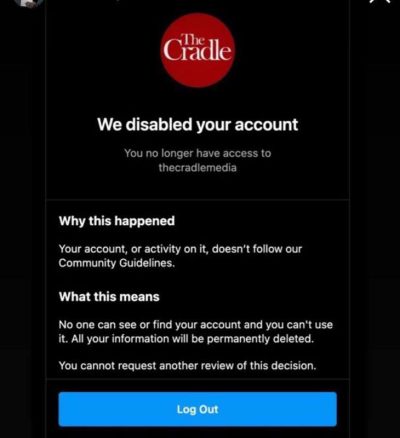
In yet another instance of censorship targeting alternative media outlets, Instagram has blocked the page of The Cradle, a journalist-driven news website covering West Asia.
Owned by Meta Platforms Inc., formerly Facebook Inc., Instagram claimed the page was “disabled” for not “following our community guidelines,” without specifying which guidelines were violated.
The Cradle’s social media team was informed that they “cannot request another review of the decision,” effectively making the suspension indefinite.
“No one can see or find your account and you can’t use it. All your information will be permanently deleted,” the message added.
A senior member of The Cradle team took to social media to condemn the censorship.
“This, my friends, is what happens when you amplify the voice of the resistance,” wrote the journalist, referring to the “permanent Meta ban.”
“We are proud of our work and its overwhelming reach, and none of it was in vain. Returning to Meta seems impossible at the moment, but please stay with us on X, Telegram, and YouTube.”
The Cradle has extensively covered Israel’s genocidal war against Palestinians in the Gaza Strip since October 7, 2023, highlighting both the regime’s war crimes and the complicity of Western states.
Its social media presence and following have also grown over the past year amid the war on Gaza.
According to rights groups, social media giants, particularly Meta-owned platforms, have engaged in systemic, global censorship of pro-Palestinian content since the genocidal war began last year.
At least three of Meta’s most senior leaders are believed to have close ties to Israel, including Chief Information Security Officer (CISO) Guy Rosen, who also served in the Israeli military’s Unit 8200.
Mark Zuckerberg, Meta founder and CEO, and Sheryl Sandberg, a Meta board member, have also been involved in pushing Israeli propaganda, including the discredited “Hamas October 7 mass rape” hoax, Paul Biggar, a New York-based software engineer and founder of Tech for Palestine, told the Press TV website in a May interview.
In October last year, days after the genocidal war on Gaza was launched, Meta removed the largest Palestinian news page, Quds News Network, on Facebook.
In February, Meta removed the English-language accounts belonging to the Leader of the Islamic Revolution Ayatollah Seyyed Ali Khamenei on Instagram.
It came on the day when the Leader said the genocide in Gaza was a tragedy for the entire humanity.
Press TV has also faced multiple bans on various social media platforms, including Instagram, Facebook, and X, for its pro-resistance coverage, both before and after Operation Al-Aqsa Storm.
US universities have imposed “police state” rules to avoid a repeat of campus protests against Israel’s genocidal war on Gaza, with students and faculties warning of the chilling effect they would have on free speech.
Reports indicate that as summer break ends, university administrations across the United States are imposing tougher measures to avoid a new wave of campus protests, which led to nationwide police crackdowns on campuses last semester.
Large protest encampments set up last semester eventually ended after a nationwide police crackdown on campuses in different US universities led to more than 3,100 arrests.
Scores of students faced criminal charges and disciplinary measures, and several schools scaled back graduation ceremonies for protesting against the Israeli war which has killed more than 40,000 Palestinians so far.
Columbia University students, who were at the vanguard of the movement, may encounter the most changes.
The university president, Minouche Shafik, resigned this week in the wake of criticism for her handling of the protests, but not before overseeing the installation of fencing around the lawns of the school’s quad – the heart of campus life and the site of large protest encampments.
According to the Wall Street Journal, university administrators are also considering bringing in “peace officers” with the authority to arrest students – something Columbia’s current 290 security personnel cannot do.
In an email sent to students last month, the administration also announced a “color-coded campus status” system, with varying levels of access restrictions “based upon the potential disruption to our academic mission and/or campus operations.”
To further confront protesting students, some universities have banned the use of “event tents, tables, walls, outdoor displays, inflatables, freestanding signs, huts, sculptures, booths, facilities, flashing or rotating lights, illuminated signs, or similar objects and structures.”
Students say despite new draconian rules the pro-Palestine rallies will continue as long as Israeli atrocities go on in occupied Palestinian lands.
“The war is still there … nothing has changed in Palestine,” said Jonathan Ben-Menachem, a sociology PhD student who participated in the Columbia University students’ campus protests.
He said universities’ efforts to quash the protests when students return from summer vacation will fail.
“It’s going to be more of a police state than it was, but I don’t think that means no one’s going to do anything,” the graduate student pointed out.
Human rights advocates and student activists as well as university faculty members have sounded the alarm about the new policies, warning that the restrictions in addition to endangering free speech, run counter to educational institutions’ mission to foster debate, risk deepening tensions on campuses, and – in the case of public universities – may run foul of schools’ constitutional obligations.
Last week, the American Association of University Professors issued a statement condemning the harsh anti-protesting rules at universities.
The tougher new rules “impose severe limits on speech and assembly that discourage or shut down freedom of expression”, wrote the group, which represents more than 44,000 faculty members nationwide.
“Those who care about higher education and democracy should be alarmed.”
Although I can still practice medicine, the ABIM’s actions against me and Paul Marik threaten the sanctity and autonomy of the physician-patient relationship.
I will just start by saying that I believe that the ABIM’s decision was 100% predetermined even before we first received their accusation in June 2022. There was no way they were going to declare us innocent of misinformation, even though a good portion of this country knows how effective and accurate our deeply evidence-based Covid treatment guidance was (and still is).
One of the reasons why they were never gonna let us off is that, if they declared us “innocent,” (i.e. accurate) that action would have immediately imperiled the decisions by medical boards across the country who persecuted hundreds of doctors for using ivermectin or hydroxychloroquine or for recommending against Covid-19 mRNA gene therapy products. More importantly, it could potentially launch hundreds of thousands of lawsuits by the families of patients who died due to lack of early treatments offerred by clinics and hospitals or filled by pharmacies.
The above examples which led to the deaths of so many shows the sheer power of mega-corporations that put their financial interests ahead of our health and our lives. Through their overwhelming influence over nearly every institution of society and Science (media, journals, health agencies, politicians, medical schools, physicians etc), they literally succeeded in depriving a whole country (and world) of the most effective, inexpensive, safe, and widely available treatments for Covid. My biggest worry is that this crime against humanity may never enter the history books and thus will be eventually erased from memory. Which is looking probable.
The massive financial opportunities that Covid immediately presented to Big Pharma were threatened by the “inconvenient truths” Paul and I put out there. This ABIM action is one way in which Big Pharma punishes those who are foolish enough to do so. Foolish is not quite the right word in our case as I would argue we were simply naive to the consequences of advocating publicly for the use of off-patent medicines for an immensely profitable disease. It wasn’t heroism as some think, but rather extreme naivete.
I really never thought I would have to lose/leave three jobs and now three Board certifications for speaking truths. Recall that I was very well known in my specialty prior to Covid and was about to become Full Professor when I resigned as Chief of the Critical Care Service at the University of Wisconsin (where I was also the Medical Director of the Trauma and Life Support Center). Reading the Washington Post article “Doctors Accused of Spreading Misinformation Lose Certification” was a pretty sobering reminder of how far I have supposedly “fallen” (Not so fun fact: they completely overstated my salary as the money I received in 2022 included retroactive pay for 2021).
But I am still standing folks. I am happily practicing medicine at my Leading Edge Clinic with my amazing partner Scott Marsland. As many know, we specialize in treating vaccine injury syndromes and Long Covid, and I believe we are soon closing in on having treated our 1,400th patient.
Thank God I managed to build a private, fee-based practice two and half years ago. At the time I suspected this was coming while also already aware that I was “unemployable” by the system. I got fired by my last hospital for a 100% made up complaint, despite the fact they desperately needed me. I was an independent contractor at the time and my ICU partners and all the nurses really liked me. But my partners were telling me that they were under increasing pressure by the Chief Medical Officer to “get rid of Kory.” Although they initially resisted, my stance on vaccines started to cause even more problems for them. When the ICU Director, who was both a friend and a colleague, called to fire me, his last words were, “Pierre, I know there is a war going on and unfortunately you are a casualty.” Truer words were never spoken.
Just know that Board certification is not a license to practice medicine (that comes from state medical licensing Boards of which I have more than a few still). But this ABIM action now puts a definitive end to any hope of me returning to an academic or “system” position (not that I have that hope anymore). Why is that? Well, because Board Certification was originally just a badge of distinction that doctors could use to impress each other and their patients. But they have since weaponized and monetized Board Certification in that currently you cannot obtain a faculty appointment at an academic medical center without one. Nor can you work for most hospitals without one. Even worse, insurance plans will not put you on their provider panels without it. So, although I have been fully excommunicated from “the system,” I cannot be happier about it.
Understand that what happened to me this week was a devastating censorship action, plain and simple. It was done for two reasons; the first was to destroy my reputation and credibility so that my voice will no longer carry (essentially silencing me) and the other was to send a message to doctors that if they stray from consensus, no matter how scientifically absurd (e.g. mRNA vaccines for a coronavirus), dangerous (e.g. remdesivir, mRNA jabs), or ineffective (Paxlovid), they will be punished.
The damage that will result to patients again, is incalculable. No longer will “system” doctors be able to practice medicine with the autonomy they require to arrive at the best decision for each individual patient. Nearly everything they do will be protocolized with society guideline recommended treatments (i.e. consensus manufactured by Pharma). No longer will they be able to “think out of the box” or use treatments which although known effective, do not have the blessing of those in control of that system. I am as terrified as ever of needing a hospital.
Not to overstate the importance of their actions, but Medicine as I knew it, or thought I knew it, is even more dead if that is possible. If you can’t have a differing scientific opinion without losing your career over it, then how is that Medicine or Science? In fact, in our repeated written defenses, we challenged the ABIM, asking them where “the line” is between legitimate scientific debate driven by a differing emphasis on or interpretation of data and outright misinformation.
Misnformation, as I understand it, is defined as “incorrect or misleading” information. For us to be misinformationists, in my mind, would mean that all the data from trials and studies that exist for therapeutics in Covid;
the overwhelming preponderance of data for the efficacy and safety of ivermectin in Covid shows it to be ineffective and dangerous
the overwhelming preponderance of data for the vaccines show they are safe and effective
Basically, it comes down to how you interpret the body of evidence which currently exists. Paul and I adhered rigidly to a “totality of the evidence” approach, drawing from in-vitro, in-vivo, clinical and epidemiologic data. All of it lined up in a truly magnificent, inspiring, and unprecedented way. Well, except for the “Big 7 RCT’s” which manipulated the design, conduct and analyses to conclude ivermectin was ineffective. I spent literally hundreds of hours (along with others like Alexandros Marinos), publishing critiques which exposed the most absurd scientific misconduct I had ever witnessed. If interested, here are just some of those critiques, e.g. Oxfords’ PRINCIPLE trial, the TOGETHER trial (three parts, here, here, and here, and the NIH ACTIV-6 trial )
We also evolved with the data, unlike the agencies who had quickly determined in December of 2020 that the vaccines were safe and effective and never, ever veered from that stance up until this day. In contrast, the founding members of the FLCCC, for quite a long time, differed in respect to the efficacy, safety, and need for the mRNA vaccines. I was the first and most vocal against the mRNA vaccines (starting in April 2021) which actually almost led to the breakup of the FLCCC or at least the membership of the original 5.
Prior to April 2021 I was simply neutral/skeptical. That skepticisim was due to what I thought might be folly in trying to vaccinate against a coronavirus (I knew that historically coronavirus vaccines had failed because the vaccinated animals developed antibody dependent enhancement and also that coronaviruses mutate rapidly). Then I did my first deep dive on VAERS and the epidemiologic data showing massive spikes in mortality and hospitalizations timed with the rollout of the jabs across dozens of countries. Voila, I was now “anti-vaxx.”
I continued to track and analyze the ever-emerging data and the horrors they revealed. This work ultimately led the FLCCC to reach an internal “consensus” that the vaccines should be avoided at all costs (literally at all costs as none of the costs incurred by taking the jab were worth someones life). Anyway, I just wanted to show that we evolved with the data, always questioning and reviewing as new data emerged.
I will end by reminding all of how dangerous the ABIM’s actions will be to all of our lives because it will further erode and/or literally destroy the patient-physician relationship. As I wrote in a previous Op-ED in the Daily Caller on January 31, 2023, “A War Is Still Being Waged Against Doctors Who Question Covid Orthodoxy:”
By virtue of their professional training, doctors must advise patients on available treatments and known risks of any treatment or procedure. By threatening doctors who might provide information different than their preferred worldview, ABIM is disrupting the doctor-patient relationship.
When allowed to practice their craft freely, physicians can prevent societal disaster by focusing on individual patients, informed by clinical experience.
Groups like the ABIM, and public medical officials like Fauci, should support and encourage evidence-based debate and patient-centered care.
Instead, they have suppressed both that debate and treatment approach by persecuting its proponents. This campaign must be stopped, its origins and evolution must be thoroughly documented, and it must never be allowed to recur. Physician autonomy must be restored lest all patients suffer.
Below is my column in The Hill on my call for a bill that would bar federal funding of any program and grant to censor, blacklist, or target individuals or sites based on their content. It is time to get the U.S. government out of the censorship business. The column discusses the proposal in my new book, “The Indispensable Right: Free Speech in an Age of Rage” to block any further funding for the current system of corporate, academic, and government programs targeting opposing or dissenting views.
Here is the column:
It is time to get the United States out of the censorship business for good.
In the last three years, the House of Representatives has disclosed a massive censorship system run in part with federal funding and with coordination with federal officials. A federal court described this system as truly “Orwellian.”
The Biden Administration has made speech regulation a priority in targeting disinformation, misinformation or malinformation. President Joe Biden even said that companies refusing to censor citizens were “killing people.”
His administration has now created an anti-free speech record that is only rivaled by the Adams Administration, which used the Alien and Sedition Acts to arrest political opponents.
Jen Easterly, who heads the Cybersecurity and Infrastructure Security Agency, is an example of how speech controls and censorship have become mainstream. Her agency was created to work on our critical infrastructure, but Easterly declared that the mandate would now include policing “our cognitive infrastructure.” That includes combating “malinformation,” or information “based on fact, but used out of context to mislead, harm, or manipulate.”
I have testified for years about the censorship system. For much of that time, Democrats insisted that there was no proof of any coordination or funding from the government. Such evidence did indeed exist, but Democrats worked to block any investigation to confirm what we already knew about government officials targeting individuals and groups for throttling, bans, and blacklisting.
Then Elon Musk bought Twitter. The release of the Twitter Files destroyed any plausible deniability of the government’s role in this censorship system. Various agencies had employees working with social media companies to target those with opposing or disfavored views. At the same time, we learned of grants from the federal government supporting blacklisting and targeting operations.
That includes efforts to quietly choke off the revenue of disfavored sites by pressuring advertisers and donors.
While companies like Facebook have continued to fight to conceal their coordination with the government, the Twitter Files pulled back the curtain to expose the system. Indeed, Democrats largely abandoned their denials and turned to full-throated defenses of censorship, even calling free speech advocates “Putin-lovers” and “insurrectionist sympathizers.”
In 1800, Thomas Jefferson defeated John Adams in the only election where free speech was a primary issue for voters. It should be again. Vice President Kamala Harris is known as a supporter for these censorship and blacklisting operations. She can now defend that record and convince Americans that they need to have less free speech.
This debate should ideally focus on one simple legislative proposal. In my new book, I suggest various measures that can regain the ground that we have lost on free speech. One such measure is a federal law that would ban any federal funding of any offices or programs (government, academic, or corporate) that rate, target, censor, throttle, or seek to take adverse action against individuals or groups based on their viewpoints in public forums or social media.
There can be easy exceptions to this ban for individuals or groups engaging in criminal conduct or unlawful foreign interference with elections. Threatening individuals or trafficking in child pornography constitute conduct, not speech. They are criminal acts under the federal code.
Nothing in this law would prevent the government from speaking in its own voice. If Secretary of Homeland Security Alejandro Mayorkas wants to challenge claims made about him or his agency, he can do so on the agency website or make his case to the media. That is the essence of free speech. What he cannot do is create a Disinformation Governance Board to regulate the speech of citizens or groups.
In my prior testimony to Congress, I warned about the use of what I called “censorship by surrogate” through which agencies did indirectly what they are barred from doing directly under the First Amendment.
This new law will not put an end to the burgeoning anti-free speech movement. It will not end the new market for groups making millions in seeking to silence or strangle sites with opposing views. However, it will create a wall of separation of the government from censorship systems.
It would also offer a simple and clear line for the 2024 election. Candidates will have to take sides on free speech. If candidates like Harris want to continue to support the government in blacklisting or censoring citizens, they should own it. We spent years of politicians engaging in cynical denials of the government’s role in censorship. If these politicians are “all in” with censorship, then they should be honest about it and let voters make the same choice that was made in 1800.
With billions to play with and enabling allies in Congress to conceal federal operations, speech regulation is an irresistible temptation for the government. We have seen how this temptation quickly becomes an insatiable appetite for government officials seeking to silence rather than answer critics.
Let’s get our government out of the business of rating, throttling blacklisting, and censoring citizens. It is time to pass a free speech protection act.
Freedom of speech in the US is only permitted for those who express pro-American views, while dissenters are subjected to a “political inquisition,” Russia’s ambassador to Washington, Anatoly Antonov, has claimed.
The diplomat was commenting on an FBI search at the home of Russian-born US political analyst and author Dimitri Simes in Virginia, on Tuesday. Simes, a critic of President Joe Biden’s administration, has been co-hosting a geopolitical talk show on Russia’s Channel 1 since 2018.
The targeting of Simes is another example of the “witch hunt” taking place in the US in the run up to the presidential election on November 5, Antonov wrote in a post on Telegram on Saturday.
“Hundreds of people are declared undesirable just because they dare to contradict the policies of the administration. They are forbidden from having their own point of view” and government agents are “breaking into homes, performing searches and seizing documents,” he stated.
According to the ambassador, the situation in the country resembles the “dark times of McCarthyism,” a campaign against suspected communists led by Republican Senator Joseph McCarthy in the 1950s.
“The local ruling circles have decisively embarked on the path of total censorship. Freedom of speech in modern America is sacred only if this speech is pro-American. All dissidents are subject to political inquisition, especially when it comes to those who fight against one-sided and biased views on Russia,” he said.
Antonov accused Washington of double standards when it comes to democracy and freedom of speech. While “easily” neglecting the rights provided by the First Amendment at home, US officials, “at the same time continue to lecture the whole world on democratic values and human rights,” he wrote.
Simes is a naturalized US citizen, who immigrated from the Soviet Union in 1973. He served as an aide to President Richard Nixon and as the publisher and CEO of National Interest magazine, which advocates a realist approach to international relations and geopolitics.
At the height of Russiagate, Simes was among those investigated by Special Counsel Robert Mueller as a suspected contact between Donald Trump and the Russian government. The report by Muller in 2019, which failed to find any evidence of collusion between Moscow and Trump’s 2016 campaign, also vindicated Simes.
FBI agents arrived at his property in Virginia a week after a search took place at the home of former US Marine and UN weapons inspector Scott Ritter in New York state. Ritter, who is now a journalist and commentator, said the US authorities appeared to be “primarily concerned” with his “relationship” with Russian media outlets – RT and Sputnik news agency.
This site is provided as a research and reference tool. Although we make every reasonable effort to ensure that the information and data provided at this site are useful, accurate, and current, we cannot guarantee that the information and data provided here will be error-free. By using this site, you assume all responsibility for and risk arising from your use of and reliance upon the contents of this site.
This site and the information available through it do not, and are not intended to constitute legal advice. Should you require legal advice, you should consult your own attorney.
Nothing within this site or linked to by this site constitutes investment advice or medical advice.
Materials accessible from or added to this site by third parties, such as comments posted, are strictly the responsibility of the third party who added such materials or made them accessible and we neither endorse nor undertake to control, monitor, edit or assume responsibility for any such third-party material.
The posting of stories, commentaries, reports, documents and links (embedded or otherwise) on this site does not in any way, shape or form, implied or otherwise, necessarily express or suggest endorsement or support of any of such posted material or parts therein.
The word “alleged” is deemed to occur before the word “fraud.” Since the rule of law still applies. To peasants, at least.
Fair Use
This site contains copyrighted material the use of which has not always been specifically authorized by the copyright owner. We are making such material available in our efforts to advance understanding of environmental, political, human rights, economic, democracy, scientific, and social justice issues, etc. We believe this constitutes a ‘fair use’ of any such copyrighted material as provided for in section 107 of the US Copyright Law. In accordance with Title 17 U.S.C. Section 107, the material on this site is distributed without profit to those who have expressed a prior interest in receiving the included information for research and educational purposes. For more info go to: http://www.law.cornell.edu/uscode/17/107.shtml. If you wish to use copyrighted material from this site for purposes of your own that go beyond ‘fair use’, you must obtain permission from the copyright owner.
DMCA Contact
This is information for anyone that wishes to challenge our “fair use” of copyrighted material.
If you are a legal copyright holder or a designated agent for such and you believe that content residing on or accessible through our website infringes a copyright and falls outside the boundaries of “Fair Use”, please send a notice of infringement by contacting atheonews@gmail.com.
We will respond and take necessary action immediately.
If notice is given of an alleged copyright violation we will act expeditiously to remove or disable access to the material(s) in question.
All 3rd party material posted on this website is copyright the respective owners / authors. Aletho News makes no claim of copyright on such material.



 Aletho News