Scott Ritter: Biden Administration Declaring War on Journalism
Sputnik – August 16, 2024
Recent FBI raids on properties belonging to Russian-American political scientist Dimitri K. Simes and Scott Ritter, who both challenge the mainstream US political propaganda, are meant to squash dissent on Ukraine, former UN weapons inspector Ritter told Sputnik.
The conflict in Ukraine – in which the US has become deeply involved by providing the Kiev regime with billions of dollars – reportedly has people questioning Washington’s hawkish policy that the government seeks to suppress.
“What is our crime? Our crime is to have an opinion that is opposite of that of the United States government when it comes to Ukraine,” Ritter emphasized.
It is not just about the government deceiving the American people, it is about the mainstream media working in close coordination with the US government to deceive the American people about a war, Ritter noted.
“That’s where independent journalists come in. That’s where a genuinely free press [comes in], a press that isn’t subordinated to the US government, that doesn’t serve as a stenographer of US government policy, a free press that questions the official narrative,” he pointed out.
Ritter concluded that the US government does not trust common people, irrespective of their political leanings, and is actively trying to deceive and manipulate the public.
Earlier, Simes, a Channel One presenter in Russia and the founder and ex-president of the Center for the National Interest (USA), told Sputnik that he had not been to the United States since 2022, and had not been notified ahead of time that FBI agents would be conducting a search of his property in Rappahannock County, Virginia, this week.
Court Denies Jordan Peterson’s Appeal as Free Speech Fight Heats Up in Canada
By Didi Rankovic | Reclaim The Net | August 15, 2024
Psychologist and author Jordan Peterson has announced that Canada’s Supreme Court refused his appeal against undergoing social media re-education (“remedial”) training.
The case stems from the demand of the Ontario College of Psychologists (which licenses practicing clinical psychologists) for Peterson to be subjected to media training. The ruling now means he is to pay court costs to the organization seeking to impose this measure on him.
According to Peterson, the demand was spurred by his negative stance regarding what’s known as “gender-affirming care,” the doomsday climate change narrative (that he spoke about on Joe Rogan’s podcast), and criticism of Canadian Prime Minister Justin Trudeau.
In a video posted on YouTube, Peterson said the court’s “terrible decision” not to consider his appeal was yet another “blow to free speech” in his country – and could well result in the revoking of his license to practice, while the ultimate goal of the social media re-education would be to get “something approximating a public apology” for his opinions and for expressing them.
Peterson previously mentioned his criticism of social service workers and police “threatening to apprehend the children of the Trucker Convoy protestors” as another reason for the Ontario College of Psychologists wanting to get him “reeducated” – though he did not speak about this in the YouTube video.
In a post on X, Peterson said that the Supreme Court ruling amounted to admitting that “mid-level bureaucrats who rule the professional colleges and regulatory boards” have more power than the Canadian Charter of Rights and Freedoms.
In another post, he criticized Ontario Premier Doug Ford’s government which he said was “overseeing the commissars” standing in the way of conservatives’ free expression, including “perhaps” Ford himself.
Peterson is also critical of the way Canada’s CBC covers the case (including his remarks on the Rogan podcast), referring to the broadcaster as “paid lackeys.”
But Peterson has received support from other corners, including Alliance Defending Freedom (ADF) International, who said they were willing to work with him “to see if he wants to take the case international” – which he seems to be open to.
And Canadian Conservative Party leader Pierre Poilievre lambasted the decision as an attempt to impose forced political reeducation, noting that this came after “another government bureaucracy threatened to ban a Canadian from practicing his profession because he expressed political opinions the state doesn’t like.”
The FBI ‘Visits’ Scott Ritter

By Andrew P. Napolitano | Ron Paul Institute | August 15, 2024
Among the lesser-known holes in the Constitution cut by the Patriot Act of 2001 was the destruction of the “wall” between federal law enforcement and federal spies. The wall was erected in the Foreign Intelligence Surveillance Act of 1978, which statutorily limited all federal domestic spying to that which was authorized by the Foreign Intelligence Surveillance Court.
The wall was intended to prevent law enforcement from accessing and using data gathered by America’s domestic spying agencies.
Government spying is rampant in the US, and the feds regularly engage in it as part of law enforcement’s well-known antipathy to the Fourth Amendment. Last week, the FBI admitted as much when it raided the home of former Chief UN Weapons Inspector Scott Ritter. Scott is a courageous and gifted former Marine. He is also a fierce and articulate antiwar warrior.
Here is the backstory.
After President Richard Nixon resigned the presidency, Congress investigated his use of the FBI and CIA as domestic spying agencies. Some of the spying was on political dissenters and some on political opponents. None of it was lawful.
What is lawful spying? The modern Supreme Court has made it clear that domestic spying is a “search” and the acquisition of data from a search is a “seizure” within the meaning of the Fourth Amendment. That amendment requires a warrant issued by a judge based on probable cause of crime presented under oath to the judge for a search or seizure to be lawful. The amendment also requires that all search warrants specifically describe the place to be searched and the person or thing to be seized.
The language in the Fourth Amendment is the most precise in the Constitution because of the colonial disgust with British general warrants. A general warrant was issued to British agents by a secret court in London. General warrants did not require probable cause, only “governmental needs.” That, of course, was no standard whatsoever, as whatever the government wants it will claim that it needs.
General warrants authorized government agents to search wherever they wished and to seize whatever they found — stated differently, to engage in fishing expeditions.
FISA required that all domestic spying be authorized by the new and secret FISA Court. Congress then unconstitutionally lowered the probable cause of crime standard for the FISA Court to probable cause of speaking to a foreign agent, and it permitted the FISA Court to issue general warrants.
Yet, the FISA compromise that was engineered in order to attract congressional votes was the wall. The wall prohibited whatever data was acquired from surveillance conducted pursuant to a FISA warrant to be shared with law enforcement.
So, if a janitor in the Russian embassy was really an intelligence agent who was distributing illegal drugs as lures to get Americans to spy for him, any telephonic evidence of his drug dealing could not be given to the FBI.
The purpose of the wall was not to protect foreign agents from domestic criminal prosecutions; it was to prevent American law enforcement from violating personal privacy by spying on Americans without search warrants.
Fast forward to the weeks after 9/11 when, with no serious debate, Congress enacted the Patriot Act. It removed the wall between law enforcement and spying. And by 2001, the FISA Court had on its own lowered the standard for issuing a search warrant from probable cause of speaking to a foreign agent to probable cause of speaking to a foreign person. This, too, was unlawful and unconstitutional.
The language removing the wall sounds benign, as it requires that the purpose of the spying must be national security and the discovered criminal evidence — if any — must be accidental or inadvertent. In January 2023, the FBI admitted that it intentionally uses the CIA and the NSA to spy on Americans as to whom it has neither probable cause of crime nor even articulable suspicion of criminal behavior.
Articulable suspicion is the linchpin of commencing all criminal investigations. Without requiring suspicion, we are back to fishing expeditions.
The FBI’s admission that it uses the CIA and the NSA to spy for it came in the form of a 906-page FBI rulebook written during the Trump administration, disseminated to federal agents in 2021 and made known to Congress last year.
Last week, when FBI agents searched Ritter’s home in upstate New York, in addition to trucks, guns, a SWAT team and a bomb squad, they arrived with printed copies of two years’ of Ritter’s emails and texts that they obtained without a search warrant. To do this, they either hacked into Ritter’s electronic devices — a felony — or they relied on their cousins, the CIA and the NSA, to do so, also a felony.
But the CIA charter prohibits its employees from engaging in domestic surveillance and law enforcement. Nevertheless, we know the CIA is physically or virtually present in all of the 50 US statehouses. And the NSA is required to go to the FISA Court when it wants to spy. We know that this, too, is a charade, as the NSA regularly captures every keystroke triggered on every mobile device and desktop computer in the US, 24/7, without warrants.
The search warrant for Ritter’s home specified only electronic devices, of which he had three. Yet, the 40 FBI agents there stole a truckload of materials from him, including his notes from his U.N. inspector years in the 2000s, a draft of a book he is in the midst of writing and some of his wife’s personal property.
The invasion of Scott Ritter’s home was a perversion of the Fourth Amendment, a criminal theft of his private property and an effort to chill his free speech. But it was not surprising. This is what has become of federal law enforcement today. The folks we have hired to protect the Constitution are destroying it.
To learn more about Judge Andrew Napolitano, visit https://JudgeNap.com.
COPYRIGHT 2024 ANDREW P. NAPOLITANO
DISTRIBUTED BY CREATORS.COM
CAIR files lawsuit against FBI, US govt agencies over blacklisting of Palestinian-Americans
MEMO | August 13, 2024
An American Muslim advocacy group has filed a lawsuit against the Federal Bureau of Investigations (FBI) and the leaders of other United States government agencies after two Palestinian-American men were blacklisted due to their pro-Palestine activism.
On Monday, the Council on American-Islamic Relations (CAIR) filed the lawsuit in response to what it called a discriminatory and racist placement of two Palestinian Americans – Osama Abu Irshaid and Mustafa Zeidan – on a watch list by US federal authorities.
According to the lawsuit, Irshaid, the Executive Director of an organisation named American Muslims for Palestine, travelled to Qatar from the US in late May and returned in early June. Upon his return, federal agents forced him to undergo extra screening and questioning – reportedly focusing on his activism and organising against Israel’s offensive on Gaza – while seizing his phone, which has not yet been returned.
The California-based Zeidan, meanwhile, who often visits his ailing mother in Jordan, was not allowed to board a flight on his way to the country earlier this year, with authorities later informing him that he was placed on the no-fly list.
Filed in the US District Court for the Eastern District of Virginia, the lawsuit stated that “CAIR is challenging the mistreatment of these Palestinian-American activists on constitutional grounds”, asserting that their blacklisting is based on discrimination and racism rather than actual criminal or national security concerns. “Neither Dr. Abu Irshaid nor Mr. Zeidan have ever been charged or convicted of a violent crime,” it said.
Aside from the FBI, other defendants named in the lawsuit are the leaders of government agencies, including the State Department and the Homeland Security Department.
Specialist UK Police Teams Target “Hate” on Social Media
By Cindy Harper | Reclaim The Net | August 13, 2024
The UK authorities and the media either willing to or feeling pressure to take their cues from the government, continue to assert that the root cause of the serious rioting that hit the country this month is to be found on – social media.
This, in turn, makes for a convenient excuse to ramp up police surveillance of online content. Special police teams are now going through social sites in order to identify those said to have “incited” the riots, and there’s a special name for them – “hate influencers.”
The said teams consist of what reports refer to as “specialized” officers, those investigating serious crimes (i.e., murder and the like) and terrorism, as well as local units whose job is normally to investigate organized crime.
“Other” national-level teams are also mentioned as taking part in scouring the internet, and what they might be doing is suggested by the goal of this exercise being gaining “a clear intelligence picture,” as one article put it, citing the National Police Chiefs’ Council (NPCC).
A statement on the NPCC site said that the search for “online offenders” is being led by regional organized crime units (ROCUs) and that the offense is spreading hate and inciting violence on the internet.
NPCC Chief Constable Chris Haward is quoted as saying that the large number of people taking part in protests and riots “did not mobilize spontaneously.”
“It was the result of dozens of so-called influencers, exploiting the outpouring of grief from the tragic loss of three young girls in Southport,” Haward said, referring to the knife attack that resulted in the three murders.
Still talking about “hate influencers,” Haward added: “They knowingly spread misinformation, stoked the flames of hatred and division, and incited violence from the comfort of their own homes – causing chaos on other people’s doorsteps. (…) Online crimes have real-world consequences and you will be dealt with in the same way as those physically present and inflicting the violence.”
Thus far, the NPCC has said that it is investigating hundreds of leads. The content targeted by law enforcement and intelligence units is reportedly spread across a range of unnamed social sites and platforms, according to the press release.
It is also revealed that “hate influencers” as the British legacy press calls them will not be held responsible simply for using the internet to allegedly incite real-world violence – but also for something separate which the NPCC calls “violence online.”
“A senior investigator” will have the last word on whether any of this can be treated as a crime – and if so, people behind the accounts and/or content will be identified and arrested.
Tyranny in the UK – Can it Happen Here?
By Ron Paul | August 12, 2024
As the UK descends into tyranny, where just re-Tweeting something the government doesn’t like can land a person a multi-year jail sentence, Americans are wondering, “can it happen here?” After all, we have the guarantees of the First Amendment.
But while we shake our heads at UK authorities jailing people for their social media posts this past week, we should not kid ourselves. The answer is that silencing dissent can happen here and it is happening here.
Here are just three recent examples of how the “deep state” or the permanent government is conspiring to restrict political dialogue in the United States.
First is the revelation that former US Representative and former US presidential candidate Tulsi Gabbard has been placed under the bizarrely named “Quiet Skies” program. As reported by journalist Matt Taibbi based on revelations by TSA whistleblowers, this July Gabbard was flagged as a terror threat, and every time she travels her boarding pass is marked so that she is pulled aside for extensive screening. According to the whistleblowers, “Gabbard is unaware she has two Explosive Detection Canine Teams, one Transportation Security Specialist (explosives), one plainclothes TSA Supervisor, and three Federal Air Marshals on every flight she boards.”
As Gabbard herself revealed recently on the Laura Ingraham show, “A few weeks ago, I had the audacity to tell the truth: that Kamala Harris would essentially be a mouthpiece and puppet of the Military Industrial Complex and National Security State. The next day, July 23, they retaliated. Sadly this is what we can expect from the ‘Harris Administration.’”
Next we have the attempted assassination of former president Donald Trump. It seems every day brings a new revelation that calls into question whether the massive failure to protect the Republican presidential candidate was just an “honest mistake.” We know from 1963 what can happen to presidents who cross the “deep state” and we know from Trump’s four years in office how “former” deep state officials can conspire to undermine the presidency with lies like “Russiagate.”
Finally we have the case of Robert F. Kennedy, Jr. Up until the Trump assassination attempt, the Biden/Harris Administration refused to provide the independent presidential candidate with Secret Service protection. RFK, Jr. has consistently and effectively criticized not only the current administration but the “deep state” itself while out on the campaign trail. Even though there were credible threats against him on the campaign trail the Biden/Harris administration refused to budge for months. Why? Did they want to silence him?
The US government learned an important – and dangerous – lesson from Covid: all you have to do to crush political dissent is to use the weight of the government to force the “private” sector to do the censoring for you. It is only a half-step away from forbidding us from expressing our thoughts on a virus to sending us to prison for expressing other thoughts the government does not like. And maybe worse.
There will be a reaction in the UK to the brutality of the Starmer regime. We can only hope for their – and our – sake that the reaction will be a newfound determination by the people that no government should have the authority to shut them up or jail them for their political views. To paraphrase Benjamin Franklin, “free speech, if you can keep it.”
Scott Ritter: FBI Raids Part & Parcel of US Government’ Intimidation
By Svetlana Ekimenko – Sputnik – August 12, 2024
Former USMC intelligence officer and Sputnik contributor Sсott Ritter’s New York home was raided earlier this month over allegations he had violated the Foreign Agents Registration Act (FARA), which requires anyone who acts on behalf of a foreign nation to register as such to the US government.
The US government is “not happy” with the truthful message that he is conveying as a Sputnik contributor, former UN weapons inspector Scott Ritter believes.
This explains the recent FBI raid on his home over claims he had violated the Foreign Agents Registration Act (FARA).
It was “disconcerting and chilling” when around 40 FBI agents raided his house, revealed Ritter.
“I asked repeatedly, ‘Why are you doing this?’’ What are you concerned about? Tell me what specific actions you’re concerned about and I can help resolve this.’ Now, we had a lengthy conversation, the special agents and I, but never once were they able to say this is why we believe you’re in violation,” he said.
However, what the agents did talk a lot about was the pundit’s relationship with Sputnik.
“They were very concerned about the work that I do as a contributor to Sputnik […] The US government is clearly unhappy with my message, unhappy with the impact that I’m having, and nervous that they can’t control me. And so I think that this raid, this search warrant, this ongoing investigation is part and parcel of a larger project of intimidation that unfortunately will continue, I believe, for the near future,” Ritter said.
The FBI and US Department of Justice are bothered by the impact people like him are having “on informing an audience not only inside the United States, but around the world about the malfeasance of American foreign policy,” Scott Ritter said. However, the author and commentator refused to be intimidated, saying he looked forward to continuing to operate as a contributor to Sputnik.
“I’m very proud of this relationship and I think highly of the editors and producers that I work with, and I look forward to continuing to do this for the foreseeable future,” Ritter stated.
EU Threatens Musk Over “Harmful” Speech Ahead Of Trump Interview
By Cindy Harper | Reclaim The Net | August 12, 2024
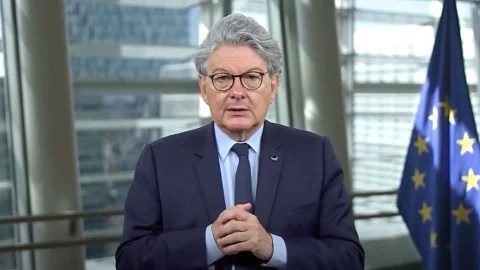
On the day of Elon Musk’s interview with President Donald Trump on X, the EU’s top digital official, Thierry Breton, issued a reminder to Musk of his responsibilities under EU law to curb the spread of “harmful content.”
Breton, the pro-censorship internal market commissioner, emphasized the significance of platform moderation in a letter and a post on X, stating, “With great audience comes greater responsibility.”
The European Union, under its censorship law, the Digital Services Act (DSA), mandates that digital platforms stringently monitor online content to shield users from potential “harm.”
This legislation is part of a broader scrutiny of X, which has consistently been targeted by the EU. Breton’s correspondence highlighted that the DSA’s mandates apply uniformly, including to Musk.
The reminder was prompted by concerns over the “risk of amplification of potentially harmful content in the EU,” particularly with Musk’s upcoming interview with Trump and Musk’s own recent remarks concerning the attack on free speech currently being experienced in the UK.
Breton further warned, “My services and I will be extremely vigilant to any evidence that points to breaches of the DSA and will not hesitate to make full use of our toolbox, including by adopting interim measures, should it be warranted to protect EU citizens from serious harm.”
As the European Union persists in the stringent enforcement of its censorship law, the imposition of its regulatory well beyond its borders, notably into the United Kingdom—a nation no longer tethered by EU membership—raises profound concerns about the overreach of censorship under the guise of protection.
The EU’s call for rigorous content moderation, even in territories outside its jurisdiction, smacks of an unsettling desire to extend its influence, stifling discourse and dissent not only within its member states but also in nations that have consciously chosen a different path.
The insistence on such broad and pervasive controls over digital content by an entity like the EU, which should ostensibly champion democratic values, is alarming.
This form of interventionism in the UK, under the pretense of safeguarding EU citizens from “harm,” undermines the very essence of free speech—a cornerstone of democratic societies. By dictating terms and conditions that stretch its authority into non-EU territories, the European Union not only compromises the sovereignty of other nations but also sets a dangerous precedent for global digital governance, where freedom of expression becomes a casualty in the battle against vaguely defined “harmful content.”
Judges Back Meta in Vaccine “Misinformation” Battle, Free Speech Advocates Vow to Fight On
By Dan Frieth | Reclaim The Net | August 10, 2024
The 9th Circuit US Court of Appeals ruled this week in favor of Meta, Facebook’s parent company. The case was brought forward by the Children’s Health Defense (CHD) over allegations that the social media giant violated free speech rights.
The lawsuit, initiated in August 2020 and later updated in December, claimed that Facebook, along with its CEO Mark Zuckerberg and two fact-checking entities, Science Feedback, and the Poynter Institute’s PolitiFact site, was complicit in an unconstitutional act of privately exercising governmental censorship. CHD alleges that Facebook, in collaboration with the Centers for Disease Control and Prevention (CDC) and other federal institutions, is censoring content and discussions that the government is barred from suppressing under the First Amendment.
We obtained a copy of the opinion for you here.
The plaintiff specifically accused these sides of working in tandem to unfairly stifle valid attempts to discuss vaccine safety on Facebook, often through indirect yet sensorial measures like the use of warning labels. According to CHD, this type of arrangement between public entities and private corporations represents a breach of the First Amendment due to its perceived status as “state action.”
Despite these arguments, the 9th Circuit court concluded that CHD was not successful in meeting the initial requirement for state action, as the censorship inflicted was more a result of Meta’s content moderation policies and not any directive under federal law. Further, the court also asserted that CHD did not present any evidence of a binding agreement requiring Facebook to execute any particular action in response to misinformation about vaccines.
Although all judges did not share the same opinion, Circuit Judge Daniel P. Collins presented a partially dissenting viewpoint. He opined that the interactions between Meta and the Government involving the suppression of specific types of vaccine-related speech were substantial enough to evoke First Amendment considerations.
Expressing disappointment and worry, CHD CEO Mary Holland stated, “If we cannot stop the government’s joint action with Big Tech to censor unwanted information, our First Amendment is a pyrrhic victory — it means almost nothing in our real world of social media.” While she was pleased with the non-unanimous nature of the decision, Holland hinted at the possibility of appealing to the US Supreme Court after further review.
At the heart of the court battle, ongoing for almost four years, were claims, primarily leveled by CHD’s then-Chairman and Chief Executive Counsel, Robert F. Kennedy Jr., that tactics employed by the US Government to pressure Facebook into censoring vaccine “misinformation” were existential threats.
Israeli strikes on Gaza kill two more Palestinian journalists, their family members

Deceased Palestinian journalists Abdullah al-Soussi (L) and Tamim Muammar (Photo via social media)
MEMO | August 10, 2024
The agency called on: “The International Criminal Court Prosecutor to quickly begin investigations into the occupation’s crimes against Palestinian journalists.”
‘Targeted Harassment’: Scott Ritter Blasts Raid on His Home as US Government ‘Fishing Expedition’
Sputnik – 08.08.2024
Former USMC intelligence officer Scott Ritter’s home was raided Wednesday over allegations he had violated the Foreign Agents Registration Act (FARA), which requires anyone who acts on behalf of a foreign nation to register as such to the US government. However, individuals accused of such a violation are typically notified by letter, not a raid.
The recent raid carried out on the New York home of former UN weapons inspector Scott Ritter was another chapter in the US government’s harassment campaign against him and his family, he told Sputnik.
“It’s a fishing expedition. It’s harassment,” Ritter told Radio Sputnik’s Critical Hour on Thursday, noting that the US government’s end goal is to discredit him in the eyes of the public as he continually works to shed light on US policy.
Within the more than two dozen boxes that were carried out of Ritter’s home were documents that substantiated his findings that Iraq never had weapons of mass destruction, a key claim that encouraged the US to undertake its invasion of the Middle Eastern nation in 2003.
“This is the archive that backs up my allegations, my assertions that Iraq didn’t have weapons of mass destruction, that the US policies … that accused Iraq of such were premised on a lie. It’s an archive that I was relying upon to write a book that’s in draft form right now, and they seized that archive,” Ritter told show hosts Dr. Wilmer Leon and Garland Nixon, adding that the confiscation of those documents were out of the scope of the search warrant.
“This is not about FARA. It literally isn’t. This is targeted harassment. This is a frontal assault on free speech and free press.”
Touching on how the legal system has outlined that sharing a viewpoint with a foreign government does not equate the status of foreign agent, Ritter recalled he had told one of the agents on the scene that his “main premise is stopping a nuclear war” and less about throwing his support behind another government.
“My main premise is to, you know, support diplomacy over militarism, to promote dialogue instead of confrontation, you know, and to promote arms control instead of an arms race,” he said. “If this is a crime in America, then convict me and throw the key away. But it’s not.”
Having acted as a journalist for some 20 years now, Ritter has published works in numerous publications that include the Washington Post and the New York Times. Ritter told Nixon that he’s no different than any other journalist being paid for their work.
“But they’re trying to twist this into somehow saying that I am in the employ of the Russian government, and that I am acting on instructions from the Russian government. The good news is that nothing they seized will back up these assertions. The bad news is I don’t think it matters,” he said.
“They kept saying you’re trying to shape the opinion of the American people. You’re damn right I’m trying to shape the opinion of the American people. Everybody engaged in journalism is doing this. This is what you’re supposed to do to empower people with knowledge and information, fact-based knowledge and information so they can make their own decisions. The most dangerous thing in a democracy like America is a knowledgeable citizen, a citizen empowered with information to make an informed, you know, choice on election day, not dumb sheep being herded down the path.”
“This is harassment designed to silence me. It’s designed to intimidate me. And for everybody listening, understand this is a frontal assault on the Constitution of the United States,” Ritter stressed. “A frontal assault on free speech. A frontal assault on the free press.”
“Free speech isn’t free if when you execute your right to speak freely, you get raided by the FBI. And a free press cannot exist if, carrying out your journalistic duties, you are accused because of the position you take of, you know, working for an entity because these positions have to clash with the official policy objectives of the United States.”
Asked if the raid was tied to the June seizure of his passport or a recent event he attended in New York to discuss his latest work and efforts to encourage an ease of tension between the US and Russia, the former intelligence officer admitted “they’re all connected.”
Ritter detailed he had planned additional trips to Russia later this year that would help to gain information that would help “empower the American audience about, you know, the reality of Russia and the danger of American policy.”
“The United States government did not want any of these trips to happen. They seized my passport and now they’re just extending the harassment,” he said. “They fear what I’m doing, and they fear what we are doing and this is what happens when governments get afraid of their own citizens. Citizens who, again, I remind everybody, are simply executing their rights of free speech and, as a journalist, my participation in the free press.”
“I never want to be a foreign agent. I’m not acting as one and I don’t want to act as one. I will never represent another country. I represent America, only America,” he continued. “I believe in the potential of my country to be that which we, you know, purport to be, what we want to be, and I recognize that we’re not there and one of the reasons we’re not there is because of the policies of my government.”
“And, therefore, as an American citizen, it is my duty to speak out and shine a light on where I think my government is going wrong so that we, the people, can take corrective action and get the government back on track because the government serves us, we don’t serve the government.”
Featured Video
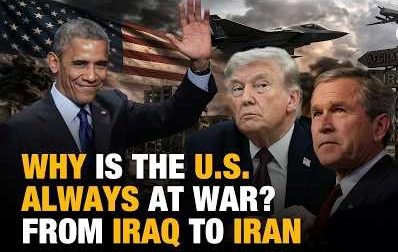
The Source of America’s Wars – Kristol Clear
or go to
Aletho News Archives – Video-Images
From the Archives
Is Israel to blame for the Iraq War?
American Goy | March 10, 2008
I am so tired of this old canard that “Israel had nothing to do with USA’s war with Iraq – in fact, it officially advised America against it”.
Bullshit. … continue
Blog Roll
 Aletho News
- Israel’s priority lies in destroying chances of peace between Iran, US: Ex-UN nuclear chief
- Ceasefire for all or for none: Iran shuts Hormuz over Lebanon attacks
- Strait of Hormuz is Iran’s ‘nuclear weapon’ that forced US retreat: Medvedev
- Energy crisis will last for months – Kremlin envoy
- Europe’s quiet role in the war on Iran
- Forty days that shook the Empire: How Iran turned the tables on US and prevailed
- Netanyahu unilaterally declares Lebanon outside of ceasefire deal
- Israeli leaders: ‘Not a single goal’ achieved in war with Iran
- What on earth just happened? Trump, Iran, and the unlikely ceasefire
- Alberta Bill Would Fine Political Deepfakes $10,000 Without Satire Exemptions
- If Americans Knew
- Gazans face a triple crisis: severe shortages of water and bread, healthcare in tatters
- NY Times reports how Netanyahu took the US into Iran War
- A sigh of relief over Iran, but Gaza and Lebanon in dire straits – Daily Update
- Thousands dead and neighborhoods razed to the ground: Aid agencies fear southern Lebanon is becoming the new Gaza
- The war the US is fighting for Israel could cost trillions
- ‘Cigarette Burns, Nail Wounds’: Toddler Tortured in Gaza to Coerce Father
- Trump Says US Sent ‘a Lot of Guns’ to Protesters in Iran
- Israeli forces destroy 17 UN peacekeeper cameras in south Lebanon
- US-Israeli strikes ‘completely destroy’ synagogue in Tehran
- Archbishop for US Military Says Iran War Is Unjust Under Catholic Teaching
- No Tricks Zone
- An Inconvenient Tree: Uncovered In Alps… Europe Much Warmer Than Today 6000 Years Ago
- New Study Reports A 60% Slowdown In Greenland’s Ice Loss Rate In The Last Decade
- Low Intensity Tornado Wrecks Major Solar Farm, Creating A Potential Toxic Dump
- New Study Finds Warming Saves Lives…Cold Temperatures 12 Times More Deadly Than Excess Heat
- German Science Blog Accuses PIK Climate Institute Of Hallucinating Climate Tipping Points
- Devastating Assessment Of Comirnaty Vaccine By Former Senior Pfizer Europe Toxicologist
- New Study: CO2 Is ‘Effectively Negligible’ As An Explanatory Climate Change Factor Since 2000
- Former Pfizer Toxicologist Dr. Helmut Sterz Tells Bundestag Hearing Pfizer Vaccine Should Have Never Been Approved
- Energy Expert: Germany’s Nuclear Phaseout Was A “500 Billion Euro Mistake”
- New Research: South Australia’s Mid-Holocene Sea Surface Temperatures Were 4°C Warmer Than Today
 Aletho News