Why Are US Military Personnel Heading to Peru?
By Nick Corbishley – naked capitalism – May 26, 2023
The ostensible goal of the operation is to provide “support and assistance to the Special Operations of the Joint Command of the Armed Forces and National Police of Peru,” including in regions recently engulfed in violence.
Unbeknown, it seems, to most people in Peru and the US (considering the paucity of media coverage in both countries), US military personnel will soon be landing in Peru. The plenary session of Peru’s Congress last Thursday (May 18) authorised the entry of US troops onto Peruvian soil with the ostensible purpose of carrying out “cooperation activities” with Peru’s armed forces and national police. Passed with 70 votes in favour, 33 against and four abstentions, resolution 4766 stipulates that the troops are welcome to stay any time between June 1 and December 31, 2023.
The number of US soldiers involved has not been officially disclosed, at least as far as I can tell, though a recent statement by Mexico’s President Andrés Manuel Lopéz Obrador, who is currently person non grata in Peru, suggests it could be around 700. The cooperation and training activities will take place across a wide swathe of territory including Lima, Callao, Loreto, San Martín, Huánuco, Ucayali, Pasco, Junín, Huancavelica, Iquitos, Pucusana, Apurímac, Cusco and Ayacucho.
The last three regions, in the south of Peru, together with Arequipa and Puno, were the epicentre of huge political protests, strikes and road blocks from December to February after Peru’s elected President Pedro Castillo was toppled, imprisoned and replaced by his vice-president Dina Boluarte. The protesters’ demands included:
- The release of Castillo
- New elections
- A national referendum on forming a Constitutional Assembly to replace Peru’s current constitution, which was imposed by former dictator Alberto Fujimori following his self-imposed coup of 1992
Brutal Crackdown on Protests
Needless to say, none of these demands have been met. Instead, Peru’s security forces, including 140,000 mobilised soldiers, unleashed a brutal crackdown that culminated in the deaths of approximately 70 people. A report released by international human rights organization Amnesty International in February drew the following assessment:
“Since the beginning of the massive protests in different areas of the country in December 2022, the Army and National Police of Peru (PNP) have unlawfully fired lethal weapons and used other less lethal weapons indiscriminately against the population, especially against Indigenous people and campesinos (rural farmworkers) during the repression of protests, constituting widespread attacks.”
As soon as possibly next week, an indeterminate number of US military personnel could be joining the fracas. According to the news website La Lupa, the purported goal of their visit is to provide “support and assistance to the Special Operations of the Joint Command of the Armed Forces and National Police of Peru” during two periods spanning a total of seven months: from June 1 to September 30, and from October 1 to December 30, 2023.
The secretary of the Commission for National Defence, Internal Order, Alternative Development and the Fight Against Drugs, Alfredo Azurín, was at pains to stress that there are no plans for the US to set up a military base in Peru and that the entry of US forces “will not affect national sovereignty.” Some opposition congressmen and women begged to differ, arguing that the entry of foreign forces does indeed pose a threat to national sovereignty. They also lambasted the government for passing the resolution without prior debate or consultation with the indigenous communities.
The de facto Boluarte government and Congress are treating the arrival of US troops as a perfectly routine event. And it is true that the US military has long held a presence in Peru. For example, in 2017, U.S. personnel took part in military exercises held jointly with Colombia, Peru and Brazil in the “triple borderland” of the Amazon region. Also, the US Navy operates a biosafety-level 3 biomedical research laboratory close to Lima as well as two other (biosafety-level 2) laboratories in Puerto Maldonado.
But the timing of the operation raising serious questions. After all, Peru is currently under the control of an unelected government that is heavily supported by Washington but overwhelmingly rejected by the Peruvian people. The crackdown on protests in the south of the Peru by the country’s security forces — the same security forces that US military personnel will soon be joining — has led to dozens of deaths. Peru’s Congress is refusing to call new elections in total defiance of public opinion. Just a few days ago, the country’s Supreme Court issued a ruling that some legal scholars have interpreted as essentially criminalising political protest.
As Peru’s civilian institutions fight among themselves, Peru’s armed forces — the last remaining “backbone” in the country, according to Mexican geopolitical analyst Alfredo Jalife — has taken firm control. And lest we forget, Peru is home to some of the very same minerals that the US military has identified as strategically important to US national security interests, including lithium. Also, as I noted in my June 22, 2021 piece, Is Another Military Coup Brewing in Peru, After Historic Electoral Victory for Leftist Candidate?, while Peru’s largest trading partner is China, its political institutions — like those of Colombia and Chile — remain tethered to US policy interests:
Together with Chile, it’s the only country in South America that was invited to join the Trans-Pacific Partnership, which was later renamed the Comprehensive and Progressive Agreement for Trans-Pacific Partnership after Donald Trump withdrew US participation.
Given as much, the rumours of another coup in Peru should hardly come as a surprise. Nor should the Biden administration’s recent appointment of a CIA veteran as US ambassador to Peru, as recently reported by Vijay Prashad and José Carlos Llerena Robles:
Her name is Lisa Kenna, a former adviser to former US Secretary of State Mike Pompeo, a nine-year veteran at the Central Intelligence Agency (CIA), and a US secretary of state official in Iraq. Just before the election, Ambassador Kenna released a video, in which she spoke of the close ties between the United States and Peru and of the need for a peaceful transition from one president to another.
It seems more than likely that Kenna played a direct role in the not-so-peaceful transition from President Castillo to de facto President Boluarte, having met with Peru’s then-Defence Minister Gustavo Bobbio Rosas on December 6, the day before Pedro Castillo was ousted, to tackle “issues of bilateral interest”.
On a Knife’s Edge
After decades of stumbling from crisis to crisis and government to government, Peru rests on a knife’s edge. When Castillo, a virtual nobody from an Andean backwater who had played an important role in the teachers’ strikes of 2017, rode to power on a crest of popular anger at Peru’s hyper-corrupt establishment parties in June 2021, Peru’s legions of poor and marginalised hoped that positive changes would follow. But it was not to be.
Castillo was always an outsider in Lima and was out of his depth from day one. He had zero control over Congress and failed miserably to overcome rabid right-wing opposition to his government. Even in his first year in office he faced two impeachment attempts. As Manolo De Los Santos wrote in People’s Dispatch, Peru’s largely Lima-based political and business elite could never accept that a former schoolteacher and farmer from the high Andean plains could become president.
On December 7, they finally got what they wanted: Castillo’s impeachment. Just hours before a third impeachment hearing, he declared on national television that he was dissolving Congress and launching an “exceptional emergency government” and the convening of a Constituent Assembly. It was a preemptive act of total desperation from a man who held no sway with the military or judiciary, had zero control over Congress, and had even lost the support of his own party. Hours later, he was impeached, arrested by his own security detail and taken to jail, where he remains to this day.
Castillo may be out of the picture but political instability continues to reign in Peru. The de facto Boluarte government and Congress are broadly despised by the Peruvian people. According to the latest poll by the Institute of Peruvian Studies (IEP), 78% of Peruvians disapprove of Boluarte’s presidency while only 15% approve. Congress is even less popular, with a public disapproval rate of 91%. Forty-one percent believe that the protests will increase while 26% believe they will remain the same. In the meantime, Peru’s Congress continues to block general elections.
Peru’s “Strategic” Resources
As regular readers know, EU and US interest in Latin America is rising rapidly as the race for lithium, copper, cobalt and other elements essential for the so-called “clean” energy transition heats up. It is a race that China has been winning pretty handily up until now.
Peru is not only one of China’s biggest trade partners in Latin America; it is home to the only port in Latin America that is managed entirely by Chinese capital. And while Peru may not form part of the Lithium Triangle (Bolivia, Argentina and Chile), it does boast significant deposits of the white metal. By one estimate, it is home to the sixth largest deposits of hard-rock lithium in the world. It is also the world’s second largest producer of copper, zinc and silver, three metals that are also expected to play a major role in supporting renewable energy technologies.
In other words, there is a huge amount at stake in how Peru evolves politically as well as the economic and geopolitical alliances it forms. Also, its direct neighbour to the north, Ecuador, is undergoing a major political crisis that is likely to spell the end of the US-aligned Guillermo Lasso government and a handover of power to Rafael Correa’s party and its allies.
And the US government and military have made no secret of their interest in the mineral deposits that countries like Peru hold in their subsoil. In an address to the Washington-based Atlantic Council on Jan 19, Gen. Laura Richardson, head of the U.S. Southern Command, spoke gushingly of Latin America’s rich deposits of “rare earth elements,” “the lithium triangle — Argentina, Bolivia, Chile,” the “largest oil reserves [and] light, sweet crude discovered off Guyana,” Venezuela’s “oil, copper, gold” and the fact that Latin America is home to “31% of the world’s fresh water in this region.”
She also detailed how Washington, together with US Southern Command, is actively negotiating the sale of lithium in the lithium triangle to US companies through its web of embassies, with the goal of “box[ing] out” US adversaries (i.e. China and Russia), concluding with the ominous words: “This region matters. It has a lot to do with national security. And we need to step up our game.”
Which begs the question: is this the first step of the US government and military’s stepping-up-the-game process?
The former president of Bolivia Evo Morales, who knows a thing or two about US interventions in the region, having been on the sharp end of a US-backed right-wing coup in 2019, certainly seems to think so. A few days ago, he tweeted the following message:
The Peruvian Congress’ authorisation for the entry and stationing of US troops for 7 months confirms that Peru is governed from Washington, under the tutelage of the Southern Command.
The Peruvian people are subject to powerful foreign interests mediated by illegitimate powers lacking popular representation.
The greatest challenge for working people and indigenous peoples is to recover their self-determination, their sovereignty and their natural resources.
With this authorization from the Peruvian right, we warn that the criminalization of protest and the occupation of US military forces will consolidate a repressive state that will affect sovereignty and regional peace in Latin America.
Mexico’s President Andrés Manuel Lopéz Obrador, who refuses to acknowledge Boluarte (whom he calls the “great usurper”) as Peru’s president and has recently faced threats of direct US military intervention in Mexico’s drug wars from US Republican lawmakers, had a message for the US government this week: “[Sending soldiers to Peru] merely maintains an interventionist policy that does not help at all in building fraternal bonds among the peoples of the American continent.”
Unfortunately, the US government does not seem interested, if indeed it ever has been, in building fraternal bonds with the peoples of the American continent. Instead, it is set on upgrading the Monroe Doctrine for the 21st century. Its strategic rivals this time around are not Western European nations, which are now little more than US vassals (as a recent paper by the European Council of Foreign Relations, titled “The Art of Vassalisation”, all but admitted), but rather China and Russia.
China calls on Israel to ‘stop encroaching’ on Palestinian land
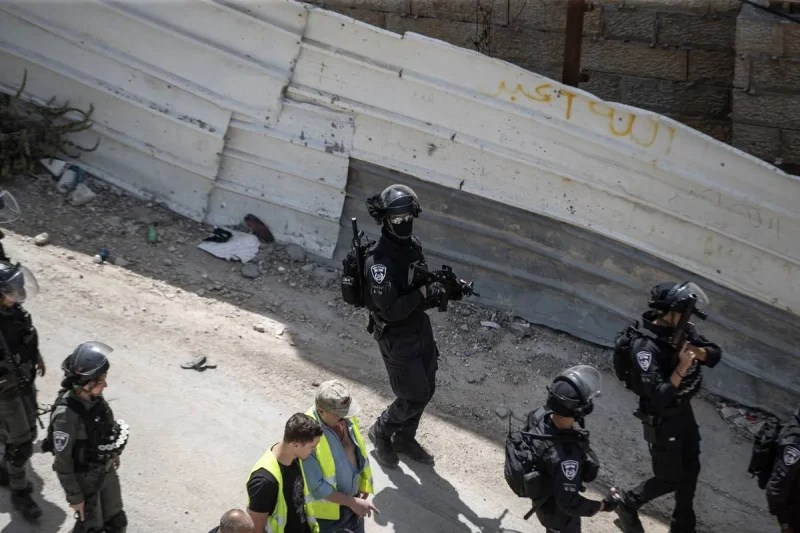
Israeli forces secure demolition of a building belonging to Palestinians claiming that it was unlicensed at Jabel Mukaber Neighborhood in East Jerusalem on May 24, 2023 [Mostafa Alkharouf – Anadolu Agency]
MEMO | May 26, 2023
China has called on Israel to “stop encroaching” upon Palestinian territory and resources, as Tel Aviv continues to allow and approve the construction of illegal Jewish settlements in the Occupied Territories.
Speaking to the United Nations Security Council yesterday, Geng Shuang, China’s deputy Permanent Representative to the UN, stated that “since the beginning of this year, Israel has continued to advance unilateral actions on approving returns, building new settlements and legalising settlements”.
Emphasising that such settlement building and activities violate international law and UN Security Council Resolution 2334, he expressed Beijing’s stance to “urge Israel to immediately halt these actions and stop encroaching upon the land and resources of the Palestinian people”.
Shuang also stressed that “the historical status quo of religious holy sites in Jerusalem must be respected and upheld”, saying that Israeli National Security Minister, Itamar Ben-Gvir “caused renewed tensions” by storming the Al Aqsa Mosque compound for the second time this year and proclaiming Israel’s alleged ownership of the Islamic holy site.
“On the issue of religious holy sites, Israel must stop its provocations, guarantee the right to worship of Muslim worshipers, uphold the peace and tranquillity of religious holy sites, and respect the custodianship of Jordan”, he asserted.
Shuang also drew attention to the fact that tensions and clashes between the Israeli occupation and Palestinian Resistance groups “have been repeating themselves over the past few years, fully demonstrating that a long-stalled peace process is not sustainable, that piece-meal crisis management will not last, and that a comprehensive and just solution is irreplaceable”.
He indicated China’s increasing role in the issue, as with others in the region, and the possibility of surpassing the United States as a mediatory force and hegemon. Supposedly referring to the US, he stated that “the country with major influence on the parties concerned should make concrete efforts to advance the Middle East peace process and should not unjustifiably prevent the Security Council from arriving at the minimum consensus on the Palestine-Israeli issue”.
The Chinese diplomat’s remarks came as the Israeli government yesterday approved the proposed state budget for 2023-2024, which allocates around 3.5 billion Israeli shekels ($941 million) for the illegal settlement projects and the upgrading of their infrastructure.
Current estimates report that there are around 700,000 illegal settlers living in 164 settlements and 116 outposts in the Occupied West Bank and Occupied East Jerusalem, with that set to expand as Tel Aviv frequently approves thousands of more settlement units.
New legislation aims to block New York charities from funding Israeli settlements
Press TV – May 19, 2023
A New York State assembly member has introduced a legislation to stop charities from sending millions of dollars to Israel to stop its settlement expansion activities across the occupied Palestinian territories which are being advanced in flagrant violation of the international law.
The legislation, dubbed “Not on our dime!: Ending New York Funding of Israeli Settler Violence Act,” was introduced by state assembly member Zohran Mamdani, the third Muslim in the New York State assembly, earlier this week.
It would give the state attorney general authority to sue and dissolve not-for-profit organizations that are found to be using their tax-deductible donations to support organizations funding illegal Israeli settlements in the occupied West Bank.
The legislation would also give Palestinians harmed by settler organizations funded by New York-based charities the right to seek damages in American courts.
“Charities registered in New York State currently send more than $60 million dollars a year in tax-deductible donations to aid and abet Israeli settlements. This is done on our dime as New Yorkers,” Mamdani said, the Middle East Eye reported on Thursday.
He added, “This legislation puts an end to that and makes explicit that subsidizing violence and activities outlawed by the Geneva Convention is not, and should not be considered, charitable giving. It’s past time for New York to catch up to international law.”
Mamdani noted that while this issue is important to him as a Muslim, as his faith informs his fight to ensure justice for all people, this is not a bill motivated by religion.
“It is a bill motivated by a desire that New York State stop subsidizing human rights violations through the conferring of charitable status to organizations such as these,” he said.
“Too often, we see an exception drawn when it comes to Palestine – whether it be in our policies or the application of them. This makes it clear that our belief in human rights is universal, without exception,” he added.
The legislation has already received some backlash. Mamdani highlighted that his office has received a call saying all Muslims should die and all Muslim lovers should be killed as well.
“This is the reality when you dare speak up about Palestine and Palestinians,” he said.
Additionally, 66 lawmakers signed an open letter condemning the legislation, saying it “attacks” Jewish organizations.
Emboldened by former US president Donald Trump’s all-out support, Israel has stepped up its illegal settlement construction activities in defiance of United Nations Security Council Resolution 2334, which pronounced settlements in the West Bank and East al-Quds “a flagrant violation under international law.”
More than 600,000 Israelis live in over 230 settlements built since the 1967 Israeli occupation of the West Bank and East al-Quds.
All Israeli settlements are illegal under international law. The UN Security Council has condemned Israel’s settlement activities in the occupied territories in several resolutions.
Palestinians want the West Bank as part of a future independent state with East al-Quds as its capital.
The last round of Israeli-Palestinian talks collapsed in 2014. Among the major sticking points in those negotiations was Israel’s continued illegal settlement expansion.
Many Palestinians believe the Israeli plans to annex one-third of the already occupied West Bank, including parts of the strategic Jordan Valley, is only a formality and that a de facto Israeli occupation of their land has been underway for many years.
US kills Syrian shepherd claiming he was Al-Qaeda leader

Lotfi Hassan Misto, who was killed on 3 May 2023 by a US drone strike in Syria. (Photo courtesy of the Misto family)
The Cradle | May 19, 2023
After US military officials claimed to kill an important Al-Qaeda figure in Syria in an airstrike earlier this month, evidence from the dead man’s family indicates he was instead an impoverished shepherd and father of 10 children, The Washington Post reported on 19 May.
According to interviews with his brother, son, and six others who knew him, the slain man was Lotfi Hassan Misto, 56, a former bricklayer who they described as a kind, hard-working man whose “whole life was spent poor.”
Misto was killed by a Predator Drone strike using a Hellfire missile on 3 May. Hours later, without evidence or providing a name of the person targeted, US Central Command claimed that they had killed a “senior Al Qaeda leader.”
The interviews with Misto’s family members have caused US officials to backtrack from their original claims.
“We are no longer confident we killed a senior AQ official,” one US official told The Washington Post. Another said that “though we believe the strike did not kill the original target, we believe the person to be al-Qaeda.” Both spoke on the condition of anonymity.
The Post notes further that, “In the weeks since the attack, US military officials have refused to identify publicly who their target was, how the apparent error occurred, whether a legitimate terrorist leader escaped and why some in the Pentagon maintain Misto was a member of al-Qaeda despite his family’s denials.”
In a statement, Michael Lawhorn, a spokesman for Central Command, said that “Centcom takes all such allegations seriously and is investigating to determine whether or not the action may have unintentionally resulted in harm to civilians.”
The US military has faced accusations it has covered up past instances of airstrikes that killed innocent people as a result of what The Post described as “flawed intelligence” and “confirmation bias,” including in the case of a 2021 strike in Afghanistan that officials claimed targeted a suicide bomber but instead killed 10 Afghan civilians, including seven children.
In perhaps the most famous case, the US military carried out an airstrike in Mosul in 2017 during the battle against ISIS that killed 240 civilians sheltering in a large home.
The US military has carried out airstrikes in Syria intermittently in recent years in areas controlled by Al-Qaeda affiliated groups, including Hayat Tahrir al-Sham, previously known as the Nusra Front.
This is despite the fact that US planners played a key role in helping the Nusra Front capture Syria’s northwest Idlib governate in 2015 by supplying TOW anti-tank missiles to Free Syrian Army (FSA) groups fighting as Nusra proxies.
Supplying the weapons was part of the CIA’s Timber Sycamore Program, which sought to arm and fund extremist Salafist armed groups fighting the Syrian government under the FSA banner.
US, British, Turkish, and Gulf efforts to effect regime change in Syria failed, however, and President Donald Trump ended the CIA program, which enjoyed a budget of over $1 billion per year, in 2017.
The extremist groups occupying Idlib have enjoyed continued Turkish support since that time, while Turkish troops have also occupied areas in northern Syria directly.
But the status of Turkish-backed and Al-Qaeda-linked extremist groups in Syria is now in doubt as Turkish President Recip Tayyip Erdogan has in recent months participated in Russian-backed talks to normalize relations with Damascus.
Syrian President Bashar al-Assad has demanded that Turkiye end its occupation of northern Syria and cease support for extremist groups as a condition of any normalization of ties with Ankara.
America faces major hurdles trying to form ‘Asia-Pacific NATO’
By Drago Bosnic | May 11, 2023
While serving as the UK Foreign Secretary, Liz Truss pompously announced that so-called “Global NATO” was in the making, while also calling for the United Nations to be reformed to the political West’s liking (although quite the opposite is sorely needed). However, the ever-belligerent power pole seems to be having trouble forming even the “Asia-Pacific NATO”, let alone a global organization that would gather virtually all of Washington DC’s vassals and satellite states. The main issue seems to be stemming from the unresolved historical disputes of the Second World War and the way it affected the Asia-Pacific region.
It should be noted that attempts to create a NATO equivalent in the region are hardly new. The United States has been trying to accomplish this for decades during the (First) Cold War. However, the deals would usually fall apart faster than it took them to be signed by all parties involved. Such disunity greatly contributed to the humiliating defeat of US aggression in Vietnam/Indochina half a century ago. Nowadays, similar disunity is once again emerging among America’s East Asian satellite states, specifically between South Korea and Japan. The US insists that the two countries should set their differences aside and go for a historical push that would lead to complete reconciliation.
However, numerous Japanese war crimes during WWII (as well as in the decades prior) are deeply ingrained in the minds of the Korean people, on both sides of the 38th parallel. In fact, it’s one of the few things both Seoul and Pyongyang actually agree on, albeit tacitly. A recent South Korean court case was supposed to resolve the issue of several major Japanese companies using forced labor in Korea during WWII, but Tokyo was still left unscathed by the process, which angered many Koreans. South Korean President Yoon Suk-yeol dubbed the court decision “a step towards trilateral cooperation to defend freedom, peace and prosperity not only in our two countries, but also around the world”.
The “trilateral cooperation” he was referring to is between the US, Japan and South Korea. However, only a third of South Korean citizens support the deal, as they consider it didn’t truly address Japanese war crimes. Worse yet, this isn’t the first time such deals have fallen through. In 2015, a similar arrangement regarding the so-called “comfort women battalions”, another Japanese war crime that went largely unpunished, collapsed shortly after it was announced, as the vast majority of South Koreans rejected the deal. On the other hand, Japan considers this to be a “case closed”, further antagonizing the (rightfully) angered Korean people who suffered tremendously during decades of Japanese occupation.
To add insult to injury, South Korea is doing all this so it could firmly join an explicitly anti-Chinese coalition (and also implicitly anti-Russian), becoming the first country in the line to get quite literally obliterated in a possible superpower confrontation, as if the US inability to deal with North Korea wasn’t enough already. And while Seoul might feel “motivated” by incessant US pressure, the people of South Korea are wholly unmoved. They see China as an important trade partner, as well as a virtually endless market for South Korean pop culture. Thus, they have no interest in an open confrontation (or any other kind) with their giant neighbor. On the contrary, they prefer the current status quo.
The US is worried this could greatly weaken their ability to form a wider and more compliant anti-Chinese coalition. For years, Washington DC has been trying to enlist Beijing’s neighbors in a “freedom and democracy alliance”, the bulk of which would be composed of Japanese and South Korean forces. Precisely this is the reason why Tokyo started a massive rearmament program last year, while Seoul engaged its fast-growing domestic military-industrial complex to arm several key US vassals around the world (particularly Poland). However, the question remains, how ready this anti-Chinese/anti-Russian coalition would be to deal with powers that make North Korea’s nuclear program look like a footnote?
America’s usual warmongering doesn’t only bring instability to the region that enjoyed decades of relative peace, prosperity and economic cooperation, but it also risks leading to the complete fracturing of US-imposed alliances, which itself could backfire and cause Washington DC to lose influence in the region. Naturally, this would be fantastic for the advancement of actual peace, but it makes America’s foreign policy framework look completely self-defeating and even suicidal. Similar efforts have already led to such results, with the Quad (Japan, UK, US, India) effectively dead as New Delhi has outright rejected anti-Russian rhetoric. The only exception to this is the AUKUS (Australia, UK and US), but even this alliance has created issues with other US partners.
Apart from being virtually redundant, as the so-called Five Eyes (UK, US, Canada, Australia, New Zealand) covers its functions, AUKUS created a lot of controversies after Australia backed out of the extremely lucrative submarine deal with France and opted for an arrangement with its Anglo-American overlords. This didn’t only make Canberra look like an outright satellite state, but also made Paris deeply frustrated, which might have contributed to its (for now only apparent) tilt towards Beijing, the very superpower AUKUS is aimed against. Such dictatorial US moves are creating multilayered problems in other geopolitical theaters as America is effectively forcing others to prioritize its national interests over their own.
Drago Bosnic is an independent geopolitical and military analyst.
Syria’s Return to Arab League Shows US Gulf Allies Tired of ‘Regime Change’
By James Tweedie – Sputnik – 09.05.2023
Syria’s secular government is still standing after more than a decade of sectarian terrorist insurgency backed by the US and its regional allies. Independent investigative journalist Christopher Helali said its readmittance to the Arab League was a sign of waning US power in the Middle East.
Return of Damascus to the bosom of the Arab League after 11 years of pariah status shows the failure of the US doctrine of regime change, a journalist says.
The regional group of nations voted on Sunday to reverse its 2012 decision to expel the Syrian Arab Republic over President Bashar al-Assad’s resistance to religious-sectarian ‘rebels’ backed by the Western powers and several of the Gulf monarchies.
The tide of the conflict turned in 2015 with Russia’s military assistance, helping to break the sieges of Aleppo and other cities alongside volunteers from Iraq and Lebanon’s Hezbollah and the Iranian Revolutionary Guard Corps.
Christopher Helali told Sputnik that the major change of stance by the Arab nations was “part of the ongoing geopolitical shifts that we’re seeing in the wider region.”
“Syria being allowed back into the Arab League is certainly a coup, not only for the Arab countries, but I think for countries like China behind the scenes who have been pushing diplomacy and pushing rapprochement between different sides in the Syrian civil war,” Helali said.
The welcome back for Damascus and President Bashar al-Assad showed there was “no more appetite for regime change” or for backing the “alphabet soup of jihadist groups” funded and armed by Washington — the al-Nusra Front, Islamic State, various al-Qaida affiliates and the Free Syrian Army (FSA).
Those sectarian terrorist forces were supported by Saudi Arabia, the United Arab Emirates (UAE) and possibly Qatar and Jordan, the journalist said.
The journalist noted there was “growing discontent” among the Arab states over how the conflict has progressed and its unwanted effects. “People are saying, okay, let’s just let’s finish it and let’s send a lot of these refugees back.”
The other question is who Assad must negotiate with to finally end the 12-year conflict, given the Gulf monarchies previous insistence on a political “transition” that brings the “rebels” into the mainstream.
Those groups have been “allowing different Western journalists there to show that ‘we are moderate rebels… we are Islamists, but we’re not fanatical like ISIS, even though they are underground’,” Helali said.
“Ultimately, Assad would have to speak to the great power brokers in this conflict — the people who supported those groups. So you’d have to think about Turkiye, Saudi Arabia and other Gulf states, the United States, Russia, Iran, everybody would have to be at the table,” he continued. “But of course, nobody’s coming to that table except for the people already on Assad’s side. Plus Turkiye, because it’s being pushed to find a settlement, especially for the northern part of Syria, especially by Russia and as well as Iran.”
The elephant in the room remains the illegal US occupation of north-eastern Syria, with its concentration of lucrative oil fields, along with its outpost at al-Tanf in the southern desert near the border with Jordan.
“There can be no peace plan, there can be no situation in which everything is resolved so long as foreign troops, including US troops, still occupy sovereign Syrian territory and so long as arms and equipment and funding keeps funnelling in to Syria, to other armed groups,” Helali stressed.
“Once that stops and once there can be sovereignty over in territorial integrity, Syria reclaiming all of its borders, then there can be some plan. But that plan will have to be Syrian-led” and not imposed form outside, he said.
The ultimate significance the republic’s return to the League is the tacit admission that the US-led plan to overthrow Syria’s government failed — with disastrous consequences for her neighbours.
“What the Arab League is saying is that we’ve tried, it’s failed. Assad is here to stay and we have to find some normalization because we’re also dealing with millions of refugees in the region,” Helali said. “There has to be some political resolution to this conflict so that people can return home. Turkiye has 5 million Syrian refugees. Everybody wants a resolution to this.”
Biden unilaterally extends ‘national emergency’ targeting Syria
The Cradle | May 9, 2023
On 8 May, US President Joe Biden signed a new one-year extension for the “national emergency” declared concerning Syria, just one day after the Arab League approved Damascus’ reentry to the bloc despite Washington’s objections.
Initially signed in 2004 by former president George W. Bush, Executive Order 13338 classified Syria, a nation nearly 10,000km away from Washington, as an “unusual and extraordinary threat to the national security, foreign policy, and economy of the United States.”
“The United States will consider changes in policies and actions of the Government of Syria in determining whether to continue or terminate this national emergency in the future,” Biden’s letter concludes.
On Sunday, White House officials confirmed that crushing US sanctions on Syria would continue to be enforced despite an ongoing push by the Arab world to normalize ties with the war-torn country.
“We do not believe that Syria merits readmission to the Arab League at this time, and it’s a point that we’ve made clear with all of our partners,” US State Department spokesperson Vedant Patel said on 7 May.
Since 2011, Syria has been the setting of a brutal war sponsored by several members of NATO and regional nations like Qatar and Saudi Arabia. This includes the ongoing occupation of large swathes of its territory by the US and Turkiye and the plundering of its natural resources and humanitarian aid by anti-government militias.
While the CIA was tasked with arming and training extremist groups in Syria since late 2012, US troops officially entered the fray once Damascus asked for Russia’s help to push back against ISIS in 2015.
Seeing the gains the Syrian and Russian armies made against ISIS and other armed groups, the US partnered with the Kurdish People’s Protection Units (YPG) to create the Syrian Democratic Forces (SDF), effectively starting a race for control of Syria’s resource-rich Deir Ezzor and Hasakah governorates.
Around 900 US troops are still present in Syria. Their deployment is illegal under international law, as the government in Damascus did not approve it.
Moreover, former US presidents Barack Obama and Donald Trump deployed the troops without congressional approval, abusing the Authorization for Use of Military Force (AUMF) passed in 2001 in the wake of the 11 September attacks.
Syria’s return to Arab League is a big deal
BY M. K. BHADRAKUMAR | INDIAN PUNCHLINE | MAY 8, 2023
When a mere subplot overnight assumes habitation and a name, it becomes more fascinating than the main plot itself. Syria’s return to the Arab League after its decade-long exclusion can be regarded as a sub-plot of the China-brokered rapprochement between Saudi Arabia and Iran. But then, China and Iran are not per se party to the process.
Syria’s return to the Arab League is seen as an Arab initiative, but it is quintessentially a project Riyadh steered through in close consultation and coordination with Damascus, ignoring some murmur by a clutch of Arab States and patently in defiance of Washington’s trenchant opposition.
Against the backdrop of the epochal struggle for a new world order characterised by multipolarity and resistance to Western hegemony, Russia and China quietly encouraged Riyadh to move in such a direction.
A riveting thing about the decision taken by the foreign ministers of the seven Arab League nations at the meeting in Cairo on Sunday is its sweet timing. For, this is the 80th anniversary of the establishment of the Ba’ath Party in Damascus in 1943, which espoused an ideology of Arab nationalist and anti-imperialist interests that have lately re-appeared in the geopolitics of West Asia.
Syria has a tradition of strategic autonomy. Through the past decade, it was preoccupied with fighting off the US-sponsored regime change project, with help from Russia and Iran. As it turns the corner and is stabilising, Syria’s strategic autonomy will be increasingly in evidence. This is one thing.
However, the strategic relations with Russia and Iran will continue to remain special and there should be no misconceptions on that score. But Syria is capable of ingenuity and diplomatic acumen to create space for itself to manoeuvre, as geopolitics takes a back seat and Assad prioritises stabilisation and reconstruction of the economy, which requires regional cooperation.
The recent visit by Iran’s president Ebrahim Raisi to Syria testifies to Tehran’s “soft diplomacy,” exuding pragmatism that on the one hand made it clear that despite the recent rapprochement between Damascus and Arab countries, Syrian-Iranian ties are still strong and even highlighted Syria’s role in the resistance to Israel — with Raisi holding a meeting in Damascus with senior Palestinian officials, including leaders of Hamas and Islamic Jihad — while on the other hand, the negotiations with the Syrian leadership was largely about economic cooperation.
Raisi said Iran is ready to take an active part in the post-war reconstruction of Syria. Iran faces competition from Gulf countries that have deep pockets. Meanwhile, the warming of relations between Syria and Turkey is also on the agenda, which is sure to lead to increased trade and spur investment flow.
To put matters in perspective, Iran’s exports to Syria currently amount to a paltry sum of $243 million. However, since the beginning of the conflict in Syria, Iran has been a key sponsor of the Syrian authorities. In January 2013, Tehran opened the first credit line of $1 billion for Damascus, which was under international sanctions, thanks to which the government was able to pay for imported food. This was followed by a loan of $3.6 billion for the purchase of petroleum products. The third loan of $1 billion was extended in 2015. Tehran also allocated funds to Damascus to pay salaries to civil servants, which helped preserve state institutions. In 2012, a free trade agreement began to operate between the countries. Iran is also spending billions to finance Shiite militias in Syria and supply them with weapons. Naturally, Tehran would like to recoup some of these investments.
Syria is assessing, rightly so, that normalisation with the Arab neighbours and Turkey will be a game changer. But, while everyone is talking about Syria’s “readmission to the Arab family” as a concession, Damascus reacted to the Arab League decision in a measured way.
The Syrian Foreign Ministry statement said on Sunday, “Syria has been following the positive trends and interactions that are currently taking place in the Arab region, and believes that these benefit all Arab countries and favour the stability, security and well-being of their peoples.
“Syria has received with interest the decision issued by the meeting of the Council of the League of Arab States.” The statement went on to stress the importance of dialogue and joint action to confront the challenges facing the Arab countries. It recalled that Syria is a founding member of the Arab League and always had a strong position in favour of strengthening joint Arab action.
Most important, the statement concluded by reaffirming that the next stage requires “an effective and constructive Arab approach on the bilateral and collective levels on the basis of dialogue, mutual respect, and the common interests of the Arab nation.”
From all appearance, the Arab League statement itself was a “consensus statement” drafted with great sensitivity by Saudi Arabia.
In an interview with Al-Mayadeen, Raisi said prior to his departure for Damascus that “Syria has always been on the axis of resistance… We unequivocally support all fronts of the axis of resistance, and my visit to Syria is within the framework of this support, and we are working to strengthen the resistance front, and we will not hesitate in this.” In fact, Raisi’s arrival in Syria coincided with increased Israeli attacks by Israel on Iranian military facilities, including on Aleppo airport.
Without doubt, Iran remains Syria’s main ally and Iranian influence in Damascus is still strong. Iran views Syria as its strategic territory through which Tehran can establish ties with Lebanon and confront Israel.
What works to Syria’s advantage here is that the Saudi-Iranian detente is based on a common view in Riyadh and Tehran that they have to coexist in one form or another, since their enmity and regional rivalry turned out to be a “lose-lose” proposition that didn’t improve their regional standing. Suffice to say, their national interest resulting from their rapprochement overrides past rivalries. Syria will be a testing ground where each other’s true intentions as well as conduct will come under close scrutiny.
The good part is that the Saudis have concluded that President Assad is firmly in the saddle, having weathered the most devastating war since World War 2, and mending relations with Damascus can be a “win-win” for Riyadh.
That said, Syria is a strategic hinge where Riyadh will need to balance its strategic ties with the US and its tacit ties with Israel. But then, Saudi Arabia’s new strategic calculus also includes China and Russia. When it comes to Syria, Russia is an anchor sheet for Assad, while China has been all along on the right side of history.
This geopolitical setting has driven Biden Administration into frenzy, NSA Jake Sullivan rushed to Saudi Arabia holding the hands of his Indian and Emirati counterparts for company! Wisdom lies in Washington using Saudis (and Emiratis and Indians) to open a line to Damascus. However, Assad will set the very same non-negotiable condition to Washington for normalisation that he insisted with Turkey — vacation of US occupation. Beyond that lies, of course, Israel’s annexation of Golan Heights.
Arab states call for withdrawal of foreign forces from Syria
RT | May 1, 2023
The government in Damascus should re-establish the rule of law on all of Syria’s territory, ending the presence of foreign armed groups and terrorists, the foreign ministers of Syria, Saudi Arabia, Jordan, Egypt, and Iraq said on Monday after meeting in Amman.
Jordan hosted the meeting, the first of its kind since Syria’s membership in the Arab League was suspended in 2011. Prior to the multilateral meeting, Syrian Foreign Minister Faisal Mekdad met with his Jordanian counterpart Ayman Safadi to discuss refugees, border security and “water issues,” according to Amman.
In a joint statement distributed by state news agencies, the five ministers called for “ending the presence of terrorist organizations” as well as “armed groups” on the territory of Syria, and “neutralizing their ability to threaten regional and international security.” They also pledged to “support Syria and its institutions to establish control over all of its territory and impose the rule of law.”
Saudi Arabia, Egypt, Jordan and Iraq pledged to establish ties with the Syrian military and security institutions in order to “address security challenges.” The five ministers also called for stopping “foreign interference in Syrian domestic affairs.” Their joint declaration also called for setting up technical teams of experts that would follow up on the summit and implement practical measures to resolve the conflict in Syria.
The Amman meeting comes just weeks after Mekdad visited Saudi Arabia and received the kingdom’s endorsement for Syria’s territorial integrity. Currently, Turkish-backed militants control parts of northern Syria, while the northeast is under the control of US-backed Kurdish militias. Several hundred US soldiers are also in Syria, controlling most of the country’s oil wells.
MIlitants backed by Saudi Arabia and the US launched an uprising against Syrian President Bashar Assad in 2011. With the help of Russia and Iran, the government in Damascus eventually prevailed over the collection of rebels, including terrorists affiliated with Al-Qaeda and Islamic State (IS, formerly ISIS). While Syria’s neighbors and regional powers have moved to improve relations with Damascus in recent months, the US has not changed its “regime change” policy.
The Leaked Plan to Attack Russians in Syria Revealed
By Steven Sahiounie | Strategic Culture Foundation | May 1, 2023
The war in Ukraine was planned to extend to Syria. Leaked secret documents revealed the Ukrainian military were planning to attack Russian troops stationed in Syria in an effort to distract Russia and cause losses and casualties far from the battlefield in eastern Europe.
Jack Teixeira, a young member of the Massachusetts Air National Guard, was arrested by the FBI in the investigation of leaked classified military intelligence which were viewed on the Discord chat platform.
Among the documents were details of the planning and assessment of attacks on Russian military capabilities in Syria, to be carried out by the U.S. military partner there, the SDF.
The SDF control the northeast quarter of Syria and the troops are made up of about one-third Kurds and two-thirds Arab tribal members. The Kurdish semi-autonomous region in Syria was created by the U.S. alliance with the Communist administration of the Kurds under Ilham Ahmed and General Mazloum Abdi.
The area the U.S.-Kurdish alliance controls is not populated by a majority of Kurds, but the Kurds do represent a sizable ethnic population. Once they became financially and militarily supported by the U.S., the Kurds were able to carry out a program of ethnic cleansing which displaced the original inhabitants from their homes, lands and businesses.
The SDF working alongside the U.S. occupation forces in Syria were planned to be supplied with drones and other equipment to attack the Russian troops in Syria. The Russian airbase on the coast in Latakia was cited to be attacked as well as other areas.
The Ukrainian military intelligence had planned the attacks in Syria, using the U.S. allied paramilitary force the SDF, for the purpose of opening a second front in the war with Russia. The planning strategized that Russia would be distracted by attacks on its forces in Syria, and become weaker in their military capabilities.
Ukrainian President Zelenskyy, a former TV comedienne, cancelled the operations while still in the planning stages.
The Russian military was invited into Syria in October 2015, when the terrorist group Jibhat al-Nusra was at its height and threatened to over-run the coastal region. After the Russian military arrived in Syria, the Russian forces alongside the Syrian Arab Army were successful in pushing the terrorists back. Today, the central government in Damascus controls almost all of Syria with the exception of the Kurdish region previously described, and the small province of Idlib in the north west which is under the occupation of Hayat Tahrir al-Sham, the current name of Jibhat al-Nusra. Mohammed al-Julani is in control of Idlib. He started off in Iraq with Al Qaeda, then was sent to Syria by the leader of ISIS, and finally is holding about 3 million civilian hostage in Idlib, while being supplied with humanitarian aid by the U.S., UN, EU and other charities.
The Russian presence in Syria today can be termed a peace-keeping mission. They still attack ISIS and terrorist positions, but most of their presence is in holding the peace between the Kurds and their sworn enemy, Turkey. If it was not for the Russian military presence in Syria, Turkey would have invaded even further into the Kurdish region, and there could have been massacres.
Russia has a working relationship with Syria, Iran and Turkey and has been negotiating for a peaceful settlement to the Syrian crisis.
Turkey had been a U.S. ally, but has felt betrayed by the U.S. support of the Kurdish paramilitary SDF, which consists of the core military group YPG, which is aligned with the PKK, a terrorist group responsible for about 30,000 deaths over decades.
Had the Ukrainian plan to attack Russians in Syria been carried out, the response could have been a joint Turkish-Russian military operation against the Kurds, which could have resulted in U.S. military deaths or injuries, and would likely have ended with the U.S. occupation forces withdrawal to Iraq.
If Zelensky hadn’t stopped the plans, Syria could have regained the north east quarter from the Kurds, and Turkey could have vanquished the SDF and YPG. That would then leave Idlib and the terrorists sitting on the border without their U.S. supporters. It could have resulted in Idlib’s terrorist occupiers fleeing under cover of darkness, and the 3 million hostages being set free after more than a decade of captivity.
Under the plan, the SDF asked for protection that they would not be revealed as the source of the planned attacks on the Russian military in Syria, and instead make it appear that the U.S. protected terrorists holding Idlib would be blamed.
Turkey has military troops occupying Idlib, and should the plan have been carried out, Russia could have attacked Idlib as the source of the planned attacks, and this would have been a direct confrontation between Turkey and Russia on Syria soil.
The U.S. may have ordered Zelenskyy to halt the planned attacks on Russians in Syria. Washington, DC. is insisting to remain occupying bases in Syria to prevent Syria from access to its energy resources, and thus preventing Syria from recovery from the U.S.-NATO attack on Syria beginning in 2011. The U.S. has failed in their plan to install an American puppet in Syria, but they were successful in making sure they have a compliant and easily manipulated leader in Ukraine.
An open letter to Madame Ursula Von Der Leyen, President of the European Commission
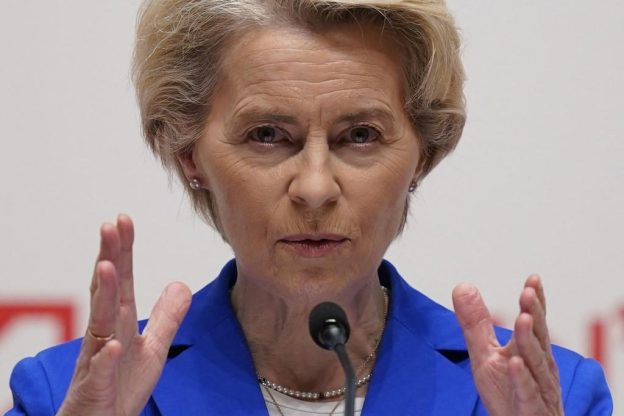
By Dr Salman Abu Sitta | MEMO
On 29 April 2023
Your Excellency,
You made a speech this week praising the establishment of Israel on its 75th anniversary.
For someone in your position, it is surprising that it had so many errors of fact, misguided judgment, violation of international law, and deviation from basic norms of justice.
You congratulated Israel on 75 years of existence on a land area of 20,500 km2, which is 78% of Palestine. Not one square kilometer of this area is obtained by any legal or just means. Six percent was obtained through the treacherous British collusion and 72% by military conquest. How could you congratulate a regime which obtained this land by spilling the blood of the innocent?
Israel has no boundaries, neither by international law nor by its own admission. The Armistice Agreement of 1949 confers no legal title on any boundary. Which Israel are you congratulating? Is it in the land occupied by Israel in 1948, or in 1967?
There is not a single line in UN resolutions that supports you in either.
You congratulate Israel on its “dynamism ingenuity and groundbreaking innovations”.
I ask you if you gather the best German scientists and locate them on Madagascar Island, where they killed the people of the island and set up the best laboratory. Would you consider that a scientific achievement?
Einstein did not discover the Theory of Relativity because he was a Jew or a Swiss; he discovered it because he was a brilliant scientist. To his credit, he refused the idea of Israel and condemned the Jewish massacre of Deir Yassin.
Your European government poured billions of Euros into Israel for “scientific research” under the EU-Israel Association. The agreement contained a clause requiring Israel to abide by Human Rights in the conduct of research. But you, in particular Germany and Holland, waived this clause on demand by Israel.
Your Israel did not waste time. Its arms industry company Elbit sold weapons of mass destruction to many countries, spreading death and destruction in many parts of the world.
The prime victim is our people in Gaza. In four Israel wars against Gaza in the last six years, not only Elbit products were used to kill women and children, but its operators were in the field to guide the Israeli soldiers.
People of good conscience in the UK protested against that and demonstrated against the Elbit factory in England. Similar people in Germany protested against Elbit but your government jailed them.
Is this the Israeli science you celebrate?
You say also “Israel made the desert bloom”. You fell into the trap of Israeli propaganda. With your government capabilities, you could have done a better job.
The area of the southern district is 12,500 km2. Israel irrigated at best 800 km2. The remaining 94% was and is still desert. The irony is that the irrigation water is stolen water from the West Bank and Golan Heights. All the stolen water used in agriculture produces only 1.5% of Israel GDP.
Making “the desert bloom” is a myth. How can this escape you?
You paid for your guilt about atrocities against your Jewish citizens with Palestinian blood. Your leaders flocked to Yad Vashim, erected in Palestine not in Germany, to shed tears and ask for forgiveness. But none of your leaders had the moral courage to look at the opposite hill, 3 km away, at Deir Yassin and confront your hosts, the criminals who committed the massacre there.
You paid no notice or care about the Israeli-run concentration camps and forced labour camps for captured Palestinian civilians in 1948, set up by your citizens who fled to Palestine, only three years after those camps were closed in Germany, even though they were reported by ICRC.
The major defect in your speech is that you did not see the elephant in the room. You did not see or recognize Al Nakba, the worst disaster in Palestine’s 4000 years of history.
You did not mention the Zionist invasion by 120,000 European soldiers in 9 brigades carrying out 31 military operations. This invasion depopulated 560 towns and villages through massacres, making refugees of two-thirds of the Palestinian people.
How can you escape this calamity? Do you not know Palestine?
Go back to maps in the mid-19th century by your geographers Kiepert and Van de Velde. They tell you about 1200 localities in Palestine. You are a fluent French speaker. Go to seven volumes of Victor Guerin describing every village in Palestine.
If you miss all that, you cannot miss the historical visit of Kaiser Wilhelm II of Germany to Palestinian Jerusalem on 31st October 1898. You cannot miss the voluminous scholarly work of Gustav Dalman about Palestine’s people.
With this knowledge, it is very sad, and indicative of the Western racism, that you voted frequently against Palestinian Inalienable rights in the United Nations, invoking the sordid European history of colonialism.
But it is not too late. You can retract your words and actions and come back to the true path, peace, and justice for Palestinians. They are the true heirs of Jesus Christ, after whom your political party was named.
Yours respectfully,
Dr Salman Abu Sitta
UN cross-border aid program for Syria abused by extremists: Moscow
The Cradle | April 28, 2023
Moscow’s permanent representative to the UN, Vasily Nebenzia, said on 27 April that the UN-sponsored cross-border aid mechanism for Syria has “exhausted its capabilities” and is being “used for other purposes.”
The cross-border humanitarian aid mechanism has “has long since exhausted its capabilities and is being used for other purposes, far from addressing the humanitarian situation,” Nebenzia stressed.
The cross-border aid mechanism was established by the UN in 2014 in order to provide aid to northern Syria through the Turkish-Syrian border without authorization from the government in Damascus – a contravention of international regulations.
However, extremist militants in control of large swathes of Syria’s north began taking advantage of the mechanism in order to seize humanitarian aid for themselves, at times to sell for higher prices. Northern border-crossings associated with the UN aid program have even been subject to drug smuggling by armed groups.
Groups such as the Nusra Front, the former Al-Qaeda branch now known as Hayat Tahrir al-Sham (HTS), have also been involved in kidnapping aid workers to demand large ransoms – worsening an already volatile humanitarian situation. The aid program also excludes the majority of the population who reside in government-held territory, where an economy ravaged by sanctions has created significant humanitarian concerns.
“We would like to stress that if our western colleagues in the UN Security Council continue to act as if nothing has happened, and ignore the thwarting of the implementation of the Security Council resolution by international terrorists, we will draw the required conclusions from the current situation while formulating our position on extending the aid transfer mechanism for next July,” Nebenzia added.
The last time the cross-border aid mechanism was extended was in January this year. Russia has called for an end to the program numerous times, and has vetoed its extension in the past.
“It looks like permissions to use two additional checkpoints for three months, issued by Damascus, have de-facto reduced to zero UN enthusiasm to unblock deliveries via the contact line,” the Russian official said.
This refers to the two additional border crossings opened by the Syrian government following February’s devastating earthquake. The crossings, which link government-held territory to the militant-held north, would allow aid to be dispersed conventionally through the Syrian Arab Red Crescent (SARC). However, the UN has yet to lift restrictions on the use of these crossings.
Some have said that this is to perpetuate the idea that Damascus is behind the obstruction of aid delivery across the country, when in fact, HTS and other groups are to blame.
Featured Video
Seyed M. Marandi: U.S. Military DIVIDED? Iran’s Secret Defense EXPOSED
or go to
Aletho News Archives – Video-Images
From the Archives
‘Israel sees Iran as obstacle to its policies’
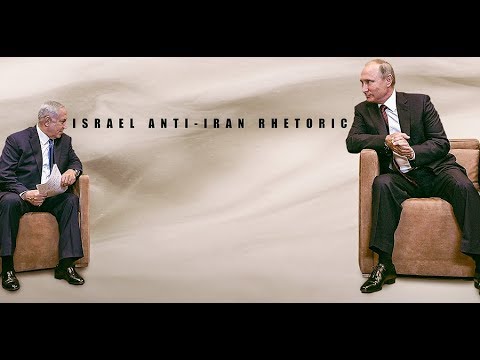
Press TV – August 25, 2017
Prime Minister Benjamin Netanyahu has said that Israel felt threatened by Iran’s growing influence in the Middle East. Netanyahu expressed his Iranophobic view in a meeting with Russian President Vladimir Putin in Russia’s Black Sea resort of Sochi on Wednesday. Press TV has asked Scott Rickard, former American intelligence linguist from Tampa, Florida, and Brent Budowsky, a columnist at The Hill from Washington, to give their thoughts on the issue.
Rickard said Tel Aviv is concerned about the fact that the regime could not carry out its old project to spread sectarian divisions and pave the way for dismemberment of the countries in the Middle East region because of the Iranian-led resistance against Israeli policies, not only in the occupied territories of Palestine but also in the whole region.
“Iran is not a threat to Israel whatsoever. The threat that Israel sees is the fact that their Oded Yinon Plan is being put to a hold by Iran,” the intelligence linguist said on Thursday night.
“They (the Israelis) look at Iran as a threat only because they have no influence on their governments and Iran is autonomous and is not under the Zionist influence,” he added.
Since the victory of the Islamic Republic of Iran in 1979, Tehran has been critical of Israel’s policies in the region, whereas “no leaders [of other states] even dared to speak out against Zionism,” Rickard argued. … continue
Blog Roll
 Aletho News
- Alberta Bill Would Fine Political Deepfakes $10,000 Without Satire Exemptions
- Iran declares ‘historic victory’ over US, says enemy forced to accept its proposal
- Trump Claims Ceasefire, Reopening of Strait of Hormuz Agreement with Iran
- Israeli tank fire killed UN peacekeeper in Lebanon, UNIFIL investigation finds
- Russia, China block Bahrain-sponsored UN resolution on Strait of Hormuz
- The US-Israeli War on Science is an Assault on our Future
- Trump’s Promise to Bomb Iran ‘Like Never Before’ Faces Brutal Logistics — Expert
- Germany seeks to restrict stays abroad for men of fighting age – Berliner Zeitung
- Evidence points to Ukraine being behind TurkStream attempted sabotage, but that should come as no surprise
- Sri Lanka secures supplies of Russia oil – minister
- If Americans Knew
- Thousands dead and neighborhoods razed to the ground: Aid agencies fear southern Lebanon is becoming the new Gaza
- The war the US is fighting for Israel could cost trillions
- ‘Cigarette Burns, Nail Wounds’: Toddler Tortured in Gaza to Coerce Father
- Trump Says US Sent ‘a Lot of Guns’ to Protesters in Iran
- Israeli forces destroy 17 UN peacekeeper cameras in south Lebanon
- US-Israeli strikes ‘completely destroy’ synagogue in Tehran
- Archbishop for US Military Says Iran War Is Unjust Under Catholic Teaching
- Iranian leaders’ Open Letters to the American People
- Trump says Iranians appreciate bombs, WHO warns of nuclear risks – Daily Update
- U.N. experts demand Israel release prominent Gaza doctor after reports of ‘severe torture’
- No Tricks Zone
- An Inconvenient Tree: Uncovered In Alps… Europe Much Warmer Than Today 6000 Years Ago
- New Study Reports A 60% Slowdown In Greenland’s Ice Loss Rate In The Last Decade
- Low Intensity Tornado Wrecks Major Solar Farm, Creating A Potential Toxic Dump
- New Study Finds Warming Saves Lives…Cold Temperatures 12 Times More Deadly Than Excess Heat
- German Science Blog Accuses PIK Climate Institute Of Hallucinating Climate Tipping Points
- Devastating Assessment Of Comirnaty Vaccine By Former Senior Pfizer Europe Toxicologist
- New Study: CO2 Is ‘Effectively Negligible’ As An Explanatory Climate Change Factor Since 2000
- Former Pfizer Toxicologist Dr. Helmut Sterz Tells Bundestag Hearing Pfizer Vaccine Should Have Never Been Approved
- Energy Expert: Germany’s Nuclear Phaseout Was A “500 Billion Euro Mistake”
- New Research: South Australia’s Mid-Holocene Sea Surface Temperatures Were 4°C Warmer Than Today
 Aletho News