Settlers assault Palestinian woman in Al-Khalil, destroy vital water line in Nablus

Palestinian Information Center – July 10, 2025
A Palestinian woman was injured Thursday morning after a group of armed Israeli settlers attacked residents in the Tabyan and Fakhit areas of Masafar Yatta, south of Al-Khalil in the southern occupied West Bank. Local sources confirmed the settlers assaulted multiple residents, leaving the woman wounded.
In a separate but related act of sabotage, settlers used a bulldozer at dawn Thursday to destroy a critical water pipeline between the villages of Aqraba and Majdal Bani Fadel, south of Nablus. The pipeline served at least seven surrounding villages, including Jorish, Qusra, Qaryut, Jalud, Duma, Talfit, and Majdal Bani Fadel. The destruction of this essential infrastructure deepens the humanitarian crisis facing Palestinian communities already under siege.
Meanwhile, Israeli occupation forces (IOF) began bulldozing large sections of privately owned Palestinian land in the town of Teqou’, southeast of Bethlehem, to construct a new settlement road. Accompanied by heavy machinery, the IOF targeted lands belonging to the Al-Asakira, Al-Zeer, and Jibrin families in the Qanan Saqir and Fasoura areas.
Local residents fear the road project will lead to the seizure of thousands of dunums under the pretext of “securing the road,” reinforcing a broader Israeli policy of annexation and Judaization.
The town of Teqou’ is already subject to movement restrictions imposed by seven iron gates placed at its entrances and within neighborhoods, effectively isolating large parts of the town and limiting access to nearby villages.
Daily settler attacks continue across the West Bank, with the clear aim of forcibly displacing Palestinians and expanding illegal settlement infrastructure. Since the onset of the Israeli genocide in the Gaza Strip on October 7, 2023, settler groups have carried out more than 5,000 attacks and established 80 new outposts on Palestinian land in the West Bank.
These acts of aggression are part of a wider, systemic campaign of ethnic cleansing and land theft, carried out in parallel with the ongoing genocide in Gaza.
Tom Barrack’s project to destabilize Lebanon
The Cradle | July 7, 2025
“A century ago, the west imposed maps, mandates, penciled borders, and foreign rule. Sykes-Picot divided Syria and the broader region for imperial gain-not peace. That mistake cost generations. We will not make it again.”
–Tom Barrack, US ambassador to Turkiye and special envoy to Syria
When US Envoy to Turkiye and Syria Tom Barrack made this declaration last month in Ankara, it suggested Washington was repudiating the colonial-era borders imposed on the Levant by Britain and France. But Barrack’s actual meaning was far more insidious: The Sykes-Picot agreement may be dead, but now the US intends to redraw the region’s frontiers to suit one purpose only – Israeli expansionism.
US envoy’s agenda: Redrawing the region by dismantling resistance
Lebanon’s fate remains tightly interwoven with that of Syria and occupied Palestine. Any imposed resolution to the so-called Israeli-Palestinian conflict will inevitably reverberate through both Damascus and Beirut, forcing their governments to make existential choices. Chief among these is the surrender of arms and capabilities, a demand embedded in the US-led effort to transform the region’s balance of power.
Enter Barrack, the Lebanese-American billionaire and close confidant of US President Donald Trump, now repurposed as a roving envoy to Lebanon and Syria. He has since positioned himself as a chief advocate of pulling both Syria and Lebanon into the Abraham Accords, a euphemism for normalizing ties with the occupation state.
Barrack met with top officials in Beirut today, where he was expected to peddle this political reconfiguration under the guise of regional peace.
Maximum pressure and the threat of force
Lebanon is at the sharp end of a US-Israeli campaign to disarm Hezbollah at any cost and within months. The escalation is not a reaction to local dynamics, but rather a consequence of Washington’s regional failures: from the quagmire in Ukraine to its inability to deter Iran or check Israel’s war crimes in Gaza.
With nothing substantive to offer, the US is leaning on coercion to twist arms at the top. Israeli military threats serve as a blunt instrument to corner Lebanese officials into signing off on the resistance’s disarmament – a fantasy the US is now aggressively chasing.
Trump, seeking a legacy boost, is betting on a high-stakes foreign policy gambit: force Lebanon – the last Levantine Arab state still tethered to the Axis of Resistance – into surrender, and break its last defensive stronghold against Israeli expansion.
A new kind of envoy, a new kind of threat
Barrack’s mission departs from the playbook of previous US envoys who, for all their meddling, took Lebanon’s fragility seriously. Not so today. Barrack, who also serves as US ambassador to Turkiye and envoy to Syria, represents a new breed of imperial proxy, unconcerned with sectarian fault lines or civil strife.
Washington now believes Hezbollah is vulnerable. The plan is to crush it politically, and if needed, militarily, even if that means weaponizing the Lebanese army against its own citizens. The Trump administration has made clear it will trade Lebanese stability for US-Israeli hegemony.
According to a Lebanese official cited by Anadolu Agency, Barrack handed Beirut a five-page proposal in June that centered on three main objectives. The first is the monopolization of all weapons under the Lebanese state’s control. The second involves enacting fiscal and economic reforms, including tighter border controls, anti-smuggling efforts, and boosted customs revenues. The third demands a reconfiguration of ties with Syria by demarcating borders and expanding trade.
No timeline is spelled out in the document, but US pressure suggests an expectation for full implementation by year’s end. Lebanon, the official claims, is drafting a unified response based on the ministerial statement and President Joseph Aoun’s inaugural address.
But Beirut has its own demands, including an end to Israeli violations, a full withdrawal from occupied territories, and the launch of reconstruction efforts in the south.
For now, Hezbollah’s official position remains undisclosed. Its response is expected to surface in the coming days, as Barrack returns to Beirut.
After meeting with President Aoun, Prime Minister Nawaf Salam, and Speaker of Parliament Nabih Berri in Beirut today, Barrack announced that he is “satisfied” with the Lebanese authorities’ response to Washington’s request regarding the disarmament of Hezbollah. At the same time, he warned that Lebanon “will be left behind” if it does not move in line with the ongoing regional changes. Barrack also stated that “Hezbollah is a political party, and it also has an armed wing. Hezbollah needs to see that there is a future for them, and that this path is not meant to be only against them, and that there is an intersection between peace and prosperity for them as well.”
Empty promises, no Israeli restraint
During his last visit, Barrack met Lebanon’s three top officials to pitch a phased disarmament plan, divided by time and geography. He hinted at possible US pressure on Tel Aviv to vacate recently occupied points. But when pressed, he admitted there were no guarantees that Israel would halt its aggression.
This is no peace deal. It is an ultimatum.
Barrack’s push marks the culmination of a decades-long campaign to dismantle the region’s anti-imperialist front. With Egypt and Jordan long co-opted, Syria’s Baathist era gutted, and Iraq’s factions fragmented, apart from Yemen’s Ansarallah-aligned army, Hezbollah remains the last major armed deterrent to Israeli expansion.
Washington and Tel Aviv understand this. Disarming Hezbollah clears the path for diplomatic normalization not only with Beirut, but also with Syria’s so-called interim government under de facto President Ahmad al-Sharaa, a former ISIS chief who went by the nom de guerre Abu Mohammad al-Julani, now edging closer to normalization with Tel Aviv.
Capitulation without compensation
The US demands everything and offers nothing. There are no guarantees of Israeli withdrawal. No prisoner releases. No end to airstrikes or assassinations. Not even arms for the Lebanese army or funds for reconstruction.
Instead, Washington continues to throttle the army by blocking weapons transfers and targeting seized stockpiles, cementing its subservience.
Barrack’s so-called solution is a trap. It further strips Lebanon of sovereignty, invites more Israeli strikes across the south, the Bekaa, and even Beirut, and paves the way for sectarian fragmentation under the guise of national reform.
With some domestic factions parroting US-Israeli talking points, the threat is no longer just foreign. Western-backed, right-wing Lebanese elements are gaining narrative traction, openly adopting Tel Aviv’s discourse on resistance weapons. These forces could soon coordinate directly with the occupation state, becoming internal agents of destabilization.
Meanwhile, the proposal ignores the Palestinian refugee question, omits border security mechanisms, and offers no path to deter Israeli incursions. In effect, it sets the stage for a sectarian, security-driven partition of Lebanon.
Divide and conquer: Disarming in stages
Washington’s strategy is clear. It aims to isolate and disarm resistance factions one by one. Last month, the target was Palestinian groups. Now, Hezbollah. The aim is to prevent a unified front by cutting off cross-sectarian solidarity and picking off targets individually.
If these pressures are not absorbed and neutralized, the risks are existential. A major Israeli assault on Lebanon or a manufactured civil conflict is likely. At the same time, extremist groups are resurging in Syria under Sharaa’s watch, a man eager to appease Washington and Tel Aviv at all costs.
Hezbollah and its supporters face a stark choice. They must either surrender to foreign diktats or entrench their defenses and refuse to even entertain a debate on arms as long as threats persist.
This may be the gravest threat to Lebanon’s post-war existence. With the US shedding all pretense of neutrality and openly advocating for a new regional map, the country faces a binary future: resist, or be dismembered.
Lebanon’s salvation hinges on one truth. Only a united front behind the resistance can preserve its sovereignty and shield it from the vultures circling overhead.
BRICS leaders demand ceasefire in Gaza, condemn strikes on Iran
Al Mayadeen | July 6, 2025
Leaders of the BRICS bloc, comprising 11 emerging economies, issued a strong and unified call on Sunday for an immediate, permanent, and unconditional ceasefire in Gaza, as the war enters its 22nd month.
In the final declaration of their summit held in Rio de Janeiro, BRICS leaders urged all parties to engage in good-faith negotiations to halt the war on Gaza and demanded a full withdrawal of Israeli forces from the Strip and all other parts of the occupied Palestinian territories.
“We exhort the parties to engage in good faith in further negotiations to achieve an immediate, permanent and unconditional ceasefire,” the 11-nation bloc said in a final summit statement.
The statement comes as indirect truce negotiations between the Israeli occupation and Hamas resumed in Doha, with international pressure mounting for a resolution to the war.
BRICS condemns strikes on Iran
The summit also addressed the recent escalation between Iran and “Israel”, during which the latter launched an unprovoked 12-day war on the Islamic Republic, culminating in US airstrikes on Iranian nuclear facilities in June.
“We condemn the military strikes against the Islamic Republic of Iran since June 13, 2025,” the statement read, without directly naming the United States or “Israel”.
It added, “We express serious concern over deliberate attacks on civilian infrastructure and peaceful nuclear facilities, which constitute a violation of international law.”
BRICS demands Israeli withdrawal from Lebanon
Moreover, the statement called for a ceasefire in Lebanon and for all “parties to strictly adhere to its terms and fully implement UN Security Council Resolution 1701,” adding, “We condemn the ongoing violations of the ceasefire, as well as the violations of Lebanon’s sovereignty and territorial integrity.”
“We urge Israel to respect the terms agreed upon with the Lebanese government and to withdraw its occupying forces from all Lebanese territory, including the five remaining sites in southern Lebanon.”
BRICS demands Israeli withdrawal from Syria
Regarding Syria, the BRICS leaders reaffirmed their commitment to the independence, sovereignty, and territorial integrity of the country, calling on “Israel” to withdraw troops from Syrian territory without delay, according to the statement.
“We reaffirm our commitment to the sovereignty, independence, unity, and territorial integrity of Syria and call for a peaceful and inclusive Syrian-led and Syrian-owned, UN-facilitated political process, based on the principles of Security Council Resolution 2254 (2015), in a manner that ensures the security and well-being of the civilian population, without discrimination,” it read.
The statement further condemned the threat posed by foreign terrorists in Syria and the risk of the spread of terrorists from Syria to regional countries.
“Syria should firmly oppose all forms of terrorism and extremism and take concrete actions to respond to concerns of the international community about terrorism,” it added.
The BRICS leaders welcomed the lifting of sanctions on Syria and expressed their hope that the country’s economy will be rebuilt.
It is worth noting that the next BRICS summit will be held in India in 2026, a final declaration of the Rio De Janeiro summit said.
BRICS encourages diplomatic efforts on Ukraine
On the Ukrainian issue, the leaders expressed hope that ongoing diplomatic efforts, including the African Peace Initiative and the Group of Friends for Peace, would lead to a sustainable resolution, advocating for dialogue and diplomacy to this end.
“We recall our national positions concerning the conflict in Ukraine as expressed in the appropriate fora, including the UN Security Council and the UN General Assembly. We note with appreciation relevant proposals of mediation and good offices, including the creation of the African Peace Initiative and the Group of Friends for Peace, aimed at peaceful resolution of the conflict through dialogue and diplomacy. We expect that current efforts will lead to a sustainable peace settlement,” the statement read.
Criticism of Trump’s trade policies
In addition to Middle East affairs, the summit took aim at US economic policy. BRICS leaders expressed “serious concerns” over US President Donald Trump’s recent wave of unilateral tariffs, calling them “indiscriminate” and damaging to global trade.
“We voice serious concerns about the rise of unilateral tariff and non-tariff measures which distort trade and are inconsistent with WTO rules,” the statement said.
The bloc warned that these actions could “disrupt global supply chains” and increase economic uncertainty, particularly as Trump has threatened new tariffs on trading partners unless “deals” are reached by August 1.
Lula urges BRICS action on Gaza
In his opening remarks at the summit, Brazilian President Luiz Inácio Lula da Silva drew a parallel with the Cold War’s Non-Aligned Movement, a group of developing nations that resisted formally joining either side of a polarized global order.
“BRICS is the heir to the Non-Aligned Movement,” Lula told leaders. “With multilateralism under attack, our autonomy is in check once again.”
BRICS nations now represent more than half the world’s population and 40% of its economic output, Lula noted in remarks on Saturday to business leaders, warning of rising protectionism.
“If international governance does not reflect the new multipolar reality of the 21st century, it is up to BRICS to help bring it up to date,” Lula added in his opening remarks.
Furthermore, he defended the integrity of Iran’s borders, following the Israeli war and the US bombing of Iranian nuclear facilities, highlighting the failure of US-led wars in the Middle East.
“We cannot remain indifferent to the genocide carried out by Israel in Gaza, the indiscriminate killing of innocent civilians and the use of hunger as a weapon of war,” Lula told fellow BRICS leaders, including those from China, India, and other key emerging economies.
The renewed BRICS stance comes as Israeli Prime Minister Benjamin Netanyahu prepares to meet with Trump at the White House on Monday. Trump has been pushing for an end to the war and expressed hope for a ceasefire agreement in the coming week.
Putin calls era of liberal globalization ‘obsolete’
In his video statement, Russian President Vladimir Putin proposed the formation of a new BRICS investment platform to be developed through the New Development Bank.
“This is a matter of jointly developing harmonized tools to support and raise funds for the economies of our countries and those of the global South and East,” Putin stated, underlining the growing use of national currencies in intra-BRICS trade and calling for further expansion of this practice to reduce dependence on external systems.
Growing global influence
Putin noted that BRICS’ global authority and influence continue to grow each year, surpassing the G7 in terms of purchasing power parity.
“The authority and influence of our association in the world are growing from year to year. BRICS has rightfully established itself among the key centers of global governance,” he said.
He added that BRICS has many like-minded partners in the Global South and East and that the shift away from a unipolar world order is accelerating.
Speaking via video link to the summit in Rio de Janeiro, Putin told BRICS leaders that the era of liberal globalization was obsolete and that the future belonged to swiftly growing emerging markets, which should enhance the use of their national currencies for trade.
“Everything indicates that the model of liberal globalization is becoming obsolete,” Putin said, adding, “The center of business activity is shifting toward the emerging markets.”
Putin also called on the BRICS countries to step up cooperation in a range of spheres, including natural resources, logistics, trade, and finance.
Araghchi mourns Iranians killed by ‘Israel’ in BRICS speech
At the BRICS summit, Iranian Foreign Minister Abbas Araghchi delivered a moving speech where he mourned the Iranians killed by the recent Israeli aggression on Iran.
Araghchi expressed gratitude to fellow BRICS members who recognized the seriousness of recent escalations and condemned the aggression, detailing the destruction of residential areas, military sites, and civilian infrastructure.
The attacks, he said, resulted in the deaths of off-duty soldiers, scientists, university professors, and civilians, including women and children.
Particularly alarming, he noted, was the targeting of Iran’s peaceful nuclear facilities, which are under strict International Atomic Energy Agency (IAEA) oversight. The foreign minister accused the US of direct involvement in the strikes, reinforcing its complicity in what he called “Israel’s” broader campaign of occupation, apartheid, and regional destabilization.
He warned that these attacks not only inflicted human and infrastructural damage but also delivered a “lethal blow” to diplomacy and the international rule of law, occurring just days before a scheduled round of nuclear talks between Iran and the United States.
Calling for international accountability, the top Iranian diplomat urged BRICS leaders to recognize the dangerous precedent set by what he described as unprovoked, lawless aggression by two nuclear-armed states.
Details of Qatari negotiations framework for Gaza ceasefire revealed
Al Mayadeen | July 6, 2025
Qatari mediators put forward a negotiation framework to secure a lasting ceasefire deal between the Palestinian Resistance in Gaza and the Israeli occupation.
The Qatari proposal outlined the ceasefire’s terms and phases of implementation, though officials clarified that the published document was unofficial.
The proposed agreement calls for a 60-day ceasefire that would temporarily halt all military operations by both sides and includes a guarantee from US President Donald Trump that “Israel” will adhere to the truce throughout the agreed-upon period.
A complete halt to Israeli offensive operations in Gaza
The Qatari proposal states that all Israeli offensive military operations in Gaza will cease when the agreement takes effect, with the occupation’s aerial activities (both military and reconnaissance) halting daily for 10 to 12 hours during prisoner exchange days.
Additionally, the proposed terms outline “Israel’s” military redeployment in Gaza, specifying that on Day 1 after releasing 8 living Israeli captives, occupation forces will withdraw from northern areas and the Netzarim corridor to positions defined in previous agreement maps, with minor mutually agreed adjustments to be finalized later.
On day seven, following the release of 5 Israeli bodies, the occupation forces will redeploy in southern areas to positions previously agreed upon in the same past agreement maps, with minor adjustments to be finalized later.
Phased captive exchange
The proposed deal includes a prisoner exchange provision under which 10 living Israeli captives and 18 bodies from the previously agreed list of 58 would be released according to a phased schedule, with releases taking place on days 1, 7, 30, 50, and 60 following the ceasefire’s implementation.
The agreement outlines a specific release schedule, with 8 living Israeli captives to be released on the first day, 5 bodies to be returned on day 7, another 5 bodies on day 30, 2 living prisoners on day 50, and finally 8 bodies to be released on day 60 of the ceasefire period.
The proposal stipulates that “Israel” will simultaneously release Palestinian prisoners through a prearranged mechanism in exchange for both living Israeli captives and remains, with the process conducted discreetly without public displays or ceremonial events.
Ten days after the ceasefire takes effect, Hamas will provide complete documentation, including proof of life, medical reports, or death certificates, for all remaining Israeli captives. In return, “Israel” will provide complete records of Palestinians detained in Gaza since October 7, 2023, along with the number of deceased Gazans held in Israeli custody.
The Qatari proposal notes that Hamas is committed to ensuring the health, safety, and security of the captives throughout the ceasefire period.
A framework for negotiation
Moreover, Qatar supports continuing negotiations to establish the necessary arrangements for reaching a permanent ceasefire within 60 days while stipulating that upon reaching such an agreement, all remaining Israeli captives (both living and deceased) from “Israel’s” list of 58 individuals would be released. The proposal states that the temporary ceasefire may be extended if permanent ceasefire terms aren’t finalized in the given period.
The proposal affirms that negotiations mediated and guaranteed by international parties will begin on the first day to work out terms for a permanent ceasefire.
The negotiations will cover several key areas, including the terms for releasing all remaining Israeli captives in exchange for an agreed number of Palestinian prisoners held in Israeli jails, the issues surrounding Israeli troop redeployment and withdrawal, along long-term security arrangements in Gaza. Additionally, the talks will cover post-war governance and reconstruction plans for Gaza that either party may propose, and announce a permanent ceasefire.
Support and guarantees
The document points out that Qatari Emir Tamim bin Hamad Al Thani is “serious about both parties’ commitment to the ceasefire agreement, and insists that the negotiations during the temporary ceasefire period, if successfully concluded through an agreement between the two sides, should lead to a permanent resolution of the conflict.”
Mediators, the United States, Egypt, and Qatar, will ensure the ceasefire holds throughout the 60 days and will guarantee that serious discussions take place regarding arrangements for a permanent ceasefire.
The mediators will also ensure negotiations continue seriously for an extended period until both parties reach an agreement and maintain all measures outlined in this framework.
US Special Envoy Steve Witkoff will arrive in the region to finalize the agreement and will lead the negotiations. Meanwhile, Trump announces a ceasefire, and the document states that the United States and President Trump are committed to working toward ensuring that fair negotiations continue until a final agreement is reached.
Humanitarian aid on the agenda
Regarding humanitarian aid, the proposal stipulates that assistance will be delivered to Gaza immediately upon Hamas’ acceptance of the ceasefire agreement, specifying that the delivery mechanism will align with the provisions outlined in the January 19th agreement.
The aid package covers rebuilding water, power, and sewage systems, restoring hospitals and bakeries, providing equipment for rubble clearance, and reopening the Rafah crossing for travelers, patients, and trade.
The Qatari proposal emphasized that humanitarian aid would be distributed to Gaza’s population through the United Nations and its agencies, along with the Palestinian Red Crescent.
Israeli special forces launch massive raid in southern Syria
The Cradle | July 4, 2025
Israeli occupation forces carried out a large-scale raid near the Syrian capital Damascus late on 3 July, lasting several hours and involving the use of helicopters and armored vehicles.
With three helicopters, Israeli special forces carried out a landing operation in the Yaafour area located around 10 kilometers from Damascus, local sources told Al Mayadeen.
The troops raided a site belonging to the Republican Guard of Syria’s former military.
“The search operation lasted for five hours before the force departed via helicopter,” Al Mayadeen’s sources added. “Another Israeli force entered the village of Saysoun in the Yarmouk Basin area of the western Deraa countryside, with six military vehicles,” the sources went on to say.
Simultaneously, Israeli troops launched ground incursions into Rakhlah in the western Damascus countryside.
Additional forces reportedly entered Ayn Dhakar in the Yarmouk Basin area. “This was the first incursion of its kind into the area,” Al Mayadeen’s sources noted.
Since the fall of former Syrian president Bashar al-Assad’s government last year, Israeli forces have established a widespread occupation across southern Syria.
Israeli troops have set up a new base on Eastern al-Ahmar hill in Quneitra governorate in southern Syria, local sources told Al-Akhbar newspaper on 1 July.
The hill lies adjacent to a nearby Israeli base established months earlier on the western side of the same ridge.
Israeli forces are “rapidly working to turn it into a key operational hub,” the sources said.
Israel’s continued expansion in Syria comes amid negotiations between Tel Aviv and Damascus, and talk of a potential normalization agreement between them.
The Syrian government claims the negotiations are indirect. However, Israeli National Security Advisor Tzachi Hanegbi confirmed on 24 June that Israel is engaged in direct, daily communication with Syria’s interim authorities, with the aim of exploring normalization.
Speaking to Israel Hayom, Hanegbi said he personally leads the talks “at all levels” with political officials in Damascus.
According to Israeli media reports, a potential meeting between Syrian interim President Ahmad al-Sharaa and Israeli Prime Minister Benjamin Netanyahu is being considered for the upcoming UN General Assembly meeting in New York.
‘Israel’ establishes 10th military outpost in Syria
Al Mayadeen | July 3, 2025
“Israel’s” occupation forces have constructed a new forward military outpost within Syrian territory, marking the tenth such site since the fall of then-President Bashar al-Assad’s control, according to Israeli media outlet i24.
The i24 report states that these outposts are distributed between two positions on Mount Hermon and eight across the occupied Syrian Golan Heights. The latest position was reportedly completed on Tuesday.
The 7006th Battalion of the Israeli military is responsible for building and maintaining this latest outpost, as part of broader efforts to entrench “Israel’s” military presence in the occupied territories.
Consistent Israeli-Syrian engagement
According to a report by Axios, “Israel” is engaging with Syria through at least four communication channels. These include Tzachi Hanegbi, the national security advisor to Prime Minister Benjamin Netanyahu; David Barnea, director of the Mossad; Foreign Minister Gideon Sa’ar; and ongoing military coordination through the Israeli army.
Al-Sharaa reportedly held a covert meeting with senior Israeli intelligence officials in the United Arab Emirates earlier this year, marking a dramatic departure from Syria’s historic rejection and refusal to submit to “Israel”.
Moreover, a source cited by i24NEWS reported that the April 13 meeting in Abu Dhabi was mediated by the UAE and attended by top Israeli representatives from the Mossad, National Security Council, and IOF intelligence.
Additionally, previous reports have indicated that Netanyahu is interested in initiating negotiations for a broader security agreement with Syria, which could serve as a preliminary step toward a comprehensive “peace” accord.
New outposts signal long-term Israeli occupation
On a related note, earlier in March this year, The New York Times reported that the Zionist regime is entrenching its military presence in Syria and Lebanon by building a network of outposts and infrastructure that signaled a potential long-term occupation of neighboring lands.
Satellite imagery, eyewitness accounts, and UN sources confirm the establishment of fortified positions, roads, surveillance towers, and military housing in illegally occupied lands. In the Syrian town of Jubata al-Khashab, heavy machinery has been spotted alongside new barriers and defensive walls, underscoring the scale of the ongoing land grab.
The Israelis moved aggressively to fortify their hold in Syria, establishing at least nine outposts across the south. Citing distrust in Syria’s newly formed government, Tel Aviv expanded its reach into formerly demilitarized zones, backed by continued airstrikes.
Even though Al-Sharaa reaffirmed Damascus’ commitment to the 1974 cease-fire, Netanyahu dismissed the agreement, declaring it void and calling for the “complete demilitarization” of southern Syria.
Syria’s Jolani is a US-Israeli ‘intelligence tool’ working to advance their interests: Activist
By Sally Ahmed | Press TV | July 1, 2025
Abu Mohammed al-Jolani, the head of the Hay’at Tahrir al-Sham (HTS)-led regime in Damascus, is a US-Israeli “intelligence tool” working to advance their interests, according to a Syrian political activist.
In an interview with the Press TV website, activist Mohammed al-Jajeh described the situation in Syria roughly six months after the collapse of the Assad government as “catastrophic by all measures” and said “no one” in the country, including ethnic and religious minorities, is safe.
The country, he said, has descended into “a dangerous slide into chaos,” marked by “ethnic and sectarian purges,” particularly targeting minorities such as Alawites, Christians, Ismailis, Shias, and even moderate Sunni Muslims.
Al-Jajeh noted that members of the former Syrian president’s Alawite sect have been subjected to a “fierce campaign of revenge,” citing reports of “horrific” massacres in Syria’s western coastal region.
Among the incidents he referenced was the killing of more than 70 civilians in the village of Ain al-Tinah, adding that thousands of Alawites have been forcibly displaced, with their homes and properties seized in the provinces of Tartus and Latakia.
‘Minorities as easy targets’
In reference to pledges made by the HTS regime to uphold the rights of religious and ethnic minorities, the Sweden-based Syrian political activist dismissed those promises as “empty.”
“Christians have become easy targets for militias and extremist Salafi groups,” he said, referring to the latest attack on Mar Elias church in Damascus.
On June 22, a man with a rifle entered the church and shot at worshippers, killing 25 people and wounding dozens of others, before blowing himself up.
The activist said Christians’ homes have been ransacked and monasteries have been looted, adding that cases of abductions among Christians and mass exodus from towns like Maaloula and Sednaya have been reported, due to the inaction of the Jolani regime.
Al-Jajeh noted that people from the Ismaili sect have also been a target for kidnappings and attacks since Assad’s fall, adding that a civil activist named Hilal Samaan was assassinated “just for calling for coexistence”.
Speaking about the violence targeting Shia Muslims, al-Jajeh said that sectarian killings have become routine. Individuals are often questioned about their religious affiliation at checkpoints, and in some cases, he noted, they are killed solely because of their names or how they pronounce certain words.
He added that even moderate Sunni Muslims, who make up the majority of Syria’s population, are not spared from violence and intimidation.
According to al-Jajeh, religious scholars and preachers who oppose extremism or foreign intervention have been either assassinated or forcibly removed from their mosques.
Stressing that the state “has collapsed”, al-Jajeh said “the institutions are absent, the law is not enforced, and power is divided among warring factions, some of which are loyal to Turkey and some others to the [Persian] Gulf [Arab] states and foreign militant groups of various nationalities.”
Since Assad’s fall, the activist said, rights groups have recorded “more than 1,200 sectarian violations”, “over 30,000 people” have been trapped in prisons with an unknown fate and “more than 5,000” abducted girls have been taken as captives.
“Syria after Assad: No one is safe,” he emphasized.
‘Jolani is a trained agent’
Amid Israel’s expansion of its occupation into Syrian territories beyond the already-occupied Golan Heights following the fall of the Assad government, al-Jajeh said this further proves Jolani is merely an American-Israeli intelligence asset, positioned in Syria to advance a broader agenda.
Referring to Jolani’s public statements expressing a willingness to normalize relations with Israel and declaring that his top priority is fighting the former Syrian government.
“This is the language of a trained agent who knows what the West wants to hear, and sends reassuring messages to Tel Aviv,” he stated.
Al-Jajeh emphasized that Jolani, who was previously affiliated with al-Qaeda and Daesh, is ultimately “just a tool” and “a minor detail” in what he described as the U.S.-led project for a “new Middle East.”
“Abu Mohamad al-Jolani is neither a revolutionary, a rebel, nor a warlord. He is a carefully trained American-Israeli intelligence tool, speaking in measured language and acting within defined boundaries,” he remarked.
Despite Jolani’s offer to normalize ties with Israel, the activist noted that the regime continues to attack Syria because it “knows its real size and continues to strike Syria because it simply despises the agents even if they serve it.”
‘It’s a gang, not an army’
Commenting on the Jolani regime’s plan to incorporate thousands of foreign Takfiri militants into the country’s new military, al-Jajeh said this move is aimed at tightening Jolani’s grip on power, slamming it as “the most dangerous, unannounced demographic change process”.
The activist said the decision comes as the new ruler “doesn’t trust the Syrian people” and seeks to recruit foreigners “who don’t speak Arabic, don’t know the geography [of the country] and have not any belonging to the territory” to just carry weapons and “obey his orders without question”.
He described those militants as “tools ready for killing, in exchange for salaries, housing and insurance”.
“This army is not built to protect Syria, but to protect the ruler from the Syrians themselves.”
To stay in power, the activist said Jolani aims to create “a personal army that owes him complete loyalty” and “does not hesitate to open fire at Syrians simply because they are not ‘one of them’.”
“Whoever brings in strangers to rule over their people does not run a state; rather, they run a gang, that’s waiting for the moment of explosion,” he added.
‘Syria as part of new regional deal’
Commenting on recent remarks by Turkey’s defense minister where he announced that Ankara has no immediate plans to withdraw from Syria, al-Jajeh said this is “a declaration of actual occupation and a direct message stating: ‘This land is no longer yours, but it has become part of the new regional deal’.”
The activist referred to the role played by Turkey in the foreign-backed militancy that erupted in Syria in 2011, saying Ankara “was not a ‘supporter of the revolution’ as it claimed, but rather one of its architects”. This was “tailored to its national interests”, he added.
Al-Jajeh noted that Turkey facilitated the passage of thousands of foreign militants into Syria in the very early days of the militancy, allowed the entry of weapons to the al-Nusra Front, trained the Takfiri militants in camps on its territory, and provided them with medical and logistical support.
“What is happening today is a clear implementation of a soft partition plan,” he stated.
Al-Jajeh also referred to “the imposition of Turkish education” in the schools of Idlib, Afrin and al-Bab, the raising of Turkish flags in institutions, the changing of streets names to Turkish names, the issuance of temporary identity cards to residents, the use of Turkish language in administrative dealings, and the establishment of large military bases in Aleppo.
“These are not emergency measures to protect ‘the borders’, but rather complete practices of political and administrative occupation,” he said.
The security situation in Syria remains tenuous after militant factions, led by HTS, toppled President Assad’s government and took control of Damascus on December 8, 2024.
Israeli army expands Syria occupation with new base in Quneitra
The Cradle | July 1, 2025
Local sources in southern Syria say Israeli forces have established a new base on Eastern al-Ahmar hill in Quneitra governorate, according to a report by Lebanese daily Al-Akhbar published on 1 July.
The hill lies adjacent to a nearby Israeli base established months earlier on the western side of the same ridge.
Local tribal sources told Al-Akhbar that Israeli forces are “rapidly working to turn it into a key operational hub,” prompting fears among residents of a repeat of the destruction in al-Hamidiyah, where on 17 June, troops demolished 16 homes.
A UN Disengagement Observer Force (UNDOF) patrol arrived ten days later only to assess the damage.
Israeli troops have also begun building a new outpost near Beer Ajam and stepped up patrols inside Syrian villages, including Abu Madrah farm near Saida al-Golan.
Roads connecting villages within the Quneitra buffer zone have been destroyed, raising concerns that Israel intends to impose de facto borders. Residents now face the choice of fleeing or living under occupation.
The occupation has spread to other parts of southern Syria, including Hader and Mount Barbar, while UN forces remain confined to passive observation. The fate of 22 detained Syrians remains unknown, with UNDOF reportedly telling local officials that their release “depends on broader peace negotiations.”
The expansion comes as Israeli officials openly link normalization with Syria to retaining control of occupied territory, with Foreign Minister Gideon Saar declaring on 30 June that Tel Aviv “will not withdraw from the Syrian [Mount] Hermon (Jabal al-Sheikh).”
This followed National Security Advisor Tzachi Hanegbi’s admission of ongoing daily talks with the Damascus government.
A day earlier, US President Donald Trump lifted most sanctions on Syria, citing the “positive actions” of the new government under Ahmad al-Sharaa, formerly the leader of Al-Qaeda’s Syrian branch. Conditions reportedly included normalization with Israel and the expulsion of Palestinian factions.
According to Israel’s Channel 12, an imminent Israeli-Syrian security agreement is expected to include several key components: an update to the 1974 disengagement agreement signed following the 1973 October War, intelligence coordination between Syria and Israel aimed at countering Iranian and Hezbollah activity in southern Syria, an Israeli acknowledgment of the Syrian identity of the Shebaa Farms, and a potential trilateral arrangement involving Jordan regarding the waters of the Yarmouk Basin.
Israeli confidence in missile defenses shaken amid Iran strikes
Al Mayadeen | June 16, 2025
After three consecutive nights of Iranian missile strikes, growing numbers of Israeli settlers are beginning to grasp a truth long acknowledged by military officials: the much-touted missile defense system is, in their own words, “not hermetic”, according to The Telegraph.
The ongoing Iranian strikes have revealed new vulnerabilities that are rattling public confidence, even among those who had previously felt secure in designated protective areas.
In one of the most alarming incidents yet, at least five more Israeli settlers were killed overnight, including two settlers in the illegal settlement of Petah Tikvah, located east of Tel Aviv.
According to the Army Radio, the two Israeli settlers were killed despite taking refuge in a reinforced shelter, a place believed to offer protection from such attacks.
The report confirmed that a ballistic missile from Iran struck directly between two fortified bunkers, rendering the so-called “protected space” ineffective under the concentrated impact of the warhead. The blast penetrated the structure with lethal force.
For years, public faith in “Israel’s” Iron Dome and layered defense systems has served as a psychological buffer against escalating regional threats. That confidence is now visibly eroding. Iranian ballistic missiles have continued to breach multiple layers of “Israel’s” missile shield in recent days, even as officials attempt to reassure the public.
As cited by The Telegraph, military spokespeople had long warned that the defense system was not infallible. But the extent of the damage and civilian deaths, even in areas with fortified infrastructure, is beginning to register more deeply with a population used to relying on technological superiority for survival.
Confidence wanes amid fear of more missile barrages
Though public support for the war on Iran remains strong on the surface, the increasing effectiveness of Iran’s missile salvos is prompting fear across the occupied territories.
Tehran has thousands of additional ballistic missiles, raising concerns about whether “Israel’s” air defenses can keep up.
For many residents, the traditional belief in the safety of reinforced rooms, often located within residential high-rises, has been a key factor in their willingness to stay put during times of conflict. That belief is now being challenged, especially as growing numbers of settlers assess Israeli officials hiding themselves and military infrastructure among civilians.
Army Radio’s detailed account of the Petah Tikvah strike has added to the public unease. The fact that casualties occurred inside designated Israeli safe rooms contradicts previous patterns in which fatalities were largely attributed to individuals who had not followed shelter protocols.
The psychological impact of this shift is significant. As The Telegraph notes, the death toll and visible damage are beginning to fray the edges of what was once unshakable national morale.
‘Leave to save your lives’: Iran’s armed forces warn Israeli settlers in occupied territories
Press TV – June 15, 2025
The Iranian armed forces have issued a stern warning to Israeli settlers in the occupied territories, urging them to evacuate immediately as Iran prepares to launch widespread strikes across the entire occupied land.
In a televised message on Sunday, Colonel Reza Sayyad, spokesperson for Iran’s Armed Forces Communications Center, warned settlers that remaining in the area would place their lives in grave danger, as Iran prepares for a “crushing” retaliation to recent Israeli military aggression.
“Leave the occupied territories. Leaving this occupied land is the only way to preserve your lives,” Colonel Sayyad said in the video statement, slamming the “Zionist regime” for criminal aggression against the Islamic Republic.
Sayyad condemned Prime Minister Benjamin Netanyahu’s regime as “desperate, corrupt, and criminal,” saying that its latest military aggression was “doomed”.
He warned that Iran’s response would extend across all parts of the occupied territories.
The Iranian military, Sayyad said, possesses a “comprehensive bank of intelligence” on sensitive targets within Israeli-controlled areas, warning settlers to avoid these locations and noting that even underground shelters would not guarantee their safety.
He said the Israeli regime was using settlers as human shields, adding that the regime’s actions—motivated by political and personal interests—are driving the region into a deeper crisis.
“The criminal Zionist regime, especially its criminal prime minister, has begun a crime for his and his family’s personal gain—a crime that will end in nothing but defeat and regret.”
He added that ignoring Iran’s warnings would lead to “even more difficult days” for those who remain in the occupied territories.
Sayyad’s comments followed a new wave of missile and drone strikes launched by the Islamic Revolution Guards Corps (IRGC) on Sunday afternoon as part of Operation True Promise III.
The strikes caused large explosions in the Upper and Lower Galilee, Haifa, Afula, and Nazareth.
The operation is a direct response to the Israeli aggression against Iran on Friday morning, which resulted in the assassination of senior military commanders, nuclear scientists, and civilians, including women and children.
Israeli Incursion in Rural Damascus Leaves One Martyred, Seven Detained
Al-Manar June 12, 2025
In a pre-dawn military incursion near the Israeli-occupied Golan Heights, Israeli occupation forces shot and killed a young Syrian man on Thursday in the town of Beit Jinn, west of Damascus, amid a wider sweep through border villages near Mount Hermon.
 According to Syria TV, the Zionist troops also detained seven young men during a series of raids in the town. The martyr, identified as Mohammad Ahmad Hamadeh, was reportedly shot at close range. His uncle, Ali Qassem Hamadeh, was among those arrested. No further details about the detainees were provided.
Heavily Armed Incursion
The incursion began before dawn, with Israeli forces advancing from positions near Qurs Al-Nafl in northern Quneitra and Tloul Al-Hamr—areas under Zionist military control—toward Beit Jinn, a town situated less than 20 kilometers from Quneitra and roughly 50 kilometers from Damascus.
Witnesses reported the sounds of Israeli tanks, armored vehicles, and aircraft accompanying the operation. Syria TV described the raid as a large-scale military deployment involving approximately 100 personnel and at least 10 tanks and armored vehicles.
The invading forces reportedly surrounded Beit Jinn, using loudspeakers to call out the names of individuals targeted for arrest. Tensions escalated between residents and soldiers before Mohammad Hamadeh was fatally shot.
Part of Ongoing Cross-Border Violations
The latest operation is part of a broader pattern of Israeli violations along the border with the occupied Golan Heights. These include surveillance and drone activity, as well as direct ground incursions into Syrian territory—often resulting in the detention of civilians, including farmers and shepherds working near the separation lines.
Most people across 24 surveyed countries have negative views of Israel and Netanyahu
By Laura Silver | Pew Research Center | June 3, 2025
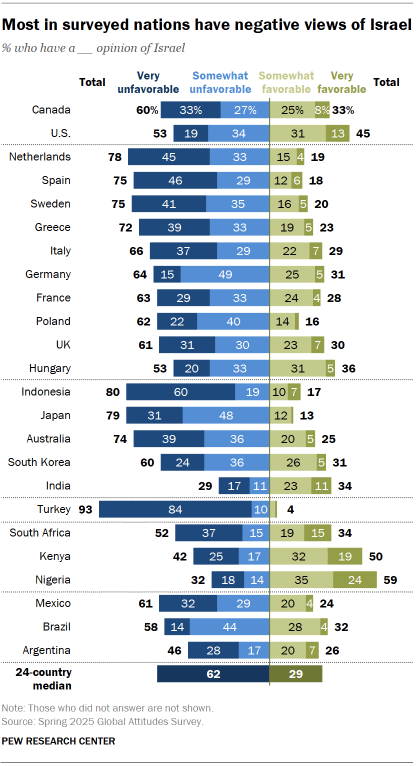 International views of Israel and Prime Minister Benjamin Netanyahu are much more negative than positive, according to a Pew Research Center survey of 24 countries conducted this spring.
Israelis, for their part, tend to say their country is not respected internationally: 58% say Israel is not too or not at all respected around the world, while 39% think it is.
In 20 of the 24 countries surveyed, around half of adults or more have an unfavorable view of Israel. Around three-quarters or more hold this view in Australia, Greece, Indonesia, Japan, the Netherlands, Spain, Sweden and Turkey.
Views of Israel are fairly divided in India (34% favorable, 29% unfavorable).
In Kenya and Nigeria, around half of adults or more have a favorable view of Israel.
How views have changed in recent years
The recent survey is not the first time Pew Research Center has asked about international views of Israel. We have asked about views of Israel before in some countries – including in the United States, where the share of adults with a negative view of Israel rose 11 percentage points between March 2022 and March 2025.
In 10 other countries, we last asked this question in 2013. In seven of these countries, the share of adults with a negative view of Israel has increased significantly. In the United Kingdom, for example, 44% had an unfavorable view of Israel in 2013, compared with 61% now. (In Nigeria, both the share of adults with a negative view of Israel and the share with a positive view have increased since 2013, due to a decline in the share saying they don’t know.)
Views by age
In some countries, younger people are more likely than older people to have an unfavorable view of Israel. This is particularly the case in the high-income countries surveyed: Australia, Canada, France, Poland and South Korea and the U.S. In fact, the U.S. has one of the largest age gaps in views of Israel. … Full article
Featured Video

The Most Important Bet You’ve Never Heard Of
or go to
Aletho News Archives – Video-Images
From the Archives
The Occupied Mentality Syndrome
Saudi Arabia on the American chessboard – Part 2
By B. J. Sabri | American Herald Tribune | April 19, 2016
Since the Korean War, but particularly since the Iranian Revolution of 1979 until today, the United States has been steadily escalating its military presence in the Persian Gulf. Taking advantage of many colossal events of the past 36 years, [1] the hyper-empire has institutionalized its massive presence on land and sea, and expanded its objectives to include the unambiguous physical control of the area, as well as the clear understanding that local Arab governments should abide by them. The pretext is always the same: in “defense” of the national interests and security of the United States. From observing how the United States has been interacting with the governments of the region, and by judging from the size of its expeditionary force, we could reach a basic conclusion. The United States is occupying, de facto, the entire Arabian Peninsula. (Yemen, devastated by Saudi and American jets is yet to be conquered. Oman? Britain returned not as colonial ruler but as a soft occupying power.)
Under this articulation, Saudi Arabia, Qatar, Kuwait, and the United Arab Emirates are virtually occupied countries. If we compare this type of occupation to the mandate and protectorate regimes of the past, the results might be identical—the nations affected by it lose sovereignty. When Arab governments comply with the objectives of a foreign power that station military forces on their national milieu, then that power controls them in multiple ways including how they react to policy deliberations and what decisions they intend to take on specific issues. A good method to verify the concept of effective occupation is this: take notice of what the United States says and wants, and then compare it to what the gulf rulers do in response. (I shall discuss this detail at some point in the upcoming parts.)
If the presence of US forces or other means of political pressure are a factor in Saudi Arabia’s interventionist Arab wars, then we need to debate this issue. However, from the history of resistance to colonialism, we learnt: if a powerful state imposes its order on a nation by military means or other forms of coercion, and if this nation does not resist that imposition, then a mental subordination to the powerful state will ensue. This is especially true in the case of Saudi Arabia. One single event, 9/11, has transformed it from a US “ally” into an instant political hostage of the American Empire. … continue
Blog Roll
 Aletho News
- Trump and the debris of Iran war
- IRGC hits US tech giant Oracle’s data center, computing site in UAE over new assassinations
- Bombing Iran Back Into the Stone Age /Lt Col Daniel Davis & Jim Jatras
- UAE rejects report claiming it is ready to join war on Iran to reopen Hormuz
- A New Resistance Front: How Does Syria Factor into the Regional War?
- Gulf states weigh pipeline expansion plans, hoping to bypass Hormuz
- Iran sets up ‘tollbooth’ system in Strait of Hormuz
- Wave 90: IRGC strikes US-linked industrial sites in Gulf
- Iran Says US-Israeli Claims of Its Military Strength Are Wrong
- Trump’s April Fools’ Address to the nation
- If Americans Knew
- ‘War crime’: Global condemnation as Israeli ministers celebrate death penalty law targeting Palestinian prisoners
- 7 Ways Israel Is Turning Lebanon Into Gaza
- World’s Leading Football Bodies Under Fire Over Israel Policies
- Experts warn of possible use of nukes against Iran
- Israeli invasion of Lebanon could be worse than 1982, warn European officials
- Passover: Liberation and collective punishment
- Trump says the quiet part out loud: (Israel’s) war on Iran > Americans’ health – Daily Update
- Gaza families reunite years after babies evacuated amid Israel’s war
- International Rescue Committee warns Gaza’s children face grave protection risks
- Iran’s Alleged 47-Year War on America: Debunking the 1,050 American Deaths Canard
- No Tricks Zone
- Low Intensity Tornado Wrecks Major Solar Farm, Creating A Potential Toxic Dump
- New Study Finds Warming Saves Lives…Cold Temperatures 12 Times More Deadly Than Excess Heat
- German Science Blog Accuses PIK Climate Institute Of Hallucinating Climate Tipping Points
- Devastating Assessment Of Comirnaty Vaccine By Former Senior Pfizer Europe Toxicologist
- New Study: CO2 Is ‘Effectively Negligible’ As An Explanatory Climate Change Factor Since 2000
- Former Pfizer Toxicologist Dr. Helmut Sterz Tells Bundestag Hearing Pfizer Vaccine Should Have Never Been Approved
- Energy Expert: Germany’s Nuclear Phaseout Was A “500 Billion Euro Mistake”
- New Research: South Australia’s Mid-Holocene Sea Surface Temperatures Were 4°C Warmer Than Today
- Storing Green Energy To Last Germany 10 Days Would Require A 60-Million Tonne Battery
- New Studies: UK Sea Levels Were 4 Meters Higher Than Today During The Mid-Holocene
 Aletho News