Down & out at Porton Down: Embarrassment for the UK’s ‘Rush to Blame Russia’ brigade

By Neil Clark | RT | April 4, 2018
The news that the UK’s own chemical weapons scientists can’t confirm that the nerve agent we’re told was used on the Skripals came from Russia is another blow to the credibility of the UK political and media establishment.
They were oh so sure, weren’t they? Or at least they wanted us to think that. For the past four weeks in Britain, we’ve been subjected to a quite hysterical wave of Russophobia, worse than anything we witnessed even at the height of the old Cold War. The poisoning of former MI6 agent Sergei Skripal and his daughter Yulia, who were found in a collapsed state on a bench in the cathedral city of Salisbury on Sunday, March 4, led not only to calls for a boycott of the football World Cup in Russia, but for RT to be taken off the air. The UK expelled 23 Russian diplomats, and then pressured other European countries to do the same. While on Good Friday, in another provocative move, British authorities boarded an Aeroflot plane at Heathrow Airport.
The important principle of ‘innocent until proven guilty,’ enshrined in Article 11 (1) of the UN’s Universal Declaration of Human Rights, was chucked out of the window. In its place we had ‘guilty until proven innocent.’
Instead of waiting until a full and proper investigation could even begin – let alone be concluded – we had a show trial and sentencing, by media, politicians, and members of neocon think tanks.
Anyone who dared to question the official narrative and didn’t support punishing Russia, faced attack from Imperial Truth Enforcers. Former UK Ambassador to Uzbekistan Craig Murray, who said that Foreign and Commonwealth Office sources had told him that Porton Down scientists were unable to confirm Russian culpability, was labelled a ‘conspiracy theorist’ for observing: “The same people who assured you Saddam Hussein had WMDs now assure you Russian ‘Novichok’ nerve agents are being wielded by Vladimir Putin to attack people on British soil.”
Labour leader Jeremy Corbyn, who condemned the attack but called for a thorough investigation, was savaged not just by the Tories, but also his own Parliamentary party, simply for taking a cautious line in Parliament on March 14.
Thirty-six Labour MPs signed an Early Day Motion – sponsored by arch Corbyn-critic John Woodcock – which declared “This House UNEQUIVOCALLY accepts the Russian state’s culpability for the poisoning of Yulia and Sergei Skripal.” The EDM supported the expulsion of Russian diplomats and the calling of a special meeting of the UN Security Council to “discuss Russia’s use of chemical weapons on UK soil.”
Will these MPs now be apologizing to Russia for accusing them of doing something which most definitely has not been proved? Or does supporting a neocon foreign policy mean never having to say you’re sorry?
It’s not just politicians who need to eat some humble pie.
In all my years in journalism, I have never felt so ashamed of my profession as in the last four weeks. The job of the journalist is to ask questions. To find out the truth. To be absolutely fearless in following leads, wherever they may take you. Today in Britain, political journalism means just parroting the official War Party line. It soon became apparent that the government narrative on Salisbury had more holes in it than a slab of Swiss cheese. But we were all expected, like the good little townsfolk in Hans Christian Andersen’s ‘Emperor’s New Clothes,’ not to notice. Newspapers and magazines which should have been holding Theresa May and Boris Johnson to account did nothing of the sort. Suppositions were reported, day after day, as proven fact.
The last four weeks have shown how nothing really changed even after the catastrophe of Iraq. The same pro-war commentators are still in place, robotically churning out their rabidly anti-Russian, anti-Putin diatribes for an ever-dwindling readership.
After the lies told about Iraqi WMDs, you might have thought there would be a bit of ‘mainstream’ skepticism about UK government chemical weapons claims against an ‘Official Enemy’ state, which seem designed to lead us into an even more calamitous war. But no, they all carried on as if the only important thing that had happened in 2003 was Arsenal beating Southampton 1-0 in the FA Cup Final.
Just before the Iraq invasion, I remember asking a Conservative MP at a party if he really believed the guff about Saddam having WMDs. He looked at me and paused, before saying, “Well you’ve got to admit, he’s not a frightfully nice chap.” Today that MP, who clearly didn’t believe the government’s assertions, is the British Foreign Secretary.
Boris Johnson has gone further than any minister down the ‘Russia did it’ line. In an interview with Deutsche Welle on March 20, he said: “they (the scientists at Porton Down) were absolutely categorical and I asked the guy myself, I said, ‘Are you sure?’ And he said there’s no doubt.”
That is flatly contradicted by the statement today of Gary Aitkenhead, the chief executive of the Defence Science and Technology Laboratory at Porton Down, who said, “We have not identified the precise source.”
Just as interesting was Aitkenhead’s response to being asked if Novichok could have emanated from Porton Down itself. “There’s no way that anything like that would ever have come from us… we’ve got the highest standards of control and security,” he said.
Yet in his Deutsche Welle interview, Boris Johnson, in answer to the question: “Does Britain possess samples of it?” (i.e. Novichok), replied, “They (Porton Down) do.” How could Porton Down know the substance used was Novichok if they possessed no samples to test it against?
If samples were stored literally just down the road from where the Skripals were poisoned, surely it’s reasonable to ask whether or not some of them did get out? To maintain, as the UK government does, that no other explanation other than Russian guilt is plausible is clearly nonsense. After going out on a limb on this one, (one suspects in order to curry favor with kingmaker Rupert Murdoch, Boris Johnson’s position as foreign secretary is surely now untenable. Jeremy Corbyn needs to be calling for his resignation – and also that of Prime Minister Theresa May – when he next goes to the House of Commons.
But it’s clear that the UK’s problems go a lot deeper than changing the faces at the top. The Salisbury ‘Rush to Blame Russia,’ before any evidence of Kremlin involvement was produced, proves that we need a clear out of the entire political and media establishment and a move to a more democratic, publicly accountable system. We didn’t get that after Iraq, but we really must get it now.
NATO Plotted ‘Skripal Case’ to Justify Their Defense Spendings – Moscow
Sputnik – April 3, 2018
The Russian Foreign Ministry says it can’t discern how to convene a NATO-Russia Council in the current climate, considering absurd NATO’s statements regarding a readiness for dialogue while expelling Russian diplomats.
“Yes, indeed, seven people have been declared undesirable. And they (in Brussels) have announced that they will not issue visas to three other employees,” Deputy Foreign Minister of the Russian Federation Alexander Grushko stated at the Valdai Discussion Club’s event.
According to the diplomat, the next meeting of the Russia-NATO Council (NRC) cannot be convened under the conditions of Russian diplomats being expelled.
“NATO, expelling Russian diplomats, cuts the branch on which it sits. This contradicts the numerous statements made by the Secretary-General and other representatives of the alliance about NATO being interested in a political dialogue and the convening of a regular meeting of the NRC… How can it be convened under these conditions?” the Alexander Grushko said.
Moscow does not rule out that the poisoning of former Russian intelligence officer Sergei Skripal in the United Kingdom has been designed to justify the growing defense spending of NATO among other reasons, Russian Deputy Foreign Minister Alexander Grushko stated.
“I think that all this was planned, including due to the fact that it would be necessary to explain to the public in the near future where the money is going because it is colossal spending,” Grushko said when asked whether Moscow expected NATO to increase defense spending over the so-called Skripal case.
Euro-Atlantic solidarity around Skripal case has become a direct danger to European security, according to the Russian Deputy Foreign Minister.
Moscow does not exclude that the Skripal case was plotted as the argument for NATO’s increase in defense expenditures, a great enemy is needed, the deputy minister said.
“NATO has crossed the line when it continued to expand its defense presence at Russia’s borders. Today, the situation along our borders has changed dramatically and in fact, not only in terms of politics but also in the field of military development, NATO has resorted to Cold War schemes that should have remained in the past and today cannot provide security… without Russia,” the Deputy Foreign Minister of the Russian Federation noted.
London decided to follow a provocative path to support an atmosphere of Russophobia, Grushko said.
“It is obvious that this is a provocation. The whole situation was turned upside down, an ideological campaign was built in such a way as to exclude a normal dialogue, professional, in fact, what happened. The UK refused to use legally binding instruments, which are fixed in the Convention on the Prohibition of Chemical Weapons. Therefore, these are all signs that this is a provocation chosen at a special moment in order to further aggravate the relations between Russia and the West, worsen the prospects for a return to normalcy, and prevent the transition to cooperation schemes in the areas of common interest,” Alexander Grushko stated.
Western countries, making claims over Russia on the “Skripal case”, should have understood that it is impossible to speak with Moscow in the language of ultimatums, Grushko emphasized.
“An ultimatum was delivered, which was not intended to be answered because the people who formulated this ultimatum could not fail to understand beforehand that this is not the language in which one can speak,” he said.
Moscow will answer in an asymmetric way to any unfriendly NATO move in order to protect our interests, Grushko noted.
RT, Sputnik Facing Pressure in West Due to Effective Work
“By the way, why are they closing Sputnik and Russia Today? For one simple reason – because they [media outlets] carry out their function effectively, they really influence public opinion,” Grushko said.
Tensions between Russia and Western countries began to grow after the Salisbury incident, where Sergei Skripal, former Russian intelligence officer and his daughter Yulia were harmed by a nerve agent. The UK accused Russia of orchestrating the attack and expelled 23 Russian diplomats. The move has been supported by more than 25 countries, despite of the fact that Russia has repeatedly denied the accusations and cited the lack of proof.
NPR Runs IDF Playbook, Spinning Killing of 17 Palestinians
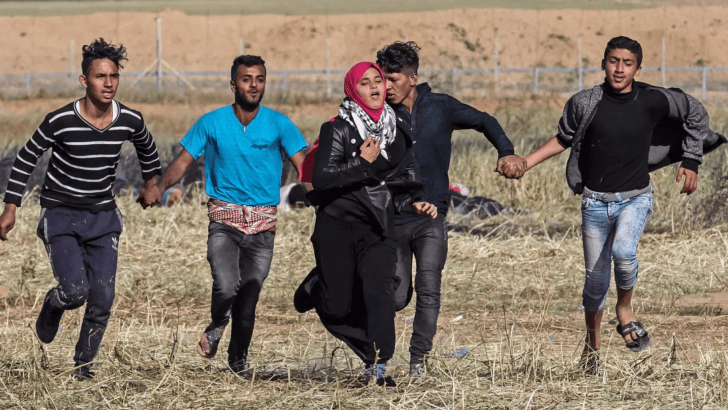
Photo credit – Said Khatib, AFP
By Adam Johnson | FAIR | April 2, 2018
NPR, as FAIR has noted throughout the years (e.g., 8/14/01, 11/01, 2/5/02, 11/15/12, 10/10/14), takes a default pro-Israel line when reporting on the affairs of Israel/Palestine. Its correspondents almost always live in West Jerusalem or in Israel proper, are rarely Palestinian or Arab, and they work consistently to deflect blame for Israeli violence—either shifting blame onto Palestinian victims or dispersing it through false parity.
A segment from Friday (All Things Considered, 3/30/18) on Israel’s killing of Gaza protesters provides a case study in this process. NPR host Ari Shapiro set up the segment, an interview with reporter Daniel Estrin, by blaming the 17 dead and hundreds of injured Palestinians on “the militant group Hamas,” framing Israel as totally defensive. From the very first line, blame is deflected from the Israeli military:
Today saw some of the most violent clashes in years between Palestinian demonstrators and Israeli troops.
We do not have one party’s snipers opening fire on another, unarmed party; we have “violent clashes”—a term, as FAIR (8/12/17) has noted before, that implies symmetry of forces and is often used to launder responsibility. The whitewashing got worse from there:
Tens of thousands of people in Gaza answered the militant group Hamas’ call to protest.
Palestinians have no organic reasons for wanting to protest the occupation of their homes; the whole thing was a top-down decree from “the militant group” Hamas.
They threw rocks and firebombs near the border fence with Israel. On the other side, Israeli troops assembled.
This conveys the impression the Israeli military was just sitting around, minding its own business, when it was aggressively attacked by hundreds of Palestinians, then responded to this assault.
The “firebombs” claim is repeated later in the piece by Estrin himself: “Israel responded to Palestinians throwing rocks, firebombs, burning tires.” This isn’t qualified with “according to the IDF” or “the Israeli government”—even though as of now, there’s no independent evidence firebombs were used, much less used before any sniper fire from Israel.
The issue isn’t trivial: The matter of first blood when it comes to the Palestinian/Israeli “conflict” is a crucial one (FAIR.org, 12/8/17); framing Israel as always responding to threats, rather than inflicting aggressive violence on an occupied people, is a critical difference. And subtle framing devices like “clashes,” distorting timelines of who did what, or morphing IDF claims of “firebombs” into fact are how media keep this myth alive, and further delegitimize Palestinian resistance. (It should be borne in mind that opposition to occupation, even armed opposition, is a right guaranteed by international law.)
When FAIR pointed out to Estrin on Twitter that he had reported the “firebombs” as fact and not a claim by the IDF, he responded, “I reported the firebombs as an Israeli claim.” When FAIR showed evidence he and host Shapiro had done the opposite, Estrin deflected: “Be kind; it’s live radio.”
“Explain why this violence broke out today,” host Shapiro asked. It’s not a massacre or an attack or “firing on protesters,” as it is when official US enemies do it; it’s simply “violence breaking out.”
Estrin again took care to re-establish Hamas as the “driving force” and guilty party:
And it was billed as an independent Palestinian protest campaign. But actually Hamas, which controls Gaza, was a driving force.
This effectively militarized the whole of the protest, treating it not as an outpouring of popular grievances but as an operation quarterbacked by “a militant group.” This is where Estrin asserted the protesters used “firebombs” without attributing the claim to the Israeli attackers. Instead, he cited the IDF as a source on crowd size:
And according to the Israeli army, there were more than 30,000 Palestinians at six different spots along the border. Israel responded to Palestinians throwing rocks, firebombs, burning tires. Israel fired tear gas and live fire. It was the most violence in Gaza since the Gaza War in 2014.
A brief mention of the dire humanitarian situation in Gaza was thrown in, but it is blamed on an “ongoing internal Palestinian political fight” that has made the situation “even worse.” Estrin then erroneously told listeners “Hamas took control of Gaza by force a decade ago,” when Hamas actually gained power in Gaza in 2006 through an internationally recognized election. In 2007, Hamas won a civil war with US-backed Fatah, the faction it had defeated in the election, but to say Hamas “took control of Gaza by force” falsely paints it as an usurping force with no legitimate authority.
Asked what will happen next, Estrin shrugged and says more of the same, and that is it.
It’s a brief report, but a highly revealing one: Hamas is at fault, the Palestinians threw “firebombs” first, then the Israeli army “assembled.” The illegitimate Hamas astroturfed the protest, the people are being exploited. Israel just killed those 17 protesters in self-defense.
You can contact NPR ombud Elizabeth Jensen via NPR’s contact form or via Twitter: @EJensenNYC. Please remember that respectful communication is the most effective.
More Than 75 Percent of Americans Think TV, Newspapers Report Fake News – Poll
Sputnik – 02.04.2018
WASHINGTON – More than 75 percent of Americans think that the major TV networks and newspapers report fake news, a new Monmouth University Poll stated.
“More than 3-in-4 Americans believe that traditional major TV and newspaper media outlets report ‘fake news,’ including 31 percent who believe this happens regularly and 46 percent who say it happens occasionally,” a press release on the poll results said.
The release said the 77 percent who believe there is some reporting of ‘fake news’ is up from 63 percent last year in the same poll.
Most Americans think “fake news” applies to the way news outlets decide what to report, while 25 percent think news stories that are incorrect are “fake news.”
Eighty-three percent of Americans think outside groups are trying to plant fake stories in mainstream media.
The Monmouth University poll was conducted on March 2-5, amidst a random sample of 803 adults. The survey’s margin of error is 3.5 percent with 95 percent confidence.
The Warm War: Russiamania At The Boiling Point
By Jim Kavanagh | The Polemicist | March 31, 2018
Is it war yet?
Yes, in too many respects.
It’s a relentless economic, diplomatic, and ideological war, spiced with (so far) just a dash of military war, and the strong scent of more to come.
I mean war with Russia, of course, although Russia is the point target for a constellation of emerging adversaries the US is desperate to entame before any one or combination of them becomes too strong to defeat. These include countries like Iran and China, which are developing forces capable of resisting American military aggression against their own territory and on a regional level, and have shown quite too much uppitiness about staying in their previously-assigned geopolitical cages.
But Russia is the only country that has put its military forces in the way of a U.S. program of regime change—indirectly in Ukraine, where Russia would not get out of the way, and directly in Syria, where Russia actively got in the way. So Russia is the focus of attack, the prime target for an exemplary comeuppance.
Is it, then, a new Cold War, even more dangerous than the old one, as Stephen F. Cohen says?
That terminology was apt even a few months ago, but the speed, ferocity, and coordination of the West/NATO’s reaction to the alleged nerve-agent poisoning of the Skripals, as well as the formation of a War Cabinet in Washington, indicates to me that we’ve moved to another level of aggression.
It’s beyond Cold. Call it the Warm War. And the temperature’s rising.
The Nerve of Them
There are two underlying presumptions that, combined, make present situation more dangerous than a Cold War.
One is the presumption of guilt—or, more precisely, the presumption that the presumption of Russian guilt can always be made, and made to stick in the Western mind.
The confected furor over the alleged nerve-agent poisoning of the Skripals demonstrates this dramatically.
Theresa May’s immediate conclusion that the Russian government bears certain and sole responsibility for the nerve-agent poisoning of the Skripals is logically, scientifically, and forensically impossible.
False certainty is the ultimate fake news. It is just not true that, as she says: “There is no alternative conclusion other than the Russian state is culpable.” The falsity of this statement has been demonstrated by a slew of sources—including the developers of the alleged “Novichok” agent themselves, a thorough analysis by a former UN inspector in Iraq who worked on the destruction of Russian chemical weapons, establishment Western scientific outlets like New Scientist (“Other countries could have made ‘Russian’ nerve agent”), and the British government’s own mealy-mouthed, effective-but-unacknowledged disavowal of that conclusion. In its own words, The British government found: “a nerve agent or related compound,” “of a type developed by Russia.” So, it’s absolutely, positively, certainly, without a doubt, Russian-government-produced “Novichok”…. or something else.
Teresa May is lying, everyone who seconds her assertion of false certainty is lying, they all know they are lying, and the Russians know that they know they are lying. It’s a knowledgeable family.
Prince Geoffrey to his mother Eleanor in The Lion in Winter.
It boggles the—or at least, my—mind how, in the face of all this, anyone could take seriously her ultimatum, ignoring the procedures of the Chemical Weapons Convention, gave Russia 24 hours to “explain”—i.e., confess and beg forgiveness for—this alleged crime.
Indeed, it’s noteworthy that France initially, and rather sharply, refused to assume Russian guilt, with a government spokesman saying, “We don’t do fantasy politics. Once the elements are proven, then the time will come for decisions to be made.” But the whip was cracked—and surely not by the weak hand of Whitehall—demanding EU/NATO unity in the condemnation of Russia. So, in an extraordinary show of discipline that could only be ordered and orchestrated by the imperial center, France joined the United States and 20 other countries in the largest mass expulsion of Russian diplomats ever.
Western governments and their compliant media have mandated that Russian government guilt for the “first offensive use of a nerve agent” in Europe since World War II is to be taken as flat fact. Anyone—like Jeremy Corbyn or Craig Murray—who dares to interrupt the “Sentence first! Verdict afterwards!” chorus to ask for, uh, evidence, is treated to a storm of obloquy.
At this point, Western accusers don’t seem to care how blatantly unfounded, if not ludicrous, an accusation is. The presumption of Russian guilt, along with the shaming of anyone who questions it, has become an unquestionable standard of Western/American political and media discourse.
Old Cold War McCarthyism has become new Warm War fantasy politics.
Helled in Contempt
This declaration of diplomatic war over the Skripal incident is the culmination of an ongoing drumbeat of ideological warfare, demonizing Russia and Putin personally in the most predictable and inflammatory terms.
For the past couple of years, we’ve been told by Hillary Clinton, John McCain, Marco Rubio, and Boris Johnson that Putin is the new Hitler. That’s a particularly galling analogy for the Russians. Soviet Russia, after all, was Hitler’s main enemy, that defeated the Nazi army at the cost of 20+ million of its people—while the British Royal Family was not un-smitten with the charms of Hitlerian fascism, and British footballers had this poignant moment in 1938 Berlin:

“War” is what they seem to want it to be. For the past 18 to 24 months, we’ve also been inundated with Morgan Freeman and Rob Reiner’s ominous “We have been attacked. We are at war,” video, as well as the bipartisan (Hillary Clinton, John McCain) insistence that alleged Russian election meddling should be considered an “act of war” equivalent to Pearl Harbor. Indeed, Trump’s new National Security advisor, the warmongering lunatic John Bolton, calls it, explicitly “a casus belli, a true act of war.”
Even the military is getting in on the act. The nerve-agent accusation has been followed up by General John Nicholson, the commander of U.S. Forces in Afghanistan, accusing Russia of arming the Taliban! It’s noteworthy that this senior American military general casually refers to Russia as “the enemy”: “We’ve had stories written by the Taliban that have appeared in the media about financial support provided by the enemy.”
Which is strange, because, since the Taliban emerged from the American-jihadi war against Soviet forces in Afghanistan, and the Taliban and Russia have “enduring enmity” towards each other, as Kate Clark of the Afghanistan Analysts Network puts it. Furthermore, the sixteen-year-long American war against the Taliban has depended on Russia allowing the U.S. to move supplies through its territory, and being “the principal source of fuel for the alliance’s needs in Afghanistan.”
So the general has to admit that this alleged Russian “destabilising activity” is a new thing: “This activity really picked up in the last 18 to 24 months… When you look at the timing it roughly correlates to when things started to heat up in Syria. So it’s interesting to note the timing of the whole thing.”
Yes, it is.
The economic war against Russian is being waged through a series of sanctions that seem impossible to reverse, because their expressed goal is to extract confession, repentance, and restitution for crimes ascribed to Russia that Russia has not committed, or has not been proven to have committed, or are entirely fictional and have not been committed by anyone at all. We will only stop taking your bank accounts and consulates and let you play games with us if you confess and repent every crime we accuse you of. No questions permitted.
This is not a serious framework for respectful international relations between two sovereign nations. It’s downright childish. It paints everyone, including the party trying to impose it, into an impossible corner. Is Russia ever going to abandon Crimea, confess that it shot down the Malaysian jet, tricked us into electing Donald Trump, murdered the Skripals, is secretly arming the Taliban, et. al.? Is the U.S. ever going to say: “Never mind”? What’s the next step? It’s the predicament of the bully.
This is not, either, an approach that really seeks to address any of the “crimes” charged. As Victoria Nuland (a Clintonite John Bolton) put it on NPR, it’s about, “sending a message” to Russia. Well, as Russia’s ambassador to Washington, Anatoly Antonov said, with this latest mass expulsion of diplomats, the United States is, “Destroying what little remained of US-Russian ties.” He got the message.
All of this looks like a coordinated campaign that began in response to Russia’s interruption of American regime-change projects in Ukraine and especially Syria, that was harmonized—over the last 18 to 24 months—with various elite and popular motifs of discontent over the 2016 election, and that has reached a crescendo in the last few weeks with ubiquitous and unconstrained “enemization”1 of Russia. It’s hard to describe it as anything other than war propaganda—manufacturing the citizenry’s consent for a military confrontation.
Destroying the possibility of normal, non-conflictual, state-to-state relations and constituting Russia as “the enemy” is exactly what this campaign is about. That is its “message” and its effect—for the American people as much as for the Russia government. The heightened danger, I think, is that Russia, which has for a long time been reluctant to accept that America wasn’t interested in “partnership”, has now heard and understood this message, while the American people have only heard but do not understand it.
It’s hard to see where this can go that doesn’t involve military conflict. This is especially the case with the appointments of Mike Pompeo, Gina Haspel, and John Bolton—a veritable murderers’ row that many see as the core of a Trump War Cabinet. Bolton, who does not need Senate confirmation, is a particularly dangerous fanatic, who tried to get the Israelis to attack Iran before even they wanted to, and has promised regime change in Iran by 2019. As mentioned, he considers that Russia has already given him a “casus belli.” Even the staid New York Times warns that, with these appointments, “the odds of taking military action will rise dramatically.”
The second presumption in the American mindset today makes military confrontation more likely than it was during the Cold War: Not only is there a presumption of guilt, there is a presumption of weakness. The presumption of guilt is something the American imperial managers are confident they can induce and maintain in the Western world; the presumption of weakness is one they—or, I fear, too many of them—have all-too blithely internalized.
This is an aspect of the American self-image among policymakers whose careers matured in a post-Soviet world. During the Cold War, Americans held themselves in check by the assumption, that, militarily, the Soviet Union was a peer adversary, a country that could and would defend certain territories and interests against direct American military aggression—“spheres of interest” that should not be attacked. The fundamental antagonism was managed with grudging mutual respect.
There was, after all, a shared recent history of alliance against fascism. And there was an awareness that the Soviet Union, in however distorted a way, both represented the possibility of a post-capitalist future and supported post-colonial national liberation movements, which gave it considerable stature in the world.
American leadership might have hated the Soviet Union, but it was not contemptuous of it. No American leader would have called the Soviet Union, as John McCain called Russia, just “a gas station masquerading as a country.” And no senior American or British leader would have told the Soviet Union what British Defense Secretary Gavin Williamson told Russia last week: to “go away and shut up.”
This is a discourse that assumes its own righteousness, authority, and superior power, even as it betrays its own weakness. It’s the discourse of a frustrated child. Or bully. Russia isn’t shutting up and going away, and the British are not—and know they’re not—going to make it. But they may think the Big Daddy backing them up can and will. And daddy may think so himself.
Like all bullies, the people enmeshed in this arrogant discourse don’t seem to understand that it is not frightening Russia. It’s only insulting the country, and leading it to conclude that there is indeed nothing remaining of productive, non-conflictual, US-Russian “partnership” ties. The post-Skripal worldwide diplomatic expulsions, which seem deliberately and desperately excessive, may have finally convinced Russia that there is no longer any use trying. Those who should be frightened of this are the American people.
The enemy of my enemy is me.
The United States is only succeeding in turning itself into an enemy for Russians. Americans would do well to understand how thoroughly their hypocritical and contemptuous stance has alienated the Russian people and strengthened Vladimir Putin’s leadership—as many of Putin’s critics warned them it would. The fantasy of stoking a “liberal” movement in Russia that will install some nouveau-Yeltsin-ish figure is dissipated in the cold light of a 77% election day. Putin is widely and firmly supported in Russia because he represents the resistance to any such scheme.
Americans who want to understand that dynamic, and what America itself has wrought in Russia, should heed the passion, anger, and disappointment in this statement about Putin’s election from a self-described “liberal” (using the word, I think, in the intellectual tradition, not the American political, sense), Margarita Simonyan, editor-in-chief of RT TV (translator’s errors corrected):
Essentially, the West should be horrified not because 76% of Russians voted for Putin, but because this elections has demonstrated that 95% of Russia’s population supports conservative-patriotic, communist and nationalist ideas. That means that liberal ideas are barely surviving among measly 5% of population.
And that’s your fault, my Western friends. It was you who pushed us into “Russians never surrender” mode…
[W]ith all your injustice and cruelty, inquisitorial hypocrisy and lies, you forced us to stop respecting you. You and your so called “values.”
We don’t want to live like you live, anymore. For fifty years, secretly and openly, we wanted to live like you, but not any longer.
We have no more respect for you, and for those amongst us that you support, and for all those people who support you. …
For that you only have yourself to blame. … In meantime, you’ve pushed us to rally around your enemy. Immediately after you declared him an enemy, we united around him….
It was you who imposed an opposition between patriotism and liberalism. Although, they shouldn’t be mutually exclusive notions. This false dilemma, created by you, made us chose patriotism.
Even though, many of us are really liberals, myself included.
Get cleaned up, now. You don’t have much time left.
In fact, the whole “uprising”/color revolution strategy throughout the world is over. It’s been fatally discredited by its own purported successes. Everybody in the Middle East has seen how that worked out for Iraq, Libya, and Syria, and the Russians have seen how it worked out for Ukraine and for Russia itself. In neither Russia nor Iran (nor anywhere else of importance) are the Americans, with their sanctions and their NGOs and their cookies, going to stoke a popular uprising that turns a country into a fractured client of the Washington Consensus. More fantasy politics.
The old new world Washington wants won’t be born without a military midwife. The U.S. wants a compliant Russia (and “international community”) back, and it thinks it can force it into being.
Fear Knot
Consider this quote from The Saker, a defense analyst who was born in Switzerland to a Russian military family, “studied Russian and Soviet military affairs all [his] life,” and lived for 20 years in the United States. He’s been one of the sharpest analysts of Russia and Syria over the last few years. This was his take a year ago, after Trump’s cruise missile attack on Syria’s Al Shayrat airfield—another instant punishment for an absolutely, positively, proven-in-a day, chemical crime:
For one thing, there is no US policy on anything. The Russians expressed their total disgust and outrage at this attack and openly began saying that the Americans were “недоговороспособны”. What that word means is literally “not-agreement-capable” or unable to make and then abide by an agreement. While polite, this expression is also extremely strong as it implies not so much a deliberate deception as the lack of the very ability to make a deal and abide by it. … But to say that a nuclear world superpower is “not-agreement-capable” is a terrible and extreme diagnostic.
This means that the Russians have basically given up on the notion of having an adult, sober and mentally sane partner to have a dialog with…
In all my years of training and work as a military analyst I have always had to assume that everybody involved was what we called a “rational actor”. The Soviets sure were. As were the Americans.…
Not only do I find the Trump administration “not agreement-capable”, I find it completely detached from reality. Delusional in other words. …
Alas, just like Obama before him, Trump seems to think that he can win a game of nuclear chicken against Russia. But he can’t. Let me be clear here: if pushed into a corner the Russian will fight, even if that means nuclear war.
There is a reason for this American delusion. The present generation of American leadership was spoiled and addled by the blissful post-Soviet decades of American impunity.
The problem is not exactly that the U.S. wants full-on war with Russia, it’s that America does not fear it.2
Why should it? It hasn’t had to for twenty years during which the US assumed it could bully Russia to stay out of its imperial way anywhere it wanted to intervene.
After the Soviet Union broke up (and only because the Soviet Union disappeared) the United States was free to use its military power with impunity. For some time, the U.S. had its drunken stooge, Yeltsin, running Russia and keeping it out of America’s military way. There was nary a peep when Bill Clinton effectively conferred on NATO (meaning the U.S. itself) the authority to decide what military interventions were necessary and legitimate. For about twenty years—from the Yugoslavia through the Libya intervention—no nation had the military power or politico-diplomatic will to resist this.
But that situation has changed. Even the Pentagon recognizes that the American Empire is in a “post-primacy” phase—certainly “fraying,” and maybe even “collapsing.” The world has seen America’s social and economic strength dissipate, and its pretense of legitimacy disappear entirely. The world has seen American military overreach everywhere while winning nothing of stable value anywhere. Sixteen years, and the mighty U.S. Army cannot defeat the Taliban. Now, that’s Russia’s fault!
Meanwhile, a number of countries in key areas have gained the military confidence and political will to refuse the presumptions of American arrogance—China in the Pacific, Iran in the Middle East, and Russia in Europe and, surprisingly, the Middle East as well. In a familiar pattern, America’s resultant anxiety about waning power increases its compensatory aggression. And, as mentioned, since it was Russia that most effectively demonstrated that new military confidence, it’s Russia that has to be dealt with first.
The incessant wave of sanctions and expulsions is the bully in the schoolyard clenching his fist to scare the new kid away. OK, everyone’s got the message now. Unclench or punch?
Let’s be clear about who is the world’s bully. As is evident to any half-conscious person, Russia is not going to attack the United States or Europe. Russia doesn’t have scores of military bases, combat ships and aircraft up on America’s borders. It doesn’t have almost a thousand military bases around the world. Russia does not have the military forces to rampage around the world as America does, and it doesn’t want or need to. That’s not because of Russia’s or Vladimir Putin’s pacifism, but because Russia, as presently situated in the political economy of the world, has nothing to gain from it.
Nor does Russia need some huge troll-farm offensive to “destabilize” and sow division in Western Europe and the United States. Inequality, austerity, waves of immigrants from regime-change wars, and trigger-happy cops are doing a fine job of that. Russia isn’t responsible for American problems with Black Lives Matter or with the Taliban.
All of this is fantasy politics.

It’s the United States, with its fraying empire, that has a problem requiring military aggression. What other tools does the U.S. have left to put the upstarts, Russia first, back in their places?
It must be hard for folks who have had their way with country after country for twenty years not to think they can push Russia out of the way with some really, really scary threats, or maybe one or two “bloody nose” punches. Some finite number of discrete little escalations. There’s already been some shoving—that cruise missile attack, Turkey’s downing of a Russian jet, American attacks on Russian personnel (ostensibly private mercenaries) in Syria—and, look, Ma, no big war. But sometimes you learn the hard way the truth of the reverse Mike Tyson rule: “Everyone has a game plan until they smack the other guy in the face.”
Consider one concrete risk of escalation that every informed observer is, and every American should be, aware of.
The place where the United States and Russia are literally, geographically, closest to confrontation is Syria. As mentioned, the U.S. and its NATO ally, Turkey, have already attacked and killed Russians in Syria, and the U.S. and its NATO allies have a far larger military force than Russia in Syria and the surrounding area. On the other hand, Russia has made very effective use of its forces, including what Reuters calls “advanced cruise missiles” launched from planes, ships, and submarines that hit ISIS targets with high precision from 1000 kilometers.
Russia is also operating in accordance with international law, while the U.S. is not. Russia is fighting with Syria for the defeat of jihadi forces and the unification of the Syrian state. The United States is fighting with its jihadi clients for the overthrow of the Syrian government and the division of the country. Russia intervened in Syria after Obama announced that the U.S. would attack Syrian army troops, effectively declaring war. If neither side accepts defeat and goes home, it is quite possible there will be some direct confrontation over this. In fact, it’s hard to imagine that there won’t.
A couple of weeks ago Syria and Russia said the U.S. was planning a major offensive against the Syrian government, including bombing the government quarter in Damascus. Valery Gerasimov, head of Russia’s General Staff, warned: “In the event of a threat to the lives of our servicemen, Russia’s armed forces will take retaliatory measures against the missiles and launchers used.” In this context, “launchers” means American ships in the Mediterranean.
Also a couple of weeks ago, Russia announced a number of new, highly-advanced weapons systems. There’s discussion about whether some of the yet-to-be-deployed weapons announced may or may not be a bluff, but one that has already been deployed, called Dagger (Kinzhal, not the missiles mentioned above), is an air-launched hypersonic cruise missile that files at 5-7,000 miles per hour, with a range of 1,200 miles. Analyst Andrei Martyanov claims that: “no modern or prospective air-defense system deployed today by any NATO fleet can intercept even a single missile with such characteristics. A salvo of 5-6 such missiles guarantees the destruction of any Carrier Battle Group or any other surface group, for that matter.” Air-launched. From anywhere.
The U.S. attack has not (yet) happened, for whatever reason (Sputnik reporter Suliman Mulhem, citing “a military monitor,” claims that’s because of the Russian warnings). Great. But given the current state of America’s anxiously aggressive “post-primacy” policy—including the Russiamania, the Zionist-driven need to destroy Syria and Iran, and the War Cabinet—how unlikely is that the U.S. will, in the near future, make some such attack on some such target that Russia considers crucial to defend?
And Syria is just one theater where, unless one side accepts defeat and goes home, military conflict with Russia is highly likely. Is Russia going to abandon the Russian-speaking people of the Donbass if they’re attacked by fascist Kiev forces backed by the U.S.? Is it going to sit back and watch passively if American and Israeli forces attack Iran? Which one is going to give up and accept a loss: John Bolton or Vladimir Putin?
Which brings us to the pointed question: What will the U.S. do if Russia sinks an American ship? How many steps before that goes full-scale, even nuclear? Or maybe American planners (and you, dear reader) are absolutely, positively sure that will never happen, because the U.S. has cool weapons, too, and a lot more of them, and the Russians will probably lose all their ships in the Mediterranean immediately, if not something worse, and they’ll put up with anything rather than go one more step. The Russians, like everybody, must know the Americans always win.
Happy with that, are we? Snug in our homeland rug? ‘Cause Russians won’t fight, but the Taliban will.
This is exactly what is meant by Americans not fearing war with Russia (or war in general for that matter). Nothing but contempt.
The Skripal opera, directed by the United States, with the whole of Europe and the entire Western media apparatus singing in harmony, makes it clear that the American producers have no speaking role for Russia in their staging of the world. And that contempt makes war much more likely. Here’s The Saker again, on how dangerous the isolation the U.S. and its European clients are so carelessly imposing on Russia and themselves is for everybody:
Right now they are expelling Russian diplomats en masse and they are feeling very strong and manly. …
The truth is that this is only the tip of a much bigger iceberg. In reality, crucial expert-level consultations, which are so vitally important between nuclear superpowers, have all but stopped a long time ago. We are down to top level telephone calls. That kind of stuff happens when two sides are about to go to war. For many months now Russia and NATO have made preparations for war in Europe. …Very rapidly the real action will be left to the USA and Russia. Thus any conflict will go nuclear very fast. And, for the first time in history, the USA will be hit very, very hard, not only in Europe, the Middle-East or Asia, but also on the continental US.
Mass diplomatic expulsions, economic warfare, lockstep propaganda, no interest whatsoever in respectfully addressing or hearing from the other side. What we’ve been seeing over the past few months is the “kind of stuff that happens when two sides are about to go to war.”
The less Americans fear war, the less they respect the possibility of it, the more likely they are to get it.
Ready or Not
The Saker makes a diptych of a point that gets to the heart of the matter. We’d do well to read and think on it carefully:
1. The Russians are afraid of war. The Americans are not.
2. The Russians are ready for war.
The Americans are not. Russia is afraid of war. More than twenty million Soviet citizens were killed in WWII, about half of them civilians. That was more than twenty times the number of Americans and British casualties combined. The entire country was devastated. Millions died in the 872-day siege of Leningrad alone, including Vladimir Putin’s brother. The city’s population was decimated by disease and starvation, with some reduced to cannibalism. Wikileaks calls it “one of the longest and most destructive sieges in history [and] possibly the costliest in casualties.” Another million-plus died in the nine-month siege of Stalingrad.
Every Russian knows this history. Millions of Russian families have suffered from it. Of course, there was mythification of the struggle and its heroes, but the Russians, viscerally, know war and know it can happen to them. They do not want to go through it again. They will do almost anything to avoid it. Russians are not flippant about war. They fear it. They respect it.
The Americans are not (afraid of war). Americans have never experienced anything remotely as devastating as this. About 620,000 Americans died in the Civil War, 150 years ago. (And we’re still entangled in that!) The American mainland has not been attacked by a significant military force since the War of 1812. Since then, the worst attacks on American territory are two one-off incidents (Pearl Harbor and 9/11), separated by seventy years, totaling about six-thousand casualties. These are the iconic moments of America Under Siege.
For the American populace, wars are “over there,” fought by a small group of Americans who go away and either come back or don’t. The death, destruction, and aroma of warfare—which the United States visits on people around the world incessantly—is unseen and unexperienced at home. Americans do not, cannot, believe, in any but the most abstract intellectual sense, that war can happen here, to them. For the general populace, talk of war is just more political background noise, Morgan Freeman competing for attention with Stormy Daniels and the Kardashians.
Americans are supremely insouciant about war: They threaten countries with it incessantly, the government routinely sells it with lies, and the political parties promote it opportunistically to defeat their opponents—and nobody cares. For Americans, war is part of a game. They do not fear it. They do not respect it.
The Russians are ready for war. The Nazi onslaught was defeated—in Soviet Russia, by Soviet Citizens and the Red Army—because the mass of people stood and fought together for a victory they understood was important. They could not have withstood horrific sieges and defeated the Nazis any other way. Russians understand, in other words, that war is a crisis of death and destruction visited on the whole of society, which can only be won by a massive and difficult effort grounded in social solidarity. If the Russians feel they have to fight, if they feel besieged, they know they will have to stand together, take the hits that come, and fight to the finish. They will not again permit war to be brought to their cities while their attacker stays snug. There will be a world of hurt. They will develop and use any weapon they can. And their toughest weapon is not a hypersonic missile; it’s that solidarity, implied by that 77%. (Did you read that Simonyan statement?) They may not be seeking it, but, insofar as anybody can be, they are ready to fight.
Americans are not (ready for war) : Americans have experienced the horror of what was as a series of discrete tragedies visited upon families of fallen soldiers, reported in human-interest vignettes at the end of the nightly news. Individual tragedies, not a social disaster.
It’s hard to imagine the social devastation of war in any case, but American culture wants no part of thinking about that concretely. The social imagination of war is deflected into fantastic scenarios of a super-hero universe or a zombie apocalypse. The alien death-ray may blow up the Empire State Building, but the hero and his family (now including his or her gender-ambivalent teenager, and, of course, the dog) will survive and triumph. Cartoon villains, cartoon heroes, and a cartoon society.
One reason for this, we have to recognize, is the victory of the Thatcherite/libertarian-capitalist “no such thing as society” ideology. Congratulations, Ayn Rand, there is no such thing as American society now. It’s every incipient entrepreneur for him or herself. This does not a comradely, fighting band of brothers and sisters make.
Furthermore, though America is constantly at war, nobody understands the purpose of it. That’s because the real purpose can never be explained, and must be hidden behind some facile abstraction—”democracy,” “our freedoms,” etc. This kind of discourse can get some of the people motivated for some of the time, but it loses its charm the minute someone gets smacked in the face.
Once they take a moment, everybody can see that there is nobody with an army threatening to attack and destroy the United States, and if they take a few moments, everybody can see how phony the “democracy and freedom” stuff is and remember how often they’ve been lied to before. There’s just too much information out there. (Which is why the Imperial High Command wants to control the internet.) Why the hell am I fighting? What in hell are we fighting for? These are questions everybody will ask after, and too many people are now asking before, they get smacked in the face.
This lack of social understanding and lack of political support translates into the impossibility of fighting a major, sustained war that requires taking heavy casualties—even “over there,” but certainly in the snug. American culture might be all gung-ho about Seal Team Six kicking ass, but the minute American homes start blowing up and American bodies start falling, Hoo-hah becomes Uh-oh, and it’s going to be Outta here.
Americans are ready for Hoo-hah and the Shark Tank and the Zombie Apocalypse. They are not ready for war.
You Get What You Play For
“Russiagate,” which started quite banally in the presidential campaign as a Democratic arrow to take down Trump, is now Russiamania—a battery of weapons wielded by various sectors of the state, aimed at an array of targets deemed even potentially resistant to imperial militarism. Trump himself—still, and for as long as he’s deemed unreliable—is targeted by a legal prosecution of infinite reach (whose likeliest threat is to take him down for something that has nothing to do with Russia). Russia itself is now targeted in full force by economic, diplomatic, ideological—and, tentatively, military—weapons of the state. Perhaps most importantly, American and European people, especially dissidents, are targeted by a unified media barrage that attacks any expression of radical critique, anything that “sows division”—from Black Lives Matter, to the Sanders campaign, to “But other countries could have made it”—as Russian treachery.
The stunning success of that last offensive is crucial to making a war more likely, and must be fought. To increase the risk of war with a nuclear power in order to score points against Donald Trump or Jill Stein—well, only those who neither respect, fear, nor are ready for war would do such a stupid and dangerous thing.
It’s impossible to predict with certainty whether, when, or with whom a major hot war will be started. The same chaotic disarray and impulsiveness of the Trump administration that increases the danger of war might also work to prevent it. John Bolton may be fired before he trims his moustache. But it’s a pressure-cooker, and the temperature has spiked drastically.
In a previous essay, I said that Venezuela was a likely first target for military attack, precisely because it would make for an easy victory that didn’t risk military confrontation with Russia. That’s still a good possibility. As we saw with Iraq Wars 1 (which helped to end the “Vietnam Syndrome”) and 2 (which somewhat resurrected it), the imperial high command needs to inure the American public with a virtually American-casualty-free victory and in order to lure them into taking on a war that’s going to hurt.
But the new War Cabinet may be pumped for the main event—an attack on Iran. Trump, Pompeo, and Bolton are all rabid proponents of regime-change in Iran. We can be certain that the Iran nuclear deal will be scrapped, and everyone will work hard to implement the secret agreement the Trump administration already has with Israel to “to deal with Iran’s nuclear drive, its missile programs and its other threatening activities”—or, as Trump himself expresses it: “cripple the [Iranian] regime and bring it to collapse.” (That agreement, by the way, was negotiated and signed by the previous, supposedly not-so-belligerent National Security Advisor, H. R. McMaster.)
Still, as I also said in the previous essay, an attack on Iran means the Americans must either make sure Russia doesn’t get in the way or make clear that they don’t care if it does. So, threatening moves—not excluding probing military moves—against Russia will increase, whether Russia is the preferred direct target or not.
The siege is on.
Americans who want to continue playing with this fire would do well to pay some respectful attention to the target whose face they want to smack. Russia did not boast or brag or threaten or Hoo-Hah about sending military forces to Syria. When it was deemed necessary—when the United States declared its intention to attack the Syrian Army—it just did it. And American 10-dimensional-chess players have been squirming around trying to deal with the implications of that ever since. They’re working hard on finding the right mix of threats, bluffs, sanctions, expulsions, “Shut up and go away!” insults, military forces on the border, and “bloody nose” attacks to force a capitulation. They should be listening to their target, who has not tired of asking for a “partnership,” who has clearly stated what his country would do in reaction to previous moves (e.g., the abrogation of the ABM Treaty and stationing of ABM bases in Eastern Europe), whose country and family have suffered from wartime devastation Americans cannot imagine, who therefore respects, fears, and is ready for war in ways Americans are not, and who is not playing their game:
1 Ironically, given current drivers of Russiamania, this is a reference to remarks by Janet Napolitano. “The Enemization of Everything or an American Story of Empathy & Healing?”
2 Though it’s ridiculous that it needs to be said: I’m not talking here about the phony fear engendered by the media presentation of the “strongman,” “brutal dictator” Vladimir Putin. This is part and parcel of comic-book politics—conjuring a super-villain, who, we all know, is destined to be defeated.
Russia ‘Novichok’ Hysteria Proves Politicians and Media Haven’t Learned The Lessons of Iraq
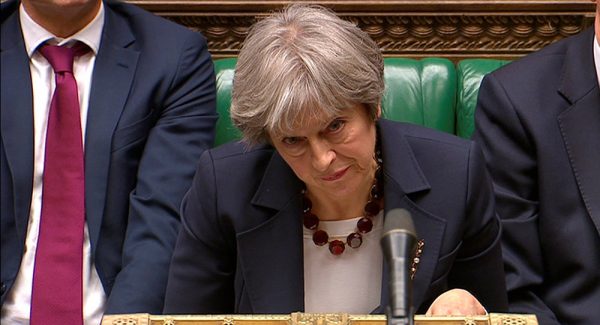
By Patrick Henningsen | 21st Century Wire | March 31, 2018
If there’s one thing to be gleaned from the current atmosphere of anti Russian hysteria in the West, it’s that the US-led sustained propaganda campaign is starting to pay dividends. It’s not only the hopeless political classes and media miscreants who believe that Russia is hacking, meddling and poisoning our progressive democratic utopia – so many have pinned their political careers to this by now that’s it’s too late to turn back. As it was with Iraq in 2003, these dubious public figures require a degree of public support for their policies, and unfortunately many people do believe in the grand Russian conspiracy, having been sufficiently brow-beaten into submission by around-the-clock fear mongering and official fake news disseminated by government and the mainstream media.
What makes this latest carnival of warmongering more frightening is that it proves that the political and media classes never actually learned or internalized the basic lessons of Iraq, namely that the cessation of diplomacy and the declarations of sanctions (a prelude to war) against another sovereign state should not be based on half-baked intelligence and mainstream fake news. But that’s exactly what is happening with this latest Russian ‘Novichok’ plot.
Admittedly, the stakes are much higher this time around. The worst case scenario is unthinkable, whereby the bad graces of men like John Bolton and other military zealots, there may just be a thin enough mandate to short-sell another military conflagration or proxy war – this time against another nuclear power and UN Security Council member.
Enter stage right, where US President Donald Trump announced this week that the US is moving closer to war footing with Russia. It’s not the first time Trump has made such a hasty move in the absence any forensic evidence of a crime. Nowadays, hearsay, conjecture and social media postings are enough to declare war. Remember last April with the alleged “Sarin Attack” in Khan Sheikhoun, when the embattled President squeezed off 59 Tomahawk Cruise missiles against Syria – a decision, which as far as anyone can tell, was based solely on a few YouTube videos uploaded by the illustrious White Helmets. Back then Trump learned how an act of war against an existential enemy could take the heat off at home and translate into a bounce in the polls. Even La Résistance at CNN were giddy with excitement and threw their support behind Trump, with some pundits describing his decision to act as “Presidential.”
As with past high-profile western-led WMD allegations against governments in Syria and Iraq (the US and UK are patently unconcerned with multiple allegations of ‘rebel’ terrorists in Syria caught using chemical weapons), an identical progression of events appears to be unfolding following the alleged ‘Novichok’ chemical weapon poisoning of retired British-Russian double agent Sergei Skripal and his daughter Yulia in Salisbury, Wiltshire on March 4th.
Despite a lack of evidence presented to the public other than the surreptitious “highly likely” assessments of British Prime Minister Theresa May and Foreign Secretary Boris Johnson, President Trump once again has caved in to pressure from Official Washington’s anti-Russian party line and ordered the expulsion of 60 Russian diplomats – which he accused of being spies. Trump also ordered the closure of the Russian Consulate in Seattle, citing speculative fears that Russia might be spying on a nearby Boeing submarine development base. It was the second round of US expulsions of Russian officials, with the first one ordered by the outgoing President Obama in December 2016, kicking out 35 Russian diplomats and their families (including their head chef) and closing the Russian Consulate in San Francisco, with some calling it “a den of spies”.
Trump’s move followed an earlier UK action on March 14th, which expelled 23 Russian diplomats also accused of being spies. This was in retaliation for the alleged poisoning of a retired former Russian-British double agent in Salisbury, England.
This was my initial reaction back on March 14, 2018, during a live TV segment:
The ‘Collective’ Concern
It’s important to understand how this week’s brash move by Washington was coordinated in advance. The US and the UK are relying on their other NATO partners, including Germany, Poland, Italy, Canada, the Czech Republic, the Netherlands, Estonia and Lithuania – to create the image of a united front against perceived ‘Russian aggression’. As with multilateral military operations, multilateral diplomatic measures like this are not carried out on a whim.
Aside from this, there are two seriously worrying aspects of this latest US-led multilateral move against Russia. Firstly, this diplomatic offensive against Russia mirrors a NATO collective defense action, and by doing so, it tacitly signals towards an invocation of Article 5. According to AP, one German spokesperson called it a matter of ‘solidarity’ with the UK. Statements from the White House are no less encouraging:
“The United States takes this action in conjunction with our NATO allies, and partners around the world in response with Russia’s use of a military grade chemical weapon on the soil of the United Kingdom — the latest in its ongoing pattern of destabilizing activities around the world,” the White House said.
“Today’s actions make the United States safer by reducing Russia’s ability to spy on Americans, and to conduct covert operations that threaten America’s national security.”
What this statement indicates is that any Russian foreign official or overseas worker in the West should be regarded as possible agents of espionage. In other words, the Cold War is now officially back on.
Then came this statement: “With these steps, the United States and our allies and partners make clear to Russia that its actions have consequences.”
In an era of power politics, this language is anything but harmless. And while US and UK politicians and media pundits seem to be treating it all as a school yard game at times, we should all be reminded that his is how wars start.

BIRDS OF A FEATHER: Never in modern history has mediocrity in politics been celebrated as a virtue by so many.
The second issue with the Trump’s diplomatic move against Russia is that it extends beyond the territorial US – and into what should be regarded at the neutral zone of the United Nations. As part of the group of 60 expulsions, the US has expelled 12 Russian diplomats from the United Nations in New York City. While this may mean nothing to jumped-up political appointees like Nikki Haley who routinely threaten the UN when a UNGA vote doesn’t go her way, this is an extremely dangerous precedent because it means that the US has now created a diplomatic trap door where legitimate international relations duties are being carelessly rebranded as espionage – done on a whim and based on no actual evidence. By using this tactic, the US is casting aside decades of international resolutions, treaties and laws. Such a move directly threatens to undermine a fundamental principle of the United Nations which is its diplomatic mission and the right for every sovereign nation to have diplomatic representation. Without it, there is no UN forum and countries cannot talk through their differences and negotiate peaceful settlements. This is why the UN was founded in the first place. Someone might want to remind Nikki Haley of that.
On top of this, flippant US and UK officials are already crowing that Russia should be kicked off the UN Security Council. In effect, Washington is trying to cut the legs out from a fellow UN Security Council member and a nuclear power. This UNSC exclusion campaign been gradually building up since 2014, where US officials have been repeatedly blocked by Russia over incidents in Syria and the Ukraine. Hence, Washington and its partners are frustrated with the UN framework, and that’s probably why they are so actively undermining it.
Those boisterous calls, as irrational and ill-informed as they might be, should be taken seriously because as history shows, these signs are a prelude to war.
Also, consider the fact that both the US and Russian have military assets deployed in Syria. How much of the Skripal case and the subsequent fall-out has to do with the fact that US Coalition and Gulf state proxy terrorists have lost their hold over key areas in Syria? The truly dangerous part of this equation is that the illegal military occupation by the US and its NATO ally Turkey of northeastern Syria is in open violation of international law, and so Washington and its media arms would like nothing more than to be history’s actor and bury its past indiscretions under a new layer of US-Russia tension in the Middle East.
Another WMD Debacle?
Is it really possible to push East-West relations over the edge on the basis of anecdotal evidence?
Former British Ambassador to Uzbekistan, Craig Murray, highlighted the recent British High Court judgement which states in writing that the government’s own chemical weapons experts from the Porton Down research facility could not categorically confirm that a Russian ‘Novichok’ nerve agent was actually used in the Salisbury incident. Based on this, Murray believes that both British Prime Minster Theresa May and Foreign Secretary Boris Johnson, and Britain’s deputy UN representative Jonathan Allen – have all lied to the public and the world when making their public statements that the Russians had in fact launched a deadly chemical weapons attack on UK soil. Murray elaborates on this key point:
“This sworn Court evidence direct from Porton Down is utterly incompatible with what Boris Johnson has been saying. The truth is that Porton Down have not even positively identified this as a ‘Novichok’, as opposed to “a closely related agent”. Even if it were a ‘Novichok’ that would not prove manufacture in Russia, and a ‘closely related agent’ could be manufactured by literally scores of state and non-state actors.”
“This constitutes irrefutable evidence that the government have been straight out lying – to Parliament, to the EU, to NATO, to the United Nations, and above all to the people – about their degree of certainty of the origin of the attack. It might well be an attack originating in Russia, but there are indeed other possibilities and investigation is needed. As the government has sought to whip up jingoistic hysteria in advance of forthcoming local elections, the scale of the lie has daily increased.”
Murray has been roundly admonished by the UK establishment for his views, but he is still correct to ask the question: how could UK government leaders have known ‘who did it’ in advance of any criminal forensic investigation or substantive testing by Porton Down or an independent forensic investigation by the Organization for the Prohibition of Chemical Weapons (OPCW)?
One would hope we could all agree that it’s this sort of question which should have been given more prominence in the run-up to the Iraq War. In matters of justice and jurisprudence, that’s a fundamental question and yet, once again – it has been completely bypassed.
Murray is not alone. A number of scientists and journalists have openly questioned the UK’s hyperbolic claims that Russia had ordered a ‘chemical attack’ on British soil. In her recent report for the New Scientist, author Debora MacKenzie reiterates the fact that several countries could have manufactured a ‘Novichok’ class nerve agent and used it in the chemical attack on Russians Sergei and Yulia Skripal in Salisbury.
“British Prime Minister Theresa May says that because it was Russia that developed Novichok agents, it is ‘highly likely’ that Russia either attacked the Skripals itself, or lost control of its Novichok to someone else who did. But other countries legally created Novichok for testing purposes after its existence was revealed in 1992, and a production method has even been published.”
The New Scientist also quotes Ralf Trapp, a chemical weapons consultant formerly with the OPCW, who also reiterates a point worth reminding readers of – that inspectors are only able to tell where molecules sampled in Salisbury have come from if they have reference samples for the ingredients used.
“I doubt they have reference chemicals for forensic analysis related to Russian CW agents,” says Trapp. “But if Russia has nothing to hide they may let inspectors in.”
Even if they can identify it as Novichok, they cannot say that it came from Russia, or was ordered by the Russian government, not least of all because the deadly recipe is available on Amazon for only $28.45.
It should be noted that a substantial amount of evidence points to only two countries who are the most active in producing and testing biological and chemical weapons WMD – the United States and Great Britain. Their programs also include massive ‘live testing’ on both humans and animals with most of this work undertaken at the Porton Down research facility located only minutes away from the scene of this alleged ‘chemical attack’ in Salisbury, England.
Problems with the Official Story
If we put aside for the moment any official UK government theory, which is based on speculation backed-up by a series of hyperbolic statements and proclamations of Russian guilt, there are still many fundamental problems with the official story – maybe too many to list here, but I will address what I believe are a few key items of interest.
The UK police have now released a statement claiming that the alleged ‘Novichok’ nerve agent was somehow administered at the front door of Sergie Skripal’s home in Wiltshire. This latest official claim effectively negates the previous official story because it means that the Skripals would have been exposed a home at the latest around 13:00 GMT on March 4th, and then drove into town, parking their car at Sainsbury’s car park, then having a leisurely walk to have drinks at The Mill Pub, before for ordering and eating lunch at Zizzis restaurant, and then finally leaving the Zizzis and walking before finally retiring on a park bench – where emergency services were apparently called at 16:15 GMT to report an incident. Soon after, local Police arrived on the scene to find the Skripals on the bench in an “extremely serious condition”. Based on this story, the Skripals would have been going about their business for 3 hours before finally falling prey to the deadly WMD ‘Novichok’. From this, one would safely conclude that whatever has poisoned the pair was neither lethal nor could it have been a military grade WMD. Even by subtracting the home doorway exposure leg of this story, it hardly adds up – as even a minor amount of any real lethal military grade WMD would have effected many more people along this timeline of events. Based on what we know so far, it seems much more plausible that the pair would have been poisoned at Zizzis restaurant.
When this story initially broke, we were told that the attending police officer who first arrived on the scene of this incident, Wiltshire Police Detective Sgt. Nick Bailey – was “fighting for his life” after being exposed to the supposed ‘deadly Russian nerve agent’. As it turned out, officer Bailey was treated in hospital and then discharged on March 22, 2018. To our knowledge, no information or photos of Bailey’s time in care are available to the public.
The public were also told initially that approximately 4o people were taken into medical care because of “poison exposure”. This bogus claim was promulgated by mainstream media outlets, like Rupert Murdoch’s Times newspaper. In reality, no one showed signed of “chemical weapons” exposure, meaning that this story was just another example of mainstream corporate media fake news designed to stoke tension and fear in the public. We exposed this at the time on the UK Column News here:
@medialens @Ian56789 Look who’re the ACTUAL producers of #FakeNews on the #Skripal #RussianSpyPoisoning #MSM story… pic.twitter.com/ytKE0EVA6j
— Patrick Henningsen (@21WIRE) March 21, 2018
To further complicate matters, this week we were told that Yulia Skripal has now turned the corner and is in recovery, and is speaking to police from her hospital bed. If this is true, then it further proves that whatever the alleged poison agent was which the Skripals were exposed to – it was not a lethal, military grade nerve agent. If it had been, then most likely the Skripals and many others would not be alive right now.
Unfortunately, in the new age of state secrecy, we can expect that most of the key information relating to this case may be sealed indefinitely under a national security letter. In the case of Porton Down scientist David Kelly, the key information is sealed (hidden) for another 60+ years (which means we might get to see it in the year 2080). This means that we just have to take their word for it, or to borrow the words of the newly crowned UK Defence Secretary Gavin Williamson – any one asking questions, “should just go away and shut up.”
Such is the level of decorum and transparency in this uncomfortably Orwellian atmosphere.
While Britain insists that it has ‘irrefutable proof’ that Russia launched a deadly nerve-gas attack to murder the Skripals, the facts simply do not match-up with the rhetoric.
The Litvinenko Conspiracy Theory
It’s important to note that as far as public perceptions are concerned, the Skripal case has been built directly on top of the Litvinenko case.
In order to try and reinforce the speculation, the media have resurrected the trial-by-media case of another Russian defector, former FSB officer Alexander Litvinenko, who is said to have died after being poisoned with radioactive polonium-210 in his tea at a Mayfair restaurant. Despite not having any actual evidence as to who committed the crime, the British authorities and the mainstream media have upheld an almost religious belief that Vladimir Putin had ordered the alleged poisoning of Litvinenko.
The media mythos was reinforced in 2016, when a British Public Inquiry headed by Sir Robert Owen accused senior Russian officials of ‘probably having motives to approve the murder’ of Litvinenko. Again, this level of guesswork and speculation would never meet the standard of an actual forensic investigation in a real criminal court, but as far as apportioning blame to another nation or head of state – it seems fair enough for British authorities. Following the completion of the inquiry, Sir Robert had this to say:
“Taking full account of all the evidence and analysis available to me, I find that the FSB operation to kill Litvinenko was probably approved by Mr Patrushev and also by President Putin.”
Owen’s inquiry was not definitive. Quite the opposite in fact, and in many ways it mirrors the Skripal case as it has been presented to the public. Despite offering no evidence of any criminal guilt, Owen’s star chamber maintained that President Vladimir Putin “probably” approved the operation to assassinate Litvinenko. Is “probably” really enough to assign guilt in a major international crime? When it comes to high crimes of state, the answer seems to be yes.
According to Russian Foreign Ministry spokesperson Marina Zakharova, that UK inquiry was “neither transparent nor public” and was “conducted mostly behind doors, with classified documents and unnamed witnesses contributing to the result…”
Zakharova highlighted the fact that two key witnesses in the case – Litvinenko’s chief patron, UK-based anti-Putin defector billionaire oligarch Boris Berezovsky, and the owner of Itsu restaurant in London’s Mayfair where the incident is said to have taken place – had both suddenly died under dubious circumstances. The British authorities went on to accuse two Russian men in the Litvineko murder, businessman Andrey Lugovoy and Dmitry Kovtun. Both have denied the accusations. Despite the lack of any real evidence, the United States Treasury’s Office of Foreign Assets Control blacklisted both Lugovoi and Kovtun, as well as Russian persons Stanislav Gordievsky, Gennady Plaksin and Aleksandr I. Bastrykin – under the Magnitsky Act, which freezes their assets held in American financial institutions, and bans them from conducting any transactions or traveling to the United States. This is a familiar pattern: even if the case is inconclusive, or collapses due to a lack of evidence, the policies remain in place.
Despite all the pomp and circumstance however, the official conspiracy theory failed to sway even Litvinenko’s own close family members. While Litvinenko’s widow Marina maintains that it was definitely the Russian government who killed her husband, Alexsander’s younger brother Maksim Litvinenko, based in Rimini, Italy, believes the British report is “ridiculous” to blame the Kremlin for the murder of his brother, stating that he believes British security services had more of a motive to carry out the assassination.
“My father and I are sure that the Russian authorities are not involved. It’s all a set-up to put pressure on the Russian government,” said Litvinenko to the Mirror newspaper, and that such reasoning can explain why the UK waited almost 10 years to launch the inquiry into his brother’s death. Following the police investigation, Alexander’s father Walter Litvinenko, later said that he had regretted blaming Putin and the Russian government for his son’s death and did so under intense pressure at the time.
For anyone who is also reticent to accept the proclamations of the British state and the mainstream media on the Litvinenko case, it’s worth reading the work of British journalist Will Dunkerly here.
With so many questions hanging over the actual validity of the British state’s accusations against Russia, it’s somewhat puzzling that British police would say they are still ‘looking for similarities’ between the Skripal and Litvinenko cases in order to pinpoint a modus operandi.
The admission by the British law enforcement that their investigation may take months before any conclusion can be drawn also begs the question: how could May have been so certain so quick? The answer should be clear by now: she could not have known it was a ‘Novichok’ agent, any more than she could know that ‘Russia did it.’
A Plastic Cold War
Historically speaking, in the absence of any real mandate or moral authority, governments suffering from a chronic identity crisis and will often seek to define themselves not what they stand for, but what (or who) they are in opposition to. This profile suits both the US and UK perfectly at the moment. Both governments are limping along with barely a mandate, and have orchestrated two of the worst and most hypocritical debacles in history in Syria and Yemen. With their moral high-ground long gone, both countries require an existential enemy in order to give their missions legitimacy. The cheapest, easiest option is to reinvigorate a framework which was already there, and that’s the Cold War. Reds under the bed. The Russian are coming. It’s cheap and easy because it’s already been seeded with 70 years of Cold War propaganda and institutionalized racism in the West directed against Russians. If you don’t believe me, just go look at some of the posters, watch the TV propaganda in the US, or look at the horrific McCarthy witch hunts. I grew up being taught, “never again!” and that “welcome to the future: those days of irrational paranoia are behind us now.” That madness was mainstream and actively promoted by government and mainstream media.
You would have to be at the pinnacle of ignorance to deny that this is exactly what we are seeing today, albeit a more plastic version, but just as immoral and dangerous.
Dutifully fanning the flaming of war, Theresa May has issued her approval of the NATO members diplomatic retaliation this week exclaiming, “We welcome today’s actions by our allies, which clearly demonstrate that we all stand shoulder to shoulder in sending the strongest signal to Russia that it cannot continue to flout international law.”
But from an international law perspective, can May’s ‘highly likely’ assurances really be enough to position the west on war footing with Russia? When Labour leader Jeremy Corbyn asked these same fundamental questions on March 14th, he was shouted down by the Tory bench, and also by the hawkish Blairites sitting behind him.

Afterwards, the British mainstream press launched yet another defamation campaign against Corbyn with the UK’s Daily Mail calling the opposition leader a “Kremlin Stooge”, followed by British state broadcaster the BBC who went through the effort of creating a mock-up graphic of Corbyn in front of the Kremlin (pictured above) apparently wearing a Russian hat, as if to say he was a Russian agent. It was a new low point in UK politics and media.
When considering the mainstream media’s Corbyn smear alongside the recent insults hurled at Julian Assange by Tory MP Sir Alan Duncan who stood up in front of Parliament and called the Wikileaks founder a “miserable worm”, what this really says is that anyone who dares defy the official state narrative will be beaten down and publicly humiliated. In other words, dissent in the political ranks will not be tolerated. It’s almost as if we are approaching a one party state.
Would a UN Security Council member and nuclear power really be so brazen as to declare on another country guilty without presenting any actual evidence or completing a genuine forensic investigation?
So why the apparent rush to war? Haven’t we been here before, in 2003? Will the people of the West allow it to happen again?
As with Tony Blair’s WMD’s in 2003, the British public are meant to take it on faith and never question the official government line. And just like in 2003, the UK has opened the first door on the garden path, with the US and its ‘coalition’ following safely behind, shoulder to shoulder. In this latest version of the story, Tony Blair is being played by Theresa May, and Boris Johnson is playing Jack Straw. On the other side of the pond, a hapless Trump is the hapless Bush. Both Blair and Straw, along with the court propagandist Alastair Campbell – are all proven to have been liars of the highest order, and if there were any real accountability or justice, these men and their collaborators in government should be in prison right now. The fact they aren’t is why the door has been left wide open for the exact same scam to be repeated again, and again.
Iraq should have taught us all to be skeptical about official claims of chemical weapons evidence, and to face the ugly truth about how majors wars are waged by deception – by our own governments. What does it tell us about today’s society if people still cannot see this?
That’s why it was wrong to let Blair, Bush and others off the hook for war crimes. By doing so, both the British and Americans are inviting a dark phase of history to repeat itself again, and again.
It’s high time that we break the cycle.
***
Author Patrick Henningsen is a global affairs analyst and founder of independent news and analysis site 21st Century Wire, and host of the SUNDAY WIRE weekly radio show broadcast globally over the Alternate Current Radio Network (ACR).
Russian Embassy Outraged at UK Media’s One-Sided Coverage of Skripal Case
Sputnik – 30.03.2018
The Russian embassy in London has expressed bewilderment over how British media is handling the case of the poisoning of former spy Sergei Skripal, particularly its remarkable fidelity to a single unproven version of the incident.
Freedom is diversity. With Russian media under constant pressure for not being “free” enough, British media has decided to provide an example of true Western freedom — by unequivocally stating that Russia poisoned British-Russian ex-spy Sergei Skripal and his daughter, Yulia, in Salisbury, England.
You would think the investigation into the incident had been wrapped up and the culprit — Moscow — found. But the investigation into the March 4 incident is still underway and new information is surfacing every day. Last week there was speculation that Skripal had been poisoned inside his car; this week, the story advanced by British police is that Skripal could have come in contact with the toxic nerve agent in his home.
Of course, the job of the police is to work through evidence and propose scenarios — but in this, case British inspectors need not worry, because their media has solved the case without them.
“Russian talk shows may have produced 24 or 234 versions of the Salisbury attack, but the British press is sticking to ONE, unsupported by any facts. So much for free and independent media holding government to account,” the Russian Embassy in the UK said on its Twitter account on March 29. The post was accompanied by an image of various British newspapers’ headlines, all pointing the finger at Russia for poisoning the Skripals.
Fanning the flames of hype has become the trademark style of Western journalism, as colorfully illustrated by the famous allegations about “Russian hackers” and “Russian meddling” in US elections. Throughout 2016 and 2017, Western mainstream media kept blaming Russia for hacking political emails and interfering in the US and other elections, all the while doing their best to avoid providing any proof of their allegations. So the game being played by British journalists is old hat now.
With Skripal’s case, one key question has remained unvoiced for too long: what will the British media do if investigations reveal that Russia was not, in fact, involved? Will they pretend that all their past headlines never happened?
British accusations against Russia for Skripal poisoning not only unproven, but absurd!
By Tom Stanford | The Duran | March 24, 2018
The British government claims to have overwhelming evidence of Russia’s responsibility in the Salisbury poison attack on Sergei Skripal and his daughter. In his Washington Post article of March 14, Foreign Secretary Boris Johnson went so far as to claim that there was “only [one] plausible conclusion: that the Russian state attempted murder in a British city, employing a lethal nerve agent banned under the Chemical Weapons Convention”. He even connected this with Russia “covering up” the alleged use of “the nerve agent sarin against the town of Khan Sheikhoun in April 2017” by Syrian forces. In a separate statement, the Foreign Secretary tells us it is “overwhelmingly likely” that Vladimir Putin personally ordered the attack. What evidence is there to support such serious accusations?
According to the British government (see e.g. Boris Johnson’s article) and the mainstream media, the following elements are sufficient to incriminate the Russian state with near certainty: the weapon used, the motive, Russia’s past record, the lack of another explanation.
Use of novichok is no proof of Russian involvement
The nerve agent reportedly used in the attack, named novichok, was developed by the Soviet Union in the 1970s and 1980s. The fact that Russian stockpiles of novichok were destroyed under supervision of UN bodies after the collapse of the Soviet Union and that the OPCW (Organisation for the Prohibition of Chemical Weapons) has seen no reason for suspecting any country of continuing to store this deadly agent does not seem to bother the incriminators. Of course, it can be speculated that Russia may have kept the weapon secretly, as does Vil Mirzayanov, the Russian scientist who revealed the existence of the project in 1992 and has lived in the US since 1995.
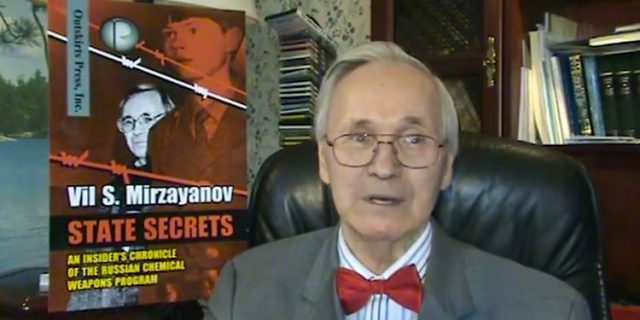
Russian ex-counter intelligence officer Vil Mirzayanov defected to the United States. Now 83 years old, he comments on the Skripal affair from Boston. (Photo credit: Business Insider)
Boris Johnson has announced that over the last ten year Britain has gathered evidence of Russia creating and storing novichok. We are given no detail of what kind of evidence this may be. It could turn out to be nothing more than isolated, unsubstantiated claims made by Mirzayanov and other opponents of the Russian government.
Not only Russia, but other former members of the Soviet Union, or the US, could have secretly stored or recreated the poison. In 1999 US defence officials helped Uzbekistan dismantle a former Soviet facility which had tested chemical weapons such as novichok. Samples, as well as the knowledge required to produce the nerve agent, are highly likely to have become available to countries other than Russia.
Did Russia have a motive?
Russia supposedly had an obvious motive. The argument goes as follows: Sergei Skripal, while still officially working for the Russian military intelligence service, the GRU, had been secretly recruited by the British MI6, and handed over to his new paymasters the names of all Russian agents he knew to be working in the West. Even after serving a few years in a Russian prison and being allowed to emigrate to the UK as part of a spy swap, he would have remained on an official Russian hit list for his act of treason. His murder would serve as a deterrent towards any other Russian agent who may consider switching sides. And to make things even clearer to would-be defectors, the attack would leave some kind of signature pointing to the Russian state as the perpetrator.
On the face of it, the argument sounds reasonable. However, it makes no sense to consider motives as evidence for doing something if we ignore counter-motives, i.e. reasons for refraining from doing it. Suppose you are in your doctor’s waiting room and have been sitting there for quite some time when suddenly an elderly lady, who arrived there just before you, collapses and is rushed to hospital. You had never seen her before. Now imagine the police later suspect some foul play and discover that the incident allowed you to have your own waiting time shortened by ten or fifteen minutes. You had a clear motive for harming the poor lady. Luckily for you, it then occurs to the investigators that your motive for doing so (saving a few minutes of your time) pales into insignificance compared with the reasons that would have held you back, such as the idea of spending years in jail, not to mention your moral conscience or feelings of human compassion.
In other words, motivation is the result of weighing out costs and benefits.
Putin had a clear motive… for NOT doing it
In the case of the Salisbury attack, the foreseeable costs to Russia, and more specifically to President Putin, are enormous. The Russian government spends considerable effort trying to convince the world that it firmly abides by the rule of law, especially international law and agreements between states. Its own statements, as well as the foreign-policy analyses appearing in the Russian state-owned media, all go towards highlighting Russia’s perceived superiority to the US in terms of respect for international law. Such efforts have greatly intensified in the context of the renewed tensions with the West over the last few years.
Russia’s current leaders believe in ending the current US-dominated unipolar world and are striving to recover some of the influence over world affairs that was lost with the collapse of the Soviet Union. This requires having allies, not only state allies, but also Russia-friendly organizations and individuals within states. Any damage to Russia’s international reputation does considerable harm to such prospects.
President Putin himself cultivates the image of a highly principled, responsible and law-abiding person – not that anyone would guess by reading the Western mainstream media! Whatever Russia’s state representatives and media may argue, the Salisbury attack has put many weapons in the hands of Putin’s detractors. In this light, it is absolutely inconceivable that Russia’s president ordered the attack himself. Boris Johnson’s personal accusation not only shows his total misunderstanding of the Russian leadership, but is also utterly irresponsible on the part of Britain’s top diplomat.
Russia had long been hoping that the EU may gradually put to an end its sanctions policy. It is still very dependent on trade with the block. It would be insane for Russia to do anything that could threaten the current Nord Stream 2 gas pipeline project, especially given that the US, with the support of a number of EU countries mainly from Eastern Europe, has been putting pressure on the EU to abandon the project. But Germany, determined to ensure its supply of cheap gas, has so far resisted such calls.
Predictably, the EU has sided with the UK and is officially demanding explanations from Russia concerning its novichok programme – which only makes any sense if Russia was in some way involved in the Salisbury attack, definitely not if it genuinely ceased the production and storage of the nerve agent in the 1990s, as documented by the OPCW!
Could other agents of the Russian state be responsible?
It is also entirely unrealistic to imagine that leading members of the Russian secret service agencies may have acted autonomously and ordered the Salisbury attack without consulting their superiors and not realizing how much damage it would have on Russia’s and Putin’s international reputation. They live in the world of the Russian state elite, continually exposed to its way of thinking, and not cocooned in some fantasy world of their own – unlike many Western politicians and journalists who apparently still live with the image of James Bond-like characters fighting against evil Russian agents!
Any significant agent of the Russian state would be fully aware of the displeasure that a Salisbury-type attack would trigger among the leadership. Supposing players within the Russian state did carry out the attack, it could only be construed as a hostile act towards President Putin and his team.
No sense for Russia to kill Skripal abroad rather than in Russia
This is not a simple case of a former spy-turned-traitor being “executed”. The attack leaves a deliberate Russian “signature” (there is no other reason for using novichok rather than a more discreet or classical weapon) and was carried out on the soil of a foreign country, the United Kingdom, which in spite of the Brexit process remains a highly significant player on the international stage. Whoever the perpetrators may be, they would have foreseen that any improvement in relations between Russia and its Western neighbours would be seriously jeopardized as a consequence.
But what makes Russian involvement even more absurd is the fact that Alexander Skripal was officially released and allowed to emigrate as part of a spy swap. Why would the Russians have waited another eight years before killing him in another country, with the terrible diplomatic consequences that would ensue, when he could have been much more easily liquidated while still in Russia, in a manner that would give would-be defectors an even clearer warning that there is “no way out for traitors”.
Would Russia give up the chance of other spy swaps?
Furthermore, a spy-swap deal implies that the parties involved agree to give up all claims pertaining to the released individuals. In other words they will not try to recapture or kill them, which would amount to a breach of the agreement. A country reneging on such a deal would no longer be trusted for any similar arrangements in the future. Is it reasonable to believe that the Russian government, or any top secret service official in Russia, would be prepared to sacrifice Russia’s chances of making any new spy-swap deals with its Western partners in the future? This is not just unlikely, it is the pinnacle of absurdity! Sadly, Western political leaders and mainstream media are quite happy to believe and propagate such nonsense.
Goal of attack: outrage against Russia
The attack itself does not seem to bear the mark of professional Russian agents. The daughter of the former double agent suffered the same fate as her father. It is only a matter of circumstances that many others were not seriously injured. It is like using a sledgehammer to crack a nut! And the main target, Sergei Skripal, is – weeks later – still reported to be alive! Either it was some very sloppy attack carried out by non-professionals, or the attack was deliberately not confined to Mr Skripal in order to provoke even greater outrage against Russia.
Boris Johnson has apparently recently adapted his interpretation of Russian intentions to take account of these facts. He now claims it was probably specially timed just before the presidential election, “to conjure up in the public imagination the notion of an enemy”. So the Russian president supposedly deliberately provoked British outrage to help him win the election! The Foreign Secretary seems to be completely out of touch with reality. It has long been common knowledge that Vladimir Putin would win with a landslide anyway. Would he wish to cause himself and his country enormous trouble for absolutely no gain at all?
What is Russia’s past record?
We are told there is “a pattern” of state-sponsored assassinations or deaths in unusual circumstances of political opponents, critical journalists and secret service defectors. Deaths attributed to President Putin have included the journalist Politskaya, the political opponent Nemtsov, the accountant and lawyer Magnitsky, the former agent Litvinenko and even the oligarch Berezovsky. In all these cases, the incrimination of the Russian state is based on rather flimsy evidence. The argumentation here is circular: in each case the belief in the Russian government’s responsibility is strengthened by the existence of the other stories. But if none of the stories are true, then the whole argument collapses.
The Litvinenko case does bear a similarity to the current one. Instead of the nerve agent novichok, Litvinenko was poisoned by radioactive polonium, a substance very difficult to obtain and produced only by a few countries – such as Russia – with a nuclear weapons industry. In both cases, it is highly unlikely that the Russian state would choose to leave a “made in Russia” signature on the poison used, with only one major outcome – the poisoning of Britain’s relationship with Russia.
If not Russia, then who did it?
Russia’s accusers claim there are no alternative explanations for the attack: nobody, apart from the Russian state, is understood to have had a motive for the attempted murder. This argument can only make sense to those who believe in the world of an evil, criminal Russia whose only opponents are pure, honest, angelic fighters for freedom and justice.
The main consequence of the Salisbury attack – undoubtedly one that would have been predicted by whoever planned it – is to further damage relations between Russia and the West, or at least prevent their improvement. A long list of countries (Ukraine, Poland, the US and many others) or organizations may believe they have an interest in this – at least they have been doing their best to spoil Western Europe’s relationship with Russia. Of course, the existence of a possible motive does not constitute sufficient ground to suspect anyone in particular. However, on the basis the motives involved, to quote British former Member of Parliament George Galloway, “Russia must be near the bottom of the list of suspects.”
How to get away with murder: blame Russia!
It can also not be excluded that the attack was the work of some rogue “ultra-patriotic” group within Russia (whether within or outside Russia’s state institutions) wishing to undermine Putin’s attempts to mend relations with the West by killing a “traitor” on British soil. In this case, the Salisbury attack would clearly be an act of aggression against the Russian government more than against the UK. And Britain’s refusal to cooperate with Russia would make the UK unwittingly guilty of helping the perpetrators avoid the course of justice.
Another aspect is that we do not know what personal enemies Aleksander Skripal may have had. There may be motives involved that nobody suspects. If, for whatever reason a person or organization with sufficient power wished to have him killed, there was a simple way to get away with the crime: a highly effective cover-up the crime would involve using a weapon that points towards Russia, with the knowledge the British authorities would be unlikely to seriously explore other avenues, especially in the current international climate. The same can be argued in the case of Litvinenko’s murder in 2006.
There is something particularly disturbing about the Western international community rushing to accuse Russia for any crime showing the slightest hint of a Russian connection: it provides criminal organizations and terrorists with assurances that they can avoid being held accountable. All they need to do is to leave some kind of “Russian signature”.
UK reckless attitude is dangerous
The words of Theresa May and Boris Johnson, accusing Russia for crimes it did not commit with astoundingly aggressive and hostile language, will naturally lead the Russian population and their decision makers to believe their country is the victim of an orchestrated attack. Hostility towards the West will increase dramatically as a result. British, European and North-American leaders may have convinced themselves of Russia’s guilt, but have they reflected on the possible consequences of their reckless attitude?
It is urgent to stop the escalation in the Russia blame game, which has taken a momentum of its own. It may be of benefit for the media, who can publish stories that make a good read, with an evil bogey man that everyone loves to hate, or for politicians who, when confronted with problems at home – such as the UK government with its current Brexit troubles – can take the opportunity to look strong in the face of an enemy. However, it is an extremely dangerous game which could have disastrous consequences for the entire world.
Trump orders expulsion of 60 Russian diplomats, closure of Seattle consulate
RT | March 26, 2018
President Donald Trump has ordered the expulsion of 60 Russian diplomats and the closure of the Russian consulate in Seattle. It comes in response to the poisoning of Sergei Skripal in Salisbury, which the UK has blamed on Russia.
The move follows major diplomatic pressure by the UK on its allies to follow their lead in expelling Russian diplomats. The Russian embassy in Washington had previously urged Trump not to heed the “fake news” on Skripal’s poisoning.
British Prime Minister Theresa May has accused Moscow of being behind the poisoning of the former spy Skripal and his daughter in the town of Salisbury in early March.
Of the 60 diplomats expelled, 12 formed part of the Russian mission to the United Nations. In a statement, US ambassador to the UN Nikki Haley said the 12 Russians in question had “abused their privilege of residence” in the US and had “engaged in espionage activities that are adverse to our national security.”
Haley said that the Russian diplomats had used the UN as “a safe haven for dangerous activities within our own borders.”
During a summit in Brussels last week, the 28 EU leaders agreed with Britain’s assertion that it is “highly likely” that Russia was responsible for the attack on Skripal.
Members of the EU numbering 14 have also decided to expel Russian diplomats following Britain’s lead.
Canada has also jumped on the bandwagon, announcing that it will expel four Russian diplomats “in solidarity” with the UK.
The timing of the expulsions by the US, EU and Canada appears to have been coordinated between Washington and Brussels. Eight EU countries confirmed within 15 minutes of each other on Monday afternoon that they would expel a number of Russian diplomats. Canada’s announcement followed shortly after.
Moscow has always denied playing any role in the attack, and offered to cooperate with the investigation into the incident. Britain has declined, however, to send samples of the chemical agent used on Skripal and his daughter to Moscow.
How Israel and its partisans work to censor the Internet
By Alison Weir | If Americans Knew | March 25, 2018
Students at the Israeli military’s Computing and Cyber Defense Academy. Israel is also “scouring Jewish communities abroad for young computer prodigies willing to join its ranks.”
Numerous well funded, organized projects by and for Israel work to flood social media with pro-Israel propaganda, while blocking facts Israel dislikes. The projects utilize Israeli soldiers, students, American teens and others, and range from infiltrating Wikipedia to influencing YouTube. Some operate out of Jewish Community Centers in the U.S.
[…]
Israeli soldiers paid to “Tweet, Share, Like and more”
Israel and partisans of Israel have long had a significant presence on the Internet, working to promote the Israel narrative and block facts about Palestine, the Israel lobby, and other subject matter they wish covered up.
Opinionated proponents of Israel post comments, flag content, accuse critics of “antisemitism,” and disseminate misinformation about Palestine and Palestine solidarity activists. Many of these actions are by individuals acting alone who work independently, voluntarily, and relentlessly.
In addition to these, however, a number of orchestrated, often well-funded projects sponsored by the Israeli government and others have come to light. These projects work to place pro-Israel content throughout the Internet, and to remove information Israel doesn’t wish people to know.
One such Israeli project targeting the Internet came to light when it was lauded in an article by Arutz Sheva, an Israeli news organization headquartered in an Israeli settlement in the West Bank.
The report described a new project by Israel’s “New Media desk” that focused on YouTube and other social media sites. The article reported that Israeli soldiers were being employed to “Tweet, Share, Like and more.”
The article noted, “It is well known nowadays that what happens on Facebook, Twitter and YouTube has great influence on events as they occur on the ground. The Internet, too, is a battleground.” It was “comforting,” the article stated, to learn that the IDF was employing soldiers whose job was specifically to do battle on it. […]
Israeli media report that the Israeli military “has begun scouring Jewish communities abroad for young computer prodigies” to recruit for its ranks.
An Israeli official described the process: “Our first order of business is to search Jewish communities abroad for teens who could qualify, Our representatives will then travel to the communities and begin the screening process there.”
Israeli Government Ministry backs secret online campaigns

General Sima Vaknin-Gil told Israeli tech developers to “flood the Internet” with pro-Israel propaganda. As Israel’s Chief Censor, she said: ” “We censor information that is critical to our enemies, who have no capabilities like us, do not have a Jewish brain, and therefore our enemy relies to a large extent on open information…”
Israel’s Strategic Affairs Ministry, which is behind this and similar projects, has mobilized substantial resources for online activities.
Israel’s Ynet news reports that the Ministry’s director “sees it as a war for all intents and purposes. ‘The delegitimization against the State of Israel can be curbed and contained through public diplomacy and soft tools,’ she says. ‘In order to win, however, we must use tricks and craftiness.’”
The director, General Sima Vaknin-Gil, told a forum of Israeli tech developers at a forum: “I want to create a community of fighters.” The objective is to “curb the activities of anti-Israel activists,” and “flood the Internet” with pro-Israel content.
An Israeli report in December stated that the ministry has acquired a budget of roughly $70 million to “stand at the forefront of the battle against delegitimization, adopting methods from the fields of intelligence and technology. There is a reason why ministry officials define it as ‘a war on consciousness terrorism.’” [‘Delegitimization’ is a common Israeli term for criticism of Israel. See here for a discussion of the term.]
A Ha’aretz article reports: “The Strategic Affairs Ministry’s leaders see themselves as the heads of a commando unit, gathering and disseminating information about ‘supporters of the delegitimization of Israel’—and they prefer their actions be kept secret.”
The article reports that the Ministry includes a job role entitled “Senior official—new-media realm,” responsible for surveillance and activities “in the digital realm.”
This individual head is responsible for analyzing social media and formulating a social media campaign against sites and activists who are deemed a threat to Israel.
Among the job’s responsibilities are:
“Analysis of the world of social media, in terms of content, technology and network structure, emphasizing centers of gravity and focuses of influence, methods, messages, organizations, sites and key activists, studying their characteristics, areas, realms and key patterns of activities of the rival campaign and formulating a strategy for an awareness campaign against them in this realm and managing crises on social media. That is, surveilling of activities mainly in the digital arena.”
Officials at the ministry are charged with “construction and promotion of creative and suitable programs for new media.”
The unit works to keep its activities secret from the public. For example, a program to train young Israelis for activities on social media was exempted from publishing a public bid for funding. Similarly, the ministry’s special unit against delegitimization, “Hama’aracha” (The Battle), is excluded from Israel’s Freedom of Information Law.
Its activities reportedly include a “24/7 operations room monitoring all the delegitimization activities against Israel: Protests, conferences, publications calling for an anti-Israel boycott and international bodies’ boycott initiatives. The operations room will transfer the information to the relevant people to provide a proper response to these activities, whether through a counter-protest or through moves to thwart the initiative behind the scenes.”
Other programs include a 22-million-shekel project to work among labor unions and professional associations abroad “to root out the ability of BDS entities to influence the unions,” and a 16-million-shekel program focused on student activities throughout the world.
Israel’s UNIT 8200
Another Israeli entity that plays a role in covert Internet activity is the Israeli military’s legendary high-tech spy branch, Unit 8200. This unit is composed of thousands of “cyber warriors” primarily 18 to 21 years of age; some even younger. A number of its graduates have gone on to top positions at tech companies operating in the U.S., such as Check Point Software (where the spouse of the Jewish Voice for Peace head is employed as a solutions architect).
In 2015 Israel’s Foreign Ministry announced plans “to establish a special command to combat anti-Israel incitement on social media.” The command would operate under the foreign ministry’s hasbara [propaganda] department and would especially recruit from graduates of Unit 8200.
An article in the Jewish Press about the new command reports that Unit 8200 “has developed a great reputation for effectiveness in intelligence gathering, including operating a massive global spy network. Several alumni of 8200 have gone on to establish leading Israeli IT companies, including Check Point, ICQ, Palo Alto Networks, NICE, AudioCodes, Gilat, Leadspace, EZchip, Onavo, Singular and CyberArk.”

Check Point Software headquarters in Tel Aviv. Founded by a former Unit 8200 member, it also has offices throughout the U.S. Israeli tech companies sometimes assist in online spying efforts.
Numerous Israeli tech companies, many of them headed by former military intelligence officers, assist in these online spying efforts, sometimes receiving Israeli government funding “for digital initiatives aimed at gathering intelligence on activist groups and countering their efforts.”
According to the ministry’s statement, among the Command’s activities is “finding videos with inflammatory content and issuing complaints to the relevant websites.”
To be clear, this is an occupying military working covertly to achieve censorship of reporting on its atrocities. … Read full article at If Americans Knew
Featured Video
Ted Postol: Fraud of Missile Defence Exposed in Iran War
or go to
Aletho News Archives – Video-Images
Frlom the Archives
Containing the United States
By Edward S. Herman | Z Magazine | September 2016
“Containing the United States” is, of course, a ridiculous and self-contradictory idea in the U.S. and Western ideological and propaganda system. We all know that the United States had to “contain” the Soviet Union from 1945 to 1991, and since then has had the task of containing Russia and China. Only they threaten, bully, aggress and worry countries like Poland and Vietnam. Obama has had to reassure them both of our steadfast stand against Russian and Chinese military attacks. NATO has, of course, expanded greatly over the past several decades, despite the deaths of the Soviet Union and Warsaw Pact, but only to contain the renewed Russian — and Iranian, Libyan, Syrian and other — military threats; and we have “pivoted” to Asia, supported Japanese rearmament, bolstered our own forces in that area and jousted with the Chinese in their coastal waters solely to contain China. Earlier we had been obliged to contain North Vietnam, or was it the Soviet Union in Vietnam? Or China? Or “communism”? Or maybe all of them? Or none of them, but just needing an excuse to enlarge power?
The parallel propaganda has taken many forms. One is accepting as a premise that the United States only acts defensively and has no internal forces and interests that drive it to enlarge its sphere of control. I noted in an earlier article how Paul Krugman claims that internal Russian problems may well be the explanation of Russian “aggression,” but how at the same time it never occurs to him that the huge U.S. transnational corporate interests and “defense” establishment, and the pro-Israel lobby’s activities, might possibly make for an expansionist dynamic here.2 This reflects the standard establishment perspective that we are good and only react to evil. This was the view sustaining and justifying the invasion and occupation of Iraq from 2003. That attack was taken here as not evil but a response to evil, even if involving lies and mistakes, hence not describable as “aggression.” … continue
Blog Roll
 Aletho News
- Trump press conference reveals a man who wants out of war
- When Tel Aviv decides, Washington fights
- Top official: Iran ready for a long war with US, no more diplomacy
- How Iran’s Toxic Rain Reveals US-Israel Discord
- Trump Admits He Is Destroying Iran For Israel
- Iran’s latest move in the GCC countries was a stroke of genius
- Blackmail and death threats, Zelensky embarrasses the EU, but there’s no condemnation
- Israel threatens to kill Iran’s new leadership
- Possible Scenarios for the Middle East
- The Horizon of the War. “Italy is being Dragged Into the War against Iran”
- If Americans Knew
- Corporate Media Go All Out To Support The US-Israeli War On Iran
- US-Israel war on Iran is creating a steady growing number of amputees
- Israel planned this war on Iran for 40 years. Everything else is a smoke screen
- The wrong question about the war in Iran
- ‘Your Tax Dollars Being Used to Raise Your Gas Prices’: US-Israel Bomb Major Iranian Oil Depots
- ‘Bogus Evidence’: Former Nuclear Watchdog Head Debunks US Justification for Iran War
- EXPLAINER – Dimona: What to know about Israel’s nuclear site
- Fires and toxic air in Iran (thanks, Israel) – Not a ceasefire Day 150
- At Israel’s hands, Iran is burning, Lebanon and Gaza are crumbling – Not a ceasefire Day 149
- Israel is using the ‘Gaza doctrine’ in Lebanon and Iran
- No Tricks Zone
- Wake-up Call: Survey Shows Majority Of Germans Now Favor Postponing Climate Targets!
- Televised! Leading German Political Candidate Tells Schoolchildren CO2 Makes Sun Hotter!
- New Study: A Century Warming Of 1.1°C Is ‘Commonplace’ And ‘Not Unusual’ During This Interglacial
- New Study: ‘Internal Noise’ And Volcanic Forcing Can Trigger 10-15°C Warming Within Decades
- Glaciers Worldwide Are Suddendly Surging, Experts Blame Warming!
- Surprising Discovery: Sahara Is Greening…Billions Of Trees Where Once Thought To Be Barren
- New Research Reaffirms Clouds, Aerosols, And Surface Solar Radiation Are ‘Driving The Climate System’
- Germany: Electric Car Catches Fire At Charging Station, Sets Off Local “Inferno”, Widespread Damage
- New Study: Canada’s New Brunswick Was 1°C Warmer Than Today During The Medieval Warm Period
- Coal Power Back In Trend As Globe Tries To Keep Pace With Growing Demand For Power
 Aletho News
