NYT’s Argentina Op-Ed Fails to Disclose Authors’ Financial Conflict of Interest
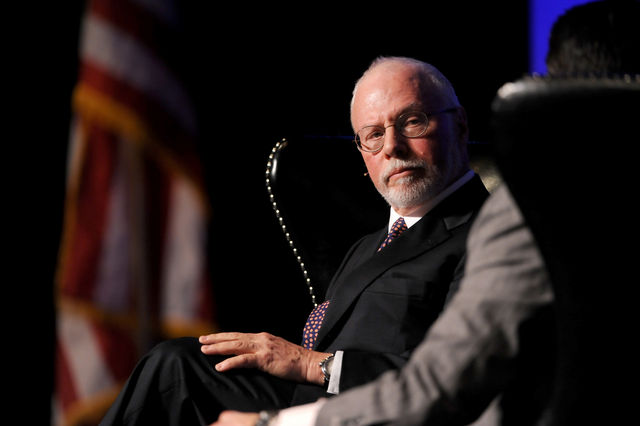
Photo: Paul Singer
By Eli Clifton | LobeLog | December 13, 2017
On Tuesday, Mark Dubowitz and Toby Dershowitz, two executives at the hawkish Foundation for Defense of Democracies (FDD), took to the op-ed pages of The New York Times to celebrate last week’s announcement that Argentina’s former president, Cristina Fernández de Kirchner, would face treason charges for her alleged role in covering up Iran’s alleged involvement in the 1994 bombing of a Jewish community center in Buenos Aries, killing 85 people.
But their op-ed fails to disclose a serious financial conflict of interest underpinning their attacks on Kirchner. One of FDD’s biggest donors financed a multi-year public diplomacy campaign against Kirchner all while attempting to collect $2 billion in debt from Argentina.
Indeed, legitimate questions exist about the bombing and suspicious 2015 death of Argentine Special Investigator Alberto Nisman who claimed in 2006 that Iran ordered the bombing. But Kirchner’s supporters fear that Argentina’s President Mauricio Macri is using judicial reforms and charges against Kirchner to remove his political opposition.
FDD has been eager to promote Nisman’s work. The group also runs AlbertoNisman.org “to honor the legacy of late Argentine Prosecutor Natalio Alberto Nisman and his tireless pursuit of justice.” FDD continues this work despite serious questions about large unexplained deposits to Nisman’s bank account.
Moreover, their rush to denigrate Kirchner omits a major conflict of interest in Dubowitz and Dershowitz’s funding. Between 2007 and 2011, hedge-fund billionaire Paul Singer contributed $3.6 million to FDD. That coincided with his battle to force Argentina to repay the full amount of the sovereign debt held by Singer’s firm, Elliott Management, a payout that Kirchner rejected. Ninety-three percent of Argentina’s creditors accepted losses, but Singer was one of the few holdouts. Having bought up Argentina’s defaulted bonds at pennies on the dollar, he had then sued the country for payment in full.
Singer embarked on a 15-year legal battle to collect on Argentina’s debt payments by attempting to seize Argentine government assets around the world, including a 100-meter three-masted tall ship when it docked in Ghana). After financing public diplomacy campaigns against Kirchner, Singer’s firm walked away with approximately 75 percent of what he was owed, $2.4 billion. The deal, finalized last year, was largely credited to Mauricio Macri, Kirchner’s successor.
Groups receiving Singer’s donations kept up a steady drumbeat of attacks on Kirchner and sought to tie her to Iran and Nisman’s suspicious death. “We do whatever we can to get our government and media’s attention focused on what a bad actor Argentina is,” Robert Raben, executive director of the American Task Force Argentina (ATFA) explained to The Huffington Post.
ATFA, a group created by Singer and other hedge fund holdouts, spent at least $3.8 million dollars over five years in its efforts attacking Argentina.
“Argentina and Iran: Shameful Allies” was the headline of one ATFA ad that ran in Washington newspapers in June 2013 as the Obama administration was weighing whether to file an amicus brief with the U.S. Supreme Court in Argentina’s favor. The ad featured side-by-side photos of Kirchner and then-Iranian President Mahmoud Ahmadinejad connected by the question, “A Pact With the Devil?” That same spring, FDD release an English-language summary of a new “ground-breaking” report by Nisman detailing “Iran’s extensive terrorist network in Latin America.”
This was followed by a flood of op-eds by FDD fellows and a series of hearings held by the House Homeland Security Subcommittee. According to FDD’s vice president, Toby Dershowitz, the report, which contains serious flaws and leaps of logic (detailed by Jim Lobe here and here), provided:
[A] virtual road map for how Iran’s long arm of terrorism can reach unsuspecting communities and that the AMIA attack was merely the canary in the coal mine. … The no-holds-barred, courageous report is a ‘must read’ for policy makers and law enforcement around the world and Nisman himself should be tapped for his guidance and profound understanding of Iran’s terrorism strategy.
Singer’s largesse also extended to the American Enterprise Institute (AEI) where he contributed $1.1 million in 2009. AEI Fellow Roger Noriega, who received $60,000 directly from Elliott Management in 2007 to lobby on the issue of “Sovereign Debt Owed to a U.S. Company,” published an article on the group’s website—“Argentina’s Secret Deal with Iran?”—citing secret documents about an alleged nuclear cooperation agreement between Tehran and Buenos Aires “brokered and paid for” by then-Venezuelan President Hugo Chávez.
In 2013, Noriega and Jose Cardenas, a contributor to AEI’s “Venezuela-Iran Project,” co-authored a seven-page policy report—“Argentina’s Race to the Bottom”—charging that Kirchner’s government was “casting its lot with rogue governments like those in Venezuela and Iran.”
Singer also gave $500,000 to The Israel Project (TIP) in 2007 and $1 million in 2012. By May 2015, the group’s magazine, The Tower, published no fewer than 48 articles that mentioned Argentina and 40 that cited Nisman and the 1994 bombing.
Neither AEI, TIP, nor FDD has bothered to disclose its funding from Singer when publishing work that advanced his public pressure campaign against Kirchner. Indeed, there is no public record of why Singer chooses to fund these organizations. But his funding poses a conflict of interest, especially when The New York Times publishes Dershowitz and Dubowitz without any public acknowledgement that their criticism of Kirchner conveniently follows the narrative and financial interests of one of the duo’s biggest financial donors.
Questioning the Russia-gate ‘Motive’

Donald Trump and Hillary Clinton in the third presidential debate in 2016, during which Clinton called Trump Vladimir Putin’s “puppet.”
By Gilbert Doctorow | Consortium News | December 18, 2107
The American public is now experiencing mass paranoia over Russia-gate, hysteria about Russia supposedly corrupting and manipulating the U.S. political system. This panic originated with Obama administration holdovers in the intelligence community who outlined the narrative while providing few if any facts — and it has been carried forward by Democrats, some Republicans hostile to President Trump, and by the U.S. mainstream media.
The Russia-gate frenzy has similarities to the madness that followed the 9/11 attacks when public passions were manipulated to serve the geopolitical agenda of President George W. Bush and Vice President Dick Cheney. In that case, civil liberties that had become accepted norms in the U.S. were suddenly cast aside – and the public was deceptively led into the invasion of Iraq.
In both cases – the Iraq War and Russia-gate – the U.S. intelligence community played central roles by – regarding Iraq – promoting false intelligence that Iraq was hiding WMD and had ties to Al Qaeda and – in the Russian case – assessing (without presenting evidence) that Russian President Vladimir Putin ordered the hacking of Democratic emails and their publication via WikiLeaks to hurt Hillary Clinton’s campaign and to help elect Donald Trump.
While the Iraq deception was driven by the neoconservatives in the Bush-Cheney administration, the Russia paranoia was started by the nominally left-of-center administration of Barack Obama in the closing months of his presidency. It has been fanned ever since by liberals and centrists in the Democratic Party and the never-Trump contingent in the Republican Party as well as the mainstream media – with the goal of either removing Trump from office or politically crippling him and his administration, i.e., to reverse the results of the 2016 election or, as some might say, reverse the “mistake” of the 2016 election.
Because promoters of the Russia-gate hysteria talk about the Kremlin’s “war” on the U.S. political process, the frenzy also carries extreme dangers, even greater than the death and destruction from the Iraq War. Russia is the only country on earth capable of turning the United States into ashes within a day. And even as U.S. journalists and politicians have casually – and sloppily – hyped the Russia-gate affair, the Russians have taken the growls of hostility from the United States very seriously.
Rumbles of War
If Russia is preparing for war, as the latest issue of Newsweek magazine tells us, we have no one but our political leaders and media pundits to blame. They have no concern for Russian national sensitivities and the “red lines” that the Russians have drawn. U.S. senators and congressmen listen only to what U.S. “experts” think the Russian interests should be if they are to fit into a U.S.-run world. That is why the Senate can vote 98-2 in favor of elevating President Obama’s executive sanctions against Russia into federal law as happened this past summer so President Trump can’t reverse them.
There have been a few U.S. journalists and academics who have examined the actual facts of the Russia-gate story and found them lacking in substance if not showing outright signs of fabrication, including Consortiumnews.com, Truthdig.com, and Antiwar.com. But they make up a very small minority.
Instead the major U.S. media has taken the Jan. 6 “Intelligence Community Assessment” accusing the Russians of meddling in the 2016 election as unassailable truth despite its stunning lack of evidence. According to President Obama’s Director of National Intelligence James Clapper, that “assessment” came from a “hand-picked” group of analysts from the CIA, FBI and National Security Agency, not the “all 17 intelligence agencies consensus” that the public was repeatedly told.
Perhaps the most significant challenge to the Russia-did-the-hacking “assessment” came from a study of the available forensic evidence by a group of former U.S. intelligence officers with relevant technical expertise from Veteran Intelligence Professionals for Sanity.
The VIPS’ analysis of the known download speed of one batch of Democratic emails concluded in July that the emails were likely extracted by a local download, not an external hack over the Internet, i.e., an inside job by someone with direct access to the computers. But the VIPS findings were largely ignored by the U.S. mainstream media, which has treated the original “assessment” by those “hand-picked” analysts as unchallengeable if not flat fact.
Besides the conventional wisdom that Russia did “hack” the emails and somehow slipped the emails to WikiLeaks, there is another core assumption of the Jan. 6 report – that Russian President Vladimir Putin ordered the hack of the Democratic emails and their publication through WikiLeaks because of his contempt for Hillary Clinton and his desire for Trump to win.
Indeed, the Jan. 6 “assessment” treats this supposed motive as the central evidence of Russian guilt, since actual physical or testimonial evidence is lacking. Yet what is also missing from the report is any recognition of other attitudes among the Russian political elite that would go against the report’s thesis, including whether Putin would have taken such a risk in the face of a widespread consensus that Clinton was the near-certain winner – and the strong possibility that any Russian operation would be exposed. An evenhanded intelligence “assessment” would have included these counter-arguments even if in the end they were cast aside. But the Jan. 6 report offered no such context or balance.
A View from Moscow
However, from my perspective – having participated in some of the leading Russian public affairs programs in 2016 – I heard Russian insiders close to President Putin expressing grave doubts about whether a Trump presidency would be good for Russia.
Political talk shows are a very popular component of Russian television programming on all channels, both state-run and commercial channels. They are mostly carried on prime time in the evening but also are showing up in mid-afternoon where they have displaced soap operas and cooking lessons as entertainment for housewives and pensioners.
The shows are broadcast live either to the Moscow time zone or to the Far East time zone. Given the fact that Russia extends over nine time zones, they are also video recorded and reshown locally at prime time. In the case of the highest quality and most watched programs produced by Vesti 24 for the Rossiya One channel, they also are posted in their entirety and in the original Russian on Youtube.
The panelists come from a rather small pool of Russian legislators, including chairmen of the relevant committees of the Duma (lower house) and Federation Council (upper house); leading journalists; think tank professors; and retired military brass. The politicians are drawn from among the most visible and colorful personalities in the Duma parties, but also extend to Liberal parties such as Yabloko, which failed to cross the five-percent threshold in legislative elections and thus received no seats in parliament.
(Since I live in Brussels, I was flown by the various channels who paid airfare and hotel accommodation in Moscow. That is to say, my expenses were covered but there was no honorarium. I make this explicit acknowledgement to rebut in advance any notion that I and other outside panelists were in any way “paid by the Kremlin” or restricted in our freedom of speech on air.)
During the period under review, I appeared on both state channels, Rossiya-1 and Pervy Kanal, as well as on the major commercial television channel, NTV. My debut on the No. 1 talk show in Russia, “Sunday Evening with Vladimir Soloviev,” on Sept. 11, 2016, was particularly useful because I had a chance to speak with the host, Vladimir Soloviev, for five minutes before the program.
I put to him the question that interested me the most: whom did he want to see win the U.S. presidential election. Without hesitation, Soloviev told me that he did not want to see Trump win because the celebrity businessman was volatile, unpredictable — and weak. Soloviev added that he and other politically knowledgeable Russians did not expect improved relations with the U.S. regardless of who won. He rejected the notion that Trump’s tossing the neocons out of government would be a great thing in and of itself.
The Devil You Know
Soloviev’s resistance to the idea that Trump could be a good thing was not just an example of Russians’ prioritizing stability, the principle “better the devil you know,” meaning Hillary Clinton. During a chat with a Russian ambassador, someone also close to power, I heard the firm belief that the United States is like a big steamship which has its own inertia and cannot be turned around, that presidents come and go but American foreign policy remains the same.
This view may be called cynical or realistic, depending on your taste, but it is reflective of the thinking that came out from many of the panelists in the talk shows.
To appreciate what weight the opinions of Vladimir Soloviev carry, you have to consider just who he is – that his talk show is the most professional from among numerous rival shows and attracts the most important politicians and expert guests. But even more to the point, he is as close to Putin as journalists can get and is familiar with the President’s thinking.
In April 2015, Soloviev conducted a two-hour interview with Putin that was aired on Rossiya 1 under the title “The President.” In early January 2016, the television documentary “World Order,” co-written and directed by Soloviev, set out in forceful terms Putin’s views on American and Western attempts to stamp out Russian sovereignty that first were spoken at the Munich Security Conference in February 2007 and have evolved and become ever more frank since.
Soloviev has a Ph.D. in economics from the Institute of World Economics and International Relations of the USSR Academy of Sciences. He was an active entrepreneur in the 1990s and spent some time back then in the U.S., where his activities included teaching economics at the University of Alabama. He is fluent in English and has been an unofficial emissary of the Kremlin to the U.S. at various times.
For all of these reasons, I believe it is safe to say that Vladimir Soloviev represents the thinking of Russian elites close to Putin, if not the views of Putin himself.
I encountered similar skepticism about Trump elsewhere as well. On Sept. 27, 2016, I took part in the “Sixty Minutes” talk show on Rossiya 1that presented a post-mortem of the first Trump-Clinton debate the day before.
Presenter Yevgeny Popov and his wife and co-presenter Olga Skabeyeva made a point that was largely missing in Western news coverage – that the Democrats and Republicans had largely switched positions on the use of military force, with Clinton taking the more hawkish position and Trump the more dovish stance.
Doubting Trump
Yet, Russian politicians and journalists on the panel were split down the middle on whether Trump or Clinton was their preferred next occupant of the Oval Office. The Trump skeptics noted that he was impulsive and could not be trusted to act with prudence if there was some crisis or accidental clash between U.S. and Russian forces in the field, for example.
They took the cynical view that the more dovish positions that Trump took earlier were purely tactical, to differentiate himself from his Republican competitors and then Clinton. Thus, these analysts felt that Trump could turn out to be no friend of Russia on the day after the elections.
One Trump doubter called Trump a “non-systemic” politician – or anti-establishment. But that is not a compliment in the Russian context. It has the odious connotation applied to Alexei Navalny and some members of the U.S.- and E.U.-backed Parnas political movement, suggesting seditious intent.
The Oct. 20 program “Evening with Vladimir Soloviev,” which I watched on television from abroad, was devoted to the third Clinton-Trump debate. My main takeaway from the show was that there was a bemused unanimity on the very diverse panel that the U.S. presidential campaign was awful, with both candidates having serious weaknesses of character and/or careers. Particular attention was devoted to the very one-sided position of the U.S. mass media and the centrist establishments of both parties favoring Hillary Clinton.
Though flamboyant in his language, nationalist politician Vladimir Zhirinovsky, leader of the LDPR Party, touched on a number of core concerns:
“The debates were weak. The two cannot greet one another on stage, cannot say goodbye to one another at the end. They barely can get out the texts that have been prepared for them by their respective staffs. Repeating on stage what one may have said in the locker room. Billions of people around the world conclude with one word: disgrace! This is the worst electoral campaign ever.
“And mostly what we see is the style of the campaign. However much people criticize the USSR – the old fogies who ran it, one and the same, supposedly the conscience of the world. Now we see the same thing in the USA: the exceptional country – the country that has bases everywhere, soldiers everywhere, is bombing everywhere in some city or other. …
“Hillary has some kind of dependency. A passion for power – and that is dangerous for the person who will have her finger on the nuclear button. If she wins, on November 9th the world will be at the brink of a big war.”
Zhirinovsky made no secret of his partiality for Trump, calling him “clean” and “a good man” whereas Clinton has “blood on her hands” for the deaths of hundreds of thousands due to her policies as Secretary of State. But then again, Zhirinovsky has made his political career over more than 30 years precisely by making outrageous statements that run up against what the Russian political establishment says aloud.
Zhirinovsky had been the loudest voice in Russian politics in favor of Turkey and its president Erdogan, a position which he came to regret when the Turks shot down a Russian jet at the Syrian border, causing a rupture in bilateral relations.
The final word on Russia’s electoral preferences during the Oct. 20 show was given by the moderator, Vladimir Soloviev: “There can be no illusions. Both Trump and Clinton have a very bad attitude toward Russia. What Trump said about us and Syria was no compliment at all. The main theme of American political life right now is McCarthyism and anti-Russian hysteria.”
This being Russia, one might assume that the deeply negative views of the ongoing presidential election reflected a general hostility toward the United States as a country. But nothing of the sort came out from the discussion. To be sure, there was the odd outburst from Zhirinovsky. But otherwise the panelists, including Zhirinovsky, displayed informed respect and even admiration for what the U.S. has achieved and represents as a country. But the panelists concluded that the U.S. has a political leadership at the national level that is unworthy and inappropriate to its position in the world.
Yet, back in the U.S., the ongoing hysteria over Russia-gate and the perceived threat that Russia poses to U.S. national interests, risks tilting the world into nuclear war.
Gilbert Doctorow is an independent political analyst based in Brussels. His latest book, Does the United States Have a Future?
Is TIME’s Afghan “cover girl” really a victim of mutilation by the Taleban?
Zero Anthropology | August 8, 2010

TIME : What Happens if We Leave Afghanistan (story)

BOING BOING : What Still Happened Despite 10 Years of Occupying Afghanistan (story)

ZERO ANTHRO : What Happens When We Don’t Fix Problems at Home (story)
The August 9th TIME magazine cover story is about a young Afghan woman whose nose and ears have been allegedly “mutilated” by the Taleban. The story has generated widespread self-serving moral indignation and self-righteous clamor in the U.S. propaganda machine supporting the occupation of Afghanistan run by the Israeli-American weapon-making industry. The American culture cleansing project in Afghanistan must be in need of a booster shot from the radical feminist forces that so fervently collaborated with the American war machine in initiating this racist imperial enterprise in 2001. Perhaps the flaunting of this fictitious story is a desperate attempt by the Obama war regime to offset the steep decline of support for this murderous program against unarmed and helpless pre-industrial Afghanistan. Let us recall the production of the picture of the frightened green-eyed Afghan girl on the cover of the National Geographic magazine to justify the United States sponsorship of local anti-government terrorist gangs who currently host the American occupation of Afghanistan.
TIME’s story does not provide its readers with any specific or credible factual text and context about what has really caused the deformity in this young woman’s face. Like much fiction that has been produced in the shadow of the American war machine in Afghanistan, this “story” appears to be a string of hearings and imaginings about women’s life in Afghanistan put together by Aryn Baker and Jodi Bieber, two young American journalists who probably first encountered Afghanistan in the pages of “the kite runner”. Having the readers see the reporters’ pictures (p. 4) in a “Kabul kite shop” speaks to the compelling impact of the untruths about life in Kabul in that “bestseller” book. What is the relationship of kites to a story about a mutilated nose? TIME’s story by Baker and Bieber has no truth value. Let us have a closer look at some of the cultural content and ethnographic claims in this fabricated telltale.
The narrative in which the Taleban single out this young woman for ears and nose mutilation at the instigation of her husband cannot be credible when exposed to the spatial, temporal, and cultural framework provided by the reporters. First, Urozgan province is located in central Afghanistan not “southern” Afghanistan. And if the alleged mutilation took place in central or northern Urozgan, TIME’s tale becomes even less credible for these parts of Urozgan are home to non-Paxtuns, especially Hazaras. What is the victim’s ethnic background? Even if the agency of this “mutilation” were the Taleban, why would they devote this amount of precious human resources in a hostile area to the personal disenchantment of a single Taleb foot soldier with his runaway wife, Aisha? This does not make tactical or strategic sense.
The Taleban dragged Aisha “to a mountain clearing near her village” where “[s]hivering in the cold air and blinded by the flashlights trained on her by her husband’s family, she faced her spouse and accuser… and men moved to deliver her punishment. Aisha’s brother-in-law held her down while her husband pulled out a knife. First he sliced off her ears. Then he started on her nose. Aisha passed out from her pain but awoke soon after, choking on her own blood. The men had left her on the mountaintop to die” (pp. 20-22). If the men wanted Aisha to die, why did they not kill her on the spot, on the mountain? Why give her a chance to live? Why risk her potential recovery and/or rescue?
To receive her punishment, why would Aisha have to be dragged to the mountain clearing (or is it a “mountainside”)? Where is this mountain clearing or side located in Urozgan? However, it must be at a distance from the village. And if TIME’s narrative is valid, the mutilation is a public affair with the husband, his family, and Taleban officials present. Thus, there are witnesses to the mutilation of Aisha’s nose and ears. These witnesses, especially members of her husband’s family, can be located. Did Aisha “pass out” from “pain” or loss of blood? How does a victim whose ears and nose have been mutilated and is choking on her own blood, and left alone “on the mountainside to die” survive such virtually fatal injuries? The human face is heavily irrigated with blood. I am not a medical doctor, but based on common sense, it would not take more than a few minutes of suffering heavy blood loss from open veins around the nose and ears to become fatal? How does a rural 19 year girl in such perilous medical condition, bleeding from open veins around her nose and ears, manage to move from a mountainside in remote Urozgan to a “shelter” in downtown Kabul hundreds of miles away? “A few months after Aisha arrived at the shelter, her father tried to bring her home with promises that he would find her a new husband. Aisha refused to leave. In rural areas, a family that finds itself shamed by a daughter sometimes sells her into slavery, or worse, subjects her to a so-called honor killing—murder under the guise of saving the family’s name” (p. 26). Now, what are the prospects (or practical feasibility) for marriage of a woman who has her ears and nose mutilated for having dishonored her own family, husband, and in-laws in patriarchal Afghanistan or for that matter in patricentric United States? What would be the market value of Aisha’s labor? What kind of labor could a severely mutilated woman like this produce as a slave? Only total ignorance of the Afghan cultural plane and complete disregard for the intelligence of the audience by the American popular media would allow such fabricated prattle to see the light of public print.
Aisha’s disposition could be congenital. It could be caused by a bacterial or viral infection such as cancer, a malady not rare in Afghanistan among both men and women. Or it could be related to an injury caused by firearms or explosives. Harelips and other deformities in the mandible, although rare, occur in the population of Afghanistan. Incidents of human body deformities in Afghanistan have steadily increased with the expanding military interference of the United States going back to the 1980s. These incidents have soared since 2001 with the American occupation and experimentation with weapon systems designed for “population centered wars” in Afghanistan and elsewhere.
The non-Paxtun Northern Alliance warlords and their inner circles are the only Afghans that pray and beg for the American military presence in Afghanistan. It was these anti-Paxtun American trained and subsidized terrorist gangs who scouted and pimped for the American occupation of Afghanistan. And it is the Northern Alliance that opposes a political solution in Afghanistan because any such solution would remove them from power and expose and punish their criminal deeds. Amrullah Saleh, a known psychopath and a leading member of this criminal gang who headed Afghanistan’s intelligence services, recently expatiated: “I have killed many of them (Taleban) with pride”, killing “them is part of my blood” (Lara Logan interview on “60 Mintes”, August 1, 2010). The informants for TIME’s reporters of this story are the female dependents of the Northern Alliance criminal clique one of whom is credited with this rabid hateful lie “I go running in the stadium where the Taliban used to play football with women’s heads” (p. 24). This woman is pictured standing in Kabul stadium with three Kabuli teenagers in the background clearly running-in-place! There is not a shred of evidence for a football game played with human heads anywhere at any time in Afghanistan. TIME magazine has truly stooped to the lowest standards in journalism. During the 1990s the Kabul stadium was used once for the public execution of a woman found guilty of violating a Taleban decree.
The American intimate love affair during the past three decades with the various gangs of terrorists including Al-Qaeda, Hezb-e Islami, Northern Alliance, and sporadically the early manifestation of the Taleban movement during the 1990s has inflicted irreparable damage on the political, economic, and security prospects of Afghanistan. The ethnic and sectarian divisions caused by the American military operations and criminal deeds in South Asia has brought the frail state structure of Afghanistan to the verge of total collapse. It has destabilized the whole region. Tens of thousands of innocent and helpless Afghans have been slaughtered by the American Zionist-controlled killing machine. These are war crimes and crimes against humanity for which history will condemn its perpetrators.
On an ethnographic level, the manipulation of the body of the subject human population by the state has historical roots in several culture areas including Europe, the Middle East and South Asia. To this day in the popular lore of non-Paxtun areas of Afghanistan (especially among the Farsi-speaking population) a person, male or female, who compromises the interests and standards of the larger community, is symbolically labeled “beeni borida” (Farsi, one whose nose has been cut, one who has lost his nose, i. e. one who has lost her/his honor, a person without honor). The equivalent of this linguistic construct and its cultural content does not exist among Paxtuns.
However, no matter the untruths and distortions from which TIME’s August 9th cover story is concocted, we need a proper comparative cultural framework for the understanding of abuse of the human body including the practice of mutilation of body parts. An informed glance at global ethnographic realities connects such practices with a relation of power called patriarchy—male domination of society. As a system of ideas and practices patriarchy “is a threat to public health everywhere” (Laura Nader, Anthropology News, September 2006, p. 7) including Afghanistan and the United States. In principle the socio-cultural ingredients involved in the mutilation of the human body in Afghanistan are not different than the socio-cultural forces that impose industrial “vaginal rejuvenation”, “pussy tightening” (JoAnn Wypijewski, The Nation, 9/28/2009, p. 8), and breast enhancement in Euro-America. In no other culturally constructed space are women, womanhood, and femininity so universally abused, exploited, demeaned, and vulgarized than in the Euro-American industry of internet pornography—the biggest money making enterprise in cyberspace. Comparative studies reveal that American domestic violence is approximately 25%–about the same as in Syria and Bolivia (Nader 2006:7). The extensive system of shelters for abused women throughout the United States is symptomatic of a widely practiced tradition of physical and verbal abuse of women by men that is qualitatively not different than the abuse of women by men elsewhere in the world.
TIME, you are a beeni borida!
_________
Addendum by Max Forte:
[“In 2005, 1,181 women were murdered by an intimate partner. That’s an average of three women every day. Of all the women murdered in the U.S., about one-third were killed by an intimate partner” (source). 17.6 % of women in the United States have survived a completed or attempted rape. Of these, 21.6% were younger than age 12 when they were first raped, and 32.4% were between the ages of 12 and 17. 64% of women who reported being raped, physically assaulted, and/or stalked since age 18 were victimized by a current or former husband, cohabiting partner, boyfriend, or date. Only about half of domestic violence incidents are reported to police. The National College Women Sexual Victimization Study estimated that between 1 in 4 and 1 in 5 college women experience completed or attempted rape during their college years. One out of every six American women have been the victims of an attempted or completed rape in their lifetime. Factoring in unreported rapes, about 5% – one out of twenty – of rapists will ever spend a day in jail. 19 out of 20 will walk free. The costs of intimate partner violence against women exceed an estimated $5.8 billion. These costs include nearly $4.1 billion in the direct costs of medical care and mental health care and nearly $1.8 billion in the indirect costs of lost productivity and present value of lifetime earnings. A University of Pennsylvania research study found that domestic violence is the leading cause of injury to low-income, inner-city Philadelphia women between the ages of 15 to 44 – more common than automobile accidents, mugging and rapes combined. In this study domestic violence included injuries caused by street crime (see sources).]
Protecting the Shaky Russia-gate Narrative
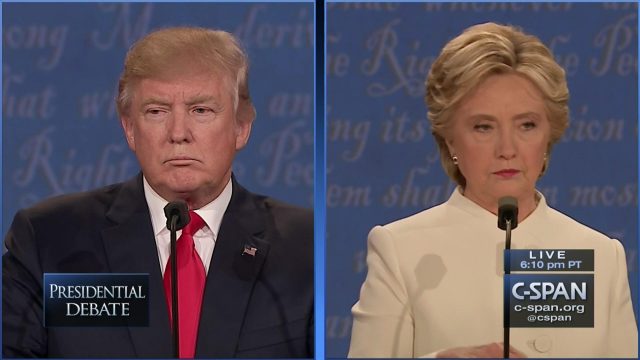
Donald Trump and Hillary Clinton in the third presidential debate in 2016, during which Clinton called Trump Vladimir Putin’s “puppet.”
By Robert Parry | Consortium News | December 15, 2017
If Russia-gate is the massive scandal that we are told it is by so many Important People — across the U.S. mainstream media and the political world — why do its proponents have to resort to lies and exaggerations to maintain the pillars supporting the narrative?
A new example on Thursday was The New York Times’ statement that a Russian agency “spent $100,000 on [Facebook’s] platform to influence the United States presidential election last year” – when the Times knows that statement is not true.
According to Facebook, only 44 percent of that amount appeared before the U.S. presidential election in 2016 (i.e., $44,000) and few of those ads addressed the actual election. And, we know that the Times is aware of the truth because it was acknowledged in a Times article in early October.
As part of that article, Times correspondents Mike Isaac and Scott Shane reported that the ads also covered a wide range of other topics: “There was even a Facebook group for animal lovers with memes of adorable puppies that spread across the site with the help of paid ads.”
As nefarious as the Times may think it is for Russians to promote a Facebook page about “adorable puppies,” the absurdity of that concern – and the dishonesty of the Times then “forgetting” what it itself reported just two months ago about the timing and contents of these “Russian-linked ads” – tells you a great deal about Russia-gate.
On Thursday, the Times chose to distort what it already knew to be true presumably because it didn’t want to make the $100,000 ad buy (which is not a particularly large sum) look even smaller and less significant by acknowledging the pre-election total was less than half that modest amount – and even that total had little to do with the election.
Why would the Times lie? Because to tell the truth would undercut the narrative of evil Russians defeating Hillary Clinton and putting Donald Trump in the White House – the core narrative of Russia-gate.
Another relevant fact is that Facebook failed to find any “Russian-linked” ads during its first two searches and only detected the $100,000 after a personal visit from Sen. Mark Warner, D-Virginia, the vice chairman of the Senate Intelligence Committee and a leading legislator on Internet regulation.
In other words, Facebook’s corporate executives dredged up something to appease Warner. That way, Warner and the Democrats could blame Russia for the Trump presidency, sparing further criticism of Clinton’s dreadful campaign (in which she labeled half of Trump’s voters “deplorables”) and her neo-liberal economic policies (and neo-conservative foreign policies) that have alienated much of America’s working class as well as many progressives.
Leaving Out Context
The Times also might have put the $100,000 in “Russian-linked” ads over a two-year period in the context of Facebook’s $27 billion in annual revenue, but the Times didn’t do that – apparently because it would make even the full $100,000 look like a pittance.
Trimming the total down to $44,000 and admitting that only a few of those ads actually dealt with Clinton and Trump would be even worse for the Russia-gate narrative.
Ironically, the Times’ latest false depiction of the $100,000 in ads as designed “to influence” the 2016 election appeared in an article about Facebook determining that other Russian-linked ads, which supposedly had a powerful effect on Great Britain’s Brexit vote, totaled just three ads at the cost of 97 cents. (That is not a misprint.)
According to Facebook, the three ads, which focused on immigration, were viewed some 200 times by Britons over four days in May 2016. Of course, the response from British parliamentarians who wanted to blame the Brexit vote on Moscow was to assert that Facebook must have missed something. It couldn’t be that many Britons had lost faith in the promise of the European Union for their own reasons.
We have seen a similar pattern with allegations about Russian interference in German and French elections, with the initial accusations being widely touted but not so much the later conclusions by serious investigations knocking down the claims. [See, for instance, Consortiumnews.com’s “German Intel Clears Russia on Interference.”]
The only acceptable conclusion, it seems, is “Russia Guilty!”
These days in Official Washington, it has become almost forbidden to ask for actual evidence that would prove the original claim that Russia “hacked” Democratic emails, even though the accusation came from what President Obama’s Director of National Intelligence James Clapper acknowledged were “hand-picked” analysts from the CIA, FBI and National Security Agency.
These “hand-picked” analysts produced the evidence-lite Jan. 6 “assessment” about Russia “hacking” the emails and slipping them to WikiLeaks – a scenario denied by both WikiLeaks and Russia.
When that “assessment” was released almost a year ago, even the Times’ Scott Shane noticed the lack of proof, writing: “What is missing from the [the Jan. 6] public report is what many Americans most eagerly anticipated: hard evidence to back up the agencies’ claims that the Russian government engineered the election attack. … Instead, the message from the agencies essentially amounts to ‘trust us.’”
But the Times soon “forgot” what Shane had inconveniently noted and began reporting the Russian “hacking” as accepted wisdom.
The 17-Agencies Canard
Whenever scattered expressions of skepticism arose from a few analysts or non-mainstream media, the doubts were beaten back by the claim that “all 17 U.S. intelligence agencies” concurred in the conclusion that Russian President Vladimir Putin had ordered the hacking to hurt Hillary Clinton and help Donald Trump. And what kind of nut would doubt the collective judgment of all 17 U.S. intelligence agencies!
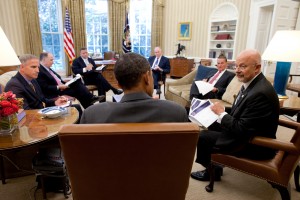
Director of National Intelligence James Clapper talks with President Barack Obama in the Oval Office, John Brennan and other national security aides present. (Photo credit: Office of Director of National Intelligence)
Though the 17-agency canard was never true, it served an important purpose in establishing the Russia-gate groupthink. Wielding the “all 17 intelligence agencies” club, the U.S. mainstream media pounded politicians and policymakers into line, making any remaining skeptics seem more out of step and crazy.
So, in May 2017, when Clapper (along with former CIA Director John Brennan) admitted in congressional testimony that it wasn’t true that all 17 agencies concurred in the Russian hacking conclusion, those statements received very little attention in the mainstream media.
The New York Times among other major news outlets just continued asserting the 17-agency falsehood until the Times was finally pressured to correct its lie in late June, but that only led to the Times shifting to slightly different but still misleading wording, citing a “consensus” among the intelligence agencies without mentioning a number or by simply stating the unproven hacking claim as flat fact.
Even efforts to test the Russian-hack claims through science were ignored or ridiculed. When former NSA technical director William Binney conducted experiments that showed that the known download speed of one batch of DNC emails could not have occurred over the Internet but matched what was possible for a USB-connected thumb drive — an indication that a Democratic insider likely downloaded the emails and thus that there was no “hack” — Binney was mocked as a “conspiracy theorist.”
Even with the new disclosures about deep-seated anti-Trump bias in text messages exchanged between two senior FBI officials who played important early roles in the Russia-gate investigation, there is no indication that Official Washington is willing to go back to the beginning and see how the Russia-gate story might have been deceptively spun.
In a recently released Aug. 15, 2016 text message from Peter Strzok, a senior FBI counterintelligence official, to his reputed lover, senior FBI lawyer Lisa Page, Strzok referenced an apparent plan to keep Trump from getting elected before suggesting the need for “an insurance policy” just in case he did. A serious investigation into Russia-gate might want to know what these senior FBI officials had in mind.
But the Times and other big promoters of Russia-gate continue to dismiss doubters as delusional or as covering up for Russia and/or Trump. By this point – more than a year into this investigation – too many Important People have bought into the Russia-gate narrative to consider the possibility that there may be little or nothing there, or even worse, that it is the “insurance policy” that Strzok envisioned.
Investigative reporter Robert Parry broke many of the Iran-Contra stories for The Associated Press and Newsweek in the 1980s.
Food and medicine can’t get past the Saudi blockade on Yemen, but Nikki Haley thinks missiles can
Nikki Haley once again pushing for war against Iran–this time making an argument that is not only flawed but nonsensical
By Adam Garrie | The Duran | December 15, 2017
Nikki Haley, Donald Trump’s Ambassador to the United Nations, has given an extraordinary “press conference”, even by her habitually outrageous standards.
First all, it was hardly a “press conference” as Haley did not answer any of the questions posed to her. Instead, she merely assured journalists that she has evidence to back her up position, although it is not clear what this evidence might look like.
Haley’s position is that since the outbreak of the current crisis in Yemen, beginning in March of 2015, Iran has been supplying Yemen’s Ansar Allah Movement, more commonly known [in western media] as the Houthis, with the missiles they have sporadically used to target Saudi Arabia and allegedly the UAE.
There is a fatal flaw in this line of thinking however. Saudi Arabia has, since the beginning of the conflict, controlled all air and sea traffic coming into Yemen, while monitoring the region with the latest US made technology.
Yemen has subsequently been surrounded by a Saudi Naval blockade, Saudi borders through which nothing can pass and Omani borders through which there is no evidence of anything passing and which in any case, border areas which do not belong to Ansar Allah fighters, but instead have fluctuated between the Hadi government based in Aden, al-Qaeda terrorists and ISIS terrorists.
Not only has the Saudi blockade caused a man made famine which itself has resulted in a mass outbreak of the disease Cholera, but even the UN has found it difficult to convince the Saudis to allow basic medicine, bottled water and dried foods into the always poor and now starving nation.
But for Nikki Haley, who gave her press conference standing in front of what appeared to be a rusty missile casing–it all makes perfect sense. In Haley’s parallel universe, an aid ship with UN flags cannot bring bottles of water and jars of medical pills to Yemenis, but somehow Iranian ships bearing humongous missiles have easily passed through the Saudi blockade undetected.
There is simply no logic to the argument, no matter how it is interpreted.
Even a journalist at Haley’s “press conference” asked how the US can verify the provenance of the missiles and in particular when they were sent to Yemen. She had no answer apart from effectively saying ‘trust us–we know’.
The fact, as the Ansar Allah themselves have always maintained, is that the missiles which they occasionally launch are taken from Yemeni military bases which Ansar Allah have controlled for approximately two years. Video footage of the missile strikes is consistent with these statements.
Iran’s Foreign Minister Javad Zarif has Tweeted the following photo, comparing Haley’s accusations against Iran to Colin Powell’s infamous accusations against Iraq, saying that Saddam Hussein had weapons of mass destruction which he did not possess.
In reality, Haley’s statement is even more ludicrous as there is physically no way for Iran to transport missiles or anything else for that matter, to Yemen without being seen and almost certainly stopped by the Saudi blockade, a blockade which started in March of 2015, nearly four months before the JCPOA even came into effect.
This last point is crucial as Haley’s allegations rest on the fact that in delivering missiles to the Ansar Allah, Iran is in violation of the terms of the JCPOA, a longstanding US allegation that has been rejected by the EU as a whole, as well as individual parties to the agreement: Germany, France, Britain, China, Russia and the United Nations.
Haley of course repeated what for most American neo-cons is a standard line that Iran sponsors terrorism and is “behaving badly” in Iraq, Syria and Lebanon. If fighting groups like ISIS(Daesh) and al-Qaeda is bad behaviour, the mind simply boggles. The closest Iran is to terrorism is fighting terrorism on the field of battle and advising Iraqi and Syrian partners on how better to do such.
Nikki Haley has proved once again that her aptitude is low, her ethics are non existent and her intelligence is a void.
The fact that she is an Ambassador to the UN but acts increasingly like a hybrid of a Secretary of State combined with a Defense Secretary, is a deeply worrying prospect for all those concerned with global peace and stability.
Biden was wrong: Intel agencies find no evidence of ‘Russian meddling’ in Italian polls
RT | December 14, 2017
Italian intelligence services did not find evidence to back up allegations voiced by former US Vice President Joe Biden. He claimed Moscow had meddled with Italy’s polls before and plans to do it again.
Two Italian intelligence agencies did not find any evidence of the alleged Russian interference into last year’s constitutional reform referendum, despite conducting “attentive monitoring” of possible foreign meddling, ANSA news agency reported. The chiefs of the Internal Information and Security Agency (AISI) and the External Intelligence and Security Agency (AISE), Mario Parente and Alberto Manenti, respectively, faced the parliamentary intelligence committee this week.
The parliamentary hearings were triggered by an article by Biden, dubbed, “How to stand up to the Kremlin,” published earlier in December by the journal Foreign Affairs. Among the numerous accusations, largely repeating the mainstream media “Russian meddling” narrative, Biden claimed that Moscow interfered in the Italian Constitutional referendum and warned about alleged meddling in the country’s upcoming parliamentary elections.
“A Russian effort is now under way to support the nationalist Northern League and the populist Five Star Movement in Italy’s upcoming parliamentary elections,” Biden stated, without providing any proof to back up the claim. The allegations prompted an angry response from the parties accused of getting Russian support.
Matteo Salvini, leader of the Northern League (Lega Nord), said that Italy’s ruling Democratic party “lost the referendum and will lose the elections, because the Italians have good sense, and not because Putin wants it,” as quoted by La Repubblica.
The 5 Star Movement responded to Biden by stating that “we all must respect the vote” and “know how to lose.” President Barack Obama’s former deputy simply did not get over the Democrats’ defeat last year, and was seeking to blame the Russians for everything he didn’t like, the party said in a Facebook post.
“Today, Biden says it is Russia’s fault, as he says it is Russia’s fault that Trump won and his party lost. Biden goes further and says Russia is helping the 5 Star Movement. He does not provide any evidence, this is unacceptable,” the post reads. The party’s candidate for prime minister, Luigi di Maio, dismissed Biden’s allegations as “fake news,” stating that millions of Italians voted ‘No’ during the referendum on their own, without “being paid by the Russians.”
The 2016 Constitutional referendum was aimed at reorganizing the Italian Senate and redirecting more powers from the regions to central government. The reform, however, failed spectacularly, as nearly 60 percent of Italians voted against it, prompting the resignation of then-PM Matteo Renzi, who currently leads the Democratic Party.
US allegations on Yemen missile ‘provocative’, ‘destructive’: Iran
Press TV – December 14, 2017
Iran’s UN mission has categorically dismissed as “unfounded” US Ambassador Nikki Haley’s claim that a missile fired at Saudi Arabia from Yemen last month was supplied by the Islamic Republic.
In a statement released on Thursday, the mission denounced the US allegations as “irresponsible, provocative and destructive,” saying “this purported evidence … is as much fabricated as the one presented on some other occasions earlier.”
“These accusations seek also to cover up for the Saudi war crimes in Yemen, with the US complicity, and divert international and regional attention from the stalemate war of aggression against the Yemenis that has so far killed more than 10,000 civilians, displaced three million, crippled Yemen’s infrastructure and health system and pushed the country to the brink of the largest famine the world has seen for decades, as the UN has warned,” the statement read.
It went on to accuse the US government of being “constantly at work to deceive the public into believing the cases they put together” to advance its agenda.
“While Iran has not supplied Yemen with missiles, these hyperboles are also to serve other US agendas in the Middle East, including covering up for its adventurist acts in the region and its unbridled support for the Israeli regime,” the statement read.
It also stressed “the Yemenis’ right to self-defense” and reiterated that the conflict in the impoverished country had no military solution.
Iran’s Foreign Minister Mohammad Javad Zarif also took to twitter to compare Haley’s allegations against Iran to those of former US secretary of defense, Colin Powell, who alleged in 2003 that former Iraqi dictator, Saddam Hussein, was hiding weapons of mass destruction in order to make a case for attacking the country.
The anti-Iran accusations come at a time that the US and Saudi Arabia themselves are under fire for secretly providing weapons to the militants fighting the Syrian government.
Conflict Armament Research (CAR), a UK-based organization that monitors the movement of conventional weapons, warned on Thursday that the sophisticated arms given to the so-called Syria militants fell into the hands of the Daesh terrorist group.
The weapons included anti-tank rockets purchased by the US military that ended up in possession of Daesh within two months of leaving the factory, according to the study, which was funded by the European Union and German government.
This came after the UN Secretary-General Antonio Guterres said in a confidential report obtained by AFP on Monday, December 11, that the world body’s team, which visited Riyadh last month to scrutinize the alleged evidence, had not yet established a link between them and the Islamic Republic.
On November 4, a missile fired from Yemen targeted the King Khalid International Airport near Riyadh, reaching the Saudi capital for the first time.
The Houthi movement, which has been fighting back a Saudi aggression, said it had fired the missile but the Riyadh regime was quick to point the finger at Iran.
Tehran rejected the allegations as “provocative and baseless,” saying the Yemenis had shown an “independent” reaction to the Saudi bombing campaign on their country.
Speaking at a press conference at a military base in Washington on Thursday, Haley presented what she claimed to be “undeniable” evidence, including the allegedly recovered pieces of the missile, saying it proved that Iran was violating international law by giving missiles to the Houthis.
“It was made in Iran then sent to Houthi militants in Yemen,” she added.
However, a panel appointed by the United Nations Security Council said last month that it had seen no evidence to support Saudi Arabia’s claims that missiles had been transferred to Yemen’s Houthi fighters by external sources.
The Security Council-appointed panel said in its confidential assessment that it had seen no evidence to back up the Saudi claims that short-range ballistic missiles (SRBMs) had been transferred to Yemeni fighters in violation of the Resolution 2216.
It said the tightening of the blockade by the Saudi-led coalition and its invoking of Resolution 2216 had been an attempt to merely “obstruct” the delivery of civilian aid.
“The panel finds that imposition of access restrictions is another attempt by the Saudi Arabia-led coalition to use paragraph 14 of resolution 2216 as justification for obstructing the delivery of commodities that are essentially civilian in nature,” the assessment read.
The Saudi war since 2015, accompanied by the land, naval, and aerial blockade on Yemen, has killed over 12,000 people so far and led to a humanitarian crisis as well as a deadly cholera epidemic.
Saudi Arabia and its allies launched the war in a bid to crush the Houthi movement and reinstate the former Riyadh-friendly regime, but the kingdom has achieved neither of its goals.
The UN has listed Yemen as the world’s number one humanitarian crisis, with 17 million Yemenis in need of food and gripping the country.
The US, which has long been a staunch Saudi ally, signed a deal to sell the kingdom $110 billion in weapons in May.
The Foundering Russia-gate ‘Scandal’
By Robert Parry | Consortium News | December 13, 2017
The disclosure of fiercely anti-Trump text messages between two romantically involved senior FBI officials who played key roles in the early Russia-gate inquiry has turned the supposed Russian-election-meddling “scandal” into its own scandal, by providing evidence that some government investigators saw it as their duty to block or destroy Donald Trump’s presidency.
As much as the U.S. mainstream media has mocked the idea that an American “deep state” exists and that it has maneuvered to remove Trump from office, the text messages between senior FBI counterintelligence official Peter Strzok and senior FBI lawyer Lisa Page reveal how two high-ranking members of the government’s intelligence/legal bureaucracy saw their role as protecting the United States from an election that might elevate to the presidency someone as unfit as Trump.
In one Aug. 6, 2016 text exchange, Page told Strzok: “Maybe you’re meant to stay where you are because you’re meant to protect the country from that menace.” At the end of that text, she sent Strzok a link to a David Brooks column in The New York Times, which concludes with the clarion call: “There comes a time when neutrality and laying low become dishonorable. If you’re not in revolt, you’re in cahoots. When this period and your name are mentioned, decades hence, your grandkids will look away in shame.”
Apparently after reading that stirring advice, Strzok replied, “And of course I’ll try and approach it that way. I just know it will be tough at times. I can protect our country at many levels, not sure if that helps.”
At a House Judiciary Committee hearing on Wednesday, Rep. Jim Jordan, R-Ohio, criticized Strzok’s boast that “I can protect our country at many levels.” Jordan said: “this guy thought he was super-agent James Bond at the FBI [deciding] there’s no way we can let the American people make Donald Trump the next president.”
In the text messages, Strzok also expressed visceral contempt for working-class Trump voters, for instance, writing on Aug. 26, 2016, “Just went to a southern Virginia Walmart. I could SMELL the Trump support. … it’s scary real down here.”
Another text message suggested that other senior government officials – alarmed at the possibility of a Trump presidency – joined the discussion. In an apparent reference to an August 2016 meeting with FBI Deputy Director Andrew McCabe, Strzok wrote to Page, “I want to believe the path you threw out for consideration in Andy’s office — that there’s no way he gets elected — but I’m afraid we can’t take that risk.”
It’s unclear what strategy these FBI officials were contemplating to ensure Trump’s defeat, but the comments mesh with what an intelligence source told me after the 2016 election, that there was a plan among senior Obama administration officials to use the allegations about Russian meddling to block Trump’s momentum with the voters and — if elected — to persuade members of the Electoral College to deny Trump a majority of votes and thus throw the selection of a new president into the House of Representatives under the rules of the Twelfth Amendment.
The scheme involved having some Democrats vote for former Secretary of State Colin Powell (which did happen), making him the third-place vote-getter in the Electoral College and thus eligible for selection by the House. But the plan fizzled when enough of Trump’s electors stayed loyal to their candidate to officially make him President.
After that, Trump’s opponents turned to the Russia-gate investigation as the vehicle to create the conditions for somehow nullifying the election, impeaching Trump, or at least weakening him sufficiently so he could not take steps to improve relations with Russia.
In one of her text messages to Strzok, Page made reference to a possible Watergate-style ouster of Trump, writing: “Bought all the president’s men. Figure I needed to brush up on watergate.”
As a key feature in this oust-Trump effort, Democrats have continued to lie by claiming that “all 17 U.S. intelligence agencies concurred” in the assessment that Russia hacked the Democratic emails last year on orders from President Vladimir Putin and then slipped them to WikiLeaks to undermine Hillary Clinton’s campaign.
That canard was used in the early months of the Russia-gate imbroglio to silence any skepticism about the “hacking” accusation, and the falsehood was repeated again by a Democratic congressman during Wednesday’s hearing of the House Judiciary Committee.
But the “consensus” claim was never true. In May 2017 testimony, President Obama’s Director of National Intelligence James Clapper acknowledged that the Jan. 6 “Intelligence Community Assessment” was put together by “hand-picked” analysts from only three agencies: the CIA, FBI and National Security Agency.
Biased at the Creation
And, the new revelations of high-level FBI bias puts Clapper’s statement about “hand-picked” analysts in sharper perspective, since any intelligence veteran will tell you that if you hand-pick the analysts you are effectively hand-picking the analysis.
Although it has not yet been spelled out exactly what role Strzok and Page may have had in the Jan. 6 report, I was told by one source that Strzok had a direct hand in writing it. Whether that is indeed the case, Strzok, as a senior FBI counterintelligence official, would almost surely have had input into the selection of the FBI analysts and thus into the substance of the report itself. [For challenges from intelligence experts to the Jan. 6 report, see Consortiumnews.com’s “More Holes in the Russia-gate Narrative.“]
If the FBI contributors to the Jan. 6 report shared Strzok’s contempt for Trump, it could explain why claims from an unverified dossier of Democratic-financed “dirt” on Trump, including salacious charges that Russian intelligence operatives videotaped Trump being urinated on by prostitutes in a five-star Moscow hotel, was added as a classified appendix to the report and presented personally to President-elect Trump.
Though Democrats and the Clinton campaign long denied financing the dossier – prepared by ex-British spy Christopher Steele who claimed to rely on second- and third-hand information from anonymous Russian contacts – it was revealed in October 2017 that the Democratic National Committee and the Clinton campaign shared in the costs, with the payments going to the “oppo” research firm, Fusion GPS, through the Democrats’ law firm, Perkins Coie.
That discovery helped ensnare another senior Justice Department official, Associate Attorney General Bruce Ohr, who talked with Steele during the campaign and had a post-election meeting with Fusion GPS co-founder Glenn Simpson. Recently, Simpson has acknowledged that Ohr’s wife, Nellie Ohr, was hired by Fusion GPS last year to investigate Trump.
Bruce Ohr has since been demoted and Strzok was quietly removed from the Russia-gate investigation last July although the reasons for these moves were not publicly explained at the time.
Still, the drive for “another Watergate” to oust an unpopular – and to many insiders, unfit – President remains at the center of the thinking among the top mainstream news organizations as they have scrambled for Russia-gate “scoops” over the past year even at the cost of making serious reporting errors.
For instance, last Friday, CNN — and then CBS News and MSNBC — trumpeted an email supposedly sent from someone named Michael J. Erickson on Sept. 4, 2016, to Donald Trump Jr. that involved WikiLeaks offering the Trump campaign pre-publication access to purloined Democratic National Committee emails that WikiLeaks published on Sept. 13, nine days later.
Grasping for Confirmation
Since the Jan. 6 report alleged that WikiLeaks received the “hacked” emails from Russia — a claim that WikiLeaks and Russia deny — the story seemed to finally tie together the notion that the Trump campaign had at least indirectly colluded with Russia.
This new “evidence” spread like wildfire across social media. As The Intercept’s Glenn Greenwald wrote in an article critical of the media’s performance, some Russia-gate enthusiasts heralded the revelation with graphics of cannons booming and nukes exploding.
But the story soon collapsed when it turned out that the date on the email was actually Sept. 14, 2016, i.e., the day after WikiLeaks released the batch of DNC emails, not Sept. 4. It appeared that “Erickson” – whoever he was – had simply alerted the Trump campaign to the public existence of the WikiLeaks disclosure.
Greenwald noted, “So numerous are the false stories about Russia and Trump over the last year that I literally cannot list them all.”
Yet, despite the cascade of errors and grudging corrections, including some belated admissions that there was no “17-intelligence-agency consensus” on Russian “hacking” – The New York Times made a preemptive strike against the new documentary evidence that the Russia-gate investigation was riddled with conflicts of interest.
The Times’ lead editorial on Wednesday mocked reporters at Fox News for living in an “alternate universe” where the Russia-gate “investigation is ‘illegitimate and corrupt,’ or so says Gregg Jarrett, a legal analyst who appears regularly on [Sean] Hannity’s nightly exercise in presidential ego-stroking.”
Though briefly mentioning the situation with Strzok’s text messages, the Times offered no details or context for the concerns, instead just heaping ridicule on anyone who questions the Russia-gate narrative.
“To put it mildly, this is insane,” the Times declared. “The primary purpose of Mr. Mueller’s investigation is not to take down Mr. Trump. It’s to protect America’s national security and the integrity of its elections by determining whether a presidential campaign conspired with a foreign adversary to influence the 2016 election – a proposition that grows more plausible every day.”
The Times fumed that “roughly three-quarters of Republicans still refuse to accept that Russia interfered in the 2016 election – a fact that is glaringly obvious to everyone else, including the nation’s intelligence community.” (There we go again with the false suggestion of a consensus within the intelligence community.)
The Times also took to task Sen. Lindsey Graham, R-South Carolina, for seeking “a Special Counsel to investigate ALL THINGS 2016 – not just Trump and Russia.” The Times insisted that “None of these attacks or insinuations are grounded in good faith.”
But what are the Times editors so afraid of? As much as they try to insult and intimidate anyone who demands serious evidence about the Russia-gate allegations, why shouldn’t the American people be informed about how Washington insiders manipulate elite opinion in pursuit of reversing “mistaken” judgments by the unwashed masses?
Do the Times editors really believe in democracy – a process that historically has had its share of warts and mistakes – or are they just elitists who think they know best and turn away their noses from the smell of working-class people at Walmart?
Investigative reporter Robert Parry broke many of the Iran-Contra stories for The Associated Press and Newsweek in the 1980s.
Bethlehem Mayor Responds to Israeli Report on Christmas
IMEMC | December 12, 2017
The mayor of Bethlehem, lawyer Anton Salman, on Monday, made comments about an Israeli report which portrayed Bethlehem city as if it were simply celebrating Christmas and separating itself from the Palestinian struggle, and the ongoing political situation, while there are protests and clashes currently ongoing in all Palestinian cities, against Donald Trump’s decision to move the U.S. embassy from Tel-Aviv to Jerusalem.
“Israeli attempts to create false illusions about the unity of the Palestinian people through promoting deceptive videos will be futile,” Salman told PNN in an exclusive interview.
He added that the content and timing of the video and interviews were manipulated, where the report showed that there have been celebrations and tree-lighting, following the Trump declaration on 6 December, while the actual date of lighting the tree was over a week ago, on 2 December 2017.
Meanwhile, the interview was filmed on 28 November.
The report was published on 8 December, two days after the start of the protests and the Trump declaration, and 10 days after the interview was recorded.
Salman added that, as a sign of protest, the tree lights were turned off for three days, following the decision, since it offends all Palestinians, including Christian Palestinians.
Salman said the Bethlehem municipality would file a lawsuit, in the Palestinian and Israeli courts, against the Israeli channel and its crew, as well as take measures to prevent Israeli journalists from entering Bethlehem because of the abuse and falsification it takes to the media.
Salman called on all Palestinian media and journalists to react responsibly, especially in light of the difficult circumstances and targeting of the Palestinian cause and society, considering all these practices an attempt to attack Palestinian society in the media.
On the matter of the visit of US Vice President Mike Pence, the mayor of Bethlehem said that the municipality had already released statements explaining that the same position in line with the official stance, which denounced the visit saying that they will not receive him following the move, which has been denounced by the international community.
UN experts do not confirm Iran link to Yemen missiles: Report
Press TV – December 12, 2017
UN experts, who examined the debris from missiles fired from Yemen at Saudi Arabia earlier in the year, have not confirmed that the projectiles were “Iranian-made” as claimed by the Riyadh regime and the US.
The missiles were fired by Yemeni Houthi fighters at the Saudi capital on July 22 and November 4 in retaliation for Riyadh’s deadly raids against the country.
United Nations Secretary-General Antonio Guterres said in a confidential report obtained by AFP on Monday that the world body’s team, which visited Riyadh last month to scrutinize the alleged evidence, had not yet established a link between them and the Islamic Republic.
Saudi Arabia, which accuses Iran of arming Yemen’s Houthi Ansarullah movement against the kingdom, claims the missiles, which it says were fired at its capital city, had been supplied to Yemeni forces by Iran.
Following the first missile launch, Riyadh also angered the international community and human rights groups by tightening the already crippling siege against Yemen.
Tehran has invariably dismissed having ever armed the movement and any accusation of regional interference for that matter.
On Monday, Iran’s Foreign Ministry Spokesman Bahram Qassemi said, “Whatever happens inside Yemen concerns the Yemeni people and resistance and does not concern the Islamic Republic.”
The Houthis have been defending Yemen against a Saudi-led military offensive, which seeks to restore the former Riyadh-allied government. The war has killed some 12,000 people and reduced the country’s infrastructure to smithereens since its start in early 2015.
Guterres wrote that UN officials were “still analyzing the information collected and will report back to the [UN] Security Council.”
The investigators also examined two drones allegedly recovered in Yemen, but did not confirm a Saudi claim that one of them was “Iranian-made.”
Russia-gate’s Litany of Corrections

By Robert Parry | Consortium News | December 11, 2017
The U.S. mainstream media’s year-long hysteria over Russia’s alleged role in the election of Donald Trump has obliterated normal reporting standards leading to a rash of journalistic embarrassments that have both disgraced the profession and energized Trump’s backers over new grievances about the MSM’s “fake news.”
Misguided groupthink is always a danger when key elements of the Washington establishment and the major news media share the same belief – whether that is Iraq’s supposed possession of WMD or the need to bring down some foreign or domestic leader unpopular with the elites.
Yet, we have rarely witnessed such a cascading collapse of journalistic principles as has occurred around the Russia-gate “scandal.” It is hard to keep track of all the corrections or to take note of all the dead ends that the investigation keeps finding.
But anyone who dares note the errors, the inconsistencies or the illogical claims is either dismissed as a “Kremlin stooge” or a “Trump enabler.” The national Democrats and the mainstream media seem determined to keep hurtling down the Russia-gate roadway assuming that the evidentiary barriers ahead will magically disappear at some point and the path to Trump’s impeachment will be clear.
On Friday, the rush to finally prove the Russia-gate narrative led CNN — and then CBS News and MSNBC — to trumpet an email supposedly sent from someone named Michael J. Erickson on Sept. 4, 2016, to Donald Trump Jr. that involved WikiLeaks offering the Trump campaign pre-publication access to purloined Democratic National Committee emails that WikiLeaks published on Sept. 13, nine days later.
With CNN finally tying together the CIA’s unproven claim that WikiLeaks collaborates with Russia and the equally unproven claim that Russian intelligence “hacked” the Democratic emails, CNN drew the noose more tightly around the Trump campaign for “colluding” with Russia.
After having congressional reporter Manu Raju lay out the supposed facts of the scoop, CNN turned to a panel of legal experts to pontificate about the crimes that the Trump campaign may have committed now that the “evidence” proving Russia-gate was finally coming together.
Not surprisingly the arrival of this long-awaited “proof” of Russian “collusion” exploded across social media. As The Intercept’s Glenn Greenwald noted in an article critical of the media’s performance, some Russia-gate enthusiasts heralded the CNN revelation with graphics of cannons booming and nukes exploding.
The problem, however, was that CNN and other news outlets that jumped on the story misreported the date of the email; it was Sept. 14, 2016, i.e., the day after WikiLeaks released the batch of DNC emails, not Sept. 4. In other words, it appeared that “Erickson” – whoever he was – was simply alerting the Trump campaign to the WikiLeaks disclosure.
CNN later issued a quiet correction to its inflammatory report – and not surprisingly people close to Trump cited the false claim as yet another example of “fake news” being spread by the mainstream media, which has put itself at the forefront of the anti-Trump Resistance over the past year.
But this sloppy journalism – compounded by CNN’s rush to put the “Sept. 4 email” in some criminal context and with CBS and MSNBC panting close behind – was not a stand-alone screw-up. A week earlier, ABC News made a similar mistake in claiming that candidate Donald Trump instructed Michael Flynn to contact Russian officials during the campaign, when Trump actually made the request after the election when Flynn was national security adviser-designate, a thoroughly normal move for a President-elect to make. That botched story led ABC News to suspend veteran investigative reporter Brian Ross.
Another inaccurate report from Bloomberg News, The Wall Street Journal and other news outlets – that Russia-gate special prosecutor Robert Mueller had subpoenaed Deutsche Bank records of President Trump and his family – was denied by Trump’s lawyer and later led to more corrections. The error apparently was that the bank records were not those of Trump and his family but possibly other associates.
A Pattern of Bias
But it wasn’t just a bad week for American mainstream journalism. The string of errors followed a pattern of earlier false and misleading reporting and other violations of journalistic standards, a sorry record that has been the hallmark of the Russia-gate “scandal.” Many stories have stirred national outrage toward nuclear-armed Russia before petering out as either false or wildly exaggerated. [See, for instance, Consortiumnews.com’s “Russia-gate Jumps the Shark.”]
As Greenwald noted, “So numerous are the false stories about Russia and Trump over the last year that I literally cannot list them all.”
The phenomenon began in the weeks after Trump’s shocking victory over Hillary Clinton as Democrats and the mainstream media looked for people to blame for the defeat of their much-preferred candidate.
So, on Thanksgiving Day, just weeks after the election, The Washington Post published a front-page story based on an anonymous group called PropOrNot accusing 200 Web sites of acting as propaganda agents for Russia. The list included some of the Internet’s leading independent news sources, including Consortiumnews, but the Post did not bother to contact the slandered Web sites nor to dissect the dubious methodology of the unnamed accusers.
Apparently, the “crime” of the Web sites was to show skepticism toward the State Department’s claims about Syria and Ukraine. In conflating a few isolated cases of “fake news” in which people fabricated stories for political or profitable ends with serious dissent regarding the demonizing of Russia and its allies, the Post was laying down a marker that failure to get in line behind the U.S. government’s propaganda on these and other topics would get you labeled a “Kremlin tool.”
As the Russia-gate hysteria built in the run-up to Trump’s inauguration during the final weeks of the Obama administration, the Post also jumped on a claim from the Department of Homeland Security that Russian hackers had penetrated into the nation’s electrical grid through Vermont’s Burlington Electric.
As journalist Gareth Porter noted, “The Post failed to follow the most basic rule of journalism, relying on its DHS source instead of checking with the Burlington Electric Department first. The result was the Post’s sensational Dec. 30 story under the headline ‘Russian hackers penetrated U.S. electricity grid through a utility in Vermont, U.S. officials say.’ …
“The electric company quickly issued a firm denial that the computer in question was connected to the power grid. The Post was forced to retract, in effect, its claim that the electricity grid had been hacked by the Russians. But it stuck by its story that the utility had been the victim of a Russian hack for another three days before admitting that no such evidence of a hack existed.”
The Original Sin
In other cases, major news outlets, such as The New York Times, reported dubious Russia-gate claims from U.S. intelligence agencies as flat fact, rather than unproven allegations that remain in serious dispute. The Times and others reported Russian “hacking” of Democratic emails as true even though WikiLeaks denied getting the material from the Russians and the Russians denied providing it.
For months into 2017, in dismissing or ignoring those denials, the U.S. mainstream media reported routinely that all 17 U.S. intelligence agencies concurred in the conclusion that Russia was behind the disclosure of Democratic emails as part of a plot initiated by Russian President Vladimir Putin to help elect Trump. Anyone who dared question this supposed collective judgment of all the U.S. intelligence agencies risked being called a “conspiracy theorist” or worse.
But the “consensus” claim was never true. Such a consensus judgment would have called for a comprehensive National Intelligence Estimate, which was never commissioned on the Russian “hacking” issue. Instead there was something called an “Intelligence Community Assessment” on Jan. 6 that – according to testimony by President Obama’s Director of National Intelligence James Clapper in May 2017 – was put together by “hand-picked” analysts from only three agencies: the CIA, FBI and National Security Agency.
Even after Clapper’s testimony, the “consensus” canard continued to circulate. For instance, in The New York Times’ White House Memo of June 25, correspondent Maggie Haberman mocked Trump for “still refus[ing] to acknowledge a basic fact agreed upon by 17 American intelligence agencies that he now oversees: Russia orchestrated the attacks, and did it to help get him elected.”
Finally, the Times ran a correction appended to that article. The Associated Press ran a similar “clarification” applied to some of its fallacious reporting which used the “17-intelligence-agencies” meme.
After the correction, however, the Times simply shifted to other deceptive wording to continue suggesting that U.S. intelligence agencies were in accord on Russian “hacking.” Other times, the Times just asserted the claim of Russian email hacking as flat fact. All of this was quite unprofessional, since the Jan. 6 “assessment” itself stated that it was not asserting Russian “hacking” as fact, explaining: “Judgments are not intended to imply that we have proof that shows something to be a fact.”
Even worse than the Times, the “fact-checking” site Politifact, which is part of Google’s First Draft Coalition for deciding what the search engine’s algorithms will promote as true and what information will be disappeared as false, simply decided to tough it out and continued insisting that the false “consensus” claim was true.
When actual experts, such as former National Security Agency technical director William Binney, sought to apply scientific analysis to the core claim about Russian “hacking,” they reached the unpopular conclusion that the one known download speed of a supposed “hack” was not possible over the Internet but closely matched what would occur via a USB download, i.e., from someone with direct access to the Democratic National Committee’s computers using a thumb drive. In other words, the emails more likely came from a DNC insider, not an external “hack” from the Russians or anyone else.
You might have thought that the U.S. news media would have welcomed Binney’s discovery. However, instead he was either ignored or mocked as a “conspiracy theorist.” The near-religious belief in the certainty of the Russian “hack” was not to be mocked or doubted.
‘Hand-picked’ Trouble
In recent days, former DNI Clapper’s reference to “hand-picked” analysts for the Jan. 6 report has also taken on a more troubling odor, since questions have been raised about the objectivity of the Russia-gate investigators and — as any intelligence expert will tell you — if you “hand-pick” analysts known for their personal biases, you are hand-picking the conclusion, a process that became known during the Reagan administration as “politicizing intelligence.”
Though little is known about exactly who was “hand-picked” by President Obama’s intelligence chiefs to assess the Russian “hacking” suspicions, Russia-gate special prosecutor Robert Mueller has been forced to reassign Peter Strzok, one of the top FBI investigators who worked on both the Hillary Clinton email-server case and the Trump-Russia inquiry, after it was discovered that he exchanged anti-Trump and pro-Clinton text messages with a lawyer who also works at the FBI.
Last week, Republicans on the House Judiciary Committee sought answers from new FBI Director Christopher Wren about Strzok’s role in clearing Hillary Clinton of criminal wrongdoing in her use of a private unsecured email server to handle official State Department communications while Secretary of State. They also wanted to know what role in the Russia-gate probe was played by a Democratic-funded “opposition research” report from ex-British intelligence officer Christopher Steele, which included unverified hearsay claims by unnamed Russians about Trump.
Wren avoided direct answers by citing an ongoing Inspector General’s review and Mueller’s criminal investigation, but Republicans expressed displeasure at this evasiveness.
The Republican questions prompted E.J. Dionne Jr., a liberal columnist at The Washington Post, to publish a spirited attack on the GOP committee members, accusing them of McCarthyistic tactics in questioning the FBI’s integrity.
Dionne’s straw man was to postulate that Republicans – because of this discovery of anti-Trump bias – would discount evidence that proves Trump’s collusion with Russia: “if Strzok played some role in developing [the] material. … Trump’s allies want us to say: Too bad the president lied or broke the law or that Russia tried to tilt our election. This FBI guy sending anti-Trump texts is far more important, so let’s just forget the whole thing. Really?”
But the point is that no such evidence of Russian collusion has been presented and to speculate how people might react if such evidence is discovered is itself McCarthyistic, suggesting guilt based on hypotheticals, not proof. Whatever one thinks of Trump, it is troubling for Dionne or anyone to imply treasonous activities based on speculation. That is the sort of journalistic malfeasance that has contributed to the string of professional abuses that pervades Russia-gate.
What we are witnessing is such an intense desire by mainstream journalists to get credit for helping oust Trump from office that they have forgotten that journalism’s deal with the public should be to treat everyone fairly, even if you personally disdain the subject of your reporting.
Journalists are always going to get criticized when they dig up information that puts some politician or public figure in a negative light, but that’s why it’s especially important for journalists to strive for genuine fairness and not act as if journalism is just another cover for partisan hatchetmen.
The loss of faith among large swaths of Americans in the professionalism of journalists will ultimately do severe harm to the democratic process by transforming information into just one more ideological weapon. Some would say that the damage has already been done.
It was, if you recall, the U.S. mainstream media that started the controversy over “fake news,” expanding the concept from the few low-lifes who make up stories for fun and profit into a smear against anyone who expressed skepticism toward State Department narratives on foreign conflicts. That was the point of The Washington Post’s PropOrNot story.
But now many of these same mainstream outlets are livid when Trump and his backers throw the same “fake news” epithet back at the major media. The sad truth is that The New York Times, The Washington Post, CNN, MSNBC and other leading news organizations that have let their hatred of Trump blind them from their professional responsibilities have made Trump’s job easy.
Investigative reporter Robert Parry broke many of the Iran-Contra stories for The Associated Press and Newsweek in the 1980s.
Featured Video
Laith Marouf: Hezbollah’s position on US-Iran ceasefire
or go to
Aletho News Archives – Video-Images
From the Archives
Is Israel to blame for the Iraq War?
American Goy | March 10, 2008
I am so tired of this old canard that “Israel had nothing to do with USA’s war with Iraq – in fact, it officially advised America against it”.
Bullshit. … continue
Blog Roll
 Aletho News
- Laith Marouf: Hezbollah’s position on US-Iran ceasefire: What you’re not being told
- Israel’s priority lies in destroying chances of peace between Iran, US: Ex-UN nuclear chief
- Ceasefire for all or for none: Iran shuts Hormuz over Lebanon attacks
- Strait of Hormuz is Iran’s ‘nuclear weapon’ that forced US retreat: Medvedev
- Energy crisis will last for months – Kremlin envoy
- Europe’s quiet role in the war on Iran
- Forty days that shook the Empire: How Iran turned the tables on US and prevailed
- Netanyahu unilaterally declares Lebanon outside of ceasefire deal
- Israeli leaders: ‘Not a single goal’ achieved in war with Iran
- What on earth just happened? Trump, Iran, and the unlikely ceasefire
- If Americans Knew
- Gazans face a triple crisis: severe shortages of water and bread, healthcare in tatters
- NY Times reports how Netanyahu took the US into Iran War
- A sigh of relief over Iran, but Gaza and Lebanon in dire straits – Daily Update
- Thousands dead and neighborhoods razed to the ground: Aid agencies fear southern Lebanon is becoming the new Gaza
- The war the US is fighting for Israel could cost trillions
- ‘Cigarette Burns, Nail Wounds’: Toddler Tortured in Gaza to Coerce Father
- Trump Says US Sent ‘a Lot of Guns’ to Protesters in Iran
- Israeli forces destroy 17 UN peacekeeper cameras in south Lebanon
- US-Israeli strikes ‘completely destroy’ synagogue in Tehran
- Archbishop for US Military Says Iran War Is Unjust Under Catholic Teaching
- No Tricks Zone
- An Inconvenient Tree: Uncovered In Alps… Europe Much Warmer Than Today 6000 Years Ago
- New Study Reports A 60% Slowdown In Greenland’s Ice Loss Rate In The Last Decade
- Low Intensity Tornado Wrecks Major Solar Farm, Creating A Potential Toxic Dump
- New Study Finds Warming Saves Lives…Cold Temperatures 12 Times More Deadly Than Excess Heat
- German Science Blog Accuses PIK Climate Institute Of Hallucinating Climate Tipping Points
- Devastating Assessment Of Comirnaty Vaccine By Former Senior Pfizer Europe Toxicologist
- New Study: CO2 Is ‘Effectively Negligible’ As An Explanatory Climate Change Factor Since 2000
- Former Pfizer Toxicologist Dr. Helmut Sterz Tells Bundestag Hearing Pfizer Vaccine Should Have Never Been Approved
- Energy Expert: Germany’s Nuclear Phaseout Was A “500 Billion Euro Mistake”
- New Research: South Australia’s Mid-Holocene Sea Surface Temperatures Were 4°C Warmer Than Today
 Aletho News