The big slide in renewable energy tells the real story
No, renewables are not taking over the world anytime soon.
By Bjørn Lomborg | Watts Up With That? | November 26, 2017
We have spent the last two centuries getting off renewables because they were mostly weak, costly and unreliable. Half a century ago, in 1966, the world got 15.6% of its energy from renewables. Today (2016) we still get less of our energy at 13.8%.
With our concern for global warming, we are ramping up the use of renewables. The mainstream reporting lets you believe that renewables are just about to power the entire world. But this is flatly wrong.
The new World Energy Outlook report from the International Energy Agency shows how much renewables will increase over the next quarter century, to 2040. In its New Policies Scenario, which rather optimistically expects all nations to live up to their Paris climate promise, it sees the percentage increase less than 6 percentage points from 13.8% to 19.4%. More realistically, the increase will be 2 percentage points to 15.8%.
Most of the renewables are not solar PV and wind. Today, almost 10 percentage points come from the world’s oldest fuel: wood. Hydropower provides another 2.5 percentage points and all other renewables provide just 1.6 percentage points, of which solar PV and wind provide 0.8 percentage points.
Neither will most renewables in 2040 come from solar PV and wind, as breathless reporting tends to make you believe. 10 percentage points will come from wood. Hydropower provides another 3 percentage points and all other renewables provide 6 percentage points, of which solar PV and wind will (very optimistically) provide 3.7 percentage points.
Oh, and to achieve this 3.7 % of energy from solar PV and wind, you and I and the rest of the world will pay – according to the IEA – a total of $3.6 trillion in subsidies from 2017-2040 to support these uncompetitive energy sources. (Of course, if they were competitive, they wouldn’t need subsidies, and then they will be most welcome.)
Most people tend to think about electricity for renewables, but the world uses plenty of energy that is not electricity (heat, transport, manufacture and industrial processes).
Actually, if the world miraculously could make the *entire* global electricity sector 100% green without emitting a single ton of greenhouse gasses, we would have solved just a third of the total global greenhouse gas problem.
As Al Gore’s climate adviser, Jim Hansen, put it bluntly:
“Suggesting that renewables will let us phase rapidly off fossil fuels in the United States, China, India, or the world as a whole is almost the equivalent of believing in the Easter Bunny and [the] Tooth Fairy.”
We need to get real on renewables. Only if green energy becomes much cheaper – and that requires lots of green R&D – will a renewables transition be possible.

References
Data for graph: “A brief history of energy” by Roger Fouquet, International Handbook of the Economics of Energy 2009; IEA data DOI: 10.1787/enestats-data-en, and World Energy Outlook 2017, unfortunately not free, https://www.iea.org/weo2017/
Hansen quote: http://www.columbia.edu/…/mail…/2011/20110729_BabyLauren.pdf
The world emitted 49Gt CO₂e in 2014, and all electricity/heat came to 15Gt or less than a third, http://cait.wri.org/profile/World.
Ignoring Washington’s Role in Yemen Carnage, 60 Minutes Paints US as Savior

By Adam Johnson | FAIR | November 20, 2017
In one of the most glaring, power-serving omissions in some time, CBS News’ 60 Minutes (11/19/17) took a deep dive into the humanitarian crisis in Yemen, and did not once mention the direct role the United States played in creating, perpetuating and prolonging a crisis that’s left over 10,000 civilians dead, 2 million displaced, and an estimated 1 million with cholera.
Correspondent Scott Pelley’s segment, “When Food Is Used as a Weapon,” employed excellent on-the-ground reporting to highlight the famine and bombing victims of Saudi Arabia’s brutal two-and-a-half year siege of Yemen. But its editors betrayed this reporting—and their viewers—by stripping the conflict of any geopolitical context, and letting one of its largest backers, the United States government, entirely off the hook.
As FAIR has previously noted (10/14/16, 2/27/17), US media frequently ignore the Pentagon’s role in the conflict altogether. Pelly did not once note that the US assists Saudi Arabia’s bombing campaign with logistical support, refueling and the selling of arms to the tune of $400 billion. The US also routinely protects Saudi Arabia at the UN from condemnation—a shield that may have vastly prolonged the war, given that it signals the support of the most powerful country on Earth.
Meanwhile, Iran’s involvement in the conflict—which, even by the most paranoid estimates, is far less than the United States’—is placed front and center as one side of the “war.” The conflict is framed in hackneyed “Sunni vs Shia” terms, with Saudi Arabia unironically called the “leader of the Sunni world” and Iran the “leader of the Shia world.” A reductionist narrative that omits that Sunnis have fought alongside the Houthis, and the fact that Saudi bombs kill members of the marginalized, mostly Sunni Muhamasheen caste, who are neither “led” by Saudi Arabia nor part of the “Shia world.”
This cartoon dichotomy is the extent of the context. Saudi Arabia is rightly singled out as the primary aggressor (though a dubious comparative body count of 3,000 killed by Saudis vs. 1,000 by Houthis is proffered that is far lower than the UN’s January 2017 estimates of 10,000 total civilians killed), but who the Saudis’ primary patrons are—the United States and Britain (and Canada, too)—is simply not mentioned. One would think, watching Pelley’s report, it was a purely regional conflict, and not one sanctioned and armed by major Western superpowers to counter “Iranian aggression.”
To compound the obfuscation, 60 Minutes doesn’t just omit the US role in the war, it paints the US as a savior rescuing its victims. The hero of the piece is American David Beasley, the director of the UN’s World Food Programme, the organization coordinating humanitarian aid. “The US is [the World Food Programme]’s biggest donor, so the director is most often an American. Beasley was once governor of South Carolina,” Pelly narrates over B-roll hero shots of Beasley overseeing food distribution.
Beasley, in his sit-down interview, bends over backwards to downplay Saudi responsibility, insisting at every turn that “all parties” are to blame:
You see it’s chaos, it’s starvation, it’s hunger, and it’s unnecessary conflict, strictly man-made. All parties involved in this conflict have their hands guilty, the hands are dirty. All parties.
The spin that the crisis is the fault of “all parties” is understandable from a US-funded de facto diplomat, charged with providing some cover for a major regional ally. But the premise that “all parties” are causing the famine is never challenged by Pelley. It’s taken as fact, and the piece moves on.
It’s part of a broader trend of erasing American responsibility for the conflict and resulting humanitarian disaster. The Washington Post ran an editorial last week (11/8/17) and an explainer piece Saturday (11/19/17) detailing the carnage in Yemen, neither one of which bothered to mention US involvement. American complicity in the war is so broad in scope, it merited a warning last year from the US’s own State Department they could be liable for war crimes—yet it hardly merits a mention in major media accounts. The war just is, a collective moral failing on the part of “all parties”—irrational sectarian Muslims lost in a pat “cycle of violence” caricature.
As momentum builds in Congress, animated by grassroots anti-war activists, to push back against the war and hold US lawmakers accountable, how the US contributes to the death and disease in the Arabian peninsula is of urgent political import. By erasing the US role in the war, CBS producers obscure for viewers the most effective way they can end the war: by pressuring their own lawmakers to stop supporting it. Instead, viewers are left with what filmmaker Adam Curtis calls “Oh, dearism”: the act of feeling distressed but ultimately helpless in the face of mindless cruelty—perpetrated, conveniently, by everyone but us.
You can send a message to 60 Minutes at 60M@CBSNews.com (or via Twitter: @60Minutes).
‘Google’s plan to isolate Russian media is an act of information warfare’
RT | November 21, 2017
Google’s announcement that it is working to reduce the presence of Russian media in its news feeds has been slammed by lawmakers and political commentators as an act of aggression which will have a global impact on the freedom of speech and thought.
“This is an open form of information warfare waged right now – a bombardment, a direct aggression” against the Russian news outlets, Andrey Svintsov, deputy chairman of the State Duma Committee for Information Policy, Information Technologies and Communications, told RT. The lawmaker explained that tweaking search results for the news category would cut off the global readership that remains interested in the Russian position on global events, calling it a “powerful blow” to the freedom of speech.
“We as MPs should think about… limiting [the use of] the Google search engine, as well as certain social networks belonging to this holding in Russia,” Svintsov said. Meanwhile, the head of the Russian Upper House Commission for Information Policy, Senator Aleksey Pushkov, also wondered whether Google should be “de-ranked” in Russia in a tit-for-tat response.
Eric Schmidt, the executive chairman of Google’s parent company, Alphabet, said earlier that the company is “trying to engineer the systems” to prevent RT and Sputnik content from reaching wider audiences. RT Editor-in-Chief Margarita Simonyan criticized the initiative as an arbitrary form of censorship that defies “all logic and reason.”
Google’s initiative will have a direct impact on “freedom of speech and thought” in the US, believes Prof. Dan Kovalik, from the University of Pittsburgh School of Law.
“It is a form of censorship, and the idea is to lead readers away from RT content. And it will have an impact on the discourse in this country,” Kovalik told RT. “When [you start] censoring anyone, they are going to censor everyone, and I think everyone in the US should be appalled by this and very concerned.”
The human rights lawyer remains certain that US companies initiated an anti-RT campaign to woo the American government at the expense of free speech.
“I think what you see has happened is that Google, Twitter and Facebook have been pressured by the US government to try to essentially [put] blame on Russia where there is none, and to appear somehow that they are working with the US government against Russia. And they have bowed to this pressure,” Kovalik said.
Kovalik also argued that RT presents an alternative point of view that is simply incompatible with US policies.
“I do believe that there is a concern in the US government and the mainstream media of this alternative narrative about what is happening in Syria, for example, about whether the US is truly fighting terrorism in Syria as it claims. Well, Russia has a different view of that. RT has a different view of that. The same thing in Ukraine. The US has been backing neo-Nazis in Ukraine. That is something that the powers that be don’t want Americans to know. And so, I think the attack on RT, which has a very different view of those things, is an attack on those alternative narratives of issues that are very important to the American people,” he said.
Google is dancing to the tune of the US government as part of the broader campaign to demonize Russia, political commentator and TV host Steve Malzberg told RT.
“This is all about the fact that Russia is right now the enemy. Russia has been made the enemy by the left, the Democrats and, by definition, the media. The media has been nonstop for a year now about ‘evil Russia.’ Anything associated with the ‘evil Russia’ will incur the wrath of the government,” Malzberg said. “It is because they have been called in before Congress and because of this witch hunt that is going on… They don’t want to risk the wrath of Congress, and that is the problem.”
“There has been nothing found in the whole Russian collusion investigation so far. And there really no meat here when it comes to RT and nefarious doings and dealings, but that does not stop them. They are just going with the flow,” the political commentator added.
Malzberg noted that if Google really wanted to address the so-called ‘fake news’ phenomenon, they should look in their own backyard and check the information flow that comes out of the US mainstream media.
“If they wanted to concentrate on the real program, they certainly have all the opportunity to look at what I call propaganda from the leftist mainstream news media… But they do not have interest in that, because Congress isn’t calling them to say, ‘Oh, big bad CNN or big, bad, evil MSNBC’,” Malzberg said. “Russia is ‘boogeyman’ right now, and this is all part of that deal.”
The Lost Journalistic Standards of Russia-gate
By Robert Parry | Consortium News | November 20, 2107
A danger in both journalism and intelligence is to allow an unproven or seriously disputed fact to become part of the accepted narrative where it gets widely repeated and thus misleads policymakers and citizens alike, such as happened during the run-up to war with Iraq and is now recurring amid the frenzy over Russia-gate.
NYT building in Manhattan (Photo by Robert Parry)
For instance, in a Russia-gate story on Saturday, The New York Times reported as flat fact that a Kremlin intermediary “told a Trump campaign aide, George Papadopoulos, that the Russians had ‘dirt’ on Mr. Trump’s rival, Hillary Clinton, in the form of ‘thousands of emails.’” The Times apparently feels that this claim no longer needs attribution even though it apparently comes solely from the 32-year-old Papadopoulos as part of his plea bargain over lying to the FBI.
Beyond the question of trusting an admitted liar like Papadopoulos, his supposed Kremlin contact, professor Joseph Mifsud, a little-known academic associated with the University of Stirling in Scotland, denied knowing anything about Democratic emails.
In an interview with the U.K. Daily Telegraph, Mifsud acknowledged meeting with Papadopoulos but disputed having close ties to the Kremlin and rejected how Papadopoulos recounted their conversations. Specifically, he denied the claim that he mentioned emails containing “dirt” on Clinton.
Even New York Times correspondent Scott Shane noted late last month – after the criminal complaint against Papadopoulos was unsealed – that “A crucial detail is still missing: Whether and when Mr. Papadopoulos told senior Trump campaign officials about Russia’s possession of hacked emails. And it appears that the young aide’s quest for a deeper connection with Russian officials, while he aggressively pursued it, led nowhere.”
Shane added, “the court documents describe in detail how Mr. Papadopoulos continued to report to senior campaign officials on his efforts to arrange meetings with Russian officials, … the documents do not say explicitly whether, and to whom, he passed on his most explosive discovery – that the Russians had what they considered compromising emails on Mr. Trump’s opponent.
“J.D. Gordon, a former Pentagon official who worked for the Trump campaign as a national security adviser [and who dealt directly with Papadopoulos] said he had known nothing about Mr. Papadopoulos’ discovery that Russia had obtained Democratic emails or of his prolonged pursuit of meetings with Russians.”
Missing Corroboration
But the journalistic question is somewhat different: why does the Times trust the uncorroborated assertion that Mifsud told Papadopoulos about the emails — and trust the claim to such a degree that the newspaper would treat it as flat fact? Absent corroborating evidence, isn’t it just as likely (if not more likely) that Papadopoulos is telling the prosecutors what he thinks they want to hear?
If the prosecutors working for Russia-gate independent counsel Robert Mueller had direct evidence that Mifsud did tell Papadopoulos about the emails, you would assume that they would have included the proof in the criminal filing against Papadopoulos, which was made public on Oct. 30.
Further, since Papadopoulos was peppering the Trump campaign with news about his Russian outreach in 2016, you might have expected that he would include something about how helpful the Russians had been in obtaining and publicizing the Democratic emails.
But none of Papadopoulos’s many emails to Trump campaign officials about his Russian contacts (as cited by the prosecutors) mentioned the hot news about “dirt” on Clinton or the Russians possessing “thousands of emails.” This lack of back-up would normally raise serious doubts about Papadopoulos’s claim, but – since Papadopoulos was claiming something that the prosecutors and the Times wanted to believe – reasonable skepticism was swept aside.
What the Times seems to have done is to accept a bald assertion by Mueller’s prosecutors as sufficient basis for jumping to the conclusion that this disputed claim is undeniably true. But just because Papadopoulos, a confessed liar, and these self-interested prosecutors claim something is true doesn’t make it true.
Careful journalists would wonder, as Shane did, why Papadopoulos who in 2016 was boasting of his Russian contacts to make himself appear more valuable to the Trump campaign wouldn’t have informed someone about this juicy tidbit of information, that the Russians possessed “thousands of emails” on Clinton.
Yet, the prosecutors’ statement regarding Papadopoulos’s guilty plea is strikingly silent on corroborating evidence that could prove that, first, Russia did possess the Democratic emails (which Russian officials deny) and, second, the Trump campaign was at least knowledgeable about this core fact in the support of the theory about the campaign’s collusion with the Russians (which President Trump and other campaign officials deny).
Of course, it could be that the prosecutors’ “fact” will turn out to be a fact as more evidence emerges, but anyone who has covered court cases or served on a jury knows that prosecutors’ criminal complaints and pre-trial statements should be taken with a large grain of salt. Prosecutors often make assertions based on the claim of a single witness whose credibility gets destroyed when subjected to cross-examination.
That is why reporters are usually careful to use words like “alleged” in dealing with prosecutors’ claims that someone is guilty. However, in Russia-gate, all the usual standards of proof and logic have been jettisoned. If something serves the narrative, no matter how dubious, it is embraced by the U.S. mainstream media, which – for the past year – has taken a lead role in the anti-Trump “Resistance.”
A History of Bias
This tendency to succumb to “confirmation bias,” i.e., to believe the worst about some demonized figure, has inflicted grave damage in other recent situations as well.
One example is described in the Senate Intelligence Committee’s 2006 study of the false intelligence that undergirded the case for invading Iraq in 2003. That inquiry discovered that previously discredited WMD claims kept reemerging in finished U.S. intelligence analyses as part of the case for believing that Iraq was hiding WMD.
In the years before the Iraq invasion, the U.S. government had provided tens of millions of dollars to Iraqi exiles in the Iraqi National Congress, and the INC, in turn, produced a steady stream of “walk-ins” who claimed to be Iraqi government “defectors” with knowledge about Saddam Hussein’s secret WMD programs.
Some U.S. intelligence analysts — though faced with White House pressure to accept this “evidence” — did their jobs honestly and exposed a number of the “defectors” as paid liars, including one, who was identified in the Senate report as “Source Two,” who talked about Iraq supposedly building mobile biological weapons labs.
CIA analysts caught Source Two in contradictions and issued a “fabrication notice” in May 2002, deeming him “a fabricator/provocateur” and asserting that he had “been coached by the Iraqi National Congress prior to his meeting with western intelligence services.”
But the Defense Intelligence Agency never repudiated the specific reports that were based on Source Two’s debriefings. Source Two also continued to be cited in five CIA intelligence assessments and the pivotal National Intelligence Estimate in October 2002, “as corroborating other source reporting about a mobile biological weapons program,” the Senate Intelligence Committee report said.
Thus, Source Two became one of four human sources referred to by Secretary of State Colin Powell in his United Nations speech on Feb. 5, 2003, making the case that Iraq was lying when it insisted that it had ended its WMD programs. (The infamous “Curve Ball” was another of these dishonest sources.)
Losing the Thread
After the U.S. invasion and the failure to find the WMD caches, a CIA analyst who worked on Powell’s speech was asked how a known “fabricator” (Source Two) could have been used for such an important address by a senior U.S. government official. The analyst responded, “we lost the thread of concern as time progressed I don’t think we remembered.”
A CIA supervisor added, “Clearly we had it at one point, we understood, we had concerns about the source, but over time it started getting used again and there really was a loss of corporate awareness that we had a problem with the source.”
In other words, like today’s Russia-gate hysteria, the Iraq-WMD groupthink had spread so widely across U.S. government agencies and the U.S. mainstream media that standard safeguards against fake evidence were discarded. People in Official Washington, for reasons of careerism and self-interest, saw advantages in running with the Iraq-WMD pack and recognized the dangers of jumping in front of the stampeding herd to raise doubts about Iraq’s WMD.
Back then, the personal risk to salary and status came from questioning the Iraq-WMD groupthink because there was always the possibility that Saddam Hussein indeed was hiding WMD and, if so, you’d be forever branded as a “Saddam apologist”; while there were few if any personal risks to agreeing with all those powerful people that Iraq had WMD, even if that judgment turned out to be disastrously wrong.
Sure, American soldiers and the people of Iraq would pay a terrible price, but your career likely would be safe, a calculation that proved true for people like Fred Hiatt, the editorial-page editor of The Washington Post who repeatedly reported Iraq’s WMD as flat fact and today remains the editorial-page editor of The Washington Post.
Similarly, Official Washington’s judgment now is that there is no real downside to joining the Resistance to Trump, who is widely viewed as a buffoon, unfit to be President of the United States. So, any means to remove him are seen by many Important People as justified – and the Russian allegations seem to be the weightiest rationale for his impeachment or forced resignation.
Professionally, it is much riskier to insist on unbiased standards of evidence regarding Trump and Russia. You’ll just stir up a lot of angry questions about why are you “defending Trump.” You’ll be called a “Trump enabler” and/or a “Kremlin stooge.”
However, basing decisions on dubious information carries its own dangers for the nation and the world. Not only do the targets end up with legitimate grievances about being railroaded – and not only does this prejudicial treatment undermine faith in the fairness of democratic institutions – but falsehoods can become the basis for wider policies that can unleash wars and devastation.
We saw the horrific outcome of the Iraq War, but the risks of hostilities with nuclear-armed Russia are far graver; indeed, billions of people could die and human civilization end. With stakes so high, The New York Times and Mueller’s prosecutors owe the public better than treating questionable accusations as flat fact.
Investigative reporter Robert Parry broke many of the Iran-Contra stories for The Associated Press and Newsweek in the 1980s.
#blamePutin continues to be the media’s dominant hashtag
OffGuardian | November 20, 2017
The decline of the falsely self-described “quality” media outlet The Guardian/Observer into a deranged fake news site pushing anti-Russian hate propaganda continues apace. Take a look at this gem:
The Russian president, Vladimir Putin, has accused prominent British businessman Bill Browder of being a “serial killer” – the latest extraordinary attempt by the Kremlin to frame one of its most high-profile public enemies.
But Putin has not been reported anywhere else as making any recent statement about Browder whatever, and the Observer article makes no further mention of Putin’s supposed utterance or the circumstances in which it was supposedly made.
As the rest of the article makes clear, the suspicions against Browder were actually voiced by Russian police investigators and not by Putin at all.
The Observer fabricated a direct quote from the Russian president for their propaganda purposes without any regard to basic journalistic standards. They wanted to blame Putin personally for the suspicions of some Russian investigators, so they just invented an imaginary statement from him so they could conveniently do so.
What is really going on here is the classic trope of demonisation propaganda in which the demonised leader is conflated with all officials of their government and with the targeted country itself, so as to simplify and personalise the narrative of the subsequent Two Minutes Hate to be unleashed against them.
When, as in this case, the required substitution of the demonised leader for their country can’t be wrung out of the facts even through the most vigorous twisting, a disreputable fake news site like The Guardian/Observer is free to simply make up new, alternative facts that better fit their disinformative agenda. Because facts aren’t at all sacred when the official propaganda line demands lies.
In the same article, the documents from Russian investigators naming Browder as a suspect in certain crimes are first “seen as” a frame-up (by the sympathetic chorus of completely anonymous observers yellow journalism can always call on when an unsupported claim needs a spurious bolstering) and then outright labelled as such (see quote above) as if this alleged frame-up is a proven fact. Which it isn’t.
No evidence is required down there in the Guardian/Observer journalistic gutter before unsupported claims against Russian officials can be treated as unquestionable pseudo-facts, just as opponents of Putin can commit no crime for the outlet’s hate-befuddled hacks.
The above falsifications were brought to the attention of the Observer’s so-called Readers Editor – the official at the Guardian/Observer responsible for “independently” defending the outlet’s misdeeds against outraged readers – who did nothing. By now the article has rolled off the site’s front page, rendering any possible future correction nugatory in any case.
Later in the same article Magnitsky is described as having been Browder’s “tax lawyer” a standard trope of the Western propaganda narrative about the case. Magnitsky was actually an accountant.
A trifecta of fakery in one article! That makes crystal clear what the Guardian meant in this article, published at precisely the same moment as the disinformation cited above, when it said:
“We know what you are doing,” Theresa May said of Russia. It’s not enough to know. We need to do something about it.
By “doing something about it” they mean they’re going to tell one hostile lie about Russia after another.
Israel’s Ploy Selling a Syrian Nuke Strike
By Gareth Porter | Consortium News | November 18, 2017
In September 2007, Israeli warplanes bombed a building in eastern Syria that the Israelis claimed held a covert nuclear reactor that had been built with North Korean assistance. Seven months later, the CIA released an extraordinary 11-minute video and mounted press and Congressional briefings that supported that claim.
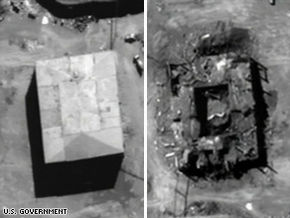
Supposed Syrian nuclear site before and after Israeli airstrike
But nothing about that alleged reactor in the Syrian desert turns out to be what it appeared at the time. The evidence now available shows that there was no such nuclear reactor, and that the Israelis had misled George W. Bush’s administration into believing that it was in order to draw the United States into bombing missile storage sites in Syria. Other evidence now suggests, moreover, that the Syrian government had led the Israelis to believe wrongly that it was a key storage site for Hezbollah missiles and rockets.
The International Atomic Agency’s top specialist on North Korean reactors, Egyptian national Yousry Abushady, warned top IAEA officials in 2008 that the published CIA claims about the alleged reactor in the Syrian desert could not possibly have been true. In a series of interviews in Vienna and by phone and e-mail exchanges over several months Abushady detailed the technical evidence that led him to issue that warning and to be even more confident about that judgment later on. And a retired nuclear engineer and research scientist with many years of experience at Oak Ridge National Laboratory has confirmed a crucial element of that technical evidence.
Published revelations by senior Bush administration officials show, moreover, that principal U.S. figures in the story all had their own political motives for supporting the Israeli claim of a Syrian reactor being built with North Korean help.
Vice President Dick Cheney hoped to use the alleged reactor to get President George W. Bush to initiate U.S. airstrikes in Syria in the hope of shaking the Syrian-Iranian alliance. And both Cheney and then CIA Director Michael Hayden also hoped to use the story of a North Korean-built nuclear reactor in Syria to kill a deal that Secretary of State Condoleezza Rice was negotiating with North Korea on its nuclear weapons program in 2007-08.
Mossad Chief’s Dramatic Evidence
In April 2007 the chief of Israel’s Mossad foreign intelligence agency, Meir Dagan, presented Cheney, Hayden and National Security Adviser Steven Hadley with evidence of what he said was a nuclear reactor being constructed in eastern Syria with the help of the North Koreans. Dagan showed them nearly a hundred hand-held photographs of the site revealing what he described as the preparation for the installation of a North Korean reactor and claimed that it was only a few months from being operational.
The Israelis made no secret of their desire to have a U.S. airstrike destroy the alleged nuclear facility. Prime Minister Ehud Olmert called President Bush immediately after that briefing and said, “George, I’m asking you to bomb the compound,” according to the account in Bush’s memoirs.
Cheney, who was known to be a personal friend of Olmert, wanted to go further. At White House meetings in subsequent weeks, Cheney argued forcefully for a U.S. attack not only on the purported reactor building but on Hezbollah weapons storage depots in Syria. Then-Secretary of Defense Robert Gates, who participated in those meetings, recalled in his own memoirs that Cheney, who was also looking for an opportunity to provoke a war with Iran, hoped to “rattle Assad sufficiently so as to end his close relationship with Iran” and “send a powerful warning to the Iranians to abandon their nuclear ambitions.”
CIA Director Hayden aligned the agency clearly with Cheney on the issue, not because of Syria or Iran but because of North Korea. In his book, Playing to the Edge, published last year, Hayden recalls that, at a White House meeting to brief President Bush the day after Dagan’s visit, he whispered in Cheney’s ear, “You were right, Mr. Vice-President.”
Hayden was referring to the fierce political struggle within the Bush administration over North Korea policy that had been underway ever since Condoleezza Rice had become Secretary of State in early 2005. Rice had argued that diplomacy was the only realistic way to get Pyongyang to retreat from its nuclear weapons program. But Cheney and his administration allies John Bolton and Robert Joseph (who succeeded Bolton as the key State Department policymaker on North Korea after Bolton became U.N. Ambassador in 2005) were determined to end the diplomatic engagement with Pyongyang.
Cheney was still maneuvering to find a way to prevent the successful completion of the negotiations, and he saw the story of a Syrian nuclear reactor built secretly in the desert with help from the North Koreans as bolstering his case. Cheney reveals in his own memoirs that in January 2008, he sought to sandbag Rice’s North Korea nuclear deal by getting her to agree that a failure by North Korea to “admit they’ve proliferating to the Syrians would be a deal killer.”
Three months later, the CIA released its unprecedented 11-minute video supporting the entire Israeli case for a North-Korean-style nuclear reactor that was nearly completed. Hayden recalls that his decision to release the video on the alleged Syrian nuclear reactor in April 2008 was “to avoid a North Korean nuclear deal being sold to a Congress and a public ignorant of this very pertinent and very recent episode.”
The video, complete with computer reconstructions of the building and photographs from the Israelis made a big splash in the news media. But one specialist on nuclear reactors who examined the video closely found abundant reason to conclude that the CIA’s case was not based on real evidence.
Technical Evidence against a Reactor
Egyptian national Yousry Abushady was a PhD in nuclear engineering and 23-year veteran of the IAEA who had been promoted to section head for Western Europe in the operations division of agency’s Safeguards Department, meaning that he was in charge of all inspections of nuclear facilities in the region. He had been a trusted adviser to Bruno Pellaud, IAEA Deputy Director General for Safeguards from 1993 to 1999, who told this writer in an interview that he had “relied on Abushady frequently.”
Abushady recalled in an interview that, after spending many hours reviewing the video released by the CIA in April 2008 frame by frame, he was certain that the CIA case for a nuclear reactor at al-Kibar in the desert in eastern Syria was not plausible for multiple technical reasons. The Israelis and the CIA had claimed the alleged reactor was modeled on the type of reactor the North Koreans had installed at Yongbyon called a gas-cooled graphite-moderated (GCGM) reactor.
But Abushady knew that kind of reactor better than anyone else at the IAEA. He had designed a GCGM reactor for his doctoral student in nuclear engineering, had begun evaluating the Yongbyon reactor in 1993, and from 1999 to 2003 had headed the Safeguards Department unit responsible for North Korea.
Abushady had traveled to North Korea 15 times and conducted extensive technical discussions with the North Korean nuclear engineers who had designed and operated the Yongbyon reactor. And the evidence he saw in the video convinced him that no such reactor could have been under construction at al-Kibar.
On April 26, 2008, Abushady sent a “preliminary technical assessment” of the video to IAEA Deputy Director General for Safeguards Olli Heinonen, with a copy to Director General Mohamed ElBaradei. Abushady observed in his memorandum that the person responsible for assembling the CIA video was obviously unfamiliar with either the North Korean reactor or with GCGM reactors in general.
The first thing that struck Abushady about the CIA’s claims was that the building was too short to hold a reactor like the one in Yongbyon, North Korea.
“It is obvious,” he wrote in his “technical assessment” memo to Heinonen, “that the Syrian building with no UG [underground] construction, can not hold a [reactor] similar [to] NK GCR [North Korean gas-cooled reactor].”
Abushady estimated the height of the North Korean reactor building in Yongbyon at a 50 meters (165 feet) and estimated that the building at al-Kibar at a little more than a third as tall.
Abushady also found the observable characteristics of the al-Kibar site inconsistent with the most basic technical requirements for a GCGM reactor. He pointed out that the Yongbyon reactor had no less than 20 supporting buildings on the site, whereas the satellite imagery shows that the Syrian site did not have a single significant supporting structure.
The most telling indication of all for Abushady that the building could not have been a GCGM reactor was the absence of a cooling tower to reduce the temperature of the carbon dioxide gas coolant in such a reactor.
“How can you work a gas-cooled reactor in a desert without a cooling tower?” Abushady asked in an interview.
IAEA Deputy Director Heinonen claimed in an IAEA report that the site had sufficient pumping power to get river water from a pump house on the nearby Euphrates River to the site. But Abushady recalls asking Heinonen, “How could this water be transferred for about 1,000 meters and continue to the heat exchangers for cooling with the same power?”
Robert Kelley, a former head of the U.S. Department of Energy’s Remote Sensing Laboratory and former senior IAEA inspector in Iraq, noticed another fundamental problem with Heinonen’s claim: the site had no facility for treating the river water before it reached the alleged reactor building.
“That river water would have been carrying debris and silt into the reactor heat exchangers,” Kelley said in an interview, making it highly questionable that a reactor could have operated there.
Yet another critical piece that Abushady found missing from the site was a cooling pond facility for spent fuel. The CIA had theorized that the reactor building itself contained a “spent fuel pond,” based on nothing more than an ambiguous shape in an aerial photograph of the bombed building.
But the North Korean reactor at Yongbyon and all 28 other GCGM reactors that had been built in the world all have the spent fuel pond in a separate building, Abushady said. The reason, he explained, was that the magnox cladding surrounding the fuel rods would react to any contact with moisture to produce hydrogen that could explode.
But the definitive and irrefutable proof that no GCGM reactor had been present at al-Kibar came from the environmental samples taken by the IAEA at the site in June 2008. Such a reactor would have contained nuclear-grade graphite, Abushady explained, and if the Israelis had actually bombed a GCGM reactor, it would have spread particles of nuclear-grade graphite all over the site.
Behrad Nakhai, a nuclear engineer at Oak Ridge National Laboratory for many years, confirmed Abshuady’s observation in an interview. “You would have had hundreds of tons of nuclear-grade graphite scattered around the site,” he said, “and it would have been impossible to clean it up.”
IAEA reports remained silent for more than two years about what the samples showed about nuclear-grade graphite, then claimed in a May 2011 report that the graphite particles were “too small to permit an analysis of the purity compared to that normally required for use in a reactor.” But given the tools available to laboratories, the IAEA claim that they couldn’t determine whether the particles were nuclear grade or not “doesn’t make sense,” Nakhai said.
Hayden acknowledged in his 2016 account that “key components” of a nuclear reactor site for nuclear weapons were “still missing.” The CIA had tried to find evidence of a reprocessing facility in Syria that could be used to obtain the plutonium for a nuclear bomb but had been unable to find any trace of one.
The CIA also had found no evidence of a fuel fabrication facility, without which a reactor could not have gotten the fuel rods to be reprocessed. Syria could not have gotten them from North Korea, because the fuel fabrication plant at Yongbyon had produced no fuel rods since 1994 and was known to have fallen into serious disrepair after the regime had agreed to scrap its own plutonium reactor program.
Manipulated and Misleading Photographs
Hayden’s account shows that he was ready to give the CIA’s stamp of approval to the Israeli photographs even before the agency’s analysts had even begun analyzing them. He admits that when he met Dagan face-to-face he didn’t ask how and when Mossad had obtained the photographs, citing “espionage protocol” among cooperating intelligence partners. Such a protocol would hardly apply, however, to a government sharing intelligence in order to get the United States to carry out an act of war on its behalf.
The CIA video relied heavily on the photographs that Mossad had given to Bush administration in making its case. Hayden writes that it was “pretty convincing stuff, if we could be confident that the pictures hadn’t been altered.”
But by his own account Hayden knew Mossad had engaged in at least one deception. He writes that when CIA experts reviewed the photographs from Mossad, they found that one of them had been photo-shopped to remove the writing on the side of a truck.
Hayden professes to have had no concern about that photo-shopped picture. But after this writer asked how CIA analysts interpreted Mossad’s photo shopping of the picture as one of the questions his staff requested in advance of a possible interview with Hayden, he declined the interview.
Abushady points out that the main issues with the photographs the CIA released publicly are whether they were actually taken at the al-Kibar site and whether they were consistent with a GCGM reactor. One of the photographs showed what the CIA video called “the steel liner for the reinforced-concrete reactor vessel before it was installed.” Abushady noticed immediately, however, that nothing in the picture links the steel liner to the al-Kibar site.
Both the video and CIA’s press briefing explained that the network of small pipes on the outside of the structure was for “cooling water to protect the concrete against the reactor’s intense heat and radiation.”
But Abushady, who specializes in such technology, pointed out that the structure in the picture bore no resemblance to a Gas-Cooled Reactor vessel. “This vessel cannot be for a Gas-Cooled Reactor,” Abushady explained, “based on its dimensions, it thickness and the pipes shown on the side of the vessel.”
The CIA video’s explanation that the network of pipes was necessary for “cooling water” made no sense, Abushady said, because gas-cooled reactors use only carbon dioxide gas — not water — as a coolant. Any contact between water and the Magnox-cladding used in that type of reactor, Abushady explained, could cause an explosion.
A second Mossad photograph showed what the CIA said were the “exit points” for the reactor’s control rods and fuel rods. The CIA juxtaposed that photograph with a photograph of the tops of the control rods and fuel rods of the North Korean reactor at Yongbyon and claimed a “very close resemblance” between the two.
Abushady found major differences between the two pictures, however. The North Korean reactor had a total of 97 ports, but the picture allegedly taken at al-Kibar shows only 52 ports. Abushady was certain that the reactor shown in the photograph could not have been based on the Yongbyon reactor. He also noted that the picture had a pronounced sepia tone, suggesting that it was taken quite a few years earlier.
Abushady warned Heinonen and ElBaradei in his initial assessment that the photo presented as taken from inside the reactor building appeared to an old photo of a small gas-cooled reactor, most likely an early such reactor built in the U.K.
A Double Deception
Many observers have suggested that Syria’s failure to protest the strike in the desert loudly suggests that it was indeed a reactor. Information provided by a former Syrian air force major who defected to an anti-Assad military command in Aleppo and by the head of Syria’s atomic energy program helps unlock the mystery of what was really in the building at al-Kibar.
The Syrian major, “Abu Mohammed,” told The Guardian in February 2013 that he was serving in the air defense station at Deir Azzor, the city nearest to al-Kibar, when he got a phone call from a Brigadier General at the Strategic Air Command in Damascus just after midnight on Sept. 6, 2007. Enemy planes were approaching his area, the general said, but “you are to do nothing.”
The major was confused. He wondered why the Syrian command would want to let Israeli fighter planes approach Deir Azzor unhindered. The only logical reason for such an otherwise inexplicable order would be that, instead of wanting to keep the Israelis away from the building at al-Kibar, the Syrian government actually wanted the Israelis to attack it. In the aftermath of the strike, the Damascus issued only an opaque statement claiming that the Israeli jets had been driven away and remaining silent on the airstrike at al-Kibar.
Abushady told this writer he learned from meetings with Syrian officials during his final year at the IAEA that the Syrian government had indeed originally built the structure at al-Kibar for the storage of missiles as well as for a fixed firing position for them. And he said Ibrahim Othman, the head of Syria’s Atomic Energy Commission, had confirmed that point in a private meeting with him in Vienna in September 2015.
Othman also confirmed Abushady’s suspicion from viewing satellite photographs that the roof over the central room in the building had been made with two movable light plates that could be opened to allow the firing of a missile. And he told Abushady that he had been correct in believing that what had appeared in a satellite image immediately after the bombing to be two semi-circular shapes was what had remained of the original concrete launching silo for missiles.
In the wake of the Israel’s 2006 invasion of Southern Lebanon, the Israelis were searching intensively for Hezbollah missiles and rockets that could reach Israel and they believed many of those Hezbollah weapons were being stored in Syria. If they wished to draw the attention of the Israelis away from actual missile storage sites, the Syrians would have had good reason to want to convince the Israelis that this was one of their major storage sites.
Othman told Abushady that the building had been abandoned in 2002, after the construction had been completed. The Israelis had acquired ground-level pictures from 2001-02 showing the construction of outer walls that would hide the central hall of the building. The Israelis and the CIA both insisted in 2007-08 that this new construction indicated that it had to be a reactor building, but it is equally consistent with a building designed to hide missile storage and a missile-firing position.
Although Mossad went to great lengths to convince the Bush administration that the site was a nuclear reactor, what the Israelis really wanted was for the Bush administration to launch U.S. airstrikes against Hezbollah and Syrian missile storage sites. Senior officials of the Bush administration didn’t buy the Israeli bid to get the United States to do the bombing, but none of them ever raised questions about the Israeli ruse.
So both the Assad regime and the Israeli government appear to have succeeded in carrying out their own parts in a double deception in the Syrian desert.
Gareth Porter is an independent investigative journalist and historian on U.S. national security policy and the recipient of the 2012 Gellhorn Prize for journalism.
Guardian, NYT Paint Power-Grabbing Saudi Dictator as Roguish, Visionary ‘Reformer’
By Adam Johnson | FAIR | November 17, 2017

The Guardian (11/5/17)
Two weeks ago, Saudi Crown Prince Mohammed bin Salman carried out a brutal crackdown on his political opponents, arresting dozens of high-ranking relatives, kidnapping the prime minister of Lebanon, and seeing eight of his political rivals die in a convenient helicopter crash. The “consolidation of power” by the de facto Saudi ruler comes as his government ramps up its siege of Yemen and gets even closer to its US sponsor, thanks to a Trump’s dopey love affair with—and direct assistance of—the regime.
The cynical plan has been met, in some media quarters, with condemnation, but for many in the Western press, Mohammed’s self-serving power grab is the action of a bold “reformer,” a roguish bad boy doing the messy but essential work of “reforming” the kingdom—the “anti-corruption” pretext of the purge largely repeated without qualification. The most prominent sources for this spin were two major newspapers, the New York Times and Guardian:
- Guardian (11/5/17): “Royal Purge Sends Shockwaves Through Saudi Arabia’s Elites: Move Consolidates Power of Prince Mohammed Bin Salman as He Attempts to Reform Kingdom’s Economy and Society”
- Guardian (11/5/17) : “Saudi Arrests Show Crown Prince Is a Risk-Taker With a Zeal for Reform: Mohammed Bin Salman Is Confronting Some of the Kingdom’s Richest and Most Powerful Men in His Anti-Corruption Drive—but Is He Taking on Too Much Too Fast?”
- Guardian (11/6/17): “Oil Price Rises to Two-Year High After Saudi Arabia Purge: Markets Push Price Up to $62 a Barrel After Anti-Corruption Purge by Billionaire Crown Prince Who Backs Prolonging Oil Production Curbs”
- Guardian (11/7/17): “‘This Is a Revolution’: Saudis Absorb Crown Prince’s Rush to Reform: Consolidation of Power in Mohammed Bin Salman’s Hands Has Upended All Aspects of Society, Including Previously Untouchable Ultra-Elite”
- New York Times (11/5/17): “Saudi Crown Prince’s Mass Purge Upends a Longstanding System”
- New York Times (11/14/17): “The Upstart Saudi Prince Who’s Throwing Caution to the Wind”
While the text of the Times articles was far more skeptical about Mohammed’s motives, the Guardian’s (11/5/17) initial coverage of the bloody purge—not just the headlines—was written in breathless press release tones:
Saudi Arabia’s leadership has pulled off its boldest move yet to consolidate power around its young crown prince, Mohammed bin Salman, arresting 11 senior princes, one of the country’s richest men and scores of former ministers in what it billed as a corruption purge.
The move sidelined at least 20 senior figures, among them outspoken billionaire, Prince Alwaleed bin Talal, sending shockwaves through the ranks of the kingdom’s elites, who had long viewed senior royals as immune.
Lots of glowing prose to unpack here. Longtime Mideast correspondent Martin Chulov began by referring to “Saudi Arabia’s leadership,” which is a nice, sterile way of referencing the country’s unelected hereditary king and crown prince. Then he pivoted into marketing pablum about “bold moves” and “consolidating power,” before unironically framing the purge as an “anti-corruption” gesture designed to stick it to the “kingdom’s elites.” One could come away from reading this lead with the impression that the billionaire aristocrat was a populist folk hero in the vein of Robin Hood or John Dillinger. The thrilling profile continued:
Prince Mohammed will oversee the corruption commission, adding to his already formidable list of responsibilities, including his role as Defense minister and champion of the economic transformation, dubbed Vision 2030, that aims to revolutionize most aspects of Saudi life within 12 years.
Prince Mohammed told the Guardian last month that the kingdom had been “not normal” for the past 30 years and pledged to return Saudi Arabia to moderate Islam.
While the author had a “to be sure” paragraph, citing “others” calling it a “naked attempt to weed out dissent,” the overall thrust of the article was that a roguish billionaire Boy King was earnestly seeking “reform” and opposing “elites.”
A follow-up piece (11/7/17) took flattering coverage to new extremes. The dispatch, again by Chulov, cited nothing but anonymous Saudi court hanger-ons and a Gulf-funded talking head from the NATO-aligned Atlantic Council think tank. The article, “‘This Is a Revolution’: Saudis Absorb Crown Prince’s Rush to Reform,” was populated with blind quotes from such adversarial voices as a “senior minister,” “a senior Saudi official,” a “senior figure,” a “senior Saudi businessman” and “veteran business leaders.” (Evidently no junior officials or rookie business leaders were available for comment.)
The article painted the “consolidation of power” by Mohammed as an inevitability with broad support—using the dubious “reform” narrative without irony. With Guardian editors again painting Mohammed as a populist hero by insisting he “upended” “previously untouchable ultra-elite,” one is left to wonder why they don’t consider the absolute-monarch-in-waiting—who just bought a $590 million yacht—part of the “ultra elite.” It’s a curious framing that reeks more of PR than journalism.

The New York Times (6/23/17)
This was a trope one could see emerging over the past few months. Similar “bold reformer” frames were used in New York Times editorials (“The Young and Brash Saudi Crown Prince,” 6/23/17) and straight reporting (“Saudi Arabia’s Grand Plan to Move Beyond Oil: Big Goals, Bigger Hurdles,” 10/24/17). Everything’s new and exciting. The brutal, routine functions of the Saudi state are seen as laws of nature—and those in charge of it are the reformers of the very oppression they initially authored.
A Guardian editorial on November 7 was critical of the government, calling it “regressive” and Mohammed “belligerent,” but ultimately rested on “both sides” framing of recent events. The only meaningfully critical coverage of Saudi Arabia coming from the Guardian since the purge has been in two articles (11/12/17, 11/16/17), both in the context of Saudi Arabia’s war on Yemen. Neither mentioned bin Salman, and both stressed how the Saudis are responding in earnest to international pleas to stop their mass-murdering blockade of the Arab world’s poorest country.
Per usual, the Guardian reserves the label “regime” for Official Enemies like Syria and North Korea; Saudi Arabia doesn’t have a regime, it has “leadership.” Unlike adversary governments, often seen in need of “regime change,” the Saudi government merely requires “reform”—and a bold new “reformer,” of the sort championed by the likes of the Guardian and New York Times.
You can send a message to the New York Times at letters@nytimes.com , and to the Guardian at guardian.letters@theguardian.com (Twitter: @NYTimes, @Guardian). Please remember that respectful communication is the most effective.
Security Council-appointed panel says no missiles sent to Houthis, refuting Saudi Arabia claim
Press TV – November 18, 2017
A United Nations Security Council-appointed panel has said in a confidential memo that it has seen no evidence to support Saudi Arabia’s claims that missiles have been transferred to Yemen’s Houthis fighters by external sources.
The panel made the conclusion in a confidential assessment sent to Security Council diplomats on November 10, The Intercept, a US-based investigative website, reported on Friday.
On November 4, a missile attack from Yemen targeted the King Khalid International Airport (KKIA) near the Saudi capital, Riyadh. It was the first missile from Yemen to have reached deep inside Saudi territory.
The Houthi movement, which has been fighting back a Saudi-led coalition with allied Yemeni army troops and tribal fighters, said it had fired the missile, which the Saudis said they had intercepted mid-air.
However, the Riyadh regime quickly blamed the Islamic Republic for the incident.
Heating up rhetoric against Iran, and then being proven wrong
In a November 7 letter to the Security Council, Saudi UN Ambassador Abdallah al-Mouallimi claimed that the debris of the missiles fired by the Houthis on July 22 and November 4 confirmed Iran’s role “in manufacturing these missiles.”
Following the attack, the Saudi-led coalition tightened a blockade that had already been imposed on Yemen in a bid to prevent “the smuggling of weapons, ammunitions, missile parts and cash that are regularly being supplied by Iran” to the Houthis.
It invoked Paragraph 14 of Security Council Resolution 2216, which was passed in April 2015, calling for measures to prevent the supply, sale, or transfer of military goods to Houthi fighters.
The coalition said the missile’s firing was “a blatant act of military aggression” by the Iranian government.
Crown Prince Mohammad bin Salman said it had been “a direct military aggression” by Iran against Saudi Arabia, while Foreign Minister Adel al-Jubeir stressed that his country reserved the right to “respond in the appropriate manner at the appropriate time.”
The belligerent Saudi posture toward Iran worked to significantly raise tensions.
Iran rejected the allegations as “provocative and baseless,” saying Yemenis had shown an “independent” reaction to the Saudi bombing campaign on their country.
Iran also said that it could not transfer any weapons to Yemen because of the Saudi-led blockade.
The Security Council-appointed panel said in its confidential assessment that it had seen no evidence to back up the Saudi claims that short-range ballistic missiles (SRBMs) had been transferred to Yemeni fighters in violation of the Resolution 2216.
It said the tightening of the blockade by the Saudi-led coalition and its invoking of Resolution 2216 had been an attempt to merely “obstruct” the delivery of civilian aid.
“The panel finds that imposition of access restrictions is another attempt by the Saudi Arabia-led coalition to use paragraph 14 of resolution 2216 as justification for obstructing the delivery of commodities that are essentially civilian in nature,” the assessment read.
Touching on the July 22 attack, it said, “The supporting evidence provided… is far below that required to attribute this attack to a Qiam-1 SRBM.”
Yemen has witnessed a deadly Saudi-led war since March 2015. The protracted Saudi offensive, which has been accompanied by the, land, naval, and aerial blockade on Yemen, has so far killed over 12,000 people and led to a humanitarian crisis.
The UN has listed Yemen as the world’s number one humanitarian crisis, with 17 million Yemenis in need of food and a cholera epidemic causing over 2,200 deaths so far.
Featured Video

Meet The Ellisons: Zionists, Technocrats, Moguls
or go to
Aletho News Archives – Video-Images
Frlom the Archives
Who Rules America?
The Power Elite in the Time of Trump
By James Petras | Axis of Logic | September 6, 2017
Introduction
In the last few months, several competing political, economic and military sectors – linked to distinct ideological and ethnic groups – have clearly emerged at the centers of power.
We can identify some of the key competing and interlocking directorates of the power elite:
- Free marketers, with the ubiquitous presence of the ‘Israel First’ crowd.
- National capitalists, linked to rightwing ideologues.
- Generals, linked to the national security and the Pentagon apparatus, as well as defense industry.
- Business elites, linked to global capital.
This essay attempts to define the power wielders and evaluate their range of power and its impact. … continue
Blog Roll
 Aletho News
- Iran Does Not Consider Israel Party to Talks to Need Mediators With It – Ambassador
- Macron’s aircraft carrier and warplanes to the Persian Gulf is a dangerous vanity project
- Meet The Ellisons: Zionists, Technocrats, Moguls
- US failures in Iran reveal Russia is key to South Korea’s strategic security
- ‘All ports in Persian Gulf will be legitimate targets if Iranian ports are attacked’
- 40 Years of Endless War, Data Point by Data Point
- Department of War Using Palantir AI to Pick Targets in Iran
- American bases do not protect – they attack the peoples of the Persian Gulf
- ‘We’ve Obliterated Their Missiles’
- Syrian president vows ‘absolute support’ to disarm Hezbollah
- If Americans Knew
- Israeli strategic plans to “remake the Middle East” from the 1950s and since
- Honoring Gaza’s women who refused to let the world look away
- 97% of victims of war on Iran are Iranian, 98% of victims in war on Gaza are Gazans – Not a ceasefire Day 152
- Early Iran strikes cost $5.6 billion in munitions, Pentagon estimates
- Israel Decided the War, But Trump’s America Fights and Pays the Bill
- Conscientious Objector Group: Phone ‘Ringing Off Hook’ As Huge Mobilization Underway
- U.S. support for Israel continues to plummet, despite media’s best efforts
- Threats and missiles fly, death tolls soar in Iran, Lebanon, Gaza – Not a ceasefire Day 151
- Lebanon: Israel’s White Phosphorous Use Risks Civilian Harm
- Corporate Media Go All Out To Support The US-Israeli War On Iran
- No Tricks Zone
- Destructive Green New Deal: German Energy And Metal Group Warns Of Drastic Crisis
- New Study Documents A 20-Year Pause In Arctic Sea Ice Decline – Driven By Internal Variability
- Wake-up Call: Survey Shows Majority Of Germans Now Favor Postponing Climate Targets!
- Televised! Leading German Political Candidate Tells Schoolchildren CO2 Makes Sun Hotter!
- New Study: A Century Warming Of 1.1°C Is ‘Commonplace’ And ‘Not Unusual’ During This Interglacial
- New Study: ‘Internal Noise’ And Volcanic Forcing Can Trigger 10-15°C Warming Within Decades
- Glaciers Worldwide Are Suddendly Surging, Experts Blame Warming!
- Surprising Discovery: Sahara Is Greening…Billions Of Trees Where Once Thought To Be Barren
- New Research Reaffirms Clouds, Aerosols, And Surface Solar Radiation Are ‘Driving The Climate System’
- Germany: Electric Car Catches Fire At Charging Station, Sets Off Local “Inferno”, Widespread Damage
 Aletho News