NYT’s New Syria-Sarin Report Challenged
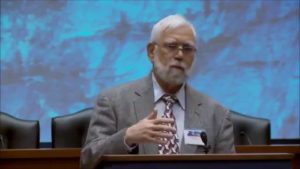
MIT national security technical expert Theodore Postol
By Robert Parry | Consortium News | June 7, 2017
For U.S. mainstream journalists and government analysts, their erroneous “groupthinks” often have a shady accomplice called “confirmation bias,” that is, the expectation that some “enemy” must be guilty and thus the tendency to twist any fact in that direction.
We have seen this pair contribute to fallacious reasoning more and more in recent years as the mainstream U.S. media and the U.S. government approach international conflicts as if the “pro-U.S. side” is surely innocent and the “anti-U.S. side” is presumed guilty.
That was the case in assessing whether Iraq was hiding WMD in 2002-2003; it was repeated regarding alleged chemical weapons attacks in Syria during that six-year conflict; and it surfaces as well in the New Cold War in which Russia is always the villain.
The trend also requires insulting any Western journalist or analyst who deviates from the groupthinks or questions the confirmation bias. The dissidents are called “stooges”; “apologists”; “conspiracy theorists”; or “purveyors of fake news.” It doesn’t really matter how reasonable the doubts are. The mocking insults carry the day.
In addition, there is almost no accountability in those rare cases when the mainstream media and government propagandists must admit that they were demonstrably wrong. For every Iraq WMD confession – which resulted in almost no punishments for the “groupthinkers” – there are dozens of cases when the Big Boys just hunker down, admit nothing and count on their privileged status to protect them.
It doesn’t even seem to matter how well-credentialed the skeptic is or how obvious the failings of the mainstream analysis is. So, you even have weapons experts, such as Theodore Postol, professor of science, technology and national security policy at the Massachusetts Institute of Technology, who are ignored when their judgments conflict with the conventional wisdom.
The Syrian Case
For instance, in a little-noticed May 29, 2017 report on the April 4, 2017 chemical weapons incident at Khan Sheikhoun in northern Syria, Postol takes apart the blame-the-Syrian-government conclusions of The New York Times, Human Rights Watch and the Establishment’s favorite Internet site, Bellingcat.
Postol’s analysis focused on a New York Times video report, entitled “How Syria And Russia Spun A Chemical Strike,” which followed Bellingcat research that was derived from social media. Postol concluded that “NONE of the forensic evidence in the New York Times video and a follow-on Times news article supports the conclusions reported by the New York Times.” [Emphasis in original.]
The basic weakness of the NYT/Bellingcat analysis was a reliance on social media from the Al Qaeda-controlled area of Idlib province and thus a dependence on “evidence” from the jihadists and their “civil defense” collaborators, known as the White Helmets.
The jihadists and their media teams have become very sophisticated in the production of propaganda videos that are distributed through social media and credulously picked up by major Western news outlets. (A Netflix infomercial for the White Helmets even won an Academy Award earlier this year.)
Postol zeroes in on the Times report’s use of a video taken by anti-government photographer Mohamad Salom Alabd, purporting to show three conventional bombs striking Khan Sheikhoun early in the morning of April 4.
The Times report extrapolated from that video where the bombs would have struck and then accepted that a fourth bomb – not seen in the video – delivered a sarin canister that struck a road and released sarin gas that blew westward into a heavily populated area supposedly killing dozens.
The incident led President Trump, on April 6, to order a major retaliatory strike with 59 Tomahawk missiles hitting a Syrian government airfield and, according to Syrian media reports, killing several soldiers at the base and nine civilians, including four children, in nearby neighborhoods. It also risked inflicting death on Russians stationed at the base.
A Wind Problem
But the Times video analysis – uploaded on April 26 – contained serious forensic problems, Postol said, including showing the wind carrying the smoke from the three bombs in an easterly direction whereas the weather reports from that day – and the presumed direction of the sarin gas – had the wind going to the west.
Indeed, if the wind were blowing toward the east – and if the alleged location of the sarin release was correct – the wind would have carried the sarin away from the nearby populated area and likely would have caused few if any casualties, Postol wrote.
Postol also pointed out that the Times’ location of the three bombing strikes didn’t match up with the supposed damage that the Times claimed to have detected from satellite photos of where the bombs purportedly struck. Rather than buildings being leveled by powerful bombs, the photos showed little or no apparent damage.
The Times also relied on before-and-after satellite photos that had a gap of 44 days, from Feb. 21, 2017, to April 6, 2017, so whatever damage might have occurred couldn’t be tied to whatever might have happened on April 4.
Nor could the hole in the road where the crushed “sarin” canister was found be attributed to an April 4 bombing raid. Al Qaeda jihadists could have excavated the hole the night before as part of a staged provocation. Other images of activists climbing into the supposedly sarin-saturated hole with minimal protective gear should have raised other doubts, Postol noted in earlier reports.
There’s also the question of motive. The April 4 incident immediately followed the Trump administration’s announcement that it was no longer seeking “regime change” in Syria, giving the jihadists and their regional allies a motive to create a chemical-weapons incident to reverse the new U.S. stand. By contrast, the Syrian government seemed to have no logical motive to provoke U.S. outrage.
In other words, Al Qaeda and its propagandists could have posted video from an earlier bombing raid and used it to provide “proof” of an early-morning airstrike that corresponded to the staged release of sarin or some similar poison gas on April 4. Though that is just one possible alternative, it’s certainly true that Al Qaeda does not show very much humanitarian concern about the lives of civilians.
Critics of the White Helmets have identified the photographer of the airstrike, Mohamad Salom Alabd, as a jihadist who appears to have claimed responsibility for killing a Syrian military officer. But the Times described him in a companion article to the video report only as “a journalist or activist who lived in the town.”
Mocking the Russian/Syrian Account
For their part, the Syrian government and the Russians said Syrian planes conducted no airstrike early in the morning but did attack the area around noon. They speculated that the noontime attack may have struck chemical weapons stored by the jihadists, causing an accidental release of poisonous gas.
The Times jumped on the discrepancy between the reports of an early-morning attack and the Syrian-Russian account of a noontime strike to show that the Syrians and Russians were lying.
In response to Syrian President Bashar al-Assad asking, “How can you verify the video?” the Times narration by Malachy Browne smugly says: “Well, here’s how. Let’s take a look at videos, satellite photos and open source material of that day. They show that Assad and Russia are telling a story that contradicts the facts.”
Yet, the Times’ point about the Syrians and Russians lying about the time element makes little sense because the Syrians and Russians aren’t denying that an airstrike occurred. They acknowledged that there was an airstrike, albeit later in the day, and they speculate that the attack might have accidentally released chemicals stored by Al Qaeda’s Nusra Front. In other words, they gained no advantage by putting the time at noon instead of early in the morning.
There could have been honest confusion on the part of the Syrians and Russians as they struggled to understand what had occurred and how – or the noontime airstrike and the morning chemical release could have been unrelated, i.e., the jihadists and/or their foreign allies could have staged the early-morning poison-gas “attack” and the Syrian bombing raid could have followed several hours later but could have been unrelated to the poison-gas release.
However, for the Times and others to pounce on a seemingly meaningless time discrepancy, further shows how “confirmation bias” works. The “enemy” must be shown to be guilty, so any comment – no matter how innocent or irrelevant – can be cited to “prove” a point.
Double Standard on Trust
The Times also has displayed a bizarre bias when Syrians speak from government-controlled areas. Then, the Times always inserts language suggesting that the interviewees may be under coercion. Yet the Times assumes that “witnesses” inside Al Qaeda-controlled territory are commenting honestly, freely and without fear of contradicting the jihadists.
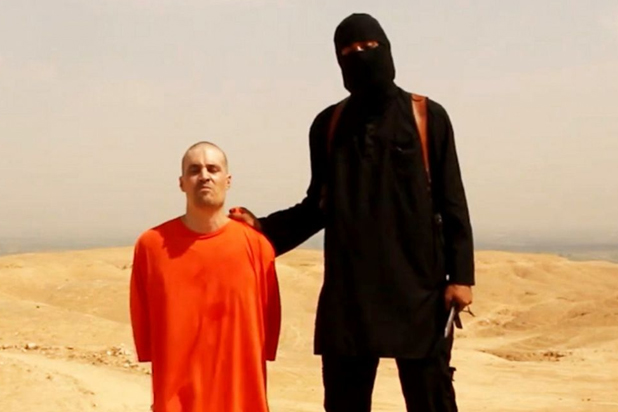
Journalist James Foley executed by ISIS
The Times’ double standard is particularly curious because United Nations investigators don’t even dare enter these jihadist zones because the jihadists have a history of beheading journalists and other civilians who get in the way.
An example of this bias was on display in Wednesday’s Times in an article about the family of Omran, the boy made famous by a photo of him in an ambulance. The article discussed the family’s ordeal and mentioned the father’s vocal support for the Assad government.
However, because the family backed Assad, the Times inserted this caveat: “Syrians appearing on state television or on channels associated with the Assad government are not able to speak freely. The government exerts tight control over all information broadcast about the war, including interviews with civilians, who can be coerced and threatened with arrest if they criticize the government.”
Yet, the Times treats interviews with people inside jihadist-controlled territory as inherently truthful with the interview subjects described in favorable or neutral terms, such as “rescue workers,” “journalists,” “eyewitnesses” or sometimes “activists.” There is rarely any suggestion that Al Qaeda might either be controlling these messages or intimidating the interviewees, who are usually denouncing Assad, what the Times and other mainstream news outlets want to hear.
False-Flag Evidence
This gullibility has continued despite evidence that the jihadists do generate sophisticated propaganda to promote their cause, including staging “false-flag” chemical weapons attacks. For instance, U.N. investigators who examined one alleged chlorine-gas attack by the Syrian government against Al-Tamanah on the night of April 29-30, 2014, heard multiple testimonies from townspeople that the event had been staged by rebels and played up by activists on social media.
“Seven witnesses stated that frequent alerts [about an imminent chlorine weapons attack by the government] had been issued, but in fact no incidents with chemicals took place,” the U.N. report stated. “While people sought safety after the warnings, their homes were looted and rumours spread that the events were being staged. … [T]hey [these witnesses] had come forward to contest the wide-spread false media reports.”
Accounts from other people, who did allege that there had been a government chemical attack on Al-Tamanah, provided suspect evidence, including data from questionable sources, according to the U.N. report.
The report said, “Three witnesses, who did not give any description of the incident on 29-30 April 2014, provided material of unknown source. One witness had second-hand knowledge of two of the five incidents in Al-Tamanah, but did not remember the exact dates. Later that witness provided a USB-stick with information of unknown origin, which was saved in separate folders according to the dates of all the five incidents mentioned by the FFM [the U.N.’s Fact-Finding Mission].
“Another witness provided the dates of all five incidents reading it from a piece of paper, but did not provide any testimony on the incident on 29-30 April 2014. The latter also provided a video titled ‘site where second barrel containing toxic chlorine gas was dropped tamanaa 30 April 14’”
Some other “witnesses” alleging a Syrian government attack offered curious claims about detecting the chlorine-infused “barrel bombs” based on how the device sounded in its descent.
The U.N. report said, “The eyewitness, who stated to have been on the roof, said to have heard a helicopter and the ‘very loud’ sound of a falling barrel. Some interviewees had referred to a distinct whistling sound of barrels that contain chlorine as they fall. The witness statement could not be corroborated with any further information.”
The U.N. report might have added that there was no plausible explanation for someone detecting a chlorine canister in a “barrel bomb” based on its “distinct whistling sound.” The only logical conclusion is that the chlorine attack had been staged by the jihadists, and their supporters then lied to the U.N. team to enrage the world public against the Assad regime.
Another Dubious Case
In 2013, the work of Postol and his late partner, Richard M. Lloyd, an analyst at the military contractor Tesla Laboratories, debunked claims from the same trio — Bellingcat, the Times and Human Rights Watch — blaming the Syrian government for the even more notorious sarin-gas attack outside Damascus on Aug. 21, 2013, which killed hundreds.
Postol and Lloyd showed that the rocket carrying the sarin had only a fraction of the range that the trio had assumed in tracing its path back to a government base.
Since the much shorter range placed the likely launch point inside rebel-controlled territory, the incident appeared to have been another false-flag provocation, one that almost led President Obama to launch a major retaliatory strike against the Syrian military.
Although the Times grudgingly acknowledged the scientific problems with its analysis, it continued to blame the 2013 incident on the Syrian government. Similarly, Official Washington’s “groupthink” still holds that the Syrian government launched that sarin attack and that Obama chickened out on enforcing his “red line” against chemical weapons use.
Obama’s announcement of that “red line,” in effect, created a powerful incentive for Al Qaeda and other jihadists to stage chemical attacks assuming that they would be blamed on the government and thus draw in the U.S. military on the jihadist side. If Obama’s expected “retaliation” had devastated the Syrian military in 2013, Al Qaeda or its spinoff Islamic State might well have taken Damascus.
Yet, the 2013 “groupthink” of Syrian government guilt survives. After the April 4, 2017 incident, President Trump took some pleasure in mocking Obama’s weakness in contrast to his supposed toughness in quickly launching a “retaliatory” strike on April 6 (Washington time, although April 7 in Syria).
White House Claims
Trump’s attack came even before the White House released a supportive – though unconvincing – intelligence report on April 11. Regarding that report, Postol wrote, “The White House produced a false intelligence report on April 11, 2017 in order to justify an attack on the Syrian airbase at Sheyrat, Syria on April 7, 2017. That attack risked an unintended collision with Russia and a possible breakdown in cooperation between Russia and United States in the war to defeat the Islamic State. The collision also had some potential to escalate into a military conflict with Russia of greater extent and consequence.
“The New York Times and other mainstream media immediately and without proper review of the evidence adopted the false narrative produced by the White House even though that narrative was totally unjustified based on the forensic evidence. The New York Times used an organization, Bellingcat, for its source of analysis even though Bellingcat has a long history of making false claims based on distorted assertions about forensic evidence that either does not exist, or is absolutely without any evidence of valid sources.”
Postol continued, “This history of New York Times publishing of inaccurate information and then sticking by it when solid science-based forensic evidence disproves the original narrative cannot be explained in terms of simple error. The facts overwhelmingly point to a New York Times management that is unconcerned about the accuracy of its reporting.
“The problems exposed in this particular review of a New York Times analysis of critically important events related to the US national security is not unique to this particular story. This author could easily point to other serious errors in New York Times reporting on important technical issues associated with our national security.
“In these cases, like in this case, the New York Times management has not only allowed the reporting of false information without reviewing the facts for accuracy, but it has repeatedly continued to report the same wrong information in follow-on articles. It may be inappropriate to call this ‘fake news,’ but this loaded term comes perilously close to actually describing what is happening.”
No Admissions
When I interviewed Postol on Wednesday, he said he had received no responses from either the Times or Bellingcat, adding: “It seems to me that the analysts were ignorant beyond plausibility or they rigged the analysis. … To me, this is malpractice on a large scale.”
Referring to some of the photographed scenes in Khan Sheikhoun, including a dead goat that appeared to have been dragged into location near the “sarin crater,” Postol called the operation “a rather amateurish attempt to create a false narrative.”
But the problem of the Times and Bellingcat presenting dubious – or in Postol’s view, “fraudulent” – information about sensitive geopolitical and national security issues has another potentially even darker side. These two entities are part of Google’s First Draft Coalition of news organizations that are expected to serve as gatekeepers separating “truth” from “fake news.”
The emerging idea is to take their judgments and enter them into algorithms to scrub the Internet of information that doesn’t comport with what the Times, Bellingcat and other approved news outlets deem true.
That these two organizations would operate with a pattern of “confirmation bias” on sensitive war-and-peace issues is thus doubly troubling in that their future “groupthinks” could not only mislead their readers but could ensure that contrary evidence is whisked away from everyone else, too.
Investigative reporter Robert Parry broke many of the Iran-Contra stories for The Associated Press and Newsweek in the 1980s.
Russia-gate’s Mythical ‘Heroes’
By Coleen Rowley | Consortium News | June 6, 2017
Mainstream commentators display amnesia when they describe former FBI Directors Robert Mueller and James Comey as stellar and credible law enforcement figures. Perhaps if they included J. Edgar Hoover, such fulsome praise could be put into proper perspective.
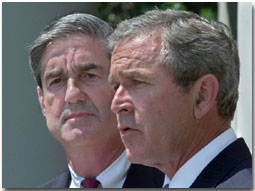
Robert Mueller with President George W. Bush
July 5, 2001 – (White House photo)
Although these Hoover successors, now occupying center stage in the investigation of President Trump, have been hailed for their impeccable character by much of Official Washington, the truth is, as top law enforcement officials of the George W. Bush Administration (Mueller as FBI Director and James Comey as Deputy Attorney General), both presided over post-9/11 cover-ups and secret abuses of the Constitution, enabled Bush-Cheney fabrications used to launch wrongful wars, and exhibited plain vanilla incompetence.
TIME Magazine would probably have not called my own disclosures a “bombshell memo” to the Joint Intelligence Committee Inquiry in May 2002 if it had not been for Mueller’s having so misled everyone after 9/11. Although he bore no personal responsibility for intelligence failures before the attack, since he only became FBI Director a week before, Mueller denied or downplayed the significance of warnings that had poured in yet were all ignored or mishandled during the Spring and Summer of 2001.
Bush Administration officials had circled the wagons and refused to publicly own up to what the 9/11 Commission eventually concluded, “that the system had been blinking red.” Failures to read, share or act upon important intelligence, which a FBI agent witness termed “criminal negligence” in later trial testimony, were therefore not fixed in a timely manner. (Some failures were never fixed at all.)
Worse, Bush and Cheney used that post 9/11 period of obfuscation to “roll out” their misbegotten “war on terror,” which only served to exponentially increase worldwide terrorism.
Unfulfilled Promise
I wanted to believe Director Mueller when he expressed some regret in our personal meeting the night before we both testified to the Senate Judiciary Committee. He told me he was seeking improvements and that I should not hesitate to contact him if I ever witnessed a similar situation to what was behind the FBI’s pre 9/11 failures.
A few months later, when it appeared he was acceding to Bush-Cheney’s ginning up intelligence to launch the unjustified, counterproductive and illegal war on Iraq, I took Mueller up on his offer, emailing him my concerns in late February 2003. Mueller knew, for instance, that Vice President Dick Cheney’s claims connecting 9/11 to Iraq were bogus yet he remained quiet. He also never responded to my email.
Beyond ignoring politicized intelligence, Mueller bent to other political pressures. In the aftermath of the 9/11 attacks, Mueller directed the “post 9/11 round-up” of about 1,000 immigrants who mostly happened to be in the wrong place (the New York City area) at the wrong time. FBI Headquarters encouraged more and more detentions for what seemed to be essentially P.R. purposes. Field offices were required to report daily the number of detentions in order to supply grist for FBI press releases about FBI “progress” in fighting terrorism. Consequently, some of the detainees were brutalized and jailed for up to a year despite the fact that none turned out to be terrorists.
A History of Failure
Long before he became FBI Director, serious questions existed about Mueller’s role as Acting U.S. Attorney in Boston in effectively enabling decades of corruption and covering up of the FBI’s illicit deals with mobster Whitey Bulger and other “top echelon” informants who committed numerous murders and crimes. When the truth was finally uncovered through intrepid investigative reporting and persistent, honest judges, U.S. taxpayers footed a $100 million court award to the four men framed for murders committed by (the FBI-operated) Bulger gang.
Current media applause omits the fact that former FBI Director Mueller was the top official in charge of the Anthrax terror fiasco investigation into those 2001 murders, which targeted an innocent man (Steven Hatfill) whose lawsuit eventually forced the FBI to pay $5 million in compensation. Mueller’s FBI was also severely criticized by Department of Justice Inspector Generals finding the FBI overstepped the law improperly serving hundreds of thousands of “national security letters” to obtain private (and irrelevant) metadata on citizens, and for infiltrating nonviolent anti-war groups under the guise of investigating “terrorism.”
For his part, Deputy Attorney General James Comey, too, went along with the abuses of Bush and Cheney after 9/11 and signed off on a number of highly illegal programs including warrantless surveillance of Americans and torture of captives. Comey also defended the Bush Administration’s three-year-long detention of an American citizen without charges or right to counsel.
Up to the March 2004 night in Attorney General John Ashcroft’s hospital room, both Comey and Mueller were complicit with implementing a form of martial law, perpetrated via secret Office of Legal Counsel memos mainly written by John Yoo and predicated upon Yoo’s singular theories of absolute “imperial” or “war presidency” powers, and requiring Ashcroft every 90 days to renew certification of a “state of emergency.”
The Comey/Mueller Myth
What’s not well understood is that Comey’s and Mueller’s joint intervention to stop Bush’s men from forcing the sick Attorney General to sign the certification that night was a short-lived moment. A few days later, they all simply went back to the drawing board to draft new legal loopholes to continue the same (unconstitutional) surveillance of Americans.
The mythology of this episode, repeated endlessly throughout the press, is that Comey and Mueller did something significant and lasting in that hospital room. They didn’t. Only the legal rationale for their unconstitutional actions was tweaked.
Mueller was even okay with the CIA conducting torture programs after his own agents warned against participation. Agents were simply instructed not to document such torture, and any “war crimes files” were made to disappear. Not only did “collect it all” surveillance and torture programs continue, but Mueller’s (and then Comey’s) FBI later worked to prosecute NSA and CIA whistleblowers who revealed these illegalities.
Neither Comey nor Mueller — who are reported to be “joined at the hip” — deserve their current lionization among politicians and mainstream media. Instead of Jimmy Stewart-like “G-men” with reputations for principled integrity, the two close confidants and collaborators merely proved themselves, along with former CIA Director George “Slam Dunk” Tenet, reliably politicized sycophants, enmeshing themselves in a series of wrongful abuses of power along with official incompetence.
It seems clear that based on his history and close “partnership” with Comey, called “one of the closest working relationships the top ranks of the Justice Department have ever seen,” Mueller was chosen as Special Counsel not because he has integrity but because he will do what the powerful want him to do.
Mueller didn’t speak the truth about a war he knew to be unjustified. He didn’t speak out against torture. He didn’t speak out against unconstitutional surveillance. And he didn’t tell the truth about 9/11. He is just “their man.”
Coleen Rowley, a retired FBI special agent and division legal counsel whose May 2002 memo to then-FBI Director Robert Mueller exposed some of the FBI’s pre-9/11 failures, was named one of TIME magazine’s “Persons of the Year” in 2002. Her 2003 letter to Robert Mueller in opposition to launching the Iraq War is archived in full text on the NYT and her 2013 op-ed entitled “Questions for the FBI Nominee” was published on the day of James Comey’s confirmation hearing. This piece will also be cross-posted on Rowley’s Huffington Post page.)
Relevant links:
http://content.time.com/time/covers/0,16641,20020603,00.html
http://govinfo.library.unt.edu/911/report/911Report_Ch8.pdf
http://www.nytimes.com/2003/03/05/politics/full-text-of-fbi-agents-letter-to-director-mueller.html
https://oig.justice.gov/special/0306/full.pdf
https://www.nytimes.com/2015/06/18/us/immigrants-suit-over-detention-after-9-11-is-revived.html
http://www.ocregister.com/2017/05/21/comey-mueller-bungled-big-anthrax-case-together/
http://www.pbs.org/newshour/bb/government_programs-jan-june07-patriotact_03-09/
http://abcnews.go.com/TheLaw/DOJ/story?id=4444329
https://www.aclu.org/news/fbi-counterterrorism-unit-spies-peaceful-faith-based-protest-group
http://www.nytimes.com/2013/07/09/opinion/questions-for-the-fbi-nominee.html
http://www.newsweek.com/ali-soufan-breaks-his-silence-77243
Latest Russia-hacking ‘revelation’ only exposes more ‘garbage’ US journalism
RT | June 6, 2017
A report, allegedly based on leaks within the NSA, once again lacks underlying raw intelligence, yet reporters from The Intercept ran with it anyway, Brian Becker from the anti-war ANSWER Coalition told RT.
The US National Security Agency has arrested a former contractor after she allegedly leaked classified defense material.
A Department of Justice statement said Reality Leigh Winner had a complaint filed against her after stealing a document and supplying it to a news outlet.
Some Western media have already linked the arrest to a newly published article by The Intercept about alleged Russian hacking.
The report by The Intercept alleges Russia carried out at least one cyberattack against the US during the 2016 election. Like other so-called intelligence, it does not provide any concrete evidence. Nor does it name the source of the information it based the article on.
RT: “The Intercept” has published a highly classified report by NSA stating that Russian military intelligence executed a cyberattack on at least one US voting software supplier just days before the US presidential election. Do you think the report is credible?
Brian Becker: The article in The Intercept has to be read carefully, and I would say with a giant grain of salt. I actually think it is very shoddy journalism. Why would the NSA or NSA contractors, who have spared no effort to generate an anti-Russia witch hunt over the last year, release this document to The Intercept ? Why not The New York Times, why not The Washington Post, why not CNN? The Intercept is one of the few websites that has some audience in the US that has had critical thinking from Glenn Greenwald and others who have doubted the veracity of the assertions. The report shows that the report from the NSA – again, which was given by someone working with the NSA to The Intercept for some reason – lacks all underlying raw intelligence. So we have again the formulation ‘a high degree of confidence’ and then mixing and matching as if the NSA, which has made this revelation available to The Intercept, found out that Russia was hacking American voting machines on the eve of the election. But again with no connectivity to trying to get Donald Trump elected, and yet that is what the article summarizes in its conclusion. It’s shoddy journalism; I would say it is garbage journalism and it is based on nothing with underlying intelligence. Again, why would the NSA, FBI, and CIA have been waging a war for the past year to convince the American people that Russia is taking over America, why would they release this document to The Intercept ?
There are a number of things that are peculiar here. One of them is the circumstance of the arrest of this contractor so quickly after this item appeared in The Intercept. But on The Intercept article itself, it is a little odd: this is the first article that appears to be pointed toward any kind of compromise of the actual election system, as opposed to releasing information that maybe prejudicial to Hillary Clinton’s campaign that came from the DNC, which has been the allegation thus far. Also it seems odd it would be sent to some place like The Intercept rather than the usual vehicles for leaked information, like The Washington Post or The New York Times. – former US diplomat Jim Jatras
RT: Although it’s supposedly the most detailed US report yet on claimed Russian interference in the election, it doesn’t actually show the raw intelligence. Are we ever going to see the actual hard evidence?
BB: No one actually knows what the Russian intelligence agencies hacked or didn’t hack. We don’t know. We do know that during the past year when this has become the dominant narrative within the mainstream media, the dominant call by the Democratic Party elites, the primary allegation explaining why they lost the election, when we see all of this, and we realize even up to today, even with this article, not one piece of hard evidence backing it up. Wouldn’t there be some hard evidence now, after all of this time showing the raw intelligence underlying the report? For some reason, the NSA wanted to use this liberal website in order to give them a top classified document again without any real facts or evidence contained therein.
Some people are touting this as the first counter-attack from the Trump administration to this tyranny of leaks that has been going on here in Washington. I certainly don’t see it as that. If we look at other leaks, like ones concerning General Flynn, or Comey’s conversations with Trump or the meeting of Trump and Lavrov, again, these went to the prestige media, New York Times and The Washington Post. Nobody has been nailed for any of those leaks. Those are things coming from within the deep state itself. Here is a 25-year old contractor, who doesn’t seem to be the kind of vehicle for this we are talking about, and she gets nailed right from the top on a very questionable report. This just happened today, but it almost seems like a provocation of some sort. – former US diplomat Jim Jatras
RT: Even if the hacking took place, why does the NSA insist the Russian government made the interference? Couldn’t random hackers have done it with “patriotic leanings”?
BB: Because we are in the midst of a witch hunt. After WWII, and after the breakup of the US-British-Soviet military alliance that defeated fascism, the US media and the intelligence agencies, like CIA, like FBI, later now the NSA, joined to generate a witch hunt against anyone associated with the Soviet Union and thus Russia. We see the same thing happening today. There are no facts, there is no evidence, but there is a hysteria being created. The intelligence agencies, which have overthrown other countries’ governments if they win elections that the Americans don’t prefer, who have intervened in other countries’ governments, who have carried out assassination programs now are saying we are the champions and the defenders of American democracy from the great menace to American democracy which is posed by the Kremlin. This is political; it is actually pure politics.
Read more:
DOJ charges govt contractor with leaking top secret material to The Intercept
Timing is everything
Xymphora | June 6, 2017
“Barely an hour after a news organization published an article about a Top Secret National Security Agency document on Russian hacking, the Justice Department announced charges against a 25-year-old government contractor who a senior federal official says was the leaker of the document.”
In other words, they were sitting around waiting for publication (with foreknowledge, somehow), essentially part of a conspiracy with the Intercept to make a big anti-Trump PR splash (timed to fall between the Putin interview and the Comey testimony). Of course, no effort whatsoever to prevent the spilling of secrets. This speedy arrest stands in marked contrast to the big zero of arrests of all the other anti-Trump leakers.
It is hilarious how the Intercept describes the methods that the Russians used to attempt to gain control of American elections – with, as usual, no proof, just ‘analysis’ (see, generally, the excellent “The Big Fat Compendium Of Russiagate Debunkery”, as good as it gets while maintaining a respectable shyness about real root khauses) – without troubling itself to consider the issue that anybody could have done this, and could do it in the future. It is really an indictment of the entire non-paper-ballot system.
You have to read well into the piece to see that the alleged attack was not against the voting process itself, but voter registration. Why would the Russians go to all this effort to attack a relatively unimportant part of the process? Why waste effort and potential exposure (which would allow countermeasures to be taken) when they might have decided to attack the integrity of the vote casting to actually alter results? A lot of the Intercept article is spent dodging around these obvious questions.
It is the Republicans who are famous for using voter registration for vote suppression.
Remember Omran in Syria’s Aleppo?

Al-Manar | June 6, 2017
Remember the five-year-old boy whose bloodied and dusty image went viral on media outlets and social media last year?
Omran Daqneesh, whose photo made a CNN presenter weep on air, and whose photo was taken from a pocket of a Swiss Journalist in front of President Bashar Assad, in a bid to blame his government for “killing civilians in Aleppo”.
Today, a new footage of Omran has emerged. However this time a new story is being told, by Omran’s father.
In a video broadcast on Syrian TV, Omran’s father told TV presenter Kinana Alloush that he and his family did not get out of Aleppo, stressing that he did not consider himself and his family targeted by the Syrian army.
Moreover, the father revealed that Takfiri terrorists brought his son to the hospital “just to film him, in order to use him for their propaganda.”
He said that he did not hear a plane above his house before the alleged strike last August and said he rejected offers to leave Syria by parties wishing to damage the reputation of the country’s army.
Omran’s father said that he changed his son’s name and his hairstyle to evade individuals who threatened to kidnap him, noting that the insurgents intimidated him.
Below is a video of Omran aired on Press TV:
This boy seems to be fine and happy in the liberated Aleppo pic.twitter.com/0b9qmQqA1I
— Press TV (@PressTV) June 6, 2017
After US Bombs Syrian Government for Third Time in 8 Months, Media Ask Few Questions
By Ben Norton | FAIR | June 2, 2017
The United States has bombed Syrian government–allied forces three times in just eight months. Major media outlets have overwhelmingly failed to ask critical questions about these incidents, preferring instead to echo the Pentagon.
For years, media have consistently downplayed the extent of US military intervention in Syria, and repeatedly propagated the long-debunked myth that Washington never pursued regime change there in the first place. The distorted reporting on these US attacks reflects this longer trend.
On May 18, the US military launched an air raid against forces allied with the Syrian government, killing several soldiers. The Trump administration claimed Syrian- and Iranian-backed militias had entered a 55-kilometer (34-mile) “deconfliction zone” around a base in southern Syria, near the borders of Iraq and Jordan, where the US trains opposition fighters.
Yet US officials also later admitted that they do not themselves recognize the legitimacy of these de-escalation zones—even while using them to justify carrying out such attacks.
No major media outlets questioned the government narrative, or the notion that the Syrian-allied forces were a “threat.” (For context, 34 miles is the distance between Aleppo and Idlib, considered two separate theaters in the Syrian civil war. It is also roughly the distance between Baghdad and Fallujah, or between Washington, DC, and Baltimore.)
In its report on the attack, Reuters‘ cartoonish headline (5/18/17) was “US Strikes Syria Militia Threatening US-Backed Forces: Officials.” The article uncritically repeated that an unnamed pro-government militia “posed a threat to US and US-backed Syrian fighters in the country’s south.”
Reuters added that, when those “threatening” government-allied forces were hit, they were allegedly still a distant 27 kilometers (17 miles) from the US-led coalition’s al-Tanf base.
USA Today (5/18/17) simply noted that the “forces came within a 34-mile defensive zone around the al-Tanf base,” and unskeptically claimed the US airstrike “targeted pro-regime forces who were threatening a coalition base.”
Fox News (5/18/17) triumphantly declared, “US Airstrikes Pound Pro-Assad Forces in Syria.” Obediently echoing the US government, Fox claimed the Syrian forces “were near the Jordanian border and deemed a threat to coalition partners on the ground.”
The New York Times‘ report was similarly deferential (5/18/17), echoing Pentagon officials who insisted the pro-government convoy “ignored warnings.”
Unquestioned Double Standards
Later follow-up statements added a wrinkle to the US government narrative the media had parroted.
In peace talks in early May, Russia, Iran and Turkey signed an agreement to create four deconfliction zones in Syria. This deal was supposed to apply to the US as well, but the Trump administration has refused to recognize the legitimacy of these de-escalation zones—even while using them to justify attacks on Syrian government-allied forces.
The US military official who is leading the air war against ISIS, Air Force Lt. Gen. Jeffrey Harrigian, insisted at a May 24 press conference (The Hill, 5/24/17), “We don’t recognize any specific zone in itself that we preclude ourselves from operating in.”
Harrigian stressed that the US carries out whatever air strikes it wants in Syria. “We do not have specific zones that we are deconflicting with them,” the general said. “When we’ve talked to the Russians, we do not talk about those deescalation zones.”
Yet media reports still went along with the narrative that US forces were “threatened” by Syrian government-allied forces miles away in a zone that the US does not even accept as legitimate.
An anonymous CENTCOM official quoted two weeks after the attack by Military Times (5/30/17) complained, “These patrols and the continued armed and hostile presence of pro-regime forces inside the deconfliction zone are unacceptable and threatening to coalition forces.”
Meanwhile, Syrian rebels applauded the US attack and called for more strikes against the government.
‘First Time’ for a Third Time
Immediately after the May 18 airstrike, media portrayed the attack as something completely new. The Associated Press published a newswire headlined “US Airstrike Hits Pro-Syria Government Forces for First Time,” which was reprinted by the Washington Post and Yahoo News. Foreign Policy (5/18/17) similarly claimed “US Bombs Syrian Regime Forces for First Time.”
In reality, this was the third time in eight months that the US bombed Syrian government and allied forces. Some of these reports, strangely, even acknowledged the Trump administration’s April strike on a Syrian airfield, but acted as though this somehow did not constitute an attack.
In September 17, 2016, the Syrian military was leading a fight against the genocidal extremist group ISIS near the airport of Deir al-Zor, in eastern Syria. Suddenly, the US launched an hour of sustained airstrikes on the Syrian military, killing 106 soldiers in the attack, according to the Syrian government.
The US insisted the air raid was an accident and that it had meant to target ISIS militants. This has been called into question, however. A senior officer in the Syrian Arab Army said the US-led coalition had sent drones above the Syrian troops’ positions before the attack, so it knew where they were situated. The officer also recalled that the majority of the US airstrikes were not targeted at the frontline, where the Syrian soldiers were fighting ISIS.
Ultimately, it was the self-declared Islamic State that benefited from the US attack. The extremist group seized important areas around the Deir al-Zor airport. The US air raid also led to a breakdown in the ceasefire in Syria that had been agreed to just six days before.
Since President Donald Trump entered office, the US has launched two more intentional attacks on pro-government forces. In April, the US launched 59 Tomahawk missiles at Syria’s Shayrat airbase, in an attack that the Pentagon said destroyed 20 percent of Syria’s war planes. Trump claimed the strike was done in retaliation for a chemical attack in Khan Sheikhoun, a village in the Al Qaeda–dominated province of Idlib, although this accusation has been called into question by some arms experts.
This incident, the US’s first officially intentional attack on the Syrian government, also in effect aided ISIS, which launched an offensive near the city of Homs immediately afterward.
Unasked Questions
Many questions remain unanswered. Why can the US use deconfliction zones it does not even itself recognize to justify attacking Syrian government-allied forces? Do the US and UK have the right to tell Syria where its forces can go in its own country? How is 34, or 17, miles “close”? How can the US attack Syrian government forces without benefiting ISIS, a group that routinely threatens Western civilians?
A strong independent media should be asking these important questions. Instead, news outlets are effectively recycling government press releases.
For their part, Syria and Russia were furious after the May 18 strike. “This brazen attack by the so-called international coalition exposes the falseness of its claims to be fighting terrorism,” declared a Syrian military official on state media. The Syrian government said “a number of people” were killed, and equipment including a tank and a bulldozer were struck.
Syrian President Bashar al-Assad called the attack “a breach of Syrian sovereignty,” and Russia’s deputy foreign minister said it was “completely unacceptable.”
Yet the apparent presupposition shared and spread by corporate media is that Syria now belongs to the US, and the US can do whatever it wants in the country without anyone questioning it—especially not media outlets, which have been bending over backward to defend US actions.
Escalating US Military Intervention
The May 18 US air raid at the town of al-Tanf is only the latest in a string of attacks that have steadily been growing under Trump. The US has not officially declared war in Syria, although for more than 1,000 days it has waged thousands of airstrikes in the country, most of which have targeted ISIS.
Thousands of civilians have been killed in the US air campaign, which began in September 2014.
Even the Syrian Observatory for Human Rights—which is frequently cited by media as an impartial observer, even though it until recently had the Syrian opposition flag openly at the top of its website and consists essentially of one man in England—has acknowledged the massive civilian casualties.
In the month from mid-April to mid-May alone, at least 225 civilians were killed in US-led air strikes in Syria, including 44 children and 36 women, according to the Observatory. From February to March, another 220 civilians were killed.
The bombing campaign against ISIS has killed many civilians in Iraq as well as Syria. FAIR has previously detailed how media outlets have whitewashed and downplayed US complicity in the deaths of hundreds of civilians in Mosul, Iraq.
Media should be asking critical questions about US military intervention in Syria and beyond. Instead, they are downplaying US involvement and relaying Pentagon press releases.
‘WikiLeaks’ Vault 7 cache shows US – not Russia – hacked past French elections’
RT | June 2, 2017
Any establishment-anointed political candidate wants to say they are under attack by the Russians because it gives them credibility, former MI5 intelligence officer Annie Machon told RT. Political analyst Adam Garrie joins the discussion.
Guillaume Poupard, the head of the National Cybersecurity Agency of France (ANSSI), said on Thursday there’s no trace of a Russian hacking group being behind the attack on Emmanuel Macron’s presidential election campaign.
According to him, the hack was “so generic and simple that it could have been practically anyone.”
RT: Where does this statement by France’s cybersecurity chief leave the claims of Macron’s team on Russian hacking?
Annie Machon: It leaves rather a lot of egg on their faces. It appears that this attack was of such of low technical level it could have been done by a script kiddie from their mom’s basement. So rather than this hysteria about: ‘The Russians must have done it, the Russians must have done it,’ which reminds me to a certain extent of the Monty Python script that ‘you must always expect a Spanish Inquisition.’ It is beyond parody. We have a situation now where he was trying to make political hay. It seems to me that any establishment-anointed political candidate now wants to immediately say they are under attack by the Russians because it gives them credibility. It is just crazy.
Now, the one thing we do know from this is that the one country that actually has hacked the French election was the USA, and that was back in the presidential election of 2012 where they were not only intercepting the electronic communications, they were actually running human agents in the political parties. We know this because of disclosures through the Vault 7 cache that WikiLeaks put out a month or two ago. For everyone to go around blaming the Russians, when in fact the Americans have been doing this for years, is rather rich?
RT: Why were members of Macron’s team so sure about Russia’s involvement? Do they know something France’s cybersecurity chief doesn’t?
AM: Obviously not. I think they were just jumping on the bandwagon because it was the sort of cool thing to do. After the fake buildup of the ‘Russians hacked the American elections,’ which started by the way with a leak from the DNC [Democratic National Committee] that was given to WikiLeaks, and somehow it moved into ‘Russians hacked the American election.’
Suddenly it has become established fact in the mainstream media in the West that the Russians are going to hack every Western democratic election. That is patently not the case in France, and it is also patently not the case in Germany, where there has also been a similar panic about Russia trying to hack the forthcoming chancellor’s elections in the autumn this year. In fact, the BND [Federal Intelligence Service] and BfV [Federal Office for the Protection of the Constitution,] the two major intelligence agencies in Germany, put out a report in February saying there was absolutely no evidence whatsoever the Russians were trying to do this. Merkel didn’t like that result. She told her intelligence agencies to go away and to find more evidence and to find a case to say that they were indeed trying to interfere in the German elections. It is collective hysteria.
‘Low-level hack’
Adam Garrie, political analyst
RT: Why were members of the Macron team so sure about Russia’s involvement in hacking the campaign? Do they know something France’s cybersecurity chief doesn’t?
AG: I strongly doubt that. They barely seem to know how to beat Marine Le Pen. But with a little help from their friends in the mainstream media, France and elsewhere they managed to just about accomplish that. It is simply the restating of a tired, old narrative; they have very little else to say. Macron as a man, if you can even really call him that in terms of his personality, is more of a viceroy, more of a governor general than he is a president. Putin, at the press conference he had at Versailles with Macron, questioned whether France is able to even independently conduct its foreign policy in Syria, independent of NATO and the US-led coalition. So these people that really don’t have much to offer their own country, let alone their political masters, are just churning out the narrative again and again. You’ve seen it with Hillary Clinton in America, and her supporters, and you see something similar in France. And likewise, the allegations are based – Donald Trump, probably accurately, said it could have been a 400-pound man in his bedroom somewhere. As the French authorities said today, it was probably the work of a lone hacker, and the hack itself wasn’t at the level of sophistication that would have even required state operators to be behind it.
RT: Do you think all these Russian hacking allegations during the presidential race had much impact on the final choice of the new president?
AG: I agree with President Putin on this. All of these hacks and allegations of hacks have very little impact on the actual electoral results. People are going to look first and foremost in all countries at domestic issues. Unless you’re in the war-zone that’s what the priorities are going to be for voters. They are going to look at tax; they are going to look at healthcare. They are going to look at living standards, wages, employment, etc. – these sorts of things. This idea that somehow magically Russia is pulling the political strings of various candidates in different Western countries is simply absurd. And I personally give the average voter – whether in France or America – more credit than the mainstream media is willing to give him.
Hillary Clinton’s Deceptive Blame-Shifting
By Robert Parry | Consortium News | June 1, 2017
Hillary Clinton has grown even more insistent that she was not at fault for her stunning election defeat last November, claiming that 1,000 Russian “agents” and their American collaborators were a decisive factor, a bizarre twist that further locks the Democrats into their evidence-light “Russia-gate” obsession.
In comments at a California technology conference on Wednesday, Clinton also repeated one of her favorite falsehoods – that all 17 U.S. intelligence agencies unanimously concluded that Russia hacked Democratic emails and ran a covert influence campaign against her.
Referring to a report released by President Obama’s Director of National Intelligence (DNI) on Jan. 6, Clinton asserted that “Seventeen agencies, all in agreement, which I know from my experience as a Senator and Secretary of State, is hard to get. They concluded with high confidence that the Russians ran an extensive information war campaign against my campaign, to influence voters in the election. They did it through paid advertising we think; they did it through false news sites; they did it through these thousand agents; they did it through machine learning, which you know, kept spewing out this stuff over and over again. The algorithms that they developed. So that was the conclusion.”
But Clinton’s statement is false regarding the unanimity of the 17 agencies and misleading regarding her other claims. Both former DNI James Clapper and former CIA Director John Brennan acknowledged in sworn testimony last month that the Jan. 6 report alleging Russian “meddling” did not involve all 17 agencies.
Clapper and Brennan stated that the report was actually the work of hand-picked analysts from only three agencies – the Central Intelligence Agency, National Security Agency and Federal Bureau of Investigation – under the oversight of the DNI’s office. In other words, there was no consensus among the 17 agencies, a process that would have involved some form of a National Intelligence Estimate (or NIE), a community-wide effort that would have included footnotes citing any dissenting views.
Instead, as Clapper testified before a Senate Judiciary subcommittee on May 8, the Russia-hacking claim came from a “special intelligence community assessment” (or ICA) produced by selected analysts from the CIA, NSA and FBI, “a coordinated product from three agencies – CIA, NSA, and the FBI – not all 17 components of the intelligence community,” the former DNI said.
And, as Clapper explained, the “ICA” was something of a rush job beginning on President Obama’s instructions “in early December” and completed by Jan. 6. Clapper continued: “The two dozen or so analysts for this task were hand-picked, seasoned experts from each of the contributing agencies.”
However, as any intelligence veteran will tell you, if you hand-pick the analysts, you are really hand-picking the conclusion since the agency chiefs would know who was, say, a hardliner on Russia and who could be trusted to deliver the desired product.
On May 23, in testimony before the House Intelligence Committee, former CIA Director John Brennan confirmed Clapper’s account about the three agencies involved.
“It wasn’t a full inter-agency community assessment that was coordinated among the 17 agencies, and for good reason because of the nature and the sensitivity of the information trying, once again, to keep that tightly compartmented,” Brennan said.
In other words, Clinton’s beloved claim that all 17 intelligence agencies were in agreement on the Russian “hacking” charge – an assertion that the “fact-checking” group Politifact has certified as “true” and that has been repeated endlessly by the mainstream U.S. news media – is not true. It is false. Gee, you might even call it “fake news.”
The Mysterious ‘Agents’
But Clinton’s false claim about the intelligence consensus was not her only dubious assertion. Her reference to the 1,000 Russian “agents” is not contained in the Jan. 6 report, either. It apparently derived from unconfirmed speculation from Sen. Mark Warner, D-Virginia, who mentioned this claim at a news conference on March 30, admitting that he didn’t know if it was true.
Warner, the ranking Democrat on the Senate Intelligence Committee, said: “We know about the hacking, and selective leaks, but what really concerns me as a former tech guy is at least some reports – and we’ve got to get to the bottom of this – that there were upwards of a thousand internet trolls working out of a facility in Russia, in effect taking over a series of computers which are then called botnets, that can then generate news down to specific areas.
“It’s been reported to me, and we’ve got to find this out, whether they were able to affect specific areas in Wisconsin, Michigan, Pennsylvania, where you would not have been receiving off of whoever your vendor might have been, Trump versus Clinton, during the waning days of the election, but instead, ‘Clinton is sick’, or ‘Clinton is taking money from whoever for some source’ … fake news.”
Of course, many stories about Clinton being sick or her taking money from special interests weren’t “fake news.” In late 2012, she suffered from a blood clot and – during the 2016 campaign – she was staggered by a bout of pneumonia. She also was paid hundreds of thousands of dollars for speeches to Wall Street and other groups.
Warner didn’t specify where his information about the “trolls” came from but it paralleled a claim by freelance journalist Adam Chen who asserted in a podcast with Longform that Russian “trolls” began writing favorably about Trump in late 2015. (The CIA/FBI/NSA report also apparently alluded to the same report without mentioning the name of the journalist or specifying the number of alleged “trolls.”)
“I created this list of Russian trolls when I was researching,” Chen said, referring to a 2015 reporting project that he turned into a rather thinly sourced New York Times Magazine article accusing a Russian oligarch of funding a professional “troll” operation in St. Petersburg, Russia. “I check on it once in a while, still. And a lot of them have turned into conservative accounts, like fake conservatives. I don’t know what’s going on, but they’re all tweeting about Donald Trump and stuff.”
Although such “troll” and “hacking” complaints are treated as a one-way street – coming only from the evil Russians – the reality is that U.S. intelligence agencies, their allies and U.S.-government-funded “non-governmental organizations” have mounted similar operations against Russia and other targets.
It is always difficult to nail down precisely where such operations are originating, but the Russians have cited previous cases of malicious hacking aimed at senior officials, including Prime Minister Dmitri Medvedev, whose accounts were hacked in 2013 and 2014 including publication of a false resignation and a confession of wrongdoing.
In 2015, the “Panama Papers,” a vast trove of documents purloined from a Panamanian law firm, became an investigative project that involved a USAID-funded news outlet and led to attacks on President Vladimir Putin for corruption even though his name did not appear in the documents.
So, this high-tech spy-vs.-spy game – if that’s what it is – does not appear to be originating entirely from the Russian side of the street. But the U.S. intelligence community is not going to divulge what it knows about the attacks against Russia, only what it can “assess” about Russia’s possible attacks against Western targets.
No Self-Criticism
Neither, of course, are Hillary Clinton and the Democratic Party eager to engage in a serious self-criticism about how they managed to blow an extremely winnable race against an extraordinarily flawed candidate in Donald Trump. Rather than look at their own missteps and misjudgments, they are presenting themselves as innocent victims.
In Wednesday’s interview – after misrepresenting what the Jan. 6 report actually said – Clinton suggested that the Trump campaign must have colluded with the Russians in “weaponizing” the data.
“How did they know what messages to deliver?” Clinton asked. “Who told them? Who were they coordinating with, or colluding with? … [The Russians] were conveying this weaponized information and the content of it. … So the Russians — in my opinion and based on the intel and the counterintel people I’ve talked to — could not have known how best to weaponize that information unless they had been guided. … Guided by Americans and guided by people who had polling and data information.”
Although Clinton lacked any proof of this convoluted accusation, she cited as her “best example” the fact that “within one hour, one hour of the ‘Access Hollywood’ tapes being leaked [in which Trump was caught boasting about groping women], within one hour, the Russians — let’s say WikiLeaks, something — dumped the John Podesta emails.”
However, if you changed the context of this claim slightly – and made a similar jump in logic – you would surely be labeled a nutty conspiracy theorist, but instead Clinton has drawn nods of agreement for this wholly unsubstantiated speculation.
Yet, besides blaming the Russians and WikiLeaks for her loss, Clinton spread the blame even wider, for instance, to The New York Times for focusing too much on her decision to use a private email server while Secretary of State – “they covered it like it was Pearl Harbor” – and for the Times’ Nate Silver publishing optimistic odds on her chances for victory. “I also think I was the victim of a very broad assumption I was going to win,” she said.
Clinton also placed blame on the Democratic National Committee for lacking money and sophisticated technology. “I get the nomination. So I’m now the nominee of the Democratic Party. I inherit nothing from the Democratic Party,” she said. “I mean it was bankrupt; it was on the verge of insolvency; its data was mediocre to poor, nonexistent, wrong. I had to inject money into it.”
Yet, when Clinton was asked about some of her own “misjudgments,” she slipped back into the defensive posture that contributed to her troubles as a presidential candidate. For instance, regarding why she gave lucrative speeches to Goldman Sachs between her time leaving the State Department and announcing her White House run, she answered coyly, “They paid me.”
When pressed on the point, Clinton retreated behind the sanctity of the 9/11 terror attack and the issue of women’s rights. Reminded that “you’re not somebody who needed that money for the next week’s shopping, and you knew you might run, so why do it?” – she responded:
“The most common thing that I talked about in all those speeches was the hunt for Bin Laden. You know, that was one of the central missions that I felt from the time the towers fell on 9/11 as a Senator from New York.”
Then, Clinton added, “you know, men got paid for the speeches they made. I got paid for the speeches I made. And it [the paid-speech issue] was used, and I thought it was unfairly used.”
Blocking Witnesses
So, while the Democrats dig themselves deeper into the so-far empty pit of blaming Russia for their electoral disaster, the Russia-gate investigation continues to take on other curious aspects, such as an unwillingness to hear from some of Donald Trump’s advisers who have been named in accusations and who have volunteered to testify publicly.

Former Trump foreign policy adviser Carter Page
On Wednesday, Carter Page, a Navy veteran and businessman who had lived in Russia, announced that his plans to defend himself in testimony next week before the House Intelligence Committee had been placed on hold by the Democrats.
Rep. Adam Schiff of California, the ranking Democrat on the committee and a major spark plug powering the investigation, offered a curious denial of Page’s complaint while confirming the truth of it.
The New York Times, which has been another advocate for blaming Russia, phrased the postponement of Page’s testimony as if Page were the unreasonable one, reporting:
“Representative Adam Schiff … dismissed accusations from Carter Page, another Trump adviser who is under scrutiny, that the committee is preventing him from testifying. Mr. Schiff …. said the investigation would first review relevant documents before interviewing witnesses.”
In other words, Page, who has been portrayed via intelligence leaks to the news media as essentially a traitor, won’t be given the opportunity to defend his reputation until Schiff and the other Democrats decide the time is ripe.
Yet, it’s not as if the House Intelligence Committee has not taken public testimony about Russia-gate. For instance, former CIA Director Brennan was allowed to speak indirectly about Page and other possibly treasonous Americans amid media reports naming Page as one of those suspected Russian “agents.”
Normal investigations grant the people under attack at least the opportunity to defend themselves and their reputations in a timely fashion, rather than make them live under the cloud of suspicion without having a chance to state their case.
If their sworn testimony is later undermined by evidence developed by investigators, the witnesses can be called back and called out on possible perjury. So, it’s not as if Schiff and the other Democrats are surrendering prerogatives by letting Page testify now rather than later. Indeed, Page would be putting himself in legal jeopardy if he is caught lying.
Even the Republican-driven “Benghazi investigation,” which also had the look of an over-the-top “witch hunt,” gave Secretary of State Clinton and other Obama administration officials multiple opportunities to explain their response to the Sept. 11, 2012 attack on the U.S. consulate.
But, so far, a similar courtesy has not been extended to the targets of the Russia-gate investigation.
Investigative reporter Robert Parry broke many of the Iran-Contra stories for The Associated Press and Newsweek in the 1980s.
Featured Video
American Military Failure in Afghanistan
or go to
Aletho News Archives – Video-Images
Frlom the Archives
Iran War: United States Military Versus Israel Firsters
By James Petras | November 27, 2007
Why must Jewish organizations be and be seen as the loudest drum-beaters of all? Why can we not bring ourselves to say that military intervention is not on the table at all? Why not stash it under the table, out of sight and mount instead a diplomatic assault? – Leonard Fein, Forward
Introduction
As the White House and Congress escalate their economic sanctions and military threats against Iran, top military commanders and Pentagon officials have launched a counter-offensive, opposing a new Middle East War. While some commentators and journalists, like Chris Hedges (Truthdig, November 13, 2007), privy to this high stakes inter-elite conflict, attribute this to a White House cabal led by Vice President Cheney, a more stringent and accurate assessment puts the Zionist Power Configuration (ZPC) in the center of the Iran war debate.
There is a great deal riding in this conflict – the future of the American empire as well as the balance of power in the Middle East. Equally important is the future of the US military and our already heavily constrained democratic freedoms. The outcome of the continuous and deepening confrontation between top US military officials and the Israel Firsters over US foreign policy in the Middle East has raised fundamental questions over self-determination, colonization, civilian primacy and military political intervention, empire or republic. These and related issues are far from being of academic interest only; they concern the future of the United States. … continue
Blog Roll
 Aletho News
- Hezbollah Returns: It Didn’t Start a War, It Is Ending One
- EU states seek ‘talks’ with Iran for access to Strait of Hormuz: Report
- Trump on Hormuz: “Others must take care of it” after US falters
- Who Is closer to collapse?
- A War that Backfired: Why the US-Israeli Campaign Is Strengthening Iran
- How Zionist Control Is Hurting US Interests
- Iran warns it may target US missile launch sites in UAE cities
- American Military Failure in Afghanistan
- Friendly Skies of Georgia: Are Israeli-Linked Drones Launching False Flags from Georgian Territory?
- The Three Big Lies about Mammography Screening
- If Americans Knew
- No let-up in attacks on Gaza as Israel takes on Iran, Lebanon – Not a ceasefire Day 155
- ‘Of Course’: IDF Drops Case Against Soldiers Accused of Raping Palestinian Prisoner
- Don’t Fall for the Regime Change Talk. Israel Is ‘Mowing the Lawn’ in Iran
- Will Israel and the US wreck the Gulf States along with Iran?
- US so far burned through ‘years’ of munitions in Iran war: Report
- How the Israeli Tail Wags the American Dog
- Outdated intel likely led to deadly U.S. strike on Iranian elementary school, sources say
- Pentagon insider says high U.S official Douglas Feith reported to Netanyahu
- In fond memory of Walid Khalidi, the historian of Palestine
- 6 more Americans killed, as Israel ‘mows the lawn’ in Iran – Not a ceasefire Day 154
- No Tricks Zone
- Storing Green Energy To Last Germany 10 Days Would Require A 60-Million Tonne Battery
- New Studies: UK Sea Levels Were 4 Meters Higher Than Today During The Mid-Holocene
- Destructive Green New Deal: German Energy And Metal Group Warns Of Drastic Crisis
- New Study Documents A 20-Year Pause In Arctic Sea Ice Decline – Driven By Internal Variability
- Wake-up Call: Survey Shows Majority Of Germans Now Favor Postponing Climate Targets!
- Televised! Leading German Political Candidate Tells Schoolchildren CO2 Makes Sun Hotter!
- New Study: A Century Warming Of 1.1°C Is ‘Commonplace’ And ‘Not Unusual’ During This Interglacial
- New Study: ‘Internal Noise’ And Volcanic Forcing Can Trigger 10-15°C Warming Within Decades
- Glaciers Worldwide Are Suddendly Surging, Experts Blame Warming!
- Surprising Discovery: Sahara Is Greening…Billions Of Trees Where Once Thought To Be Barren
 Aletho News