UK media chiefs defend coverage of Gaza war as study exposes pro-Israel bias
Press TV – March 7, 2024
UK news chiefs have defended their biased coverage of Israel’s brutalities in Gaza even as a new report has exposed significant distortions in the Western coverage of the war.
The report, Media Bias Gaza 2023-24, by Center for Media Monitoring (CFMM) was launched on Wednesday and analyzed data from 28 UK online media websites for a period of one month starting from October 7, 2023.
The study that examined more than 200,000 articles and TV reports said the British media had failed to represent the conflict in Gaza in a fair manner.
Speaking at the event hosted by CFMM in the House of Parliament, Richard Burgess, director of news content at the BBC, said it was unlikely that there would be no mistakes made by a 24-hour news channel.
“It’s impossible not to make mistakes, we will make mistakes,” Burgess said while justifying their coverage.
The CFMM report, however, found that “many prominent media personalities, senior editors and journalists regurgitated Islamophobic tropes about Muslim belief and identity, with the aim of undermining the Palestinian cause and/or Palestinian advocates.”
The study also found “how some media outlets and commentators have framed the conflict as being between Muslims and Jews.”
“Muslim opposition to Israel has been framed as anti-Semitic by some publications and commentators,” the study said
Defending the distortion of facts while reporting the war, Jonathan Levy, managing director and executive editor at Sky News, disputed criticism of a number of points made in the report, including reducing the conflict to “Israel-Hamas” war.
The study showed Israelis were 11 times more likely to be referred to as “victims of attacks” compared to the Palestinians, while 76 percent of online articles framed the conflict as an “Israel-Hamas war.” Only 24 percent mentioned “Palestine/Palestinian,” which they said indicated a lack of context.
Marwan Yaghi, a Palestinian diplomat in the UK, described the media coverage as “appallingly biased.”
Right wing news channels and right-wing British publications were at the forefront of misrepresenting pro-Palestinian protesters as anti-Semitic, the report said.
It also mentioned that pro-Palestinian voices faced misrepresentation and vilification by media outlets, with allegations of anti-Semitism and terrorism weaponized to discredit legitimate advocacy efforts.
It highlighted the lack of scrutiny around a number of stories perpetuated in the press, noting 361 mentions of the false “beheaded babies” story.
Latest European Propaganda: Russia Is Flooding Europe With Illegal Migrants
By Robert Bridge | Strategic Culture Foundation | March 5, 2024
Western media is in full-blown hysteria mode, asserting that Vladimir Putin is ‘weaponising’ the flow of migrants in an effort to destabilize upcoming European elections.
Right up there with ridiculous claims of “little green men” and “tractor protests from Moscow,” Europe is now accusing Russia of fielding paramilitary forces and private mercenaries for the purpose of directing waves of migrants from Africa across the Mediterranean Sea and into the heart of Europe, an apparent effort to ratchet up the spring fever just in time for general elections across the continent.
With no loss of irony, Western propagandists are disseminating allegations that the Kremlin is in the process of agitating those African nations that for so long suffered from European colonial rule, namely Burkina Faso, Mali, Sudan, Ghana, Central African Republic and Libya, a formerly highly developed country that was destroyed by a U.S.-led attack in 2011.
The Telegraph would have its British readers believe it has “seen” intelligence documents detailing plans for “Russian agents” to create a “15,000-man strong border police force” comprising former militias in Libya to control the flow of migrants. Anyone hoping to review something like photographic evidence of this massive army would be advised not to hold their breath. Apparently, the thousands of Russian recruits are so technologically advanced they are invisible to spy satellites.
While it stands to reason that millions of desperate refugees from these turbulent nations would seek shelter in Europe, or possibly even in the United States, risking a trans-Atlantic journey to reach the wide-open U.S.-Mexican border, Brussels simply hopes to deflect attention away from its immigration failures onto Moscow, a sham that is transparent to anyone with even a half-functioning brain.
Let’s not forget that we’ve heard such allegations before.
Without so much as a single apprehended trespasser, Moscow was accused of trying to foment a refugee crisis by transferring asylum seekers to its border with Finland, thus prompting the new NATO lackey to close its land crossings with Russia in contravention of all diplomatic norms. The truth of the matter is that Helsinki was aggravating Russophobia to make the bitter pill of increased spending on Western-made (read: American) armaments go down smoother for Nordic voters.
Belarus, Russia’s closest ally, has also been accused – once again, without a shred of evidence – of sending immigrants from the Middle East and North Africa to its borders with Poland, Lithuania and Latvia.
The latest wave of Russophobia to strike the European capitals comes at a time when migration is set to be a key issue in general elections on the continent, as well as in the UK, where the drumbeat about Russian-sponsored migrant invasion parties resonates the loudest.
An unidentified security source reportedly told the Telegraph : “If you can control the migrant routes into Europe then you can effectively control elections, because you can restrict or flood a certain area with migrants in order to influence public opinion at a crucial time.”
“A failure to control the number of migrants coming to the UK is already seen as a major weakness for Rishi Sunak who is struggling to push through a scheme to deport illegal migrants to Rwanda to stop the flow of small boats across the Channel,” the British daily continued.
Sunak made “stopping the boats” one of his top priorities as Prime Minister, though a survey of British sentiment earlier this year showed that three-quarters of voters believe the pledge has not gone well.
Since June 2023, over 52,000 illegal migrants were recorded as entering the UK, up 17 percent on the previous year. Data released last month revealed that the number of illegal migrants granted asylum in the UK hit a record high in 2023 as border guards waved through thousands of applications “in an attempt to clear a huge post-pandemic backlog.” What is even more laughable, albeit totally predictable, is that the people doing the “waving through” were British border officials, not secret “Russian agents.”
With EU elections in June, the European parliament looks set to shift hard to the right, with migration already proving to be a key issue for voters. Who best to blame for this approaching debacle? Certainly not Angela Merkel, who is personally responsible for much of the mess. Once again, Russia serves as a convenient bogeyman for the blockheaded decision-making processes coming out of the EU, and we’ve heard such accusations before.
In February 2016, one year after Merkel opened the floodgates to some 2 million migrants, many of them Muslims from Syria, U.S. General Philip Breedlove, Head of NATO forces in Europe, blamed Russia for working to exacerbate the refugee flows in a dastardly ploy to destabilize and destroy the EU. In a testimony before the House Armed Services Committee, he said, “Together, Russia and the Assad regime are deliberately weaponizing migration from Syria. In an attempt to overwhelm European structures and break European resolve.”
Nearly a decade later, the same reckless utterances are being made, although this time around the European public, more skeptical about ‘Russia the enemy’ narrative following the Nord Stream fallout, is prepared to express its anger at the ballot box come June during elections for European Parliament. Far-right populist parties are polling well in several EU countries, notably in Austria, Germany, Italy and the Netherlands. This terrifies Brussels, as the threat of a right-wing takeover appears imminent, and Europe has only itself to blame for that.
What’s the Truth About Russian ‘Meat Assaults’ Against Ukrainian Forces?
By Robert Bridge | Strategic Culture Foundation | March 3, 2024
Lately, there has been much talk in the Western media about desperate waves of Russian troops hurling themselves recklessly at Ukrainian fortifications, while suffering huge losses. What is the truth?
human wave attack: is an offensive infantry tactic in which an attacker conducts an unprotected frontal assault with densely concentrated infantry formations against the enemy lines, intended to overrun and overwhelm the defenders by engaging in melee combat.
Here are some of the mainstream media armchair generals as they pontificate, hundreds of miles away, on Russia’s military operation in Ukraine:
On January 24, The New York Post (“Moscow’s ‘meat wave’ tactic litters Ukraine battlefield with frozen corpses of Russian troops”) reported that “Russia is using a ‘meat wave’ strategy that sends scores of poorly trained soldiers to die on the front lines against Ukraine to clear a path for the Kremlin’s more valuable elite units — then abandons their frozen corpses on the battlefield.”
The image that the Post article wishes to convey is that the Russian military is some sort of technologically inferior fighting force that must rely on brute force if it hopes to make any battlefield gains. The ultimate goal here is to portray the Russians as cold-blooded barbarians; an effort to dehumanize the Russians as, to quote one twitter user, “zombies, like meat without fear and self-preservation instincts” that leaves its dead and wounded on the battlefield unattended.
Earlier, Business Insider (“Russia is bringing back its bloody ‘human wave’ tactics, throwing poorly trained troops into a massive new assault in eastern Ukraine, White House says”) quoted John Kirby, the spokesperson for the National Security Council, as saying that “the Russian military appears to be using human wave tactics, where they throw masses of poorly trained soldiers right into the battlefield without proper equipment, and… without proper training and preparation.”
Is Kirby projecting here? After all, it has been the Ukrainians who have been sweeping military age males off the street in broad daylight, sending them off to fight on the front lines with very little combat training.
Not to be outdone, on January 24, CNN (“Russia’s relentless ‘meat assaults’ are wearing down outmanned and outgunned Ukrainian forces”) quoted a Ukrainian sniper with the callsign ‘Bess’ who said “Nobody evacuates [the Russian corpses], nobody takes them away,” he said. “It feels like people don’t have a specific task, they just go and die.”
Is there any truth to these allegations? Are the Russians really carrying out zombie-style frontal assaults that are “unprotected, exposed and concentrated” in a desperate effort to overrun Ukrainian positions? How do the facts stand up to this latest batch of mainstream media hype?
Aside from the lack of any video evidence, consider basic military tactics. Only in the case of superior numerical troop strength – for example, as during the Battle of Normandy (June 6 – August 30, 1944) in World War II when the Allied forces launched a successful attack on German positions in northern France with over 2 million troops – would one side commit itself to carrying out massive frontal assaults on enemy positions.
In a recent interview with Germany’s ARD broadcaster, Ukrainian President Vladimir Zelensky said the Ukrainian army currently has a force level numbering about 880,000 troops.
“We have 880,000 troops; that’s an army of almost a million,” he said, when asked about the army’s force strength.
Meanwhile, President Vladimir Putin has said that Russia had deployed more than 600,000 military personnel in Ukraine.
“The front line is over 2,000 kilometers (1,242 miles) long. There are 617,000 people in the conflict zone,” the Russian leader said during his first end-of-year press conference since sending his army into Ukraine in February 2022.
Meanwhile, even the Western mainstream media admits that Russia enjoys a 10-to-1 advantage in the number of artillery supplies, aircraft, drones and armored assault vehicles. With such an overwhelming advantage, why would the Russians need to resort to the desperate tactic of exposing its infantry to “human wave” attacks? If anything, it would be the numerically superior Ukrainian forces – now being systematically crushed by the Russians across the entire field of contact – who would be expected to throw themselves against their enemy in open fields.
The fact is, however, there has never been any video evidence of huge waves of Russian forces – nor Ukrainian, for that matter – running across open fields in some kind of mad dash to storm enemy defenses. Such a spectacle simply does not exist except in the imagination of the mainstream media, which would also have its readers believe that Russian troops in Artyomovsk (known in Ukraine as Bakhmut) were forced to fight with shovels against their opponent, while also being forced to cannibalize components from foreign appliances to facilitate its defense production.
In the words of an old sage: “hogwash.”
‘Israel is destroying itself’ as Western media helps in the slaughter of Palestinians
By Ian DeMartino – Sputnik – 01.03.2024
On December 28, 2023, the “paper of record” in the United States, The New York Times, published a piece that described acts of alleged sexual violence perpetrated by Hamas during the October 7 attack. Since publication, independent media outlets have revealed significant issues with the piece.
The New York Times and other Western media outlets paved the way for Israel’s slaughter, Seyed Mohammad Marandi, an Iranian-American academic and political analyst, told Sputnik’s The Critical Hour on Thursday.
“When The New York Times published that dishonest piece about rape on October the 7th, some Israeli [media] were rejecting those claims, [but] the Western media would not accept any of this. They closed their eyes and simply repeated the accusations in order to help the Israelis justify genocide and they continue to do so today,” he said.
The Times article’s co-author was later revealed as a former Israeli Defense Force officer who had no prior reporting experience and had liked posts that called Gazans “human animals” and advocated turning the Gaza Strip “into a slaughterhouse.”
The family of one of the victims featured heavily in the article later said the newspaper misled them, and the victim’s brother-in-law and sisters denied there was evidence that their family member was raped.
The Times has since said it is reviewing the author’s social media accounts, but has not retracted the article.
“In other words, what the New York Times and others did was that they prepared the ground so that Israelis could slaughter Palestinians, and no one in the West would complain,” he continued.
Marandi noted that anyone who is denying that “Israelis are intentionally massacring Palestinians” has been “closing their eyes to reality,” especially in the wake of videos released on Thursday that appear to show IDF forces firing on Palestinians gathering food from aid trucks.
“It’s quite clear that the Israelis use the trucks as bait and when starving people gather to find food for their starving children, the Israelis open fire.” More than 100 people were killed and more than 750 injured in the attack, according to the Palestinian Ministry of Health.
But it is the mainstream media’s portrayal and non-coverage of these events that brainwash the masses, Marandi said.
“That’s exactly why the United States is not a democracy, why it’s never been a democracy. People are not allowed to have information,” he argued. “If people are being managed, if they’re being fed information that’s divorced from reality and then they make decisions based upon that information, that’s not democratic. That’s a brainwashed society that will do as it’s told.”
Despite the propaganda, the images coming out of Gaza are so horrific that even some of Israel’s most adamant supporters are turning against the US policy of unconditional support.
“Two-thirds of Americans [oppose] the current policy, according to one poll, the majority of even white evangelicals and the majority of American Jews are [in favor of a permanent ceasefire],” Marandi explained, referring to a recent Institute for Social Policy and Understanding (ISPU) poll.
“The irony is that while the Israeli regime and its allies in Washington are the ones who are preventing a ceasefire from taking place, these are the ones who are going to lose the most by continuing the war,” Marandi argued.
“They can kill more Palestinians and they want to kill more Palestinians, but they are destroying their image. They are destroying their legitimacy in the eyes of those who thought they were legitimate previously across the world. So in my opinion, Israel is destroying itself.”
Houthis Refute Claims They’ve Sabotaged Underwater Cables in Red Sea
By Ilya Tsukanov – Sputnik – 27.02.2024
Israeli media reported on Monday that the Yemeni militia had targeted “four submarine communication cables” in the area between Jeddah, Saudi Arabia and the Republic of Djibouti.
The Houthis’ Telecommunications Ministry has denied reports by “Zionist-linked media” claiming that they have sabotaged major underwater telecommunications cables connection, Europe, Africa and Asia.
“The Ministry of Telecoms and Information Technology denies what has been published by the Zionist-linked media outlets and also what has been published by other media outlets and the social networks, on allegations as to what [has] been caused to Red Sea submarine cables,” the militia said in an English-language statement Tuesday, a day after an Israeli Hebrew-language newspaper reported that the militia had caused “serious disruption” to internet cables between Europe and Asia.
“Yemen Telecom affirms its pivotal role to continue and build up and develop the international and regional telecom and internet networks which are provided by the submarine cables running within the Yemeni territorial waters and will keep up to facilitate the passage and implementation of the submarine cables projects through the Yemeni territorial waters, inclusive the projects into which the Yemen Republic participated, by Yemen International Telecom Co – TeleYemen,” the statement added.
The Ministry pointed to recent statements by Houthi movement leader Abdul-Malik al-Houthi committing the militia to keeping underwater cables and its relevant services “away from any possible risks,” and said the militia’s campaign “to ban the passage of Israeli ships” through Red Sea waters “does not pertain [to] the other international ships which have been licensed to execute submarine works within the Yemeni territorial waters.”
Houthi Politburo member Khuzam al-Assad told Sputnik that the militia undertook “no actions… aimed at damaging internet cables, and we have repeatedly confirmed this.”
Al-Assad said the claims of Houthi attacks on the cables were insinuations being pushed by Tel Aviv, Washington and London to try to turn global public opinion against the Houthis instead of “stopping the crimes of genocide committed by the Israeli Army with the support of the United States and the West against Gaza residents.”
The Israeli media report said four major cables, including AAE-1 (connecting East Asia to Europe via Egypt), Seacom (linking Europe, Africa and India), EIG (linking India and the Gulf to Africa and Europe) and TGN (linking France to India) had been hit, with most of the immediate damage expected to be felt by India and the Gulf States.
Western reporting on possible Houthi operations to sabotage underwater internet cables began to surface in January, with the BBC running a story in early February saying the Houthis “almost certainly would” target the cables “if they could,” while admitting that “the fiber cables, which carry 17% of the world’s internet traffic, lie on the seabed mostly hundreds of meters below the surface – well below the reach of divers.” Only a handful of countries, including the US and Russia, have the capability to sabotage this infrastructure using deep sea submersibles, the outlet said.
The Houthis began a months-long maritime campaign of ship hijackings, drone strikes and missile launches targeting Israel-affiliated commercial vessels in the Red Sea in November in solidarity with Gaza amid Israel’s ground assault into the enclave. The US announced the creation of a naval ‘coalition of the willing’ against Yemen in December, and started bombing the country in January to try to degrade the militia’s missile and drone capabilities. The Houthis responded by banning all American and British ships from passing through the strategic waterway, and launching attacks on US and British warships operating in the area.
The Yemeni militia has effectively shut the Red Sea down to up to 40 percent of its normal commercial traffic, adding tens if not hundreds of billions of dollars to global shipping costs and disrupting supply chains worldwide.
After All the Media Hype, Wildfires Across Southern Europe Were Completely Normal in 2023
BY CHRIS MORRISON | THE DAILY SCEPTIC | FEBRUARY 25, 2024
Writing in the Daily Telegraph last July, Suzanne Moore reported that the “world is on fire – and we can’t ignore it any longer”. She was noting the usual outbreaks of summer wildfires in southern Europe and suggested a retreat by cautious holiday makers in Rhodes away from one conflagration was “what climate refugees look like”. The Guardian was in similar hysterical mode observing that the lesson from Greece was “the climate crisis is coming for us all”. Such was the level of Thermogeddon interest last summer it is curious that final figures for areas burnt during the year are missing from mainstream media. In the five largest southern European countries for which the EU provides separate data – Portugal, Spain, France, Italy and Greece – 2023 was only the 20th highest in the modern satellite burnt acreage record going back to 1980.
This is perhaps not surprising. Fire ‘weather’ is a potent tool in stoking up general climate anxiety and helps promote the need for a collectivist Net Zero political solution. The Guardian used video footage of tourists moving away from one wildfire last year to claim “survival mode” could easily pass for a “TV climate crisis awareness raising campaign”. An Agence France-Presse report in the Guardian quoted EU spokesman Balazs Ujvari as stating that fires are getting more severe. “If you look at the figures every year in the past years, we are seeing trends which are not necessarily favourable.”
Let us look at some of the figures, starting first with the graph below compiled by the investigative climate writer Paul Homewood.

As noted, the five major countries of southern Europe show many years since 1980 when wildfires consumed more hectares of land. Last year was an average period, easily beaten by 2017 and dwarfed by 1985. In fact the graph above from EU data shows that wildfire acreage over these countries has actually declined over the last 43 years.
Economic damage can be considerable, although the trend on this front shows little overall change over the last two decades across the EU.
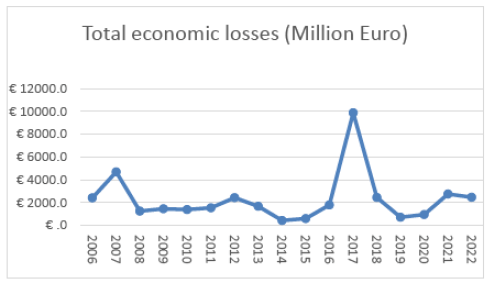
Like many natural events, wildfires cause lives to be lost. Using this tragic loss of life to whip up climate fear is deplorable, not least since many wildfires are deliberately or accidentally started by humans. Greece had a bad wildfire season last year with the BBC reporting that 79 arrests had been made for arson. The BBC accepts that wildfires are common in Greece but “scientists say” there is a link between extreme weather events and climate change. Stefan Doerr of the Centre for Wildlife Research at Swansea University notes that arson “can more easily turn into fast-moving wildfires”. Arsonists, it seems, just love climate change.
Last year, the climate scientist Patrick Brown admitted that he had written a paper published in Nature that focused exclusively on how climate change had affected extreme wildfire behaviour and ignored other key factors. In particular he downplayed the information that 80% of wildfires are lit by humans. He laid out his whistle-blowing claims in an article titled: ‘I Left Out the Full Truth to Get My Climate Change Paper Published’. He knew not to try to quantify key aspects other than climate change because it would dilute the message journals like Nature want to tell, he observed, adding: “To put it bluntly, climate science has become less about understanding the complexities of the world and more about serving as a kind of Cassandra, urgently warning the public about the dangers of climate change.”
Wildfires are an easy propaganda win for climate alarmists. People die, property is destroyed and the published images are spectacular. But fires are a vital part of nature, always have been. They help clear away the debris that accumulates naturally in forests and scrub land and provide a path for regenerative growth. There is little evidence that natural trends are on the increase around the world, and none to suggest that humans play a part in natural ignition by burning hydrocarbons and releasing carbon dioxide into the atmosphere. In its sixth assessment report, the Intergovernmental Panel on Climate Change (IPCC) specifically ruled out human involvement in ‘fire weather’, both in the past and going forward to the turn of this century.
Chris Morrison is the Daily Sceptic’s Environment Editor.
Iran rejects ‘baseless and boring’ accusations over Ukraine war
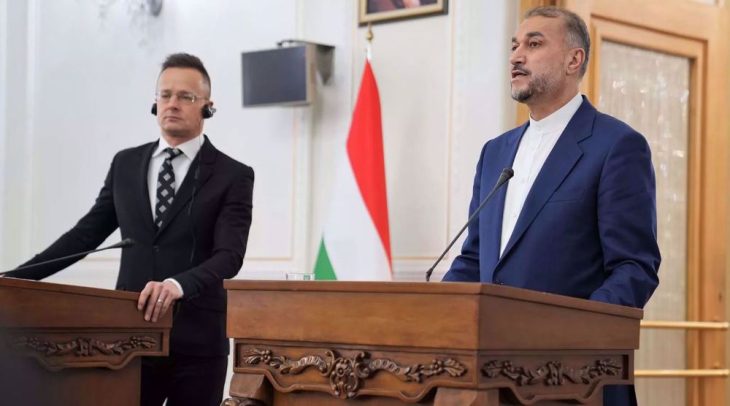
Iranian Foreign Minister Hossein Amir-Abdollahian speaks at a joint press conference with his Hungarian counterpart Peter Szijjarto in Tehran on February 22, 2024.
Press TV -February 23, 2024
Iranian Foreign Minister Hossein Amir-Abdollahian says the repetition of baseless claims against the Islamic Republic over the war in Ukraine has reached a “boring stage”.
Amir-Abdollahian made the remarks at a joint press conference with his Hungarian counterpart Peter Szijjarto in Tehran on Thursday.
Iran’s top diplomat noted that they discussed bilateral relations and the latest global developments, including the conflict in Ukraine, adding “I would like to once again strongly condemn the baseless accusations leveled against Iran regarding Russia’s use of Iranian weapons.”
“The repetition of baseless claims has reached a boring stage,” he said.
Amir-Abdollahian’s remarks came as US National Security Council spokesman John Kirby said on Thursday that Washington will be “imposing additional sanctions on Iran in the coming days” over its alleged efforts to supply Russia with drones and other technology for the war.
Both Iran and Russia have repeatedly denied claims that Tehran has provided Moscow with weapons to be used in the war in Ukraine.
The anti-Iran claims first emerged in July 2022, when US National Security Advisor Jake Sullivan alleged that Washington had received “information” indicating that the Islamic Republic was preparing to provide Russia with “up to several hundred drones, including weapons-capable UAVs on an expedited timeline” for use in the war.
Elsewhere in his remarks, Iran’s top diplomat noted that he and Szijjarto also discussed Israel’s genocidal war on the besieged Gaza Strip that began in October.
“We had frank discussions on the logic behind Iran’s support for the Palestinian people. I also asked Hungary to use all its capacity to stop the war and restore sustainable security to the region,” Amir-Abdollahian said.
He slammed the US and Britain’s attempts to extend the war to other parts of the world as “a mistake”, stressing that Yemenis are acting independently regarding pro-Palestine operations.
The US and the UK have been carrying out numerous attacks against Yemen as a means of trying to pressure the country into stopping a series of operations that it has been conducting in support of Palestinians in the Gaza Strip.
In solidarity with the Palestinians in Gaza, the Yemeni armed forces have targeted ships in the Red Sea with owners linked to Israel or those going to and from ports in the occupied territories.
Tehran-Budapest ties
The visit of Szijjarto, who also acts as the minister of trade, to Iran came as Tehran and Budapest held a joint economic commission earlier on Thursday.
“Relations between the two countries are developing,” Amir-Abdollahian said, adding that a protocol of the economic commission and a road map for cooperation in the field of agriculture were signed during the session of the commission.
Budapest concerned about war in West Asia
For his part, Szijjarto hailed the bilateral ties between the two countries as “strong”, expressing his country’s concern over the ongoing war in the West Asia region.
He warned that the escalation of the situation and the spillover of the war in Gaza into the region “could be a great threat to the global security.”
Israel launched the war on Gaza on October 7 after the Palestinian resistance movement Hamas waged the surprise Operation Al-Aqsa Storm against the occupying entity in response to the Israeli regime’s decades-long campaign of bloodletting and devastation against Palestinians.
Since the start of the offensive, the Tel Aviv regime has killed at least 29,514 Palestinians and injured more than 69,616 others.
Thousands more are also missing and presumed dead under the rubble in Gaza, which is under “complete siege” by Israel.
Biden and US media lies about Ukraine are reminiscent of Vietnam War – American Conservative
By Ahmed Adel | February 23, 2024
The American Conservative published an article that parallels the Vietnam War, considered the greatest military humiliation in US history, with what they point out is a campaign of deception carried out by the current US Government, which will lead to a defeat for Kiev and NATO.
According to the author James W. Carden, who served as an advisor on US-Russian affairs at the State Department during the Obama administration, the media campaign regarding Ukraine carried out by the White House was a copy of the actions of successive US governments in Vietnam until the Nixon administration withdrew troops and concluded the intervention in 1973. He relates the Vietnam War with the lies with which President Joe Biden and his collaborators have tried to deceive citizens about the progress of the Ukraine conflict and its origin, among other issues.
These false narratives, the article notes, have been put in place and presented to Americans with the help of the “most dutiful accomplices,” such as the New York Times and the Washington Post, media outlets that, until recent times, published the triumphalist comments of Biden and his administration without any type of questioning, in addition to analysis columns where Russian President Vladimir Putin was demonised and falsely stated that Ukraine was on its way to victory.
This falsification of reality, in which all the complexity of the conflict was eliminated, and the responsibility of the US and NATO in inciting it, was omitted. Instead, they presented the war as a simple confrontation between good and evil, which is similar to the deception that Washington and the establishment media consummated in the 1960s to justify the US invasion of Vietnam, the article states.
Now, notes The American Conservative, as it is “too obvious to ignore” that Russian troops are prevailing in Ukraine, the American media is finally realising what is really happening on the battlefield after having helped prolong the conflict with their lies.
“If we are being lied to about the progress of the war—and we are—what do you suppose are the odds we are also being lied to about the causes of the war?” the author questions.
For US politicians and journalists, the expansion of NATO, Ukraine’s post-Euromaidan nationalist agenda, the refusal to implement the Minsk Agreements, or threats by Ukrainian President Volodymyr Zelensky made in Munich in February 2022 to acquire nuclear weapons had nothing to do with the outbreak of war, the article ironically states.
“If we are being lied to about the causes of the war, are we also then being misled about what is at stake in eastern Ukraine? Probably. Here the parallel with the government’s mendacity during the war in Vietnam period becomes too obvious to ignore,” Carden continues.
“Recall in the first case that the template, that of the Cold War, is essentially unchanged, even in some of the particulars, not least in the comparisons of (the Vietnamese anti-communist leader) Ngo Dinh Diem and Volodymyr Zelensky to Winston Churchill. The South Vietnamese government (avaricious, corrupt) had the right to American arms by virtue of its right ‘to determine [the nation’s] future,’ the article says, recalling the argument used by the US to justify its war against North Vietnam, which was part of its global operation against what Washington perceived as an expansion of communism that could threaten its interests and hegemony.
The same thing is happening now with Ukraine: President Biden publicly justifies launching a proxy war with Russia with the excuse that it is necessary to stop Moscow, once again invoking the theory of the domino effect, the long-discredited thesis that drove the US interventionist policy during the second half of the 20th century.
Following the publication of the Pentagon Papers in 1971, the philosopher Hannah Arendt observed during the Vietnam War era that “the policy of lying was hardly ever aimed at the enemy… but was destined chiefly if not exclusively, for domestic consumption, for propaganda at home and especially for the purpose of deceiving Congress,” Carden warns.
He concludes his article by saying: “Two years on, we citizens have been serially lied to by the Biden administration and the media about the war’s causes, its stakes, and its progress. The question that should, but of course will not, be addressed in the aftermath of this latest American misadventure abroad is: Will we ever learn?”
Ahmed Adel is a Cairo-based geopolitics and political economy researcher.
Space Nukes & Washing Machines: Western Media Prints ‘Anything’ to Paint Russia as Threat
Sputnik – 23.02.2024
Last week, House Intelligence Committee Chair Rep. Mike Turner (R-OH) released a document with a cryptic warning that called on US President Joe Biden to declassify information on a “serious national security threat.” Within hours, the story spread like wildfire.
The recent media craze stemming from unfounded claims of a Russian nuclear space weapon exploded and stole headlines for days because “the media” will print anything it is told about Russia, Mark Sleboda, a foreign relations and security expert told Sputnik’s Fault Lines.
“Russia’s the gift that keeps on giving, propaganda-wise, because you can accuse Russia of anything, no matter what you said about them [before], about shovels, and microchips or washing machines. And, generally, people will believe it. Or at least the media will print it,” he said, referring to previous Western propaganda claims that Russian soldiers were fighting armed only with shovels and that their missiles used microchips from stolen Ukrainian washing machines.
“Then you accuse Russia of having space weapons, space nuclear weapons, or having plans to put nuclear weapons in space, or someone in Russia once thought technically about the contingency of putting weapons in space,” Sleboda scoffed.
As the story made the rounds on the media circuit, US National Security Council John Kirby told reporters that the threat US Rep. Mike Turner raised was related to “an anti-satellite weapon that Russia is developing.” Soon after that, US media outlets began reporting that the mysterious weapon was nuclear.
Russia vehemently denied the accusation, saying it is only developing the same space capabilities that the US has. “Firstly, there are no such projects – nuclear weapons in space. Secondly, the United States knows that this does not exist,” Russian Defense Minister Sergei Shoigu said during a televised discussion with Russian President Vladimir Putin.
Sleboda noted that for mainstream media, “the details aren’t important as much as the scaremongering factor.”
“It’s the same thing with this continual octogenarian fantasy about linking Trump and Russia… all the powers of the US investigative bodies were unable to prove any connection… but that doesn’t stop an enormous number of the American people from believing in it because they want to, and [US Rep.] Nancy Pelosi certainly knows that.”
The analyst further admitted that the latest anti-Russia rhetoric is part of a larger effort in preparation for the November presidential election in the US but that it also “does the double job of, you know, buttressing arguments for providing more US taxpayer dollars for weapons for the regime in Kiev.”
US spies behind ‘Russiagate’ conspiracy – report
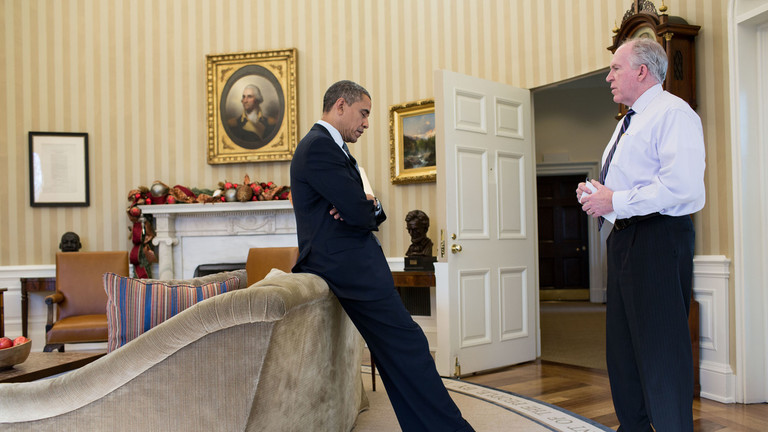
US President Barack Obama and CIA Director John Brennan, December 14, 2012 in Washington, DC. © Pete Souza / The White House via Getty Images
RT | February 14, 2024
The US intelligence community inappropriately used foreign allies to target Republican presidential candidate Donald Trump’s campaign to set up the ‘Russiagate’ conspiracy ahead of the 2016 election, according to a trio of investigative journalists.
Michael Shellenberger, Matt Taibbi and Alex Gutentag – of ‘Twitter Files’ fame – published the first part of an investigation on Tuesday, in which they claim the so-called ‘Five Eyes’ were operationalized against Trump staffers, citing anonymous sources close to the House Intelligence Committee.
According to their report, President Barack Obama’s CIA Director, John Brennan, had sent America’s partners – the UK, Canada, Australia, and New Zealand – a list of 26 Trump associates to target with data collection, misinformation and manipulation.
The Russiagate conspiracy involved multiple failures across western media networks to critically assess US intelligence claims that Russia had interfered in the 2016 US presidential election. A 2018 Pulitzer prize was awarded to Washington Post and New York Times journalists for their reporting on what was later to exposed as a false story.
“They were making contacts and bumping Trump people going back to March 2016,” said a committee source. “They were sending people around the UK, Australia, Italy — the Mossad in Italy. MI6 was working at an intelligence school they had set up,” the journalists claim.
Officially, the FBI only started looking into the Trump campaign that summer, after an Australian diplomat reportedly overheard an aide mention Russia. If confirmed, these findings would demonstrate that the US intelligence community had worked for months before that to set up just such a pretext.
In a statement to the investigative journalists, the FBI said it had made “missteps” in the 2016 and 2017 investigation of the Trump campaign, but has since implemented reforms to prevent it from happening again.
“The allegations that GCHQ was asked to conduct ‘wiretapping’ against the then president-elect are nonsense,” a spokesman for the British surveillance agency said. “They are utterly ridiculous and should be ignored.” Shellenberger, Taibbi and Gutentag said they had never asked the GCHQ about “wiretapping.”
According to Shellenberger, there is a “10-inch binder” containing previously unknown documents about the intelligence community’s surveillance of the Trump campaign. The 45th US president had ordered these documents declassified, but they went missing instead. In a Fox News appearance on Tuesday evening, Shellenberger suggested the FBI’s August 2022 raid on Trump’s Mar-a-Lago resort may have been related to the missing binder.
After the US intelligence community created a pretext for investigating Trump for ‘ties to Russia,’ they spied on his campaign – and then his presidency – using a falsely obtained FISA warrant. The warrant was based on the ‘Steele dossier,’ a file compiled by a British spy in the pay of Hillary Clinton’s campaign, through several intermediaries. The FBI knew the dossier was false as early as January 2017, but continued using the FISA warrant for almost a year thereafter.
The FBI lawyer who altered evidence to obtain the warrant, Kevin Clinesmith, ended up sentenced to probation and his law license has since been restored.
Are You an Anti-Paxxer?
As doctors drop Paxlovid because of drug interactions, Covid rebounds, and virus shedding, Pfizer cranks the PR machine to hide the facts and shame “anti-paxxers.”
BY LINDA BONVIE | RESCUE | FEBRUARY 9, 2024
When an article by Los Angeles Times metro reporter Rong-Gong Lin II recommended last month that practically everyone who tests positive for Covid takes Pfizer’s Paxlovid, some media veterans may have wondered what had become of the traditional wall between news reporting and advertising.
The story, which appeared on January 28, swept away almost all of the reservations that have been raised about the safety and effectiveness of this patent medicine, assuring us that “Paxlovid rebound” is a non-issue and fear of serious side effects is “erroneous.” It even went so far as to suggest that if your doctor won’t prescribe this “highly effective” medication, it’s time to go doctor shopping.
So why is this LA Times writer so desperately trying to sell us this fast-tracked antiviral that comes with a black box warning?
The article appeared at a particularly critical time for Pfizer just as it transitions from Emergency Use Authorization, or EUA Paxlovid, to FDA-approved Paxlovid. Originally free to patients, the medication was stockpiled by the U.S. government to the tune of 24 million treatment courses at a cost to taxpayers of $530 a box. Now, the FDA-approved version (same drug, different box) sells for a list price of up to $1,500. (According to an analysis by researchers at Harvard University, the actual cost to Pfizer for a five-day Paxlovid course is $13).
But to Pfizer’s chagrin, it now doesn’t seem to be able to even give the stuff away, let alone sell it at a premium price. Last fall Pfizer accepted a return of nearly 8 million boxes sent back by the U.S. government.
What’s a drugmaker to do when both patients and doctors shun a product that was anticipated to be the better half of Pfizer’s post-Covid “multibillion-dollar franchise?
Flush with all that Covid cash and new Paxlovid FDA approval last May, Pfizer went shopping for partners to help promote its products.
No stranger to top-tier PR firms such as Edelman and Ogilvy, the drugmaker tagged two of the biggest names in contemporary communications companies, Publicis Groupe, a Paris-based giant PR and ad agency, and the humongous Interpublic Group. These high-level agencies come at a big price tag, but what they can offer is priceless—a way to get your story told by respected media outlets.
That’s right, if you have enough money to hire the folks with all the right contacts, you too can create your own “news!” And these special contacts are something that PR firms, such as Edelman, are very proud of. Many agency hires, in fact, are recruited directly from major media outlets, such as Edelman NYC Brand Director Nancy Jeffrey, who spent a decade at the Wall Street Journal.
As quoted in an Edelman website blog, Jeffrey recalls how Richard Edelman (son of founder Dan) would call her during her time working at the paper “to meet a client with a story to tell.” As Jeffrey says, “No one at Edelman ever rises too high to pitch a reporter.”
So was our LA Times reporter “pitched,” or does he just have an evangelical connection with Paxlovid?
Let’s take a close look at his story and see what we find.
First, there’s the article’s headline, which began: “If it’s COVID, Paxlovid”? Getting your oft-advertised product’s rhyming tagline in a headline—now that’s branding! And we don’t have to tell any of the side effects in this venue. The LA Times piece was off to a great start.
Why aren’t more people being given Paxlovid, the reporter wanted to know. It’s “cheap or even free for many,” he said. And then he delivered his first rave review, calling it “highly effective.”
By paragraph four, however, our intrepid reporter had uncovered the bad news that “a number of doctors are still declining to prescribe it.” But why? It must be those pesky “outdated arguments” about “Paxlovid rebound.” Anyone who gets Covid “has a similar rare chance of rebound,” he told us. For extra punch, he called on Dr. Peter Chin-Hong, professor of medicine at UCSF, to back up that statement. Rebound is “like, bogus” and “just dumb,” Chin-Hong said.
What Lin didn’t report is that a study published in the Annals of Internal Medicine in November 2023, by researchers from Mass General Brigham, found that in Covid patients taking Paxlovid, rebound was “much more common” and often without symptoms. Nearly 21 percent had virologic rebound versus under 2 percent not on the drug. Of perhaps even more significance, prolonged viral shedding for an average of fourteen days was noted in those who rebounded, indicating that they “were potentially still contagious for much longer.” The virologic rebound “phenomenon,” in Paxlovid patients, the authors noted, “has implications for post-N-R (Paxlovid) monitoring and isolation recommendations.” This study closely monitored patients with follow-ups three times a week “sometimes for months.”
After quoting from several Paxlovid-positive FDA and CDC statements and referencing a California Public Health commercial where people dance to an upbeat tune singing “Test it, treat it, beat it, California you know you need it,” Lin got around to some serious stuff—side effects.
Not mentioned by Lin, but good to know anyway, Paxlovid bears an FDA-required black-box warning about drug interactions, cautioning of “potentially severe, life-threatening, or fatal events.” But the article carefully danced around this inconvenient issue, simply mentioning that some Paxlovid takers may need to have their medications adjusted. The fear of “serious side effects . . . is largely erroneous,” it claimed.
Really?
“There are 125 drug interactions (for Paxlovid) across twenty-five different classes of medicines,” author and FLCCC President Dr. Pierre Kory said in a phone interview. “I’ve never used any medicine that had that number and degree of drug interactions, and I find it absurd,” added Kory, who is an expert in early Covid treatment.
And this is no secret. The Paxlovid package insert lists thirty-nine specific drugs that interact with this anti-viral (which is not a complete list, we’re warned) including medications that treat conditions such as an enlarged prostate, gout, migraines, high blood pressure, high cholesterol, arrhythmias, and angina.
With side effects out of the way, our reporter moved on to an interesting idea—doctor shopping.
If your doctor turns you down for Paxlovid, “what other options are there?” How about “reaching out to another healthcare provider” we’re advised, one “who might be more knowledgeable about Paxlovid . . .”
Don’t be an ‘Anti-Paxxer!’
The LA Times isn’t alone in this timely pushing of Paxlovid. The New York Times also ran a glowing Paxlovid piece at the beginning of January. The black-box warning was glossed over by simply saying that some “doctors balk” over the “long list of medications not to be mixed with Paxlovid,” referring to the drug as being “stunningly effective.” The NYT reporter also added five mentions of a study—actually a preprint (not yet peer reviewed or published)—which through the use of statistical magic concluded that during the course of the research had only half of the eligible Covid patients in the U.S. taken Paxlovid, 48,000 lives would have been saved.
The server where the research was posted warns journalists and others when discussing preprints to “emphasize it has yet to be evaluated by the medical community and information presented may be erroneous.”
Paxlovid is not the only drug that gets special treatment by the media. Last January, a 60 Minutes segment was called out by the Physicians Committee for Responsible Medicine as “an unlawful weight loss drug ad” for the med Wegovy. The piece, it noted, “looked like a news story, but it was effectively a drug ad,” the group said in a press release. PCRM also stated that Novo Nordisk, which makes Wegovy, paid over $100,000 to the doctors CBS interviewed for the segment.
With this new frenzy to sell Paxlovid, one can’t help but compare it to the campaign against ivermectin. Kicked off by the FDA in August 2021, it successfully branded this Nobel Prize-winning, FDA-approved drug as nothing more than a horse dewormer endorsed by fanatical outlier doctors and accepted by gullible patients. Despite being found to be an extremely safe treatment as well as an effective one for Covid, the FDA, CDC, and its media “partners” made ivermectin the subject of false accusations and warnings about the supposed risks of using it.
But early on in the game it was decided, as Dr. Kory pointed out, “to keep the market open for their novel pricey Paxlovid pill.” And to that effect, nothing was going to stand in the way. In an interview last summer with the head of the UCSF Department of Medicine, FDA Commissioner Dr. Robert Califf admitted that he helped promote Paxlovid—something he acknowledged is explicitly against the rules.
“In normal times, the FDA should not be a cheerleader . . .” Califf said. But since back then EUA drugs could not be advertised (a policy that changed in the fall of 2022) he went ahead and pitched it himself.
The Paxlovid campaign is far from over. In fact, it may now be revving up to full throttle. There’s even a name being bandied about for those who question the drug: “Anti-Paxxers.”
And if we can take any insight from the new Pfizer tagline (just filed for protection with the US Patent and Trademark Office), “Outdo Yesterday,” there are even more spurious strategies in its pharmaceutical pipeline.
Linda Bonvie is an investigative journalist, freelance health and environmental writer and co-author of several books including “Chemical-Free Kids” and most recently “A Consumer’s Guide to Toxic Food Additives.”
FOR WESTERN MEDIA, ISRAEL’S BOMBING OF GAZA IS NOT ‘DEADLY’
Right across the Anglo-American mainstream media, the killing of Palestinians is seen as normal. It’s only Israeli lives that matter.
BY DES FREEDMAN | DECLASSIFIED UK | JANUARY 30, 2024
Twenty-four Israeli soldiers were killed in two separate incidents in Gaza on 22 January. Mainstream media outlets around the world reacted in unison: that this was the “deadliest day” for Israel since 7 October.
This exact phrase was used in headlines on 23 January carried by news agencies such as Reuters and AFP, and major broadcasters including the BBC, CBS, NBC, CNN, ABC and ITV News.
The exact same phrase was also used by leading news titles including the New York Times, Washington Post, Wall Street Journal, Time magazine, Daily Telegraph, the Sun, Jerusalem Post, Guardian, London’s Evening Standard, Financial Times, Independent and Yahoo News.
On the same day, Israeli forces killed almost 200 Palestinians in Gaza including at least 65 people in Khan Younis alone.
These deaths received no headlines in the above outlets. Where they were reported, they were listed as part of the regular daily round-up of events in an unfolding genocide that has now seen more than 26,000 people killed in Gaza.
How is it possible that the world’s media could embrace exactly the same phrase in relation to Israeli victims but largely ignore the identities of the much higher number of Palestinians killed?
Why would 22 January be described as “deadly” for one group of people but not for another?
Unequal value
You might expect that editors took the “deadliest day” phrase from press statements from the Israeli government or military.
Yet Israel Defense Forces (IDF) spokesperson Daniel Hagari did not use this phrase in his statement and neither did the IDF Chief of the General Staff, Herzi Halevi, who instead simply called it a “difficult day”.
Prime minister Benjamin Netanhayu also described it as “one of the most difficult days” while Israel’s President, Isaac Herzog, spoke of “an unbearably difficult morning”.
He used the same language as both Knesset speaker Amir Ohana and minister Benny Gantz, both of whom referred to a “painful morning”.
Of course, it is possible the phrase was used in private and informal briefings to the press on the morning of 23 January. It is, however, equally conceivable that this was a trope that came “naturally” from a deep-rooted idea in the western media that the lives of Israelis and Palestinians are not of equal value.
And, therefore, that measuring the “deadliness” of a particular day should only be done for Israelis (where every life matters) and not for Palestinians (whose individual lives clearly appear to count for less).
‘Deadliest day’
Indeed, a search of the Nexis database of UK national and local news (including BBC broadcast bulletins) reveals that there were 856 uses of the phrase “deadliest day” from 7 October 2023 until 25 January 2024, none of which directly referred to evidence of Palestinian deaths in Gaza.
The only exception to this were some BBC bulletins on 25 October which mentioned “Palestinians reporting the deadliest day in Gaza” (emphasis added).
Otherwise, there was not a single reference during this period across the British media to “the deadliest day for Palestinians” or “for the people of Gaza”.
The other approximately 850 references directly related only to Israeli casualties. Some 28 per cent of them focused on the killing of IDF soldiers on 22 January.
The vast majority referred to the events of 7 October, described either as “the deadliest day for Jews” or “the deadliest day for the Jewish people” which accounted for some 25% of all references.
Many of these stories were focused on the words of US president Joe Biden who, in a much publicised speech to Jewish leaders at the White House, described the Hamas attack on 7 October as the “deadliest day for Jews since the Holocaust”.
Biden’s words alone make up 20% of all references to the “deadliest day” trope.
Perhaps Biden’s words were on the minds of editors across the world as they listened to Israeli spokespeople on the morning of 23 January and that the deaths of 24 IDF soldiers merited such a phrase when talking about Israeli lives.
Framing the war
But why has the phrase not been used in relation to Palestinians and, indeed, why is there so little preoccupation with days when particularly large number of Gazans are killed?
Precisely because the war is not framed in a way which recognises the equal worth of all those affected – in other words, a situation where every instance of significant Palestinian casualties would deserve a headline – it’s hard to be certain of which have been the very deadliest days for the residents of Gaza.
However, it’s clear that the period immediately after the temporary ceasefire in the last week of November saw particularly intense airstrikes and there were, according to Al Jazeera, at least 700 Palestinians killed on 2 December alone.
Yet there was no mention in the UK media about this being the “deadliest day” for Palestinians. Instead, the Guardian simply ran with a headline of “‘Israel says its ground forces are operating across ‘all of Gaza’” while the Sunday Times wrote that “Fears for hostages as Gazans say bombardment is worse than ever”.
According to the Mail Online, “Israel says it is expanding its ground operations against Hamas’ strongholds across the whole of the Gaza Strip as IDF continues to bomb territory after terrorists broke fragile truce”.
The BBC’s TV news bulletins on 3 December carried distressing footage of casualties but also featured a quote from an adviser to Netanyahu saying that “Israel was making the ‘maximum effort’ to avoid killing civilians” without carrying an immediate rebuttal of this outrageous claim.
In other words, despite the fact that 30 times more Palestinians were killed on 2 December than when the 24 IDF soldiers were killed, there was no recognition of the “deadliness” of that day.
Instead, the framing was all about the strategic plans of the Israeli military rather than the mass slaughter of Palestinians.
‘Intensive strike’
On 26 December, a further 241 people were killed by Israeli bombs. Britain’s “newspaper of record”, The Times, responded with the headline: “Israel-Gaza war: Palestinians hit by ‘most savage bombing’” with a sub heading that “Israel launches most intensive strike since Hamas attack on October 7”.
You could be forgiven for thinking that there was nothing deadly about this episode because, after all, Palestinians were only being “struck” as opposed to brutally killed.
But this was hardly an exceptional day given that Oxfam reported earlier this year that Israel’s military was killing Palestinians at an average rate of 250 people a day, a figure it said exceeded the daily death toll of any other major conflict of recent years.
There is clearly a brutal politics to counting the dead. The New York Times ran an article on 22 January headlined “The Decline of Deaths in Gaza” arguing that average daily deaths across a 30-day period have now fallen below 150.
For the NYT, it is “plausible that a lower percentage of deaths are among civilians now that Israel’s attacks have become more targeted and the [average] daily toll has declined”.
Not only, however, is there little evidence that the IDF is in any way opposed to killing civilians but the idea that casualties are declining at a time when we are soon likely to see a total of 30,000 Palestinian deaths is profoundly shocking.
Any slowdown in the rate of killing is hardly a consolation to the millions who still live in fear of IDF raids and rockets.
Media consensus
The media consensus that only Israelis are the victims of the “deadliest days” in the region and not Palestinians, despite the latter accounting for 95% of deaths since 7 October, is one of the many illustrations of the unequal and profoundly distorted coverage of this war.
Until the South African government submitted its partially successful claim to the International Court of Justice, news organisations were unwilling even to investigate the genocidal language of Israeli political and military leaders.
The media also routinely uses dehumanising and differential language where Israelis are “massacred” while Palestinians simply “die”. This illustrates the awful role of the mainstream media in paving the way for the ethnic cleansing we are currently seeing.
The real reason you don’t see or hear the media talk about a “deadly day” for Palestinians is that every day is deadly when you live in Gaza.
Featured Video

More Iran War fallout: Maritime insurance industry shifts from London to China
or go to
Aletho News Archives – Video-Images
From the Archives
Allies Don’t Need Lobbies
By Jay Knott | Dissident Voice | September 24, 2013
In a recent article on Counterpunch, Rob Urie defended the traditional Marxist analysis of US policy in the Middle East. He argues that support for Israel is driven primarily by economic interest, not the Jewish lobby.
He starts by paying tribute to the idea that Western societies are uniquely racist. He says that the “Western narrative” claims there is an “Arab character”, and that this is “antique racist blather”. He gives no definition of these terms. Further, he establishes his credentials as part of the dominant current in the American left by claiming that “over a million people in Iraq died so ‘we’ in the West can drive SUVs.”1
When he tries to criticize bourgeois economics, he makes it clear he doesn’t understand the developments it has made since Marx’s day, using the mathematical discipline known as “game theory”. He dismisses the basic abstraction of economic theory, the idea of the rational individual, on the grounds that it is “devoid of history, culture and political context”. But abstractions are always devoid of something.
He defends a more concrete economic theory, mostly Marxist, with some input from another theorist of capitalist crisis, Hyman Minsky. This concrete theory leads him to the view that US activity in the Middle East is primarily driven by rational capitalist motives, the need to secure a supply of oil.
“Taking the totality of circumstance — former oil company executives launching war on an oil rich nation on a pretext they publicly proclaimed they didn’t believe shortly before taking office — and that upon launching their war proved to be non-existent, requires a willingness to overlook the obvious — that the war on Iraq was for oil, that is difficult to support.”1
Perhaps I’ve misunderstood him, but based on what he says in the rest of the article, this convoluted sentence seems to argue that, because president Bush and vice-president Cheney attacked Iraq on false premises, and they also said it was all about oil, and they are former oil executives, and Iraq has a lot of oil, it’s difficult to deny US attacks on Iraq are all about oil.
In fact, it’s not hard at all. As Urie points out, at times Bush and co. said that attacking Iraq was “protecting the world’s supply of oil.”1 But, as he also points out, they are congenital liars. Why should we believe them when they say they are trying to “protect” the oil supply? Protect it against what? When politicians “admit” attacks on Middle Eastern countries are wars for oil, they are parroting the neo-con party line, feeding the public, both left and right, with a plausible-sounding pretext. For right-wingers, “it’s a war for oil” is a reason to support war, and for leftists, it’s a way to feel better by complaining impotently about corporate greed. Both approaches help the war drive. … continue
Blog Roll
 Aletho News
- More Iran War fallout: Maritime insurance industry shifts from London to China
- US-Israeli aggression on Iran triggers review of GCC countries’ investment pledges to Washington
- Russia slams UK plan to seize tankers suspected of carrying its oil
- Pakistan ramps up food exports to Persian Gulf nations as war deepens food insecurity
- Iran submits response to US plan, sets terms for war’s end: Tasnim
- US vs Iran: Kharg Island Talk — Bluff or Escalation? Ex-Military Officer Weighs In
- Zelensky unnecessarily involves Ukraine in the Middle East crisis
- Turkish tanker blacklisted by Ukraine hit in drone attack – media
- Canada, the U.S., and NATO: the inescapable trap
- Villains of Judea: Leonid Radvinsky
- If Americans Knew
- ‘No Innocent Children’: Far-right Israeli Lawmaker Defends Killing of Palestinian Family
- Mossad’s promises helped Netanyahu convince Trump that Iran could be toppled
- US Arms Control Official Refuses To Comment When Asked If Israel Has Nuclear Weapons
- Veterans warn US landing could be ‘more Gallipoli than Vietnam’
- Israel may be committing war crimes in Lebanon – Not a ceasefire Day 167
- In the West Bank, life is a constant battle – 3 articles
- Jacob Reses, one of the most powerful pro-Israel operatives in Trump’s Washington
- Israeli-US assaults kill or injure 87 children a day – Not a ceasefire Day 166
- ‘Forever live by the sword’: Understanding Israelis’ massive support for Iran war
- UN’s special rapporteur on human rights says Israel is systematically torturing Palestinians
- No Tricks Zone
- Devastating Assessment Of Comirnaty Vaccine By Former Senior Pfizer Europe Toxicologist
- New Study: CO2 Is ‘Effectively Negligible’ As An Explanatory Climate Change Factor Since 2000
- Former Pfizer Toxicologist Dr. Helmut Sterz Tells Bundestag Hearing Pfizer Vaccine Should Have Never Been Approved
- Energy Expert: Germany’s Nuclear Phaseout Was A “500 Billion Euro Mistake”
- New Research: South Australia’s Mid-Holocene Sea Surface Temperatures Were 4°C Warmer Than Today
- Storing Green Energy To Last Germany 10 Days Would Require A 60-Million Tonne Battery
- New Studies: UK Sea Levels Were 4 Meters Higher Than Today During The Mid-Holocene
- Destructive Green New Deal: German Energy And Metal Group Warns Of Drastic Crisis
- New Study Documents A 20-Year Pause In Arctic Sea Ice Decline – Driven By Internal Variability
- Wake-up Call: Survey Shows Majority Of Germans Now Favor Postponing Climate Targets!
 Aletho News