US veteran faked heroics on Ukraine battlefield to become rich
By Ahmed Adel | July 19, 2023
A US military veteran, who claimed battlefield victories as a combatant in Ukraine and gained fame through media interviews and Twitter posts by boasting about his exploits against Russian forces, has been exposed for lying to create a false image that he could take advantage of after the end of the conflict to become rich. This again demonstrates the unprofessionalism of Western media, which knowingly advanced the lies of a mercenary for propaganda reasons.
James Vasquez, who has amassed more than 400,000 followers on Twitter and is regularly quoted by CNN and the New York Times, has falsely claimed exploits on the Ukraine battlefield, Insider reported on July 16.
The portal, which cited allegations by four other foreign volunteers in Ukraine, also confirmed through the Pentagon that Vasquez lied about his military history when he claimed to have had combat deployments as a sergeant in the US Army in Iraq and Kuwait. It is revealed that he served as an electrical systems repairman in the US Army Reserve.
Vasquez’s social media posts often went viral, purportedly about his exploits on the front lines.
“In his videos and posts, he bragged about capturing Russians and taking out tanks, was regularly interviewed by the news media, and made catchy claims including that he imagined the ‘punchable’ Tucker Carlson when preparing for battle,” wrote the portal.
Other fighters told the media that Vasquez boasted he would become a millionaire when the conflict ended.
“James said, and I quote, ‘I’m never gonna go back to work as a handyman. I’m probably never gonna have to work again after this war. I’m gonna be famous,’” said Tim, an American man working with the Ukrainian army who spoke to Insider on the condition of withholding his last name.
Vasquez created his claims by going to areas where battles had recently occurred, filming videos of destroyed equipment and claiming achievements as his own, say other foreigners. In one case, he claimed on Twitter that he was heading to Soledar, where heavy fighting was allegedly occurring. However, Ukrainian forces had withdrawn from the area days earlier.
Accusations against Vasquez apparently began to surface earlier this year. Sarah Ashton-Cirillo, an American who works in the Ukrainian Territorial Defence Forces media department, said in a Twitter post in March that Vasquez could not have legally gone on combat missions because he did not have a contract with the Ukrainian Armed Forces.
“I met James Vasquez three times for a total of about four hours,” she told Insider. “During our last meeting, in the presence of another person, he gave himself up and confirmed what I had known since last summer, that he was never a member of the AFU. That night he stated clearly he never had a contract nor had he ever been paid. This was in January. It was the last time I saw him.”
Although Vasquez was often accused of being a fraud or a scammer who exploited the situation in Ukraine for personal gain or fame, one of the most serious accusations against him was that he endangered the safety of his fellow fighters for social media clout. In one instance, he posted a video on Twitter that showed him standing next to a sign that indicated the exact coordinates of the unit he was with, which could have exposed them to a Russian attack.
Ashton-Cirillo told Insider : “As someone who notified a large media outlet about James Vasquez in June of 2022 and stated to them clearly that Vasquez had no combat experience and was filming fake fight scenes, it is disgraceful that they and so many other journalists advanced his lies for so long.”
This is far from being the only example of propaganda deployed by Western media in relation to Ukraine, and Ashton-Cirillo is fully aware of this fact considering her own position. In fact, she engages in such propaganda. Rather, her main concern was that Vasquez became too obvious in his propaganda stunts, and she knew it was only a matter of time until it all is exposed.
For her part, April Huggett, a Canadian volunteer who knew Vasquez, told Insider in a text message that he would exaggerate how close he was to the heavy fighting.
“I did realise very quickly he was sitting comfy right in Maidan and he was not leaving Kiev very often,” she said. “He also drank so much.”
“James just kept talking about becoming a millionaire after this,” Huggett continued.
“I’m tired, but I’m not sorry I exposed the lying scammer. […] We took away his fame and fortune, we made people see him for the disgrace he is,” she added.
Ahmed Adel is a Cairo-based geopolitics and political economy researcher.
Fake News Alert: Wagner Isn’t Going To Invade The Suwalki Corridor

BY ANDREW KORYBKO | JULY 18, 2023
The Daily Mail sensationally claimed on Sunday that Wagner is plotting to invade the Suwalki Corridor from Belarus, after which this narrative virally spread across the global information ecosystem to take on a life of its own. There’s no truth to this allegation, however, since it’s solely the editorial spin that this British tabloid put on the words of a leading Russian parliamentarian. The present piece will debunk this fake news about Russia’s intentions prior to analyzing the importance of what was really said.
Chairman of the Duma’s Defense Committee Andrey Kartapolov inadvertently set this scandal into motion after recently saying the following on a top domestic political talk show:
“It is clear that Wagner [mercenary army] went to Belarus to train the Belarusian armed forces… [But] not only, and not so much. There is such a place as the Suwalki Corridor. Should anything happen, we need this Suwalki Corridor very much… A strike force [based on Wagner forces in Belarus] is ready to take this corridor in a matter of hours.”
As can be seen beyond any credible doubt, Kartapolov was only talking about a hypothetical scenario and not conveying his country’s forthcoming intentions like the Daily Mail falsely alleged in their piece.
They spun his words for clickbait, but this also served to fearmonger about Russia, Wagner, and Belarus, which advances the West’s narrative interests in the New Cold War. That trifecta is smeared as the new “Axis of Evil” by the media, with average Westerners now being misled by the Daily Mail into thinking that President Putin might be about to spark the apocalypse if he isn’t stopped. Accordingly, those who fall for this fake news might therefore be in favor of NATO accelerating its buildup in the east.
The above insight should show the Alt-Media Community how irresponsible it is to spew conspiracy theories about Wagner’s presence in Belarus since claiming that there’s some “5D chess master plan” involved unwittingly fuels Western fearmongering about Russia that hastens NATO’s containment plans. In reality, the group’s role in that neighboring country will be limited to improving its defenses in the face of Western Hybrid War threats such as another coup attempt and/or Belgorod-like proxy incursions.
No foreign offensive actions are planned, but that doesn’t mean that Kartapolov’s words aren’t important to pay attention to. Reading between the lines, he cleverly conveyed several points that observers would do well to reflect on. First, he discredited the conspiracy theories about why Wagner was sent to Belarus by reaffirming that they’ll only focus on training that host country’s armed forces, which protects Russia’s integrity by counteracting false claims about its supposedly aggressive intentions.
The second point is that he indirectly reminded everyone of Wagner’s battlefield finesse by talking about a hypothetical scenario where they might be ordered to go on the offensive. This reinforces their hard-earned reputation as being among the most formidable forces that Russia has fielded since World War II, which directly leads to the third point about how they might be ordered to secure this geostrategic corridor in the event that NATO-Russian proxy war in Ukraine turns into a larger conflict.
What’s so significant about the last-mentioned point is the suggestion that Wagner still takes commands from the Kremlin, thus segueing into the fourth point regarding the outcome of President Putin’s meeting with its leaders in the days after their chief Yevgeny Prigozhin’s failed coup attempt. There was nothing conspiratorial about this as explained in detail here since it simply concerned the Russian leader requesting their feedback about how best to restructure the group while still retaining its efficiency.
And finally, the last point to be discerned by reading between the lines of Kartapolov’s words is that Wagner remains a bastion of Russian patriots in spite of some members previously being misled by their chief into committing treason. After all, if there were any lingering doubts about their reliability, then he’d never suggest that they’d be ordered to secure the Suwalki Corridor in the worst-case scenario of a direct hot conflict with NATO. This shows that the Kremlin and Wagner have truly reconciled.
To summarize the importance of this scandal, it’s worth paying much more attention to what Kartapolov actually said than what the Daily Mail sensationally claimed for clickbait. Although the West is exploiting the latter’s fake news for information warfare purposes, astute observers who read between the lines of this official’s words will learn a lot about what’s really going on behind the scenes in Russia nowadays, namely that Wagner has returned to its role in defending that country’s national security interests.
A Bonfire of the Vanities
By Alastair Crooke | Strategic Culture Foundation | July 17, 2023
Hubris consists in believing that a contrived narrative can, in and of itself, bring victory. It is a fantasy that has swept through the West – most emphatically since the 17th century. Recently, the Daily Telegraph published a ridiculous nine minute video purporting to show that ‘narratives win wars’, and that set-backs in the battlespace are incidentals: What matters is to have a thread of unitary narrative articulated, both vertically and horizontally, throughout the spectrum – from the special forces’ soldier in the field through to the pinnacle of the political apex.
The gist of it is that ‘we’ (the West) have compelling a narrative, whilst Russia’s is ‘clunky’ – ‘Us winning therefore, is inevitable’.
It is easy to scoff, but nonetheless we can recognise in it a certain substance (even if that substance is an invention). Narrative is now how western élites imagine the world. Whether it is the pandemic emergency, the climate or Ukraine ‘emergencies’ – all are re-defined as ‘wars’. All are ‘wars’ that are to be fought with a unitary imposed narrative of ‘winning’, against which all contrarian opinion is forbidden.
The obvious flaw to this hubris is that it requires you to be at war with reality. At first, the public are confused, but as the lies proliferate, and lie is layered upon lie, the narrative separates further and further from touched reality, even as mists of dishonesty continue to swathe themselves loosely around it. Public scepticism sets in. Narratives about the ‘why’ of inflation; whether the economy be healthy or not; or why we must go to war with Russia, begin to fray.
Western élites have ‘bet their shirts’ on maximum control of ‘media platforms’, absolute messaging conformity and ruthless repression of protest as their blueprint for a continued hold in power.
Yet, against the odds, the MSM is losing its hold over the U.S. audience. Polls show growing distrust of the U.S. MSM. When Tucker Carlson’s first ‘anti-message’ Twitter show appeared, the noise of tectonic plates grinding against each other was unmissable, as more than 100 million (one in three) Americans listened to iconoclasm.
The weakness to this new ‘liberal’ authoritarianism is that its key narrative myths can get busted. One just has; slowly, people begin to speak reality.
Ukraine: How do you win an unwinnable war? Well, the élite answer has been through narrative. By insisting against reality that Ukraine is winning, and Russia is ‘cracking’. But such hubris eventually is busted by facts on the ground. Even the western ruling classes can see their demand for a successful Ukrainian offensive has flopped. At the end, military facts are more powerful than political waffle: One side is destroyed, its many dead become the tragic ‘agency’ to upending dogma.
“We will be in a position to extend an invitation to Ukraine to join the Alliance when Allies agree and conditions are met … [however] unless Ukraine wins this war, there’s no membership issue to be discussed at all” – Jens Stoltenberg’s statement at Vilnius. Thus, after urging Kiev to throw more (hundreds of thousands) of its men into the jaws of death to justify NATO membership, the latter turns its back on its protégé. It was, after all, an unwinnable war from the beginning.
The hubris, at one level, lay in NATO’s pitting of its alleged ‘superior’ military doctrine and weapons versus that of a deprecated, Soviet-style, hide-bound, Russian military rigidity – and ‘incompetence’.
But military facts on the ground have exposed the western doctrine as hubris – with Ukrainian forces decimated, and its NATO weaponry lying in smoking ruins. It was NATO that insisted on re-enacting the Battle of 73 Easting (from the Iraqi desert, but now translated into Ukraine).
In Iraq, the ‘armoured fist’ punched easily into Iraqi tank formations: It was indeed a thrusting ‘fist’ that knocked the Iraqi opposition ‘for six’. But, as the U.S. commander at that tank battle (Colonel Macgregor), frankly admits, its outcome against a de-motivated opposition largely was fortuitous.
Nonetheless ‘73 Easting’ is a NATO myth, turned into the general doctrine for the Ukrainian forces – a doctrine structured around Iraq’s unique circumstance.
The hubris – in line with the Daily Telegraph video – however, ascends vertically to impose the unitary narrative of a coming western ‘win’ onto the Russian political sphere too. It is an old, old story that Russia is military weak, politically fragile, and prone to fissure. Conor Gallagher has shown with ample quotes that it was exactly the same story in World War 2, reflecting a similar western underestimation of Russia – combined with a gross overestimation of their own capabilities.
The fundamental problem with ‘delusion’ is that the exit from it (if it occurs at all) moves at a much slower pace than events. The mismatch can define future outcomes.
It may be in the Team Biden interest now to oversee an orderly NATO withdrawal from Ukraine – such that it avoids becoming another Kabul debacle.
For that to happen, Team Biden needs Russia to accept a ceasefire. And here lies the (largely overlooked) flaw to that strategy: It simply is not in the Russian interest to ‘freeze’ the situation. Again, the assumption that Putin would ‘jump’ at the western offer of a ceasefire is hubristic thinking: The two adversaries are not frozen in the basic meaning of the term – as in a conflict in which neither side has been able to prevail over the other, and are stuck.
Put simply, whereas Ukraine structurally hovers at the brink of implosion, Russia, by contrast, is fully plenipotent: It has large, fresh forces; it dominates the airspace; and has near domination of the electromagnetic airspace. But the more fundamental objection to a ceasefire is that Moscow wants the present Kiev collective gone, and NATO’s weapons off the battle field.
So, here is the rub: Biden has an election, and so it would suit the Democratic campaign needs to have an ‘orderly wind-down’. The Ukraine war has exposed too many wider American logistic deficiencies. But Russia has its’ interests, too.
Europe is the party most trapped by ‘delusion’ – starting from the point at which they threw themselves unreservedly into the Biden ‘camp’. The Ukraine narrative broke at Vilnius. But the amour propre of certain EU leaders puts them at war with reality. They want to continue to feed Ukraine into the grinder – to persist in the fantasy of ‘total win’: “There is no other way than a total win – and to get rid of Putin … We have to take all risks for that. No compromise is possible, no compromise”.
The EU Political Class have made so many disastrous decisions in deference to U.S. strategy – decisions that go directly against Europeans’ own economic and security interests – that they are very afraid.
If the reaction of some of these leaders seems disproportionate and unrealistic (“There is no other way than a total win – and to get rid of Putin”) – it is because this ‘war’ touches on a deeper motivations. It reflects existential fears of an unravelling of the western meta-narrative that will take down both its hegemony, and the western financial structure with it.
The western meta-narrative “from Plato to NATO, is one of superior ideas and practices whose origins lie in ancient Greece, and have since been refined, extended, and transmitted down the ages (through the Renaissance, the scientific revolution and other supposedly uniquely western developments), so that we in the west today are the lucky inheritors of a superior cultural DNA”.
This is what the narrators of the Daily Telegraph video probably had at the back of their minds when they insist that ‘Our narrative wins wars’. Their hubris resides in the implicit presumption: that the West somehow always wins – is destined to prevail – because it is the recipient of this privileged genealogy.
Of course, outside of general understanding, it is accepted that notions of ‘a coherent West’ have been invented, repurposed and put to use in different times and places. In her new book, The West, classical archaeologist Naoíse Mac Sweeney takes issue with the ‘master myth’ by pointing out that it was only “with the expansion of European overseas imperialism over the seventeenth century, that a more coherent idea of the West began to emerge – one being deployed as a conceptual tool to draw the distinction between the type of people who could legitimately be colonised, and those who could legitimately be colonizers”.
With the invention of the West came the invention of Western history – an elevated and exclusive lineage that provided an historical justification for the Western domination. According to the English jurist and philosopher Francis Bacon, there were only three periods of learning and civilization in human history: “one among the Greeks, the second among the Romans, and the last among us, that is to say, the nations of Western Europe”.
The deeper fear of western political leaders therefore – complicit in the knowledge that the ‘Narrative’ is a fiction that we tell ourselves, despite knowing that it is factually false – is that our era has been made increasingly and dangerously contingent on this meta-myth.
They quake, not just at a ‘Russia empowered’, but rather at the prospect the new multi-polar order led by Putin and Xi that is sweeping the globe will tear down the myth of Western Civilisation.
The War on ‘Misinformation’: Outlawing Dissident Data on the Road to Tyranny
Judge Terry A. Doughty’s Defense of the Right to be Wrong
Michael Hoffman’s Revelation of the Method | July 12, 2023
“Misinformation” [noun]: Any data that contradicts Establishment dogma
Fittingly, on Independence Day, July 4, U.S. Federal Judge Terry A. Doughty in the Western District of Louisiana, issued a preliminary injunction in the case of Missouri v. Biden, documenting and excoriating the Federal government’s abrogation of the First Amendment with regard to policing social media.
The patricians assigned exalted status as “First Amendment experts” by their cronies in the legacy media, have lied about Judge Doughty’s ruling and presume to explain it to the rest of us mere plebians in the hope that we will not read the 155 pages of his decision.
Thus, His Eminence Laurence Tribe, Carl M. Loeb University Professor of Constitutional Law Emeritus at Harvard University, together with Leah Litman, professor of law at the University of Michigan, contemptuously dismiss Justice Doughty’s decision as buncombe. They rely on their prestige to convince us of their evidence-free claim that, “The impetus behind the case is the now thoroughly debunked conspiracy theory that the government is somehow strong-arming Big Tech into censoring conservative speech and speakers in violation of the First Amendment.”
Words Intended to Trigger our Obeisance
Notice the words intended to trigger our obeisance to the anathema which Tribe and Litman have pronounced: “thoroughly debunked,” and the old reliable put-down, “conspiracy theory.”
No respectable true believer in the stature and renown of the Carl M. Loeb University Professor of Constitutional Law Emeritus will dare to think otherwise than as prescribed.
Tribe and Litman add to their pejorative-laden rant, stating, “the absurdity of different aspects of the decision…….Each step in the reasoning of the decision manages to be more outlandish than the last…”
“Absurd.” “Outlandish.”
They go further: “There is no shortage of errors in this opinion, which is trying to make the infamous ‘Twitter files’ into constitutional law. Who knows whether the equally infamous U.S. Court of Appeals for the Fifth Circuit will correct any of these mistakes…”
“Infamous.” “Equally infamous.”
A heretical thought occurs to the reader of Tribe and Litman’s invective: prove it. They can’t, so they don’t bother.
Ah, but there’s the rub, fellow plebe. This legal duo need not prove anything. They are famous legal scholars.
Musk’s Twitter file revelations are “infamous” and Justice Doughty is “absurd.” Therefore, predicated on their ad hominem adjudication, Tribe and Litman don’t stoop to offering a refutation because none is necessary. Their ipse dixit is sufficient. We are in the realm of the blind faith required of people by the secular religion that enforces a fundamentalist intellectual conformity which brooks no dissent.
Witness the 155 pages of Doughty’s decision dismissed without a single factual reply concerning the Federal government illegally threatening and pressuring social media which publish disfavored authors and data on the Internet.
But is misinformation really the crux of the issue? Witness the misinformation that pours forth daily from the presses of the sacrosanct New York Times. We need look no further than Michael Shear and David McCabe’s report July 5 in the Times regarding Judge Doughty’s ruling. The issue of government censorship, which concerns all civil libertarians across the political spectrum, is reduced to an “effort by conservatives to document what they contend is a liberal conspiracy.”
That’s not just misinformation, it’s a lie. Two victims of the government crackdown on social media who are plaintiffs in the case of Missouri v. Biden, Dr. Jay Bhattacharya and Dr. Martin Kulldorff, are infectious disease epidemiologists, not conservative Republican politics wonks.
The Great Barrington Declaration of October 4, 2020, criticized lockdown policies and expressed concern about the damaging physical and mental health impacts of lockdowns. Shortly after being published, the Great Barrington Declaration, which was signed and endorsed by numerous health science personnel holding a variety of political views, was censored on social media by Google, Facebook and Twitter under the threat of reprisals from the Biden administration.
Jill Hines is Co-Director of Health Freedom Louisiana, a consumer and human rights advocacy organization. Hines was censored because she advocated against the use of mask mandates for young children. Health Freedom Louisiana’s social-media page was suspended on Facebook in January 2022 for sharing a display board that contained Pfizer’s preclinical trial data. Facebook did the government’s bidding.
There are dozens of examples like these. The New York Times is misinforming its readers into believing that Missouri v. Biden is mainly an issue of Republican partisanship, with no wider significance for all liberty-loving Americans. The Times expects us to believe that Justice Doughty ruled in favor of the victims of government-inspired viewpoint censorship because, in the words of Shear and McCable, he is “favorable to right-wing lawsuits.”
The New York Times is determined to engage in misinformation by falsely characterizing the paramount issue, interdiction of freedom of the press by agents of the Federal government, as something of concern to right-wingers who see “liberal conspiracies” under every bed.
As of July 12, in almost every instance of legacy media misinformation related to the judge’s ruling that we have encountered, at no time were readers provided a link to Justice Doughty’s decision, which is published online, in order to facilitate the now out-of-fashion principle that the people should be encouraged to decide for themselves, rather than being told what to think.
Instead, the Times referred its readers to Litman and Tribe’s splenetic fulmination, in which government censorship is “content moderation,” and ensuring the Biden administration doesn’t threaten online news media if they don’t submit to their censorship orders, becomes, “a huge blow to vital government efforts to harden U.S. democracy against threats of misinformation.”
Without apprehension, we ought to call a thing by its accurate description. In their report, which appeared on New York University’s website, JustSecurity.org, we regret to say that the University of Michigan’s Litman, and Harvard’s Tribe, lied about Judge Doughty’s ruling—as follows:
“… the district court made no effort to identify circumstances where the government came even close to coercing social media companies into doing something they didn’t want to do…”
How does one parse a mendacity that is so transparently false it is beyond chutzpagh? The duo who put forth the preceding statement are insulting the intelligence of their readers on the assumption that they are too lazy to find and study Justice Doughty’s ruling—in which he clearly “identifies” the points at which the Federal government coerced social media companies into censoring scientists, activists and vital alternative information.
Judge for yourself:
Excerpts from Missouri v. Biden documenting Government Coercion of Social Media Companies
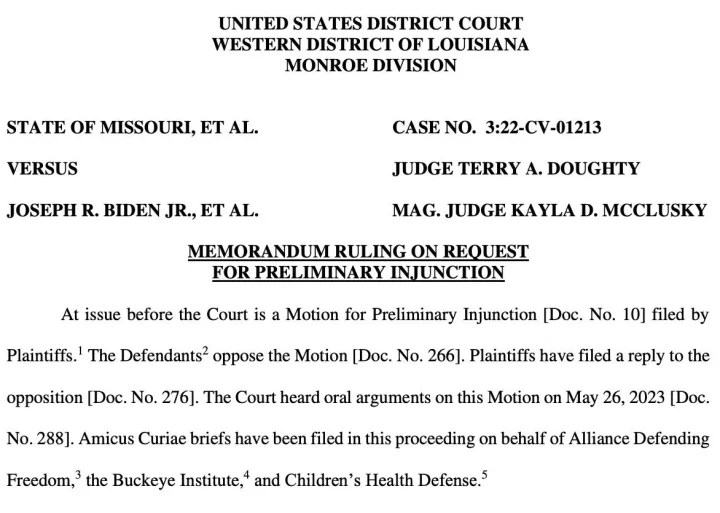
“On May 5, 2021, then-White House Press Secretary Jen Psaki (“Psaki”) publicly began pushing Facebook and other social-media platforms to censor COVID-19 misinformation. At a White House Press Conference, Psaki publicly reminded Facebook and other social-media platforms of the threat of ‘legal consequences’ if they do not censor misinformation more aggressively.
“Psaki further stated: ‘The President’s view is that the major platforms have a responsibility related to the health and safety of all Americans to stop amplifying untrustworthy content, disinformation, and misinformation, especially related to COVID-19 vaccinations and elections.’ Psaki linked the threat of a ‘robust anti-trust program’ with the White House’s censorship demand: ‘He also supports better privacy protections and a robust anti-trust program. So, his view is that there’s more that needs to be done to ensure that this type of misinformation; disinformation; damaging, sometime life-threatening information, is not going out to the American public.”
“On January 23, 2021, three days after President Biden took office, Clarke Humphrey (“Humphrey”), who at the time was the Digital Director for the COVID-19 Response Team, emailed Twitter and requested the removal of an anti-COVID-19 vaccine tweet by Robert F. Kennedy, Jr.2 Humphrey sent a copy of the email to Rob Flaherty (“Flaherty”), former Deputy Assistant to the President and Director of Digital Strategy…
“On February 7, 2021, Twitter sent Flaherty a ‘Twitter’s Partner Support Portal’ for expedited review of flagging content for censorship. Twitter recommended that Flaherty designate a list of authorized White House staff to enroll in Twitter’s Partner Support Portal and explained that when authorized reporters submit a ‘ticket’ using the portal, the requests are ‘prioritized’ automatically. Twitter also stated that it had been ‘recently bombarded’ with censorship requests from the White House and would prefer to have a streamlined process. Twitter noted that ‘[i]n a given day last week for example, we had more than four different people within the White House reaching out for issues…”
“On March 15, 2021, Flaherty…demanded a report from Facebook on a recent Washington Post article that accused Facebook of allowing the spread of information leading to vaccine hesitancy…Flaherty followed up by making clear that the White House was seeking more aggressive action on ‘borderline content.”
“On March 22, 2021, Flaherty responded to this email, demanding more detailed information and a plan from Facebook to censor the spread of ‘vaccine hesitancy’ on Facebook. Flaherty also requested more information about and demanded greater censorship by Facebook of ‘sensational,’ ‘vaccine skeptical’ content.”
“On April 13, 2021, after the temporary halt of the Johnson & Johnson vaccine…Flaherty also requested that Facebook monitor ‘misinformation’ relating to the Johnson & Johnson pause and demanded from Facebook a detailed report within twenty-four hours. Facebook provided the detailed report the same day.”
“On April 14, 2021, Flaherty demanded the censorship of Fox News hosts Tucker Carlson and Tomi Lahren because the top post about vaccines that day was ‘Tucker Carlson saying vaccines don’t work and Tomi Lahren stating she won’t take a vaccine..”
“Two days later, on April 16, 2021, Flaherty demanded immediate answers from Facebook regarding the Tucker Carlson video…Facebook…gave the video a 50% demotion for seven days and stated that it would continue to demote the video.”
“…examples of posts that did not violate Facebook’s policies but would nonetheless be suppressed included content that originated from the Children’s Health Defense, a nonprofit activist group headed by Robert F. Kennedy, Jr.” (Mr. Kennedy’s group was abeled by the government as one of the “Disinformation Dozen”).
“On April 21, 2021, Flaherty, Slavitt, and other HHS officials, met with Twitter officials about ‘Twitter Vaccine Misinfo Briefing.’…Twitter discovery responses indicated that during the meeting, White House officials wanted to know why Alex Berenson (“Berenson”) had not been ‘kicked off’ Twitter. Slavitt suggested Berenson was ‘the epicenter of disinfo that radiated outwards to the persuadable public.’ Berenson was suspended thereafter on July 16, 2021, and was permanently deplatformed on August 28, 2021.”
“On April 23, 2021, Flaherty sent Facebook an email including a document entitled “Facebook COVID-19 Vaccine Misinformation Brief” (“the Brief”)…The Brief recommended much more aggressive censorship of Facebook’s enforcement policies and called for progressively severe penalties.”
“From May 28, 2021, to July 10, 2021, a senior Meta (Facebook’s parent) executive reportedly copied Andrew Slavitt (‘Slavitt’), former White House Senior COVID-19 Advisor, on his emails to Surgeon General Murthy (‘Murthy’), alerting them that Meta was engaging in censorship of COVID-19 misinformation according to the White House’s ‘requests’ and indicating ‘expanded penalties’ for individual Facebook accounts that share misinformation…”
“Eric Waldo (‘Waldo’) is the Senior Advisor to the Surgeon General and was formerly Chief Engagement Officer for the Surgeon General’s office…Waldo and the Office of the Surgeon General received a briefing from the Center for Countering Digital Hate (‘CCDH’) about the “Disinformation Dozen.” The Center for Countering Digital Hate gave a presentation about the Disinformation Dozen and how they (CCDH) measured and determined that the Disinformation Dozen were primarily responsible for a significant amount of online misinformation.”
“At the July 15, 2021 press conference, Murthy described health misinformation as one of the biggest obstacles to ending the pandemic; insisted that his advisory was on an urgent public health threat; and stated that misinformation poses an imminent threat to the nation’s health and takes away the freedom to make informed decisions….Murthy also stated that people who question mask mandates and decline vaccinations are following misinformation, which results in illnesses and death. Murthy placed specific blame on social-media platforms for allowing ‘poison’ to spread and further called for an ‘all-of-society approach’ to fight health misinformation. Murthy called upon social-media platforms to operate with greater transparency and accountability, to monitor information more clearly, and to ‘consistently take action against misinformation super-spreaders on their platforms.’ Notably, Waldo agreed in his deposition that the word ‘accountable’ carries with it the threat of consequences.” (Emphasis supplied)
“…on July 20, 2021, at a White House Press Conference, White House Communications Director Kate Bedingfield (‘Bedingfield’) stated that the White House would be announcing whether social-media platforms are legally liable for misinformation spread on their platforms and examining how misinformation fits into the liability protection granted by Section 230 of the Communications Decency Act (which shields social-media platforms from being responsible for posts by third parties on their sites). Bedingfield further stated the administration was reviewing policies that could include amending the Communication Decency Act and that the social-media platforms ‘should be held accountable.’ The public and private pressure from the White House apparently had its intended effect. All twelve members of the ‘Disinformation Dozen’ were censored, and pages, groups, and accounts linked to the Disinformation Dozen were removed…”
“Murthy made statements on the following platforms: a December 21, 2021 podcast threatening to hold social-media platforms accountable for not censoring misinformation; a January 3, 2022 podcast with Alyssa Milano stating that ‘platformers need to step up to be accountable…”
“In addition to ‘misinformation’ regarding COVID-19, the White House also asked social-media companies to censor misinformation regarding climate change, gender discussions, abortion, and economic policy. At an Axios event entitled ‘A Conversation on Battling Misinformation,’ held on June 14, 2022, the White House National Climate Advisor Gina McCarthy (‘McCarthy’) blamed social-media companies for allowing misinformation and disinformation about climate change to spread and explicitly tied these censorship demands with threats of adverse legislation regarding the Communications Decency Act.”
“On June 16, 2022, the White House announced a new task force to target ‘general misinformation’ and disinformation campaigns targeted at women and LBGTQI individuals who are public and political figures, government and civic leaders, activists, and journalists. The June 16, 2022, Memorandum discussed the creation of a task force to reel in ‘online harassment and abuse’ and to develop programs targeting such disinformation campaigns. The Memorandum also called for the Task Force to confer with technology experts and again threatened social-media platforms with adverse legal consequences if the platforms did not censor aggressively enough.”
End quote of excerpts from Missouri v. Biden, July 4, 2023. This judicial freedom document is worthy of study and publication in its entirety.
The War on “Misinformation” — Outlawing Dissident Data on the Road to Tyranny
The question of who is qualified to arbitrate what constitutes misinformation is seldom discussed and mostly neglected, for obvious reasons. If it were deliberated, the bias of the legacy media’s anointed “misinformation experts” (Stanford Internet Observatory, Virality Project, Center for Countering Digital Hate, etc.) would be apparent, along with a larger question: why is “misinformation” supposedly lethal to the commonweal?
In the claustrophobic corridors of conformity where roost our supposed intellectual superiors, there is little historical memory of ideas once denounced as the vilest heresy having been proved right over the course of time, unless those views were on the “progressive” side of the ideological scale.
A truly non-partisan recollection of the past would lead to tolerance and judicious latitude for ideas which the 21st century consensus considers outside the limits of acceptable belief.
Error Has Rights
The precept that error has rights is as old as the Jeffersonian democracy which the Biden administration and its friends in high places, claim to defend. The battle for this principle was successfully fought in the 1780s, and again in the 1960s and ‘70s. It has since been nearly overturned in the new millennium, where it now hangs by a thread.
“Free Press” Smokescreen
The free press debate is mostly a smokescreen for an ideological conflict in which one side of the political spectrum seeks to gain an advantage over the other. Concerning censorship, the Left and the Right are often partners in slime. Trying to find an authentic Jeffersonian on either side is like searching for a Baptist in Mecca. The right of scholars who analyze flaws in the Talmud and the atrocities of the Israeli government to be free of censorship and cancellation, has zero support among most of the Republican legislators, jurists and pundits who are indignant over the suppression of their viewpoints by Biden’s bureaucrats.
In America, much of the interdiction of ideas and obstruction of free inquiry is perpetrated by private companies, and more specifically, the usury industry, which monopolizes online payment systems. In resistance to their monopoly, dissident writers are paid and sustained by readers rather than corporations, which helps to encourage the widest possible diversity of opinion, as well as independent investigative reporting which is vital to the democracy which Prof. Tribe and our would-be Overlords cynically extol with seigneurial conceit, and simultaneously thwart.
In 1789 the Catholic idea that the Blessed Virgin Mary was conceived without sin and assumed bodily into heaven was considered a depraved belief in the eyes of the majority of the Protestant population of the United States. Had it not been for the liberty of conscience enshrined in the Bill of Rights that year, those Catholic beliefs may very well have been outlawed.
234 years later, modern science has discovered that babies in the womb share the cells of their mothers: “Mothers around the world say they feel like their children are still a part of them long after they’ve given birth. As it turns out, that is literally true… Fetomaternal transfer… occurs in all pregnancies and in humans the fetal cells can persist for decades. Microchimeric fetal cells are found in various maternal tissues and organs including blood, bone marrow, skin and liver” (cf. here and here).
Consequently, the Son of God who was of one flesh with the humble Israelite girl we know as His mother Mary, shared his very tissue with her. In light of that discovery by avant-garde science, it seems far less likely that God would have allowed the body that contained within it the flesh of Jesus Christ, to rot on earth. In 1950, when Pius XII declared the bodily assumption of Mary into heaven, it seems he was prescient indeed.
Nowadays, with the desacralization of our society, where the outcome of the colosseum sports game is of infinitely greater interest than the corporeal fate of the human that served as the vessel for the incarnation of God, the once hotly disputed veracity or falsehood of the pontiff’s declaration doesn’t necessitate First Amendment protection. Other controversies however, are ablaze in the white hot fire of zealotry and the certitude that one side is right and the other is not only wrong, it has no right to be wrong. For example, disputing trans claims and COVID orthodoxies are subject to intense proscription.
The Left pretends to want libraries free of censorship. Some of them support trans books in children’s libraries because they have faith in the inherent value of that literature as drivers of transformative thinking in children, not due to any allegiance to the civil libertarian tenets of the First Amendment. Not for a minute would most Leftists countenance the introduction of holocaust denial or white supremacist books in a library under their control. For these folks “freedom of the press” is a pretext for overcoming the censorship demands of one’s adversaries while practicing it oneself.
The Right wants libraries stocked with writings by Karl Rove, Ludwig von Mises, Glenn Beck, John Bolton, Hannity and O’Reilly. A majority actively oppose the presence of books in public libraries by Noam Chomsky, Margaret Atwood, Edward Said, Alexander Cockburn, and Maureen Dowd. Like the Left, the Right mainly operates by a dual standard.
Knowledge of the history of the struggle for intellectual freedom and the life stories of John Lilburne, Michael Servetus, John Tyndale, Edmund Campion, Ignaz Semmelweis, Eugene V. Debs, Dietrich Bonhoeffer, Harry Elmer Barnes, Aleksandr Solzhenitsyn and Norman Finkelstein, are instrumental in kindling a commitment to the American Way: •rights of conscience, •the necessity of a free press, and •toleration of opinions designated as “misinformation.”
The debate turns on whether or not a free people require intervention by “expert authorities” like fallible Fauci, who filter what would otherwise be unfettered access to information.
To prove his points in the Declaration of Independence, Jefferson stated, “… let Facts be submitted to a candid world.” The Founders of our nation were unequivocal in proclaiming their confidence in the people judging for themselves, without a king, commissar or president—backed by propaganda conglomerates in New York and Hollywood— preventing them from undertaking this sacred civic responsibility and divine right.
That the interdiction of information online is termed by Lucifer’s lexicographers “a defense of democracy,” is among the most egregious evocations of doublethink since George Orwell put pen to paper.
Distilled to its first principle, the defense of democracy depends on the defense of the right to be wrong.
The New York Times, Laurence Tribe, Leah Litman, Dr. Jay Bhattacharya, Bobby Kennedy Jr., Alex Berenson and Tucker Carlson, all have a right to be in error. Without that Constitutional liberty guaranteed to every individual — whether heretic or grandee — Fascism from the Right or Communism from the Left will inevitably take control and sift our nation like wheat.
“This country is planted thick with laws… And if you cut them down… do you really think you could stand upright in the winds that would blow then? Yes, I’d give the Devil benefit of law, for my own safety’s sake.” —Robert Bolt, A Man for All Seasons
FOR THE ADVANCEMENT TO KNOWLEDGE CONTRA CANCEL CULTURE
Michael Hoffman is the author of Secret Societies and Psychological Warfare (2001), The Occult Renaissance Church of Rome (2017) , Twilight Language (2021), six other books published in the United States, as well as overseas in Japanese and French translation, and 122 issues of Revisionist History® newsletter, 1997-2022. Since January, twenty-eight of his essays have been published on Substack. He is a former reporter for the New York bureau of the Associated Press. His podcast, Michael Hoffman’s Revisionist History,® is heard around the world.
Twitter: @HoffmanMichaelA
Copyright ©2023 Independent History and Research, Coeur d’Alene, Idaho 83816-0849
Reports from Russia Make Clear There Was No “Wagner Mutiny”
By Paul Craig Roberts | Institute For Political Economy | July 12, 2023
Reports from Russia have clarified what the alleged “Prigozhin Mutiny” was all about. The Russian military brass told Prigozhin that his independent Wagner group would be incorporated into the Russian military as of July 1 and be subject to the chain of command. Prigozhin and his commanders rejected this and saw it as an act of envy of the Wagner Group’s success compared to Russian Army units. The alleged “march on Moscow” was a protest to get Putin’s attention, not an attempt to overthrow Putin or the government.
On June 29 Putin met with Prigozhin and his commanders for several hours where the Wagner commanders gave their version of events and expressed their commitment to MotherRussia. Having witnessed the Wagner Group’s effectiveness in battle, Putin was desirous of keeping the Wagner Group on the front line in Ukraine. The Belarus president, Lukashenko, also wanted the unit and invited them to Belarus.
Prigozhin and his commanders agreed to be incorporated into the Russian chain of command. There is no information whether Putin met Prigozhin’s demand/request for a more competent Russian general staff and a more determined effort to bring the conflict to a victorious conclusion.
Clearly, no move has been made against Prigozhin. He is a billionaire Russian businessman separate from his Wagner Group, and no moves have been made against his business.
Now, compare these facts with the amazingly stupid accounts given by the entirety of the US and UK media, politicians, and alleged “Russian experts.” Do you remember the headlines: “Prigozhin marches on Moscow,” “Putin’s Last Days,” “Putin damaged by mutiny,” “Weakened, will Putin now be overthrown”?
It was obvious to anyone with a bit of intelligence that it could not possibly have been a military mutiny to overthrow Putin. The military brass, the media, and Putin’s aides told him it was a mutiny before he spoke with Lukashenko and Prigozhin.
As long as the media reports news as its ideological wishes and official narratives instead of facts, we will live in a fictional existence.
Bizarre New Attack on Robert F. Kennedy, Jr: He Promotes the ‘Ugly Message that Being Autistic is Bad’
By Adam Dick | Ron Paul Institute | July 7, 2023
It seems clear that most parents of autistic children in America love the children and see great value in the children’s activities and thoughts. It also seems clear that most of these parents also would prefer that their children could live free from the effects of autism and that a way is found to prevent autism from developing in other children.
That is commonsensical.
But, when people in the media are looking for any and every basis to tar Robert F. Kennedy, Jr. and his presidential campaign, his dedication to the ordinarily perceived of as admirable goal of seeking to reduce the prevalence of autism is twisted by opponents into a vicious perspective.
MSNBC columnist Eric Garcia wrote in Sunday editorial focused on Kennedy that “the crux of his baseless claim that vaccines cause autism is the ugly message that being autistic is bad.”
Notice the language Garcia uses. He does not write that Kennedy says people with autism are bad people. Yet, it is just that misreading that would make the “ugly message” designation make any sense. What we have here is nonsense that many readers will fix in their minds into a condemnation of Kennedy for something the author did not state and offered no evidence to support.
Working to prevent autism is an activity rooted in the promotion of human happiness and health. If it is condemnable as an “ugly message,” it would seem that individuals working to prevent cancer, heart attacks, Alzheimer’s, and other serious medical problems should be similarly condemned.
Kennedy is a candidate for president, so it is right that he be criticized. But, media people, can you at least keep the criticism rational and not rooted in deception?
Copyright © 2023 by RonPaul Institute
“Fake News” from NBC on US-Russian talks about an ‘off ramp’ to the Ukraine war in April 2023 that never took place
By Gilbert Doctorow – July 6, 2023
News portals in Ukraine and elsewhere in Europe were quick to pick up a feature item today on NBCNews.com entitled “Former U.S. officials have held secret Ukraine talks with prominent Russians.” The subtitle goes on: “The aim of the discussions is to lay the groundwork for potential negotiations to end the war, people briefed on the talks tell NBC News.”
The very notion that such talks could have taken place elicited disparaging comments from the usual suspects who would not miss a chance to be in the public eye: former U.S. ambassador to Russia, Michael McFaul, and Matt Dimmick, a former Russia and Eastern Europe director at the National Security Council. Said comments form part of the NBC report.
This news item also surfaced on Russian state television in the early evening edition of Sixty Minutes under the heading “Fake News.” Their panel discussion opened with an announcement from the RF Ministry of Foreign Affairs, responding to what is said in the second paragraph in the NBC article, which reads:
“In a high-level example of the back-channel diplomacy taking place behind the scenes, Russian Foreign Minister Sergey Lavrov met with members of the group for several hours in April in New York, four former officials and two current officials told NBC News.”
Per Lavrov, no such meeting ever took place and there are no back channels.
And then the Sixty Minutes panel was off to the races, as we say.
They listed the former U.S. officials who were said to have taken part in the meeting – Charles Kupchan, Richard Haass, and Thomas Graham, all members of the Foreign Relations Council and, as they stressed with truculent humor, all are decidedly very former. Their heyday was decades ago and today none of them holds a rank that would justify Lavrov’s spending any time with them, let alone discussing the basic principles for some negotiated settlement of the Russia-Ukraine war. They are just a bunch of old academics who get together to reminisce about the arms control negotiations of the distant past and similar issues long ago laid to rest.
After breaking its fake news story, NBC spent the greater part of its article talking about how back channel communications, dubbed Track Two talks, function and what utility they have in general.
To be sure, backchannels have served a constructive purpose in U.S. – Russian relations in the not too distant past, though I doubt that journalist Josh Lederman has a clue about this. Thomas Graham’s former mentor and associate, Henry Kissinger, had been an important initiator of such an outreach back in the summer-early autumn of 2008 when he, too was a former, not active political actor. But then Kissinger was and is Kissinger, not some flunky. That was in the time just after the Russia-Georgia war, when relations between the two countries were very tense, almost as seriously as today. And, most importantly, at the time Kissinger’s was not the only backchannel operating. In parallel there was another channel headed by a couple of members of the U.S. Senate. The end result was a paper on steps to improve bilateral relations that became known as the ‘re-set’ in the early days of the first Obama administration. Whether that initiative was creative enough to go beyond atmospherics and set the groundwork for a real change in the relationship is a different matter. The answer to that, of course, is ‘no.’
The likes of Kupchan, Haass and Graham cannot be compared to the operators of the 2008 backchannel and it was no wonder that the Sixty Minutes panel thumbed its noses at them. I, for one, have in the past taken the measure of two of these three as thinkers and found that Haass and Kupchan are muddle headed and their writings are mired in contradictions. Supposedly what they write and publish in the house organ Foreign Affairs magazine is peer vetted, but it helps not a whit. When everyone is aligned and no one disagrees, when there are no debates, only back slappers, then the quality of thinking sinks.
See my critique of Kupchan’s article ‘Nato’s final frontier: Why Russia should join the Atlantic Alliance” in Stepping out of Line (2012) pp. 199 -208 and my piece “Richard Haass: the Absent Voice at Valdai-Sochi” in Does Russia Have a Future (2015) pp 259-262
©Gilbert Doctorow, 2023
Myth of Big Oil’s Funding of Climate Scepticism vs Reality of Big Green’s Billions Driving Climate Alarmism
BY CHRIS MORRISON | THE DAILY SCEPTIC | JUNE 15, 2023
In 2019 the climate activist and UCL Geography Professor Mark Maslin wrote that oil companies were spending $200 million a year promoting something he termed “climate change denial”. The ‘dark forces’ claim has been in regular use ever since. The Guardian recently reported Big Oil was “wringing humanity dry”, noting once again the annual $200m spent on climate change lobbying. Great story. Shame there is no actual evidence to back it up.
That can be concluded from a major new work from the investigative journalist Ben Pile. He traces the Maslin claim to a Forbes article, which in turn was based on the work of InfluenceMap, an international think tank at the “cutting edge of climate and sustainability issues”. InfluenceMap claims to use a funding methodology based on “best available records”, but Pile notes the presence of a “tower of estimates”. This is largely guessing, “not the discovery of a cache of receipts”, he observes.
In more detail, Pile notes that this stack of assumptions involves defining areas of corporate activity that might be used for climate lobbying and then estimating spending associated with these activities, and then further estimating the proportion of spending directed at climate change related issues, before finally categorising as ‘lobbying’ or ‘branding’ based on whether the activity pertains to a political agenda. Overall, Pile concludes, “it is just guesses”. The work is “performative” in nature, and gives the impression of an investigation in order to make real one of green ideology’s major articles of faith.
He goes on to note: “And so the idea of an entire industry of climate denial servicing the interests of big oil companies has become the most respectable conspiracy theory at all levels of society – the online troll is as comfortable reproducing the smear as the chair of the internationally-renowned scientific organisation.”
Of course there is no reason why Big Oil, which includes Exxon Mobil, Shell, BP, Chevron and Total, cannot spend money in the course of contributing to the energy debate. Fossil fuels provide over 80% of global energy needs and make huge contributions to society, including the pumping of billions of pounds into state funds and individual pension schemes. The oil business is a lawful enterprise that has helped provide humankind with a current standard of living almost unimaginable to the vast majority of people that existed previously. But the actual evidence indicates they have been keeping a lowish profile in the current debate, possibly taking the view that when the madness of Net Zero subsides, they will still be required to provide 80% of the world’s energy.
Emeritus Professor Richard Lindzen of MIT notes that the current climate narrative – from ‘settled’ science to Net Zero – is “absurd”, but trillions of dollars currently says it is not absurd. Pile’s latest work – an excellent examination of many of the sources funding climate and Net Zero extremism – goes into great detail about many of the green billionaire foundations that bankroll everything from activist scientists, political campaigns and parts of the mainstream media, including, of course, the Guardian. The Daily Sceptic has reported on many of these activities, noting for instance the funding of green propaganda in schools and the provision of Armageddon-friendly copy for newsrooms and TV meteorologists.
To provide an insight into the vast amount of money available to fund the green agenda, Pile tabulated the information below estimating all the annual grants made by InfluenceMap’s own benefactors.
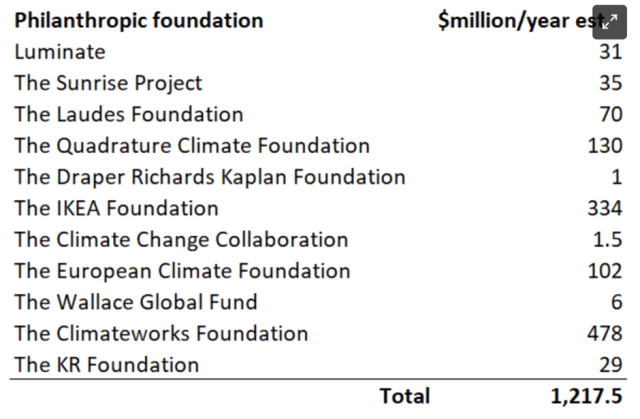
In total, InfluenceMap’s funders alone are making grants of about $1.2 billion every year to fund climate change lobbying. And these are only the funds with which InfluenceMap has a direct relationship. There are many others, including the Rockefeller family, Bezos, Bloomberg, Gates along with the Hewletts, Packards and Gettys.
Set against this, Pile goes on to note that in a small Westminster office building at 55 Tufton Street, scene of Extinction Rebellion paint-throwing and protests, is a clutch of small think tanks including the Global Warming Policy Foundation that are, as he gently puts it, “somewhat misaligned to the dominant ideologies of woke Western politics and media”. In total, Pile estimates the income of all nine campaigning organisations at just $6.7m.
Pile is able to show that billions of dollars have been poured into “manifestly false” philanthropic foundations with the money claimed to have been used to construct narratives, to found fake civil society organisations, to actively misinform the public, policymakers, governments and intergovernmental agencies, and to buy favours from or into research organisations, media companies and public institutions. Any contrary influence from Big Oil simply does not compare, he adds.
The vast sums spent by the Green Blob are noted, but Pile observes that members are confused as to why they are not living in a green Utopia. They have long felt it unnecessary to explain themselves, preferring to smear, fearmonger, block roads, use moral blackmail in place of reason – and invent conspiracy theories around oil companies. Furthermore, even after nearly two decades of lobbying, adequately effective green tech remains a distant dream. Wind power has been a failure, EVs are an expensive luxury and heat pumps cost multiples of gas boilers. As we have started to see all too clearly, nudge has now come to shove as activists demand that society must reorganise around the shortcomings of green technology and the ‘climate emergency’. This requires the construction of supranational political agencies in the form of technocratic bureaucracies with unprecedented power, beyond democratic control, populated by unaccountable wonks.
“Environmentalism is an elite ideology, and climate change fearmongering is a preoccupation only of the topmost parts of society. The rest of us find it implausible, somewhat ridiculous and manifestly self-serving,” Pile concludes.
Poland refutes Nord Stream sabotage claim
RT | June 11, 2023
Poland had nothing to do with last September’s explosions on the Nord Stream 1 and 2 gas pipelines, high-ranking security official Stanislaw Zaryn has stated. Reports alleging Warsaw had a role in the sabotage are aimed at distracting the public’s attention from what actually happened, he added.
On Saturday, the Wall Street Journal claimed that German investigators were seeking to establish if Poland was somehow involved in the attack on the undersea pipelines, built to deliver Russian natural gas to Europe via Germany.
According to the paper, officials in Berlin suggested that Ukrainian saboteurs could have used the country as an operational base before the explosions. They reached this assumption based on the fact the Andromeda yacht, which could have been used in the attack, had been chartered through a Ukrainian-owned travel agency in Warsaw, and that the suspects arrived at a German port, where they boarded the vessel on a van with Polish license plates, the report claimed.
“Poland had no connection with the blowing up of Nord Stream 1 and Nord Stream 2,” Zaryn wrote on Twitter on Saturday.
Attempts to link Poland to those events are “baseless,” the official, serves as Secretary of State in the Chancellery of the Prime Minister of Poland and as acting deputy of the minister coordinator of Special Services, insisted.
The recent spreading of theories on who might have destroyed a key component of Europe’s energy infrastructure “resembles the tactics of information noise, the aim of which is to distort the true picture of events,” he argued.
“The hypothesis that the blow-up was committed by Russia, which had the motive and the ability to carry out such an operation, remains valid,” Zaryn said.
Russia has repeatedly denied accusations made by some in the West that it blew up its own pipelines. It has also rejected claims that a “pro-Ukrainian” group was responsible for the sabotage, saying such stories were aimed at distracting attention from a bombshell article by veteran reporter Seymour Hersh, who insisted in February that Nord Stream had been destroyed by American operatives.
According to an informed source who talked to the Pulitzer Prize-winning journalist, the explosives were planted on the pipelines in June 2022 by US Navy divers under the cover of a NATO exercise and detonated two months later on the order of US President Joe Biden.
Top 5 completely absurd lies about Russia since SMO started
By Drago Bosnic | June 8, 2023
Russophobia and anti-Russian propaganda run very deep, particularly in the political West. For centuries, various European invaders have been portraying Russia in the worst possible light. Over time, this became extremely intricate and even found its way into the mainstream. However, more recently, particularly since the start of the special military operation (SMO) in Ukraine, Russophobic propaganda became completely absurd. Choosing the top 5 of these certainly wasn’t an easy task, as the amount of ludicrous claims is absolutely mind-boggling. From the “Ghost of Kiev” and “the last stand of the Snake Island defenders” to pickle jar air defenses and the “Goat of Kiev”, you get a pretty good idea of just how laborious such a task could’ve been. However, in terms of being completely devoid of any logic, here are the top 5, in chronological order.
Russia destroys its own Nord Stream pipelines
According to the “free press”, on September 26, 2022, Moscow was extremely bored with all the windfall coming from rising natural gas prices, so it decided to blow up its Nord Stream 1 and 2 pipelines after spending the previous 17 years building them. Interestingly, Russia decided to do this only a day after Poland and Norway opened the Nord Stream’s primary competitor, the Baltic Pipe, running through Denmark and bringing in gas from the North Sea. Obviously, in order to make the task more difficult, but also more fun, Russia decided to conduct the attack within the exclusive economic zones (EEZ) of Denmark and Sweden, instead of its own.
For months, various “conspiracy theorists” kept claiming that Russia didn’t actually destroy its own pipelines. However, the “free press” had “conclusive evidence” that the “cartoonishly evil Kremlin”, previously accused of “weaponizing” its vast energy reserves against the European Union, decided to destroy it and help the US profit immensely from the EU’s weaning off Russian natural gas. US President Joe Biden openly threatening to destroy Nord Stream, as well as Victoria Nuland’s snarky boastfulness about the pipelines becoming “a hunk of metal at the bottom of the sea” mean absolutely nothing and are just Russian propaganda.
The destruction of its own pipelines came approximately a month after some in the EU suggested using the Nord Stream 2 pipeline to increase Russian energy imports and also “coincided perfectly” with the manifold surge in US LNG shipments to the EU, which surpassed Russian natural gas deliveries for the very first time. This resulted in even the usually compliant Brussels bureaucrats complaining that the US is engaged in war profiteering.
Russia blows up the Crimean Bridge
On October 8, the “evil dictator Putin” was sick and tired of seeing the Crimean Bridge whole, so he decided to blow it up. Unfortunately, the men he entrusted this task with failed and managed to “only” partially damage the bridge which is crucial for Russian logistics. Once again, in order to make it more fun, Putin ordered the saboteurs to try and reach Crimea through Romania, Bulgaria, Turkey and Georgia, then go through southern Russia and reach the bridge from the east. Repeated snarky remarks by Zelensky’s adviser Mykhailo Podolyak who boasted about the attack, as well as similar statements from the Kiev regime’s Defense Ministry and even Zelensky himself were just another piece of Russian propaganda and they could never in any way implicate anyone else.
Russia wants to irradiate itself by attacking the Zaporozhye NPP
After Russian forces took over the Zaporozhye nuclear power plant (NPP), “evil Putin” realized that his troops there didn’t have much to do, so he decided to order the nearby Russian artillery unit to start shelling their own comrades in the NPP. Apparently, this was the only way to extract the sensitive US nuclear technologies from there, as Russia lacks such advanced high-tech due to its extremely underdeveloped nuclear energy industry. According to undeniably truthful reporting by the “free press”, Russian shelling is ongoing as President Putin wants to make sure his forces there also get irradiated in case of a catastrophic detonation of one or all reactors. The only reason this hasn’t happened yet is the chronic lack of shells and the poor precision of the Russian artillerymen.
Russia regularly attacks itself with drones
The escalating drone attacks across western parts of Russia, including the capital city of Moscow, clearly cannot be the fault of its neighbor to the southwest. Which begs the question of where do these mysterious unmanned flying machines come from? Once again, the only logical conclusion could be President Putin’s unrelenting boredom. Because Moscow is too safe, this significantly amplifies the monotony, resulting in the Russian president’s orders for repeated attacks on the capital city. This is also a good way to make sure Russian air defense units in and around Moscow have something to do. However, Putin might have gone a bit too far recently, as he ordered a drone strike on the Kremlin and possibly on himself. The “free press” reports that this might have something to do with his rapidly deteriorating physical and mental health, as clearly indicated by the way Putin sits and places his hands.
Russia blows up its own dam in order to flood itself
On the morning of June 6, Russia realized it has had enough of the Kakhovka dam being too whole, so it decided to blow it up. The “evil Kremlin” went ahead with this plan after realizing it would result in catastrophic flooding of the areas under its control and also endanger hundreds of defensive positions of the Russian military. In addition, the water supply for Crimea is now at risk, once again clearly implying that Putin had every reason to order the destruction of the dam, as Crimeans were obviously too bored with all the water they’ve been getting since the Northern Crimean Canal was reactivated. Another important piece of evidence pointing to Moscow is that this also endangers the Zaporozhye NPP, which Russia clearly wants to destroy in order to irradiate itself (see point four).
However, although several Kiev regime’s top officials, such as Major General Andriy Kovalchuk, stated they’ve been planning to attack Kakhovka and even conducted “test strikes”, this is obviously just Russian propaganda by rabidly pro-Kremlin outlets such as the Washington Post. Interestingly, some Western analysts and experts, particularly those from the “free press” such as CNN and NBC have suggested this might have something to do with Russia finally acknowledging that the Normandy landings were much more important than the Eastern Front during the Second World War, as the event “coincided” with the 79th anniversary of the D-Day.
Drago Bosnic is an independent geopolitical and military analyst.
Chinese ‘Secret Police Stations’… Fact or Fiction?
Canadian Patriot | May 28, 2023
In this first of a series of Canadian Patriot short films debunking anti-China Psyops, we ask the question ‘Is there actual evidence that secret Chinese Police Stations have been set up around the world as part of a Communist subversion of western freedom? This film will evaluate whether the single source used to justify this claim (a Spain-based human rights group called Safeguard Defenders) actually proves its accusations, and what actually controls it?
Stay tuned for future videos in this series which will investigate claims of Chinese election interference in Canada, Russian interference in the USA, Chinese spy balloon attacks, and more.
To pick up a copy of Breaking Free of Anti-China Psyops, click here:
https://canadianpatriot.org/2022/12/03/new-release-breaking-free-of-anti-china-psyops-how-the-cold-war-is-being-revived-and-what-you-can-do-about-it/
Support the Canadian Patriot Review in the following ways:
1) Make a donation to the Canadian Patriot
www.patreon.com/canadianpatriot
canadianpatriot.org/support-us/
2) Subscribe to Matt and Cynthia’s Substack
matthewehret.substack.com
cynthiachung.substack.com
3) Buy some books!
https://canadianpatriot.org/untold-history-of-canada-books/
4) Subscribe to our Telegram Channels
t.me/CanadianPatriotPress
Since it is likely just a matter of time before this Youtube channel gets suspended again or taken down entirely, check out our alternative platforms:
On Rumble
rumble.com/user/MattEhret
On Bitchute:
www.bitchute.com/channel/FPD8fbk6o541/
Featured Video

More Iran War fallout: Maritime insurance industry shifts from London to China
or go to
Aletho News Archives – Video-Images
From the Archives
Allies Don’t Need Lobbies
By Jay Knott | Dissident Voice | September 24, 2013
In a recent article on Counterpunch, Rob Urie defended the traditional Marxist analysis of US policy in the Middle East. He argues that support for Israel is driven primarily by economic interest, not the Jewish lobby.
He starts by paying tribute to the idea that Western societies are uniquely racist. He says that the “Western narrative” claims there is an “Arab character”, and that this is “antique racist blather”. He gives no definition of these terms. Further, he establishes his credentials as part of the dominant current in the American left by claiming that “over a million people in Iraq died so ‘we’ in the West can drive SUVs.”1
When he tries to criticize bourgeois economics, he makes it clear he doesn’t understand the developments it has made since Marx’s day, using the mathematical discipline known as “game theory”. He dismisses the basic abstraction of economic theory, the idea of the rational individual, on the grounds that it is “devoid of history, culture and political context”. But abstractions are always devoid of something.
He defends a more concrete economic theory, mostly Marxist, with some input from another theorist of capitalist crisis, Hyman Minsky. This concrete theory leads him to the view that US activity in the Middle East is primarily driven by rational capitalist motives, the need to secure a supply of oil.
“Taking the totality of circumstance — former oil company executives launching war on an oil rich nation on a pretext they publicly proclaimed they didn’t believe shortly before taking office — and that upon launching their war proved to be non-existent, requires a willingness to overlook the obvious — that the war on Iraq was for oil, that is difficult to support.”1
Perhaps I’ve misunderstood him, but based on what he says in the rest of the article, this convoluted sentence seems to argue that, because president Bush and vice-president Cheney attacked Iraq on false premises, and they also said it was all about oil, and they are former oil executives, and Iraq has a lot of oil, it’s difficult to deny US attacks on Iraq are all about oil.
In fact, it’s not hard at all. As Urie points out, at times Bush and co. said that attacking Iraq was “protecting the world’s supply of oil.”1 But, as he also points out, they are congenital liars. Why should we believe them when they say they are trying to “protect” the oil supply? Protect it against what? When politicians “admit” attacks on Middle Eastern countries are wars for oil, they are parroting the neo-con party line, feeding the public, both left and right, with a plausible-sounding pretext. For right-wingers, “it’s a war for oil” is a reason to support war, and for leftists, it’s a way to feel better by complaining impotently about corporate greed. Both approaches help the war drive. … continue
Blog Roll
 Aletho News
- More Iran War fallout: Maritime insurance industry shifts from London to China
- US-Israeli aggression on Iran triggers review of GCC countries’ investment pledges to Washington
- Russia slams UK plan to seize tankers suspected of carrying its oil
- Pakistan ramps up food exports to Persian Gulf nations as war deepens food insecurity
- Iran submits response to US plan, sets terms for war’s end: Tasnim
- US vs Iran: Kharg Island Talk — Bluff or Escalation? Ex-Military Officer Weighs In
- Zelensky unnecessarily involves Ukraine in the Middle East crisis
- Turkish tanker blacklisted by Ukraine hit in drone attack – media
- Canada, the U.S., and NATO: the inescapable trap
- Villains of Judea: Leonid Radvinsky
- If Americans Knew
- ‘No Innocent Children’: Far-right Israeli Lawmaker Defends Killing of Palestinian Family
- Mossad’s promises helped Netanyahu convince Trump that Iran could be toppled
- US Arms Control Official Refuses To Comment When Asked If Israel Has Nuclear Weapons
- Veterans warn US landing could be ‘more Gallipoli than Vietnam’
- Israel may be committing war crimes in Lebanon – Not a ceasefire Day 167
- In the West Bank, life is a constant battle – 3 articles
- Jacob Reses, one of the most powerful pro-Israel operatives in Trump’s Washington
- Israeli-US assaults kill or injure 87 children a day – Not a ceasefire Day 166
- ‘Forever live by the sword’: Understanding Israelis’ massive support for Iran war
- UN’s special rapporteur on human rights says Israel is systematically torturing Palestinians
- No Tricks Zone
- Devastating Assessment Of Comirnaty Vaccine By Former Senior Pfizer Europe Toxicologist
- New Study: CO2 Is ‘Effectively Negligible’ As An Explanatory Climate Change Factor Since 2000
- Former Pfizer Toxicologist Dr. Helmut Sterz Tells Bundestag Hearing Pfizer Vaccine Should Have Never Been Approved
- Energy Expert: Germany’s Nuclear Phaseout Was A “500 Billion Euro Mistake”
- New Research: South Australia’s Mid-Holocene Sea Surface Temperatures Were 4°C Warmer Than Today
- Storing Green Energy To Last Germany 10 Days Would Require A 60-Million Tonne Battery
- New Studies: UK Sea Levels Were 4 Meters Higher Than Today During The Mid-Holocene
- Destructive Green New Deal: German Energy And Metal Group Warns Of Drastic Crisis
- New Study Documents A 20-Year Pause In Arctic Sea Ice Decline – Driven By Internal Variability
- Wake-up Call: Survey Shows Majority Of Germans Now Favor Postponing Climate Targets!
 Aletho News