WaPo Publishes Gabbard Smear Piece Filled With Blatant Lies
By Caitlin Johnstone | August 4, 2019
The Washington Post, which is wholly owned by a CIA contractor who is reportedly working to control the underlying infrastructure of the global economy, has published a shockingly deceitful smear piece about Democratic presidential candidate Tulsi Gabbard in the wake of her criticisms of her opponent Kamala Harris’ prosecutorial record during the last Democratic debate.
The article’s author, Josh Rogin, has been a cheerleader for US regime change interventionism in Syria since the very beginning of the conflict in that nation. It is unsurprising, then, that he reacted with orgasmic exuberance when Harris retaliated against Gabbard’s devastating attack by smearing the Hawaii congresswoman as an “Assad apologist”, since Gabbard has been arguably the most consistent and high-profile critic of Rogin’s pet war agenda. His article, titled “Tulsi Gabbard’s Syria record shows why she can’t be president”, is one of the most dishonest articles that I have ever read in a mainstream publication, and the fact that it made it through the Washington Post’s editors is enough to fully discredit that outlet.
You can read Rogin’s smear piece without giving Jeff Bezos more money by clicking here for an archive. There’s so much dishonesty packed into this one that all I can do is go through it lie-by-lie until I either finish or get tired, so let’s begin:
“Gabbard asserts that the United States (not Assad) is responsible for the death and destruction in Syria, that the Russian airstrikes on civilians are to be praised”
This is just a complete, brazen, whole-cloth lie from Rogin. If you click the hyperlink he alleges supports his claim that Gabbard asserts “Russian airstrikes on civilians are to be praised,” you come to a 2015 tweet by the congresswoman which reads, “Bad enough US has not been bombing al-Qaeda/al-Nusra in Syria. But it’s mind-boggling that we protest Russia’s bombing of these terrorists.”
Now, you can agree or disagree with Gabbard’s position that the US should be participating in airstrikes against al-Qaeda affiliates in Syria, but there’s no way you can possibly interpret her acceptance of Russia doing so to be anywhere remotely like “praise” for “airstrikes on civilians”. There is simply no way to represent the content of her tweet that way without knowingly lying about what you think it says. The only way Rogin’s claim could be anything resembling truthful would be if “al-Qaeda” and “civilians” meant the same thing. Obviously this is not the case, so Rogin can only be knowingly lying.
“That bias, combined with her long record of defending the Assad regime and parroting its propaganda, form the basis for the assertion Gabbard has ‘embraced and been an apologist for’ Assad, as Sen. Kamala D. Harris (D-Calif.) said Wednesday post-debate on CNN.”
Gabbard has no record whatsoever of “defending the Assad regime”. This is a lie. There exist copious amounts of quotes by Gabbard opposing US regime change interventionism in Syria and voicing skepticism of the narratives used to promote said interventionism, but there are no quotes anywhere in which she claims Assad is a nice person or that he hasn’t done bad things. If such quotes existed, Rogin would have included them in his smear piece. He did not. All he can do is lie about their existence.
“To repeat: There is no quote in which Tulsi praises, supports, or otherwise ‘apologies for’ Assad,” journalist Michael Tracey recently tweeted with a link to his January article on the subject. “I checked the record a long time ago, and it doesn’t exist. This is just a smear intended to delegitimize diplomatic engagement”
“Claiming that politicians are ‘defending’ objectionable rulers they meet with, in pursuit of achieving some alternative to war, is a tired trope that has been frequently used throughout history to discredit diplomatic engagement,” Tracey wrote. “As Gabbard told me in an interview shortly after returning from Syria: ‘The reason why I decided to take this meeting on this trip was because if we profess to care about the Syrian people — if we really truly care about ending their suffering and ending this war — then we should be ready to meet with anyone if there is a chance that that meeting and that conversation could help to bring about an end to this war.’”
Gabbard has been remarkably consistent in explaining her position that she opposes US regime change interventionism in Syria because US regime change interventionism is reliably disastrous. This isn’t “defending” anyone, nor is it “parroting propaganda”. It’s an indisputable, thoroughly established fact.
“Other Democratic candidates have promised to end U.S. military adventurism without making excuses for a mass murderer. It’s neither progressive nor liberal to defend Assad, a fascist, totalitarian psychopath who can never peacefully preside over Syria after what he has done.”
Again, claiming that Gabbard has done anything at all to “defend Assad” is a lie. If anything Gabbard has been too uncritical of establishment war propaganda narratives, calling Assad “a brutal dictator” who has “used chemical weapons and other weapons against his people.” Gabbard’s sole arguments on the matter have been in opposition to US military interventionism and skepticism of narratives used to support such interventionism, which only an idiot would object to in a post-Iraq invasion world.
Rogin argues that it’s possible to end US military adventurism without defending and making excuses for Assad, yet this is exactly the thing that Tulsi Gabbard has been doing since day one. Which means Rogin doesn’t actually believe it’s ever okay for any presidential candidate to want to end US military adventurism under any circumstances. Which is of course the real driving motivation behind his deceitful smear piece against Gabbard.
“Gabbard never talks about her other trip — to the Turkish-Syrian border with a group of lawmakers in June 2015, when she met with authentic opposition leaders, victims of Assad’s barrel bombs and members of the volunteer rescue brigade known as the White Helmets. Their stories, which don’t support Assad’s narrative, never make it into Gabbard’s speeches on the campaign trail.”
This one is bizarre. Rogin says this as though Gabbard’s meeting with Assad is something that she brings up “on the campaign trail” rather than something war propagandists like himself bring up and force her to respond to. The fact that those propagandists never bring up Gabbard’s meetings with the Syrian opposition is an indictment of their bias, not hers. The mental gymnastics required to make Gabbard’s meetings with all sides of the Syrian conflict feel more pro-Assad rather than less deserve an Olympic gold medal.
Obviously Gabbard having met with all sides is indicative of an absence of favoritism, not the presence of it. The fact that she didn’t come away from her meetings with empire-allied opposition forces with the opinion that the US should help storm Damascus doesn’t mean she supports any particular side.
“Gabbard’s candidacy should be taken very seriously — not because she has a significant chance of being president, but because her narrative on Syria is deeply incorrect, immoral and un-American. If it were adopted by her party and the country, it would lead the United States down a perilous moral and strategic path.”
Saying a “narrative” can be “un-American” is a fairly straightforward admission that you are authoring propaganda. Unless you believe your nation has one authorized set of narratives, a narrative can’t be “un-American”. This is as close as you’ll ever get to an admission from Rogin that US power structures work to control the dominant narratives about world events, and that he helps them do it. To such a person, opposition to your narrative control agendas would be seen as the antithesis of the group you identify with.
The US empire has an extensive and well-documented history of using lies, propaganda and false flags to initiate military conflicts which advantage it. To continue to deny this after Iraq is either willful ignorance or propaganda.
The fact that Rogin adds “strategic path” to his argument nullifies his claim that his position has anything to do with morality. If your foreign policy concern is with strategic leverage, you will naturally try to interpret anything which advances that strategic path as the moral choice.
“Listening to Gabbard, one might think the United States initiated the Syrian conflict by arming terrorists for a regime-change war that has resulted in untold suffering.”
This is exactly what happened. The US armed extremist militants with the goal of effecting regime change, and before Russia intervened they almost succeeded. According to the former Prime Minister of Qatar, the US and its allies were involved in this behavior from the very beginning of the conflict in 2011. Here is a link to an article full of primary source documents showing that the US and its allies had been scheming since well before 2011 to provoke a civil war in Syria with the goal of regime change. They did exactly what they planned to do, which is exactly the thing Rogin claims they did not do.
But Gabbard never even takes her analysis this far. She simply says the US should not get involved in another US regime change war, because it shouldn’t.
“Responding to Harris, Gabbard called Assad’s atrocities ‘detractions,’[sic] before eventually saying she doesn’t dispute that he’s guilty of torture and murder. That’s a slight improvement from her previous protestations that there was not enough evidence.”
Rogin falsely implies here that Gabbard only just began accusing Assad of war crimes, and that she only did so in response to new pressure resulting from Harris’ criticism. As noted earlier, this is false; Gabbard has been harshly critical of Assad.
“Gabbard then quickly accused President Trump of aiding al-Qaeda in Idlib. ‘That does sound like a talking point of the Assad regime,’ CNN’s Anderson Cooper said. He could have just said she is wrong.”
Even the US State Department has acknowledged that Idlib is an al-Qaeda stronghold, and the Trump administration has taken aggressive moves to prevent the Assad coalition from launching a full-scale campaign to reclaim the territory. Claiming that this did not happen is a lie per even the accepted narratives of the US political/media class.
“Gabbard’s 2017 trip was financed and run by members of a Lebanesesocialist-nationalist party that works closely with the Assad regime.”
Former US Congressman Dennis Kucinich, who accompanied Gabbard on this trip, dismissed this accusation as “so much horseshit I can’t believe it.” All parties involved have denied this narrative, which Rogin has played a pivotal role in promoting from the very beginning and to which he has been forced to make multiple embarrassing corrections.
“Gabbard’s plan to overtly side with Assad and Russia while they commit crimes against humanity would be a strategic disaster, a gift to the extremists and a betrayal of decades of U.S. commitments to stand up to mass atrocities. Democratic voters who believe in liberalism and truth must reject not only her candidacy but also her attempt to disguise moral bankruptcy as a progressive value.”
Another lie; Gabbard has no such plan. Opposing US regime change interventionism isn’t “siding” with anybody, it’s just not supporting a thing that is literally always disastrous and literally never helpful.
Rogin’s closing admonishment to reject not just Gabbard but her skepticism of US war narratives is yet another admission that he’s concerned with narrative control here, not with truth and not even really with a US presidential candidate.
Whoever controls the narrative controls the world, and shameless war propagandists like Josh Rogin are the attack dogs of establishment narrative control.
California Dreaming and Erosion “Crises”

California’s spectacular coastline attracts tourists from around the world. Headlands of granite or basalt resist erosion, defiantly jutting out into the sea. Pocket beaches form where focused wave energy bites into softer sandstones and uncemented stream sediments. Relentless waves undermine and steepen cliffs bordering 70% of California’s shoreline. Over hundreds and thousands of years, natural erosion sculpted our awe-inspiring undulating coast.
But beauty is in the eye of the beholder – likewise the magnitude of a “coastal crisis”. The Los Angeles Times recently published ‘California coast is disappearing under the rising sea. Our choices are grim’. They inaccurately painted natural erosion as a recent crisis due to CO2 induced climate change. However, California’s erosion “crisis” must be understood within a greater timeframe.
Since the end of the last ice age, sea level has risen 400 feet. Over 18,000 years, San Francisco’s regional coastline marched 25 miles inland, advancing 7 feet a year – more than twice California’s average. My beautiful home town of Pacifica was featured in that Times’ article because it lost several homes unfortunately built on loosely cemented sand and gravel deposited 100,000 years ago when sea level was 20 feet higher. Although the ocean’s landward march has slowed over the past 5000 years, northern Pacifica’s fragile coastline still retreated by over 7 feet per year between 1929 and 1943. Despite a warming world, the average rate of cliff retreat then markedly declined since 1943.

The ill-fated Ocean Shore Railway, initiated in 1905, foreshadowed California’s erosion problems. To give tourists awesome views, tracks were laid on a ledge dug into steep coastal cliffs. But landslides were common, and costly repairs forced the railway to close. Today, only 25% of the railway ledge built by 1928 still exists. Undeterred, designers of California’s scenic Pacific Coast Highway hoped to give automobile travelers similar breath-taking views. Again, landslides were common. Only 38% of the highway constructed by 1956 still remains. Geologists tell us such landslides constantly altered California’s modern coastline for hundreds of years.
There are few straight lines in nature. Our coastlines undulate. Likewise, our climate oscillates, and coasts erode episodically. Between 1976 and 1999 (the warm phase of the Pacific Decadal Oscillation), California experienced more frequent El Niños. Over 70% of California’s 20th century disappearing coastline eroded during El Niño events. El Niños bring more storms and more destructive waves. El Niños bring more rains that saturate soils and promote landslides. The Pacific Decadal Oscillation then switched to its cool phase. It brought more La Niñas and more drought, but fewer winter storms and less erosion. In 1949, also a time of less erosion, Pacifica’s government believed homes setback 65 feet from the edge of a bluff would be safe. They never suspected a single El Niño event would move the cliff edge 30 feet landward 50 years later.
There are some who see human structures as a blight on California’s natural coastline. In response to natural erosion, they suggest we abandon the coast. They argue California’s only choice is “managed retreat” versus “unmanaged retreat”. Although well engineered seawalls can protect homes and businesses, some environmentalists called seawalls a coastal “crisis”. California’s Coastal Commission recently pledged seawalls will “only be permitted if absolutely necessary”. But the Commission’s policy only fosters a mishmash of emergency fixes. Randomly armored properties deflect destructive waves downstream, accelerating erosion in a neighbor’s unprotected property. Coastal cities must construct well-engineered sea walls, without any gaps.
Because sea walls prevent erosion, the Commission ill-advisedly fears local beaches will be lost if denied locally eroded sand. The Times parroted that belief writing, ‘for every constructed seawall, a beach is sacrificed’. But is that true? San Francisco’s O’Shaughnessy sea wall built in 1929 prevents erosion of the fragile sand dunes supporting Golden Gate Park. Yet SF’s north ocean beach continues to grow. Without a seawall, San Francisco’s south ocean beach rapidly eroded, and threatened infrastructure now requires a sea wall.
Sources of beach sand fluctuate, and simplistic sea wall analyses are very misleading. Sand is stored and transported to beaches in many ways. Streams and rivers supply the most sand needed to nourish a beach, but mining SF bay’s sand has deprived nearby coastal beaches. Furthermore, ocean oscillations shift winds and the direction of currents that transport sand. Beaches grow for decades then suddenly shrink. Although some argue our beaches face a rising sea level “crisis”, archaeologist determined that despite more rapidly rising sea levels 5000 years ago, many California beaches grew when supplied with adequate sand.
Lastly, it’s interesting to note scientists suggested Pacific islands also face an erosion crisis due to rising sea levels. But the latest scientific surveys determined 43% of those islands remained stable while land extent of another 43% has grown. Only 14% of the islands lost land. So, I fear exaggerated crises only erode our trust in science.
Jim Steele is director emeritus of the Sierra Nevada Field Campus, SFSU and authored Landscapes and Cycles: An Environmentalist’s Journey to Climate Skepticism
American Pravda: John McCain, Jeffrey Epstein, and Pizzagate
Our Reigning Political Puppets, Jerked by Invisible Strings
By Ron Unz • Unz Review • July 29, 2019
The death of Sen. John McCain last August revealed some important truths about the nature of our establishment media.
McCain’s family had released word of his incurable brain cancer many months earlier and his passing at age 84 was long expected, so media outlets great and small had possessed all the time necessary for producing and polishing the packages they eventually published, and that was readily apparent from the voluminous nature of the tributes that they ran. The New York Times, still our national newspaper of record, allocated more than three full pages of its printed edition to the primary obituary, and this was supplemented by a considerable number of other articles and sidebars. I cannot recall any political figure other than an American president whose passing had ever received such an enormous wealth of coverage, and perhaps even some former residents of the Oval Office might have fallen short of that standard. Although I certainly didn’t bother reading all of the tens of thousands of words in the Times or my other newspapers, the coverage of McCain’s life and career seemed exceptionally laudatory across the mainstream media, liberal and conservative alike, with scarcely a negative word appearing anywhere outside the political fringe.
On the face of it, such undiluted political love for McCain might seem a bit odd to those who have followed his activities over the last couple of decades. After all, the Times and most of the other leading lights of our media firmament are purportedly liberal and claim to have become vehement critics of our disastrous Iraq War and other military adventures, let alone the calamitous possibility of an attack upon Iran. Meanwhile, McCain was universally regarded as the leading figure in America’s “War Party,” eagerly supporting all prospective and retrospective military endeavors with gleeful fury, and even making his chant of “Bomb, Bomb, Bomb Iran” the most widely remembered detail of his unsuccessful 2008 presidential campaign. So either our major media outlets somehow overlooked such striking differences on an absolutely central issue, or perhaps their true positions on certain matters are not exactly what they seem to be, and merely constitute elements of a Kabuki-performance aimed at deceiving their more naive readers.
Even more remarkable were the discordant facts airbrushed out of McCain’s history.
As the winner of the Pulitzer Prize and two George Polk awards, the late Sydney Schanberg was widely regarded as one of the greatest American war correspondents of the twentieth century. His exploits during our ill-fated Indo-Chinese War had become the basis of the Oscar-winning film The Killing Fields, which probably established him as the most famous journalist in America after Woodward and Bernstein of Watergate fame, and he had also served as a top editor at The New York Times. A decade ago, he published his greatest expose, providing a mountain of evidence that America had deliberately left behind hundreds of POWs in Vietnam and he fingered then-presidential candidate John McCain as the central figure in the later official cover-up of that monstrous betrayal. The Arizona senator had traded on his national reputation as our best-known former POW to bury the story of those abandoned prisoners, permitting America’s political establishment to escape serious embarrassment. As a result, Sen. McCain earned the lush rewards of our generous ruling elites, much like his own father Admiral John S. McCain, Sr., who had led the cover-up of the deliberate 1967 Israeli attack on the U.S.S. Liberty, which killed or wounded over 200 American servicemen.

As publisher of The American Conservative, I ran Schanberg’s remarkable piece as a cover story, and across several websites over the years it has surely been read many hundreds of thousands of times, including a huge spike around the time of McCain’s death. I therefore find it rather difficult to believe that the many journalists investigating McCain’s background might have remained unaware of this material. Yet not a hint of these facts were provided in any of the articles appearing in any remotely prominent media outlets as can be seen by searching for web pages containing “McCain and Schanberg” dated around the time of the Senator’s passing.
Schanberg’s journalistic stature had hardly been forgotten by his former colleagues. Upon his death a couple of years ago, the Times ran a very long and glowing obituary, and a few months later I attended the memorial tribute to his life and career held at the New York Times headquarters building, which drew a couple of hundred prominent journalists mostly from his same generation, including those of the highest rank. Times Publisher Arthur Sulzberger, Jr. gave a speech describing how as a young man he had always so greatly admired Schanberg and had been mortified by the unfortunate circumstances of his departure from the family’s newspaper. Former Executive Editor Joseph Lelyveld recounted the many years he had worked closely with the man he had long considered his closest friend and colleague, someone whom he almost seemed to regard as his older brother. But during the two hours of praise and remembrance scarcely a single word was uttered in public about the gigantic story that had occupied the last two decades of Schanberg’s celebrated career.
This same blanket of media silence also enveloped the very serious accusations regarding McCain’s own Vietnam War record. A few years ago, I drew upon the Times and other fully mainstream sources to strongly suggest that McCain’s stories of his torture as a POW were probably fictional, invented to serve as a cover and an excuse for the very real record of his wartime collaboration with his Communist captors. Indeed, at the time our American media reported his activities as one of the leading propagandists of our North Vietnamese foes, but these facts were later flushed down the memory-hole. McCain’s father was then ranked as one of America’s top military officers, and it seems likely that his personal political intervention ensured that the official narrative of his son’s wartime record was transmuted from traitor to war-hero, thereby allowing the younger McCain to later embark upon his celebrated political career.
The story of the abandoned Vietnam POWs and McCain’s own Communist propaganda broadcasts hardly exhaust the catalog of the major skeletons in the late Senator’s closet. McCain was regularly described by reporters as being remarkably hot-headed and having a violent temper, but the national press left it to the alternative media to investigate the real-life implications of those rather suggestive phrases.
In a September 1, 2008 Counterpunch expose later published online, Alexander Cockburn reported that interviews with two emergency room physicians in Phoenix revealed that around the time that McCain was sucked into the political maelstrom of the Keating Five Scandal, his wife Cindy was admitted to her local hospital suffering from a black eye, facial bruises, and scratches consistent with physical violence, and this same situation occurred two additional times over the next few years. Cockburn also noted several other highly suspicious marital incidents during the years that followed, including the Senator’s wife appearing with a bandaged wrist and her arm in a sling not long after she joined her husband on the 2008 campaign trail, an injury reported by our strangely incurious political journalists as being due to “excessive hand-shaking.” It’s an odd situation when a tiny leftist newsletter can easily uncover facts that so totally eluded the vast resources of our entire national press corps. If there were credible reports that Melania Trump had been repeatedly admitted to local emergency rooms suffering from black eyes and facial bruises, would our corporate media have remained so uninterested in any further investigation?
McCain had first won his Arizona Congressional seat in 1982, not long after he moved into the state, with his campaign bankrolled by his father-in-law’s beer-distributorship fortune, and that inheritance eventually elevated the McCain household into one of the wealthiest in the Senate. But although the Senator spent the next quarter-century in public life, even nearly upsetting George W. Bush for the 2000 Republican presidential nomination, only in late 2008 did I learn from the Times that the Phoenix beer-monopoly in question, then valued at around $200 million, had accrued to a man whose lifelong business partner Kemper Marley had long been deeply linked to organized crime. Indeed, close associates of that latter individual had been convicted by a jury of the car-bomb assassination of a Phoenix investigative crime reporter just a few years before McCain’s sudden triumphal entrance into Arizona politics. Perhaps such guilt-by-association is improper, but would our national press-corps have remained silent if the personal fortune of our current president were only a step or two removed from the car-bomb assassins of a nosy journalist who died while investigating mobsters.
As I gradually became aware of these enormities casually hidden in McCain’s background, my initial reaction was disbelief that someone whose record was so deeply tarnished in so many different ways could ever have reached such a pinnacle of American political power. But as the media continued to avert its eyes from these newly revealed facts, even those disclosed in the pages of the Times itself, I gradually began to consider matters in a different light. Perhaps McCain’s elevation to great American political power was not in spite of the devastating facts littering his personal past, but because of them. As I wrote a few years ago:
Today when we consider the major countries of the world we see that in many cases the official leaders are also the leaders in actuality: Vladimir Putin calls the shots in Russia, Xi Jinping and his top Politburo colleagues do the same in China, and so forth. However, in America and in some other Western countries, this seems to be less and less the case, with top national figures merely being attractive front-men selected for their popular appeal and their political malleability, a development that may eventually have dire consequences for the nations they lead. As an extreme example, a drunken Boris Yeltsin freely allowed the looting of Russia’s entire national wealth by the handful of oligarchs who pulled his strings, and the result was the total impoverishment of the Russian people and a demographic collapse almost unprecedented in modern peacetime history.
An obvious problem with installing puppet rulers is the risk that they will attempt to cut their strings, much like Putin soon outmaneuvered and exiled his oligarch patron Boris Berezovsky. One means of minimizing such risk is to select puppets who are so deeply compromised that they can never break free, knowing that the political self-destruct charges buried deep within their pasts could easily be triggered if they sought independence. I have sometimes joked with my friends that perhaps the best career move for an ambitious young politician would be to secretly commit some monstrous crime and then make sure that the hard evidence of his guilt ended up in the hands of certain powerful people, thereby assuring his rapid political rise.
In physics, when an object deviates from its expected trajectory for inexplicable reasons, we assume that some unknown force has been at work, and tracing the record of such deviations may help to determine the characteristic properties of the latter. Over the years, I’ve increasingly become aware of such strange ideological deviations in public policy, and although some are readily explained, others suggest the existence of hidden forces far beneath the surface of our regular political world. This same situation may have occurred throughout our history, and sometimes the political decisions that so baffled contemporaries eventually came to light decades later.

In The Dark Side of Camelot, famed investigative reporter Seymour Hersh claimed that secret blackmail evidence of JFK’s extra-marital affairs probably played a crucial role in having his administration overrule the unanimous verdict of all top Pentagon advisors and award the largest military procurement contract in U.S. history to General Dynamics instead of Boeing, thereby saving the former company from likely bankruptcy and its major organized-crime shareholders from devastating financial losses. Hersh also suggests that a similar factor likely explains JFK’s last-minute reversal in the choice of his Vice President, a decision that landed Lyndon Johnson on the 1960 ticket and placed him in the White House after Kennedy’s 1963 assassination.
As I recently mentioned, in the 1950s Sen. Estes Kefauver shifted the focus of his Organized Crime Hearings after the Chicago Syndicate confronted him with the photographs of his sexual encounter with two mob-supplied women. A decade later, California Attorney-General Stanley Mosk suffered much the same fate, with the facts remaining hidden for over twenty years.
Similar rumors swirl around events much farther back in history as well, sometimes with enormous consequences. Well-placed contemporary sources have claimed that Samuel Untermyer, a wealthy Jewish lawyer, purchased the secret correspondence between Woodrow Wilson and his longtime mistress, and that the existence of that powerful leverage may have been an important factor behind Wilson’s astonishingly rapid rise from president of Princeton in 1910 to governor of New Jersey in 1911 to president of the United States in 1912. Once in office, Wilson signed the controversial legislation establishing the Federal Reserve system in 1913 and also named Louis Brandeis as the first Jewish member of the U.S. Supreme Court despite the public opposition of nearly our entire legal establishment. Wilson’s swiftly changing views on American involvement in the First World War may also have been influenced by such personal pressures rather than solely determined by his perceptions of the national interest.
Without naming any names, since 2001 it has been difficult to avoid noticing that one of the most zealous and committed supporters of the Neocon party-line on all Middle Eastern foreign policy matters has been a leading Republican senator from one of the most socially-conservative Southern states, a man whose rumored personal inclinations have long circulated on the Internet. The strikingly-sudden reversal of this individual on a major policy question certainly supports these suspicions. There have also been several other such examples involving prominent Republicans.
But consider the far different situation of Rep. Barney Frank of Massachusetts, who in 1987 became the first member of the Congress to voluntarily admit that he was gay. Not long afterward, a notorious scandal erupted when it was revealed that his own DC townhouse had been used by a former boyfriend as headquarters for a male-prostitution ring. Frank claimed to have had no knowledge of that sordid situation, and his liberal Massachusetts constituents apparently accepted that, since he was resoundingly reelected and went on to serve another 24 years in Congress. But surely if Frank had been a Republican from a socially-conservative district, anyone possessing such evidence would have totally controlled his political survival, and with Frank spending several years as Chairman of the very powerful House Financial Services Committee, the value of such a powerful hold would have been enormous.
This demonstrates the undeniable reality that what constitutes effective blackmail material may vary tremendously across different eras and regions. Today, it is widely accepted that longtime FBI Director J. Edgar Hoover lived his life as a deeply-closeted homosexual and there seem to be serious claims that he also had some black ancestry, with the secret evidence of these facts probably helping to explain why for decades he stubbornly refused to admit the existence of American organized crime or focus his G-men on efforts to uproot it. But in today’s America, he would surely have proudly declared his sexuality and racial ancestry in an New York Times Magazine cover-story, rightly believing that they would have enhanced his political invulnerability on the national stage. There are lurid rumors that the Syndicate possessed secret photos of Hoover wearing a dress and high-heels, but just a few years ago Rep. Mike Honda of San Jose desperately placed his eight-year-old transgendered grand-daughter front-and-center in his unsuccessful attempt to win reelection.
The decades have certainly softened the effectiveness of many forms of blackmail, but pedophilia still ranks as an extremely powerful taboo. There seems to be a great deal of evidence that powerful organizations and individuals have successfully managed to suppress credible accusations of that practice for very long periods of time so long as no group with substantial media influence had chosen to target the offenders for unmasking.
The most obvious example is the Catholic Church, and the failings of its American and international hierarchy in that regard have regularly made the front pages of our leading newspapers. But until the early 2000s and the breakthrough reporting of the Boston Globe as recounted in the Oscar-winning film Spotlight, the Church had routinely fended off such scandals.
Consider also the remarkable case of British television personality Sir Jimmy Savile, one of his country’s most admired celebrities, eventually knighted for his public service. Only shortly after his death at age 84 did the press begin revealing that he had probably molested many hundreds of children during his long career. Accusations by his young victims had stretched back across forty years, but his criminal activities had seemingly been protected by his wealth and celebrity, along with his numerous supporters in the media.
There is also the intriguing example of Dennis Hastert. As the longest serving Republican Speaker of the House in U.S. history, holding office during 1999-2007, Hastert was third in line to the Presidency and even ranked as our nation’s top Republican elected official during some of that period. Based upon my newspaper readings, he had always struck me as a rather bland and ordinary individual, with journalists sometimes even strongly hinting at his mediocrity, so that I occasionally wondered just how someone so unimpressive could have risen to such extremely high national office.
Then a few years ago, he was suddenly thrust back into the headlines, arrested by the FBI and charged with financial crimes relating to what apparently had been his past history of abusing young boys, at least one of whom had committed suicide, with the federal judge who sent him to prison denouncing him as “a serial child molester” at sentencing. Perhaps I’ve led an overly sheltered life, but my impression is that only a tiny sliver of Americans have had a long record of child molestation, and all things being equal, it seems rather unlikely that someone of such a background but who possesses no other great talents or skills would rise to near the absolute top of our political heap. So perhaps not all things were otherwise equal. If some powerful elements possessed the hard evidence that placed a particular elected official under their total control, working very hard to elevate him to Speaker of the House would be a very shrewd investment.
At times the unwillingness of our national media to see major stories in front of their very noses reaches ridiculous extremes. During the summer of 2007, the Internet was ablaze with claims that Sen. John Edwards, a runner-up in the 2004 Democratic presidential primaries, had just fathered a child with his mistress, and those reports were backed by seemingly-credible visual evidence, including photos showing the married senator holding his new-born baby. Yet as the days and even the weeks went by, not a whiff of this salacious scandal ever reached the pages of any of my morning newspapers or the rest of the mainstream media although it was a top conversation topic everywhere else. Eventually, the National Enquirer, a notorious gossip tabloid, scored a journalistic first, receiving a Pulitzer Prize nomination for breaking the story that no other outlet seemed willing to cover. Would our media have similarly averted its eyes from a newborn baby Trump coming from the wrong side of the bed?
Over the years, it became increasingly obvious to me that nearly all elements of our national media were often quite willing to enlist in a “conspiracy of silence” to minimize or entirely ignore stories of tremendous potential interest to their readership and major public importance. I could easily have doubled or tripled the number of such notable examples I provided above without much effort. Moreover, it is quite intriguing that so many of these cases involve the sort of criminal or sexual misbehavior that would be ideally suited for blackmailing powerful individuals who are less likely to be vulnerable to other influences. So perhaps many of the elected officials situated at the top of our democratic system merely reign as political puppets, jerked by invisible strings.
Given my awareness of this remarkable track-record of major media cover-ups, I’m ashamed to admit that I had paid almost no attention to the Jeffrey Epstein case until it exploded across our national headlines earlier this month, suddenly becoming one of the biggest news stories in our country.
For many years, reports about Epstein and his illegal sex-ring had regularly circulated on the fringes of the Internet, with agitated commenters citing the case as proof of the dark and malevolent forces that secretly controlled our corrupted political system. But I almost entirely ignored these discussions, and I’m not sure that I ever once clicked on a single link.
Probably one reason I paid so little attention to the topic was the exceptionally lurid nature of the claims being made. Epstein was supposedly an enormously wealthy Wall Street financier of rather mysterious personal background and source of funds, who owned a private island and an immense New York City mansion, both regularly stocked with harems of underage girls provided for sexual purposes. He allegedly hobnobbed on a regular basis with Bill Clinton, Prince Andrew, Harvard’s Alan Dershowitz, and numerous other figures in the international elite, as well as a gaggle of ordinary billionaires, frequently transporting those individuals on his personal jet known as “the Lolita Express” for the role it played in facilitating illegal secret orgies with young girls. When right-wing bloggers on obscure websites claimed that former President Clinton and the British Royals were being sexually serviced by the underage girls of a James Bond super-villain brought to life, I just assumed those accusations were the wildest sort of Internet exaggeration.
Moreover, these angry writers did occasionally let slip that the fiendish target of their wrath had already been charged in a Florida courtroom, eventually pleading guilty to a single sexual offense and receiving a thirteen month jail sentence, mitigated by very generous work-release provisions. This hardly seemed like the sort of judicial punishment that would lend credence to the fantastical accusations against him. If Epstein had already been investigated by law enforcement authorities and given the sort of sentence one might expect for writing a bad check, I found it quite unlikely that he was actually the Goldfinger or Dr. No that deluded Internet activists made him out to be.
Then these same wild, implausible claims previously found only on anonymous comment-threads were suddenly repeated as solid fact on the front pages of the Times and all my other morning newspapers, and the former federal prosecutor who had signed off on Epstein’s legal slap-on-the-wrist was forced to resign from the Trump Cabinet. Epstein’s safe had been found to contain a huge cache of child-pornography and other highly suspicious material, and he was quickly rearrested on charges that could send him to federal prison for decades. Prestigious media outlets described Epstein as the mastermind of a huge sex-trafficking ring, and numerous underage victims began coming forward, telling their stories of how he had molested, raped, and pimped them. The author of a long 2003 Epstein profile that had appeared in Vanity Fair explained that she had personally spoken to some of his victims and included their highly-credible accounts in her article, but that those portions had been censored and removed by her timorous editors.
As presented by these media outlets, Epstein’s personal rise also seemed rather inexplicable unless he had benefited from some powerful network or similar organization. Lacking any college degree or credentials, he had somehow gotten a job teaching at one of New York City’s most elite prep schools, then quickly jumped to working at a top investment bank, rising to become partner with astonishing speed until he was fired a few years later for illegal activity. Despite such a scanty and doubtful record, he was soon managing money for some of America’s wealthiest individuals, and keeping so much of it for himself that he was regularly described as a billionaire. According to newspaper accounts, his great specialty was “making connections for people.”
Obviously, Epstein was a ruthlessly opportunistic financial hustler. But extremely wealthy individuals must surely be surrounded by great swarms of ruthlessly opportunistic financial hustlers, and why would he have been so much more successful than all those others? Perhaps a clue comes from the offhand remark of Epstein’s now-disgraced prosecutor, saying that he had been told to go very easy on the sex-trafficker because he “belonged to intelligence.” The vague phrasing of that statement raises questions about whether the intelligence service may not have been one controlled by the U.S. government.
Philip Giraldi, a highly-regarded former CIA officer, put things very plainly when he suggested that Epstein had probably been working for the Israeli Mossad, operating “honey traps” to obtain blackmail information on all the wealthy and powerful individuals whom he regularly plied with underage girls. Indeed, longtime Canadian journalist Eric Margolis recounted his early 1990s visit to Epstein’s enormous NYC mansion, in which he had barely crossed the threshold before he was offered an “intimate massage” by one of the many young girls there, presumably in a bedroom well-stocked with hidden cameras.
Given my personal lack of interest in the Epstein case, then or now, perhaps a few of these details may be garbled, but it seems undeniable that he was exactly the sort of remarkable renegade typically faced by Agent 007 of the movies, and the true facts will presumably come out at his trial. Or perhaps not. Whether he lives to see trial is not entirely clear given the considerable number of powerful individuals who might prefer that hidden facts remain hidden, and the Friday newspapers reported that Epstein had been found injured and unconscious in his prison cell.
When one seemingly implausible pedophilia scandal has suddenly jumped from obscure corners of the Internet to the front pages of our leading newspapers, we must naturally begin to wonder whether others might not eventually do the same. And a very likely candidate comes to mind, one that seemed to me far better documented than the vague accusations being thrown about over the last few years against a wealthy financier given a thirteen-month jail sentence in Florida a decade earlier.
I don’t use Social Media myself, but near the end of the 2016 presidential campaign, I gradually began seeing more and more Trump supporters referring to something called “Pizzagate,” a burgeoning sexual scandal that they claimed would bring down Hillary Clinton and many of the top leaders of her party, with the chatter actually increasing after Trump was elected. As near as I could tell, the whole bizarre theory had grown up on the far-right fringe of the Internet, with the utterly fantastical plot having something to do with stolen secret emails, DC pizza parlors, and a ring of pedophiles situated near the top of the Democratic Party. But given all the other strange and unlikely things I’d gradually discovered about our history, it didn’t seem like something I could necessarily dismiss out of hand.
At the beginning of December, a right-wing blogger produced a lengthy exposition of the Pizzagate charges, which finally gave me some understanding of what was actually under discussion, and I soon made arrangements to republish his article. It quickly attracted a great deal of interest, and some websites pointed to it as the best single introduction to the scandal for a general audience.
A couple of weeks later, I republished an additional article by the same writer, describing a long list of previous pedophilia scandals that had occurred in elite American and European political circles. Although many of these seemed to be solidly documented, nearly all of them had received minimal coverage by our mainstream media outlets. And if such political pedophile rings had existed in the relatively recent past, was it so totally implausible that there might be another one simmering beneath the surface of today’s Washington DC?
Those interested in the details of the Pizzagate Hypothesis are advised to read these articles, especially the first one, but I might was well provide a brief summary.
John Podesta had been a longtime fixture in DC political circles, becoming chief of staff to President Bill Clinton in 1998, and afterward remaining one of the most powerful figures in the Democratic Party establishment. While serving as as chairman of Hillary Clinton’s 2016 presidential campaign, his apparent carelessness with the password security of his Gmail account allowed it to easily be hacked, and tens of thousands of his personal emails were soon published on WikiLeaks. A swarm of young anti-Clinton activists began scouring this treasure-trove of semi-confidential information, seeking evidence of mundane bribery and corruption, but instead they came across some quite odd exchanges, seemingly written in coded language.
Now use of coded language in a supposedly secure private email account raises all sorts of natural suspicions regarding what might have been under discussion, with the most likely possibilities being illegal drugs or sex. But most of the references didn’t seem to fit the former category, and in our remarkably libertine era, in which political candidates compete for the right to be Grand Marshal at an annual Gay Pride Parade, one of the few sexual activities still discussed only in whispers would seem to be pedophilia, with some of the very strange remarks possibly hinting at this.
The researchers also soon discovered that his brother Tony Podesta, one of the wealthiest and most successful lobbyists in DC, had extremely odd taste in art. Major items of his very extensive personal collection seemed to represent tortured or murdered bodies, and one of his favorite artists was best known for paintings depicting young children being held captive, lying dead, or suffering under severe distress. Such peculiar artwork obviously isn’t illegal, but it might naturally arouse some suspicions. And oddly enough, arch-Democrat Podesta had long been a close personal friend of former Republican Speaker and convicted child-molester Dennis Hastert, welcoming him back into DC society after his release from prison.
Furthermore, some of the rather suspiciously-worded Podesta emails referred to events held at a local DC pizza parlor, greatly favored by the Democratic Party elite, whose owner was the gay former boyfriend of David Brock, a leading Democratic activist. The public Instagram account of that pizza-entrepreneur apparently contained numerous images of young children, sometimes tied or bound, with those images frequently labeled by hashtags using the traditional gay slang for underage sexual targets. Some photos showed the fellow wearing a tee-shirt bearing the statement “I Love Children” in French, and by a very odd coincidence, his possibly assumed name was phonetically identical to that very same French phrase, thus proclaiming to the world that he was “a lover of children.” Closely connected Instagram accounts also included pictures of young children, sometimes shown amid piles of high-value currency, with queries about how much those particular children might be worth. None of this seemed illegal, but surely any reasonable person would regard the material as extremely suspicious.
DC is sometimes described as “Powertown,” being the seat of the individuals who make America’s laws and govern our society, with local political journalists being closely attuned to the relative status of such individuals. And oddly enough, GQ Magazine had ranked that gay pizza parlor owner with a strange focus on young children as being one of the 50 most powerful people in our national capital, placing him far ahead of many Cabinet members, Senators, Congressional Chairmen, Supreme Court justices, and top lobbyists. Was his pizza really that delicious?
These few paragraphs provide merely a sliver of the large quantity of highly-suspicious material surrounding various powerful figures at the apex of the DC political world. A vast cloud of billowing smoke is certainly no proof of any fire, but only a fool would completely ignore it without attempting further investigation.
I usually regard videos as a poor means of imparting serious information, far less effective and meaningful than the simple printed word. But the overwhelming bulk of the evidence supporting the Pizzagate Hypothesis consists of visual images and screen shots, and these are naturally suited to a video presentation.
Some of the best summaries of the Pizzagate case were produced by a young British YouTuber named Tara McCarthy, whose work was published under the name of “Reality Calls,” and her videos were viewed hundreds of thousands of times. Although her channel was eventually banned and her videos purged, copies were later reloaded to other accounts, both on YouTube and BitChute. Some of the evidence she presents seemed rather innocuous or speculative to me and other elements were probably based upon her unfamiliarity with American society and culture. But a great deal of extremely suspicious material remains, and I would suggest that people watch the videos and decide for themselves.
See also instagram video at Unz Review [disturbing]
Around the same time that I first became familiar with the details of the Pizzagate controversy, the topic also started reaching the pages of my morning newspapers, but in an rather strange manner. Political stories began giving a sentence or two to the “Pizzagate hoax,” describing it as a ridiculous right-wing “conspiracy theory” but excluding all relevant details. I had an eerie feeling that some unseen hand had suddenly flipped a switch and caused the entire mainstream media to begin displaying identical signs reading “Pizzagate Is False—Nothing To See There!” in brightly flashing neon. I couldn’t recall any previous example of such a strange media reaction to some obscure controversy on the Internet.
Articles in the Washington Post and the Los Angeles Times also suddenly appeared denouncing the entirety of the alternative media—Left, Right, and Libertarian—as “fake news” websites promoting Russian propaganda, while urging that their content be blocked by all patriotic Internet giants such as Facebook, Twitter, and Google. Prior to that moment, I’d never even heard the term “fake news” but suddenly it was ubiquitous across the media, once again almost as if some unseen hand had suddenly flipped a switch.
I naturally began to wonder whether the timing of these two strange developments was entirely coincidental. Perhaps Pizzagate was indeed true and struck so deeply at the core of our hugely corrupted political system that the media efforts to suppress it were approaching the point of hysteria.
Not long afterward, Tara McCarthy’s fine Pizzagate videos were purged from YouTube. This was among the very first instances of video content being banned despite fully conforming to all existing YouTube guidelines, another deeply suspicious development.
I also noticed that mere mention of Pizzagate had become politically lethal. Donald Trump had selected Lt. Gen. Michael Flynn, former head of the Defense Intelligence Agency, as his National Security Advisor, and Flynn’s son served as the latter’s chief of staff. The younger Flynn happened to Tweet out a couple of links to Pizzagate stories, pointing out that the accusations hadn’t yet been actually investigated let alone disproven, and very soon afterward, he was purged from the Trump transition team, foreshadowing his father’s fall a few weeks later. It seemed astonishing to me that a few simple Tweets about an Internet controversy could have such huge real-life impact near the top of our government.
The media continued its uniform drumbeat of “Pizzagate Has Been Disproven!” but we were never explained how or by whom, and I was not the only individual to notice the hollowness of such denunciations. An award-winning investigative journalist named Ben Swann at a CBS station in Atlanta broadcast a short television segment summarizing the Pizzagate controversy and noting that contrary to widespread media claims, Pizzagate had neither been investigated nor debunked. Swann was almost immediately purged by CBS but a copy of his television segment remains available for viewing on the Internet.
There is an old wartime proverb that enemy flak is always heaviest over the most important target, and the remarkably ferocious wave of attacks and censorship against anyone broaching the subject of Pizzagate seems to raise all sorts of dark suspicions. Indeed, the simultaneous waves of attacks against all alternative media outlets as “Russian propaganda outlets” laid the basis for the continuing regime of Social Media censorship that has become a central aspect of today’s world.
Pizzagate may or may not turn out to be true, but the ongoing Internet crackdown has similarly engulfed topics of a somewhat similar nature but with vastly stronger documentation. Although I don’t use Twitter myself, I encountered the obvious implications of this new censorship policy following McCain’s death last August. The senator had died on a Saturday afternoon, and readership of Sydney Schanberg’s long 2008 expose quickly exploded, with numerous individuals Tweeting out the story and a large fraction of our incoming traffic therefore coming from Twitter. This continued until the following morning, at which point the huge flood of Tweets continued to grow, but all incoming Twitter traffic suddenly and permanently vanished, presumably because “shadow banning” had rendered all such Tweets invisible. My own article on McCain’s very doubtful war record simultaneously suffered the same fate, as did numerous other articles of a controversial nature that we published later that same week.
Perhaps that censorship decision was made by some ignorant young intern at Twitter, casually choosing to ban as “hate speech” or “fake news” a massively-documented 8,400 word expose by one of America’s most distinguished journalists, a Pulitzer-prize winning former top editor at The New York Times.
Or perhaps certain political-puppeteers who had spent decades controlling that late Arizona senator sought to ensure that their political puppet-strings remained invisible even after his death.
Related Reading:
- John McCain and the POW Cover-Up by Sydney Schanberg
- John McCain: When “Tokyo Rose” Ran for President
- Pizzagate by Aedon Cassiel
- What We Know About Pizzagate So Far by Tara McCarthy
- Precedents for Pizzagate by Aedon Cassiel
MSNBC host claims Putin helped BoJo become PM
RT | July 25, 2019
Boris Johnson’s political rise has been analyzed and dissected in plenty of ways since he landed in 10 Downing Street this week, but MSNBC put a particularly odd spin on his premiership, calling it a “big win” for Russia.
Recalling the US’ own debunked Russiagate “collusion” narrative, host of ‘The Last Word’ Lawrence O’Donnell dramatically declared that Russia had a hand in Johnson’s rise to power — but in true MSNBC fashion — offered exactly zero evidence to back up his outlandish claim.
“Like Donald Trump, Boris Johnson made it to the top of British politics with the help of Vladimir Putin and Russians who attacked the British voting system and helped deliver an electoral victory for Brexit.”
O’Donnell went on to remind viewers that 51.9 percent of British voters had chosen Brexit in a 2016 referendum, but added a large dollop of fake news, saying the outcome had been delivered “with Russian support.”
It was a reference to rubbished claims that Moscow had interfered in the Brexit vote by posting pro-Brexit messages and memes online. Both Twitter and Facebbok have dismissed the notion that Russian bots had anything to do with the Brexit outcome. Of course, that didn’t stop the fearless O’Donnell from telling his viewers that Russia had “attacked the British voting system” anyway.
Disinformation seems to be totally fine when it’s about Russia, well, according to MSNBC at least.
O’Donnell continued on his lengthy rant denouncing Johnson and Brexit; naturally, two ‘analysts’ were on hand to back up his baseless conspiracy theory.
Jeremy Bash, MSNBC’s ‘national security analyst’ and former chief of staff at the CIA told O’Donnell that there were “strong allegations that Russia interfered in the British selection of Brexit as their future path,” despite no such “strong allegations” actually existing.
Preferring to rely on the always trustworthy CIA, O’Donnell obviously hadn’t heard former deputy UK PM Nick Clegg say in a recent BBC Radio 4 interview that there is “absolutely no evidence” of Russian interference in the Brexit referendum.
Lawrence, like many of his MSNBC colleagues is known for concocting and revelling in extravagant Russia-related conspiracy theories. In 2017, he suggested that Vladimir Putin had orchestrated a chemical weapons attack in Syria to help out Trump by distracting his critics at home. Very reasonable indeed.
It’s not the first time a high-profile American has linked Johnson to Russia. In congressional hearings on Wednesday, Republican Devin Nunes asked former special counsel Robert Mueller if it was possible that the new UK PM had been “compromised” by Russia because of his appearance in a photograph with alleged spy Joseph Mifsud.
A recent Financial Times article also speculated that Johnson may be some kind of Kremlin agent due to his relationship with a Putin-hating Russian oligarch. Go figure.
A Non-Hack That Raised Hillary’s Hackles
By Ray McGovern – Consortium News – July 22, 2019
Three years ago Monday WikiLeaks published a trove of highly embarrassing emails that had been leaked from inside the Democratic National Committee. As has been the case with every leak revealed by WikiLeaks, the emails were authentic. These particular ones, however, could not have come at a worse time for top Democratic Party officials.
The emails made it unmistakably clear that the DNC had tipped the scales sharply against Democratic insurgent Bernie Sanders, giving him a snowball’s chance in hell for the nomination. The posting of the DNC emails is also widely seen as having harmed the the electoral prospects of Hillary Clinton, who could not escape responsibility completely, while a handful of the very top DNC officials were forced to immediately resign.
Relatively few Americans read the actual emails, their attention diverted to the incessant media-fostered question: Why Did the Russians Hack the DNC to Hurt Hillary? For the millions of once enthusiastic Democrats who favored Sanders, however, the disclosure that the nomination process had been fixed came as a bitter pill, leaving a sour taste in their mouths and a passive-aggressive reluctance to promote the candidacy of one they considered a usurper. Having had a huge stake in Bernie’s candidacy, they had little trouble seeing through the diversion of attention from the content of the emails.
Clinton Prevails
A mere four days after the WikiLeaks release, a well orchestrated Democratic Convention nominated Clinton, while many Sanders supporters loudly objected. Thus, she began her campaign under a cloud, and as more and more Americans learned of the fraud that oozed through the DNC email correspondence — including the rigging of the Democratic primaries — the cloud grew larger and darker.
On June 12, 2016, six weeks before the convention, WikiLeaks publisher Julian Assange had announced in an interview on British TV, “We have upcoming leaks in relation to Hillary Clinton … We have emails pending publication.”
Independent forensic investigations demonstrated two years ago that the DNC emails were not hacked over the Internet, but had been copied onto an external storage device — probably a thumb drive. Additional work over recent months has yielded more evidence that the intrusion into the DNC computers was a copy, not a hack, and that it took place on May 23 and 25, 2016.
The DNC almost certainly knew what had happened — not only that someone with physical access to DNC computers had copied thousands of emails, but also which ones they had copied, and thus how prejudicial to the Clinton campaign they would be when they saw the light of day.
And so, candidate Clinton, the DNC, and the mainstream media (forever quoting anonymous “current and former intelligence officials”) appear to have colluded, deciding the best defense would be a good offense. No one knew how soon WikiLeaks would publish the emails, but the DNC offense/defense would surely have to be put in place before the convention scheduled to begin on July 25. That meant there were, at most, six weeks to react. But it only took two days. As early as July 24, about 48 hours after the leaks were published, and a day before the convention, the DNC first blamed Russia for hacking their emails and giving them to WikiLeaks to sabotage Clinton.
A Magnificent Diversion
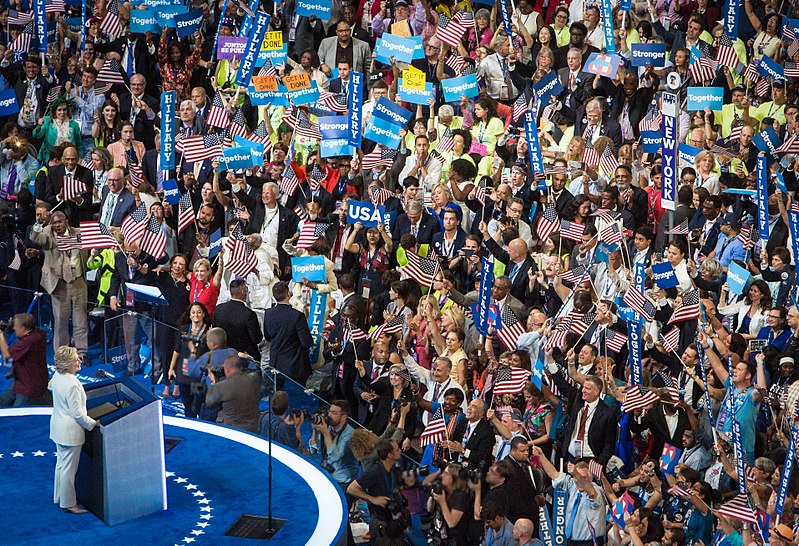
Clinton: Already blaming the Russians at DNC 2016 convention. (Wikipedia)
Granted, it was a stretch — and the DNC would have to hire a pliable cybersecurity firm to back up their claim. But they had good reason to believe that CrowdStrike would perform that service. It was the best Clinton campaign manager Robbie Mook and associates could apparently come up with. If they hurried, there would be just enough time to prepare a PR campaign before the convention and, best of all, there was little doubt that the media could be counted on to support the effort full bore.
When WikiLeaks published the emails on July 22, 2016, just three days before the Democratic convention, the propagandists were ready to deflect attention from the damning content of the DNC emails by repeating incessantly that the Russians hacked the emails and gave them to WikiLeaks to hurt Clinton.
It pretty much worked like a charm. The late Senator John McCain and others were quick to call the Russian “hack” an “an act of war.” Evidence? None. For icing on the cake, then-FBI Director James Comey decided not to seize and inspect the DNC computers. Nor, as we now know, did Comey even require a final report from CrowdStrike.
Eight months after the convention, in remarks at the Clinton/Podesta Center for American Progress on April 6, 2017, Clinton’s PR director, Jennifer Palmieri, could scarcely contain her pride that, after a difficult start, she was ultimately successful in keeping the Russian bear front and center.
Transcribed below (verbatim) are some of Palmieri’s more telling remarks when asked to comment, from her insider perspective, on “what was actually going on in late summer/early fall.”
“… I did appreciate that for the press to absorb … the idea that behind the stage that the Trump campaign was coordinating with Russia to defeat Hillary Clinton was too fantastic for people to, um, for the press to process, to absorb…. But then we go back to Brooklyn and heard from the — mostly our sources were other intelligence, with the press who work in the intelligence sphere, and that’s where we heard things and that’s where we learned about the dossier and the other story lines that were swirling about … And along the way the administration started confirming various pieces of what they were concerned about what Russia was doing. … [Emphasis added.]
“And we did finally get to the point on October 7, when the administration came out with a very stunning [memorandum]. How stunning it was for both the Director of National Intelligence and the Director of Homeland Security to put out a statement – a long statement – that said with high confidence that Russia was interfering in the election and they were also directing the timing of the leaks. And it named the institutions – WikiLeaks, DC Leaks, and Guccifer – as being Russian-led, and how stunning that was to be that certain and that public. … So I do think that the answer for the Democrats now … in both the House and the Senate is to talk about it more and make it more real ….”
And so, the Magnificent Diversion worked as intended.
Recognizing Liminal Time
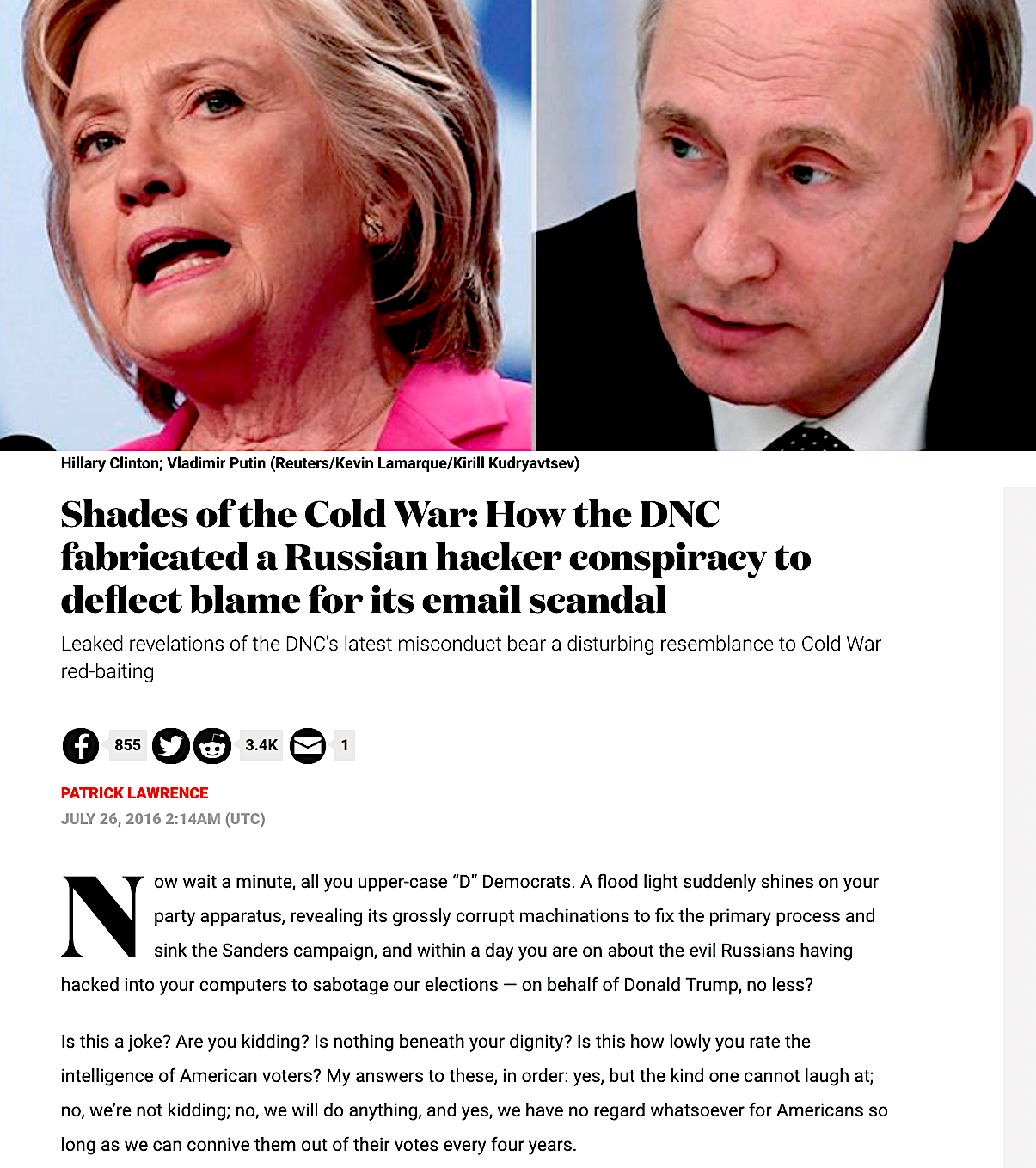 But not all journalists fell for it. Patrick Lawrence (once of The Nation, now of Consortium News) was onto the ruse from the start. He says he had “fire in the belly” on the morning of July 25, 2016, the day the Democratic convention began, and that he dashed off an article “in one long, furious exhale” within 12 hours of when the media started really pushing the “the Russians-did-it” narrative. The title of his article, pointed out to me a few months ago by VIPS member Todd Pierce, was “How the DNC fabricated a Russian hacker conspiracy to deflect blame for its email scandal … a disturbing resemblance to Cold War red-baiting.”
Lawrence’s off-the-cuff ruminations, which Salon published the next day are extraordinarily prescient and worth reading in full. He instinctively recognized the email disclosure-cum-media-obfuscation campaign as a liminal event. Here are some excerpts, reprinted here with Lawrence’s permission:
”Now wait a minute, all you upper-case “D” Democrats. A flood light suddenly shines on your party apparatus, revealing its grossly corrupt machinations to fix the primary process and sink the Sanders campaign, and within a day you are on about the evil Russians having hacked into your computers to sabotage our elections … Is this how lowly you rate the intelligence of American voters? …
The Sanders people have long charged that the DNC has had its fingers on the scale … in favor of Hillary Clinton’s nomination. The prints were everywhere … Last Friday WikiLeaks published nearly 20,000 DNC email messages providing abundant proof that Sanders and his staff were right all along. The worst of these, involving senior DNC officers, proposed Nixon-esque smears having to do with everything from ineptitude within the Sanders campaign to Sanders as a Jew in name only and an atheist by conviction. …
The caker came on Sunday, when Robby Mook … appeared on ABC’s “This Week” and … CNN’s “State of the Union” to assert that the D.N.C.’s mail was hacked “by the Russians for the purpose of helping Donald Trump.” He knows this … because “experts” — experts he will never name — have told him so.
… the Clinton campaign now goes for a twofer. Watch as it advances the Russians-did-it thesis on the basis of nothing, then shoots the messenger, then associates Trump with its own mess — and, finally, gets to ignore the nature of its transgression (which any paying-attention person must consider grave). Preposterous, readers. Join me, please, in having absolutely none of it. There is no “Russian actor” at the bottom of this swamp, to put my position bluntly. You will never, ever be offered persuasive evidence otherwise. … [Emphasis added.]
Trump, to make this work, must be blamed for his willingness to negotiate with Moscow. This is now among his sins. Got that? Anyone who says he will talk to the Russians has transgressed the American code. … I am developing nitrogen bends … Which way for a breath of air?”
Sad Sequel
A year later Lawrence was commissioned by The Nation to write an investigative report on the so-called “Russian hack.” On August 9, 2017, after he interviewed several Veteran Intelligence Professionals for Sanity, among others, The Nation published his findings in an article entitled “A New Report Raises Big Questions About Last Year’s DNC Hack.” Lawrence wrote, “Former NSA experts, now members of Veteran Intelligence Professionals for Sanity (VIPS), say it wasn’t a hack at all, but a leak—an inside job by someone with access to the DNC’s system.”
Again, Lawrence got it right — this time relying less on his own experience and intuition than on applied science as practiced by real technical experts with no axes to grind. But, sadly, that cut across the grain of the acceptable Russia-gate narrative, and a furor erupted among Hillary followers still licking their wounds over her loss. It proved simply too much for them to entertain the notion that Clinton was quite capable, with help from the likes of Mook, to snatch defeat out of the jaws of victory — without any help from Vladimir Putin.
Ray McGovern works with Tell the Word, a publishing arm of the ecumenical Church of the Saviour in inner-city Washington. An ex-CIA analyst, his expertise on Russia goes back a half-century. He prepared and briefed The President’s Daily Brieffor Presidents Nixon, Ford, and Reagan, and in retirement he co-founded Veteran Intelligence Professionals for Sanity (VIPS).
We all deserve an investigation into BBC Panorama’s propaganda
By Nasim Ahmed | MEMO | July 17, 2019
The British public were subjected to an hour of anti-Palestine propaganda by the BBC last week when it aired a Panorama programme on the “anti-Semitism” row within the Labour Party. The public service broadcaster appeared to be doing very little public service when it unleased what was, by any reasonable assessment, a media broadside taken straight from the disinformation rule book.
Received by the mainstream media as though it were the final say on the anti-Semitism row that has rocked the Labour Party since Jeremy Corbyn became leader in 2015, the public have been duped into submitting to the dominant narrative. The political party that was born out of a desire to fight inequality and headed now by a leader whose record of fighting for social justice and equality is second to none is, we are led to believe, institutionally anti-Semitic.
The main characters used to “prove” this thesis in Panorama dominate the who’s who of people in the anti-Palestine lobby groups in Britain. Such basic information was omitted because it did not serve the presenter’s agenda. By failing to disclose the clearly relevant affiliations of the individuals involved in the programme, including the fabricated claims of anti-Semitism by one of the so called whistle-blowers, the BBC has basically admitted that their connections to the Israeli Embassy in London and anti-Palestine lobby groups like BICOM and Labour Friends of Israel completely discredits the “evidence” put forward.
The BBC producers also ignored the fact that there are dozens of Jewish Labour members and Jewish groups that totally reject allegations of the kind made in the programme. None were interviewed by Panorama veteran John Ware, who is developing a track record of being anti-Palestine and very pro-Israel; hardly the neutral journalism that one would expect from the BBC. Nor did Ware point out that there are Jews among the Labour Party members suspended or expelled for alleged anti-Semitism.
It has been claimed that the programme had such disregard for the truth that it resorted to doctoring quotes in an attempt to drive its point home. It presented an email by Labour’s director of communications Seumas Milne, for example, which gave the impression that senior Labour officials were interfering in the party’s disciplinary process. The BBC version of Milne’s email was, “Something’s going wrong, and we’re muddling up political disputes with racism… I think going forward we need to review where and how we’re drawing the line.” The Labour Party has released the full email, which shows that Milne was responding to a request from a former Labour staff member for a view on a complaint. He was talking specifically about Jewish people being accused of anti-Semitism and the unedited text of his email is this: “Having identified the subject of the complaint as a ‘Jewish activist, the son of a Holocaust survivor’… if we’re more than very occasionally using disciplinary action against Jewish members for anti-Semitism, something’s going wrong and we’re muddling up political disputes with racism.” This gives a very different meaning to the one put out on Panorama.
One has to wonder if the BBC, like the members of the Jewish Labour Movement interviewed in the programme as “whistle-blowers”, thinks that Jews supportive of Labour and refuting allegations of anti-Semitism are “the wrong type of Jew”. Is it just a coincidence that members of the Jewish community ignored by the BBC are very critical of Israel and its brutal occupation of Palestine and those given a voice by the public broadcaster are strongly anti-Palestinian?
Perhaps the BBC’s most glaring omission and disservice to the viewing public was its abject failure to give any background to the “whistle-blowers” who also featured prominently in the 2017 Al Jazeera documentary on the pro-Israel lobby. The two hour documentary detailed how the Israeli Embassy provided covert assistance to supposedly independent groups within the Labour Party; how jobs at the embassy were being offered to groom young Labour activists; and how concerned the embassy was with removing not just Foreign Office Minister Sir Alan Duncan, but also Crispin Blunt MP, the chair of the Foreign Affairs Select Committee (both of whom are Conservative MPs), as well as Labour leader Corbyn.
Anti-Palestinian activists were captured on camera boasting about “taking down” British ministers; how easy it is to get most Conservative MPs to do the bidding of pro-Israel activists; and giving details of how they would write prepared questions for MPs to ask the Prime Minister in parliament. “If you do everything for them,” they explained, “it’s harder for them to say, ‘I don’t have the time, I won’t do it’.”
The four-part Al Jazeera documentary along with its US version marked a watershed moment in exposing the workings of the anti-Palestinian lobbies on both sides of the Atlantic. The Lobby – USA was made by Al Jazeera’s investigations unit, but ironically it was never broadcast by the Qatari channel, after a massive censorship push by the anti-Palestine lobby.
Unsurprisingly, despite their questionable activities being exposed on camera, anti-Palestinian groups cried foul by accusing Al Jazeera of anti-Semitism. Their complaint was investigated by Britain’s media regulator, Ofcom. In its lengthy ruling, Ofcom noted that the complaints received “raised a range of issues about the programme including that they were anti-Semitic and were not duly impartial.” Other complaints “considered that the programme was materially misleading.”
The latter allegation was dismissed by Ofcom without further investigation, following information received from Al Jazeera. With respect to the other complaints, it found that Al Jazeera was not in breach of the obligation to have “due impartiality”, and similarly rejected claims of anti-Semitism. A second attack on the programme was inevitable, and it seems that Panorama’s “shock and awe” tactic has provided such an opportunity, generating the kind of social panic required to silence legitimate opinions and dismiss counter-narratives as anti-Semitism and conspiracy theories.
The Jewish Chronicle was attuned to the public paralysis and did exactly that, launching into a full-on attack on Al Jazeera’s documentary by labelling anyone who defended Labour using facts uncovered in the programme as “conspiracy theorists” which, let’s admit it, is another way of saying that they are anti-Semitic. Panorama’s broadcast was timed perfectly for the community newspaper which, along with anti-Palestinian groups, has been waiting for the opportunity to discredit The Lobby. If the sort of revelations contained therein were made by anyone connected to Russia, or any other state for that matter, there would be calls for investigations into such open foreign interference in Britain’s democracy. It is significant that no such calls have ever been made in political circles for any investigations into Israel’s efforts — captured on camera, remember — to disrupt the British democratic process.
Why did John Ware and Panorama ignore the findings of the Al Jazeera documentary, especially given that it was vindicated by Ofcom? That’s a mystery. Viewers should have been told about the “whistle-blowers” and their backgrounds as well as their connections to the State of Israel and the anti-Palestine lobby. And that the allegations made against them by Al Jazeera were noted by the media regulator not to have been “made on the grounds that any of the particular individuals concerned were Jewish” and that “no claims were made relating to their faith”. Ofcom went on to say that it did not “consider that the [Al Jazeera] programme portrayed any negative stereotypes of Jewish people as controlling or seeking to control the media or governments.”
Ofcom concluded further: “Rather, it was our view that these individuals featured in the [Al Jazeera] programme in the context of its investigation into the alleged activities of a foreign state [the State of Israel acting through its UK Embassy] and their association with it.”
One is not a “conspiracy theorist” for citing evidence from a serious documentary vindicated by the media regulator to expose falsehoods in a BBC programme that one suspects would not survive the level of scrutiny placed on non-mainstream media organisations, including Al Jazeera. At the very least, the British public whose licence fees pay for the BBC — including up to 600,000 Labour Party members —have a right to know if the Corporation is indeed serving the public or simply peddling propaganda in the best interests of a foreign state rather than impartial journalism.
It’s a Lie, We Never Knew of Interference and Would Never Allow It – Ex-Ecuadorian President Correa
© AFP 2019 / JOHN THYS
Sputnik – July 17, 2019
Earlier, CNN published a report based on what it termed “exclusive documents”, accusing Julian Assange of meddling in the 2016 US elections. In an interview with Sputnik, Correa shared his perspective on Assange, CNN’s ‘prejudice’, EU-US relations and more.
Sputnik: What do you think about a CNN story claiming that Assange has meddled in the US 2016 election from Ecuadorian embassy?
Rafael Correa: It is already known. This is the same story when the US intended to invade Iraq and media, starting with CNN, created the whole campaign, claiming that there were weapons of mass destruction. So that even good people could applaud the invasion of the country and the war, which claimed more than a hundred thousand lives among civilians, not counting military personnel.
The same was made with Assange. This is all lynching in the media, this is all a show, so that when he is extradited to the US, he could be sentenced to a life term in prison, a disproportionate penalty that even good people may welcome.
It is already a commonly known strategy, an installation, concocted by certain media. We were not aware of Assange’s intelligence activities. They have not proved it in this story. It is merely a show. That there is some video footage where he walks with a bag and now they claim – they know what was inside of this bag…no, this story tells Mueller’s report. That means that CNN in its investigation uses side sources and cannot be responsible for that?
There are two things. First we were shown this. Secondly, we would not have allowed it if we knew of it. Did not prove that it really happened. The same staging that they want to prove, are the claims about spying activity from the embassy, which Assange – together with Russians – made a centre of special operation and that we allegedly knew this and protected him.
First, they have not proved it. I cannot be deceived with this show. Second, it is a lie. If there was any meddling/spying, we would know about it and would never allow it.
Sputnik: Good. So, when you told the government to cut Assange’s Internet access, it was not because you knew that he spied or meddled in US elections?
Rafael Correa: This happened because [Assange] published information that harmed the [US presidential] candidates. I don’t know how he got it. Maybe, he copied it from somewhere – how am I supposed to know? There is a difference between spying on the US Democratic Party, [working with] a Russian hacker from the Ecuadorean embassy in London, or [getting information] from the Internet. What is clear is that he sent messages that harmed Hillary Clinton. And this is wrong. We don’t like when [other countries] interfere in [our] internal affairs. I wouldn’t have liked if a foreign nation meddled in the presidential elections in Ecuador. Just like any other nation, we would not allow it, we respect other nations’ sovereignty.
Assange had been warned several times. He failed to comply with [asylum agreement] terms and continued to publish information that only harmed one side; this was not balanced information about [both] Clinton and Trump. It was only a negative information on Hillary Clinton. We could not accept it. This is why I personally ordered Assange’s internet connection to be cut on 17 October 2016, ahead of 8 November 2016 elections in the US.
Sputnik: What’s your opinion, why is Russia always blamed for everything related to Assange? For example, CNN mentions Russian nationals who visited Assange in the embassy.
Rafael Correa: It’s a geopolitical matter. Yesterday, I had an interview with CNN’s Patricia Ramos, in which she demonstrated the falseness of her prejudice. She considers it a proven fact that the Russian embassy engaged in the operation, but it’s a lie that the Russians were there, it’s a lie.
So, you know, she asked: why didn’t [embassy personal] search those hackers that visited [the embassy], those German hackers?
If you don’t like someone, it does not mean he’s a hacker. Presumption of innocence is a human right. Just because CNN does not like someone, we won’t deny them entry to the embassy and humiliate them with searches. They don’t understand that, they believe themselves the masters of the world. But, obviously, mentioning Russia is geopolitical. In other cases, they would mention China. They are US’s world rivals.
Imagine a different situation; as if an Australian programmer or hacker hid in the UK embassy in [Ecuadorian capital city of] Quito, because he got his hands on confidential information on Russia and China and discovered war crimes committed by these countries.
Imagine him staying [in the embassy] for seven years – they would have already invaded [Ecuador], am I right? And if that man left the embassy, they would have put him a memorial in Washington or next to Big Ben in London. But, since it’s Assange, who got his hands on information about the US, he must be crushed, he must be denied asylum, he must be next to be crucified. This an international double morality.
Sputnik: Recently, the UK Foreign Secretary said that he would not extradite Assange to any country where his life would be threatened. What is your opinion on this statement?
Rafael Correa: They often play with words. […] Yes, [Assange] won’t receive a death penalty, but, if he gets sentenced to life in prison, or a 30-year term, it’s absolutely [too strict a] measure for what he’s done.
We do not necessarily agree with his actions. We have not granted him asylum because we agreed with his actions. I believe that every country must have confidential information for security’s sake, but it also should not commit war crimes like the US did. Assange was granted asylum because there were no guarantees – and there are still no guarantees – of proper prosecution. In reality, there’s a media lynching going on, there were threats made by US hawks to judge [Assange] in accordance to laws that imply a death sentence.
There is no guarantee of a proper judgement. The British are playing with words a little bit.
Sputnik: Do you think Europe acts as an ally to the US?
Rafael Correa: I think the European Union has a bit more independence now. The world in the 21st century undergoes a sway towards the right-wing, towards liberal capitalism, towards the so-called liberal democracy – if only it was real. A democracy is based on a rule of law, and the law works in someone’s favor.
I will provide the same example I provided earlier: if Assange stole Russia’s and China’s secret documents and hid in the UK embassy in Quito, they would have invaded [our] country if we failed to let him leave to a safe country; they would have also put up a memorial to him as a freedom of speech hero. As long as this international double morality exists, as long as justice works in favor of the strongest, we still have a long way to go towards a real world society, towards real civilizational breakthrough, towards humanism.
Unfortunately, in the 21st century, there is a sway towards double morality, towards principles that are convenient for some. In this sense, Europe has made a step backwards.
It used to be an enlightened continent, an example for Latin America to follow. And now they are often worse than the US, a nation which I respect and admire. The US began its independent existence approximately at the same time as – only 30 years earlier than – the Latin American republics. Why did they develop and we did not? What did they do right and we did not? Obviously, as a hegemon country, its foreign policy – particularly towards Latin American nations that don’t submit – leaves a lot to be desired. Unfortunately, in this sense [the US], matches the EU. That’s very unfortunate, because I adore Europe.
Sputnik: Would you like to add anything that we have not previously addressed?
Rafael Correa: There are a lot of things in [CNN’s] article which – and I insist – depict things as actual and checked, although this is not the case. It appears as if they’ve proven that Assange engaged in espionage – with Russian spies, I think. Do they believe repetition is proof? What proof? Is the Mueller report a big proof? What report? *laughs* It’s like the report which said Iraq had WMDs or those videos where things are shown and God knows what happens to them.
Another part of this montage is to create an impression that we knew [about Assange’s activities]. We didn’t know anything. It does not mean it took place. If it took place, we did not know, because if we knew, we wouldn’t have allowed it. I don’t know how clear it is. Why do they do that?
We remember it well. It’s just the same as what [Lenin Moreno’s] Ecuadorian government did on a national level, all this campaign of hounding Assange, when he was expelled from the embassy in violation of international law, in violation of the Vienna convention, in violation of the Constitution of Ecuador – specifically article 41, which obliges the nation not to give away asylum seekers. Ecuador was humiliated, not only on an international level, but in perspective, for ages to come. The way Ecuador humiliated an asylum seeker will be remembered for ages.
However, before they did that, they engaged in an entire campaign of smearing and conspiring with the media who claimed that Assange is ill-tempered, that he smears feces on the walls, that his cat is spying, etc. It’s nonsense, insanity.
CNN does something similar, but on a slightly higher level: they construct a fake reality so that, when Assange gets extradited and sentenced to disproportionately severe punishment, even the kind-hearted people applauded this giant disgust. It’s a trap and you should be careful not to fall in it. We do remember Iraq’s “WMDs,” which they used to justify an invasion, and the whole world applauded them. And then we discovered it was all a lie.
Newspeak at the Media Freedom Conference
Joint UK-Canada Event Littered With Insidious Undertones
By Kit Knightly | OffGuardian | July 16, 2019
OffGuardian already covered the Global Media Freedom Conference, our article Hypocrisy Taints UK’s Media Freedom Conference, was meant to be all there was to say. A quick note on the obvious hypocrisy of this event. But, in the writing, I started to see more than that. This event is actually… creepy.
Let’s just look back at one of the four “main themes” of this conference:
building trust in media and countering disinformation
“Countering disinformation”? Well,that’s just another word for censorship.
This is proven by their refusal to allow Sputnik or RT accreditation. They claim RT “spreads disinformation” and they “countered” that by barring them from attending.
“Building trust”? In the post-Blair world of PR newspeak, “building trust” is just another way of saying “making people believe us” (the word usage is actually interesting, building trust not earning trust).
The whole conference is shot through with this language that just feels… off.
Here is CNN’s Christiane Amanpour:
Our job is to be truthful, not neutral… we need to take a stand for the truth, and never to create a false moral or factual equivalence.”
Being “truthful not neutral” is one of Amanpour’s personal sayings, she obviously thinks it’s clever.
Of course, what it is is NewSpeak for “bias”.
Refusing to cover evidence of The White Helmets staging rescues, Israel arming ISIS or other inconvenient facts will be defended using this phrase – they will literally claim to only publish “the truth”, to get around impartiality… and then set about making up whatever “truth” is convenient.
Oh, and if you don’t know what “creating a false moral equivalence is”, here I’ll demonstrate:
MSM: Putin is bad for shutting down critical media.
OffG: But you’re supporting RT being banned and Wikileaks being shut down.
BBC: No. That’s not the same.
OffG: It seems the same.
BBC: It’s not. You’re creating a false moral equivalence.
Understand now? You “create a false moral equivalence” by pointing out mainstream media’s double standards.
Other ways you could mistakenly create a “false moral equivalence”:
- Bringing up Gaza when the media talk about racism.
- Mentioning Saudi Arabia when the media preach about gay rights.
- Referencing the US coup in Venezuela when the media work themselves into a froth over Russia’s “interference in our democracy”
- Talking about the invasion of Iraq. Ever.
- OR Pointing out that the BBC is state funded, just like RT.
These are all no-longer flagrant examples of the media’s double standards, and if you say they are, you’re “creating a false moral equivalence”… and the media won’t have to allow you (or anyone who agrees with you) air time or column inches to disagree.
Because they don’t have a duty to be neutral or show both sides, they only have a duty to tell “the truth”… as soon as the government has told them what that is.
Prepare to see both those phrases – or variations there of – littering editorials in the Guardian and the Huffington Post in the coming months. Along with people bemoaning how “fake news outlets abuse the notion of impartiality” by “being even handed between liars the truth tellers”. (I’ve been doing this site so long now, I have a Guardian-English dictionary in my head).
Equally dodgy-sounding buzz-phrases litter topics on the agenda.
“Eastern Europe and Central Asia: building an integrated support system for journalists facing hostile environments”, this means pumping money into NGOs to fund media that will criticize our “enemies” in areas of strategic importance. It means flooding money into the anti-government press in Hungary, or Iran or (of course), Russia. That is ALL it means.
I said in my earlier article I don’t know what “media sustainability” even means, but I feel I can take a guess. It means “save the government mouthpieces”.
The Guardian is struggling for money, all print media are, TV news is getting lower viewing figures all the time. “Building media sustainability” is code for “pumping public money into traditional media that props up the government” or maybe “getting people to like our propaganda”.
But the worst offender on the list is, without a doubt…
“Navigating Disinformation”
“Navigating Disinformation” was a 1 hour panel from the second day of the conference. You can watch it embedded above if you really feel the need. I already did, so you don’t have to.
The panel was chaired by Chrystia Freeland, the Canadian Foreign Minister. The members included the Latvian Foreign Minister, a representative of the US NGO Committee to Protect Journalists, and the Ukrainian Deputy Minister of Information
Have you guessed what “disinformation” they’re going to be talking about?
I’ll give you a clue: It begins with R.
Freeland, chairing the panel, kicks it off by claiming that “disinformation isn’t for any particular aim”.
This is a very common thing for establishment voices to repeat these days, which makes it all the more galling she seems to be pretending its is her original thought.
The reason they have to claim that “disinformation” doesn’t have a “specific aim” is very simple: They don’t know what they’re going to call “disinformation” yet.
They can’t afford to take a firm position, they need to keep their options open. They need to give themselves the ability to describe any single piece of information or political opinion as “disinformation.” Left or right. Foreign or domestic. “Disinformation” is a weaponised term that is only as potent as it is vague.
So, we’re one minute in, and all “navigating disinformation” has done is hand the State an excuse to ignore, or even criminalise, practically anything it wants to. Good start.
Interestingly, no one has actually said the word “Russia” at this point. They have talked about “malign actors” and “threats to democracy”, but not specifically Russia. It is SO ingrained in these people that “propaganda”= “Russian propaganda” that they don’t need to say it.
The idea that NATO as an entity, or the individual members thereof, could also use “disinformation” has not just been dismissed… it was literally never even contemplated.
Next Freeland turns to Edgars Rinkēvičs, her Latvian colleague, and jokes about always meeting at NATO functions. The Latvians know “more than most” about disinformation, she says.
Rinkēvičs says disinformation is nothing new, but that the methods of spreading it are changing… then immediately calls for regulation of social media.
Nobody disagrees.
Then he talks about the “illegal annexation of Crimea”, and claims the West should outlaw “paid propaganda” like RT and Sputnik.
Nobody disagrees.
Then he says that Latvia “protected” their elections from “interference” by “close cooperation between government agencies and social media companies”.
Everyone nods along.
If you don’t find this terrifying, you’re not paying attention. They don’t say it, they probably don’t even realise they mean it, but when they talk about “close cooperation with social media networks”, they mean government censorship of social media. When they say “protecting” their elections… they’re talking about rigging them.
It only gets worse.
The next step in the Latvian master plan is to bolster “traditional media”. The problems with traditional media, he says, are that journalists aren’t paid enough, and don’t keep up to date with all the “new tricks”.
His solution is to “promote financing” for traditional media, and to open more schools like the “Baltic Centre of Media Excellence”, which is apparently a totally real thing. It’s a training centre which teaches young journalists about “media literacy” and “critical thinking”.
You can read their depressingly predictable list of “donors” here.
I truly wish I was joking.
Next up is Courtney Radsch from CPJ – a US-backed NGO, who notionally “protect journalists”, but more accurately spread pro-US propaganda. (Their token effort to “defend” RT and Sputnik when they were barred from the conference was contemptible). She talks for a long time… without saying much at all. Her revolutionary idea is that disinformation could be countered if everyone told the truth. Inspiring.
Beata Balogova, Journalist and Editor from Slovakia, gets the ship back on course – immediately suggesting politicians should not endorse “propaganda” platforms. She shares an anecdote about “a prominent Slovakian politician” who gave exclusive interviews to a site that is “dubiously financed, we assume from Russia”.
They assume from Russia. Everyone nods. It’s like they don’t even hear themselves.
Then she moves on to Hungary.
Apparently, Orban has “created a propaganda machine” and produced “antisemitic George Soros posters”. No evidence is produced to back-up either of these claims. She thinks advertisers should be pressured into not giving money to “fake news sites”. She calls for “international pressure”, but never explains exactly what that means.
The stand-out maniac on this panel is Emine Dzhaparova, the Ukrainian First Deputy Minister of Information Policy. (She works for the Ministry of Information – nicknamed the Ministry of Truth, which was formed in 2014 to “counter lies about Ukraine”. Even The Guardian thought that sounded dodgy.)
She talks very fast and, without any sense of irony, spills out a story that shoots straight through “disinformation” and becomes “incoherent rambling”. She claims that Russian citizens are so brainwashed you’ll never be able to talk to them, and that Russian “cognitive influence” is “toxic… like radiation.”
Is this paranoid, quasi-xenophobic nonsense countered? No. Her fellow panelists nod and chuckle.
On top of that, she just lies. She lies over and over and over again.
She claims Russia is locking up Crimean Tartars “just for being muslims”, nobody questions her.
She says the war in Ukraine has killed 13,000 people, but doesn’t mention that her side is responsible for over 80% of civilian deaths.
She says only 30% of Crimeans voted in the referendum, and that they were “forced”. A fact not supported by any polls done by either side in the last four years, and any referenda held on the peninsula any time in the last last 30 year. It’s simply a lie.
Nobody asks her about the journalists killed in Ukraine since their glorious Maidan Revolution.
Nobody questions the fact that she works for something called the “Ministry of Information”.
Nobody does anything but nod and smile as the “countering disinformation” panel becomes just a platform for spreading total lies.
When everyone on the panel has had their ten minutes on the soapbox, Freeland asks for recommendations for countering this “threat” – here’s the list:
- Work to distinguish “free speech” from “propaganda”, when you find propaganda there must be a “strong reaction”.
- Pressure advertisers to abandon platforms who spread misinformation.
- Regulate social media.
- Educate journalists at special schools.
- Start up a “Ministry of Information” and have state run media that isn’t controlled, like in Ukraine.
This is the Global Conference on Media Freedom… and all these six people want to talk about is how to control what can be said, and who can say it.
They single only four countries out for criticism: Hungary, Nicaragua, Venezuela and Russia…. and Russia takes up easily 90% of that.
They mention only two media outlets by name: RT and Sputnik.
This wasn’t a panel on disinformation, it was a public attack forum – a month’s worth of 2 minutes of hate.
These aren’t just shills on this stage, they are solid gold idiots, brainwashed to the point of total delusion. They are the dangerous glassy eyes of a Deep State that never questions itself, never examines itself, and will do anything it wants, to anyone it wants… whilst happily patting itself on the back for its superior morality.
They don’t know, they don’t care. They’re true believers. Terrifyingly dead inside. Talking about state censorship and re-education camps under a big sign that says “Freedom”.
And that’s just one talk. Just one panel in a 2 day itinerary filled to the brim with similarly soul-dead servants of authority.
Truly, perfectly Orwellian.
Sic Transit Gloria Mueller
Making the Worst Case Appear the Better
By Ray McGovern | Consortium News | July 16, 2019
Friday’s surprising report that Robert Mueller had successfully sought an extra week to prepare for his House testimony on Russiagate (now set for July 24) must have come as scary news to those of his fans who can put two and two together. Over the past few weeks, it has become clearer that each of the two frayed findings of Russian interference in the 2016 U.S. presidential election has now come apart at the seams.
Saturday’s New York Times reports that “the Democrats said they chose to delay at the request of Mr. Mueller” after a day of negotiations, “as both Democrats and Republicans were deep in preparations for his testimony” earlier scheduled for July 17. The Washington Post, on the other hand, chose not to say who asked for the delay. Rather, it explained the abrupt change in timing with a misleading article entitled, “Mueller, House panels strike deal to delay hearing until July 24, giving lawmakers more time to question him.”
How to Avoid Eating Crow
Friedrich: Told Mueller put up or shut up (Flickr)
As the truth seeps out, there will be plenty of crow to go around. To avoid eating it, the Democrats on the House Judiciary and Intelligence Committees, the stenographers who pass for journalists at the Times and Post, and the “Mueller team” will need all the time they can muster to come up with imaginative responses to two recent bombshell revelations from the United States District Court for the District of Columbia.
Perhaps the most damning of the two came last Monday, when it was disclosed that, on July 1, Judge Dabney Friedrich ordered Mueller to stop pretending he had proof that the Russian government was behind the Internet Research Agency’s supposed attempt to interfere via social media in the 2016 election. While the corporate media so far has largely ignored Judge Friedrich’s order, it may well have been enough to cause very cold feet for those attached to the strained Facebook fable. (The IRA social-media “interference” has always been ludicrous on its face, as journalist Gareth Porter established.)
Ten days is not a lot of time to conjure up ways to confront and explain Judge Friedrich’s injection of some unwelcome reality. Since the Democrats, the media, and Mueller himself all have strong incentive to “make the worst case appear the better” (one of the twin charges against Socrates), they need time to regroup and circle the wagons. The more so, since Mueller’s other twin charge — Russian hacking of the DNC — also has been shown, in a separate Court case, to be bereft of credible evidence.
No, the incomplete, redacted, second-hand “forensics” draft that former FBI Director James Comey decided to settle for from the Democratic National Committee-hired CrowdStrike firm does not qualify as credible evidence. Both new developments are likely to pose a strong challenge to Mueller. On the forensics, Mueller decided to settle for what his former colleague Comey decided to settle for from CrowdStrike, which was hired by the DNC despite it’s deeply flawed reputation and well known bias against Russia. In fact, the new facts — emerging, oddly, from the U.S. District Court, pose such a fundamental challenge to Mueller’s findings that no one should be surprised if Mueller’s testimony is postponed again.
Requiem for ‘Interference’
Daniel Lazare’s July 12 Consortium News piece shatters one of the twin prongs in Mueller’s case that “the Russian government interfered in the 2016 presidential election in sweeping and systematic fashion.” It was the prong dripping with incessant drivel about the Kremlin using social media to help Trump win in 2016.
Mueller led off his Russiagate report, a redacted version of which was published on April 18, with the dubious claim that his investigation had
“… established that Russia interfered in the 2016 election principally through two operations. First, a Russian entity carried out a social media campaign that favored presidential candidate Donald J. Trump and disparaged presidential candidate Hillary Clinton. Second, a Russian intelligence service conducted computer-intrusion operations against entities, employees, and volunteers working in the Clinton campaign, and then released stolen documents.”
Judge to Mueller: Put Up or Shut Up
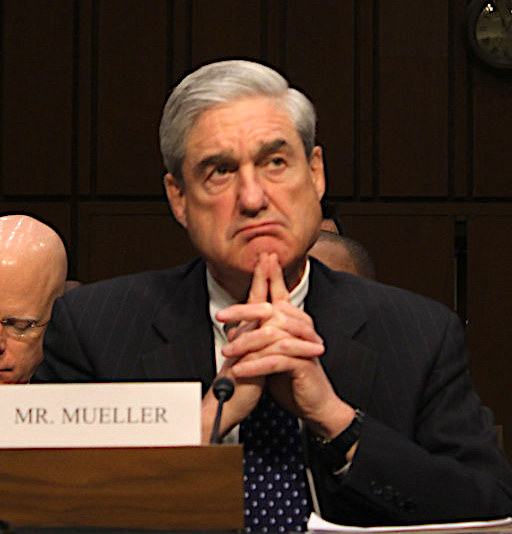
Mueller: Needs more time. (Flickr)
Regarding the social-media accusation, Judge Friederich has now told Mueller, in effect, to put up or shut up. What happened was this: On February 16, 2018 a typically credulous grand jury — the usual kind that cynics say can be persuaded to indict the proverbial ham sandwich — was convinced by Mueller to return 16 indictments of the Internet Research Agency (IRA) and associates in St. Petersburg, giving his all-deliberate-speed investigation some momentum and a much-needed, if short-lived, “big win” in “proving” interference by Russia in the 2016 election. It apparently never occurred to Mueller and the super-smart lawyers around him that the Russians would outsmart them by hiring their own lawyers to show up in U.S. court and seek discovery. Oops.
The Feb. 2018 indictment referred repeatedly to the IRA simply as a “Russian organization.” But in Mueller’s report 14 months later, the “Russian organization” had somehow morphed into “Russia.” The IRA’s lawyers argued, in effect, that Mueller’s ipse-dixit “Russia did it” does not suffice as proof of Russian government involvement. Federal Judge Friedrich agreed and ordered Mueller to cease promoting his evidence-less charge against the IRA; she added that “any future violations of her order will trigger a range of potential sanctions.”
More specifically, at the conclusion of a hearing held under seal on May 28, Judge Friedrich ordered the government “to refrain from making or authorizing any public statement that links the alleged conspiracy in the indictment to the Russian government or its agencies.” The judge ordered further that “any public statement about the allegations in the indictment . . . must make clear that, one, the government is summarizing the allegations in the indictment which remain unproven, and, two, the government does not express an opinion on the defendant’s guilt or innocence or the strength of the evidence in this case.”
Reporting Thursday on Judge Friedrich’s ruling, former CIA and State Department official Larry C. Johnson described it as a “potential game changer,” observing that Mueller “has not offered one piece of solid evidence that the defendants were involved in any way with the government of Russia.” After including a lot of useful background material, Johnson ends by noting:
“Some readers will insist that Mueller and his team have actual intelligence but cannot put that in an indictment. Well boys and girls, here is a simple truth–if you cannot produce evidence that can be presented in court then you do not have a case. There is that part of the Constitution that allows those accused of a crime to confront their accusers.”
IRA Story a ‘Stretch’
Last fall, investigative journalist Gareth Porter dissected and debunked The New York Times’ far-fetched claim that 80,000 Facebook posts by the Internet Research Agency helped swing the election to Donald Trump. What the Times story neglected to say is that the relatively paltry 80,000 posts were engulfed in literally trillions of posts on Facebook over the two-year period in question — before and after the 2016 election.
In testimony to Congress in October 2017, Facebook General Counsel Colin Stretch had cautioned earlier that from 2015 to 2017, “Americans using Facebook were exposed to, or ‘served,’ a total of over 33 trillion stories in their News Feeds.” Shamefully misleading “analysis” by Times reporters Scott Shane and Mark Mazzetti in a 10,000-word article on September 20, 2018 made the case that the IRA’s 80,000 posts helped deliver the presidency to Trump.
Shane and Mazzetti neglected to report the 33 trillion number for needed context, even though the Times’ own coverage of Stretch’s 2017 testimony stated outright: “Facebook cautioned that the Russia-linked posts represented a minuscule amount of content compared with the billions of posts that flow through users’ News Feeds everyday.”
The chances that Americans saw any of these IRA ads—let alone were influenced by them—are infinitismal. Porter and others did the math and found that over the two-year period, the 80,000 Russian-origin Facebook posts represented just 0.0000000024 of total Facebook content in that time. Porter commented that this particular Times contribution to the Russiagate story “should vie in the annals of journalism as one of the most spectacularly misleading uses of statistics of all time.”
And now we know, courtesy of Judge Friederich, that Mueller has never produced proof, beyond his say-so, that the Russian government was responsible for the activities of the IRA — feckless as they were. That they swung the election is clearly a stretch.
The Other Prong: Hacking the DNC
The second of Mueller’s two major accusations of Russian interference, as noted above, charged that “a Russian intelligence service conducted computer-intrusion operations against entities, employees, and volunteers working in the Clinton campaign, and then released stolen documents.” Sadly for Russiagate aficionados, the evidence behind that charge doesn’t hold water either.
CrowdStrike, the controversial cybersecurity firm that the Democratic National Committee chose over the FBI in 2016 to examine its compromised computer servers, never produced an un-redacted or final forensic report for the government because the FBI never required it to, the Justice Department admitted.
The revelation came in a court filing by the government in the pre-trial phase of Roger Stone, a long-time Republican operative who had an unofficial role in the campaign of candidate Donald Trump. Stone has been charged with misleading Congress, obstructing justice and intimidating a witness.
The filing was in response to a motion by Stone’s lawyers asking for “unredacted reports” from CrowdStrike challenging the government to prove that Russia hacked the DNC server. “The government … does not possess the information the defendant seeks,” the DOJ filing says.
Small wonder that Mueller had hoped to escape further questioning. If he does testify on July 24, the committee hearings will be well worth watching.
Ray McGovern works with Tell the Word, a publishing arm of the ecumenical Church of the Saviour in inner-city Washington. He was a CIA analyst for 27 years and a presidential briefer. In retirement he co-founded Veteran Intelligence Professionals for Sanity. His colleagues and he have been following closely the ins and outs of Russiagate.
How Assange & RT meddled in 2016, according to CNN’s ‘possibilities’, innuendo & lies
RT | July 16, 2019
CNN has released a new ‘exclusive’ report, accusing Julian Assange of conspiring with ‘the Russians’ (including RT) to meddle in the 2016 US election – again.
Citing a report compiled by a private Spanish security company – but not providing any of it – the network basically re-hashed the entirety of the Russiagate conspiracy on Monday, painting a sinister portrait of WikiLeaks publisher Julian Assange, RT and “Russians and world-class hackers” that supposedly made the revelations of Democratic National Committee (DNC) and Podesta emails happen during the 2016 election. It includes speculation, insinuation, selective quoting of special counsel Robert Mueller’s report, and even an easily and repeatedly disproven lie about RT.
Let’s dispense with the last point first. Per CNN: “On at least two occasions, RT even published articles detailing the new batches of emails before WikiLeaks officially released them, suggesting that they were coordinating behind the scenes, which they deny.”
In reality, RT journalists simply noticed a pattern to the WikiLeaks’ releases and kept a close eye on its website in expectation of every new batch. As RT’s Dublin bureau editor-on-duty at the time Ivor Crotty put it, “We merely watched a trend and performed journalism.” It was Clinton’s aides that suggested“coordinating behind the scenes,” which CNN here uncritically endorses.
The rest of CNN’s sensationally-titled “scoop” openly admits the Spanish papers merely “build on the possibility” raised by Mueller’s report about how WikiLeaks received the emails. Safe words for “unprovable speculation” begin a few lines below the headline, and keep multiplying from there on.
CNN quotes the Mueller report as having named German hacker Andrew Müller-Maguhn as someone who “may have assisted” WikiLeaks in obtaining the files – something page 55 of the report “cannot rule out” happened, based on “public reporting”, not actual evidence.
Throughout the story, the CNN authors seem almost incredulous that Ecuador allowed Assange, a political refugee, to have basic facilities like high-speed Internet or the absence of 24/7 snooping – all of which he is portrayed as having exploited to undermine American democracy.
Assange also had visitors – including a “Russian national named Yana Maximova” (who the authors never tracked down, but appear to assume her an insidious figure by the sole merit of her being Russian) and with “senior staffers from RT” such as London bureau chief Nikolay Bogachikhin, who even “gave him a USB drive on one occasion.”
Bogachikhin, one of the very few people who actually responded to CNN’s requests for comment, was open about RT’s cooperation with Assange. RT’s editor-in-chief Margarita Simonyan joined in by tweeting about her own visits to Assange and listing quite a few more things RT staff brought to him: “Cassettes, floppy disks, flash drives, pieces of paper, technical equipment, candy…”
That’s because RT hosted a show with Assange, and widely advertised it both on air and online. “It’s hard to host a show without equipment, you know. It was an awesome show. Can you google it up yourself?” Simonyan tweeted.
CNN, meanwhile, repeats the literal smear – not substantiated by a single photo or video clip since Assange’s arrest in April – that the journalist “smeared feces” on the embassy walls.
Wrapping up the piece, CNN finds it sinister that the Russian government denounced the arrest as a violation of Assange’s human rights and dignity – the ultimate proof Assange “still has allies in Russia.”
Also on rt.com:
Another nail in Russiagate coffin? Federal judge destroys key Mueller report claim
Featured Video
Prof. Ted Postol: Iran Already Achieved Nuclear Deterrence Against Israel
or go to
Aletho News Archives – Video-Images
From the Archives
How the occupied mentality syndrome works
Saudi Arabia on the American chessboard – Part 3
By B. J. Sabri | American Herald Tribune | June 27, 2016
Read part 2: “The occupied mentality Syndrome“
Previously I argued whether Saudi Arabia’s repeated involvements in U.S. interventions and wars stem from free national will or in response to a specific condition. For starters, in Saudi Arabia there is no national will. In Saudi Arabia, the national will is the will of the Al Saud clan. Still, when a major Arab state allies itself with a superpower that committed unspeakable crimes against humanity in almost every Arab country, then something is wrong. This fact alone should compel us to examine the U.S.-Saudi relation for one exceptional reason. As a result of the U.S.-Saudi wars, hundreds of thousands of people in Afghanistan, Iraq, Iran, Libya, Syria, Yemen, and Somalia have lost their lives. Millions became displaced in their own homelands. And millions more rendered refugees.
Attributing the Saudi policies to the bonds of “partnership” with the U.S. is frivolous. There are no bonds between these two thugs except those of business, military deals, secret plots, and wars. Proving this point, bonds such as these have no space for the American and Saudi peoples to share significant cultural or societal exchanges. If partnership is not the reason for the Saudi contribution to the U.S. strategy of empire and imperialism, then another reason must exist.
This leads to three possibilities. … continue
Blog Roll
 Aletho News
- NIAID/NIH and USDA Fund Bioengineered Chimeric Influenza Viruses Built Using Pandemic H1N1 Components: Journal ‘Science Advances’
- Hezbollah hits Israeli warship off Lebanon’s coast, sets it aflame
- Iran slams US strikes on B1 bridge, Mahshahr petrochemical plants as ‘blatant acts of state terrorism’
- In letter to UN chief, Araghchi warns of dire consequences of US-Israeli attacks on Iran’s nuclear facilities
- Why the CIA conspiracy to invade Iran with Kurdish militias failed
- Why Are Upbeat US Claims About Mission to Rescue Pilot ‘Highly Questionable’?
- Aircraft destroyed during US ‘rescue’ of downed F-15 pilot cost more than $100 million each
- Washington University removes professor who condemned US-Israeli war on Iran
- Russia Warns of Retaliation as UK Authorizes Seizure of Vessels
- Serbia thwarts plot to bomb Russia-Hungary gas pipeline – Vucic
- If Americans Knew
- In Iran, Israel-US take aim at “reason, research, and freedom of thought” – Daily Update
- US loses planes over Iran, Israel downgrades Lebanon war goals – Daily Update
- Israel Is Blocking Palestinians from Easter at Church Where Jesus Resurrected
- Plot to assassinate Palestinian activist follows harassment campaign promoted by Zionist groups and elected officials
- Prominent New York synagogue hosts presentation on why U.S. Jews should support the ethnic cleansing of Gaza
- Tapper vs. Piker: Is the CNN Anchor Auditioning for David Ellison?
- Shouldn’t Democrats Be Able to Condemn Genocide?
- Israel-US kill negotiators, destroy civilian structures, but Iran’s military capabilities still largely intact – Daily Update
- ‘War crime’: Global condemnation as Israeli ministers celebrate death penalty law targeting Palestinian prisoners
- 7 Ways Israel Is Turning Lebanon Into Gaza
- No Tricks Zone
- An Inconvenient Tree: Uncovered In Alps… Europe Much Warmer Than Today 6000 Years Ago
- New Study Reports A 60% Slowdown In Greenland’s Ice Loss Rate In The Last Decade
- Low Intensity Tornado Wrecks Major Solar Farm, Creating A Potential Toxic Dump
- New Study Finds Warming Saves Lives…Cold Temperatures 12 Times More Deadly Than Excess Heat
- German Science Blog Accuses PIK Climate Institute Of Hallucinating Climate Tipping Points
- Devastating Assessment Of Comirnaty Vaccine By Former Senior Pfizer Europe Toxicologist
- New Study: CO2 Is ‘Effectively Negligible’ As An Explanatory Climate Change Factor Since 2000
- Former Pfizer Toxicologist Dr. Helmut Sterz Tells Bundestag Hearing Pfizer Vaccine Should Have Never Been Approved
- Energy Expert: Germany’s Nuclear Phaseout Was A “500 Billion Euro Mistake”
- New Research: South Australia’s Mid-Holocene Sea Surface Temperatures Were 4°C Warmer Than Today
 Aletho News