‘Western Media Haven’t Covered Syria the Way They Should’ – Prof
Sputnik – February 14, 2019
The video of people being treated after an alleged chemical weapons attack in the Syrian city of Douma was fabricated. This is what BBC Syria producer Riam Dalati wrote on his Twitter account on Wednesday.
Sputnik has discussed the development with Piers Robinson, co-director of the Organisation for Propaganda Studies and professor at the University of Sheffield.
Sputnik: What is your reaction to Mr Dalati’s tweets?
Piers Robinson: It’s obviously very interesting that somebody in his position is now declaring that it’s his opinion that there was some element of manipulation or fabrication occurring in the events surrounding Douma. In some ways, of course, as you see in the recent Intercept article by [James] Harkin, the message of his idea is that there was an attack of some kind and Riam Dalati is saying that there was an attack.
But what kind of attack is unclear. So we really need to hear more from him. But at the very least, if it is the case that it is established that there were staging and manipulation going on, then it really just starts to raise a whole series of further questions about staging and manipulation in the case of Douma, running all the way through to the obvious question which is whether it was some kind of a false flag event.
That it was something that was carried out by opposition groups, Jaish al-Islam, in order to try to enable a military intervention, which obviously did occur six or seven days later with the bombing against Damascus. All of that is on the table now, undoubtedly.
And in some ways what Riam is saying does confirm what myself and many other academics, independent researchers and journalists have been saying for some time that there are serious questions about the official claims being brought forward by Western governments about what happened in Douma.
Sputnik: Moscow is now waiting for an official response from BBC to this tweet. What’re your thoughts? Will the BBC respond and what we can expect from them in the way of some kind of response based on, perhaps, past incidents?
Piers Robinson: I’m really not quite sure if I can guess how the BBC might respond. I think we need to wait and see what more comes out. I mean, it’s not very clear if Riam Dalati is referring to an article he has coming out, if that’s an article which is going to go to the BBC or independently, we just don’t know.
I guess most media organisations in general when they’ve got it wrong in the past tend to be fairly mealy-mouthed in their ability to either correct the record or to apologise for what has happened. We saw that in the case of the 2003 Iraq War, with some very limited apologies about their failure to scrutinise Western governments over WMD claims in Iraq.
So, I would suspect nothing more than a very cautious response from the BBC and they will probably want to wait and see what more Riam Dalati comes out and says over the coming days and weeks.
Sputnik: It’s interesting that there aren’t really [any] mainstream media reports about this at all. Do you think it’s just too early, or do you think there are some other reasons for that nobody has really picked up on this?
Piers Robinson: I think the reasons are well-known. We know that when it comes to, especially foreign policy, war and conflict, media in Western democracies, as is the case in pretty much every other country in the world, tend to toe the line of what governments are doing and saying. This is well established across the critical political communication literature; it’s for a whole number of reasons that this occurs.
Mainstream media, in the case of Syria, haven’t been covering it in the way they should have been because they have been beholden and co-opted by the government position and so on in relation to this conflict. We see it in every war time and time again; and it’s no different in the conflict in Syria than it was on the case of Iraq or going all the way back to Vietnam in the 1960s.
You see a real timidity and lack of confidence amongst journalists and editors to really ask difficult questions of their governments when their countries are involved in some kind of war.
READ MORE:
BBC Says Its Producer Expressed ‘Personal Opinions’ on Douma Incident
BBC Producer Says Footage of Alleged Gas Attack Victims in Syria’s Douma Staged<
BBC “Trying to Limit Damage” After Fake News of Syrian Chemical Attack – Journo
Sputnik – February 14, 2019
BBC Syria producer Riam Dalati tweeted on Wednesday that the video of people treated after an alleged chemical weapons attack in the Syrian city of Douma had been fabricated. Sputnik has discussed the development with Vanessa Beeley, an independent investigative journalist who specialises in the Middle East and Syria in particular.
Sputnik: This doesn’t really look good though, does it, for Mr. Dalati. Why do you think he decided to speak up now? He is now contradicting himself basically.
Vanessa Beeley: Well, yeah, and effectively this is a damage limitation operation. One of their own, so to speak, James Harkin, who is a mainstream journalist, he writes in the Internet and he also writes for the Guardian, and the Guardian’s Simon Tisdall I believe it was, almost immediately after the alleged attack in Douma, which has, of course, been largely discredited by the OPCW report that has told us that no organic phosphates were used, there is still an element of doubt over whether chlorine was used. But the OPCW report itself has already negated the use of sarin in this attack.
But when Harkin himself is saying that this event was staged, then, of course, the BBC and Louisa Loveluck of Washington Post are immediately, in my opinion, trying to limit damage.
Sputnik: What do you think the BBC is going to do next? Do you think that they are going to have an official statement out on this? What can we expect?
Vanessa Beeley: I guess we should be waiting for Riam Dalati’s full investigation. He’s told us on Twitter that he’s been looking into this for six months and he’ll be providing further details soon. So we should be waiting to see whether the BBC will retract its previous statements; I mean it put out a very misleading report even on the use of chlorine after the release of the OPCW interim report. It basically stated on its leading report that chlorine had been used, it later changed that but it didn’t retract its storyline.
And I’ve just checked, for example, the Telegraph, on its timeline of chemical weapon attacks or alleged chemical weapon attacks inside Syria, it’s still stating that it is alleged that sarin was used in Douma. So, that is still standing on the Telegraph website.
So, fundamentally what these mainstream outlets do is put out a narrative which, as I’ve pointed out, effectively manufactured consent for the unlawful bombing of a sovereign nation, Syria, by the US, France and the UK post- the Douma alleged attack. But these storylines and these narratives are never retracted; so it remains to be seen whether the BBC will apologise to Syria for having manufactured the consent for the bombing, and whether Riam Dalati and the BBC will apologise to academics and to independent journalists that they smeared at the time for arriving at the same conclusion they’ve now arrived at.
Sputnik: If Mr. Dalati’s tweet is proven, what will it say about the White Helmets and their trustworthiness, not to mention their, perhaps, role in the whole event?
Vanessa Beeley: Of course, this raises huge questions. I mean, I’ve proven and I’ve written an open investigation based on testimony from civilians in Eastern Ghouta of the White Helmets staging at least one chemical weapon attack one month before Douma… which was actually derailed by the civilians themselves who exposed it on social media etc. The White Helmets have been proven time and time again to be staging events in order to serve the NATO member states’ regime change narrative inside Syria. This might start to raise questions over the veracity of the White Helmets reports, bearing in mind that the UK government document has publicly stated that Amnesty International and Human Rights Watch, for example, rely extensively on the evidence of the White Helmets to produce their reports that, again, largely criminalise the Syrian government.
Sputnik: This alleged attack was actually used to justify a response, the bombing of the area by the US, UK and France; it was quite a significant military strike that was perpetrated after that attack. What would this mean for evaluating the legality or the justification of that attack?
Vanessa Beeley: The very fact that France, the UK and the US went ahead and bombed Syria, and as you said it was an extensive bombing operation that targeted alleged chemical weapons manufacturing facilities that were proven afterwards and also reported by OPCW to not be chemical weapons manufacturing facilities, brings into question the legality of that attack. It brings into question the legality of the entire regime change war that has been waged against Syria since 2011, of course instigated by those same nations that bombed after Douma.
But the fact that that the bombing went ahead without any OPCW investigation having been able to take place and based entirely on what is now proven or thought to be spurious information from groups like the White Helmets, that are being funded by the nations that carried out the bombing attack, I mean, this is an extraordinary event; this basically means that the US, the UK and France have completely violated international law time and time again inside Syria and this must be brought into the light, it must be investigated. And the media’s role in enabling this unlawful act must also be investigated.
READ MORE:
Assad Calls Douma Chemical Attack ‘British PR Stunt’ Straight to UK Media’s Face
BBC Producer Says Footage of Alleged Gas Attack Victims in Syria’s Douma Staged
Militants Engaged in Chemical Attacks Are Under Western Patronage – Sec. Council
Propaganda Blitz Against Venezuela’s Elected President
By Joe Emersberger – FAIR – February 12, 2019
The Miami Herald (2/8/19) reported, “Venezuelan leader Nicolás Maduro continues to reject international aid—going so far as to blockade a road that might have been used for its delivery.“
The “Venezuelan leader” reporter Jim Wyss referred to is Venezuela’s elected president. In contrast, Wyss referred to Juan Guaidó as Venezuela’s “interim president.”
Guaidó, anointed by Trump and a new Iraq-style Coalition of the Willing, did not even run in Venezuela’s May 2018 presidential election. In fact, shortly before the election, Guaidó was not even mentioned by the opposition-aligned pollster Datanálisis when it published approval ratings of various prominent opposition leaders. Henri Falcón, who actually did run in the election (defying US threats against him) was claimed by the pollster to basically be in a statistical tie for most popular among them. It is remarkable to see the Western media dismiss this election as “fraudulent,” without even attempting to show that it was “stolen“ from Falcón. Perhaps that’s because it so clearly wasn’t stolen.
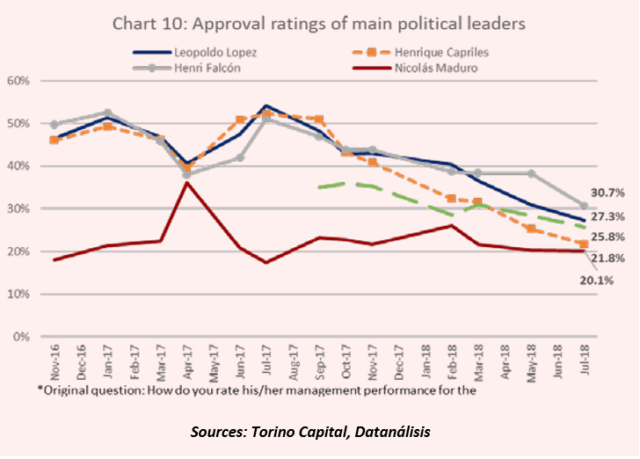
Data from the opposition-aligned pollsters in Venezuela (via Torino Capital) indicates that Henri Falcón was the most popular of the major opposition figures at the time of the May 2018 presidential election. Nicolás Maduro won the election due to widespread opposition boycotting and votes drawn by another opposition candidate, Javier Bertucci.
The constitutional argument that Trump and his accomplices have used to “recognize” Guaidó rests on the preposterous claim that Maduro has “abandoned” the presidency by soundly beating Falcón in the election. Caracas-based journalist Lucas Koerner took apart that argument in more detail.
What about the McClatchy-owned Herald‘s claim that Maduro “continues to reject international aid”? In November 2018, following a public appeal by Maduro, the UN did authorize emergency aid for Venezuela. It was even reported by Reuters (11/26/18), whose headlines have often broadcast the news agency’s contempt for Maduro’s government.
It’s not unusual for Western media to ignore facts they have themselves reported when a major “propaganda blitz” by Washington is underway against a government. For example, it was generally reported accurately in 1998 that UN weapons inspectors were withdrawn from Iraq ahead of air strikes ordered by Bill Clinton, not expelled by Iraq’s government. But by 2002, it became a staple of pro-war propaganda that Iraq had expelled weapons inspectors (Extra! Update, 10/02).
And, incidentally, when a Venezuelan NGO requested aid from the UN-linked Global Fund in 2017, it was turned down. Setting aside how effective foreign aid is at all (the example of Haiti hardly makes a great case for it), it is supposed to be distributed based on relative need, not based on how badly the US government wants somebody overthrown.
But the potential for “aid” to alleviate Venezuela’s crisis is negligible compared to the destructive impact of US economic sanctions. Near the end of Wyss’ article, he cited an estimate from the thoroughly demonized Venezuelan government that US sanctions have cost it $30 billion, with no time period specified for that estimate. Again, this calls to mind the run-up to the Iraq invasion, when completely factual statements that Iraq had no WMDs were attributed to the discredited Iraqi government. Quoting Iraqi denials supposedly balanced the lies spread in the media by US officials like John Bolton, who now leads the charge to overthrow Maduro. Wyss could have cited economists independent of the Maduro government on the impact of US sanctions—like US economist Mark Weisbrot, or the emphatically anti-Maduro Venezuelan economist Francisco Rodríguez.
Illegal US sanctions were first imposed in 2015 under a fraudulent “state of emergency” declared by Obama, and subsequently extended by Trump. The revenue lost to Venezuela’s government due to US economic sanctions since August 2017, when the impact became very easy to quantify, is by now well over $6 billion. That’s enormous in an economy that was only able to import about $11 billion of goods in 2018, and needs about $2 billion per year in medicines. Trump’s “recognition” of Guaidó as “interim president” was the pretext for making the already devastating sanctions much worse. Last month, Francisco Rodríguez revised his projection for the change in Venezuela’s real GDP in 2019, from an 11 percent contraction to 26 percent, after the intensified sanctions were announced.
The $20 million in US “aid” that Wyss is outraged Maduro won’t let in is a rounding error compared to the billions already lost from Trump’s sanctions.
Former US Ambassador to Venezuela William Brownfield, who pressed for more sanctions on Venezuela, dispensed with the standard “humanitarian” cover that US officials have offered for them (Intercept, 2/10/19):
And if we can do something that will bring that end quicker, we probably should do it, but we should do it understanding that it’s going to have an impact on millions and millions of people who are already having great difficulty finding enough to eat, getting themselves cured when they get sick, or finding clothes to put on their children before they go off to school. We don’t get to do this and pretend as though it has no impact there. We have to make the hard decision—the desired outcome justifies this fairly severe punishment.
How does this gruesome candor get missed by reporters like Wyss, and go unreported in his article?
Speaking of “severe punishment,” if the names John Bolton and Elliott Abrams don’t immediately call to mind the punishment they should be receiving for crimes against humanity, it illustrates how well the Western propaganda system functions. Bolton, a prime facilitator of the Iraq War, recently suggested that Maduro could be sent to a US-run torture camp in Cuba. Abrams played a key role in keeping US support flowing to mass murderers and torturers in Central America during the 1980s. Also significant that Abrams, brought in by Trump to help oust Maduro, used “humanitarian aid” as cover to supply weapons to the US-backed Contra terrorists in Nicaragua.
In the Herald article, the use of US “aid” for military purposes is presented as another allegation made by the vilified Venezuelan president: “Maduro has repeatedly said the aid is cover for a military invasion and has ordered his armed forces not to let it in, even as food and medicine shortages sweep the country.”
Calling for international aid and being democratically elected will do as little to protect Maduro’s government from US aggression as being disarmed of WMD did to prevent Iraq from being invaded—unless there is much more pushback from the US public against a lethal propaganda system.
BBC-staged footage on Syria’s Douma Western media’s ‘theater of absurd’: Russia
Press TV – February 14, 2019
Russia says the latest revelations by BBC that the footage of an April chemical attack near the Syrian capital was fabricated proves the “theater of absurd” in Western media’s coverage of events in the Arab country.
“Over the past few years, and not just in Syria, we have been witness to a travesty being staged by the West and its media agencies, which on [the one] hand brags about brilliant democratic goals and support for civilians of a sovereign state, but on the other does not … give a damn about … international law, various forms of freedom and rights of a nation or a certain minority,” the spokeswoman for the Russian Foreign Ministry, Maria Zakharova, told reporters in Moscow on Thursday.
The footage broadcast by BBC showed people being treated after a chemical attack in Douma.
BBC Syria producer Riam Dalati wrote on Twitter on Wednesday that the issue had been investigated for six months.
Zakharova added, “The culmination of this theater of absurd may be a statement by a BBC producer, who confirmed based on his own research that the footage [in Douma] had been staged with direct participation of [the so-called civil defense group] White Helmets.
She further pointed out that Russia wanted to listen to BBC’s explanation because it actively covered the events in favor of the US-led coalition purportedly fighting the Daesh Takfiri terrorist group.
The Western-backed White Helmets group, which has been repeatedly accused of cooperating with Takfiri terrorists and staging fictional chemical attacks, published a video in April 2018, alleging that Syrian government forces had launched a chemical assault in the city of Douma, located about 10 kilometers northeast of Damascus.
The US has warned it would respond to any possible chemical weapons attack by Syrian government forces with retaliatory strikes, stressing that the attacks would be stronger than those conducted by American, British and French forces last year.
On April 14, 2018, the US, Britain and France carried out a string of airstrikes against Syria over a suspected chemical weapons attack on the city of Douma.
Washington and its allies blamed Damascus for the Douma attack, an allegation rejected by the Syrian government.
On September 11 last year, Russian Deputy Foreign Minister Sergei Ryabkov censured the US threats to use military force against Syria as part of Washington’s blackmail policy.
“Unlike the United States, Britain and their allies, Russia provides particular facts on a daily basis through its Defense Ministry, the Foreign Ministry as well missions in New York, The Hague and Geneva. We particularly name geographical points, where preparations are underway for certain terrorist groups backed by the US and its allies to carry out provocations,” Ryabkov said.
BBC Says Its Producer Expressed ‘Personal Opinions’ on Douma Incident
Sputnik – February 14, 2019
BBC Syria producer Riam Dalati, who wrote on Twitter that he could prove the video of the victims of the alleged chemical attack in Douma being treated in hospital was staged, was expressing his own opinion and did not deny the fact of the attack itself, the broadcaster’s spokesperson told Sputnik on Thursday.
“The producer was expressing his personal opinions about some of the video footage that emerged after the attack but has not claimed that the attack did not happen”, the BBC spokesperson said.
On Wednesday, the journalist tweeted that he could “prove without a doubt” that the Douma hospital footage had been staged and no fatalities had occurred in the hospital. He said the attack did take place but without the use of sarin gas and that the nature of any chemical used would have to be verified by the Organisation for the Prohibition of Chemical Weapons.
Previously, the RT broadcaster reported that Dalati had already expressed his scepticism about the Douma hospital video in a Twitter post. However, the journalist subsequently deleted his tweet, citing a breach of editorial policy.
The same month, Hassan Diab, 11, who was featured in the White Helmets video, in an interview with a Russian media outlet alongside his father, gave a detailed description of how the footage of people treated in the hospital was filmed. Diab said, among other things, that children were given food for participating in the video.
Moreover, Douma residents, interviewed by Sputnik, were unable to confirm that the attack had taken place there. They said they knew nothing about it and were not aware of anybody having been affected by toxic chemicals.
The reports about the attack and the publication of the footage by the White Helmets were followed by missile strikes carried out by France, the United Kingdom and the United States targeting alleged chemical weapons production facilities in Damascus.
Western states have repeatedly accused the Syrian authorities of having carried out the Douma attack, while Damascus denied any involvement in the incident. The Russian Foreign Ministry has said that the claims about the alleged use of toxic chemicals by the Syrian government were aimed at justifying external military action.
READ MORE: German Journalist Federation Calls on Regulators to Deny Broadcast License to RT
The Real Motive Behind the FBI Plan to Investigate Trump as a Russian Agent
By Gareth Porter | Consortium News | February 13, 2019
 The New York Times and CNN led media coverage last month of discussions among senior FBI officials in May 2017 of a possible national security investigation of President Donald Trump himself, on the premise that he may have acted as an agent of Russia.
The episode has potentially profound political fallout, because the Times and CNN stories suggested that Trump may indeed have acted like a Russian agent. The New York Times story on Jan. 11 was headlined, “F.B.I. Opened Inquiry into Whether Trump Was Secretly Working on Behalf of Russia.” CNN followed three days later with: “Transcripts detail how FBI debated whether Trump was ‘following directions’ of Russia.”
By reporting that Russia may have been able to suborn the president of the United States, these stories have added an even more extreme layer to the dominant national political narrative of a serious Russian threat to destroy U.S. democracy. An analysis of the FBI’s idea of Trump as possible Russian agent reveals, moreover, that it is based on a devious concept of “unwitting” service to Russian interests that can be traced back to former CIA director John O. Brennan.
The Proposal That Fell Apart
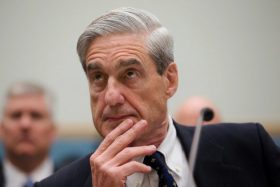
The FBI discussions that drove these stories could have led to the first known investigation of a U.S. president as a suspected national security risk. It ended only a few days after the deliberations among the senior FBI officials when on May 19, 2017, the Justice Department chose Robert Mueller, a former FBI director, to be special counsel. That put control over the Trump-Russia investigation into the hands of Mueller rather than the FBI.
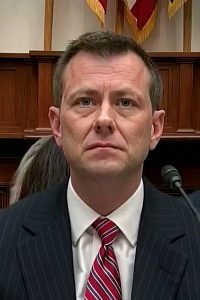
Peter Strzok, who led the bureau’s counter-espionage section, was, along with former FBI General Counsel James A. Baker, one of those involved in the May 2017 discussions about investigating Trump. Strzok initially joined Mueller’s team but was fired after a couple of months when text messages that he had written came to light exposing a deep animosity towards Trump that cast doubt over his impartiality.
The other FBI officials behind the proposed investigation of Trump have also since left the FBI; either fired or retired.
The entirety of what was said at the meetings of five or six senior FBI officials in the immediate aftermath of Trump’s firing of James Comey as FBI director on May 9, 2017, remains a mystery.
Closed-door Testimony
The CNN and Times stories were based on transcripts either obtained or, in the case of the Times, on portions read to it, of private testimony given to the House Judiciary and Government Oversight and Reform committees last October by Baker, one of the participants in the discussions of Trump as a possible Russian agent.
Excerpts of Baker’s testimony published by CNN make it clear that the group spoke about Trump’s policy toward Russia as a basis for a counter-intelligence investigation. Baker said they “discussed as [a] theoretical possibility” that Trump was “acting at the behest of [Russia] and somehow following directions, somehow executing their will.”
Baker went on to explain that this theoretical possibility was only “one extreme” in a range of possibilities discussed and that “the other extreme” was that “the President is completely innocent.”
He thus made it clear that there was no actual evidence for the idea that he was acting on behalf of Russia.
Baker also offered a simpler rationale for such an investigation of Trump: the president’s firing of FBI Director Comey. “Not only would [firing Comey] be an issue of obstructing an investigation,” he said, “but the obstruction itself would hurt our ability to figure what the Russians had done, and that is what would be the threat to national security.”
But the idea that Comey’s firing had triggered the FBI’s discussions had already been refuted by a text message that Strzok, who had been leading the FBI’s probe into the Trump campaign’s contacts with Russians, sent immediately after the firing to Lisa Page, then legal counsel to Andrew McCabe, formerly the bureau’s deputy director who was then acting director.
“We need to open the case we’ve been waiting on now while Andy is acting,” Strzok wrote, referring to McCabe.
As Page later confirmed to congressional investigators, according to the CNN story, Strzok’s message referred to their desire to launch an investigation into possible collusion between Trump and the Russians. Strzok’s message also makes clear he, and others intent on the investigation, were anxious to get McCabe to approve the proposed probe before Trump named someone less sympathetic to the project as the new FBI director.
Why the FBI Wanted to Investigate
The New York Times story argued that the senior FBI officials’ interest in a counter-intelligence investigation of Trump and the Russians sprang from their knowledge of the sensational charges in the opposition research dossier assembled by British ex-spy Christopher Steele (paid for by the DNC and the Clinton campaign) that the Putin government had “tried to obtain influence over Mr. Trump by preparing to blackmail and bribe him.”
But the Times writers must have known that Bruce Ohr, former associate deputy attorney general, had already given McCabe, Page and Strzok information about Steele and his dossier that raised fundamental questions about its reliability.
Ohr’s first contacts at FBI headquarters regarding Steele and his dossier came Aug. 3, 2016, with Page and her boss McCabe. Ohr later met with Strzok.
Ohr said he told them that Steele’s work on the dossier had been financed by the Clinton campaign through the Perkins-Cole law firm. He also told them that Steele, in a July 30, 2016 meeting, told him he was “desperate that Donald Trump not get elected and was passionate about him not being president,” according to Ohr’s contemporaneous notes of the meeting.
 So, key figures in the discussion of Trump and Russia in May 2017 knew that Steele was acting out of both political and business motives to come up with sensational material.
Strzok and Page may have started out as true believers in the idea that the Russians were using Trump campaign officials to manipulate Trump administration policy. However, by May 2017, Strzok had evidently concluded that there was no real evidence.
In a text message to Page on May 19, 2017, Strzok said he was reluctant to join the Mueller investigation, because of his “gut sense and concern” that “there’s no big there there.”
Why, then, were Strzok, Page, McCabe and others so determined to launch an investigation of Trump at about the same time in May 2017?
A CNN article about the immediate aftermath of the Comey firing reported that Deputy Attorney General Rod Rosenstein and senior FBI officials “viewed Trump as a leader who needed to be reined in, according to two sources describing the sentiment of the time.”
That description by anti-Trump law enforcement officials suggests that the proposed counter-intelligence investigation of Trump served as a means to maintain some leverage over his treatment of the FBI in regard to the Russia issue.
That motivation would be consistent with the decision by McCabe on May 15, 2017 – a few days after the discussions in question among the senior FBI officials – to resume the bureau’s relationship with Steele.
The FBI had hired Steele as a paid source when it had earlier launched its investigation of Trump campaign official’s contacts with Russians in July 2016. But it had suspended and then terminated the relationship over Steele’s unauthorized disclosure of the investigation to David Corn of Mother Jones magazine in October 2016. So, the decision to resume the relationship with Steele suggests that the group behind the new investigation were thinking of seizing an opportunity to take off the gloves against Trump.
The ‘Unwitting Collaboration’ Ploy
The discussion by senior FBI officials of a counter-intelligence investigation of Trump has become part of the political struggle over Trump mainly because of the stories in the Times and CNN.
The role of the authors of those stories illustrates how corporate journalists casually embraced the ultimate conspiracy theory – that the president of the United States was acting as a Russian stooge.
The reporters of the CNN story — Jeremy Herb, Pamela Brown and Laura Jarrett — wrote that the FBI officials were “trying to understand why [Trump] was acting in ways that seemed to benefit Russia.”
The New York Times story was more explicit. Co-authors Adam Goldman, Michael S. Schmidt and Nicholas Fandos wrote that the FBI officials “sought to determine whether Mr. Trump was knowingly working for Russia or had unwittingly fallen under Moscow’s influence.”
The same day the Times story was published, the lead author on the piece, Adam Goldman, was interviewed by CNN. Goldman referred to Trump’s interview with NBC’sLester Holt in the days after the Comey firing as something that supposedly pushed the FBI officials over the edge. Goldman declared, “The FBI is watching him say this, and they say he’s telling us why he did this. He did it on behalf of Russia.”
But Trump said nothing of kind. What he actually said — as the Times itself quoted Trump, from the NBCinterview —was: “[W]hen I decided just to do it, I said to myself – I said, you know this Russia thing with Trump and Russia is a made-up story.” The Times article continued: “Mr. Trump’s aides have said that a fuller examination of his comments demonstrates that he did not fire Mr. Comey to end the Russia inquiry. ‘I might even lengthen out the investigation, but I have to do the right thing for the American people,” Mr. Trump added. ‘He’s the wrong man for that position.’”
Goldman was evidently trying to sell the idea of Trump as a suspected agent of Russia.
Goldman also gave an interview to The New Yorker’s Isaac Chotiner, in which the interviewer pressed him on the weakest point of the Trump-as-Russian-agent theory. “What would that look like if the President was an unwitting agent of a foreign power?” asked Chotiner.
The Times correspondent, who won a Pulitzer Prize for his coverage of the alleged Russian efforts to influence the 2016 election, responded: “It is hard to say what that would look like.” Goldman then reiterated the concept. “People were very careful to tell me that: ‘It is wittingly or unwittingly.’” And in answer to a follow-up question, Goldman referred to evidence he suggested might be held by the FBI that “perhaps suggests that the President himself may be acting as a foreign agent, either wittingly or unwittingly….”
The idea that American citizens were somehow at risk of being led by an agent of the Russian government “wittingly or unwittingly” did not appear spontaneously. It had been pushed aggressively by former CIA Director John O. Brennan both during and after his role in pressing for the original investigation.
When Brennan testified before the House Intelligence Committee in May 2017, he was asked whether he had intelligence indicating that anyone in the Trump campaign was “colluding with Moscow.” Instead of answering the question directly, Brennan said he knew from past experience that “the Russians try to suborn individuals, and they try get them to act on their behalf either wittingly or unwittingly.” And he recalled that he had left the government with “unresolved questions” about whether the Russians had been successful in doing so in regard to unidentified individuals in the case of the 2016 elections.
Brennan’s notion of “unwitting collaboration” with Russian subversion is illogical. Although a political actor might accidentally reveal information to a foreign government that is valuable, real “collaboration” must be mutually agreeable. A policy position or action that may benefit a foreign government, but is also in the interest of one’s own government, does not constitute “unwitting collaboration.”
The real purpose of that concept is to confer on national security officials and their media allies the power to cast suspicion on individuals on the basis of undesirable policy views of Russia rather than on any evidence of actual collaboration with the Russian government.
The “witting or unwitting” ploy has its origins in the unsavory history of extreme right-wing anti-communism during the Cold War. For example, when the House Un-American Activities Committee was at its height in 1956, Chairman Francis E. Walter declared that “people who are not actually Communist Party members are witting or unwitting servants of the Communist cause.”
The same logic – without explicit reference to the phrase — has been used to impugn the independence and loyalty of people who have contacts with Russia.
It has also been used to portray some independent media as part of a supposedly all-powerful Russian media system.
The revelation that it was turned against a sitting president, however briefly, is a warning signal that national security bureaucrats and their media allies are now moving more aggressively to delegitimize any opposition to the new Cold War.
Gareth Porter is an independent investigative journalist and historian writing on U.S. national security policy. His latest book, “Manufactured Crisis: The Untold Story of the Iran Nuclear Scare,” was published in 2014. Follow him on Twitter: @GarethPorter.
YouTube Will Determine What ‘Conspiracy’ Is and Stop Recommending Such Videos

By Michael Krieger | Liberty BlitzKrieg | February 11, 2019
While the evolution of Google’s YouTube from a free expression platform into something entirely different has been underway for a while, it just took another step in a very short-sighted and restrictive direction. NBC News reports:
YouTube has announced that it will no longer recommend videos that “come close to” violating its community guidelines, such as conspiracy or medically inaccurate videos… Chaslot said that YouTube’s fix to its recommendations AI will have to include getting people to videos with truthful information and overhauling the current system it uses to recommend videos.
There’s a lot to unpack here so let’s get started. First, it appears YouTube has announced the creation of a new bucket when it comes to content uploaded to the site. It’s no longer just videos consistent with company guidelines and those that aren’t, but there’s now a category for “conspiracy or medically inaccurate videos.” This is a massive responsibility, which neither YouTube or anyone else seems fit to be judge and jury. In other words, YouTube is saying it’s comfortable deciding what is “conspiracy” and what isn’t. Which brings up a really important question.
So no videos of government officials lying the public into wars, or is that the Silicon Valley approved type conspiracy? https://t.co/mUEQGMlLyr
— Michael Krieger (@LibertyBlitz) February 11, 2019
“Conspiracy” and covering up conspiracies is a fundamental part of the human experience, and always has been. It demonstrates extreme hubris for a tech giant to claim it can differentiate between a legitimate conspiracy to explore, versus an illegitimate one. One person’s righteous investigation is another’s conspiracy theory, with Russiagate serving as an obvious contemporary example.
Going back to the early 21st century, we witnessed a major conspiracy to start a war in Iraq based on lies; lies which were endlessly repeated uncritically throughout the mass media. Even worse, General Wesley Clark described an even larger conspiracy which consisted of starting multiple additional wars in the aftermath of 9/11. This conspiracy is ongoing and has continued to move forward in the years since, through both Republican and Democratic administrations.
It’s pretty clear what will end up happening as a result of this tweaking to YouTube’s recommended videos AI. The “conspiracies” of your average person will be pushed aside and demoted, while government and mass media lies will remain unaffected. Google will assume mass media and government are honest, so government and billionaire approved propaganda will be increasingly promoted, while the perspectives of regular citizens will be pushed further to the margins. YouTube is simply not a platform anymore, but rather a self-proclaimed arbiter of what is ridiculous conspiracy and what is truth.
The most dangerous and consequential liars on planet earth are those in government, yet I guarantee YouTube will gladly recommend such liars and their lies.
— Michael Krieger (@LibertyBlitz) February 11, 2019
While YouTube says videos it deems conspiracy will still be available via search, it’s not a stretch to imagine this is just the first step and before you know it certain categories will be banned from the site entirely. Either way, I think there’s a silver lining to all of this.
As I outlined in a recent post, U.S. tech giants, particularly Facebook, Google and Amazon, aren’t simply private companies. They appear more akin to quasi-government entities that increasingly view themselves as instrumental gatekeepers for a discredited status quo. Moreover, their primary business models consist of mass surveillance and violating our privacy.
Ultimately, I think the increasingly nefarious and desperate behavior of these tech giants will lead to their demise. More and more of us have looked under the hood and seen the seedy and privacy-destroying nature of these entities. We’ve also seen what it’s like to have genuine free expression on the internet and we don’t want to turn the web into another cable news where Facebook, Google and Amazon become the new CBS, NBC and ABC. If we do, then the entire promise of the internet will have turned out to be a giant waste.
But I don’t think that’s going to happen. I think most of us have had a taste of what’s possible, and agree that free speech and expression on the internet, the good, the bad and the ugly, is better than an internet censored by tech companies and their billionaire executives, who will always be biased toward the status quo point of view. It’s still not clear which platforms will emerge to replace the tech giants, but it seems fairly clear to me the best days are over for these companies, and it cannot come a moment too soon.
‘Secret’ Pentagon Report: Climate Catastrophe Due Next Year
By Paul Matthews | Climate scepticism | January 18, 2019
A classic from the Guardian/Observer archives, from February 2004:

The article is so absurd that it hardly needs any commentary. After explaining that Britain will be Siberian by next year according to a suppressed report, it goes on to claim that the ‘findings’ of the report will embarrass the climate-denying president:
The findings will prove humiliating to the Bush administration, which has repeatedly denied that climate change even exists. Experts said that they will also make unsettling reading for a President who has insisted national defence is a priority.
The report was commissioned by influential Pentagon defence adviser Andrew Marshall, who has held considerable sway on US military thinking over the past three decades. He was the man behind a sweeping recent review aimed at transforming the American military under Defence Secretary Donald Rumsfeld.
Climate change ‘should be elevated beyond a scientific debate to a US national security concern’, say the authors, Peter Schwartz, CIA consultant and former head of planning at Royal Dutch/Shell Group, and Doug Randall of the California-based Global Business Network.
An imminent scenario of catastrophic climate change is ‘plausible and would challenge United States national security in ways that should be considered immediately’, they conclude. As early as next year widespread flooding by a rise in sea levels will create major upheaval for millions.
Later on we are told more details of the catastrophes that will occur by 2020:
Already, according to Randall and Schwartz, the planet is carrying a higher population than it can sustain. By 2020 ‘catastrophic’ shortages of water and energy supply will become increasingly harder to overcome, plunging the planet into war. They warn that 8,200 years ago climatic conditions brought widespread crop failure, famine, disease and mass migration of populations that could soon be repeated.
Randall told The Observer that the potential ramifications of rapid climate change would create global chaos. ‘This is depressing stuff,’ he said. ‘It is a national security threat that is unique because there is no enemy to point your guns at and we have no control over the threat.’
Randall added that it was already possibly too late to prevent a disaster happening. ‘We don’t know exactly where we are in the process. It could start tomorrow and we would not know for another five years,’ he said.
Of course the authors of the report, Randall and Schwartz, aren’t climate scientists. But their report gets the glowing endorsement of two leading UK climate scientists — Sir John Houghton, former boss of the Met Office and IPCC co-chair, and former IPCC chair Bob Watson:
Sir John Houghton, former chief executive of the Meteorological Office – and the first senior figure to liken the threat of climate change to that of terrorism – said: ‘If the Pentagon is sending out that sort of message, then this is an important document indeed.’
Bob Watson, chief scientist for the World Bank and former chair of the Intergovernmental Panel on Climate Change, added that the Pentagon’s dire warnings could no longer be ignored.
‘Can Bush ignore the Pentagon? It’s going be hard to blow off this sort of document. Its hugely embarrassing. After all, Bush’s single highest priority is national defence. The Pentagon is no wacko, liberal group, generally speaking it is conservative. If climate change is a threat to national security and the economy, then he has to act. There are two groups the Bush Administration tend to listen to, the oil lobby and the Pentagon,’ added Watson.
Hugely embarrassing indeed, but for Watson, not Bush. Why would a senior scientist like Bob Watson say that a report claiming global catastrophe by 2020 is non-wacko and should be taken seriously? Well there’s a hint that politics may be a factor, later on in the article:
So dramatic are the report’s scenarios, Watson said, that they may prove vital in the US elections. Democratic frontrunner John Kerry is known to accept climate change as a real problem. Scientists disillusioned with Bush’s stance are threatening to make sure Kerry uses the Pentagon report in his campaign.
The fact that Marshall is behind its scathing findings will aid Kerry’s cause. Marshall, 82, is a Pentagon legend who heads a secretive think-tank dedicated to weighing risks to national security called the Office of Net Assessment. Dubbed ‘Yoda’ by Pentagon insiders who respect his vast experience, he is credited with being behind the Department of Defence’s push on ballistic-missile defence.
Is it not rather worrying that the defence of the USA is in the hands of people who produce such garbage?
This Pentagon report was cited in a recent article Climate Change and National Security, Part II: How Big a Threat is the Climate?
The consequences of abrupt, severe warming for national security are obvious in general, if unclear in the specifics. In 2003, the Defense Department asked a contractor to explore such a scenario. The resulting report outlined the offensive and defensive national security strategies countries may adopt if faced with abrupt climate change, and highlighted the increased risk of inter- and intra-state conflict over natural resources and immigration. Although the report may be off in its imagined timeframe (positing abrupt climate change by 2020), the world it conjures is improbable but not outlandish.
This is a bit like the doomsday cults that say that the world is going to end this year, and then when that doesn’t happen, say it’s going to happen next year. Even more comically, a few paragraphs before acknowledging that the 2003 report got it wrong, the article claims that “Scientists can predict the consequences of climate change to 2050 with some measure of certainty”.
That article also provides a link to the Pentagon climate report by Schwartz and Randall, dated October 2003.
By looking at the report, we can see to what extent it is in itself complete nonsense, and to what extent it was misrepresented by the Observer’s journalists. As usual in the game of Climate Chinese Whispers, there’s an element of both. The report starts with a boxed disclaimer, acknowledging that “We have created a climate change scenario that although not the most likely, is plausible, and would challenge United States national security in ways that should be considered immediately.” The Observer journalists Townsend and Harris quite dishonestly only quote the second half of that sentence.
The report plays a common climate game — we’re not making a prediction, we’re setting out a scenario — but then sets out its scenario like this:

thereby making it very easy for a journalist to accidentally or deliberately interpret it as a prediction.
Where did Schwartz and Randall get all this from? Did they just make it up? At the beginning, they say that they “interviewed leading climate change scientists, conducted additional research, and reviewed several iterations of the scenario with these experts.”
But who were these leading climate scientists? As far as I can see, only one climate scientist is mentioned in the report — notorious fraudster Peter Gleick.
Integrity Initiative – The HSBC Connection
Real Media | February 3, 2019
“2 Degrees of separation” – a theory whistleblower Nicholas Wilson has, that wherever in the world a financial scandal occurs HSBC is to be found nearby.
Nicholas has been campaigning for 13 years after blowing the whistle on a High Street fraud of excessive bank charges applied to store cards administered by HSBC. He has recently been vindicated by a Financial Conduct Authority ruling and HSBC have had to begin paying back some of the money defrauded from customers. He was dubbed “Mr. Ethical” by his boss at the time for refusing to defraud debtors.
In this first of several interviews for Real Media, he connects Government funding and the security services to the recently revealed psyops outfit, Institute for Statecraft and its ‘integrity initiative’.
He asks whether there might be a connection with the suspicious death of auditor Sergei Magnitsky, who was working for the Hermitage Fund there. HSBC bankrolled and jointly managed the Hermitage Fund with Bill Browder, who appears in Institute of Statecraft’s documents.
Browder, convicted of tax fraud in Russia connected with the Magnitsky affair, has spent years pointing the finger at the Russians over both the killing and the disappearance of nearly quarter of a billion pounds, but a film by Andrei Nekrasov casts suspicion on Browder and HSBC. If the film is to be believed, it would make sense that Browder is involved with a shadowy group set up to counter Russian “disinformation”.
Nicholas Wilson reveals the close associations between HSBC and the UK security forces, and asks whether the Foreign and Commonwealth Office should be giving public funding to the Institute of Statecraft.
More HSBC revelations at nicholaswilson.com
Claim that Russian media buy SM accounts to rock France is fake news – Moscow on Macron’s interview
RT | February 5, 2019
French President Emmanuel Macron is spreading fake news to undermine the work of the Russian media, if his recent interview with Le Point is anything to go by, a Russian Foreign Ministry spokeswoman said.
Before Yellow Vests went out to the streets in the twelfth weekend of consecutive mass demonstrations against the government’s economic policies, weekly political magazine Le Point published an interview with President Macron. There he blamed the scale of public discontent on Russians, social media, the far right and the far left.
“If it’s confirmed that Macron said that RT and Sputnik are buying social media accounts to destabilize the situation in Frаnce – this is real fake news,” Maria Zakharova told RT.
The foreign ministry sent a request to Paris to clarify whether the claims are a true representation of Macron’s thoughts and if that is the official position of the French government.
Macron lambasted the French media for picking up on what people are saying on social media and urged them to put more trust into the words of officials rather than “ordinary” people like the Yellow Vests. The president’s dismissive attitude to the public was noted.
Zakharova said that Macron should not be surprised that it’s the Yellow Vests and not the authorities that are being interviewed frequently, as officials had long been prohibited from talking to Russian media.
She also said that it’s “outrageous” that the French president equaled fascists and Russians when he was listing those he blamed for fueling protests. Macron used the term “la fachosphère” that describes ultra-nationalists and fascists.
“Russians are presented as the new enemies of the 21st century by French officials,” Zakharova said. She called attacks on Russian media a “co-ordinated” and “well-directed” campaign that is orchestrated by Brussels and Washington, who want to present Russian news outlets as “toxic” without bothering to provide facts.
“If there was any proof, they would have produced it already,” she said, noting that the ministry’s numerous requests to provide evidence when Russia is accused of “meddling” through its media went without a reply.
Tulsi Gabbard Slams “Neocon/Neolib Warmongers” After NBC Propaganda Exposed
By Tyler Durden – Zero Hedge – 02/04/2019
Tulsi Gabbard lashed out at “neocon” and “neolib warmongers” after NBC News was exposed trying to smear her as a Kremlin stooge. The network was called out over the weekend for relying on a Democrat-run firm that created fake Russian twitter bots to stage a “false flag” campaign against Republic Roy Moore in the 2017 Alabama special election – New Knowledge.
To justify its claim that Tulsi Gabbard is the Kremlin’s candidate, NBC writes:
“analysts at New Knowledge, the company the Senate Intelligence Committee used to track Russian activities in the 2016 election, told NBC News they’ve spotted ‘chatter’ related to Gabbard in anonymous online message boards, including those known for fomenting right-wing troll campaigns.”
Only to be called out hard by journalist Glenn Greenwald:
This NBC News report is a total disgrace from top to bottom. It’s a joke using the most minimal journalistic standards. But that’s because NBC is in partnership with the Democratic Party (and intel community) to smear any Dem adversary, on the left or right, as a Kremlin tool: pic.twitter.com/1jUhJQuhJu
— Glenn Greenwald (@ggreenwald) February 3, 2019
After Greenwald fingered NBC for relying on New Knowledge – run by Jonathan Morgan (who also developed the technology behind “Hamilton 68” Russian bot-tracking propaganda website that refuses to disclose its methods) – Gabbard chimed in, tweeting:
“@ggreenwald exposes that @NBC used journalistic fraud to discredit our campaign. But more important is their motive: “to smear any adversary of the establishment wing of the Democratic Party – whether on the left or the right – as a stooge or asset of the Kremlin.”
She later added:
“As commander-in-chief, I will work to end the new cold war, nuclear arms race and slide into nuclear war. That is why the neocon/neolib warmongers will do anything to stop me.
As commander-in-chief, I will work to end the new cold war, nuclear arms race and slide into nuclear war. That is why the neocon/neolib warmongers will do anything to stop me. https://t.co/MPybv8AZ5p
— Tulsi Gabbard (@TulsiGabbard) February 4, 2019
The term “neoliberal warmongers” is thus bornhttps://t.co/xiB7qkkao9
— zerohedge (@zerohedge) February 4, 2019
Disturbingly, the Senate Intelligence Committee has relied on a report by New Knowledge on Russian social media election interference, while the firm has created a “Hamilton 68” offshoot, “Disinfo2018” referenced in the NBC article, which claims that three of the top URLs propagated throughout social media by Kremlin bots were about Gabbard.
Three of the top 15 URL’s shared over the past 24 hours by 800 Russian-linked disinformation accounts tracked by Disinfo2018 are about Tulsi Gabbard, the pro-Putin, pro-Assad congresswoman who just announced she’s running for POTUS in 2020. (One URL is an article; 2 are tweets). pic.twitter.com/SG43IGt9ZV
— Caroline Orr (@RVAwonk) January 15, 2019
In short; NBC relied on a known propagandist who created a Russian bot “false flag” to meddle in an election, who claims to track pro-Kremlin Twitter activity, in order to smear Tulsi Gabbard as a Putin puppet.
That’s a lot of hot talk, Mike.
— Ben Popken (@bpopken) February 4, 2019
And your article is one of the hottest piles of garbage masquerading as “journalism” that I’ve ever seen, so congratulations on that. You’re a pathetic joke
— Michael Tracey (@mtracey) February 4, 2019
Except they’re not “experts” NBC–they’re admitted forgers. You’re a rabble NBC. A complete rabble. Go back to school: https://t.co/e9KJU2oisv … pic.twitter.com/1XnfMmjqgh
— WikiLeaks (@wikileaks) February 3, 2019
It’s uncanny what lengths the establishment will go to in order to eliminate threats. For example, take a look at this Vanity Fair hit piece from Jan 30, which uses perhaps the most unflattering photo Gabbard has ever taken and starts off (emphasis not ours):
The presidential campaign of Rep. Tulsi Gabbard, the renegade Democrat known as much for her chummy relationship with Bashar al-Assad as for supporting Bernie Sanders, is beginning to resemble the candidate herself: confusing, disorganized, and, according to Politico, falling apart. –Vanity Fair
If you squint hard, you can almost tell they don’t like her. Very subtle pic.twitter.com/duwKhrrUd1
— Michael Tracey (@mtracey) February 2, 2019
One question remains; will Gabbard become a Democrat puppet like Bernie Sanders if the DNC colludes with their chosen candidate to cheat against her?
Featured Video
Stanislav Krapivnik: Russia-Iran Cooperation & Escalation in Ukraine
or go to
Aletho News Archives – Video-Images
Frlom the Archives
Are the Jews indigenous to Palestine?
By David Miller | Al Mayadeen | August 3, 2022
There is a rising tide of claims from apologists for the crimes of Zionism that they have been misunderstood. Palestinians might be indigenous to Palestine, but the Jews definitely are. What is called the ‘Israel-Palestine’ conflict, they say, is competition over the same small piece of land by two rival groups of indigenous people. But are the Jews indigenous to the Levant? And what are the consequences of the argument?
In fact, most of the power structure of the Zionist state is dominated by Ashkenazi Jews who have no ancestral link to Palestine. Overall despite very significant financial and infrastructural contributions from Western European countries (especially the US, UK and France, for example via the Rothschild family), Eastern European Ashkenazim have been at the centre of the Zionist power structure since the early years of the 20th Century. … continue
Blog Roll
 Aletho News
- UK readies deployment of Prince of Wales carrier amid war on Iran
- Iran warns of consequences after US strike on water plant
- US Bases in Middle East Fail to Secure Nations & Become Safety Risk – Expert
- Iranian Crisis Becomes Embarrassment for US Military That Can’t Protect Anyone – MidEast Analyst
- IAEA Never Had Reasons to Forgo Talks With Iran — Russian MFA Spox
- Iran pledges to ‘respect sovereignty of neighbors’, declares US-Israel assets ‘primary targets’
- USA and Israel: Who is the lord and who is the colony?
- Indian journalist reveals severe Israeli censorship after escape from occupied territories
- Majority of Israelis Back War with Iran as Anti-War Minority Faces Stigmatization
- Are the Jews indigenous to Palestine?
- If Americans Knew
- US, Israel ravage Iran and Lebanon; 4 killed in Gaza – Not a ceasefire Day 148
- US troops were told war on Iran was ‘all part of God’s divine plan’, watchdog alleges
- Trump wants to run the show in Iran, but doesn’t know what he’s doing – Not a ceasefire Day 147
- ‘Dirty Work’ :The truth about how Israel was founded
- Mass Expulsion in Lebanon as Israel Expands War: “We Don’t Know Where to Go”
- Lies, distortions, and propaganda: how the U.S. mainstream media coverage on Iran hides the truth
- Palestinians in Gaza fear famine returning as Israel cuts off food amid Iran war
- AIPAC, other pro-Israel groups enter midterms with $100 million to spend
- Iranian girls killed by ‘double-tap’ strikes on Minab school
- Bari Weiss Is Going Full ‘Propaganda-Palooza’ With the Iran War
- No Tricks Zone
- Televised! Leading German Political Candidate Tells Schoolchildren CO2 Makes Sun Hotter!
- New Study: A Century Warming Of 1.1°C Is ‘Commonplace’ And ‘Not Unusual’ During This Interglacial
- New Study: ‘Internal Noise’ And Volcanic Forcing Can Trigger 10-15°C Warming Within Decades
- Glaciers Worldwide Are Suddendly Surging, Experts Blame Warming!
- Surprising Discovery: Sahara Is Greening…Billions Of Trees Where Once Thought To Be Barren
- New Research Reaffirms Clouds, Aerosols, And Surface Solar Radiation Are ‘Driving The Climate System’
- Germany: Electric Car Catches Fire At Charging Station, Sets Off Local “Inferno”, Widespread Damage
- New Study: Canada’s New Brunswick Was 1°C Warmer Than Today During The Medieval Warm Period
- Coal Power Back In Trend As Globe Tries To Keep Pace With Growing Demand For Power
- New Study: A 4°C Warmer Beaufort Sea Had ‘No Sea Ice’ 11,700 – 8200 Years Ago
 Aletho News