Inventing Pretexts to Bash Russia
By Stephen Lendman | April 9, 2021
Establishment media provide press agent services for US imperial interests.
Russia bashing again surfaced in support of political nobody, convicted embezzler Navalny.
Along with grand theft of millions of dollars for self-enrichment, he’s unindicted but guilty of sedition, serving as a CIA/NED asset, and operating as an unregistered US foreign agent — a nation waging war on Russia by other means that could turn hot by accident or intent.
Navalny got off easily. Instead of longterm imprisonment for betraying his country and grand theft, he was sentenced to 2.8 years imprisonment.
He’s interned in central Russia about 80 miles from Moscow.
According to the lying machine NYT, his imprisonment “poses a lethal risk to his health (sic).”
Calling him Putin’s “preeminent political opponent” reinvented reality, a Times specialty.
So is serial lying. Last summer en route to Moscow, he fell ill from a metabolic disorder, what Russian doctors diagnosed when treating and stabilizing him.
No “poisoning with a military nerve agent” occurred, no “assassination attempt,” no attempt to harm him in any way.
Just the opposite! Russian doctors saved him from what may have been severe hypoglycemia, or insulin shock, a serious health risk for anyone with diabetes like Navalny.
Nearly a week ago, he began hunger-striking over alleged failure by prison authorities to provide medical treatment sought.
On Monday, prison doctors diagnosed a respiratory ailment. In response, he was moved to an infirmary for treatment.
If poisoned by a military grade nerve agent, he’d have died in minutes.
If Russia wanted him dead, he’d have been eliminated long ago.
Despite his criminality and overall unacceptable action, Moscow respects the rule of law — polar opposite how the US-dominated West operates, waging endless wars on humanity at home and abroad.
Navalny fully recovered, returned to Moscow voluntarily, was arrested for violating terms of his suspended sentence, and is paying the price.
He warrants no leniency, sympathy, or support for his criminality.
Establishment media backing is all about inventing any pretext to bash Russia and Vladimir Putin personally — a preeminent world leader in stark contract to his unindicted Western counterparts for crimes of war, against humanity, and other criminality too serious to ignore.
Turning reality on its head like the Times, WaPo falsely claimed Navalny is being “slowly killed” by Russia (sic).
His temperature is slightly elevated at 100.5. He’s coughing, and may be suffering from a respiratory illness.
Saying he’ll continue hunger-striking despite being ill makes him responsible if his condition worsens.
Former US political prisoner Maria Butina visited Navalny’s prison ward with an RT camera crew, saying the following:
“I’m tired of the complaining. He is in one of the best penal colonies in Russia.”
His treatment is polar opposite Butina’s horrific ordeal — imprisoned and brutally mistreated for being a Russian national in police state USA at the wrong time.
US dirty war on Russia by other means takes many forms — including politicized arrests, imprisonments, and brutal mistreatment under harsh gulag conditions.
Arrested by the FBI in July 2018, Butina was detained without bond and falsely charged with operating as an unregistered Russian agent — a bald-faced Big Lie.
At the time, Russian Foreign Ministry spokeswoman Maria Zakharova denounced her arrest, detention, and mistreatment, calling it part of (a US) campaign to “stoke Russophobic hysteria.”
Despite innocent of bogus charges against her and posing no flight risk, she was denied bail, largely held in suffocating solitary confinement, and given no proper medical care – aiming to break her will by gross mistreatment.
Numerous other Russian nationals languish unjustly in Washington’s gulag longterm — guilty of nothing but their “wrong” nationality.
A Final Comment
Last October, Russia’s OPCW representative Alexander Shuglin said the following:
Despite unjustifiable demands by Russophobic Western officials, Moscow “does not owe anything to anybody” in response to groundless accusations of poisoning Navalny, adding:
“We do not need to explain ourselves to (Western officials) and we are not going to.”
“Until we receive documents, materials, samples, physical evidence that – as alleged by those accusing us – proving that a toxic agent was found in Alexei Navalny’s tests, until they sit down at the negotiating table with us for an engaged expert-level dialogue, we will treat everything that is going on in the context of this incident as a vociferous propaganda campaign of lies, or, simply, a low-grade provocation.”
To the present day, Russia never received information it requested from Berlin where Navalny was treated —nothing in cahoots with US dark forces to unacceptably bash Russia, part of their long war by other means.
No COVID Vaccine Required: The Case For Ivermectin
Written by thesaqproject | February 21, 2021

We would not need a COVID19 vaccine if there is already a safe and effective treatment. Imagine that: No lockdowns, no masks, no destruction of jobs and livelihoods. Are there treatments for Covid-19 that are safe, cheap, and effective?
The Case for Ivermectin is Part 1 of an investigative series exploring the ever increasing fight against censorship, health freedom, and the medical professionals and researchers who dare to question the official narrative.
Please SHARE, DOWNLOAD, and FOLLOW @TheSAQproject on the following platforms:
IG – www.instagram.com/thesaqproject
TELEGRAM – t.me/TheSAQproject
GAB – gab.com/TheSAQproject
MeWe – mewe.com/i/thesaqproject
BitChute – www.bitchute.com/channel/the-saq-project/
Alex Salmond declines to blame Russia for Salisbury incident
Press TV – April 7, 2021
The leader of the pro-independence Alba Party, Alex Salmond, has steadfastly refused to toe the British government’s line on the alleged poisoning of a Russian double agent in England in 2018.
Former Russian military intelligence officer, Segei Skripal, who betrayed his country by working for the UK’s MI6, was allegedly poisoned, alongside his daughter Yulia, with what the British government says was the Novichok nerve agent.
The alleged attack took place in the medieval cathedral city of Salisbury on March 04, 2018. Both Skripal and his daughter survived the alleged attack.
Speaking to BBC Good Morning Scotland on April 07, Salmond refused no less than four times to blame Russia for the alleged attack.
Faced by Salmond’s defiance, the show’s presenter, Gary Robertson, tried to undermine the former First Minister’s position by pointing out that he produces a show for the Russian TV network RT.
But Salmond hit back by saying: “I produce, along with Tasmina Ahmed-Sheikh, a program for Slainte Media which is then broadcast on the RT platform, as they’re perfectly entitled to do”.
“I can tell you from personal experience – I don’t know what your experience at the BBC is – not a single word of editorial instruction or even suggestion has been made to me from anyone at RT and the program stands on its own merits”, the former leader of the Scottish National Party (SNP) added.
Salmond and fellow Alba Party candidate Ahmed -Sheikh (who is a former SNP MP), host “The Alex Salmond Show” each week on RT.
On another subject, Salmond suggested that evidence of Russian interference in recent US elections was “very slight”.
Salmond’s position on these sensitive issues will alarm the British establishment which has identified Russia as an “active threat” to UK national security in its newly-released Integrated Review of Security, Defense, Development and Foreign Policy.
Both the Alba Party and the SNP are committed to closing down the headquarters of the Royal Navy in Scotland.
The Faslane naval base, formally called Her Majesty’s Naval Base, Clyde, hosts the UK’s nuclear weapons capability.
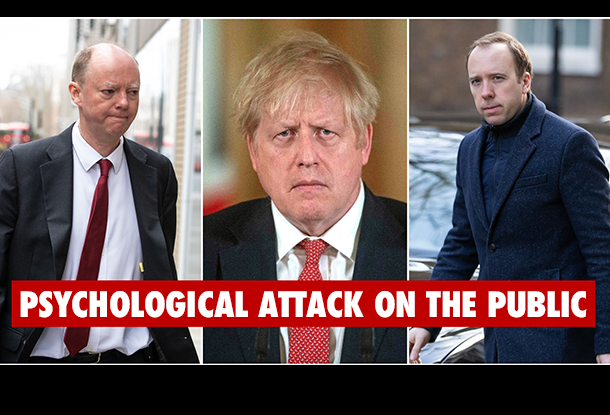
SAGE Document Reveals ‘Covert’ Propaganda to Scare British Into Staying Home in Lockdown
21st Century Wire | April 6, 2021
Once again, the UK government has been shown to have used ‘covert tactics’ in order to scare UK residents into staying at home for lockdown by increasing the ‘perceived threat’ of COVID’ rather than genuine science-backed risk assessment data, and also used ‘hard-hitting emotional messages’ designed to cower the public into complying with the government’s arbitrary diktats.
Due to the heightened level of public outrage, mainstream media outlets are finally being forced to admit what they have been systematically covering-up now for 12 months – that Government have been involved in active psychological and information warfare measures against their own population.
In a document presented to the UK government’s ‘SAGE’ confab, a scientific group meant to advise government on pandemic policies, it was revealed how technocrats sought to increase the ‘perceived threat’ of COVID-19 using aggressive psychological ‘hard-hitting emotional messages’ in order to brainwash the public into compliance.
Upon hearing the official admission, some psychology professionals have turned their sights on Downing Street, accusing bureaucrats of using “covert psychological strategies” in order to hype-up the threat of the virus, and offering no context as to the actual risk posed to the general public.
Government officials are accused of creating ‘a state of heightened anxiety’ which led to many people becoming ‘too frightened to attend hospital’.
This rebuke of the government’s active measures is given further credence by the fact that the majority of hospital beds in the UK remained largely empty in 2020, especially during the first few months of the ‘pandemic.’ This is especially relevant because it was at this same time when the government and mainstream media were relentlessly pushing out the idea that health services were ‘under threat’ of being overrun by Covid, only it never happened.
As a result of the government’s fear campaign, along with the overall throttling of the NHS, there have been an estimated 4.66 million people left waiting many months to begin even routine treatment, as well as thousands of pre-cancer screening appoints abandoned or pushed back – all because of the constant ramping-up of the fear of Covid.
The question still remains: will cabinet ministers be held to account for this unprecedented over-reach of state power?
The Mail Online reports…
Experts fear Britons have been the subject of an experiment in the use of tactics which operate ‘below their level of awareness,’ it was said.
They have now made a formal complaint to an organisation which will rule on whether Government advisers are guilty of a breach of ethics.
Downing street denies this, claiming it simply presented the facts.
Complainants point to a document handed to the Scientific Advisory Group for Emergencies last March, when the pandemic began to rapidly grow in Britain.
The paper, written by Scientific Pandemic Influenza Group on Behaviours, said: ‘A substantial number of people still do not feel sufficiently personally threatened; it could be that they are reassured by the low death rate in their demographic group, although levels of concern may be rising.
‘The perceived level of personal threat needs to be increased among those who are complacent, using hard-hitting emotional messaging. To be effective this must also empower people by making clear the actions they can take to reduce the threat.’
The document, seen by the Telegraph, allegedly then gave 14 options for improving compliance including ‘use media to increase sense of personal threat’, which they said would be highly effective but runs the risk of ‘negative’ side effects.
SAGE members have since claimed the British public have been ‘subjected to an unevaluated psychological experiment without being told that is what’s happening.’
They added that SPI-B reports are often not ‘challenged’ by SAGE because many of those involved are ‘not very well equipped to evaluate it.’
‘When someone from SPI-B is saying we need to ramp up the fear and keep it ramped up – there wasn’t much questioning of that at the beginning and most of the questioning came from external sources, not from within.’
SPI-B is described as providing behavioural science advice aimed at anticipating and helping people adhere to interventions that are recommended by medical or epidemiological experts.
(…) Last November, Sir Patrick Vallance admitted he had ‘regrets’ over frightening people with a doomsday dossier that forecasted as many as 4,000 Covid-19 deaths a day over winter and was used to justify a second national lockdown.
Number 10’s top scientific adviser made the comments alongside Professor Chris Whitty, England’s chief medical officer, after the pair were hauled before MPs to defend SAGE’s modelling that also predicted hospitals would be overrun with virus patients by the end of this month.
During the grilling by members of the House of Commons Science and Technology Committee, Labour MP Graham Stringer asked Sir Patrick if he believed he had frightened people with the bleak deaths data presented during Saturday night’s press briefing.
The Chief Scientific Adviser said: ‘I hope not and that’s certainly not the aim… I think I positioned that as a scenario from a couple of weeks ago, based on an assumption to try and get a new reasonable worst-case scenario. And if that didn’t come across then I regret that.
Australian-British received Israeli training for spying in Iran, analyst affirms
Press TV – April 3, 2021
A political commentator has shed light on the case of Kylie Moore-Gilbert, an Australian-British citizen who served a prison sentence over espionage charges in Iran, highlighting US media’s dishonesty in intentional concealing of the truth about Tehran’s assertion that the academic lecturer had passed a special training course under Israel’s direct supervision for her spying mission in the country.
Tim Anderson, the director of the Center for Counter Hegemonic Studies (CCHS) in Australia, said in an article published on the center’s website on Friday that the American news mogul Rupert Murdoch’s media outlet had spread misinformation over the convicted Israeli spy, Gilbert, who returned home to Australia from an Iranian jail late last year.
The media outlet claimed that Gilbert had been held in a “hellhole” in Iran for no reason at all.
The British-Australian academic was freed from Tehran’s Evin prison in November after serving about two years of her 10-year jail term.
Iranian media reported that Gilbert had passed a two-year special training course in Israeli occupied territories for her spying mission and she had became fluent in Persian during the course and got prepared to perform espionage activities inside Iran.
Anderson said he had provided Murdoch journalist Stephen Rice with evidence that Gilbert had engaged in Israeli “leadership training” for her spying mission in Iran through a fellowship offer in the Ein Prat Israeli leadership academy at the Alon Shvut settlement, one of many illegal settlements in the occupied West Bank.
Anderson added that Gilbert had received a scholarship for the course from Tikvah Fund, an institution committed to supporting the intellectual, religious, and political leaders of the Jewish people.
As cited by the CCHS’s website, Anderson said, “Stephen Rice was either too lazy or too dishonest” to look at the links he had sent him, and that Rice had mentioned in one Israeli article that the linked article said nothing about “leadership” or “training” and those words were an “invention” by Anderson.
“Murdoch’s Megaphone @riceyontheroad was either too lazy or dishonest to recognize Israeli sources backing Iran’s assertion that @KMooreGilbert took Israeli leadership training in a militarized colony at the heart of Palestine’s occupied West Bank,” Anderson also said in a tweet.
Anderson also underlined that Rice pretended Gilbert’s Israeli “leadership training” did not exist and he misled his readers.
“This willful ignorance and distortion of facts allows the Murdoch stable to keep representing the US backed regional wars in Palestine, Afghanistan, Iraq, Libya, Lebanon, Syria and Yemen as humanitarian exercises,” he noted.
Gilbert traveled to different Iranian cities as part of her mission and gathered information.
Unaware that she was being watched by Iranian intelligence forces, the woman went to religious and tourist places in order to make her sojourn in Iran look normal.
She later tried to get in touch with some figures and targets to obtain economic and military information about Iran as well as the anti-Israel resistance front, but she was arrested in September 2018.
Following legal and judicial proceedings, the spy was sentenced to 10 years in prison for acting against Iran’s national security through her intelligence cooperation with the Israeli regime.
The Lockdowners Have Their Own Conspiracy Theories
By Phillip W. Magness | AIER | April 2, 2021
A bizarre Covid-19 conspiracy theory appears to have taken root among the epidemiologists and public health officials who still support lockdowns. According to their claims, the UK government’s pandemic response was secretly captured at some point in the fall of 2020 by lockdown critics including Great Barrington Declaration co-author Sunetra Gupta, her Oxford colleague Carl Heneghan, and Sweden’s state epidemiologist Anders Tegnell.
Seizing on an article in the Times of London, supporters of this theory allege that Gupta and her colleagues convinced UK Prime Minister Boris Johnson and Chancellor Rishi Sunak to abandon a so-called “circuit breaker” lockdown during an audience in late September. Had the UK gone back into lockdown around the beginning of October instead of a month later – proponents of this theory maintain – it would have avoided its disastrous second wave over the fall and winter months.
Even the basic narrative flies in the face of empirical reality. In November 2020 and again in January 2021, the UK went through two successive rounds of draconian lockdowns of the exact type that Gupta and her colleagues advised against. Championed by Johnson as a way to avert the second wave, these policies utterly failed at their stated purpose. On November 5th, the date the second lockdown took effect, the UK’s death toll stood at 48,000. Over the next four months, three of them spent under recurring lockdowns, the UK’s fatality numbers exploded to over 120,000.
Equally telling, the timing of the UK’s fall/winter wave almost perfectly matched that of Sweden, which remained open throughout the same period – except the UK’s results under lockdowns were visibly worse. As a growing body of scientific literature attests, lockdowns did practically nothing to contain the pandemic. Instead, the performance of this policy shows no discernible advantage over states and countries that opted against suspending the basic operations of daily life, and in many cases lockdown countries actually did worse than those that remained open.
Still, proponents of the newest UK conspiracy theory hold that something very different would have happened if only Johnson had enacted an earlier lockdown around the beginning of October instead of November 5th. Its underlying narrative has gained an unusually intense following among public health activists and pundits in the UK.
Deepti Gurdasani, an epidemiologist at Queen Mary University in London and a principal organizer of the pro-lockdown John Snow Memorandum, has aggressively promoted the alleged wresting of pandemic policy away from the lockdowners as an explanation for why the UK’s second and third lockdowns failed. As early as December, Gurdasani blasted Downing Street for supposedly listening to the “dangerous ideology” of Gupta, Heneghan, and Tegnell, which “has cost thousands of lives” and sought to replicate the “dangerous” Swedish strategy. Never mind that Sweden, without lockdowns, has a much lower deaths-per-million residents total (1,303 as of April 1st) than the UK (1,890) under three harsh lockdowns.
The same narrative has become a favorite of Devi Sridhar, an anthropologist and Snow Memorandum co-signer who frequently appears in the UK media to advocate the fringe “Zero Covid” strategy (the same one that claims we need more lockdowns to prevent future lockdowns, apparently unaware of the contradiction that entails). Attempting to explain why her own lockdown approach did not work, Sridhar wrote on January 5th that “Chancellor Sunak invited Heneghan, Gupta & Tegnell to advise on strategy. That says it all.”
Other variants of the same conspiracy theory permeate the UK’s pundit ranks. Far-left Guardian columnist Owen Jones repeated it in a December column targeting Sunak and the scientists for allegedly delaying the lockdowns until it was “too late to bring coronavirus rates down to anywhere near the level needed to suppress the virus.”
A little over a month later, Sam Bowman, a right-leaning self-described “neoliberal,” penned an almost identical argument to Jones in the same newspaper, writing “Sunak was reported as having been the decisive voice in government against an autumn lockdown that might have brought cases low enough to make things like test-and-trace viable,” all because of “Sunetra Gupta, Carl Heneghan and Anders Tegnell being invited to speak via Zoom at Downing Street.”
Note that none of these commentators are even willing to consider the possibility that lockdowns do not deliver on their promises, or that Britain’s dismal performance under the policies they advocated is a direct testament to their failure as public health measures. The validity of lockdowns has become an axiom to them, and the only conceivable reason they do not work must be some form of malfeasance preventing them from working the way the epidemiology models claim they should. Sunak and the three dissenting scientists accordingly became a natural scapegoat for Britain’s dismal public health performance over the winter months.
Is there even a kernel of truth behind the lockdowner’s UK conspiracy theory? Gupta, Heneghan, and Tegnell did meet with Downing Street via Zoom on September 20th to voice their opposition to lockdowns in general – a position they have consistently held throughout the pandemic. Unfortunately, as Gupta has explained and as the next four months repeatedly demonstrated, the Prime Minister largely ignored their advice.
The conspiracists’ alleged “smoking gun” is a series of minutes from the UK government’s SAGE advisory committee on September 21st, which included a “circuit-breaker lockdown” among a “short-list” of policies “that should be considered” in response to rising Covid-19 cases. Apparently in their minds, being “considered” equates to adoption, and the fact that Johnson did not lock down the very next day is proof that the dissenting scientists had wrested the reins of the UK’s pandemic policy from those who advocated lockdowns, delaying the necessary response until November 5th after which it was too late.
There are multiple immediate problems with this narrative. First off, Wales tried a “circuit breaker” lockdown that almost exactly followed the proposal being considered by the SAGE committee, announcing it on October 19 and implementing it a few days later. Although it had a lead of almost two weeks before the rest of Britain went into lockdown in November, Wales’s per capita case numbers followed the same trajectory as the rest of the country, including the sharp spike in late December and early January. Far from working as intended, Wales’s “circuit breaker” lockdown only slightly shifted the timing of this pattern. Its maximum daily peak of 87 cases per 100,000 residents nearly matched England’s peak of 96, and its curve for Covid-19 fatalities followed the same pattern as the rest of Britain.
Equally telling, a number of the conspiracy theory adherents themselves were singing a very different tune when these events were unfolding. Gurdasani, Sridhar, and other lockdown advocates of the John Snow Memorandum crowd want you to believe that they were patiently counseling the government to adopt an early lockdown between the end of September and mid-October, only to see their advice deflected by Downing Street due to the interference of Gupta and the other dissenting scientists. The record reveals a very different story.
On September 24, only three days after the SAGE meeting minutes, an interesting editorial appeared in the leading British medical journal. Written by Karl Friston, a frequent collaborator with Gurdasani and fellow John Snow Memorandum organizer, the editorial advocated a “third way beyond lockdown or herd immunity” premised on implementing a contact tracing regime over the next few weeks. Far from raising alarms about the immediate need for another lockdown, Friston attempted to assure calm.
“We have already developed a substantial population immunity (around 8% in the UK) and our physical distancing policies remain adaptive and effective,” he explained, arguing that a contact tracing regime could synergistically harness and augment their effectiveness. As far as the fall case surge went, he predicted a comparatively mild trajectory: “When one models what is likely to happen…in terms of viral spread and our responses to it—a plausible worst-case scenario is a peak in daily deaths in the tens (e.g., 50 to 60) not hundreds, in November.” As it happens, the UK topped 400 deaths per day during the November lockdown, and surged to 1,200 deaths per day at the peak of the January lockdown.
Just over two months later, Friston joined Gurdasani and several other Snow Memorandum signers in an letter to the Lancet that blamed the UK’s second wave on failing to heed pro-lockdown advice that they now claimed as their own, even as it conflicted with their public messaging from September that downplayed the very same recommendation. Writing in hindsight and with a liberal amount of revisionism, they recast themselves as proponents of an earlier lockdown all along: “On Sept 21, 2020, the Scientific Advisory Group for Emergencies (SAGE) advised the UK Government to institute a circuit breaker in England to suppress the epidemic. Instead, the government opted for several weeks of ineffective local tiered restrictions, and cases continued to rise exponentially.”
A similar messaging came from the “Independent SAGE” group – a private organization of scientists who now generally support the lockdown approach, but also spent the early fall advocating less-restrictive measures that would supposedly avoid another lockdown. On September 20th, the same day that Gupta and the other scientists met with Downing Street, the Independent SAGE group (not to be confused with the official SAGE group despite their shared name) released a 10-point plan “to avoid a national lockdown.”
The scheme warned of a point “when the situation is so far out of control that the only possible response will be a second national lockdown,” but advised “we can only avoid it if we take urgent action” as recommended by the group. They sought a variety of restaurant restrictions limited to outdoor dining, plus the same testing and contact tracing programs espoused by Friston. Six months later, Independent SAGE member Kit Yates is now faulting the anti-lockdown scientists for Johnson’s failure to implement a policy last September that his own group purported to oppose and sought to forestall.
Indeed, what we see when we look to the words of these lockdowner scientists and pundits is nothing short of a conscious attempt to rewrite their own positions from the time period when the conspiracy theory that they’ve now adopted was allegedly playing out. As I documented last fall, the overwhelming media narrative from late September and early October explicitly deflected attention away from the prospect of a second lockdown. Scientists such as Gupta, Heneghan, and the Great Barrington Declaration (GBD) signers, they vigorously maintained, were arguing with a “strawman” of renewed lockdowns that nobody was seriously proposing or considering anymore.
A typical version of this narrative appeared inWired UKon October 7th as part of a media attack on the GBD. “The kind of lockdown that the Great Barrington Declaration seems to be railing against hasn’t been in place in the UK since mid-June,” argued the magazine’s science editor Matt Reynolds. Even in UK cities that were under local restrictions, “pubs, restaurants and schools are still open and it’s hard to find people who are advocating for a return to the lockdown we saw in March.” Reynolds continued: “When the Great Barrington Declaration authors declare their opposition to lockdowns, they are quite literally arguing with the past.”
Similar messages appeared throughout the UK media at the time, each insisting that lockdowns were no longer on the table. On October 11th, Guardian columnist Sonia Sodha wrote “The [Great Barrington] declaration sets itself up against a straw proposal that nobody is arguing for – a full-scale national lockdown until a vaccine is made available.” By October 30th, Sodha was already contradicting herself and revising her own history, tweeting “Wish we’d had a circuit breaker lockdown when SAGE first recommended it.” By mid-December, she was touting the conspiracy theory about Gupta, Heneghan, and Tegnell’s Zoom meeting with Downing Street. More recently, she’s become an advocate of de-platforming the same scientists from British media channels for their anti-lockdown heresies.
Sridhar’s own navigation of the lockdown question followed a similar course. Although she now chastises opponents of the “circuit breaker” lockdown proposal from the events of September 20-21 and faults them for Britain’s second wave, Sridhar wrote a bizarre op-ed in the Guardian on October 10th purporting to oppose “continual lockdowns.” Much like the Zero Covid messaging she would later adopt, its argument is confused and self-contradictory, meandering from touting the model of Taiwan, which never locked down, to New Zealand, which continues to use aggressive lockdowns to suppress even the slightest outbreak. But it also sought to signal her opposition to the specter of renewed lockdowns, which could be avoided – she insisted – by adopting less-stringent localized restrictions and an extensive contact tracing regime.
Sridhar would doubtless insist that her own re-adoption of lockdown advocacy about a month later arose from a failure to heed her earlier advice, as opposed to a more fundamental error with the lockdown approach. Even then, it’s difficult to square her mid-October position with her newfound claim to have recognized the wisdom of a national lockdown some 2 to 3 weeks earlier than the October 10th op-ed, only to see it derailed by the scientists who spoke to Downing Street. Like the Independent SAGE group’s September 20th manifesto, Sridhar was either far less attached to a second lockdown at that point in time than she now insists, or she was engaging in deception about her intentions.
The most astounding attempt at revisionism, however, came from Gurdasani – the Snow Memorandum organizer who has since tried to scapegoat the UK’s Covid failures on Gupta, Heneghan, and Tegnell over the September Zoom conference. She now depicts herself as an early lockdown advocate whose advice from September was shoved aside and ignored. Yet as late as October 26, Gurdasani was still pushing the same “lockdowns are a strawman” line that had dominated the previous month of UK media coverage.
Writing for the Byline Times, a London-based blog that has pushed multiple unhinged conspiracy theories of its own about the Great Barrington Declaration, Gurdasani described lockdowns as “a strawman that the science is not only not advocating for, but very keen to avoid.”
Gurdasani was in the middle of a publicity campaign for the John Snow Memorandum at the time, its own language having been carefully crafted to present its recommendations as a strategy “to prevent future lockdowns” by relying on nondescript localized “restrictions” and a contact tracing regime. As Gurdasani and another Snow Memorandum signer told the Byline Times’ readership, “Unfortunately, the proponents of herd immunity have had a huge impact on responses to the pandemic, effectively creating the lockdown strawman,” insisting that this presented a “dangerous false dichotomy.”
With Gurdasani stressing that she was keen to avoid future lockdowns – a “strawman” in her own words – as late as October 26th, one begins to wonder how she could have supported the very same “strawman” over a month earlier on September 20th, the date on which the dissenting scientists allegedly wrested control of the UK’s pandemic response. Perhaps the lockdowners’ latest conspiracy theory has another as of yet undisclosed twist to it, this one involving a time machine.
The Vaccine Passport Propaganda Template
By Adam Dick | Ron Paul Institute | March 30, 2021
With reports that President Joe Biden’s administration is planning for imposing a vaccine passport mandate in America, expect to see in the media a deluge of vaccine passport propaganda. What will that propaganda look like? A template illustrating several elements you can expect to see in the propaganda push was provided several weeks ago in a CNN interview.
In the first week of March, host Fareed Zakaria and his guest Arthur Caplan provided at CNN a textbook example of how to present vaccine passport propaganda to the American people. Let’s look at some of the major elements of the propaganda template as demonstrated by Zakaria and Caplan.
1) Include some short expression that the idea of vaccine passports can be troubling, but make sure to only bring this up superficially. This is accomplished in the CNN segment by starting with a clip from a short scene from the movie Casablanca. In the clip, a policeman asks to see a man’s “papers,” the man says he does not have them, and the policeman responds, “in that case we’ll have to ask you to come along.” Not shown is the remainder of the scene in which the accosted man, after presenting apparently expired papers, attempts to flee only to be gunned down. Not showing the full scene demonstrates the care demanded in the propaganda to not allow any depiction of potential dire consequences from imposing vaccine passports.
2) Frame the imposing of a vaccine passport mandate as something that is both inevitable and threatens only minimal, if any, harm. Zakaria accomplishes this task with the first sentence he utters to begin the media segment. Zakaria states: “From Casablanca to today, a demand to produce personal documents can be uncomfortable, but, post-pandemic, it’s something we’ll all likely have to get more and more comfortable with.” Masterfully, Zakaria, in addition to minimizing the problems with passports as just causing discomfort, asserts that even that discomfort with time will disappear, suggesting objecting to vaccine passports is just an irrational or silly reaction.
3) Bring on a guest who, despite his description making him sound like someone who would be looking out for the interests of people concerned about vaccine passports, pretty much says that vaccine passports are the best thing since sliced bread. In the CNN interview the guest performing this role is Arthur Caplan, who Zakaria introduces as a “medical ethicist” and “professor at NYU.” A medical ethicist will surely provide some warning about dangers from vaccine passports, right? Yes, in many cases. But, Caplan is not that sort of medical ethicists. He is the one picked to be interviewed in a media segment designed to promote acceptance of vaccine passports.
4) Reiterate that vaccine passports are inevitable, and that people should support them. Zakaria hits the nail on the head with this, presenting this first question to his guest: “So explain why you think, basically, that this is the future and we should be comfortable with it.”
5) Declare that vaccine passports must be imposed on the American people because of coronavirus. Caplan accomplishes this task in his first words in the media segment. He states: “Well, I’m sure that the future holds vaccine passports for us, partly to protect against the spread of Covid.” Of course, as coronavirus has turned out not to be a major danger to most people, imposing a vaccine passport mandate to counter it makes no more sense than doing it to counter any other of many diseases. But, this is not a topic to be brought up when selling people on vaccine passports. Fearmongering, no matter how ridiculously unjustified, is the name of the game. This is the fraudulent message people are encouraged to act on without much critical thought: Coronavirus is gonna kill us all unless we take the shots and show our papers!
6) Say that mandating vaccine passports is really no big deal because of some other supposedly very similar restriction to which some people are already subjected. Caplan states: “And, you know, it’s not a new idea, we have it for yellow fever; there are about more than a dozen countries that say you can’t come in if you haven’t been vaccinated against yellow fever, and many others require you to show proof of vaccination if you transit through those countries.” Are the yellow fever-related requirements justified? Caplan does not say more than that, because these somewhat similar restrictions exist someplace, the mandating of vaccine passports in America is fine. That’s medical ethicist reasoning? Anyway, the yellow fever stuff, because most Americans have no experience with or knowledge of it, is a fine example for the propaganda. Few watchers of the segment will have any basis for questioning the current practice that is used to justify the new desired mandate. One big difference, though, jumps out on further consideration. Caplan explains that the yellow fever requirements apply for just coming to several countries. In contrast, Zakaria early in the interview says the vaccine passports that will, he claims, inevitably be imposed on Americans will be required for people “to get on an airplane, to go to a concert, or to go back to work.” The vaccine passport mandate is, thus, much more troublesome for most Americans than yellow-fever-related requirements for entry into a few countries that most Americans never visit. But, the point is to quickly present the example as if it provides conclusive support no matter how far that representation is from the truth.
7) Dismiss as insignificant people’s concerns about being required, in order to go about their daily activities, to present a vaccine passport and to take a vaccine, or, really, an experimental coronavirus vaccine that is not even a vaccine under the normal meaning of the term. Assert instead that the only danger to freedom could be something theoretical that could be additionally required in the future. Here is how Zakaria puts it in a question to Caplan: “What about the concerns that many people have about privacy, about the privacy of their health data, that, you know, is there a slippery slope here — ‘OK, I’m comfortable telling you whether or not I have Covid, but does that mean it becomes OK to ask about other things?’” Of course, many people are justifiably wary of being pressured to take the shots and then having their mandated vaccine passport used to track them as they go about their daily activities. That is why this media segment and others like it are being presented, after all.
8) Dismiss any concern that vaccine passports can in fact harm freedom. Instead, describe people as benefiting from and gaining freedom by their being mandated to take experimental coronavirus vaccines and present vaccination passports in order to go about their daily activities. Oh yeah, and keep quiet about all the mass surveillance facilitated by a vaccine passport program, the vaccinations-based caste system resulting from the mandate that will make people who do not take the shots suffer, and how the vaccine passport program can be expanded to advance many additional types of control over people. Here is how Caplan puts it: “With a Covid certification, you’re going to gain freedom, you’re going to gain mobility, and I’m going to suggest that you’re probably going to be able to get certain jobs.” Talk about turning things on their head. The mandate really means that people who do not comply will be barred from the mobility they already have and fired from their jobs. Freedom is supported by rejecting the mandate, not by supporting it.
9) Insist that the vaccine passport mandate is fine because it will be applied equally to all people. This is something Zakaria and Caplan spend a long time talking about in the CNN segment. Come on guys, something bad does not become good because it is applied to the maximum number of people, irrespective of their race, sex, or whatever. We are dealing with a mandate here, not giving everyone a serving of his favorite dessert.
10) Declare that a vaccine passport mandate helps encourage people to take the shots. (Unlike the other nine elements of the vaccine passport mandate propaganda template, this one is likely true. Threats can yield compliance. Still, the threats could deter some people from taking the experimental coronavirus vaccine shots. It sure makes you wonder about shots’ supposed safety when an extreme, and unprecedented, act of force is employed to ensure people take the shots.) States Caplan in the interview: “It also gives you an incentive to overcome vaccine hesitancy. Some people are not sure still whether they want to do the vaccine, but if you promise them more mobility, more ability to get a job, more ability to get travel, that’s a very powerful incentive to actually achieve fuller vaccination.” What Caplan is really talking about is coercion. He is saying that people who would otherwise refuse taking the shots will be forced to do so by the vaccine passport mandate severely restricting their activities and even depriving them of the ability to earn an income so long as they do not give in to the demand they take the shots. All this authoritarianism is dressed up in deceptive language. “Vaccine hesitancy” is substituted for “vaccine refusal” to disguise that the vaccine passport mandate is about stopping people from exercising free choice. “Incentive” is substituted for “coercive technique.”
Watch Zakaria and Caplan’s interview here:
Hopefully, many people will see through the deception and be able to prevent the implementation of the vaccine passport mandate Zakaria, Caplan, and others are promoting in the media.
Copyright © 2021 by RonPaul Institute
They’re Not Even Trying to Make Sense Now
By Patrick Armstrong | Strategic Culture Foundation | March 31, 2021
The US intelligence community published a report on 10 March, widely reported in the US free speech news media, on foreign interference in the US election (how many oxymorons so far?). The report establishes a new level of idiocy on the long-running “Russiagate” nonsense.
The idiocy began when Trump, campaigning, remarked that it would be better to get along with Russia than not. A sentiment that would not have surprised Presidents Eisenhower, Kennedy, Nixon, Reagan or any of the others who recognised that, like it or not, Moscow was a fact. A fact that had to be dealt with, talked to, negotiated with so as to produce the best possible result. Why? Well, apart from the diplomatic reality that it is better to get on with your neighbours, the fact that the USSR/Russia was a nuclear power that could obliterate the USA was adequate reason to keep communications alive. If relations could be improved, all earlier US Presidents would agree, so much the better. But for Trump – the outsider – to dare to say so was an outrage. Or more accurately, a hook on which to hang enough simulated outrage to cost him the election. Then, upsetting all expectations, he won. Immediately pussy hat protests, blather about tax returns, Electoral College speculations, 25th Amendment, psychiatrists opining unfitness (COVFEFE: Bizarre Trump Behavior Raises More Mental Health Questions): an entire industry was created to get Trump out, or, if he couldn’t be got out, then at least prevented from doing any of the things he campaigned on. All the swamp creatures were mobilised. The most enduring of these efforts was the Russia allegation. A Special Counsel was created to investigate Russia, Trump and the election. Leaks from this and other investigations fuelled outrage and talk shows.
One of the indications that the story was actually an information operation and not based on fact was its imprecision. Was Trump merely too friendly with Putin, or was he his puppet? Was Trump just a fool to think that relations with Russia could be improved, or was he following instructions? In short, was he a dupe or a traitor? How exactly had Russia interfered in the election and to what effect? Had a few voters been influenced or had the result been completely determined by Moscow? In short was Moscow running the USA or just trying to? Proponents of these crackpot theories never quite specified what they were talking about – it was all suggestion, innuendo, rumours and promises of future devastating revelations. Some of the highlights of the campaign: Keith Olberman shouting Russian scum! Morgan Freeman solemnly intoning that we were at war, and, night after night, Rachel Maddow spewing conspiracies. Some media headlines: Opinion: Here are 18 reasons Trump could be a Russian asset. Trump is ‘owned by Putin’ and has been ‘laundering money’ for Russians, claims MSNBC’s Donny Deutsch. Mueller’s Report Shows All The Ways Russia Interfered In 2016 Presidential Election. A media firestorm as Trump seems to side with Putin over US intelligence. Trump and Putin, closer than ever. All signs point the same way: Vladimir Putin has compromising information on Donald Trump. And so on. Four years of non-stop nonsense promising, tomorrow, or the next day, the final revelation that would disgrace Trump and rid the country of him forever: my personal favourite is this mashup of TV hairstyles telling us that the walls were closing in. Information war. Propaganda. Fake news.
All this despite the fact that the story as presented simply made no sense at all. As I pointed out in December 2017, if Moscow had wanted to nobble Clinton, it had far more potent weapons at its disposal than a too-late revelation of finagling inside the DNC.
And it wasn’t just TV talking heads; the US intelligence community participated. There were two laughable “intelligence assessments”. The DHS/FBI report of 29 December 2016 carried this stunning disclaimer:
This report is provided “as is” for informational purposes only. The Department of Homeland Security (DHS) does not provide any warranties of any kind regarding any information contained within.
The DNI report of 6 January 2017 devoted nearly half its space to a four-year-old rant about RT and admitted that the one Agency that would really know had only “moderate confidence”. In short: ignore the first report, and don’t take the second one seriously. Were people inside these organisations trying to tell us it was all phoney? No matter, the anti-Trump conspiracy shrieked out the reports immediately.
One by one, it fell apart. Mueller, despite the prayer candles, came up with nothing. The “Dirty Dossier” was a fraud. The impeachment for something that Biden actually did failed. These dates should be remembered – Crowdstrike CEO Shawn Henry told the House committee that he had no evidence on 5 December 2017; this classified testimony was not made public until 7 May 2020. Simply put: the key allegation, the trigger for all the excitement and investigations that followed, was a lie, many people knew it was a lie, the lie was kept secret for 884 days. But the lie served its purpose.
There were no investigations of this fraud, only pseudo investigations that went nowhere. When the Republicans had a majority on the House of Representatives there were serious investigations but the testimonies – like Henry’s – were kept secret because they were “classified”. When the Democrats gained control, there were continual boasts that the evidence of collusion was overwhelming, but nothing happened either. Trump’s first Attorney General recused himself and the investigation was conducted by the conspirators. His second Attorney General promised much, set up a Special Counsel, but nothing happened. Well, not quite nothing: a junior conspirator had his knuckles rapped for faking a FISA warrant. In short, the Deep State ran the clock out: the swamp drained Trump.
Ran it out quite successfully too: relations with Russia got worse and Trump himself was hamstrung. His orders were ignored everywhere: on investigating the conspiracy and on removing troops; here’s an insider telling us that the Pentagon ignored his orders on Afghanistan. He was stonewalled on Syria: “We were always playing shell games to not make clear to our leadership how many troops we had there.” The “most powerful man in the world” was blocked on almost every initiative and the long false Russia connection story was a powerful weapon in the conspiracy to impede his attempts to change course.
In 2021 Trump left office and there was no need to mention any of it again. But here’s where it gets really stupid. In December 2020, the NYT solemnly told us: Russian Hackers Broke Into Federal Agencies, U.S. Officials Suspect: In one of the most sophisticated and perhaps largest hacks in more than five years, email systems were breached at the Treasury and Commerce Departments. Other breaches are under investigation. At the same time we were equally solemnly told by US officials “The November 3rd election was the most secure in American history”.
In short, we are supposed to believe that
in 2016 the Russian hacked nothing but the election
and in 2020 they hacked everything but the election.
How stupid do they think we are? Even stupider evidently. Instead of retiring the Trump/Russia/collusion/interference nonsense when it had achieved its purpose, the Intelligence Community Assessment on Foreign Threats to the 2020 US Federal Elections takes us right back down the rabbit hole. I haven’t read it and certainly don’t intend to (see oxymoron above), but Matt Taibbi has and eviscerates it here; he’s read far enough to have mined this gem “Judgments are not intended to imply that we have proof that shows something to be a fact”. (Is this a hint from insiders that it’s all fake?) The report claims that Putin authorised, and various Russian government entities conducted, a campaign to denigrate Biden. Specifically by using Ukrainian sources to talk about corruption of Biden and his son Hunter; despite the video of Biden boasting about firing the investigator, we’re assured that this is all disinformation. And the consumers of the NYT and CNN will believe what they were told. Or, actually, will believe what they weren’t told: the media kept quiet. (Now that’s interference and interference that actually might have changed votes.) The report goes on to say that China did something or other and Iran, Hezbollah, Cuba and Venezuela also chipped in. But fortunately no foreign actor did anything to affect the technical part of the election.
The US security organs expect us to believe,
giving no proof,
that there was lots of malign activity
which had no effect on the election whatsoever.
Which is telling us they think we’re even stupider. Russia swung the election four years ago but forgot how to this time? Putin’s attempt to keep Trump in was blocked by security measures adopted when his tool was President? This time Putin wanted Biden in? Russia’s efforts on behalf of Trump were countered by China’s on behalf of Biden and Iran’s interference broke the tie? But then, information operations don’t have to make sense, they just have to create an impression: Russia, China, Iran and Venezuela do bad things to good people.
Oh, and the latest is that Moscow cultivated Trump for over 40 years, Imagine that: in 1980 they were so perceptive as to see the future importance of a property developer; who’ve they got lined up in the wings now? And Rachel Maddow is back at the old stand pushing some conspiracy theory about Trump, Putin and COVID. I guess it’s not yet time to put away the tinfoil hats.
As I have said before, English needs a whole new set of words for the concept “stupid”: the old ones just don’t have the power any more.
Covid-19 cases decrease in Texas as governor’s ‘NEANDERTHAL THINKING’ apparently hasn’t caused a predicted virus catastrophe
RT | March 30, 2021
Nearly three weeks on from Texas ending its mask mandate and other Covid-19 measures – leading to Governor Greg Abbott being called a murderer by media and politicians – there’s no sign of the sky falling on the Lone Star State.
In fact, Texas just posted a record low in its rate of positive Covid-19 tests, at less than 5.3%, and hospitalizations are at the lowest level since last October. Deaths are at the lowest level in four months. Since March 2, the day Abbott announced that state Covid-19 restrictions would end the following week, the seven-day average for new infections has dropped 48%, to a nearly six-month low of 3,774.
No one is claiming that infections and other Covid-19 measures are down in Texas specifically because Abbott decided “we no longer need government running our lives,” but the absence of predicted catastrophe is providing a shining example for those who argue that states that keep their economies open fare just as well on pandemic performance as those that lock their people down and destroy livelihoods.
Texas, in fact, is seeing declines in Covid-19 cases just as New York and New Jersey – states with such draconian measures that business owners were literally taken to jail for refusing to obey – are once again suffering the highest infection rates in the country. New Jersey has seen a 37% surge in new cases in the past month, to 23,600 weekly.
The juxtaposition in statistics is clearly flipped the wrong way for President Joe Biden, who earlier accused Abbott and Mississippi Governor Tate Reeves of “Neanderthal thinking” for lifting their coronavirus restrictions, and other doomsayers. And by the way, Mississippi’s Covid-19 case rate is down 57% in the past month, to a seven-day average of 254.
Abbott set off a wave of Republican governors freeing their citizens from mask mandates, which Vanity Fair called a “bold plan to kill another 500,000 Americans.” Biden’s fellow Democrat, California Governor Gavin Newsom, called Abbott “absolutely reckless.” Mainstream media hero Dr. Anthony Fauci, chief medical adviser to Biden, called Abbott’s decision “inexplicable,” while author Kurt Eichenwald said it was “murderous.”
Texas Democratic Party Chairman Gilberto Hinojosa accused the governor of being “anti-human” and predicted that hospitals would be jammed with Covid patients.
That hasn’t happened so far, and Texas has posted 18 straight days of improving case numbers since the restrictions officially ended on March 10. But US mainstream media outlets have responded to the counter-narrative phenomenon mostly by ignoring it.
Instead of telling the Texas story, the New York Times breathlessly warned on Monday that case numbers in Republican-controlled Florida had ticked up 8% from two weeks ago, to nearly 5,000 infections a day. Hospitalizations and deaths remained down, the Times conceded, and the increase in cases paled in comparison to those in New York and New Jersey.
But the outlet warned that Florida is a “bellwether for the nation” and falsely said it was “furthest along in lifting restrictions.” Iowa and Montana lifted their restrictions in early February, and some GOP-led states didn’t have mask mandates to begin with.
And rather than rethinking the efficacy of tight Covid-19 mitigation measures, lockdown proponents suggest that the recent case increases in New York and New Jersey mean that their apparently ineffective rules need to be tougher. New York City Public Advocate Jumaane Williams urged Governor Andrew Cuomo to “stick to the science, trust the experts and pause planned reopenings now.” Biden said Monday that a national increase in Covid cases may stem from people “letting up on precautions.”
BBC Presenter “Won’t Hug Parents” As It’s “Not Permitted”
By Richie Allen | March 29, 2021
“I’m really looking forward to seeing my parents later”, Rick Edwards told Rachel Burden this morning. The BBC Radio 5 Live presenters were discussing the gradual easing of lockdown, which begins today. “I won’t hug them though”, Edwards hastily added. “Hugging is still not permitted.”
Edwards hasn’t seen his parents in a long time. He’s been avoiding them for fear of killing them with covid. The planet is an open-air lunatic asylum now. Madness reigns supreme. Who’d have believed that such conversations would ever be possible let alone normal?
“How long is it since you saw yer mum?”
“Six months.”
“Shielding?”
“Yep, the government told them to shield cos they’re vulnerable. I’m seeing them later though.”
“Looking forward to it?”
“Yes, but I can’t hug them. Hugging isn’t permitted.”
I met a man in my local park this morning. Lovely bloke. Our dogs were playing and we had a natter. He told me he hasn’t seen his grandchildren in a year.
His daughter is a real stickler for the rules. They get on fine and pre-covid he watched them three times a week. They’re in Liverpool. He’d usually make the short drive.
Now he chats with them on Skype. His daughter won’t hear of them meeting up. She took the “don’t kill granny/grandad” nonsense to heart. The little ones are terrified they’ll make him sick. He has no say in it. He’s concerned that the fear-porn is damaging the kids.
It’s a madhouse. As I write this, Stephen Dixon on SKY News is telling viewers that he’s thrilled to bits that outdoor swimming is “allowed” and that he can now meet with up to six people, because the government said it’s permitted.
A new ad campaign, fronted by ITV resident doctor Hilary Jones, tells us all to “be firm” with friends and relatives if they try to hug us and give them “gentle reminders” about distancing.
Study: U.S. Media’s Covid Coverage Slants Heavily Negative
Mainstream outlets stoke fear while shielding us from encouraging facts
By Brian McGlinchey | March 27, 2021
If you’ve felt the media has heavily emphasized bad news throughout the Covid-19 pandemic, your judgment now has some scholarly corroboration.
Dartmouth College and Brown University researchers have analyzed tens of thousands of Covid-19 articles and found major U.S. media outlets have overwhelmingly pushed negative narratives about the virus.
“The most striking fact is that 87 percent of the U.S. stories are classified as negative, whereas 51 percent of the non-U.S. stories are classified as negative,” according to the study by Dartmouth economics professor Bruce Sacerdote, Dartmouth’s Ranjan Sehgal and Brown University’s Molly Cook.
Thwarting Public Clarity About Covid-19
Though the study doesn’t delve deep into the societal implications, there’s little doubt excessive media negativity has contributed to public misunderstanding of the nature of the disease and the risk it poses to various segments of society.
Consider one of the study’s most glaring findings: Even when Covid-19 cases were falling nationally between April 24 and June 27, major media discussed rising caseloads 5.3 times as frequently as falling ones.
The impact was evident: A June CBS News poll found a record number of Americans felt the fight against coronavirus was going badly. Of course, news of the poll was itself another negative story, feeding a media-facilitated vicious circle of fear.
In July, a Franklin Templeton-Gallup poll found Americans had a poor understanding of the risk of Covid-19 death for different age cohorts:
- Participants said people aged 55+ accounted for a little over half of the deaths, when the actual share was 92%.
- Those under age 25 accounted for just 0.2% of deaths—participants overestimated the share by a factor of 50.
The results aren’t surprising, given the media’s compulsion to accentuate rare occasions when teens and twentysomethings fall victim to the virus.
In June, CNN served up a particularly flagrant example of Covid scaremongering: an article titled “Healthy teenager who took precautions died suddenly of Covid-19.”
The many who skimmed the headline received an anecdotal infusion of fearful misinformation. The minority who made it to the tenth paragraph would finally learn that doctors treating the purportedly “healthy” yet visibly obese teen found he had Type 1 diabetes with a blood sugar level 10 times the norm.
Two months earlier, the Centers for Disease Control announced that about 90% of those hospitalized with the virus had one or more underlying conditions. Among the most common were obesity (48%) and diabetes (28%). Rather than using this teen’s grim story to enlighten the public about who is at greatest risk, CNN aggressively pushed a perception that nobody is safe.
The media’s failure to foster understanding of Covid-19 also seems evident in the many people still seen wearing masks while alone outdoors. According to Dr. Muge Cevik, an infectious diseases and virology scientist at the University of St Andrews, “outdoor risk is negligible unless it involves close interaction or you are in a crowded or semi-outdoor environment.”
Perceptions of the Virus Influence Policy Opinions
Overly-negative Covid-19 reporting has implications well beyond individual feelings and practices: Those who’ve been led to an exaggerated perception of their personal risk are more prone to support strict government policies to counter the virus.
A recent Pew Research poll confirms that individuals’ perception of the pandemic heavily influences their opinions about various government interventions.
For example, Pew asked if limiting restaurants to carry-out service has been necessary to counter the virus. Among those who think Covid-19 represents a minor threat to the U.S. population, 21% agreed. Support soared to 66% among those who deem the virus a major threat.
Many are likely opining from a position of ignorance: How many know that a New York contact tracing study attributed less than 2% of Covid-19 case transmission to bars and restaurants?
Negative About Positives
The Dartmouth and Brown researchers found “the negativity of the U.S. major media is notable even in areas with positive developments, including school re-openings and vaccine trials.”
When schools reopen to in-person teaching—a move validated by the experience of European schools—U.S. media has been quick on the scene with a wet blanket: The study found 86% of mainstream media articles about school reopenings are negative.
The easing of government restrictions reliably attracts negative media. Iowa governor Kim Reynolds’s lifting of the state’s mask mandate in early February sparked a wave of negative reporting and opinion pieces, including a Washington Post piece that was actually titled “Welcome to Iowa: a state that doesn’t care if you live or die.”
In September, similar derision was heaped on Florida governor Ron DeSantis when he lifted major statewide restrictions.
However, when neither Florida nor Iowa experienced negative consequences, there was little media reporting of the good news that government restrictions and mandates may not be worthwhile after all.
We see a similar pattern with the media’s never-ending cycle of warning that various holidays and special events will bring a surge in contagion. From Thanksgiving to Christmas to the Super Bowl and spring break, we’re constantly presented headlines stoking fears these occasions will cause major virus spikes.
When predicted surges don’t happen, the media gives little attention to the happy news that their alarms proved false. Instead, they’re apparently hard at work drafting warnings about whatever’s next on the calendar.
It’s as if mainstream journalists feel duty-bound to stoke Covid-19 fear, while paternalistically shielding us from welcome facts that could lead us to “let our guard down.” In doing so, they negligently disregard the collateral harm they do to mental health and our quality of life.
Hope for Greater Media Balance?
The Dartmouth-Brown study on U.S. media negativity prompted The New York Times’ David Leonhardt to call for introspection: “If we’re constantly telling a negative story, we are not giving our audience the most accurate portrait of reality. We are shading it.”
That’s a welcome acknowledgment: Until recently, Leonhardt’s own Times email newsletter has mirrored the negative slant found across U.S. media.
There are hints of a growing balance. For example, in recent weeks, major outlets have finally started acknowledging that Florida’s post-reopening experience conflicts with the media-reinforced notion that shutdowns are an essential strategy.
Concluding his review of the study, Leonhardt expressed gratitude to researchers Sacerdote, Cook and Sehgal for “holding up a mirror to our work and giving us a chance to do better.” Let’s hope his sentiment proves highly contagious.
FBI Prepares Massive TV and Movie Propaganda Blitz to Rehabilitate Its Image and Viciously Smear Its Political Targets
By Eric Striker | National Justice | March 27, 2021
It is broadly assumed that TV and movie production in the United States is generally free of government meddling, but this is not true in the case of America’s secret police.
A little known law passed in 1954 at the urging of then FBI Director J. Edgar Hoover makes it illegal to display the FBI seal, the FBI initials, and the words “Federal Bureau of Investigation” in commercial popular culture without expressed permission from the Bureau’s propaganda office, the Investigative Publicity and Public Affairs Unit (IPPAU).
In order to obtain permission to portray the FBI on film, writers and producers must give propaganda agents full veto power over their content.
A cache of documents obtained in 2017 by journalists under the Freedom of Information Act (FOIA) found that the FBI uses this power liberally to sanitize its image. Various other federal agencies like the CIA and ICE do not have this power.
In 2010 terrorism thriller Unthinkable, the IPPAU forced producers to cut a scene showing FBI and CIA agents torturing a man together. In the “revised” version, the CIA agent still tortures the man, but laughably, the FBI agent present protests against the action the entire time, even citing the Geneva Convention as reason for refusing to participate.
The FBI sends “advisors” to rewrite scripts in all productions about them, often cutting out instances of them violating people’s civil rights, talking down to local cops, or engaging in various heinous activities. The result is preferential media treatment most law enforcement groups do not enjoy: the popular portrayal of every single FBI agent as a hero saving the world while we sleep without ever needing to break any rules is deliberately constructed fantasy.
The Trump-era and the Coming Propaganda Offensive
The thuggish and corrupt behavior of the FBI after the 2016 election has, naturally, caused it to suffer an enormous credibility crisis that is only getting worse.
In an attempt to mitigate this, then FBI Director James Comey solicited Jewish television mogul Dick Wolf to create a series of programs to help manufacture public opinion in their favor.
In an interview on the 2017 reality TV show in question, Inside The FBI: New York, Wolf told reporters: “(Comey) feels strongly that this type of positive programming about the Bureau will help educate people about the multitude of areas the Bureau covers and the diversity of its agents and operations. The opportunity to work together was too good to resist.”
The show was co-produced by special agent Anne C. Beagan, who in her capacity as an IPPAU operative went on to supervise Wolf’s fictionalized FBI crime drama, FBI , which began airing in 2018, as well as its spinoff FBI: Most Wanted which began in January 2020.
As if three FBI public relations projects masquerading as TV shows weren’t enough, CBS announced this week that yet another spinoff is in the works: FBI: International.
These shows were all greenlit for new seasons in 2021-2022, meaning that audiences will be inundated without pause with realistic looking fiction glorifying federal agents.
Agent Beagan, who retired last year after a decade of covertly and overtly influencing the media, has also founded her own production company, Anne Beagan Productions, which promises to help create scores of new FBI themed shows and films.
Inverting Reality Through Hyperreality
In FBI, by far the most popular in the young franchise, comical narratives are spun showing FBI agents thwarting villainized portrayals of, you guessed it, white men. “White supremacists” and far-right boogeymen are the most recurring bad guys in the series.
In case you thought the IPPAU would intervene out of inter-agency solidarity, multiple episodes of FBI show an ethnic stew of female-led enlightened agents checking the excesses of caricatured Immigration Customs Enforcement (ICE) officers, who are shown as a gang of ignorant, racist, murderous thugs out to hurt brown people.
In FBI’s pilot, a bomb goes off in a non-white neighborhood, which investigators initially believe to be part of a gang war between blacks and MS-13. As the story progresses, shrewd agents discover that the culprit is a suit and tie paleo-conservative who planted the bombs in a conspiracy to frame non-whites as violent and dangerous.
In “Crossfire,” a white veteran from Staten Island brainwashes a young Somali Muslim into helping him assassinate state officials. “This Land Is Your Land” features militia members working with a Russian to create biological weapons.
ICE gets special interest. In “Most Wanted,” a federal deportation officer is shown massacring his family and then going on the run. Season 2’s “American Dreams” features a white supremacist hijacking a school bus, with a side plot featuring ICE racially profiling an FBI agent’s daughter and trying to deport her.
While critics have given the show mixed ratings, it is popular with liberal audiences, garnering 8-10 million views per episode.
FBI, in conjunction with mass media, undoubtedly plays a role in manipulating public perception, particularly in Blue America. Last February, 47% of Democrats said “white nationalists” were America’s number one national security threat, compared with just 3% of Republicans and 29% of the population overall.
In a May 2019 survey, only 48% of Republicans said the FBI was doing a good job, with 28% rating them poorly. This number has probably eroded further following the selective and mass prosecution of Capitol protesters compared to the total lack of consequences for murderous violent Antifa rioters over the summer.
The FBI, Hollywood and television corporations seem to think the solution to this is to keep doing exactly what has made them such a polarizing institution while drowning the country with their egoistic sense of themselves.
They are vicious and cowardly tyrants. When this dark moment in America is finally over, they will be categorized alongside the KGB and Stasi, where they belong.
Featured Video

Chinese jet fuel and the myth of energy independence
or go to
Aletho News Archives – Video-Images
From the Archives
The Dirty Little Secret behind the “Global Terrorism Index”
The Omission of Israeli Terrorism in the Occupied Palestinian Territories
By Karin Brothers | Global Research | December 6, 2014
… The Israeli settlements — all of which are illegal – have been identified as a major impediment to peace. The refusal of a major “global” terrorism report to name the Israeli settlers as one of the groups most responsible for terrorism not only misrepresents a major source of regional violence but exposes the Global Terrorism Index as a propaganda tool that supports a U.S. agenda.
In recent years, governments have been attempting to thwart terrorism by blocking supportive fund-raising. When it comes to Israeli settlements, however, the US and Canada actually encourage fund-raising by giving organizations (such as Christian Friends of Israeli Communities (CFOIC) and the Jewish National Fund) financial support in the form of donor tax-deductions.
Charities which provide funds for the Israeli settlements should be regarded as terror-financing organizations. They should not only lose their tax-deductible status, but they should be banned because they support the violation of international humanitarian law. The terror-financing laws that are being strictly enforced for Muslim charities should be applied to Christian and Jewish charities as well. … Read full article
Blog Roll
 Aletho News
- Chinese jet fuel and the myth of energy independence
- Ukraine Sea Drone Fired From Libya Hit Russian Tanker in Mediterranean
- IRGC: Iranian forces launched no attacks during ceasefire hours
- Trump Administration Moves To Automate U.S. Military Draft Registration
- Spain orders reopening of Tehran embassy, condemns Israel’s carpet bombing of Lebanon
- Israel faces ‘unsustainable’ strategic crisis following 40-day war against Iran: Analyst
- Iran restricts Hormuz access to 15 vessels per day under ceasefire terms: Report
- The ‘Opposition Party’ Has Done Nothing to Stop the Iran War and Much to Goad Trump Into Continuing It
- Moscow backs Tehran on status of Lebanon in US-Iran deal
- How UK Regulator Ofcom Quietly Bypassed International Law to Police American Speech
- If Americans Knew
- Amnesty: Urgent – Protect Lebanese civilians from brutal escalation in Israeli attacks
- Is The War Against Iran Over?
- Inside the Israeli army’s propaganda wing
- Hundreds of Gaza Amputees Stranded in Legal Limbo
- The gallows law: Israel moves toward executing Palestinian children
- Tucker Carlson: The Path to Peace requires ending ‘special alliance’ with Israel
- This is ceasefire? Israel’s biggest massacre yet in Lebanon, another journalist killed in Gaza – Daily Update
- Tucker Carlson on Israel: This Is the Behavior of an Ally? Really?
- Gazans face a triple crisis: severe shortages of water and bread, healthcare in tatters
- NY Times reports how Netanyahu took the US into Iran War
- No Tricks Zone
- An Inconvenient Tree: Uncovered In Alps… Europe Much Warmer Than Today 6000 Years Ago
- New Study Reports A 60% Slowdown In Greenland’s Ice Loss Rate In The Last Decade
- Low Intensity Tornado Wrecks Major Solar Farm, Creating A Potential Toxic Dump
- New Study Finds Warming Saves Lives…Cold Temperatures 12 Times More Deadly Than Excess Heat
- German Science Blog Accuses PIK Climate Institute Of Hallucinating Climate Tipping Points
- Devastating Assessment Of Comirnaty Vaccine By Former Senior Pfizer Europe Toxicologist
- New Study: CO2 Is ‘Effectively Negligible’ As An Explanatory Climate Change Factor Since 2000
- Former Pfizer Toxicologist Dr. Helmut Sterz Tells Bundestag Hearing Pfizer Vaccine Should Have Never Been Approved
- Energy Expert: Germany’s Nuclear Phaseout Was A “500 Billion Euro Mistake”
- New Research: South Australia’s Mid-Holocene Sea Surface Temperatures Were 4°C Warmer Than Today
 Aletho News