The New Scientist Misses the Science on ‘Sinking Pacific Islands’
By Anthony Watts | Climate Realism | January 16, 2026
The New Scientist (NS) recently published “The Pacific Islanders fighting to save their homes from catastrophe” by Katie McQue and Sean Gallagher. The article claims that small Pacific island nations face an existential threat from rising seas and intensifying storms driven by climate change, with displacement already underway and submergence looming. This article is factually false and unsupported by real-world data. The piece relies on emotive anecdotes and dire projections while ignoring a substantial body of empirical research showing that many low-lying islands and atolls are stable or growing, keeping pace with sea-level rise rather than succumbing to it.
The article asserts that “rising seas are anything but a distant projection,” that high tides now regularly inundate areas that “used to stay dry,” and that island nations such as Tuvalu could be “almost completely submerged at high tide by the end of the century.” It further suggests that climate-driven sea-level rise is already forcing migration and poses an existential risk. These claims are presented as settled science, yet New Scientist fails to engage with the very studies that have directly measured island change over time.
Actual surveys of island nations tell a very different story. As summarized in Climate at a Glance’s evidence-based review “Islands and Sea Level Rise,” dozens of peer-reviewed studies using aerial photography, satellite imagery, and on-the-ground surveys show that the majority of low-lying coral islands have remained stable or increased in land area over recent decades. Research on atolls in the Pacific and Indian Oceans finds that sediment transport, reef dynamics, and natural island-building processes allow islands to adjust to gradual sea-level rise. In other words, these islands are not passive sand piles waiting to drown; they are dynamic landforms.
This is not a fringe view. Climate Realism has repeatedly documented how media outlets ignore these findings, including in its coverage collected under island and sea-level rise reporting, where studies showing island growth in places like Tuvalu, the Marshall Islands, and Kiribati are contrasted with alarmist headlines predicting imminent disappearance. Those empirical studies directly contradict New Scientist’s framing of inevitability and catastrophe. Further, sea level rise data from NOAA on the island of Kirbati is quite modest, just 0.77 feet per century.
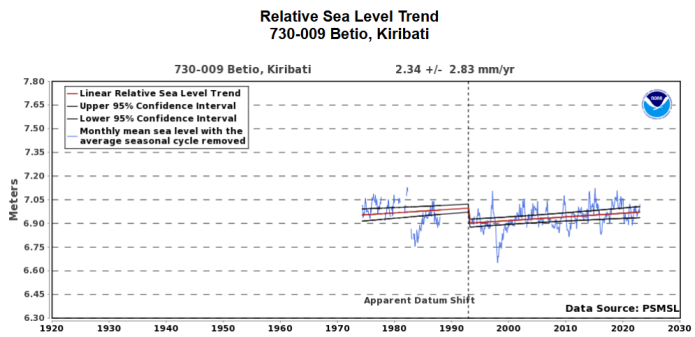
Relative sea level trend is 2.34 millimeters/year with a 95% confidence interval of +/- 2.83 mm/yr based on monthly mean data from 1974 to 2022 which is equivalent to a change of 0.77 feet in 100 years
Equally telling is what is happening on the ground. Island nations supposedly facing near-term sea level submergence are investing heavily in long-term infrastructure. Tuvalu, the Maldives, Fiji, and other Pacific and Indian Ocean nations are expanding airports, reclaiming land, and approving major hotel and resort developments. These are capital-intensive projects with planning horizons measured in decades, not emergency stopgaps for populations about to flee. Governments and investors with real money at stake do not behave this way if these countries are about to vanish beneath the waves.
NS also conflates local flooding, erosion, and freshwater management problems with global sea-level rise. High tides washing into low areas, saltwater intrusion into wells, and coastal erosion are often driven by local factors such as land use, groundwater extraction, reef damage, and poor coastal management. Treating every such problem as proof of climate catastrophe is a classic case of confusing site-specific issues with global trends.
Perhaps most damning is what NS does not do.
It does not cite the extensive body of peer-reviewed literature documenting island stability and growth. It does not explain why measured island area changes contradict its narrative. It does not ask why nations allegedly facing “existential” risk are expanding infrastructure rather than abandoning it. Instead, it relies on selective anecdotes, speculative end-of-century projections, and emotionally charged language to imply a settled scientific conclusion that the data do not support.
If the New Scientist were actually doing science rather than regurgitating rhetoric, this article would not exist in its current form. A serious treatment would grapple with the observational record showing that many island nations are keeping up with sea-level rise, not disappearing beneath it. By failing to cite that science and by presenting a one-sided story of inevitable catastrophe, the New Scientist misleads readers and does a disservice to both the public and the people living on these islands, whose real challenges deserve honest, evidence-based discussion—not recycled counterfactual climate alarmism.
Truth as first casualty: Deconstructing disinformation campaign on Iran riots death toll
By Yousef Ramazani | Press TV | January 19, 2026
Amid the foreign-instigated riots and terrorism that struck Iran in recent weeks, a parallel narrative war also unfolded, centered on the deliberate propagation of wildly inflated and unverifiable casualty figures.
These figures were designed to manufacture global outrage and legitimize calls for American military intervention and yet another aggression against the Islamic Republic.
The discourse surrounding riot-related casualties in the past few weeks has been fundamentally shaped by a coordinated disinformation campaign originating from US-funded organizations operating entirely outside Iran. Central to this campaign was the circulation of sensational death tolls that bore little resemblance to verifiable facts on the ground.
The figure of 12,000 deaths was initially promoted by the New York–based Center for Human Rights in Iran, an organization financially linked to the National Endowment for Democracy (NED), a US Congress–funded entity with a well-documented history of interference in the internal affairs of sovereign states.
This claim was presented without transparent methodology, primary data, or independent verification, raising eyebrows both inside and outside the country.
Despite this lack of evidence, the narrative was uncritically amplified by major Western media outlets and online influencers, creating a pervasive – but demonstrably false – impression of mass violence. Iranian officials consistently rejected these claims, presenting forensic evidence of manipulated datasets and instead reporting a death toll in the hundreds, the majority of whom were security personnel and civilians killed by armed rioters with foreign backing.
The subsequent escalation of these figures to even more implausible numbers – such as claims of 52,000 dead – underscores the persistence of a hybrid warfare strategy aimed at demonizing Iran while obscuring or outright excusing the violence committed by its adversaries.
Genesis of a false narrative: Center for Human Rights in Iran and its backers
The primary source of the sensational 12,000-fatality claim was neither an Iranian authority nor a verifiable international body, but the Center for Human Rights in Iran, an organization headquartered in New York. Despite its name, the group operates entirely outside Iran and has no physical presence or investigative capacity within the country.
An examination of its leadership and funding reveals a clear political orientation inconsistent with impartial human rights monitoring. The chair of its board is Minky Worden, an American activist with a documented history of spearheading anti-China advocacy campaigns, including efforts to politicize the Beijing Winter Olympics.
Financially, the organization relies heavily on grants from the National Endowment for Democracy in Washington, D.C. The NED is a privately managed but publicly funded institution that receives annual allocations from the US Congress through the State Department budget.
Historians, observers, and former intelligence officials have long characterized the NED as a transparent successor to activities once conducted covertly by the Central Intelligence Agency, particularly the funding of political opposition groups and media outlets under the banner of “democracy promotion.”
The NED’s record includes extensive involvement in “regime-change” efforts across Eastern Europe, Latin America, and West Asia – regions that have consistently featured in American foreign policy campaigns.
Amplification network: From NED grantees to global headlines
The unfounded casualty figure did not remain confined to a single organization. It was rapidly injected into the global media bloodstream through a tightly networked ecosystem of interconnected groups.
Other NED-funded entities, including the Human Rights Activists News Agency and the Abdorrahman Boroumand Center, echoed and cross-cited the same unsubstantiated statistics.
Operating largely from the US, these organizations function within a closed loop of mutual citation, manufacturing the illusion of multiple independent confirmations.
This echo chamber was then leveraged by major Western media outlets, including BBC Persian, Voice of America, The Washington Post, and ABC News, which incorporated the figures into their reporting.
Typically, these outlets attributed the numbers vaguely to “human rights groups” or “activists,” effectively laundering the information and granting it a veneer of credibility without conducting any independent verification. This failure is particularly striking given the well-documented funding sources and political objectives of the originating organizations.
Crucially, much of this coverage omitted the context that these groups are financially and ideologically aligned with the very governments actively seeking to pressure, isolate, and destabilize the Islamic Republic of Iran.
Iranian rebuttal and exposure of fabricated evidence
Iranian government officials and domestic media mounted a comprehensive, forensic rebuttal to the widespread disinformation campaign. The judiciary’s spokesperson and the head of the Supreme National Security Council categorically denounced the claim of 12,000 deaths as “psychological warfare” and a “complete fabrication.”
They publicly challenged the originators of the figure to provide a single verifiable name, death certificate, or precise locational detail to substantiate their alleged casualty lists, a challenge that was never answered.
Cyber units affiliated with Iranian media conducted technical analyses tracing the viral dissemination of the figures to known bot networks operating from locations in the United States, Israeli-occupied territories, and Albania.
Further investigations revealed that purported “martyr lists” were riddled with fraud: hundreds of duplicate entries, names of individuals who had died decades earlier during the Holy Defense war, and even names copied directly from public cemetery records in other countries.
The case of Saghar Etemadi became emblematic of the deception. Widely declared a “martyr” by external outlets, she was later confirmed by the Iranian judiciary and by her own family to be alive and receiving medical treatment for injuries sustained during a riot.
Iranian reports emphasized that the actual death toll, resulting from terrorist acts carried out by foreign-backed armed rioters, numbered in the hundreds. A significant proportion of the victims were police officers, Basij forces, and civilians deliberately targeted by violent saboteurs.
Escalation to absurdity and the weaponization of atrocity propaganda
The disinformation ecosystem demonstrated its capacity for rapid and unchecked escalation.
From the initial claim of 12,000 deaths, narratives soon proliferated across social media platforms and activist circles alleging 52,000 fatalities and more than 300,000 wounded.
These figures, divorced from any conceivable reality, serve a deliberate psychological and political function. They are designed to induce global emotional shock, overwhelm critical scrutiny, and portray the Iranian state as uniquely and exceptionally undemocratic
This narrative fulfills a dual geopolitical purpose, according to experts. First, it seeks to manufacture consent for foreign intervention, intensified sanctions, or diplomatic isolation by invoking a humanitarian pretext. Second, it functions as a tool of distraction and moral laundering.
By creating a false equivalence, or even attempting to eclipse, the documented casualties inflicted by the Israeli regime in Gaza, the campaign aims to redirect global outrage and obscure the horrendous crimes of Washington’s and Tel Aviv’s allies.
Influencers and online networks aligned with the Israeli regime aggressively promoted the fabricated Iranian casualty figures in an effort to undermine the global Palestine solidarity movement and digitally overwrite the extensive evidence of Israeli war crimes.
Underlying architecture: NED as a US “regime-change” instrument
The role of the National Endowment for Democracy is central to understanding the structural foundations of this disinformation campaign. Leaked documents and historical analyses reveal the NED as a key instrument of US foreign policy, operating as a conduit for government funds to support political movements aligned with American strategic interests abroad.
The organization was established following congressional scrutiny of CIA covert operations. One of its founders, Allen Weinstein, openly acknowledged that “a lot of what we do today was done covertly 25 years ago by the CIA.”
The NED’s activities extend far beyond Iran. It has been a principal funder and organizer of so-called “color revolutions” in Eastern Europe and has been formally designated an “undesirable organization” by Russia for interference in domestic affairs. Its involvement in Hong Kong and Xinjiang has prompted sanctions from China.
In the Iranian context, the NED has for decades funded an array of exile media outlets, advocacy groups, and cultural figures, with the explicit aim of cultivating an alternative political leadership.
A leaked 2024 proposal revealed NED plans to funnel State Department resources into an “Iran Freedom Coalition” composed of US neoconservatives and selected exile figures, exposing the direct link between humanitarian narrative construction and overt regime-change ambitions.
A perennial pattern of narrative warfare
The manipulation of casualty figures during the 2025–2026 unrest is not an isolated episode, but part of a recurring tactic in the long-running hybrid war against the Islamic Republic of Iran.
The pattern is consistent and predictable: a US-funded NGO, operating safely from New York or Washington, releases an unverifiable and sensational claim. A network of affiliated organizations and social media assets amplifies it, after which mainstream Western media repackages it as credible reporting.
The objective is never truth, but the construction of a carefully engineered perceptual reality serving strategic interests. This reality is designed to demonize independent states, legitimize coercive policies, and erase or minimize the crimes of allied regimes.
The Iranian experience, from the myth of 12,000 deaths to the even more fantastical claim of 52,000, stands as a stark case study in the weaponization of information in the 21st century.
In this domain, the battlefield is not only the street, but global consciousness itself, and the most powerful weapons are often not missiles, but meticulously crafted falsehoods.
The anti-Iran human rights bazaar
By Karim Sharara | Al Mayadeen | January 16, 2026
Mainstream media’s reliance on US-funded “Iranian human rights” NGOs reveals a recycled regime-change pipeline, where anonymous activists are used with opaque finances to treat propaganda like facts.
“2,000 protesters killed, activists say.”
My, my, it seems anonymous activists are really all the rage in Western media, with this headline being parroted (in multiple forms, no doubt). Because if it’s in The Guardian, BBC, and CNN, among others, it has to be “true”, particularly when it’s Iran they’re talking about.
But really, journalistic integrity is about citing sources, and if these “unbiased”, “professional”, and “objective” outlets are good at anything, it’s choosing the proper organizations to cite, which are in no way affiliated with suspect sources.
After all, it’s not suspect if it’s the CIA or the US federal government, right?
Human Rights Activists in Iran (HRANA)
Take HRANA, for instance, which is THE go-to “agency” cited by Western media.
Arrest figures? HRANA.
Death tolls? HRANA.
Names of the arrested? HRANA.
Claims of repression cited by Reuters, AP, the BBC, CNN, and The New York Times? HRANA.
According to its website, “Human Rights Activists in Iran (also known as HRAI and HRA) is a non-political and non-governmental organization comprised of advocates who defend human rights in Iran. HRAI was founded in 2005.”
Contrary to the name, the Human Rights Activists in Iran organization is not, in fact, in Iran, but rather operates from the comfort of Virginia, in the United States. Kind of like when you buy Brussels sprouts expecting something European but then find out they were “imported” from California.
HRANA also makes this claim: “Because the organization seeks to remain independent, it doesn’t accept financial aid from either political groups nor governments.”
Oddly enough, no Western media source has disclosed that HRANA is being funded by the NED (National Endowment for Democracy), which was established to keep CIA funding covert, according to its co-founder Allen Weinstein, who had said, “A lot of what we do today was done covertly 25 years ago by the CIA.”
HRANA was founded by Keyvan Rafiee in 2006, in Virginia, and according to tax filings dating back to 2012 (when Rafiee only got $59,000 in tax-exempt donations) he is now raking in a comfortable $1 million dollars in donations.
In total, Rafiee has taken $10.7 million from 2012 to 2015, no doubt from “good Samaritans” donating funds to his Patreon.
CHRI
The Center for Human Rights in Iran (CHRI), much like HRANA, is also being cited by mainstream media as a credible source, amassing “over 7,000 international media citations in 2022,” according to its own website. Also like HRANA, it identifies itself as an “independent, nonpartisan” nonprofit organization (seems like it’s a mantra they all use).
With nonprofit being the keyword here, Hadi Ghaemi, CHRI’s founder and executive director, gave himself more than $200,000 in compensation from US taxpayer money just last year for his tiring work in advancing human rights, almost double the $105,000 he received in 2013.
It’s noteworthy that Ghaemi had claimed in 2009 that he had never received any sort of funding from the US government or NED, speaking in particular regarding his work for United4Iran, another organization he founded.
From 2012 to 2024, CHRI, registered as Campaign For Human Rights Inc and tax-exempt since 2011, has received $16.3 million, also in tax-exempt donations. However, because of the lack of transparency regarding the organization’s finances, the source of the funding could not be ascertained.
Tavaana
One of the most active organizations among Iranian dissident groups is Tavaana. On its website, it brands itself as “Iran’s premier civic education and civil society capacity building initiative.” You’d think to yourself it’s based in Iran until you’re hit quite boldly in the next sentence with “Launched in 2010 with a seed grant from the Bureau for Democracy, Human Rights and Labor (DRL) at the US Department of State.”
Going through tax files related to Tavaana will net you nothing; that’s because the taxes are filed under the name “E Collaborative For Civic Education,” Tavaana’s parent organization, which has been tax-exempt since 2011. The tax filings show that the organization received grants totaling $250,000 in 2011, which quickly skyrocketed to a high of $1.9 million in 2014. In total, from 2011 to 2024, Tavaana received a total of $15.9 million in donations.
Looking at the scope of activities it’s involved in, and how its online courses are about sharing articles similar to eHow on circumventing internet restrictions in Iran, it’s difficult to see where those millions of dollars went… Either that or they were contracted to write the most expensive compilation of e-brochures.
According to a NED booklet authored by Sherry Ricchiardi for NED’s Center for International Media Assistance (CIMA) and published on March 13, 2014, “The Tavaana project’s parent organization, the E-Collaborative for Civic Education, has received support from the National Endowment for Democracy, the Netherlands Ministry of Foreign Affairs, and the United States Agency for International Development.”
“Program Manager Layla Attia listed some of the project’s accomplishments, including 29 e-courses and 47 webinars on such topics as women’s rights, digital safety, gay rights in Islam, social entrepreneurship, democratic institutions, and power searching on Google. Participants connect securely from Iran to anonymous e-classrooms, and so far none have reported being compromised, according to Attia.”
Imagine being an American and finding out that $100,000 of your tax dollars was spent to teach “power searching on Google.”
Tavaana’s co-founders are Akbar Atri and Mariam Memarsadeghi. Atri has largely been inactive on social media since 2018, but Mariam Memarsadeghi paints a different tale. She is an avid supporter of “Israel”, as seen in her bio, which features an Israeli flag, and has even called for US and Israeli strikes on her own country, the last time being just a few days ago:
Perhaps more interestingly, she is also an avid monarchist, who advocates giving power to a man whose sole claim to fame is being born with a saffron spoon in his mouth and who has gone on record saying he doesn’t know what he’ll be going back to, if he ever returns to Iran, suggesting he may live between the US and Iran because he has spent his entire life in the US.
This is the same man who thought showing pictures of himself doing yoga would somehow give him better optics.
One prominent Iranian dissident, Ruhollah Zam, who was involved in directing anti-Iran operations (including teaching rioters how to make homemade weapons through his Amad News Telegram channels), and later captured and repatriated in an intelligence operation, has also gone on record years ago telling people in a video call that he’s seen the late shah’s son practising inspecting troops in front of his bedroom mirror.
Iran Disinformation Project
One short-lived project started directly with US State Department funding was the Iran Disinformation Project, after, according to The Guardian, “it was found to be trolling US journalists, human rights activists and academics it deemed to be insufficiently hostile to the government in Tehran.”
Once @IranDisinfo began targeting mainstream journalists for not being radically anti-Iran, buzzers went off, and their funding was cut. “The bulk of the work by @IranDisinfo has been in line with the scope of a project with the Department of State. We have, however, identified recent tweets that fall outside the scope of the project to counter foreign state propaganda or disinformation,” one State Department spokesperson said.
The tweets in question were then deleted, but funding was not restored. The page can still be seen on Twitter, inactive since 2019.
Boroumand Center for Human Rights in Iran
One of the most effective organizations funded by the National Endowment for Democracy is the Boroumand Center for Human Rights in Iran, co-founded by dissident sisters Ladan and Roya Boroumand. Its board of directors features prominent neocon-turned-something-or-other Francis Fukuyama (post-neocon liberal institutionalist is what my search tells me he is, and for some reason, that’s an actual thing), and prominent Iranian celebrities, such as Nazanin Boniadi.
In 2024, NED presented its “partner” Roya Boroumand a medal “in recognition of her leadership and dedication to the promotion of human rights and democracy in Iran.”
In particular, the NED statement read: “Roya along with her sister Ladan Boroumand, a former Reagan-Fascell Democracy Fellow at NED, have dedicated their lives to upholding human rights in Iran.”
From 2011 to 2024, the Boroumand Center received $13.5 million in tax-exempt donations in the US. Before that, information suggests that it was bankrolled by contributions from foundations, such as the influential right-wing Lynde and Harry Bradley Foundation, to the tune of tens of thousands of dollars each year per donor.
The Boroumand Center has also collaborated with and received funding from George Soros’ Open Society Foundations.
Curiously, the Center’s What We Do page reads: “Our goal is to prepare for a peaceful and democratic transition in Iran and build a more just future.”
One would think that people who are so avid to preserve democracy and democratic practices, even being honored with prestigious awards for their work, would do better than to amplify a call for the firing of Iranian academics in the US asking questions about the Mossad’s involvement in the riots, particularly ones as distinguished as Hamid Dabashi.
On Jan 12, Ladan Boroumand also amplified a post by Iranian dissident Omid Shams in which he discussed how an attack on Iran can be justified under “humanitarian intervention”.
It seems that a recurring theme of Iranian dissidents abroad is how hard they all cheer for strikes on their own country, but none have taken it as far as Masih Alinejad, who seems to have spearheaded the opposition, much to the chagrin of many dissidents who call her an opportunist.
Through her work in VOA Farsi (VOA meaning Voice of America, because it’s an American network), which is directly funded by the State Department, through which Alinejad has called for strikes, regime change, sanctions, and all manner of actions by the US against her country, she has catapulted into the frontlines of the opposition. She has also received hundreds of thousands of dollars in payments for her work with VOA Farsi.
A regime-change ecosystem
So the next time you’re told, very solemnly, that “2,000 protesters were killed, activists say,” it may be worth asking a dangerous question: which activists, funded by whom, operating from where, and with what openly stated political objectives?
Because what emerges here isn’t an ecosystem of independent human rights advocacy, but a tightly interlinked industry of regime-change NGOs, generously financed by US government cutouts, recycled endlessly through Western newsrooms that treat “Virginia-based Iranian activists” as a substitute for on-the-ground verification.
Maybe the real miracle isn’t that these figures are uncritically repeated, but that after Iraq’s WMDs, Libya’s humanitarian war, Syria’s “moderate rebels”, and every other CIA-flavored moral crusade, we’re still expected to gasp in awe when someone from the mainstream has “trust me bro” for a source.
Italy and the drone that isn’t there
By Lorenzo Maria Pacini | Strategic Culture Foundation | January 14, 2026
Damn: it was all so well orchestrated that it seemed authentic. But no. The story of Russian drones flying over Italy – and in particular the Joint Research Center (JRC) in Ispra – has been revealed for what it was: a grotesque fabrication, devoid of any real basis. Sergio Barlocchetti had already written about the absurdity of it all, well in advance, in Dronezine Magazine (issue 66). Now comes the official confirmation: the Milan Public Prosecutor’s Office has asked the investigating magistrate to close the investigation into serious allegations ranging from political and military espionage to terrorism and subversion.
To tell the truth, we Italians were never particularly impressed by this narrative of Russian ‘hybrid attacks’, with Moscow invading Europe inch by inch with drones that were never identified or shot down. But then the so-called Drone Zero entered the scene, the progenitor of all drones, naturally sent by Putin directly to Italy. In the spring, according to reconstructions, the powerful security system of the JRC in Ispra – apparently more vigilant than Ursula von der Leyen and Kaja Kallas – intercepted it repeatedly: nine times between March 20 and April 14 and thirteen times between April 16 and May 27. What was the purpose of its presence? According to the media and television news, the aircraft was spying with ill-concealed eagerness on both the European Union laboratories and Leonardo’s helicopter unit, the pride of the national military industry, located nearby.
Some newspapers even went so far as to describe its technical characteristics: Russian production, night-time filming capability, high-precision three-dimensional mapping. Others evoked the specter of “hybrid warfare,” Moscow intelligence activities, and even suspicious pro-Russian presence in the Varese area. The situation was so serious that the Milan Public Prosecutor’s Office opened a file for espionage, terrorism, and attacks on transport security. Some people even alerted their tattoo artists.
Then, however, reality knocked on the door. Technical checks revealed that the sophisticated anti-drone system suffered from structural limitations: software that could not withstand continuous use, decoding errors, and incorrect classifications. The ‘Russian drone’ turned out to be a simple phantom signal, generated by a GSM amplifier purchased on Amazon by a local family to improve cell phone reception. There was nothing in the sky above Ispra and Vergagliate, no drone, no Russia, no conspiracy.
The narratives about alleged Russian drones flying over Italian skies can be interpreted as part of a broader hybrid communication strategy, fitting into a media and political ecosystem in which the Atlantic Alliance and various European governments use the frame of the Russian threat – including the drone dimension – to strengthen internal consensus and legitimize rearmament and a posture of deterrence towards the East.
The Ispra case is truly emblematic and shows how mainstream media and institutional actors have constructed an emergency narrative of Russian “hybrid warfare” in the absence of solid technical evidence; a narrative that has been amplified by alarmist headlines, talk shows, and social networks, contributing to the consolidation of a negative image of Russia in public opinion, shifting the emotional center of gravity from rational debate to fear.
On a strategic-communicative level, this climate of perception serves three objectives: to promote acceptance of NATO programs to strengthen anti-drone defense and increase military spending; to reduce the legitimacy of positions critical of Atlantic policies, which are easily labeled as “pro-Russian”; consolidating a dichotomous friend/enemy frame in which Moscow is the threatening Other, and NATO-integrated Europe is the defensive and ‘rational’ subject.
These are fairy tales that are no longer even good enough for children. These Russians who fight wars with washing machines and horses, as Italian newspapers report, but who are capable of sending drones to disturb the naps of the average Italian in upper Lombardy, are not to blame this time. Maybe next time for the next fake news story!
Here’s who really weaponizes children in the Russia-Ukraine conflict
By Eva Bartlett | RT | January 9, 2026
For the last three years, Ukraine and concerted legacy media campaigns have been screaming that Russia has abducted, or forcibly displaced, thousands of Ukrainian children – even up to 1.5 million!
The accusations resurged in December, with a UN General Assembly vote on a draft resolution on the return of Ukrainian children.
During the meeting, Ukraine’s Deputy Foreign Minister Mariana Betsa once again pushed claims that “at least 20,000 Ukrainian children have been deported to Russia,” in spite of the fact that months prior, during the June Istanbul talks, the Ukrainian side finally provided a list of the children it accuses Russia of abducting: 339 children, surprisingly far fewer than the number alleged for years.
The absence of over 19,500 on the list indeed leads to many questions, mainly: is Ukraine lying again? Recall that in 2022, the accusations by the (now former) Ukrainian ombudswoman, Lyudmila Denisova, about “sexual atrocities” allegedly committed by Russian soldiers, were revealed to be lies and propaganda. So much so that Denisova was sacked. But before her dismissal, legacy media and the UN all backed the lies.
Some recent accusations are that children were being sent to labor camps in Russia – “165 re-education camps where Ukrainian children are militarized and Russified” – or even of being sent to North Korea, as Katerina Rashevskaya of the Ukrainian Regional Center for Human Rights told the US Subcommittee on State, Foreign Operations, and Related Programs on December 3.
The footnotes of the claims made by Rashevskaya, instead of a source for the information, say “The Regional Human Rights Center can provide information upon request.” In other words, her sources are “trust me, bro.”
Regarding the North Korean camp in question, if two Russian teens were sent there, they’d potentially be made to enjoy water slides, basketball and volleyball courts, an arcade room, a rock climbing wall, art and performance halls, an archery range, a private beach, and hikes in the mountains.
Regarding the list of 339 children Ukraine says were abducted by Russia, Russian Foreign Ministry Spokeswoman Maria Zakharova remarked, “30 percent of the names on the list could not be verified, as most of those children were never in Russia, are now adults, or have already returned to their families. As for the Ukrainian children who are actually in our country, they are under state care in appropriate institutions. They are safe now; in many cases, their evacuation from combat zones saved their lives. Local children’s rights commissioners are now working to reunite them with their relatives.”
Just as legacy media has whitewashed the eight years of Ukraine’s war against Donbass civilians prior to Russia commencing its military operation in 2022, including the Ukrainian shelling which killed 250 children starting in 2014, media likewise ignore the children Russia says are missing.
During the talks in Istanbul, Zakharova noted, “the Russian side presented Ukraine with a list of 20 Russian children who are either currently in Ukraine or relocated from Ukraine to Western Europe, including to countries that endorsed this very statement. Now, the burden falls on these states to provide Russia with a substantive response regarding our ‘list of 20.’”
Over 500 Ukrainian orphans abused in Türkiye
Recently, Donbass-based journalist Christelle Néant wrote about a report published on a pro-Ukrainian website which broke the story of 510 Ukrainian children who had been evacuated by a Ukrainian oligarch in 2022 from Dnepropetrovsk to Türkiye, where the benevolent foundation which brought them there allegedly allowed its staff to beat the children, sexually assault them, and deny them food if they refused to perform on camera to raise funds for their lodging. These are just some of the reported violations of the orphans’ rights.
The details of the report show that the children suffered physically and psychologically. Additionally, two underage teens were impregnated by staff at the hotel they stayed in, with educators allegedly aware of the interactions.
According to Néant, the orphanage director’s response to the fact of one of the teens in her care becoming pregnant was to blame the girl: “This young girl comes from an asocial family. Well, this way of life is already inscribed in every cell, in the blood of these children.”
“In almost 10 years of work in Donbass,” Néant wrote, “I have conducted or filmed many humanitarian missions to orphanages in the region. And never ever have I heard a director make such vile remarks about one of the children in her care. Even the most difficult and recalcitrant were cared for with pedagogy, love, and patience.”
Ukraine hunting down children
In April 2023, Christelle Néant and I interviewed Artyomovsk civilians who had recently been rescued by Russian soldiers. In addition to being deliberately shelled by Ukrainian forces who knew they were sheltering in the basement of a residential building, the civilians we spoke to told us about Ukrainian military police hunting for children.
The evacuees told us some of these police went by the name ‘White Angels’, and were taking children away without their consent or that of their parents.
Around that time, more reports came out about these abductions or attempted abductions, including an 11-year-old girl who spoke of how White Angels, who introduced themselves as military police, came to the basement she was sheltering in with a photo of her, looking for her, and saying they needed to take her away, because “Russia killed her mother.” According to the girl, her mother was alive and with her.
Reports of these abductions also emerged in Avdeyevka, Kupyansk, Slavyansk, Chasov Yar and Konstantinovka, as well as in Ukrainsk and Zhelannoye.
Néant wrote of a July 2023 conference on Ukraine’s crimes against the Donbass children, in which Liliya and her daughter Kira from Schastye, in the Lugansk People’s Republic, spoke.
They gave evidence of how, “at the start of the special military operation (when Ukraine controlled Schastye), around ten children were taken from a school in Schastye to western Ukraine by the headmistress of the school, on orders from Kiev, without informing their parents.”
The children were even forbidden to call their parents, Néant wrote, “But Kira knew her mother’s telephone number by heart and managed to call her to let her know that they were in Lviv and then Khoust. Thanks to Liliya’s determination to find her daughter, we discovered how Kiev ‘exports’ the children it abducts.” Ukraine had forged a new “original” birth certificate for Kira. The girl said she and the other children were to be sent to Poland.
Former SBU officer Vasily Prozorov spoke at the same conference, where he explained, according to Néant, “that one of his investigations had revealed that some of the children abducted by Ukraine are sent to pedophile networks in Great Britain, via a whole network of Ukrainian and British officials or former officials who work together. On the British side, members of MI6 and the Foreign Office are involved.”
Prozorov, she wrote, spoke of “another of his investigations on organizations registered in EU countries involved in ‘exporting’ children from Ukraine under the pretext of providing them with shelter. These organizations take unaccompanied Ukrainian children out of Ukraine. What happens to them afterwards is unknown.”
Evacuees from Kherson reject ‘abduction’ claims
In November 2022, in the southern Russian seaside city Anapa, I met numerous people displaced from Kherson who were being lodged in hotels and apartments in the city.
The first site I visited was a few minutes by taxi outside of the city, one of many hotels along the coast. The hotel director showing me around said they don’t call them refugees, “we call them guests of the building,” and spoke affectionately of them, how grateful they were to be there, far from any shelling. Just under 500 refugees had been living there since October, she told me.
No guards monitored the entrance/exit; the refugees walked around tidy grounds. But in any case, I asked about their freedom of movement, or lack thereof.
“They move freely, of course. We don’t prohibit them from going out. Many aren’t here now because they’re in town, looking for jobs, getting documents. Children are at school.”
With my hired translator, I spoke with two Kherson women, a young mother and her own mother, to hear their stories.
“We were living with explosions at night, it was very scary, not only for myself, but for my children and for my grandchildren,” the older woman said. “When you go to bed, you don’t know if you will get out of bed in the morning. We were forced to leave.”
I asked who was shelling them. “Word of mouth transmits very clearly, and people around us spoke about it. We were bombed by the Armed Forces of Ukraine. Russian soldiers protected us.”
The younger woman said she used to speak with the Russian soldiers there. “They are friendly. We wanted to hug them, because we felt protected. They helped us, gave us humanitarian aid, brought it to the house.”
Some minutes’ taxi ride away, I visited an apartment complex that could have served tourists in summer. There, fifty buildings housed around 1,500 refugees who had also arrived in October, mostly from Kherson Region.
My translator and I walked around, passing playgrounds, a pharmacy, a library, a swimming pool, a gym, a small petting zoo with peacocks, and a kindergarten. Near a playground, I spoke with a mother sitting on a bench with two of her four children.
“In the early days, there was bombing. We spent two and a half weeks in the basement. It was unbearable, the children were very afraid.” One of her daughters became ill. “She had acute inflammation of the lower jaw, we think due to hypothermia. We took her to Simferopol and she had surgery.”
In Anapa, she said, her children had full medical examinations. “We were helped by the mayor of the city of Anapa. We are grateful for everything.”
I mentioned that according to Western media, she and her family were kidnapped by Russia. She replied that her husband’s parents had demanded to see the children, having been told that children were being separated from their parents in Russia.
“His mother called three days in a row, saying, ‘Where are the children?’ We answered, ‘They went to the cinema. They’re playing, etc.’ She said, ‘Show me the children, they say that they took your children from you.’”
Details matter
Whereas legacy media continue to push the “Evil Russia child kidnapper” narrative, there is ample evidence that Ukraine is guilty of doing precisely what it accuses Russia of. There is also a significant absence of evidence regarding the ‘20,000 kidnapped children’ claims still being pushed.
Will media investigate the reports of abuse of Ukrainian children in Türkiye? Surely not. It wouldn’t suit their scripted anti-Russia bias.
Eva Bartlett is a Canadian independent journalist. She has spent years on the ground covering conflict zones in the Middle East, especially in Syria and Palestine (where she lived for nearly four years).
Britain’s Secret Role In Yugoslavia’s Destruction
By Kit Klarenberg | Global Delinquents | January 6, 2026
December 23rd marked the 35th anniversary of an independence referendum in Slovenia, then a Yugoslav republic. In all, 88.5% of registered voters – 95.7% of participants – said “da” to secession. The plebiscite prompted Ljubljana’s formal declaration of independence, and ensuing Ten Day War between Slovene territorial defence forces and the Yugoslav federal army. This was the spark that triggered bitter, bloody interethnic conflicts throughout Yugoslavia over the subsequent decade, and the multiethnic socialist federation’s ultimate destruction.
In May 2000, Britain’s Observer exposed how in the Ten Day War’s leadup, London secretly supplied Slovenia with tactical military communications equipment worth millions, to assist Ljubljana’s impending battle against the Yugoslav military. The disclosure elicited outcry, as London was officially at the time committed to preserving Yugoslavia, leading international efforts to prevent the country descending into fractious civil wars. The clandestine provision was at direct odds with this public-stated policy, which included unbending support for an arms embargo on the region.
Responding to the news, former British Foreign Secretary David Owen, who served as the EU’s lead peace negotiator during the Bosnian war, said he was “surprised” London covertly undermined her formal commitment to keeping Yugoslavia “together”. He nonetheless downplayed the assistance, noting what Britain supplied “was not aggressive” – “radios not guns”. Owen therefore argued the shipment “sails close to the border but does not cross it.” By contrast, the Observer reported the communications equipment “played a vital role” in Slovenia’s victory over Yugoslav forces.
This was because Ljubljana won the Ten Day War not via conventional military means, but a wide-ranging, devastatingly effective international propaganda campaign. In physical terms, the brief conflict consisted exclusively of minor skirmishes, and was largely bloodless, with just 44 Yugoslav soldiers and 18 Slovene territorials killed. One would not have known this from contemporary Western media reporting though, which relentlessly portrayed Slovenia as fighting countless grand military engagements against Belgrade’s barbarous invaders, and pluckily prevailing.
British military communications equipment greatly facilitated this informational onslaught. The psychological battlefield’s centrality to Ljubljana’s successful independence struggle had a resounding impact on Slovenia’s fellow breakaway Yugoslav republics. Engendering maximum international sympathy while demonising Belgrade became a core component of Albanian Kosovar, Bosniak and Croat war strategies. In Sarajevo, secessionist authorities deliberately immiserated the local population to create emotionally impactful images for global broadcast. Meanwhile, its military routinely carried out false flags, including targeting civilians with sniper fire. As Canadian UN peacekeepers on-the-ground directly observed:
“The [Bosniaks] are not above firing on their own people or UN areas and then claiming the Serbs are the guilty party in order to gain further Western sympathy. The [Bosniaks] often site their artillery extremely close to UN buildings and sensitive areas such as hospitals in the hope that Serb counter-bombardment fire will hit these sites under the gaze of the international media.”
Ljubljana’s triumph left an enduring impression upon the British too. In multiple proxy conflicts since, London has taken the lead on psychological warfare, in particular atrocity propaganda, vilifying official enemies and justifying intervention and regime change. Since February 2022, a secret Ministry of Defence-created military and intelligence cell, Project Alchemy, has endeavoured to “keep Ukraine fighting at all costs.” Fundamental to this effort are “information operations” designed to convince Western citizens, and Ukrainians themselves, Kiev can somehow defeat Russia, by grossly distorting reality on-the-ground.
‘Quite Incredible’
A memory-holed July 1991 report from now-defunct British newspaper The European – “Lies Win Balkan War Of Words” – lays out in forensic detail how Slovenia’s propaganda war was fought and won. The operation’s “nerve-centre” was “an underground conference complex deep below the streets of Ljubljana.” Here, dozens of Slovene Information Ministry apparatchiks “worked tirelessly” to provide over 1,000 foreign journalists with a relentless barrage of information about the conflict – particularly Yugoslav war crimes, and Slovene military victories – supposedly taking place above ground.
Wild figures on reported “tanks hit, shots fired, prisoners taken” by Ljubljana were supplied hourly. Meanwhile, the Slovenes struck up a chummy rapport with their overseas guests, portraying themselves “as clean-limbed, tanned church-goers who only wanted to live peacefully and democratically in their Alpine idyll of mountains, lakes and meadows.” They claimed to be under attack by “ruthless Communists… dirty, unshaven brutes who dropped cluster bombs on innocent civilians… [and] sought to inflict [their] intolerant religious fanaticism and alphabet of squiggly lines on Europe.”
Ljubljana “needed a bloody, dramatic conflict to ensure the world did not lose interest” in their independence crusade. Thus, “they showered the media with details of battles that had often never taken place,” frequently “enlivening the day” with lurid, often unfalsifiable assertions, such as Belgrade landing “squads of special troops in plain clothes” across the country “to terrorise the population,” or plotting to target a local nuclear power plant and create a Chernobyl-style disaster. Journalists dutifully amplified these dubious claims as fact internationally.
Such was the deluge, “it was possible to report the war without ever venturing above ground” – “but, for those who did venture into the sunlight, the bunker war often seemed a fantasy.” For example, Western news outlets widely covered a purportedly “major battle” at Jezersko, a municipality near Austria. When The European visited the area subsequently, “greatly surprised” local Slovene militiamen instead described a brief tussle with a few Yugoslav soldiers over a borderpost in which “no one had been hurt.”
Throughout the Ten Day War, the Western-backed separatist government of neighbouring Croatia was “carefully analysing” Ljubljana’s informational offensive. They concluded the conflict’s “decisive engagements, which virtually guaranteed Slovenia’s independence, took place in the pages of the foreign media and, even more important, in the news bulletins of the major television networks.” Zagreb duly launched its own “propaganda blitz”. Croat officials were instructed “to hold twice-daily press conferences, which should be as colourful and dramatic as possible,” while Western journalists were given tours by soldiers:
“Everywhere, in town halls, hotel foyers and crouching nervously behind roadblocks, Croat mayors, police chiefs and militia officers… hold press conferences or hand out neatly-typed news bulletins to tell the world of the latest atrocities by Serbian extremists and of unprovoked attacks by the [Yugoslav] army… The Croats’ strategy today is clear. They are bombarding the world with information, which is usually so petty it seems it must be true.”
For example, Croatia’s state media agency Hina pumped out “extraordinarily detailed accounts of the fighting allegedly taking place in the countryside,” with an emphasis on “trivial” incidents. Typically, it was “impossible to check most of these reports precisely because the clashes were so minor that, even if they happened, they left no mark.” This inconsequential, unverifiable cavalcade was occasionally interspersed with “quite incredible allegations”, such as Belgrade having flooded the republic with “hired assassins” drawn from the ranks of Romania’s notorious Communist-era Securitate.
‘Managed Understanding’
The “grotesque caricatures” of Yugoslav forces, and Serbs more generally, as uniquely bloodthirsty monsters peddled by “brilliant” propagandists in Ljubljana and Zagreb took “hold of the public imagination in the West”, transforming “complex” interethnic struggles “into a straightforward battle between the forces of light (Slovenes and Croats) and darkness (Serbs).” This fraudulent dichotomy was exploited even more perniciously during the Bosnian civil war, and subsequent Kosovo ‘crisis’, during which atrocity propaganda served to justify and sustain NATO’s criminal 78-day-long bombing of Belgrade in 1999.
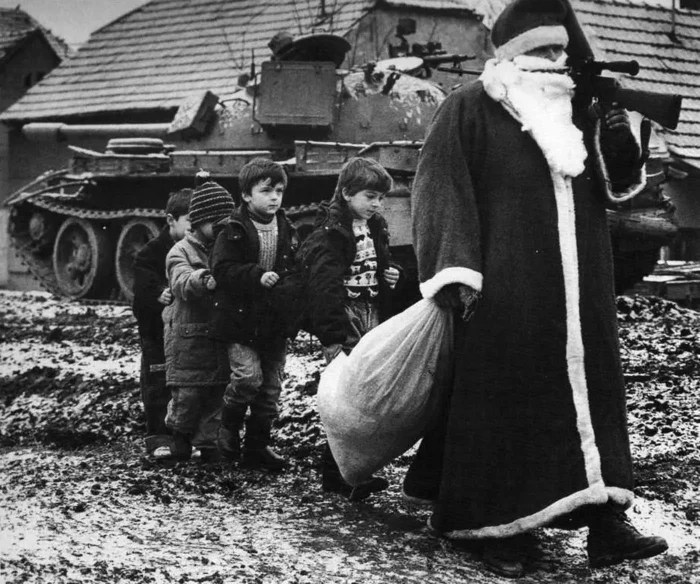
An impactful staged photo, Croatia, Christmas 1992
The European concluded by noting reliance on psychological manipulation to win wars created a “major problem”. Namely, while “a daily publicity blitz of exaggerations and lies may win international support… it will do nothing to heal the divisions which are ripping the country apart.” Locking-in overseas sympathy made Western-backed leaders in the former Yugoslavia less willing to accept negotiated settlements, and keep brutal internecine battles grinding on, safe in the knowledge further carnage only strengthened their position, in information warfare terms.
Notably, a key propaganda strategy for Croats and Slovenes, per The European, was to portray Yugoslav forces “as incompetent and thuggish.” An identical disinformation dynamic played out during the first 18 months of the Ukraine proxy war. As a November 2023 NATO paper on “Humour In Online Information Warfare” revealed, the military alliance and its Kiev puppets specifically sought to weaponise “humour and mockery”, emphasising “Russian failures” and “Ukrainian determination” in media reporting and online, from the conflict’s inception.
These efforts augmented “the responsiveness and impact” of Ukraine’s “information campaigns,” proving “instrumental” in Kiev securing “US-made F-16 combat aircraft” in August 2023, among other Western arms shipments. The NATO paper makes clear weaponisation of mockery is a long-running objective for the alliance, citing a 2017 study, “Stratcom Laughs”, which outlines methods of exploiting “humour” as a military “communications tool”. Four years later, an official Ukrainian government website entry boasted of how such methods can “influence your opinion”:
“How does propagandistic humor work? Relieves tension, makes perception less critical. Uses common contexts to convey messages with which the audience agrees. Simplifies everything to the ‘obvious’. Creates clear groups: strong and intelligent ‘we’ and clumsy and stupid ‘they’. Of course, the audience associates itself with the former and begins to despise the latter. Simplified managed understanding is easily disseminated by the audience and creates the necessary social context for propagandists.”
Atrocity propaganda has also played a crucial role in prolonging the unwinnable quagmire at unsustainable economic, human, and material cost. In April 2022, British intelligence exploited the ever-mysterious Bucha incident to sabotage fruitful peace talks between Kiev and Moscow, framing the apparent killing of innocent civilians in the town as somehow genocidal. At the time, a US Defense Intelligence Agency apparatchik lamented how the “Bucha Effect” had “led to frozen negotiations and a skewed view of the war” – apparently unaware this was London’s precise objective.
Trump Is Correct That María Corina Machado Has No Popular Support In Venezuela
The Mainstream Media Freaks Out Over The One Thing Trump Got Right
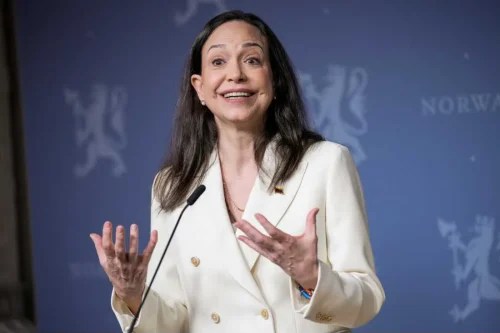
The Dissident | January 5, 2026
While the mainstream media has largely cheered on Trump’s kidnapping of Venezuela’s president, Nicolas Maduro, and regime change bombing in Venezuela, it has attacked him for his comments calming that the U.S. puppet opposition politician María Corina Machado has no popular support in the country.
For context, Trump said he will not install María Corina Machado as president of Venezuela because she “doesn’t have the support”.
This comment from Trump has caused the most backlash out of anything he has done or said in the mainstream media, with CNN’s Jim Sciutto, interviewing María Corina Machado’s advisor, who claimed she has “got the support from almost every Venezuelan,” and the Washington Post’s editorial board writing that Trump’s claim was “foolish”.
But in reality, poll after poll shows that Maria Corina Machado is despised by people in Venezuela.
A poll from the pollster Hinterlaces put out on October 8th of last year showed that, “91% of those consulted have an unfavorable opinion about the opposition leader María Corina Machado” in Venezuela and noted that this placed Machado as “the most unpopular, with a rejection rate significantly higher than the rest of the country’s political leaders.”
Another October poll from the polling firm Dataviva showed that, “86% of those consulted expressed disagreement with the award of the Nobel Peace Prize to María Corina Machado, pointing out that there are no merits or concrete actions that support that recognition”.
Yet another poll from September of last year showed that, “64.6% of Venezuelans maintain a negative opinion on the role played by the opposition led by María Corina Machado after a recent survey conducted by the Datanálisis poll. In contrast, only 18.6% expressed a positive assessment of its management.”
In reality, María Corina Machado’s role as a U.S.-funded puppet has been to publicly cheer on U.S. imperialism in Venezuela, which is opposed by the overwhelming majority of Venezuelans, no matter if they like Maduro or not, to give the false impression that Venezuelans will greet American intervention as liberation.
During Trump’s first term in office, 86% of Venezuelans Opposed Military Intervention and 81 percent opposed the US starvation sanctions on the country, while María Corina Machado – as journalist Michelle Ellner has documented – “worked hand in hand with Washington to justify regime change, using her platform to demand foreign military intervention to ‘liberate’ Venezuela through force” and “pushed for the U.S. sanctions that strangled the economy, knowing exactly who would pay the price: the poor, the sick, the working class.”
During Trump’s current war on Venezuela, polls show that “93% categorically reject any request or proposal for multifactorial aggression against Venezuela, considering it contrary to the peace, dialogue and independence of the country” while María Corina Machado – as documented by Wikileaks founder Julian Assange has repeatedly cheered on U.S. intervention, including by saying:
-5 December 2025, Machado on CBS Face the Nation: “I say this from Oslo right now, I have dedicated this award to [President Trump] because I think that he finally has put Venezuela in where it should be, in terms of a priority for the United States national security.”
– 30 October 2025, Bloomberg interview: “Military escalation may be the only way… the United States may need to intervene directly”
-October 2025, Fox News interview on U.S. military strikes on civilian vessels: “justified.”
-5 October 2025, interview in The Sunday Times on the U.S. military buildup and extra-judicial assassination strikes against civilian boats: Trump’s strikes are “visionary”. “I totally support his strategy.”
-9 February 2019, interview with EL PAÍS : Maduro will only leave “in the face of a real threat from a more powerful state.”
– February 2014, testimony before U.S. Congress: “The only path left is the use of force.”
The mainstream media’s freakout over Trump’s accurate comments about Maria Corina Machado is more to do with the fact that it exposes the truth that Venezuelans both who support and oppose Maduro, don’t want U.S. intervention in their country, and the false idea that Venezuelans are cheering on U.S. intervention only comes from deeply unpopular U.S. funded assets like Maria Corina Machado who are propped up in the mainstream to give this false impression.
Ukraine strikes civilians in drone attacks, western media silent
By Martin Jay | Strategic Culture Foundation | January 3, 2026
In recent days, the Ukrainian regime has carried out two key drone strikes: the first aimed at attacking Putin or his family deep within Russia, and the second in the Kherson region. Given that Zelensky’s Christmas broadcast hinted at the demise of the Russian president, one has to wonder how desperate he has become, especially as Russia prepares to capture a number of key towns along the front line. Was Zelensky sending a cryptic message?
While the first attack made headlines worldwide – coinciding with talks between Zelensky and Trump, and perhaps designed to underline a point by the Ukrainian caretaker president – the second attack, which claimed many lives, received hardly any coverage from Western journalists.
This media blackout is consistent with how the West has reported on the war. Omission is the favoured tactic of Western journalists. It’s not what they write – it’s what they leave out.
According to Russian authorities, the strike occurred shortly before midnight on December 31 in the Black Sea coastal village of Khorly. Multiple drones struck a crowded café and a hotel, creating a fireball; at least one UAV was carrying an incendiary mixture – particularly barbaric given that the victims were civilians.
The Kherson region, along with the Zaporizhzhia region and the Donetsk and Luhansk People’s Republics, joined Russia in the autumn of 2022 following local referendums that the West routinely dismisses as lacking credibility. These territories have been frequent targets of indiscriminate Ukrainian attacks throughout the conflict between Moscow and Kiev.
Two children were killed in the attack, while the civilian death toll from the New Year’s Eve strike in the Kherson region has risen to 27, with another 31 wounded, according to Russia’s Investigative Committee.
At least 100 civilians, including guests and staff, were inside the venue when what Russian authorities termed a “terrorist act” occurred.
If there was a message, Zelensky seemed to be saying, “I’m not interested in any peace deal.” Few could argue that ordering strikes on civilians makes any kind of peace agreement more difficult to reach – especially agreements currently under review, such as the Ukrainian proposal following Trump’s, which bore little resemblance to Russia’s stated non-negotiable points.
As for Western media, the message may be even clearer. When Zelensky is clearly guilty of violating international law and has the blood of children on his hands following drone strikes, Western journalists willingly whitewash him and his crimes. No doubt they are encouraged by their own elites, who have gone to extraordinary lengths to ignore the staggering levels of corruption in Kiev under his watch.
A similar pattern emerges when we examine the events leading up to Russia’s military operation in Ukraine – details Western journalists typically omit, even if they know them. Social media overflows with video evidence that leaves no doubt about U.S. meddling in Ukraine’s 2014 elections, with figures like Lindsey Graham and Victoria Nuland hardly hiding their objective: to install a Western puppet and push through massive arms deals tied to NATO/EU membership for Ukraine. Even Nuland’s private phone calls were leaked to the press, so the real story behind Russia’s “invasion” is hardly a secret anymore.
The Western press’s omission of recent drone attacks from regular reporting only underscores its tawdry complicity in advancing Western objectives. It suggests that manipulating daily facts to serve a narrative may itself amount to a war crime.
The drone attack against Putin’s residence was deemed worthy of coverage – yet we should be sceptical of Trump’s claims that he knew nothing about it and is shocked. Equally, we should question Western media’s stoic refusal to report the gruesome details of drone strikes when images of dead children might shift public opinion in gullible EU countries, where people have been primed to see the war in absurdly simple terms: a clear case of good versus evil, with Moscow wearing the black Stetson.
For the Ukrainian regime to lob missiles into Russian-speaking regions feels like déjà vu to many. Shelling civilians in those areas was the main impetus behind Zelensky’s election – he promised to stop the practice. Perhaps it is this irony that Western media will not write about or contextualize, denying readers crucial insight.
Perish the thought.
The Bari Weiss Playbook: How a Zionist Operative Conquered American Media

By Jose Alberto Nino | The Occidental Observer | December 31, 2025
Long before she ran a newsroom, Bari Weiss was already running a campaign. The target was anyone she perceived as a threat to Israel. In the mid-2000s, at Columbia University, she helped found a student effort that marketed itself as a defense of Jewish students and Zionist speech in an environment she portrayed as hostile.
The controversy reached its zenith with the release of Columbia Unbecoming, a documentary created in collaboration with The David Project, which leveled accusations against Middle East Studies faculty for their alleged intimidation of students who expressed pro-Israel views. The film circulated online as video testimony that Jewish students were allegedly under threat on campus.
The counterattack naturally came quickly. Civil liberties advocates warned that encouraging students to monitor faculty for ideological infractions would chill speech and collapse academic freedom into factional policing. An online critique from the Columbia ecosystem framed the campaign as overreach and a template for future pressure tactics. Such concerns proved to be prescient, as Jewish students would keep tabs on Columbia professors and report them for anti-Zionist and antisemitic conduct after October 7, 2023.
That early fight showcased Weiss’s primordial instinct to go to the mat for her tribe. This did not come out of the blue. Weiss grew up in a politically engaged Jewish household in Pittsburgh, where her father Lou Weiss served on the National Council for AIPAC and frequently organized missions to Israel, profoundly shaping her early Zionist identity.
With unwavering devotion to Zionist principles, Weiss navigated the political landscape with a singular focus, her commitment to advancing Jewish interests remaining unshaken by the petty squabbles and transient allegiances of partisan politics. By the time she rose inside legacy media, she carried a worldview that opportunistically fused free speech rhetoric with strong stances on Israel and antisemitism.
Weiss’s ascent mirrored the classic trajectory of the modern mandarin class, ascending the rungs of the opinion-making apparatus that manufactures public consent. Her journey began in the trenches of reporting, leading to an editorial position at The Wall Street Journal. In that capacity, she gained the skills of gatekeeping and narrative framing, which she would continue to employ as she climbed up the media ladder.
In 2017, she landed at the New York Times opinion section after she believed that the WSJ took too hard of a pro-Trump stance. She described herself “as center left on most issues”, but the issue of Israel was non-negotiable for her, when push came to shove. Ultimately, her position at the Times did not hold. In July 2020, she announced her exit with a resignation letter that accused the institution of enforcing ideological conformity, tolerating internal bullying, and letting social media pressure shape editorial decisions.
While the letter publicly signaled her break with legacy liberalism, it was fundamentally an act of strategic repositioning. A deeper, more calculating motive propelled this departure: the dawning realization that the very media establishments she inhabited were losing their effectiveness as guardians of Jewish interests. Her subsequent career trajectory into new media ventures confirms this was not an ideological conversion, but a pragmatic pivot to more reliable channels of influence.
In 2021 she took matters into her own hands by launching a Substack newsletter called Common Sense, then rebranded it into The Free Press, positioning it as a supposed bastion for free speech. The Free Press outwardly curated a portfolio of anti-woke commentary on issues like gender ideology and campus radicalism. However, these topics served as a popular façade for the publication’s central, animating purpose: the advancement of Zionism. Weiss meticulously assembled a stable of contributors—including prominent voices like Douglas Murray, Niall Ferguson, Konstantin Kisin, and Eli Lake—whose primary alignment was a staunch defense of Israeli policy, making the outlet’s broader ideological commitment unmistakable.
Israel was the unwavering constant, serving not as a footnote but as the central organizing principle of her moral worldview. She treated anti-Zionism as a mask for antisemitism and made that position central to her public identity, a framework reflected in discussion around her book and its reception. Her 2019 book How to Fight Anti Semitism became the manifesto version of the same argument.
The 2018 mass shooting at Pittsburgh’s Tree of Life synagogue, in which Robert Bowers murdered eleven Jewish congregants, threw Weiss’s propensity for targeting the hard Right into stark relief. The atrocity held profound personal significance for her, as the synagogue was the site of her Bat Mitzvah ceremony. Weiss pinpointed Bowers’ motive: his belief in organized Jewry’s outsized promotion of mass migration. She conceded this factual premise during an NPR interview, highlighting HIAS’s active role in facilitating refugee settlement, although it was much more than just HIAS—the entire organized Jewish community.
Weiss offered a trenchant analysis of the anti-Zionist left, warning that the climate of intolerance fostered by cancel culture posed a clear and present danger to American Jews—a concern that crystallized for her following the violence in Pittsburgh. She developed this argument while headlining a virtual event on June 6th dedicated to exploring the phenomenon of cancel culture through a specifically Jewish framework.
“I have felt more of a sense of alarm over the past few weeks now than I did in the aftermath of the attack on my synagogue,” said Weiss, referring to the 2021 Israel-Palestine confrontation. “Anti-Semitism,” she said, “has moved from the lunatic fringe firmly into the mainstream of American cultural life and into the halls of Congress.”
Weiss went mask off In October 2023, during the Israel-Hamas war, when her ethno-religious activism was on full display. Refaat Alareer, a professor and poet from Gaza, provoked outrage with a since-deleted tweet in which he jested about unverified claims that Hamas fighters had incinerated a Jewish baby in an oven, sarcastically asking, “with or without baking powder.” Weiss immediately pounced and quote-tweeted this post, highlighting it as an example of moral depravity. Alareer reported receiving death threats following Weiss’s post to her large following. He posted, “If I get killed by Israeli bombs or my family is harmed, I blame Bari Weiss and her likes,” arguing that her platforming of his tweet marked him as a target. The Israeli military would then kill Alareer, along with multiple members of his family, in a single, targeted airstrike on December 6. 2023.
The allegation from Alareer’s supporters was unequivocal: Weiss had committed stochastic terrorism. They argued she deliberately employed her massive reach to channel hostility and, by inevitable extension, the attention of military and intelligence agencies toward Alareer, a process that ended with his assassination.
Weiss’ fanatic commitment to her tribe was recognized by the likes of David Ellison—CEO of Skydance Media and the son of billionaire Oracle founder Larry Ellison. The younger Ellison had been considering how to revitalize CBS News even before the Paramount acquisition closed. Both David and Larry Ellison are described as “extremely fervent supporters of Israel,” with Larry being a “known Trump supporter” and David “at least suspected to be” pro-Trump as well.
Throughout summer 2025, as Skydance awaited regulatory approval for the Paramount merger, Ellison held discussions with Weiss about integrating The Free Press‘s editorial vision into CBS News. Democracy Now! reported that “Ellison has gotten very close with Bari Weiss”. CNN added that Ellison was “interested in infusing Weiss’s editorial perspective into CBS News.” The deal was eventually finalized in early October, Paramount officially announced the acquisition of The Free Press in a deal valued at approximately $150 million in cash and Paramount shares, to be disbursed gradually and potentially varying based on Paramount’s stock performance. Further, Weiss was appointed editor-in-chief of CBS News—a newly created position.
In her position, Weiss reports directly to David Ellison, the CEO of Paramount Skydance, not through the normal CBS News chain of command. The Free Press maintains independent operations as a separate brand within Paramount. Weiss will collaborate with Tom Cibrowski, president of CBS News, though they occupy parallel rather than hierarchical positions.
A lifetime of dedicated advocacy for Zionist causes has yielded its intended dividends for Bari Weiss. Her trajectory demonstrates a remarkable consistency, guided unerringly by the twin lodestars of perceived Jewish safety and the legitimization of the Zionist endeavor. In the end, Bari Weiss’s career trajectory reveals a fundamental truth: she is not a journalist in any meaningful sense, but a zealous agent for Jewish tribal power, making her a conscious and effective enemy of the gentile civilization whose institutions she has so skillfully subverted.
Hamas calls for ‘impartial international probe’ into Al-Aqsa Flood operation
The Cradle | December 26, 2025
Hamas has released a 42-page document titled “Our Narrative,” calling for an “impartial” international probe into the Operation Al-Aqsa Flood, which took place on 7 October 2023.
The document also reiterates Hamas’s position on the false claims made by western and Israeli media in the aftermath of the attack.
“We challenge the Israelis to allow for an impartial international investigation into the claims of Israeli civilian deaths on 7 October, just as we challenge them to agree for an impartial, neutral international investigation into the crimes they have committed against the Palestinian people, particularly during their recent war on Gaza,” the document states.
“From the very first moment of the 7 October attack, the Israeli entity attempted to distort the truth. It launched a global disinformation machine, involving western media and Zionist lobby groups, to transform the legitimate military operation – which targeted the Israeli army’s Gaza Division, a military unit that had perpetuated killing and siege against Gaza – into claims about targeting civilians and children,” it added.
“We have previously discussed the Israeli allegations and lies propagated against the resistance, and there is no need to repeat them here, especially after their falsehood was proven by independent international investigations. However, because the Israeli entity´s leaders continue to brazenly repeat their lies, we affirm the following: Killing civilians is not part of our religion, morality, or education; and we avoid it whenever we can,” it went on to say.
In the first days after Operation Al-Aqsa Flood, Israeli media reported that Palestinian resistance fighters beheaded 40 babies. Former US president Joe Biden claimed he had seen pictures of “terrorists” beheading babies, and Israeli officials repeatedly made the accusation in interviews and public remarks.
The claims were picked up by major British news outlets and international media, but were quickly proven false – with even prominent Israeli journalists confirming that no evidence for beheaded babies existed.
Hebrew media also heavily focused on the narrative that Hamas fighters committed sexual assault against Israelis.
By January 2025, Israeli police were still unable to verify any accounts of rape on 7 October. The UN Special Rapporteur on Violence against Women and Girls, Reem al-Salem, said in November this year that “No independent investigation found that rape took place on the 7th of October.”
“For those who naively believe that Israeli perpetrators of sexual violence against Palestinians will ever be investigated and prosecuted, think again,” she added.
Since Operation Al-Aqsa Flood took place, Israel’s own media has disproven many of the initial claims made following the attack.
Significant amounts of evidence have emerged on Israel’s implementation of the ‘Hannibal Directive’ – a measure taken to prevent the capture of Israelis.
Israeli helicopters and tanks indiscriminately opened fire at the settlements that were stormed by Hamas fighters that Saturday, causing mass destruction and Israeli casualties, testimonies in Hebrew media have confirmed.
Just days after Operation Al-Aqsa Flood, a survivor told Israel’s public broadcaster KAN that “They eliminated everyone, including the hostages.”
When the interviewer asked if Israeli troops were responsible for civilian deaths, she responded: “Undoubtedly.”
Many Israeli captives were also killed by airstrikes while being held in Gaza.
Moscow accuses Bloomberg of spreading ‘fake news’
RT || December 26, 2025
Bloomberg is spreading “fake news” by claiming to have inside access to Kremlin information, Russian Foreign Ministry spokeswoman Maria Zakharova said on Thursday.
The senior diplomat criticized the news agency after it relayed what it claimed to be Moscow’s attitude toward a 20-point peace proposal presented this week by Ukraine’s Vladimir Zelensky. The story cited an anonymous source described as “a person close to the Kremlin.”
“This purported news outlet has no reliable sources close to the Kremlin. Only unreliable ones. And the wording ‘close to the Kremlin’ serves only as a cover up for fake news,” Zakharova said on Telegram.
Kiev’s proposal, which Zelensky claimed was discussed with US officials as part of President Donald Trump’s efforts to resolve the ongoing conflict, envisions an 800,000-strong Ukrainian army backed by NATO members and an immediate ceasefire with the current front line frozen.
Moscow has declined to make its position public, saying sensitive diplomacy must be conducted privately. Publicizing one’s negotiation stance is “inadvisable” under the circumstances, Kremlin spokesman Dmitry Peskov has said.
Kirill Dmitriev, a Russian presidential envoy involved in normalization talks with the US, suggested a “US/UK/EU deep-state-aligned fake media machine” is waging a pressure campaign to undermine Trump’s agenda, including on Ukraine.
Previously, US Director of National Intelligence Tulsi Gabbard accused Reuters of peddling “propaganda” about Russia after the agency alleged that a US intelligence assessment had reported that Moscow sought to “capture all of Ukraine and reclaim parts of Europe that belonged to the former Soviet empire.” Russia said the claim was false regardless of whether or not such a US document exists.
Featured Video

Iran Is Not Our Enemy
or go to
Aletho News Archives – Video-Images
Book Excerpt
“Vaccines Do Not Cause Autism!” The Science is Settled. Right?
ICAN urges the IACC to actually study infant vaccines and autism
 By Aaron Siri | Injecting Freedom | March 16, 2026
On behalf of ICAN, we just sent a copy of chapter 11 of Vaccines, Amen to the newly appointed members of the federal Interagency Autism Coordinating Committee (IACC).
If you haven’t already read this chapter, you can read the whole thing in the attached letter. I trust that after you read it, you’ll see why the statement “vaccines do not cause autism” is a belief, not science!

Blog Roll
 Aletho News
- Russia Strongly Condemns Actions Aimed at Harming Health of Iranian Leadership – Kremlin
- Israeli Journalist Demands Tucker Carlson and Candace Owens Be Placed in WWII-Style Internment Camps
- No Liability, No Studies, No Accountability: The Vaccine System Aaron Siri Exposed in Federal Court
- No time for losers: Why the war meant to save Israel may destroy it
- Top US Counterterrorism Official Resigns in Protest of Operation Against Iran
- Just Get Out! Now!
- Unpacking glaring contradictions in US-Zionist justifications for war against Iran
- Iranian model of warfare bleeds US dry while Persian Gulf states watch and learn: Analyst
- IRGC orders ‘defeated’ US to evacuate industrial facilities in region
- Hegseth’s call for ‘no mercy’ to Iranians deemed war crime
- If Americans Knew
- Trump’s counterterrorism chief, whose own wife was killed by ISIS, quits over Iran War saying Tehran posed ‘no imminent threat’
- Here’s what US could fund instead of Bibi’s war on Iran
- Israel Killed Over a Dozen Lebanese Paramedics in Three Days, Now Claiming That Ambulances Are “Hezbollah” Targets
- War on Iran: These are the heritage sites devastated by US and Israeli attacks
- Four news stories from Israeli media that illustrate Israeli “justice”
- CIA Prepares Criminal Referral of Tucker Carlson, as Israel and Its Loyalists Demand His Arrest
- Top US counterterror advisor resigns in protest of “war manufactured by Israel” – Not a ceasefire Day 157
- ‘I Liked the House’: When Israeli Soldiers Turn Palestinian Homes into Barracks
- ‘They Were All I Had’: Lebanese Father Buries Parents, 4 Daughters Killed by Israeli Bombing
- Israel and its supporters are causing attacks on Jewish institutions. Case in point: Michigan synagogue tragedy.
- No Tricks Zone
- New Research: South Australia’s Mid-Holocene Sea Surface Temperatures Were 4°C Warmer Than Today
- Storing Green Energy To Last Germany 10 Days Would Require A 60-Million Tonne Battery
- New Studies: UK Sea Levels Were 4 Meters Higher Than Today During The Mid-Holocene
- Destructive Green New Deal: German Energy And Metal Group Warns Of Drastic Crisis
- New Study Documents A 20-Year Pause In Arctic Sea Ice Decline – Driven By Internal Variability
- Wake-up Call: Survey Shows Majority Of Germans Now Favor Postponing Climate Targets!
- Televised! Leading German Political Candidate Tells Schoolchildren CO2 Makes Sun Hotter!
- New Study: A Century Warming Of 1.1°C Is ‘Commonplace’ And ‘Not Unusual’ During This Interglacial
- New Study: ‘Internal Noise’ And Volcanic Forcing Can Trigger 10-15°C Warming Within Decades
- Glaciers Worldwide Are Suddendly Surging, Experts Blame Warming!
 Aletho News