Time for the western media to send real journalists to Russia & Ukraine
By Bryan MacDonald | RT | August 3, 2015
The media’s use of young, inexperienced freelancers in Ukraine has long been a disaster waiting to happen. Last weekend’s obviously fabricated “dirty bomb” nonsense is further proof.
I’ve said it dozens of times. I’ll now repeat it. The western media needs to send qualified, experienced journalists to cover Russia and Ukraine. Especially at this particular moment, when civil war rages in the latter and the former is experiencing significant economic and foreign policy challenges.
The practice of using unskilled, amateur hacks in the region, no matter how noble their intentions, is unfair to readers and viewers. It’s also unjust to the wannabe journalists themselves. As non-staff members (many don’t even have contracts) they lack the usual protections afforded to media professionals on foreign postings. Many working in Eastern Ukraine have only rudimentary Russian-language skills and are unable to afford competent translators and security.
Newsdesks back home will always demand coverage be tailored to certain tastes. However, staff status supplies a safety blanket that empowers them to resist some of the more ludicrous suggestions – particularly those that may endanger them. Freelancers and short-term contract workers don’t have such luxuries. The former are usually paid by the article or appearance, which forces them to desperately hustle to be published. It sometimes encourages them to make up or exaggerate stories.
Decline in standards
Since Ukraine’s Maidan protests kicked off over a year and a half ago now, the western media has dipped in and out of events. Around the time of the 2014 Kiev coup and later following the MH17 disaster, most credible outlets did send competent reporters from their headquarters.
During these periods, coverage improved immeasurably. Sadly, the rest of the time they’ve used local stringers or inexperienced hacks who emerged from the Moscow and Kiev expat press. The standard of these publications is, frankly, laughable. Indeed, they’d compare most unfavorably to many local freesheet rags in the British Isles, let alone paid-for newspapers.
There are exceptions, notably the BBC, which, to be fair, has humongous resources. Indeed, the Beeb even sent their renowned foreign correspondent Fergal Keane to Donbass for an extended period. Nevertheless, the rest of the UK and American media has left the A-team at home. Instead, we are treated to the best efforts of low-paid beat hacks, many of whom are learning on the job.
Veterans of the late Soviet period and the Yeltsin years, a time when giants of journalism walked Moscow’s streets are, privately, aghast. Following a recent RT op-ed when I questioned the quality of contemporary reportage, I was amazed by how many former Moscow correspondents contacted me.
“Newspapers have no money for translators and drivers and the like. There’s a very small pool of people who can speak Russian and write reasonably well in English,” mused one former British great. An American legend observed: “They are now using the type of guys (sic) we used to use for illness and holiday cover to actually run the bureau. It’s mind-bogglingly silly. Russia is a delicate posting.”
The menace of unreality
Indeed it is. Yet, right now, Ukraine is even more sensitive. An inaccurate report from the country’s eastern war zone could cost lives or raise tensions. Or both. In February, a hoax report in the Washington Free Beacon encouraged US senators to urge the White House to act swiftly to counter a “Russian invasion” of Ukraine. There was a problem. The photographic evidence was years old and predated the Ukraine crisis. It later emerged that the photos had been supplied to Republican Senator Jim Inhofe of Oklahoma by a Ukrainian “delegation” to the US capital.
A US senator from an earlier age, Hiram Warren Johnson, is credited as first observing that “the first casualty when war comes is truth.” During the Ukrainian civil war, Johnson’s theory has been proven countless times, by both sides. Far too often, the western media accepts Ukrainian misinformation as genuine. From estimates of hundreds of thousands of Russian soldiers inside the country to, obviously inaccurate, death toll numbers. The Russian press is equally guilty of parroting hyperbolic statements from the rebel side. An infamous example was the allegation that a 10-year-old child had been crucified in Slavyansk last year.
While the various reports of Russian “invasions” can be laughed off, like this hilarious Daily Beast propaganda effort, sometimes the deliberate manipulation of facts is far more sinister. Incidentally, as an example of media negligence on Russia, the Daily Beast employs a “Russia expert” who has never lived in the country and can’t speak the language. Do the outlet’s management even countenance how insulting this is to their readers?
This weekend, in the pages of The Times of London and Newsweek, we saw exactly what happens when media concerns use greenhorn stringers in sensitive situations. Instead of sending an experienced staffer to Ukraine, both have recently collaborated with Maxim Tucker. Tucker, a former Amnesty International activist, who doesn’t hide his pro-Maidan credentials, published the same story in both. The Times version was headlined, “Ukraine rebels ‘building dirty bomb’ with Russian scientists.” Meanwhile, Newsweek went for “Ukraine Says Pro-Russia Rebels Are Building a Dirty Bomb.”
Incendiary stuff. If true, it could feasibly ignite a major diplomatic, perhaps even military, stand-off. Luckily, the story is fiction. This is blindingly obvious to anyone with even a minute comprehension of the region. Newsweek and The Times have embarrassed themselves. At the same time, Tucker has exposed himself as being seriously out his depth. Even his hack-pack colleagues are distancing themselves from this nonsense. Tucker, either knowingly or unwittingly, has fallen hook, line and sinker for Ukrainian Security Service (SBU) disinformation. Unsophisticated misinformation at that. In fact, typically Soviet in its execution, going for the big lie.
Allow me to explain why Tucker’s two, almost identical, pieces are total rubbish. Tucker himself, along with most western hacks in Ukraine, asserts that Russia is backing the east Ukrainian rebels. If this were true, why would the rebels need to “research” dirty bombs? Russia, currently uniquely, can send people into space – such a device would be child’s play to its scientists. Or is Tucker contradicting himself and now alleging that Russia is not arming the insurgents?
There are a few more blatantly obvious holes in the supposition. Tucker writes: “The SBU said it was not clear from those conversations whether the specialists were employees of the Russian state or private individuals. The transcripts of these conversations could not be provided.” Why could the transcripts not be provided? It’s abundantly clear that Tucker’s sole source is the SBU, an organization not noted for fealty to the truth.
Social media war
“The dossier includes three documents, written in Russian, that appear to be military orders from DPR leaders to subordinate commanders at the Ministry of Defence and the Ministry for Emergency Situations, and the Donetsk chemical factory. They were allegedly downloaded with hundreds of others when SBU agents took control of a rebel email address in the first week of July.”
Is Tucker seriously saying that the rebels discussed bombs by email? Why not VKontakte (Russia’s version of Facebook) or Twitter? In fact, if they were that stupid, perhaps they posted a few postcards on the topic too?
Tucker also claims: “The OSCE is believed to have raised the issue with the Kremlin at talks in Minsk on July 21, and is expected to bring in its own specialist to examine the bunker at the plant.” He doesn’t say who believes the OSCE has done this.
However, the biggest sign this article is a piece of low-grade fiction is contained in what Tucker omits. He fails to explain how the SBU believes the rebels would deliver the “bomb.” The Ukrainian rebels have no air force. Hence, the only feasible route would be by truck. If so, how would the vehicle bypass Ukraine’s line of control?
I am sure that Tucker is aware that in 2010 the US paid for the installation of Radiation Portal Monitors at all Ukrainian border posts to prevent the smuggling of radioactive material. As a result, the only places the rebels could use a “dirty bomb” are either inside Donbass or inside Russia. Unless their leadership has completely lost its marbles, this would make no sense.
Newsweek and The Times are among dozens of respectable media outlets who need to send proper, qualified journalists to Russia and Ukraine. Cutting corners insults their readers. Journalism is a serious craft. It mustn’t be left to amateurs, no matter how well intentioned their efforts.
~
Bryan MacDonald is a journalist, writer, broadcaster and teacher. He began his career in journalism aged 15 in his home town of Carlow, Ireland, with the Nationalist & Leinster Times, while still a schoolboy. Later he studied journalism in Dublin and worked for the Weekender in Navan before joining the Irish Independent. Following a period in London, he joined Ireland On Sunday, later the Irish Mail on Sunday. He was theater critic of the Daily Mail for a period and also worked in news, features and was a regular op-ed writer. Bryan also worked in Los Angeles. He has also frequently appeared on RTE and Newstalk in Ireland as well as RT. Bryan is particularly interested in social equality, European geopolitics, sport and languages. He has lived in Berlin, Russia and the USA.
Russian Duma dares to limit Imperial power
OffGuardian | July 29, 2015
In a brazen move, designed to ensure that Russia is ruled by Russians, the Duma has passed laws limiting the powers of Non-Governmental Organisations (NGOs) to operate inside Russia. The first target being the National Endowment for Democracy. This is a terrible blow for freedom around the world, according to The Guardian, because the NED is simply an oasis of decency in Putin’s Empire of Evil:
The National Endowment for Democracy, a Washington-based nonprofit funded largely by the US Congress, has become the first group to be banned in Russia under a law against “undesirable” international nongovernmental organisations.
According to its website, the National Endowment for Democracy (NED) is “dedicated to the growth and strengthening of democratic institutions around the world” and has funded local non-governmental organisations in more than 90 countries. But in a statement on Tuesday, the prosecutor general’s office said it “poses a threat to the constitutional order of the Russian Federation and the defensive capability and security of the government”. [our emphasis]
Really? Really Guardian ? In order to inform us about what the NED is you just went to their own website and did copy/paste? Even the HuffPo, which is no one’s idea of hard-hitting investigative journalism can do better than that. Here’s an article it published by Mark Taliano about the NED:
Democracy is usually the first victim of the National Endowment for Democracy (NED), a U.S. agency that promotes the U.S Empire’s foreign policy beneath the false guise of “promoting democracy”.
Considered a “soft” tool of Empire, NED and its subsidiaries work to transform societal fissures in target countries into gaping holes, through which covert agendas can metastize before exploding into illegal regime changes.
Funding flows from the congressional budget of USAID, to NED and its subsidiaries, and finally to factions within target countries whose political economies do not align with globalized economic models of monopoly capitalism.
Beneath NED’s democratic veneer is a Board of Directors replete with members who also represent Fortune 500 companies. Additionally, board members include signatories to the pro-war, pro-corporatocracy think tank Project For A New American Century: Francis Fukuyama, Zalmay Khalizad, Will Marshall, and Vin Weber.

You’ll notice they don’t say whose freedom.
Which makes the Russian Duma’s decision to boot these guys out a tad more understandable, no?
Since the Graun apparently doesn’t do its own research any more, maybe it could at least copy/paste the Huff’s article in place of the contents from NED’s own About page? Or will that conflict with their GCHQ brief?
The marketing of perpetual war

By BlackCatte | offGuardian | July 10, 2015
… The war is not meant to be won – it is meant to be continuous.…” – George Orwell, 1984
David Kilcullen has a message for us over at the Guardian, and this is it:
We’re living in an era of persistent conflict…”
Which is sadly, true. You might think the next thing to be discussed on that topic would be – why? Why are we now living in an era of endless war? What forces are behind this development? Who, if anyone, is profiting from the same? But, no, David doesn’t think any of this is worthy of our attention. He simply wants us to understand that “perpetual conflict” is absolutely and inescapably the new reality.
… you can read it in the latest concept documents of half a dozen western militaries. But it doesn’t seem to have hit home, for the public or some policymakers, that the notion that this can all end, that we can get back to some pre-9/ 11 “normal,” is a fantasy.
Do we get that? Is it hitting home? Peace is now a “fantasy”. It’s official. And in case you are still harbouring some smidgen of doubt, Dave is going to say it again in different words:
This – this instability, this regional conflict surrounded by networked global violence, this convergence of war and crime, of domestic and international threats, this rise of a new aggressive totalitarian state from the rubble of the last war – is the new normal, and it’s not going to change for a very, very long time. There are no quick solutions: we need to settle in for the long haul.
Ergo….
That being the case, we have to figure out methods of dealing with persistent conflict.
and…
I see no alternative to a larger, more intense, conventional war against Isis than the one currently being contemplated…
Do you see that children? That’s called “paradigm-creation.” The topic for discussion is evidently intended to be “how do we deal with persistent conflict?” The question of why the persistent conflict is happening, or who is funding these “aggressive new totalitarian states” is NOT part of the agenda, and is being excised from our collective conscious. All we need to know is:
Isis is an escalating threat that’s growing and worsening.
We do not need to worry our little heads about what this entity called “ISIS” actually is, how plausible the clownish stories of its super-villain powers are. Nor are we supposed to waste a single moment asking who is picking up its not inconsiderable tab. What matters is that Syria and Iraq are “problems” (never mind why or how) and that “greater western involvement would mitigate all these problems” (because that is what western involvement does – ask Libya). Most importantly, the US needs to get over its scruples and do more:
…US passivity and reluctance to target Assad (though his regime kills more people than Isis) makes many Syrians wary of joining the “moderate” rebels.
“US passivity and reluctance”? Really, Dave? What about the article in the Washington Times claiming the US state department lied about Syrian chemical attacks in order to fabricate a reason for attacking Assad? And what about this article at Global Research which alleges the US is actually targeting the Syrian government- not ISIS – with its current air strikes.
I’m left wondering – is Assad really any worse than the dreadful and medieval Saudis? He certainly seems to be pretty popular in Syria, where they apparently have a different take on things (but Dave doesn’t bother to tell us that). If we in the west have no problem with murderous tyrants, why do we have a problem with Assad? Is it because he isn’t our murderous tyrant?
Is the US really out there in Syria trying (but inexplicably failing) to defeat ISIS? Or is it happy to aid and abet ISIS in doing the dirty work it tried and failed to do itself? If Dave gets his way and we launch a “more intense conventional war” in Syria, will our soldiers’ lives and our taxes really be spent on defeating ISIS or is that just a shallow ruse to enable the US to finally go in and get Assad?
Is “perpetual conflict” really something we should all just accept as inevitable and leave it to people like Dave to sort out? Or is it something we should be resisting and interrogating at every level and at every opportunity?
Nah. Never mind. None of this matters. Let’s just keep it simple. The message is:
1. Persistent conflict is the new normal
2. There is no need to ask why.
Everyone got that?
Save Susiya: Israeli Threat to Demolish Village Finds a Back Door to the NY Times
By Barbara Erickson | Times Warp | July 23, 2015
The New York Times has finally done the right thing and informed readers of Israel’s plan to destroy an entire village in the West Bank. This is good to see, but the move exposes a significant fault line in the newspaper: The foreign desk and Jerusalem bureau have been the gatekeepers here, avoiding their responsibilities in reporting the story.
The piece appears on the op-ed page under the byline of one of the threatened villagers—Nasser Nawaja, community organizer and a researcher for the Israeli human rights organization B’Tselem. It’s a good article, summarizing the sad history of Susiya and the resistance to Israel’s plan, which comes from local and international supporters.
Nawaja’s article includes a quote from U.S. State Department spokesman John Kirby made during a press briefing last week. Kirby was clearly prepared to address the issue and ask Israel to back off. This in itself should have prompted the news section of the paper to address the story, but the Times remained silent. (See TimesWarp 7-20-15.)
Until today the only mention of Susiya’s plight came in a Reuters story that the Times published earlier this week without posting it on the Middle East or World pages. Readers had no way to find it unless they specifically searched for it, by typing in the key word “Susiya,” for instance.
The story of Susiya and its struggle to survive has been reported in news outlets since 2013. The United Nations and other groups, such as Rabbis for Human Rights, have issued statements and press releases on Susiya; the European Union, and now the State Department, have spoken out; but none of this prompted the Times to do what good journalism demands and assign a reporter to the story.
The Times’ treatment of Susiya is reminiscent of a similar story, which emerged during the attacks on Gaza in 2012: In one day Israel targeted and killed three journalists traveling in marked cars, but the Times article describing events that day simply said that “a bomb” had killed two men, even though an officer confirmed the army’s responsibility.
Times readers learned the full story only when columnist David Carr wrote of the journalists’ deaths days later in the Business section. He titled his piece “Using War As a Cover to Target Journalists,” and he did the reporting that was missing in the news section. (See TimesWarp 2-17-15.)
Carr gave the details of the killings, and quoted the lieutenant colonel who affirmed the attacks on the journalists. He then wrote, “So it has come to this: killing members of the media can be justified by a phrase as amorphous as ‘relevance to terror activity.’”
When Carr died earlier this year, the Times was filled with tributes to his work, but none of the articles mentioned this fine moment of his career. The story of the assassinated journalists never again emerged in the newspaper.
Susiya may have a different fate, however. Now that its name has appeared in the back pages of the newspaper, we may find that the story flickers to life in the news section as well. All things are possible, even in the Times.
National Plutocrat Radio
Corporate One-Percenters dominate NPR affiliates’ boards
By Aldo Guerrero | FAIR | July 2, 2015
For a public radio service, NPR is notoriously known for its lack of diversity within its staff, audience and guests invited onto their shows—problems that NPR has itself acknowledged.
A new FAIR study finds that NPR’s diversity problem also extends into the board of trustees of its most popular member stations: Two out of three board members are male, and nearly three out of four are non-Latino whites. Fully three out of every four trustees of the top NPR affiliates belong to the corporate elite.
FAIR studied the governing boards of the eight most-listened-to NPR affiliate stations, based on Arbitron ratings (Cision, 2/13/13). The stations and their broadcast regions are KQED (San Francisco), WAMU (Washington, DC), WNYC (New York City), KPCC (Los Angeles), WHYY (Philadelphia), WBUR (Boston), WABE (Atlanta) and WBEZ (Chicago). (Two top-rated public stations, KUSC in Los Angeles and WETA in Arlington, Va., were not included in the study because they mainly play classical music rather than having a news/talk format.) Board members were coded by occupation, ethnicity and gender.
Out of the 259 total board members, 194—or 75 percent—have corporate backgrounds. Many of these board members are executives in banks, investment firms, consulting companies and corporate law firms. Some of the elite corporations include Verizon, Bank of America and Citigroup.
Of the board members with corporate occupations, 66 are executives in the financial industry. Another 22 are corporate lawyers. Eleven other members appear to be board members by virtue of their family’s corporate-derived wealth, usually with a primary affiliation as an officer of a family-run charitable foundation.
Of trustees with non-corporate occupations, academics are the most common, with 18 individuals—just 7 percent of total board members. Thirteen were coded as leaders of nonprofit organizations not affiliated with family-run foundations.
The other non-corporate occupations were represented on NPR boards in the single digits: eight former government officials, five medical doctors, five educators, four station insiders, three current government officials, three religious educators and three non-corporate lawyers. (Three other board members’ occupations could not be categorized.)
Corporate-affiliated board members were a large majority on virtually every board. New York’s WNYC has the most, with 90 percent corporate representation, followed by Boston’s WBUR at 83 percent. The board of Philadelphia’s WHYY is 80 percent corporate-tied, the Bay Area’s KQED is 79 percent, Chicago’s WBEZ is 76 percent and Washington, DC’s WAMU is 73 percent.
Two stations, Southern California’s KPCC and Atlanta’s WABE, are affiliated with educational institutions. Both stations are governed under a partnership agreement where two boards share responsibility: the educational institution’s publicly elected board that holds the station’s broadcast license along with the board of a nonprofit entity that manages the station’s day-to-day operations.
In KPCC‘s case, Pasadena City College’s Board of Trustees is 29 percent corporate-affiliated, with an equal number of academics, while the board of Southern California Public Radio is 71 percent corporate. WABE is governed by the Atlanta Board of Education (44 percent corporate) and the American Educational Telecommunications Collaborative (60 percent corporate).
Although the Pasadena City College board and the Atlanta Board of Education do not have a majority of corporate occupations, corporate occupations are still the most common on each board.
The corporate composition of the NPR affiliate boards are in line with a previous FAIR study that found that the governing boards of leading public television stations—most of which are PBS affiliates—are stacked with 84 percent corporate board members overall (Extra!, 10/14).
NPR president and CEO Jarl Mohn claims he wants to ask “wealthy donors” for more money and double revenue from corporate underwriting to stabilize NPR’s financial status (NPR, 10/17/14). What easier way to accomplish these goals than by having governing boards dominated by wealthy individuals from the corporate sector? Of course, the inevitable consequence of this is to put legal control of what is supposed to be public radio into the hands of a tiny, highly privileged fraction of the population.
As evidenced in stations’ annual fiscal year reports where major donors are listed, many of these wealthy and corporate-connected board members are relied upon to regularly donate thousands of dollars to their respective stations. For example, an executive from Capital Group International sits on their board of KPCC, while the Capital Group Companies Charitable Foundation donates between $100,000-$249,999 to KPCC.
Washington DC’s WAMU was the only station to reveal how much of its revenue specifically comes from corporate underwriting—38 percent (WAMU-FM, 10/8/14). With wealthy donors representing the One Percent class making up a substantial portion of contributions from the “public,” it’s hard to see what essentially distinguishes National Public Radio from its explicitly commercial media counterparts–and what justifies NPR and its affiliates receiving public subsidies via the federally funded Corporation for Public Broadcasting. … Full article
On Iran’s Nuclear Program, Ghosh’s “Gotcha” is Nothing But Smoke
“Whoever is careless with the truth in small matters cannot be trusted in important affairs.” – Albert Einstein
By Nima Shirazi | Wide Asleep in America | July 3, 2015
Bobby Ghosh, former TIME contributor and currently managing editor at Quartz, decided on Tuesday to produce some absurd, mouth-breathing click-bait – the kind of deliberately sloppy disinformation that serves only to further chum the waters of public opinion with the false narratives and grotesque stereotypes that have long been the stock-in-trade of agenda-driven, attention-seeking commentators about Iran and its nuclear program.
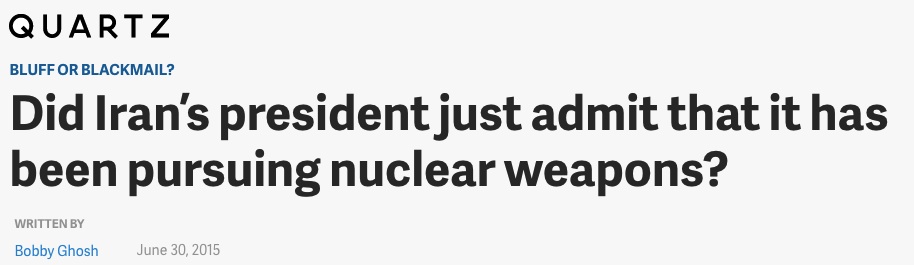
There’s a quick answer to this leading – and deceiving – question: No, no he did not.
There’s a longer answer, too, which we’ll get to in a minute.
Ghosh, in his desire to expose what he thinks is a “gotcha” moment from a recent Iranian media interview with Iranian President Hassan Rouhani, eagerly and disingenuously conflates uranium enrichment with nuclear weapons development. In doing so, he reveals himself to be more interested in delivering page views to his website and dishing out conventional wisdom than in reporting truthfully and critically about an important international issue.
Ghosh notes that, during a interview with Iranian media about the pending nuclear deal with six world powers, Rouhani said that “if the other side breaches the deal, we will go back to the old path, stronger than what they can imagine.” Ghosh omitted Rouhani’s initial comment, “If we reach a deal, both sides should be committed to it.”
What gets Ghosh’s goat is Rouhani’s reference to “the old path,” that is, the allusion to Iran’s previous state of nuclear development, as opposed to its current restricted program under the interim deal and what results from a potential negotiated multilateral agreement.
Conceding that Iranian officials have long “sworn, over and over again, that [Iran] has never pursued nuclear weapons,” Ghosh then gets to the crux of his claim:
If we’re to believe the regime’s claim, then Rouhani’s threat makes no sense. The “old path” would simply be more “peaceful” nuclear research, allowing the sanctions to continue devastating the Iranian economy. That’s not so much a threat as a flagellant’s cry for help: “If you go back on your word, I’ll hurt myself.”
To jump to such a conclusion requires a remarkably mistaken understanding of both the history of Iran’s nuclear program and either the ignorance or dismissal of the massive concessions it has already made during ongoing international talks. Ghosh apparently suffers from both.
In an emblematically Ghoshian column on why the Iranian government is eviler than the Cuban government, Ghosh wrote on December 18, 2014, that Iran “was caught trying to build nuclear-weapons technology as recently as 2002, when its secret facilities at Arak and Nataz [sic] were discovered. Thereafter, under pressure from the US and the international community, the Tehran regime backed down from its policy of developing dual-use nuclear technology (for energy and weapons) and promised not to build bombs.”
There’s a lot wrong here, but I’ll try to be quick (not my strong suit).
The facilities at Arak and Natanz were never “secret” nor do they “build nuclear-weapons technology.” In 2002, they were both under construction and non-operational. Iran was, at that point, not obligated to declare their existence to the IAEA. Arak was designed as a power plant, Natanz is an enrichment site. Upon declaration, both have been subject to IAEA safeguards for over a decade. Iran’s interest in developing an uranium enrichment industry has been open knowledge (and publicly acknowledged) since shortly after the Iranian Revolution in 1979.
The Iranian government never “backed down” from a “policy of developing dual-use technology” and “promised not to build bombs” as Ghosh claims. Such a claim is bizarre. Beyond the fact that, as an original signatory to the Nuclear Nonproliferation Treaty, Iran has in effect “promised not to build [nuclear] bombs” since 1968 and Iranian officials have – since at least the early 1990s – constantly and consistently condemned and prohibited any domestic development of nuclear weapons (not only after 2002), it is literally impossible for any nation with an ongoing enrichment program to stop the acquisition of “dual-use” nuclear infrastructure since every single enrichment program on Earth is inherently dual-use: enriched uranium can be used for both energy or weaponry.
With this false narrative, Ghosh has, however, set up a convenient straw man with which to bandy about his erroneous assumptions of Iran’s nuclear past. This brings us back to his recent article.
In trying to hash out what Rouhani’s “old path” statement means, Ghosh establishes two options – the bluff or the blackmail – one of which, he claims, must be true. The bluff is that, in Ghosh’s words, “There’s no “old path,” and Tehran is simply trying to frighten the P5+1 into relenting on the remaining sticking points at the negotiating table in Vienna.”
The blackmail, on the other hand, is a damning admission by the Iranian leader of a clandestine nuclear weapons program Iran has long denied having. “The alternative,” Ghosh writes, “is that Rouhani has unwittingly revealed that Iran was indeed pursuing nukes. That would be a real threat, especially if he is also sincere in pursuing this path ‘stronger than what they can imagine.'”
But there is a third option, unacknowledged by Ghosh, which is the most obvious and most accurate: Rouhani is not talking about a nuclear weapons program to return to, but rather the reestablishment of full-scale uranium enrichment, which has been curtailed by Iran’s obligations under the terms of its diplomatic agreements since January 2014.
Ghosh doesn’t tell his readers that, in the same interview he cites as “fascinating” and “belligerent,” Rouhani said of his international interlocutors, “If they claim that they want to prevent the development of nuclear weapons in Iran, they should know that Iran has never sought to build nuclear weapons.” Obviously, such a statement – in the very same interview – severely undermines the credibility of Ghosh’s blackmail or blunder claim that Rouhani has either purposely or accidentally revealed something alarming about its nuclear work.
Under the terms of the November 2013 Joint Plan of Action, agreed to by Iran and the six powers – Britain, China, France, Germany, Russia, and the United States – known as the P5+1, Iran has halted all enrichment above 5%, diluted or disposed of its entire stockpile of 19.75% low-enriched uranium (LEU), converted the vast majority of its remaining stockpile of LEU to a form incapable of being weaponized, suspended upgrades and construction on its safeguarded nuclear facilities at Natanz, Fordow, and Arak, and allowed unprecedented access to its program by IAEA inspectors.
At every single juncture, Iran has complied fully with the demands of the plan.
All Rouhani was saying, therefore, is that these commitments – which were negotiated and agreed to by Iran, not imposed forcibly by foreign countries – would no longer be binding and Iran would resume its previous course of action, or “the old path.” This previous course of action, still, was anything but a mysterious, opaque, nefarious development of dubious and deadly technology. Rather, even before current talks began, Iran’s was the most heavily-scrutinized nuclear program on the planet and had been for years.
Rouhani’s statement, therefore, was actually a fairly innocuous clarification of the fact that, if the P5+1 reneges on its own negotiated commitments, Iran will no longer abide by the deal either. That’s hardly cause for Ghosh to collapse on his fainting couch.
What Ghosh also doesn’t point out is that there is clear historical precedent for Rouhani’s statement.
A dozen years ago, Iran’s then-nascent uranium enrichment program was the subject of intensive diplomacy between Iran and the EU-3, shorthand for Britain, France and Germany. It was on Rouhani’s watch – he was secretary of Iran’s Supreme National Security Council and lead negotiator at the talks – that Iran voluntarily suspended uranium enrichment in 2003 and accepted intrusive inspections above and beyond what was legally required by its safeguards agreement as talks progressed. During this period, the IAEA affirmed the peaceful nature of the program.
In mid-2004, with Iran fully complying with its obligations under Saadabad Agreement of October 2013, the negotiations were strained by the prospect of a new European-drafted IAEA resolution against Iran. President Mohammad Khatami told the press, in terms strikingly similar to Rouhani’s recent statement, that Iran’s voluntary suspension of enrichment would thus be endangered if the resolution passed.
“If the draft resolution proposed by the European countries is approved by the IAEA, Iran will reject it,” Khatami said on June 18, 2004. “If Europe has no commitment toward Iran, then Iran will not have a commitment toward Europe.”
A month later, Khatami insisted that “nothing stands in the way” of Iran “building and assembling centrifuges designed for uranium enrichment,” reported the Associated Press.
Throughout the first half of 2005, Iranian officials were still intent on resolving the nuclear impasse through diplomacy with Europe, but explained that the resumption of “full-scale enrichment” was the ultimate goal of the talks, along with assurances that the program would remain forever peaceful.
Following the election of Mahmoud Ahmadinejad in June 2005, outgoing president Khatami made the Iranian position clear. “We will never overlook our legal and national right for possessing nuclear technology and fuel cycle to generate electricity. Iran will never change its national policy in this respect,” he said, adding, “We have made it clear that suspension of uranium enrichment will not be forever. We have displayed our good faith. Now, it is the turn of the European friends to do in line with the commitments they have made about the matter.”
Regardless of the offer soon to be put forward by the EU-3, Khatami reiterated that Iran would resume its conversion activities and eventually enrichment as well, in line with its inalienable rights to development domestic, civilian nuclear technology. “I hope that the Europeans’ proposals will, as agreed, allow for the resumption of [nuclear activities],” Khatami told reporters in late July 2005. “But if they do not agree, the system has already made its decision to resume [uranium conversion] at Isfahan.”
Uranium conversion restarted in early August 2005.
It was only after Iran’s European negotiating partners, at the behest of the Americans, reneged on their promise to offer substantive commitments and respect Iran’s inalienable right to a domestic nuclear infrastructure that talks dissolved and Iran resumed enrichment. The proposal eventually brought to Iran by Western negotiators on August 5, 2005 has been described as “vague on incentives and heavy on demands,” and even dismissed by one EU diplomat as “a lot of gift wrapping around an empty box.”
The resumption of full-scale enrichment by Iran had nothing to do with nuclear weapons, as the IAEA has affirmed consistently in quarterly reports over the past decade that no fissile material has ever been diverted to military purposes. Lingering questions about Iran’s past work have long been debunked as unfounded allegations for which no credible evidence actually exists.
Rouhani’s statement about “the old path” – that is, the legal and inalienable right of Iran to enrich uranium under international safeguards and supervision – therefore reveals nothing not previously known.
On the other hand, Ghosh’s reaction to Rouhani’s statement reveals the extent to which Ghosh himself will go to demonize and propagandize about Iran and its nuclear program. If he can’t get the small stuff like this right, why are we listening to him about anything at all?
*****
Disclosure: I am an (often erstwhile) editor for the online magazine Muftah, which has recently announced a new partnership with Quartz, where Mr. Ghosh is managing editor.
After 15 Years of Killing Journalists Pentagon Writes It Into Manual
Having liberally assassinated journalists in Yugoslavia, Iraq and Libya Pentagon has done the logical next step and openly wrote the practice into its code of conduct
By Marko Marjanović | Russia Insider | June 26, 2015
Four weeks into NATO’s 1999 bombing of Yugoslavia American bombs slammed into Belgrade’s main television station massacring 16 employees of Serbia’s state television broadcaster (RTS).
All killed were civilians but these were the 1990s. Sloban Milošević was “Adolph Hitler” and Serbs were “his willing executioners”.* Serbian civilian deaths didn’t matter. Thus BOOM! Program director dead, security guard dead, electrician dead, cameraman dead, sound technician dead, make up lady dead…
Tony Blair and a host of NATO spokespeople appeared before cameras to explain these people deserved to die – they were part of Milošević’s “machinery of hate”. No bombs hit them in turn.
RTS had been covering Serbia’s civilian deaths caused by NATO but this wasn’t the reason it was hit – as said nobody really cared and besides RTS had been taken off satellite by NATO and could no longer broadcast beyond Yugoslavia. However, NATO’s strategy in the war had been to make the life of Serbian civilians so miserable they would beg Milošević to capitulate – and RTS’ mix of airing patriotic music videos and reports of NATO carnage was doing a decent job of propping up Serb morale and resolve.
RTS was interfering with NATO’s strategy – it was giving the Serbian populace a measure of comfort and strength – this made it a top target of those who needed it broken.

Stretchering a victim of RTS bombing, April 23, 1999
Next stop Iraq. April 8th 2003 American tanks finally smashed into downtown Baghdad – Iraq had been conquered. Americans marked the occasion by opening fire on journalists in three separate locations in the city.
Offices of Qatar’s Al-Jazeera were hit by an air strike. Offices of United Arab Emirates Abu Dhabi satellite channel likewise. Finally a US tank fired into the Palestine Hotel – Bagdad’s more well-known hotel and a well-known base for foreign journalists. In all Americans’ attacks on journalists that day killed three and wounded four.
This was just the beginning. Iraq became a veritable killing ground for journalists including due to attacks by American occupiers. In the first two years of the occupation alone 13 journalists are known to have been killed by American fire.
Most famously in 2007 a US helicopter crew deliberately gunned down two Iraqi reporters for Reuters along with a dozen other civilians – this was the so called “collateral murder” incident later brought to light and made famous by WikiLeaks.
Throughout the Iraq occupation US bitterly complained about reporting done by Al-Jazeera and Al-Arabiyah. It accused them of inflaming the Arab street against the US and helping to fuel the Sunni resistance in Iraq.
The two were repeatedly banned from reporting from Iraq by the US-installed government in Baghdad. Likewise in 2004 the US launched the Al-Hurra Arab-language satellite channel to try to rival the two.
Finally, during the 2011 NATO bombing of Libya the alliance repeated its performance during the bombing of Yugoslavia and deliberately took out a Libyan TV compound slaying three journalists.
It may be the case that US military has only now produced a “law of war manual” explaining its policy of killing journalists, but it is the case it has been at it for at least 15 years.
The thing to understand is that Pentagon has convinced itself that media has dealt it its greatest defeat in history – the hugely traumatic loss in the Vietnam War. In Pentagon’s retelling of the Vietnam debacle journalists delivered a fatal stab in the back of a war effort that was on the cusp of turning things around.
The problem according to US military wasn’t so much US atrocities and real strategic setbacks, but the fact the knowledge of these was spread by journalists to the people at home.

Vietnam – the high tide of American war reporting
That is to say the main lesson Pentagon drew from the Vietnam War was the need to control information coming out from the war zone. Military thinkers spent the next two decades thinking about the ways to accomplish this and eventually perfected it into an art form.
Thus the highly managed and highly favorable coverage of US military invasion of Iraq – served up by embeded journalists assigned to this or that unit of the US military. But if embedding journalists showed to just what degree they may be tamed it also served to highlight how unfriendly and dangerous (at least in the Pentagon’s imagination) the remaining independent journalists were by comparison.
In Pentagon’s thinking an independent journalist threatens its control of information coming out of the war zone and therefore threatens “the mission” – that above all is what really makes him a “legitimate” target.
The rest, the nonsense about “unprivileged belligerents” and what not – that’s just sophistry and mumbo jumbo to obscure the fact that US military – the armed force of the “land of the free and the home of the brave” believes in murdering civilian non-combatants.
* Serbs had been so thoroughly collectively demonized in the west that the neocon Charles Krauthammer could openly complain from the pages of Washington Post that the bombing wasn’t killing enough Serbian civilians and the liberal interventionist Thomas Friedman could call from the pages of The New York Times for Serbia to be bombed back into the Middle Ages and spark no mainstream outrage whatsoever. Link
Malaysian Pressure Forces MH17 Investigation to UN
By Eric Zuesse | RINF | June 27, 2015
Malaysia, frustrated by the refusal of the official international investigation-team to produce any clear evidence yet of whom to blame for the downing of the MH17 Malaysian airliner over the Ukrainian civil-war zone on 17 July 2014, has finally forced the team to request the UN to investigate. They’ve forced the original four nations on the team to accept UN adjudication of any final report. This will enable a court-proceeding to make the ultimate determination of guilt (upon which judgment penalties and compensation will be assessed), and this court-determination would inevitably allow whatever party is being blamed by the five-member official investigating team, to present its own evidence in the case, so that the court will make the ultimate determination — the official investigating team will not be performing that crucial judgmental function.
Malaysia was long prohibited from even participating in this investigational team, but on 5 November 2014, a deal was finally reached with the four nations that did comprise the team — four U.S. allies: Netherlands, Australia, Belgium, and (a suspect in possibly having downed the MH17) Ukraine itself (though it had lost none of its citizens in the disaster) — so, the next day, Malaysia’s New Straits Times headlined “Malaysia to join MH17 criminal probe team,” and reported that, “The prime minister said the country had been invited to play a bigger role in the recovery and investigation of the ill-fated aircraft, believed to have been downed by a missile over eastern Ukraine on July 17.” The Malaysian report went on then, pointedly, to note: “In July, the Dutch and Ukrainian authorities agreed that the bulk of the operations would be carried out by the Netherlands, with assistance from countries whose citizens were on board the flight. Malaysia had repeatedly asked to be part of the joint investigation team, currently comprising investigators from the Netherlands, Belgium, Australia and Ukraine.” Implicitly, that phrase “Malaysia had repeatedly asked to be part of the investigating team” said that Malaysia had consistently been refused membership until 5 November 2014. In fact, even by late November of 2014, Malaysia continued to be refused membership, and I headlined on November 30th, “Malaysia Becomes Angry About Exclusion from MH17 Investigation.” That refusal was especially outrageous because, like three of the four nations that already were on the team, Malaysia had lost (44) citizens from the downing. But in addition, Malaysia had lost the plane, from it. There was no excuse for the four pro-Western nations to exclude Malaysia, and for their limiting the investigating-team to only Ukraine (a key suspect in the downing) and three of its allies. And, between November and now, Malaysia has finally become so fed-up with the team’s continuing refusal to act, and to declare the culprit, so that the rest of the team finally consented to Malaysia’s demand to transfer the investigation over to the UN.
On 24 June 2015, Agence France Press, a mouthpiece for yet another Western nation (France), bannered, “Netherlands, Malaysia push for UN tribunal for MH17 culprits,” and Thailand’s Bangkock Post headlined this same story more honestly and directly, as “Malaysia demands UN court for MH17 shootdown,” but carried unchanged the anti-Russian-slanted AFP text. The anti-Russian-slanted AFP ‘news’ report said “It remains unclear, however, whether Russia would back the creation of the special tribunal” (something which they could also have said of the U.S., for example) and included a sub-head: “- Getting Russia on board -,” which section had only this brief and anonymously sourced reference to Russia: “The diplomat [unidentified] said the countries were mindful of the need to ‘avoid a Russian veto’ [as if a Russian veto would have been likelier than an American one, etc.].” That’s propaganda for a regime, not news-reporting for a democracy — it delivers the bias (to whip up support for war), along with its sugar-coated pro-regime facts.
The present writer has already set forth the conclusive evidence that Ukraine downed this airliner, and that the reason Ukraine did it — intentionally, not at all by mistake — was in order to enable the U.S. to blame Russia for it and thus get the EU to hike economic sanctions against Russia. Adolf Hitler’s Nazi Germany isn’t the only nation in history that has used what the intelligence trade calls “false-flag attacks” in order to blame the nations that it itself aims to attack. The U.S. has perfected that technique.
Russia was framed for the downing of MH17, which was a U.S. job carried out by the Ukrainian Air Force. (The EU knows that the U.S. has a mega-criminal government, but they go along with it, thinking that their aristocrats will get some of the loot that’s being yanked off by America’s aristocrats. They do this though 206 of the murdered passengers were EU citizens. And Netherlands, which provided the U.S. key assistance in the buildup to overthrowing Ukraine’s democracy, lost the most people in it, which just goes to show on which side Dutch aristocrats stand — it’s not the Dutch public’s side.)
Finally, Malaysia is having some success in pulling this criminal investigation away from the clearly proven criminal (Ukraine — which now is itself a U.S. client-state) and its friends.
Anyone who believes Western ‘news’ media about international affairs is simply laying his mind out to be raped by agents of the local nation’s aristocracy. Almost everything has become propaganda now. Honest journalism is squelched, if not strangled.
That’s why, if you’ll google the headline of this news-report, none of the major mainstream and ‘alternative’ ‘news’ sites will likely come up — though it has been sent to all of them.
~
Investigative historian Eric Zuesse is the author, most recently, of They’re Not Even Close: The Democratic vs. Republican Economic Records, 1910-2010, and of CHRIST’S VENTRILOQUISTS: The Event that Created Christianity, and of Feudalism, Fascism, Libertarianism and Economics.
U.S. Intelligence Agencies Mock America in 9/11 Trial
By Kevin Ryan | Dig Within | June 13, 2015
Last year, it was discovered that the FBI had attempted to infiltrate the legal defense team of a Guantanamo Bay prisoner. The defendant is charged, along with four others including Khalid Sheik Mohammed (KSM), of conspiring to commit the 9/11 attacks. As a result, the military trial was moved out for approximately one year to allow for an investigation into the FBI’s offense. Recently, Al-Jazeera reported that the trial has been moved out yet again because the Department of Justice team leading the investigation (of its own bureau) needs more time to complete its secret report. These delays highlight the absurdity of the case against these men and the contemptible abuse of justice that the military trial represents.
 Apparently, it has been difficult for the Justice Department to explain why the FBI approached a member of defendant Ramzi bin al-Shibh’s legal team to “create a relationship with him that he was forbidden from disclosing.” That explanation became more difficult when it was learned that another member of Bin al-Shibh’s defense team had been cooperating with the FBI since late 2013.
The FBI infiltration of the Bin Al-Shibh defense team is just the tip of this anti-justice iceberg, however. In February, it was revealed that a translator assigned to help defend the accused was a CIA operative. That’s one way to ensure that the official account of 9/11, created entirely through torture testimony and secret evidence provided by the CIA ad FBI, would not be contradicted by defendant testimony. More was needed, however, as previous disclosures showed that the CIA was controlling audio feeds from the courtroom, bugging the rooms where the accused met with their lawyers, and censoring the lawyers. Additionally, hundreds of thousands of confidential defense team emails were provided to the prosecutors.
The military trial of these men was never expected to bring justice. But the absurd actions taken by the CIA and FBI have made the whole thing seem ludicrous, mocking the U.S. justice system. Why would these measures be needed and tolerated if the defendants were actually involved in 9/11? The reasons include that:
- The charges against the defendants were largely established based on torture testimony, the records of which were destroyed by the CIA. That was after the agency misled the 9/11 Commission about the existence of the records.
- Bin al-Shibh and KSM were both originally identified by the first torture victim, Abu Zubaydah. However, the government now says that Zubaydah was never associated with al Qaeda at all and therefore he could not have known what the government previously said he knew. In other words, the arrest and torture of Bin al-Shibh and KSM were initiated by way of a fictional account attributed to Zubaydah.
- 9/11 Commission leader Lee Hamilton suddenly can’t recall anything about these torture victims or his use of their testimony (441 times) in the 9/11 Commission Report.
- KSM’s behavior prior to 9/11 was reported to be very different from that of a Muslim. He enjoyed go-go dancers and drinking parties and was said to be dangerous to nothing but his own bank account. The playboy lifestyle of KSM was similar to that of alleged hijacker ringleader Mohamed Atta, who seemed to be protected by U.S. authorities and might have been an intelligence asset.
- One of the defense team lawyers resigned from the Army in protest of what was happening. He accused the U.S. government of “stacking the deck against the defense” and conducting a “show trial.”
One reasonable explanation for why the CIA and FBI have gone to such great lengths to control this trial is that the agencies are trying to cover-up their own role in 9/11. Much has been learned that suggests the CIA and FBI were involved. For example:
- There are many examples of (admitted) government-sponsored terrorism.
- It is known that the FBI manufactures terrorism.
- FBI director Louis Freeh is a 9/11 suspect.
- CIA director George Tenet facilitated the 9/11 crimes.
- U.S. intelligence agencies continue to lie about their “response” to 9/11.
Whatever the reason for the antics, the military trial of these men has become an absolute farce leading American society farther down a path of tyranny. It sets a precedent in which the CIA and FBI can be suspected of crimes against the nation and then charge others with those crimes using secret evidence. The accused can be held in seclusion for thirteen years until agents of the CIA and FBI insert themselves as defense team members, ensuring total control from start to end.
At the same time, the press never notices that such an obviously fake trial would not be needed if there were actually any legitimate evidence against the accused. All things considered, this trial is not only a travesty of justice, it makes a mockery of 9/11 and brings shame upon the American people.
Putin intends to undermine NATO – Jt. Chiefs Chairman Dempsey
RT | June 7, 2015
Russia is seeking to “discredit and eventually undermine” NATO, chairman of the Joint Chiefs of Staff Gen. Martin Dempsey said in an interview published shortly after President Vladimir Putin said only a madman would think of Russia as a threat to NATO.
“I can’t tell you, as we sit here today, precisely what Putin and Russia intend to do,” Dempsey said in the interview to the Wall Street Journal. “They have demonstrated some behaviors outside the international order that clearly indicate that they are willing to push beyond what most of the nations with whom we deal consider to be international norms.”
Dempsey also called on the NATO allies to “harden against the subversive activities Russia has demonstrated its willingness to use.”
“We have the conventional threat posed by Russia’s conventional forces,” the Pentagon chief said.
“[Putin and Russia] have demonstrated some capabilities with long-range aviation and with their nuclear forces that are clearly intended to signal the nations in Europe and us of their willingness to consider all the instruments of military power,” Dempsey said.
The comments come shortly after the release of an interview with Vladimir Putin where he has warned against taking the West’s “Russian aggression” scaremongering seriously.
“I think that only an insane person and only in a dream can imagine that Russia would suddenly attack NATO,” Putin said. “I think some countries are simply taking advantage of people’s fears with regard to Russia. They just want to play the role of front-line countries that should receive some supplementary military, economic, financial or some other aid.”
The Russian president invited journalists to compare the global military presence of Russia, on one hand, and that of the US and NATO, and draw their own conclusions.
“We have dismantled our bases in various regions of the world, including Cuba, Vietnam, and so on,” Putin said. “I invite you to publish a world map in your newspaper and to mark all the US military bases on it. You will see the difference.”
Dempsey listed “capabilities that do threaten security in Europe” mentioning among them Russia’s being “very adept in the media space of propaganda.”
In April, Secretary of State John Kerry asked US lawmakers for more money for propaganda and “democracy promotion” programs around the world, having directly referred to RT’s growing influence. RT’s budget for 2015 is 13.85 billion rubles (some $277 million, according to the current exchange rate). By contrast, the US government media receives $721 million.
Among other threats Dempsey mentioned is Russia’s “ability to conduct snap exercises with conventional forces that can coerce or at least threaten borders.” The remark comes as military exercises close to Russian borders are being conducted on a non-stop basis.
The latest example is a major US-led exercise BALTOPS in the Baltic Sea, which began June 5. Around 50 vessels from 17 countries, involving overall 5,600 troops, are taking part in these war-games that are set to last 15 days, to show off NATO’s ability to protect the region.
In mid-May, NATO Secretary General Jens Stoltenberg announced the alliance is going to increase its activity at its eastern borders, with more air and sea patrols, amid non-stop exercises.
Featured Video

No Threat Can Force Iran’s Surrender /Trita Parsi & Lt Cl Daniel Davis
or go to
Aletho News Archives – Video-Images
From the Archives
An Expert Military Analysis of War with China
Actually, None is Necessary
By Fred Reed • Unz Review • December 13, 2020
The Correlation of Armed Forces: U.S. goods and services trade with China totaled an estimated $634.8 billion in 2019. Exports were $163.0 billion; imports were $471.8 billion. The U.S. goods and services trade deficit with China was $308.8 billion in 2019. Trade in services with China (exports and imports) totaled an estimated $76.7 billion in 2019. Services exports were $56.5 billion; services imports were $20.1 billion. The U.S. services trade surplus with China was $36.4 billion in 2019.
There is talk within the Washingtoniat of a possible war with China. Steve Bannon, who apparently was dropped on his head as a child, actually favors such a war. We hear the usual shoo-the-boobs alarm about how the Chinese are doing something terrible and we must gird our loins and American values and show them what for, bow wow, woof. The danger is that the current game of who-blinks-first in Asian waters might actually provoke a shooting war. You know the kind of thing: One warship refuses to get out of the way of another, a collision ensues, some retard lieutenant who signed up on waivers opens fire, and we’re off and running. It is not a good idea to let children play with matches.
The said war is discussed either in emotional terms by idiots or in purely naval terms by those familiar with such things, so we hear of the First Island Chain and the Second Island Chain and whose missiles against the other’s missiles and so on. This would be appropriate if we were fighting World War Two again. Which we aren’t. Let’s take a quick-and-dirty look at how such a war might go.
To begin the war, America would overestimate itself and underestimate China. This is doctrine in the Pentagon. … continue
Blog Roll
 Aletho News
- Theodore Postol: Iran’s Missiles & Drones Were Underestimated
- Iran To Target Military Industrial-Tech Complex That Facilitated Gaza Genocide
- Collapsing Empire: The Resistance Disarms ‘Israel’
- Suicide Should Not Be a Government Service
- Rethinking America’s greatest threat: Iran vs. Israel-Firsters
- Iran accuses adversaries of false flags to strain Turkey ties
- Poland rules out sending Patriot missiles to US/Israel amid war on Iran
- Tehran approves new Hormuz plan with major restrictions
- No Threat Can Force Iran’s Surrender /Trita Parsi & Lt Cl Daniel Davis
- UK’s New Pandemic Plan Would Turn Big Tech Into a Mass Location Tracking Network
- If Americans Knew
- Ann Coulter Rips Into Fox News for Iran War Coverage, Compares to False Rigged 2020 Election Reporting
- Joe Kent Urges Americans To Call White House and Congress To Object To Sending Troops Into Iran
- DNC Resolution to Reject AIPAC Funding Puts Democratic Leaders in the Hot Seat
- Swedish foundation to build 400 schools as over 650,000 Gaza children remain without education for 2 years
- Israeli army admits photshopping image of slain Lebanese journalist
- This is how Israel is systematically killing health workers under the cover of war in Lebanon
- Carrying life under fire: Israeli invasion of Lebanon leaves pregnant women facing deadly risks
- Champagne all around for the new death penalty (for Palestinians) law – Not a ceasefire Day 172
- Why are Palestinian books struggling to be seen on Amazon?
- The Line Between Affinity and Conspiracy
- No Tricks Zone
- New Study Finds Warming Saves Lives…Cold Temperatures 12 Times More Deadly Than Excess Heat
- German Science Blog Accuses PIK Climate Institute Of Hallucinating Climate Tipping Points
- Devastating Assessment Of Comirnaty Vaccine By Former Senior Pfizer Europe Toxicologist
- New Study: CO2 Is ‘Effectively Negligible’ As An Explanatory Climate Change Factor Since 2000
- Former Pfizer Toxicologist Dr. Helmut Sterz Tells Bundestag Hearing Pfizer Vaccine Should Have Never Been Approved
- Energy Expert: Germany’s Nuclear Phaseout Was A “500 Billion Euro Mistake”
- New Research: South Australia’s Mid-Holocene Sea Surface Temperatures Were 4°C Warmer Than Today
- Storing Green Energy To Last Germany 10 Days Would Require A 60-Million Tonne Battery
- New Studies: UK Sea Levels Were 4 Meters Higher Than Today During The Mid-Holocene
- Destructive Green New Deal: German Energy And Metal Group Warns Of Drastic Crisis
 Aletho News