I claim credit for being the first person to demand a demonstration project to show how a zero emissions electrical grid is supposed to work, before trying to build such a thing for our entire population of three hundred million as involuntary guinea pigs.
How could it be that lots of others haven’t been demanding this for years? It’s like everyone has lost their minds. Before climate hysteria set in, the idea of attempting an engineering project as enormous as a zero emissions electrical grid for the United States, or even for one state, without first having a functioning demonstration project, would have been completely unthinkable. But under the powerful sway of the fear of climate armageddon, the need for a demonstration project to prove feasibility never seems to occur to anybody. And thus trillions of dollars are getting spent — wasted — on facilities that anyone with a brain can easily see will never come close to providing a zero emissions grid — although building these facilities will greatly drive up the cost of electricity to consumers.
Let me then welcome an important new voice to the still tiny chorus of those demanding a demonstration project. The new voice is Congresswoman Harriet Hageman of Wyoming. (Ms. Hageman is the woman who took out the former Wyoming Congresswoman, Liz Cheney, in a primary in 2022.)
Ms. Hageman went public with her demand at a town hall held this past Tuesday, August 6, in Jackson, Wyoming. She proposed that the ultra-liberal town of Boulder, Colorado, step up as the potential guinea pig. Wyoming-based news source WyoFile had the story on August 7, with the headline “Hageman proposes a Boulder, Colorado, fossil-fuel-free experiment.” Excerpt:
[Hageman] proposed a pilot project that would strip Boulder, Colorado, a progressive enclave, of its fossil fuel infrastructure — all to be replaced with windmills and solar panels on the city’s open space. “The pilot project is, you take out all their gas stations,” she said to a crowd of about 70 people in the Teton County Library. “We take away all their internal combustion engines — cars. We take away all of their highways and streets, because that’s all oil-and-gas-produced.” . . . “They’ve been a no-growth city for decades,” Hageman said, “so they have a lot of open space around them. We fill out open space with windmills and solar panels, and we’ll see if we can actually run a city of 100,000 people [with] no fossil fuels whatsoever.”
According to WyoFile, Hageman’s remarks drew a response of “applause and laughter” from the supportive crowd in Jackson. However, the WyoFile reporter took the proposal to a City Councilman in Boulder named Mark Wallach, and asked for comment. Wallach was not amused. Here is Wallach’s reaction:
“One of the things that makes people so leery of politics and politicians is when people make ridiculous suggestions like that,” [Wallach] said in a telephone interview with WyoFile. “Nobody on the Boulder Council suggested we can do without all the fossil fuels at this point,” he said. “We make efforts to do better — to recognize that climate change is real and we do things we can do to combat it.”
Well, Mark, what am I missing? If the good people of Boulder are demanding that the whole country be force-marched to a zero emissions future, why shouldn’t they be willing to step up themselves and show that the goal is feasible to achieve? A simple zero-emissions-grid demonstration project is all that it will take.
And, if I might make a suggestion to Ms. Hageman, there is no need to be punitive about this. The claim of the green energy advocates is that electricity from wind and sun are cheaper than electricity from hydrocarbon fuels, and that electric cars and electric heat will be cheaper and better than the cars and heat we have now. So there is no need to forcibly take away the cars and the gas stations. Just have them build the magical zero-emissions grid and, if they can do it, they will have plenty of electricity to power everything, and the gas-powered cars and gas stations will rapidly fade away.
The problem is that it is not going to be possible to build a zero-emissions grid. However, the people of Boulder clearly think that it is going to be possible, and I am perfectly willing to be proved wrong.
But my confidence that I am right only increases with time. The closest thing that the world has to an attempted demonstration project of a zero emissions grid continues to fail spectacularly. That would be the Gorona del Viento project on El Hierro Island in Spain’s Canary Islands.
I have written about the El Hierro project many times, and will not go into the full background here. Suffice it to say that El Hierro was absolutely intended to be a demonstration of a zero emissions grid. A facility of five large wind turbines and a massive pumped-storage hydro backup facility (Gorona del Viento) was built and opened in 2014. The website of Gorona del Viento continues to proclaim on its opening page: “An island 100% renewable energy.” Hah!
It’s an island of about 10,000 people. Average electricity demand is 4-5 MW, and peak demand is about 7.5 MW. Roger Andrews did an independent analysis of the project for the Energy Matters website back in 2017. They built wind turbines with nameplate capacity of 11.5 MW on a mountainside in the trade-winds zone — about the most favorable wind conditions in the world. The hydro storage facility has a capacity of some 270 MWh, which is about 54 – 68 hours of average usage. (By contrast, New York governor Kathy Hochul has a big storage initiative to spend about $10 billion to build one hour of storage.). Doesn’t it sound like El Hierro has what they need to make this work?
Here are the latest statistics from Gorona del Viento, for the full year 2023. The percent of electricity for the island supplied by the wind/storage system for the full year was 35%. The other 65% came from the backup diesel generator. The best month for the wind/storage system was July, when it supplied 62% of the island’s electricity. But then there was October, when it only supplied 10%.
How could they be failing so completely with so much excess generation capacity and a huge storage facility that no one in the world can duplicate? You’ll have to ask them. I’m just reporting the statistics they put out themselves.
This is the best that anyone in the world can do, at least so far. Boulder: it’s up to you to show how this can be done!
91% of German e-car dealerships see current order situation as “poor” or “very poor” for the year.
Politicians in Germany had been racing to eliminate fossil fuel cars and replace them with e-cars. But then the technical and economic realities began to sink in – especially among private consumers, who are turning their backs on them in droves!
They should have listened to real science instead of all the activist funded rubbish.
Online German national daily Weltreports how electric car sales among private consumers in the first half of 2024 have fallen through the floor, dropping a whopping 47% compared to a year earlier. The massive drop is a major setback in the country’s rush to going “carbon neutral.”
“Germans are becoming increasingly skeptical about electric cars. Current figures from car dealerships reveal an escalation in rejection,” reports Welt. Especially private customers are rejecting e-vehicles. Hybrid cars are also seeing a massive drop, with sales plummeting 37% over the same period.
“Dealerships are not expecting any improvement for the second half of the year,” reports Welt. “Of the car dealerships surveyed, 91% rate the order situation among private customers for purely electric cars as ‘poor’ or ‘very poor’ for the year as a whole.”
Meanwhile petrol and diesel engine car sales have risen 24% and 20% respectively.
Buyers have become turned off by the lousy national charging infrastructure, range limitations and high costs. Moreover, many consumers have begun to understand that e-cars are not that green after all and pose their own set of environmental challenges. Owning an e-car offers very few benefits, but come with high costs.
A massive wind turbine blade shattered causing an extensive debris field that shut down beaches on tony Nantucket Island.
As workers in protective clothing resembling hazmat suits rushed to contain the damage, “the federal Bureau of Safety and Environmental Enforcement said Wednesday that operations at Vineyard Wind have been suspended until it can be determined whether the ‘blade failure’ impacts other turbine blades on the development,” according to The Associated Press.
Check out the photo above, taken by whale protection activist Mary Chalke.
The Vineyard Gazette reports that Vineyard Wind is “the first approved and currently largest offshore wind energy project in the country… The Vineyard Wind turbines are over 800 feet tall, with blades as long as a football field. As of last month, Vineyard Wind had 10 turbines in operation, generating about 136 megawatts of power. About a dozen more were under construction. The turbines are manufactured by GE Vernova, and the company is responsible for them as they are initially installed.”
Last month, America Electric Power filed suit against GE Vernova over quality and warranty concerns, alleging that “within only two to three years of commercial operation, the GE wind turbine generators have exhibited numerous material defects on major components and experienced several complete failures, at least one turbine blade liberation event, and other deficiencies.”
Wind turbine blades are made from fiberglass, or fiber-reinforced plastic, and cannot be recycled. CFACT has yet to see any serious proposal as to what to do with the mountain of waste that will result when thousands of turbine blades reach the end of their useful lives in 10-20 years.
CFACT has actively challenged the Biden Administration’s rush to transform America’s coasts into industrial wind turbine sites, focusing on the threat they pose to marine mammals, the power grid, and the economic hazards of mining rare earths and other materials in developing nations.
Our federal “watchdogs” should call a halt to wind turbine construction until the potential hazards they pose to the Jersey Shore, the Virginia coast, and the rest of our national waters are genuinely understood.
Beautiful Nantucket Island and neighboring Martha’s Vineyard are the chosen summer playgrounds of America’s rich and famous, including Barack and Michelle Obama.
Florida Governor Ron DeSantis quipped last night that the wealthy Left “support open borders allowing millions and millions of illegal aliens to pour into our country and to burden our communities, but just don’t send any to Martha’s Vineyard then they get really upset.”
Let’s see how the beautiful people, who have been so vociferous in pushing wind and solar on the rest of us, enjoy picking fiberglass shards out of their beach picnics.
When you think about oil there is probably one thing that immediately comes to mind: motor oil for your car or lawn mower. And, when you hear about natural gas, you may think about heating your home, cooking, or even electric power generation.
But, there are many other uses for these hydrocarbons than what meets the eye. Petrochemicals derived from oil and natural gas make the manufacturing of over 6,000 everyday products and high-tech devices possible.
Major petrochemicals—including ethylene, propylene, acetylene, benzene, and toluene, as well as natural gas constituents like methane, propane, and ethane—are the feedstock chemicals for the production of many of the items we use and depend on every day.
Modern life relies on the availability of these products that are made in the United States and across the globe. We zero in on some of these common household and commercial products below. The list may surprise you!
Every time you hear a “climate change” scare story, that person was PAID. He is a Rockefeller stooge. He may not know it; but his profession has been entirely corrupted
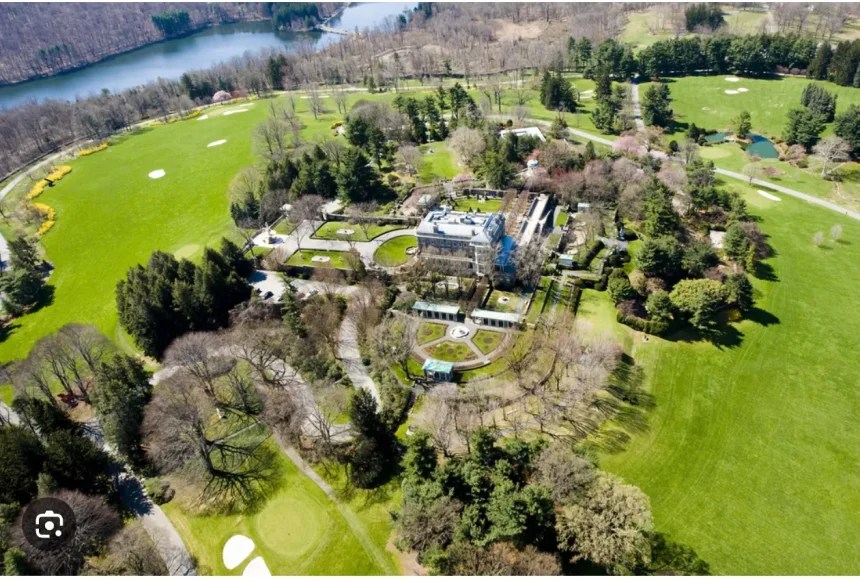
This is the most public of their estates but Rockefeller houses, mansions, lodges, city palaces, beachfront estates, and dozens upon dozens of holiday houses litter America.
In the climate change arena, the Rockefellers call the shots. The whole thing was their idea, they took a silly but interesting theory and amped it up with hundreds and hundreds of million of dollars. They founded institutions and linked the survival of those institutions to promoting climate change and population reduction. They adopted one likely politician after another.
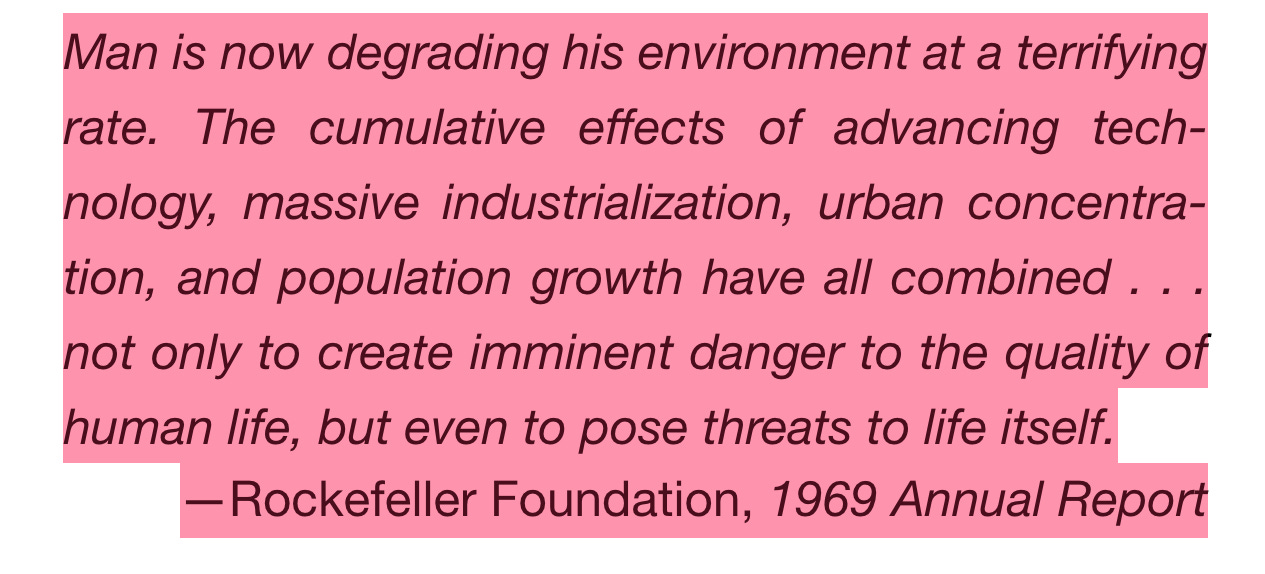
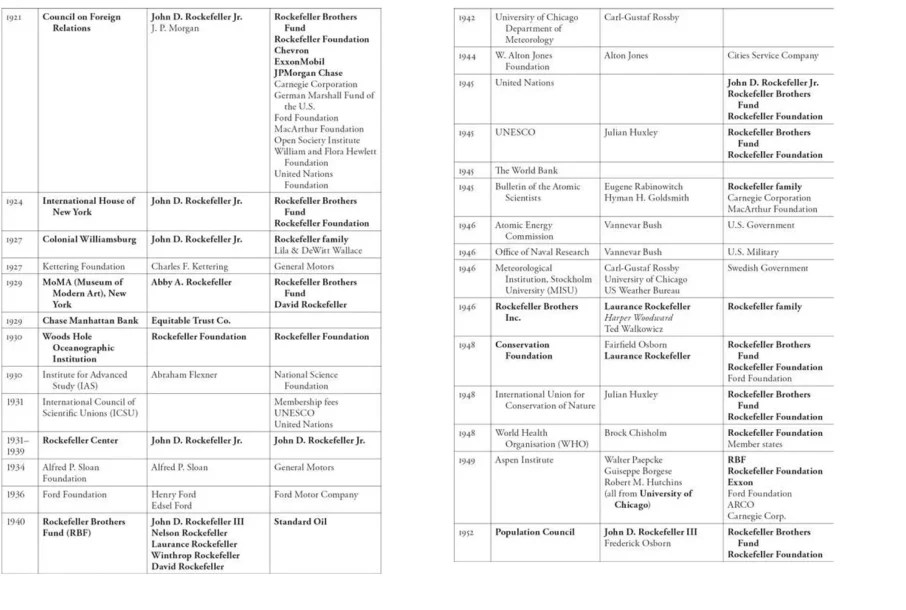
The Rockefellers have created 990 Climate Change activist organizations. They give them directions, financing, and launch them on the world. The Green Movement was started, financed, organized, and militarized by the Rockefellers. By the late 40’s the family was all in, on the same page. In the 50’s they began to stand up countless institutions, committees, university departments, university institutes, foundations, and policy shops gathered around this one idea, as below:
Let’s just pause here and recognize that the United States and Canada are 5% developed. If it were 50%, then maybe we would have reason to worry about the effects of trace gas that takes up .04% of the atmosphere, of which 3% is currently contributed to by humans. But were we to have that level of development, our science would have long ago solved the problem. Our sense of proportion, size and consequence has been twisted, propagandized via hundreds of billions of purposed dollars. And all of it is exaggerated science done by scientists compromised by Rockefeller money.
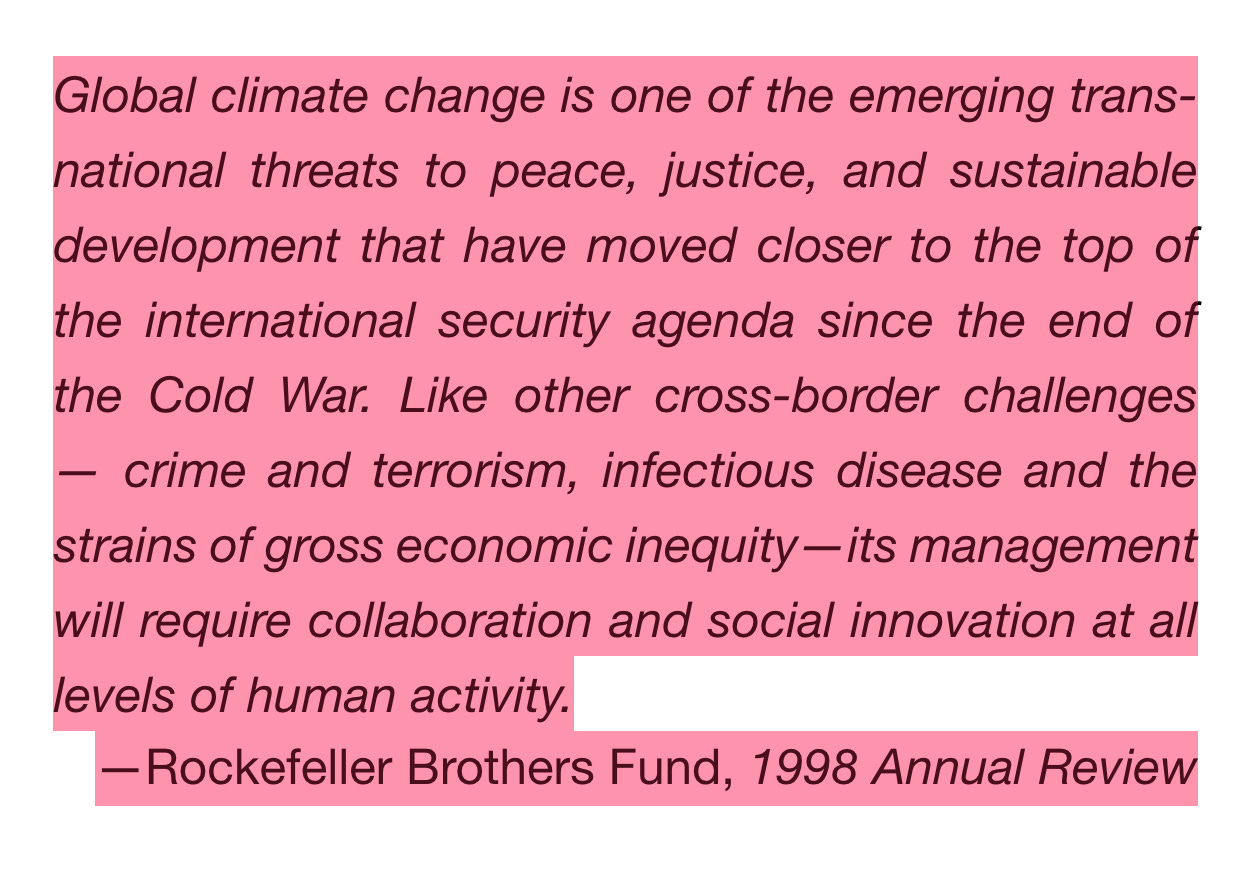
By 1998, the Rockefeller family had swept the table clean of any opposition to this one idea. Any scientist not on board with the agenda was imperiled. Any university department not working towards this one artificial goal, was in danger of being marginalized. Infiltration had begun into every media organization, every entertainment division of every major corporation. This, as stated below, would be a generational goal. For everyone. Or get off the bus.
The Rockefellers have created 990 Climate Change institutions, foundations, and activist groups. And they fund them.
What is evidentiary, what can be proved in a court of law, rather than opinion, however, is that the Fabians started the idea of this whole one-world, no nation state. It is clear too that after the First World War, the Fabians roped in the second generation of Rockefellers. It was a major catch. It meant they had America. And it was spiritual. It was meant to change mankind, to kill off Homo Sapiens and turn us to Homo Universalis.
The New Man would be not-Christian, quietist, and self-obsessed. The economy would trend towards zero-growth if not de-growth. There is a preponderance of data, many many publications that laid out their plans. They twisted education away from practical science, engineering and building things towards social movements, the humanities, the arts, and pleasure. And via Laurance Rockefeller’s money and organizational skill, they devised and invented the discipline of cybernetics from which the internet flows.
The first Rockefeller, as almost everyone knows, was John D., by all accounts a deeply unpleasant individual who, after his private army killed protestors, was advised to go into charity in a big way to rescue his reputation. Which he did, and managed to dodge the trustbusters and Teddy Roosevelt, and build his empire over the corpses of his competitors. And then, as advised, he began to buy the media. The Luce empire of Time-Life fell into step. From the 60’s on Time-Life stood astride the media world, attracting the best, the authority on every subject. I was trained there, and trained well, but all the writing was done back in New York, in the Time Life building in Rockefeller Center. It was massaged to fit the message. I wanted to write and left.
By the second generation, the family had found its purpose, the meaning for all the wealth, the path forward. John D., according to Sir Stephen Wilkinson, who has studied him all his life, believed to his core that God had favored him with so much wealth because he was good; his Baptist faith coupled with titanic wealth made him a modern priest. His family, his heirs, would be a Royal Priesthood leading mankind to a new paradise. How the family must have fallen upon the Fabians, with their starry titled members, Bertrand Russell, all the Huxleys, H.G. Wells, Emmeline Pankhurst. How seductive socialism is to the intellectual class. It gives them the right, being so smart, to order humanity. To choose for the rest of us. Few of them could run a corner store.
The seduction of great wealth is pretty much irresistible. Everyone falls. The last time I was “in society” was at a wedding hosted by the Bostonian Cabots – so ancient they arrived in the New World in 1498. Famously, “The Lodges only talk to the Cabots and the Cabots only talk to God.” That’s how grand they are. Their wealth spread out that weekend was like entering heaven, everything so beautiful, so absolutely perfect in every detail. It was a lush sinking feeling, utterly seductive to the ego. Any Clinton, Gore, Obama, Kerry, Bush, any impoverished scientist, any ambitious university administrator, every fundraiser, every marginalized military man, would just fall over like an ambitious 20 year old faced with her first billionaire. Take me I’m yours.
And that’s what happened. That’s how they did it, by inviting likely servants to their houses and hunting lodges, donating buildings, buying the land for the U.N., funding organizations, appealing to vanity and greed and above all, the human’s desperate need for significance. They created a super-class unmoored to reality and entirely 100% destructive of human life. It was systematic, a fierce, unstoppable, detailed two-hundred-year plan. Each generation would make their contribution.
It started with the felt need to reduce population and turn man into something other. To stress, environmentalism, neo-Malthusianism; the ‘saving of the planet’ was the motivator for each of the following actions. If you accepted Rockefeller funding, you toed the line. There were too many people, the carrying capacity of the earth was breeched, the planet was dying, we need a new form of human. These ideas all came out of the Fabian stable and metastasized through the culture like the most delicious poison. Every intellectual, all the universities started to promote this idea. It was heady, exciting. It celebrated Man, not some faceless distant Deity. Fabians hated Christianity and wanted, above everything, to replace it. But first, they had to command every institution of civil society.
The following is a partial list of the institutions by which the Rockefeller family built the modern world, in every aspect of the culture. It was masterful. Ancient Kings and Emperors would have marveled.
In 1920, John D. co-founded the League of Nations. He was the major donor. It failed because the U.S. refused to sign on. The family began to run for office, in order to manipulate levers of power behind the scenes. Today, there is pretty much always a Rockefeller in power at each level of government.
In 1921, they founded the Council of Foreign Relations, (CFR). David built and donated CFRs headquarters. CFR is closely allied to the Royal Institute of International Affairs (RIIA) in London, Chatham House, itself closely allied with the British Round Table and the Fabians. When people talk about the 13 Families theory, the Round Table and RIIA feature big-time.
In 1944, they co-founded the World Bank, its ideals and purpose devised by the Council of Foreign Relations’ War and Peace Studies Committee.
In 1945, they co-founded the United Nations, with the CFR and RIIA. David Rockefeller wrote the preamble to the U.N. Charter. John D. Jr bought the 17 acres for the U.N building. Nelson chose the architect, Philip Johnson, thereby introducing the International Style. The family funded the U.N. building.
In 1948, came their statement of purpose:
If the world government cause is to triumph it will need more than sympathetic endorsement by the majority. People must be made to feel that their own security, freedom, and prosperity, yes, their own survival, depend on the creation in our time, of a world rule of law. They must be made to believe that the establishment of a World Government is more urgent than the maintenance of a high domestic standard and as, if not more, practical than the pursuity of a deceptive security by full military preparedness. – Atomic physicist, Edwin Rabinowitch, a Rockefeller client/servant, 1948
In 1948, in league with Julian Huxley, Mr. Population, a leading member of the British Eugenics Society and the British Humanist Society, they formed the International Union for the Conservation of Nature, (IUCN). Stated goal: better distribution of the world’s population (which is behind the migrant crisis) and fertility control. The IUCN has systematically cleared tens of millions of traditional and indigenous peoples from their lands in Africa and the East.
In 1948, they founded the Conservation Foundation. In 1953, they funded it with $53 million, the equivalent of $650 million today.
In 1954, they founded, with Bernhard of the Netherlands (thought to be the apex child predator) the Bilderberg group.
In 1955, they cofounded the International Meterological Institute (IMI)
In 1959, the first publication of the Rockefeller Institute Press included a section on “Changes in the Carbon Dioxide Content of the Atmosphere and Sea due to Fossil Fuel Combustion”.
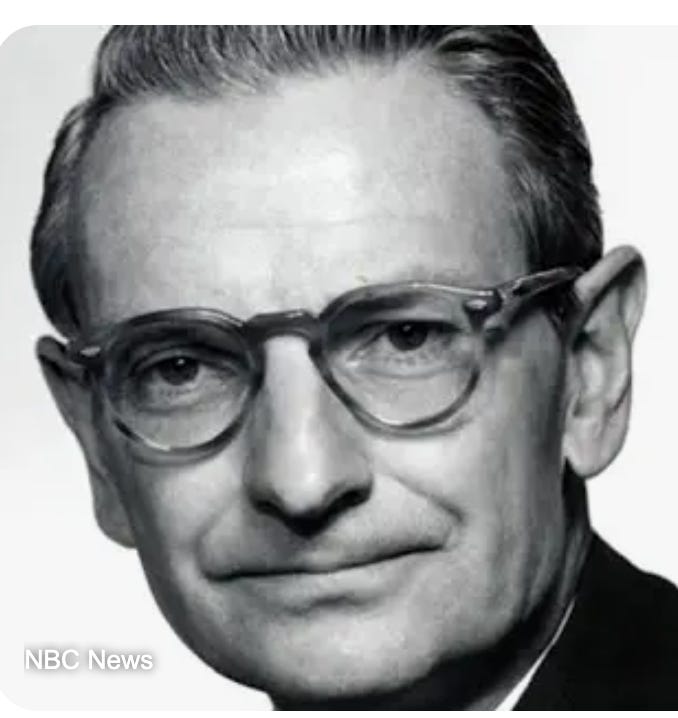
Laurance Rockefeller was purposed with the spiritual arm of the operation. Starting in the late 40’s. Laurance founded fifty environmental organizations including the World Wildlife Federation, the World Resource Foundation, the IUCN, and UNESCO. Laurence is behind Esalen and Lindesfarne Association, and is responsible for coining the term “New Age”. He founded and funded the Fund for the Advancement of the Human Spirit, the Foundation for Conscious Evolution, the Conservation Foundation. He was a board member of the National Resources Defense Council, the National Geographic Society, Woods Hole Geographic Society, Resources for the Future, and the Sloan foundation. He was a board member of the Environmental Defence Fund and the WWF. He co-founded the Rockefeller Brothers Fund and served as its chairman from 1958-1979. Laurance Rockefeller founded Cybernetics as a discipline by funding its study.
This man created the New Age, the climate scare and the Sixth Great Extinction scare
He stood up and funded most of the New Age gurus followed today by tens of millions, if not hundreds of millions. The New Age says “Stay out of the battleground, don’t worry about your neighbor, your family, your town, your country. Worry about your personal spiritual advancement, your tolerance and forgiveness. Work on yourself. Do your “shadow work”, you are everything, everything is a reflection of you.”
He funded the Disclosure Movement, which claims that aliens walk among us, and that their technology, liberated from the Naval Research Labs (another Rockefeller genesis) will save humanity. He was a ferocious, destructive nut.
Next, the family founded, financed and organized the European Commission, OPEC, and the UN Development Program.
In 1973, they founded the Trilateral Commission.
The plans for Princeton’s Institute for Advanced Study had been drawn up by Tom Jones from the British Round Table, intended as an American version of All Souls at Oxford which is primarily an academic research institution with particular strengths in the humanities and social and theoretical sciences. The Rockefellers were closely involved via funding the Institute and funding all of its heads and especially, significant scientists, providing grants for their work.
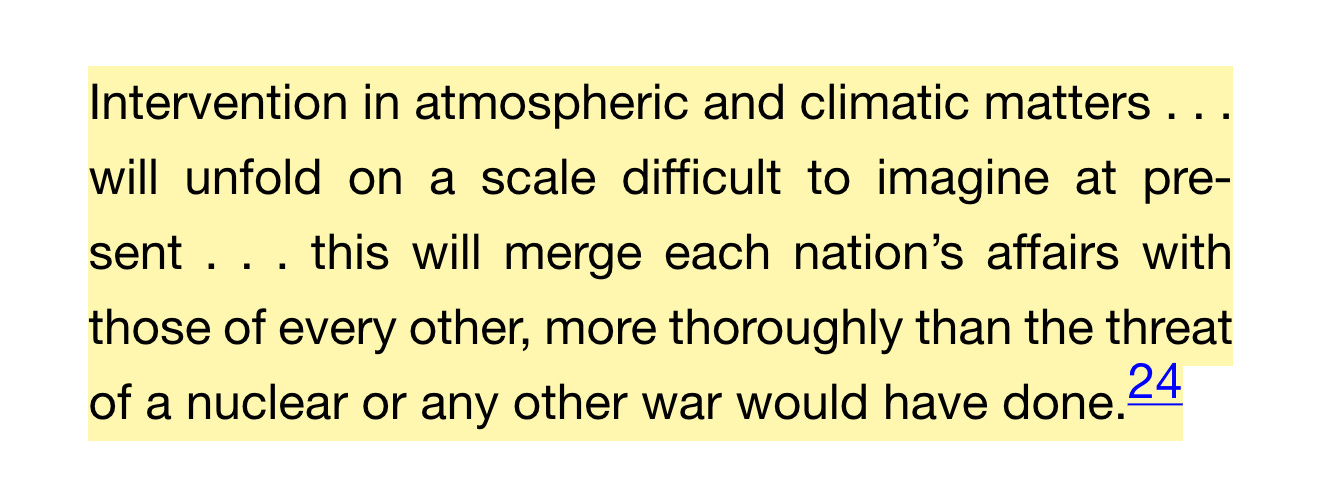
Here the science of climate forecasting was developed using climate modelling during the 1950’s Initially it was thought that geo-engineering would be the principal method used, rather than reducing emissions. They were math freaks, one of whom made the following convenient prophecy.
The climate scare well entrained, the family turned their attention to art and architecture. The breaking of architectural tradition was deliberate. Modern architecture, the International Style was created in order to disrupt and make uneasy Homo Sapiens.
”The International Style suited the Rockefeller brothers’ internationalist aspirations like a glove. It also inspired radically new zoning laws and urban planning models, leading not only to a boxy skyline of rectangular high-rise slivers, but to extensive sprawl and automobile dependency— which also happened to be highly profitable for the oil and auto industries.” (Nordangard)
In New York alone, they commissioned the following buildings, all built to be intentionally unsettling, deliberately destructive. Modernism deliberately erased the the past. It was purposed to make the human walking by and through these buildings, a sense of himself as base, insignificant, submissive and subject.
Some of the Rockefeller-financed buildings:
Rockefeller University
The U.N. Headquarters
Memorial Sloan Kettering Cancer Center
Riverside Church
The Cloisters
Lincoln Center of the Performing Arts
Empire State Plaza in Albany
One Chase Manhattan Plaza
The World Trade Center
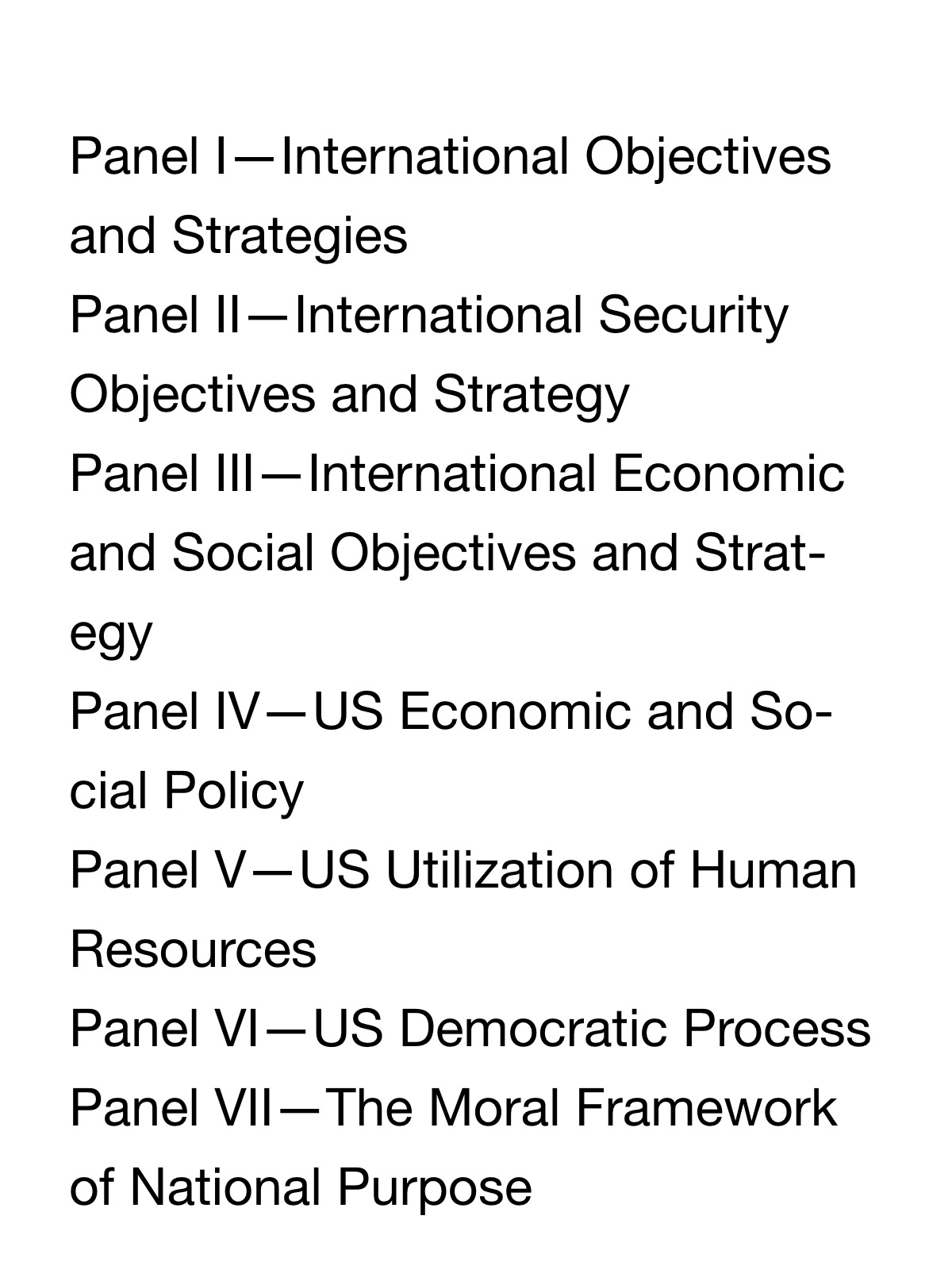
Kissinger, then a professor at Harvard, was one of the family’s most treasured assets. He believed “a new political architecture would be required, better able to offer long-term governance.” He became part of Nelson’s “portable brains trust”, the Rockefeller Brother’s fund, the Special Studies Project. The SSP worked from 1956-1961 to build that new political architecture:
They co-founded Woods Hole Oceanographic Institute
They co-founded the Scripps Institute of Oceanography.
They co-founded the Atomic Energy Commission, the Office of Naval Research, and the National Science Foundation while Nelson Rockefeller was in power.
This is only a partial list. Every single one of these institutions are neo-Malthusian, bent on fewer humans, and taking us off the land into giant pens, controlled, measured and monetized.
In 1989, illustrating the family’s reach abroad, the Hague Declaration (with 24 signatories) called for a new international institutional authority that could preserve the Earth’s atmosphere and fight global warming.
Thereafter, in that same year, 1989, the Rockefeller Brothers Fund under the leadership of David Rockefeller and Henry Kissinger founded the United Nations Panel on Climate Change (IPCC). and funded it with near unlimited resources going forward.
In the appendices of Norgangard’s book, he lists all the institutions founded by the family. Skimming them, I found myself jumping out of my desk chair and shouting into the void. The dog vanished, the cat hid. It is infuriating – they used their power to corrupt every institution that would serve their end game. Here is one page.
The End Game
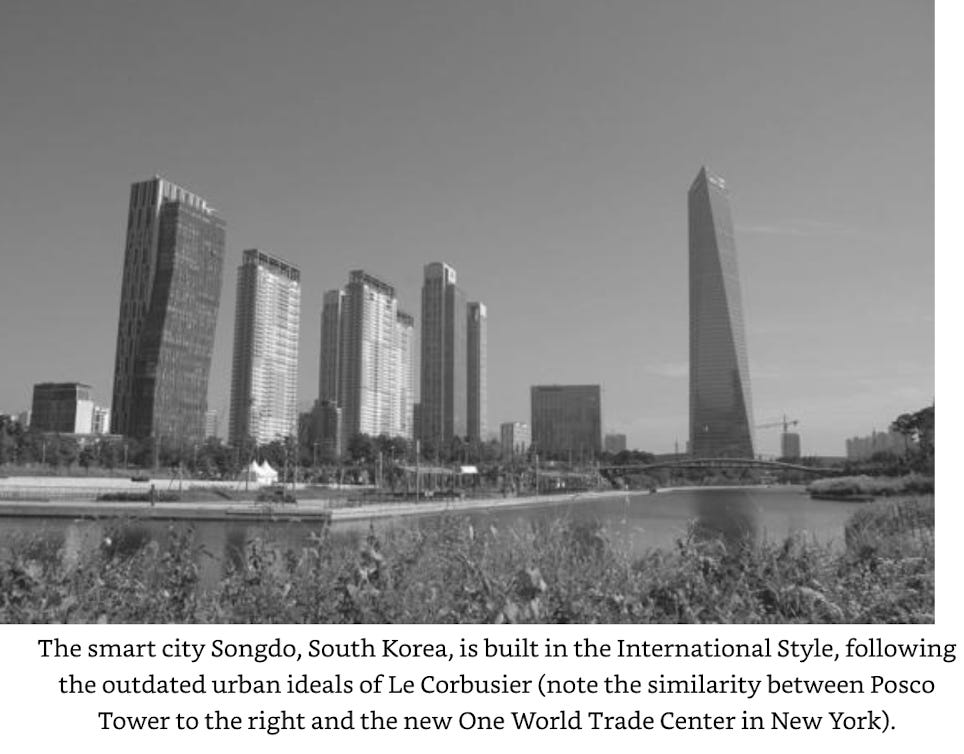
In 2012, the U.N. Climate Fund announced the establishment of the model for the cities of the future, outside Seoul, Korea called Songdo. Songdo is failing. No one wants to live there. Those who visit describe the place as soulless, with no people, no vivid life. Billions were spent creating it.
Nordangard describes:
“Traffic flow and citizen behaviour is monitored in real-time via five hundred surveillance cameras. Household waste is automatically transported via the pneumatic system under the city and converted into energy. All apartments have smart locks, with smart cards which can also be used for loaner bikes, parking, subway, and movie tickets. All apartments have smart meters (enabling residents to compare their energy consumption with that of their neighbors) and built-in cameras everywhere. Floor sensors detect pressure changes and automatically alert an alarm service of a suspected fall. Systems are tested where residents via the TV screen can receive language lessons or communicate with their physician as well as neighbors and relatives, and bracelets for locating children via GPS.7 In other words, a futuristic dream straight out of the World Future Society’s 1970s vision—or Orwell’s 1984. And this is South Korea. How successful, environmentally friendly, and inclusive Songdo really turned out to be has been questioned. It was built primarily for an affluent middle class expected to be able to afford the higher standard and the new technology. The electricity comes from coal-fired power plants and the buildings are completely glazed with windows that cannot be opened, which requires air conditioning all year round.8 Also, the pneumatic waste disposal system does not always work properly. As of March 2018 there was still no cultural life, no street vendors or old people, public transport, transport systems were empty and three-quarters of the homes were empty.
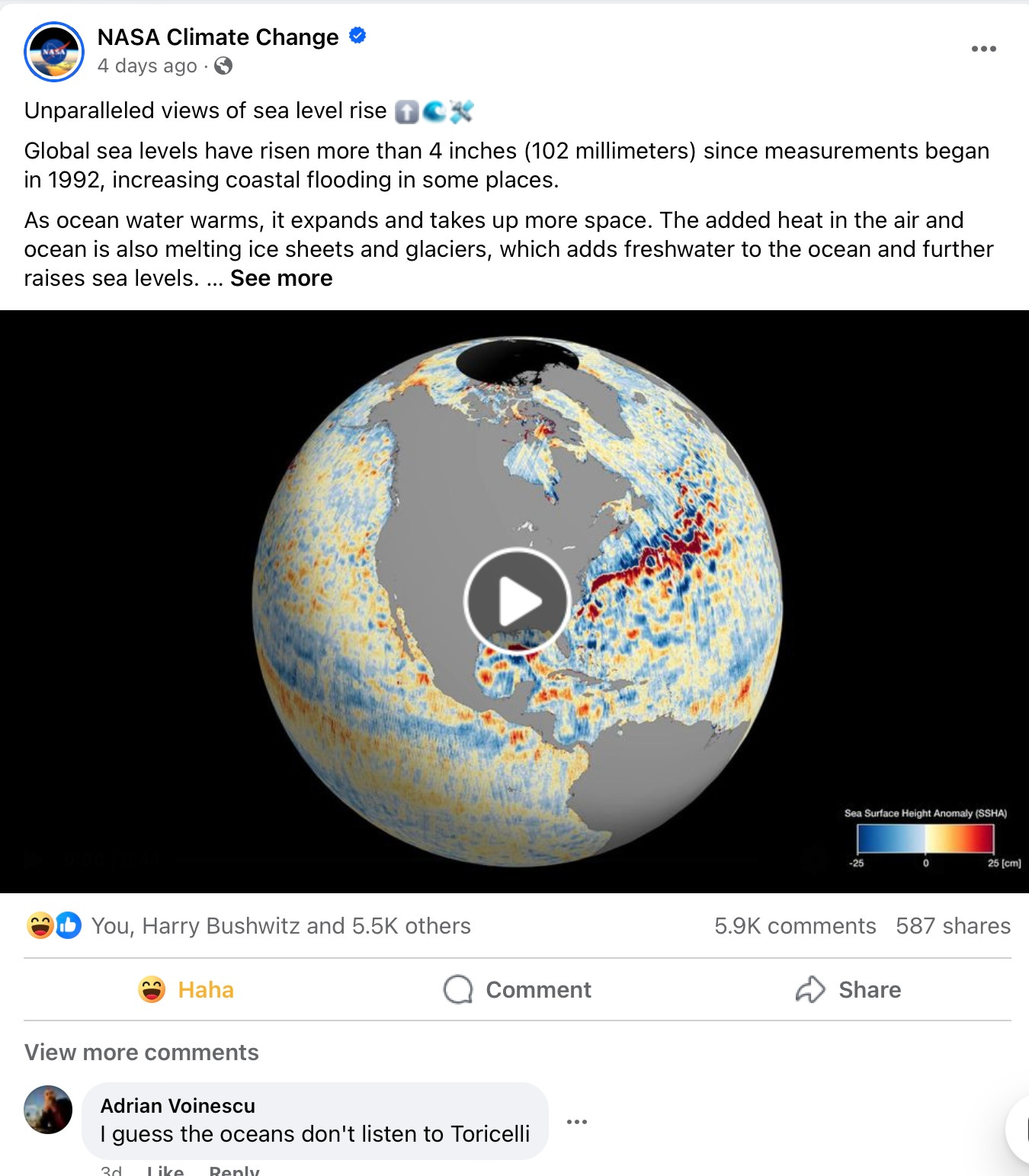
Evil has a human face, but despite the billions thrown at the people of the earth, fewer and fewer of us are falling for it. This latest Facebook-hysteria-the-sky-is-falling post from NASA’s Climate Change Center, received 5,600 reactions. 5,300, including mine were laughing emojis. And the top comment cited Torecelli, with one man’s work refuting every single flatulent government propaganda machine theory. Facebook, remember, is controlled speech and still, the people win.
Elizabeth Nickson was trained as a reporter at the London bureau of Time Magazine. She became European Bureau Chief of LIFE magazine in its last years of monthly publication, and during that time, acquired the rights to Nelson Mandela’s memoir before he was released from Robben Island. She went on to write for Harper’s Magazine, the Guardian, the Observer, the Independent, the Sunday Telegraph, the Sunday Times Magazine, the Telegraph, the Globe and Mail and the National Post. Her first book The Monkey Puzzle Tree was an investigation of the CIA MKULTRA mind control program and was published by Bloomsbury and Knopf Canada. Her next book, Eco-Fascists, How Radical Environmentalists Are Destroying Our Natural Heritage, was a look at how environmentalism, badly practiced, is destroying the rural economy and rural culture in the U.S. and all over the world. It was published by Adam Bellow at Harper Collins US. She is a Senior Fellow at the Frontier Center for Public Policy, fcpp.org. You can read in depth policy papers about various elements of the environmental junta here: https://independent.academia.edu/ElizabethNickson
Denmark is set to become the first country in the world to tax farmers for the greenhouse gasses emitted by their livestock, in a deal reached June 24 between the Danish government and representatives of the farming industry and unions.
The tax, which specifically targets methane emissions by cows, pigs and sheep, will take effect in 2030, pending final approval by the Danish Parliament, The Associated Press (AP) reported.
Beginning in 2030, farmers will be required to pay a tax of 300 kroner (approximately $43) per ton of carbon dioxide equivalent. This will increase to 750 kroner ($108) by 2035. After a 60% tax deduction, the respective amounts will be 120 kroner ($17.30) and 300 kroner.
CNN, quoting Denmark’s “green think tank” Concito, reported that Danish dairy cows emit, on average, 5.6 tonnes (6.2 U.S. tons) of CO2-equivalent emissions per year. This would result in a tax of 672 kroner per cow ($96) in 2030 and 1,680 kroner ($241) in 2035.
The respective emissions figure for all Danish cows is an average of 6.6 tons of CO2-equivalent annually, according to the AP, which reported that the Danish government aims to reduce the country’s greenhouse emissions by 70% from 1990 levels by 2030, citing Taxation Minister Jeppe Bruus.
According to CNN, the proceeds from the tax will be used to support the agricultural industry’s green transition in the first two years, including the investment of 40 billion kroner ($3.7 billion) for measures including reforestation and establishing wetlands.
After two years, the tax will be “reassessed.”
Denmark is a significant exporter of pork and dairy products, CNN reported. Agriculture is the country’s largest source of greenhouse gas emissions. The AP reported that, as of June 2022, there were nearly 1.5 million cows in Denmark.
Tax will encourage farmers ‘to look for solutions to reduce emissions’
Proponents of the tax emphasized that Denmark is the first country to enact such a policy, characterizing it as a step toward greater environmental sustainability.
“We will take a big step closer in becoming climate neutral in 2045,” Bruus said.
“We are investing billions in the biggest transformation of the Danish landscape in recent times,” said Danish Foreign Minister Lars Lokke Rasmussen in a statement quoted by CNN. “At the same time, we will be the first country in the world with a (carbon) tax on agriculture.”
According to Torsten Hasforth, Concito’s chief economist, “The whole purpose of the tax is to get the sector to look for solutions to reduce emissions,” CNN reported. Hasforth noted that farmers could, for instance, change the feed they use, as part of their efforts to reduce emissions.
The Danish Society for Nature Conservation called the tax “a historic compromise,” in remarks quoted by the AP. The organization’s president, Maria Reumert Gjerding, said, “We have succeeded in landing a compromise on a CO2 tax, which lays the groundwork for a restructured food industry — also on the other side of 2030.”
And Ben Lilliston, director of Rural Strategies and Climate Change at the Institute for Agriculture and Trade Policy, told PBS NewsHour that methane emissions are “a huge problem … a huge challenge.” He argued that while methane remains in the atmosphere for fewer years than CO2, it has “about 80 times the potency.”
“If you reduce methane, you can get more near-term results and allow us to have a little longer of a window to reduce carbon dioxide emission,” Lilliston said.
The farmers voiced grievances over new environmental regulations and the corporate takeover of European farming.
In recent years, EU member states such as Ireland and the Netherlands have also pursued plans to limit farming and cull livestock, leading to protests in those countries.
Criticisms are now being levied against Denmark’s new carbon tax, with some experts arguing that it amounts to an added burden for the agricultural sector — particularly small farmers.
CNN quoted Danish farmers’ association Bæredygtigt Landbrug, which described the new policy as a “scary experiment.”
Peder Tuborgh, CEO of Arla Foods, Europe’s largest dairy company, told CNN that the new tax is “positive,” but farmers who “genuinely do everything they can to reduce emissions” should be exempt.
In remarks shared with The Defender, Catherine Austin Fitts, founder and president of the Solari Report, said, “Emissions are a cover story to achieve steps in the central bankers’ ‘Going Direct Reset.’”
According to Fitts, the goal of this “reset” is “to consolidate control over the food supply, shifting to corporate-controlled ‘PharmaFood’ and to shift energy availability from the general population to feed an electrical control grid that will supply AI [artificial intelligence], robotics, digital IDs and an all-digital financial system.”
“We are trading fresh food and freedom for digital concentration camps and lab-grown meat,” Fitts said. “On Wall Street, we used to call this ‘a bad trade.’”
Other critics told The Defender the Danish government’s new tax has less to do with protecting the environment and reducing emissions, and more to do with achieving the United Nations’ (U.N.) Sustainable Development Goals (SDGs) and the objectives of global entities such as the G20 and the World Economic Forum (WEF).
Dutch attorney and activist Meike Terhorst told The Defender :
“I think the measures have nothing to do with sustainability but with power. A group of companies, the so-called globalists/banks/investors, such as the WEF, work together with governments, such as the G20, and together they can force the small farmers off their lands.”
“Small farmers will be the first to go, and their land will most likely be used to house a variety of so-called ‘green initiatives,’ such as fake meat labs, acres of solar panels and wind turbines as far as the eye can see, new AI data centers that require tons of water, energy and land, and possibly even nuclear power plants to power those data centers,” he said.
Similarly, Terhorst said the goal is to “close down the small farmers as part of the ‘Agenda 2030’ — U.N. SDGs — or the corporate takeover agenda.”
Terhorst said this agenda aims “to ensure that small farmers are to be removed from the land and replaced by ‘digital’ farming” — meaning “replacing meat and milk with factory-made insect food or milk and lab-grown meat.”
Critics also questioned claims that policies like carbon taxation help promote “sustainability.”
“When unelected globalists at the WEF and the U.N. talk about sustainability, they don’t mean self-sustainability for the individual. They don’t want that at all. They want to ensure sustainable control, influence and power for themselves for decades to come,” Hinchliffe said, adding:
“As I see it, the real goal here is to take control of prime agricultural land and to tax farmers out of existence. Once the taxes get too expensive and the farmers can’t keep up, that’s when public-private entities swoop in to take control of the land.
“If they really believed that flatulent farm animals were responsible for the weather, they would just plant more trees to absorb the carbon, and their imaginary crisis would be solved, but they’re not doing that because what they’re really after are land grabs, money, and total control of our food systems.”
According to Hinchliffe, global organizations also aim to change human habits — including meat consumption. He said:
“On a nutritional level, groups like the WEF and the U.N. want us eating less meat and more bugs, and this will only make us weaker and more docile as a species over time.
“It also makes us all dependent on very centralized sources of protein, so if there’s an outbreak or a contamination, citizens all over the world will suffer because there’ll be no alternative. The local farmers will have disappeared due to the carbon taxes and land grabs.”
“The bio meat industry was organized and financed by the investors and banks that are part of the WEF,” Terhorst said. “If we want to become sustainable, we have to limit the powers of the investors and WEF and support small farmers.”
Hinchliffe added, “When carbon taxes fail to quash the human spirit completely, they already have plans to tax just about everything else in nature, including the air we breathe, the water we drink and the very soil upon which we walk.”
The need for energy in India is so dire, the Modi government just leaned on the power companies to get their act together. Instead of adding the usual 1 – 2 gigawatts of new coal power, which they have for a lot of the last decade, last year they ordered enough gear to build 10 gigawatts. And this year Modi wants them to aim for 31 gigawatts. Which is about the same capacity as the entire coal generation of the Australian National Grid (and our gas plants too).
Somewhat miraculously, they are talking of building them “in the next 5 or 6 years”:
India is rushing to add fresh coal-fired plants as it is barely able to meet power demand with the existing fleet in non-solar hours.
Post pandemic, the country’s power demand scaled new records on the back of the fastest rate of economic growth among major economies and increased instances of heatwaves.
India saw its biggest power shortfall in 14 years in June, and had to race to avoid night time outages by deferring planned plant maintenance, and invoking an emergency clause to mandate companies to run plants based on imported coal and power.
— Asia Financial
And they are discussing numbers like $33 billion instead of $3.3 trillion. When President Modi wants electrical generation fast, he didn’t say “quick, build 50,000 wind mills, with batteries, gas plants, high voltage lines and pumped hydro.”
Meanwhile the Western advisors sit around at frequent-flyer lounges on the way to UN junkets and tell themselves how the world is transitioning away from coal. And when the UN patsy declares coal is a “stranded asset” they nod obediently and sip more champagne.
When our inept and traitorous scientific agencies calculate energy costs, they won’t even put coal on the map unless they add up the cost of every cyclone in the next hundred years and park it in the “coal” column. Witchdoctors, every one of them.
In April 2024, Russia announced its proposals for the BRICS Contact Group on Climate Change and Sustainable Development. The priorities for the year of Russia’s chairmanship included: issues of a just transition, adaptation to climate change, natural solutions, carbon markets and carbon pricing. Initiatives to share experience in the development of carbon markets and implementation of adaptation measures, as well as a proposal to foster scientific climate cooperation sparked considerable interest.
The discussion of climate agenda within BRICS already has a certain background. With its proposal, Russia took an important step towards institutionalizing the dialogue by establishing the Contact Group on Climate Change and Sustainable Development. In 2015, during the period preceding the adoption of the Paris Agreement, at the 7th BRICS summit in Ufa the countries emphasized in their final declaration their readiness to address climate change at both the global and national levels. Despite this declaration, the climate issue has long remained an element of dialogues and cooperation on sustainable development rather than a stand-alone item on the BRICS agenda. The climate issue came out of the “environmental” canopy after the BRICS High-Level Meeting on Climate Change, held remotely in the year of China’s presidency on May 13, 2022.
All of Russia’s initiatives refer to different areas of international climate cooperation – from a just transition, carbon markets and pricing to mitigation of climate change mainly by reducing greenhouse gas emissions. The interest in carbon markets can be explained by the willingness shared by the BRICS nations to ensure the inflow of foreign investment in renewable energy projects, energy efficiency, and energy infrastructure.
The same argument is generally applicable to climate change adaptation. It is known that international climate finance (from developed to developing countries) is accompanied by a serious imbalance towards the financing of greenhouse gas emission reduction projects, while adaptation measures attract much less financial resources. Even within the Green Climate Fund (GCF), overseen by the UNFCCC, there is a skew in the ratio of financial assistance channeled in favor of mitigation over adaptation. The benefits of reducing greenhouse gas emissions are global, as greenhouse gases are well mixed in the atmosphere, while the benefits of adaptation are largely local and depend entirely on a country’s ability to build a climate risk management system and integrate it with urban planning, emergency response and prevention policies, sectoral regulation.
For a long time, the motives for developing climate cooperation among the “old” BRICS members were driven by political rather than economic interests. Therefore, discussions and references to climate in the summary documents did not go further than that. The BRICS platform was not even used by countries to hold consultations during important processes under the UNFCCC, as is usually the case in the G20.
The events in Ukraine and the expansion of BRICS in membership are likely to change this situation. It is quite unlikely that all priorities will be worked out equally well with partners during Russia’s presidency, so it makes sense to analyze the documents to understand the existing groundwork in this area.
Adaptation to climate change
Climate change adaptation is a relatively new item on the BRICS climate agenda. The BRICS Economic Partnership Strategy 2025 mentioned that many nations were ready to raise climate change awareness risks and open a financial window for adaptation projects in the BRICS New Development Bank (NDB). Indeed, the NDB’s Overall Strategy 2022-2026 contains a target to use 40% of the financial resources raised for projects that address climate change and adaptation (without specifying the fund allocation ratio). The same document stated that the NDB “will, to the extent possible, consider disaster resilience in the preparation and implementation of its projects.” However, the NDB made this decision in line with the general policy of international development banks to strengthen their compliance with the Paris Agreement goals rather than with the BRICS strategies.
BRICS member states (except Iran), as parties to the Paris Agreement, are obliged to provide information on adaptation activities within nationally determined guidelines. In addition, as a result of the Conference of the Parties to the FCCC in 2010, a process was launched for developing countries to prepare and submit National Adaptation Plans (NAPs), which is now linked to Green Climate Fund grants and, as it was before, to UN development agencies and the World Bank providing support. Among the BRICS nations, it is Brazil, China, India, Russia and South Africa that report adaptation policies in their Nationally Determined Contributions (NDCs) to the Paris Agreement. Brazil, Ethiopia and South Africa are devising national plans to receive funds from international development agencies. Egypt, Iran, the UAE and Saudi Arabia have not yet formulated climate change adaptation policies. Thus, of all the BRICS+ nations that have an adaptation policy, only Russia and China do not link its implementation to the receipt of international aid.
Clearly, in the BRICS context, adaptation financing can only be disbursed on a South-to-South basis, i.e. voluntarily. Meanwhile, finance is an important—but not the only—component of adaptation cooperation. The availability of tools for integrated assessment of the climate change impact on the BRICS economies and, conversely, the climate policies and measures taken by countries that could be used for adaptation planning, are of paramount importance. Such tools are now actively developed by some of the BRICS nations, such as China or South Africa. Other members of BRICS, like India, are working with these countries to develop the said tools. Given that all BRICS states are highly exposed to both physical and transition risks, the contribution of risk assessment tools to adaptation planning cannot be overemphasized. In addition, businesses, municipalities (especially cities) and local communities may be interested in developing climate risk assessment tools that are tailored to the needs of different sectors based on their geographical location.
The 6th coordinated BRICS multilateral project competition within the BRICS Science and Technology Framework 2023 focused on climate change adaptation and mitigation, but among the research priorities there was none that would be directly linked to ensuring adaptation-related decision-making. This is surprising if one considers the current interest in climate risk management among BRICS central banks and financial institutions in general, which perceive climate change risks as a serious threat to their resilience and sustainability.
In the contact group discussions on adaptation in the year of Russia’s chairmanship, it is important to raise the issues of creating climate risk assessment tools accessible to a wide range of users and stimulating applied research on adaptation planning – for example, in cities. It will be equally important to link the results of projects and studies to NDB priorities and policies, to discussions within the interbank cooperation mechanism, and to support them with bilateral agreements on the development of monitoring and natural disaster risk mitigation systems.
A Just Energy Transition and BRICS Carbon Market Perspectives
Fully in line with the ideas of common but differentiated responsibilities actively supported by the new and old BRICS members and seeking to avoid climate measures imposing serious burdens on developing nations, Russia has proposed to discuss a just transition to a low-carbon economy. The very notion of a “just transition” has been extensively used by the European Union since its Green Deal was announced.
A just transition has a very broad meaning, but the main component is the need to mitigate the negative impact of an accelerated transition to a carbon-free economy on the poor, the fossil fuel labor market, and to “ensure that the substantial benefits of the transition to a green economy are widely shared.” But what is meant by a just transition in the framework of the association?
South Africa’s 2023 Chairmanship Program contained a paragraph on “developing partnerships for a just transition,” but this idea did not go any further in the final declaration of the summit. It was noted that the bloc’s member states:
– welcome increased cooperation and investment in supply chains for the energy transition and recognize the need to fully participate in the global clean energy value chain,
– recognize the role of fossil fuels in supporting energy security and energy transition and call for cooperation among BRICS nations on technology neutrality, as well as the adoption of common, efficient, clear, fair and transparent standards and rules for assessing emissions, developing compatible taxonomies of sustainable projects, and carbon accounting.
Thus, “equity” is understood in the BRICS context as the problem of global inequality of benefits gained from the energy transition and the right of nations to determine their own means of achieving the goals set in the Paris Agreement, politically neutral standards and rules for reporting emissions and generating carbon units from climate projects, rather than supporting people and industries in decarbonization programs.
To succinctly describe the emerging consensus on a just transition within BRICS, a short formula would be enough: “more investment in energy”. It describes grid construction, production of renewable energy equipment, modernization of fossil fuel-fired power generation capacity, etc. It is still premature to say whether there’s been an unambiguous political choice of the BRICS member states in favor of green energy.
Currently, BRICS comprises countries with opposite strategic orientations in the field of energy. Importing countries such as China, India, South Africa, Ethiopia and Egypt are interested in reducing their dependence on foreign energy supplies, while Russia, Saudi Arabia and the UAE seek to jump on the last train of the fossil fuel era and establish channels of energy trade for decades to come.
The BRICS nations are now looking for additional sources of financing to address energy poverty and reduce their carbon footprints. Besides, representatives of commercial circles have recently proposed on various platforms of the association to discuss a voluntary carbon market, which could become a source of investment. The initiative can be launched through agreeing on a common methodology for climate projects, approaches to their implementation and verification of results (carbon units) with subsequent mutual recognition of standards for disclosure of information on greenhouse gas emissions.
Of all BRICS member states, only China has a national carbon market, and Russia has only recently created the requisite infrastructure. Therefore, the discussion of the carbon market should be preceded by an exchange of views on approaches to carbon pricing, the role of compensation mechanisms (climate offsets) in achieving each country’s national climate goals. After all, the proposed initiative should take into account the international voluntary market for carbon units that has already existed for many years, as well as the emerging market under Article 6.4 of the Paris Agreement. How should companies from BRICS nations be “locked in” on the association’s carbon market is another difficult question.
Finally, a key obstacle to the BRICS carbon market, including a common registry and methodology for climate projects, lies in the very nature of the climate goals that the countries set for themselves. At present, only Russia, Brazil, Iran and Ethiopia have set economy-wide targets for reducing greenhouse gas emissions.
This factor predetermines a significant difference in the supply and demand of carbon units, and most importantly – in their “cost”. Companies from countries that do not have quantitative commitments to reduce emissions will be in an obviously more favorable position, while there’s not much clarity on the motive for establishing an external pool of BRICS carbon units instead of stimulating the implementation of climate projects within jurisdictions. Given the existing commitments under the Paris Agreement, the BRICS carbon market is at risk of being left without buyers.
***
The BRICS climate agenda cannot and should not be considered in isolation from the strategic guidelines of its members in terms of trade and investment, energy, and technology. It is not another “sphere” of interaction among the BRICS members, nor is it a continuation of the climate policy that the member states pursue by other means. The climate agenda of any intergovernmental association is a dense tangle of agreements and compromises reached in dialogues on trade and economic issues. The presiding country may propose a specific pool of topics for the climate track, but this is not what sets the dynamics of the relationship. The real driving force will be converging interests—not necessarily national interests, but sectoral and private interests, as well as available resources and opportunities, coupled with the political will to use and/or exchange them.
A serious limiting factor for the climate agenda in the BRICS context is the institutional “laxity” of the association. Since Russia took over BRICS chairmanship in 2024, more than 50 events of various levels have already been held on a wide range of issues, but there is no mechanism for aggregating the results of dialogues, tracking the implementation of agreements and no channel for “spillover” between different formats of meetings. There is no mechanism to account for the results of discussions within the thematic tracks in the final documents of BRICS summits. For example, it would be productive to discuss climate change adaptation issues around recommendations for the NDB, as the results of applied research could be linked to the work of the Interbank Cooperation Mechanism and other platforms with financial institutions participating.
Amid the serious pressure of anti-Russian sanctions on the global energy market and the accelerated transit of the EU and China to carbon-free energy, Russia is now considering the nations of BRICS as important partners in energy trade. There is already ample evidence of this dynamic. In recent years, Russia has significantly increased its natural gas supplies to China and coal supplies to India. Russia and India have started to cooperate in the nuclear industry. The volume of China’s energy trade transactions with BRICS has been growing in 2024, although it accounts for less than 15% of the country’s total trade.
In the meantime, individual BRICS members are actively developing mutual trade in renewable energy technologies, and companies within BRICS, especially Chinese, are expanding access to critical raw materials (lithium, bauxite, cobalt, etc.) needed for the energy transition. Nevertheless, it remains far from clear how the expansion of BRICS might affect green energy technology markets. Meanwhile, this is precisely one of the key issues on the BRICS climate agenda.
Specific initiatives are to be preceded by dialogue on approaches to the relevant policies in both climate change adaptation and a just transition to a low-carbon economy. Even a cursory analysis of the current situation shows that these approaches are still too diverse. At the same time, the experience of the pandemic, EU and U.S. sanctions policies have shown how quickly and easily global supply chains, whereon the developing economies of BRICS heavily depend, can be disrupted. Thus, the threat of de-globalization emerges as the main driver for the rapprochement of countries. Yet, common interests of the BRICS nations can be short-term or long-term. BRICS climate agenda could be essential for building longer-term common interests. To do so, it must be consistent with national goals for low-emission sustainable development, the basis for which has to be established now.
Ekaterina Bliznetskaya is a lecturer at Moscow State Institute of International Relations under the MFA of Russia, Environment and Natural Research Studies.
The word charade has several meanings, and including an act or event that is clearly false (Cambridge Dictionary), something done just for show (Vocabulary.com), or a situation in which people pretend that something is true when it clearly is not (Oxford Leaner’s Dictionary).
The charade I refer to is President Biden’s $7.5 billion dollar investment to install 500,000 electric charging stations along America’s highways by 2030. A reliable and convenient public EV charging infrastructure is critical to achieve the President’s goal of meeting the recent EPA CO2 emission regulations that require nearly 72% of U.S. new light vehicle sales to be fully electric or plug-in hybrid by 2032. Without diving deeper into the announcement, one would likely assume that $7.5 billion is sufficient to construct the 500,000 charging stations, one every 50 miles along the nation’s highways.
To identify the charade, one must first, look at the math: 500,000 charging stations, each with a minimum of four chargers, accomplished with an investment of $7.5 billion dollars. But that is only $15,000 per charging station, installed. A single high capacity charger can cost $100,000 or more, and most stations have multiple chargers. We are now in the second year of the program and only seven stations have been opened so far. At this rate, it will require thousands of years to build all 500,000 charging stations, assuming there are sufficient funds to do so.
Global consulting firm McKinsey and Company estimates that the U.S. will need 28 million charging ports by 2030. There are just two million charging ports today. To meet the goal, about 12,000 new public and private charging ports will need to be added every single day to reach the goal by 2030.
It is true that significantly more government funded charging stations are in the works and will be opened. The stations completed so far cost significantly more than what has been promised. With retailers contributing land to the projects opened so far, the cost of each station has averaged one-million dollars, with the government participation of 80% of the cost. Eight-hundred-thousand dollars for each station is significantly more than the 15,000 committed by the administration. At this rate, the 500,000 charging stations will cost the government $400 billion, not the $7.5 billion the President has promised.
If the administration is so wrong with this program, one must consider how many government programs designed to bring electric vehicles to the masses are similarly defective.
Europe’s leading green energy producer, Statkraft, is drastically scaling back its plans for new wind and solar power plants – due to falling electricity prices and rising costs, so reports Germany’s online Blackout News, a leading site for independent German energy news.
According to company CEO, Birgitte Vartdal, market conditions have become more difficult as the company’s ambitious targets for wind energy and solar power are now being called into question.
The new Statkraft target is two to two and a half GW instead of an originally planned 4 gigawatts annually.
“In the offshore wind energy sector, the Group is now planning a total output of six to eight GW. The original target was ten GW,” Blackout News adds.
The scaleback follows other European countries’ plans to reduce expansion, including Danish energy company Orsted, which “has lowered its targets by more than ten GW” and has also “canceled two offshore wind projects in the USA and reported impairments amounting to 28.4 billion Danish kroner (approx. 3.8 billion euros).”
Portugal’s largest energy supplier, Energias de Portugal (EDP), has also reduced its investment plans – due to the “deterioration in market conditions.” Moreover, French energy supplier Engie earlier had postponed developing hydrogen projects.
Leading officials blame projects having become “much more challenging” and offering “no relative returns.”
As a result, solar and wind equipment manufacturers have seen their values plummeting and ESG equity funds have “recently suffered outflows of 38 billion dollars,” reports Blackout News.
Blackout News is operated by an independent and non-partisan small group of engineers with experience in energy management.
You may have heard about the new “animal-free dairy milk” called Bored Cow. It’s being billed as a more animal and environmentally friendly option to traditional milk that comes from a ruminant’s udders. It all sounds great until you dig a bit deeper to learn that it is produced using synthetic biology (synbio), using genetically engineered (GE) yeast that is then put into a so-called ‘precision fermentation’ system. While the whey protein in it is the same as that found in cow’s milk, that’s only a small part of the overall story. Emerging data from some scientists, like John Fagan from the Health Research Institute(HRI), says the fermentation isn’t as precise as claimed, and there’s a lot of other compounds in the milk, some of which have never been recorded by science before. That might mean that drinking Bored Cow ‘milk’ on a daily basis could have unknown and potentially dangerous human health implications. This might just be one product, but it matters because powerful special interests are working to make synbio the tech platform of our food system moving forward—where farms are replaced with fermentation tanks—in the name of protecting the environment.
What’s happening here is an effort to get consumers to believe they can enjoy all the flavor, mouth feel, and nutrition of real cow’s milk…without the involvement of any cows (hence the “Bored Cow” name). Bored Cow is made with whey protein produced through a process called “precision fermentation,” a form of synbio. This involves taking a gene for whey protein and inserting it into a GE yeast. The yeast is put into fermentation tanks with other nutrients to help it grow. At the end the GE yeast is supposed to be filtered out, leaving only the milk protein. Bored Cow takes this protein and adds vitamins, minerals, and other ingredients to mimic the taste, consistency, and nutritional content of real cow’s milk.
Far from ‘bioequivalent’
The marketing hype behind Bored Cow starts falling apart when you learn that it’s not even close to being equivalent to real milk from pasture. HRI’s independent testing found 92 unknown compounds in this synbio milk. Fagan, HRI’s chief scientist, said these compounds are “completely novel to our food…They are nutritional dark matter.”
The FDA must be on top of this, right? Wrong. Bored Cow has not undergone safety testing at the FDA. Perfect Day, the manufacturer of the synbio whey protein, determined it was “generally recognized as safe” (GRAS) and voluntarily notified the FDA of this determination; in response the FDA said it had no questions. Given how rife the GRAS process is with conflicts of interest, this is akin to taking the company’s word for it that its novel synbio whey protein is safe.
Nor is it very likely that Bored Cow is nutritionally equivalent to real milk. Just as meat is more than just protein, milk is far more than a simple combination of whey and various vitamins and minerals. Milkfat contains 400 different fatty acids. Milk has two types of proteins, whey and casein—and there are several different types of these two proteins contained in milk, and a whole bundle of other compounds like lactoferrin and bioactive peptides that help prime the immune system.
Bored Cow is representative of a whole new generation of GE foods that are in development, some of which we’ve written about previously. Older genetically modified (GM) foods were created by modifying the genome of a living plant by inserting, for example, an herbicide-resistance trait. That was nothing compared to what’s going on now. GE yeast or fungi are being used as little factories to manufacture food components that regulators say are biologically equivalent to their natural counterparts, so, they say, no additional testing is required because the foods have been shown to be safe through their long history of consumption. But, as we’ve seen, getting a yeast to make one protein found in milk, fermenting it, then adding nutrients, and slapping “milk” on the label doesn’t make it milk. Nor, for that matter, is lab-grown meat biologically equivalent to pasture-raised meat.
And herein lies the problem. The entire framework for dealing with genetically engineered foods in the US is fundamentally broken. That’s because the federal government decided decades ago that the final product is all that matters, not the process used to create that product. This was codified in the 1986 Coordinated Framework for the Regulation of Biotechnology, which was updated in 1992 and again in 2017. Astoundingly, it wasn’t updated to install more robust safety measures to protect Americans from new and previously unthinkable forms of food. It was updated in large part to remove or mitigate “unnecessary costs and burdens” that “limit the ability of technology developers” to “navigate the regulatory process” which also “hamper economic growth, innovation, and competitiveness.” That is, the Framework was updated to make it easier for the biotech industry to ger their frankenfoods onto our dinner plates!
We’re worried that what’s coming are further “updates” to this framework that allow GE foods and those developed using synbio technologies to be considered “bioequivalent” to their natural counterparts—in essence, drinking the lab-grown food industry’s Kool-Aid. If regulators determine that synbio milk is equivalent to real milk, will consumers be allowed to make their own choices, or will we be sold out as we were with the sham GMO labeling law that allowed companies to hide the GM contents of their food in scannable codes?
Some countries are already moving in that direction: Costa Rica just adopted new regulations which treat a wide-range of gene edited products as equivalent to conventionally-bred products. This is something we have to keep a keen eye on.
The advent of lab-grown meat, plant-based meat, and products like Bored Cow show how inadequate our current laws are in dealing with these foods. Of course it matters how these foods are made! CRISPR, the gene-editing technology, is known to produce unintended outcomes. What evidence is there that eating food grown in laboratories from genetically modified yeast—food that is significantly different than the food we have evolved to eat over human history—is safe, much less healthy?
Put simply, the fake meat and milk synbio manufacturers are exploiting old rules never intended for synbio products so they can escape doing any safety testing before their products hit the market. They’re using all-too-familiar revolving doors with the FDA to get their way, and they want to deceive us into thinking they’re saving the planet from those nasty, carbon dioxide-producing animals while offering us foods that are as safe and healthy as those produced on real farms with the help of real animals—without any of it.
We’re watching these developments closely, and we’ll alert you as soon as we see an opportunity to take political action on this critical issue. In the meantime, please share this article widely, as we need a lot more awareness of how synbio makers are using the principle of ‘bioequivalence’ to get their questionable foods into our mouths.
Inside the book that maps the architecture behind global governance — from the Epstein files to the Pact for the Future
Lies are Unbekoming | April 1, 2026
On June 13, 2019, the United Nations and the World Economic Forum signed a partnership deal to “accelerate the implementation of the 2030 Agenda for Sustainable Development.” That same evening, WEF president Börge Brende — Norway’s former Foreign Minister — had dinner with Jeffrey Epstein at Epstein’s Manhattan townhouse. The Epstein files, released January 2026, contain an exchange between the two from the previous year. Epstein to Brende: “Davos can really replace the UN. C21, cyber, crypto . genetics… intl coordination.” Brende back to Epstein: “Exactly — we need a new global architecture. World Economic Forum (Davos) is uniquely positioned — public private.”
The next day, the UN General Assembly adopted the framework for restructuring global governance.
That sequence — the partnership signing, the Epstein dinner, the candid admission about replacing the UN with a public-private architecture, and then the formal adoption — opens Jacob Nordangård’s The Digital World Brain. Pages two and three. Footnoted to the UN resolution number, the Epstein files, and the General Assembly record.
I keep coming back to it because it captures what this book does that almost nothing else in the independent research space manages. I’ve followed Jacob’s work for years now and interviewed him about his research. Each book peels back another layer of the same institutional architecture, and each time I think he’s reached the limit of what can be documented, the next one goes further. Nordangård doesn’t speculate. He doesn’t editorialize much. He lays institutional actions next to each other in chronological order and lets the pattern announce itself. … continue
This site is provided as a research and reference tool. Although we make every reasonable effort to ensure that the information and data provided at this site are useful, accurate, and current, we cannot guarantee that the information and data provided here will be error-free. By using this site, you assume all responsibility for and risk arising from your use of and reliance upon the contents of this site.
This site and the information available through it do not, and are not intended to constitute legal advice. Should you require legal advice, you should consult your own attorney.
Nothing within this site or linked to by this site constitutes investment advice or medical advice.
Materials accessible from or added to this site by third parties, such as comments posted, are strictly the responsibility of the third party who added such materials or made them accessible and we neither endorse nor undertake to control, monitor, edit or assume responsibility for any such third-party material.
The posting of stories, commentaries, reports, documents and links (embedded or otherwise) on this site does not in any way, shape or form, implied or otherwise, necessarily express or suggest endorsement or support of any of such posted material or parts therein.
The word “alleged” is deemed to occur before the word “fraud.” Since the rule of law still applies. To peasants, at least.
Fair Use
This site contains copyrighted material the use of which has not always been specifically authorized by the copyright owner. We are making such material available in our efforts to advance understanding of environmental, political, human rights, economic, democracy, scientific, and social justice issues, etc. We believe this constitutes a ‘fair use’ of any such copyrighted material as provided for in section 107 of the US Copyright Law. In accordance with Title 17 U.S.C. Section 107, the material on this site is distributed without profit to those who have expressed a prior interest in receiving the included information for research and educational purposes. For more info go to: http://www.law.cornell.edu/uscode/17/107.shtml. If you wish to use copyrighted material from this site for purposes of your own that go beyond ‘fair use’, you must obtain permission from the copyright owner.
DMCA Contact
This is information for anyone that wishes to challenge our “fair use” of copyrighted material.
If you are a legal copyright holder or a designated agent for such and you believe that content residing on or accessible through our website infringes a copyright and falls outside the boundaries of “Fair Use”, please send a notice of infringement by contacting atheonews@gmail.com.
We will respond and take necessary action immediately.
If notice is given of an alleged copyright violation we will act expeditiously to remove or disable access to the material(s) in question.
All 3rd party material posted on this website is copyright the respective owners / authors. Aletho News makes no claim of copyright on such material.


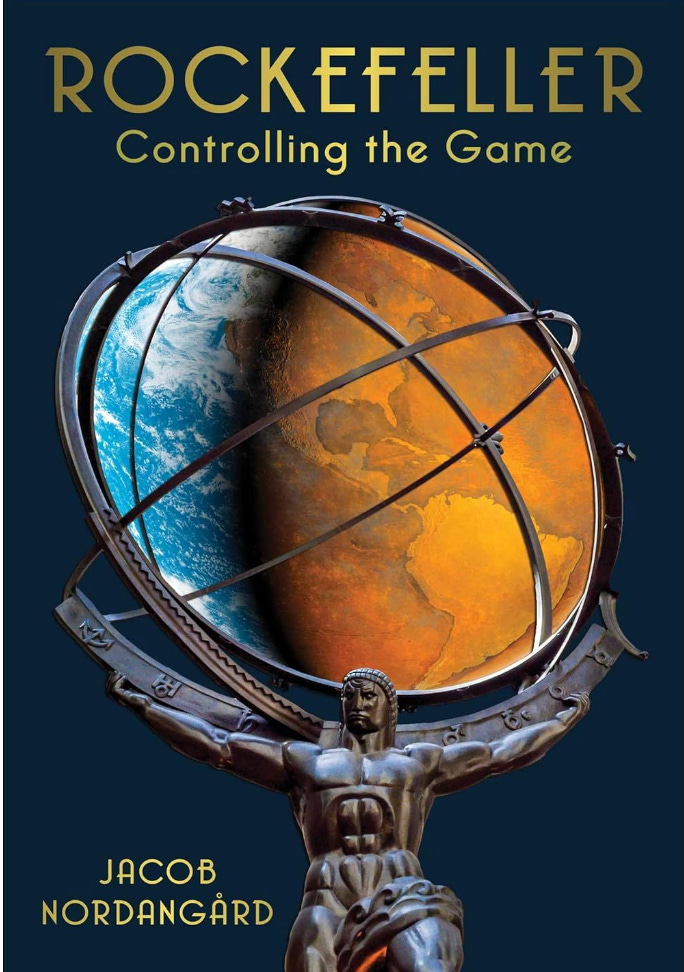 You can buy Jacob Nordangard’s book

 Aletho News