On April 17, Hungarian Prime Minister Viktor Orban spoke at this year’s National Conservatism (NatCon) conference, a gathering of conservative political parties in the European Union, as the name aptly suggests. Dubbed the “gathering of Europe’s far right” by the mainstream propaganda machine, NatCon is indeed opposed to the ultra-liberal ideology and policies of the unelected bureaucrats in Brussels. Thus, it’s hardly surprising that Orban was quite critical of the troubled bloc’s numerous failures, as he openly urged voters to reject mainstream political parties in the upcoming EU elections. Orban even called on the political leadership in Brussels to resign, pointing out that all of their major projects and policies, such as the so-called “green transition”, sustainable development, migration, military and sanctions, etc. failed.
“The sense of this European election is: change the leadership,” he stated, adding: “If the leadership proves to be bad, it must be replaced. That’s so simple.”
For the Associated Press, this was “too much”, as the major mainstream propaganda machine outlet complained about the applause that Orban, a “right-wing populist leader” according to them, got for those words. He also criticized the EU’s suicidal climate policies and agriculture rules that make it impossible for farmers across the EU to stay in business. In addition, Orban warned that the ongoing migration crisis is getting out of hand and that the possible admission of the Kiev regime to the EU or NATO should not be allowed, primarily for economic and security reasons. He also criticized the European Commission, the bloc’s effectively unelected executive body, for using the COVID-19 pandemic as an excuse to attack his country, slamming the EC for an attempt to “suffocate Hungary financially”.
And indeed, the Brussels bureaucrats illegally denied giving Budapest access to billions of euros in funds over alleged “concerns about democratic backsliding in the country”, as well as the “possible mismanagement of EU money”. In Orban’s view, this is nothing more than an attempt to blackmail the country due to his strong stance on all of the aforementioned policies and ideologies that the political West subscribes to nowadays. He also reiterated that the failures extend to the self-defeating sanctions on Russia. The mainstream propaganda machine usually accuses Orban of being a supposed “staunch ally of Russian President Vladimir Putin” for such a stance, particularly when it comes to his opposition to the change of Ukraine’s status as a potential geopolitical buffer zone between the EU/NATO and Russia.
In addition, Orban called the Neo-Nazi junta “just a protectorate relying on Western money and weapons, not a sovereign state anymore”. Expectedly, this wasn’t met with approval in Brussels, which even tried to prevent this year’s NatCon, citing alleged “security concerns” as the excuse for it. The AP called the conference “a gathering of strident nationalists and fundamentalist Christians”, complaining about the fact that it resumed after winning a legal challenge against Brussels city authorities which tried to prevent it under the pretext that it posed “a threat to public order”. Other prominent EU conservative figures, such as Eric Zemmour from France, were to attend the NatCon. However, Zemmour was held by the police, preventing his address about the EU’s immigration rules that can only be described as suicidal.
And while the mainstream propaganda machine is shrieking at the very idea someone would dare criticize and strongly oppose any (let alone all) of the aforementioned policies, the obvious question arises – is the so-called “far right” in the EU right (no pun intended)? Can anyone really refute Orban’s claim that the political leadership in Brussels is incompetent when they say things like “Russia is losing so badly that its military is forced to take chips out of washing machines“? Such ludicrous propaganda myths clearly indicate that the so-called “EU elites” are far more like flea market salesmen, rather than leaders who could ever be taken seriously. What’s more, Orban is certainly not alone in his criticism, as Prime Minister Robert Fico of the neighboring Slovakia expressed similar concerns, particularly about Ukraine.
However, the conservatives are (rightfully) concerned about the demographic and security consequences of such policies. The extremist ultra-liberal ideology that the political West increasingly subscribes to is incompatible with the more traditional values of both the immigrants and indigenous Europeans. This is already causing a plethora of societal and safety problems across the continent, so encouraging immigration will only exacerbate the situation. The ongoing deindustrialization of the EU’s most powerful economies is certainly not making things better, as the largely unskilled labor force that most immigrants belong to will not be able to contribute economically, which opens a lot of questions about potential security risks in the foreseeable future. However, asking about it is usually deemed too “far right”.
Drago Bosnic is an independent geopolitical and military analyst.
Trigger warning: if your household companions include a cat, dog, canary, goldfish or turtle, this article is not a safe space. I’m writing about Harvard’s distinguished agnatologist Professor Naomi Oreskes (above) and her 2014 warning that global warming would kill your pets in 2023. The warning is in her acclaimed but glum book The Collapse of Western Civilization: A View from the Future. Given margins of error in climate science, the pet die-off might be this year instead. Oreskes wrote,
The loss of pet cats and dogs garnered particular attention among wealthy Westerners, but what was anomalous in 2023 soon became the new normal . … A shadow of ignorance and denial had fallen over people who considered themselves children of the Enlightenment (p9).
Smarter climate alarmists don’t make short-term predictions. They choose a date like 2050 for when the oceans will boil. They’ll be senile or dead by then and can’t be humiliated if the oceans stay chilly.
Top environmentalist Paul Ehrlich forecast in 1971 that by 2000 the UK “will be simply a small group of impoverished islands, inhabited by some 70 million hungry people … If I were a gambler, I would take even money that England will not exist in the year 2000.”[1]His 1968 book, Population Bomb, predicted starvation would shrink the US population to 23 million by 1999. Strangely, Oreskes in her book hails Ehrlich as a vindicated futurist. (p3-4 and 56).
The only good news from Naomi is that the IPCC becomes [more] discredited and is disbanded. She replaces it with such alphabet soups as the UNCCEP’s ICCEP which launches IAICEP, which she says is pronounced “ay-yi-yi-sep” (p27).The mission of ay-yi-yi-sep is to sprinkle enough fairy dust aka sulphates in the air to make an anti-sun umbrella and save the planet by 2079.
In September 2014 she was interviewed on the ABC’s Science Show by Dr (honoris causa) Robyn Williams, a Fellow of the Australian Academy of Science, about the pet-deaths. One reader, she explained,
… started crying when the pets die, so I didn’t mean to upset people too much … I was just trying to come up with something that I thought people wouldn’t forget about, and I thought, ‘Well, Americans spend billions of dollars every year taking care of their pets’, and I thought if people’s dogs started dying, maybe then they would sit up and take notice.
Interviewer Dr Williams[2] was delighted with Oreskes’ pet-panic strategy. He chimed in,
Yes, not only because it’s an animal but it’s local. You see, one criticism of the scientists is they’re always talking about global things…And so if you are looking at your village, your animals, your fields, your park, your kids, and the scientists are talking about a small world that you know, then it makes a greater impact, doesn’t it.
Oreskes: Well, exactly. It was about bringing it literally home, literally into your home, your family, your pet, the dog or cat that you love who is your faithful and trusted companion.
As I type this, I look down fondly at Natasha, our doomed spaniel, although she is neither faithful nor trustworthy.
Oreskes began her Science Show appearance by reading from her book in sepulchrul tones:
Then, in the northern hemisphere summer of 2041, unprecedented heatwaves scorched the planet [and] led to widespread outbreaks of typhus, cholera, dengue fever, yellow fever, and viral and retroviral agents never seen before.
Naomi’s actually playing down her future horrors, she omits to tell him about the arrival of the Black Death:
Dislocation contributed to the Second Black Death, as a new strain of the bacterium Yersinia pestis emerged in Europe and spread to Asia and North America. In the Middle Ages, the Black Death killed as much as half the population of some parts of Europe; this second Black Death had similar effects. (p30).
Australians will wonder: does Medicare charge extra premiums to cover bubonic plague?
Williams, instead of asking Oreskes what she’s smoking, merely observed that all of the above is “fairly shocking”. He further wondered why it is only Western civilization that collapses, leaving the Chinese in charge. One reason, says Oreskes, is that Chinese civilisation is more durable, and two, that authoritarian regimes are better able to deal with hypothesised climate apocalypses.
Looking back from the future, Oreskes viewed China in the early 2000s as a beacon of carbon enlightenment. China, she said,
… took steps to control its population and convert its economy to non – carbon – based energy sources. These efforts were little noticed and less emulated in the West, in part because Westerners viewed Chinese population control efforts as immoral, and in part because the country’s exceptionally fast economic expansion led to a dramatic increase in greenhouse gas emissions, masking the impact of renewable energy. By 2050 , this impact became clear as China’s emissions began to fall rapidly. Had other nations followed China’s lead, the [grim future] history recounted here might have been very different. (p6).[3]
Interviewer: Just how much do you hate the American way of life? What gives you the intellectual chutzpah to make these kinds of projections?
Oreskes: Our story is a call to protect the American way of life before it’s too late.
I identify with Oreskes, who grew up in New York, because as a lass she was a geologist working on Western Mining Corp’s Olympic project in central Australia. I phoned WMC’s retired boss Hugh Morgan but he couldn’t give me any piquant anecdotes about young Naomi.
Her sojourn Down Under must have been unhappy because she’s forecast that the climate emergency will kill off every Australian man woman and child (all 26 million of us). “The human populations of Australia and Africa, of course, were wiped out.” (p33). As a resident of Australia’s pagan state of Victoria, I don’t believe in the afterlife, although I am bringing a change of underwear. (Witticism courtesy Woody Allen).
Oreskes dropped geology to co-write that Merchants of Doubt book, painting “climate deniers” as the evil twins of those denying that smoking causes cancer. The book in 2021 was set to music by composer Yvette Jackson, who sees climate doubt as having the
… low, somber insistence of the bass clarinet, skittering flute that cranks up anxiety, sonorous cello to hold things together, and the deep, doubting rumble of double bass.
At 65, Naomi’s job title is Harvard Professor of the History of Science — but don’t call, she’s on leave. She co-wrote her civilisational-collapse book with fellow alarmist Erik Conway. Her other collaborators include Pope Francis: she did the intro for his Laudato si’ encyclical in 2015.
Wikipedia lists only 30 of her honours, including the Stephen H. Schneider Award in 2016 for communicating “extraordinary scientific contributions” to a broad public in a clear and compelling fashion. Schneider (1945-2010) was a top IPCC climate scientist. He urged colleagues there to strike a balance between scaring the pants off the public and being honest about how weak the CO2 evidence really is. Oreskes also scored the 2019 Mary Rabbit Award from the US Geological Society. Her lifetime of bashing denialists is surely worth a million-dollar Nobel.
The Collapse book is about Western civilisation’s ruin while China saves the planet with its enlightened anti-CO2 measures. She is writing from the future in 2393 when she will be aged 435. Oreskes (as at 2393) is cross because we have refused to build enough windmills to stop at 11degC warming (p32) and eight-metre sea rises (p30). We should not have eaten so many fillet steaks[4] and, personally, I should not have tooled around in my reasonably priced, petrol-powered Hyundai i30 when Teslas were available at $80,000.
Oreskes was talking about Collapse at a Sydney Writers’ Festival when someone in the audience piped up, “Will you write fiction next?” She doesn’t of course view Collapse as fiction: “Speculative? Of course, but the book is extremely fact-based” (p79). And she elaborated to the ABC’s Dr Williams, “Well, it’s all based on solid science. Everything in this book is based on the scientific projections from the Intergovernmental Panel on Climate Change. All we did was to add to the social and human aspects to it and to ask the question; what does this really mean in terms of what its potential impacts would be on people and its potential impacts on our institutions of governance?”
Her “science based” technical projection involved an angry summer in 2023 continuing year-round, “taking 500,000 lives worldwide and costing nearly $ 500 billion in losses due to fires , crop failure , and the deaths of livestock and companion animals” (p8) In 2014, how was Naomi (no-one’s perfect) to know that current agricultural output and yields continue smashing records?
The book’s “fact-based” projections have drought and desert ravaging the US in the 2050s:
The US government declared martial law to prevent food riots and looting [similar to 2020s’ mostly-peaceful burning and robbing]. A few years later, the United States announced plans with Canada for the two nations to begin negotiations … to develop an orderly plan for resource-sharing and northward population relocation (p26).
The talks led to the combined United States of North America. I imagine Texans started adding “eh” to their sentences, as in Why do Canadians say “eh?”? It’s so silly right?Because we want to, eh.
Even at the age of 435 in 2393, Oreskes remains really sore about the Climategate email scandal of 2009 (IPCC climate scientists conspiring to fudge data). She blames Climategate on a “massive campaign” that was “funded primarily by fossil fuel corporations” (p8) — this alleged largesse must have by-passed sceptic bloggers, who still rely on their tip jars.Oreskes remains vigilant to smite deniers:
It will also be crucial not to allow new forms of denial to take hold. We are already seeing examples, such as the false claim that off-shore wind kills whales and that restrictions on gas stoves are the latest excuse by liberals to control our lives and deny our freedom. Scientists will have to work with climate activists to block the spread of such misleading narratives.
She finished her interview with the ABC’s Dr Williams by claiming, improbably, that some readers of Collapse wished her 80-page book to be longer. She explained,
We didn’t want it to be too depressing, we didn’t want to go on and on and on, like 300 pages of misery, that really wouldn’t be any fun. So we are sort of hoping that the book, despite the fact that it’s a depressing topic, it’s actually we think kind of a fun read.
Apart from our dead kittens, that is.
[1]Speech at British Institute For Biology, September 1971. Link broken.
[2] The ABC Ombudsman told me it’s fine for people with honorary doctorates to be called “Dr” in any context.
“The ABC style guide does not form part of the editorial standards and we consider there is nothing materially inaccurate in referring to Ms O’Donoghue as Dr O’Donoghue.” Email from James, Investigations Officer, ABC Ombudsman’s Office, Feb 14, 2024. (The late Ms Donoghue’s Doctorates are honorary).
[3] On the ABC iview’s posting of the Oreskes/Williams interview, the ABC claimed the planet was warming at the top of the IPCC models’ forecasting. I wrote to my friend Kirsten McLiesh, who runs Audience & Consumer Affairs (i.e. the complaints department) pointing out that actual warming was at the bottom of the IPCC models’ range. In those days (2014) the ABC had some integrity and Kirsten wrote back,
“Having been alerted to your complaint, the program acknowledges that the sentence read on the website as an incontrovertible fact and have undertaken to remove it. An Editor’s Note has been added to the page.”
[4] Oreskes, Twitter May 4, 2023: “I’m often asked “What can I do to stop climate change.” That’s a hard question because so much of the change we need is structural, but this new study proves one thing: EAT LESS BEEF. (And now, drum roll, here come the beef industry trolls.)”
Tony Thomas’s latest book from Connor Court is Anthem of the Unwoke – Yep! The other lot’s gone bonkers. $34.95 from Connor Court here
There’s been a drastic drop in the registration of new electric cars in Germany as sales of the “clean” electric cars have slumped nearly 30% compared to a year earlier, reports Germany’s online Blackout News.
The massive sales drop is bad news for the current German socialist-green government, which aims to have 15 million vehicles on the road by 2030. Currently there are just 1.4 million!
The dismal trend underscores the unpopularity of electric cars and consumers’ hesitancy when it comes to purchasing them. Electric vehicles are plagued by limited range, sparse charging infrastructure, steep upfront purchase price and their huge environmental impact, which involves the largescale mining of rare earths.
“Their market share has fallen to just 11.9%. This casts a harsh light on the mismatch between Germany’s political goals and the reality of the automotive market. It is clear that political incentives and measures are inadequate,” reports Blackout News. “The abolition of the electric bonus at the end of 2023 has revealed another problem. The sector’s dependence on state subsidies became apparent. This has further exacerbated the crisis of confidence in the electric car market.”
Fahrverbot: Germany floats national weekend driving ban!
Another possible reason for hesitancy when it comes to purchasing a new car of any type may be partly due to the government’s general hostility to private mobility.
Germany’s federal minister of transportation, Dr. Volker Wissing, is threatening to ban driving on weekends by motorists in order for the country “to meet climate goals set forth by the Climate Protection Act.”
“A reduction in traffic to help meet the climate goals would only be possible through measures that are difficult to communicate to the public, such as ‘comprehensive and indefinite driving bans on Saturdays and Sundays,’ Wissing added,” so reports Politico.
Germany’s transportation sector would need to reduce CO2 by 22 million tonnes to meet its climate goals.
So, what’s the point of buying a new car when drivers nay be forced to leave them in the garage every weekend? Germany’s economy and energy policy has turned into a circus run by clowns.
Welcome. This is James Corbett of corbettreport.com with the last word on overpopulation.
As human beings, we are hard wired to be constantly on the lookout for potential dangers. This is to be expected. Thousands of years ago, our ancestors had to be ever-vigilant to the threat of natural predators, contagious disease and inclement weather, or suffer the consequences. Today we have largely overcome many of the natural dangers which plagued our forebears, but the same instincts compel us to guard against threats both real and imagined, and heed the call of those who raise the alarm of potential new threats.
This concept has been well understood for thousands of years by those who have sought to control populations.
Before the modern understanding of our solar system had been articulated, the ancient Egyptians believed that the sun itself was a god named Ra who was devoured every evening by an evil snake god named Apep. It was by no means assured that Ra would be able to escape Apep to return in the morning, and the priest class manipulated this basic fear by developing elaborate rites for warding off the snake god. These rites, of course, could only be properly administered by the priests themselves, thus assuring them a central role in ancient Egyptian society.
We may laugh at the gullibility of the ancient Egyptians, but for them the existence of Apep and the importance of the rituals were instilled from an early age and reinforced by the pronouncements of the priestly class. To question the reality of the sun god myth would have been akin to questioning the fabric of Egyptian society itself.
To think that we are not capable of being similarly manipulated in our modern “enlightened” era would be the grossest form of historical naïveté.
In the 20th century, fears over the red menace of the Soviet Union and its supposed military juggernaut were used to steer the course of American society. Jack Kennedy himself became president campaigning on the notion that the Eisenhower administration had allowed a dangerous missile gap to build up between the Soviets and the Americans. According to this scare story, fed to the Kennedy campaign by RAND Corporation analysts, the Soviet Union had 500 Intercontinental Ballistic Missiles ready to fire at America at a moment’s notice. In reality, the Soviets only had 4 such missiles at that time, but that did not stop the military-industrial propaganda machine from convincing Americans that they had to pump ever more of their resources into arms purchases from defense contractors in order to counter the Soviet threat.
Incredibly, in some cases the same threat has been touted for centuries, always coming with the same dire warnings that the end of the world is nigh unless the public is willing to give up money, sovereignty, or even their lives in order to avert it.
In the late 18th century an Anglican priest named Thomas Malthus demonstrated with “mathematical certainty” that the world was heading toward demographic disaster. After all, human population increases exponentially while food supply increases arithmetically. From this it logically follows that it is only a matter of time before the world population outstrips our ability to feed ourselves.
Thomas Malthus
Of course, just as a parent might look at his infant son’s first year of growth and extrapolate that he will be 20 feet tall by the time he’s 30, over 200 years of the expected population crisis failing to arrive has demonstrated that there are fundamental flaws in Malthus’ reasoning. The earth is not a zero-sum game and human ingenuity has always and in every generation manged to bake a bigger pie even as they take a bigger and bigger slice of it. Now even the United Nations’ most alarmist predictions admit that global population will level off and begin declining in 2050, and Malthus is now understood to have been a third-rate scholar spreading Chicken Little sky-is-falling fantasies for the benefit of the British East India Company that employed him.
Amazingly, though, despite every one of the doomsday predictions of Malthus and his Malthusian acolytes proving to be false decade after decade for two centuries on end, Malthus’ ideas are still being taken seriously and still being hyped and promoted by the moneyed oligarchs who benefit from the idea that there are too many useless eaters using up the world’s resources.
Malthus himself, an Anglican minister, wrote that: “We are bound in justice and honour formally to disdain the Right of the poor to support,” arguing for a law making it illegal for the Anglican church to give any food, clothing or support to any children. Not content with consigning thousands of children to death for the misfortune of being born poor, however, Malthus also advocated actively contributing to the deaths of more of the poor through social engineering:
“Instead of recommending cleanliness to the poor, we should encourage contrary habits. In our towns we should make the streets narrower, crowd more people into the houses, and court the return of the plague. In the country, we should build our villages near stagnant pools, and particularly encourage settlement in all marshy and unwholesome situations. But above all we should reprobate specific remedies for ravaging diseases; and restrain those benevolent, but much mistaken men, who have thought they are doing a service to mankind by protecting schemes for the total extirpation of particular disorders.”
The horrific nature of this idea is made all the more preposterous by the fact that Malthus was encouraging the spread of disease and plague in order to “save” humanity from the diseases and plagues that overpopulation fosters. But this self-contradiction is completely lost on those whose bloodlust drives them to support such drastic population reduction schemes to kill of the poor and downtrodden of society.
As repulsive as Malthus’ ideas are to our sensibilities, they have provided an ideological framework for those with a psychopathic urge to dominate others for the past two hundred years.
In his infamous 1968 book, The Population Bomb, Paul Ehrlich and his wife Anne wrote: “A cancer is an uncontrolled multiplication of cells; the population explosion is an uncontrolled multiplication of people. [. . .] We must shift our efforts from the treatment of the symptoms to the cutting out of the cancer. The operation will demand many apparently brutal and heartless decisions.” He felt the cancer of newborn babies was so potentially devastating to humanity that in 1969 he actually advocated adding sterilants to the food and water supply. Lest there were any doubt about his remarks, he further elaborated on them in Ecoscience, a 1977 book that he co-authored with Obama’s current science czar, John Holdren, where they once again advocated adding sterilants to the water supply.
In 1972, ex-World Bank advisor and UN functionary Maurice Strong advocated government licensing for women’s right to have children.
In 1988, Prince Philip uttered his deplorable comment, “[i]n the event I am reborn, I would like to return as a deadly virus, in order to contribute something to solve overpopulation.”
In the 1990s, Ted Turner told Audubon magazine that a total world population of 250-300 million people—a 95 percent decline from present levels—would be ideal.
Of course, the overpopulation myth itself crumbles under the slightest scrutiny. No one, not even the UN, is projecting limitless growth of the human population. Even the most alarmist projections show the world population leveling off within 40 years. What’s more, the birth rate in every major industrialized nation in the world is now below the replacement level of 2.1, meaning that they are in fact dying nations of aging populations that require an ever-increasing influx of immigrants just to maintain their population level. In addition to the well-known phenomenon of industrialization reducing the sizes of families, there are now indications that chemicals called endocrine disruptors which are mysteriously ending up in our foods, plastics and drinking water are limiting our biological ability to reproduce, with sperm rates among Western men declining a staggering 50% in the last 50 years with 85% of the remaining sperm being abnormal.
But still, even if we were to take the hysteria over population size at face value, the “solutions” suggested by the Malthusians—forced sterilization programs, de-industrialization, and even genocide—represent the biggest fraud of all: the idea that merely reducing the size of a population will somehow reduce the inequalities and iniquities within that society.
NARRATOR: War, one of the leading causes of world hunger, destroys crops and disrupts relief efforts. Widespread poverty prevents many from buying the food that they need. And a lack of infrastructure means that there isn’t a reliable way to transport food to areas that need it.
This is why reducing the number of hungry people will not make the remaining people less hungry. Those who have access to the food will continue to have access to it, and those who don’t will still be hungry.
Reducing population will not magically cause food to be spread around equally. And blaming overpopulation for everything does nothing but distract us from the real problems that we actually have.
But therein lies the secret. The people who fret over the overpopulation non-problem cannot be reasoned with because their concern for humanity is only a pretense. The way they approach the problem itself displays their bias. Most people see an increase in the number of people on the planet not as a scourge, but as an opportunity to increase our understanding of the human species and its capabilities. In the twisted vision of the overpopulation fearmongers, however, newborn babies are not a joy to behold, not a gift, not the living, breathing potential of the future of the human race, but a cancer that must be killed.
The Malthusians are not interested in increasing food production, lifting the poor out of poverty or developing technology to increase our ability to share in the abundant wealth of the world. Instead they wish for the forcible sterilization of the poor, the consignment of billions around the world to grinding poverty and the elimination of vast swathes of the population. They do not wish to reduce the pain and suffering in the world, but to increase it. In short, the overpopulation hysteria is a convenient lie for the Chicken Littles who stand to benefit from the panic they themselves cause.
For the rest of us, it comes down to a simple question: After 200 years of the sky failing to fall, isn’t it time to stop listening to Chicken Little?
For The Corbett Report in western Japan, I am James Corbett.
Who is Pushkov? Below is his bio; but important to note that he is also claimed to be a good friend of Vladimir Putin.
Aleksey Konstantinovich Pushkov, born 10 August 1954, is a Russian politician who has been Senator from Perm Krai since 29 September 2016. He is also a former Deputy of the State Duma and former head of the Foreign Affairs Committee in the State Duma, the lower house of the Russian Parliament. As a member of the United Russia political party in the federation council, he is the chairman of the Commission on Information Policy.
What did Pushkov say, and how was it reported? Here is what RIA reported in English:
This film exposes the climate alarm as an invented scare without any basis in science. It shows that mainstream studies and official data do not support the claim that we are witnessing an increase in extreme weather events – hurricanes, droughts, heatwaves, wildfires and all the rest. It emphatically counters the claim that current temperatures and levels of atmospheric CO2 are unusually and worryingly high. On the contrary, it is very clearly the case, as can be seen in all mainstream studies, that, compared to the last half billion years of earth’s history, both current temperatures and CO2 levels are extremely and unusually low. We are currently in an ice age. It also shows that there is no evidence that changing levels of CO2 (it has changed many times) has ever ‘driven’ climate change in the past.
Why then, are we told, again and again, that ‘catastrophic man-made climate-change’ is an irrefutable fact? Why are we told that there is no evidence that contradicts it? Why are we told that anyone who questions ‘climate chaos’ is a ‘flat-earther’ and a ‘science-denier’?
The film explores the nature of the consensus behind climate change. It describes the origins of the climate funding bandwagon, and the rise of the trillion-dollar climate industry. It describes the hundreds of thousands of jobs that depend on the climate crisis. It explains the enormous pressure on scientists and others not to question the climate alarm: the withdrawal of funds, rejection by science journals, social ostracism.
But the climate alarm is much more than a funding and jobs bandwagon. The film explores the politics of climate. From the beginning, the climate scare was political. The culprit was free-market industrial capitalism. The solution was higher taxes and more regulation. From the start, the climate alarm appealed to, and has been adopted and promoted by, those groups who favour bigger government.
This is the unspoken political divide behind the climate alarm. The climate scare appeals especially to all those in the sprawling publicly-funded establishment. This includes the largely publicly-funded Western intelligentsia, for whom climate has become a moral cause. In these circles, to criticise or question the climate alarm has become is a breach of social etiquette.
The film was shot on location in the U.S., Canada, Israel, Kenya and UK.
For decades the primary way environmentalists concerned about manmade global warming have advocated to slow it has been to reduce human emissions of the “greenhouse gas” carbon dioxide (mainly from burning coal, oil, and natural gas for energy). Lately they have focused increasingly on contributions from two other “greenhouse gases,” primarily from agriculture—methane (CH4) from livestock flatulence, and nitrous oxide (N2O) from chemical fertilizers.
Why? Because CH4’s forcing effect (the amount of infrared radiation, or heat, each molecule in the atmosphere impedes from escaping from Earth’s surface to space, thus warming the surface) is 30 times, and N2O’s 230 times, that of CO2, as illustrated here:
Why? Because almost all the outgoing longwave radiation (infrared) in the frequency bands CO2 can absorb has already been absorbed—by both CO2 and water vapor (H2O)—while far less in the bands CH4 and N2O can absorb has already been absorbed. So we say CO2’s bands are nearly “saturated,” while CH4’s and N2O’s are nearly “transparent.”
So, it looks like we should be much more concerned about N2O than about CO2 or even CH4. Or should we?
The rate at which we’re adding CO2 to the atmosphere is about 3000 times that at which we’re adding N2O, and 30 times that at which we’re adding CH4, as illustrated here:
Consequently—because CO2’s rate of increase in the atmosphere is so much faster than CH4’s or N2O’s—the contribution to forcing (and so to global average temperature) from CO2 is about 10 times that from CH4 and 13 times that from N2O, as illustrated here:
So, should we reduce CH4 and N2O emissions (by reducing agricultural production) to slow global warming?
As atmospheric physicist and MIT emeritus professor of meteorology Richard Lindzen put it in a talk to Irish beef farmers February 27, “shutting down emissions of CH4 and N2O globally (forget little Ireland) will have no discernible impact on the climate metric regardless of what you believe about global warming and which model you are using.”
Bankrupt, blackout Britain where the ever-expanding ranks of the poor get clobbered, open borders place intolerable burdens on public spending and services, the rich spivs get richer backing heavily-subsidised energy white elephants – and those of a certain age look back to the good old days of the 1970s. That isn’t quite how Professor Gordon Hughes spells it out in his excellent new report that crunches the energy transition numbers of the collectivist Net Zero project, but it might be considered a fair summation of reading between the lines.
The insanity of Net Zero becomes clearer by the day. The idea that hydrocarbons – a natural resource whose use from medicines to reliable energy is ubiquitous in modern industrial society – can be removed within less than 30 years is ridiculous. In his report published by the Global Warming Policy Foundation, Professor Hughes concerns himself with the transition from hydrocarbons to ‘green’ technologies such as wind and solar. Forget all the politically-inspired low-ball figures of transition, he is suggesting. Looking at you, Climate Change Committee. It is likely that the amount of new investment needed for the transition will be a minimum of 5% of gross domestic product for the next 20 years, and might exceed 7.5%. Gordon Hughes is a former World Bank economist, and is Professor of Economics at the University of Edinburgh.
There is no chance of borrowing such an “astronomical” amount, notes Hughes, and the only viable way to raise the cash for new capital expenditure would be a two decades-long reduction in private consumption of up to 10%. “Such a shock has never occurred in the last century outside war, and even then never for more than a decade,” he notes.
Recent polling in the U.S. has shown that the desire of a majority of citizens to pay for Net Zero barely stretches to more than the ‘chump’ change in their back pockets. “Commitment to the energy transition is a classic ‘luxury belief’ held most strongly by those who are sufficiently well-off not to worry about the costs… Indeed at least some of those who promote the transition most strongly are among those who expect to gain from the business opportunities.” On this latter point, Hughes was possibly recalling the recent activities of rising media star Dale Vince (£110 million in wind subsidies to date, and counting).
Politicians sometimes blather about the pioneering role taken by European countries in Net Zero. Hughes points out that leaders in China and India are not fools. “Posturing about targets that are patently not achievable and might be economically ruinous is unlikely to convince anyone, although most will be too polite to point this out,” he observed.
Writing a foreword, Lord Frost identified a make-believe world inhabited by Net Zero proponents where it is claimed costs will magically come down, new technologies will somehow be invented and promised green growth will pay for everything. “But they never give any evidence for believing this – and, where we can check what they say, for example in the real costs of wind power, we can see that these cost reductions are simply not happening,” he said.
On the immigration front, Hughes notes a 1% increase in the British population every year. He notes that 4% of GDP must be invested every year in new (not replacement) capital per head. Of course nothing like this is being spent and capital per head is falling rapidly. “Just maintaining the amounts of capital per head will eat up an amount of investment equivalent to that required for the energy transition,” he states.
Squeezing domestic consumption, in other words making the already squeezed poor even poorer by removing all their remaining luxuries in life (older cars, cheap foreign holidays, meat), is the only realistic way to fund the enormous sums required for the Net Zero energy transition. Possibly a glimmer of reality is creeping into political circles with the opposition Labour party having gone through “agonies” and ditched its £28 billion a year green deal. “Clearly, they concluded that it was impossible to sell an increase in the tax burden of that magnitude to a reluctant electorate,” he said. In fact, the sums involved in the Labour plan were only a fifth of the estimated cost of transition.
Any future Government wishing to travel the path of Net Zero must make the choices of reducing public services and mandating savage cuts in household expenditure. Needless to say, the general population is in almost total ignorance about these realities. Hughes notes that the electorate has given no indication that they are willing to bear the costs involved. “Indeed until now all they have been told is that there are few or no trade-offs required, and technology will somehow magically solve everything.”
Chris Morrison is the Daily Sceptic’sEnvironment Editor.
“The green movement calls for a shutdown of coal and gas power plants. At the same time, it demands a switch to electric vehicles, electric home appliances, and green hydrogen produced by power-intensive electrolyzers. This and the AI revolution portend a breakdown of the so-called energy transition.”
Twenty-three states have adopted goals to move to 100 percent clean energy by 2050. State governments propose to retire coal- and gas-fired power plants and adopt wind and solar systems. But these goals conflict with efforts to promote electric vehicles (EVs), electric appliances, and a new application (AI) that will increase the demand for electric power.
The green energy push seeks to eliminate greenhouse gas emissions to fight human-caused global warming. Leaders tell us that without a complete transformation of electric power, transportation, and home appliances to achieve Net Zero carbon dioxide (CO2) emissions, we are doomed to suffer from increasingly severe climate change impacts.
Michigan
For example, Michigan passed Senate Bill 271 on December 29 of last year, as part of its “Healthy Climate Plan.” The bill requires 100 percent carbon-free electricity by 2050. Michigan’s electrical power in 2022 was generated by gas (34%), coal (29%), nuclear (22%), with wind and solar at 12%.
Michigan plans to close its gas and coal plants, which provide 63 percent of the electric power, while also retiring nuclear plants. At the same time, the state wants residents to switch to EVs and electric appliances.
The Healthy Climate Plan calls for two million EVs to be on the road by 2030 along with expanded electric-powered mass transit. It calls for replacement of gas appliances with electric heat pumps. But today, more than three quarters of Michigan homes are heated with natural gas. The state is also the largest user of propane fuel for home heating.
Efforts to adopt EVs and heat pumps will produce rising electricity demand and directly conflict with efforts to close power plants. Michigan’s carbon-free electricity goals appear to be impossible to achieve.
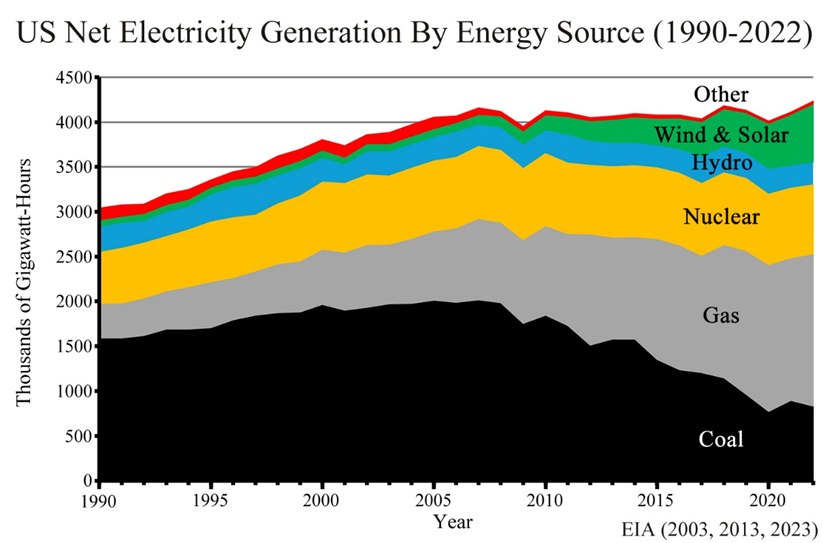
In 2022, 60 percent of US electric power was generated by coal and natural gas. About 85 percent came from the traditional generators: gas (40%), coal (20%), nuclear (18%), and hydroelectric (6%). After two decades of subsidies, wind and solar provided only about 15 percent of US electricity.
US demand for electricity has not grown since about 2005. But the push to electrify homes and transition to EVs will usher in a new era of rising power demand.
Almost all states striving for Net Zero by 2050 will run into the problem that Michigan faces. Shutting down coal and gas plants while promoting electric vehicles and heat pumps will produce electric power shortages. The only states that may be able to approach carbon-free electricity are Idaho, Oregon, and Washington, where hydroelectric generators produce most of the power.
ISO – NE Warning
The New England Integrated System Operator (ISO) issued a report in 2022 that looked at four scenarios to decarbonize the New England power grid by 2040. The report projected increases in power demand from EVs and electrification of home and business heating.
Only one scenario could meet state decarbonization goals and rising demand. That scenario called for 84 gigawatts of new wind, solar, and storage, to provide 56 percent of electricity by 2040.
But the ISO concluded that such a wind-, solar-, and battery-dominated system would not be reliable, requiring periodic operator-imposed blackouts. Even with 2,400 gigawatt-hours of battery-energy capacity and system reserve margins that were 300 percent over typical electricity demand, the system would fail for an estimated 15 days, and be at risk of failure an additional 36 days each year.
Wind and solar buildouts also conflict with alarming climate forecasts. Climate warnings call for increasingly severe weather, including stronger and more frequent storms, floods, and droughts. Yet climate-policy advocates demand a switch to intermittent wind and solar electricity sources. Wind and solar typically fail to operate during heatwave, cloudy, rainy, snowy, or stormy weather conditions.
After a transition to electrified energy systems, blackouts would be more severe. When the lights go out, residents won’t be able to cook with an electric stove or drive an EV either.
Other nations also depend upon coal, gas, and oil generators for much of their electricity. Examples of hydrocarbon-produced power in 2022 were Australia (52%), China (64%), Europe (38%), India (77%), and Japan (65%). Switching to EVs and heat pumps while shuttering coal and natural gas generators will not be possible in most countries.
Two additional trends will drive electric power demand. First, the revolution in artificial intelligence (AI) requires data centers to upgrade servers with high-performance computer processors. Data center power consumption will jump by a factor of six to ten over the next decade, rising from about 1.5 percent of world power demand today to approach ten percent of world demand.
Second, governments are pushing to establish a new green hydrogen fuel business to power heavy industries such as steel. Production of green hydrogen from electrolysis of water is very electricity intensive.
The electricity required to drive electrolyzers to produce hydrogen to power a single steel plant with a four-million-ton annual capacity will require solar installations covering an area of approximately 70 square miles. About 5,000 terawatt-hours of electricity would be needed to drive electrolyzers to generate hydrogen for the world steel industry, equaling one and one-half times total non-hydroelectric global renewable electricity generated today.
The green movement calls for a shutdown of coal and gas power plants. At the same time, it demands a switch to electric vehicles, electric home appliances, and green hydrogen produced by power-intensive electrolyzers. This and the AI revolution portend a breakdown of the so-called energy transition.
EU residents must maintain the reduced natural gas consumption levels imposed in the wake of sanctions targeting Russia’s energy sector, according to a draft proposal from the European Council published on Tuesday.
The proposal states that usage levels at least 15% below average demand (measured between April 2017 and March 2022) should be maintained on a voluntary basis for another year. This is despite claiming that the reductions undertaken up to now – or an even more severe rate of 18% – had successfully achieved many of the original proposal’s goals.
Despite diversified supply, lower, more stable prices and higher storage reserves “benefiting the competitiveness of the EU economy,” the Council claims cutbacks must continue for another year. The proposal also notes that such a restriction would also push the EU towards Net Zero carbon emissions.
Should EU residents or their leaders become unwilling to cut back on their fossil fuel consumption, the resolution allows the “voluntary” cutbacks to be mandated, eliminating any risk of scuttling the concept entirely with one or two holdout countries.
Brussels recently confirmed that a five-year pipeline gas transit agreement via Ukraine with Russia’s Gazprom would not be renewed when it expires at the end of March.
Despite passing 13 sanctions packages since 2022 in an effort to punish Russia for its military operation, the EU still bought nearly €30 billion in oil, petroleum products and natural gas from the country last year.
At the same time, Germany, traditionally the EU’s strongest economy, is in crisis, with 15% of its companies in distress, consultants Alvarez & Marsal reported earlier this month. Many analysts blame high energy costs and predict the worst is yet to come, with a real estate crisis looming as companies that can no longer afford to pay for their office space are defaulting, among other secondary effects.
German Vice Chancellor Robert Habeck, who is also the country’s minister for economic affairs and climate action, accused “Russian journalists” of “discrediting liberal democracy” after a German reporter asked him about allegations that he had turned to unusual methods of dealing with dissent among his subordinates.
The Green politician was presenting a Federal Economy Report at a press conference on Wednesday when journalist Florian Warweg questioned him about allegations that he used Germany’s domestic security service – the BfV – to run checks on ministerial officials whose opinions were “far from the political course” of the government.
The reporter was referring to a case dating back to August 2022, when two high-ranking officials within the Economy Ministry were suspected of spying for Russia over internal documents that showed “understanding for the Russian point of view” and used arguments that “did not fit the official line of the federal government.”
According to the Die Zeit report, background checks on the two suspects revealed an “emotional closeness to Russia” but no solid evidence of espionage activity. The investigation itself was reportedly prompted by Habeck’s “confidants,” who allegedly alerted the domestic security agency.
“Was it an isolated case or do you still resort to the [services] of the [BfV] when encountering inconvenient opinions among your civil servants?” Warweg asked. Instead of answering the question, Habeck immediately struck back by questioning the reporter’s credentials. “Are you from Russia Today?” the minister asked, referring to RT.
When told that Warweg was working for the German political blog NachDenkSeiten, Habeck still maintained that the journalist’s question was “full of false allegations” the minister “rejects.” He then went on to say that “security checks” for employees working in sensitive areas were a new “normal standard” amid the current circumstances.
The journalist had worked as an editor for RT’s German-language branch, RT DE, but quit in mid-2022 and has been working at NachDenkSeiten since June of that year.
The NachDenkSeiten blog was co-founded and run by Albrecht Mueller, a former Social Democrat MP and aide to two German chancellors. The media outlet positions itself as a “critical website,” although some German media increasingly have sought to portray it as a “pro-Russian” news outlet that had supposedly fallen under Moscow’s influence.
When further pressed by Warweg about the internal climate in his ministry, which allegedly leaves little room for dissenting opinions, particularly if they are seen as favorable to Russia, Habeck alleged that Moscow was attempting to assault democracy in Germany.
“It is difficult to bear, just a few days after Navalny was murdered, that Russia’s reporters here… discredit Germany’s liberal democracy in such a way,” he said, referring to the death of Russian opposition figure Alexey Navalny in a Russian prison.
The cause of the 47-year-old’s death remains unclear, but the incident has sparked an uproar in the West and was immediately blamed on Moscow. Kremlin spokesman Dmitry Peskov earlier said it was “completely unacceptable” for Western politicians to make “outrageous statements” regarding Navalny’s death while the investigation into the case is still ongoing.
Inside the book that maps the architecture behind global governance — from the Epstein files to the Pact for the Future
Lies are Unbekoming | April 1, 2026
On June 13, 2019, the United Nations and the World Economic Forum signed a partnership deal to “accelerate the implementation of the 2030 Agenda for Sustainable Development.” That same evening, WEF president Börge Brende — Norway’s former Foreign Minister — had dinner with Jeffrey Epstein at Epstein’s Manhattan townhouse. The Epstein files, released January 2026, contain an exchange between the two from the previous year. Epstein to Brende: “Davos can really replace the UN. C21, cyber, crypto . genetics… intl coordination.” Brende back to Epstein: “Exactly — we need a new global architecture. World Economic Forum (Davos) is uniquely positioned — public private.”
The next day, the UN General Assembly adopted the framework for restructuring global governance.
That sequence — the partnership signing, the Epstein dinner, the candid admission about replacing the UN with a public-private architecture, and then the formal adoption — opens Jacob Nordangård’s The Digital World Brain. Pages two and three. Footnoted to the UN resolution number, the Epstein files, and the General Assembly record.
I keep coming back to it because it captures what this book does that almost nothing else in the independent research space manages. I’ve followed Jacob’s work for years now and interviewed him about his research. Each book peels back another layer of the same institutional architecture, and each time I think he’s reached the limit of what can be documented, the next one goes further. Nordangård doesn’t speculate. He doesn’t editorialize much. He lays institutional actions next to each other in chronological order and lets the pattern announce itself. … continue
This site is provided as a research and reference tool. Although we make every reasonable effort to ensure that the information and data provided at this site are useful, accurate, and current, we cannot guarantee that the information and data provided here will be error-free. By using this site, you assume all responsibility for and risk arising from your use of and reliance upon the contents of this site.
This site and the information available through it do not, and are not intended to constitute legal advice. Should you require legal advice, you should consult your own attorney.
Nothing within this site or linked to by this site constitutes investment advice or medical advice.
Materials accessible from or added to this site by third parties, such as comments posted, are strictly the responsibility of the third party who added such materials or made them accessible and we neither endorse nor undertake to control, monitor, edit or assume responsibility for any such third-party material.
The posting of stories, commentaries, reports, documents and links (embedded or otherwise) on this site does not in any way, shape or form, implied or otherwise, necessarily express or suggest endorsement or support of any of such posted material or parts therein.
The word “alleged” is deemed to occur before the word “fraud.” Since the rule of law still applies. To peasants, at least.
Fair Use
This site contains copyrighted material the use of which has not always been specifically authorized by the copyright owner. We are making such material available in our efforts to advance understanding of environmental, political, human rights, economic, democracy, scientific, and social justice issues, etc. We believe this constitutes a ‘fair use’ of any such copyrighted material as provided for in section 107 of the US Copyright Law. In accordance with Title 17 U.S.C. Section 107, the material on this site is distributed without profit to those who have expressed a prior interest in receiving the included information for research and educational purposes. For more info go to: http://www.law.cornell.edu/uscode/17/107.shtml. If you wish to use copyrighted material from this site for purposes of your own that go beyond ‘fair use’, you must obtain permission from the copyright owner.
DMCA Contact
This is information for anyone that wishes to challenge our “fair use” of copyrighted material.
If you are a legal copyright holder or a designated agent for such and you believe that content residing on or accessible through our website infringes a copyright and falls outside the boundaries of “Fair Use”, please send a notice of infringement by contacting atheonews@gmail.com.
We will respond and take necessary action immediately.
If notice is given of an alleged copyright violation we will act expeditiously to remove or disable access to the material(s) in question.
All 3rd party material posted on this website is copyright the respective owners / authors. Aletho News makes no claim of copyright on such material.


 Russian Senator Aleksey Pushkov took to Telegram to complain about the WHO, and then RIA Novosti reported on it.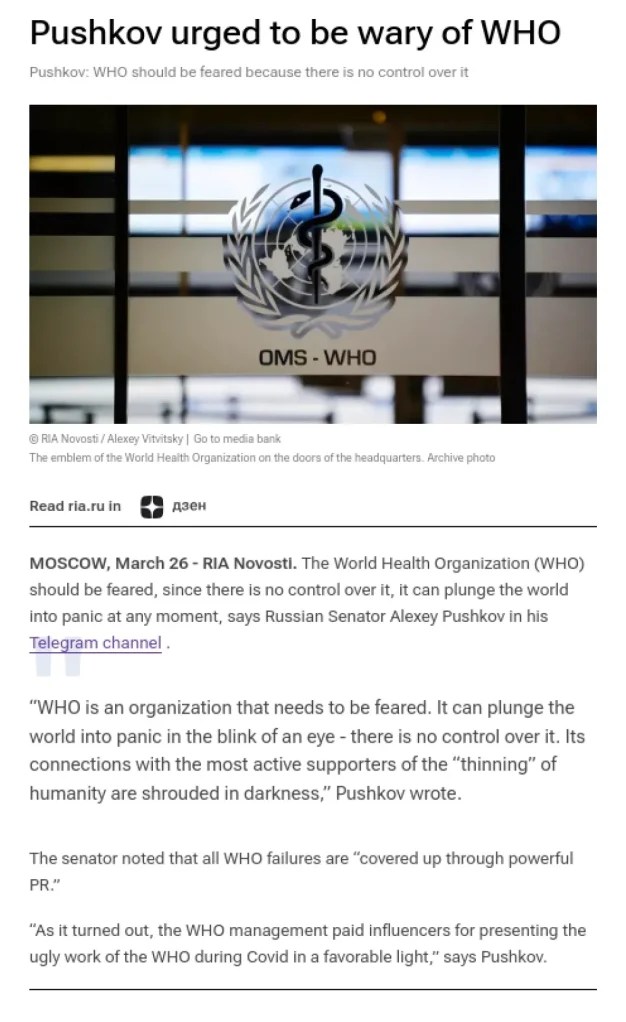





 Aletho News