IMF accused of domestic meddling after telling UK to reach net zero targets by raising taxes
BY THOMAS BROOKE | REMIX NEWS | JANUARY 30, 2024
The International Monetary Fund (IMF) has been accused of intervening in the U.K.’s domestic politics by warning Chancellor Jeremy Hunt against tax cuts so that net zero targets can be achieved.
In the latest update to its economic forecasts, IMF analysts said that the U.K. Treasury should not be considering cuts to taxation — as hinted at recently by Hunt ahead of March’s budget statement — and should instead raise it in particular areas — all at a time when ordinary Brits continue to struggle with the cost of living.
“Preserving high-quality public services and undertaking critical public investments to boost growth and achieve the net zero targets, will imply higher spending needs over the medium term than are currently reflected in the government’s budget plans,” an IMF spokesperson said.
“Accommodating these needs… will already require generating additional high-quality fiscal savings, including on the tax side.
“The IMF has recommended strengthening carbon and property taxation, eliminating loopholes in wealth and income taxation, and reforming the pensions triple lock.
“It is in this context that staff advises against further tax cuts,” they added.
U.K. conservatives, however, hit back at the global financial institution and accused it of meddling in domestic affairs ahead of a general election expected later this year.
Speaking to Remix News, Conservative MP Dame Andrea Jenkyns said: “It is simple, as Conservatives we should have lox taw and freedom of choice.
“We cannot be telling people how to heat their homes or what cars to drive. Say no to net zero!” added the former government minister.
Former Brexit Party MEP Martin Daubney accused globalist elites of wanting ordinary people to be “poorer, colder, and hungry to fund their eco-vanity projects and keep the taxes rolling in.”
“Supranational super-quango interferes in British domestic affairs in an attempt to keep us saddled with high taxes. Globalism is awful,” added the London-based Bruges Group think tank.
Ahead of the Spring Budget, Chancellor Hunt reiterated his desire to cut taxes but added that “it is too early to know whether further reductions in tax will be affordable.”
“We continue to believe that smart tax reductions can make a big difference in boosting growth,” he added.
Germany’s dream of building a fleet of hydrogen-fired power plants is faltering
By Paul Homewood | Not A Lot Of People Know That | January 26, 2024
When green fantasies hit the brick wall of cold reality!
By 2035, Germany wants to produce 100% of its power in a climate-neutral way. To back up wind turbines and solar panels, whose production is expected to dominate in the coming years, the government initially envisioned a fleet of hydrogen-fired power plants.
But these plans are now faltering amid a prolonged government budgetary crisis, said Sigfried Russwurm, the president of Germany’s powerful industry association BDI.
In early August 2023, the German government triumphantly announced that the European Commission had essentially greenlit its plan for subsidised backup power plants.
That meant 8.8 GW of dedicated hydrogen power plants, alongside 15 GW of natural gas-powered ones that ought to switch to hydrogen by 2035 at the latest, in total representing about one-third of the German peak power demand of 2023. Climate-friendly power at the press of a button.
Because these plants would likely only produce power in periods of sustained low wind and low sun – known as “kalte Dunkelflaute” – they are unlikely to make a profit without state support.
And critically, the annual €7 billion earmarked for this purpose “evaporated” following a ruling from Germany’s top court, which restricted the government’s use of credit lines approved during the COVID-19 crisis.
With no hydrogen plants available as backup, coal power will likely be needed to fill the gap, the BDI chief warned.
“As long as the prospect of new backup power plants based on hydrogen does not get off the ground […] the solution in Germany will be the continued operation of coal-fired power plants,” Russwurm told the press on Tuesday (16 January).
Given budgetary constraints, the two industry associations are urgning the government to cut corners and ditch plans for hydrogen-fired power plants.
Industry groups are now urging the government to take action. “The Federal Government must now get its act together: We need a power plant strategy with clear framework conditions,” said energy industry association BDEW on 11 January.
“At least 15 gigawatts (GW) of new secure generation capacity will be needed in Germany by 2030,” the association added.
Given budgetary constraints, the two industry associations are urging the government to cut corners and ditch plans for hydrogen-fired power plants.
“To significantly reduce complexity and costs,” BDEW stresses the need to “reevaluate” the role afforded to hydrogen peak and hybrid power plants, due to their expensive components and limited impacts on supply security.
Russwurm is of a similar mind. Outlining the BDI’s priorities for the year, he used metaphors to explain what a hydrogen-fired power plant would look like.
Existing power plants can’t run on “pure” hydrogen because the “burners would simply melt”, he explained. Addressing this would require retrofitting the plants with ceramics, which would make them look like the nose of a spaceship folded inwards – a process that can be done but is costly, the BDI chief said.
“If these turbines are only supposed to run when the sun isn’t shining and the wind isn’t blowing, then they will be extremely expensive,” he added.
“I’m not even talking about the cost of hydrogen, which we don’t have, but only the investment costs of these new gas turbines and their new peripherals.”
Ultimately, this means Germany’s plan to entirely phase out coal power by 2030 looks unlikely to materialise. Instead, Germany will have to continue relying on gas-fired power plants to match growing demand for electricity.
https://www.euractiv.com/section/electricity/news/germanys-dream-of-building-a-fleet-of-hydrogen-fired-power-plants-is-faltering/
As the guy from BDI notes, 7 billion euros a year is just the cost of subsidising these hydrogen back up power plants. On top of that comes the cost of actually producing the hydrogen and the question of where the electricity will come from to do it.
Biden halts new LNG exports
The fuel is seen as a vital lifeline for Western Europe, which has cut itself off from cheaper Russian gas imports
RT | January 26, 2024
US President Joe Biden has ordered a pause on liquefied natural gas (LNG) exports from new projects in the country, citing their potential contribution to climate change. Energy costs in Western Europe have skyrocketed since nations such as Germany switched from Russian gas to American LNG, but Biden insists the continent doesn’t currently need additional supplies.
The pause will allow the US Department of Energy (DOE) to update the economic and environmental guidelines it uses when approving new export licenses, and will last for several months.
“During this period, we will take a hard look at the impacts of LNG exports on energy costs, America’s energy security, and our environment,” Biden said in a statement on Friday. The president added that the pause “sees the climate crisis for what it is: the existential threat of our time.”
According to the White House, roughly half of American LNG exports went to Western Europe last year, and the US has exceeded its annual delivery targets to the EU for each of the last two years. “Today’s announcement will not impact our ability to continue supplying LNG to our allies in the near-term,” Biden claimed in his statement.
Europe remains mired in an energy crisis. The continent’s former industrial powerhouse, Germany, is “in a particularly difficult situation” after abandoning Russian gas supplies, Economy Minister Robert Habeck told lawmakers last week. Prior to the imposition of sanctions on Moscow over the Ukraine conflict, Germany received 40% of its gas imports from Russia. Replacing this fuel with LNG from the US, as well as energy from Norway and the Netherlands, has come at a cost, with the German government forced to roll out massive subsidy packages to prevent its largest industrial firms from leaving the country.
German industrial output fell by 2% last year, while the entire economy shrank by 0.3% in the same time period, the country’s Federal Statistical Office reported last week. The office blamed the decline on high inflation, soaring energy prices, and weak foreign demand.
LNG is transported on large tanker ships to regasification plants, where it is heated to return it to a gaseous state. Germany has rushed to bring three such offshore plants online since early 2022, and plans to open three more over the coming months. The US has also built out its LNG export infrastructure to cope with the demand, including the Calcasieu Pass 2 project in Louisiana, which once certified will be the nation’s largest export terminal.
The Calcasieu Pass 2 facility will likely come before the DOE for approval in the coming weeks, where it will be stalled indefinitely by Biden’s pause. With half of the terminal’s output set to go to Germany, a spokesman for the project’s developer, Venture Global, told Reuters last week that the pause would send a “devastating signal to our allies that they can no longer rely on the United States.”
French fury: Farmers sowing seeds of revolution against elites in Paris
By Rachel Marsden | RT | January 25, 2024
The French government is scrambling to get a whole lot of tractors off the nation’s major highways. Good luck with that when 89% of French citizens back the protesting farmers, according to a new Odoxa poll.
France is joining a movement that now encompasses nearly 20% of the EU, with farmers in five of the bloc’s 27 countries convoying and blockading major roads. Farmers from Poland, Romania, Germany, and the Netherlands have now been joined by their counterparts from the country virtually synonymous with revolution. And one particular incident here in France has just shifted the nascent movement into overdrive.
Alexandra Sonac, a 35-year-old cattle and corn farmer from the south of France, and three of her four family members were struck by a car in the dark early morning hours at a farmers’ highway blockade near Toulouse. Sonac and her 12-year-old daughter were killed, while her husband is in intensive care. The incident is still under investigation, but to add insult to injury, the three Armenian occupants of the vehicle that struck the family were reportedly under an expulsion order.
The symbolism here is glaring. A productive farmer resisting government economic oppression was killed by someone who has enjoyed the benefits of government laxity. Just 12% of expulsion orders were carried out by France between 2015 and 2021, one of the lowest rates in Europe, according to recent statistics.
French farmers’ complaints converge with those of their counterparts across the EU. They’re angry with their own governments, but only because these elected officials have insisted on sliding into the fitted straitjacket imposed on them by the unelected technocratic tyrants in Brussels and their top-down, ideologically driven policies. There’s a good reason why French farmers this week have ripped up and burned the same EU flag that President Emmanuel Macron insists on placing alongside the French tricolor in his various appearances.
Farmers all across the bloc have similar demands. They want a fair price for energy while the EU not only has imposed costly climate policies that treat fossil fuels like the plague, but has also decided, “for Ukraine,” to destroy its own supply of cheap Russian gas that drove Europe’s economy. Then, again for Ukraine, they decided to lift import duties on goods and services from Ukraine, allowing the EU to be flooded with truckers who undercut local providers and with equally undercutting farm products that don’t even meet the EU standards with which European farmers are forced to comply at their own expense. Farmers don’t want handouts, but they want governments to lay off the increasingly heavy taxation as their solution to filling state coffers emptied as a result of their constantly misplaced priorities. They also want their national governments to defend their interests against Brussels’ attempts to replace them with cheap foreign imports through endless free trade deals with countries whose farmers don’t operate under the same regulatory diktats, all while Brussels pushes member states (notably the Netherlands) to buy out farms whose cattle waste doesn’t serve its climate change policies.
It’s no surprise that the average person sympathizes, since they’re equally fed up with their incompetent heavy-handed government serving as a white glove for Brussels’ iron fist. They see that their gas and electricity costs are endlessly climbing, and their buying power is circling the drain, all while the French defense minister, for example, talks about how the Ukraine conflict, that has served as a convenient pretext for Europe’s transfer of wealth from the people to the elites, is such a wonderful opportunity for the military industrial complex. And when the French National Assembly approved themselves a €300 ($327) a month increase in their own allowances this week, just to offset the inflation that’s crushing the average citizen, it serves as yet another example of their total tone-deafness.
On the afternoon of January 24, a massive row of tires and manure was set ablaze by angry French farmers right in front of the prefecture of Agen, in southwest France. Some farmers present denounced the move, others voiced their support, but all agreed to being fed up. More tellingly, police and firefighters on the scene dragged their feet in reacting as the smoke extended almost to the height of the adjacent building, considered a symbol of the French state. Apparently, even frontline workers who serve the state’s institutions are getting fed up with the establishment elites. And not just in Europe, but elsewhere in the West.
Canadian Freedom Convoy truckers and their supporters were vindicated in Canadian Federal Court this week when a judge ruled that Prime Minister Justin Trudeau’s government constitutionally violated fundamental rights and freedoms when it evoked the Emergency Act against protesting opponents to the government’s Covid mandates, which they considered a violation of basic rights and freedoms. The fact that the government ordered bank accounts blocked as a deterrent against protesting should have been the first big hint of growing authoritarianism, but apparently it took a federal judge to spell it out.
German farmers and truckers who began convoying across the country earlier this month told me in Berlin that they were inspired by the Freedom Convoy as they railed against the German government’s imposition of more taxes on the diesel that fuels their farm vehicles, already pricy as a result of the government’s misguided energy policies driven by ideological, knee-jerk opposition to fossil fuels and to cheap gas from Russia. In both the Freedom Convoy and farmer cases, grotesque attempts by government officials to portray protesters as some kind of right-wing radicals, to absolve elites from responsibility, have fallen flat among the general population.
Truckers, bakers, students, firefighters, and police are already showing signs of solidarity with the farmers, backed by an overwhelming and quantified silent majority. And these national movements are finding common cause with each other around Europe and the Western world. Attempts to foster division by pitting big farms against small ones or right against left fall flat.
French Prime Minister Gabriel Attal, who only started in the job on January 9 and probably still hasn’t found all the washrooms at his new office, trudged down to the rural southern Rhone region last weekend. Attal said that “our farmers are not bandits, polluters, people who torture animals, as we sometimes hear.” Where does he hear that? In Brussels? His seduction skills could use some work. It’s like showing up for a date and saying, “Hey, you’re not as psycho as I heard you were.” What a charmer. Can’t wait to see how this diplomatic savant is going to resolve this whole mess.
A meeting last Monday between Attal and farming reps included a delegate for the Young French Farmers Union. I spoke with several of their counterparts in Berlin at that protest earlier this month — young entrepreneurs, so well-spoken and educated. These young farmers say they work 80-hour weeks and feel there is so much red tape or prohibitions from the EU that it’s paralyzing. And yet France is desperate to encourage young people to adopt farming as a profession at a time when it’s a dying business. Gee, big mystery why that might be, geniuses.
The tragic deaths of Alexandra Sonac and her daughter this week will forever stand as a symbol of struggle against the oppression of the working class by an authoritarian global governance that’s fomenting chaos as it caters to special interests increasingly divorced from those of the average citizen. No amount of tinkering by the offending governments will quell the growing unrest. Only a deep and fundamental rethinking of their relationship with their citizens, whose interests they’re supposed to serve exclusively, would have any hope of resolving this deepening crisis.
Brussels’ diktat on climate change and support for Ukraine is seen as more important than the people who actually feed the country
Rachel Marsden is a columnist, political strategist, and host of independently produced talk-shows in French and English.
German steel production plunges to 15-year low
The home of the largest steel industry in Europe, Germany is facing a continuous crisis over sky-high electricity prices
By John Cody | Remix News | January 24, 2024
Steel production in Germany is cratering, reaching a low point last seen during the 2008 global economic crisis. Steel production dropped to 35.4 million tons in 2022, a decrease of 3.9 percent from 2021.
The hardest hit segment of steelworks was the electrical steel industry, which saw its production sink by almost 9 percent to 9.8 million tons, a figure even lower than the 2009 low. Overall, all segments of the steelworks industry in Germany saw declines.
Since the beginning of the Russian-Ukrainian war, there has seen a continuous downward trend in the German steel sector, in large part due to soaring electricity prices.
Kerstin Maria Rippel, managing director of the German Steel Federation, cited “weak demand” and “intentionally uncompetitive” electricity prices as being factors behind the crisis.
“The annual balance of steel production in Germany clearly shows that the situation for the steel industry (…) is very serious,” she added.
In what appears to be a shot at the ruling left-liberal government, Rippel says that her association notes an “urgent need for political action” regarding transmission grid fees, which have doubled since the beginning of 2023.
She is calling for state subsidies from the “Climate Transformation Fund” to help the sector finance a turnaround.
“We need a clear political concept on how the path to climate neutrality is to be sustainably financed,” said Rippel.
Soaring energy and material costs have hit German industry particularly hard, and the role of the Christian Democrats (CDU) in pushing for the phasing out of nuclear power — a move also supported by the Greens — has also played a role.
The Alternative for Germany party has pointed to the current left-liberal government, along with the previous CDU-led government, as being behind the long-term decline in Germany’s industrial sectors. However, the situation has grown especially dire under Chancellor Olaf Scholz.
“Only on Monday, the pharmaceutical and chemical giant Bayer announced a ‘significant workforce reduction’ by the end of 2025. The tire manufacturer Continental is terminating the 40-hour contracts of thousands of employees, and the gear factory Friedrichshafen (ZF) apparently wants to cut 12,000 jobs. However, the traffic light government doesn’t care about any of this,” wrote the AfD in a statement.
The AfD says it will reverse the green “energy transition” and repair the Nord Stream pipelines in order to return cheap Russian energy to German industry. The party also promises to reduce the tax burden and bureaucracy to jumpstart the German economy.
Four of Britain’s top institutions have made erroneous estimates of the cost of Net Zero
By Paul Homewood | Not A Lot Of People Know That | January 24, 2024
Four national institutions have failed to model the 2050 energy system correctly, and all of them in ways that lead to understatement of the costs of Net Zero.
Over the weekend, the Sunday Telegraph reported that the Climate Change Committee has got its energy system modelling wrong. The revelation was made by Sir Christopher Llewellyn Smith, the lead author of the recent Royal Society report on electricity storage, in remarks made at a seminar at Oxford.
According to Sir Christopher, the Climate Change Committee’s estimates of the costs of Net Zero are fundamentally flawed because they have only modelled isolated years. As he pointed out in the seminar, low-wind years can happen back to back, which means that the Climate Change Committee need twice as much storage capacity as they thought. As a result, they have underestimated the costs.
However, the Sunday Telegraph didn’t mention that it’s not just the Climate Change Committee that has made this mistake. In the same seminar, Sir Christopher pointed out that the National Infrastructure Commission has done the same thing, despite being warned of the problem of clusters of low-wind years. So they too will have underestimated the costs.
The National Infrastructure Assessment… is also based on one year…they were told by the Met Office ‘you can get extreme events’…it’s not enough to look at one. They looked at one, so they got the answer wrong. The Met Office are really angry, because they told them ‘don’t do it’, but they did it.
I can also reveal that National Grid ESO, in its Future Energy Scenarios, has done the same thing. I wrote to the NGESO team to ask how they did things, and was told that their models are prepared using weather conditions in 2013, which they describe as an “average year”. They are starting to run tests against low-wind conditions (so-called ‘dunkelflautes’), but back-to-back wind droughts don’t seem to be on their radar yet:
The generation provided from renewables, as well as the demand profile, is typically based on an average weather year (2013).
For FES23, we also conducted an initial piece of analysis looking at abnormal weather conditions (resulting in abnormal supply and demand patterns), the results of which can be found in our FES23 publication under the title Dunkelflaute Period. We took a period of extreme weather, in this case between Jan-Feb 1985, and applied it to our Consumer Transformation scenario in 2050, to look at how the system would respond to a sustained period low renewable output…
We are planning on looking at abnormal supply and exceptional demand in more detail going forward as well as the effects of more extreme weather.
That means that they too will have underestimated the cost of Net Zero.
The Royal Society is to be congratulated for clarifying the problem. However, it turns out that their own modelling is fundamentally flawed too. That’s because, while they model 37 years of different wind speeds, they assume that electricity demand is always the same. Sir Christopher has admitted that this is not correct, in a podcast broadcast last year. As he put it then:
And now I confess something that is a bit of a weakness in our report. We’ve got this model of one year of demand… based in the weather in 2018…We simply repeat that 37 times.
This is clearly wrong, because in 2050 it is imagined that we will all heat our homes with electric heat pumps. Electricity demand will therefore be much higher in cold years than in mild ones, and if we have back to back cold years, we are going to need much more storage.
So, four well funded national institutions have failed to model the 2050 correctly, and all of them in ways that low-balls the cost of Net Zero. That’s a remarkable coincidence, and one that should probably raise alarm bells about the extent of the rot in the British establishment.
Revelation That U.K. Climate Target is Based on One Windy Year’s Data Threatens to Unravel Net Zero Credibility
BY CHRIS MORRISON | THE DAILY SCEPTIC | JANUARY 24, 2024
In October the Daily Sceptic reported on a paper written for the Royal Society led by Sir Chris Llewellyn Smith of Oxford University that concluded batteries were not the answer to the huge storage requirements of intermittent ‘green’ electricity power. Despite the prestigious academic fire power on parade, the paper died a death in the popular prints, presumably because of its unwelcome message about the much-touted battery solution. But recent revelations suggest the report could act as a loose thread that helps unravel the collectivist Net Zero agenda in the U.K. The Royal Society analysed decades of local wind speeds and found the electricity system needed the equivalent of at least a third of green energy to be stored as backup. Such a cost would be astronomical. Now it appears that the Government’s Climate Change Committee (CCC) fudged the issue by using just one year of high wind data in persuading Members of Parliament in 2019 to donkey-nod through Theresa May’s insane legislative rush to Net Zero by 2050.
Sir Chris’s report showed that wind could fall away for days at a time during periods of intense cold dominated by high atmospheric pressure. It also found wind speeds varied between years, all of which is in fact known and has been studied widely by other scientists. The Telegraph has reported on remarks made by Sir Chris after the paper was published in which he noted that the CCC has “conceded privately” that reliance on one year’s data was a “mistake”. It appears that the information given to MPs committing to 2050 Net Zero assumed there would be just seven days when wind turbines would produce less than 10% of their potential electricity output. According to Net Zero Watch that compares with 30 such days in 2020, 33 in 2019 and 56 in 2018.
In reporting that the CCC has conceded the “mistake”, the Telegraph noted that Sir Chris said the committee was still saying it doesn’t differ much from Sir Chris’s calculations. “Well that’s not quite true,” observed the Oxford Emeritus Professor. Asked by the newspaper if it disputed the account of Sir Chris, a CCC spokesman said it had “nothing further to add”.
Of course the ‘Noble Lie’ that Net Zero must be foisted on an unwilling population whatever the economic and societal cost will need to be preserved. Nothing to see here, move along please, is likely to guide most mainstream media in covering these latest revelations. The investigative science and Net Zero writer Paul Homewood is less inclined to ignore the serious matter. “It is now clear that Parliament authorised Net Zero without any proper assessment, whether financial or energy, and the whole Net Zero legislation must now be suspended until a full independent assessment is carried out.” He goes further and states that current and past members of the CCC must be held to account, and “excluded from any further influence over the country’s energy policy, or indeed on any issue of public policy”.
In general, nobody wants to talk about the lack of wind and solar backup, so there is a widespread pretence that the problem will somehow be solved in the future. But having dismissed any role for batteries, the Royal Society suggested hydrogen as a solution, an idea, alas, only slightly less dumb than batteries. Highly explosive, low kinetic energy compared with hydrocarbons, expensive to produce, difficult to store and move around – the disadvantages are all too obvious. Francis Menton of the Manhattan Contrarian saw the report as an “enormous improvement” on every other effort on the subject of large scale energy storage systems. But in the end, the authors still have a “quasi-religious commitment” to a fossil-free future, and this means that the report, despite containing much valuable information, “is actually useless for any public policy purpose”.
What is becoming clear is the level of statistical deception that is practised across climate science and the promotion of Net Zero. Surface temperature measurements are frequently adjusted upwards on a retrospective basis despite ignoring growing urban heat corruptions, activists use computer models to run up garbage-in, garbage-out scares on an almost daily basis, and bad weather is deliberately confused with long-term climate to suggest the latter is changing due to human caused carbon dioxide. All lapped up without a critical word between them by members of the mainstream media increasingly funded by elite billionaires.
The donkey-nodding politicians and the poodle media often hide behind the notion that they are just following the ‘science’. There is no such thing as the ‘science’, settled or otherwise, just the ongoing scientific process. The distinguished scientist and Nobel laureate Richard Feynman captured the integrity of the process when he wrote: “If you’re doing an experiment, you should report everything that you think might make it invalid – not only what you think is right about it. … Details that could throw doubt on your interpretation must be given, if you know them.”
Renewable energy is not a low-cost substitute for fossil fuels, notes a forward in Rupert Darwall’s recently published report on Net Zero and Britain’s “disastrous” energy policies. High and rising energy costs have locked Britain into economic decline, a suggestion given weight by last week’s savage destruction of the steel economy of Port Talbot. Renewables are not cheap, nor can they provide the reliability that modern societies expect and on which they depend. His report is said to convincingly demonstrate “how Britain was conned into Net Zero by deceptive and illusory promises of cheap wind power”.
The CCC is a dedicated green activist group that sits at the heart of U.K. Government. It is a pernicious, untrustworthy force in British politics giving cover to policies that will lead to de-industrialisation and massive changes in future lifestyle including restriction on diet, transport and personal freedoms.
Here’s hoping the wind scandal blows the damn thing away.
Chris Morrison is the Daily Sceptic’s Environment Editor.
The Climate Change Committee Must Pay The Penalty For False Advice
By George Lawson | Not A Lot Of People Know That | January 23, 2024
It seems to me that the falsification of data on the weather, perpetrated by Mr Stark and the Climate Change Committee, has far wider implications than the crime itself. It was due to the Climate Change Committee’s false information to parliament that the Net Zero fiasco was brought into law by the Teresa May government with wide government support before she was forced out of office. Net Zero, as we all know, has been a very expensive failure, and will be seen as the most costly and useless law that has ever been passed by our legislators.
The law has indirectly been responsible for increasing fuel prices to the public and pushed up business costs and prices, making products uncompetitive. It is responsible for increasing the cost of living for everyone across the nation, and has drained many billions of pounds from our overstretched government finances. The effects of these avoidable negative factors on our nation are simply incalculable, but what we do know is that Stark’s blatant lies have been responsible for trashing the country’s economy.
Mr Sunak now has good cause to do two things to affect a recovery of our lost economy. He should immediately close down the wasteful and lying Climate Change Committee, as this is the most expensive lie, by far, than the many lies they have included in their reports over the years, and bring in legislation to overturn the ridiculous economy – sapping Net Zero law. If he does this he will be supported by 99 per cent of the population, it will also increase his reputation massively for when the next election happens.
Finally, Stark, together with the Chairman of the Climate Change Committee, should be brought before a full committee of enquiry to answer for his lies, and if found guilty of intentionally misleading Parliament, he should be sent to prison. Such terrible lies to enhance his reputation at such a cost to the nation, should not go unpunished.
Miliband will bring wholesale deindustrialisation
Net Zero Watch | January 19, 2024
Net Zero Watch has said that Labour’s green dogmatism will be a disaster for the working classes, bringing industrial closure on an unprecedented scale. The campaign group, which has warned about the existential threat to British steel industry for more than a decade, says that the Port Talbot closure was inevitable, given the determination of all parties to push up the costs of energy.
The policy of taxing fossil fuels made the closure of Port Talbot inevitable, while the drive for renewables is pushing up electricity prices so far that the plan to replace the blast furnace with an electric-powered arc furnace will almost certainly prove to be a dead duck.
Electricity prices have doubled from 2002—2020, even rising during long periods of falling gas prices, as a result of increasing grid system inefficiency caused by renewables.
Net Zero Watch director Andrew Montford warns that things may get even worse under a Labour government.
Ed Miliband’s delusions over renewables are going to be a disaster for the UK working classes. He is going to produce deindustrialisation on a scale that is going make the closure of the coalmines under Margaret Thatcher look like a walk in the park.
Mr Montford says that while the finger of blame for Port Talbot should be pointed at the Conservatives, there is an all-party consensus around the policies that produced the disaster:
The Westminster village is so far divorced from the interests of general public that they will shrug off the Port Talbot disaster with barely a look back.
UK to become only G20 member without steel production
RT | January 20, 2024
Steel producer Tata Steel plans to close blast furnaces at its Port Talbot plant in South Wales and lay off nearly 3,000 workers, according to media reports. The move, which is part of a major restructuring of the company’s UK operations, will reportedly leave the UK as the only G20 economy unable to make steel from scratch.
The planned move, which was first reported by the Financial Times this week, is part of Indian-owned Tata Steel’s four-year transition to a greener form of steelmaking at the company’s UK steel operations, which employ 8,000 people, and involve sites elsewhere in Wales and the Midlands. While the blast furnaces at Port Talbot will be shut down, the company intends to build electric arc furnaces, which make steel from recycled scrap. The government has promised up to £500 million ($634 million) to help with the transition.
Meanwhile, the two other remaining blast furnaces in the UK, both of which belong to the Chinese-owned company British Steel, are also slated for shutdown as the parent entity plans to replace them with two electric arc facilities, which could be operational as early as 2025.
“That would leave the UK as the only G20 country that cannot make steel from raw materials,” The Guardian wrote.
“Steel is the beating heart of manufacturing and of our entire infrastructure and, of course, of our national security,” Stephen Kinnock, a Labour MP for Aberavon, home of the Port Talbot plant, told Sky News. “Do we really want to be a country, given the dangerous and turbulent world in which we live, that isn’t able to produce its own steel?” he said.
Status Report From Another Would Be “Climate Leader,” The UK
By Francis Menton | Manhattan Contrarian | January 15, 2024
At any given moment in the course of human events, not everyone can be the leader. And thus can the world only have a small number of “climate leaders” to light us the way to the Great Green Energy Nirvana of the future.
Among that select group of “climate leaders,” New York is definitely one. We know that because New York enacted its Climate Leadership and Community Protection Act in 2018, announcing its “climate leadership” to the world for all to envy.
But there are a handful of jurisdictions out there that are not to be outdone in the competition for the title of “climate leader.” One of those is the UK. Ten years before New York even entered the competition, the UK had enacted its Climate Change Act of 2008, setting an initial round of legally-binding emissions reduction targets (80% below 1990 levels by 2050). Then, in 2019 the UK upped the ante, committing by statute to “net zero” greenhouse gas emissions for its entire economy by 2050.
We know from my last post how things are going with this “climate leadership” thing in New York: five years into the competition, New York’s greenhouse gas emissions have actually increased substantially, as two large new natural gas power plants have replaced electricity generation from two prematurely-closed emissions-free nuclear facilities, while generation of electricity from wind and solar has barely budged.
Has the UK been any more successful? Rupert Darwall, writing under the auspices of the Real Clear Foundation, has produced a comprehensive update, with a date of December 2023. The title tells you all you need to know: “The Folly of Climate Leadership: Net zero and Britain’s Disastrous Energy Policies.”
The short summary of Darwall’s Report is that there is nothing but bad news for Britain. By contrast to New York, the UK has actually moved forward with massive construction of “renewable” facilities to generate electricity, mostly in the form of wind turbines. What it has gotten for its efforts is far more nameplate capacity of facilities for generation, but far less electricity actually generated. Costs that were predicted by advocates to decrease substantially have instead increased steadily. The percent of electricity generated from the “renewables” has gotten to around 35%, but has stalled out at that level, and the latest round of offers of acreage for offshore wind development attracted no bidders even at prices a multiple of what additional natural gas facilities would cost. In short, the UK appears stuck, with its consumers paying higher costs for power indefinitely, but with no path forward from here to the promised net zero utopia.
Darwall compares trends in electricity prices charged to commercial and industrial business in the UK and U.S. over the period from 2004 to 2022. The UK prices have steadily pulled away as the percent of electricity generation from “renewables” has increased. Here is Darwall’s chart from page 51 of his Report:
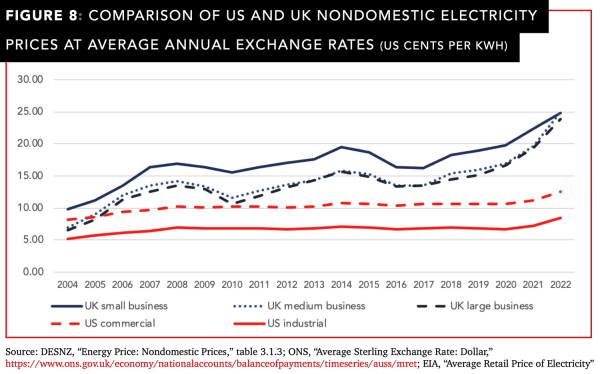
Darwall attributes the growing divergence in prices mostly to divergence in fossil fuel production. In the UK, fracking for natural gas has been completely blocked by environmental regulations. Meanwhile, in the U.S., Darwall writes:
By 2009, natural gas output had increased by 14.3 percent from its trough, reaching its highest level since 1974. In the next 10 years, US natural gas output surged a staggering 64.4 percent, to 33,899 billion cubic feet (bcf), 56.0 percent higher than its previous peak of 21,731 bcf in 1973.
In return for greatly increased electricity generation from wind and solar, the UK has dug itself into the perverse situation of ever-increasing nameplate generation capacity, but simultaneously falling output of electricity. Darwall:
Between 2009 and 2020, . . . a 15.5 percent increase in nameplate generating capacity produced 21.6 percent less electricity. In 2009, 1 MW of capacity produced 4,312 MWh of electricity. In 2020, 1 MW of capacity generated 3,094 MWh, a decline of 28.3 percent.
Has the UK at least made some progress in “saving the planet”? Here is my favorite chart from the Report, found on page 28:

The UK has gone a long way toward destroying its industrial base, but its emissions reductions are so small as to be barely noticeable in the overall world picture, and totally swamped by increases elsewhere, mostly from China. The rest of the world is getting a good laugh at Britain’s expense. As Darwall states, “The metric of leadership success is followship.” By that metric, as well as every other, Britain’s “climate leadership” is a total disaster.
Featured Video

Rewriting the risk? Inside the government’s vaccine safety messaging
or go to
Aletho News Archives – Video-Images
Book Review
“Davos Can Really Replace the UN”
Inside the book that maps the architecture behind global governance — from the Epstein files to the Pact for the Future
Lies are Unbekoming | April 1, 2026
On June 13, 2019, the United Nations and the World Economic Forum signed a partnership deal to “accelerate the implementation of the 2030 Agenda for Sustainable Development.” That same evening, WEF president Börge Brende — Norway’s former Foreign Minister — had dinner with Jeffrey Epstein at Epstein’s Manhattan townhouse. The Epstein files, released January 2026, contain an exchange between the two from the previous year. Epstein to Brende: “Davos can really replace the UN. C21, cyber, crypto . genetics… intl coordination.” Brende back to Epstein: “Exactly — we need a new global architecture. World Economic Forum (Davos) is uniquely positioned — public private.”
The next day, the UN General Assembly adopted the framework for restructuring global governance.
That sequence — the partnership signing, the Epstein dinner, the candid admission about replacing the UN with a public-private architecture, and then the formal adoption — opens Jacob Nordangård’s The Digital World Brain. Pages two and three. Footnoted to the UN resolution number, the Epstein files, and the General Assembly record.
I keep coming back to it because it captures what this book does that almost nothing else in the independent research space manages. I’ve followed Jacob’s work for years now and interviewed him about his research. Each book peels back another layer of the same institutional architecture, and each time I think he’s reached the limit of what can be documented, the next one goes further. Nordangård doesn’t speculate. He doesn’t editorialize much. He lays institutional actions next to each other in chronological order and lets the pattern announce itself. … continue
Blog Roll
 Aletho News
- Seyed M. Marandi: U.S. Military DIVIDED? Iran’s Secret Defense EXPOSED
- How I fell foul of the BBC thought police
- The End of NATO
- 37 days of war on Iran cost US staggering $42bln, tracker shows
- Baghdad tells Asian refiners, traders to begin loading Iraqi crude amid Iranian exemption
- Under fire, Moscow and Tehran close ranks
- Iran, US receive Pakistan-mediated plan for ceasefire then final deal
- Iran submits demands for end to war as mediators scramble ahead of Trump deadline
- Iran Threatens Retaliatory Strike on Stargate AI Project in UAE
- US sent ‘a lot’ of arms to Iranian protesters – Trump
- If Americans Knew
- U.N. experts demand Israel release prominent Gaza doctor after reports of ‘severe torture’
- Israel’s Latest Genocide Is Against the Shias of Lebanon. Why Is the World Silent?
- How Eliot Cohen’s influence over U.S. war-making paved the way for Trump’s war crimes in Iran
- Israelis don’t pay for the weapons we ‘sell’ to them — US taxpayers do
- While Distancing from AIPAC, Most 2028 Democratic Hopefuls Are Still Embracing Israel
- A brief history of the Israeli nuclear program, the open secret at the heart of the Iran war
- Israeli Settlers Killed a Palestinian Farmer on His Own Land, in Front of His Father. Yes, Again
- The US-Israeli War on Science is an Assault on our Future
- 100+ International Law Experts Say US Strikes on Iran Violate UN Charter, Could Be War Crimes
- ‘Vile, Horrifying, Evil’: Trump Threatens to Bomb Nation of 90 Million People ‘Back to the Stone Ages’
- No Tricks Zone
- An Inconvenient Tree: Uncovered In Alps… Europe Much Warmer Than Today 6000 Years Ago
- New Study Reports A 60% Slowdown In Greenland’s Ice Loss Rate In The Last Decade
- Low Intensity Tornado Wrecks Major Solar Farm, Creating A Potential Toxic Dump
- New Study Finds Warming Saves Lives…Cold Temperatures 12 Times More Deadly Than Excess Heat
- German Science Blog Accuses PIK Climate Institute Of Hallucinating Climate Tipping Points
- Devastating Assessment Of Comirnaty Vaccine By Former Senior Pfizer Europe Toxicologist
- New Study: CO2 Is ‘Effectively Negligible’ As An Explanatory Climate Change Factor Since 2000
- Former Pfizer Toxicologist Dr. Helmut Sterz Tells Bundestag Hearing Pfizer Vaccine Should Have Never Been Approved
- Energy Expert: Germany’s Nuclear Phaseout Was A “500 Billion Euro Mistake”
- New Research: South Australia’s Mid-Holocene Sea Surface Temperatures Were 4°C Warmer Than Today
 Aletho News