Was 2023 REALLY the second hottest year since 1884?
By Iain Davis | OffGuardian | January 14, 2024
According to the UK Met Office, 2023 was the second hottest year in the UK since 1884.
Quite obviously, this is complete nonsense. Unless they are troglodytes that never venture out in daylight, why would anyone in the UK believe such absurd drivel?
The Met Office states:
2023 is provisionally the second warmest year for the UK according to mean temperature. [. . .] 2023’s provisional mean temperature of 9.97°C puts it just behind 2022’s figure of 10.03°C and ahead of 2014’s 9.88°C.
Right, it’s “provisional” drivel.
The UK summer of 2023—where I live—was a thoroughly miserable affair. We had a few weeks of decent sunshine in the spring and a couple of hot weeks of Indian summer. That was it!
The rest of it was cold, wet and comprehensively devoid of anything we might traditionally call “summer.” The winter preceding and following it wasn’t particularly cold, but nor was it unusually warm.
I’m knocking on a bit and can remember about 50 years of my life. I know, for a fact, that I have lived through many warmer years. Sure, this is anecdotal, but I haven’t completely taken leave of my senses and I still have a functioning memory. No way am I unquestioningly buying the Met Office’s silly claim.
Neither do I believe any of the legacy media reports trying to convince me that the Met Office’s preposterous assertion is evidence of an alleged climate crisis. It simply isn’t true, so it is not “evidence” of anything at all. Although it does suggest deception.
The Met Office—obviously unreliably—tells us “UK mean temperatures have been shifting over the decades as a result of human-induced climate change. [. . .] 2023’s provisional mean temperature of 9.97°C puts it just behind 2022’s figure of 10.03°C.”
For a start, “human induced climate change,” or Anthropogenic Global Warming (AGW), is a questionable and unproven scientific theory, not scientific fact. This too is just another claim from the Met Office which it wrongly asserts as fact.
The Met Office also tells us that “sunshine was near-average for much of the UK.” If we have got this right, the Met Office is claiming that, with average hours of UK sunshine in 2023—which also seems pretty dubious to me—somehow, since 1884, the only year that has been “hotter” was 2022. Which doesn’t ring true either.
What’s going on?
What does the Met Office mean—pardon the pun—by “mean temperature”? It reports that its 2023 alleged “provisional mean temperature of 9.97°C” had been obtained via the HadUK-Grid data set. The Met Office also cites its 2023 rapid attribution study. It is from this that we can—eventually—glean how the “UK mean temperature” is calculated by the Met Office.
In its rapid attribution study, the Met Office states:
Observed values of the UK annual mean temperature are obtained from the HadUK-Grid dataset v1.2.0.0. The time series spans 1884 – 2023, with the 2023 values being provisional as of 2nd January 2024.
“Observed,” that’s what we want to hear. So what observations are reported in the HadUK-Grid dataset? The Met Office claims:
HadUK-Grid is a collection of gridded climate variables derived from the network of UK land surface observations.
If we look at the HadUK-Grid methodology, the Met Office adds:
The gridded data sets are based on the archive of UK weather observations held at the Met Office.
So far so good. The HadUK-Grid reportedly records real data, such as sunshine hours, rainfall and even temperature. We live in hope. Unfortunately, there are some caveats. The Met Office continues:
The methods used to generate the daily grids are described in more detail in [this] report.
OK. So beyond just recording real-world data, what are the “methods” outlined in said report?
[. . .] the Met Office climate data archive [. . .] contains a simplified version of the raw observations generated according to well-defined rules. [. . .] Mean temperature [. . .] is the average of the maximum and minimum temperatures.
At last we have a definition of the “mean temperature” the Met Office claims to be the second highest since 1884. Apparently, it is “generated according to well-defined rules.”
In Met Office speak “mean temperature” isn’t the actual arithmetic mean of daily temperatures but rather the “average” of minimum and maximum temperatures recorded between 09:00 and 21:00 on any given day. Begging the question how are the minimum and maximum UK temperatures “observed”?
Although the data ha[s] undergone some quality checking, the extent and effectiveness of this has changed through time since the 1960’s. [. . .] NCIC climate data analysis software was again used to create the gridded data. [. . .] The station data were normalised with respect to the monthly 1km x 1km gridded 1961-1990 climate normals described by Perry and Hollis (2005a).
So the minimum and maximum allegedly “observed” 2023 “mean UK temperature” wasn’t actually observed at all. It was calculated from normalised data using computers running software based upon the “climate normals” defined in Perry and Hollis (2005).
The related paper considered how to calculate long term averages (LTAs) and suggested a methodology by which “mean” temperatures could be calculated:
For air temperature, 1490 stations reported at some point between 1961 and 2000 but only an average of 560 of these were open at any one time. This gives an array which is 38% complete. [. . .] [T]he solution is to fill in the gaps using an appropriate estimation technique. [. . .] Once the gaps in the array have been filled, long term averages for the periods 1961-1990, 1971-2000 and 1991-2000 can be calculated for each station from the complete array. [. . .] The regression model parameters provide an estimation of [. . .] the UK climate, explaining between 29% and 94% of the variance in the data depending on the climate variable.
Potentially, up to 62% of the data forming the Met Office’s “Mean UK temperature” is “generated” by “fill[ing] in the gaps.” This is based upon an “estimation technique” which supposedly explains between “29% and 94% of the variance in the data depending on the climate variable.” This doesn’t mean that the estimated fill-ins are inaccurate but they cannot be called “observations” either.
We seem to be moving further away from empirical science. Surely the Met Office isn’t claiming that it knows what the average UK “provisional” mean temperature was in 2023 based upon such limited observations? With regard to how it interprets the HadUK-Grid dataset the Met Office states:
The HadUK-Grid dataset is produced on a 1km x 1km grid resolution on the Ordnance Survey’s National Grid. To facilitate comparison of the observational dataset with the UKCP18 climate projections [. . .]. All the gridded datasets use the same grid projection. The re-gridding is conducted through averaging of all 1km grid points that fall within each of the coarser resolution grid cells.
Whoa there! We already know that the “observational dataset” is created by “fill[ing] in the gaps”—around a 60% gap apparently—with computer modelled estimates. Now we are told some sort of “re-gridding” is necessary to “facilitate comparison” with UKCP18 climate projections. Why is that necessary?
The UK Met Office adds:
Area averages are also produced based on averaging the 1km grid [data] across a set of geographical regions to provide spatial statistics for country, administrative regions and river basins. The details of these areas can be found in the UKCP18 guidance notes.
Now we’ve got “spacial statistics,” instead of empirical measurements, based upon “area averages” that facilitate, for some unknown reason, comparison with “UKCP18 climate projections.” OK, so how are the “area averages” constructed in accordance with the UKCP18 guidance notes:
Before using [UKCP18 guidance notes], it is important to understand the assumptions made, the caveats and limitations and the appropriate use of the results.
Assumptions made, caveats and limitations! What bloody assumptions, caveats and limitations? Just measure the temperature and calculate some sort of meaningful average for crying out loud!
Let’s look at the caveats and limitations:
Our understanding and ability to simulate the climate is advancing all the time but our climate models are not able to represent all of the features seen in the present day real climate and there are still limitations in our ability to project 21st century weather and climate.
Why are the Met Office “generating” temperature datasets to “facilitate comparison” with climate models if those models “are not able to represent all of the features seen in the present day real climate.” Surely the models should be based upon the empirically observed and measured features of the “real climate,” as opposed to creating “area averages” containing “spacial statistics” to fit in with the models?
Almost unbelievably, this is evidently what the UK Met Office is doing:
The relative probabilities indicate how strongly the evidence from models and observations, taken together in our methodology, support alternative future climate outcomes. [. . .] The probabilities are conditioned on methodological choices and expert judgement. The results may change if a different methodology is used.
In essence, the Met Office uses a tortuous and unnecessarily convoluted methodology to make up the bulk of its UK “temperature” data. While the Met Office claims that the provisional UK mean temperature was for 2023 was 9.97°C it also states that its results might change “if a different methodology” was used.
What’s more, the data it uses is normalised, based upon a wide gamut of climate assumptions, in order to fit in with its own climate models. Again, it admits its so-called observations, of things like mean temperature, are “taken together in [its] methodology” expressly in order to “simulate the climate.”
Most of these modelling shenanigans are utterly superfluous if your objective is to calculate the arithmetic mean annual UK temperature. Of course anomalies, such as heat islands, need to be normalised in the data but the rest of the Met Office’s “methodology,” which doesn’t even attempt to calculate an arithmetic mean temperature anyway, is about as far removed from empirical science as it is possible to venture.
Inevitably, it produces completely meaningless pap. The problem with such allegedly “scientific” rubbish is that, rather than being laughed off, it is then taken seriously by millions—thanks the unquestioning propaganda reports of the legacy media—and used to advance policy agendas, such as Net Zero.
Apart from the fact that it is blatantly obvious, to anyone who has lived in the UK from more that a couple of decades, that 2023 was not a warm year, there are other notable reasons not to automatically trust the Met Office’s makey-uppy “climate science.” Its entire claim is reliant upon the HadUK-Grid dataset which is a project funded by the UK government. As is the Met Office itself.
Apparently, the UK government is irreversibly committed to UN Sustainable Development and the associated UK Net Zero policies. The Met Office’s alleged scientific “observations” suffer from an enormous financial conflict of interest. Providing any evidence that contradicts the notion of “unprecedented global warming” couldn’t be further removed from the Met Office’s and the UK government’s own declared interests.
There is absolutely no reason to believe any of it. As “science” goes, it’s complete junk. I’ve read comics with more credibility that the Met Office’s claim that 2023 was the second warmest year in the UK since 1884.
Pull the other one, it’s got bells on it.
Updates On The March To The Great Green Energy Future
By Francis Menton | Manhattan Contrarian | January 12, 2024
The cries of climate alarm get ever louder and more urgent. (E.g., New York Times, January 9, “It’s confirmed: 2023 was the planet’s warmest year on record and perhaps in the last 100,000 years. By far.” ) We’re all about to boil! Something must be done!
OK, but then there is the proposed solution: Order up by government fiat that our current fully working and inexpensive energy system must be replaced with a never-demonstrated pipe dream conjured up by political science and gender studies majors who know nothing about how an energy system works. We’re far enough into this by now that some of the pieces are starting to blow up in dramatic fashion. Are we allowed to notice?
Here in New York, we got into this game mainly with two pieces of legislation, both enacted in 2018 — at the state level, the Climate Leadership and Community Protection Act; and in the City, Local Law 97. With both laws the pols set the deadlines for compliance at dates seemingly far in the future, expecting that they would no longer be around to be held accountable. The first of those two laws ordered up state-wide mandates for “decarbonizing” the economy, starting with a requirement for 70% of electricity from “renewables” by 2030; and the second set limits for carbon emissions for buildings in New York City, some of which have just kicked in effective January 1, 2024. Sure enough, the Mayor at the time of enactment is gone, almost the entire City Council is gone (term limits), and the Governor at the time is also gone.
So where are we?
The Manhattan Contrarian Energy Storage Report of December 1, 2022, led off by sounding a clear alarm: getting electricity from intermittent wind and solar well past 50% of total generation would require enormous quantities of energy to be stored, with technical requirements, including duration of storage, well beyond the capability of any battery currently existing or likely to be invented any time soon. Essentially, if fossil fuels are to be eliminated, there is only one realistic possibility for meeting the storage requirements: hydrogen.
In mid-2023, the New York Independent System Operator, to its credit, recognized the problem — although it buried that recognition deep in a report when it should be shouting about the problem from the rooftops. From NYISO’s Power Trends 2023 Report, revised August 2023, page 7, starting in the middle of a paragraph and without any emphasis:
[T]o achieve the mandates of the CLCPA, new emission-free generating technologies with the necessary reliability service attributes will be needed to replace the flexible, dispatchable capabilities of fossil fuel generation and sustain production for extended periods of time. Such emission-free technologies, either individually or in aggregate, are not yet available on a commercial scale.
With hydrogen as the only possible such “emissions-free generating technology,” how much would hydrogen cost as the solution to this problem, particularly if one follows the hypothesis that it must be created without any use of fossil fuels? My Report, page 14, noted that existing commercial production of this so-called “green” hydrogen was “negligible,” leaving no good benchmark for understanding what the costs might be. As a substitute, I ran some rough numbers based on cost of wind and solar generators to make the electricity and efficiency of the electrolysis process. The result was a very rough estimate that this “green” hydrogen would cost “somewhere in the range of 5 to 10 times more” than natural gas (page 17).
Well, now some new precision has come into view. In July 2022 the UK government launched what it calls its First Hydrogen Allocation Round (HAR 1), to obtain bids and award contracts to produce this so-called “green” hydrogen using wind power. The process took a while, but here from December 14, 2023 is the announcement of the first round of contract awards. Excerpt:
Following the launch of the first hydrogen allocation round (HAR1) in July 2022, we have selected the successful projects to be offered contracts. We are pleased to announce 11 successful projects, totalling 125MW capacity. HAR1 puts the UK in a leading position internationally: this represents the largest number of commercial scale green hydrogen production projects announced at once anywhere in Europe. . . . The 11 projects have been agreed at a weighted average strike price of £241/MWh.
£241/MWh? At today’s exchange rate of 1.27 $/£, that would be $306/MWh. Prices of natural gas are generally quoted in $/MMBTU rather than per MWh, but here is EIA’s latest Electricity Monthly Update, dated December 21 and covering the month of October 2023. It gives natural gas prices in the per MWh units. The “price of natural gas at New York City” is given as $11.32/MWh. That would make the price that the UK has just agreed to pay to buy this “green” hydrogen stuff approximately 27 times what we can buy natural gas for here in New York to obtain the same energy content.
And that $306/MWh is just for the hydrogen. It includes nothing for the massive new facilities (underground salt caverns?) to store the stuff, for a new pipeline network to transport it, and for a new collection of power plants to burn it.
To be at least a little fair, natural gas prices do vary considerably by location. Even within the U.S., some prices per the EIA Report are about double the New York City price, and in Europe maybe four times the New York City price. But those prices are affected by European demand for LNG from the U.S., due to their own stupid decision to ban fracking for natural gas combined with the unpleasantness in Russia.
And even if you figure that green hydrogen can be produced for “only” 7 – 10 times what it costs to buy natural gas, rather than 25 – 30 times, is anybody really going to go forward with such a project to replace all natural gas in an entire modern economy? It would be completely nuts.
Finally, let’s take a look at how New York is progressing toward that 2030 mandated goal of 70% of electricity from renewables. Data on electricity production for New York State for 2023 are just out from the NYISO. The good people from Nuclear New York (advocates for more nuclear power plants) have compiled the ISO data into a helpful aggregate chart covering the years 2019 (immediately after enactment of the Climate Change Act) to 2023. Here is the chart:
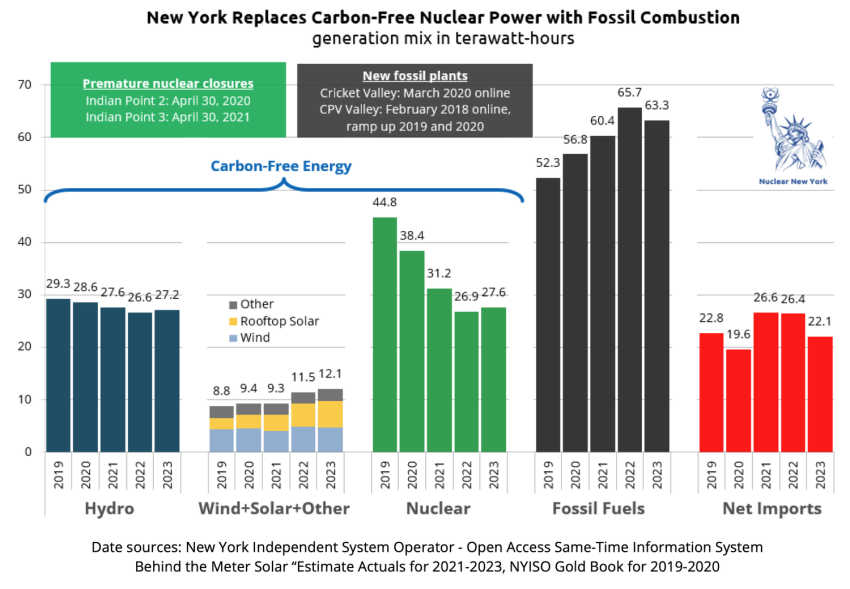
Out of 152.3 TWh of electricity produced or imported in 2023, fossil fuels continued to provide 63.3 TWh (41.5%). Most of the imports (14.5%) are undoubtedly from fossil fuels as well. Wind/solar/other provided just 12.1 TWh, or 7.9% of the total, barely up from about 6% in 2019. And that’s now suddenly going to go to 70% by 2030? Ridiculous. Meanwhile, the big story leaps off the page, as the Nuclear New York guys emphasize in the headline. The State forced the premature closure of two nuclear plants in 2020 and 2021, which caused the (carbon free) nuclear share of the total to drop from about 29% to only 18%; and almost all of that was taken up by two new natural gas plants, causing the fossil fuel share of the total to soar from only 34% to 41.5%. No person looking at this chart would ever conclude that New York has spent the past five years embarked on a crash program to replace fossil fuels with wind and solar. That process is going absolutely nowhere.
The truth is that the march to the Great Green Energy Future is over, but no one is yet willing to admit that.
Germany: Scholz’s ‘green’ government wants to buy 3 VIP helicopters for €200 million
By Denes Albert | Remix News | January 15, 2024
At a time when farmers are staging mass national protests over austerity measures that they say will put them under tremendous financial strain, German Chancellor Olaf Scholz and his ministers are aiming to purchase three new, luxury VIP helicopters that will cost €200 million.
However, the budget cuts for farmers are just one austerity measure, with the total budget cut expected to be €17 billion. The opposition is reacting with outrage over the news of the helicopter purchases, with the luxury helicopters designed for Chancellor Olaf Scholz and Defense Minister Boris Pistorius to attend appointments in Germany.
The German armed forces are supposed to replace the aging Cougar helicopters currently stationed in Berlin, which have a range of 850 kilometers and a cruising speed of up to 315 kilometers per hour. The VIP helicopters became famous when the former Social Democrat (SPD) Defense Minister Christine Lambrecht took her son on holiday in one of them.
The German newspaper Bild says that government officials probably suspect that citizens will not be happy about spending taxpayers’ money in a time of crisis, which is why they wanted to hide the €200 million expense.
German MPs do not recall this type of spending ever being discussed in the budget committee, and the helicopters were not included in the December budget proposal. The news is especially surprising considering German police still have so-called VIP Super Puma helicopters, which government representatives can fly in to emergency meetings.
The opposition is stunned, with Christian Democratic Union (CDU) budget expert Ingo Gädechens telling Bild that the government has lost touch with reality. He points out that the government wants to take €176 million from farmers this year, almost as much as the new helicopters cost.
“All of Germany is suffering from the collapse of fiscal policy. Austerity is everywhere,” the politician said. He added that it is obvious that Scholz’s travel convenience is the reason for the purchases and that ministers are more important than budgetary discipline.
However, Scholz may never get to experience the joy of riding a brand-new luxury helicopter, as the government cannot buy new helicopters without parliamentary approval. Now, it is up to the budget committee.
New Report Highlights Green Failure in Europe and Warns America
By Rick Whitbeck | RealClear Energy | January 4, 2024
As one digests Rupert Darwall’s latest report for the RealClear Foundation, the well-known quote from Spanish philosopher George Santayana might ring through the mind: “Those who cannot remember the past are condemned to repeat it.”
Anyone looking to combat the activists pushing a ‘net zero’ agenda here in the U.S. would be wise to read Darwall’s piece, entitled “The Folly of Climate Leadership.”
The analysis tells the story of Great Britain heeding the cries for decarbonization, starting when Parliament wrote an 80% decrease in emissions target into law in 2008. They raised it to 100% – or “net zero” – in 2019. The results have clearly been catastrophic.
Since decarbonization efforts commenced, Britain’s economy has grown at half the rate as it did from 1990-2008. According to a research study from noted British economic historian Nicholas Crafts, that’s the second-worst period of British peacetime growth since 1780.
In addition to the economic malaise, British energy prices have skyrocketed, and Britons are now concerned with how to survive the effect of those costs on their wallets, as they look to heat and power their homes and businesses, travel for work and pleasure and live life as best they can.
The differences between British energy costs and those here in the U.S. are staggering: Britons paid an average of $228 per megawatt hour (MWh) for electricity generated from coal in 2022, whereas Americans paid an average of $27 per MWh. For natural gas, 2022 saw Britons paying $251 per MWh, versus American consumers averaging $61 per MWh for their power.
Darwall’s report also highlights the effects of unchecked and anti-market driven government investment in ‘green’ energy on grid reliability, as intermittent production from wind and solar – coupled with a lack of utility-grade energy storage – dropped electricity generated per gigawatt of capacity falling 28% since 2009.
The same arguments that have crippled Britain’s economy are now being used by the Biden Administration here at home, with zealots in Cabinet-level positions – including Energy Secretary Jennifer Granholm, Interior Secretary Deb Haaland, and EPA Director Michael Regan – pushing the message from their bully pulpits.
The recent – and completely misnamed – Inflation Reduction Act passed by Congress provided the zealots with nearly $400 billion to dole out to supportive organizations and start-ups to jump-start our nation’s push for ‘net zero.’ Those dollars – doled out with few oversights or performance metrics attached in many cases – have produced very few wins in the last year, unless a win is measured in keeping political cronies happy and rich.
Consider: wind energy projects in Nebraska, Colorado, Rhode Island, Connecticut, and New Jersey were scrapped last year, even after untold millions of federal dollars went to their developers. Over 100 solar companies went bankrupt, and solar projects from California to Florida were shuttered in the middle of their development. Battery storage – a key component to offsetting the intermittency of wind and solar – also saw projects stalled, along with at least one lawsuit filed against a storage company when its solution failed.
Despite the perils of ‘green’ energy dependence shown throughout Europe, the eco-left continues to double down on ridding America of traditional energy sources. Supporting those efforts are ideologue billionaires, who continue to fund net-zero initiatives.
Former New York City Mayor Michael Bloomberg has given well over $1 billion of his personal wealth to the Sierra Club to fund its “Beyond Coal” and “Beyond Carbon” campaigns. Designed to rid the U.S. of every coal-fired power plant by 2030, the Sierra Club/Bloomberg partnership has succeeded in shutting down nearly two-thirds of the plants to-date, with most of the remaining in rural locations, including my home state of Alaska, where alternatives to existing coal plants in the state’s interior don’t readily exist. Without coal, countless Alaskans would have their livelihoods – and very lives – threatened during our long, dark and sub-zero-temperature winters.
With activists entrenched in government bureaucracy, zealots running government agencies and rich men (and women) funding these efforts, only those educated in historical failures of decarbonization – and willing to stand up and fight back against the climate warriors – stand a chance of helping stem the attacks. Darwall’s study should be required reading for anyone looking to build a fortress in their state against job-killing, family-harming decarbonization efforts.
Rick Whitbeck is the Alaska State Director for Power The Future, a national nonprofit organization that advocates for American energy jobs. Contact him at Rick@PowerTheFuture.com and follow him on X (formerly Twitter) @PTFAlaska
Speaker on BBC Verify Correspondent’s Six Month Sabbatical Course Has Called for Jailing Climate Contrarians

BY CHRIS MORRISON | THE DAILY SCEPTIC | JANUARY 1, 2024
Further and better particulars have emerged about the green billionaire-funded course run by the Oxford Climate Journalism Network (OCJN), which has to date attracted over 400 participants from around the world. It recently signed up Marco Silva, the climate ‘disinformation’ specialist employed by BBC Verify. To “hit closer to home”, course participants are told to pick a fruit such as a mango and discuss why it wasn’t as tasty as the year before due to the impact of climate change. Noted climate hysteric Saffron O’Neill has been a past speaker and she is on record as speculating on the need for “fines and imprisonment” for expressing scepticism about “well supported” science. There is something very disturbing about a climate activist from a State-reliant broadcaster attending a course funded by narrative-driven billionaires with a speaker who has suggested that sceptical climate scientists and writers be locked up in prison.
As the Daily Sceptic disclosed, the OCJN six-month course is run by the Reuters Institute, which is funded by the Thomson Reuters Foundation. Direct funding for the course, which started last year, has been provided by the Laudes Foundation and the European Climate Fund, the latter heavily supported by Extinction Rebellion funder Sir Christopher Hohn. Immersion in the correct political narrative surrounding climate collapse, the so-called ‘settled’ science, and the need for extreme Net Zero measures, whatever the cost, is the order of the day. It would appear that the aim of the OCJN is to insert constant fearmongering messages into media stories, as global elites press ahead with a collectivist Net Zero political agenda.
In a recently published essay, two OCJN organisers give chapter and verse as to how this is being directed on the course. It is designed to allow climate journalists to “move beyond their siloed past” into a strategic position within newsrooms “combining expertise with collaboration”. The “pick your mango” strategy is designed to make climate change “less abstract” and delegates are told to pick a “beloved fruit or activity that everyone in your country or region seems to care about, and seems to capture attention when impacted by climate change”.
“Less abstract” is one way of summing up this pseudoscientific hogwash. ‘Infantile’ might be better. None of it is based on a scintilla of scientific proof. Much the same can be said for a presentation by Dr. Friederike Otto who uses computer models to claim her green billionaire-funded World Weather Attribution (WWA) team can attribute individual bad weather events to human-caused climate change. Following Otto’s presentation, attendees are reported to have shown a “massive jump in self-confidence” when attributing individual weather to the long-term climate change.
The distinguished science writer Roger Pielke Jnr. is scathing about weather attribution calling it a new “cottage industry”, adding that the need to feed the climate beast leads to a knock-on effect of creating incentives for researchers to produce studies with links to climate – “no matter how tenuous or trivial”. At the BBC, weather attribution has always been very popular. Writing in a WWA guide for journalists, the former BBC Today editor Sarah Sands says attribution studies have given us “significant insight into the horseman of the climate apocalypse”. Former OCJN attendee, Ben Rich, the BBC’s lead weather presenter, has used the “science” of climate attribution “to help explain to audiences when and how scientists can link extreme weather to climate change”.
None of this ludicrous propaganda can be questioned since the science is deemed to be ‘settled’. Geography lecturer Dr. Saffron O’Neill has taken climate hysteria to a new level with a demand that journalists should not use photos of people enjoying themselves on beaches during summer heat waves. She recently told theGuardian that such images “can hold the same power” as photos of the tanks in Tiananmen Square and smoke billowing from the Twin Towers. After a session with O’Neill, audience members said that “news outlets and photo agencies can and should think ahead of time about how they photograph the risks of hot weather”. And of course if anyone disagrees with O’Neill and her version of the “well supported” science, it is time for fines and prison. The last suggestion was published in Carbon Brief, the activist blog financed by the European Climate Fund. As it happens, Carbon Brief is represented on the OCJN Advisory Board through its editor Leo Hickman.
The OCJN is far from the only billionaire foundation-funded operation trying to spread climate alarm and hysteria throughout the general population. Climate Central targets local media with ready-to-publish stories about significant landmarks disappearing beneath rising sea levels. It recently gulled the Mirror into running a notably silly story about much of London disappearing beneath the waves within 80 years. Covering Climate Now (CC Now) is an off-shoot of the Columbia Journalism Review and is backed by the Guardian. It claims to feed over 500 media operations with pre-written climate stories. Both these operations rely on heavy financial support from a small cluster of green billionaire funds.
The links between these operations spreads far and wide. One of the partners of CC Now is Reuters, the news agency connected to the OCJN through its Reuters Institute. Not everyone is happy with Reuters’ connections to operations such as CC Now that make no secret of a desire to promote a hard-line Net Zero narrative and suppress opposition to it. Neil Winton worked for 32 years at the agency covering science in his time. Politicians and lobbyists are in the process of dismantling our way of life, he notes. If we are going to give up our civilisation, at the very least we ought to have an open debate. “Journalists need to stand up and be counted. The trouble is this requires bravery and energy, and an urge to question conventional wisdom,” he said.
And, he might have added, avoiding the naughty step of Dr. Saffron O’Neill.
Chris Morrison is the Daily Sceptic’s Environment Editor.
Are EV Fires Stories Being Covered Up?
By Paul Homewood | Not A Lot Of People Know That | January 1, 2024


On Boxing Day, we passed this house on our way up to the common where we take the dogs. We go there most days, so were shocked to see this fire damage (photos taken today). On Boxing Day, there was a totally burnt out car on the drive, and also a gas van outside, presumably checking the mains were safe. The last time we went past was, I believe, Saturday, so the fire must have happened between then and Tuesday.
We could not identify the burnt out car at the time, as we did not stop. But there is often a Tesla parked on the driveway.
The fire obviously has all the classic trappings of an EV fire. Note how the right side of the house is hardly affected. The garage door must have been subjected to extreme heat, because it is hopelessly buckled out of shape.
This is not why I am making this post however.
For some reason, there seems to be no record or news at all of this locally. The South Yorkshire Fire Service keep a daily log of all incidents they have been called to, even down to wheelie bin fires. Yet they have no record at all of this fire. I have requested any information they have, but they have so far not responded.
The local newspaper, the Sheffield Star, also appears to have ignored the story, and there is no trace of the news on Google.
Is there some policy afoot to cover up stories of EV fires? It seems far fetched, but I can think of no other explanation.
Falling falling falling. The stock price of fake meat
Didn’t they say the substance derived from lab-grown blood that gives it a meat flavor was carcinogenic?
BY MERYL NASS | DECEMBER 27, 2023
The Impossible Burger company (Impossible Foods) has not gone public:
As of December 2023, Impossible Foods remains privately owned. Furthermore, while the company has stated that an IPO “will happen,” it seems not to be in a hurry, a state indicated by lukewarm statements and a lack of time references. Since the market curtailed its enthusiasm toward plant-based food alternatives during the second half of 2023, the current financial environment pushes the earliest likely Impossible Foods IPO date to 2024 or even 2025.
Beyond Meat isn’t worth much.

Even when its stock price was high, it never made any money. And now its cost of revenue exceeds its revenue. Better close up shop while it can.

Germany: “Renewable Energy Sector Facing The Abyss”… ”On The Brink” … Economy Breaking Up
By P Gosselin | No Tricks Zone | December 27, 2023
Germany’s Blackout News reports on how Germany’s move into renewable energies has gone from “a boom to crisis”.

The policies of (worst ever) Economics Minister Robert Habeck (Green Party) are leading the German economy to disaster. Photo: public domain.
It wasn’t long ago, when interest rates and inflation were low, and the economy and the business of renewable energies in Germany were booming.
But now, Blackout News reports how “the outlook for the renewable energy sector has deteriorated drastically” and affordable raw materials have become hard to get. Manufacturers are now reeling. “The renewable energy sector is facing the abyss” and is “on the brink.”
“The S&P Global Clean Energy Index, which monitors the performance of the sector, has fallen by 32% in the last 12 months, while the global stock markets have risen by 11%,” writes Blackout News. “These losses on the stock market not only affect the companies themselves, but also the investors and shareholders who have invested in renewable energies.”
Reduced work hours, job cuts
Blackout News also reports how the German economy in general, the biggest in Europe, is crumbling at its foundation. For example, construction equipment manufacturer Liebherr “is putting 1000 employees on short-time working for 9 months.”
Also Stiehl, Gardena and Hansgrohe, are “opting for short-time working and job cuts.”
Other famous German companies planning cuts include textile group Groz-Beckert in Albstadt-Ebingen, and chainsaw manufacturer Stihl,
“Rising inflation and the construction crisis are two of the main reasons for the current economic uncertainty. Rising inflation is putting a strain on households,” reports Blackout News.
The major driver of inflation and all the German economic misery? The rising cost of energy caused by the government’s incompetent energy policies.
Junk Science Alert: Met Office Set to Ditch Actual Temperature Data in Favour of Model Predictions
By Chris Morrison | The Daily Sceptic | December 23, 2023
The alternative climate reality that the U.K. Met Office seeks to occupy has moved a step nearer with news that a group of its top scientists has proposed adopting a radical new method of calculating climate change. The scientific method of calculating temperature trends over at least 30 years should be ditched, and replaced with 10 years of actual data merged with model projections for the next decade. The Met Office undoubtedly hopes that it can point to the passing of the 1.5°C ‘guard-rail’ in short order. This is junk science-on-stilts, and is undoubtedly driven by the desire to push the Net Zero collectivist agenda.
In a paper led by Professor Richard Betts, the Head of Climate Impacts at the Met Office, it is noted that the target of 1.5°C warming from pre-industrial levels is written into the 2016 Paris climate agreement and breaching it “will trigger questions on what needs to be done to meet the agreement’s goal”. Under current science-based understandings, the breaching of 1.5°C during anomalous warm spells of a month or two, as happened in 2016, 2017, 2019, 2020 and 2023, does not count. Even going above 1.5°C for a year in the next five years would not count. A new trend indicator is obviously needed. The Met Office proposes adding just 10 years’ past data to forecasts from a climate model programmed to produce temperature rises of up to 3.2°C during the next 80 years. By declaring an average 20-year temperature based around the current year, this ‘blend’ will provide ”an instantaneous indicator of current warming”.
It will do no such thing. In the supplementary notes to the paper, the authors disclose that they have used a computer model ‘pathway’, RCP4.5, that allows for a possible rise in temperatures of up to 3.2°C within 80 years. Given that global warming has barely risen by much more than 0.2°C over the last 25 years, this is a ludicrous stretch of the imagination. Declaring the threshold of 1.5°C, a political target set for politicians, has been passed based on these figures and using this highly politicised method would indicate that reality is rapidly departing from the Met Office station.
Using anomalous spikes in global temperature, invariably caused in the short-term by natural variations such as El Niño, is endemic throughout mainstream climate activism. ‘Joining the dots’ of individual bad weather events is now the go-to method to provoke alarm. So easily promoted and popular is the scare that an entire pseudoscience field has grown up using computer models to claim that individual weather events can be attributed to the actions of humans. ‘Weather’ and ‘climate’ have been deliberately confused. Climate trends have been shortened, and the weather somehow extended to suggest a group of individual events indicates a much longer term pattern. Meanwhile, the use of a 30-year trend dates back to the start of reliable temperature records from 1900, and was set almost 100 years ago by the International Meteorological Organisation. It is an arbitrary set period, but gives an accurate temperature trend record, smoothing out the inevitable, but distorting, anomalies.
By its latest actions, the Met Office demonstrates that the old-fashioned scientific way lacks suitability when Net Zero political work needs to be done. Trends can only be detected over time, leading to unwelcome delays in being able to point to an exact period when any threshold has been passed. Whilst accepting that an individual year of 1.5°C will not breach the Paris agreement so-called guard-rail, the Met Office claims that its instant indicator will “provide clarity” and will “reduce delays that would result from waiting until the end of the 20-year period”. The Met Office looks forward to the day when its new climate trend indicator comes with an IPCC ‘confidence’ or ‘high likelihood’ statement such as, “it is likely that the current global warming level has now reached (or exceeded) 1.5°C”. In subsequent years, this might become, “it is very likely that the current global warming level exceeded 1.5°C in year X”.
Why is this latest proposal from the state-funded Met Office junk science-on-stilts? A variety of reasons include that climate models have barely an accurate temperature forecast between them, despite 40 years of trying. Inputting opinions that the temperature of the Earth might rise by over 3°C in less than 80 years is hardly likely to improve their accuracy. There are also legitimate questions to be asked about the global temperature datasets that record past temperatures. Well-documented poor placing of measuring devices, unadjusted urban heat effects and frequent retrospective warming uplifts to the overall records do not inspire the greatest of confidence. At its HadCRUT5 global database, the Met Office has added around 30% extra warming over the last few years.
The Impact Of Heat Pumps On Electricity Demand
By Paul Homewood | Not A Lot Of People Know That | December 22, 2023
Following on from the post about heat pumps, I thought I would have a look at their impact on electricity demand.
My analysis reckoned on a typical household consumption of 3857 KWh with a heat pump. If we assume that they will only be used for heating for six months every year, that equates to 643 KWh a month, or 21 KWh a day.
At the coldest times of year, that average will increase substantially, so we could well be looking at 30 KWh a day then, since the heat pump will have to work much harder.
Although heat pumps are designed to provide low level heat continuously, I suspect that many will turn them off at night because it is too warm to sleep. We usually have our bedroom windows open all winter at night!
If we assume then that the heat pumps are in use for 14 hours a day, that gives average hourly electricity demand of 2.1 KWh. This assumes that the heat pump runs at a constant power rating. In practice, the system would have to work harder in the early evening as temperatures drop.
There are about 24 million homes with gas and oil boilers, so a peak demand of 2.1 KW amounts to 50 GW for the country as a whole. To that we can add demand from offices, shops etc, which currently use gas and oil.
Along with demand from EVs, the UK would need well over 100 GW of capacity to meet peak demand.
This is all twenty years or more away. But if the government’s target of 600,000 heat pumps a year is met, even within the next ten years, we will be needing at least 13 GW of extra grid capacity, at a time when dispatchable power generation is being shut down.
Featured Video

Rewriting the risk? Inside the government’s vaccine safety messaging
or go to
Aletho News Archives – Video-Images
Book Review
“Davos Can Really Replace the UN”
Inside the book that maps the architecture behind global governance — from the Epstein files to the Pact for the Future
Lies are Unbekoming | April 1, 2026
On June 13, 2019, the United Nations and the World Economic Forum signed a partnership deal to “accelerate the implementation of the 2030 Agenda for Sustainable Development.” That same evening, WEF president Börge Brende — Norway’s former Foreign Minister — had dinner with Jeffrey Epstein at Epstein’s Manhattan townhouse. The Epstein files, released January 2026, contain an exchange between the two from the previous year. Epstein to Brende: “Davos can really replace the UN. C21, cyber, crypto . genetics… intl coordination.” Brende back to Epstein: “Exactly — we need a new global architecture. World Economic Forum (Davos) is uniquely positioned — public private.”
The next day, the UN General Assembly adopted the framework for restructuring global governance.
That sequence — the partnership signing, the Epstein dinner, the candid admission about replacing the UN with a public-private architecture, and then the formal adoption — opens Jacob Nordangård’s The Digital World Brain. Pages two and three. Footnoted to the UN resolution number, the Epstein files, and the General Assembly record.
I keep coming back to it because it captures what this book does that almost nothing else in the independent research space manages. I’ve followed Jacob’s work for years now and interviewed him about his research. Each book peels back another layer of the same institutional architecture, and each time I think he’s reached the limit of what can be documented, the next one goes further. Nordangård doesn’t speculate. He doesn’t editorialize much. He lays institutional actions next to each other in chronological order and lets the pattern announce itself. … continue
Blog Roll
 Aletho News
- What’s Behind U.S./Israeli Strikes On Iranian Pistachio Factories?
- Seyed M. Marandi: U.S. Military DIVIDED? Iran’s Secret Defense EXPOSED
- How I fell foul of the BBC thought police
- The End of NATO
- 37 days of war on Iran cost US staggering $42bln, tracker shows
- Baghdad tells Asian refiners, traders to begin loading Iraqi crude amid Iranian exemption
- Under fire, Moscow and Tehran close ranks
- Iran, US receive Pakistan-mediated plan for ceasefire then final deal
- Iran submits demands for end to war as mediators scramble ahead of Trump deadline
- Iran Threatens Retaliatory Strike on Stargate AI Project in UAE
- If Americans Knew
- U.N. experts demand Israel release prominent Gaza doctor after reports of ‘severe torture’
- Israel’s Latest Genocide Is Against the Shias of Lebanon. Why Is the World Silent?
- How Eliot Cohen’s influence over U.S. war-making paved the way for Trump’s war crimes in Iran
- Israelis don’t pay for the weapons we ‘sell’ to them — US taxpayers do
- While Distancing from AIPAC, Most 2028 Democratic Hopefuls Are Still Embracing Israel
- A brief history of the Israeli nuclear program, the open secret at the heart of the Iran war
- Israeli Settlers Killed a Palestinian Farmer on His Own Land, in Front of His Father. Yes, Again
- The US-Israeli War on Science is an Assault on our Future
- 100+ International Law Experts Say US Strikes on Iran Violate UN Charter, Could Be War Crimes
- ‘Vile, Horrifying, Evil’: Trump Threatens to Bomb Nation of 90 Million People ‘Back to the Stone Ages’
- No Tricks Zone
- An Inconvenient Tree: Uncovered In Alps… Europe Much Warmer Than Today 6000 Years Ago
- New Study Reports A 60% Slowdown In Greenland’s Ice Loss Rate In The Last Decade
- Low Intensity Tornado Wrecks Major Solar Farm, Creating A Potential Toxic Dump
- New Study Finds Warming Saves Lives…Cold Temperatures 12 Times More Deadly Than Excess Heat
- German Science Blog Accuses PIK Climate Institute Of Hallucinating Climate Tipping Points
- Devastating Assessment Of Comirnaty Vaccine By Former Senior Pfizer Europe Toxicologist
- New Study: CO2 Is ‘Effectively Negligible’ As An Explanatory Climate Change Factor Since 2000
- Former Pfizer Toxicologist Dr. Helmut Sterz Tells Bundestag Hearing Pfizer Vaccine Should Have Never Been Approved
- Energy Expert: Germany’s Nuclear Phaseout Was A “500 Billion Euro Mistake”
- New Research: South Australia’s Mid-Holocene Sea Surface Temperatures Were 4°C Warmer Than Today
 Aletho News