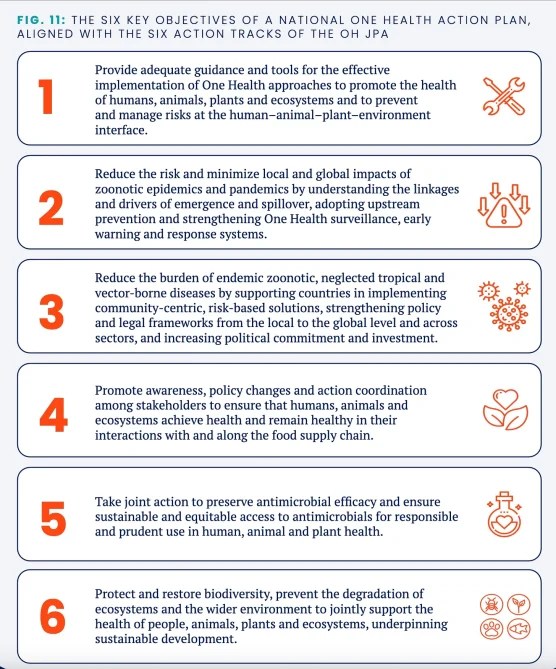
“Provide adequate guidance and tools for the effective implementation of One Health approaches to promote the health of humans, animals, plants and ecosystems and to prevent and manage risks at the human–animal–plant–environment interface.”
This drills into the reader’s brain the idea that the human-animal or human-environment interface is a dangerous place to be, that the risks must be acknowledged, and major efforts made to manage them. Note the absence of evidence supporting the assertion that major risk exist when humans are exposed to animals and nature.
Reduce the risk and minimize local and global impacts of zoonotic epidemics and pandemics by understanding the linkages and drivers of emergence and spillover, adopting upstream prevention and strengthening One Health surveillance, early warning and response systems.
The concept that pandemics are caused by “spillover” from animals is asserted, as is the very shaky idea that one can prevent and identify pandemics early using “surveillance” “warning and response systems”—which tellingly are never defined in any detail since no methods have ever worked.
Reduce the burden of endemic zoonotic, neglected tropical and vector-borne diseases by supporting countries in implementing community-centric, risk-based solutions, strengthening policy and legal frameworks from the local to the global level and across sectors, and increasing political commitment and investment.
Blather about helping developing nations without saying anything specific, except that they need to strengthen “policy and legal frameworks”—such as implementing legislation for authorization of unlicensed, liability-free drugs and vaccines? They need more political commitment—commitment to what, exactly, is ominously left unsaid. And naturally more investment (and commissions) are needed.
Promote awareness, policy changes and action coordination among stakeholders to ensure that humans, animals and ecosystems achieve health and remain healthy in their interactions with and along the food supply chain.
The ominous missing information about the policy changes and action desired should make you very nervous. Now the “food supply chain” is invoked, turning food and the methods by which it travels from farm to kitchen fair game for the purveyors of One Health.
Take joint action to preserve antimicrobial efficacy and ensure sustainable and equitable access to antimicrobials for responsible and prudent use in human, animal and plant health.
It sounds like there is a plan to withhold antibiotics from us in the name of preserving their efficacy. Pharmacists were made to monitor azithromycin use as well as hydroxychloroquine, chloroquine and mefloquine use during the COVID time. Bacterial pneumonias were untreated until the victim’s lips turned blue. Expect more of this.
Protect and restore biodiversity, prevent the degradation of ecosystems and the wider environment to jointly support the health of people, animals, plants and ecosystems, underpinning sustainable development.
This will be the justification to move people off the land in areas where species are said to be threatened. It may also lead to enforced changes in land use, based on my earlier readings of Daszak, Fauci and the Lancet One Health commission. And of course we must give up our simple pleasures in the name of the Sustainable Development Goals (SDGs). Who voted for them, and why are we being frog-marched into a SDG future, even though we don’t know where it is leading?
_________________
The cabal that delivered COVID and its pandemic response plan to us wants to solve the rest of the world’s problems for us, too. Will YOU let them?
“This is not about complicated issues of cryptocurrency,” assistant U.S. attorney Nicolas Roos declared in the Sam Bankman-Fried trial, after accusing the defendant of building FTX on a “pyramid of deceit.” Much the same can be said about the foundations of Britain’s net zero experiment. Energy is complicated, and electricity is essential to modern society and our quality of life, but as with FTX, the underlying story is straightforward: wind power and net zero are built on a pyramid of deceit.
Net zero was sold to Parliament and the British people on claims that wind-power costs were low and falling. This was untrue: wind-power costs are high and have been rising. In the net zero version of “crypto will make you rich,” official analyses produced by the Treasury and the Office for Budget Responsibility rely on the falsehood that wind power is cheap, that net zero would have minimal costs, and that it could boost productivity and economic growth. None of these has any basis in reality.
The push for net zero began in 2019, when the U.K.’s Climate Change Committee produced a report urging the government to adopt the policy. Part of the justification was historic climate guilt. In the words of committee chair Lord Deben, Britain had been “one of the largest historical contributors to climate change.” But the key economic justification for raising Britain’s decarbonization from 80% to 100% by 2050 – i.e., net zero – was “rapid cost reductions during mass deployment for key technologies,” notably in offshore wind. These illusory cost reductions, the committee claimed, “have made tighter emission reduction targets achievable at the same costs as previous looser targets.” It was green snake oil.
During the subsequent 88-minute debate in the House of Commons to write net zero into law, the clean-energy minister, Chris Skidmore, also asserted that net zero’s cost would be the same as the previous 80% target, which Parliament had approved in 2008. Challenged by a Labour MP on the absence of a regulatory-impact assessment, Skidmore misled Parliament, saying that there had been no regulatory-impact assessment in respect of raising the initial 60 percent target to 80 percent.
The regulatory-impact assessment that Skidmore says doesn’t exist gave a range of £324 billion to £404 billion when the target was raised to 80% – an estimate that excluded transitional costs – and cautioned that costs could exceed this range. Unlike today’s political pronouncements, the assessment was honest about the consequences of Britain acting if the rest of the world did not. “The economic case for the UK continuing to act alone where global action cannot be achieved would be weak,” it warned.
The Climate Change Act was passed to show Britain’s climate leadership and inspire the rest of the world to follow its example. How did that work out? In the 11 years that transpired from passing the Act to legislating net zero in 2019, Britain’s fossil fuel emissions fell by 180 million metric tons – a 33% reduction. Over the same period, the rest of the world’s emissions increased by 5,177 million metric tons – a rise of 16%. Put another way, 11 years of British emissions reduction were wiped out in around 140 days by increased emissions from the rest of the world.
Someone who claims that he’s a leader but who has no followers is typically regarded as a fool. It’s different with climate. Politicians parade their green virtue – Skidmore is to quit the House of Commons, and he teaches net zero studies at Harvard’s Kennedy School – while voters get mugged with higher energy bills. Analysis of Britain’s Big Six energy companies’ regulatory filings reveals that fuel-input costs for gas and coal-fired power stations were flat from 2009 to 2020. Still, the average price per kilowatt hour (kWh) of electricity paid by households rose 67%, driven by high environmental levies to subsidize renewable-energy investors. Yet supposedly the cost of renewable energy has plummeted.
During Prime Minister’s Questions earlier this year, Rishi Sunak claimed the cost of offshore wind had fallen from £140 per megawatt hour (MWh) to £40 per MWh, numbers assiduously propagated by the wind lobby and the Climate Change Committee. His claim is flat-out false. The prime minister has been suckered by falling per MWh price bids made by wind investors in successive allocation-round bids for offshore wind subsidies.
The explanation for this is to be found not in falling costs but in a flawed bidding process that rewards opportunistic bidding by wind investors. The government was giving away valuable options that commit the government to honor the prices paid for winning bids but commit investors to nothing. Because investors don’t pay anything for these options, the only way they can get them is by cutting the price they offer – but are not obliged to take – for their electricity unless they choose to exercise their options much later in the process.
Falling prices in successive allocation rounds are thus an artefact of moral hazard hardwired into the allocation mechanism; they reveal nothing about the trend in the costs of offshore wind. Analysis of audited financial data of wind farm companies undertaken by a handful of independent researchers comprehensively debunks the falling wind costs claim. The unavoidable move to deeper waters offset any cost reductions and operating costs per MWh of electricity for new offshore wind projects; the prices for the move are around double those assumed in the subsidy bids.
Preeminent among these researchers is Gordon Hughes, a former economics professor at Edinburgh University and adviser to the World Bank on power plant economics. Hughes’s analysis shows that by the twelfth year of operation, rising per MWh operating costs of deep-water wind turbines exceed their government-guaranteed prices, squeezing out their capacity to repay their capital and financing costs.
The intermittency and variability of wind and solar led the government to create a capacity market to pay for standby generation. In any economic appraisal of renewables, the costs of running the capacity market should be allocated to wind and solar as their intermittency and variability create the need for it. Electricity procured from the capacity market is not cheap. In 2020, German-owned Uniper’s thermal power stations obtained an average price of £224 per MWh, around four times the typical wholesale price.
Confirmation that offshore wind has huge, likely insuperable, cost and operating difficulties came in June, when Siemens Energy issued a shock profits warning and saw its shares plunge by 37 percent, in part because of higher-than-anticipated turbine failure rates. According to Hughes, the implication is that future wind operating costs will be higher, and output significantly lower, shortening the turbines’ economic lives. His conclusion is crushing:
The whole justification for the falling costs of wind generation rested on the assumption that much bigger wind turbines would produce more output at lower capex cost per megawatt, without the large costs of generational change. Now we have confirmation that such optimism is entirely unjustified . . . It follows that current energy policies in the UK, Europe and the United States are based on foundations of sand – naïve optimism reinforced by enthusiastic lobbying divorced from engineering reality.
The British government has been conned into placing a massive bet on offshore wind and is forcing electricity consumers to spend billions of pounds on a dead-end technology.
The falling cost of wind deception contaminates official assessments of the macroeconomic consequences of net zero. The Office for Budget Responsibility claims that the cost of low-carbon generation has fallen so fast that it is now cheaper than fossil fuel generation. Similarly, the Treasury erroneously took falling prices in wind subsidy allocation rounds as indicating falling wind costs. Both see the economy riddled with multiple layers of market failures, while not recognizing the real danger of government policy being captured by vested interests, as, indeed, it has been. Taken to its logical conclusion, theirs is an argument for switching to central planning and a command-and-control economy.
The Treasury argues that “other things being equal,” the added investment required by renewable energy “will translate into additional GDP growth.” Other things, of course, are not equal. As recent history shows, there’s a world of difference between investors and politicians making capital-allocation decisions. The centrally planned economies of the former communist bloc squandered colossal amounts of capital, immiserating their populations. Few now believe that investment in those economies boosted growth.
We don’t need to hypothesize. Government data disprove the Treasury’s contention and demonstrate that increasing deployment of renewable capacity reduces the productivity of Britain’s grid. In 2009, 87.3 gigawatts (GW) of generating capacity, comprising only 5.1 percent of wind and solar, generated 376.8 terrawatt hours (TWh) of electricity. In 2020, 100.9 GW of generating capacity, with wind and solar accounting for 37.6 percent of capacity, produced 312.3 TWh of electricity. Thanks to renewables, 13.6 GW (15.6 percent) more generating capacity produced 64.5 TWh (17.1 percent) less electricity.
Those numbers are damning for renewables and demonstrate why they make electricity more expensive and people poorer. Before mass deployment of renewables, 1 MW of capacity in 2009 produced 4,312 MWh of electricity. In 2020, 1 MW of capacity generated 3,094 MWh, a decline of 28.3 percent. It’s as clear as can be: investment in renewables shrinks the economy’s productive potential. This is confirmed by the International Energy Agency’s net zero modelling. Its net zero pathway sees the global energy sector in 2030 employing nearly 25 million more people, using $16.5 trillion more capital and taking an additional land area the combined size of California and Texas for wind and solar farms and the combined size of Mexico and France for bioenergy – all to produce 7 percent less energy.
Britain’s energy-policy disaster has lessons for America. The physics and economics of wind power are not magically transformed when they cross the Atlantic. Whenever a politician or wind lobbyist touts wind as low-cost or says net zero will boost growth, they become accessories to the wind power scam. The data lead ineluctably to a decisive conclusion: net zero is anti-growth. It is a formula for prolonged economic stagnation. Anyone who wants the truth about renewables should look at Britain and the sorry state of its economy. For the last decade and a half, it has been going through its worst period of growth since 1780.
Unlike in business and finance, there are no criminal or civil penalties for those who promote policies based on fraud and misrepresentation. Rather, net zero is similar to communism. Like net zero, communism was based on a lie: that it would outproduce capitalism. But it failed to produce, and belief in communism evaporated. When the collapse came, it was sudden and rapid. The truth could not be hidden. A similar fate awaits net zero.
It’s the question that must always be front and center in your mind when you read anything generated by advocates of energy transition as a supposed solution to “climate change”: Is this just rank incompetence, or is it intentional fraud? (The third possibility — reasonable, good faith advocacy — can generally be ruled out in the first few nanoseconds.). As between the options that the advocate is completely incompetent or an intentional fraudster, I suppose it would be better to be merely incompetent. However, often the misdirection is so blatant that it borders on impossible to believe that the author could be so stupid as to actually believe what he or she is saying.
So let’s apply this inquiry to a piece that has come to my attention in the past few days.
From euronews.green we have a piece from November 12 with the headline “Powered by wind and water: The Canary Island proving it is possible to run on renewables.” The byline is Lauren Crosby Mendicott. Ms. Mendicott announces the exciting news that one of Spain’s Canary Islands, El Hierro, has recently reported that it ran its electricity system entirely on wind and water power for 28 consecutive days. Excerpt:
The smallest of the Canary Islands has achieved a record of only using wind and water power for 28 consecutive days. . . . [T]he 1.1 million-year-old volcanic island is on route to being 100 per cent energy self-sufficient through clean, renewable sources. Its 10,000 inhabitants and local government are equally committed to the sustainability of the island.
Wow, that’s great! But OK Lauren, tell us more. If the system ran on just wind and water power for 28 days, what happened on days 29, 30, 31 and thereafter? Can we expect that with just a few tweaks the system can get to running 365 days a year on its wind/water system without fossil fuel backup? Or is it in fact nowhere close to that goal? Unfortunately you will not find any information on those subjects in Ms. Mendicott’s piece.
As readers here know, I have been somewhat focused on the El Hierro project for several years, because it is the closest thing in the world to an attempt to build a demonstration project to show that wind power combined with energy storage can create a fully-functioning electricity grid without fossil fuel backup. I have had numerous pieces over the years dealing with the results of the El Hierro project, most recently this one on September 30, 2023. My conclusion from the data available at that time:
The Gorona del Viento project (wind turbines and a pumped storage reservoir) on El Hierro Island off Spain fails worse and worse every year.
The El Hierro system has wind turbines and energy storage from a pumped hydro system with nameplate capacity seemingly well in excess of peak electricity usage on the island. So theoretically they should have no problem getting all of their electricity from the wind/storage system — right? And yet, when you look at their annual data, somehow they only seem to average about 50% of annual electricity from the wind/storage system. Sometimes it gets to 70% or so for a few months, but then at other times it drops back to as little as around 30%. When I visited the Gorona del Viento website back in September, I found data for what it claimed as hours of operation on “100% renewable” generation for the years 2018, 2019 and 2020 — and nothing thereafter. For some reason, they had stopped reporting these data after 2020. The numbers were 2300 hours in 2018, 1905 in 2019, and 1293 in 2020 — a rather precipitous ongoing decline. Given that there are 8760 hours in a non-leap year (24 x 365 — likely beyond Ms. Mendicott’s math skills) these numbers represent shockingly small percentages of the annual operation of the system, declining from 26.3% in 2018 to only 14.7% in 2020 (a leap year with 8784 hours).
Going back to the Gorona del Viento web site today, I find the same figure of 1293 hours of “100% renewable” generation for 2020, and no subsequent data. Maybe those data are lurking somewhere in the Spanish-language portions of the site where I can’t find them. But somehow I think that if they had some great news to report on that subject, it would be front and center.
El Hierro is blessed with a rare near-perfect site for a pumped-storage hydro facility, with a volcano rising nearly straight up from the sea and a big crater on the top to store the water. Here is a picture of the shoreline, with the mountain rising nearly perpendicular out of the water:
And yet, despite having such a rare near-perfect site for a large pumped hydro storage facility, the El Hierro system does not have nearly the energy storage needed to provide full-time electricity from the wind/storage system. It would need to multiply its storage capacity by at least an order of magnitude to come close to 100% electricity from this system. Meanwhile, most of its electricity comes from a backup diesel generator — a fact nowhere mentioned in Ms. Mendicott’s piece.
So, is the piece mere incompetence, or intentional fraud? Several factors would seem to give strong support to the inference of intentional fraud — failure to mention the diesel backup at all; failure to mention the number of hours in each recent year where the diesel backup had to be called into activity to keep the lights on, and whether that number of hours was trending up or down; failure even to consider how much energy storage would be needed to enable the system to operate full time without the diesel backup, and whether there are any plans to provide that amount of storage or at what cost. Is it possible that someone could write a piece on this subject without even being aware of these issues? You be the judge!
Why are London’s buses spontaneously bursting into flames? And why are our politicians not addressing the problem?
In the past couple of years, two huge ships carrying thousands of cars have gone up in flames, apparently because of batteries in electric vehicles. A fire on board car carrier Felicity Ace in February 2022 led to the vessel sinking in the Atlantic, along with its cargo of 4,000 vehicles. And cargo ship Fremantle Highway caught fire in the North Sea.
In India, a spate of electric scooters catching fire in early 2022 sparked safety concerns causing buyers to think twice. Electric scooters bursting into flames hasn’t stopped. Fires are so commonplace that The Times of India now have a section dedicated to ‘Electric Scooter Fire News’.
At Luton Airport at least 125 flights were cancelled after a huge fire, which started on level three of the airport’s multi-storey car park. It caused the entire £20 million structure to collapse. Up to 1,500 vehicles were unlikely to be salvageable, according to estimates at the time. Authorities said the blaze “appeared to have been accidental and began in a parked car, believed to be a diesel vehicle.”
Well, not according to one witness, The Telegraph pointed out. The eyewitness managed to snap a picture of the vehicle suspected of causing the fire, which looked very like a Range Rover Evoque. There was none of the thick black smoke you would expect with a diesel fire. Instead, the blaze was focused on the front left seat of the car under which – well, I never! – the lithium-ion battery happens to be located in some hybrid Range Rovers.
Data from the London Fire Brigade for 2019 showed an incident rate of 0.04% for petrol and diesel car fires, while the rate for plug-in vehicles is more than double at 0.1%. But vested interests are creating as much smoke as possible to obscure the cause of these fires. Why? Because meeting the notably insane and economically disastrous net zero target by 2050 is predicated on the UK giving up fossil fuels.
The real danger with electric vehicles is the lithium-ion batteries, which are prone to catching fire unexpectedly or exploding and the ensuing inferno is very hard to put out.
Professor Peter Edwards, chair in inorganic chemistry at the University of Oxford, told The Telegraph: “Lithium-ion batteries in electric vehicles can develop unstoppable so-called ‘thermal runaway’ fires which burn uncontrollably.”
“As well as intense heat, during a battery fire, numerous toxic gases are emitted, such as hydrogen cyanide and hydrogen fluoride. The emission of these gases can be a larger threat than the heat generated,” he said.
Prof. Edwards is also raising the alarm about a pending “potential catastrophe” with all the large-scale lithium-ion battery storage sites sprouting up all over the UK, especially on solar farms.
There’s also a looming potential catastrophe in Sadiq Khan’s London bus fleet.
As of 31 March 2023, approximately 56% of London’s bus fleet is “environmentally friendly.” Out of a total bus fleet of 8,643, there are 3,835 hybrid buses, 950 battery electric buses, and 20 hydrogen fuel cell buses operating in London.
Below we have gathered incidences of buses spontaneously bursting into flames during 2022 and 2023. To find these, we conducted an internet search for the term “London bus fire,” while we came across some incidences in other locations along the way, we very much doubt the following is an extensive record of incidences in the past couple of years.
Buses carry many people at any one time, including schoolchildren. As an urgent matter of public safety, we must ask: What is causing these buses to spontaneously burst into flames?
In May 2022, six electric buses were destroyed in a bus garage in Potters Bar, Hertfordshire. At the height of the blaze, eight engines were in attendance and six Transport for London (“TfL”) buses – two hybrid electric and four diesel-powered – were on fire. The first bus caught fire while it was charging, before causing the other five to become engulfed.
According to Hertfordshire Live, an unnamed bus driver said that the fire was believed to have been caused by a battery exploding in one of the electric buses while it was charging – but, the Daily Mail said, this had not yet been confirmed.
Hertfordshire Fire and Rescue Service said at the time that “The cause and origin of the fire is currently under investigation and is yet to be established.”
After the fire in Potters Bar depot, TfL recalled 90 electric buses. “The precautionary measure has been decided while the company investigates causes of the blaze,” media outlet Sustainable Bus said.
London bus explosion: Five electric buses go up in a fireball – smoke seen for miles
FIVE electric double decker buses have exploded at the Potters Bar Bus Garage near London. pic.twitter.com/z6mLTswRPq
— Petronilla Husbands (@PetronillaHusb1) May 22, 2022
Dramatic images on social media showed a double-decker bus on fire on Brixton Hill, south London, on 17 June 2022. The driver and passengers left the bus before firefighters arrived. Thankfully, there were no injuries and the blaze was under control in 30 minutes.
Never letting a good crisis go to waste, the Mirroradded a climate twist to its reporting of the incident: “The incident comes on what is touted to be the hottest day of the year, with temperatures expected to peak at 34oC this afternoon.”
It is not the first time that climate science deniers have used the fabricated “climate change crisis” to explain spontaneous combustion. In July 2021, IFL Science used the dramatic title ‘The UK Is So Hot That A Bus Stop Reportedly Burst Into Flames’ to describe a passenger bus shelter catching fire in Solihull, West Midlands, UK.
IFL Science went on to say: “The extreme heat is leading to some unlikely (and disastrous) events. On 19 July [2021], the powerful sun bearing down on an unsuspecting bus stop in Solihull reportedly caused it to spontaneously burst into flames.”
The Guardian refuted a link between ambient temperature and the cause of the bus bursting into flames on 17 June 2022. “The Guardian understands that the extreme heat in London was not believed to be the cause of the fire,” it said.
The Guardian: London bus bursts into flames in Brixton, 17 June 2022
London bus passengers managed to escape a large fire that engulfed the rear of a vehicle on Baker Street near Portman Square in Marylebone, London on 10 January 2023.
Cars and homes on a residential road in Hackney, east London were left damaged after a school bus for pupils with special needs was engulfed in flames on 20 January 2023.
The children were inside the bus when it caught fire. The bus was carrying three primary school children and was forced to stop after smoke was detected from the front of the vehicle. It was quickly evacuated with no injuries, The Telegraph reported.
The Daily Mail reported that a witness who lived nearby said as soon as the bonnet caught fire, everyone was evacuated off the bus – and she believes people were also evacuated from their houses.
Six other vehicles were also damaged.
The Independent: Hackney school bus fire leaves surrounding cars and homes damaged, 20 January 2023
White smoke was seen billowing out from a London double-decker bus after it broke down in south London,The Independent reported. The bus was stationed near West Croydon Bus Station when it began to emit smoke onto the street.
The Independent: Clouds of white smoke seen billowing from London bus in Croydon, 19 May 2023
A double-decker bus was destroyed by a huge fire on Bradford Broadway, London on 9 October 2023. First Bus said no passengers were on board when the incident started.
A spokesperson said: “One of our buses on the 607 service was involved in a fire incident on the upper deck … We do not know what caused the fire and will assist in the investigation including a review of CCTV footage.”
Bradford double decker bus fire just now… 😱 Thank goodness for the fire brigade who were quickly on the scene… pic.twitter.com/pgdQBoXDWi
It’s not only passengers and nearby road users that are in danger from exploding buses.
In October 2023, The Telegraph reported that residents are fighting to block plans to build an electric bus garage under the development of thousands of new flats amid fears battery fires could cause a “volcano.”
Labour-run Barnet Council were in talks with TfL and developer Ballymore about the joint £1.7bn project to build 25 tower blocks on top of a proposed underground electric bus depot in Edgware town centre.
However, Save Our Edgware, a community group, warned that residents would be at “severe risk” from electric vehicle batteries igniting, leading to explosive combustion and multi-vehicle fires.
Other forms of electric-powered transport pose a risk to homes as well. On Monday, the London Fire Brigade had this warning for Christmas:
Thinking about buying someone an e-bike or e-scooter for Christmas?
Make sure you’re buying from a reputable seller and be very careful if buying online – products sold online might not meet UK safety standards and are at more risk of exploding and catching fire.#ChargeSafe⚡ pic.twitter.com/koibxGfK4N
Why? Because e-bikes and e-scooters also spontaneously burst into flames. The London Fire Brigade warned a few months ago that e-bike fires are up 60% this year. Firefighters have been called to an e-scooter or e-bike fire every two days since the start of 2023. Since 2020, at least 12 people have died and a further 190 have been injured in the UK in suspected e-bike and e-scooter blazes, The Telegraph reported.
In one instance, an e-bike left charging is believed to have caused the house fire that tore through a maisonette in Cambridge, UK, over the summer, killing a mother and her two young children.
On the other side of the pond, firefighters are seeing the same problems. In Montgomery County, Maryland a fire broke out on 28 October 2022, on the 14th floor of the high-rise apartment buildingcalled ‘Twin Towers’. (ER: Hmm.) Fire officials said an e-scooter battery malfunctioned while charging.
According to New York City Fire Department in September 2022, electric battery-related fires were up a whopping 233% in two years. The fires have resulted in 163 injuries and 10 deaths, including a 5-year-old girl who was killed in an apartment building fire.
Inside Edition: Why Are Some Electronic Bikes and Scooters Catching Fire? 22 September 2022 (2 mins)
Featured image: The remains of the school bus after the blaze in Hackney on 20 January 2023. Source: The Telegraph
On November 29th, the British Parliament’s cross-party Environmental Audit Committee published a new report on “Environmental change and food security”.
The timing of the report is more than interesting, considering the UN’s COP28 summit published its own “Declaration on Sustainable Agriculture, Resilient Food Systems and Climate Action” (which the UK signed) just two days later. But I’m sure that’s just a coincidence.
The report claims – amongst many other things – that we…
need to adapt our food and farming system to become more resilient to the effects of climate change and biodiversity loss.
This is actually an inversion of the usual argument. The standard line is that we should change our eating habits to prevent climate change (the report still claims this too), but now we are being told that we must change our eating habits or climate change will cause us to starve to death.
Just like the push to change climate into a public health crisis, inverting this argument is about creating a sense of threat, about scaring people. It’s always about scaring people.
But, you’ll be pleased to know, while the reason we need to change may have altered, what we actually have to do remains the same: Eat less meat. A lot less meat.
The report repeats, countless times, the Climate Change Committee’s recommendation that the UK “reduces its meat and dairy consumption by 20% by 2030, and by 35% by 2050”
In a blatant rhetorical trick, it tries to make this figure into some kind of compromise by pointing out that some of their witnesses (eg. noted lunatic George Monbiot) advocated eating zero meat or animal products of any kind.
The report is full of this kind of manipulative language.
For example, on page 48, the authors claim that “the Government does not believe it has a role to tell people what to eat”, but then proceed to quote testimony from “experts” who tell them they have a responsibility to tell people what to eat (even though they really don’t want to).
Sue Pritchard argues people aren’t informed or sensible enough to make these decisions, while Professor Tim Lang essentially argues what we eat is chosen for us anyway:
Everyone thinks they choose their diet. We don’t, actually; we choose it by race, by class, by family, by gender, by culture, by when we were brought up, by the power of advertisers and their expenditure. Nearly £1 billion is spent on advertising food in Britain and it is overwhelmingly the ultraprocessed foods that get that advertising. There is very little advertising, let alone national guidance, for eating more appropriately.
“It’s OK to tell people what to do because choice is an illusion”. Beautiful.
The whole report is basically 90 pages of this kind of sophistic nonsense. If you’ve got a strong stomach and a lot of free time, you can read it all here.
We’re just going to focus on the “recommendations” at the end.
There’s this one…
The Government must show its leadership by upholding standards for the environmental impacts of food production in its trading relationships with other countries.
… which, loosely translated, means charging more import taxes on foods that aren’t “environmentally responsible” (or some other buzzphrase). This would mirror legislation in the EU, where the “Carbon Border Adjustment Mechanism” has been in place since earlier this year.
Of course, the unwritten consequence of this would be higher prices for ordinary consumers. Oops.
Then there’s this one…
The Government’s plans for a strong food curriculum in schools should include science-based education about the environmental impacts of food production, including food waste.
Which doesn’t need to be translated. It’s about indoctrinating – sorry, educating – children.
Or this one, promoting diet-related propaganda:
We recommend… that the Government should publish national guidance on sustainable diets
And there’s this one, which is my favourite [emphasis very much added]:
The Government does not want to tell people what to eat BUT from its plans to encourage people to eat more healthily it clearly understands its role in helping people make better choices.
Other recommendations call for more “Highly Protected Marine Areas (HPMAs)” to limit fishing in some areas of the sea as well as lowering maximum yield limits.
Still more suggest “sustainability ratings” being made a mandatory part of food labeling, and it’s not hard to see how rating all food purchases on a “sustainability” scale can be parlayed into social credit systems or the like.
Another includes a demand to “designate food security a public good”, like education, infrastructure, and national defense (which I imagine would grant some more powers under some act or other).
It goes on and on.
So, for anyone keeping score at home, the report recommends…
Using taxpayer money to create and distribute anti-meat propaganda
Educating children that eating meat is wrong
Publishing “government recommended diets”
Controlling where people fish and what they are allowed to catch
Using taxes to raise the prices of foods that are “bad for the environment”
Don’t worry though, “the Government does not believe it has a role to tell people what to eat”. Honest.
The truth is it goes well beyond simply telling people what to do. Perhaps the most concerning issue in the report is the much-praised “Environmental Land Management” schemes, described as:
a critical lever in incentivising a shift towards achieving food security in the context of environmental change
Here’s how they work…
Environmental Land Management schemes pay farmers to do certain things with their land… including to improve the environment”
You’ll notice it says “including” to improve the environment, not only to improve the environment. They never say what else is included, or what it might be in aid of.
Also, “Paying farmers to do certain things” ? That’s very vague, isn’t it?
What exactly are these “certain things” ?
Well, there’s a short list included but it doesn’t get much less vague. It mentions:
“undertaking certain environmentally beneficial actions”
“activities that support local nature recovery and meet local environmental priorities”
and “long-term projects that support landscape and ecosystem recovery.”
All of which can be fairly accurately summed up as “not farming”.
Yes, the British government is actively paying farmers not to farm, and – in truly Orwellian fashion – are doing it in the name of “promoting food security”. (You can read about similar schemes in the US and UK here.)
It goes beyond “telling people what to eat”, into the realm of making sure they don’t eat at all.
“How we live, heat, get around, travel and what we eat could soon no longer be an individual decision, but increasingly be dictated by the state,” a former German federal minister warns.
Kristina Schröder, who served as the Federal Family Minister from 2009 to 2013 in the government of Chancellor Angela Merkel, recently commented that Germany currently finds itself on a dangerous environmentally dogmatic path under the current leadership.
Pandemic as the blueprint
In a commentary published at Der Pragmaticus, she writes: “The pandemic has provided a blueprint for the climate movement on how to enforce fundamental restrictions on basic rights.”
“Germany is heading in the direction of a radical climate protection dogma that almost completely ignores the costs of the path taken. And once again, the two predominant patterns of argumentation in the pandemic can be observed: A refusal to weigh things up and an ends-justify-the-means mindset,” Schröder adds. “I am convinced that large sections of the climate protection movement are also fighting our way of living and our economy at least as much as they are fighting climate change.”
CO2 as the virus to fear
Schröder adds that it is easy to see that CO2 is being viewed as a virus and to imagine future measures to curb it: “there is a threat of regulations affecting our most private lifestyles. How we live, heat, get around, travel and what we eat could soon no longer be an individual decision, but increasingly be dictated by the state.”
Schellnhuber “3 tonnes per year”
She also speaks critically of Prof. Hans Joachim Schellnhuber, the former director of the Potsdam Institute for Climate Impact Research (PIK) who proposes “every citizen could be given a CO2 budget of three tons per year.” The average German emits 11 tons per year, and thus getting down to just 3 would certainly entail draconian restrictions and regulations.
But so far many Germans have been acting complacently about such drastic proposals, Schröder notes, adding: “This eager willingness to relinquish fundamental freedoms is all the more disturbing as a crucial question is hardly being asked, let alone answered: Does effective climate protection really have to mean such losses of freedom and prosperity?”
Schröder, who contributes regularly toWelt, also wonders why in Germany there’s such a “blindness to the costs” of reducing CO2. “Why this indifference to the loss of freedom and prosperity?” And: “Why this longing for bans, renunciation and penance?”
“Powerful lever” against capitalism
In Schröder’s view, for the activists, climate protection is “a powerful lever to push back the hated capitalist system.”
She concludes:
“I am certain that if a technical solution were to be found tomorrow that would allow us to render CO2 harmless overall, large sections of the radical climate protection movement would not be relieved, but disappointed.”
For the greens and the many activists, it’s follow our politics! It’s not about science.
Every day, people across the world wake up to news about climate change affecting their lives. With the seeming randomness of a roulette wheel, the doomsday clique of the climate world daily selects a fresh topic to sow seeds of anxiety among the populace.
Popular things easily recognized — even cherished — by people are continually identified as being at risk of being damaged or destroyed by climate change. Coffee, for example, is a commodity experiencing a surge in popularity, and there are no prizes for guessing what climate doomsayers are saying now.
Yes, coffee is now said to be under threat from man-made climate change. CNN, in a recent article, made this statement: “climate change poses a huge threat to the coffee business and to farmers.” Keeping with its customary approach of presenting climate change as a threat to all manner of things, CNN quotes the Inter-American Development Bank as warning that “rising temperatures will reduce the area suitable for growing coffee by up to 50%.”
Is this claim true? If so, plenty of people would be affected, because coffee is selling like hot cakes.
The brew is a staple in nearly 98% of households in Brazil. According to the 2023 National Coffee Data Trends Report, coffee consumption in the U.S. has hit a 20-year peak, with over 50% of consumers gravitating toward specialty coffee.
Even in my home country, India, there is a sudden deluge of boutique coffee shops. Some chains have opened as many as 50 branches within a span of five years, and that is not an easy task in a country of 1.3 billion tea-lovers. India is now the eighth largest producer of coffee beans.
More than 99% of global coffee production comprises the arabica and robusta species, which are just two of over 140 different species in the Coffea genus. Coffea, especially arabica, depends highly on soil fertility and temperature.
The purveyors of climate apocalypse are particularly interested in the temperature aspect, as it provides a legitimate pathway for indulging in climate scaremongering. Despite widespread concern about increasing warmth, satellite temperature data collected from 1979 to 2023 indicate that there has not been a significant rise in temperatures.
Despite widespread concern about increasing warmth, global satellite temperature data collected from 1979 to 2023 indicates that there has only been a modest rise of less than one-degree C in temperature.
Besides, it is widely acknowledged that warming since the Little Ice Age and increased atmospheric CO2 since the Industrial Revolution have boosted agricultural production and the general greening of ecosystems.
Scientists in Brazil have discovered that “carbon dioxide fertilization offsets negative impacts of climate change on arabica coffee yield.” They say that the CO2 fertilization effect will cause a net increase of the average Brazilian arabica coffee harvest by the years 2040–2070.
CO2 enrichment studies in Latin America show that elevated CO2 increased photosynthesis by 40% and increased the efficiency plants’ water use by approximately 60%. Higher CO2 eventually caused a 7–14% increase in plant height and a 12–14% increase in yield. Another study showed that there were significant increases in all leaf area and biomass markers in response to increased CO2.
The research indicates that we might already be reaping the rewards of increased productivity rates in both arabica and robusta coffee varieties thanks to the recent rise in atmospheric CO2. This reality is reflected in the plantations across the globe. Production in South America and Southeast Asia have shown increases in yield during the past two decades.
Brazil and Vietnam are the top two coffee bean producers. Both countries have seen remarkable increases in their yield, with Vietnam’s production climbing from 0.54 tons per acre in 2002 to 1.11 tons per acre in 2021. Meanwhile, Brazil’s yield has also shown significant growth, rising from 0.49 tons per acre in 2002 to 0.87 tons per acre in 2020.
Even if the temperatures were to increase dramatically, experts say that coffee cultivation would be possible in cooler regions at latitudes away from equator or at higher altitudes.
So sit back and drink that morning cup of Joe. Climate is not going to steal your coffee, and thank CO2 for keeping the plantations productive.
Vijay Jayaraj is a research associate at the CO2 Coalition, Arlington, Virginia. He holds a Master’s degree in environmental sciences from the University of East Anglia, U.K.
Achieving Net Zero means building 80 million kilometres of new and refurbished power lines within 17 years, equivalent to wrapping the Earth 2,000 times with new electricity grid capacity. All the high voltage lines built in the last century will need to be built again by 2040 to benefit from all the intermittent power produced by the vast number of wind turbines. The ecological costs of all this can only be guessed at. Electricity cables are made of aluminium and copper and strung on giant pylons made of steel and supported by large concrete bases. For their part, wind turbines are a menace to both avian and oceanic wildlife, consume vast quantities of raw materials, have a limited lifespan and are an increasing blight on both inland and offshore landscapes.
If the International Energy Agency (IEA) gets its way, you ain’t seen nothing yet. The roll-out of high voltage lines will be on an unprecedented scale. In a report on global electricity grids issued to coincide with COP28, the IEA states that “an unprecedented level of attention from policymakers and business leaders is needed to ensure grids support clean energy transitions and maintain electricity security”. Major changes in how grids operate and are regulated are said to be essential. Annual investment in grids, which has remained broadly stagnant, needs to double to more than $600 billion a year by 2030.
The Australian science journalist Jo Nova is in no mood to be understanding: “Remember, it’s not their fault that renewables need far more land, more space, more backup and more infrastructure – it’s our fault we didn’t build a world ready for their holy energy.”
The IEA paints a world where electricity grids are becoming a “bottleneck” for transitions to Net Zero emissions. While investment in renewables has been increasing rapidly, global investment in grids “has barely changed”. In Europe, policymakers can speed up progress on grids by “enhancing planning, ensuring regulatory risk assessments allow for anticipatory investment, and streamlining administrative processes”. In plain English this means ripping up local planning laws in over-populated Britain and blanketing the country with millions of giant electricity pylons. These will be required to bring energy to urban areas from power intermittently generated far away in the North Sea and off the Scottish coast.
It is perhaps no coincidence that the British Government recently set out “major plans” to speed up connections and rapidly increase capacity on the electricity grid. The press release cunningly linked it with a £960 million government investment in “green industries”. The new package is “expected” to bring forward £90 billion of investment over the next 10 years. The Government promised that it will “reward” those living closest to new infrastructure with up to £1,000 a year off their electricity bills. In another part of the release, this is downgraded to communities “could” benefit, and the bung is limited to 10 years.
Whatever the money is spent on, it is likely to be chickenfeed compared with the growing £12 billion annual subsidy paid by electricity consumers to the producers of renewable energy. But the next British government will face an empty exchequer and soaring state debt. Lack of finance along with the end of low interest rates and free money printing is likely to kill many of the green fantasises currently being peddled by collectivist Net Zero fanatics. It is becoming clearer by the day, to an increasing number of people, that renewable energy is unreliable and uneconomic, and has an insatiable requirement for financial subsidy.
Emeritus Cambridge Professor Michael Kelly has long been a critic of the blind, un-costed rush to Net Zero. The U.K. electricity grid will require upgrading from top to bottom, he wrote in a recent GWPF essay. Leaving aside the massive roll out of long-distance transmission lines required, he noted the inadequacies of all the local cabling and sub-stations built before the need to charge electric cars and run heat pumps. “The whole distribution system will need to be upgraded… the work will be extraordinarily expensive, but without it there will either be regular brownouts, or drivers will be told where and when they can charge their batteries,” he explained.
Professor Kelly believes it is a failure of the British political machinery, notably the work of the unelected Climate Change Committee. “We have set out to decarbonise the economy without anyone having thought through all the engineering issues, let alone put a cost on the exercise,” he concluded.
But as Jo Nova observes, it is all our fault. “Apparently, we should have paid attention and built the right grid and now due to our laziness we will have to rush in another 80 million kilometres of interconnectors, just like that,” she writes. Tell the children they’ve been lied to, she concludes. “The Green future is an industrial wasteland of concrete and steel built to line the pockets of billionaires and bankers.”
Chris Morrison is the Daily Sceptic’s Environment Editor.
IMF Chief Kristalina Georgieva has called for every government to implement some form of carbon taxes or “carbon pricing” in the near future.
Yes, we’re into week two of the UN’s COP28 climate change summit, and the hits just keep on coming.
For example, yesterday it was announced sixty-three world governments have pledged to reduce the emissions from air conditioners and electrics fans.
[You can read a detailed breakdown of the other pledges made during COP28’s first week here.]
Speaking at COP28 in Dubai, and repeated in an interview with the Guardian, Georgieva extolled the virtues of “carbon pricing” and heaped praise on the EU and Canada for their implementation:
When you put a price on carbon, decarbonisation accelerates. The Europeans introduced the emission trading scheme [in 2005] and they have been growing and yet emissions went down by 37%. You see the same thing in Canada with their carbon tax.”
While both the speech and interview discuss the proposed carbon taxes in terms of corporations as “major polluters”, any tax applied to big business would be directly passed onto private citizens via price increases.
The Guardian acknowledges this, but of course, decides to add a weasel-word qualification [emphasis added]:
However, attractive though a carbon price may be in economic theory, in practice governments are reluctant to impose such explicit prices and taxes, because they can easily be attacked, and because they hit poorer people hardest, if badly applied.
“If badly applied”, sure.
The truth is economic destruction, designed to lower the standard of living for ordinary people, is the whole point of “carbon taxes”. just as it was the point of lockdowns.
Deceptive language aside, the undeniable fact that any carbon tax – corporate or individual – would directly harm the poorest is clearly understood by the people who would seek to enforce them.
Not that they have a problem with that, you understand, their concern is merely that purely public rage and/or civil disobedience makes direct taxation difficult to implement. The Guardian article gives the game away by referencing France’s Gilets Jaunes protests as an example.
So, even as Georgieva names carbon taxes the “perfect” solution to climate change, she recognizes the need to rely on more indirect methods.
Yes, the best way to introduce implement carbon prices [is] a carbon tax…But it is not politically feasible in some countries … We can also use regulatory compliance in which standards lead to implicit prices on carbon.”
These “regulations” and “implicit” prices would not be “carbon taxes” in name, but they would very much be so in spirit.
Again the Guardian cites an example, the EU’s recent “carbon border adjustment mechanisms”, which charge more import duties on goods coming from countries with “lax” emissions policies.
A global version of those rules is likely just one of many such measures we can expect moving forward since, according to Georgieva, the world’s biggest financial institutions are all working together on this issue:
[T]he IMF, World Bank, OECD and World Trade Organization [have] set up a taskforce to examine the different carbon prices that are implied in countries around the world by their carbon policies and regulations.”
The head of IMF has spoken, and the World Bank and World Trade Organization are all on board: Carbon Taxes are inevitable. The only question is what they decide to call them.
All the world’s biggest financial heavy-hitters are coming together to figure out the best way to scam people out of their hard-earned money… for the good of the planet, obviously.
As with the previous competent analyses of energy storage requirements needed to back up intermittent renewable generation that have been featured on this blog and in my energy storage Report, there is nothing complicated about the Fekete, et al., analysis. The authors call it “a modified surplus/deficit calculation [as] taught to water engineers to size reservoirs for meeting water demand when the water resources vary.” When there is surplus production you add it to storage, and when there is a deficit you subtract; and then you sum over a year (or two, or ten) to calculate how much storage you need. It’s all basic arithmetic. What could be simpler?
You will not be surprised that the conclusion is “CO2 obsession driven dead-end.”
This subject would seem almost too obvious and trivial to cover on this blog. There is nothing complicated here. Everybody who is involved in any way in the energy transition game, and who has even the lowest level of professional competence, simply must be aware of this subject and of these calculations. And yet I just attended the big New York “Climate Summit,” (aka the Krazy Klimate Konference), featuring all of the powerful politicians and bureaucrats and industry leaders who are in charge of our state’s energy transition, and to a person they have no idea about any of this. And by no idea, I mean none, zero, zilch. One guy even came up to me and accused me of being “rude” for laughing out loud at his astounding ignorance. (The only other possibility was that it was intentional comedy.)
Unsurprisingly, the authors of Fekete, et al., make no claim to being “climate scientists.” Climate scientists as a class are way too smart to stoop to doing basic arithmetic. In the intro to the paper, Fekete identifies himself as a professor at the City University of New York — of Civil Engineering. Second author Mihály Bacskó is a former executive of the Hungarian Power Company. The other two co-authors are meteorologists working at the University of Oklahoma. In other words, the focus here is not on scaring the public with frightening scenarios from the occult voodoo of climate “science,” but rather only on whether the proposed solutions will or will not work.
The particular calculations in Fekete, et al., look at data from twelve states of the northeastern U.S. — New England, plus New York, New Jersey, Pennsylvania, Delaware, Maryland and West Virginia. Rather than using production data from existing wind and solar facilities, the authors obtained daily wind speed and solar irradiation data for the region. For consumption data, the blog post states that the authors applied an assumption of “constant energy consumption,” after determining that “seasonal variations of energy consumption are relatively small (deviate by only 10-15% of the annual average).” (Perhaps this decision could be criticized, but I doubt that it makes any material difference to the conclusion.)
And the bottom line is:
The storage capacity needed to align power generation from solar or wind is around 25% of the annual energy consumption.
In other words, you need three months worth of storage to try to make this work. Previous studies that I highlighted in my energy storage Report — for example, those of Roger Andrews and Ken Gregory — had calculated storage needs in the range of one to two months. However, those studies only used one year’s worth of data for each calculation, and allowed running the storage balance right down to zero. If you think that it’s too risky to run the storage right down to zero before the balance starts to refill, then three months of storage is a much more reasonable figure. Indeed, it’s still rather conservative.
Fekete, et al., don’t get into the specifics of cost of any possible storage solution. But then, they don’t need to. The potential costs are so enormous as to completely rule out any attempt even to start down this road. According to the U.S. Energy Information Administration, total U.S. electricity consumption in 2022 was just over 4 trillion kWh. So one-quarter of that would be just over 1 trillion kWh. Just to get an idea of the cost of that much energy storage, this site (Tesla fans) gives a (highly optimistic) cost for Tesla batteries of just over $100 per kWh. So a trillion of those will run you about $100 trillion. That’s four times the entire U.S. economy. Meanwhile, a Tesla-style battery is not remotely up to the job of the energy storage needed to back up wind/solar electricity generation, which would necessarily include the ability to save up power over a year or more and discharge over a year. But then, the economics are so wildly out of line that it’s hardly worth worrying about such technicalities.
Fekete, et al., in a very understated manner, put it this way:
In the absence of energy storage technology that can store several months worth of energy, one has to conclude that all studies suggesting that solar or wind are price competitive with other forms of energy should be retracted.
The Fekete blog post at Climate, Etc. contains two other subjects of interest. One relates to the peer review process. It appears that one of the peer reviewers made a run at getting the paper blocked, without stating the nature of any substantive criticisms:
One of the reviewers stated that “The manuscript contains fundamental errors that cannot be rectified through author revisions” without venturing into any details.
Fekete calls this effort “unscientific, unjust, and unethical,” which is again quite an understatement. Sadly, such conduct is the norm in what goes by the name “climate science” today. Fortunately, in this case, another reviewer was supportive, as was the staff of the journal.
The second subject of further interest in the blog post is that another reviewer criticized the draft paper for alleged “lack of references to the “plethora of work” related to integrating renewables to the current energy systems and transitioning to a sustainable energy future.” The criticism caused the authors to “roll up their sleeves” and go out and review some 360 papers recommended by the critic. Here is a list of what they found:
The inter-annual and seasonal variations were rarely studied.
The vast majority of the studies were limited to diurnal and minute-by-minute variations.
The publications only investigated the use of few hourly storage capacities.
The primary sustainability metric was reducing CO2 emissions.
Most of the publications were limited to low renewable penetration.
No publication attempted to address complete decarbonization.
Even the most ambitious “deep decarbonization” scenarios stopped at 25-50% renewable contributions that was considered “high renewable penetration”.
And in summary:
Most of the reviewed papers assumed that solar and wind will be always supplemented by some form of “firm generation capacity”, which is the obfuscated name of using fossil fuels complemented with “carbon capture and sequestration”.
In other words, the orthodox “peer reviewed” scientific literature is almost completely lacking in consideration of the most important, fundamental problem of transitioning to an energy system based on electricity generated by the wind and sun. Well, now there is one competent paper in the mix. They will do their best to ignore it, at least until the whole wind/solar thing has conclusively shown that it can’t work.
New York thinks it is going to be the “leader” in showing the world how to transition away from fossil fuels to “green” energy. Our politicians and bureaucrats have not bothered with things like feasibility studies or demonstration projects showing that this can be done, because after all they are geniuses and it is up to the little people to figure out the details. So the energy transition has been ordered up via statutes filled with mandates and deadlines and penalties, with no attention paid to feasibility or cost. We now all get to sit back and watch as this crashes and burns.
In New York City, the main statute on this subject, enacted in 2019, has the title of Climate Mobilization Act, also known as Local Law (LL) 97. The most significant impending mandates are for reductions in “emissions” from buildings, with the first deadline for residential buildings coming right up in January 2024. Few buildings will fail the 2024 cap, but the mandated emissions limits keep ratcheting down over time. The mandate for 2030 for residential buildings over 25,000 square feet is set such that it cannot be met if the building continues to use gas or oil for heat; so effectively this is a mandate to convert to electric heat by that time.
Daughter Jane — a board member of a co-op in Queens which is over the 25,000 square feet and thus subject to the 2030 mandate — has previously covered this subject at Manhattan Contrarian. Here is her piece from October 2022. The gist was that boards in Queens that had looked into how to convert had been advised of very large costs that were not remotely affordable for their middle-class owners. Jane is currently on maternity leave from Manhattan Contrarian, having just delivered her third baby, so I am taking up this subject while we await her return.
So how big a problem will it be for these buildings to convert to electric heat? Nobody really knows. Remarkably — given that the first deadline, applicable to at least some buildings, is barely over a month away — as far as we can find there doesn’t exist a single example of a large building that has successfully completed a conversion that others can look to to benchmark feasibility and cost. New buildings can be built with all-electric infrastructure without great difficulty. But nobody has any solid idea how much will it cost, and how much disruption will be involved, to retrofit heat pumps into large apartment buildings built in the 1970s, or 60s, or 50s, or even the 1920s.
However, that may be about to change. There is at least one conversion project for a large building that is under way, and near completion, and scheduled to begin operation imminently, in December 2023. You won’t find any reporting about that project in the New York Times or other such media operations that constantly hype the dire need to reduce emissions. However, here is a piece, dated October 28, in a local newspaper called the West Side Rag that covers the Upper West Side neighborhood of Manhattan. The headline is “Heat Pump Project in Frederick Douglass Houses Nears Completion; ‘Powered by Electricity’.”
So, how is it going? The answer is that this effort is an unmitigated disaster. Let’s look into the details.
The conversion in question is taking place at one building in an eighteen-building New York City Housing Authority complex called Frederick Douglass Houses, located in Manhattan along Amsterdam Avenue between West 100th and 104th Streets. NYCHA is effectively exempt from LL97, since it is not subject to the penalties for non-compliance that apply to privately-owned buildings. However, the mandated emissions limits do nominally apply to NYCHA, and for this conversion NYCHA partnered with the New York Power Authority (NYPA) to finance the work.
From the West Side Rag:
A two-year project to convert a public housing building to an electrically powered heat pump system is nearing completion on the Upper West Side. The 58-year-old 20-story tower at 830 Amsterdam Avenue (100th Street), part of the New York City Housing Authority (NYCHA) Frederick Douglass Houses development, is being retrofitted to provide heating, cooling, and hot water for residents – and to serve as a possible template for converting more of the 2,410 buildings NYCHA maintains citywide. . . . The project is designed to reduce greenhouse gas emissions and give tenants more control over the temperature in their individual units. . . .
The agencies [NYCHA and NYPA] said the new heat pump system would be the first of its kind at a public housing facility in New York state, and the Amsterdam building would be the first to move away from burning fossil fuels. That makes it “a model for the portfolio,” said Vlada Kenniff, the housing authority’s vice president for energy and sustainability. . . .
So with the first deadline for LL97 compliance barely over a month away, they are just approaching the completion of a heat pump conversion on exactly one of their 2,410 buildings.
Here, from the West Side Rag, are pictures first of the building, and then of the array of large heat pumps that have been installed out in what apparently previously was part of the parking lot:
Then the West Side Rag gives figures for the number of units in the building and the cost of the project. The number of units is 159. And the cost? $28 million.
Holy shit! That’s over $176,000 per unit, just for the heat pump conversion. At a current financing rate of about 7%, that would mean an addition to rent of well over $1000 per month per unit just to finance the purchase and installation of the heat pump system. For comparison, NYCHA here gives the average monthly rent of its apartments as $557 in 2023. So if the tenants were expected to pay the cost of buying and installing this heat pump system, that would mean more than tripling each tenant’s monthly rent. Maybe we shouldn’t worry, because undoubtedly NYCHA’s plan would not be to burden the residents, but rather to get the money from the infinite pile of federal loot available from Washington.
At that same NYCHA link, they give their total number of apartments as 177,569. To provide each of them with heat from one of these heat pumps at $176,000 each would cost a total of over $31 billion.
In other words, converting this building has shown that retrofitting a central heat pump system like this for such buildings is infeasible to the point of being ludicrous. But of course, this is New York, and nobody is allowed to say that. The West Side Rag seeks out a comment from one Paul DiMichele, identified as a spokesman for NYPA:
NYPA spokesman Paul DeMichele explained via email that “the complexities of the project motivated NYPA and NYCHA to think about other scalable solutions to bring heat pump technology to NYCHA residents.”
Ah, the “complexities.” Well, how about another possible approach, such as a heat pump on the roof?:
An earlier effort to install a different kind of heat pump mechanism on the roof of the Fort Independence Houses in the Bronx experienced similar challenges, with program manager Jordan Bonomo quoted in a story about that project on the Grist media platform explaining, “Each apartment had a story. We quickly realized that while we like the technology, we couldn’t possibly scale that across our portfolio.”
And thus, with a month to go to the first (theoretical) deadline under this LL97, we are exactly nowhere in coming up with a way to convert older buildings built with gas or oil heat to electric heat pumps at any remotely affordable cost. Energy reality is rising up once again.
Moscow should take the US threat to halve Russia’s energy revenues seriously, billionaire Oleg Deripaska said on Saturday. To make his point the businessman cited last year’s sabotage of the Nord Stream pipelines and a recent train derailment in Siberia.
The Russian aluminum magnate urged the government to focus on transport networks and port infrastructure in the country’s Far East, and the development of the North-South Transport Corridor in the Caspian region.
“Threats of blocking the Danish straits and the Bosporus have already been voiced,” Deripaska wrote on his Telegram channel.
“Russia is wholly up to the task of creating alternative routes via the Baltic and Turkish directions over four years,” he said, adding that the plan’s implementation should be monitored on a daily basis.
Earlier this week, a senior US official told the Financial Times that Washington would pursue its sanctions on Russian energy “for years to come” with the goal of halving Moscow’s oil and gas revenues by 2030.
On Wednesday, a freight train caught fire as it passed through the Bessolov Severomuysky tunnel, the longest in Russia, located in Buryatia. The incident was caused by an unidentified explosive device, Russian business daily RBK reported on Friday citing a local police source.
Russia’s Investigative Committee earlier opened an investigation into a similar incident, in which 19 freight cars carrying mineral fertilizers derailed on November 11 in Ryazan Region, around 200km southeast of Moscow. Later, the case was reclassified as a “terrorist act.” Earlier this week, law enforcement agencies reported the arrest of a man in relation to the attack, saying it had been carried out on behalf of Ukraine.
Several Western media outlets previously reported, citing an unnamed Ukrainian source, that operatives working for the Security Service of Ukraine (SBU) had detonated explosives in the rail tunnel in Siberia, targeting the route due to its alleged use for transporting military supplies.
In September 2022, the Nord Stream 1 and 2 gas pipelines, connecting Russia and Germany under the Baltic Sea, were sabotaged by explosions. Berlin has yet to identify the perpetrators of the attack, which Moscow claimed was orchestrated by US intelligence agencies. Meanwhile, several Western media outlets have suggested that the pipelines were blown up by Ukraine-linked saboteurs.
Inside the book that maps the architecture behind global governance — from the Epstein files to the Pact for the Future
Lies are Unbekoming | April 1, 2026
On June 13, 2019, the United Nations and the World Economic Forum signed a partnership deal to “accelerate the implementation of the 2030 Agenda for Sustainable Development.” That same evening, WEF president Börge Brende — Norway’s former Foreign Minister — had dinner with Jeffrey Epstein at Epstein’s Manhattan townhouse. The Epstein files, released January 2026, contain an exchange between the two from the previous year. Epstein to Brende: “Davos can really replace the UN. C21, cyber, crypto . genetics… intl coordination.” Brende back to Epstein: “Exactly — we need a new global architecture. World Economic Forum (Davos) is uniquely positioned — public private.”
The next day, the UN General Assembly adopted the framework for restructuring global governance.
That sequence — the partnership signing, the Epstein dinner, the candid admission about replacing the UN with a public-private architecture, and then the formal adoption — opens Jacob Nordangård’s The Digital World Brain. Pages two and three. Footnoted to the UN resolution number, the Epstein files, and the General Assembly record.
I keep coming back to it because it captures what this book does that almost nothing else in the independent research space manages. I’ve followed Jacob’s work for years now and interviewed him about his research. Each book peels back another layer of the same institutional architecture, and each time I think he’s reached the limit of what can be documented, the next one goes further. Nordangård doesn’t speculate. He doesn’t editorialize much. He lays institutional actions next to each other in chronological order and lets the pattern announce itself. … continue
This site is provided as a research and reference tool. Although we make every reasonable effort to ensure that the information and data provided at this site are useful, accurate, and current, we cannot guarantee that the information and data provided here will be error-free. By using this site, you assume all responsibility for and risk arising from your use of and reliance upon the contents of this site.
This site and the information available through it do not, and are not intended to constitute legal advice. Should you require legal advice, you should consult your own attorney.
Nothing within this site or linked to by this site constitutes investment advice or medical advice.
Materials accessible from or added to this site by third parties, such as comments posted, are strictly the responsibility of the third party who added such materials or made them accessible and we neither endorse nor undertake to control, monitor, edit or assume responsibility for any such third-party material.
The posting of stories, commentaries, reports, documents and links (embedded or otherwise) on this site does not in any way, shape or form, implied or otherwise, necessarily express or suggest endorsement or support of any of such posted material or parts therein.
The word “alleged” is deemed to occur before the word “fraud.” Since the rule of law still applies. To peasants, at least.
Fair Use
This site contains copyrighted material the use of which has not always been specifically authorized by the copyright owner. We are making such material available in our efforts to advance understanding of environmental, political, human rights, economic, democracy, scientific, and social justice issues, etc. We believe this constitutes a ‘fair use’ of any such copyrighted material as provided for in section 107 of the US Copyright Law. In accordance with Title 17 U.S.C. Section 107, the material on this site is distributed without profit to those who have expressed a prior interest in receiving the included information for research and educational purposes. For more info go to: http://www.law.cornell.edu/uscode/17/107.shtml. If you wish to use copyrighted material from this site for purposes of your own that go beyond ‘fair use’, you must obtain permission from the copyright owner.
DMCA Contact
This is information for anyone that wishes to challenge our “fair use” of copyrighted material.
If you are a legal copyright holder or a designated agent for such and you believe that content residing on or accessible through our website infringes a copyright and falls outside the boundaries of “Fair Use”, please send a notice of infringement by contacting atheonews@gmail.com.
We will respond and take necessary action immediately.
If notice is given of an alleged copyright violation we will act expeditiously to remove or disable access to the material(s) in question.
All 3rd party material posted on this website is copyright the respective owners / authors. Aletho News makes no claim of copyright on such material.


 “How we live, heat, get around, travel and what we eat could soon no longer be an individual decision, but increasingly be dictated by the state,” a former German federal minister warns.




 Aletho News