When New York passed its utopian Climate Leadership and Community Protection Act back in 2019, it set mandatory targets for reductions in greenhouse gas emissions from the state’s energy consumption. But none of the mandates were scheduled to take effect prior to 2030. The earliest mandates were: 70% of electricity from “renewables” by 2030, and 40% overall reduction in GHG emissions by the same year. (Still more ambitious mandates were also set for 2040, followed by a “net zero” mandate for 2050). These dates all seemed so terribly far away — plenty of time for somebody to invent some new gizmos in the off chance that new technology might be needed to hit the goal.
Our legislators, innumerate to a person, had bought into the fantasy — peddled by lightweight academics like Mark Jacobson and Robert Howarth, and by grifting promoters like the American Wind Energy Association and investment bank Lazard — that wind and solar were now the cheapest way to make electricity. To abolish the evil fossil fuels, all that was needed was some political will.
The legislators definitely did not pay the slightest attention to the Manhattan Contrarian. Beginning in 2016, and consistently from then until the CLCPA was enacted in mid-2019, this site published one clear warning after another that the costs of a wind/solar energy system that would work full time would inevitably be a large multiple of those claimed by the promoters. If you want to entertain yourself for a while on this subject, you might be interested in my series “How Much Do The Green Energy Crusaders Plan To Increase Your Cost Of Electricity?” Part I (August16, 2016), Part II (August 20, 2016), and Part III (November 29, 2018). Well, I tried.
There actually was one other important deadline in the CLCPA, which was not a deadline for emissions reductions themselves, but rather a deadline for the state Department of Environmental Conservation to publish regulations to direct how the mandated emissions reductions would be achieved. The text from the CLCPA setting this deadline was codified in Section 75-0109 of the state’s Environmental Conservation Law. It states that DEC “shall . . . promulgate rules and regulations to ensure compliance with the statewide emissions reductions limits.” The deadline to promulgate these regulations was January 1, 2024.
January 1, 2024 came and went, and then another year went by, and still no regulations, nor any indication of when or whether they would be forthcoming. A reasonable inference would be that Kathy Hochul (who had taken over as Governor in 2021), or more likely some people on her staff, had figured out that this was not going to work. But they also knew that saying that out loud would be political suicide. Thus, silence.
By March of this year, the environmental zealots had had enough. In that month, a collection of environmental groups — Citizens Action of New York, People United for Sustainable Housing Buffalo, Sierra Club, and We Act for Environmental Justice — filed what we call an “Article 78” proceeding in the state Supreme Court of [Ulster] Albany County, to compel the DEC to comply with the statute and issue the regulations. (Article 78 is a part of the state procedural statute that provides for lawsuits to compel state agencies to comply with the law.). The case was assigned to Justice Julian Schreibman (who normally sits in Ulster County).
The Attorney General’s August 11 letter submission is truly a remarkable document. Basically, it states that the emissions-reduction mandates of the CLCPA are “infeasible,” and it asks the court to refrain from enforcing the mandate to issue regulations on the ground that because the emissions reductions are infeasible the regulations to compel them to happen would cause “damage to the public interest.” As a little background, the letter frequently refers to the state’s draft “Energy Plan,” which was issued on July 25, and which I covered here at Manhattan Contrarian in a post on August 11 titled “New York’s Official Energy Plan Is No Plan,” where I called the Energy Plan “hundreds of pages of fluff.”
Here are a few excerpts from the state’s August 11 letter for your enjoyment:
The draft [Energy Plan] itself shows that a 40% greenhouse gas reduction from 1990 levels by 2030 is infeasible under the Climate Act’s accounting methodology and unaffordable for consumers. . . . [W]hile New York’s current policies and additional action would be expected to raise economywide costs for the state energy system in 2040 by less than 10%, the two net zero scenarios the Board considered raise energy-system costs by at least 35% in 2040, which is $42 billion in additional costs for that year alone. . . . In sum, under even the most aggressive scenario the State Energy Planning Board considered—one that by 2040 would lead to an added $42 billion in annual energy costs—New York would not meet the Climate Act’s 2030 goal. While the draft plan shows that ambitious progress under the Climate Act is achievable, the 2030 goal itself is not practically feasible due to costs consumers simply cannot bear.
So they have actually calculated that the attempt to reach “net zero” emissions on the statutorily-mandated schedule will cost consumers an extra $42 billion per year by 2040. They don’t give us numbers for other years, but presumably other years would be comparable. So figure, $42 billion per year. Let’s say that that is slightly different from wind and solar being “cheaper” than our existing fossil fuel infrastructure.
Frankly, I think that the $42 billion per year is a very low-ball estimate. But for today, I will take it.
The state’s August 11 letter essentially advocates that the deadlines should be allowed to slip while we implement these policies more slowly. What the letter does not mention is whether the total cost of this transition will be reduced in any way by stretching it out or, alternatively, whether the cost will be equal or more if spread over a longer period of time. I can’t think of any reason why spreading the cost over a longer period of time would reduce the total cost. And thus, if the cost is “infeasible” for consumers, it will be equally infeasible if stretched out.
Justice Schreibman was extremely unimpressed by the very weak argument made by the state. From the court’s opinion (page 8):
Faced with this [statutory] mandate, DEC does not have the discretion to say no or to decide that it has the authority to choose not to follow the express legislative direction at issue. Under our system of separation of powers, upon concluding, based on its subject-matter expertise, that achieving the goals of the Climate Act might be “infeasible” for the reasons stated, the DEC had just two options. One, it could issue compliant regulations anyway, and let the chips fall where they may for the State’s political actors. Or, two, it could raise its concerns to the Legislature. . . .
The court’s decision gives the state until February 6 to issue the regulations. The reason for the three month window is that the state Legislature will not come back into session until January, and thus the option to ask the Legislature to reconsider is kept open.
But what is the exit strategy? Will they soon start spending $42 billion per year on a crash emissions reduction program that still will clearly be insufficient to meet the ridiculous mandates of the CLCPA? Or will they ask the state Legislature to revise the statute? The second option will bring a huge outcry from the dominant progressive group in the Legislature and their environmentalist backers, all of whom are convinced (without ever having done serious analysis) that wind and solar are cheaper than fossil fuels and only corrupt influence from oil and gas interests is preventing the energy transition.
Maybe they will postpone the deadlines for a year or two. But when the year or two is up, the problem will be back bigger than ever.
There is no graceful exit strategy. The CLCPA will inevitably be abandoned. Exactly when or how, I don’t know, but it will happen.
The global temperature did not change in October compared to August. The cooling trend remains intact. The American National Oceanic and Atmospheric Administration (NOAA) foresees a cool LA NINA developing in the Pacific this winter, which will lead to a further decline in global temperatures as well.
Belém – All that fuss for nothing
The 30th World Climate Conference in Belém is not yet over, but it is already becoming apparent that the event, announced as the “Conference of Truth,” will go down in the history of climate conferences as a turning point.
No head of state from the four largest CO2-emitting nations—China (33%), the USA (12%), India (8%), and Russia (5%)—is showing up in Belém.
Even before the conference, the New York Times headlined: “The whole world is fed up with climate policy.” And the fact that Bill Gates, one of the biggest supporters and sponsors of climate policy, explicitly warned against excessive, shortsighted climate policy just 14 days before the conference, and put prosperity back in focus — a major blow.
Glenn Beck, a prominent American television host, explains the change of heart by Bill Gates: “It’s not about science, it’s about Trump.” Expressed differently: it’s not about conviction; it’s about damage control for his own company, which is planning multibillion-dollar investments in data centers in the USA and globally. And given the situation, these will have to rely on electricity from new gas-fired power plants in the short term, as the reactivation of old nuclear power plants will not suffice, and the construction of new nuclear power plants will still take several years in the USA.
Only 1/3 of the states actually submit a plan
For the Climate Conference in Belém, states had to report on their future plans for the use of coal, oil, and gas. The fact that only one-third even submitted a statement already hints at the dissolving importance of the climate issue in most nations around the world. But the reports that were submitted are revealing. Most states reported continuously increasing use of coal, oil, and gas. The reports show an increase in global coal usage by 30%, oil by 25%, and gas by 40% by 2030 compared to 2015. The Intergovernmental Panel on Climate Change (IPCC) hoped to reduce global CO2 emissions by 45% by 2030 compared to 2015; now they are continuing to rise.
Only Europe onboard
Only Europe remains unshakably committed to the goal of achieving Net Zero CO2 emissions by 2050. Germany, the industrial heart of Europe, is even more ambitious and, according to Axel Bojanowski, is “the ‘leader’ among industrialized countries: It aims to be climate-neutral by 2045 – a self-destructive plan: Germany’s reduction will inevitably be compensated by rising emissions in other EU countries. This is because the European Emissions Trading System ensures that emission allowances not used in Germany are consumed in other EU countries.
It is becoming increasingly clear what the Wall Street Journal meant when it called Germany’s energy policy the ‘dumbest in the world.’
A few days before the conference, the European states agreed on a common goal, namely to achieve a 90% CO2 reduction by 2040 compared to 1990. 5% of the self-commitment could come from emission reductions abroad, which, of course, must also be expensively paid for. The German Minister for the Environment celebrated this agreement as “good news for the German economy, as everyone would now have the same competitive conditions.”
This statement reveals how little the German federal government and its ministers understand the global economy. As if German industry only exports goods to European countries. German goods, however, compete in a global market that does not have the burdens of CO2 taxes and high energy prices on German products and can therefore always offer them more cheaply. 50% of exports go to countries outside the EU.
Chancellor Merz and his Environment Minister Schneider are blatantly downplaying the German situation. Germany has set self-imposed shackles with the Climate Protection Act that will become highly painful in the coming years.
German climate policy: “script for an economic catastrophe”
Welt journalist Axel Bojanowski: “The German Climate Protection Act, cemented by the Federal Constitutional Court, seems to be a script for an economic catastrophe. It only allows Germany a remaining budget of 6.7 gigatonnes of CO2, which is likely to be used up by the early 2030s. According to the law, penalties, shutdowns, and restrictions on freedom are then threatened to meet the climate goals.”
6.7 gigatonnes was the remaining permissible budget after the ruling of the Federal Constitutional Court from 2020 onwards. As of today, only 3.6 gigatonnes of this remain. The buffer is reduced by about 0.5 gigatonnes each year. By 2032 at the latest, the remaining budget will be exhausted, and Germany will have reached the end of the line set by the Federal Constitutional Court. This will happen in the next legislative period, not just in 2040.
Chancellor Merz whitewashes
And in his 5-minute speech in Belém before a half-empty hall, Chancellor Merz spreads negligent whitewashing: “The economy is not the problem. Our economy is the key to protecting our climate even better.” Does the Chancellor not know the perilous state our industry is in?
Scandal surrounds tropical forest Ffund (TFF)
Probably the only outcome of the Belém conference will be the establishment of an investment fund, proposed by Brazilian President Lula, to finance the protection of tropical forests.
The fund works as follows: Donor countries pay $25 billion into the fund. Private investors (investment funds) are supposed to pay in $100 billion. The donor countries receive a return of about 4.0-4.8%, which corresponds to the return on their government bonds, as they generally have to raise the money through government debt. The return for private investors is 5.8% to 7.2%. The fund’s money is invested in emerging market government bonds, which yield comparatively high interest due to the higher risk (Brazilian government bonds are currently at 12.25%). Private investors are served first, followed by the donor countries. If anything remains after the distribution of profits to private investors and donor countries, the amount is paid out to 74 countries with tropical forests. It is hoped that this way, $3-4 billion will be distributed annually to the tropical forest countries.
The catch is this: To entice investors, private investors are given preference in the payment sequence: first the private ones, then the donor states. Furthermore, the donor countries must insure the fund against default. A default by an emerging market could quickly lead to the fund’s insolvency. In that case, the taxpayers of the donor countries would be held liable and, in an extreme scenario, lose their capital.
Disadvantageous for the German taxpayer
In preparation for Belém, there was fundamental disagreement over Germany’s participation in the fund between the Ministry of Finance and the Chancellor’s Office. The Chancellor’s Office clearly advocated for participation and a contribution of at least $1 billion. It was assisted by the Ministry for the Environment under Minister Schneider and the Ministry for Economic Cooperation and Development under Minister Alabali-Radovan. The Ministry of Finance, under Lars Klingbeil, strongly objected, viewing the fund as a billion-dollar risk and doubting the viability of the fund’s structure.
And indeed, the model is structurally disadvantageous for the German taxpayer. One could also say: We are subsidizing the returns of private investors with public money and providing the default guarantee for BlackRock and Co. That is why the Federal Ministry of Finance is persistently blocking Germany’s participation in the fund. It can be unequivocally stated that the Federal Ministry of Finance has thus far bravely defended the interests of the German taxpayer against the interests of BlackRock and Co.
This is the background to Chancellor Merz being unable to name a figure (“a noteworthy amount”) in Belém. The billion € or $ is now supposed to be found in the budget reconciliation for the 2026 federal budget, which is taking place this week, so that the federal budget can be adopted on November 28. It is to be expected that the SPD will concede. But it could be a Pyrrhic victory for Chancellor Merz, who would then visibly be prioritizing the interests of international financial investors, especially if the fund were to run into difficulties.
Whether the fund will ultimately materialize is still questionable, as it only comes into effect if the donor states commit to $10 billion. So far (excluding Germany), $5.6 billion has been raised.
The USA and the UK have already declined.
If the fund comes into being, the investment companies will profit first, with high returns secured by states, and then the emerging markets, which can sell their high-risk government bonds. Whether the tropical forest will benefit in this confusing financial jungle is not yet certain. The biggest risk remains with the donor countries, who are putting their taxpayers’ money at risk with the catchy story of saving the rainforest.”
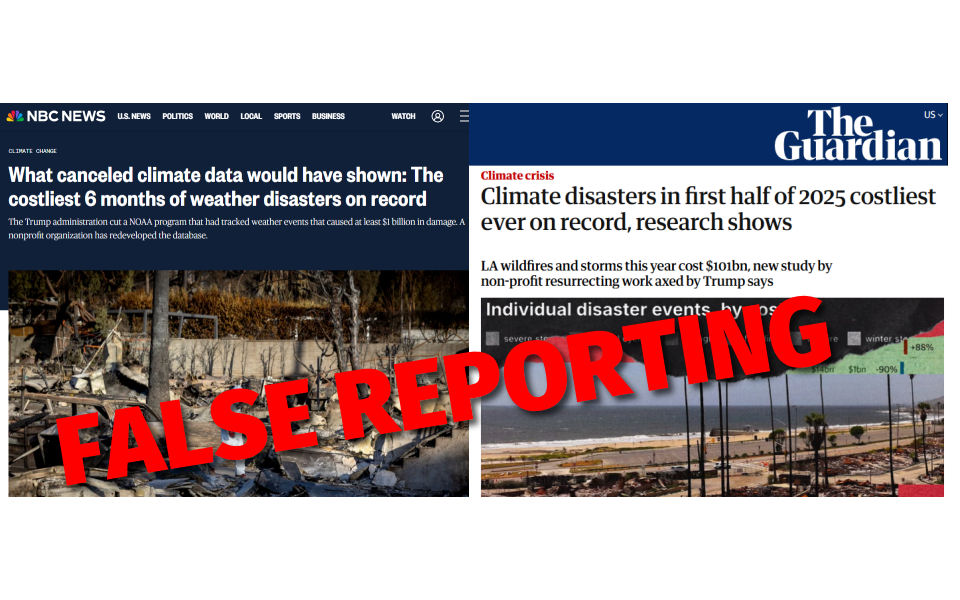
Multiple mainstream media outlets published stories this week uncritically publicizing the claims of a climate change interest group, Climate Central (CC). According to CC, climate change has caused higher weather disaster costs in the United States this year than ever in history – or at least since 1980, which is as far as the records CC uses go back. These claims are false. While the costs of extreme weather events and wildfires were high in early 2025, there are no trends that indicate climate change is responsible. Rather, higher populations, increased development in disaster prone areas, poor water management, and human evil in the form of arson, were the cause of the abnormally high disaster costs.
The tenor of The Guardian, NBC, and other outlets covering CC’s disaster cost report was nearly universal. Climate change resulted in worse weather disasters and higher costs in early 2025 than ever before, a fact that would have been missed absent CC’s work since President Donald Trump cut funding for the National Oceanic and Atmospheric Administration program, which has previously monitored such costs.
Per The Guardian :
The first half of 2025 was the costliest on record for major disasters in the US, driven by huge wildfires in Los Angeles and storms that battered much of the rest of the country, according to a climate non-profit that has resurrected work axed by Donald Trump’s administration that tracked the biggest disasters.
In the first six months of this year, 14 separate weather-related disasters that each caused at least $1bn in damage hit the US, the Climate Central group has calculated. In total, these events cost $101bn in damages – lost homes, businesses, highways and other infrastructure – a toll higher than any other first half of a year since records on this began in 1980.
As NBC News wrote:
The first half of this year was the costliest ever recorded for weather and climate disasters in the United States, according to an analysis published Wednesday by the nonprofit organization Climate Central.
It is information that the public might never have learned: This spring, the Trump administration cut the National Oceanic and Atmospheric Administration program that had tracked weather events that caused at least $1 billion in damage. The researcher who led that work, Adam Smith, left NOAA over the decision.
To be clear, Climate Central is not an objective authority on the causes and consequences of climate change, or a neutral party regarding proposed solutions. Rather, it was created and exists solely to produce and promote material blaming human activities for causing climate change resulting in catastrophic consequences that threaten human life, and to promote government enforced solutions that limit fossil fuel use.
Leaving aside the motives of the organization that produced the report, the news coverage of the report was inaccurate from the start. The stories ignore the history of natural disasters in the regions that have been impacted this year, the demographic changes that have resulted in the higher costs, and, most importantly, the lack of any long-term discernable changes in weather patterns and the incidences and severity of extreme weather events for the areas affected.
Looking at where the disasters occurred in the first half of this year, from CC’s own tracking we find the weather events were tornadoes that occurred during typical tornado season stretching from Texas through the plains to the upper mid-west. This area of the country is commonly referred to as “tornado alley” because such events are so common there during the spring and early summer. So, nothing unusual there. What critically undermines the CC report and the media’s suggestion that the rising cost of tornadoes is due to climate change is the fact, as explored in Climate Realism, here, here, and here, for example, that neither the number, frequency, nor severity of tornadoes has increased as the Earth has slightly warmed.
Other events include flooding in areas of the country historically known for spring flooding as a result of snowmelt and severe spring snowstorms – many of the areas are popular riverfront towns or communities. Climate Realism has repeatedly debunked media claims that flooding is getting worse – data show it isn’t. If flooding is not becoming more frequent or severe, climate change can’t be causing higher costs related to flooding.
Finally, more than 60 percent of the $101 billion disaster costs that CC says resulted from climate change altered weather events are attributable to just a single event: the January 2025 wildfires that decimated a large swath of Los Angeles. The Los Angeles fires were horrific, of a kind not experienced there in recent history, but not unusual historically. The huge damage was a result of a combination of factors, good seasonal rainfall in recent years creating lush natural growth combined with and regular lawn and tree watering in wealthy enclaves, followed by a severe drought, creating conditions for a wildfire, and strong Santa Anna winds to drive a fire quickly across the landscape once started (once again a natural feature of the area). With these conditions, all that was needed was a spark, which a perverse arsonist provided. Once the fire started, winds drove it quickly across a tinder dry landscape and firefighters found a shortage of water in reservoirs as a result of political decisions made by the state government.
Los Angeles is not warmer than is was in the 1950s and precipitation has actually increased slightly in the region since 1895. Despite climate alarmists and advantage seeking, virtue signaling Democratic politicians attempting to blame climate change for the fire and its severity, the evidence indicates it had nothing to do with it.
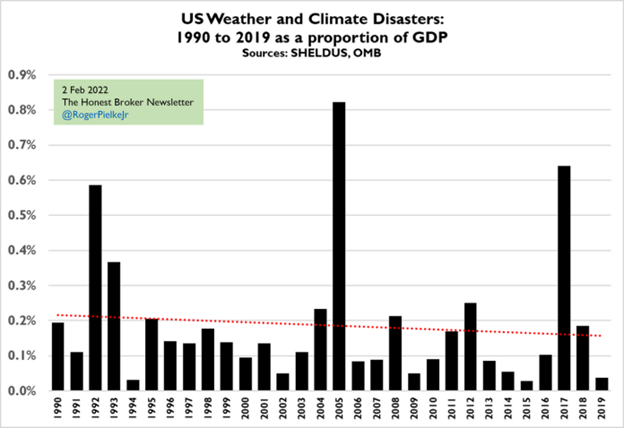
If climate conditions haven’t change appreciably across the United States, in the sense that the more extreme weather patterns are emerging, the question is, why have costs related to weather disasters gone up so much in nominal dollars? Keep in mind that in inflation adjusted dollars as a percentage of GDP, the costs of natural disasters have fallen over time. (see the figure, below)
As should be obvious to any honest observer exercising the least bit of common sense, the reason for rising disaster costs is clear, the expanding bullseye effect. As Climate Realism has explored in dozens of articles previously, with more people moving into ecologically/climatically desirable locations, locations prone to natural disasters, erecting more homes, businesses, and related structures and infrastructure, property has gone up dramatically in value overtime. When a disaster like a wildfire (in this case an arson started wildfire) strikes, more people and property is impacted and related costs are higher. Climate Realism discussed this very point in articles linked, here, here, and here, to take but a few examples. Quite simply, when a hurricane hits Miami or Galveston now, there are more buildings and structures to destroy at those locations than there was 100 years ago.
One can acknowledge that CC is right, natural disasters are imposing higher costs in nominal dollars now than they did in the past, without jumping to the completely unfounded claim that climate change is the cause. Legitimate journalists and honest news outlets, as NBC News and The Guardian purport to be, should check their facts before parroting the false rantings of a climate lobbing group as the truth. Misleading, false alarm stories like these are perhaps why trust in the media is low and falling.
From the 1st of October, Farmers in Denmark have begun feeding Bovaer to cows in order to reduce climate emissions.
This is part of a mandate requiring methane reducing feeds.
But something has gone very wrong.
Suddenly, farmers are now reporting that something is wrong with the cows. Cows have begun to produce less milk. Some cows are even collapsing and had to be euthanized.
Now suspicions have been raised that it could be Bovaer that is to blame. So farmers experimented and stopped giving Bovaer to cows. And surprise, the cows recovered. But as soon as they began with Bovaer again, the problems returned.
Things are so bad that The National Association of Danish Milk Producers have launched an investigation into this.
”We have so many people calling us who are unhappy about what is happening in their herds” says Kjartan Poulsen, chairman of the milk producers association.
”That is not the idea behind it. This is supposed to have a climate effect and if cows die from this, or produce less milk, then the effect is minus” he said further.
Not only that, but Kjartan Poulsen is now calling on the Minister of Agriculture in Denmark to introduce a ”timeout” so that the industry can find out what is actually going on.
Under the new mandate, farmers do have the option to give cows feed with a high fat content which can lower methane emissions.
Here is the thing. If you have been a subscriber to my Substack, you will know that I warned about this already many years ago. Because I did som in-depth research into Bovaer and the truth about this chemical.
And the answer might shock you. It is unbelievable that this chemical has been approved for use in cows, considering how toxic it actually is.
The chemical is actually classified as CCORROSIVE, FLAMMABLE, IRRITANT and a HEALTH HAZARD!
According to official data sheets, this chemical is also suspected of damaging fertility or the unborn child. It literally has a warning label for reproductive toxicity.
It even decreased the size of the ovaries in cows when given in high enough doses.
Farmers have to wear protective gear when handling this stuff.
Read my in-depth article on the truth about Bovaer here:
One farmer has now gone public to warn against Bovaer, as he believes it goes against animal welfare laws to feed this stuff to cows.
Danish farmer Huibert Van Dorp tells of how some of his cows have been having high fevers and that they are lethargic.
”We have had two cases since we began where they got severe stomach cramps, they were simply inflated up in the rumen. We had a veterinary here Sunday afternoon to treat the cow, but the life of the cow couldn’t be saved.” said Huibert Van Dorp in an interview.
He also says he heard from other farmers about problems with inflammation and cows not being able to stand up.
Further, he says this is a problem with animal welfare. This is not good for the cows.
I don’t know about you.
But if cows are collapsing from ingesting this chemical, and it is known to be toxic, and farmers have to wear protective equipment, I really don’t want to drink or eat any dairy that comes from these cows.
And the only reason they are giving this stuff to cows is to reduce their farts and thus reduce climate emissions. I cannot comprehend how stupid of an idea this is.
If it causes cows to collapse, what is it doing to the milk?
The European Union has become a “monster” that is increasingly undermining freedom and democracy—this is the criticism leveled by media scholar Norbert Bolz in an opinion piece for the newspaper Die Welt. He argues that the EU is no longer a community of free states, but a centralized “machine that constantly produces regulations and prohibitions,” which follows a “script” reminiscent of Kafka and Orwell.
Bolz, a professor emeritus and one of Germany’s most prominent conservative intellectuals, sees the original idea of a peaceful and economically united Europe as having been perverted. What began with free trade and freedom of movement has been replaced by bureaucratization, a lack of transparency, and authoritarian tendencies. As a concrete example, he cites the Digital Services Act and the planned chat surveillance: “This is about the methods of a totalitarian surveillance state that reads private communications and thus destroys privacy and freedom of expression.”
At the center of his criticism is EU Commission President Ursula von der Leyen. For Bolz, she embodies the “cold German face of a failed Europe.” He finds it particularly outrageous that she refuses to disclose the text messages she exchanged with the Pfizer CEO during the coronavirus pandemic.
Furthermore, he states that the EU lacks democratic legitimacy. “There is no separation of powers and no democracy,” writes Bolz. He contends that Brussels serves as a lever to push through nationally unpopular measures—for example, in the name of climate protection and corporate social responsibility. This practice enables left-wing and green parties, in particular, to circumvent the political will of their own populations.
According to Bolz, those who rebel against this development are not anti-Europeans, but good Europeans.
An Iranian Oil Ministry official says that the country requires up to $180 billion in investment to increase its oil production by at least 1 million barrels per day (bpd) by 2028, as outlined in its national development plan.
Nasrollah Zarei, who serves as CEO of Petroleum Engineering and Development Company, said on Wednesday that Iran’s Seventh National Development Plan targets an output of 4.8 million bpd within three years.
However, Zarei said that the target may be out of reach due to financial constraints caused by foreign sanctions.
He said that even a more modest target of 4.5 million bpd would require $170 to $180 billion in investment, of which the government can only allocate $10 billion. He called for an immediate revision of funding schemes for oil projects in Iran, saying the country’s sovereign wealth fund could play a larger role in financing such projects.
Despite stringent US sanctions that restrict oil sales and reinvestment, Iran has maintained its production at approximately 3.5 million bpd in recent years. Nearly 2 million bpd are exported, with the remainder used for domestic fuel and petrochemical production.
While Iran has faced challenges in meeting its oil output targets, it has achieved significant breakthroughs in the production of natural gas. The country is now the world’s third-largest gas producer, with a daily output of nearly 1 billion cubic meters, which experts believe is equivalent to approximately 6.3 million barrels of oil.
This solidifies Iran’s position as a leading hydrocarbon supplier, whose petroleum industry has a key role to play in global energy markets.
Chairman of Iran’s Geological Society, Mansour Ghorbani, said on Wednesday that the country holds some 36 trillion cubic meters of gas, representing 16% of global reserves, adding that the figure could rise to 50 trillion cubic meters with new discoveries.
Ghorbani also said that Iran’s oil reserves are estimated at 157 billion barrels, ranking among the world’s largest.
European experts themselves are beginning to acknowledge the worrying situation of the German economy – and consequently of the entire European economy, considering Berlin’s key role as a European industrial center. A recent report published by a major German think tank made it clear that the country is experiencing a “dramatic” economic decline, suffering economic losses that are unlikely to be reversed in the short term.
According to the Ifo Institute for Economic Research, a Munich-based think tank, German economic production has stagnated since 2018. Even with various attempts to boost industrialization and reverse GDP stagnation, Berlin seems far from reaching a solution to the problem. Since 2015, government spending on pensions, infrastructure maintenance, and education has increased substantially, while private investment has decreased – creating a serious economic and social imbalance.
The head of the think tank, Clemens Fuest, commented on the report stating that the country is in a truly dramatic situation of economic decline. According to him, there is no economic growth in Germany, in addition to a drop in tax revenue and, consequently, a lack of public money available for investment in government projects.
“Germany has been in economic decline for years. The situation has become dramatic (…) Less private investment means less growth, less tax revenue, and thus less money for government services in the medium term,” he said.
Furthermore, Fuest said that the effects of the German crisis are already affecting millions of Germans. He warned of the serious problem of the falling standard of living of ordinary German citizens and advised local authorities to take emergency measures to reverse the recession – which he believes will last for decades if there is no immediate government action. Fuest suggests a “comprehensive reform” plan to be implemented within a maximum of six months. He believes that only in this way will it be possible to prevent the crisis from having even more serious effects.
Among the reforms suggested by Fuest as part of this plan are changes to pension policy and a reduction in state bureaucracy for small and medium-sized enterprises. He says that it is necessary to reduce “green” bureaucracy, eliminating the need for documentation on CO2 emissions for small and medium-sized entrepreneurs interested in investing in the country. Fuest estimates that removing these environmental rules would generate economic gains for the country of at least 146 billion euros (equivalent to 170 billion dollars) per year.
However, Fuest and the think tank failed to comment on the deep roots of the current crisis. Although Germany has not grown since 2018, the core of the German economic issue is the suicidal sanctions policy adopted by the country since 2022. The stagnation the country experienced before the Russian special military operation in Ukraine was mainly due to a deliberate policy of industrial contraction imposed by the green lobby to make Germany comply with environmental guidelines and CO2 emission targets. However, since 2022 the country’s situation has been different.
By imposing sanctions against Russian energy, Germany lost its main source of strategic commodities. Without a safe, abundant, and cheap source of gas and oil, it is impossible for Germany to implement any relevant reindustrialization project. If previously the reduction of industrial activity was a voluntary action to meet specific environmental goals, now deindustrialization is an inevitable consequence of the energy instability affecting the country.
Added to this is the fact that Germany, also motivated by “green” paranoia, has eliminated its own nuclear program. In practice, Germany is currently experiencing an unprecedented energy crisis, the consequences of which affect not only industry and businesses, but also ordinary citizens, who are paying high prices for gas supplies. Without lifting the anti-Russian sanctions, Germany will hardly be able to emerge from this crisis – and consequently will not have the necessary conditions to implement fruitful economic reforms.
However, the German government does not seem interested in reversing its anti-Russian policies. On the contrary, Berlin is increasingly deepening its Russophobic paranoia. Moreover, the German state is spending more and more money on anti-Russian projects, both in terms of sending weapons to Ukraine and in internal militarization initiatives. It is worth remembering that Berlin recently offered to pay the salaries of American soldiers stationed at US bases on German territory, which shows how the country is willing to worsen its own economic condition just to keep NATO’s military plans in Europe active.
The biggest challenge for Germany today is its own belligerent and anti-Russian political choice. Only by reversing the Russophobic mentality of the German government will it be possible to save the country’s economy.
Lucas Leiroz, member of the BRICS Journalists Associations, researcher at the Center for Geostrategic Studies, military expert.
A plug-in hybrid exploded inside a garage in Izegem, Belgium, destroying multiple apartments and displacing several families. Investigators say the blast originated from the vehicle’s lithium-ion battery system. In this video, I break down what happened, why lithium-ion batteries can cause powerful explosions in enclosed spaces, and what this means for first responders and building safety.
Pfizer faces over a thousand lawsuits from women after its popular birth control drug, Depo-Provera, was linked to brain tumors. As the UN releases a report on the global fertility crisis, Illinois Governor J.B. Pritzker is moving to allow pharmacists to dispense birth control without a doctor’s prescription.
A recent article at the BBC, “Government told to prepare for 2C warming by 2050,” claims that the United Kingdom needs to prepare for increasing extreme weather as the planet approaches 2°C warming. This is false in its framing. Although it’s always a good idea to harden infrastructure against weather, the UK is not suffering more extreme weather due to human emissions of carbon dioxide, and the recommendation of attempting to prevent temperature rise is not going to help anyone.
The BBC’s post discusses a letter written by the UK government’s “Climate Change Committee” (CCC), which the BBC reports said, “[t]he country was ‘not yet adapted’ to worsening weather extremes already occurring at current levels of warming, ‘let alone’ what was expected to come.”
The CCC asked the government to “set out a framework of clear long-term objectives” to prevent further temperature rise, with new targets every five years and departments “clearly accountable” for delivering those goals. It warned that “a global warming level of 2C would have significant impact on the UK’s weather, with extreme events becoming more frequent and widespread.”
These include increases in heatwaves, droughts, floods, and longer wildfire seasons.
These claims are fearmongering, and no amount of deindustrialization – which is what’s implied by the “objectives to prevent further temperature rise”—will stop bad weather from happening, nor will it have any measurable impact on global average temperature.
The simple fact is that the UK contributes a very small amount of carbon dioxide to the atmosphere, which would in theory contribute an even smaller amount to warming. According to emissions data, the global share of all UK carbon dioxide emissions is 0.88 percent. Not even 1 percent. Eliminating UK emissions would do absolutely nothing to slow or stop any amount of warming that could be connected to human emissions, if they are, in fact, driving temperature changes.
On top of that, data do not show that weather is becoming more extreme in the UK.
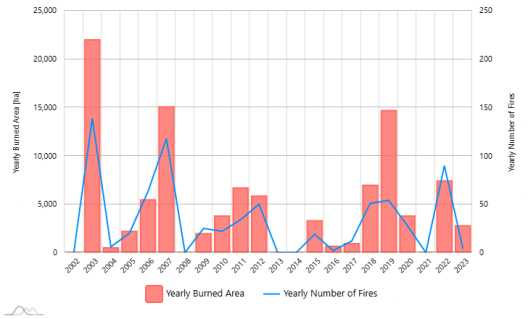
The BBC claims that global warming will increase the wildfire season in the UK, and presumably they believe it must have already done so during the past 150 years of planetary warming. A longer wildfire season should result in more fires. Available data, however, does not show that wildfires are getting more frequent or more intense in the UK. Satellite data from Copernicus show no trend at all.
Chart of United Kingdom yearly burned area and number of fires from Copernicus
For another example, looking at Central England as thisClimate Realism post did, the number of days per year breaching 25°C (77°F) show no rising trend, nor does the measured highest daily maximum.
Long term historical data for Europe show that drought is likewise not worse today than it was during the Renaissance, long before industrialization.
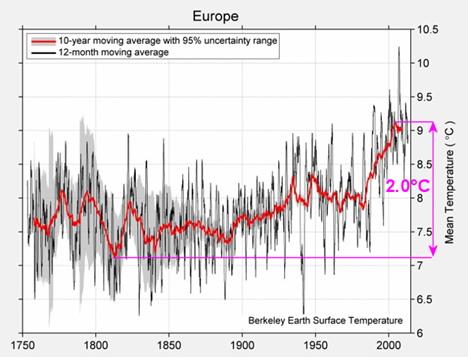
What is really notable is that Europe alone has actually already warmed 2°C since about 1820, according to historic European temperature averages, but no catastrophic change in weather has occurred. (See figure below)
Weather isn’t getting worse, but bad weather does still happen. The UK’s largest industrial solar facility, for example, blighting the landscape of Anglesey, North Wales, was recently destroyed by a bad storm. That should be enough to give government agencies pause when it comes to at least some net-zero policies, but the real point is that hardening infrastructure against weather should be a priority regardless of climate change. Bad weather will occur, and it will wreck fragile facilities, including solar complexes.
Hardening against weather extremes, which always have and always will exist, is just common sense. As technology develops and new ways of protecting against bad weather are discovered (like the invention of air conditioning) they should be implemented where they can be, as they can be. Achieving net zero – especially for a country that emits negligible amounts of greenhouse gases anyway—will not save the UK from bad weather events.
As a news organization, the BBC should not carry water for its government or government advisory boards that want to continue wasting money on futile “objectives to prevent further temperature rise” when direct efforts to improve infrastructure and harden it against weather extremes, which have happened throughout history, would be far more effective in saving lives and reducing harm.
The attempts of Friedrich Merz’s government to “relaunch” Germany’s role as a global political actor in the Global South without revising its conceptual foundations risk leaving the country stranded on the margins of international diplomacy – caught between formal participation and substantive isolation.
The Gaza Summit and the New Security Architecture
On October 13, 2025, under the auspices of President Abdel Fattah al-Sisi, a peace summit on Gaza took place in Sharm el-Sheikh, Egypt. The event, co-chaired by U.S. President Donald Trump, gathered representatives from over twenty nations to observe and validate the signing of the first phase of the American initiative for conflict resolution. Egypt and the United States, alongside Qatar and Turkey, acted as the principal mediators of the emerging architecture of multilateral diplomacy. Serving both as brokers of the ceasefire and as the de jure guarantors of the “Declaration on Lasting Peace and Prosperity,” they oversaw a framework that encompassed bilateral agreements on the release of hostages and prisoners, coordination of humanitarian aid, and a detailed roadmap for demilitarization and post-conflict reconstruction of Gaza’s infrastructure.
A wave of criticism followed the paradoxical absence of the conflict’s key parties, the Israeli cabinet and Hamas. At the same time, attention focused on the participation of several unorthodox players in the Middle Eastern geopolitical arena, notably the United Kingdom, France, and Germany. The German presence drew disproportionate attention due to an evident dissonance between its media portrayal and its actual diplomatic standing. Chancellor Friedrich Merz, standing to the side of the main participants, appeared frozen in an uneasy, almost constrained posture, smiling politely yet refraining from engaging any of the leaders. The image quickly spread through German and international media, sparking debate. This scene became emblematic of Berlin’s uncertain role within the emerging security architecture. The question arises: what position does Germany seek to claim, and why, despite shifting geopolitical realities and the lessons of history, it risks remaining a “paper player,” bereft of real influence or credibility across the Global South and the Middle East?
From “Feminist Foreign Policy” to the Merz Plan
To understand Germany’s current trajectory, one must revisit the recent phase of its foreign policy. Under Chancellor Scholz and Foreign Minister Annalena Baerbock, diplomacy was anchored in the doctrine of so-called “feminist foreign policy,” framed as a flagship direction of global engagement. Yet in practice, this approach revealed its conceptual inadequacy. Its normative and universalist foundations clashed with the political cultures and socio-cultural frameworks of the Global South. Gender and humanitarian rhetoric, imported indiscriminately into conflict zones, failed to take root, particularly when juxtaposed with Western double standards evident in the humanitarian catastrophe of Gaza.
Another blow to Berlin’s image came from its insistence on the “green agenda” as an alternative to traditional energy models. Amid a domestic energy crisis, this stance not only weakened Germany’s position in international negotiations but also eroded its reputation as a reliable and autonomous economic actor. To many states of the Global South, German initiatives in climate and energy diplomacy appeared declarative and unsupported by functional mechanisms.
Against this backdrop, Russia’s advocacy of “multipolarity” gained increasing traction, widely perceived as an attractive alternative to the neo-colonial logic of the West. Moscow succeeded in institutionalizing this discourse through frameworks such as BRICS, which evolved into both an economic and symbolic vehicle of a new international subjectivity. Germany and its European partners failed to propose an equivalent model, thereby cementing their peripheral status in dialogue with the Global South.
The Old–New Architecture of Irrelevance
Despite its declining relevance, Berlin continues to undertake institutional steps aimed at restoring its international agency. Notable measures include expanding humanitarian assistance, covering medical support and the establishment of temporary camps for displaced persons—participating in prospective Palestinian self-governance structures, co-organizing an international conference on Gaza’s reconstruction, and devising instruments for monitoring and coordinating humanitarian aid. Germany aspires to act not merely as a donor but as a mediator, presenting itself simultaneously as a humanitarian and political broker.
However, these ambitions collide with structural constraints. Key mechanisms for monitoring, hostage exchange, and aid distribution depend on the consent of regional actors who, tellingly, were absent from the summit. Germany’s declarative and instrumental efforts to secure influence falter against the realities of local political culture, where situational alliances, pragmatism, and realpolitik shape diplomacy far more than normative idealism. Berlin still relies on a logic of moral universalism inherited from previous decades, cloaked in new labels and narratives yet perpetuating the same disconnect between ambition and capability.
This pattern mirrors the systemic flaws observed during Baerbock’s “feminist foreign policy.” The persistent refusal to engage with regional geopolitical realities produces a gap between Germany’s ambitions and its actual leverage. The now-famous image from Sharm el-Sheikh thus becomes a visual metaphor for deeper structural dysfunction: the fragmentation of the Western course, wherein the American line retains strategic dominance while Europe’s voice fades amid inconsistency and moral self-contradiction.
The declarative support for Israel expressed by the Merz cabinet within the Middle East peace process has triggered a crisis of trust toward Germany as a would-be neutral actor. Rooted in the concept of Staatsräson and the moral logic of historical atonement, this stance increasingly contradicts the disposition of public opinion. Recent YouGov data reveal that 62% of Germans consider Israel’s actions in Gaza an act of genocide, a view shared across party lines, including 60% of supporters of Merz’s CDU/CSU bloc. Over two-thirds of the population now hold a negative view of Israel, while sympathizers account for only 19%. Support for Palestinian recognition has climbed to 44%. This gap between domestic consensus and foreign policy undermines the legitimacy of Germany’s global agency and weakens its credibility as an impartial mediator.
Internationally, the erosion of trust is even more pronounced. Since 2023, Germany has increasingly been seen across the Global South and the Middle East as a partisan ally that has abandoned neutrality for rigid pro-Israeli alignment. Decisions such as boosting arms supplies to Tel Aviv and abstaining from U.N. ceasefire resolutions are widely interpreted in Arab and African contexts as emblematic of Western double standards. Meanwhile, as several EU states, including Spain, Ireland, and Norway, have recognized Palestine, Germany finds itself isolated even within Europe. This loss of trust is quantifiable: Arab Barometer surveys show Germany’s favorable rating in the Middle East has plunged from 70% to 35% over just two years.
The position intended to affirm moral leadership has, paradoxically, curtailed Berlin’s diplomatic efficacy. Bereft of real leverage, Germany remains a participant without presence – a formally engaged yet substantively excluded actor on the geopolitical stage of the Global South.
Friedrich Merz’s attempt to “reboot” German foreign policy reveals a structural impasse: institutional innovations without conceptual transformation cannot yield genuine agency. Without a fundamental rethinking of its diplomatic worldview, Germany risks remaining on the periphery of international affairs, caught between symbolic involvement and strategic irrelevance. The image from Sharm el-Sheikh may thus endure as more than a fleeting moment of awkwardness, it embodies Berlin’s broader crisis of orientation in an increasingly multipolar world.
Ramiz Khodzhatov – political scientist, international observer, expert in geopolitics, international security and Russian-German relations
Florida Gov. Ron DeSantis last week publicly rejected the notion that humans could be engineered to develop a red meat allergy as a way to curb meat consumption and protect the environment — an idea he linked to the World Economic Forum (WEF) and the World Health Organization (WHO).
On X, DeSantis posted a 2016 video of Matthew Liao, a professor of bioethics at New York University and director of its Center for Bioethics. Liao tells his audience that ticks could be used to spread allergies that make humans unable to tolerate red meat — an idea that has been repeated by other bioethicists.
“People eat too much meat. And if they were to cut down on their consumption of meat, then it would actually really help the planet,” Liao said in the video. “There’s this thing called the lone star tick, where if it bites you, you will become allergic to meat. So, that’s something we can do through human engineering.”
DeSantis said Liao’s statements are “an example of why entities like the WEF and WHO are persona non grata” in Florida.
“Genetically engineering humans to become allergic to meat because some elites think people eat ‘too much’ of it is insane,” DeSantis wrote.
Tim Hinchliffe, editor of The Sociable, said that while Liao’s comments were not new — the video is from an almost 10-year-old talk at the World Science Festival — DeSantis’ remarks were significant.
“Although he’s slow to the game, at least he’s noticing,” Hinchliffe said.
Liao “has been talking about making people allergic to meat for over a decade, going back to his TED Talk 12 years ago, in 2013,” Hinchliffe said.
During that talk, Liao said, “Just as some people are naturally intolerant to milk or crayfish, like myself, we could artificially induce mild intolerance to meat by stimulating our immune system against common bovine proteins.”
“This isn’t dietary advice — it’s social engineering,” Ji said. “Unelected global organizations have no business dictating what free people eat, especially when they’re demonizing traditional foods that have sustained human health for millennia.”
Kendall Mackintosh, a board-certified nutrition specialist, said such claims aren’t “just about climate,” but are also centered around “control and consolidation.”
“Real, regenerative farming supports independence and local economies. Centralizing food systems through synthetic or lab-grown products benefits corporations, not families,” Mackintosh said.
Ji agreed. He said such proposals are indicative of “the merger of biotechnology and behavioral control.” He added:
“The war on meat has never been about climate. It’s about control — consolidating food production under centralized, patented, technology-dependent systems.
“Meat represents everything the global technocracy fears: decentralized production, nutritional independence and cultural traditions that resist standardization. When people can raise their own food, they’re harder to control. The WEF understands this perfectly.”
Recent paper suggests spreading meat allergy to humans is a moral obligation
A paper published earlier this month in the journal Bioethics proposed using the lone star tick to spread alpha-gal syndrome (AGS), “a condition whose only effect is the creation of a severe but nonfatal red meat allergy.”
In the paper, Western Michigan University bioethics professors Parker Crutchfield, Ph.D., and Blake Hereth, Ph.D., argued that “if eating meat is morally impermissible, then efforts to prevent the spread of tickborne AGS are also morally impermissible.”
According to the Centers for Disease Control and Prevention (CDC), when it bites, the lone star tick transmits the alpha-gal sugar molecule into the human bloodstream, leading to a red meat allergy. Consuming red meat after being infected could result in life-threatening anaphylaxis.
The paper’s authors present what they called the “Convergence Argument.” If a specific action “prevents the world from becoming a significantly worse place, doesn’t violate anyone’s rights, and promotes virtuous action or character,” then it becomes a moral obligation to perform this action, they said.
According to the authors, the use of AGS to spread a red meat allergy to humans meets these criteria. However, they acknowledged ethical obstacles: few people would likely volunteer for the tick bite, and forcing it on people would raise questions of bodily autonomy and freedom.
The authors told The College Fix in an August email that their paper does not constitute an endorsement of spreading AGS to humans, but offers a hypothetical framework raising ethical and philosophical questions.
Mackintosh questioned this denial. “Calling it a ‘thought experiment’ doesn’t make it any less disturbing. The idea that inducing an allergy or harming human health could somehow serve a moral purpose shows just how far detached some parts of academia have become from basic human ethics,” she said.
“The fact that this was even published tells you how normalized these anti-human, anti-food narratives are becoming under the guise of ‘ethics,’” Mackintosh added.
Ji said the paper raises questions about bodily autonomy.
“This is about far more than food, it’s about whether human beings retain sovereignty over their own bodies, or whether that sovereignty can be overridden by those who believe they know better. The answer to that question will determine whether we remain free,” he said.
Mackintosh questioned the authors’ claim that lone star tick bites “only” lead to AGS.
AGS “can cause severe allergic reactions, including anaphylaxis, and can completely alter someone’s diet and quality of life,” Mackintosh said. “The suggestion of using ticks or any biological vector to intentionally spread an allergy is beyond unethical. It’s dangerous, unpredictable and medically reckless.”
A 2023 CDC report said AGS cases were on the rise in the U.S.
DeSantis previously outlawed sale of lab-grown meat in Florida
While DeSantis didn’t directly address the paper or AGS in his X posts, he has consistently spoken out against efforts to shift people away from red meat and toward alternatives such as lab-grown meat and insects.
Last year, DeSantis signed legislation prohibiting the sale of lab-grown meat in Florida. According to a press release, the law aims “to stop the World Economic Forum’s goal of forcing the world to eat lab-grown meat and insects,” which a 2021 WEF article characterized as an “overlooked” source of protein.”
“Florida is fighting back against the global elite’s plan to force the world to eat meat grown in a petri dish or bugs to achieve their authoritarian goals,” DeSantis said at the time.
Joseph Sansone, Ph.D., a psychotherapist who sued DeSantis and Florida Attorney General Ashley Moody to prohibit mRNA vaccines in Florida, said that while he has been “litigating against DeSantis for over a year and a half to stop mRNA injections,” he agrees with DeSantis on this issue.
“DeSantis is calling out something that many Americans feel — they don’t want global organizations or unelected bodies deciding what they can or can’t eat,” Sansone said.
Mackintosh said lab-grown meat raises questions about potential health risks.
“There are questions about contamination risks, the use of antibiotics or growth media, nutrient content, and even the true environmental impact once scaled up. It’s also ultra-processed — far from the whole, nutrient-dense foods our bodies were designed to thrive on,” she said.
“Many lab-grown meat companies are using immortalized cell lines — cells that are capable of continuously dividing and growing in a manner disturbingly similar to cancer cells,” Ji said. There is a “complete absence of long-term safety studies” for such products.
Scientists have raised similar concerns about human consumption of insects. The exoskeletons of many insects contain chitin, a natural material that can trigger an allergic reaction in humans. Some studies suggest that humans cannot digest chitin, while other studies suggest humans “don’t digest it well.”
WEF suggests consuming alternative meats will ‘save the planet’
In a 2019 video, the WEF suggested that in the not-too-distant future, humans would be allowed to consume only “one beef burger, two portions of fish and one or two eggs per week” to “save the planet.”
That year, the WEF published a white paper calling for “a transformation in the global system for protein provision” to meet climate-related targets.
Mackintosh said corporate interests are behind the push for “alternative” meats.
“The biggest winners in the lab-grown meat push are large food conglomerates, biotech companies and venture capital investors who own the patents and production technology. Small farmers and ranchers — the backbone of our food system — lose. This is about creating dependence, not sustainability,” she said.
Ji agreed. “Follow the money. Biotech corporations and their investors stand to profit massively from patents and market control,” he said.
Liao suggested chemically inducing empathy, making kids smaller
DeSantis and others have suggested a link between Liao and the WEF, including a claim that Liao’s 2012 co-authored paper, “Human Engineering and Climate Change,” which argued that “human engineering deserves further consideration in the debate about climate change,” was the subject of a discussion at the WEF’s 2021 annual meeting.
Hinchliffe noted that the WEF “does have a habit of scrubbing what it considers to be negative publicity from its website.” However, whether or not there is a direct connection between Liao and the WEF, Liao “is definitely aligned” with WEF policies, he said.
“Academic papers proposing disease vectors to manipulate behavior aren’t harmless philosophy — they’re rehearsals. They move the Overton window, normalize the abnormal and provide intellectual scaffolding for future atrocities. The field of bioethics has become less about protecting human dignity and more about rationalizing its violation.”
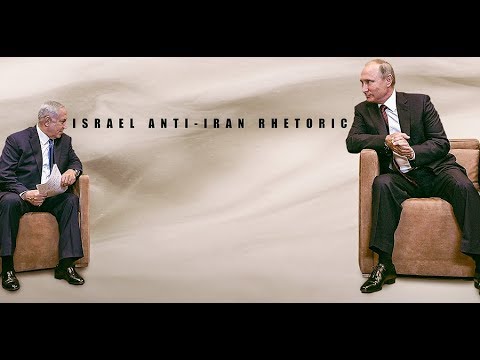
Prime Minister Benjamin Netanyahu has said that Israel felt threatened by Iran’s growing influence in the Middle East. Netanyahu expressed his Iranophobic view in a meeting with Russian President Vladimir Putin in Russia’s Black Sea resort of Sochi on Wednesday. Press TV has asked Scott Rickard, former American intelligence linguist from Tampa, Florida, and Brent Budowsky, a columnist at The Hill from Washington, to give their thoughts on the issue.
Rickard said Tel Aviv is concerned about the fact that the regime could not carry out its old project to spread sectarian divisions and pave the way for dismemberment of the countries in the Middle East region because of the Iranian-led resistance against Israeli policies, not only in the occupied territories of Palestine but also in the whole region.
“Iran is not a threat to Israel whatsoever. The threat that Israel sees is the fact that their Oded Yinon Plan is being put to a hold by Iran,” the intelligence linguist said on Thursday night.
“They (the Israelis) look at Iran as a threat only because they have no influence on their governments and Iran is autonomous and is not under the Zionist influence,” he added.
Since the victory of the Islamic Republic of Iran in 1979, Tehran has been critical of Israel’s policies in the region, whereas “no leaders [of other states] even dared to speak out against Zionism,” Rickard argued. … continue
This site is provided as a research and reference tool. Although we make every reasonable effort to ensure that the information and data provided at this site are useful, accurate, and current, we cannot guarantee that the information and data provided here will be error-free. By using this site, you assume all responsibility for and risk arising from your use of and reliance upon the contents of this site.
This site and the information available through it do not, and are not intended to constitute legal advice. Should you require legal advice, you should consult your own attorney.
Nothing within this site or linked to by this site constitutes investment advice or medical advice.
Materials accessible from or added to this site by third parties, such as comments posted, are strictly the responsibility of the third party who added such materials or made them accessible and we neither endorse nor undertake to control, monitor, edit or assume responsibility for any such third-party material.
The posting of stories, commentaries, reports, documents and links (embedded or otherwise) on this site does not in any way, shape or form, implied or otherwise, necessarily express or suggest endorsement or support of any of such posted material or parts therein.
The word “alleged” is deemed to occur before the word “fraud.” Since the rule of law still applies. To peasants, at least.
Fair Use
This site contains copyrighted material the use of which has not always been specifically authorized by the copyright owner. We are making such material available in our efforts to advance understanding of environmental, political, human rights, economic, democracy, scientific, and social justice issues, etc. We believe this constitutes a ‘fair use’ of any such copyrighted material as provided for in section 107 of the US Copyright Law. In accordance with Title 17 U.S.C. Section 107, the material on this site is distributed without profit to those who have expressed a prior interest in receiving the included information for research and educational purposes. For more info go to: http://www.law.cornell.edu/uscode/17/107.shtml. If you wish to use copyrighted material from this site for purposes of your own that go beyond ‘fair use’, you must obtain permission from the copyright owner.
DMCA Contact
This is information for anyone that wishes to challenge our “fair use” of copyrighted material.
If you are a legal copyright holder or a designated agent for such and you believe that content residing on or accessible through our website infringes a copyright and falls outside the boundaries of “Fair Use”, please send a notice of infringement by contacting atheonews@gmail.com.
We will respond and take necessary action immediately.
If notice is given of an alleged copyright violation we will act expeditiously to remove or disable access to the material(s) in question.
All 3rd party material posted on this website is copyright the respective owners / authors. Aletho News makes no claim of copyright on such material.

 Aletho News