Just Stop Oil funder Dale Vince is pressing ahead with plans to flood British primary schools with environmental and Net Zero societal propaganda. Children aged 11 and under are being taught that they face an unprecedented global climate emergency, with the possibility that the planet is entering a sixth mass extinction. The solution of course is “sustainability” and green energy, a matter that is dear to the heart of multi-millionaire Vince. His ageing onshore wind farm company Ecotricity has collected £110 million in green taxpayer subsidies over the last 20 years, at a time when he has pocketed at least £43 million in various corporate payments.
The Ministry of Eco Education (MEE) was started by Vince in 2021 with the stated aim of “greening up the curriculum”. From an initial base of 15 ‘pioneer’ schools, it is working to scale this up to 1,000. MEE operates by inserting its messaging into all aspects of primary learning including transport, energy, food, nature and society. It aims to “save teachers time”, and it claims to have “rearranged the national curriculum” around what it describes as big questions. MEE also claims to be working with secondary schools to adapt its primary approach to Key Stage 3.
Although few lesson examples are available on the MEE website, it is easy to piece together some of the ideas being taught. A lesson on veganism notes that industrial farming has negative impacts on the planet, but apparently “isn’t just about food”. Most of the sources quoted are little more than promotions for veganism with a link to a Guardian article explaining why vegans don’t eat honey. There does not appear to be any discussion about the wisdom of removing all types of animal protein from the diets of very young children, something that many scientists think should be done only under strict nutritional supervision.
The education leader of MEE is Paul Turner and a video is supplied of him talking to a group of young children in the Ecotricity tent at the Womad festival. Bouncing around a giant globe, he explains that the correct level of carbon dioxide in the planet is the ‘magic’ number of 360 parts per million (ppm). Quite how he is able to point to such a precise – if magical – figure to stop the climate changing is not explained. There are many eminent scientists who think it is a little on the low side for animal and plant life to prosper. Certainly, the children are not told the dinosaurs lived in a world of plant plenty at a time when CO2 levels were much higher. Turner, who is described by MEE as a “radical geographer”, tells the children that we need to “hoover” up all the gas, and on this front Dale is making a contribution.
In fact the current level of CO2 is around 420 ppm and recent increases are believed to have led to a dramatic 14% greening of the planet. Hoover up all this extra CO2 and veganism starts to seem an ‘unsustainable’ option. Remove nitrogen fertiliser from agriculture as many eco-extremists want and the consequent massive reduction in crop yields starts to look like mass famine.
But then it isn’t just about the planet is it? In a paper published by MEE titled ‘Foundations for an Eco Curriculum’, it is said that “we are increasingly recognising that any efforts to tackle climate and ecological emergency must also respond to the structural inequalities inherent in society”. Furthermore, “any eco school curriculum must explore ideas of social structures and processes as much as they do the natural environment, as well as exploring the intersection of ideas such as gender, race and inequality. From a young age, children are aware of injustice and can apply ideas of fairness and the environment.”
In other words, children can be caught young and brainwashed with horrific, largely unsubstantiated tales of climate and ecological collapse – a process they have no intellectual ability to question – and be marched towards a collectivist society where ruling elites remove many personal freedoms and lifestyle choices. Oh, and energy can be provided by useless windmills requiring enormous public subsidies by enlightened philanthropists such as Mr. D. Vince.
Needless to say, MEE is not the only green educational propogandist operating in the U.K. As the Daily Sceptic reported earlier this year, other elite money is pouring into British schools. London-based Climate Science aims to supply free teaching materials, with children encouraged to plot implausible temperatures rises of 11°C, taught that alkaline oceans are ‘acidic’ and write letters to policymakers claiming “our house is on fire” in the style of Greta Thunberg. Among the billionaire backers are Schmidt Futures – the family foundation of former Google boss Eric Schmidt – and the Grantham Institute at Imperial, partly funded by green billionaire investor Jeremy Grantham.
MEE is also involved with the Young Green Briton Challenge, which has also attracted the ambassadorial support of TV activist Chris Packham. The new scheme operates on a Dragons’s Den format with 16 schools competing to win a £1,000 stake for a green project. Recently, Packham gave his backing to eco-protesters breaking the law and suggested that a “radical flank” could attempt to blow up oil refineries. For his part, Vince has given hundreds of thousands of pounds to Just Stop Oil, a group that engages in civil disobedience and criminal damage.
OTTAWA, Ontario –– Conservative Party of Canada MP Leslyn Lewis has endorsed an official House of Commons petition demanding the nation’s federal government “urgently” withdraw from the United Nations and its subgroup, the World Health Organization (WHO), due to the organizations’ undermining of national “sovereignty” and the “personal autonomy” of citizens.
“We, the undersigned, Citizens and Residents of Canada, call upon the House of Commons in Parliament assembled to Urgently implement Canada’s expeditious withdrawal from the U.N. and all of its subsidiary organizations, including WHO,” reads the petition, which was initiated by Doug Porter from Burnaby, British Columbia, and then endorsed by Lewis.
As of press time, the petition, which was opened on October 10, has just over 36,000 signatures. It will remain open for signing until February 7, 2024.
The petition states that Canada’s current membership in the UN along with the WHO has resulted in “negative consequences on the people of Canada,” which far outweigh “any benefits.”
Additionally, the petition reads that the UN’s “Agenda 2030″ undermines “national sovereignty and personal autonomy.”
Many of Prime Minister Justin Trudeau’s federal government goals, notably its environmental ones, are in lockstep with the United Nations’ “2030 Agenda for Sustainable Development.”
Agenda 2030 is a plan that was adopted by the UN General Assembly in 2015, and through its 17 Sustainable Development Goals (SDGs), seeks to “transform our world for the better,” by “taking urgent action on climate change,” as well as “support[ing] the research and development of vaccines and medicines.” Some of the 17 goals also seek to expand “reproductive” services, including contraception and abortion, across the world in the name of women’s rights.
According to the UN, “all” nations working on the program “will implement this plan.”
Part of the plan includes phasing out coal-fired power plants, reducing fertilizer usage, and curbing natural gas use over the coming decades. Canada is one of the world’s largest oil and gas producers, however, Trudeau has made it one of his goals to decimate the industry.
In a blow to the globalist UN agenda, however, Canada’s oil and gas sector recently scored a huge win after the Supreme Court of Canada declared Trudeau’s government’s Impact Assessment Act, dubbed the “no-more pipelines” bill, is mostly “unconstitutional.”
As for Lewis, she is pro-life and has consistently called out the Trudeau government for pushing a globalist, anti-life agenda on Canadians.
Early this year Lewis noted that the World Economic Forum (WEF) is “not our government” and that Canadians did not “sign up” to be attached to one of its charters. Lewis herself helped expose Canadians to the fact that Trudeau’s Liberal government signed onto the WEF charter in 2020.
Petitions to Canada’s House of Commons can be started by anyone but must have the support of five Canadian citizens or residents, along with the support of a sitting MP.
Once a petition has over 500 verified signatures, it is presented to the House of Commons, where it awaits an official government response.
Petition calls out UN’s sex-ed programs, saying Canadians did not vote for these to be pushed on kids
The Lewis-backed petition states that Canada should have nothing to do with the UN’s sexual education programs as they have been pushed on the populace without the “consent” of the people.
The petition reads that Agenda 2030’s SDGs, as well as its “Comprehensive Sexuality Education (CSE)” program, its UN Judicial Review, and its International Health Regulations (IHR) are being “rapidly implemented,” with the absent awareness and “consent of the People or their elected representatives.”
The petition reads that SDGs have “negative impacts on potentially every aspect of life,” in Canada, including “religious and cultural values, familial relations, education, nutrition, child development, property rights, economic and agricultural productivity, transportation, travel, health, informed consent, privacy and physical autonomy.”
When it comes to the UN’s CSE, the petition states that publicly funded educational institutions have been “damaging children while concealing information from parents.”
As a result, the CSE’s “normalization” of “sexual values and activities with regard to children are endorsed and enforced, beginning at birth.”
As for the WHO, it claims that the CSE gives kids “accurate, age-appropriate information,” however it then says sexual education should start at the age of 5 as per UN guidelines.
“Learning is incremental; what is taught at the earliest ages is very different from what is taught during puberty and adolescence,” reads the CSE.
A report which was published by the UN’s Educational, Scientific and Cultural Organization, in collaboration with the WHO, told kids aged 5 to 8 that “people can show love for other people through touching and intimacy.”
UN’s health regulations look to violate Canadians’ charter rights, says petition
The petition notes that when it comes to Agenda 2030, many amendments to the International Health Regulations (IHR) were “secretly negotiated,” which as a result means they could “impose unacceptable, intrusive universal surveillance, violating the rights and freedoms guaranteed in the Canadian Bill of Rights and the Charter of Rights and Freedoms.”
Lastly, the petition states that the UN’s goals intend to impose “sweeping impacts on public and private life,” and only “serve the interests of UN/WHO and unelected private entities (e.g. World Economic Forum, Bill and Melinda Gates Foundation, International Planned Parenthood Federation, etc.), while diminishing the health rights and freedom of Canadians.”
The WHO says that the IHR is a legally binding international body to which all UN members are committed to.
Lewis has before blasted Canada’s involvement with the IHR and insisted last year that the Canadian government “defend our healthcare sovereignty” and vote against proposed U.S. amendments to the the IHR.
The WHO’s IHR provides an “overarching legal framework that defines countries’ rights and obligations in handling public health events and emergencies that have the potential to cross borders.”
“The IHR are an instrument of international law that is legally-binding on 196 countries, including the 194 WHO Member States,” notes the WHO.
So far this year, there have been more than 300 proposed amendments to the IHR when it comes to the declaration of a Public Health Emergency of International Concern.
Lewis recently called out the proposed amendments, saying that if enacted it would negatively affect how Canada deals with any future health crisis.
On September 26, she presented to the House of Commons a petition specific to the IHR, which called for “urgent” debates on the amendments.
Critics have sounded the alarm over the Trudeau government’s involvement in the WEF and other globalist groups, pointing to the socialist nature of the “Great Reset” agenda and its similarities to Communist China’s totalitarian Social Credit System.
Lewis in June of this year had asked for a full disclosure of all “contracts, transfer payments, memoranda of understanding, letters of intent, charters, accords, projects and associations between the government and the WEF since November 4, 2015.”
The outcomes from the Order Paper resulted in a 127-page response that was tabled in the House of Commons on September 18.
Lewis has in the past blasted the WEF and its Known Traveller Digital Identification (KTDI) programs as “glitching failures.”
It’s all a big ‘conspiracy theory’ that by 2050 we shall be living in mud and grass huts, eating a meat-free diet and giving up most forms of personal transport. Maybe we might not believe it if global elites stopped writing copious reports detailing all these lifestyle changes, which are said to be needed to move to Net Zero. The latest such report comes from the United Nations, which sets out a collectivist global vision of primary building materials consisting of mud bricks, bamboo and forest “detritus”.
According to the UN, the world needs to move to “regenerative material practices” using “ethically produced” low carbon earth and bio-based building materials. Examples include mud bricks, timber, bamboo and agricultural and forest detritus. The report harks back to the middle of the last century when the vast majority of cultures built large buildings and cities out of indigenous earthen, stone and bio-based materials, including timber, cane, thatch and bamboo. Contrasting modern concrete, steel and glass buildings, it observes that “massive mud buildings have been maintained for centuries with their structures intact”.
The UN’s recently published report, ‘Building Materials and the Climate: Constructing a New Future,’ draws on a wide variety of international authors. Heavily involved are Yale University and the Global Alliance for Buildings and Construction, the latter operation drawing financial support from the green activist Laudes Foundation and the British Government. The report is one of a number that have appeared recently that have started to lay out the hard changes that will need to be made in less than 30 years if 80% of the world energy produced by fossil fuel is banned under Net Zero. The construction sector is said to account for 37% of human-caused emissions of gases such as carbon dioxide. Making progress on reducing this will require drastic measures with the report stating that materials such as concrete, steel and aluminium will be used only when “absolutely necessary”.
War on modern building materials has also been declared by U.K. FIRES, an academic collaboration funded with a £5 million state grant. It has called for a ruthless purge of traditional building supplies, to be replaced with materials such as “rammed earth”. In other reports, U.K. FIRES promotes a world with no flying and shipping by 2050, drastic cuts in home heating and bans on beef and lamb consumption. As we have noted in the Daily Sceptic, U.K. FIRES bases its recommendations on the brutal, and many would argue honest reality of Net Zero. It does not assume that technological processes still to be perfected, or even invented, will somehow lead to minimal disturbance in comfortable industrialised lifestyles.
The latest UN report, along with U.K. FIRES, gives a valuable insight into the fantasy thinking surrounding the belief that oil and gas can be removed from industrial society. Clever people can often be very stupid, especially when group-think takes hold and ‘high status’ opinions – in this case surrounding environmentalism – are required to join the club. Net Zero mandates the dismantling of modern industrial society and the discarding of many of the essentials of modern comfortable living. Using flawed, unproven science, these high-status elites have convinced themselves that the climate is collapsing. Those who know their religious history observe doomsday cults emerging in every era, demanding sins should be purged, and human pleasures placed on strict, supervised ration.
It will hardly be a surprise that the UN buildings report is riven with demands for legislative action and the use of other people’s money to enforce its crackpot schemes. Government “incentives, awareness campaigns and legal and regulatory frameworks” are said to have been effective in previous recycling schemes. “Recycling systems for building materials tend to require similar kinds of support across countries,” the report states. It need hardly be noted that “far more investment” is required for measures that ensure cooperation across sectors and borders. Due to the complexity of what is being proposed, “regulation and synergistic enforcement is required across all phases of the building life cycle, from extraction through to end-of-use.”
Needless to say, when re-ordering the lifestyles of eight billion people around the world, it is important to tackle gender bias wherever it is found – in this case, “formal and informal building sectors.” Gender bias is said to be prevalent across the building trade and in emerging economies. Government programmes (quelle surprise) and policies are needed to expand women’s access to new technologies, marketing information and training to sustain their participation on the ground, the report states.
The biggest muddle however arises from the use of sustainable materials, most of which are grown in the ground. That would be the planned agriculture sector that another elite body is busy arguing should be cut back for re-wilding, another group of elite idiots arguing for nitrogen fertiliser to be banned leading to a 50% reduction in crop growth, another bunch of bright sparks demanding more land for bio-fuels and plant-based diets… to be continued.
Chris Morrison isthe Daily Sceptic’s Environment Editor.
Suddenly out of nowhere the population and politicians of Wales are shocked that a 20mph speed limit has been imposed across much of the country.
In fact it has been in the making for many years, since at least 2010, when the UN’s little-known Economic Commission in Europe (UNECE) held a workshop to ‘raise awareness about the important challenges that climate change impacts and adaptation requirements present for international transport networks . . . The workshop highlighted that while transport is responsible for greenhouse gas emissions it is, at the same time, heavily affected by the impacts of climate change. This workshop demonstrated the urgent need to prepare appropriate policy actions.’
In Wales it has been discussed since at least 2020 with a survey of 1,002 people which has been used to justify the policy.
The report begins: ‘The Welsh Government plans to introduce legislation in 2023 which will reduce the speed limit from 30 mph to 20 mph in residential communities across Wales.’
In July 2021 a public consultation was launched. Just over 6,000 responses were received, with 47 per cent in favour of reducing the speed limit and 53 per cent against it. Feedback from a number of organisations in Wales was submitted, with 22 out of the 25 supporting the proposed reduction in speed limit. Notice the big difference in attitude between the response from individuals and the organisations? What were these organisations? What were the responses for and against given by individuals? We don’t know.
The legislation was voted through in the Welsh Assembly/Senedd in July 2022. A Welsh Government press release trumpeted: ‘Wales becomes the first UK nation to make the move – helping to save lives, develop safer communities, improve the quality of life and encourage more people to make more sustainable and active travel choices.’ https://www.gov.wales/uk-first-welsh-senedd-gives-green-light-20mph-legislation
So were the politicians who now oppose the legislation asleep? Absent? Not paying attention? Not interested? Happy with it until the recent furore and uproar kicked off? My guess is the latter.
But there is more to it than simply the Welsh Assembly/Senedd introducing the policy. The question to ask is ‘Why are Wales and many other countries introducing a policy being pushed by the UN’s World Health Organization backed by various NGOs?’
Yes, the very same WHO trying to push through the pandemic treaties and the very same NGOs behind a lot of the turmoil in recent years. Here is the WHO’s low speed campaign launch.
There are many, many more documents on the same lines. They explain HS2, SMART motorways, ANPR cameras everywhere, 20 mph speed limits and road pricing, which is mentioned frequently. Like many other policies – 15-minute cities, low traffic neighbourhoods, low emission zones, electric vehicles, renewable energy, man-made global climate change, Covid, to name a few – it’s all one big circle of politicians, civil servants, activists and the media all quoting each other.
Everything seems to be an integral part of the sustainable development and Great Reset agendas.
Surprised?
I’m not any more now I can see the Big Picture and where it leads.
It’s like one big Gordian Knot of intertwined policies that are designed to ensnare and enslave us while proclaiming it will enhance our physical and mental wellbeing, make us safer, happier, healthier and so on and on and on.
Alexander the Great solved his Gordian Knot dilemma – he chopped it in half with a sword. Time for us to do something similar to all these intertwined polices getting closer.
My substack posts on the subjects are here, here and here.
It has been claimed by the Fire Service that the fire started on a Range Rover diesel, but experts are dismissive of this.
For instance, AA technical expert Greg Carter said the most common cause of car fires is an electrical fault with the 12-volt battery system. But he added that diesel is “much less flammable” than petrol and in a car it takes “intense pressure or sustained flame” to ignite diesel.
Regardless of the initial cause, it is difficult to see how the fire could have spread so rapidly without EVs being involved. According to Andy Hopkinson of the Bedfordshire Fire Service, within ten minutes, the fire had already spread across a “large number of vehicles and a number of floors”.
Can anyone honestly remember such a fire in a multi-storey car park before?
We should not regard it as a coincidence that Sydney Airport had its own electric car fire in its car park just a month ago:
We’ll have to wait for the facts to emerge in due course to find out what caused the fire in the first place.
But the explosions reported, the collapse of the floor and the speed at which the fire spread certainly raise the suspicion that one or more EVs were involved.
Even if not, we do know that a car park full of EVs, which will be the case in a few short years time, would be lethal in the event of a fire.
Just imagine an underground car park beneath a block of flats.
Until the full facts emerge, EVs should be banned immediately from all multi-storey car parks.
The penny is finally starting to drop. Current batteries cannot possibly store more than a fraction of the energy needed to keep the lights on when the wind stops blowing and the sun doesn’t shine. The learned U.K. Royal Society has recently analysed 37 years of wind patterns across Britain and concluded there is a serious underestimate of the amount of storage required. Around 50 academics and specialists led by Professor Sir Chris Llewellyn Smith of Oxford University state clearly that batteries are not the answer to the vast storage required. But like many learned people, wedded to the idea that it is possible to remove the fossil fuel source supplying 80% of the world needs in less than 30 years, they fall down at the practical level. Having lost batteries, the study goes for hydrogen, an idea only slightly less dumb than digging up the planet to produce vast quantities of limited-life batteries.
The Royal Society report envisages dissolving huge salt caverns capable of storing ‘green’ hydrogen. To keep the electricity grid functioning when renewables go off line, around two to three million tons of hydrogen would need to be stored for decades at a time. Wind not only stops for days during periods of intense cold in winter, but the Royal Society found recent periods when speeds were low for a number of years. Salt caverns are only available in a limited number of places in Britain, so a huge network of specialist pipelines would be needed to move the gas to turbines on constant standby. Over a period of time, hydrogen would leak from porous salt caverns.
The report, lacking a practical answer to wind and solar intermittency, seems to have been ignored by mainstream media. The news that batteries cannot play any significant part in the collectivist Net Zero project is unwelcome to those who have been betting the ranch on this solution for many years. Francis Menton of the Manhattan Contrarian sees the report as an “enormous improvement” on every other effort on the subject of large scale energy storage systems. But in the end, the authors’ “quasi-religious commitment” to a fossil-free future leads them to minimise and divert attention away from critical cost and feasibility issues. “As a result, the report, despite containing much valuable information, is actually useless for any public policy purpose,” he concludes.
What are the problems with hydrogen? Where to start. It is a highly explosive and flammable gas that needs careful handing. Its molecules are small and it has a low density. This means it escapes easily, while three times the volume of hydrogen is required to produce the same energy as natural gas. Kathryn Porter is an energy consultant and an associate member of the All-Party Parliamentary Group. She recently wrote an article in the Daily Telegraph about the gas and its possible role in Net Zero.
Hydrogen is also hard to move around. To get the gas to move through pipes, it has to be compressed and pushed along using compressors. This process requires energy: the losses in moving hydrogen through pipes are ten times greater for hydrogen than for methane; up to 30%. In other words you need to use up almost a third of your gas just moving it from A to B. …
The infrastructure for hydrogen does not exist, neither for the most part do the production facilities and they will cost billions to build. Then the underlying cost of storing hydrogen is probably at least four times that of storing methane. Huge amounts of energy are lost in each stage of the process due to the fundamental properties of hydrogen.
As a solution to storing renewable power, Porter is of the view that “hydrogen is one of the worst substances you could choose for this purpose”. But, she adds, because you can burn it in air without creating carbon dioxide, “it has been hailed as the answer to Net Zero dreams”. Both carbon capture and hydrogen are “square pegs” which people are desperately trying to force into round holes. It might be noted, in the light of this last comment from Porter, that the Royal Society traces its roots back to 1660, and published Sir Isaac Newton’s Principia Mathematica. Its politicised track record on Net Zero has yet to live up to the highlights of its glorious past.
Lead author Sir Chris Llewellyn Smith notes that the need for long-term energy storage in a renewable electricity system has been seriously underestimated, and work on constructing storage caverns needs to be started immediately if the Government is to have any chance of meeting its Net Zero targets. Construction of a large green hydrogen production and storage facility would appear to be a “no-regrets” option, he claims.
Someone regretting the option might be the consumer. Francis Menton observes that the Royal Society’s hydrogen plans suggest a cost “to the grid” of around £120 per MWh, a figure described as high but not stratospheric. But this is the wholesale cost, not the one charged to the consumer. In addition, Menton wants to know how much a nationwide set of new pipes will cost, plus the entire new fleet of standby turbines capable of burning 100% hydrogen and providing all the power to the grid when renewables stop working. In addition, Menton notes a “low” rate of interest for capital costs of 5%.
“The whole thing just cries out for a demonstration project to prove feasibility and cost. I’m betting that will never occur before the whole Net Zero thing falls apart from the disastrous skyrocketing electricity prices,” concludes Menton.
Menton sees some honesty in the Royal Society report. But as regular readers will probably agree, the top award for an honest Net Zero commentary goes to the U.K. Government-funded U.K. FIRES project. In looking at a 2050 Net Zero world, this group of academics ignore as speculative all non-scalable suggestions around carbon capture and hydrogen, along with all the green inventions yet to be made. They point to a future with barely a quarter of our current energy supply. There is nothing more honest than telling people that this will entail no flying or shipping, drastic cuts in home heating, limited transport, no meat, few modern building materials and houses made of “impacted” earth. Worryingly, though, there’s no indication the authors see this as a reason not to go full steam ahead.
Chris Morrison isthe Daily Sceptic’sEnvironment Editor.
Something strange happened last week: the Guardian published an article which was worth reading. It concerned the massive insurance costs owners of electric vehicles (EVs) are facing.
Here’s how the article started: ‘Driving an electric car should be a win-win, saving money and the planet. So David was shocked when the insurance on his Tesla Model Y came up for renewal, and Aviva refused to cover him again, while several other brands turned him away. When David did secure a new deal, the annual cost rocketed from £1,200 to more than £5,000.’
It went on: ‘A recent cost of living bulletin from the Office for National Statistics revealed that the price of car insurance – which for many Britons is one of their biggest household bills – is up by 52.9 per cent in the last 12 months. However, this average masks bigger increases for electric car owners, according to Confused.com. Its figures, derived from quotes, show that insurance premiums for electric vehicles are 72 per cent – or £402 – higher than this time last year, at a typical £959. Meanwhile, for petrol and diesel car drivers, the increase is 29 per cent, or £192, taking the figure to £848.’
Moreover, several insurance companies are simply refusing to insure EVs.
The problem seems to be the fragility of EV batteries and the enormous cost of replacing them if you have even just a small bump. As one reader explained:‘If I kerb bump my £4,000 diesel Renault Megane at 4mph it’s a £50 wheel re-alignment at the next service. If a £50,000 EV does the same, it’s potentially a slightly damaged battery and 100 per cent write off. They’re rubbish’.
You might think: ‘Why should I care since I don’t drive an EV?’ Well, when the politicians see that high insurance costs are putting people off buying the EV which they are determined to push on us, they’ll yet again attack petrol and diesel car owners.
A few years ago the EU insisted that young male drivers could not be charged higher car insurance premiums than young female drivers, notwithstanding the major difference in risk. The European Court of Justice ruled that taking gender into account when calculating car insurance premiums violated EU gender equality legislation. Regulations banning the practice came into effect in December 2012 and remain in force in the UK although we’ve since left the EU.
I predict that charging EV drivers more than ICE (Internal Combustion Engine) drivers, will also be outlawed. So there will be a massive rise in motor insurance costs for drivers of ICE cars. Maybe our rulers will even decide that, as EV drivers are dutifully (and expensively) saving the planet while ICE drivers are supposedly intent on destroying it, perhaps EV drivers may be relieved of paying more than a small nominal charge for insurance and therefore must be subsidised almost entirely by ICE drivers. I’m not betting against it.
Campaign group Net Zero Watch has condemned Government plans to move renewables levies onto gas users.
Speaking at the Conservative Party conference in Manchester, energy minister Lord Callanan announced a consultation on what he euphemistically called ‘rebalancing’, forcing gas users to pay part of the cost of the UK’s grossly inefficient renewables. The Government hopes that this will make heat pumps and other electric technologies more viable.
Net Zero Watch director Andrew Montford said:
“Trying to force up gas bills at a time when people are already struggling to heat their homes is shameful. It will cause a public health crisis. Callanan is utterly callous, but climate extremists only care about their targets, and not whether Granny is going to freeze to death in winter.”
Mr Montford says that it is not clear that moving the levies, running at around £7 billion per year, will be enough to make heat pumps viable, and secondly because if it is, it can only temporarily hide the costs: if gas boilers become a thing of the past, the cost of the levies will have to return to electricity users.
Net Zero Watch energy director Dr John Constable said:
“Using heat pumps in a wind and solar powered grid is going to be expensive; putting a surcharge on gas to deny people a cheaper and reasonably clean alternative is cruel.”
And Mr Montford warned:
“Rishi Sunak has said that successive Governments have deceived people over the cost of Net Zero, but here is the Green Blob in his own party – one of his own ministers no less – launching a shameless confidence trick on the public at large. How can the Prime Minister let them get away with it?”
Deaths from cold in winter far outnumber deaths from heat in summer, and fuel poverty is a significant contributory factor. Moving green levies to gas bills will therefore exacerbate a problem that is already serious.
Further devastating evidence of the toll that onshore wind turbines take on local eagle populations has emerged in Tasmania. The local Wedge-tailed eagle is thought to be down to just 1,000 individuals, but over the last 12 years at least 270 birds have been killed or injured in the vicinity of wind farms. According to a recent paper in Australian Field Ornithology, a further 49 vulnerable White-bellied sea eagles have also been killed in this period.
The scale of depredation is shocking but it could be much worse than reported. According to author Gregory Pullen, information about eagle deaths is not readily available, “nor readily made available”. His calculations arise from a number of primary sources including annual reports. He suggests that unrecorded casualties are higher since most are recorded anecdotally and are not the result of systematic survey. The Tasmanian sub-species of the Wedge-tailed eagle is listed as endangered under both federal and state threatened species legislation.
Large birds of prey such as eagles are at particular risk from giant wind turbine blades revolving at speed since they rely on air currents for sustained flight. The Daily Sceptic has covered this developing story, noting that few activists, bird conservation groups and writers seem able to rouse themselves to complain when the natural flight path of raptors stands in the way of green progress. The Australian climate journalist Jo Nova has stood out from the unquestioning crowd, noting that in Tasmania the greens are destroying nature – again. “It’s not about the environment is it,” she said. She went on to add that there are plans to build up to 10 wind turbine parks across Tasmania – “and if one tower misses, the next will get them”.
It’s not really about the environment over in California either, where America’s national bird, the bald eagle, and many other raptors face mass slaughter in the local wind farm avian graveyards. This follows the state Democrat-controlled legislature’s recent decision to relax controls on wildlife protections to allow permits to kill previously fully protected species for renewable energy and infrastructure projects. However, evidence continues to emerge that the slaughter has been going on for years. Last year, NextEra, one of America’s largest utility companies, was fined $8 million after 150 eagles were killed at its wind farms across eight states. According to the Golden Gate Audubon Society, a wind farm complex in Altamont has been killing 75-100 golden eagles every year since the 1980s.
The animal slaughter does not stop at large birds of course. A number of scientific studies have point to the destruction of millions of bats and smaller birds every year by turbine blades capable of travelling at the tip at speeds approaching 150mph.
Alas, it is not as if the deaths of these wildlife green martyrs are helping to produce much worthwhile economic activity. In the U.K., the small number of jobs being produced by green technologies is starting to be noticed. Gary Smith, the leader of Britain’s largest trade union, recently said that communities along the North Sea can see wind farms, “but they can’t point to the jobs”. Possibly exaggerating to make his point, he added that much of the green work seems to be either London-based lobbying or clearing away the animal casualties of wind farm blades. “It’s usually a man in a rowing boat, sweeping up the dead birds,” he observed.
Green activists are increasingly being caught between a rock and a hard place on these impact issues. It is becoming obvious that many of the green technology solutions proposed to replace fossil fuels come with heavy environmental costs. Whether it be open cobalt mining with child labour, or digging up vast quantities of the Earth’s crust to help construct second-rate solutions such as windmills, the terrible impact is all too obvious. At the moment the typical stance seems to be that voiced by Audubon California Policy Director Mark Lynas, who said we need renewable energy resources, and he did not want to see the eagle deaths “being used to push against clean energy”.
Another area where ecology fights are breaking out is on the east coast of America, where whales are beaching on the shores of New Jersey and New York in alarming numbers. In the first half of this year over 40 whales have died in this way. Large areas of the local ocean are being turned into industrial wind parks, with particular concern arising over 24-hour sonar soundings. The veteran environment campaigner Michael Shellenberger has said the massive offshore works are wreaking environmental damage in previously pristine waters. “It’s the biggest environmental scandal in the world,” he charges.
The waters off the U.S. east coast are important feeding and breeding grounds for large mammals such as whales and dolphins, including the rare North Atlantic right whale. Shellenberger has recently produced a documentary called Thrown to the Wind which presents evidence of whales hit by ships, and high decibel sonar that is said to separate mothers from their calves, sending them into harm’s way. The film shows environmentalists checking the sonar which is said to measure 150 dBs at sea – equivalent to about 90 dBs on land. The noise is a relentless drum beat that is said to pound across the ocean throughout the day and night. On land, the sonar noise would be equivalent to a hairdryer. For humans, prolonged noise much above 70 dBs may start to damage hearing.
The film makes the point that serious pile-driving to secure the giant turbines to the sea floor has yet to start in earnest. Once built there is a danger that the huge back wash created by the giant blades will disturb and kill off plankton, destroying the food supply for the whales.
It must be noted that many interested parties dispute the claims currently being made about wildlife in the new oceanic industrial parks springing up with generous subsidies from the Biden Administration. Both sides can marshal their arguments and evidence. But at the moment, the deck is rigged in favour of the green lobby. Fracking for oil and gas was banned in the U.K. with Friends of the Earth presenting evidence of local earthquakes similar in force to someone falling off a chair. It is more than likely that multiple eagle deaths would be enough to stop the operation of any oil and gas installation. Seemingly, it will take more than a mere rowing boat full of protected but very dead birds to stop the new Green Barons.
Chris Morrison isthe Daily Sceptic’sEnvironment Editor.
If you want to power our modern economy on intermittent renewables (wind and solar), and also banish the use of power from fossil fuels and nuclear, then the only option remaining to make the grid work reliably is energy storage on a massive scale. And then it turns out that energy storage on the scale needed is enormously costly — almost certainly so costly that it will in the end sink the entire “net zero” project.
Failure adequately to address the energy storage problem is the fatal defect of nearly all “net zero” plans that are out there. For an example of a thoroughly incompetent treatment of this problem, you might look at New York’s so-called “Scoping Plan” for its mandated “net zero” transition. This Scoping Plan was issued quite recently in December 2022. As examples of its stunning incompetence, it almost entirely discusses the storage problem in the wrong units (watts versus watt-hours), and regularly posits the imminent emergence of magical “dispatchable emissions-free resources,” that have not yet been invented, to cover the gaps in wind and solar generation. The people who issued this Plan have no idea what they are doing, and are setting up New York for an energy catastrophe some time between now and 2030.
But now along comes a report from Royal Society addressing this energy storage problem in the context of Great Britain. The Report came out earlier this month, and has been brought to my attention by my colleagues at the Global Warming Policy Foundation. The title is “Large-scale energy storage.”
Having now put some time into studying this Report, I would characterize it as semi-competent. That is an enormous improvement over every other effort on this subject that I have seen from green energy advocates. But despite their promising start, the authors come nowhere near a sufficient showing that wind plus solar plus storage can make a viable and cost-effective electricity system. In the end, their quasi-religious commitment to a fossil-fuel-free future leads them to minimize and divert attention away from critical cost and feasibility issues. As a result, the Report, despite containing much valuable information, is actually useless for any public policy purpose.
On the plus side of the ledger for this Report, the authors use the correct units to calculate the amount of energy storage needed to back up intermittent wind and solar generation; and their arithmetic appears correctly done as far as I have checked. Also a plus is that it takes them almost no time to conclude that there is essentially no possibility that battery technology will ever be able to solve the energy storage problem for a nation’s grid powered by intermittent sources, no matter how much the technology may improve and no matter how much its costs may decrease.
But then there are the negatives. The authors share the conceit of all green energy advocates — and of all central planners everywhere — that their models and projections have anticipated all costs and problems of their massive schemes. And thus, they think, they know all the answers to how this will work, and can dispense with the tiresome need for any physical demonstration project to prove function and cost. And then there is the discussion, or lack thereof, of ultimate cost to the consumer of these grand plans. The treatment of this subject is inadequate, and characterized by what appears to be an effort to divert the reader’s attention from the subject before too many questions are asked.
But let’s start with some pluses. This is from the “Major conclusions” section of the Executive Summary, page 5:
Wind supply can vary over time scales of decades and tens of TWhs of very long- duration storage will be needed. The scale is over 1000 times that currently provided by pumped hydro in the UK, and far more than could conceivably be provided by conventional batteries.
Go to the body of the Report, and you find that the authors have collected data on generation from wind and solar sources Great Britain over a 37 year period, 1980-2016. Those data show that the intermittency problems of wind and solar generation are far worse than even I had thought. In additional to diurnal and even annual cycles, there prove to be periods of relatively low wind that can persist literally for years. To deal with such situations requires putting huge amounts of energy in storage and then keeping it there for years, maybe decades, in anticipation of these low wind years.
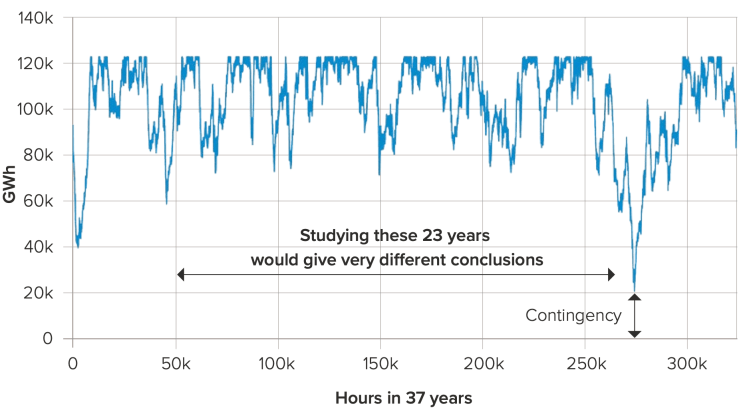
Here is one of my favorite charts from the Report. It depicts the storage balance in a hypothetical 123,000 GWh storage facility for Great Britain over the 37 year period 1980 to 2016. The storage balance never goes much below about 80,000 GWh during the 23 year period 1984 to 2006 — which might have led the incautious to conclude that about half as much storage would be sufficient. But then there was a big low-wind period from 2009-2011:
The authors describe the situation as follows (page 31):
Figure 13 exhibits two striking features. First, a study of the 23 years 1984 – 2006 would have found a storage volume very much smaller than found by studying 1980 – 2016. Second, there is a very large call on storage in the period 2009 – 2011 which reflects persistently low wind speeds that lead to the large deficits seen in figure 2 (some of the energy that fills these deficits would have been in the store since 1980). These features reinforce the conclusion that it would be prudent to add contingency against prolonged periods of very low supply and the possible greater clustering of 2009 to 2011-like years.
As a result of observations like this, the authors, I think correctly, conclude that batteries are completely out of the question to solve this problem. The only storage medium that could conceivably work would be a combustible chemical substance that can be put in massive underground facilities for decades. Only two possibilities are out there — hydrogen and ammonia. And ammonia is far more expensive and far more dangerous. So that leaves hydrogen.
Since hydrogen is the one and only possible solution to the storage problem, the authors proceed to a lengthy consideration of what the future wind/solar/hydrogen electricity system will look like. There will be massive electroayzers to get hydrogen from the sea. Salt deposits will be chemically dissolved to create vast underground caverns to store the hydrogen. Hydrogen will be transported to these vast caverns and stored there for years and decades, then transported to power plants to burn when needed. A fleet of power plants will burn the hydrogen when called upon to do so, although admittedly they may be idle most of the time, maybe even 90% of the time; but for a pinch, there must be sufficient thermal hydrogen-burning plants to supply the whole of peak demand when needed.
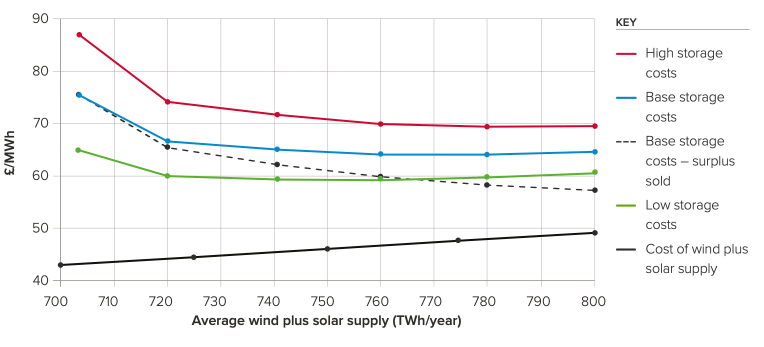
I find the treatment of the potential cost of all of this to be totally inadequate. There is never a mention of the most relevant subject, which is how much electricity prices to consumers might increase. The closest thing I find is this chart on page 32:
This is cost “to the grid,” thus wholesale cost. Will there be a huge multiplication of final price to the consumer? At first glance this doesn’t look too bad. About 50 pounds/MWh for the wind/solar input, and then 60-70 pounds/MWh for the storage makes about 110-120 pounds/MWh total. Add about 33% to convert to dollars, and you would have about $143-156/MWh, or 14.3 to 15.6 cents per kWh. It’s high, but not completely in the stratosphere.
But wait a minute. Are these guys leaving anything out?
How about the new network of pipelines to transport the hydrogen all over the place?
How about the entire new fleet of thermal power plants, capable of burning 100% hydrogen, and sufficient to meet 100% of peak demand when it’s night and the wind isn’t blowing.
They use a 5% interest rate for capital costs. That’s too low by at least half — should be 10% or more.
And can they really build all the wind turbines and solar panels and electroayzers they are talking about at the prices they are projecting?
The whole thing just cries out for a demonstration project to prove feasibility and cost. I’m betting that that will never occur before the whole “net zero” thing falls apart from the disaster of skyrocketing electricity prices. Time will tell.
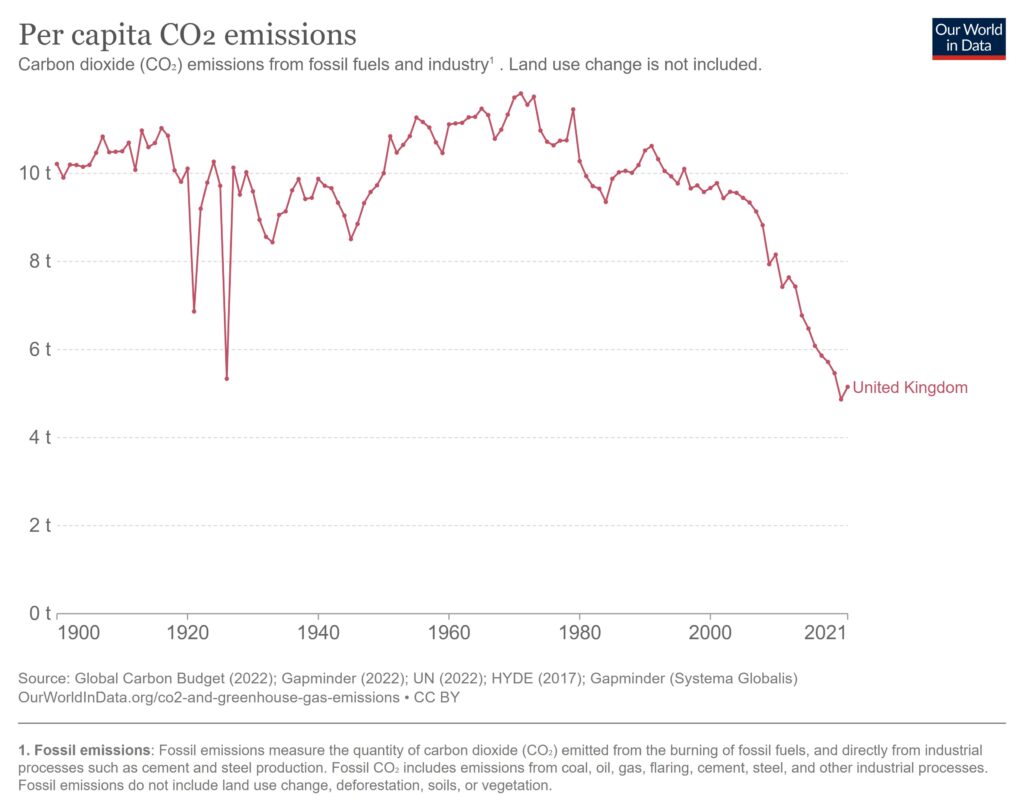
As our leaders bicker over how fast Britain should get to Net Zero, you’ll hear politicians, eco-zealots and media pundits claiming that Britain is leading the world in reducing our country’s CO2 emissions. This is one of the few statements about climate made by our ruling elites which does actually appear to be true. Since 1990, Britain’s CO2 emissions have almost halved from 604 million metric tons to just under 350 million tons by 2022. That equates to a drop from 10 metric tons per capita in 1990 to below five tons per capita:
While celebrating this great supposed ‘success’, our politicians, media and eco-activists often seem less keen to explain how this reduction in CO2 emissions was achieved.
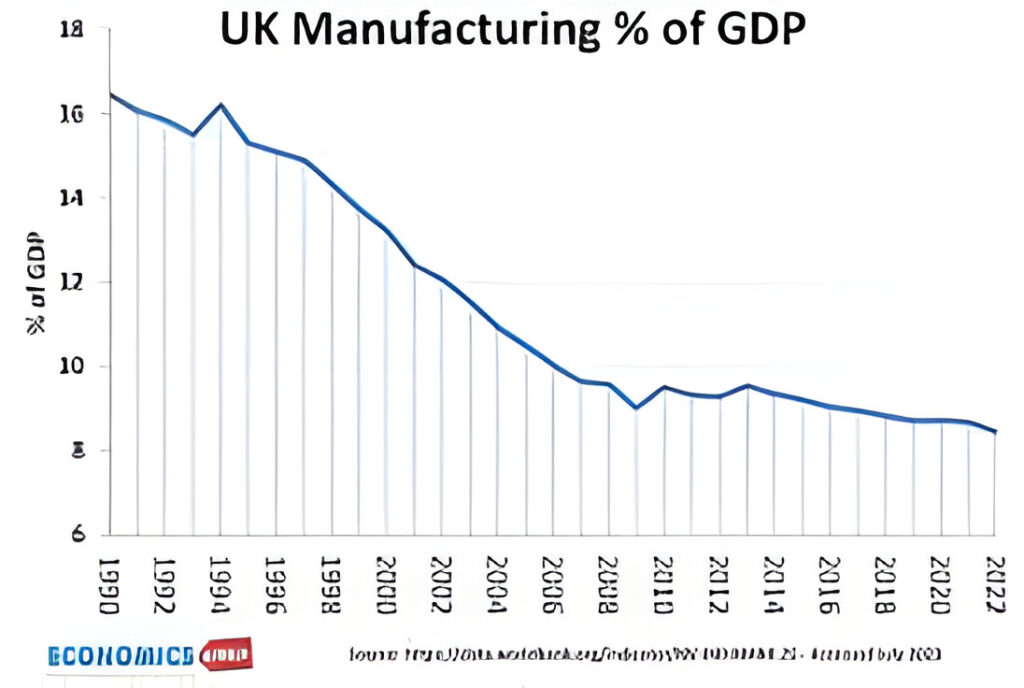
Here’s another chart. It shows the share of the U.K.’s GDP made up by manufacturing:
Since 1990, the year U.K. CO2 emissions started falling, the percentage of U.K. GDP from manufacturing has also halved from just over 16% to around 8%.
Moreover, during the same period, the number of people employed in U.K. manufacturing has dropped from 4,963,000 to just 2,601,000. A cynic mighty be tempted to wonder what happened to all those hundreds of thousands of highly-skilled, highly-paid green jobs that our rulers promised us would be created in Britain by the energy transition away from fossil fuels to renewables.
For years the U.K. has had some of the world’s highest energy prices due to our replacement of cheap, reliable fossil fuels with expensive, unreliable and intermittent supposed ‘renewables’. In 2022, in the U.K., which gets only 42% of its electricity from fossil fuels, household energy cost $0.41/kWh. In France, where 70% of its electricity comes from cheap, reliable nuclear, electricity costs were just $0.21/kWh – almost half the U.K. price. In the U.S., which generates about 60% of its energy from fossil fuels, the price was $0.18/kWh – less than half the U.K.’s cost. In China, where 55% of electricity comes from coal and a total of 83% comes from fossil fuels, household electricity costs are only $0.08/kWh – a quarter of the U.K.’s cost. There is a similar picture in India, where over 75% of electricity generation is from fossil fuels, of which three quarters comes from cheap, energy-rich coal, household energy costs only $0.07/kWh – a sixth of the U.K. cost.
So, just to put all of this into context, we can look at how much of the U.K.’s GDP comes from manufacturing – making real things that people in Britain and abroad want to buy – compared to our major competitors. In 2022, 8% of the U.K.’s GDP came from manufacturing compared to 9% for France, 12% for the U.S.A., 13% for India, 14% for Italy, 18% for Germany and a massive 28% for China.
A picture is emerging which suggests that the more a country relies on renewables for its electricity, the higher are its energy costs and the lower is the percentage of its GDP made up by manufacturing.
Economist Richard Salsman wrote: “The science of economics is clear: the production of money and debt is not equivalent to the production of real wealth. To claim otherwise is to follow fantasy, not reality – or science.”
As we in Britain enthusiastically print money and increase national debt in pursuit of our Net Zero goals, we seem to be wrecking U.K. manufacturing with high energy prices thus committing economic suicide as U.K. manufacturing moves to countries with lower energy costs. It’s more than astonishing that not a single one of our politicians and media supposed ‘experts’ seem to understand or are willing to admit what is actually happening and how the U.K. is committing an extraordinary act of self-mutilation by cutting the country’s CO2 emissions.
If there really was a climate crisis, the U.K.’s economic suicide to supposedly save the planet might be justified. But as I try to explain in my most recent book There is No Climate Crisis, there is no emergency that warrants such extreme actions. Yes, the Earth has probably warmed up a little since the freezing 1960s and 1970s when many experts were panicking about global cooling and the advent of a new ice age, which experts predicted would cause crop failures, mass starvation, the migration of millions from the cooling North towards warmer countries and wars over scarce food supplies. But this warming is just part of a natural cycle of warming and cooling driven mainly by the Earth’s rotation, solar activity and cloud cover. Moreover, the ice caps aren’t melting, in spite of the Guardian and the New York Times regularly predicting their demise. The polar bears are doing fine. In fact there may be so many of them that they may have difficulty finding sufficient food. The Great Barrier Reef has record levels of coral. Around five times as much U.S. forest burned each year in the scorching hot 1920s and 1930s as is burnt now. Even the IPCC (Intergovernmental Panel on Climate Change) admits that there has been no acceleration in sea level rise for the last 100 years. And the number of people killed by extreme weather events has fallen by over 95% in the last 120 or so years in spite of the world’s population quadrupling from under two billion in 1900 to almost eight billion now.
It’s a pity that those dragging us towards their Net Zero nirvana aren’t a bit more forthcoming about the economic devastation that their deluded policies are inflicting upon us.
David Craig is the author of There is No Climate Crisis, available as an e-book or paperback from Amazon.
The EU launched the first phase of an emissions tariff scheme on Sunday, with a planned import tax on steel, aluminum, cement and fertilisers, as part of its bid to become a climate-neutral region.
During the first phase, until 2026, Brussels does not plan to collect any CO2 emissions charges at the border. Until then the system will collect data on carbon-intensive imports.
EU importers are now obliged to report the greenhouse gas emissions embedded in the production of imported iron, steel, aluminium, cement, electricity, fertilisers and hydrogen.
Starting on January 1, 2026, they will have to buy certificates to cover these CO2 emissions. This will inevitably increase the final cost of produce imported by the bloc, reducing their competitiveness compared to goods manufactured domestically.
The Carbon Border Adjustment Mechanism is supposed to prevent more polluting foreign products from undermining the green transition. The measure will potentially protect local producers from losing out to foreign competitors, while they invest in meeting EU targets to cut the bloc’s net emissions by 55% compared to 1990 levels, by 2030.
According to European Economy Commissioner Paolo Gentiloni, the goal of the new policy is also to encourage a global shift to greener production and prevent EU producers from relocating to nations with a less strict environmental regulatory base.
The system has already faced criticism from the bloc’s major trading partners, who say it undermines free trade. It has also added to trade tensions between Brussels and Washington, with the latter asking earlier this year for US steel and exports to be exempt from tax.
Prime Minister Benjamin Netanyahu has said that Israel felt threatened by Iran’s growing influence in the Middle East. Netanyahu expressed his Iranophobic view in a meeting with Russian President Vladimir Putin in Russia’s Black Sea resort of Sochi on Wednesday. Press TV has asked Scott Rickard, former American intelligence linguist from Tampa, Florida, and Brent Budowsky, a columnist at The Hill from Washington, to give their thoughts on the issue.
Rickard said Tel Aviv is concerned about the fact that the regime could not carry out its old project to spread sectarian divisions and pave the way for dismemberment of the countries in the Middle East region because of the Iranian-led resistance against Israeli policies, not only in the occupied territories of Palestine but also in the whole region.
“Iran is not a threat to Israel whatsoever. The threat that Israel sees is the fact that their Oded Yinon Plan is being put to a hold by Iran,” the intelligence linguist said on Thursday night.
“They (the Israelis) look at Iran as a threat only because they have no influence on their governments and Iran is autonomous and is not under the Zionist influence,” he added.
Since the victory of the Islamic Republic of Iran in 1979, Tehran has been critical of Israel’s policies in the region, whereas “no leaders [of other states] even dared to speak out against Zionism,” Rickard argued. … continue
This site is provided as a research and reference tool. Although we make every reasonable effort to ensure that the information and data provided at this site are useful, accurate, and current, we cannot guarantee that the information and data provided here will be error-free. By using this site, you assume all responsibility for and risk arising from your use of and reliance upon the contents of this site.
This site and the information available through it do not, and are not intended to constitute legal advice. Should you require legal advice, you should consult your own attorney.
Nothing within this site or linked to by this site constitutes investment advice or medical advice.
Materials accessible from or added to this site by third parties, such as comments posted, are strictly the responsibility of the third party who added such materials or made them accessible and we neither endorse nor undertake to control, monitor, edit or assume responsibility for any such third-party material.
The posting of stories, commentaries, reports, documents and links (embedded or otherwise) on this site does not in any way, shape or form, implied or otherwise, necessarily express or suggest endorsement or support of any of such posted material or parts therein.
The word “alleged” is deemed to occur before the word “fraud.” Since the rule of law still applies. To peasants, at least.
Fair Use
This site contains copyrighted material the use of which has not always been specifically authorized by the copyright owner. We are making such material available in our efforts to advance understanding of environmental, political, human rights, economic, democracy, scientific, and social justice issues, etc. We believe this constitutes a ‘fair use’ of any such copyrighted material as provided for in section 107 of the US Copyright Law. In accordance with Title 17 U.S.C. Section 107, the material on this site is distributed without profit to those who have expressed a prior interest in receiving the included information for research and educational purposes. For more info go to: http://www.law.cornell.edu/uscode/17/107.shtml. If you wish to use copyrighted material from this site for purposes of your own that go beyond ‘fair use’, you must obtain permission from the copyright owner.
DMCA Contact
This is information for anyone that wishes to challenge our “fair use” of copyrighted material.
If you are a legal copyright holder or a designated agent for such and you believe that content residing on or accessible through our website infringes a copyright and falls outside the boundaries of “Fair Use”, please send a notice of infringement by contacting atheonews@gmail.com.
We will respond and take necessary action immediately.
If notice is given of an alleged copyright violation we will act expeditiously to remove or disable access to the material(s) in question.
All 3rd party material posted on this website is copyright the respective owners / authors. Aletho News makes no claim of copyright on such material.









 Aletho News