U.S. Offshore Wind Plans Are Utterly Collapsing
By David T. Stevenson | Real Clear Energy | September 21, 2023
Offshore wind developer Ørsted has delayed its New Jersey Ocean Wind 1 project to 2026. Previously, the company had announced construction of the project would begin in October 2023. The delay was attributed to supply chain issues, higher interest rates, and a failure so far to garner enough tax credits from the federal government. For now, they are not walking away from all their U.S. projects but will reconsider long-term plans by the end of this year. Ørsted’s stock price has fallen 30% in 5 days. This is just the latest bad news for offshore wind.
Ocean Wind 1 had one of the highest guaranteed prices among the 18 projects currently in the approval queue. The actual wholesale price guarantees for Ocean Wind 1 start at $98.10/MWh, rising 2% a year to $145.77. Over twenty years revenue will average $126.47/MWh according to the New Jersey Board of Public Utilities (BPU). Ørsted is seeking higher guarantees from the BPU and an increase in federal Investment Tax Credits from 30% to 40%. Recognizing the potential financial problems, New Jersey’s largest public utility, Public Service Electric & Gas Company sold its 25% share of the project to Ørsted in January.
The company said it is “reconfiguring” Ocean Wind II in New Jersey, and its Skipjack Wind project off the coasts of Maryland and Delaware because they do not currently meet its projected financial standards. The Maryland Public Service Commission guaranteed Skipjack Wind $146.42/MWh average over twenty years and also gets to keep revenue from sales to the regional grid. Apparently, the higher guarantee is still not enough to meet the company’s financial goals. Ørsted is working to renegotiate guaranteed prices on two other projects, Sunrise Wind and Revolution Wind, that would need a 30% increase just to meet the current Ocean Wind 1 guaranteed price.
Meanwhile, projects off New York are asking for an average 48% increase in guaranteed prices that could add $880 billion a year to electric rates, or almost $18 billion over twenty years (see table below).

In North Carolina, the latest long-term energy plan from Duke Energy drops offshore wind entirely in favor of nuclear, solar, and onshore wind. Furthermore, Duke has committed to only close any existing power plants once replacements are in operation, an idea that other states should follow. Two new offshore wind lease areas in the Gulf of Mexico failed to attract a bid. Vineyard Wind off Nantucket has begun construction but faces three unresolved lawsuits.
Wind turbine manufacturers are faring no better. Siemens Gamesa has announced almost $5 billion in 2023 losses from warranty repairs for turbines much smaller than those planned in the US. The company also faces price pressure. The stock price has dropped 30% since June.
This is not the time for Delaware to be considering offshore wind.
Clearly, the industry is in disarray, facing rising costs, durability, and legal issues. An 800 MW project similar in size and the current guaranteed price to Skipjack 2 may raise Delaware residential electric prices by $400 to $545/year and for businesses by the tens of thousands. A Monmouth University poll shows a major decrease in public support for offshore wind in New Jersey, falling from 84% to 54% with 40% opposed.
United Nations faces power grab resistance from countries refusing to be bulldozed
By Shabnam Palesa Mohamed | Take Back Power | September 23, 2023
“Regardless, acting as the UN’s general assembly, its 78th president Dennis Francis tried to irregularly and unlawfully approve a ‘historic’ but currently non-binding political declaration on pandemics and other areas related to health, free speech and national sovereignty”. International renowned law professor Francis Boyle said “This is very dangerous. We cannot underestimate its significance. It’s like a stick of dynamite ready to be exploded.”
The United Nations is facing one of the worst scandals in its controversial history, caused by its brazen tendency to defy democratic principles and disrespect national sovereignty. This time, given significant socio-political developments, the world is paying attention.
During the latter part of this September, the UN held its SDG Summit and its 78th General Assembly. At the top of its agenda for the 19th and 20th, was, inter alia, the adoption of a high level political declaration on pandemic prevention, preparedness, and response.
The declaration was due to be adopted via ‘silence procedure’: If a country’s delegate did not object to the declaration, they would be deemed to accept it in full. This silent procedure was a Covid-era tool that outlived its utility and is clearly a dangerous practice.
The PPPR declaration is being strongly criticised as text that is political theatre, without real commitments, except for the promise to hold another high-level meeting in 2026. During the member state comments session, many heads of state were glaringly absent.
Eleven countries wrote a compelling letter detailing the discriminatory attitudes, unlawful procedures and veto threats forcing compulsion on critical agenda items in high level meetings at the 78th UN General Assembly. The meetings include the following:
1. High Level Political Forum on Sustainable Development, 18 and 19 September
2. High-level meeting on pandemic prevention, preparedness and response, 20 September
3. High-level meeting on universal health coverage, 21 September
4. High-level meeting on the fight against tuberculosis, 22 September
These countries, represented by delegates, include two from Africa: Belarus, Bolivia, Cuba, the Democratic People’s Republic of Korea, Eritrea, the Islamic Republic of Iran, Nicaragua, the Russian Federation, the Syrian Arab Republic, Venezuela, and Zimbabwe.
One of the key issues that lead to the revolt by these eleven countries is apparently that earlier drafts of the Agenda 2030 health and sustainable development declarations included language calling on countries to refrain “from promulgating and applying any unilateral, economic, financial or trade measures not in accordance with international law”. Unsurprisingly, this paragraph was summarily removed from the final drafts and opens up sanctions which have a devastating impact on health and sovereignty.
On the fundamental subject of consensual language in UN facilitations, the letter affirms support from the Group of the 77 and China, and from the Group of Friends in Defense of the UN Charter, consisting of 19 countries, among others. The Group of 77 is the largest intergovernmental organization of developing countries in the United Nations, comprising of 135 countries.
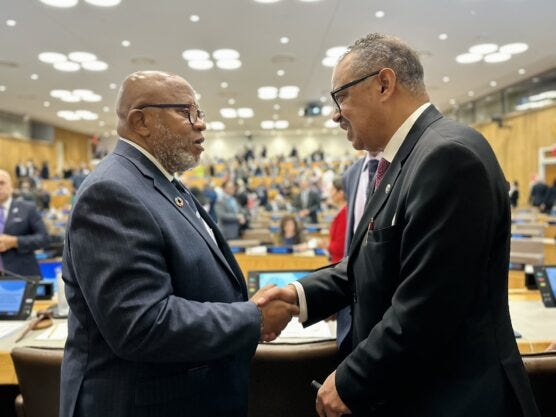
UN General Assembly 78 president Dennis Francis with WHO’s Adhenom Tedros Ghebreyseus
Dated 17 September 2023, the three page letter to the UN GA president Dennis Francis (Trinidad and Tobago) and UN secretary-general Antonio Guterres (Portugal), objected to unilateral coercive measures and other glaring issues in international law. The eleven countries stated (for readability, bold headers, italics emphasis, numbering and notes are mine):
No consent, lack of transparency and illegal unilateral coercive measures
1. It is regrettable that it has not been possible to find a political solution to the current stalemate, created, not only due to the lack of will of some developed countries to engage in true and meaningful negotiations to have balanced and acceptable outcomes for all, but also due to the lack of transparency and poor handling of your predecessor’s team of all these processes.
2. As you are aware, the issue of the negative impact of unilateral coercive measures (UCMs) is an existential one for our peoples. A third of the world’s population is affected by these illegal measures. There is ample evidence, including from UN sources, of the heavy toll caused by UCMs on targeted countries’ capacities to achieve sustainable development and to make further progress in protecting the right to health of their respective populations. Regardless of these facts, we have engaged in the negotiations of these draft outcomes in good faith, with a spirit of compromise and a constructive approach, in order to reach consensus.
3. Since the beginning of these processes, we have insisted on the need to include our concerns in these important political documents, on the basis of consensual language, as reflected in paragraph 30 of the 2030 Agenda for Sustainable Development. This request has been echoed by a large number of delegations, including from the Group of the 77 and China, and from the Group of Friends in Defense of the UN Charter, among others.
SPM note: The delegates’ critical concerns are completely ignored by the United Nations leadership, confirming that the multilateralism motto touted often by the United Nations is sloganeering on empty rhetoric. The letter continues to lay bare:
Unfair practices including veto, lack of inclusion, absence of balance, and neglect
4. The legitimate concerns of a large number of developing countries have been ignored. Hence, it is our duty to express our strong concerns on the unacceptable way in which this situation unfolded, running in clear contradiction with the spirit of multilateralism and the overall goal of “leaving no one behind”.
5. First, there has been no real willingness from a small group of developed countries to engage in meaningful negotiations to find compromises, forcing unfair practices which pretend to impose a kind of “veto” on certain issues, and pretending to even prevent their discussion within the framework of intergovernmental negotiations.
6. Second, in some cases, negotiations were not conducted in a truly inclusive, fair and balanced way. Our delegations had to witness how, in some cases, even single delegations were accommodated a great deal in their concerns, while others’ priorities, including ours, were bluntly neglected.
Objections includes forced consensus, bulldozing, and ignoring repeated breaking of silence
7. For example, the draft outcome of the High-Level Political Forum on Sustainable Development under the auspices of the General Assembly – SDGs Summit, was reopened with the purpose of exclusively accommodating the priorities of a few delegations from developed countries, while, in this very same process, and in the three (03) health-related negotiations, nothing was done to reflect and accommodate the legitimate concerns of delegations from developing countries that, in addition had broken silence repeatedly, including the Group of 77 and China.
8. Third, the attempt to ignore formal communications of delegations from developing countries, including from the Group of 77 and China, on behalf of its 134 Member States, indicating strong reservations and objections.
9. Fourth, the attempt to force consensus by your predecessor’s team, and now by your Office, when it is evident that no consensus has been reached on any of these processes; as well as the lack of transparency, inclusiveness and efficient use of the limited time available then to find compromises.
Developing countries take a stand against discrimination perpetrated through the United Nations
SPM: The clear, well-reasoned and articulate letter continues, setting a precedent in protecting national sovereignty:
10. Our delegations are convinced that this is no way to handle multilateral and intergovernmental negotiations on issues of great relevance for the international community, particularly for developing countries. Thus, we would like to put on record that we do not condone, nor accept, this practice, and that it does not set any precedent for the work of the United Nations and its General Assembly.
11. This is particularly relevant, as we look forward to future negotiation processes on fundamental matters, in which we will continue engaging with great determination, flexibility and constructiveness.
Delegations call for a recall of the nature and legal standing of UN meetings
12. Our delegations would also like to recall the nature and legal standing of the meetings in which the SDGs Summit, the High-Level Meeting on Pandemic Prevention, Preparedness and Response, the High-Level Meeting on Universal Health Coverage, and the High-Level Meeting on the Fight against Tuberculosis, will take place.
13. In relation to the High-Level Political Forum (HLPF) on Sustainable Development under the auspices of the General Assembly, SDGs Summit, and in accordance with General Assembly resolution 67/290, in its operative paragraph 9, “all meetings convened under the auspices of the General Assembly shall operate under the rules of procedure of the main committees of the Assembly, as applicable, unless otherwise provided in the present resolution”.
14. Also, operative paragraph 4 of that very same resolution clearly states that the Forum “shall result in a concise negotiated political declaration to be submitted for the consideration of the Assembly”.
15. Hence, we expect a process to take place at a later stage, where the General Assembly will formally consider the adoption of the draft Political Declaration, under Chapter XII of the Rules of Procedures of the General Assembly.
16. Similarly, General Assembly resolutions 75/315, 77/274 and 77/275, are clear in indicating that the political declarations of the three health-related High-Level Meetings should “be submitted by the President of the General Assembly for adoption by the Assembly”.
Opposition to any attempt that formally adopts draft outcome documents, and the right to take action
SPM: The ground breaking letter against illegitimate operations by the UN, continues:
17. In that sense, our delegations oppose any attempt to pretend to formally adopt any of the draft outcome documents in question, during the meetings scheduled for 18, 20, 21 and 22 September 2023, respectively.
18. In addition, we reserve the right to take appropriate action upon the formal consideration of these four (04) draft outcome documents in the coming weeks, after the conclusion of the High-Level Segment of the 78th Session of the General Assembly, when they must all be considered by the General Assembly in accordance with its rules of procedures.
19. In that spirit and in the interest of transparency, we respectfully request hereby your good offices for circulating as soon as possible this letter as an official document of the General Assembly, under agenda items 19 and 127, entitled “Sustainable development” and “Global health and foreign policy”, respectively.
SPM: The letter ends.
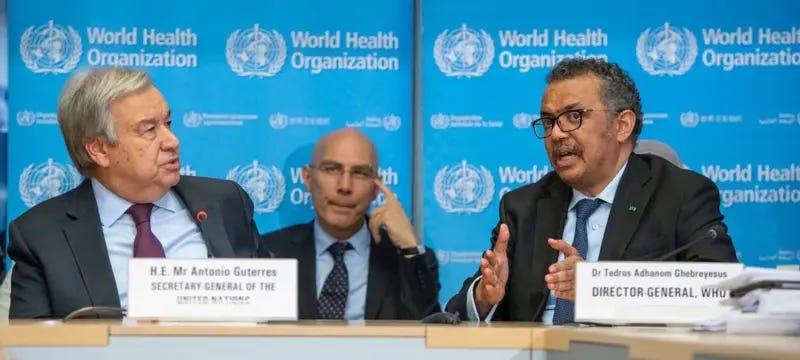
UN SG Guterres and WHO DG Tedros at a WHO meeting
• Blatantly ignoring the official letter to the UN, the WHO Director-General Adhenom Tedros Ghebreyesus incorrectly said “As you know, this morning, the 193 Member States of the United Nations approved the political declaration on pandemic prevention, preparedness and response. The declaration is a strong signal from countries that they are committed to learning the lessons of the COVID-19 pandemic, and to strengthening the world’s defences against pandemics.”
• He continued with almost delusional dishonesty “In the declaration approved today, Member States have demonstrated that even at this time of division and polarisation, it’s still possible for countries to come together to agree on a shared response to shared threats. It is that same spirit of collaboration that we urge countries to demonstrate as they continue their negotiations on the Pandemic Accord and the amendments to the International Health Regulations.”
• Displaying his complicity in violating international law, he said “The political declaration, approved by Mr Dennis Francis, President of the 78th United Nations General Assembly, and the result of negotiations under the able leadership of Ambassadors Gilad Erdan of Israel and Omar Hilale of Morocco, underscored the pivotal role played by WHO as the “directing and coordinating authority on international health,” and the need to “commit further to sustainable financing that provides adequate and predictable funding to the World Health Organization, which enables it to have the resources needed to fulfil its core functions.”
• Meanwhile, unperturbed by what member states delegates communicated days before, UN Secretary-General Antonio Guterres said, in a message delivered by Deputy Secretary-General Amina Mohamed (Britain-Nigeria): “By next year’s World Health Assembly in May, I urge all countries to deliver a strong, comprehensive pandemic accord, focused on equity; as well as amendments to strengthen the International Health Regulations. And I urge you to support the World Health Organization, including by honouring the commitment to increase assessed contributions to half of its budget, and supporting the proposed investment round.
• Unconcerned with the diplomatic fallout and failing in his duty to abide by international law, Guterres continued to outline three key priorities: First, Sustainable Development Goals Stimulus (read debt slavery). Next, countering what it defines as misinformation – which will lead to the suppression of critical thinking and free speech. Third, responding to complex global shocks via a UN emergency platform – that will make national governments and the will of the people they serve irrelevant.
On reading this article, Professor Boyle replied to me: “Right! This is a great Defeat for the Globalists. The International Court of Justice has ruled that some types of UN General Assembly Resolutions Adopted by Consensus can become Customary International Law, and the Globalists Lawyers know that. So from my perspective what happened was an Historic Defeat for the Globalists. Tedros and the WHO are trying to turn a pig’s ear into a silk purse. In fact, this was an historic failure. The Globalists tried and failed to get their Declaration adopted by Consensus by the UN General Assembly, thus preventing it from arguably becoming Customary International Law, which is what they intended to do in the first place. But they will try again.”
He continued “The danger here is that this is a Statement by Heads of State and Heads of Government, either one of whom can bind their states under international law and all of whom together could arguably create customary international law. That is what the Drafters of this Statement intended. This is very dangerous. We cannot underestimate its significance. It’s like a stick of dynamite ready to be exploded. This is all part of the Globalists Strategy to create a Worldwide Totalitarian Medical and Scientific Police State under the guise of the WHO. Thanks. Then if the 11 vote this way against it, then that will prevent this Declaration being adopted by Consensus and thus arguably becoming part of customary international law, which is what those behind the Declaration intend.”
Financing the supranationals’ ambitions – $500 billion per year, minimum
About $2 billion has already been collated for a new World Bank managed Pandemic Fund. It is said to be insufficient, compared to the amounts required, especially for debt-burdened countries, to comply with UN and WHO expectations and improve their health systems and prepare hospitals, data surveillance systems and laboratory facilities to meet potential pandemic needs.
A Sustainable Development Goals “stimulus” package in addition to “deep” reforms to the international financial architecture is required, according to UN Deputy Secretary-General Amina Mohammed. “Many developing countries are drowning in debt,” Mohammed told the high level meeting, echoing views expressed at the UN’s SDG Summit. She called for long-term financing of at least $500 billion annually as part of the Sustainable Development Goals (SDG) recovery plan.
Although Africa is not actually poor, “Today Africa spends more on debt service costs than on health care and education. We need a finance boost so that countries can invest in universal, resilient health care; their populations have a right to [access]. “We’re calling on countries to support the stimulus to scale up affordable long-term financing by at least $500 billion per year, and to support the development of an effective debt-relief mechanism that supports payments, suspensions, longer lending terms and lower rates for developing countries that are drowning in debt – and create the fiscal space to spend on the health that people have a right to [enjoy].”
Winnie Byanyima, Executive Director of UNAIDS agrees, saying that future pandemic responses need to be based on technology-sharing to facilitate more equitable access to pharmaceutical and other medical products. Byanyima also expressed that many countries were disempowered to invest adequately in health and pandemic preparedness as they were paying debts that were larger than their health budgets.
World Bank Senior Managing Director Axel Van Trotsenburg welcomed the first anniversary of the pandemic fund, which received pledges from 133 countries worth $2 billion. Despite this “very good starting point”, Mr. Trotsenburg warned that $10 billion should be allocated to pandemic preparedness and called on Member States to provide the necessary resources.
In my view, it is accurate to call what is going on under the rule of the United Nations diplomatic fraud and an act of aggression. It is also accurate to have predicted that the United Nations will be the real power driving the WHO’s ambitions, or substitute itself.
Global Threats Council – another One World Government Toolbox
“Critics have also expressed misgivings about the ability of WHO, representing politically weak health ministries, to oversee and enforce the kinds of tough, binding commitments that would be needed for effective pandemic response. Those concerns have been behind the push to make UN fora platforms for pandemic debate and decisions.
Advocates for more UN-centred action have proposed the creation of an independent pandemic governance mechanism in the office of the UN Secretary-General, and/or a UN Global Threats Council, to oversee the implementation of any pandemic accord approved by WHO member states.
“I continue to believe that action at the head of state and government level is so needed to help break the cycle of panic and neglect, which sets in around pandemics and to sustain political momentum around preparedness and response,” said Clark, who has called for the creation of a UN-hosted Global Threats Council. “And then on accountability, independent monitoring of country preparedness is needed to guarantee our mutual assurance, compliance and accountability with international agreements.”
Juan Manuel Santos, former President of Colombia and a member of The Elders, believes that the UN may be the better forum as “pandemic preparedness encompasses far more than health”. Santos told a UN side meeting on Tuesday hosted by the Pandemic Action Network (PAN) that if the pandemic accord negotiations are still “mired in confusion” by the time the WHO Intergovernmental Negotiating Body (INB) meets for the seventh time later this year, “someone has to say, enough, we need to shift it back to New York.”
“The world is inching closer to “a great fracture”, UN Secretary-General António Guterres warned as leaders converged in New York for #UNGA78. “It’s reform or rupture,” he said. I agree on the great fracture framing. The united front developed by these eleven countries – with a combined 154 other countries that also have objections about UN documents and processes – has cataclysmic implications for the United Nations – far too long a well oiled front for corporate colonialism and violent peace-making.
I am aptly reminded of the trailblazing stand that the 47 nation African bloc took at the World Health Organisation’s World Health Assembly 75 last year, where they raised objections to controversial International Health Regulation amendments, on the basis that they were rushed, and that they threaten national sovereignty – the WHO, unconvincingly, often denies any such threat.
At UN General Assembly 78, at least two presidents made compelling statements I find relevant to the seismic shift:
• Algeria’s president, Abdelmadjid Tebboune, called for reform and transparency in UN organs, particularly in reforming the Security Council. “Any effort to strengthen joint international action forces us to respond to the constant appeals to strengthen the multilateral system by reforming the main organs of our organisation in order to make them more transparent and ensure the necessary balance among the main organs and ensure equitable geographical distribution. This should be an absolute priority for the international community in order to find a consensus.”
• Paraguay’s President Santiago Peña, has called for reforms to strengthen the UN and bolster its ability to respond to global crises. “The lack of tangible results, inefficacy perceived in multilateral institutions and difficulties in addressing global problems in an effective manner have led to frustration and have led to an increase in the sense that national interests should prevail over multilateral cooperation,” he said from the podium.
Exclusive article written in July 2023, which you can read and share here
Sanctions: inhumane unilateral coercive measures impacting health and sovereignty
Seismic shifts in geopolitics are leading to so-called LMICS (low to middle income countries) or EMDC’s (emerging and developing countries) to consider their cooperation options at a national, regional and inter-regional level. Emerging countries represent 80 percent of the world’s population, while billionaires own more wealth than the majority of their fellow citizens, and corporations can own more than the GDP of countries.
The threat of sanctions through the United Nations, influenced partly by the World Health Organisation as detailed in my July article, is one these countries have a lived experience of, and which seems to weighing in its overall fear factor, evidenced by multiple revolts.
The latest report of the Report of the Special Rapporteur on the negative impact of unilateral coercive measures on the enjoyment of human rights clearly says: “Unilateral sanctions and over-compliance have a detrimental impact on implementation of all aspects of the right to health of all people in the countries under sanctions, including access to adequate medicine, healthcare facilities, medical equipment, access to qualified medical assistance, prevention and control of deceases, scarcity of health professionals, access to health facilities, training and access to up-to-date scientific knowledge, technologies, research, exchange of good practices.”
The UN and WHO have gone too far in their diabolical attempts to engineer a one world government. In weeks and months ahead, I anticipate more countries joining this coalition and asking themselves why they should remain members of the United Nations and the World Health Organisation. They will have growing support from their peoples, desperate to avoid further indignity, discrimination, exclusion, sanctions, lockdowns, censorship, coerced vaccines, digital ID’s, CBDC’s, and the erasure of the sovereignty we value.
Call to Action:
1. Raise your voice against the UN – WHO power grab. CHD Africa will deliver names and countries (only) to UN and WHO leaders (1 minute)
2. Share this article with your family, community, organisations, and media on all sides of the fence (as often as you can)
3. Share this article with your country’s political and diplomatic representatives (with urgency and please follow up)
4. Sign up to CHD Africa’s newsletter for news, analysis, updates and calls to action (immediately for full access)
5. Follow CHD Africa on Telegram and X (Twitter) for information, updates and calls to action (beat censorship!)

Author: Shabnam Palesa Mohamed is an award-winning activist, journalist, lawyer, mediator and socio-political analyst with combined experience of over 20 years. She is based in South Africa and serves as the executive director of Children’s Health Defense Africa.
Sunak’s Net Zero ‘U-turn’ – or is it?
By Ben Pile – September 20, 2023
Rishi Sunak’s ‘watering down’ of certain Net Zero targets is the first time that the green policy agenda has had ANY scrutiny of any consequence, despite many failures, starting with the ruinously expensive Renewable Obligation, extending into the totally failed CfDs that allowed wind farm developers to lie to achieve planning consent over rival generators and technologies. Not one part of the green policy agenda has lived up to any promise to deliver good to the British public.
It was the mildest possible reversal. It is in fact an attempt to SAVE Net Zero, not roll it back.
Complaints that it has left Britain without an ‘industrial policy’ or has left ‘investors’ without ‘confidence’ are for the birds. It has put the UK in the same policy position as the EU (more on which in a bit), and there is no evidence of green policies having delivered any significant industrial development to these shores. No green jobs. No green growth. No green industrial revolution. Not even a BritishVolt. It is a farce.
Politicians, who know nothing of the subject in fact, have been misled into believing that strong climate targets encourage domestic manufacturing. That is a lie. The main beneficiary of UK & EU climate laws has been China, of course, which benefits from cheaper energy prices (among other things) precisely because China does not have energy policies like ours. Strict targets are not industrial policy. Nobody was looking to develop ‘Gigafactories’ in the UK for the fact of the UK having the earliest ICE car sales ban. It’s a nonsense.
Sunak has taken stock of the simplest elements of green policy failure:
1. No politician has any clue how to realise Net Zero targets. To understand this, you need to drill down into the Climate Change Committee’s (CCC) advice to Parliament, and advice from wonks and academics to the CCC itself. They speak more candidly the deeper you investigate. The promises of upsides are simply lies. There are no drop-in replacements for the things that make our lifestyles today. That is why the CCC told Parliament that up to 62% of emissions reduction is going to come from ‘behaviour change’, which is to say that Net Zero requires government to use the criminal law and price mechanisms to regulate what people can do. That is what Sunak means when he says that previous governments have not been straight with the public. It is fact.
2. The green lobby has LONG promised lower prices and greater energy security but has failed to deliver. There have been many claims that the costs of wind power have fallen based on low ‘strike prices’ offered by wind farm developers since the Contracts for Difference (CfD) scheme was introduced in 2017. None of those miraculous strike prices have been achieved. The wind farm developers simply reneged on them. They were never going to take them up. They calculated that they would never have to. This came to crunch in the latest auction, when the government removed the wind farm operators’ ability to walk away from the contract — they called the wind sector’s bluff. No bids were offered. The major promise of renewable energy has been utterly debunked by the green lobby’s own actions.
3. Behind the scenes, the failure of both global and national climate policy has been known for a long time — since the Paris Agreement (PA) at the latest. The PA is not in fact a ‘global agreement’; it allows countries to determine their own commitment. And all that has done in turn is reignite the talking point that beset global climate policymaking in the 1990s and 2000s: the ‘free rider’ problem. Some emerging one-time ‘developing’ economies, are now booming, whereas much of the West/G7 is stagnant and facing deindustrialisation, precisely as critics of climate policy had argued, decades ago. This is why there has been so much emphasis since the PA on LOCAL government, such as LTNs/ULEZ/CAZs, using ‘air pollution’ as a proxy battle in the climate war. This was encouraged by central government, which accelerated this fake ‘localism’ during lockdowns by making large grants available to local authorities to restrict private car use. Sunak has seen the robust response to this in London, in Wales, and in cities that have adopted them, and has realised that the public has been setting down its own red lines. The green agenda is now visible to all and politically toxic.
4. Despite claims that other countries are steaming ahead with boiler bans, car bans, heat pumps, and championing Net Zero policies, especially in Europe, they are in fact creating deep schisms between and within EU member states. Auto manufacturers in Germany are warning that they cannot compete with Chinese rivals. Germany, struggling to find energy, itself is racing towards deindustrialisation, threatening the economic foundations of the Union. Its boiler ban, advanced by psychopathic Greens threatens to destabilise its own political centre of gravity, with a huge surge of interest in the AfD, now biting on the heels of the CDU in the polls. This risks not only the destabilisation of Europe, but geopolitical schism that could ultimately undermine NATO. Poland is pushing back against EU climate targets. The Netherlands, having overextended its green agenda looks set to oust its political establishment at the November election following the growth of the BBB movement, and the even newer New Social Contract party. There is the obvious polarisation of French politics, which needs no repetition here. And there is the case of Sweden’s new right-of-centre government abandoning its Net Zero targets in favour of a technology-first approach. Sunak can see all this green policy failure *everywhere* that green blobbers point to, while claiming such chaos is success.
5. ESG is failing. Former BoE governor Mark Carney, who just this week ranted against Liz Truss, disgraced his former office. Carney was appointed by Johnson to lead the The Glasgow Financial Alliance for Net Zero (GFANZ), which claimed to have aligned financial institutions with $130 trillion AUM. Vanguard and BlackRock seem to be reversing out of the Alliance. And a number of major insurance firms, including Munich Re and Zurich too, have joined the backlash. And Sunak knows about markets.
6. Ukraine, Russia, and the realignment of geopolitics. Who really believes that Western diplomats now have any chance of bringing Russia, China, and India into the Net Zero suicide pact? The drawbridge is up. And the G20 meeting saw Modi humiliate the entire green movement. Sunak offered the climate fund £1.6 billion — roughly speaking a quid per Indian. And as many Indians said “What?!! We’re going to the Moon, mate!”
Sunak can see all of these problems. And none of them are going to be solved by banning petrol and diesel car sales in 2030, or by banning boilers. The world is a fundamentally different place now, post-Brexit, post-covid, post-Russia-Ukraine, after 15 years of Climate Change Act failures, and the deindustrialisation of the West. All that carrying on with Net Zero as usual is going to do is, far from strengthening Britain’s position on the ‘world stage’, is further undermine our economy and industries, and political stability. Nobody else, except countries facing equivalent problems, perhaps, cares about our degenerate political class’s ideological fantasies. Global climate policy is collapsing as global politics shifts, whereas the basis for the UK’s draconian domestic climate policy agenda was ALWAYS global political institutions: the EU & UN etc, not domestic popular support. It’s not 2008 any more. Neither the ROW nor the UK public are as tolerant of being pushed around. And utopian, technocratic, supranational political ambitions look like so much cynical build-back-better bullshit that simply do not wash.
The histrionics that are now the counterpoint to Sunaks mildest possible Net-Zero flip-flop are the chorus of an extremely small, but extremely noisy and over-indulged part of British society that has got far to used to not being slapped down by reality, and, like spoilt infants, they are determined to find the boundaries of their behaviour. They are utterly deranged by ideology, and incapable of allowing their claims to be tested by simple arithmetic. They speak glibly in the most superficial terms about things they know nothing about: how the world must be organised; how the entire economy will be powered; how ordinary people’s lives will be managed. They lie. They try to tell people that banning things and imposing expensive restrictions will make them better off, make them safer and ‘create jobs’. From bottomless bank accounts, they commission idiot wonks at remote think tanks to produce glossy ideological bunk.
Sunak could not have done less to correct this mess. But what he has done is a good thing. And it includes setting a trap for the eco-catastrophists. The more they howl and wail, the more they will expose their utter contempt for ordinary people. It is not in Sunak’s gift, even if he wanted it, to reverse the entire sorry policy agenda. Too much stands in his way. But every scream and tantrum from the blobbers will bring that possibility closer to him or a successor. Because no person with a functioning brain believes that banning the boiler later, rather than earlier, is a good thing. And so the blobbers are set to out themselves, for the duration of this controversy, as brainless ideological zombies. Long may it continue.
Net-zero: the annals of absurdity
By Richard North | Turbulent Times | September 17, 2023
Most readers will recall the excited chatter of some commentators, speculating on the result of the summer’s Uxbridge by-election – which was attributed to a backlash over Khan’s ULEZ plans.
After vague noises from No.10 about being “pragmatic”, there was a widespread feeling that Sunak might capitalise on what some took to be an “anti-green” rebellion, and row back on the implementation of net-zero.
Whatever hopes there might have been, though, it must now be crystal clear that, short of any trivial, cosmetic concessions, Sunak has absolutely no intention of slowing down to destroy the British economy in the name of the Great God climate change.
If any further evidence was needed, it comes in an article in The Times yesterday, which tells us that the prime minister has rejected any idea of a reprieve for petrol and diesel cars. The 2030 electric vehicle targets, we are told, will stay.
As if that wasn’t bad enough, we are also warned to expect punitive measures aimed at incentivising the few remaining car manufacturers in the UK to increase their sales of EVs.
The plan is that next year, 22 percent of new cars sold will have to be electric, rising to more than 50 percent in 2028. It is left to the Independent, though, to tell us that manufacturers who fail to meet the targets will face fines of up to £15,000 per car.
A similar stratagem is being used to push the sales of heat pumps, with gas and oil-fired boiler manufacturers being required in the financial year 2024-2025 to ensure that heat pumps make up 4 percent of their sales.
An alternative is to buy “credits” from manufacturers who are over-quota, failing which the manufacturers will have to pay an eye-watering fine of £5,000 for every heat pump short of the quota. As with EVs, the quota will increase each year.
This has led some manufacturers to warn that they will have to increase the unit prices of boilers by £300 – a sum which also might have to increase each year as sales quotas increase.
This way of doing things is particularly devious as it distances the government from the consumer and puts the responsibility on manufacturers to implement net-zero policy, which must then take the blame for the increased prices when people turn their backs on “green” products.
As such, one might expect that manufacturers would be up in arms at this cynical attempt to make them take the fall, except in the case of car-makers, the sales quota system favours those which have committed only to produce EVs – apparently an intended consequence of the plan.
This has emerged after talks between the government an BMW, when it was announced that the car-maker would receive a subsidy of £600 million for its Cowley plant in Oxford – a bribe to dissuade the company from moving its whole operation to China.
But part of the package, it seems, was an “understanding” that the net-zero timescale would not be relaxed, giving the company “certainty” about the rules, and thereby protecting their investment in EVs. In order to protect the developing market, car-makers are said to be keen to see the 2030 ICE new car sales ban go ahead.
This also applies to the emerging charging industry. Ian Johnston, chairman of the industry body ChargeUK, is quoted as saying: “To go further our sector needs certainty in the form of a firm commitment to a strong zero emissions vehicle mandate”. He is said to have cautioned that scaling it down would mean “billions of pounds of investment” being put at risk.
We thus have an interesting, if not disturbing situation where the market in cars is to be heavily distorted, so that consumer preferences will no longer be the primary driver of production plans. A nexus of government, investors and car manufacturers is conspiring to create a producer-led industry.
As for the minor detail of a lack of charging points – which is one of the factors inhibiting sales – officials argue that tough annual targets will give confidence to investors to start building thousands of charge points.
That alone, however, is unlikely to be sufficient to incentivise private buyers, who have proved extremely reluctant to convert to electric. Although the government “fines” may narrow the price differential, EVs will still be substantially more expensive than their ICE counterparts and the lack of chargers continues to put off buyers.
Even then, car-makers are not yet out of the woods as there is the vexed question of battery production to resolve. Faced with subsidies pouring out of the coffers of EU and US governments, Alan Hollis, chief executive of AMTE Power – head of one of Britain’s few surviving homegrown battery manufacturers – is holding out the begging bowl, threatening to build its planned new factory overseas unless the UK closes the subsidy gap. So far, though, the UK’s experiences with building battery plants have not been happy.
Nevertheless, last May, the government offered the owners of Jaguar Land Rover £500 million in subsidies in an effort to persuade the carmaker to build a new electric battery plant in the UK.
The Indian conglomerate Tata, the parent company of JLR, was in the process of deciding whether to build the new electric battery production facility in the UK or Spain and, in July, announced that it was to build a 40GW battery cell gigafactory in the UK – although this may have Chinese backing as well.
BMW has not yet decided on the manufacturing location for its Mini batteries – with mainland Europe or the UK remaining options – but it is germane to note that the company is also producing the Mini marque in China, with exports from that country due to start in 2024.
Therein lies another tale, as Chinese EV and battery production has been heavily subsidised since the inception of the industry. State subsidies for electric and hybrid vehicles were reported at $57 billion from 2016-2022, helping China become the world’s biggest EV producer and to pass Japan as the largest auto exporter in the first quarter of this year.
However, China is not only delivering the volume, but its cars are also typically 20 percent below the prices of European-built models. This has moved the Commission to consider imposing punitive tariffs under anti-dumping laws. It is possible that the UK will follow suit although to do so would present the government with something of a conundrum.
As it stands, the import of cheaper Chinese vehicles is the only sure-fire way of eroding the price differential between ICE and electric cars, and thus the best way of achieving the government’s net-zero targets – notwithstanding that Chinese industry is largely powered by fossil fuels.
Thus, despite its Faustian deal with its own car manufacturers, the government’s best option is to open the doors to Chinese imports, at the risk of wiping out British car manufacturing.
When the BMW deal was done, Sunak was full of himself, declaring that the “investment” was “another shining example” of how the UK was the best place to build cars of the future, claiming that his government was “securing thousands of jobs and growing our economy right across the country”.
But, from current moves, it appears that Sunak is far more interested in the deindustrialisation of Britain through net-zero, in which case he should be looking to ditching the car industry as soon as possible – which is no doubt already in his mind.
After all, except for a few small-scale specialists, most of the industry is already in foreign hands, so handing it over to the coal-fired Chinese shouldn’t make too much difference. In the pursuit of net-zero targets, nothing is too much or too absurd for our government to countenance.
New York urgently needs to confront the contradiction of trying to electrify everything while also eliminating fossil fuels
By Jane Menton and Francis Menton | Manhattan Contrarian | September 13, 2023
In New York, politicians are selling the public a narrative that electricity is going to be the solution to climate change. We will eliminate all CO2 emissions by banning gasoline-powered cars, banning natural gas infrastructure, banning gas heat in buildings, and banning gas for cooking. All of these are to be replaced with supposedly “green,” emissions-free, alternatives – which in practice consist of only one thing, electricity. We’ve been told that this is how we are going to protect the planet for future generations.
But there is nothing emissions-free about the way electricity is currently generated in New York. About half of our electricity comes now, as it traditionally has, from burning fossil fuels. New York has announced plans to eliminate those from electricity generation by 2030, but as of now has no realistic plan to replace them. Meanwhile, it is forcing its citizens to convert essential systems like heating to electricity, with no basis to believe that the electricity will be available to prevent people from freezing in the winter only a few years from now. This is a glaring contradiction, that needs urgently to be addressed before we suffer a self-inflicted catastrophe.
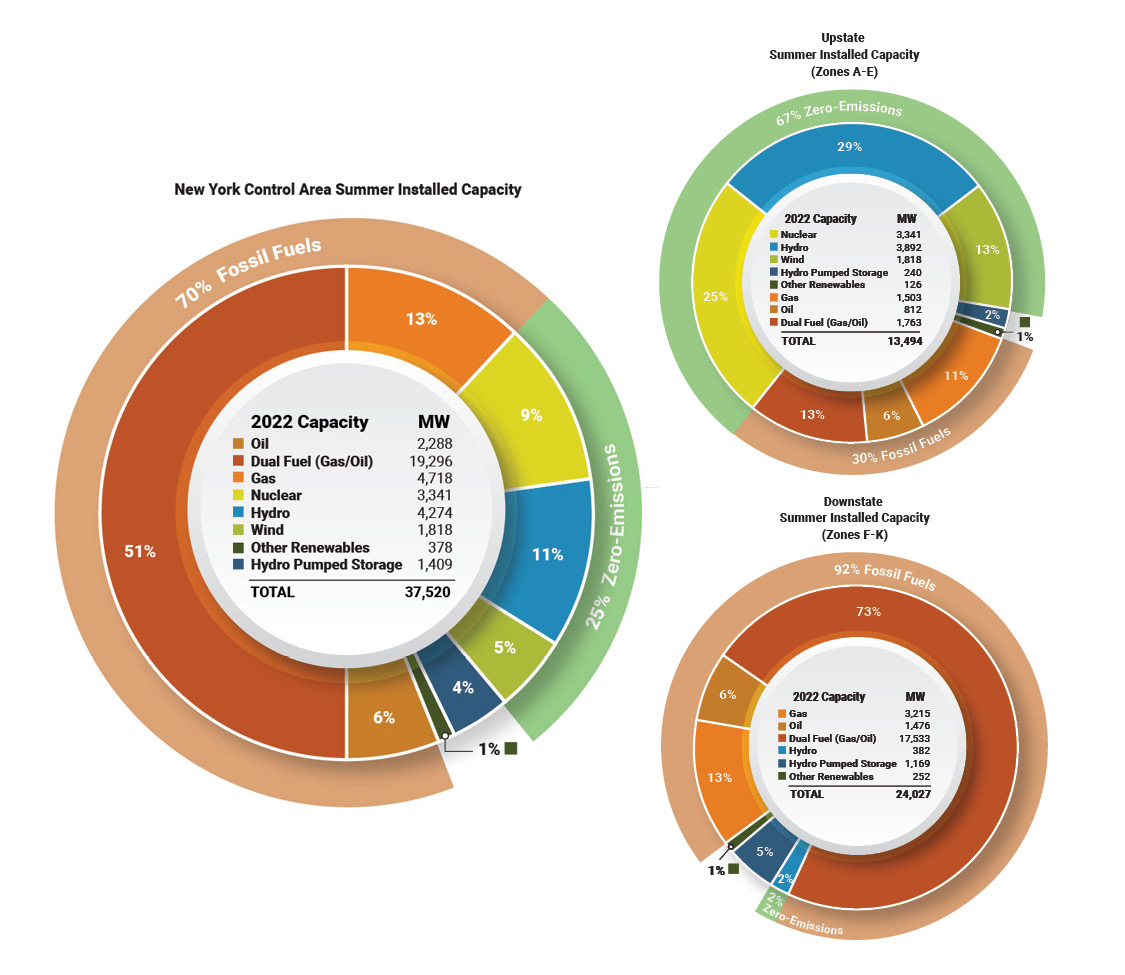
At present, fossil fuels are critical to our generation of electricity. According to the most recent data from the federal government’s Energy Information Administration, in 2021 New York got some 46% of its electricity from burning natural gas and another 1% from fuel oil, and almost all of the rest from either nuclear (25%) or hydropower (23%, most of which comes from Niagara Falls). Non-hydro “renewables” (wood, wind and solar) provided only about 6% in total, and about 2% of that was from wood. After decades of hype about their wondrous future, wind and solar provided only about 4%. And in 2021, the state closed the Indian Point nuclear plant, replacing its output almost entirely with natural gas generation, meaning that the percent of our electricity supply coming from fossil fuels is now up near 50% today.
If more electricity is needed, the options are few. New nuclear plants face vociferous opposition from environmentalists, with almost no prospect that that can be overcome. A completely finished nuclear plant called Shoreham sits idle on Long Island, having never been approved for commercial operation in the face of vigorous environmental opposition. As to hydropower, we do not have another Niagara Falls. Wind and solar produce remarkably small amounts after decades of hype and massive subsidies; and what they do produce is intermittent and often unavailable when most needed on the hottest and coldest days. The last option, natural gas – the one that is available, scalable, and actually works – is the one our politicians are pledging to eliminate without anything to replace it.
In the face of this generation picture, the State and New York City are proceeding with proposed electricity mandates that will have the effect of greatly increasing demand for the power. This will either require scaling up our electric grid to match that need or else leaving people without functioning infrastructure. Policies already in place in New York City require electrification of cars, heat, and cooking, aiming for widespread conversion by 2035, and continuing thereafter. A piece in the Daily News on June 3 includes a projection from National Grid (one of our utilities) that the State will need to increase the capacity of the grid by 57% by 2035, and 100% by 2050.
In scenarios where people’s cars, heat, cooking and more are all entirely dependent on reliable electricity, ensuring that our electricity sources are adequate and reliable is critical to the functioning of everyday life. Yet, even as our government is rapidly rolling out electrification mandates, it is simultaneously closing the biggest piece of our reliable generation.
New York is Exhibit A of a current crisis-in-waiting. At the State level, Governor Hochul has committed to closing all of the State’s fossil fuel electricity plants by 2030. Current New York State summer installed capacity is 37,520 MW, or 37.5 GW. Of that, about 60%, or more than 22 GW, consists of natural gas facilities, which are capable of running nearly all the time and ramping up to maximum output when most needed. Based on National Grid’s projection of 57% increased demand by 2035, New York should be planning to have 37.5 GW x 1.57, or almost 59 GW of always-available capacity on hand by that year. Yet the only significant plans for additional capacity by 2035 consist of about 9 GW of offshore wind, and another 1.25 GW to come from a transmission line to bring hydropower from Quebec. (In recent weeks, all of the offshore wind developers have demanded major contract price increases of 50% and up, failing which they threaten to walk off the job.)
Something here does not remotely add up. If New York state succeeds by 2030 in closing its natural gas plants — the plants that account for 60% of the State’s generation capacity — that would bring our total installed capacity down from 37.5 GW to as little as 15 GW. But we need almost 60 GW to meet projected demand. And that’s 60 GW that can be called on any time as needed to meet peak usage. The 9 GW of projected offshore wind turbines wouldn’t make much of a dent even if they operated all the time and could be dispatched to meet peak demand, which they can’t. Instead, they will operate only about a third of the time, and at their own whim. At best they will provide about 3 GW on average, when what we need for this full electrification project is more like 45 GW of dispatchable power to add to our existing hydro and nuclear.
The New York Independent System Operator, which is well aware of this gigantic contradiction, talks vaguely of something they call a “dispatchable emissions-free resource” to fill the enormous gap. Other than nuclear, which is blocked, that is something that is a pure fantasy and does not exist.
Our State’s and City’s proposed plans are putting New Yorkers on a path to catastrophe, with greatly increased dependence on electricity, but without nearly enough of the stuff to function at even the current usage level. New York City got a huge lesson on dependence on electricity from Hurricane Sandy a decade ago, when a week-long blackout left people in high-rises without elevator service and without water. Now they plan to add all heat, cooking, and transportation to the things that absolutely require electricity. In that world, insufficient electricity becomes a humanitarian crisis.
It is high time for the politicians writing electricity mandates to demonstrate that it is even possible to build and scale an emission-free grid, one that is dispatchable (meaning it will work when we need it), reliable, and resilient. In today’s world, no demonstration of such a grid exists anywhere in the world.
If these mandates are allowed to go forward unabated, the real cost of will be the impoverishment of communities and destruction of quality of life. It’s up to us to realize we’re being sold a false narrative and to stop playing along.
OPEC rejects IEA’s forecasts about fossil fuels use
Press TV – September 14, 2023
The Organization of the Petroleum Exporting Countries (OPEC) has rejected projections by the International Energy Agency’s (IEA) suggesting that the global consumption of fossil fuels will peak in 2030 before dropping to record lows because of an increase in the use of the renewables.
OPEC Secretary General Haitham Al Ghais said in a statement issued on Thursday that the IEA’s recent forecast about the decline in the use of fossil fuels in the next decade would only worsen the situation in international energy markets.
“It would lead to energy chaos on a potentially unprecedented scale, with dire consequences for economies and billions of people across the world,” said the statement.
In an article in the Financial Times published on Tuesday, IEA Executive Director Fatih Birol said estimates by the Agency shows that the age of growth in use of fossil fuels “is set to come to an end this decade.”
“This is the first time that a peak in demand is visible for each fuel this decade — earlier than many people anticipated,” Birol said in the opinion piece, adding that demand for the three fossil fuels, namely coal, oil and natural gas, is set to hit a peak in the coming years.
However, the OPEC statement called the forecasted decline “dangerous”, saying such statements normally lead to calls to stop new oil and gas investments.
“Such narratives only set the global energy system up to fail spectacularly,” said Al Ghais, adding that some 80% of the world’s energy mix still comes from fossil fuels, the same as three decades ago.
The OPEC chief said that IEA’s estimates had failed to consider the technological progress that has taken place in the oil and gas industry to cut emissions.
The inevitable EV implosion
By Ron Ross | American Thinker | September 12, 2023
 The electric vehicle honeymoon is over. Don’t expect the marriage itself to last much longer either.
The mass conversion from internal combustion engine vehicles (ICEs) to electric vehicles was never more than a Democrat/environmentalist hallucination anyway. It was the most ill-conceived government policy objective in modern history.
The transition should have been a non-starter. It’s riddled with numerous deal killers. It’s like having a dozen fatal diseases all at the same time.
Any goal as massive as a total conversion from ICE vehicles to EVs requires careful planning and infrastructure preparation. It would necessitate a rapid doubling of electricity generation and grid expansion. In today’s world that’s impossible.
EV promoters could never deliver on their promises. Their grandiose assurances were nothing more than wishful thinking.
There was no market research. Hmm — I wonder why. There were no feasibility studies. Hmm — I wonder why. Did they actually believe everyone would tolerate spending hours to charge their vehicles rather than the minutes they were accustomed to?
Car dealers are resisting further deliveries of EVs because of swelling inventories. Avis and Hertz can’t even get people to rent EVs! Yet, manufacturers are ramping up production just as consumers are balking. Something will have to give, and soon. EV makers and their shareholders will tire of pouring money down a rathole.
We are spending trillions of dollars on a fabricated dream, all for imaginary payoffs decades in the future.
When the EV house of cards collapses what will the reaction be? Ordinarily, for normal persons, it would be a time for regret, rethinking, and humility.
It would be good if the Democrat/environmentalist true believers learned something from the EV debacle. However, the same utopian blindness that caused this fiasco will prevent any lesson-learning on their part. We are more likely to see them doubling down instead.
Ron Ross Ph.D. is a former economics professor and author of The Unbeatable Market. He resides in Arcata. California and can be reached at rossecon@aol.com.
His website is rossecon.com.
The Elites Directing The Energy Transition Really Have No Idea What They Are Doing
By Francis Menton | Manhattan Contrarian | September 06, 2023
We are on our way to Net Zero by 2050. It must be true because everybody says so. The entire $6+ trillion per year federal government is committed to the project, which obviously would not be the case if the whole thing were impossible. Equally fully committed are essentially all of the colleges and universities, where all of the smartest people are to be found. As well as every other elite institution of every kind and sort.
Take the World Economic Forum. If there is a number one elitest among all elite institutions, this has to be it. At their annual confab in Davos, Switzerland, they gather the greatest of geniuses to instruct the very top government and business leaders how to run the world. Would you like to go? It will cost you $52,000 to join the organization, and then an additional $19,000 to attend the conference. Chartering a private jet to get you there will cost thousands more. Once there, you can hear the very smartest people imparting their thoughts on the most important topics of the day, like “The Great Reset,” “Emerging Technologies,” “Diversity and Inclusions,” and, of course, “The Net Zero Transition.”
Is it possible that these people are completely incompetent and have no idea what they are doing?
A reader has sent me the very latest from the WEF on how the world is going to get to Net Zero. The piece has a date of September 5, 2023, and is titled “How battery energy storage can power us to Net Zero.” The authors are three people from the World Bank, with the lead author being one Amit Jain, who is the Bank’s Energy Storage Program Lead. This is the guy on the receiving end of tens of billions of dollars of government money to pass out to make the energy transition happen throughout the developing world.
Now, it so happens that energy storage is something I know a little about, and in particular about the problem of trying to store enough energy to make an electrical grid work without full dispatchable backup. See my energy storage Report, dated December 1, 2022, at this link.
So let’s take a look at Jain, et al.’s, take on how battery storage will “power us to Net Zero.” First, some excited happy talk:
Across the globe, power systems are experiencing a period of unprecedented change. Low-cost renewable electricity is spreading and there is a growing urgency to boost power system resilience and enhance digitalization. This requires stockpiling renewable energy on a massive scale, notably in developing countries, which makes energy storage fundamental. . . .
Making energy storage systems mainstream in the developing world will be a game changer. Deploying battery energy storage systems will provide more comprehensive access to electricity while enabling much greater use of renewable energy, ultimately helping the world meet its Net Zero decarbonization targets. International organizations and development institutions are leading the way forward to enable this decarbonization. . . .
So OK Amit, how much storage are we talking about here?
In 2022, approximately 192GW (gigawatts) of solar and 75GW of wind were installed globally. However, only 16GW/35GWh (gigawatts per hour) of new storage systems were deployed. A recent International Energy Agency analysis finds that although battery energy storage systems have seen strong growth in recent years, grid-scale storage capacity still needs to be scaled up to reach Net Zero Emissions by 2050. . . . To meet our Net Zero ambitions of 2050, annual additions of grid-scale battery energy storage globally must rise to an average of 80 GW annually between now and 2030.
Holy underwear, Batman! Could this guy really not even know what units he’s talking about? Thinking his readers might not understand the abbreviation “GWh” he helpfully defines it as “gigawatts per hour”! Could he really be this clueless? And he had two co-authors to check him!
And then there’s the statement that to meet the 2050 Net Zero ambition, annual deployments of grid-scale batteries “must rise to an average of 80 GW annually.” Of course he is using the wrong units (and undoubtedly does not know that). But let’s give him the benefit of the doubt, and assume that he is talking about the standard batteries available today, which are 4 hour batteries, meaning that 80 GW would provide 320 GWh of storage. If the world would add that much capacity every year from now to 2050, that would come to 8,960 GWh of storage. How have Mr. Jain et al. come to the conclusion that this 8,960 GWh of storage will be enough to “meet our Net Zero ambitions of 2050”? The piece contains no quantitative analysis or backup of any kind to support the proposition that this amount of storage would be sufficient.
My own energy storage Report does contain backup and calculations, although only for certain countries rather than for the whole world. For example, for the United States, the figures cited in my Report are that it would take some 233,000 GWh of battery storage to fully back up the electrical grid, assuming current levels and patterns of usage. Since the U.S. is about 4% of world population, we can multiply that figure by 25 to get the storage requirement for the world (assuming that the world electrifies to the U.S. level by 2050). The total would be 5,825,000 GWh. In other words, Jain, et al., are off by a factor of about 650, give or take maybe a few hundred.
But it’s OK, because Jain and his colleagues have no skin in this game. They just babble some happy talk to get their hands on a few hundred billions of money from rich governments, and pass it out to build impressive-looking battery projects that are actually next to useless to provide reliable grid electricity. They can be very confident that no one in their circles will ever check the math to see if the numbers add up. When 2050 rolls around and the whole thing doesn’t work, they will be long retired on generous pensions.
World is ‘laughing at’ the US – Alaska governor
© AFP / Mandel Ngan
RT | September 9, 2023
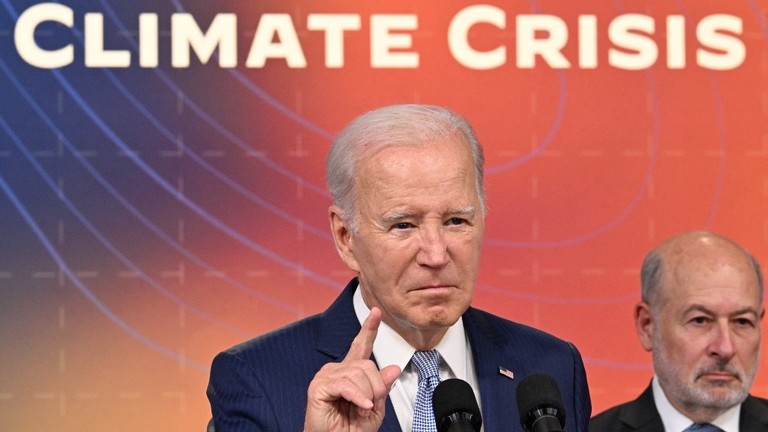
The US government’s decision to cancel oil and gas drilling licenses and forbid further drilling will “hobble” the country’s economy and makes no sense except to advance the green agenda, Alaska Governor Mike Dunleavy has declared.
President Joe Biden’s administration on Wednesday canceled seven ten-year oil and gas drilling licenses granted to the Alaska Industrial Development and Export Authority (AIDEA) by former President Donald Trump. Biden’s Department of the Interior followed up this decision by issuing a proposal to forbid future leases on more than 40% of the National Petroleum Reserve in Alaska.
Biden said that these two measures “will help preserve our Arctic lands and wildlife,” adding on Saturday that he would “continue to take bold action to meet the urgency of the climate crisis and to protect our lands and waters for generations to come.”
Speaking to Fox News on Thursday, Dunleavy said that “this makes absolutely no sense from any perspective unless your goal is to drive up the cost of oil and gas so much that it makes certain renewables cheaper.”
Dunleavy, a Republican, claimed that Russia, China, Saudi Arabia, and Iran are “laughing” at Biden’s energy policy.
“They’re laughing together at the United States of America,” the governor said. “I can’t find anywhere in, really the history of nation-states or empires, where they worked at hobbling themselves to such a degree that’s happening currently with this administration. So 2024 can’t come soon enough for most of us.”
Gasoline prices have soared under Biden, reaching a record average high of just over $5 per gallon last June, up from around $2 when the president took office.
Prices began to rise when Biden signed an executive order in January 2021 banning new oil and gas licenses on federal land, and spiked as the conflict in Ukraine rocked global energy markets. Ahead of last year’s midterm elections, Biden attempted to stabilize gasoline prices by draining the US’ strategic petroleum reserve, and by unsuccessfully lobbying the Saudi-led Organization of Petroleum Exporting States to cut production.
The AIDEA argues that Biden has no legal right to rescind existing drilling licenses and told Fox News that it intends to challenge the decision in court.
Featured Video
Seyed M. Marandi: U.S. Military DIVIDED? Iran’s Secret Defense EXPOSED
or go to
Aletho News Archives – Video-Images
From the Archives
‘Israel sees Iran as obstacle to its policies’
Press TV – August 25, 2017
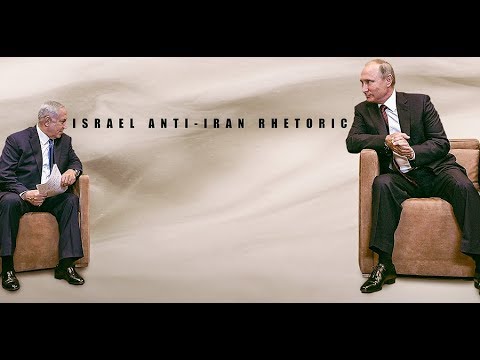
Prime Minister Benjamin Netanyahu has said that Israel felt threatened by Iran’s growing influence in the Middle East. Netanyahu expressed his Iranophobic view in a meeting with Russian President Vladimir Putin in Russia’s Black Sea resort of Sochi on Wednesday. Press TV has asked Scott Rickard, former American intelligence linguist from Tampa, Florida, and Brent Budowsky, a columnist at The Hill from Washington, to give their thoughts on the issue.
Rickard said Tel Aviv is concerned about the fact that the regime could not carry out its old project to spread sectarian divisions and pave the way for dismemberment of the countries in the Middle East region because of the Iranian-led resistance against Israeli policies, not only in the occupied territories of Palestine but also in the whole region.
“Iran is not a threat to Israel whatsoever. The threat that Israel sees is the fact that their Oded Yinon Plan is being put to a hold by Iran,” the intelligence linguist said on Thursday night.
“They (the Israelis) look at Iran as a threat only because they have no influence on their governments and Iran is autonomous and is not under the Zionist influence,” he added.
Since the victory of the Islamic Republic of Iran in 1979, Tehran has been critical of Israel’s policies in the region, whereas “no leaders [of other states] even dared to speak out against Zionism,” Rickard argued. … continue
Blog Roll
 Aletho News
- IRGC commander declares ‘new phase’ of reprisal attacks against aggressors
- Israel’s air defenses overwhelmed by cluster-warhead Iranian missiles: Reports
- Striking Iran’s Infrastructure Would Have Little Military Impact – Report
- What’s Behind U.S./Israeli Strikes On Iranian Pistachio Factories?
- Seyed M. Marandi: U.S. Military DIVIDED? Iran’s Secret Defense EXPOSED
- How I fell foul of the BBC thought police
- The End of NATO
- 37 days of war on Iran cost US staggering $42bln, tracker shows
- Baghdad tells Asian refiners, traders to begin loading Iraqi crude amid Iranian exemption
- Under fire, Moscow and Tehran close ranks
- If Americans Knew
- Trump says Iranians appreciate bombs, WHO warns of nuclear risks – Daily Update
- U.N. experts demand Israel release prominent Gaza doctor after reports of ‘severe torture’
- Israel’s Latest Genocide Is Against the Shias of Lebanon. Why Is the World Silent?
- How Eliot Cohen’s influence over U.S. war-making paved the way for Trump’s war crimes in Iran
- Israelis don’t pay for the weapons we ‘sell’ to them — US taxpayers do
- While Distancing from AIPAC, Most 2028 Democratic Hopefuls Are Still Embracing Israel
- A brief history of the Israeli nuclear program, the open secret at the heart of the Iran war
- Israeli Settlers Killed a Palestinian Farmer on His Own Land, in Front of His Father. Yes, Again
- The US-Israeli War on Science is an Assault on our Future
- 100+ International Law Experts Say US Strikes on Iran Violate UN Charter, Could Be War Crimes
- No Tricks Zone
- An Inconvenient Tree: Uncovered In Alps… Europe Much Warmer Than Today 6000 Years Ago
- New Study Reports A 60% Slowdown In Greenland’s Ice Loss Rate In The Last Decade
- Low Intensity Tornado Wrecks Major Solar Farm, Creating A Potential Toxic Dump
- New Study Finds Warming Saves Lives…Cold Temperatures 12 Times More Deadly Than Excess Heat
- German Science Blog Accuses PIK Climate Institute Of Hallucinating Climate Tipping Points
- Devastating Assessment Of Comirnaty Vaccine By Former Senior Pfizer Europe Toxicologist
- New Study: CO2 Is ‘Effectively Negligible’ As An Explanatory Climate Change Factor Since 2000
- Former Pfizer Toxicologist Dr. Helmut Sterz Tells Bundestag Hearing Pfizer Vaccine Should Have Never Been Approved
- Energy Expert: Germany’s Nuclear Phaseout Was A “500 Billion Euro Mistake”
- New Research: South Australia’s Mid-Holocene Sea Surface Temperatures Were 4°C Warmer Than Today
 Aletho News