Farmers slam Trudeau over rising fertilizer costs
By Keean Bexte | The Counter Signal | July 27, 2022
Canadian farmers slammed Justin Trudeau over rising fertilizer costs resulting from his decision to put tariffs on Russian fertilizer.
According to Ryan Koeslag, executive director of Ontario Bean Growers, tariffs on Russian fertilizer are wreaking havoc on the Canadian Agriculture Sector and the ability of farmers to merely keep their heads above water.
“Around one-third [of the 2022 shipments] had not been delivered into Ontario yet when that tariff was applied, and some of those ships were even being told that they would have to turn around,” Koeslag told CBC News in an interview. “… It’s hard to be a green farmer when you’re operating in the red.”
He also wonders why Canadian farmers are being forced to flip the bill for the war in Ukraine, despite other G7 countries abstaining from imposing such tariffs as they knew it would hurt their citizens.
“The United States is not applying a tariff. The U.K. and France are not applying a tariff. Why is it that Canada is the one that’s forcing our farmers to pay for the cost of the war in Ukraine?” asked Koeslag.
Indeed, as noted by Atlantic Grains Council chairman Roy Culberson, “The world needs Canadian farmers to produce our best crop this year. You cannot grow crops without fertilizer, and you cannot produce food without crops. An additional tariff paid by farmers on a global product such as fertilizer just penalizes the farmer. We look forward to working on a resolution with government.”
Earlier this year, Deputy PM and Finance Minister Chrystia Freeland acknowledged that the government’s decision to put tariffs on Russian fertilizer would negatively impact the Agriculture Sector but assured Canadian farmers that it wouldn’t be too bad.
“Tariffs and retaliation and sanctions are the most effective when you can devise policies that have the maximum impact on the counterparty whose attention you are seeking to get and do the minimal damage to yourself,” Freeland said a week after the Russia-Ukraine war kicked off.
How could it not cause more than “minimal damage,” though? According to Grain Farmers of Ontario, “Ontario, Quebec, and Atlantic Canada rely heavily on fertilizer imports. Approximately 660,000 – 680,000 tonnes of nitrogen fertilizer is imported from Russia to Eastern Canada annually, which represents between 85-90 per cent of the total nitrogen fertilizer used in the region.”
Trudeau, of course, hasn’t addressed any of the farmer’s concerns regarding tariffs. Moreover, the rising fertilizer costs come at a time when the Trudeau government is pushing forward with a 30% emissions reduction cap on nitrous oxide from fertilizer.
Indeed, as noted by Fertilizer Canada CEO Karen Proud, farmers are already reducing fertilizer use due to rising costs (resulting in less food and rising prices), and the nitrogen policy will only exacerbate the problem.
“We are talking about the food supply,” said Proud. “Canada is already among the top countries that use nitrogen efficiently. We don’t have much room to go before we start affecting yields.”
Agriculture Ministers from several provinces have also voiced their frustrations over the actions of the Trudeau government, explaining that this has already been the most expensive year for farming in recent memory, and Trudeau’s climate fanaticism is only going to make things worse.
“We’re really concerned with this arbitrary goal,” Saskatchewan Minister of Agriculture David Marit said. “The Trudeau government has apparently moved on from their attack on the oil and gas industry and set their sights on Saskatchewan farmers.”
Alberta Agriculture Minister Nate Horner agreed, adding, “This has been the most expensive crop anyone has put in, following a very difficult year on the prairies. The world is looking for Canada to increase production and be a solution to global food shortages. The Federal government needs to display that they understand this. They owe it to our producers.”
With what appears to be a coordinated attack on Canada’s Agriculture Sector and food supply, it’s no surprise that farmer’s groups speaking to Farmers Forum are wondering if he’s intentionally trying to cause a food shortage — which Trudeau previously told Canadians to prepare for.
German mayors want Nord Stream 2 opened
Samizdat | July 27, 2022
Berlin’s policy of trying to give up imports of Russian natural gas is likely to create hardship and spark unrest, seven mayors from the German island of Ruegen wrote in a letter sent to the regional and federal governments on Wednesday. They also urged the federal government to allow gas imports via the Nord Stream 2 pipeline, given the current technical difficulties with Nord Stream 1 – something Berlin has steadfastly rejected.
In the letter addressed to federal economy minister Robert Habeck and Manuela Schwesig, prime minister of Mecklenburg-Vorpommern, the mayors “strongly condemn” the current conflict in Ukraine but urge the government to consider the damage its policy could do to the German population and the economy, according to the news agency DPA.
“We are of the opinion that the path taken by the federal government to disconnect from Russian energy sources is not the right one,” the seven mayors wrote. Initially drafted by the leaders of Bergen, Binz and Sassnitz, the letter was later signed by four more jurisdictions on Ruegen, Germany’s largest island and a popular tourist destination.
Giving up gas imports from Russia would mean an explosion in the cost of living, which would lead to social instability and unrest that could get out of control, the mayors wrote, according to German media. Calls from the federal government to save energy – such as showering less and foregoing hot water – “defy understanding,” they added.
“As the mayors of this island, we don’t want to have to accept any further restrictions,” Sassnitz city manager Frank Kracht told the Mecklenburg-Vorpommern affiliate of the TV station NDR.
Rejecting the proposals to expand the number of wind turbines near residential areas, calling them a health hazard, the mayors advocated “a general rethinking of the solution to the current problems in relations with Russia.”
Among their suggestions was to get additional natural gas via the Nord Stream 2 pipeline. Finished in late 2021, the pipeline from Russia to Germany under the Baltic Sea was just waiting for the operating permit from Berlin – which was suspended indefinitely on February 22, two days before Russia sent troops into Ukraine.
NS2 was supposed to double the volume of Russian gas exports, but was delayed by US sanctions seeking to protect Ukraine’s gas transit earnings. Nord Stream 1, which continues to supply Germany with gas, is currently operating at only 20% capacity, due to maintenance requirements. Its operator, Gazprom, says several turbines at the Portovaya compressor station need servicing to maintain certification. The first one was held up by Canada, citing anti-Russian sanctions over the conflict in Ukraine, until Berlin intervened seeking an exemption. NS2 does not use Siemens turbines, and can be maintained regardless of the sanctions.
Berlin has refused to even consider the possibility of using NS2, however. Economy minister Habeck has said that the pipeline cannot operate without certification. He also accused Russian President Vladimir Putin of trying to damage EU solidarity with Ukraine by driving up the price of gas.
“Putin has the gas, but we have the power,” Habeck said on Tuesday, appealing to Germans to stand together.
Recent polls showed widespread pessimism in German industry regarding future business prospects. Commenting on the turbine delay last week, Foreign Minister Annalena Baerbock said gas shortages could lead to an insurrection.
“If we don’t get the gas turbine, then we won’t get any more gas, and then we won’t be able to provide any support for Ukraine at all, because then we’ll be busy with popular uprisings,” she told the TV outlet RND. Baerbock hastened to add that this may have been “exaggerated” and insisted most Germans supported sending weapons to Ukraine, though.
BASF Prepares To Slash Ammonia Production In Germany Amid Worsening NatGas Crunch
By Tyler Durden | Zero Hedge | July 27, 2022
German chemicals company BASF SE paid an extra 800 million euros ($809.5 million) to keep its plants operating in the second quarter compared with a year earlier amid skyrocketing natural gas prices. The impact of high energy prices has forced the company to make a difficult decision: slash the production of ammonia, which could have potential consequences for farming to the food industry.
“We are reducing production at facilities that require large volumes of natural gas, such as ammonia plants,” BASF Chief Executive Martin Brudermuller said in a conference call after an earnings report.
Brudermuller said BASF would tap external suppliers to fill the deficit as German plants reduced output. He warned about potential supply disruptions that could boost fertilizer costs for farmers.
Reuters details how ammonia plays a critical role in manufacturing nitrogen-based fertilizers, plastic-making, and diesel exhaust fluid. A byproduct of ammonia production is high-purity carbon dioxide (CO2) which is heavily used in the food industry.
The news of BASF reducing ammonia production because of soaring NatGas prices comes as Russian state-owned energy producer Gazprom PJSC is expected to halve supplies via Nord Stream 1 to Europe to about 20% today. EU member states agreed Tuesday to reduce NatGas demand by 15% over the next eight months, though countries like Germany, without any liquefied natural gas (LNG) port terminals to replace Russian pipeline NatGas, might have to make more considerable sacrifices.
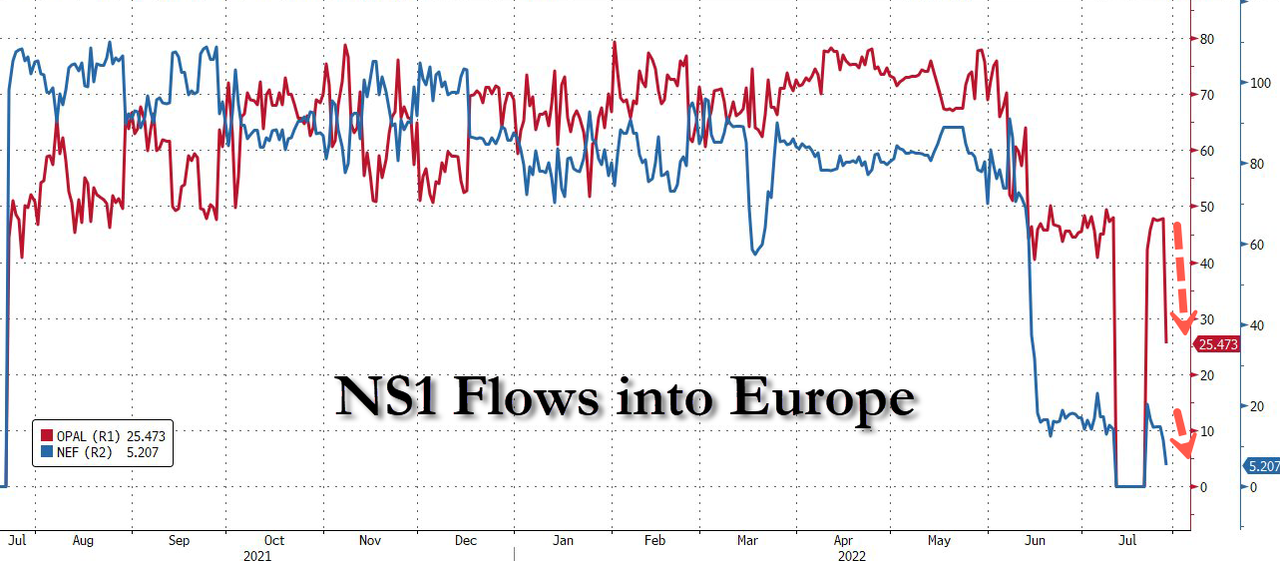
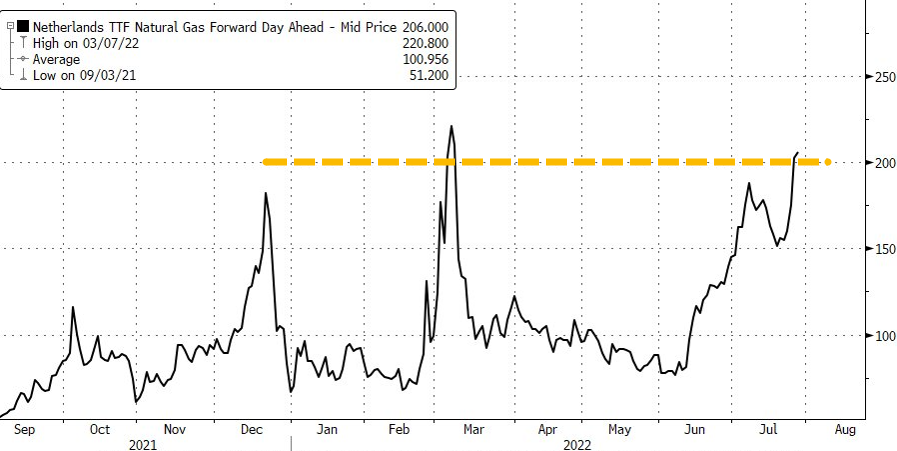
Benchmark NatGas prices in Europe at the Dutch TTF hub hit their highest level since March. Prices have shot up 35% in a week, over 200 euros per megawatt-hour (MWh), as Putin turns the screws on Europe by reducing pipeline capacity to Europe.
“Chemical companies are the biggest industrial natural-gas users in Germany, and ammonia is the single most gas-intensive product within that industry,” Reuters said.
Arne Rautenberg, a fund manager at Union Investment, said ammonia is a prime candidate by chemical companies to cut production first over the NatGas supply squeeze.
“In the northern hemisphere, nitrogen fertilizer is applied primarily during the spring. It can also be produced in the United States and shipped to Europe,” Rautenberg said, adding that the CO2 supply for the food industry could experience disruptions.
The chemical industry lobby VCI indicates German ammonia production has been curbed (some of which began last October) considerably because of soaring energy prices. This could soon impact industries that rely heavily on ammonia and ripple through the economy already facing recession.
The WEF wants to end private car ownership

By Keeane Bexte | The Counter Signal | July 25, 2022
The World Economic Forum (WEF) is calling for the end of private car ownership in the name of saving the world from climate change by reducing the need for green tech resources.
“We need a clean energy revolution, and we need it now,” the WEF begins its article.
According to the WEF, critical metals, such as cobalt, lithium, and nickel — all of which are used in “clean energy technologies” — are in short supply. And while the WEF says recycling old tech that uses these metals could lessen the impact of shortages, it’s simply not enough.
“The complication is that we do not currently have enough metals in circulation, and even with recycling taken into consideration, mineral production is still forecasted to increase by nearly 500%. So how should we proceed?” the WEF asks.
Top of the list of solutions for how the WEF thinks we should proceed is to “Go from owning to using.”
Sound familiar?
“Be honest,” the WEF continues, “you likely have at least one old mobile phone tucked in the bottom of a drawer. Possibly an unused hard drive taking up space too. You aren’t alone. The average car or van in England is driven just 4% of the time… This is not at all resource efficient. More sharing can reduce ownership of idle equipment and thus material usage. Car sharing platforms such as Getaround and BlueSG have already seized that opportunity to offer vehicles where you pay per hour used.”
The WEF adds that people should not only give up their ownership of everything from cars to smartphones but that technologies and civilization need to be redesigned to facilitate this transition.
“To enable a broader transition from ownership to usership, the way we design things and systems need to change too… A design process that focuses on fulfilling the underlying need instead of designing for product purchasing is fundamental to this transition. This is the mindset needed to redesign cities to reduce private vehicles and other usages.”
Of course, transitioning from people owning things to essentially just renting them won’t be easy. The WEF acknowledges this but says it’s totally worth it. Just trust them.
Net Zero Policies Will Turn Europe Into a “Trivial and Incapable” Backwater
BY CHRIS MORRISON | THE DAILY SCEPTIC | JULY 24, 2022
The social and economic destructive power of the political Net Zero agenda across the European Union, and by extension the U.K., is laid bare in a damning new report from the Global Warming Policy Foundation. In a long and detailed presentation, energy writer John Constable warns that the European Green Deal seems all but certain to break Europe’s economic and socio-political power – “rendering it a trivial and incapable backwater, reliant on – and subservient to – superior powers”.
It is easy to read into the report that “superior powers” include countries that supply Europe with vital oil and gas and make the industrial goods required to enjoy current lifestyles. If they wish, European consumers and politicians can continue to indulge in monumental green virtue signalling, print money until kingdom come and even consider resurrecting old economic and social disasters like pointless Covid restrictions. The TalkTV host Julia Hartley-Brewer often notes that Net Zero is “borderline insanity”. The use of the word “borderline” seems superfluous.
The collapse in competitive manufacturing capacity is nowhere more evident than in the renewable sector itself, says Constable.
It is clear that renewable energy equipment manufacturing has no future in the EU, and indeed manufacturing of any kind exposed to international competition will struggle to survive, except in niche areas.
The all but total collapse of the Spanish solar industry within eight years is highlighted. Constable describes it as “extraordinary” and in large part explained by the curtailment of subsidies. Overall, he says, “subsidised deployment in Europe has failed to give European industries a secure position in the world markets for renewable energy equipment. The field is now dominated by China”.
Again, it might be noted that if you can’t even pay companies to produce hardware under local economic conditions, Boris Johnson’s promise – backed it seems by almost all politicians – to bring plentiful green jobs in the U.K. across the ‘Red Wall’ is just windy rhetoric.
News of an impending Net Zero calamity is rarely far from the headlines. Tata Steel has been trying to obtain subsidies approaching £1.5bn from the U.K. Government to pay decarbonising costs and keep Port Talbot steelworks operational. “The new Prime Minister is unlikely to be willing to hand over subsidies on this scale, not least because every other industry hit by demands for decarbonisation would insist on handouts too,” said Dr. Benny Peiser, Director of Net Zero Watch. “It is becoming more evident by the day that the Climate Change Committee misled Parliament over the true cost of Net Zero,” he added.
The lack of Net Zero discussion in the current Tory leadership battle is interesting. Savvy politicians are starting to become aware of the disaster that is hurtling towards society as it seeks to quickly remove the cheapest and most efficient fuel it has from the energy mix and replace it with intermittent sources – described by Constable as “thermodynamically incompetent”. On the other hand, large swathes of the population have become convinced that the climate is breaking down, as evidenced by the hysteria that surrounded the recent brief heatwave. The science is ‘settled’, although a more realistic interpretation is that green activists and financiers have pursued a ruthless 30-year campaign to outlaw the scientific method from atmospheric climate science.
Constable argues that a change of course is inevitable to undo the “deeply embedded” harm of nearly 30 years. Moving towards “fundamentally cheaper energy” will require substantial reductions in European living standards. “Explaining this to the European people will form the greatest political challenge of the next 50 years,” he says.
In his wider report, Constable attempts to demonstrate that the enthusiastic adoption of the green agenda in the 1990s and early 2000s “has effectively produced gradual industrial and economic disarmament”. The ‘”resultant enfeeblement” compared to Europe’s competitors will make arresting the decline difficult: “Recovering the situation entirely may be impossible.” The author lists numerous body blows to overall competitiveness. Electricity prices to industry in the EU between 2008-2018 have been about 30% above those in the G20, an organisation that includes China, India and Russia. Gas price were 20-30% higher. Electricity prices were 80% and 30% higher respectively for industry and households, and this would have hit competitiveness hard and placed heavy energy costs on some of those least able to afford them. Petrol prices were approximately 30-50% higher, and diesel 10-40%, figures again that were guaranteed to destroy competitiveness outside the EU’s protective internal single market.
Meanwhile, energy consumption in the EU has been falling and is now said to be at levels last seen in the early 1990s. Such a deep and sustained decline is said to be unprecedented in the modern era. In the U.K., electricity consumption is reported to have fallen back to levels not seen since 1970. Energy efficiency, of course, plays a part, but Constable notes the effect of “price rationing and demand destruction”. The report labels Europe’s “green experiment” as a “costly failure”, noting that “carbon dioxide abatement costs in the EU are on average several times greater than even high-end estimates of the social cost of carbon”. This is said to indicate that the economic harm of the EU’s mitigation policies “is greater than the climate change it aims to prevent”.
Politicians – and green activist commentators – often blame inflation, high energy prices and food shortages on recent events such as Russia’s war in Ukraine. But Constable argues that the Ukrainian war, while bringing the failures of climate policies into sharper focus, does not mean that the harm is of recent origin. “On the contrary,” he argues, “the environmental policies have been damaging to the EU’s interests, and advantageous to those of its rivals, from the very beginning.”
New Prime Minister will have to pause Net Zero or face the demise of UK’s steel industry
Net Zero Watch | July 22, 2022
London – With the exorbitant costs of Net Zero plans threatening Port Talbot steelworks with closure, the next Prime Minister will be faced with a stark choice: pause Net Zero plans for energy-intensive industries or preside over the end of the UK steel manufacturing.
The warning comes from the director of Net Zero Watch, Dr Benny Peiser.
Tata Group, the owner of the UK’s largest steel manufacturer, has threatened to shut down operations if the government does not agree to provide £1.5bn of subsidies to help it reduce CO2 emissions.
The crisis for UK steel demonstrates that the cost of Net Zero is an existential threat to British industries and manufacturing.
As an energy-intensive manufacturer of internationally traded commodities, the steel sector is particularly sensitive to the astronomical cost of decarbonisation. It is the first to acknowledge that the industry simply can’t survive Net Zero without multi-billion handouts – but it won’t be the last.
Tata Steel and the energy-intensive sector more broadly can be regarded as a canary in the coalmine, giving early warning of a more general economic and industrial disaster, as the rising costs of Net Zero trickle down to the rest of the economy.
Dr Peiser said:
“The new Prime Minister is unlikely to be willing to hand over subsidies on the scale demanded by Tata, not least because every other industry hit by demands for decarbonisation would insist on handouts too.
“It is becoming more evident by the day that the Climate Change Committee misled Parliament over the true cost of Net Zero. Most energy-intensive businesses in the UK won’t be able to survive the looming Net Zero cost crisis unless the new Prime Minister takes swift action.”
Trudeau moves forward with fertilizer reduction “climate” policy
By Thomas Lambert | The Counter Signal | July 23, 2022
Trudeau has decided to move forward with his cap on nitrogen emissions by reducing fertilizer use even as provincial Agriculture Ministers beg him to stop.
As per a Government of Saskatchewan news release, both the Alberta and Saskatchewan Ministers of Agriculture have expressed “profound disappointment” in Trudeau’s decision to attempt to reduce nitrogen emissions from fertilizer.
“We’re really concerned with this arbitrary goal,” Saskatchewan Minister of Agriculture David Marit said. “The Trudeau government has apparently moved on from their attack on the oil and gas industry and set their sights on Saskatchewan farmers.”
“This has been the most expensive crop anyone has put in, following a very difficult year on the prairies,” Alberta Minister of Agriculture Nate Horner said. “The world is looking for Canada to increase production and be a solution to global food shortages. The Federal government needs to display that they understand this. They owe it to our producers.”
As previously reported by The Counter Signal, in December 2020, the Trudeau government unveiled their new climate plan, with a focus on reducing nitrous oxide emissions from fertilizer by 30% below 2020 levels by 2030. That plan is now coming into effect — though the government refuses to acknowledge that nitrous oxide emissions can be reduced without reducing fertilizer use.
“Fertilizers play a major role in the agriculture sector’s success and have contributed to record harvests in the last decade. They have helped drive increases in Canadian crop yields, grain sales, and exports,” a news release from Agriculture and Agri-Food Canada reads.
“However, nitrous oxide emissions, particularly those associated with synthetic nitrogen fertilizer use have also grown significantly. That is why the Government of Canada has set the national fertilizer emissions reduction target, which is part of the commitment to reduce total GHG emissions in Canada by 40-45% by 2030…”
This is a tacit admission that any attempt to lower emissions by reducing nitrogen fertilizer will consequently lower crop yields over the next decade, hurting the Agriculture sector and, more importantly, hurting farmers.
And indeed, according to a report from Fertilizer Canada :
Total Emission Reduction puts a cap on the total emissions allowable from fertilizer at 30% below 2020 levels. As the yield of Canadian crops is directly linked to proper fertilizer application this creates a ceiling on Canadian agricultural productivity well below 2020 levels…
It is estimated that a 30% absolute emission reduction for a farmer with 1000 acres of canola and 1000 acres of wheat, stands to have their profit reduced by approximately $38,000 – $40,500/ annually.
In 2020, Western Canadian farmers planted approximately 20.8 million acres of canola. Using these values, cumulatively farm revenues from canola could be reduced by $396M – $441M on an annual basis. Wheat famers could experience a reduction of $400M.
Moreover, Fertilizer Canada doesn’t believe that forcibly decreasing fertilizer use will even lower greenhouse gases but could lead to carbon leakage elsewhere.
Nonetheless, Trudeau’s government is moving forward, with farmer’s groups speaking to Farmers Forum now wondering if he’s intentionally trying to cause a food shortage — which Trudeau previously told Canadians to prepare for.
Canadian company is selling junk food made from crickets

By Keean Bexte | The Counter Signal | July 22, 2022
Entomo Farms, a company based in Canada, is selling junk food made from crickets in stores across the country under their “Actually Foods” brand.
“Actually Foods is on a mission to renew Canadians’ relationship with “healthy” food,” copy on the company’s website reads.
“We’ve ditched so-called “natural” ingredients that are actually not as clean as they claim. Instead, we’re making something you can feel good about, using unexpected ingredients that, although surprising, actually boast the health benefits you’re looking for: like high-protein cricket powders, fava beans, and more.”
Included in Actually Foods’ Cheddar Jalapeno Puffs are the following ingredients: Puff (Organic Corn Meal Flour, Lentil Flour, Fava Bean Flour, Rice Flour, Organic Cricket Flour), Seasoning (Buttermilk Powder, Modified Milk Ingredients, Salt, Dehydrated Vegetables (Jalapeno, Onion, Garlic, Green Bell Pepper), Yeast Extract, Natural Cheddar Cheese Flavoured Powder, Herbs, Spices, Citric Acid), Sunflower Oil.
The food itself appears indistinguishable from other junk foods, and one would have to check the labels and ingredients even to be aware that they were about to eat crickets [indeed, many processed foods contain disgusting ingredients, such as human hair sweepings, disguised with indecipherable names].
“Powered by crickets, 10g protein,” inconspicuous labelling on the package reads.
Moreover, given that the cricket powder has been mixed in with so many other ingredients commonly found in junk food, it’s likely the buggy flavour is entirely masked — though this journalist won’t be picking up a bag for a taste test any time soon.
According to the copyright on the page, the brand is owned by Entomo Farms, which is located in Norwood, Ontario, and claims that it’s “The Future of Food.”
“Through product excellence and education, to make cricket-based foods the first choice for individuals interested in high-quality, sustainable protein,” Entomo Farms’ mission statement reads.
The company’s website also includes several recipes, including their “Top 3 Cricket Powder Smoothie Recipes,” “Salsa with Cricket Powder,” and “Mexican Chopped Salad with Chili Lime Crickets.” Yum.
According to an article on the website, Entomo Farms raised its Series A Funding from Maple Leaf Foods to expand its operation in 2018.
The company was founded in 2014 by brothers Jarrod, Darren, and Ryan Goldin and had grown to 60,000 square feet of production space in just four years, making it “North America’s largest human-grade edible insect farm.”
In 2021, the company closed another round of fundraising, walking off with $3.7 million — primarily from North America and Asia — to grow the company’s operational capacity even further.
“We are thrilled to continue our growth trajectory in the alternative protein and sustainable foods space. We are expanding our facilities to support the exciting growth of our customers and we look forward to launching a new consumer brand later this year,” said Entomo Farms CEO Lauren Keegan. “With this investment, and a planned capital raise in late 2021, we will keep paving the way for crickets as an important food ingredient for people and pets.”
Featured Video

Laith Marouf: Hezbollah’s position on US-Iran ceasefire
or go to
Aletho News Archives – Video-Images
From the Archives
The Dirty Little Secret behind the “Global Terrorism Index”
The Omission of Israeli Terrorism in the Occupied Palestinian Territories
By Karin Brothers | Global Research | December 6, 2014
… The Israeli settlements — all of which are illegal – have been identified as a major impediment to peace. The refusal of a major “global” terrorism report to name the Israeli settlers as one of the groups most responsible for terrorism not only misrepresents a major source of regional violence but exposes the Global Terrorism Index as a propaganda tool that supports a U.S. agenda.
In recent years, governments have been attempting to thwart terrorism by blocking supportive fund-raising. When it comes to Israeli settlements, however, the US and Canada actually encourage fund-raising by giving organizations (such as Christian Friends of Israeli Communities (CFOIC) and the Jewish National Fund) financial support in the form of donor tax-deductions.
Charities which provide funds for the Israeli settlements should be regarded as terror-financing organizations. They should not only lose their tax-deductible status, but they should be banned because they support the violation of international humanitarian law. The terror-financing laws that are being strictly enforced for Muslim charities should be applied to Christian and Jewish charities as well. … Read full article
Blog Roll
 Aletho News
- The Black Cube Files: How Former Mossad Operatives Flipped a Nation
- Laith Marouf: Hezbollah’s position on US-Iran ceasefire: What you’re not being told
- Israel’s priority lies in destroying chances of peace between Iran, US: Ex-UN nuclear chief
- Ceasefire for all or for none: Iran shuts Hormuz over Lebanon attacks
- Strait of Hormuz is Iran’s ‘nuclear weapon’ that forced US retreat: Medvedev
- Energy crisis will last for months – Kremlin envoy
- Europe’s quiet role in the war on Iran
- Forty days that shook the Empire: How Iran turned the tables on US and prevailed
- Netanyahu unilaterally declares Lebanon outside of ceasefire deal
- Israeli leaders: ‘Not a single goal’ achieved in war with Iran
- If Americans Knew
- Gazans face a triple crisis: severe shortages of water and bread, healthcare in tatters
- NY Times reports how Netanyahu took the US into Iran War
- A sigh of relief over Iran, but Gaza and Lebanon in dire straits – Daily Update
- Thousands dead and neighborhoods razed to the ground: Aid agencies fear southern Lebanon is becoming the new Gaza
- The war the US is fighting for Israel could cost trillions
- ‘Cigarette Burns, Nail Wounds’: Toddler Tortured in Gaza to Coerce Father
- Trump Says US Sent ‘a Lot of Guns’ to Protesters in Iran
- Israeli forces destroy 17 UN peacekeeper cameras in south Lebanon
- US-Israeli strikes ‘completely destroy’ synagogue in Tehran
- Archbishop for US Military Says Iran War Is Unjust Under Catholic Teaching
- No Tricks Zone
- An Inconvenient Tree: Uncovered In Alps… Europe Much Warmer Than Today 6000 Years Ago
- New Study Reports A 60% Slowdown In Greenland’s Ice Loss Rate In The Last Decade
- Low Intensity Tornado Wrecks Major Solar Farm, Creating A Potential Toxic Dump
- New Study Finds Warming Saves Lives…Cold Temperatures 12 Times More Deadly Than Excess Heat
- German Science Blog Accuses PIK Climate Institute Of Hallucinating Climate Tipping Points
- Devastating Assessment Of Comirnaty Vaccine By Former Senior Pfizer Europe Toxicologist
- New Study: CO2 Is ‘Effectively Negligible’ As An Explanatory Climate Change Factor Since 2000
- Former Pfizer Toxicologist Dr. Helmut Sterz Tells Bundestag Hearing Pfizer Vaccine Should Have Never Been Approved
- Energy Expert: Germany’s Nuclear Phaseout Was A “500 Billion Euro Mistake”
- New Research: South Australia’s Mid-Holocene Sea Surface Temperatures Were 4°C Warmer Than Today
 Aletho News