Miliband ‘robbing Peter to pay Paul’
By Paul Homewood | Not A Lot Of People Know That | June 23, 2025
Net Zero Watch has belittled the government’s announcement that it will cut electricity bills for large industrial users by 25%. The campaign group has pointed out that the cost of the discount has to be paid somehow. Newspaper reports suggest that industrial gas users will be footing the bill, although details are scarce.
Net Zero Watch director Andrew Montford said:
Ed Miliband is once again merely proposing to shuffle costs from one energy user to another. Robbing Peter to pay Paul is all he has to offer, because his mad fixation on decarbonisation means he will not look at the underlying problem, namely the gross inefficiency of a renewables-based grid.
And Mr Montford warned that any relief would be temporary:
This latest wheeze will bring temporary relief for sectors favoured by the Secretary of State, but at the expense of others, who can ill afford it. And in the medium term, bills will continue to rise for everyone. The country can’t afford this madness any longer.
The Telegraph report:
“From 2027, they will no longer have to pay the net zero levies that are normally added to their power bills, such as the renewables obligation, the feed-in-tariff and capacity market charges.
This will be paid for by financial reforms to the energy market and a raid on companies that burn natural gas, through higher carbon taxes, the Government said.”
A spokesman for the business department added that “energy market reforms” will also pay for the changes, including longer subsidy agreements with wind farms – aimed at bringing the overall cost for power down.
Higher carbon taxes will not only punish industrial gas users, many of whom don’t qualify as “large industrial users”, they will also increase the wholesale price of electricity, meaning that while large industries will be better off, the rest of us will have to pay the bill instead.
This gives the lie to Starmer’s claim that “it would not be paid for via extra charges on households”.
The claim about “energy market reforms” is just smoke and mirrors. They will have no effect on existing subsidies for renewable energy, and longer term CfDs are only being considered because nobody wants to build offshore wind farms at the prices on offer. Inevitably the next round will see much higher prices, so there will be no “savings” to divvie out.
As is now routine with this wretched Government, policies are announced which cannot be funded and are sold to the public on the basis of a lie.
It is fantasy economics, something we have seen time and again in the last year.
Electricity prices are higher because of the £20+ billion paid out every year to subsidise renewable energy and deal with the extra costs it imposes.
Until this Government gets a grip with the real problem, nothing will change, no matter what smoke and mirror tactics they employ.
‘Net Zero’ Is Collapsing in U.S. States
By Steve Goreham – Master Resource – June 16, 2025
From New York to California, state renewable electrical power dreams are collapsing. Power demands soar, while the federal government cuts funding and support for wind, solar, and grid batteries. Renewables cannot provide enough power to support the artificial intelligence revolution. The Net Zero electricity transition is failing in the United States.
For the last two decades, state governments have embraced policies aimed at replacing coal and natural gas power plants with renewable sources. Twenty-three states enacted laws or executive orders to move to 100% Net Zero electricity by 2050. Onshore and offshore wind, utility-scale and rooftop solar, and grid-scale batteries were heavily promoted by states and most federal administrations.
The New York State Climate Action Scoping Plan of 2022 called for 70% renewable electricity by 2030 and 100% by 2040. But 49.7% of the state’s electricity came from gas in 2024, up from 47.7% in 2023. A January executive order issued by President Trump halted federal leases for construction of offshore wind systems. New York, nine other east coast states, and California were counting on offshore wind in efforts to get to 100% renewable electricity, but new offshore wind projects are now halted.
Wind and solar have benefited from federal tax credits, loans, and outright grants since 1992. But the Trump administration is now working to slash federal government support for these technologies. The One Big Beautiful Bill Act (OBBB) passed the House of Representatives on May 22. The bill eliminates Production Tax Credits and Investment Tax Credits for renewable systems that begin construction later than 60 days after passage of the bill or for projects that do not complete construction by year end 2028. The bill also halts the sale of tax credits from renewable projects. If the Senate passes the bill, these measures will choke off green energy projects that have relied on federal funding for decades.
Wind and solar advocates attack the OBBB, warning that the bill would create a “nightmare scenario” for US clean energy. These same advocates claim that wind and solar are the lowest-cost generators of electricity but also demand that huge federal subsidies must continue.
Along with federal cutbacks, the artificial intelligence (AI) revolution now drives the nation’s power system, interrupting the renewable electricity transition. Microsoft, Meta, Google, Amazon, and other giant firms are building new data centers and upgrading existing data centers to power AI. AI processors run 24-hours a day for months to enable computers to think like humans. When servers are upgraded to support AI, they consume 6 to 10 times more power than when used for cloud storage and the internet. Data centers consumed 4% of US electricity at the start of 2024 but are projected to consume 20% within the next decade.
Artificial intelligence drives a massive increase in electricity demand. For years, state legislators forced grid operators to close coal and natural gas power plants as part of a transition to renewables. More than 200 coal-fired power plants were closed. But now, many states face a shortage of generating capacity. Virginia has the highest concentration of data centers in the world, with power consumption forecasted to triple by 2040. The Electric Reliability Council of Texas estimates that Texas electricity demand will soar from a record 85.5 gigawatts in 2023 to 218 GW by 2031.
In December, the North American Electric Reliability Corporation concluded that that over half of North America risks power shortfalls in the next decade from surging demand and coal and gas plant retirements. Grid operators are now stepping back from the transition to wind and solar. Coal-fired power plant closures have been postponed in Georgia, Indiana, Illinois, Tennessee, Utah, West Virginia, and other states. Nuclear plants are being restarted in Michigan and Pennsylvania. But the big winner will be natural gas.
More than 200 gas plants are planned or under construction. Gas facilities can be brought online in about three years, compared to ten years for nuclear plants. Gas plants can be built near cities, often on former power plant sites, and require fewer new transmission lines than needed by wind and solar systems.
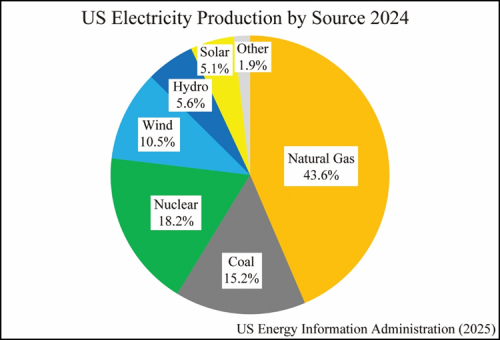
The latest trend is BYOP (bring your own power). AI firms are building their own gas plants to power data centers. Gas turbine manufacturer capacity is now sold out for years. The gas share of electricity production will rise from 43.6% of US consumption in 2024 to much higher levels. The AI power demand and the push for gas are destroying state plans for a transition to green electricity.
California, Massachusetts, Michigan, New York, Texas, and other states are installing grid-scale batteries to try to compensate for wind and solar intermittency. Huge lithium batteries are intended to store excess wind and solar output when the wind blows and the sun shines and then release electricity when wind and solar output is low. But lithium batteries are unproven technology that is prone to spontaneous ignition, creating huge fires that are difficult to extinguish and which endanger residents.
In the last two years, California suffered four grid battery fires, each at facilities less than five years old. The Otay Mesa storage facility near San Diego burned for more than a week and reignited three times. The Moss Landing battery facility, located south of Santa Cruz, caught fire in January. Forty percent of Moss Landing, one of the largest grid-scale battery facilities in the world, was destroyed in the fire. Residents have sued to prevent the restart of Moss Landing. New York also had three grid battery fires in the last 18 months. Battery fires release toxic gases, force evacuations and school closures, and disrupt communities.
In addition, grid batteries are very expensive. To back up a wind or solar facility for 24 hours requires batteries that cost about ten times as much as the wind or solar system itself. But without grid batteries, wind and solar cannot replace coal, gas, or nuclear generation and still provide reliable power.
The cost of wind, solar, and batteries is hurting the renewable electricity transition. Electricity rates in California, the epicenter of green energy, have risen 116% in the last 16 years, more than three times the national average increase of 33%. California’s residential electricity prices are now over 30 cents per kilowatt-hour, the second highest in the nation. Connecticut, Hawaii, Massachusetts, and Rhode Island complete the top five for the highest US power costs—all states with aggressive green electricity goals.
The Net Zero electricity transition, endorsed by many states for more than a decade, is failing in the United States. Wind, solar, and batteries suffer from the offshore wind cancellation, federal subsidy cuts, inability to meet the demand of the artificial intelligence revolution, grid battery fires, and high cost. A green energy breakdown is underway. States will be forced to return to sensible energy policy.
———————
Steve Goreham is a speaker on energy, the environment, and public policy and author of the bestselling book Green Breakdown: The Coming Renewable Energy Failure.
40 Buses Destroyed: Electric Bus Confirmed as Cause in Philly Fire
StacheD Training | June 7, 2025
On June 5, 2025, a massive fire broke out at SEPTA’s Midvale Depot in Philadelphia, destroying 40 out-of-service buses. Speculation swirled—was it arson, a setup, or just bad luck? Now we know: the fire started in an electric bus. And it’s not the first time a Proterra bus has ignited in Philadelphia. Back in 2022, a similar bus caught fire while charging at SEPTA’s Southern Depot. That incident led to a national recall, but no fix was in place.
Link to NTSB Investigation (HWY23IH002): https://data.ntsb.gov/Docket/?NTSBNum…
Training & Consulting: https://www.stachedtraining.com
India Spurns Carbon Tax Threat, Promotes Trade and Fossil Fuels
By Vijay Jayaraj | RealClear World | May 24, 2025
Like many developing economies, India faces coercion from the United Nations and Europe to conform to climate policies, especially through the imposition of carbon taxes on imports into their countries. But Delhi is not about to bend to such tactics.
“If they [EU and U.K.] put in a carbon tax, we’ll retaliate,” said India’s Union Minister Piyush Goya at the Columbia India Energy Dialogue in New York City. “I think it will be very silly, particularly to put a tax on friendly countries like India.”
That isn’t a bluff. It’s a moral, strategic, and scientific imperative grounded in realpolitik and economic logic.
India and the U.K. have inked a trade deal that promises to boost bilateral trade by more than $33 billion and increase U.K. gross domestic product and wages by many billions.
On paper, this deal is a triumph for both nations, removing duties on 99% of Indian goods entering the U.K. For India, this means greater market access for textiles, agriculture and manufactured goods – sectors that employ millions and drive economic growth.
Yet, the U.K.’s pending Carbon Border Adjustment Mechanism (CBAM) remains in place with no exemptions for Indian steel, cement and aluminum, despite the trade agreement.
Starting January 2027, the U.K. is to impose a levy on these “carbon-intensive” imports, supposedly to compensate for the difference between the U.K.’s domestic carbon tax and India’s lower assessment at home. The tax on imports is to prevent “carbon leakage” — the idea that emissions are “outsourced” to countries with fewer regulations.
This hocus-pocus is nothing more than repugnant virtue signaling that penalizes manufacturers in developing countries for using the very fossil fuels that powered the West’s rise in the 19th and 20th centuries.
India’s export of these products to the EU and U.K. are a critical part of its economic engine. In 2022 alone, 27% of India’s iron, steel and aluminum exports went to the EU.
Yet, the EU’s CBAM, set to take effect in 2026 prior to the U.K. tax, would slap tariffs of 20-35% on these goods.
For Indian exporters, this translates to a steep cost increase. India’s predominantly coal-based blast furnaces have higher carbon intensity of around 2.5-2.6 metric tons of CO₂ emissions per metric ton of steel produced in comparison to the global average of 1.85 metric tons of CO2 . This means a higher CBAM assessment for India.
Profit margins for steel exports could shrink, while aluminum exporters might face a sudden surcharge once indirect emissions from coal power are factored in. Take the case of Tata Steel, which employs over 75,000 people and produces 30 million tons of steel annually. A 20-35% carbon tax under the EU’s CBAM would erode profit margins, forcing layoffs or price hikes that could cost it market share.
India’s dismissal of the climate war on fossil fuels is grounded in necessity and science. Economically, the nation aims to become a $5 trillion economy by 2027, a goal that demands rapid industrialization and infrastructure growth.
Steel, cement, and aluminum are the building blocks of this ambition, used in everything from bridges to skyscrapers, and an important source of export revenue. Fossil fuels, particularly coal, are the lifeblood of these industries, providing the energy needed to keep production costs low and globally competitive.
Coal generates more than 70% of India’s electricity. It powers the factories that make steel and cement. It keeps the lights on in rural hospitals and schools. And it fuels the economic engine that has lifted 415 million people out of poverty in the past two decades.
The modern crusade against fossil fuels is based on the false premise of a disintegrating global environment. But that is not the case. Carbon dioxide is not a toxin. It is a colorless, odorless gas essential to life on Earth.
Even the term “carbon emissions” is a sleight of hand. The emissions are carbon dioxide but calling them “carbon” conjures images of potentially harmful soot and smoke. Fear perpetrated by lies have made people less resistant to destructive policies like CBAM.
However, India won’t bow to carbon taxes, and it won’t join an unscientific climate war that sacrifices its future. The U.K. and EU would do well to listen, lest they find themselves on the losing end of an Asian-dominated trade battle over manufactured goods.
Vijay Jayaraj is a Science and Research Associate at the CO2 Coalition, Fairfax, Virginia. He holds an M.S. in environmental sciences from the University of East Anglia and a postgraduate degree in energy management from Robert Gordon University, both in the U.K., and a bachelor’s in engineering from Anna University, India.
MPs from Left and Right in France vote to ditch “low emission zones” and bans on old cars
Good news — there is one less hyper-complex, pointless, car-hate program in the world

By Jo Nova | June 3, 2025
It all flipped so quickly: Only six months ago President Macron was hurling France into a climate changing roadmap of the Octopus kind. The people of France were going to have to buy EVs, work from home, swap the filet mignon for tofu, and take fewer flights overseas. Even large screen televisions were going to have to shrink, to save electrons. And some bureaucrats were enthusiastically even dreaming that they would reach into homes and set the thermostats to max out at 19C (66F) in winter and to only cool to 25C (78F) in summer.
To beat French car owners around the head, the National government legislated car zoning incentives to make life hard for anyone who wanted to drive an old car. The low emission zones started in 2019 and had already spread like a municipal leprosy to every town larger than 150,000 people.
In these ZFEs (zones à faibles émissions), cars were ranked and given a sticker. Crit’Air 0 were the cleanest and Crit’Air 5 were the most “polluting” vehicles. Different rules applied to each sticker class in each town with a soul sapping complexity. In Paris for example, Crit’Air 3 cars (basically diesel cars older than 2011, and petrol cars before 2006) were banned on weekdays. Fines varied from €68 to €750. It was a case of — if you like your car, you can keep it — (locked in the garage, right?)
But cars older than 1997 were seen as such baby killers they were not allowed to have a Crit’Air Sticker at all, so their drivers would be fined if they were caught on any weekday between 8am and 8pm. Obviously, the bans hurt the poor and the rural workers — who drove older cars. They also hurt the tradies, and small businesses that used a van.
The low emission zones were so unpopular, as the BBC even admits, they “turned into something of a lightning rod for Macron’s supporters”. (The wonder is that it took five years?)
Last week the French National Assembly voted 98 to 51 to scrap the zones entirely. The government had tried to dilute the rules, and save the restrictions to Paris and Lyon, but MP’s were having none of it. Evidently, many politicians were afraid of word getting back to voters that they didn’t vote down the low emissions zones. (Go, democracy).
Interestingly, these car zones were so awful that even some members on the far left of French politics, joined the centre right to get rid of them.
Finally, there are hints of life on the far left:
“Green policies should not be imposed on the backs of the working classes” — Clémence Guetté.
Guetté is described in the Wall Street Journal as being “to the left of Bernie Sanders”. The Greens and Socialists though, still voted for the car sticker program to change the weather. They probably like having stickers on their cars to tell everyone how smugly clever they are.
French MPs vote to scrap low-emission zones
BBC
A handful of MPs from Macron’s party joined opposition parties from the right and far right in voting 98-51 to scrap the zones, which have gradually been extended across French cities since 2019.
But it was a personal victory for writer Alexandre Jardin who set up a movement called Les #Gueux (Beggars), arguing that “ecology has turned into a sport for the rich”.
The low-emission zones began with 15 of France’s most polluted cities in 2019 and by the start of this year had been extended to every urban area with a population of more than 150,000, with a ban on cars registered before 1997.
Marine Le Pen condemned the ZFEs as “no-rights zones” during her presidential campaign for National Rally in 2022, and her Communist counterpart warned of a “social bomb”.
The head of the right-wing Republicans in the Assembly, Laurent Wauquiez, talked of “freeing the French from stifling, punitive ecology”, and on the far left, Clémence Guetté said green policies should not be imposed “on the backs of the working classes”.
Green Senator Anne Souyris told BFMTV that “killing [the ZFEs] also means killing hundreds of thousands of people” …
The legislation still has to go through the upper house, though it is expected to. And it doesn’t stop tyrant-municipalities from imposing their own small tourist-deterrent zones. But spread the word in case any of our politicians think this idea is not radioactively awful. They need to know it’s been tried and failed so we don’t have to repeat the experiment.
Ship carrying 3,000 cars catches fire in Pacific

© X/USCGAlaska
RT | June 5, 2025
A cargo vessel carrying more than 3,000 electric and hybrid vehicles from China to Mexico has caught fire in the Pacific Ocean off the coast of Alaska. All 22 crew members evacuated unharmed aboard a lifeboat and were rescued by a nearby merchant vessel.
An estimated 750 electric and hybrid vehicles were among the 3000 on board the vessel at the time.
The Liberian-flagged and UK-managed Morning Midas sent a distress call on Tuesday afternoon while approximately 300 miles (490km) southwest of Adak Island, according to the US Coast Guard.
The Coast Guard requested assistance from three nearby merchant vessels and dispatched several of its own ships and aircraft to the site of the incident.
Apart from its cargo, the ship is estimated to have approximately 1,900 metric tons of fuel onboard.
The authorities had decided to allow the fire to burn out and not attempt to extinguish it due to the risks posed by the lithium-ion batteries in the vehicles on board, according to Alaska Coast Guard spokeswoman, Petty Officer First Class Shannon Kearney, as quoted by the New York Times.
The battery type can cause an explosion and also produce toxic gases if it catches fire.
Zodiac Maritime, the company managing the cargo ship, said in a statement that the blaze started at around 00:00 UTC on June 3.
The Agenda: Their Vision – Your Future
Oracle Films | June 4, 2025
The Agenda: Their Vision | Your Future is a feature-length independent documentary produced by Mark Sharman; former UK broadcasting executive at ITV and Sky (formerly BSkyB).
In fiction and fact, there have always been people and organisations with ambitions to control the world. And now the oligarchs who pull the strings of finance and power finally have the tools to achieve their global objectives; omnipresent surveillance, artificial intelligence, digital currency and ultimately digital identities. The potential for social control of our lives and minds is alarmingly real.
The plan has been decades in the making and has seen infiltration of Governments, local councils, big business, civil society, the media and, crucially, education. A ceaseless push for a new reality, echoing Aldous Huxley’s Brave New World, or George Orwell’s 1984.
The Agenda: Their Vision, Your Future examines the digital prison which awaits us if we do not push back right now. How your food, energy, money, travel and even your access to the internet could be limited and controlled; how financial power is strangling democracy and how global institutions like the World Health Organisation are commandeered to champion ideological and fiscal objectives.
The centrepiece is man-made climate change and with it, the race to Net Zero. Both are encapsulated in the United Nations and its Agenda 2030. A force for good? Or “a blank cheque for totalitarian global control”?
The Agenda presents expert views from the UK, the USA and Europe.
‘America Must Avoid Following Europe into the CO2 Storage Rabbit Hole’
Texas Public Policy Foundation
Brussels Forces Energy Companies Into Expensive Climate Theater
The European Commission just delivered a wake-up call that Americans ignore at their own peril. In a sweeping new mandate, Brussels is forcing 44 oil and gas companies across Europe to build massive underground CO2 storage facilities by 2030.
Under the newly adopted Net-Zero Industry Act, European energy producers must collectively provide 50 million tons of annual CO2 injection capacity by 2030. The requirements, and costs, for individual companies are massive. Nederlandse Aardolie Maatschappij, the Dutch energy giant, now faces a mandate to store 6.35 million tons of CO2 annually. OMV PETROM must handle 5.88 million tons, while Romania’s SNGN ROMGAZ is on the hook for 4.12 million tons.
These companies have until June 30, 2025, to submit detailed plans showing exactly how they’ll meet these arbitrary government targets. European officials frame this as making oil and gas companies “part of the solution,” but the reality tells a different story. This massive regulatory burden will force energy companies to redirect billions of dollars from their core mission—producing reliable, affordable energy—into speculative technology with a deeply troubled track record.
The Inconvenient Truth About Carbon Capture
Here’s what Brussels bureaucrats don’t want to admit: carbon capture and storage simply doesn’t work as advertised. Despite decades of development and billions in investment worldwide, not one single CCS project has ever reached its target CO2 capture rate. The industry loves to talk about achieving 95% capture rates, but no existing project has consistently captured more than 80% of carbon emissions.
Projects from Algeria to Texas tell the same story: cost overruns, delays, and performance failures. For the hundreds of CO2 disposal projects currently being proposed around the world, there’s remarkably little solid information about whether their underground storage sites will actually work long-term.
Even if these technologies worked perfectly, the numbers are sobering. The Intergovernmental Panel on Climate Change estimates that carbon capture will account for only 2.4% of global carbon mitigation by 2030. Capturing and storing CO2 from power plants still costs more than $100 per ton of CO2, higher than even the Biden administration’s estimate for the social cost of carbon. Needless to say, cost-benefit analysis must be thrown out when there is a “climate crisis” to solve.
The Real Cost: Your Energy Bill
What does this mean for ordinary Europeans? Higher energy costs, plain and simple. When governments force energy companies to spend billions on unproven technology instead of investing in reliable energy production, consumers pay the price. Every euro diverted to these mandated CO2 storage projects is a euro not spent on maintaining and expanding the energy infrastructure that keeps the lights on and homes warm.
This isn’t theoretical. European families are already struggling with some of the world’s highest energy costs, and these new mandates will only make things worse. Energy companies will have no choice but to pass these massive compliance costs on to their customers. The result is less money in family budgets that are already paying the world’s highest energy prices, and higher costs for European businesses trying to compete in global markets.
America’s Dangerous Drift Toward European-Style Energy Policy
Unfortunately, the United States is already following Europe down this costly path. The Inflation Reduction Act expanded and extended the 45Q tax credits that subsidize carbon capture projects. These credits offer $85 per ton for capturing CO2 from power plants and industrial facilities and an eye-watering $180 per ton for direct air capture technology. The Treasury Department estimates that the credits will cost taxpayers $25 billion over the next 10 years.
Taxpayer money flows to unproven technology while reliable energy sources face increasing regulatory pressure. And while Congress looks set to heavily scale back tax credits for wind and solar, it is not touching these 45Q credits.
Thankfully, the Trump administration is set to overturn the newest iteration of the Clean Power Plan, which was set to mandate CO2 capture for all gas and coal power plants. We hope that in due time the Supreme Court will put an end to the insanity of the federal government’s attempts to regulate CO2 emissions and that Congress will bury the 45Q program. Until then, Life:Powered will be fighting to save your electric bill and your tax bill from the cost of fruitless carbon capture mandates and subsidies.
‘I lack the imagination of how to proceed now’ – German establishment very unhappy with Polish election outcome
Remix News | June 2, 2025
Following Poland’s presidential election last night, which saw the victory of conservative Karol Nawrocki, many establishment German politicians have expressed unhappiness and borderline despair with the outcome. Undoubtedly, the candidate overwhelmingly favored to win by the German government and the left lost the election, Rafał Trzaskowski, did not prevail.
Paul Ziemiak, chairman of the German-Polish parliamentary group and a member of the ruling Christian Democrats (CDU), admitted he’s at a loss regarding the future of bilateral relations.
“It is not easy with the new President Karol Nawrocki,” Ziemiak stated on Monday’s ARD “morning magazine,” while pointing to what he said was Nawrocki’s use of anti-German rhetoric during his campaign. Despite this, Ziemiak said that Chancellor Friedrich Merz remains convinced of the fundamental importance of strong cooperation between France, Germany, and Poland for Europe, especially during challenging times.
Ziemiak characterized the election outcome as a protest against “previously well-known faces” in Polish politics. As Remix News wrote before the election, Germany and many powerful voices in the left-liberal establishment in Brussels had much riding on a different outcome. Not only will Nawrocki’s victory complicate bilateral relations between Germany and Poland, but it will make it harder for the left to advance its agenda at the EU level.
Nawrocki’s victory grants him veto power over policies and laws put forward by Polish Prime Minister Donald Tusk, leading Ziemiak to question how the two factions will proceed: “I lack the imagination of how to proceed now,” he said, suggesting that either compromises must be found or early elections might be necessary.
Nawrocki has tremendous power compared to other presidents in Europe. As Polish president, he wields a powerful veto, is the leader of the Polish armed forces, can introduce bills in parliament, and generally dictates foreign policy. In other words, he has the power to generally stifle any moves Tusk makes, to the point that some are speculating Tusk may resign as prime minister following his party’s loss during the election.
The German Green Party also reacted skeptically to the Polish election outcome. Katrin Göring-Eckardt, former vice president of the Bundestag, commented on “a divided country, in the middle of Europe,” predicting “difficult times for everyone who loves freedom.”
Knut Abraham, the new Federal Government Commissioner for Poland, also described a “difficult” road ahead for Poland. Speaking on Berlin broadcaster RBB’s “Radioeins,” Abraham pointed to deep divisions between Poland’s liberal cities and its more rural areas in the east and south.
Abraham singled out areas such as judicial reform and abortion, which may become particularly difficult for the Tusk government to reform.
“So a very, very, very difficult coordination can be expected,” he said.
Perhaps some of the most dramatic words came from Free Democrats (FDP) politician Marie-Agnes Strack-Zimmermann, known for her extremely hawkish stance towards the war in Ukraine. She said that the Polish government should now “prepare for total opposition from a hostile president who will do everything possible to overthrow the Tusk government, as announced in the election campaign.”
She said it was a major setback for Europe, and described the outcome as “not a good morning for the largest peace project in the world.”
Strack-Zimmermann’s view may have to do with Nawrocki’s opposition to Ukraine joining NATO. Her FDP party, notably, was voted out of the German parliament in the last federal elections.
EU Commission President Ursula von der Leyen took a more neutral approach to the news, congratulating Nawrocki on X.
“So let us work to ensure the security and prosperity of our common home,” she wrote.
In response to her post, MEP Piotr Müller, a member of the conservative Law and Justice (PiS), wrote:
“Good relations should be based on the truth! Poles are waiting for the truth about the Pact on Migration and Asylum, the Green Deal, and the EU – Mercosur Agreement! Tusk lied, Trzaskowski lied, and you with the EU bureaucracy helped them!” he wrote.
Report: Biden May Not Have Even Known About Detrimental Climate Policies of his Own Administration

Power The Future | May 28, 2025
While the Biden administration was quick to tout and implement its aggressive climate agenda, a closer look raises a more troubling question: did President Joe Biden ever even know about some of the sweeping actions taken in his name?
We reviewed eight major executive actions that fundamentally reshaped American energy policy, from banning offshore drilling to invoking emergency powers to boost solar manufacturing, and found no evidence that President Biden ever personally spoke about any of them. Not in a press conference. Not in a speech. Not even a video statement.
These aren’t minor procedural documents, memos, or messaging documents. They include:
- Clean AI Data Centers EO (Jan. 14, 2025): Gave the Departments of Defense and Energy the green light to lease public land for AI data centers, provided they’re powered by “clean energy,” of course.
- Offshore Drilling Ban (Jan. 6 2025): Pulled over 625 million acres of the Outer Continental Shelf out of future oil and gas leasing. Biden never mentioned it on camera.
- EO 14143 (Jan. 16 2025): A last-days-of-the-administration decree making AmeriCorps alumni eligible for preferential federal hiring, potentially reshaping the makeup of the federal workforce without public debate and allowing eco-left to insert themselves in the administration.
- Arctic Drilling Ban (March 13, 2023): Prohibited oil and gas leasing in sensitive areas of the Arctic. Notably timed just after approval of the Willow Project, this was a political fig leaf, not a presidential priority.
- Defense Production Act Invocation (June 6, 2022): Used Cold War-era emergency powers to push solar panels and heat pumps without a peep from Biden himself.
- EO 14027 (May 7, 2021): Created a “Climate Change Support Office” buried in bureaucracy, giving climate staffers yet another taxpayer-funded silo of influence.
- EO 14030 (May 20, 2021): Ordered all federal agencies to assess “climate-related financial risk,” laying the groundwork for ESG-style investing mandates across the government.
- EO 14057 (Dec. 8, 2021): Committed the entire federal government to net-zero emissions by 2050 and required 100% carbon-free electricity by 2030—one of the most expansive decarbonization orders in history.
After uncovering this slew of major executive actions reshaping America’s energy landscape that were never publicly addressed by President Biden, Power The Future Executive Director stated: “Americans deserve to know which unelected staffers or radical unnamed activists implemented sweeping change through an autopen. The Biden energy agenda destroyed livelihoods of energy workers and fueled the record-high inflation that broke the budgets of millions of Americans. The question is simple, and deserves an immediate answer: what did Joe Biden know, and when did he know it?”
Despite their massive consequences for American energy producers, workers, and consumers, President Biden made no public comment, on camera or to press, about any of these actions.
This lack of public acknowledgment begs the question of whether these orders were auto-penned by eco-left policy by ghostwriters?
Americans deserve to know whether their president is making energy policy or whether it’s being run by anonymous staffers in federal agencies and activist NGOs behind closed doors.
When executive power is used to shut down energy production, rewire the economy, and restructure the federal workforce, the American people should at least expect their elected leader to own it.
Instead, we’re left with a pile of signed orders and zero accountability. Power The Future will continue investigating the true origins of these impactful policies.
Babiš attacks EU elites and calls for ‘renaissance of principle’ in fiery CPAC speech
Czech opposition leader Andrej Babiš branded Brussels a “technocracy without a soul” and warned that Europe is being dismantled from within
Remix News | May 29, 2025
Former Czech prime minister and current opposition leader Andrej Babiš delivered a blistering speech at the Conservative Political Action Conference (CPAC) in Hungary on Thursday, accusing the European Union’s ruling class of betraying its founding values and urging European nations to reclaim sovereignty and common sense from what he called a failing liberal global order.
Speaking just months before a general election in which he is widely expected to return to power, Babiš portrayed the EU as a decaying institution ruled by unelected bureaucrats, ideologues, and activist networks who have imposed censorship, economic sabotage, and uncontrolled migration on member states. He warned that the Brussels establishment has replaced cooperation among sovereign nations with a coercive, centralized system that punishes dissent and erodes national identity.
“We are standing at the historic crossroads in a time marked by deep divisions and mounting tensions,” Babiš declared. “The elites who built and profited from this system now look on in disbelief, confusion, and anger as it falls apart. But they have only themselves to blame. They betrayed the citizens who trusted them.”
In a wide-ranging speech, Babiš accused EU leaders of undermining the very foundations of European civilization. He denounced Brussels for replacing love of country with “hollow globalism,” burying common sense under “endless layers of bureaucracy,” and attempting to substitute the natural population growth with “mass migration.”
He reserved specific criticism for three key EU initiatives: the Digital Services Act, the Green Deal, and the new Migration Pact. He accused the first of ushering in online censorship, the second of sabotaging Europe’s economy under the guise of environmentalism, and the third of forcing nations to accept migrant quotas in violation of their sovereignty.
“Under this law, dissent can become a punishable offense,” Babiš said of the Digital Services Act. “This isn’t about safety. It’s about silencing.”
On the Green Deal, he argued that while China is expanding coal and nuclear power, Europe is deliberately impoverishing itself for symbolic environmental virtue. “This is not sustainability,” he said. “It’s economic self-sabotage dressed up as an environmental virtue.”
Turning to migration, he described the EU’s new asylum system as “coercion,” not solidarity, and said it “undermines cohesion, public safety, and national identity.”
Babiš framed these developments as part of a broader ideological drift in Brussels, where he said freedom is being replaced with surveillance, culture with identity politics, and values with apology. “They no longer defend our heritage, they apologize for it,” he said. “Instead of protecting Europe, they deconstruct it.”
Calling for a “renaissance, not just of policy, but of principle,” Babiš urged the EU to return to its original form: a voluntary community of nations rooted in mutual respect, diversity, and national self-determination.
“Europe is not Brussels. It is Prague, Warsaw, Budapest, Rome, Paris, Madrid,” he declared. “It is the voices of citizens who want to be heard. It is the right of nations to govern themselves.”
“The age of patriots has begun,” Babiš concluded. “Not because we want to divide Europe, but because we want to save it.”
His appearance at CPAC Hungary — an event known for bringing together conservative leaders from across Europe and the United States — further cemented his alignment with other nationalist voices in the region, including Hungary’s Viktor Orbán, Germany’s Alice Weidel, and Austrian Freedom Party leader Herbert Kickl.
As The Federal Government Abandons The Climate Fantasy, New York Doubles Down
By Francis Menton – Manhattan Contrarian – May 13, 2025
The first 100+ days of the second Trump administration (it’s now actually 113 days) have seen a near total abandonment of the fantasy that this one country’s government can change the weather and “save the planet” by suppressing use of hydrocarbon fuels and impoverishing the people. Biden administration “climate” and energy policies amounting to thousands of pages in regulations and hundreds of billions of dollars in grants and subsidies to uneconomic energy projects have been swiftly reversed. Examples in just the past few weeks include:
-
The announcement by the Department of Energy just yesterday (May 12) of no fewer than 47 regulatory reversals, covering everything from ovens. to dehumidifiers, to clothes washers and driers, to shower heads, to dishwashers, and much, much more.
-
Rescission of hundreds of grants from the Department of Energy for so-called “green energy” projects.
-
Similar rescission of hundreds of grants from EPA, supposedly to fund “greenhouse gas reduction” and “climate justice” initiatives.
-
Commencement by EPA of a process to undo the “Endangerment Finding” — a regulatory action that underlies essentially all climate and energy regulation by that agency — and some 30 other climate and energy actions of EPA.
And these are just examples. There are many more.
At this point, you would think that the blue states might take the hint. As a blue state, you had thought that you were embarking on an energy “transition” with the full backing and support of the federal government, complete with its vast powers and its infinite checkbook. Sure, this was going to cost trillions of dollars; but it was almost all their money, not yours. If somehow it all didn’t work out, you were not going to be the main one on the hook.
Now, all that has changed. In the blink of an eye, there is no more support to be had from the infinite deep pocket. Not only is the federal government no longer your partner and financial sugar daddy, but it is even taking steps to obstruct and hinder your efforts.
So going forward, is there any point? As a lone blue state, you don’t remotely have the resources to expunge fossil fuels from your energy system on your own. Maybe, would it be best just to lie low for a few years and wait for the next friendly administration in Washington?
Well, if you are New York, that is not how you react. Your religious fervor is such that you are now prepared to proceed totally on your own to defy the laws of physics and thermodynamics. Even as the federal government is telling New York to take a hike, here are some of the latest antics on the climate front from New York officials and climate activists:
-
The State’s 2025-26 budget just got enacted on Friday, May 9. ESG Today reported excitedly on Monday (May 12) that the budget includes “over $1 billion investment in decarbonization.” Excerpt:
New York Governor Kathy Hochul signed the state’s 2025-2026 budget on Friday, which included more than $1 billion in climate change-focused investments, including funding to lower emissions from buildings and accelerate the rollout of electrified transportation. . . . Key climate-focused allocations in the new budget include $450 million targeting reductions in building emissions, including investments in energy-efficient retrofits and clean heating technologies like heat pumps, more than $200 million for thermal energy networks, $250 million to support electric school buses, fast-charging stations and a NYSERDA rebate program for installing EV charging stations, as well as $200 million for renewable energy expansion and grid modernization.
Nobody is impolite enough here to mention that $1 billion is chump change in the effort to get rid of hydrocarbon fuels. If you were serious about the effort, the number would be more like $1 trillion. But don’t worry, nobody reading this stuff has sufficient numeric competency to understand that.
-
New York City Comptroller Brad Lander — who is also a candidate for Mayor in the current election cycle — fancies himself a leader in the climate movement. Lander put out a statement on April 22 (“Earth Day”) setting forth his position:
New York City Comptroller Brad Lander decried threats from the Trump administration to dramatically roll back climate progress and stood with climate activists from New York Communities for Change, 350 NYC, and Fridays for Future to announce new actions by the Comptroller’s Office to reduce New York City’s emissions. . . . [T]o stand strong against federal rollbacks, Comptroller Lander is demanding more from the asset managers who manage funds for the New York City Employees Retirement System (NYCERS), Teachers Retirement System (TRS), and Board of Education Retirement System (BERS).
-
In a prior statement on March 26, reported in Net Zero Investor, Lander vowed that the City “will not retreat one inch” on its climate program, despite the actions of the Trump administration.
-
Our local environmental activist groups brook no dissent from climate orthodoxy. On March 31, a group of four climate activist organizations sued the State government in an effort to force faster progress on greenhouse gas reduction goals. From New York Focus, March 31:
Four environmental and climate justice groups filed a lawsuit Monday in a state court, claiming that New York is “stonewalling necessary climate action in outright violation” of its legal obligations. By not releasing economy-wide emissions rules, the suit alleges, the state Department of Environmental Conservation, or dec, is “defying the Legislature’s clear directive” and “prolonging New Yorkers’ exposure to air pollution … especially in disadvantaged communities.” It’s the first lawsuit to charge the state with failing to enforce the core mandate of its 2019 Climate Leadership and Community Protection Act, or clcpa: eliminating nearly all of New York’s greenhouse gas emissions by 2050.
So, there is plenty of bluster from local politicians and activists. But despite that, I can’t find a word as to how they plan to meet the greenhouse gas reduction and green energy mandates of the 2019 Climate Leadership and Community Protection Act, now that all federal backing is withdrawn. As just one element, there was supposed to be 9000 MW of offshore wind built to replace on-shore fossil fuel power plants. Now the Trump administration is obstructing the offshore wind development. I haven’t been able to find a word from New York elected or energy officials on how they plan to transition the energy supply if they can’t build the offshore wind facilities.
So we move forward with our officials in a state of bluff and bluster and denial, and no plan of any kind to meet the impossible mandates of the Climate Act. We all know that this is doomed to failure, but it will likely be a couple of years before we see the failure unfold.
Featured Video

Israelis SUDDENLY Mass Deported From Many Countries
or go to
Aletho News Archives – Video-Images
From the Archives
Elite Western universities are a corrupt, parasitic empire
Instead of high-quality education, these institutions are fostering a global neo-feudal system reminiscent of the British Raj
By Dr. Mathew Maavak | RT | May 30, 2025
In a move that has ignited a global uproar, US President Donald Trump banned international students from Harvard University, citing “national security” and ideological infiltration. The decision, which has been widely condemned by academics and foreign governments alike, apparently threatens to undermine America’s “intellectual leadership and soft power.” At stake is not just Harvard’s global appeal, but the very premise of open academic exchange that has long defined elite higher education in the US.
But exactly how ‘open’ is Harvard’s admissions process? Every year, highly qualified students – many with top-tier SAT or GMAT test scores – are rejected, often with little explanation. Critics argue that behind the prestigious Ivy League brand lies an opaque system shaped by legacy preferences, DEI imperatives, geopolitical interests, and outright bribes. George Soros, for instance, once pledged $1 billion to open up elite university admissions to drones who would read from his Open Society script.
China’s swift condemnation of Trump’s policy added a layer of geopolitical irony to the debate. Why would Beijing feign concern for “America’s international standing” amid a bitter trade war? The international standing of US universities has long been tarnished by a woke psychosis which spread like cancer to all branches of the government.
So, what was behind China’s latest gripe? ... continue
Blog Roll
Recent Comments
loongtip on Report warns that ‘Jewish terr… Craig Nelms on New study shows that toxic gas… loongtip on A Funny Thing Happened on the… loongtip on EU free trade pact on hold as… John Edward Kendrick on Regime Change In Iran Is The F… Bill Francis on Australia Passes New Hate Spee… seversonebcfb985d9 on Australia Passes New Hate Spee… Bill Francis on Britain’s AI Policing Plan Tur… loongtip on Miami Beach Resident Questione… loongtip on Israeli agricultural export co… loongtip on The War On Free Speech In Aust… seversonebcfb985d9 on Scott Ritter Hiding the Domina…


 Aletho News
- Ukraine Blackouts Caused by Zelensky’s Terrorist Attacks on Russia
- Orban Hits Out at EU Green Light for $1.5 Trillion Ukraine Aid
- World has had enough of confused clowns: Araghchi to Zelensky
- Jordan using Israeli software to monitor journalists, rights defenders: Report
- Israelis SUDDENLY Mass Deported From Many Countries
- Peace Plan Phase 2 Without Phase 1: Can the US Really Bring Peace to Gaza?
- Hamas: Netanyahu’s inclusion in ‘peace council’ threatens justice
- Report warns that ‘Jewish terrorism is out of control’ and could lead to major security escalation
- Lebanese Resistance will inevitably triumph: Former President Lahoud
- Iran: The Eurasian Lock
- If Americans Knew
- War criminal Netanyahu kills 11 in Gaza, joins Board of Peace – Not a ceasefire Day 104
- Another baby dies of cold in Gaza, as Rafah crossing remains locked down – Not a ceasefire Day 103
- Brutal Beatings, Arson, and Impunity: A Palestinian Plant Nursery Becomes a Target for Settler Pogroms
- On Iran’s protests, Israeli hypocrisy knows no limits
- A Cease-fire for Israelis and a War for Palestinians
- ‘When will Baba come back?’ Gaza’s widows and orphans struggle to survive
- Genocide research institute levels accusations against Germany for denying Israel’s genocide against Palestinians
- Over 1,200 Israeli truce violations in Gaza – Not a ceasefire Day 102
- Trump has created a monster: Gaza Board of Peace – Not a ceasefire Day 101
- As world leaders squabble over controlling Gaza, another baby freezes to death – Not a ceasefire Day 100
- No Tricks Zone
- New Study: Sea Levels Rose 20 Times The Modern Rate During The Roman Warm Period
- As German Gas Storage Dips Dangerously Low…Shortage Hardly Avoidable
- New Study: Brazil’s Relative Sea Level Was 2+ Meters Higher And SSTs 3-4°C Warmer 6000 Years Ago
- Philosopher Schopenhauer: Climate Science Certainty Stems From Stupidity, Ignorance
- New Study: Species Extinction Rates Declining Since 1980 – ‘Climate Change Is Not An Important Threat’
- Denmark Places Climate Protection Above Animal Welfare, Poisoning And Culling Cows
- New Study: Greenland Was 3-7°C Warmer And Far Less Glaciated Than Today 6000-8000 Years Ago
- German Media Report That Current Frigid Weather Can Be Explained By Arctic Warming!
- Berlin Blackout Shows Germany’s $5 Trillion Green Scheme Is “Left-Green Ideological Pipe Dream”
- Modeling Error In Estimating How Clouds Affect Climate Is 8700% Larger Than Alleged CO2 Forcing
 Aletho News