How USAID Assisted the Corporate Takeover of Ukrainian Agriculture
By John Klar | Brownstone Institute | February 19, 2025
A recent essay titled “The Real Purpose of Net Zero” by Jefferey Jaxon posited that Europe’s current war against farmers in the name of preventing climate change is ultimately designed to inflict famine. Jaxon is not speculating on globalist motives; he is warning humanity of a rapidly unfolding reality that is observable in the perverse lies against cows, denigration of European farmers as enemies of the Earth, and calls by the WHO, WEF, and UN for a plant-based diet dependent entirely on GMOs, synthetic fertilizers, and agrichemicals.
Revelations about the evil doings of the Orwellian-monikered “United States Agency of International Development” (USAID) reveal a roadmap to totalitarian control unwittingly funded by America’s taxpaying proles. USAID’s clandestine machinations have long focused on controlling local and global food supplies as “soft colonization” by multinational chemical, agricultural, and financial corporations. European farmers revolting against climate, wildlife, and animal rights policies are harbingers of this tightening globalist noose.
The roots of the current globalist plan to “save humanity from climate change” link directly to the infamous Kissinger Report, which called to control world food supplies and agriculture as part of a globalist collaboration between nation-states and NGOs to advance US national security interests and “save the world” from human overpopulation using “fertility reduction technologies.” Kissinger’s 1974 Report was created by USAID, the CIA, and various federal agencies, including the USDA.
Fast forward to the 2003 Iraq War, justified using fear-mongering propaganda about weapons of mass destruction and neo-conservative malarky about rescuing the Iraqi people. The US-led occupation of Iraq became a rapacious profiteering smorgasbord for colonizing corporations husbanded by USAID. Iraq is heir to the birthplace of human civilization, made possible by early Mesopotamian agriculture: many of the grains, fruits, and vegetables that now feed the world were developed there. Iraq’s farmers saved back 97% of their seed stocks from their own harvests before the US invasion. Under Paul Bremer, Rule 81 (never fully implemented) sought to institute GMO cropping and patented seed varieties, as Cargill, Monsanto, and other corporations descended upon the war-ravaged nation using American tax dollars and USAID.
That playbook was more quietly implemented during the Ukraine War, once again orchestrated by USAID. Before the Russian invasion on February 24, 2022, Ukraine was the breadbasket of Europe, prohibiting GMO technologies and restricting land ownership to Ukrainians. Within months of US intervention, USAID assisted in the dismantling of these protections in the name of “land reforms,” free markets, financial support, improved agricultural efficiency, and rescuing the Ukrainian people. In just two years, over half of Ukraine’s farmland became the property of foreign investors. GMO seeds and drone technology were “donated” by Bayer Corporation, and companies such as GMO seed-seller Syngenta and German chemical manufacturer BASF became the dominant agricultural “stakeholders” in war-torn Ukraine. Russia may withdraw, but Ukraine’s foreign debts, soil degradation, and soft colonization will remain.
The UN, WTO, WHO, and WEF all conspire to peddle a false narrative that cows and peasant farmers are destroying the planet, and that chemical-dependent GMO monocropping, synthetic fertilizers, and patented fake meats and bug burgers must be implemented post haste (by force if necessary) to rescue humanity. The argument that pesticides and synthetic fertilizers (manufactured from natural gas, aka methane) are salvific is patently false. They are, however, highly profitable for chemical companies like Bayer, Dow, and BASF.
Jefferey Jaxon is exactly correct. The Netherlands committed to robust agricultural development following a Nazi embargo that deliberately inflicted mass famine following their collaboration with Allied Forces in Operation Market Garden. France boasts the highest cow population in all of Europe. Ireland’s culture is tightly linked to farming as part of its trauma during the (British-assisted) Irish Potato Famine. The corporate/NGO cabal now uprooting and targeting farmers in these nations and across the EU in the name of staving off climate change and preserving wildlife is a direct outcropping of Kissinger’s grand dystopian scheme launched through USAID in 1974.
Americans watch European farmer protests from afar, largely oblivious that most all of US agriculture was absorbed by the Big Ag Borg generations ago. Currency control linked to a (political, environmental, and economic) social credit scorecard promises the fruition of Kissinger’s demonic plan: “Control the food, control the people.”
Modern humans suffer a double hubris that blinds them to the contemplation of the truth of Jaxon’s hypothesis: a cultish trust in technology, coupled with an irrational faith in their self-perceived moral superiority to past civilizations (Wendell Berry calls this “historical pride”). Yet, as long as mankind has had the capacity to harm another for personal gain, humans have devised ways to control food for power or profit. Siege warfare generally depended on starving defenders of castle walls into submission.
Even if globalist food control proposals are well-intentioned, a monolithic, monocultured, industrial-dependent worldwide food system is a lurking humanitarian disaster. Berry observed:
In a highly centralized and industrialized food-supply system there can be no small disaster. Whether it be a production “error” or a corn blight, the disaster is not foreseen until it exists; it is not recognized until it is widespread.
The current push to dominate global food production using industrial systems is the cornerstone of complete globalist dominion over all of humanity. The “Mark of the Beast” without which no American will buy or sell goods – including guns, bullets, or factory-grown hamburgers and cricket patties – is mere steps away. Mr. Jaxon is correct that these leaders “know these basic historical and current facts,” and that “[f]armers are becoming endangered because of government [climate] policy … and it’s being allowed to happen.” USAID has been actively seeding and watering this dystopia for decades.
Klaus Schwab and Bill Gates are as fully cognizant of this fundamental truth as Henry Kissinger was in 1974. USAID has aided all three. Having lost almost all of their small farms over the last century, Americans are well ahead of Europeans in their near-complete dependence on industrial food.
That’s the plan.
The Hidden Renewable Energy in Central Asia

By Brenda Shaffer and Svante Cornell | Real Clear Energy | January 22, 2025
One of the biggest threats to human health, and a major source of air pollution, is regularly hidden in statistical reports as “renewable energy:” the burning of dung, wood, and lump coal. While most of the world receives its energy from fossil fuels, over two billion people on the globe do not have regular access to modern energy and rely on traditional burning of gathered materials. The great majority of the people without access to regular energy live in sub-Saharan Africa. However, in many states, the access to energy is highly differentiated between the main urban centers and the rural population. Central Asia is a region with such a split: it has a high level of human development and electricity access is universal in major cities, but up to a third of the population continues to rely on traditional energy, due either to a lack of reliable access to heat and electricity or due to the latter’s prohibitive cost. One of the top development priorities in Central Asia and globally should be enabling access to modern energy, specifically natural gas, which will in turn vastly improve human health and lower air pollution.
All humans need energy to perform basic functions. Without access to modern energy sources, people burn biomass and other materials they can gather for free or very cheaply. For the first time since World War II, global access to electricity declined in 2022, and likely remained flat in 2023. This left more people relying on traditional energy sources, which leads to increased health threats and rising air pollution.
The extent of people relying on traditional energy is often hidden in the formal statistics on energy use, or goes underreported. Some organizations, such as the International Energy Agency, have begun to categorize traditional burning as renewable energy. The IEA has been able to show an increase in renewable energy consumption by this reporting and an increase in “women in the energy workforce” by classifying women who gather dung and sticks as “energy workers.” In some places, there is general underreporting of traditional energy use, since most of it does not involve traded or taxed goods or formal employment.
Central Asia is a case where despite high or very high levels of human development in all but one of the states of the region, and widespread electricity access, rates of traditional energy use are still very high. In Kazakhstan, 30% of households reported burning coal or wood for heat. Residential burning of coal is one of the main sources of air pollution in Kazakhstan, especially in the winter. The situation in Kyrgyzstan is even worse, with half of the country’s households burning lump coal or dung for winter heat. Due to this indoor air pollution, mortality rates from lung diseases are the highest in the world in Kyrgyzstan. In Tajikistan, many households rely on burning coal, dung and wood for winter heating, albeit precise data on the percentage of households is lacking.
While funding is available from the World Bank and foreign aid donors for renewable energy, few funds are offered to help countries move from health threatening energy use to cleaner fuels, such as natural gas. This is because the World Bank and the G-7 countries in 2021 stopped all funding for fossil fuel energy. Other sources of renewable energy are not a realistic option to provide a serious portion of the energy needs of Central Asia, due to the extreme cold climate of most parts of the region. Kazakhstan is among the world’s coldest countries, with winters lasting for six months. In Kazakhstan and most of Central Asia, reliable and affordable access to heat is necessary for basic survival.
The wealthy countries in the West believe that by denying access to fossil fuels, they can force people to adopt renewable energy. However, the case of Central Asia shows that people will expose themselves to the dangers of traditional energy, without access to safer forms of energy, when renewable energy is expensive, unreliable or not able to meet their geographic needs, such as for heat in the winter.
An IEA report on traditional heating in Kazakhstan suggested that heat pumps could help the population access cleaner energy. This illustrates the disconnect of many of these First World energy institutions from the real life of people. Many people in Central Asia that have access to electricity continue to burn lump coal or wood in their homes, despite the health risks, because it is cheaper and more reliable than electricity. While people in wealthy countries like the United States and the UK have installed heat pumps at a very low rate, poor people in Central Asia can’t even dream of expenses of this nature.
Yet Central Asia has significant resources of natural gas, which Western well-wishers would rather leave in the ground. But increased utilization of natural gas is the only practical option that can help Central Asians lower their dependency on traditional energy. Natural gas supplies have the potential of being both reliable and affordable. Access to new gas supplies will contribute significantly to improving public health and reducing pollution in Central Asia.
The Central Asian example illustrates the unintended consequences of the West’s blanket ban on supporting fossil fuel development, and its lumping together of cleaner natural gas with more polluting fuels like coal and oil. It also serves as a reminder that “renewable” energy does not always mean healthy energy. For many, such as in Central Asia, lack of funding for gas will not drive people to a world powered by wind or solar, but will leave them dependent on burning coal and dung.
Brenda Shaffer is a faculty member of the U.S. Naval Postgraduate School.
Svante E. Cornell is a co-founder and Director of the Institute for Security and Development Policy. He is the Director of the Central Asia-Caucasus Institute & Silk Road Studies Program, the Joint Center operated by ISDP in cooperation with the American Foreign Policy Council (AFPC).
Soft Power, German-Style: What Does Germany’s GIZ Have in Common With USAID?

By Ilya Tsukanov – Sputnik – February 11, 2025
NATO countries’ ‘aid’ agencies are reeling amid Trump’s freeze on USAID and revelations on the agency’s record of global meddling and largesse. Sputnik has already explored the shady activities of USAID’s British and French cousins. Now it’s Germany’s turn.
The German Corporation for International Cooperation (German acronym GIZ) gets most of its €4 bln ($4.1 bln US) straight from the federal budget, plus EU ‘co-financing’, to support up to 1,700 projects in 120 countries.
Many of GIZ’s projects revolve around ‘climate action’ and ‘sustainability’. From organic farming in Africa to solar/wind power in Latin America, GIZ is involved in pushing countries trying to break out of poverty to adhere to development goals set by the West.
GIZ also supports things like the digitization of governance, local media, Africa’s film industry, and refugee reintegration. In Ukraine, they’ve provided over 1,100 microloans for small businesses from dance studios to fashion ateliers.
A damning 2024 Focus Magazine exposé uncovered tens of millions in questionable GIZ spending, from “vague” multi-million euro grants for “climate awareness” and monitoring projects in Thailand and Turkiye, to €5M spent to make mosques “green” in Morocco, to €44M for bike lanes in Lima as part of a €529M “climate and development partnership.”
In April 2023, the Federal Audit Office revealed, in Focus’s paraphrasing, that “nobody knows what GIZ actually does,” with lack of economic success criteria for projects, lavish salaries up to €240k, first-class flights and a fleet of luxury cars for top officials highlighting the agency’s extravagance.
Waste, combined with the increasingly sorry state of Germany’s own infrastructure amid an unprecedented economic crunch, has prompted opposition figures including the AfD’s Alice Weidel to blast the government for “squandering” millions in tax money on GIZ projects in developing nations “while the transport infrastructure in its own country is in ruins.”
GIZ-USAID cooperation has been extensive, ranging from “climate finance” projects in the developing world to small business development projects in Georgia for the EU’s Eastern Partnership (which aims to sway Russia’s neighbors toward eventual EU membership).
In Ukraine, GIZ has provided “advisory” assistance on the implementation of the EU-Ukraine association agreement – the fateful pact that triggered the 2014 coup and the present European crisis.
Moscow comments on Baltic states’ switch from ex-Soviet grid
RT | February 8, 2025
The decision of Baltic nations to disconnect themselves from the unified energy system with Russia and Belarus will only worsen the economic prospects for the EU, the Russian Mission to the bloc has said, stressing that the move is politically motivated.
Estonia, Latvia, and Lithuania, which are all members of NATO and the EU, began the two-day process of unplugging from the BRELL Energy Ring on Saturday. They will then join the alternative European power grid, known as ENTSO-E. The step is part of EU nations’ effort to cut long-standing energy links with Russia.
“Disconnecting from the BRELL is a politically motivated move that will drive up regional electricity prices, make power grids less reliable, and further erode the EU’s economic competitiveness,” the mission said on Telegram on Saturday, emphasizing that European households and businesses, primarily in the Baltic countries, will bear the costs.
The mission stressed that the EU economy demonstrated “meager” growth of only 0.8% last year, and highlighted that the continued drive to break energy ties with Moscow would only worsen its prospects.
The three ex-Soviet republics decided to disconnect from BRELL and join ENTSO-E back in 2018. This month they plan to test their power grids in isolation before connecting to the EU energy system via Poland.
Built on the existing interconnected Soviet-era power systems, the BRELL energy ring was established on 7 February 2001. It synchronized the power systems of Belarus, Russia, Estonia, Latvia, and Lithuania under Moscow’s central dispatch. Initially, the Baltics depended on Russia for grid stability, while Russia relied on them to power its exclave of Kaliningrad. Russia has since upgraded energy infrastructure in Kaliningrad, reducing its reliance on the Baltic grid.
Authorities in the three states have repeatedly claimed that reliance on the network controlled by Russia jeopardizes their energy security, believing that Moscow could weaponize the electricity supply and sever them from the network on a unilateral basis. Such fears have never materialized.
Controlled by the state, Russian electricity prices are currently among the lowest in the world, averaging around $0.055 per kWh for consumers in 2024. Power prices in the EU vary from nation to nation, with Germany having the highest price per kWh last year at €0.3951 ($0.40).
The last American Banker rats are leaving the UN Net Zero Banking club
Jo Nova | January 10, 2025
A few years ago they were all going to save the world from the sixth mass extinction, but now they just want to avoid an anti-trust suit.
Such is the phase change of the Trump win, the largest banks in the USA, JP Morgan and Morgan Chase have now joined Goldman Sachs, Wells Fargo the Bank of America, and Citigroup.
Six big US banks quit net zero alliance before Trump inauguration
The Guardian
Analysts have said the withdrawals are an attempt to head off “anti-woke” attacks from rightwing US politicians, which are expected to escalate when Trump is sworn in as the country’s 47th president in just under a fortnight.
The giant super-squid of asset management is also thinking of leaving the UN Net Zero Alliance.
By Charles Gasparino, New York Post
BlackRock — which for years has courted controversy with its focus on so-called ESG, or Environmental Social Governance investing — is considering an exit of the so-called “Net Zero” coalition of top corporations who pledge to reach zero-carbon emissions by 2050, The Post has learned.
BlackRock’s likely departure is more significant [than all the other banks]. The world’s largest investment fund, with more than $10 trillion in assets under management, was a leader in ESG investing, with its top executives including Fink evangelizing on the need to use the company’s investing might to force corporations to reduce their carbon footprint.
Mum’s the word:
BlackRock press officials declined comment. A rep for State Street and JPMorgan didn’t return a call for comment. A press official for the alliance declined to comment.
Their lawyers will have beaten them into silence. If the world is facing a crisis they look like cowards, and if the world isn’t facing a crisis they look like crooks for abusing clients funds for ideological quests or worse, traitorous sell-outs to the global oligarchs.
As I said, the Net Zero Banking Alliance was the UN-banker cabal that were colluding to use $130 trillion dollars in assets to bully the first world into sabotaging their economies by buying expensive, unreliable Net Zero electricity. It was dangerously close to being a proto World Government. The club effectively could decide national policies on who could build competitive electricity grids, and who had to do the fantasia plan to control the storms of 2100 with their electricity grid in 2024.
They wouldn’t be jumping ship if Kamala had won.
Nord Stream pipeline to be relaunched — German chancellor candidate
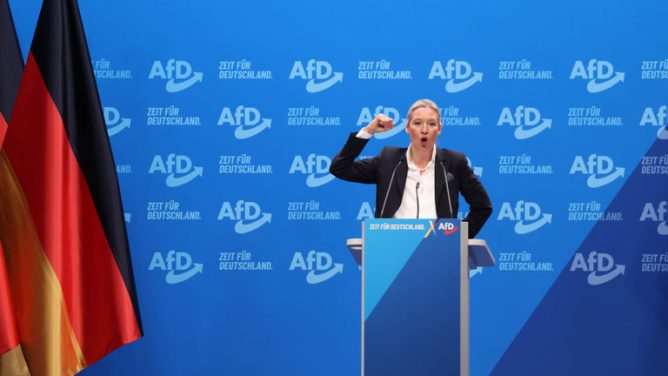
Alice Weidel speaks at the AfD party congress in Riesa, Germany, January 11, 2025 in Riesa © Getty Images / Sean Gallup
RT | January 11, 2025
Alternative for Germany (AfD) co-leader Alice Weidel has pledged to put the sabotaged Nord Stream gas pipelines back into operation if her party emerges victorious in next month’s general election.
AfD members met in the town of Riesa on Saturday to formally approve Weidel as their candidate to succeed Chancellor Olaf Scholz, whose coalition government collapsed late last year. Weidel’s nomination marks the right-wing AfD’s first bid for the chancellery in its 11-year history.
In a speech after the nomination vote, Weidel promised to implement harsh immigration policies – including the “remigration” of immigrants already living legally in Germany – and to scrap Scholz’s green policies in a bid to drive down energy prices. Restoring energy ties to Russia is vital to this latter goal, she explained.
“We will put Nord Stream back into operation, you can count on it,” Weidel told her party.
Germany relied on Russia for 55% of its natural gas supply before the Ukraine conflict escalated in February 2022. Much of this gas flowed through the Nord Stream 1 pipelines, with the parallel Nord Stream 2 lines due to come online in 2022. However, Berlin revoked the certification for Nord Stream 2 several days before Russia’s military operation in Ukraine began, and both sets of lines were destroyed in an act of sabotage in September of that year.
While German investigators have reportedly settled on the theory that the pipelines were destroyed by Ukrainian saboteurs, American journalist Seymour Hersh maintains that they were blown up by the CIA and US Navy. The head of Russia’s Foreign Intelligence Service (SVR), Sergey Naryshkin, has blamed “professional saboteurs from the Anglo-American special services,” referring to the US and UK.
Scholz’s decision to halt Russian energy imports, coupled with his government’s green policies, has led to soaring electricity costs in Germany, forcing some of the country’s manufacturing giants – including Volkswagen and BASF – to close plants and lay off workers.
The AfD is not the only German party that wants to repair and reopen Nord Stream. The leftist Sahra Wagenknecht Alliance (BSW) has also demanded that they be brought back online, with BSW MP Sevim Dagdelen calling last week for the gas lines to “finally be put into operation,” and for the German government to “stop giving money to Kiev!”
Germans go to the polls to choose a new government on February 23. The AfD is currently polling at around 20%, ahead of Scholz’s center-left Social Democratic Party (SPD) at 16%, but behind the center-right Christian Democratic Union (CDU) at 31%. However, even if the AfD were to emerge as the largest party next month, all of Germany’s other mainstream parties have ruled out entering a coalition with it.
Austrian President creates political chaos as Green ideology fights against reality
By Patrick Poppel | January 10, 2025
The EU member state Austria is struggling with a weakening economy and a high government deficit. In the parliamentary elections at the end of September, the Freedom Party FPÖ became the strongest force in parliament for the first time with 28.85 percent of the vote. The conservative ÖVP (Austrian People’s Party) gained 26.3 percent, followed by the social democratic SPÖ with 21.1 percent.
It has been a few months since elections took place in Austria, but the country still has no government. After the NEOS(New Austria and Liberal Forum) withdrew from the talks in Austria, the negotiations between the ÖVP and SPÖ also failed.
Chancellor Nehammer announced his resignation. In Austria, negotiations between the Chancellor’s party ÖVP and the social democratic SPÖ have been broken off. A spokesman for ÖVP leader explained in a written statement to the newspaper Die Presse: “We have tried everything up to this point. An agreement is not possible on essential key points, so there is no point in a positive future for Austria.”
Nehammer stated in a video message that he wants to resign as the head of government and as the head of the conservative ÖVP. He said he would retire from the post in the coming days. Nehammer made it clear that he was still not prepared to hold coalition talks with the right-wing FPÖ under Herbert Kickl.
The conservative ÖVP had been in talks about a coalition with the SPÖ and the liberal NEOS since mid-November. It is normal for the Federal President to appoint the party that has the most votes from voters to form the government.
But Austrian Federal President Alexander Van der Bellen supported negotiations between the other parties in order to keep the FPÖ from participating in a government. But his plan totally failed.
The ÖVP repeatedly emphasized during the election campaign: there will be no coalition with the Kickl-FPÖ. But after the negotiations between ÖVP, SPÖ and NEOS failed, there should now be talks between ÖVP and FPÖ.
The parties are not strangers to each other on all points – even if it often seemed so in the heat of the election campaign. The ÖVP described Kickl as a right-wing extremist, conspiracy supporter and security risk for Austria. The new acting ÖVP boss, Christian Stocker, who was ÖVP general secretary during the election campaign, spoke particularly harshly against Kickl in parliament.
Now things look different, however. Stocker is supposed to lead the negotiations with Kickl for the ÖVP. And Stocker assumes that both sides will ignore everything that was said during the election campaign.
Many experts in Austria now assume that the FPÖ and ÖVP will have a much easier time with each other in the negotiations than the ÖVP, SPÖ and NEOS in the negotiations of the last three months. Because when it comes to financial policy, which caused the first coalition attempt to collapse, the ÖVP and FPÖ are much closer together.
Both parties are economically liberal and do not want to place additional burdens on large businesses and owners. ÖVP and FPÖ want to scale back climate policy and there are also similarities when it comes to asylum and migration as both want a restrictive policy.
The biggest differences are likely to be in foreign policy. The FPÖ repeatedly showed an understanding for Russia. Kickl calls for an end to military support for Ukraine and is skeptical about the European Union. The ÖVP, on the other hand, is a pro-EU party.
An exciting time is now beginning for Austria. Nehammer is still chancellor. Austrian Foreign Minister Alexander Schallenberg will now officially take over the office on an interim basis, as Federal President Van der Bellen’s office explained. However, Schallenberg does not want to take part in a possible FPÖ-led government.
Protests from the liberal and left-wing spectrum can now be expected. A call to participate in a planned “human chain to defend democracy” demonstration in front of the Federal Chancellery in Vienna comes from, among others, the Catholic Action Austria (KAÖ).
The protests are directed against a possible blue-black government led by the FPÖ. Behind the event are social and church organizations, as well as groups that support environmental issues and refugees. In this spirit, a new government must now be put together.
This political chaos is the result of the Federal President’s actions. Austria has not had a new government for over 100 days, the political mood on the streets is tense and the society is divided. It now remains to be seen how the new government will be put together.
Patrick Poppel is an expert at the Center for Geostrategic Studies in Belgrade.
New York On The March To Climate Utopia
By Francis Menton | Manhattan Contrarian | January 2, 2025
In a post a couple of weeks ago on December 21, I observed that the country of Germany appeared to have won the race among all countries and states to be the first to hit the “Green Energy Wall.” Its pursuit of the “renewable” wind and solar electricity fantasy has put it in a spot where regular wind/sun droughts cause huge electricity price spikes, and major industries have become uncompetitive. It has no solution to its dead end, and can go no farther.
If Germany has “hit the wall,” what is the appropriate analogy for New York? New York passed its Climate Act with great fanfare in 2019. The Act orders that we are to have a “net zero” energy system by 2050, with interim deadlines along the way. The first serious deadline arrives in 2030, where the official mandate is 70% of electricity generation from “renewables” (aka “70 x 30”). That deadline is now just five years away. Within the past year, all the efforts to move toward the 70 x 30 goal are falling apart, as anybody who had given the subject any critical thought knew that they inevitably would. But nobody in authority has yet been willing to acknowledge that this has turned into a farce.
Here’s my analogy: New York is like the cartoon character Wile E. Coyote, who has run off the cliff and is now suspended in mid-air, apparently not knowing what will happen next.

We know what’s next: shortly, he will crash to earth.
Consider a few data points:
Off-shore wind procurement
The Scoping Plan developed under the Climate Act calls for some 9000 MW of offshore wind by 2035. People with elementary-school-level arithmetic skills knew that this amount of intermittent generation would not be nearly enough to replace the amounts of dispatchable generation set to close; but maybe this would at least be a serious start. By early 2023, it was reported that some 4300 MW out of the 9000 MW were in “active development,” with wholesale prices having been agreed to with developers in the range of $100/MWh.
But then reality started to hit. In this post on October 15, 2023 I reported that “essentially all” of the developers of the 4300 MW of off-shore wind in “active development” had backed out and demanded price increases in the range of 30 – 50% to proceed. New York rejected that maneuver, but ultimately had no option other than to re-bid the contracts and get bids in the range that the developers were demanding.
On February 29, 2024, the State announced that it had accepted re-bids for two of the projects in question, for a total of only about 1700 MW and at a price of over $150 per MWh. (This level of price would require retail electricity prices in the range of at least $0.40 per kWh and would be completely uneconomic if it were to become the norm for New York electricity production.).
Meanwhile, the remainder of the offshore wind procurement appears to be in complete disarray. On April 19, E&E News reported that New York had canceled efforts on three of its big offshore wind development areas, Attentive Energy, Community Offshore Wind, and Excelsior Wind. These three, had they proceeded, would have totaled about 4000 MW out of the 9000 MW 2035 goal. Excerpt:
New York canceled power contracts for three offshore wind projects Friday, citing a turbine maker’s plans to scrap its biggest machines. The news is a heavy blow to the U.S. offshore wind industry and a major setback for the climate ambitions of New York — and President Joe Biden. The three projects would have delivered 4 gigawatts of offshore wind to the state, amounting to almost half of New York’s 2035 goal.
At this point nobody has any idea how to get large amounts of offshore wind developed around New York at a price anybody is willing to pay. And of course, nobody has a solution to the intermittency problem either.
Green hydrogen
The New York regulators have recognized that a de-carbonized and predominantly wind/solar electricity generation system will require something called the “dispatchable emissions-free resource,” or DEFR, to make it work. The best idea that anybody has for the DEFR is so-called “green” hydrogen, that is, hydrogen produced by some non-emitting system, like wind, solar, or hydro.
Currently, only negligible amounts of green hydrogen are produced in the world, and none in New York. But somehow, New York got the idea that it could make this work. Two green hydrogen facilities have been granted state subsidies and are supposedly under way. One is being developed by a company called Plug Power, and is at an industrial park called STAMP west of Rochester; and the other is being developed by Air Products at Massena, on the St. Lawrence River. Both of these facitilities are almost comically small relative to the amounts of hydrogen that would be needed to fully back up New York’s electricity generation in a world of mostly wind and solar generation. But at least they would be something.
On October 18, the Batavian reported that the Plug Power hydrogen facility was “on pause.” Excerpt:
Chris Suozzi, VP for business and workforce development at the Genesee County Economic Development Center, reportedly told a Washington, D.C.-based commercial real estate firm that Plug Power’s STAMP project is on hold. . . . “They’re not ready to go,” Suozzi reportedly said. “They’re on pause. We don’t know what’s going to happen with them at this point.”
The pausing or cancellation of a green hydrogen project should surprise no one. The past year has seen major cancellations of much larger such projects by big players like Australia’s Fortescue and Origin. The fact is that the cost of producing green hydrogen is a large multiple of the cost of getting natural gas out of the ground for the same energy content, besides which natural gas is a much superior fuel in every way (higher energy density, easier to handle, less corrosive, less subject to leaks, far less dangerous and explosive, etc.). Meanwhile, the developer of the STAMP green hydrogen project, Plug Power, reported as its results for the third quarter of 2024 a loss of $211 million on revenues of $174 million. They are hoping for a loan from the federal Department of Energy to keep themselves going. I wonder what Chris Wright is going to think about that.
The Air Products facility in Massena plans to use hydro power from a dam on the St. Lawrence to produce its hydrogen. Excuse me? The hydro power is already dispatchable. How can it possibly make any sense to use dispatchable electricity to produce hydrogen whose purpose is to make dispatchable electricity? At least about 40% of the energy is going to get lost on the round trip from electricity to hydrogen and back to electricity. It simply has to be that there is a better use for the St. Lawrence River hydro power than turning it into hydrogen and then using the hydrogen. But nothing here makes any sense.
Clean Path Transmission Line
Another key facility to make renewable energy work for New York was supposed to be the Clean Path transmission line. This is a proposed 175-mile high-capacity (4 GW) transmission line to bring to New York City and the downstate region power generated at various new “renewable” (wind and solar) facilities being developed in the northern and western parts of the state. The stated cost of this major project was to be $11 billion.
On November 27, the New York State Energy Research and Development Authority informed the Public Service Commission that the Clean Path project had been canceled. Here is a copy of the NYSERDA letter. Here is a piece from Utility Dive on December 3 about the cancellation.
I don’t find any discussion about the reasons for the cancellation, but it has to be that the developers figured out the the economics did not work. Here’s the problem: because wind and solar generators only work about 20-40% of the time, this enormously expensive transmission line would not be operated at anywhere near its capacity. Likely, it would only average about one-third of capacity. That means, compared to a line that operates at or near 100% of capacity, its charges for transmission would be about triple.
The cancellation of this line has only occurred within the past month, and I haven’t seen anything about plans for a re-bid or an alternative strategy. So far, nobody is saying “this can’t possibly work.” But no matter how you approach the problem, the cost of transmitting intermittent wind and solar power from far upstate to New York City is going to be around triple the cost of transmitting power from a natural gas plant that runs nearly all the time.
So here we are, suspended up in the air, and nobody seems to realize that we will shortly crash to earth. Everybody involved is trying to milk the last dollars out of the taxpayers before the crash hits.
The 2050 Net Zero Climate Scam
By William Levin | American Thinker | December 29, 2024
Twenty fifty is the official date for net zero emissions. According to the experts, it is the last chance to stop a catastrophic rise in temperature. The leading source for climate change science, the U.N. IPCC, says so. Corporations run commercials helpfully informing the public that net zero is a top priority. Few can outdo Delta Air Lines, which promises compliance using “a fully sustainable long-haul aircraft [that] has yet to be invented.”
The urgency is palpable and the science compelling. Humanity itself is at risk without net zero CO2 and non-CO2 emissions.
Politically, 2050 is the ideal climate date because it is close enough to justify immediate action, and just far enough as to be unprovable for climate disaster.
For a science so settled and a date so specific, there must exist a wealth of data scientifically supporting the hypothesis that 25 years from now marks a deadline and turning point for the Earth’s future.
An A.I. query provides the answer:
The target year 2050 for achieving carbon neutrality is primarily driven by scientific consensus and international agreements aimed at limiting global warming to 1.5°C above pre-industrial levels. The Intergovernmental Panel on Climate Change (IPCC) and the Paris Agreement outline that reaching net-zero CO2 emissions by 2050 is crucial to avoiding catastrophic climate impacts.
A.I. is correct that the IPCC and the signatories of the Paris Agreement are the parties responsible for promoting 2050 net zero. But who exactly are these organizations, and do they deserve our trust?
The IPCC is a political body consisting of 195 member-governments, charged with providing assessments in support of the U.N. Framework Convention on Climate Change. In theory, the IPCC mandate is to collect the best available climate science. The IPCC expressly commits that its “reports should be neutral with respect to policy.” And by its own admission, “the IPCC does not conduct its own research.” Its role is to summarize the objective science.
The signatories to the Paris Agreement are likewise 195 nations convened under the auspices of the U.N. But unlike the IPCC, the Paris Agreement signatories make no pretense to being a scientific body, and indeed, no one is confused on this point. The signatories are a political body and the Paris Agreement a purely political document.
With an overlapping membership, it should come as no surprise that the two organizations coordinate their efforts. In the process, the IPCC has become the loudest and most strident advocate for existential change in human activity. In the latest IPCC report, deepening red gradient shadings convey that the Earth is a looming inferno.
According to the IPCC, the danger of imminent collapse due to rising CO2 and non-CO2 emissions, particularly methane, requires immediate action. Humanity must downsize and restructure the global economy, including, in their modest terminology, “governments, private sector, and civil society.” Everyone is responsible, and everyone must contribute.
Not only must GDP be lowered, but the world must immediately and drastically curtail fossil fuels; limit global agriculture output based on emissions, not feeding the world; spend and redistribute upwards of $125 trillion; rely on expensive, unreliable, discredited solar and wind for global power needs; and virtually ignore nuclear power, all the while “prioritizing equity, climate justice, social justice, inclusion and just transition processes.” To make the math work, governments and the private sector must implement on a global scale yet-to-exist carbon capture technologies, of unknown cost and consequence.
There is no imputation here that climate science is not real. It is the political choices of the IPCC at issue, specifically the 2023 Sixth Assessment’s Summary for Policymakers, as opposed to the physical scientists reporting as Working Group 1. As summarized by scientist Roger Pielke, “it is not within the IPCC’s mandate to call for action or to implore urgency.”
The IPCC task is to vet and summarize thousands of complex models and scientific papers produced annually. In each instance, a climate model incorporates assumptions not easily aggregated. The IPCC solution groups the models into five arbitrary scenarios based on forecasted warming in 2100. At no point does the IPCC ever declare one set of scenarios more likely than another. Indeed, as aggregators, they have no scientific basis for making any such assertion. In these scenarios, 2050 does not exist as a scientifically significant year. It is simply a point on the curve connecting the current temperature to the 2100 end point.
To get to 2050, and urgency, the IPCC needs to import the political findings of the Paris Agreement.
In 2015, the Paris Agreement signatories reviewed the then most current IPCC report, the 5th Assessment. These 195 government actors arbitrarily concluded that “well below 2 degrees Celsius” of warming was the maximum threshold the Earth could survive. Nothing in the IPCC 5th Assessment supports the “well below 2 degree warming” as a scientific consensus. No IPCC evidence identifies a scientific threshold for global warming beyond which the Earth tips into collapse. Especially relevant, the signatories to the Paris Agreement in no manner highlighted 2050 as a year of special climate meaning, nor would it matter, scientifically speaking, if they had. Following the 5th Assessment, the Paris Agreement target date is merely a “long-term temperature goal,” with one reference to “the second half” of the century.
The Paris Agreement signatories went farther, deciding by imperial fiat that the temperature goal needed a guardrail, the now infamous, endlessly repeated 1.5-degree-warming “limit.” In popular parlance, many, many people will swear that 1.5 degrees of warming is a scientifically valid statement of the limit to global warming, beyond which climate catastrophe ensues.
As important to note, all IPCC warming targets, including the Paris Agreement, start from the pre-industrial period 1850–1900. According to the IPCC, 1.1 degrees of warming has already occurred, meaning the Paris Agreement target at present is a mere 0.4 degrees over 75 years to the IPCC 2100 model date. This equates to an imperceptible 0.005 degrees of annual warming — hardly the stuff of headlines and catastrophic collapse. And nothing compared to the 10 degrees of warming observed in the Earth’s last interglacial warm period in Siberia some 115,000 to 130,000 years ago.
It needs to be said as loudly as possible. The 1.5-degree climate tipping limit has no basis in any finding of the IPCC. It is the arbitrary finding of 195 political actors, in defense of the non-scientific “well below 2 degree” catastrophe, magically transported by the IPCC from 2100 to 2050.
How does the IPCC move the climate clock back 50 years, in violation of its 2100 science? By intentional sleight of hand, the IPCC provides a science answer to a policy question. How much CO2 can be emitted before the 1.5-degree target is breached? The sole source of the 1.5 degrees is the Paris Agreement.
Pro-IPCC climate scientists confirm that the global warming limit, whether it be 1.5 degrees from the Paris Agreement or some other number, is based solely on “value judgments and choice,” not “climate science.” (See page 7 chart.) The IPCC would have readers believe the exact opposite: that the global warming limit is scientifically determined, and those who disagree are “science deniers.” It is a deception of massive consequence.
Twenty fifty, as it turns out, is a long con between 195 governments and the IPCC.
As part of his Day One actions, President Trump needs to, once again, remove the U.S. from the Paris Agreement and disavow the overtly political IPCC Sixth Assessment Summary for Policymakers. The IPCC global prescription is not scientific, and it most certainly is not benign.
2025 Looks Bleak For Germany… Energy The Most Expensive In Europe … Growing Speech Tyranny
2025 in Germany will be a year of more energy inflation and loss of free speech rights
By P Gosselin | No Tricks Zone | January 1, 2025
Effective today, Germany’s CO2 surcharge will rise from 45 euros a tonne to 55 euros, which will further fan inflation and social discontent.
Already Germany’s electricity prices are among the highest in the world, and the most expensive in Europe:

Chart: strom-report.com/
Germany clamps down on dissenters, free speech
2025 will not be an easy year for dissenters and critics of the government, as this is increasingly being criminalized in Germany thanks to recently passed laws and acts that aim to suppress free speech in Germany.
The former head Germany’s Constitution Protection Authority (Bundesverfassungsschutz), Thomas Haldenwang (CDU Party), suggested last February when presenting measures to fight right-wing extremism, that human thoughts and speech patterns need to be under surveillance and become the business of the government: “It’s also about shifting verbal and mental boundaries. We have to be careful that thought and language patterns don’t become embedded in our language.”
Mocking the state now verboten
Haldenwang’s boss, Federal Minister of the Interior Nancy Faeser (SPD Party), wants to treat vocal conservative protesters in the same way as organized crime groups: “Those who mock the state must deal with a strong state.”
“We want to take account of the fact that hate on the internet also occurs below the threshold of criminal liability,”said Federal Minister for Family Affairs Lisa Paus (Greens) at her press conference on February 13 on the topic of ‘Hate on the Internet’.“Many enemies of democracy know exactly what falls under freedom of expression on social media platforms,”
Meant by “enemies of democracy” here are opposition forces, even when democratically elected.
Unwanted election results may be annulled
In response to comments in favor of the conservatives made by Elon Musk, German President Frank Walter Steinmeier hinted he would annul the results of the upcoming February 23 national elections if he doesn’t like the results.
So in Germany, it’s watch what you say and, if the old parties don’t like the election results, then they might just annul them. Germany is slipping back quickly to darker times.
11 Reasons why the “EV Transition” will NEVER happen
MGUY Australia | December 25, 2024
Mark P Mills gave an extended talk on EV mandates in November, at Hillsdale College, Michigan, and in this video I’ve extracted 11 key points that explain why the much vaunted “EV transition” will never happen.
Go and watch the full video here:  • EV Mandates vs. Freedom | Mark P. Mills
Ten Reasons why you should NEVER buy an EV: • TEN reasons why you should NEVER buy … #electricvehicle #electriccar #evfire #ev
☕️ Want to support this channel? Buy me a coffee! ➜ https://m-g.uy/donate
Featured Video

Rewriting the risk? Inside the government’s vaccine safety messaging
or go to
Aletho News Archives – Video-Images
Book Review
“Davos Can Really Replace the UN”
Inside the book that maps the architecture behind global governance — from the Epstein files to the Pact for the Future
Lies are Unbekoming | April 1, 2026
On June 13, 2019, the United Nations and the World Economic Forum signed a partnership deal to “accelerate the implementation of the 2030 Agenda for Sustainable Development.” That same evening, WEF president Börge Brende — Norway’s former Foreign Minister — had dinner with Jeffrey Epstein at Epstein’s Manhattan townhouse. The Epstein files, released January 2026, contain an exchange between the two from the previous year. Epstein to Brende: “Davos can really replace the UN. C21, cyber, crypto . genetics… intl coordination.” Brende back to Epstein: “Exactly — we need a new global architecture. World Economic Forum (Davos) is uniquely positioned — public private.”
The next day, the UN General Assembly adopted the framework for restructuring global governance.
That sequence — the partnership signing, the Epstein dinner, the candid admission about replacing the UN with a public-private architecture, and then the formal adoption — opens Jacob Nordangård’s The Digital World Brain. Pages two and three. Footnoted to the UN resolution number, the Epstein files, and the General Assembly record.
I keep coming back to it because it captures what this book does that almost nothing else in the independent research space manages. I’ve followed Jacob’s work for years now and interviewed him about his research. Each book peels back another layer of the same institutional architecture, and each time I think he’s reached the limit of what can be documented, the next one goes further. Nordangård doesn’t speculate. He doesn’t editorialize much. He lays institutional actions next to each other in chronological order and lets the pattern announce itself. … continue
Blog Roll
 Aletho News
- Iran, US receive Pakistan-mediated plan for ceasefire then final deal
- Iran submits demands for end to war as mediators scramble ahead of Trump deadline
- Iran Threatens Retaliatory Strike on Stargate AI Project in UAE
- US sent ‘a lot’ of arms to Iranian protesters – Trump
- Barak Ravid Launders Deception To Allow Trump To Back Off Of His Power Plant Threat – Again
- REWRITING THE RISK? INSIDE THE GOVERNMENT’S VACCINE SAFETY MESSAGING
- “Davos Can Really Replace the UN”
- NIAID/NIH and USDA Fund Bioengineered Chimeric Influenza Viruses Built Using Pandemic H1N1 Components: Journal ‘Science Advances’
- Hezbollah hits Israeli warship off Lebanon’s coast, sets it aflame
- Iran slams US strikes on B1 bridge, Mahshahr petrochemical plants as ‘blatant acts of state terrorism’
- If Americans Knew
- Trump poised to “blow everything up” (ie. commit war crimes) in Iran – Daily Update
- In Iran, Israel-US take aim at “reason, research, and freedom of thought” – Daily Update
- US loses planes over Iran, Israel downgrades Lebanon war goals – Daily Update
- Israel Is Blocking Palestinians from Easter at Church Where Jesus Resurrected
- Plot to assassinate Palestinian activist follows harassment campaign promoted by Zionist groups and elected officials
- Prominent New York synagogue hosts presentation on why U.S. Jews should support the ethnic cleansing of Gaza
- Tapper vs. Piker: Is the CNN Anchor Auditioning for David Ellison?
- Shouldn’t Democrats Be Able to Condemn Genocide?
- Israel-US kill negotiators, destroy civilian structures, but Iran’s military capabilities still largely intact – Daily Update
- ‘War crime’: Global condemnation as Israeli ministers celebrate death penalty law targeting Palestinian prisoners
- No Tricks Zone
- An Inconvenient Tree: Uncovered In Alps… Europe Much Warmer Than Today 6000 Years Ago
- New Study Reports A 60% Slowdown In Greenland’s Ice Loss Rate In The Last Decade
- Low Intensity Tornado Wrecks Major Solar Farm, Creating A Potential Toxic Dump
- New Study Finds Warming Saves Lives…Cold Temperatures 12 Times More Deadly Than Excess Heat
- German Science Blog Accuses PIK Climate Institute Of Hallucinating Climate Tipping Points
- Devastating Assessment Of Comirnaty Vaccine By Former Senior Pfizer Europe Toxicologist
- New Study: CO2 Is ‘Effectively Negligible’ As An Explanatory Climate Change Factor Since 2000
- Former Pfizer Toxicologist Dr. Helmut Sterz Tells Bundestag Hearing Pfizer Vaccine Should Have Never Been Approved
- Energy Expert: Germany’s Nuclear Phaseout Was A “500 Billion Euro Mistake”
- New Research: South Australia’s Mid-Holocene Sea Surface Temperatures Were 4°C Warmer Than Today
 Aletho News