Claim: $220 Billion “Family Planning” Equivalent to a Trillion Dollars of Climate Tech Investment

Displaced Rohingya people in Rakhine State. By Foreign and Commonwealth Office – Flickr, OGL, Link
By Eric Worrall | Watts Up With That? | May 22, 2018
Family planning charities suggest helping poor women “control their fertility” will save as much CO2 as a trillion dollars of investment in low carbon technologies. But provision of family planning wrapped around a higher purpose has a long and ugly history.
Worried About Climate Change? Investing in Reproductive Health Must Be Part of the Solution
Monday, 21st May 2018
Chris Turner
…Since the invention of the contraceptive pill in the 1950’s, access to modern contraception has driven some of the key demographic and social changes in history. It has delivered improved health outcomes for mothers and babies as women are able to wait longer between births or delay having their first child. It created demographic shifts, as populations have fewer dependents and a more productive labour force. It has empowered girls and women to stay in school longer, seek higher education and participate in the formal economy. And now recent research has determined that contraception also has a key role to play in addressing climate change.
…
Poverty reduction and strengthening economies
When women can exercise reproductive choice, they are more likely to participate in education and the workforce. In most developing countries, female participation in the formal economy has increased as fertility has fallen. Women’s participation in the economy promotes economic growth and economies that are strong are better able to absorb the disturbances of climate change and recover from climate-related events.
…
Women’s participation and leadership
Women’s participation and leadership is important to climate change preparedness, resilience and action. Enabling women to control their bodies and reproductive health can help create opportunities for women to participate, lead and contribute to the conversation.
As a climate change mitigation strategy, family planning programs are also more cost-effective than other conventional, energy-focused solutions. One study found that $220 billion spent on providing family planning to those with an unmet need would reduce 34 gigatons of global carbon emissions, compared to $1 trillion for a similar outcome if spent on low carbon technologies.
…
Regardless of your position on birth control and abortion, I think we can all feel a sense of unease when efforts to provide “family planning” are offered as part of a larger mission to reduce population, rather than placing the interests of the recipients of the medical aid first.
Provision of birth control to poor people has a long, ugly history. For example, consider this Guardian story about the Bangladesh government’s recent efforts to offer sterilisation services to inconvenient Rohingya refugees displaced by ongoing political turmoil in Burma.
Bangladesh to offer sterilisation to Rohingya in refugee camps
Family planning authorities have asked the government to launch vasectomies and tubectomies for women in Cox’s Bazar, where 1m refugees fight for space.
Bangladesh is planning to introduce voluntary sterilisation in its overcrowded Rohingya camps, where nearly a million refugees are fighting for space, after efforts to encourage birth control failed.
More than 600,000 Rohingya have arrived in Bangladesh since a military crackdown in neighbouring Myanmar in August triggered an exodus, straining resources in the impoverished country.
The latest arrivals have joined hundreds of thousands of Rohingya refugees who fled in earlier waves from Myanmar’s Rakhine state, where the stateless Muslim minority has endured decades of persecution.
Most live in desperate conditions with limited access to food, sanitation or health facilities and local officials fear a lack of family planning could stretch resources even further.
…
Many of the refugees told AFP they believed a large family would help them survive in the camps, where access to food and water remains a daily battle and children are often sent out to fetch and carry supplies.
Others had been told contraception was against the tenets of Islam.
Farhana Sultana, a family planning volunteer who works with Rohingya refugees in the camps, said many of the women she spoke to believed birth control was a sin.
“In Rakhine they did not go to family planning clinics, fearing the Myanmar authorities would give medicine that harms them or their children,” Sultana said.
…
You could reasonably argue that refugee women having 19 children each is unsustainable. But I doubt the first concern of the Bangladeshi authorities is the well-being of the Rohingya. I suspect the Bangladeshi authorities would be overjoyed if the Rohingya refugee problem just quietly disappeared.
Over zealous family planning doesn’t just occur in poor countries. The USA has experienced domestic scandals in the past related to forced sterilisation, and scandals with the practices of organisations like Planned Parenthood, including accusations of medical racism.
My point is I personally have no problem with women having access to the medical services they need to create a better life for themselves and their families. I understand some people likely have different opinions about reproductive issues, what is an is not acceptable, to myself.
But surely we can all agree that mixing family planning with another mission like reducing humanity’s global carbon footprint creates a horrifying risk that the welfare of patients will not be the top priority. There are many ugly historical examples to support this concern.
Remembering Ireland’s Great Famine
A review of Black ’47 a soon to be released film about the famine in Ireland
By Caoimhghin Ó Croidheáin | Dissident Voice | April 13, 2018
Weary men, what reap ye?—Golden corn for the stranger.
What sow ye?— human corpses that wait for the avenger.
Fainting forms, hunger–stricken, what see you in the offing?
Stately ships to bear our food away, amid the stranger’s scoffing.
There’s a proud array of soldiers — what do they round your door?
They guard our masters’ granaries from the thin hands of the poor.
Pale mothers, wherefore weeping— would to God that we were dead;
Our children swoon before us, and we cannot give them bread.”
— “Speranza” (Jane Wilde, mother of Oscar Wilde)
Last Wednesday I attended a preview for a forthcoming Irish film, Black 47 (Director Lance Daly), about the worst year of the catastrophic Irish famine and is set in the west of Ireland in 1847.
The story centers around an Irish soldier, Feeney (James Frecheville), returning from serving the British Army in Afghanistan only to find most of his family have perished in the Famine or An Gorta Mor (the Great Hunger) as it is known in Gaelic.
The English and Irish terms for Ireland’s greatest tragedy are infused with different ideological approaches to the disaster. By emphasising the failure of the potato crop only, the impression is given that there was no food to be had on the island when the opposite was true – there were many other crops which did not fail but were not accessible to the vast majority of the people – hence, the Great Hunger.

Feeney (James Frecheville), Black 47 (Director Lance Daly)
In Black 47, the colonised fight back as Feeney puts the skills he has learned abroad with the British army to effective use in Ireland. He kills or executes the various people involved in the British colonial system he blames for the starvation and death of his family: from the bailiff to the judge to the colonial landlord. Moreover, Feeney goes a step further as he refuses to speak English to those in power before he kills them, reflecting back to them an immediate understanding of the powerlessness of those without the linguistic tools to negotiate compromises (as was seen in the film when a monolingual Irish speaker gets tough justice for ‘refusing’ to speak English in court).
Back in the late 1980s a book entitled ‘The Empire Writes Back: Theory and Practice in Post-Colonial Literatures‘ [1989] showed how the language and literature of the empire, English, was used by colonised peoples in the creation of a radical culture to aid their resistance to the hegemony of imperial power. However, now with many of his family dead, Feeney has ceased to be a Caliban profiting on the language of his masters and becomes a powerfully drawn hero who is uncompromising in his insistence that the Irish language and culture will be a respected equal to the imposed English language and culture of the colonists.
In the film the ruling class and their hierarchy of supporters are flush with food and the army is used to transport harvested crops to the coast and exportation. This fact is displayed symbolically when one of Feeney’s victims is literally ‘drowned’ in food, as he is found head first in a sack of wheat.
The international aspect of the Black 47 narrative hints at the geopolitics of the day with Feeney’s return from Afghanistan and the concurrent mass emigration to the United States from Ireland. Feeney’s indignation at finding out how his masters have treated his own family and compatriots as he risked his life for them abroad is similar to the treatment of the African-American soldiers of the Vietnam war on their return to the United States.
But this is not a black and white, Irish versus the Brits, movie. There is complexity as some of the British show empathy for the desperate Irish and pay the ultimate price or go on the run.
Revenge is a kind of wild justice, which the more a man’s nature runs to, the more ought law to weed it out.
— Francis Bacon
Black 47 is a revenge movie which is cathartic for an audience feeling the utter helplessness of the victims living in a brutal system without real justice, where what should have been their protectors (the law, the state, the army, etc.) became their attackers and betrayed them. In previous food crises, according to Christine Kenealy:
The closure of ports was a traditional, short-term response to food shortages. It had been used to great effect during the subsistence crisis of 1782-4 when, despite the opposition of the grain merchants, ports had been closed and bounties offered to merchants who imported food to the country. During the subsistence crisis of 1799-1800, the government had placed a temporary embargo on the export of potatoes from Ireland. In 1816 and 1821, the British government had organised the shipment of grain into areas in the west of Ireland where there were food shortages. The grain was then sold on at low prices. Similar intervention and market regulation occurred in Britain.
Unfortunately for Ireland, Sir Charles Edward Trevelyan (2 April 1807 – 19 June 1886), a British civil servant and colonial administrator, was put in charge of administering famine relief. Trevelyan was a student of the economist Thomas Malthus and a believer in laissez faire economics and the free hand of the market. Trevelyan described the famine as an “effective mechanism for reducing surplus population” as well as “the judgement of God”.

Famine Memorial in Dublin by artist Rowan Gillespie
With this change in attitude on the part of the British government towards food shortages, the crisis was doomed from the beginning. Kinealy states:
In 1847 alone, the worst year of the Famine, almost 4,000 vessels carried food from Ireland to the major ports of Britain, that is, Bristol, Glasgow, Liverpool and London. Over half of these ships went to Liverpool, the main port both for emigration and for cargo.
Ultimately, one million people starved to death and one million emigrated reducing the population by about 20% – 25%.
Black 47 is an uncompromising film that depicts the harrowing results of a crop failure combined with an ultra exploitative system that knew no moral or legal boundaries. Sure, attempts were made by well-meaning people to alleviate the crisis but the failure of the state to end the crisis on a macro level resulted in an unprecedented disaster for the Irish people. It will go on general release in September.
Further research:
For those interested in finding out more about the Great Hunger, here is a select list of material covering different aspects.
Art
The preview showing of Black 47 was to complement a concurrent exhibtion of art in Dublin Castle showing at the Coach House Gallery until June 30. The exhibition, titled ‘Coming Home: Art and the Great Hunger‘, is an exhibition of the world’s largest collection of Famine-related art.

Belfast mural
Music:
Sinéad O’Connor – ‘Famine‘
Damien Dempsey – ‘Colony‘
Christy Moore – ‘On a Single Day‘
Books:
The Great Hunger by Cecil Woodham-Smith
The Famine Plot: England’s Role in Ireland’s Greatest Tragedy by Tim Pat Coogan
The Graves are Walking by John Kelly
Atlas of the Great Irish Famine edited by J. Crowley, W. J. Smith and M.Murphy.
(Massive hardback volume covering almost all aspects of the famine throughout Ireland, lavishly illustrated.)
National Famine Commemoration Committee
The National Famine Commemoration Committee was first established in 2008 following a Government decision to commemorate the Great Irish Famine with an annual national famine memorial day.
Film
Ireland 1848 – ‘An experimental documentary of the Great Irish Famine. Shot as a film might have been shot in 1848 fifty years before the cinema was invented.’
Caoimhghin Ó Croidheáin is an Irish artist, lecturer and writer. His artwork consists of paintings based on contemporary geopolitical themes as well as Irish history and cityscapes of Dublin. His blog of critical writing based on cinema, art and politics along with research on a database of Realist and Social Realist art from around the world can be viewed country by country at http://gaelart.blogspot.ie/.
The Egypt-Israel gas deal is scandalous and shameless
Dr Amira Abo el-Fetouh | MEMO | February 21, 2018
After Al-Sisi opened the very large Zohr gas field about two weeks ago the newspapers celebrated and announced the news that Egypt will achieve gas self-sufficiency this year by means of the Zohr, North Alexandria, Nawras, and Atoll gas fields. The Egyptian citizens lived this dream until they awoke to a nightmare where Netanyahu is announcing that Israel is celebrating after signing a historical agreement with Egypt that stipulates Egypt will import gas from Israel for 10 years. The imported gas agreement is worth $15 billion and these billions will be added to the Israeli treasury in order to be spent on education, health services, and welfare for Israeli citizens.
Of course it was no coincidence that Netanyahu announced this great news to the Israeli people on the anniversary of President Anwar Sadat’s visit to Jerusalem, as such an agreement poses a new victory for Israel, no less significant than its victory in 1967 and the signing of the peace treaty. In my opinion, they are crowning their victories with this latest victory, as a result of which they control energy in Egypt and the key to the energy tap is placed in their hands. They can turn it off whenever they please. Whoever controls the energy can suffocate the states that live under its mercy and can control the decisions of these states.
This is a major crime committed against Egypt as a state and against its people. This gas is actually Egyptian gas that was seized by Israel either without the ruling government’s knowledge or in collusion with it. Instead of admitting to this crime and being ashamed of it, the government’s mouthpieces and corrupt media came up with justifications and excuses more criminal and shameless than the act itself. Some examples include but are not limited to the claims that the government has nothing to do with the Israeli gas import deal, overlooking the fact that the government facilitated the deal and prepared a draft bill allowing the private sector to import gas from abroad and sell it in the local market. Of course, the corrupt parliament, which does as the government desires and was formed under its watchful eye, approved the bill. It is foolish to make such claims when everyone knows that no private company can import anything without first obtaining government approval. Moreover, where would an unnamed company that has never operated in this field before, come up with $15 billion from to pay the Israelis?
Another justification included claims that economic interests dictate relations between countries and that there is no problem importing gas, even from an enemy, as long as it serves Egypt’s interests. However, those making these claims forgot that a country’s interests cannot be served by their enemy, and that from a purely national security standpoint, it is a strategic mistake to link Egypt’s energy security to Israel, which can stop exporting gas to Egypt if any conflict between the two countries arises.
The most absurd justification is the claim that Egypt is seeking to turn into a regional centre for energy and that the gas market has become available and open to any private company. No one bothered to mention what happened to the natural gas self-sufficiency claims made two weeks ago and ask why Egypt is importing gas when it has one of the largest gas fields, the Zohr gas field, in addition to the fields discovered in Egyptian regional waters and in the western and eastern deserts.
These mouthpieces also failed to mention why Egypt is importing gas specifically from Israel, especially since there are several alternatives, such as Algerian, Iraqi or Russian gas.
However, what is most astounding is the strange silence of the Egyptian government regarding this suspicious agreement, compared to the historical celebrations in Tel Aviv. Of course these celebrations are completely understandable given the financial, strategic, and moral benefits the agreement will grant Israel. Israel never dreamt of such benefits, even during the rule of Hosni Mubarak, their strategic treasure. What we cannot understand or accept is the fact that the corrupt Egyptian media is celebrating this agreement, despite the fact that such an agreement is the most prominent manifestation of betrayal and treachery, and the secret to the link between Egypt’s energy security and Israel’s gas.
A Few More Who Think The Poor Ought To Have Access To Cheap Energy
By Francis Menton | Manhattan Contrarian | October 31, 2017
If you were asked to name the most immoral thing going on in the world today, you would be hard pressed to come up with a better candidate than the campaign to keep the world’s poor in poverty. This campaign usually goes under the banner of “saving the planet” or “sustainability” or something similar. There are times when it feels very lonely out here in the small group pointing out the deep immorality of this campaign. For example, one such time was last April, when some hundreds of thousands of spoiled, wealthy Americans conducted what they called the “March for Science,” demanding that cheap and reliable energy be restricted and that the price of energy be increased to a level to make sure that the poor could never afford it. The entire progressive press and media cheered these people on.
In the camp of people calling out the “sustainability” campaigners for their immorality, I particularly favor the ones who don’t mince their words. These campaigners need to be harshly condemned. So today I’ll give a shout out to a couple of voices that aren’t afraid to say the obvious on this subject.
First, Benny Peiser of the Global Warming Policy Foundation in the UK participated in a debate at Cambridge University on October 26, where the question before the house was “This House would rather cool the planet than warm the economy.” Cambridge, like all elite universities these days, has become a center for advocacy of de-carbonization, of de-industrialization, and of making sure that poor countries cannot get energy that is cheap and reliable and that works. Benny’s full presentation can be found at the link. Here are a few excerpts:
[T]he fact that stopping economic development is even being advocated by some of the world’s most privileged students in Cambridge reveals how far removed this green bubble is from the harsh reality of billions of people who are desperately trying to escape poverty. Let’s not beat about the bush: If today’s motion would ever be implemented by some radical green government, it would lead to the death of millions of poor people in the developing world, astronomical mass unemployment and economic collapse. That’s because poor nations without economic growth have no future and are unable to raise living standards for impoverished populations. . . .
Climate and green energy policies have lead to is the biggest wealth transfer in the history of modern Europe — from the poor to the rich. . . . The proponents of today’s motion argue that economic growth should be sacrificed or at least curtailed in order to cut global CO2 emissions. Denying the world’s poor the very basis on which Britain and much of Europe became wealthy — largely due to cheap coal, oil and gas — amounts to an inhumane and atrocious attempt by green activists to sacrifice the needs of the world’s poor on the altar of climate alarmism.
“Inhumane” and “atrocious.” I could have come up with even more such words, but that’s a pretty good start. Good job, Benny!
And here is another one, this time from reader Mikko Paunio, who sent me a link to his recent (October 30) article discussing why restricting fossil fuels and requiring expensive and intermittent renewables threatens public health in poor countries. The title is “Sustainability Threatens Public Health In The Developing World.”
Paunio points out that good public health requires large amounts of clean water, which in turn requires reliable and affordable power.
We take sanitary practices for granted in wealthier countries but hygienic practices require water in quantity and uninterrupted power to supply that water and related sewage systems.
And it’s not just clean drinking water that is at issue. Good hygiene and sanitation require water not only for drinking, but also for things like laundry, dishes, toilets and sewers.
Painstaking research has shown that the provision of clean drinking water brings down children’s diarrhoea risk by [only] around 20-25 per cent in a developing country setting (31,32). This is partly because purified water is a harsh environment for those enteric pathogenic microbes that would otherwise enter the system. However more importantly, it is because so many water washable diseases remain transmissible under unhygienic conditions. . . . [H]ygienic practices include personal hygiene, household hygiene i.e. linen and other laundry, kitchen hygiene (utensils and food), cleanliness of suitable surface materials especially in bathrooms. These require water in substantial quantities for ensuring hygiene by de-contamination and human-waste disposal, in addition to providing solely drinking water.
And then there’s the question of air pollution, particularly the indoor variety. In countries without cheap and reliable electricity, the people of necessity turn to indoor fires of wood or animal dung for heating and cooking. The result:
Decentralized heating and cooking in homes in the urban areas of the developing world account for most ambient air pollution and perhaps 80-90 % of the WHO estimate of up to 6.5 million annual deaths linked to such air pollution.
So where are our national and international bureaucracies on addressing these critical issues?
Instead of addressing those [water and air pollution] issues in the most practical way possible, the US in 2013 declined multilateral (World Bank) aid to build centralized power plants in the poorest countries – because to be affordable they had to use coal. Instead, the US government sided with WHO and Dr. Margaret Chan and insisted on climate change mitigation for poor countries while giving China unlimited emissions until 2030.
Where did we go wrong? When guiding the “Our Common Future” report, Director General of the World Health Organization Dr. Gro Harlem Brundtland chose to deny crucial infrastructural urban development, such as the provision of fresh water supplies and the installation of sewerage systems, unless it could be done “sustainably”. But the countries that need such infrastructure are often unable to raise capital on their own and need multilateral assistance from rich countries. By mandating they could only have loans if they agreed to build things that would be too expensive, we doomed those countries to failure.
I guess I can understand how the bureaucracies can get involved in these efforts that lead to mass impoverishment and millions of deaths. After all, bureaucracies have an internal dynamic that makes them only interested in increasing their own power and prerogatives; the poor are just collateral damage. But how is it that the faculties and students of all elite universities, and the entire progressive media, have become part of this immoral endeavor? It’s impossible to understand.
Washington’s economic war against Russian gas supplies to Europe unacceptable – Gerhard Schroeder
RT | October 20, 2017
The United States would like to weaken Russia’s energy cooperation with the European Union, said former German Chancellor Gerhard Schroeder, adding it’s unacceptable to create barriers to Russian gas deliveries to the German market.
“It’s wrong if the Americans and the European Union somehow resist each other on this issue. And still there are attempts to create some difficulties for this project [Nord Stream 2 gas pipeline – Ed.],” he told Rossiya 24 news channel.
According to Schroeder, “the fact the Americans will try entering the German market with the help of sanctions and to dominate with its liquefied shale gas is nothing but the signs of an economic war, and such war is unacceptable.”
Germany is interested in gas which it “will receive for sure and which will be cheaper than shale gas,” said Schroeder.
The ex-chancellor said German authorities were right to call the Nord Stream 2 gas pipeline purely an economic project which should not be politicized.
Last week, European Commissioner for Competition Margrethe Vestager said the EU has no legal means to stop the pipeline that will deliver natural gas from Russia to Germany.
The Nord Stream 2 pipeline will double the capacity of the existing Nord Stream pipeline, which goes under the Baltic Sea to Germany. The Gazprom-led project is opposed by the Baltic States and Poland.
During the EU summit on Friday, Polish Prime Minister Beata Szydlo described the Nord Stream 2 pipeline as a threat to European energy security.
Russian President Vladimir Putin said this week Moscow faces obstacles constructing the new route despite the fact that diversification of gas supplies is cost-effective, beneficial to Europe and serves to enhance the security of supplies.
The Kremlin has repeatedly said the pipeline is strictly about business, accusing the United States of trying to thwart the project, as it wants to export its own liquefied natural gas to Europe.
Pharmaceuticals can be a license to print money
By Pete Dolack | Systemic Disorder | October 11, 2107
It’s no secret that the United States suffers from by far the world’s highest costs for health care. As the most market-oriented health care system among advanced capitalist countries, this is no surprise. Health care in the U.S. is designed to deliver corporate profits, not health care.
On that score, the U.S. system is quite successful. Pharmaceutical companies are at the head of the class in this regard, frequently justifying the spiraling costs of medications by citing large research and development costs that include the costs for drugs that don’t make it to market. There are many drugs that fail to survive testing and become a cost that will never be compensated, that is true. But are these failures really so high to justify the extreme costs of successful drugs?
It would seem not. Firmer proof of that lack of justification has been published by the JAMA Internal Medicine journal, which found that revenue for cancer drugs far outstrips spending on research and development. The article, “Research and Development Spending to Bring a Single Cancer Drug to Market and Revenues After Approval,” prepared by Drs. Vinay Prasad and Sham Mailankody, found that revenue from 10 drugs (one by each of 10 companies) exceed those companies’ total research and development costs by more than seven times.
The total revenue hauled in from these 10 drugs did vary considerably. Two of them earned more than US$20 billion after approval. Both of these high performers cost less than $500 million in research and development costs. The revenue from each of the 10, however, exceeded costs, with widely varied margins. Still profitable: The median revenue of these 10 drugs was $1.7 billion, more than double the median development cost of $648 million, the JAMA Internal Medicine authors report.
The authors write that the median cost to develop a cancer drug represents “a figure significantly lower than prior estimates,” adding that their analysis “provides a transparent estimate of R&D spending on cancer drugs and has implications for the current debate on drug pricing.”
To obtain these figures, the authors analyzed U.S. Securities and Exchange Commissions filings for pharmaceutical companies with no drugs on the U.S. market that received approval by the U.S. Food and Drug Administration for a cancer drug from January 1, 2006, through December 31, 2015. Cumulative R&D spending was estimated from initiation of drug development activity to date of approval. Earnings were tracked from the time of approval to March 2017.
The sky’s the limit for pharmaceutical prices
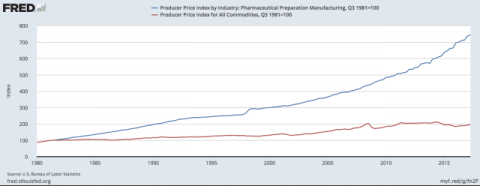
The increase in pharmaceutical prices (blue) versus the general increase in commodities prices (red).
Another way of looking at this would be to examine the increases in the cost of pharmaceuticals against other products. Here again the numbers stand out. Using data gathered by the St. Louis branch of the Federal Reserve Bank, the consumer price index for pharmaceutical preparation manufacturing for the first quarter of 2017 was 747.8, with January 1, 1980, as the benchmark of 100. In other words, the price of pharmaceuticals is seven and half times higher than they were at the start of 1980. (See graph above.)
How does that compare with inflation or other products? Quite well — for pharmaceutical companies. That more than sevenfold increase in drug prices is an increase nearly two and half times greater than inflation for the period, and nearly four times that of all commodities.
So, yes, unconscionable price-gouging is the cause here. By the industry as a whole, not simply individuals like “Pharma Bro” Martin Shkreli, who might be an outlier in his brazenness but not in his profit-generation plan.
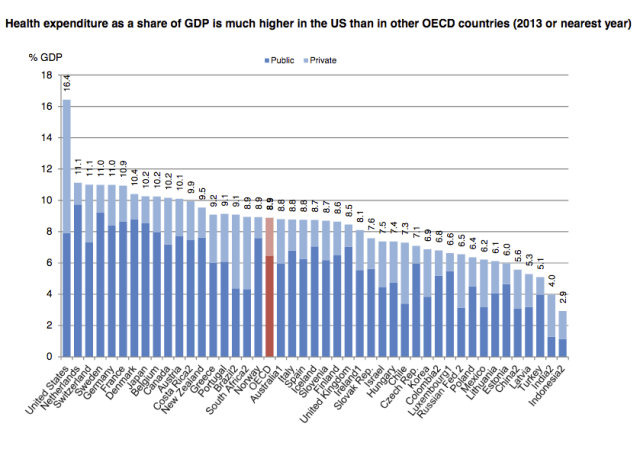
Although not the entire picture, this snapshot of corporate extortion plays a significant role in why the cost of the United States not having a universal health care system is more than $1.4 trillion per year.
Among 19 broadly defined “major” industrial sectors in the U.S., health technology is again expected to be found the most profitable for 2016, with a profit margin of 21.6 percent. Higher even than finance at 17 percent. When narrowing to more specific, narrowly defined industry categories, generic pharmaceuticals sit at the top with an expected 30 percent profit margin for 2016. Major pharmaceuticals rank fourth at 25.5 percent on a list in which health products and finance claim nine of the top 10 spots.
The sky’s the limit for pharmaceutical profits
That’s a repeat of 2015, when health technology had the highest profit margin of 19 broadly defined industrial sectors, at 20.9 percent, topping even finance, the second highest. When a separate study broke down profit margins by more specific industry categories, health care-related industries comprised three of the six most profitable.
Nothing new there, either. A BBC report found that pharmaceuticals and banks tied for the highest average profit margin in 2013, with five pharmaceutical companies enjoying a profit margin of 20 percent or more — Pfizer, Hoffmann-La Roche, AbbVie, GlaxoSmithKline and Eli Lilly. The world’s 10 largest pharmaceutical corporations racked up a composite US$90 billion in profits for 2013, according to the BBC analysis. As to their expenses, these 10 firms spent far more on sales and marketing than they did on research and development.
If those facts and figures aren’t enough, here’s another way of looking at excessive profits — a 2015 study found that, of the 10 corporations that have the highest revenue per employee among the world’s biggest corporations, three are health care companies. Two of the three, Amerisourcebergen and McKesson, both distribute pharmaceuticals, and the other, Express Scrips, administers prescription drug benefits for tens of millions of health-plan members. Each of these primarily operates in the United States, the only advanced-capitalist country without universal health coverage.
The extra layers represented by those three companies demonstrate that there are ample opportunities for corporate profiteering that contribute to extraordinarily high health care costs in the U.S., beyond drug manufacturing and insurance.
And because corporations have the ear of politicians and other government officials, it’s no surprise that one of the primary ongoing goals of the U.S. government for so-called “free trade” agreements, such as the Trans-Pacific Partnership, is to impose rules that would weaken the national health care systems of other countries. This was done in TPP negotiations at the direct behest of U.S.-based pharmaceutical companies, incensed that countries like New Zealand make thousands of medicines, medical devices and related products available at subsidized costs.
By far the most expensive system while delivering among the worst outcomes and leaving tens of millions uninsured, where tens of thousands die from lack of health care annually. That is the high cost of private profit in health care. Or, to put it more bluntly, allowing the “market” to decide health outcomes instead of health care professionals.
A Venezuelan Tanker Is Stranded Off The Louisiana Coast
By Tyler Durden | Zero Hedge | August 17, 2017
A tanker loaded with 1 million barrels of Venezuelan heavy crude has been stranded for over a month off the coast of Louisiana, not because it can’t sail but as a result of Venezuela’s imploding economy, and its inability to obtain a bank letter of credit to deliver its expensive cargo. It’s the latest sign of the financial troubles plaguing state-run oil company PDVSA in the aftermath of the latest US sanctions against the Maduro regime, and evidence that banks are slashing exposure to Venezuela across the board as the Latin American nation spirals into chaos.
As Reuters reports, following the recently imposed US sanctions, a large number of banks have closed accounts linked to officials of the OPEC member and have refused to provide correspondent bank services or trade in government bonds. The stranded tanker is one direct casualty of this escalation.
The tanker Karvounis, a Suezmax carrying Venezuelan diluted crude oil, has been anchored at South West Pass off the coast of Louisiana for about a month, according to Marinetraffic data.
For the past 30 days, PBF Energy, the intended recipient of the cargo, has been trying unsuccessfully to find a bank willing to provide a letter of credit to discharge the oil, according to two trading and shipping sources.
The tanker was loaded with oil in late June at the Caribbean island of St. Eustatius where PDVSA rents storage tanks, and has been waiting for authorization to discharge since early July, according to Reuters. It is here that the delivery process was halted as crude sellers request letters of credit from customers that guarantee payment within 30 days after a cargo is delivered.
While the documents must be issued by a bank and received before the parties agree to discharge, this time this is impossible as the correspondent bank has decided to avoid interacting with PDVSA and running afoul of the latest US sanctions. It was not immediately clear which banks have denied letters of credit and if other U.S. refiners are affected.
In an ironic coincidence, these days the state energy company of Venezuela, PDVSA, is almost as much Venezuelan as it is Russian and Chinese. Chinese and Russian entities currently take about 40% of all PDVSA’s exports as repayment for over $60 billion in loans to Venezuela and the company in the last decade, as we reported last year and as Reuters recently updated. This has left U.S. refiners among the few remaining cash buyers. Meanwhile, as a result of these ongoing historical barter deals exchanging oil for refined products and loans, PDVSA’s cash flow has collapsed even as the company’s creditors resort to increasingly more aggressive measures to collect: just this April, a Russian state company took a Venezuelan oil tanker hostage in hopes of recouping $30 million in unpaid debt.
The first indication that the financial noose is tightening on the Caracas regime came earlier this month when Credit Suisse barred operations involving certain Venezuelan bonds and is now requiring that business with President Nicolas Maduro’s government and related entities undergo a reputation risk review. In a while publicized move, this past May Goldman Sachs purchased $2.8 billion of Venezuelan debt bonds at steep discount, a move criticized by the Venezuelan opposition and other banks.
While PDVSA owns the cargo, the actual tanker was chartered by Trafigura:
Since last year, the trading firm has been marketing an increasing volume of Venezuelan oil received from companies such as Russia’s Rosneft, which lift and then resell PDVSA’s barrels to monetize credits extended to Venezuela, according to traders and PDVSA’s internal documents.
Some barrels are offered on the open market, others are supplied to typical PDVSA’s customers including U.S refiners.
Meanwhile, even before this latest sanctions-induced L/C crisis, Venezuela’s oil exports to the US were already in freefall: PDVSA and its JVs exported only 638,325bpd to the US in July, more than a fifth, or 22% less, than the same month of 2016, according to Reuters Trade Flows data.
As for the recipient, PBF received just three cargoes for a total of 1.58 million barrels last month, the lowest figure since February. Other U.S. refineries such as Phillips 66 did not receive any cargo. The US refiner and PDVSA have a long-term supply agreement for Venezuelan oil signed in 2015 when PBF bought the 189,000-bpd Chalmette refinery from PDVSA and ExxonMobil Corp.
Earlier in the month, PBF’s Chalmette refinery received half a million barrels of Venezuelan crude on the tanker Ridgebury Sally B. This second delivery got stuck on tanker Karvounis.
It is likely that soon virtually all Venezuelan cargos bound for the US will share a similar “stranded” fate as one bank after another cease providing L/C backstops to the Venezuelan company, ultimately suffocating Maduro’s regime which is in dire need of dollars to keep the army on its side and prevent a revolution. As for how high the price of oil rises as Venezuela’s oil production is slowly taken offline, it remains to be seen. Three weeks ago, Barclays calculated that a “sharper and longer disruption” to Venezuela oil production could raise oil prices by at least $5-7/barrell. Such a disruption appears to now be forming.
Is The Energiewende Running Out Of Steam?
By Paul Homewood | Not A Lot Of People Know That | August 4, 2017
News from Reuters :
Germany’s long goodbye to coal despite Merkel’s green push
FRANKFURT – Burning coal for power looks set to remain the backbone of Germany’s energy supply for decades yet, an apparent contrast to Chancellor Angela Merkel’s ambitions for Europe’s biggest economy to be a role model in tackling climate change.
Merkel is avoiding the sensitive subject of phasing out coal, which could hit tens of thousands of jobs, in the campaign for the Sept. 24 election, in which she hopes to win a fourth term.
Although well over 20 billion euros are spent each year to boost Germany’s green energy sector, coal still accounts for 40 percent of energy generation, down just 10 points from 2000.
To avoid disruption in the power and manufacturing sectors, coal imports and mines must keep running, say industry lobbies, despite the switch to fossil-free energy.
“(Coal) makes a big contribution to German and European energy supply security and this will remain the case for a long time to come,” the chairman of the coal importers’ lobby VDKi, Wolfgang Cieslik told reporters last week.
He also stressed it was crucial for steel manufacturing in Germany, the seventh biggest producer in the world, that use a quarter of the country’s coal imports.
Critics point to the irony in Merkel’s tacit support for coal given that she criticized U.S. President Donald Trump for ditching the Paris climate accord after pledging to voters he would lift environmental rules and revive coal-mining jobs.
“Merkel … has no right to criticize the disastrous climate production policy of U.S. President Trump … figures in this country speak for themselves,” said former Green lawmaker Franz-Josef Fell, referring to Overseas Development Institute (ODI) figures showing the extent of public money going to coal.
Utilities such as RWE, Uniper and EnBW with coal generation on their books fire back by saying their output is covered by them holding carbon emissions rights certificates, while much of their historic profitability has been eroded due to competition from renewables.
Apart from the environmentalist Greens, who want coal generation to end by 2030, none of the main political parties have set phase-out target dates.
Huge vested interests are stifling debate, whether it is potential job losses that alarm powerful unions or the effect on industrial companies relying on a stable power supply.
Industry figures show renewables accounted for 29 percent of power output in both 2015 and 2016, up from 7 percent in 2000. But plants burning imported hard coal still make up 17 percent and brown coal from domestic mines 23 percent of power output.
Cheap coal lets them run at full tilt when necessary while the weather dictates if wind and solar produce anything at all.
Cieslik said he expected hard coal alone to retain a share of 15 percent by 2030.
VDKi warns that nuclear energy, accounting for 14 percent of power, will remove even more of the round-the-clock supply when it is phased out by 2022.
Wind and solar cannot even fill current gaps and a system run mainly on green power would fail to provide guaranteed supply over a winter fortnight, it says.
Power grid operator Amprion has said German networks came close to blackouts during settled and overcast conditions in January when renewable plants produced almost nothing.
Even environmental groups acknowledge the fossil fuel lobbies have a point, arguing there must be remedies to the problem of intermittent renewable supply.
“Old coal plants can be made flexible at a reasonable cost and allow countries with a high share of coal-to-power a soft transition to a climate friendly energy system,” said a study commissioned by Agora thinktank, which backs the energy switch.
Meanwhile the Clean Energy Wire report that German CO2 emissions are likely to rise again this year, following last year’s rise:
Germany’s rising consumption of oil, gas and lignite in the first half of 2017 indicates that the country of the Energiewende will see another increase in emissions in 2017 after a rise in 2016, said Agora Energiewende* head Patrick Graichen. “The data translates to a one-percent increase of energy-related emissions, compared to the same period last year. This corresponds to about 5 million tonnes of CO₂,” Graichen told Clean Energy Wire. New data released by energy market research group AG Energiebilanzen (AGEB) saw energy consumption in Germany increase 0.8 percent in the first half of 2017, due to positive economic development and slightly cooler weather at the beginning of the year. “The hope that 2017 emissions will be below last year’s levels fades visibly. Rather, this is ground for concern that – just like in 2016 – we will see emissions rise in 2017,” said Graichen.
It is easy to blame Merkel’s obsession with getting rid of nuclear. but the reality is that renewable energy is proving itself incapable of filling the gap.
The latest BP Energy Review shows that renewable energy actually fell slightly in 2016, whilst fossil fuel consumption has increased for the last two years.

It is little wonder that Merkel and co are so keen on maintaining imports of Russian gas.
Nuclear power still supplies 6% of Germany’s energy, and it is clear that renewable energy cannot replace this reliable baseload.
Germany has made big strides in getting to a position where renewable energy (excl hydro) now accounts for nearly 12% of total energy consumption. But all the signs suggest that it is becoming increasingly difficult to grow this share further.
German States Take Trumpian Climate U-Turn
The Global Warming Policy Forum – 26/07/17
Germany is at risk of tacitly joining Donald Trump in turning its back on the Paris climate change deal. Two of the country’s regional governments have decided to put preserving jobs in coal mines and power plants ahead of cutting carbon emissions.
If Europe’s largest economy misses its targets, Chancellor Angela Merkel’s environmental credentials – and the global accord itself – would suffer a big setback.
Officially, Germany is fully committed to the Paris accord. At the G20 summit in Hamburg earlier this month, Merkel said she “deplored” Trump’s decision to withdraw the United States from the treaty. She led an alliance of world leaders who unsuccessfully tried to persuade the U.S. President to reconsider.
Yet two important German states are undermining Merkel’s position. North Rhine-Westphalia (NRW) and Brandenburg are home to many mines which extract brown coal and power plants that burn the carbon-intensive fuel. Their governments have vowed to protect an industry that provides more than 70,000 jobs, many of them in economically deprived regions in the country’s east.
That’s bad news for Germany’s promise to reduce overall emissions by at least 55 percent, relative to 1990, by 2030. Per unit of electricity generated, brown coal produces twice as much carbon as gas-fired power plants. In 2016, the fuel accounted for 23 percent of Germany’s electricity but emitted 50 percent of the sector’s carbon dioxide. Brown coal reserves are expected to last for several decades, and utilities even have permission to open several new mines.
NRW’s new government, which is led by Merkel’s conservative Christian Democratic Union, in late June decided to stick to the current mining plans in the region. In mid-June, Brandenburg’s government said it wanted to soften its 2030 reduction targets. A study commissioned by the World Wildlife Fund environmental group shows that NRW’s plans alone would bust Germany’s Paris targets.
Unless Merkel can rein in the brown coal enthusiasts at home, she risks sending a devastating message to the world. If a country as rich and ecologically conscious as Germany prioritises coal mining jobs over the fight against global warming, others will also find it easier to turn their back on the treaty.
The Atlantic Council: Experts on the front line of disinformation
By Bryan MacDonald | RT | July 26, 2017
NATO’s academic wing has been warning about disinformation for years. And it’s no wonder when its staff and contributors are so well-versed in the practice themselves.
The Atlantic Council is an organization dedicated to discussion between people who hate Russia and folk who really, really hate Russia. Thus, amid the current hysteria, it’s Christmas every day for its assorted staff and “fellows” or, to use a more accurate term, ‘lobbyists.’
For the uninitiated, it’s difficult to explain what exactly the Atlantic Council does. Essentially, the club exists to influence the information space to justify NATO’s continued existence. It does that by either employing Russia’s opponents directly or offering retainers to journalists and media analysts who can be relied upon to push the outfit’s anti-Russian stance. Which, of course, is its lifeblood.
While the Atlantic Council is set-up to promote antagonism toward Russia, it also needs it. Because if Russia combusted tomorrow, everyone on the payroll would be out of a job. So, it’s like the famous U2 song “I can’t live, with or without you.” But unlike the protagonist of that ditty, these guys don’t give themselves away. Instead, this NATO adjunct is lavishly funded, by a roll call of famous entities.
Such as the Foreign & Commonwealth Office of the United Kingdom, Abu Dhabi’s National Oil Company, the Ukrainian World Congress, the Lockheed Martin Corporation, the Raytheon Company, the US State Department and the Victor Pinchuk Foundation, which is the plaything of a Ukrainian oligarch.
Some of the more prominent beneficiaries of the resultant money tree include Bellingcat’s Eliot Higgins, CNN’s Michael Weiss, Crowdstrike’s Dmitri Alperovitch, Obama advisor Evelyn Farkas and Maxim Eristavi of Ukraine’s Maidan. All of whom are conveniently united by their hostility to all things Russian.
Like Rolling Stones
The Atlantic Council’s content ranges from very anti-Russian to extremely anti-Russian. For instance, it carries articles by the likes of Alexander Motyl, who predicted Russia’s imminent collapse in January of 2016, before warning in January of 2017 that Moscow was planning a major land invasion of Ukraine. Which is Russophrenia at its finest, in fairness. Nevertheless, Motyl is a shrinking violet compared to Atlantic Council lobbyist Anders Aslund, who foresaw Russia’s demise way back in September 1999. And now, almost eighteen years later, he’s still hanging around for the big moment. In the manner of a Seventh Day Adventist awaiting the second coming of Jesus, any day now.
So, now that we’ve established the Atlantic Council’s modus operandi let’s look at the latest example of the group’s myopia. This week, they’ve unleashed one Polina Kovaleva to opine on “why Congress should pass the Russian sanctions bill.” And she’s delivered a tirade which is shoddy, even when measured by the usual indigent standards.
Kovaleva gives her readers examples of why the embargo is justified, in her opinion, but then delivers a line so deceptive that it makes you wonder whether she’s in touch with reality. “Although the Senate easily passed a strong sanctions bill in June to punish Russia for its aggression in Ukraine and annexation of Crimea, the White House has quietly lobbied to weaken it, and some European politicians are pushing back,” she writes.
Eurocrat Anger
That’s’ right, “some European politicians are pushing back.” Some! What she actually means is “basically every significant elected representative in the European Union.” Including, the “leader of the free world” herself Angela Merkel and that well-known renegade Jean-Claude Juncker.
Here’s what Reuters reported on Wednesday morning: “European Commission President Jean-Claude Juncker said on Wednesday the European Union was ready to act “within a matter of days” if proposed new US sanctions on Russia undermined the bloc’s energy security. And that came three days after the Financial Times reported how Brussels was considering imposing penalties on the US if it damaged European interests to settle scores with Moscow.
Meanwhile, for her part, Merkel has backed Germany’s Foreign Minister, Sigmar Gabriel, in expressing concerns that Washington is threatening “illegal extraterritorial sanctions against European companies that participate in the development of European energy supply.”
Because everybody in Europe knows this US Congress bill has little or nothing to do with punishing Russia. Instead, it’s about trying to nudge Moscow’s energy companies out of Europe, to create market share for their competitors. In other words, a form of economic war, in which the EU countries’ interests don’t amount to a hill of beans.
Something explained recently by Wolfgang Ischinger, a prominent German pundit and former diplomat. He contended: “how would the US have reacted if Europeans had adopted a bill against Keystone XL pipeline but in favor of European business?” before pointing out “for Europe, the loss of such large oil or gas supplies from Russia is unacceptable: there are no alternatives.”
Without question, this is a high-profile resistance campaign. And these sanctions could severely rupture transatlantic ties. Because you don’t get more powerful than Merkel and Juncker in Europe. But the Atlantic Council makes it sound as if a few fringe politicians are off on a solo-run, rejecting Washington’s supreme wisdom.
That is certainly not the case and amounts to misleading agitprop of the highest order. Which is rather apt for a lobbying firm which recently held a “Disinfo week” and proudly claims to be “On the front lines of disinformation.” Because, on this evidence, the Atlantic Council is home to seriously proficient gurus of hogwash.
Bryan MacDonald is an Irish journalist, who is based in Russia.
Egypt hikes electricity prices by more than 40% as demanded by IMF
Press TV – July 6, 2017
Egypt has decided to raise electricity prices by more than 40 percent as demanded by the International Monetary Fund (IMF) in order to receive a $12 billion bailout loan.
Electricity Minister Mohamed Shaker said on Thursday the new charges would apply as of July, which are likely to further deepen the economic woes of most Egyptians.
He said households would now be paying between 18 and 42 percent more on their bills depending on the category and level of their consumption but some of the subsidies would remain in place.
Under the IMF-devised austerity plan, Cairo is obliged to cut subsidies as a condition to receive installments of the three-year loan.
“We were supposed to have been completely done with the (electricity) subsidy in the current and next fiscal years,” Shaker said.
“But considering the special situation related to the large increase in the exchange rate, we extended this period to an additional three years,” he added.
Since November, Egyptian authorities have floated the country’s currency, slashed fuel subsidies twice, and adopted a value added tax as part of the program, which has led to soaring consumer prices.
The value of the Egyptian pound has since plummeted. One US dollar which was worth 8.8 pounds at the official exchange rate in November sells for more than 17 pounds now. Annual inflation reached 30.9 percent in May.
Egypt’s economy has hugely suffered since long-time dictator Hosni Mubarak was ousted from power in 2011, and the country’s first democratically-elected president, Mohamed Morsi, was toppled in 2013.
The current president and former head of the armed forces, Abdel Fattah el-Sisi, came to power following a military coup.
The country has seen a rise in violence under Sisi and the once-booming tourism sector of Egypt has suffered greatly due to a hike in terrorism.
People also blame Sisi for wasting billions of dollars on mega-projects such as the controversial expansion of the Suez Canal.
The cash-strapped Sisi administration has tried to persuade the public that painful austerity measures would be to the benefit of the country.
However, frustration is high among Egypt’s 90 million population, especially in the wake of a controversial agreement to transfer the sovereignty of two islands in the Red Sea to Saudi Arabia.
Featured Video

Deception – Submarines against Olof Palme
or go to
Aletho News Archives – Video-Images
From the Archives
Woolsey Fire started at Santa Susana Field Lab — where “radioactive materials released were never accurately measured”
By John Laforge | CounterPunch | November 30, 2018
In my Nov. 16 column, I reported on potential radiation risks posed by California’s Woolsey wildfire having burned over parts or all of the Santa Susana Field Laboratory—south of Simi Valley, Calif., 30 miles outside Los Angeles—site of at least four partial or total nuclear reactor meltdowns.
The field laboratory operated 10 experimental reactors and conducted rocket engine tests. In his 2014 book Atomic Accidents, researcher James Mahaffey writes, “The cores in four experimental reactors on site … melted.” Reactor core melts always result in the release of large amounts of radioactive gases and particles. Clean up of the deeply contaminated site has not been conducted in spite of a 2010 agreement.
Los Angeles’s KABC-7 TV reported Nov. 13 that the Santa Susana lab site “appears to be the origin of the Woolsey Fire” which has torched over 96,000 acres. Southern Calif. Public Radio said, “According to Cal Fire, the Woolsey Fire started on the afternoon of Thursday, Nov. 8 … on the Santa Susana site.” … continue
Blog Roll
 Aletho News
- Feeling Better, Getting Worse: How Psychiatric Drugs Create the Illusion They Cure
- ‘Nobody Told Me’: Former Mental Health Patient Calls Out Dangerous Side Effects of Psychiatric Drugs
- Dr. Abu-Sitta: Beirut ‘felt like a day in Shifa Hospital’
- Iran Has Won the War, It Will Be Up to the US to Secure the Peace: Mohammad Marandi
- Iran condemns assassination threats against Iranian negotiators amid US talks
- Brussels cannot say where its own pipeline inspectors are as Hungary’s oil lifeline remains shut
- Israel’s Iran War: Myth and Reality
- Between war and industrial breakdown: The US-Israeli attrition crisis
- Pressure builds on Iran to ‘drop’ Lebanon ceasefire demand as Islamabad talks hang in balance
- In another clash report, US denies agreement to release Iran’s assets
- If Americans Knew
- Pro-Israel ‘Thinktanks’ and Individuals who Influence U.S. Foreign Policy
- Mearsheimer reveals how Israel dictates US policies on Iran, Gaza – video
- After killing 350+, Israel still has a “score to settle” with Lebanon before ceasefire – Daily Update
- Military aid to Israel emerges as the latest political litmus test for Democrats
- The only Palestinian children’s rights organization closes following years-long Israeli campaign against it
- ‘I Can’t Forget the Smell’: Lebanese Reel After Israel Kills Over 300 in Single Day
- DNC Shoots Down Resolutions Calling Out AIPAC and Limiting Arms to Israel
- TCN: Is Israel Blackmailing President Trump?
- Israel killed at least 303 Lebanese yesterday – who were they? Daily Update
- Amnesty: Urgent – Protect Lebanese civilians from brutal escalation in Israeli attacks
- No Tricks Zone
- German Expert: Heat Dome Led To Record Temps In Western USA…Warmer In 1934, 1936
- New Study: No Linear Warming Or Glacier Retreat Along Northern Antarctic Peninsula Since 1980s
- An Inconvenient Tree: Uncovered In Alps… Europe Much Warmer Than Today 6000 Years Ago
- New Study Reports A 60% Slowdown In Greenland’s Ice Loss Rate In The Last Decade
- Low Intensity Tornado Wrecks Major Solar Farm, Creating A Potential Toxic Dump
- New Study Finds Warming Saves Lives…Cold Temperatures 12 Times More Deadly Than Excess Heat
- German Science Blog Accuses PIK Climate Institute Of Hallucinating Climate Tipping Points
- Devastating Assessment Of Comirnaty Vaccine By Former Senior Pfizer Europe Toxicologist
- New Study: CO2 Is ‘Effectively Negligible’ As An Explanatory Climate Change Factor Since 2000
- Former Pfizer Toxicologist Dr. Helmut Sterz Tells Bundestag Hearing Pfizer Vaccine Should Have Never Been Approved
 Aletho News