Decline of German Greens the result of stupid energy policy and war madness
By Patrick Poppel | December 25, 2024
The Green Party is currently preparing for the federal election. To this end, they also put original green concerns up for discussion. The Greens’ entire election campaign is now tailored to their top candidate, Federal Minister of Economics Robert Habeck, a special election campaign where a personality is put in the foreground.
Criticism of the minister should be avoided as much as possible, at least until the date of the federal election. But the concept didn’t fully work. Some Greens close to the climate movement, such as Luisa Neubauer, noted that Habeck simply questioned a central goal of green climate policy in an interview.
In an interview that Habeck gave at the industrial summit, he answered the question of whether the date of the coal phase-out was in question: “Yes. For me, energy security is always the current priority.” Now the answer is also fodder for the many Habeck opponents in the parties, who have for years accused Habeck of an ideological energy policy that leads to the de-industrialization of the country.
In mid-December, when Habeck gave the interview, the price of electricity on the exchange had risen massively due to the dark season, no wind and hardly any sun. Even a steelworks in Saxony had to be disconnected from the energy grid for a short time because of this. Of course, this is not good news for a Green candidate for chancellor.
But Habeck avoided discussing his statements further. He preferred to talk about the fact that the construction of new gas-fired power plants was intended to compensate for the electricity loss caused by nuclear and coal-fired power plants being taken off the grid.
However, due to the premature end of the federal coalition, the Power Plant Act can no longer be implemented during this government period. Whether it will be back on the Bundestag agenda after the new elections also depends on whether the Greens will return to government responsibility.
According to current surveys, the CDU/CSU (Union Party) is likely to become the strongest party and could enter into an alliance with the SPD (Social Democrats) or the Greens. At the same time, there are politicians in the CDU and even more so in the CSU who almost see Habeck as their main opponent and, above all, no longer want to see him in the Federal Ministry of Economics.
But it’s not just about the reputation of the party’s top candidate. So now everyone asks themselves the question; what are the themes of the party, which at the beginning of its existence campaigned for peace in Europe and the protection and improvement of the ecology.
When it comes to peace and weapons disarmament, the Greens have finally switched to the other side since the beginning of the Ukraine conflict in 2014. No other party is as committed to escalation with Russia as the former green “Peace Party”. Both the Union Party and the Greens want to send Ukraine even more and accurate weapons against the Russian army.
But this course is also causing more and more Green voters to think, as this decision goes exactly against the party’s original direction. But in addition to the peace issue, the failure and unclear approach to energy policy is certainly also a point that will have a negative impact on the election.
First the party was against nuclear energy, then for solar power and wind turbines, then against coal-fired power plants and now against gas from Russia. Many voters are no longer familiar with this issue and are confused.
It is particularly tragic that the Greens are completely failing on exactly these two core issues of peace and energy. If this course continues, the future of this party is very uncertain.
Of course, the Greens are always a very interesting junior partner for large parties, as the current situation shows that they make a lot of compromises in order to be able to become part of a government. But with this behavior they regularly lose favor with their voters and always receive poor results in the following elections. All surveys show this clearly.
Since the Greens lost a lot of power, especially in the last regional elections in eastern Germany, it is clear that this party is unlikely to be successful in the federal elections. The Green Party of Germany has put itself in a situation from which it will be difficult to get out.
The only role this party can play in the future is as an extremely small, compromise-ready junior partner of other parties, which are trying by all means possible to prevent the patriotic forces from participating in the government.
Patrick Poppel is an expert at the Center for Geostrategic Studies in Belgrade.
EU risks losing gas supplies from Qatar – energy minister
RT | December 22, 2024
Qatar will stop gas shipments to the EU if member states enforce new legislation on carbon emissions, the Gulf nation’s energy minister Saad al-Kaabi has told the Financial Times (FT). Qatar has become an important supplier to the bloc after Brussels resolved to wean itself off Russian gas following the escalation of the Ukraine conflict in 2022.
If any EU country imposes penalties on Qatar under the bloc’s Corporate Sustainability Due Diligence Directive, Doha would stop exporting its liquefied natural gas (LNG) to the bloc, al-Kaabi told the outlet on Sunday.
QatarEnergy, the state-owned energy company, has long-term LNG contracts with several EU countries, including Germany, France, Italy, and the Netherlands.
The EU’s corporate due diligence rules, adopted in May 2023, are part of the bloc’s strategy to achieve net-zero emissions by 2050. The legislation states that non-compliance is punishable with fines of up to 5% of the company’s annual global revenue. Al-Kaabi argued that such fines would significantly impact QatarEnergy’s revenue, which directly supports the state of Qatar and its citizens.
”If the case is that I lose 5% of my generated revenue by going to Europe, I will not go to Europe… I’m not bluffing,” Kaabi said. “I cannot lose that kind of money – and nobody would accept losing that kind of money,” he pointed out.
It would be impossible for an energy producer like QatarEnergy to align with the EU’s net-zero target as stipulated by the directive because of the amount of hydrocarbons it produces, the minister explained.
If slapped with hefty penalties, QatarEnergy would not break its LNG contracts but would try and find legal avenues.
”I will not accept that we get penalized,” he said. “I will stop sending gas to Europe.”
Following the escalation of the Ukraine conflict in February 2022, the EU started replacing Russian pipeline gas with more expensive LNG from the Middle East and the US. The bloc still gets pipeline gas from Russia via Ukraine’s transit network but the agreement between Moscow and Kiev is set to expire on December 31. The authorities in Kiev have repeatedly stressed that the deal will not be renewed.
Geopolitical auto-asphyxiation: Here’s why Germany is heading for irreversible decline
Berlin is unable or unwilling to finally abandon a pernicious groupthink that subordinates its interests to Washington’s misguided political agenda

By Tarik Cyril Amar | RT | December 22, 2024
Oops, he’s done it again: Tech mogul, richest man in the world, and also now new bestie of American President-elect Donald Trump, Elon Musk has used his massive social media clout – as owner of X and a personal account with more than 200 million followers – to post about politics. And here we don’t mean his unhelpful recent intervention in how Americans – barely – keep their rickety government contraption from stuttering to a halt for lack of cash.
Nope, this is about Germany: With regard to Europe’s Sick Man on the Spree (there is another one on the Seine, of course), in his first post Musk waltzed in, guns blazing to support the right-wing AfD (Alternative for Germany) party in the run-up to the snap elections on February 23.
Only the AfD, he pronounced with typical modesty, can “save Germany.” In a second post, a few days later, Musk reacted to a murderous attack on a German Christmas market in the city of Magdeburg. This time, he called Germany’s lame-duck Chancellor Olaf Scholz “an incompetent fool” who should resign forthwith.
Some Germans are aghast. How dare Musk, an American, intervene in our elections? Deeply unpopular German minister of health Karl Lauterbach, for instance, went almost comically Victorian with his performance of righteous ire for public display, calling Musk’s statements “undignified and highly problematic.” Shocking, shocking indeed!
Interestingly enough, most of the same Germans still have no problem with Joe Biden, also an American, having helped Ukraine blow up their vital energy infrastructure and then mightily promoting the de-industrialization of Germany and the EU as a whole by subsidizing companies which move to produce in the US. Others think it’s totally normal that German politicians, such as Michael Roth – head of the German parliament’s Foreign Affairs Committee, no less – massively interfere in the politics of, say, Georgia, not only by messing with its elections but also trying to literally instigate a coup. Judge not, lest ye be judged…
So, let’s cut out the daft pearl-clutching: I am German, and I find it very objectionable when Musk fails to post about the genocide in Gaza, instead taking the side of the Israeli perpetrators. But I could not be less concerned about him stating his opinion – it’s not more than that – about what party would be best for Germany, even thought I do not agree at all. As to calling Scholz what he actually is, go ahead Elon. There, I am even on your side.
Once we dispense with the huffy-puffy theatrics, what is really at stake here? And why would it even matter so much to some Germans what Musk has to say about their politics?
It’s not complicated: Musk has hit a very sore spot. And the name of that very sore spot is Germany. Yes, all of it, or at least, everything that has to do with its tanking economy and, frankly, delusional politics. Here’s how:
On December 16, German Chancellor Olaf Scholz lost a confidence vote in the German parliament. That was no surprise but the plan from the beginning. Or to be precise, since November 6, when the former governing coalition of Greens, Free Democrat market liberals, and Scholz’s own Social Democrats imploded with a nasty bang. After that, the no-confidence vote – even if it came with some predictable yet pretty fake drama and backbiting – was merely a formality on the way to snap elections, scheduled for February 23.
On the face of it, the above may look like a minor politics-as-usual hiccup: Sometimes coalitions don’t work out and a country needs new elections to – hopefully – start over with a new government. In postwar Germany (the Cold War Western version and the post-unification one together), this procedure – based on article 68 of the constitution – is not unprecedented; it has been used 5 times before.
But this is not that sort of case. Rather, the snap elections are only one small symptom of a much deeper, all-pervasive malaise: By regularly reading the news about Germany, you could easily come to feel that Europe’s former economic locomotive and political first-among-not-so-equals is now a very unhappy country, economically in severe, persistent decline and politically – to put it kindly – badly disoriented. And you would be right. Except things are even worse, and I write that, let me remind you, as a German.
For what’s really gloomy – indeed, quite literally hopeless – about the current German doom is that no one with even a remote chance at political power in Berlin is prepared to honestly face the root causes of the country’s misery. Germany is not merely in a mess; it also has a dysfunctional non-elite that is in total denial about how to fix that mess. But before we get to that elephant in the misery room that almost all German politicians fail to acknowledge, with stereotypical thoroughness, let’s look at the wasteland their failure has made.
Take a few highlights. There are 84 million Germans. According to a major research institute in the country, a quarter of them have found out that their income is insufficient to make ends meet. In a similar vein, another new study based on official government data pays special attention to the cost of having a roof, any roof, over your head. It has just found that 17.5 million Germans are living in poverty. That is 5.4 million more than previously assumed. The reason they had escaped the traditional statistics is that the cost of their abodes had simply not been factored in. Once you, realistically, do so, a whopping 20 percent of Germans fall under the official definition of “poor.”
No wonder then that ever more Germans need soup kitchens – in German “Tafeln” – to simply have enough to eat. Indeed, demand for housing has grown so much that they even have to ration the food they are doling out.
More and more Germans have to abandon their pets because they simply can’t afford them anymore: cats and dogs are becoming a “luxury item,” and keep people in a “poverty trap.” Germany’s business mood, meanwhile, is “slumping,” according to Bloomberg.
We could go on, but the picture should be clear enough: Germans may be a little on the “Angst” side in terms of temperament, but this time, they are really in trouble. How did that happen to the industrial powerhouse and export champion? The core of the problem is, of course, the economy. It takes not a grain of alarmism – ask Bloomberg again – to observe that its very future is in danger: It is “ravaged” by an energy crisis; Chinese competitors squeeze it, while Chinese markets are being lost; and then there is US President-elect Donald Trump and his threats of brutal tariffs. And all of that on top of persistent stagnation entering its fifth year.
Indeed, for two years already the German economy has simply “flatlined,” and business is (not) looking forward to yet another year of no growth. Germany, a long report has just summed it up, is “reaching a point of no return,” on a “path of decline that threatens to become irreversible.”
Here is the crux: The mainstream parties now contesting the snap elections recognize that the situation is dire. How could they not without being laughed out of the room? They all offer suggestions, as you would expect, for what to do about it. Let’s set aside that such suggestions look a little silly when coming from the parties that made up the last government coalition. Why didn’t they implement their ideas then, after all?
Let’s just note that everything is rather predictable: The Social Democrats stress public spending and infrastructure and make unfounded promises to protect ordinary Germans from social decline, as if that process were not well underway already.
The mainstream Conservatives (CDU-CSU) emphasize lower taxes, budget cuts, less bureaucracy and red tape, and the magic powers of the market to unleash new growth. The market liberals from the Free Democrats do the same, just more extremely. And the Greens promise everything somehow, and then some, while making no sense at all. Everything as usual, in other words.
And yet, none of the above even dare name the one key issue that a new government could resolve quickly and that would have a decisive and fast impact on the German economy: namely the cause of that energy crisis that has hit crucial “energy-intensive” sectors the hardest but is, of course, affecting every single business and all the households, that is, consumers, one way or the other. The reason for that odd blindness is purely political, because that cause is very easy to identify. It’s the “structural blow” of “the loss of cheap Russian energy,” as even Bloomberg acknowledges.
It is true: Germany has an abundance of problems, some long predating the war in and over Ukraine: demography, under-digitalization, the infamous “debt brake,” a public debt limit so primitively designed it makes reasonable deficits impossible, and so on. And yet, the politically produced and self-imposed (Russia did not cut off the cheap energy, the West did, including via violent sabotage as in the Nord Stream attacks) energy crisis is decisive.
Imagine Germany, if you wish, as a past-their-prime, somewhat out-of-shape middle-class type. In principle, there is no reason such a person cannot rebuild by pursuing a healthy diet and decent exercise. Except, of course, you also cut off their oxygen supply by strangling them.
The added irony: Germany – with plenty of help from its big brother “ally” America and its dependent sponger Ukraine – is strangling itself. Auto-asphyxiation is, of course, a well-known and potentially lethal perversion, but usually it’s associated with aging rock stars in lonely hotel rooms. Seeing a whole country do it is peculiar.
In the current German party system, only two parties show signs of being willing to address this core issue instead of avoiding it: The far-right/right-wing AfD under Alice Weidel and the left-conservative BSW under Sarah Wagenknecht. What do they have in common apart from that? Nothing. Except, they both won’t be able to influence German government policy, at least not soon, and not after the February elections. The AfD is, actually, the second-strongest political party after the CDU-CSU Conservatives, according to current polls. Think what you will about Musk’s political tastes (absolutely not mine), but it’s a fact that he has spoken up for a party that almost a fifth of German voters prefer.
However, the mainstream parties swear that they will not allow it into a governing coalition. The BSW is doing reasonably well for a newcomer but may even be struggling to clear the five-percent barrier to gain seats in the new parliament, and it is certainly far from gathering the amount of votes that would make it indispensable for coalition building.
Here’s the final irony: Germany’s fundamental problem is not actually economic. The economy is in catastrophic shape, make no mistake. But the reason for that is political and even intellectual and moral: The inability or unwillingness to finally abandon a pernicious group think that subordinates obvious and vital German interests to the misguided political agenda of, ultimately, Washington and does not allow for what is obviously needed urgently: re-establishing and repairing a rational relationship with Russia.
Tarik Cyril Amar is a historian from Germany working at Koç University, Istanbul, on Russia, Ukraine, and Eastern Europe, the history of World War II, the cultural Cold War, and the politics of memory.
IS GREEN ENERGY GOING ATOMIC?
The HighWire with Del Bigtree | December 12, 2024
As big tech goes all in on artificial intelligence, the monumental amount of energy expected to be needed in the coming years has the 4 of the biggest US tech companies turning to nuclear energy. With lofty net zero goals appearing to not be coming to fruition, will nuclear be the new green energy?
Merkel Testing Public Opinion With Recent Praise of Russian Gas, German Politician Suggests
Sputnik – 12.12.2024
The head of the German Council for Constitution and Sovereignty, Ralph Niemeyer commented on national politics in the light of governmental crisis.
Former German Chancellor Angela Merkel’s recent remarks about the benefits of past gas supplies from Russia could have been an attempt to test public opinion on the possibility of resuming such supplies under a future government involving the Christian Democratic Union (CDU), the head of the German Council for Constitution and Sovereignty, Ralph Niemeyer, told Sputnik.
Merkel said on Tuesday that she did not consider the years-long gas imports from Russia to Germany a mistake, noting that the arrangement was mutually beneficial.
“It is possible [that the statement was a test of public opinion]. A good quality of Friedrich Merz [CDU leader and chancellor candidate] is pragmatism. If he sees no other way forward, he quickly changes his approach,” Niemeyer said.
Merz could pragmatically disregard earlier promises to Volodymyr Zelensky and work to rebuild relations with Russia, he added.
The German government collapsed in early November after Chancellor Scholz fired Finance Minister Christian Lindner, the Free Democratic Party (FDP) leader, citing his unwillingness to greenlight new proposals for the 2025 budget and more aid for Ukraine.
As a result of the government split, February 23 has been set as the potential date for a snap general election. Scholz will submit a written request for a vote of confidence to parliament on December 11, with a vote to be scheduled for December 16.
If Scholz survives the vote of confidence, he will enter coalition talks with rival parties in a bid to prop up his minority government, which consists of the Social Democrats and the Greens. This scenario is considered unlikely due to a near-universal agreement in parliament on the need to hold an early election.
Slovak MP Slams EU Leadership’s ‘Idiotic’ Russian Gas Sanctions
Sputnik – December 11, 2024
Reducing energy dependence on Russia became one of the European Union’s top priorities after the West unleashed its sanctions campaign against Moscow in 2022. The move has backfired on the continent, leaving Europe facing a crippling energy crisis, while Russia retained its position as the world’s largest gas exporter in 2023.
If the EU wants to drive its economy off a cliff, its self-destructive goal of halting Russian gas flows will get that result, Andrej Danko, deputy speaker of the National Council of the Slovak Republic, told Sputnik.
Ending imports of Russian gas will be a huge problem, he warned, adding that “whoever claims that this is not true is a fool.”
“Therefore, we need to talk about this problem, and a solution is needed,” Danko underscored.
The Slovak politician is set to visit Moscow in January to discuss prospects for Russian gas supplies in 2025.
He weighed in on EU Commission President Ursula von der Leyen’s crusade of totally banning both Russian piped gas and LNG, specifically, recent remarks about wanting to discuss with US President-elect Donald Trump an increase in purchases of liquefied natural gas (LNG) from the United States to replace Russian supplies.
The Slovak lawmaker admitted he was puzzled by her proposal.
“How much would US gas imports cost? What was the purpose then of Nord Stream 1, Nord Stream 2? What do they want to achieve? This will be a problem for Germany, where Ursula is from originally… If she wants to live in America later, then I get it. But if Ursula is going to live in the European Union, it’s impossible to understand her… It’s inconceivable for a person of her rank to say something like that,” Danko said.
Gas prices exceeded $500 per thousand cubic meters in Europe in November, with European gas futures reaching around €46 ($48.6) per MWh as Russia suspended fuel deliveries to Austria’s OMV. Furthermore, Ukraine is about to stop the transit of Russia’s gas through its territory by the end of the year, which could affect several European nations, including Austria and Slovakia.
Unless the EU changes its self-harming policy course, it won’t exist in 10 years’ time, Danko speculated. EU sanctions on Russian energy have generated a terrible situation, according to him, and people like Ursula von der Leyen are only driving the bloc’s economy into the ground.
He also voiced hope for dialogue between Moscow and Washington under incoming President Donald Trump. As for Ukraine’s Volodymyr Zelensky, he “does nothing for his people, he only creates problems,” Danko noted, likening the expired Kiev regime leader to a chattering “con artist.”
The EU’s energy problems are also linked to the Green Deal, Danko said, which “some jokers had come up with,” and foolhardy talk about scrapping nuclear energy.
He claimed the biggest problems were created by shutting down nuclear power plants under Germany’s then-Chancellor Angela Merkel.
Codified in a 2002 law, the nuclear phase-out in Germany was finalized after the 2011 Fukushima disaster in Japan. The country’s last trio of operating nuclear power plants, Emsland, Neckarwestheim 2, and Isar 2, were finally shuttered on April 15, 2023.
Berlin’s move to join the West’s energy sanctions against Russia and give up Moscow’s reliable and abundant energy supplies, along with the Nord Stream pipeline sabotage and the “green agenda” aimed at replacing fossil fuels and phasing out nuclear energy, have all contributed to Germany’s dismal economic data and looming deindustrialization.
Assessing the litany of mistakes made by the European Union, Danko speculated that if the continent hopes to achieve progress in energy and the economy, a fresh influx of “parties of the people” is needed to breathe new life into the EU.
Wind and Solar Are Fragile
By Steve Goreham | Master Resource | December 2, 2024
Wind and solar have been growing as a share of US electrical power generation over the last two decades. State and federal mandates and subsidies have driven the expansion of renewables because of their inherently dilute and intermittent nature. But it’s clear that renewable electricity sources have a third strike: they are fragile and prone to weather damage and destruction.

Twenty-three states now mandate Net Zero electricity by as early as 2035. Their aim is to replace coal- and gas-fired power plants with wind and solar generators. Wind and solar have grown from near zero in 2000 to 14.1% of US electricity generation in 2023 (10.2% wind and 3.9% solar).
Weather Risk
Wind and solar systems are located on ridge lines, on plains, and offshore, and are exposed to weather forces that usually don’t affect building-housed coal and gas generators. In addition, these systems require about 100 times the land area of traditional generators to deliver the same average electricity output, increasing the chances of storm damage. Damage incidents are rising as more and more systems are deployed.
In May 2019, a massive hailstorm in West Texas destroyed 400,000 solar modules of the Midway Solar Project, about 60% of the facility. The project was only one year old. The system was rebuilt, costing insurers more than $70 million.
On June 23, 2023, the Scottsbluff solar system was destroyed in western Nebraska. Baseball-sized hail falling at up to 150 miles per hour smashed most of the 14,000-panel system. The system had only been operating for four years of its 25-year lifetime and had to be completely rebuilt.
Solar loss insurance claims from hail damage now average about $58 million per claim. Hail damage claims have increased to account for about 54% of solar insurance loss claims. Analysis by Iowa State University shows that severe hail (greater than one inch in diameter) can occur for 20 to 30 days per year in Great Plains states, a wide area of the country stretching from North Dakota to Texas and Colorado to Indiana.
“Fighting Jays Solar” became operational in July of 2023, 40 miles northwest of Houston, Texas. Less than one year later, on March 15 of this year, hail destroyed much of the system, with repair costs estimated to be hundreds of millions of dollars. The system had not yet completed full construction.
Hail is not the only weather hazard facing solar installations. This fall, a tornado associated with Hurricane Milton destroyed much of the Lake Placid Solar Plant in Sylvian Shores, Florida. The facility had only been operating for about five years.
Insurance and Liability Ahead
As a result of hail and other weather damage, insurance premiums for solar facilities are skyrocketing, in some cases up by as much as 400%. In addition, policy coverage is being capped at as little as $10-15 million, requiring system developers to obtain multiple policies to try to cover their projects.
The federal government has been promoting the installation of wind systems off the US East Coast. Maryland, Massachusetts, New Jersey, New York, North Carolina, South Carolina, Rhode Island, and Virginia are constructing or planning offshore wind systems. But offshore wind must operate in one of the world’s harshest environments, buffeted by wind, waves, lightning, and salt spray that is very corrosive to man-made structures.
To date, most offshore wind systems have been deployed in China, Europe, and Vietnam. These systems are prone to weather damage. Turbines deployed in Asia coastal areas suffer typhoon wreckage. Eighty percent of the turbines installed in Europe’s North Sea have required repairs due to weather damage.
The London Array, east of England, the world’s largest offshore wind system, required extensive repairs after only five years of operation. Danish wind operator Ørsted needed to repair undersea cables to offshore wind systems in the North Sea at a cost that exceeded $100 million.
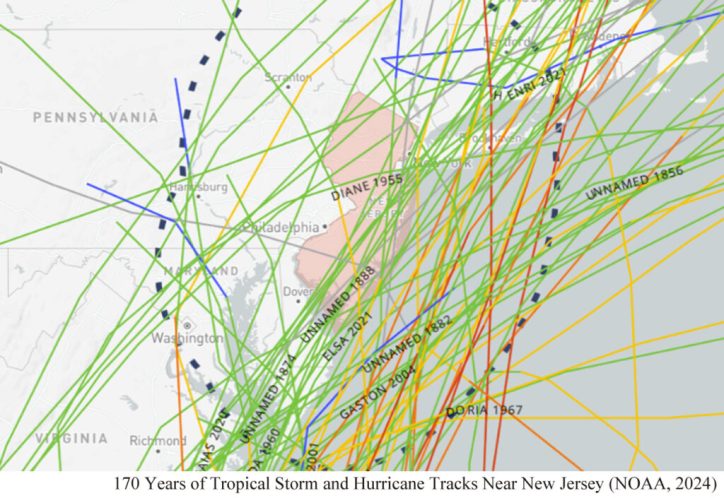
But turbines sited off the US East Coast must survive brutal weather, more severe than offshore turbines in Europe. Tropical storms, hurricanes, and nor’easters periodically traverse the coastal sites planned for new offshore wind systems.
For example, historical data from the National Oceanic and Atmospheric Administration shows that 26 hurricanes and 51 tropical storms passed through New Jersey coastal waters during the last 170 years, or almost five storms each decade. Wind installations will be vulnerable to these weather systems.
In 2018, Hurricane Maria passed over Puerto Rico, ripping blades from many turbine towers. East Coast wind systems will likely suffer the same fate.
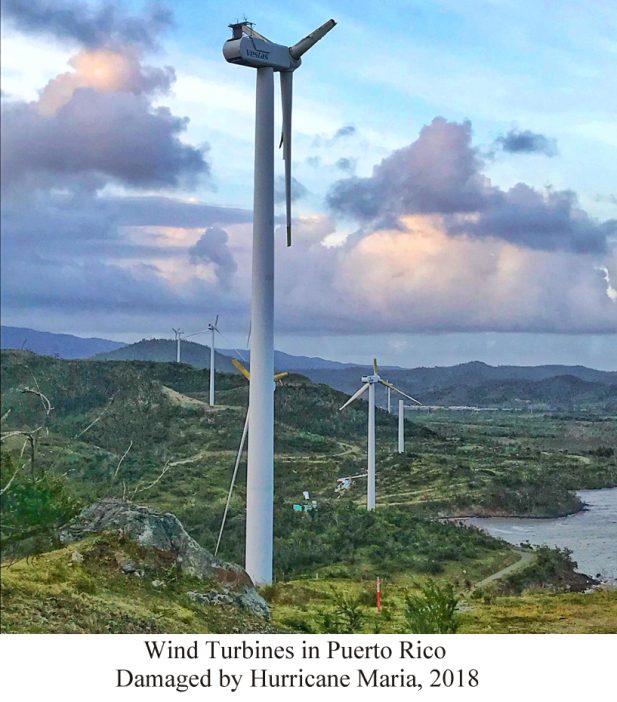
Wind systems are designed to try to protect wind towers and blades in high winds. When winds exceed 55 MPH, a braking system brings the rotor to a standstill to try to avoid turbine damage. Tower blades are also “feathered” or oriented so that they no longer catch the wind.
But near the eye of a hurricane or tropical storm, violent winds can change direction instantaneously and powerfully, too fast for damage-prevention systems to react. The result will be destroyed blades and damaged towers.
Conclusion
In July, a 351-foot-long offshore wind blade splintered and washed up on the beaches in Nantucket, Massachusetts. Beaches were closed and clean-up crews collected six truckloads of fiberglass and plastic debris from the single destroyed blade. Wind operations were temporarily shut down.
Residents, beachgoers, fishermen, and local businesses posted signs, complained to the press, and spoke out at board hearings. But this was just one turbine blade. Image the outcry when a whole offshore system is destroyed by a hurricane, producing mountains of beach debris at Myrtle Beach, Virginia Beach, Atlantic City, or Long Island?
Media headlines claim that weather is becoming more extreme because of human-caused climate change. But to solve the problem, it’s proposed that we install more and more wind and solar systems, which are fragile and vulnerable to violent weather. Incidents of weather destruction of wind and solar installations will continue to rise.
—————-
Steve Goreham is a speaker on energy, the environment, and public policy. His books include the bestselling Green Breakdown: The Coming Renewable Energy Failure.
Russian gas was ‘win-win’ – Merkel
RT | December 10, 2024
Buying natural gas from Russia was a good deal, former German Chancellor Angela Merkel has said, rejecting suggestions that it may have been a strategic mistake.
Merkel, who served as chancellor from 2005 to 2021, was in Paris this week to promote her memoir. She gave an exclusive interview to state TV channel France 2, in which she was asked about Germany’s energy relationship with Russia.
“The gas trade with Russia has a deep-rooted tradition. It began during the Cold War and continued throughout my time in office. I do not think it was a mistake, because we obtained Russian gas at a favorable price,” Merkel said in the interview, which aired on Monday evening.
“It was a win-win situation,” the former chancellor added.
Following the escalation of the Russia-Ukraine conflict, Germany had to source gas elsewhere because “prices exploded,” Merkel said, noting that this would have happened much earlier had Berlin stopped doing business with Moscow during her term.
“I believe it is reasonable to procure the most affordable gas,” she told France 2.
Earlier on her press tour, Merkel also defended the decision to build Nord Stream 2, noting that she had “no support from the business community to stop the gas trade with Russia” at the time. The project was launched in 2015 and the first pipes were laid in 2018.
While the government of Merkel’s successor, Olaf Scholz, has accused Moscow of “shutting off” gas to Germany, his coalition partner Robert Habeck had moved to end the energy trade long before the Ukraine conflict and EU sanctions on Russia provided the pretext. The Green Party leader presented giving up gas for “renewables” as an environmentally responsible policy choice.
Berlin thus refused to certify the newly finished Nord Stream 2 pipeline in January 2022. Nord Stream 1 was destroyed by a series of underwater explosions in September 2022. Investigations by Germany, Sweden, and Denmark have not pointed to a culprit yet, though German media reports have blamed a “rogue” group of Ukrainians.
One of the lines of Nord Stream 2 survived the bombing unharmed and could still deliver gas to Germany should Berlin change its policy and certify the pipeline.
The loss of Russian gas and reliance on the far more expensive US alternative has since pushed energy prices in Germany beyond what a lot of industrial enterprises could afford, triggering a wave of shutdowns and bankruptcies.
In a December 2022 interview, Merkel revealed that Germany and France considered the Minsk Agreements – a framework to peacefully resolve the dispute between Kiev and the two Donbass republics – as a play for time until the West could arm Ukraine for a confrontation with Russia. Former French President Francois Hollande has confirmed her claim.
Iran’s gas is the answer to world’s energy woes
Press TV – December 8, 2024
With the role of natural gas in future power generation being under debate by world countries amid a race to dramatically reduce carbon emissions, Iran is hosting a ministerial meeting of the Gas Exporting Countries Forum (GECF).
Organizers say the meeting is an opportunity to exchange views among the member and observer countries as well as experts and specialists in the gas industry about the mechanism of consensus-building and strengthening communication and coordination on supply policies and related affairs.
While the future role of gas in the energy mix is the source of much contention among countries, the global gas consumption grew unprecedentedly in 2023, GECF Secretary General Mohamed Hamel told the forum’s opening in Tehran on Sunday.
He touched on the resilience of gas to regional conflicts and geopolitical strains which have exposed significant fragilties in the post-pandemic global energy system. Since the formation of the GECF in Tehran in 2001, global demand for natural gas has grown 70 percent, Hamel said.
The race to rapidly decarbonize and digitize the global economy under the net zero energy initiative has been subsumed by geopolitics that remains anchored in realist power struggles. The Ukraine war has undermined interdependence and prompted unprecedented levels of economic statecraft.
The need to rapidly move away from fossil fuels and fossil raw materials has exposed countries to a myriad of compliance risks with dire financial repercussions, leading to deepening instability, injustice and energy poverty.
Even the most optimistic clean energy projections indicate that by 2050, at least half of the world’s energy needs will still come from oil and gas resources. Hence, the rush to eliminate fossil fuels from the global energy system is unrealistic, threatening the world’s energy security.
According to the Energy Studies Institute of the International Energy Agency, gas will continue to play a significant role as a clean and cost-effective fuel in the global energy mix, accounting for 28 percent of the total by 2050. Forecasts indicate that by 2050, natural gas production and consumption will increase to more than 5.9 trillion cubic meters per year.
Asia-Pacific has emerged as the world’s largest net importer of natural gas. In 2023, China was the largest consumer of natural gas in the region, with around 405 billion cubic meters. Japan was the second-largest, with a consumption of around 92.4 billion cubic meters. The region’s gas consumption is forecast to hit 1.6 trillion cubic meters by 2050.
Also, predictions show that the largest share of the increase in natural gas production in the world will be from Russia, Iran, Qatar, and Turkmenistan.
Hence, the role of the Gas Exporting Countries Forum as a leading platform for dialogue and cooperation in order to provide a level of stability beneficial to both exporters and consumers and supporting the gas industry which requires significant effort and financing is of particular importance.
Iran, as the second largest holder of gas reserves in the world, has an important role to play in the gas diplomacy and guarantee its national interests and the interests of the other members.
The GECF countries hold 70% of the world’s proven gas reserves and produce some 40% of the world’s gas.
Despite years of sanctions, Iran has made significant progress in expanding its gas sector. The country now produces 275 billion cubic meters of natural gas annually, and gas accounts for more than 70 percent of its energy consumption.
Iran’s overall proven natural gas reserves excluding shale gas deposits and huge hydrocarbon reserves in the Sea of Oman and possibly the Persian Gulf and Caspian Sea are put at 34 trillion cubic meters, or about 17.8% of world’s total.
Assuming that the current unbridled consumption of about 250 billion cubic meters per year continues and with the pessimistic assumption that no new gas fields are discovered in the coming years, the existing supplies are enough to meet Iran’s needs for the next 130 years.
With investment and production from unconventional shale reserves which the country has already discovered, Iran’s gas supply capacity can rise more than twofold in the coming decade.
Exploratory research in the Sea of Oman has indicated the existence of gas hydrate reserves in Iranian waters in larger quantities than the huge South Pars field.
Further development of more than 20 fields currently producing gas can add another 500 million cubic meters a day to the country’s gas production capacity.
This huge capacity can be tapped to supply gas to the world markets through building new pipeline networks to neighboring countries and sending LNG to the rest of the world.
Prospective German chancellor calls for end to arming Kiev
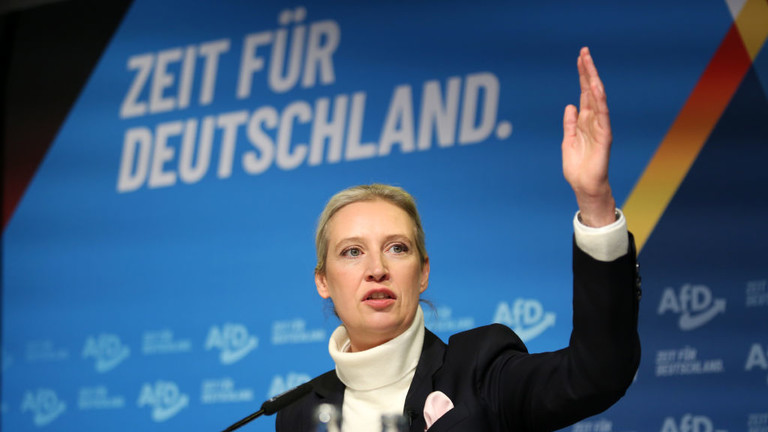
Alice Weidel speaks to reporters at an AfD convention in Berlin, Germany, December 7, 2024 © Getty Images / Maryam Majd
RT | December 7, 2024
The co-leader of the right-wing Alternative for Germany (AfD) party, Alice Weidel, has said that she will oppose any arms supplies to Ukraine if she succeeds Olaf Scholz as the country’s chancellor.
AfD nominated Weidel as its candidate for the post on Saturday, in the party’s first bid for the chancellery in its 11-year history. It has steadily risen in popularity since its founding in 2013, and is currently Germany’s second-strongest political force.
Speaking to reporters after the nomination, Weidel promised to introduce drastic immigration restrictions, to roll back Scholz’ climate policies, and to cut off military aid to Ukraine.
”We want peace in Ukraine,” the 45-year-old said. “We do not want any arms supplies, we do not want any tanks, we do not want any missiles. We do not want Taurus for Ukraine, which would make Germany a party to the war,” she added, referring to a type of German-made cruise missile that would require German military personnel to be deployed to Ukraine to operate.
The AfD, Weidel declared, is a “peace party.”
Scholz, along with his Green and Free Democrat coalition partners, overturned decades of foreign-policy pacifism in 2022 when they decided to supply weapons to the Ukrainian military. Since then, Berlin has sent Kiev almost €17 billion ($17.9 billion) in military, economic, and humanitarian aid, according to government figures. Although initially reluctant to supply heavy weapons, Scholz has authorized the transfer to Ukraine of tanks, artillery guns, anti-air missiles, and armored vehicles.
Before 2022, Germany relied on Russia for 55% of its supply of natural gas. Scholz’ decision to halt Russian energy imports, coupled with his government’s green policies, has led to soaring electricity costs, forcing some of the country’s manufacturing giants – including Volkswagen and BASF – to close plants and lay off workers.
Amid economic decline and disputes within his coalition, the Scholz government collapsed last month. The chancellor is expected to lose a confidence vote in parliament later this month, after which a snap election will likely be held in late February. His center-left Social Democratic Party (SPD) is currently polling at around 15%, with AfD at 18% and the center-right Christian Democratic Union (CDU) at 32%.
Weidel has little chance of winning the chancellery. Even if the AfD were to emerge as the largest party in February, all of Germany’s other mainstream parties have ruled out entering a coalition with the right-wingers. After a string of regional election wins this year, 113 members of the 733-member Bundestag put forth a motion last month to ban the AfD as a “Nazi party” whose beliefs clash with the German constitution. Most of the lawmakers behind the proposal were Greens, joined by 31 members of the SPD and just six from the CDU.
Bankers plot ways to get paid carbon credits for emissions they might have emitted, but didn’t
By Jo Nova | December 5, 2024
What other industry gets paid for what they could have done, but didn’t?
The carbon market is the perfect scam-quasi-tax currency for our banker overlords. They were always trading reductions in an invisible gas, now they’re trading reductions from an imaginary increase that may never have occurred.
Carbon credits were always atmospheric nullities that “might theoretically change the weather”. Now they’re less…
It’s a nice gig if you can get it. This elastic game can expand to cover as much of the economy as feasible. The bankers payout is limited only by how much they can squeeze out of their political vassals. Homeowners will not get a “carbon credit” for turning a heater off that they might have left on, or for not-buying a second-hand Dodge Challenger Hellcat. This is a game only the uber rich money-changers can play. The Blob has effectively set up a secondary fiat currency in the world that has a Byzantine web of rules that they control but has no physical products for delivery.
As Steve Milloy says — Coming soon: Unending bank climate fraud
Bankers Find Way to Claim Credit for Avoided Emissions
Bankers will soon be able to claim credit for emissions they say their financing has helped avoid, as the world’s largest voluntary carbon accounting framework for the finance industry works on broadening standards.
Under the approach, banks can assume a counterfactual scenario in which emissions remain elevated, and contrast that with the CO2 avoidance their loans or bonds enable, according to the Partnership for Carbon Accounting Financials.
Note the galactic size:
PCAF’s proposed standards are part of a larger package of changes and additions that will result in at least 90% of assets under management globally being covered by the carbon accounting system.
Why stop at 90%? When will it end?
The idea came from the Monster Banker Cartel, so we know it will benefit the bankers:
The Glasgow Financial Alliance for Net Zero, the largest finance sector climate coalition, introduced the idea of a new metric last year to drive transition finance, calling it expected emissions reductions (EER). The basic principle is that finance firms compare the emissions associated with the entity or asset in a business-as-usual scenario with those achieved if that company implements a science-based transition plan, or if a polluting asset is eventually shut down. The so-called delta is the EER.
Of course, companies drop inefficient products in favor of better ones all the time, but now, they’ll be able to say they’ve reduced the emissions they expected to have, and thus earn some carbon credits that they can sell to some other sucker, or use to offset their charter jet flights to Azerbaijan.
This will work best for corporate behemoths who can afford to pay “climate lawyers” to fill in the forms, and “climate lobbyists” to bend all the rules to suit themselves. It’s another tool to make life harder for small businesses and customers but easier for the Big Guy.
Note there is another monster banker cartel called PCAF — in this case with assets of $92 Trillion.
PCAF was created by Dutch financial institutions during the 2015 Paris Climate summit to encourage banks and investors to play their part in delivering a transition to a low-carbon economy.
Since then, the number of financial institutions committed to or already applying its accounting methods has climbed to more than 550, with combined financial assets of $92.5 trillion, according to PCAF’s website.
It’s time for a monster round of Anti-Trust suits.
Cost of switching off UK wind farms soars to ‘absurd’ £1bn
By Paul Homewood | Not A Lot Of People Know That | December 3, 2024
Cost of switching off UK wind farms soars to ‘absurd’ £1bn
British bill payers have spent an “absurd” £1bn to temporarily switch off wind turbines so far this year as the grid struggles to cope with their power.
The amount of wind power “curtailed” in the first 11 months of 2024 stood at about 6.6 terawatt hours (TWh), according to official figures, up from 3.8 TWh in the whole of last year.
Curtailment is where wind turbines are paid to switch off at times of high winds to stop a surge in power overwhelming the grid. Households and businesses pay for the cost of this policy through their bills.
The cost of switching off has reached about £1bn so far this year, according to analysis of market data by Octopus Energy which was first reported by Bloomberg. This is more than the £779m spent last year and £945m spent in 2022.
The jump in curtailment follows the opening of more wind farms at a time when the country still lacks the infrastructure needed to transport all the electricity they generate at busy times.
The real problem currently is the lack of transmission capacity between Scotland and the South, where demand is. But that is ignoring the real issue, which is that we should never have built wind farms in remote places where there is no demand in the first place. And the cost of new transmission capacity should have been built into the business case before construction went ahead. If that had been done, wind farms in such places would never have been viable.
The Grid of course are now planning to spend over £100 million on upgrading the transmission network, but the real problem going forward is that there will huge amounts of surplus wind power once Miliband has quadrupled wind power capacity. As the Telegraph notes:
According to the National Energy System Operator (Neso), curtailment costs are on course to surge to £6bn by 2030 if the status quo continues
Featured Video

Rewriting the risk? Inside the government’s vaccine safety messaging
or go to
Aletho News Archives – Video-Images
Book Review
“Davos Can Really Replace the UN”
Inside the book that maps the architecture behind global governance — from the Epstein files to the Pact for the Future
Lies are Unbekoming | April 1, 2026
On June 13, 2019, the United Nations and the World Economic Forum signed a partnership deal to “accelerate the implementation of the 2030 Agenda for Sustainable Development.” That same evening, WEF president Börge Brende — Norway’s former Foreign Minister — had dinner with Jeffrey Epstein at Epstein’s Manhattan townhouse. The Epstein files, released January 2026, contain an exchange between the two from the previous year. Epstein to Brende: “Davos can really replace the UN. C21, cyber, crypto . genetics… intl coordination.” Brende back to Epstein: “Exactly — we need a new global architecture. World Economic Forum (Davos) is uniquely positioned — public private.”
The next day, the UN General Assembly adopted the framework for restructuring global governance.
That sequence — the partnership signing, the Epstein dinner, the candid admission about replacing the UN with a public-private architecture, and then the formal adoption — opens Jacob Nordangård’s The Digital World Brain. Pages two and three. Footnoted to the UN resolution number, the Epstein files, and the General Assembly record.
I keep coming back to it because it captures what this book does that almost nothing else in the independent research space manages. I’ve followed Jacob’s work for years now and interviewed him about his research. Each book peels back another layer of the same institutional architecture, and each time I think he’s reached the limit of what can be documented, the next one goes further. Nordangård doesn’t speculate. He doesn’t editorialize much. He lays institutional actions next to each other in chronological order and lets the pattern announce itself. … continue
Blog Roll
 Aletho News
- Under fire, Moscow and Tehran close ranks
- Iran, US receive Pakistan-mediated plan for ceasefire then final deal
- Iran submits demands for end to war as mediators scramble ahead of Trump deadline
- Iran Threatens Retaliatory Strike on Stargate AI Project in UAE
- US sent ‘a lot’ of arms to Iranian protesters – Trump
- Barak Ravid Launders Deception To Allow Trump To Back Off Of His Power Plant Threat – Again
- REWRITING THE RISK? INSIDE THE GOVERNMENT’S VACCINE SAFETY MESSAGING
- “Davos Can Really Replace the UN”
- NIAID/NIH and USDA Fund Bioengineered Chimeric Influenza Viruses Built Using Pandemic H1N1 Components: Journal ‘Science Advances’
- Hezbollah hits Israeli warship off Lebanon’s coast, sets it aflame
- If Americans Knew
- Trump poised to “blow everything up” (ie. commit war crimes) in Iran – Daily Update
- In Iran, Israel-US take aim at “reason, research, and freedom of thought” – Daily Update
- US loses planes over Iran, Israel downgrades Lebanon war goals – Daily Update
- Israel Is Blocking Palestinians from Easter at Church Where Jesus Resurrected
- Plot to assassinate Palestinian activist follows harassment campaign promoted by Zionist groups and elected officials
- Prominent New York synagogue hosts presentation on why U.S. Jews should support the ethnic cleansing of Gaza
- Tapper vs. Piker: Is the CNN Anchor Auditioning for David Ellison?
- Shouldn’t Democrats Be Able to Condemn Genocide?
- Israel-US kill negotiators, destroy civilian structures, but Iran’s military capabilities still largely intact – Daily Update
- ‘War crime’: Global condemnation as Israeli ministers celebrate death penalty law targeting Palestinian prisoners
- No Tricks Zone
- An Inconvenient Tree: Uncovered In Alps… Europe Much Warmer Than Today 6000 Years Ago
- New Study Reports A 60% Slowdown In Greenland’s Ice Loss Rate In The Last Decade
- Low Intensity Tornado Wrecks Major Solar Farm, Creating A Potential Toxic Dump
- New Study Finds Warming Saves Lives…Cold Temperatures 12 Times More Deadly Than Excess Heat
- German Science Blog Accuses PIK Climate Institute Of Hallucinating Climate Tipping Points
- Devastating Assessment Of Comirnaty Vaccine By Former Senior Pfizer Europe Toxicologist
- New Study: CO2 Is ‘Effectively Negligible’ As An Explanatory Climate Change Factor Since 2000
- Former Pfizer Toxicologist Dr. Helmut Sterz Tells Bundestag Hearing Pfizer Vaccine Should Have Never Been Approved
- Energy Expert: Germany’s Nuclear Phaseout Was A “500 Billion Euro Mistake”
- New Research: South Australia’s Mid-Holocene Sea Surface Temperatures Were 4°C Warmer Than Today
 Aletho News