Monsanto and the big fat lie of food safety
By M. Gray | Food Freedom | November 7, 2010
Vandana Shiva doesn’t mince words. Food safety is food fascism:
“Risk Assessment in the hands of centralized corruptible agencies is no protection for consumers as the disease and health epidemic in the U.S. linked to over processed, industrial foods show. Even while the U.S. is at the epicenter of the food related public health crises, the U.S. government is trying to export its Food laws which deregulate the industry and over regulate ordinary citizens and small enterprise. This deregulation of the big and toxic and over regulation of the small and ecological is at the core of Food Fascism …”
The Nazi Minister of Propaganda, Joseph Goebbels, is equally straightforward:
“If you tell a lie big enough and keep repeating it, people will eventually come to believe it. The lie can be maintained only for such time as the State can shield the people from the political, economic and/or military consequences of the lie. It thus becomes vitally important for the State to use all of its powers to repress dissent, for the truth is the mortal enemy of the lie, and thus by extension, the truth is the greatest enemy of the State.”
What’s the truth?
Michael Taylor, the Monsanto executive who gave this country rBGH, deregulated GMOs, and kept GMOs all unlabeled, thanks to Obama, is “The Food Safety Czar” at the FDA.
That Czar, “[t]he person who may be responsible for more food-related illness and death than anyone in history,” has been using “food safety” as a weapon against small local farms and local food co-ops. (For any who missed the Rawesome Raid, here’s the video on youtube.)
The consequences of the lie can no longer be hidden. They are showing up in Missouri, South Dakota, Pennsylvania, Georgia, New York, Michigan, Ohio, Vermont, California, Massachusetts, Maine, Wisconsin, and most recently in Washington.
The places being shut down are providing the most wholesome and nutritious food available and their tests come back clean, but the places are closed down regardless, often with no means of reopening. The problem is they are not within a just or even rational legal framework but one run by Monsanto, a company which devised a means to sue farmers for labeling their milk honestly, as rBGH-free.
Requirements farmers are being asked to meet include such violations of civil and human rights as keeping the names, addresses and phone numbers of customers and limits of on how much milk they can produce (If the milk is safe, on what basis does the state limit how much can be produced? And what other food has limits on production?). They face closings over missing a single page of pasteurization information, and shutting down of a food club with demands for paper work and names of customers even without charges being filed.
There are no “food safety” violations here, only the violation of a corporation shutting people down who are providing safe food and cutting off people depending on them for that food.
The list of raids since Obama came in is incomplete. It comes on top of SWAT team raids that occurred under Bush – also without reasonable cause, and repeatedly against a single farmer, and sometimes without any cause.
Food (especially milk products), equipment and personal computers are seized by state agents without a warrant and destroyed (sometimes running into hundreds of thousands of dollars of losses) which is followed by destruction of the farmers’ own food, stored for the family for the year. None is replaced and the farmer is not compensated.
Under such an FDA regime, “food safety” has lost all meaning. It is a farce of paperwork and a complex, irrelevant (to true safety of food) regulations which allow for governmental discretion in how standards must be met or maliciously assuring they can never be met, and in how penalties are applied. It is an arrangement that keeps doors wide open to willful government injustices. Lost in this complicated, pretense-filled, science-sounding bureaucratic system is the fact that “food safety” has nothing whatever to do with the actual safety of the food.
When it comes to literal food safety, the FDA, tasked to protect food, has illegally allowed antibiotics, hormones and slaughterhouse waste (all banned for years in Europe) to enter the food supply, along with pesticides and GMOs, with none ever having been tested for safety in humans. And those toxic items remain there today despite decades of studies (by scientists outside the FDA) proving their danger conclusively. How many people have died from this exposure, and not from acute infections but from chronic diseases such as cancer, diabetes, heart disease and more?
Those toxic substances are all corporate products and the bases of the immense profits to Monsanto, agribusiness in general, the food industry, and especially to the pharmaceutical industry which both sells the toxins and many of the food “additives” and then, after the food is consumed, swoops in like a vulture to pick the bones clean from perhaps the most profitable aspect of all – the steadily increasing diseases it and its brother corporations are assuring.
America does produce safe food but it is produced outside of the industrial [model] based on drugs chemicals, animal confinement, and GMOs. It comes only from the farms Monsanto is working to shut down.
That the FDA is concerned with “food safety” is a fiction propped [up] by propaganda. This is perhaps best exemplified by the raids occurring now, most of them involving raw milk.
The “food safety” stage was set by a long standing government smear campaign around raw milk’s alleged threat to health, giving the public the impression that the FDA was on the job protecting them from dangerous pathogens on farms. The public was unaware of how often the government accused farmers of producing milk with salmonella or another pathogen, shut the farmer down for a few weeks, and put that scare-mongering news in the media. But when the tests came back clean, that did not make the news. In the meantime, the farmer’s reputation was damaged and weeks of income were lost. Farmers, to defend themselves, began taking samples at the same time the government did, and having independent labs quickly confirm the milk was safe, undermining the government ruse.
In any case, the false accusations did not dampen the rapidly growing demand for raw milk. Perhaps because the milk is clean and the rigmarole of testing wasn’t offering a means to shut down dairy farmers Monsanto is now shutting them and food buying clubs down anyway, dropping all pretense of cause.
This becomes yet more absurd and unjust since the reality is that raw milk is the cleanest milk in the country whereas pasteurized milk in supermarkets contains pesticides, hormones, antibiotics, pus and GMOs. And pathogens. For while the FDA is accusing raw milk of being unsafe, in truth, the FDA is ignoring 5 to 20% of pasteurized milk in supermarkets, coming from the dairy industry, can be cultured for the Crohn’s bacterium. It is contaminated with a disease bacterium. The FDA has known this for more than a decade and done nothing about it, not even informing researchers and doctors searching for the cause that pasteurized milk is a likely source.
And to make the FDA’s actions more ludicrous in terms of “food safety,” the raw milk they are trying to get rid of is sought after by many in order to treat Crohn’s disease.
“Food safety” under Monsanto is Orwellian regulations enlarged to the specter of a Howitzer, easy to swing around and aim at small farms and food co-ops providing incontrovertibly safe, nutritious food, in order to shut them down. But somehow the big gun is permanently jammed when it comes pointing at giant corporate facilities sending out contaminated food to millions, sickening and even killing people. Those facilities, despite deaths, have not been closed for a single day.
The FDA (Monsanto) claims it can’t deal with the big corporate offenders without more fire power, so it wants a much, much bigger weapon and total discretion to act whenever and however it decides. The farmers and local food producers, wide-eyed, call out to the country, “Look who their target has been! Look who their target is now!” Given Monsanto overriding existing legal constraints to shut down people doing everything right, their intent is clear as is their drive. With the force and scope of what the “food safety” bills contain, Monsanto would be freed up to obliterate small farming and all local food systems in the US.
Colbert has done a show on the armed FBI raid in LA, and Olbermann did a show on a proposed Miami law that would use “food safety” to criminalize donating to the homeless. Word is starting to get out that something serious is occurring around food and Americans’ rights to produce it and use it freely. Monsanto would probably agree, since it has been appearing in court (as FDA’s “food safety” division) to try to remove human rights around food and health.
Realizing that who is behind FDA “food safety” (Monsanto of documentary fame) begins to lift the veil from the FDA’s claims that it must have more power to go after corporate violators, to reveal the Howitzer beneath, one which Monsanto is using only against hard-working people providing exactly what the country says it wants – a local food economy, safe food, local jobs, food security, and little carbon footprint.
Vandana Shiva says this partnership between the state and corporations is corporate rule. Is that the truth about “food safety”?
Obama’s Electric Vehicle Fetish
Cars for the Elite
By ROBERT BRYCE | November 11, 2010
Imagine an American president who, during a press conference, extols the importance of cars made by Mercedes Benz or BMW. The reaction, particularly on Fox News, is easily envisioned: outraged cries of “elitist” and “out of touch” would persist for days or even months afterward.
That, in essence, is exactly what President Barack Obama did last Wednesday. Obama acknowledged the thumping that the Democrats took at the polls on November 2, and went on to discuss the need for more all-electric vehicles, at one point saying “There’s a lot of agreement around the need to make sure that electric cars are developed here in the United States.”
Fine. Both Mercedes and BMW manufacture cars in the U.S. But here are two essential points: Those two automakers each control about the same percentage of the domestic car market that automotive analysts believe electric cars will have by 2020. Second, and perhaps more important: the same people who buy Benzes and Beemers – the wealthy – are the ones most likely to buy a new electric car.
Obama’s electric vehicle fetish reflects much of the inanity of our discussions about energy. The idea that oil is bad, and that we must therefore throw vast sums of money at efforts aimed at fueling our automotive fleet with something else – anything else – ignores both economic realities and the myriad problems inherent with EVs.
First, the economic realities. Earlier this year, Deloitte Consulting released a report on EVs which found that the most likely buyers are people with household incomes “in excess of $200,000” and “who already own one or more vehicles.” Furthermore, Deloitte expects those buyers to be “concentrated around southern California where weather and infrastructure allow for ease of EV ownership.”
Deloitte concluded that the US now has about 1.3 million consumers who “fit the demographic and psychographic profiles” of expected EV buyers. It went on, saying that mass adoption of the EV “will be gradual” and that by 2020, perhaps 3 percent of the US car market could be amenable to EVs. The report also says that the keys to “mass adoption are 1) a reduction in price; and 2) a driving experience in which the EV is equivalent to the internal combustion engine.”
Think about those numbers. Out of 300 million Americans, perhaps 1.3 million of them – with many of those living in areas in or around Los Angeles and San Diego — are likely to buy an EV.
Deloitte’s projections are exactly the same as those recently put forward by Johnson Controls Inc., a company that makes batteries for cars and is building two new plants in order to supply the EV market. Last month, the Wall Street Journal reported that Johnson Controls’ research “found that the pool of US customers for whom an electric car makes financial sense – those who travel many miles a year, but on short trips – is very small, about three percent of drivers.”
Hmmm. Three percent of drivers? In both 2009 and 2010, Mercedes and BMW each controlled about 2 percent of the US auto market.
Why will EVs be playthings for the rich? The answer is simple: the history of the EV is a century of failure tailgating failure. Consider this quote: In 1911, the New York Times declared that the electric car “has long been recognized as the ideal solution” because it “is cleaner and quieter” and “much more economical” that gasoline-fueled cars.
Whenever you hear about the wonders of the new hybrid-electric Chevrolet Volt, which at $41,000 per copy costs as much as a new Mercedes-Benz C350, consider this assessment by a believing reporter: “Prices on electric cars will continue to drop until they are within reach of the average family.” That line appeared in the Washington Post on Halloween, 1915.
And since the Volt is being built by GM, ponder this news item which declared that the carmaker has found “a breakthrough in batteries” that “now makes electric cars commercially practical.” The batteries will provide the “100-mile range that General Motors executives believe is necessary to successfully sell electric vehicles to the public.” That story was published in the Washington Post on September 26, 1979.
The problem today is the same as it was in 1911, 1915, and 1979: the paltry energy density of batteries. On a gravimetric basis, gasoline has 80 times the energy density of the best lithium-ion batteries. Of course, electric-car supporters will immediately retort that electric motors are about four times more efficient than internal combustion engines. But even with that four-fold advantage in efficiency, gasoline will still have 20 times the energy density of batteries. And that is an essential advantage when it comes to automobiles, where weight, storage space, and of course, range, are critical considerations.
Despite the all-electric automobile’s long history of failure, despite the fact that EVs will likely only be driveway jewelry for the wealthy, the Obama administration is providing more than $20 billion in subsidies and tax breaks for the development and production of cars that use electricity instead of oil.
Indeed, the administration keeps throwing money at EVs despite a January 2009 report published by the Department of Energy’s Office of Vehicle Technologies, which said that despite the enormous investments being made in plug-in hybrid-electric vehicles and lithium-ion batteries, four key barriers stand in the way of their commercialization: cost, performance, abuse tolerance, and life. The key problem, according the DOE analysts, was—predictably—the battery system. The report concludes that lithium-based batteries, which it calls “the most promising chemistry,” are three to five times too expensive, are lacking in energy density, and are “not intrinsically tolerant to abusive conditions.”
Remember when Barack Obama, the presidential candidate, berated the Bush administration for not paying attention to the science? In December 2008, shortly after being elected to the White House, he declared, “It’s time we once again put science at the top of our agenda and worked to restore America’s place as the world leader in science and technology.”
Restoring America’s leadership in science and technology is a worthy goal. But by attempting to pick winners in the car business — arguably the world’s single most competitive industry — the Obama administration is forgetting history and the panoply of problems that have kept EVs in the garage since the days of Thomas Edison. It’s time to unplug this subsidy-dependent industry and let the free market work.
I Am So Tired of Malthus
By Willis Eschenbach | Watts Up With That? | September 8, 2010
Daily we are deluged with gloom about how we are overwhelming the Earth’s ability to sustain and support our growing numbers. Increasing population is again being hailed as the catastrophe of the century. In addition, floods and droughts are said to be leading to widespread crop loss. The erosion of topsoil is claimed to be affecting production. It is said that we are overdrawing our resources, with more people going hungry. Paul Ehrlich and the late Stephen Schneider assure us that we are way past the tipping point, that widespread starvation is unavoidable.
Is this true? Is increasing hunger inevitable for our future? Are we really going downhill? Are climate changes (natural or anthropogenic) making things worse for the poorest of the poor? Are we running out of food? Is this what we have to face?
Fortunately, we have real data regarding this question. The marvelous online resource, the UN Food and Agriculture Organization (FAO) statistics database called FAOSTAT, has data on the amount of food that people have to eat.
Per capita (average per person) food consumption is a good measure of the welfare of a group of people because it is a broad-based indicator. Some kinds of measurements can be greatly skewed by a few outliers. Per capita wealth is an example. Since one person can be a million times wealthier than another person, per capita wealth can be distorted by a few wealthy individuals.
But no one can eat a million breakfasts per day. If the per capita food consumption goes up, it must perforce represent a broad-based change in the food consumption of a majority of the population. This makes it a good measure for our purposes.
The FAOSTAT database gives values for total food consumption in calories per day, as well as for protein and fat consumption in grams per day. (Fat in excess is justly maligned in the Western diet, but it is a vital component of a balanced diet, and an important dietary indicator.) Here is the change over the last fifty years:

Figure 2. Consumption of calories, protein, and fat as a global average (thin lines), and for the “LDCs”, the Least Developed Countries (thick lines) . See Appendix 1 for a list of LDCs.
To me, that simple chart represents an amazing accomplishment. What makes it amazing is that from 1960 to 2000, the world population doubled. It went from three billion to six billion. Simply to stay even, we needed to double production of all foodstuffs. We did that, we doubled global production, and more. The population in the LDCs grew even faster, it has more than tripled since 1961. But their food consumption stayed at least even until the early 1990s. And since then, food consumption has improved across the board for the LDCs.
Here’s the bad news for the doomsayers. At this moment in history, humans are better fed than at any time in the past. Ever. The rich are better fed. The middle class is better fed. The poor, and even the poorest of the poor are better fed than ever in history.
Yes, there’s still a heap of work left to do. Yes, there remain lots of real issues out there.
But while we are fighting the good fight, let’s remember that we are better fed than we have ever been, and take credit for an amazing feat. We have doubled the population and more, and yet we are better fed than ever. And in the process, we have proven, once and for all, that Malthus, Ehrlich, and their ilk were and are wrong. A larger population doesn’t necessarily mean less to eat.
Of course despite being proven wrong for the nth time, it won’t be the last we hear of the ineluctable Señor Malthus. He’s like your basic horror film villain, incapable of being killed even with a stake through the heart at a crossroads at midnight … or the last we hear of Paul Ehrlich, for that matter. He’s never been right yet, so why should he snap his unbeaten string?
APPENDIX 1: Least Developed Countries
Africa (33 countries)
Angola
Benin
Burkina Faso
Burundi
Central African Republic
Chad
Comoros
Democratic Republic of the Congo
Djibouti
Equatorial Guinea
Eritrea
Ethiopia
Gambia
Guinea
Guinea-Bissau
Lesotho
Liberia
Madagascar
Malawi
Mali
Mauritania
Mozambique
Niger
Rwanda
São Tomé and Príncipe
Senegal
Sierra Leone
Somalia
Sudan
Togo
Tanzania
Uganda
Zambia
Eurasia (10 countries)
Afghanistan
Bangladesh
Bhutan
Cambodia
East Timor
Laos
Maldives
Myanmar
Nepal
Yemen
Americas (1 country)
Haiti
Oceania (5 countries)
Kiribati
Samoa
Solomon Islands
Tuvalu
Vanuatu
LATE VICTORIAN HOLOCAUSTS BY MIKE DAVIS

BOOK REVIEW
Critics of globalization point out with some justice that poor people around the world suffer far more than the citizens of industrialized nations during downturns in the global economy. Peasants in developing countries can find their lives hanging in the balance during a rise in food prices or a decline in the global market value of the goods they produce. Never was this more true than during the hey-day of the European imperialism in the last three decades of the nineteenth century. Aggressive trade practices and the ruthless use of military force effectively subdued nations in Asia, Africa, and South America and brought these countries into a global trade system. By the 1870s, and certainly by the turn of the century, many European countries, above all Great Britain, had created the world’s first global market economy. Financial markets in London, Paris, Amsterdam, and elsewhere were linked by telegraph to places where raw materials were produced for European consumption, while established trade routes were patrolled by European navies (particularly the Royal Navy). The economic power of the extensive British Empire was unparalleled and the inner workings of the global system dominated by London determined the fate of innumerable people around the world.
It is with the workings of the British economic system and their impact on indigenous populations in India, China, and elsewhere that Mike Davis’ book Late Victorian Holocausts is concerned. Davis’ point of departure is a simple question. Why is it that widespread hunger in Western Europe disappeared in the nineteenth century while famine and disease raged throughout multiple places in what today we would call the “Third World”? Davis provides a simple answer: European imperialism (especially British imperialism) created a global economic system through which the food and wealth of conquered nations (i.e. colonies) was siphoned off for the benefit of wealthy and powerful Europeans, while those in the colonies were left to starve and die. The result was mass death (what Davis calls “holocausts”) on an unprecedented scale in India, China, Brazil and other places, that was most intense during the El Niño drought years of 1876-77 and 1888-1902.
This imperial global economic system was certainly not a “free” market in any sense of the word. It was in fact bolstered by a long series of tariffs and unfavorable trade relationships that were forced by Europeans upon the peoples they conquered. Colonies were in turn subjected to economic pressure dictated by and manipulated from financial centers in Western Europe. It was these economic forces, as well as brutal gunboat diplomacy, that Davis argues created the Third World as we know it today.
THE “FREE MARKET” AS A MECHANISM OF MASS MURDER
Davis’ primary focus in fleshing out his story is the crown jewel of Britain’s colonial empire: India. Drought was the precipitating cause of the hardship faced by the Indian people. However, Davis demonstrates with statistics and anecdotes that it was the unregulated “free market” system imposed on India by Britain that led to the deaths of tens of millions in the mid-1870s and late 1880s.
How did death and human suffering on such a massive scale happen? Following the English conquest of India in the early nineteenth century, economic relationships in the sub-continent underwent revolutionary changes. Thousands of miles of railroad track were laid. Telegraph wire was strung between outlying areas and the capitol city of Bombay (Mumbai today). Central grain collection depots were created and Indian grain was exported in massive quantities to the British Isles. Also, Indian subsistence farmers were gradually forced out in favor of large land enclosures. Within these new enclosures cash crops like cotton were planted, which supplied the textile mills of Lancashire, but which could not feed the Indian peasants who farmed the land. Finally, the tax burden upon the Indian peasantry was increased exorbitantly to pay for these “improvements”. British authorities needed the revenue to finance war in neighboring Afghanistan.
The innovations imposed by the British on India re-directed the trajectory of Indian commerce and especially food production toward Great Britain and away from the local village markets where the food was needed. Rail lines and the adjacent grain depots enabled British authorities to stockpile grain and keep it under guard away from the people who needed it most, while telegraph lines dictated the price of grain on world commodities markets to local producers. When grain prices rose across the board in global trading, peasants could not afford to buy food.
In the face of these crippling economic forces, British colonial authorities did nothing, primarily because they would not “tamper” with the operation of the liberal “free” market that Britain had created. The Viceroy of India during the famine years of the 1870s was Lord Lytton, a mentally unbalanced English noble. Davis recounts that in the midst of widespread famine and the deaths of millions all around him, Lytton maintained a strict laissez-faire attitude toward famine relief. As Lytton wrote at the time, “there is to be no interference of any kind on the part of the Government with the object of reducing the price of food,” a policy proposal Lytton termed “humanitarian hysterics” and “cheap sentiment”. (p. 31)
Lytton and his fellow administrators preferred instead to blame the “laziness” of famine victims themselves for causing their own dire fate. Citing Lord Temple, “Nor will; many be inclined to grieve much for the fate which they brought upon themselves, and which terminated lives of idleness and too often of crime”. (p. 41) The task of saving life, therefore, was “beyond our power to undertake,” claimed Temple and Lytton, and it was “a mistake to spend so much money to save a lot of black fellows”. (p. 37)
British officials were thus completely unwilling to intervene in the operation of the “free” market despite seeing death on a massive scale all around them. Overall at least 7.1 million people, and perhaps as many as 10.3 million people, died during the famine years of 1876-1878. (p. 111) Furthermore, despite death on this scale and falling production caused by drought, British officials in India still managed to export 6.4 million cwt. of wheat to Great Britain. (p. 31)
LIFE AND DEATH FOLLOWS THE MARKET CYCLE
The years following 1879 were a time when the world market continued to expand. Monsoonal rains settled back into a normal pattern and grain production around the world rose considerably. These were also years when Britain and other colonial powers expanded their reach into the interior of the subjugated countries they held. In India, even more land is brought under cultivation. These lands are then connected to the market by expanded telegraph and rail lines. Then in 1888-89 and 1891-92, the bottom again fell out of the system as El Niño drought gripped the temperate regions of Asia once more.
The resulting death from famine and disease, caused by the very same factors operating in India and elsewhere in the 1870s, was unfathomably huge. By 1902 in India alone between 12.2 and 29.3 million people perished. In China, where the British, Americans, and other European powers controlled practically all trade using military force, between 19.5 and 30 million people died. In Brazil another 2 million perished over the same time span. (p. 7).
THE “FREE” MARKET AND THE MAKING OF THE THIRD WORLD
Mike Davis demonstrates beyond a doubt that the economic structure of exploitative globalization is not a new phenomenon in the world. The lives of millions of people who formerly had survived in localized economies based on subsistence farming were wiped out “in the process of being forcibly incorporated” into the modern world system. (p. 9) Davis reminds us that markets are never free and they never operate according to “iron laws” of economics. Rather, markets are created and often the power underpinning their operation is fiscal manipulation and simple brute force.
Great Britain’s global imperial economy was a case in point. It was never a “free” market. England imposed unfavorable trade terms and high tariff walls on India, China and on all of the other countries in its empire. Local economies forced open by the British were sucked dry of their vital raw materials and in return peasants were forced to buy expensive British manufactured goods. This practice was put into place throughout the colonial world by France, Portugal, Spain, Germany and other colonial powers. If anything, the economies of European colonies were more captive markets than free markets.
The latter point is perhaps the most important conclusion of Late Victorian Holocausts; specifically, that what we call the Third World today was a product of European and, to a lesser extent, American economic exploitation. The incorporation of formerly powerful countries like China and India into the global economy by Great Britain and others effectively destroyed indigenous production. Contrary to conventional wisdom, until around 1850, India and China had actually held their own against Europeans when it came to industrial production. The localized production of wealth and industry, however, was halted and then reversed by the imposition of the global economic system. It is for this reason, Davis concludes, that India’s per capita income did not increase between 1757 and 1947; and in fact declined by more than 50% between 1850 and 1900. (p. 311).
How Goldman gambled on starvation
Speculators set up a casino where the chips were the stomachs of millions. What does it say about our system that we can so casually inflict so much pain?
By Johann Hari | The Independent | 2 July 2010
By now, you probably think your opinion of Goldman Sachs and its swarm of Wall Street allies has rock-bottomed at raw loathing. You’re wrong. There’s more. It turns out that the most destructive of all their recent acts has barely been discussed at all. Here’s the rest. This is the story of how some of the richest people in the world – Goldman, Deutsche Bank, the traders at Merrill Lynch, and more – have caused the starvation of some of the poorest people in the world.
It starts with an apparent mystery. At the end of 2006, food prices across the world started to rise, suddenly and stratospherically. Within a year, the price of wheat had shot up by 80 per cent, maize by 90 per cent, rice by 320 per cent. In a global jolt of hunger, 200 million people – mostly children – couldn’t afford to get food any more, and sank into malnutrition or starvation. There were riots in more than 30 countries, and at least one government was violently overthrown. Then, in spring 2008, prices just as mysteriously fell back to their previous level. Jean Ziegler, the UN Special Rapporteur on the Right to Food, calls it “a silent mass murder”, entirely due to “man-made actions.”
Earlier this year I was in Ethiopia, one of the worst-hit countries, and people there remember the food crisis as if they had been struck by a tsunami. “My children stopped growing,” a woman my age called Abiba Getaneh, told me. “I felt like battery acid had been poured into my stomach as I starved. I took my two daughters out of school and got into debt. If it had gone on much longer, I think my baby would have died.”
Most of the explanations we were given at the time have turned out to be false. It didn’t happen because supply fell: the International Grain Council says global production of wheat actually increased during that period, for example. It isn’t because demand grew either: as Professor Jayati Ghosh of the Centre for Economic Studies in New Delhi has shown, demand actually fell by 3 per cent. Other factors – like the rise of biofuels, and the spike in the oil price – made a contribution, but they aren’t enough on their own to explain such a violent shift.
To understand the biggest cause, you have to plough through some concepts that will make your head ache – but not half as much as they made the poor world’s stomachs ache.
For over a century, farmers in wealthy countries have been able to engage in a process where they protect themselves against risk. Farmer Giles can agree in January to sell his crop to a trader in August at a fixed price. If he has a great summer, he’ll lose some cash, but if there’s a lousy summer or the global price collapses, he’ll do well from the deal. When this process was tightly regulated and only companies with a direct interest in the field could get involved, it worked.
Then, through the 1990s, Goldman Sachs and others lobbied hard and the regulations were abolished. Suddenly, these contracts were turned into “derivatives” that could be bought and sold among traders who had nothing to do with agriculture. A market in “food speculation” was born.
So Farmer Giles still agrees to sell his crop in advance to a trader for £10,000. But now, that contract can be sold on to speculators, who treat the contract itself as an object of potential wealth. Goldman Sachs can buy it and sell it on for £20,000 to Deutsche Bank, who sell it on for £30,000 to Merrill Lynch – and on and on until it seems to bear almost no relationship to Farmer Giles’s crop at all.
If this seems mystifying, it is. John Lanchester, in his superb guide to the world of finance, Whoops! Why Everybody Owes Everyone and No One Can Pay, explains: “Finance, like other forms of human behaviour, underwent a change in the 20th century, a shift equivalent to the emergence of modernism in the arts – a break with common sense, a turn towards self-referentiality and abstraction and notions that couldn’t be explained in workaday English.” Poetry found its break with realism when T S Eliot wrote “The Wasteland”. Finance found its Wasteland moment in the 1970s, when it began to be dominated by complex financial instruments that even the people selling them didn’t fully understand.
So what has this got to do with the bread on Abiba’s plate? Until deregulation, the price for food was set by the forces of supply and demand for food itself. (This was already deeply imperfect: it left a billion people hungry.) But after deregulation, it was no longer just a market in food. It became, at the same time, a market in food contracts based on theoretical future crops – and the speculators drove the price through the roof.
Here’s how it happened. In 2006, financial speculators like Goldmans pulled out of the collapsing US real estate market. They reckoned food prices would stay steady or rise while the rest of the economy tanked, so they switched their funds there. Suddenly, the world’s frightened investors stampeded on to this ground.
So while the supply and demand of food stayed pretty much the same, the supply and demand for derivatives based on food massively rose – which meant the all-rolled-into-one price shot up, and the starvation began. The bubble only burst in March 2008 when the situation got so bad in the US that the speculators had to slash their spending to cover their losses back home.
When I asked Merrill Lynch’s spokesman to comment on the charge of causing mass hunger, he said: “Huh. I didn’t know about that.” He later emailed to say: “I am going to decline comment.” Deutsche Bank also refused to comment. Goldman Sachs were more detailed, saying they sold their index in early 2007 and pointing out that “serious analyses … have concluded index funds did not cause a bubble in commodity futures prices”, offering as evidence a statement by the OECD.
How do we know this is wrong? As Professor Ghosh points out, some vital crops are not traded on the futures markets, including millet, cassava, and potatoes. Their price rose a little during this period – but only a fraction as much as the ones affected by speculation. Her research shows that speculation was “the main cause” of the rise.
So it has come to this. The world’s wealthiest speculators set up a casino where the chips were the stomachs of hundreds of millions of innocent people. They gambled on increasing starvation, and won. Their Wasteland moment created a real wasteland. What does it say about our political and economic system that we can so casually inflict so much pain?
If we don’t re-regulate, it is only a matter of time before this all happens again. How many people would it kill next time? The moves to restore the pre-1990s rules on commodities trading have been stunningly sluggish. In the US, the House has passed some regulation, but there are fears that the Senate – drenched in speculator-donations – may dilute it into meaninglessness. The EU is lagging far behind even this, while in Britain, where most of this “trade” takes place, advocacy groups are worried that David Cameron’s government will block reform entirely to please his own friends and donors in the City.
Only one force can stop another speculation-starvation-bubble. The decent people in developed countries need to shout louder than the lobbyists from Goldman Sachs. The World Development Movement is launching a week of pressure this summer as crucial decisions on this are taken: text WDM to 82055 to find out what you can do.
The last time I spoke to her, Abiba said: “We can’t go through that another time. Please – make sure they never, never do that to us again.”
Food prices to rise by up to 40% over next decade, UN report warns
Growing demand from emerging markets and for biofuel production will send prices soaring, according to the OECD and the UN Food and Agriculture Organisation
Katie Allen | guardian.co.uk | 15 June 2010
Food prices are set to rise as much as 40% over the coming decade amid growing demand from emerging markets and for biofuel production, according to a United Nations report today which warns of rising hunger and food insecurity.
Farm commodity prices have fallen from their record peaks of two years ago but are set to pick up again and are unlikely to drop back to their average levels of the past decade, according to the annual joint report from Paris-based thinktank the OECD and the UN Food and Agriculture Organisation (FAO).
The forecasts are for wheat and coarse grain prices over the next 10 years to be between 15% and 40% higher in real terms, once adjusted for inflation, than their average levels during the 1997-2006 period, the decade before the price spike of 2007-08. Real prices for vegetable oils are expected to be more than 40% higher and dairy prices are projected to be between 16-45% higher. But rises in livestock prices are expected to be less marked, although world demand for meat is climbing faster than for other farm commodities on the back of rising wealth for some sections of the population in emerging economies.
Although the report sees production increasing to meet demand, it warns that recent price spikes and the economic crisis have contributed to a rise in hunger and food insecurity. About 1 billion people are now estimated to be undernourished, it said.
Fairtrade campaigners said the predictions of sharply rising prices provided a “stark warning” to international policymakers.
“Investment to encourage the 1 billion people whose livelihoods rely on smallholder agriculture is vital. Not only will this increase yields but will go a long way to increase prosperity in poverty stricken regions,” said Barbara Crowther, director of communications at the Fairtrade Foundation.
“At the same time, the promise of increased agriculture commodity prices could spark a new surge in land grabbing by sovereign wealth funds and other powerful investors which risks marginalising further rural communities who must be included in solutions to secure and maintain food supplies.”
The report says that agricultural production and productivity must be stepped up and it argues for a well-functioning trading system to ensure fair competition and that surplus food is getting to where it is needed.
It also painted a growing role for developing countries in both boosting demand and production. Brazil is by far the fastest growing agricultural producer, with output expected to rise by more than 40% in the next decade and production growth is also expected to be well above 20% in China, India, Russia and Ukraine.
“The role of developing countries in international markets is growing quickly, and as their impact grows, their policies also have an increasing bearing on conditions in global markets,” said FAO director-general Jacques Diouf.
“This makes their role and contribution to global policy issues critical. Policy discussions must be global in scope and we need to improve the framework for such exchange of views.”
Another factor driving up food prices is the controversial biofuels industry. The report predicts that continued expansion of biofuel output – often to meet government targets – will create additional demand for wheat, coarse grains, vegetable oils and sugar.
Global proven oil reserves increase by 33% over two decades
Venezuela ‘has world’s second biggest oil reserves’
Tamsin Carlisle | VHeadline | June 11, 2010
Venezuela is now the world’s second biggest holder of proved oil reserves, overtaking the Gulf producers Iran, Iraq and Kuwait.
In the 2010 edition of its benchmark Statistical Review of World Energy, which was published last week, BP has made substantial upwards revisions to its estimates of Venezuela’s oil reserves for both last year and 2008.
It appears to have included in its latest tally about 73 billion barrels of heavy crude reserves for which the South American country has long sought recognition from Opec. That has boosted the company’s estimate of Venezuelan oil reserves by more than 73%, following a smaller revision last year.
According to BP, the Middle East’s share of global oil reserves has shrunk by almost 10 percentage points in the past two decades, as producers in South America, Eurasia and Africa have established more commercially viable deposits of the world’s leading fuel. Those countries now officially include Venezuela. BP has set at 56.6% its estimate of the proportion of the world’s proved oil reserves that are located in the Middle East. That is down from 65.7% in 1989.
- Despite the region’s diminished standing as a source of future crude supply, Middle Eastern oil reserves have increased by 14% in the past 20 years to 754 billion barrels, according to BP.
Over the same period, however, the world’s total proved oil reserves have expanded more than twice as fast, swelling by nearly a third to 1.33 trillion barrels by the end of last year from 1 trillion barrels two decades earlier. The world’s top six holders of oil reserves, according to the latest BP league table, are now, in descending order, Saudi Arabia, Venezuela, Iran, Iraq, Kuwait and the UAE, all of which are OPEC members.
Russia was last year’s top oil producer, pumping more than 10 million barrels per day, followed by Saudi Arabia and the US. Russia and Saudi Arabia were also the world’s leading oil exporters. Unlike those countries, the US is a net importer of oil. The review ranked the UAE as the eighth most prolific oil producer last year. The nation’s output, averaging 2.6 million barrels per day (bpd), narrowly exceeded those of Iraq and Kuwait, which each pumped 2.48 million bpd of crude.
Venezuela’s oil output averaged 2.44 million bpd, putting the South American state within range of overtaking every Gulf oil producer except Saudi Arabia and Iran.
As OPEC’s biggest western hemisphere oil producer and a founding member of the group, Venezuela has been pushing for a higher OPEC production quota based on recognition of its large reserves of “unconventional” heavy crude. Venezuela can still develop those deposits while honouring its commitment to OPEC because the group’s production quotas exclude unconventional oil. Formal recognition of the reserves and a higher quota, however, would give Venezuela the country more flexibility to raise its output of lighter crude, which is usually more profitable to produce.
Another landmark emerging from BP’s latest data is that Brazil’s oil production has for the first time exceeded 2 million bpd. Brazil pumped almost as much crude as Nigeria last year and surpassed the output of five other OPEC producers. Brazilian production rose by 7.1% to 2.03 million bpd, cementing the country’s position as South America’s second biggest oil producer.
US oil output, which had fallen in 2008, rebounded last year by 7% to 7.12 million bpd. The 462,000 bpd increase was “by far” the world’s biggest and came mainly from the Gulf of Mexico, said Tony Hayward, the chief executive of BP.
The Middle East remained the world’s top oil producing region last year, accounting for more than 34% of the global total. It was followed by Europe/Eurasia and North America.
In terms of gas, the biggest change from last year, according to BP’s data, was a 13.9% increase in Venezuela’s reserves.
Last September, the Spanish oil and gas group Repsol announced it had struck a giant gasfield off the coast of Venezuela. Hailing the discovery, the Venezuelan president Hugo Chavez said his country would soon become “one of the five giants in the world of gas.”
On the basis of their proved reserves, the reigning monarchs of the gas world are Russia, Iran and Qatar, which between them hold nearly 3.5 quadrillion cubic feet of reserves representing 53% of the global total. Venezuela’s gas reserves, at 200 trillion cubic feet, are now the eighth largest in the world. The UAE has 227 trillion cubic feet of reserves, putting it in seventh place.
Gas reserves in Russia and Saudi Arabia also increased last year. Russian reserves grew by 2.5% to 1.57 quadrillion cubic feet. Those of Saudi Arabia swelled by 4.6% to 280 trillion cubic feet.
Global gas reserves have increased 53% in the past 20 years, outpacing oil. The Middle East’s share has expanded to 40.6 from 30.9%, largely due to development of the world’s biggest gasfield, which is shared by Qatar and Iran.
Nails in the Global Warming Coffin
By Professor Philip Stott | April 27, 2010
My silence since mid-February has not meant that I have taken my eye off the climate-change scene. Far from it, although I have to confess that I have become increasingly wearied and bored by the fatuous lack of reality exhibited on this topic by many UK politicians. It is so glaringly obvious that, since the debacle in Copenhagen, ‘global warming’ is dying as a major political trope that I find it less and less exercising as an issue. Indeed, I do not want to waste too much energy in flogging a fundamentally dead corpse.
This last week, however, the nails in the global warming coffin have been driven in so thick and so fast that I thought it might be worth bringing attention once again to what is happening around the world – “You will therefore permit me to repeat, emphatically, that Global Warming is as dead as a door-nail,” although I suspect that the Global Warming Ghost will hang around moaning and wailing for quite a while yet.
Germany Gets Cold Feet
First, in that paragon of so-called Green virtues, Germany, Spiegel Online reports that the German Chancellor, Angela Merkel, ‘Abandons Aim of Binding Climate Agreement’:
“Frustrated by the climate change conference in December, German Chancellor Angela Merkel is quietly moving away from her goal of a binding agreement on limiting climate change to 2 degrees Celsius. She has also sent out signals at the EU level that she no longer supports the idea of Europe going it alone.”
Spiegel goes on to comment:
“… now it’s time for realpolitik. Merkel and Röttgen [have] had to admit that countries like China and India will not submit to a mandatory target that others have contrived.
Precisely so.
The Emissions Billycan Waltzes Off Indefinitely
Meanwhile, ‘Down Under’, The Sydney Morning Herald reports: ‘Emissions put on back burner’:
“A Senate vote on the trading scheme legislation, which was due next month, has now been dropped by the government for the May and June sittings of Parliament.
A government source said yesterday the fate of the Senate vote on the legislation beyond June was unclear.
The source said the decision to park the legislation indefinitely reflected the political reality that the opposition, under leader Tony Abbott, and the Greens had vowed to reject the scheme in the Senate.
Unless the Coalition or the Greens change their positions the government will now have to wait until July 1 next year for the Senate to change over after this year’s federal election to negotiate with a potentially less hostile Parliament – unless a double-dissolution election is called.
The government will now concentrate on passing other matters in the Senate including its national health reform package and the national broadband network. ‘Obviously there are a lot of pressures in the Senate, so the government has to prioritise the reforms that are most likely to be passed,’ the source said.”
Indeed. Most wise. “Good On Yer, Mate!”
Different Priorities In US Too
Then, in the US, as The New York Times reports: “The Senate climate bill sits on the brink of collapse today after the lead Republican ally threatened to abandon negotiations because of a White House push to simultaneously overhaul the nation’s immigration policies.”
Moreover, President Obama has far more pressing worries and priorities as ‘US Republicans block debate of finance rules reform’ – Mr Obama has made reining in Wall Street a cornerstone of his Presidency.
Quite so.
Finally, Elusive Pay-Offs And Not Such A Green-Blue
Further, somewhat unsurprisingly given all of the above, the monies so happily and so readily promised to help developing nations to fight ‘global warming’ are proving remarkably elusive. Only the most politically- and economically-naive of souls could have expected otherwise.
Lastly, even in our ever-Utopian UK, ‘global warming’ has, thank goodness, hardly featured in the election to date, being confined to brief comments hidden in the deepest inner recesses of a few newspapers, although it is worth stating that the energy policies of the newly-resurgent Liberal Democrats would probably do for Britain as a serious economic power.
By contrast, as The Times points out this morning about the Conservatives:
“Despite Mr Cameron’s slogan of ‘vote blue go green’, a recent survey found that only 22 per cent of Conservative candidates in winnable seats strongly supported Britain’s target of generating 15 per cent of Britain’s energy from renewable sources by 2020.
David Davis, the former Shadow Home Secretary, recently warned that the policy of tough targets to cut carbon emissions, supported by Mr Cameron, was ‘destined to collapse’.”
Just so.
Indeed, the complete collapse of the Great Global Warming Grand Narrative continues apace.
It will surely be fascinating to observe precisely the moment when UK politicians begin to stop mouthing pious platitudes about the political significance of ‘global warming’.
That moment cannot come too soon.
Global uprising against land grabbing
Social movements denounce World Bank strategy on land grabbing
GRAIN | 22 April 2010
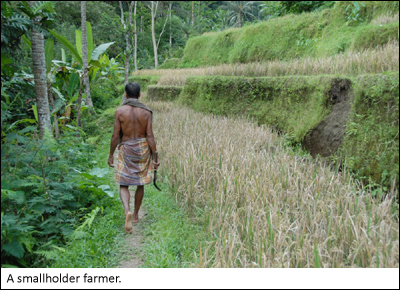 On 26 April 2010, the World Bank is opening a major two-day conference on land at its headquarters in Washington DC. Seated at the table will be governments, donor agencies, researchers, CEOs and non-government organisations. The main topic of discussion? How to harness the fresh wads of cash being put on the table to build agribusiness operations on huge areas of farmland in developing countries, especially in Africa. The Bank calls these farm acquisitions “agricultural investment”. Social movements call them “land grabbing”.
At the meeting, the Bank will release a long-awaited study on this new land grabbing trend. Apart from assessing how many hectares are being bought and sold where, why and through whom, the Bank will present its solution to the risks and concerns raised by foreign investors — from George Soros to Libya’s sovereign wealth fund to China’s telecoms giant ZTE — taking control of overseas farmland to produce food for export: a set of “principles” for all players to follow. The FAO, UNCTAD and IFAD have agreed to support the Bank in advocating these “principles”.
La Vía Campesina, FIAN, Land Research Action Network and GRAIN have produced a joint statement outlining how the Bank’s initiative will only serve to facilitate land grabbing and why it must be stopped. Over 100 other social organisations and movements have formally associated themselves with the statement as co-sponsors. Today and in the coming days, many groups will be speaking out against the current land grabbing trend and explaining how the real solution to feeding our world lies in supporting community-based family farming for local and regional markets — not industrial farming for global agribusiness.
We invite all interested groups and individuals to join forces with us and speak out from your own experience.
The LVC-FIAN-LRAN-GRAIN statement, together with the list of co-sponsors, is available in Arabic, English, French and Spanish at:
http://www.grain.org/o/?id=102.
If you wish to register your own support for the statement you can post a comment at:
http://farmlandgrab.org/12200
or send an email to info@farmlandgrab.org and we will post it for you.
Simultaneous media events and actions are taking place in Washington DC and many other towns and cities across the world. For information on the Washington DC events or how to talk to activists from the affected countries, please contact Kathy Ozer of the National Family Farm Coalition for La Via Campesina (mobile: +1-202-421-4544, email: kozer@nffc.net) or Devlin Kuyek at GRAIN (mobile: +1-514-571-7702, email: devlin@grain.org).
Media reports and further inputs and actions from different groups joining this movement will be collated online at:
http://farmlandgrab.org.
Further references
– The World Bank’s land conference webpage is:
http://go.worldbank.org/67YHA6L0K0.
The conference papers are being posted online at:
http://go.worldbank.org/IN4QDO1U10
– La Via Campesina is the international movement of peasants, small- and medium-sized producers, landless, rural women, indigenous people, rural youth and agricultural workers with 148 members in 69 countries:
http://www.viacampesina.org.
– FIAN (FoodFirst Information and Action Network) is an international human rights organisation with members and sections in 50 countries to advocate for the realisation of the right to food:
http://www.fian.org.
– LRAN (Land Research Action Network) is a network of researchers and social movements committed to the promotion of individuals’ and communities’ right to land:
http://www.landaction.org.
– GRAIN is a small international non-profit organisation that works to support farmers and social movements in their struggles for community-controlled and biodiversity-based food systems: http:// http://www.grain.org and
http://farmlandgrab.org.
Ethanol supporters in Congress try to prevent a repeat of biodiesel mothballing
Dan Looker – Successful Farming – 4/20/2010
Four months after a $1-per-gallon biodiesel tax credit expired, putting some 29,000 out of work in that industry, backers of the ethanol industry are trying to prevent that from happening on an even larger scale.
Ethanol’s 45 cent-a-gallon credit, known as the Volumetric Ethanol Excise Tax Credit (VEETC), expires at the end of this year.
Tuesday, Senators Chuck Grassley (R-IA) and Kent Conrad (D-ND) introduced a bill to extend VEETC through 2015. It would also extend a tariff on imported ethanol.
Grassley told reporters that some 112,000 jobs in the ethanol industry are at risk if the tax credit and tariff are allowed to expire.
“I don’t think we can risk a repeat performance with ethanol like we had with biodiesel,” he said.
There doesn’t seem to be much organized opposition to renewing the biodiesel tax credit, but under new pay-as-you-go rules intended to keep the federal deficit from growing even more, Congress has to find offsetting budget savings or higher taxes to pay for the biodiesel credit.
Grassley said Tuesday that the House Ways and Means Committee is looking for ways to offset the biodiesel credit.
The new 5-year tax credit extension for ethanol might also need offsets. Grassley said Tuesday that he doesn’t know where they would come from.
Unlike biodiesel, the ethanol industry does face opposition to extending VEETC and the tariff.
In March, Representatives Earl Pomeroy (D-ND) and John Shimkus (R-IL) introduced a similar bill in the House of Representatives to extend the ethanol tax credit for five more years. That bill has already drawn opposition from the American Meat Institute, Grocery Manufacturers of America, Natural Resources Defense Council, Taxpayers for Common Sense and others. […]
The bill Grassley and Conrad introduced today, the Grow Renewable Energy from Ethanol Naturally Jobs Act of 2010, or the GREEN Jobs Act of 2010, is cosponsored by Senators John Thune (R-SD), Ben Nelson (D-NE), Mike Johanns (R-NE) and Tim Johnson (D-SD).
Featured Video

US IRAN TALKS: Who Are the Crazy Ones Here? /Lt Col Daniel Davis
or go to
Aletho News Archives – Video-Images
From the Archives
Wartime internment camps in Australia
National Archives of Australia
World War I
During World War I, for security reasons the Australian Government pursued a comprehensive internment policy against enemy aliens living in Australia.
Initially only those born in countries at war with Australia were classed as enemy aliens, but later this was expanded to include people of enemy nations who were naturalised British subjects, Australian-born descendants of migrants born in enemy nations and others who were thought to pose a threat to Australia’s security.
Australia interned almost 7,000 people during World War I, of whom about 4,500 were enemy aliens and British nationals of German ancestry already resident in Australia.
Records of World War I internment camps
World War II
During World War II, Australian authorities established internment camps for three reasons – to prevent residents from assisting Australia’s enemies, to appease public opinion and to house overseas internees sent to Australia for the duration of the war.
Unlike World War I, the initial aim of internment during the later conflict was to identify and intern those who posed a particular threat to the safety or defence of the country. As the war progressed, however, this policy changed and Japanese residents were interned en masse. In the later years of the war, Germans and Italians were also interned on the basis of nationality, particularly those living in the north of Australia. In all, just over 20 per cent of all Italians resident in Australia were interned. … continue
Blog Roll
 Aletho News
- Diplomats slam US negotiators’ performance in Iran talks
- Trump Refuses Exit Ramp, War with Iran will Continue
- Trump Says US Naval Blockade in Strait of Hormuz Will Begin Shortly
- US, Iran end 21-hour talks without agreement
- US IRAN TALKS: Who Are the Crazy Ones Here? /Lt Col Daniel Davis
- Talks with the US end without a deal over excessive US demands: Iran
- Feeling Better, Getting Worse: How Psychiatric Drugs Create the Illusion They Cure
- ‘Nobody Told Me’: Former Mental Health Patient Calls Out Dangerous Side Effects of Psychiatric Drugs
- Dr. Abu-Sitta: Beirut ‘felt like a day in Shifa Hospital’
- Iran Has Won the War, It Will Be Up to the US to Secure the Peace: Mohammad Marandi
- If Americans Knew
- US-Iran ceasefire negotiations make zero progress – Daily Update
- Pro-Israel ‘Thinktanks’ and Individuals who Influence U.S. Foreign Policy
- Mearsheimer reveals how Israel dictates US policies on Iran, Gaza – video
- After killing 350+, Israel still has a “score to settle” with Lebanon before ceasefire – Daily Update
- Military aid to Israel emerges as the latest political litmus test for Democrats
- The only Palestinian children’s rights organization closes following years-long Israeli campaign against it
- ‘I Can’t Forget the Smell’: Lebanese Reel After Israel Kills Over 300 in Single Day
- DNC Shoots Down Resolutions Calling Out AIPAC and Limiting Arms to Israel
- TCN: Is Israel Blackmailing President Trump?
- Israel killed at least 303 Lebanese yesterday – who were they? Daily Update
- No Tricks Zone
- German Expert: Heat Dome Led To Record Temps In Western USA…Warmer In 1934, 1936
- New Study: No Linear Warming Or Glacier Retreat Along Northern Antarctic Peninsula Since 1980s
- An Inconvenient Tree: Uncovered In Alps… Europe Much Warmer Than Today 6000 Years Ago
- New Study Reports A 60% Slowdown In Greenland’s Ice Loss Rate In The Last Decade
- Low Intensity Tornado Wrecks Major Solar Farm, Creating A Potential Toxic Dump
- New Study Finds Warming Saves Lives…Cold Temperatures 12 Times More Deadly Than Excess Heat
- German Science Blog Accuses PIK Climate Institute Of Hallucinating Climate Tipping Points
- Devastating Assessment Of Comirnaty Vaccine By Former Senior Pfizer Europe Toxicologist
- New Study: CO2 Is ‘Effectively Negligible’ As An Explanatory Climate Change Factor Since 2000
- Former Pfizer Toxicologist Dr. Helmut Sterz Tells Bundestag Hearing Pfizer Vaccine Should Have Never Been Approved
 Aletho News