The Cost of Freedom: Confronting Military-Industrial Profiteering and Restoring Fiscal Integrity to Preserve Our Republic
By Dennis J. Kucinich | The Kucinich Report | February 14, 2025
Our government is drowning in multi-trillion-dollar financial corruption and debt while a fear-peddling national security state has reached deeply into the personal lives of each and every American, justifying its existence through endless wars cooked up by a deep state which has become the most corrupt marching band and chowder society in American history.
That deep state of permanent governance, entrenched media, think tanks, NGOs, and multi-billion-dollar government contractors, notwithstanding elections, has demanded US taxpayers pay additional TRILLIONS for wars, for subsidizing conflicts in other countries, for secret and not-so-secret arms deals to “rebels” for regime change, subverting governments through the pretext of foreign aid.
The government that we have succeeded most in subverting is our own.
There is an undeniable link between fiscal integrity and the preservation of our freedoms as Americans. When government becomes corrupt, it erodes not only our personal liberties and financial security, but also fosters a culture of lawlessness in both the public and private sectors. In order to restore our nation’s values, all three branches of government must demonstrate rigorous oversight, discipline, and integrity. Our nation requires an honest media. We must remain vigilant in holding government officials accountable. Government is too important to our lives to be left up to only those who govern.
The constitutional crisis in the form of massive federal government financial corruption looms like a giant iceberg about to sink the Ship of State. Unless its course is corrected, and soon, our nation will perish in a sea of deficits as private interests swim shark-like to feast on corpus America.
The corruption has been institutionalized in the federal budget. It has been normalized as standard operating procedure. The waste of taxpayers’ money is ubiquitous — trillions for wars, trillions in waste, fraud, and abuse. Trillions have been lost in an accounting jumble. This has been our government’s system of checks and balances: The Administration writes the checks, and Congress doesn’t know what the balance is. Is it possible that change is coming?
Congress, which by the Constitution must pass a budget, places spending bills from all federal departments into an “omnibus bill.” “Omnibus” is Latin for “budget-busting.” Most members do not know what is in the $7.3 Trillion spending bill, and those who do aren’t talking.
Welcome to America’s version of Dante’s Inferno, where in the ninth and lowest concentric circle of Hell, Cocytus, those who betrayed their countries are cast. Here is the final unresting place for those who spun the damnable lies which took us into a $3 trillion war against Iraq, which resulted in an unforgivable hemorrhage of American treasure and blood, that destroyed Iraq, killing one million Iraqi men, women and children.
The Iraq War, which began under the Bush administration, turned into a budget bacchanal of bribery, bilking, blight, and betrayal. Vice President Dick Cheney, who had been CEO of Halliburton, a major defense contractor, stood to indirectly benefit from government contracts awarded to his former company during the war.
Halliburton was awarded lucrative no-bid contracts to rebuild Iraq’s oil infrastructure and provide logistical support to the U.S. military, bringing in billions of dollars. Cheney’s ties to Halliburton raised questions about potential conflicts of interest. Cheney’s former company was found to have overcharged the government and failed to deliver on its contracts in Iraq.
As a member of the House of Representatives (1997-2013), on the floor of the House, I consistently called out corruption, and also within the Oversight and Government Reform Committee. Through two Presidential campaigns (2004 and 2008), I worked to end perpetual war, the waste of money and lives which war creates, and to refocus our resources to America’s needs at home.
Over the years, I called for an end to the systemic waste, fraud and abuse plaguing war spending, including the trillions of dollars spent on the Iraq War and other military conflicts. I introduced multiple pieces of legislation, including measures to hold defense contractors accountable, strengthen oversight mechanisms, and enforce stricter regulations to prevent corruption in federal contracts. It is one thing to criticize a system. It is another thing to relentlessly work to change it.
A Few Examples of My Efforts in Congress:
1. 2003-2007: Led efforts in the Oversight and Government Reform Committee to scrutinize defense spending, especially contracts awarded to companies like Halliburton, to ensure taxpayer dollars were not being wasted or siphoned off into private hands. During this period, I made multiple floor speeches highlighting the lack of accountability in the U.S. military’s procurement processes and demanded comprehensive audits.
2. 2007: Introduced H.R. 2042, the “Contractor Accountability Act of 2007,” requiring the Department of Defense to report on waste and fraud in military contracts, particularly those related to the Iraq War. This was a direct response to massive issues with no-bid contracts awarded to companies with ties to high-ranking government officials, such as Halliburton.
3. 2009-2012: Urged Congress to conduct investigations into the billions of dollars spent on “reconstruction” projects in Iraq that failed to materialize or were poorly managed. I consistently pushed for more robust transparency and oversight measures, speaking out against the disastrous consequences of unchecked spending in conflict zones.
4. 2011-2012: As a ranking member of the Committee on Oversight and Government Reform, I called for audits on military contractors and their role in fueling waste and corruption. One of the biggest examples I highlighted was the $61 million overcharge by Halliburton for transporting oil into Iraq.
My Call for Expanded Oversight: USAID and Other Agencies
In addition to the scrutiny of military contracts, I repeatedly called for comprehensive oversight of U.S. foreign aid and development programs. USAID has long been a channel through which billions of taxpayer dollars have been funneled abroad, often with little accountability or transparency. For years, I pushed for the auditing and review of USAID’s operations, specifically targeting the lack of measurable results in the countries it sought to “help.”
One of the most glaring examples came in the early 2000s, when billions in USAID funds were allocated to countries like Afghanistan and Iraq for reconstruction and development. There was little oversight into how those funds were being used, leading to ineffective and sometimes outright fraudulent projects.
I demanded oversight into USAID’s practice of funneling funds to for-profit companies, without competitive bidding and called for legislation enforcing stricter accountability measures.
The Pushback:
My efforts to root out waste, fraud, and corruption in military spending were often met with harsh criticism from both the mainstream media and political opponents, who characterized my calls for accountability as naive, unrealistic and damaging to national security.
The Wall Street Journal, in an editorial, called my opposition to military interventions misguided, suggesting that my views were out of touch with the political mainstream. Politico went as far as to label my approach idealistic and impractical.
On the political front, many of my Republican colleagues dismissed my positions as unpatriotic, arguing that scrutinizing defense spending would weaken the country’s ability to defend itself. But the problem wasn’t just with Republicans.
Democratic leadership, despite campaigning on promises to end wars, repeatedly voted to fund them once in office. Key figures like Joe Biden and Hillary Clinton supported the Iraq War authorization in 2002, and President Obama, despite vows to withdraw, continued the Iraq War and expanded military actions into Syria and Libya.
This hypocrisy—condemning endless wars while funding and escalating wars—allowed the military-industrial complex to thrive, betraying both the promises of peace and the trust of the American people.
The First Trump Administration
Unlike his Democratic predecessors, President Trump did not initiate new military conflicts during his first term. While the U.S. remained engaged in existing wars, particularly in Syria and Afghanistan, Trump made efforts to reduce troop deployments and avoid escalating military action. This stood in stark contrast to the actions of previous Democratic administrations, which, despite campaign promises to end wars, continued or expanded military engagements once in office.
Trump’s stance on reducing foreign military involvement marked a departure from the longstanding cycle of military escalation under Democratic leadership. Yet, even as he moved toward peace and restraint abroad, his first administration’s approach to military spending remained largely influenced by the military-industrial complex—a reality he must confront more directly in his 2025 agenda.
The Trump administration’s fiscal approach was entrenched in the military-industrial complex. Trump advocated for increasing military spending, and in 2019, his administration requested $732 billion for the Department of Defense for FY2020 alone—reflecting a continuation of the military-driven fiscal expansion.
Notably, the Trump administration also continued to rely heavily on private military contractors, which flourished during this period. With little oversight, defense spending and contracts grew, with military companies like Lockheed Martin, Raytheon, and Boeing benefiting enormously.
One of the more controversial policies was the Trump administration’s continued involvement in the war in Afghanistan, where taxpayer dollars were flowing into both military operations and private contractors, despite bipartisan calls for an end to the conflict.
The second Trump Administration must focus on rooting out the massive, systemic corruption and corporate giveaways that continue to drain our resources and undermine our national security.
Will President Trump now reign in military spending and fight the entrenched interests that have profited from endless war?
The Biden Administration:
The Biden administration’s 2023 budget proposed a military spending request of $813 billion. This included funds for continued involvement in global conflicts, counterterrorism operations, and military contractors.
While the Biden administration has faced criticism for its handling of the war in Afghanistan, it also made efforts to address the domestic impacts of military spending, focusing on rebuilding infrastructure and increasing social safety nets. However, waste, fraud, and abuse continued to plague the system. The Department of Health and Human Services (HHS), for example, reported more than $100 billion in improper Medicare and Medicaid payments in 2023, echoing concerns about the massive inefficiencies within federal spending.
With Dick Cheney’s endorsement of the 2024 Democratic presidential nominee, the Democrats were officially recognized as the war contractors’ party, with Trump as a threat to business as usual.
Cheney’s endorsement of the Democratic nominee marked a pivotal shift in the political landscape, where the party that once claimed to stand against endless wars had now fully embraced the military-industrial complex.
It’s encouraging to see that in recent years a growing number of Americans and lawmakers are beginning to recognize the dangers of unchecked military spending and corruption. However, the consequences of years of waste, fraud, and abuse will take years to undo. The growing recognition of the necessity of reform must translate into transparency and fiscal discipline.
This Administration must be made aware of glaring examples of waste and corruption which, in the past, became “business as usual:”
$10 Billion in Cash… Vanished
After the U.S. invasion of Iraq, over $10 billion in freshly minted $100 bills, shrink-wrapped into bundles of $75,000 each, were placed on skids and loaded onto a C-130 transport to be flown from the United States directly to the U.S.’ Coalition Provisional Authority (CPA) in Baghdad.
Over $10 BILLION in CASH disappeared in an orgy of corruption, ultimately ending up in the hands of enemies of the United States. That the money derived from proceeds from the sale of Iraq oil compounded the corruption, placing an exclamation point on zero accountability in protecting Iraq’s money or, as you will see, the taxpayers.
A Commission on Wartime Contracting in Iraq and Afghanistan estimated the cost of waste, fraud, and abuse to be upwards of $60 BILLION, deriving from a lack of oversight, no internal controls in keeping track of who received the money, who spent it, and what it was spent for—and if indeed its purpose was accomplished.
A 2007 audit of Iraq Reconstruction couldn’t determine how $1.3 BILLION for Iraq internal security was spent.
Well-connected government contractors cashed in, overcharging the government for tens of millions, notably Halliburton, which overcharged the government $61 million for transporting oil into Iraq.
DynCorp nicked U.S. taxpayers for millions, inflating Iraq contract costs and billing the U.S. for unauthorized projects, like an Olympic-sized swimming pool built in a war zone.
RTX (Raytheon) was caught in a web of no-bid contracts, involving bribery, fraud, lying about labor and material costs, and double-billing. RTX (Raytheon) paid back $950 million in a settlement last October.
Trillions of hard-earned U.S. taxpayer dollars were spent on a war based on lies, notably the biggest one: that Iraq had Weapons of Mass Destruction (WMDs) ready to use against the U.S. Iraq did not.
Years later, the WMDs have been discovered, not in Iraq, but in Washington. Lying is a Weapon of Mass Destruction. Corruption is a Weapon of Mass Destruction. A $37 trillion dollar deficit is a Weapon of Mass Destruction.
This is the war machine of wealth transfer at work. Each conflict escalates the flow of public money into private hands, further enriching defense contractors, military suppliers, and multinational corporations, while the costs of war—lives lost, communities shattered, and nations destabilized—are borne by the public. The more destruction and chaos generated abroad, the more contracting opportunities arise, providing new revenue streams for those who profit off the war economy.
The federal government needs to be cleaned from top to bottom. It must align with the principles expressing the connection between honest government and freedom. Those principles were implicit in Benjamin Franklin’s warning to the Constitutional Convention on September 17, 1787, in which he forecast the insidious danger and reciprocal nature of a corrupt government which corrupts the public and thereby induces despotism:
“… I think a General Government necessary for us, and there is no form of government, but what may be a blessing to the people if well administered, and believe further that this is likely to be well administered for a course of years, and can only end in despotism, as other forms have done before it, when the people shall become so corrupted as to need despotic government.”
As he was leaving Independence Hall, Franklin was asked by Elizabeth Willing Powell, “Doctor, what have we got? A republic or a monarchy?”
His reply, bids us to be eternally vigilant citizens, if we are to remain free:
“A Republic, if you can keep it.”
Algeria demands France acknowledge ‘nuclear crimes’ committed on its soil

MEMO | February 14, 2025
The speaker of Algeria’s lower house of parliament yesterday called on France to officially acknowledge its responsibility for “nuclear crimes” it committed during its colonial era in the North African country, Anadolu reported.
“We demand with one voice an official recognition from France of its full responsibility for these nuclear crimes,” Ibrahim Boughali, speaker of the People’s National Assembly, told an event commemorating France’s first nuclear test in Algeria on 13 February 1960.
Algeria cannot accept “a mere political acknowledgment, but an acknowledgement followed by a clear moral commitment” from France, he added.
France carried out its first nuclear test in 1960, named Blue Jerboa (Gerboise Bleue in French), in the Reggane desert of southern Algeria. Paris continued its nuclear tests on Algerian territory until 1966.
Boughali said that France had carried out 17 nuclear explosions in the area, leaving devastating effects that persist to this day.
The nuclear tests “were a dark chapter in [the French] colonial history that continues to cast its shadow, as its dangerous and destructive effects continue to affect the environment and humanity,” he added.
The Algerian speaker called for forcing France to compensate the victims of the nuclear tests and clean up nuclear waste in Algeria.
Diplomatic relations between Algeria and France remain volatile, particularly due to unresolved issues stemming from France’s colonisation of Algeria for 132 years (1830–1962). Paris has refused to fully address the historical grievances that continue to affect Algerian society.
Trump Tells Xi, Putin ‘Let’s Cut Military Budget In Half’ – Says Russia Should Be Back In G7
By Tyler Durden | Zero Hedge | February 13, 2025
On Thursday President Donald Trump continued to signal positive feelings about a future relationship with Russia and Putin, telling reporters that he’d like to see Russia invited back in to join the The Group of Seven major economies, or G7, which until 2014 was the G8 when Russia was included.
“I’d love to have them back. I think it was a mistake to throw them out. Look, it’s not a question of liking Russia or not liking Russia. It was the G8,” Trump said from the Oval Office upon announcing new US reciprocal tariffs.
“I said, ‘What are you doing? You guys – all you’re talking about is Russia and they should be sitting at the table.’ And he then added, “I think Putin would love to be back.”
The G7 countries are Canada, France, Germany, Italy, Japan, the UK and the US. In 2014 these nations decided to expel Russia over the annexation of Crimea, but Moscow pointed out that Crimeans overwhelmingly voted to become part of the Russian Federation after a popular referendum.
Another highlight from the Oval Office press conference was when the president called on China and Russia to join the United States in agreeing to cut their enormous defense budgets in half. He said in the context of also urging the three major powers to restart nuclear arms control talks.
“One of the first meetings I want to have is with President Xi of China, President Putin of Russia. And I want to say, ‘let’s cut our military budget in half.’ And we can do that. And I think we’ll be able to,” Trump declared.
According to an Associated Press summary of the comments:
Speaking to reporters in the Oval Office, Trump lamented the hundreds of billions of dollars being invested in rebuilding the nation’s nuclear deterrent and said he hopes to gain commitments from the U.S. adversaries to cut their own spending.
“There’s no reason for us to be building brand new nuclear weapons, we already have so many,” Trump said. “You could destroy the world 50 times over, 100 times over. And here we are building new nuclear weapons, and they’re building nuclear weapons.”
“We’re all spending a lot of money that we could be spending on other things that are actually, hopefully much more productive,” Trump continued.
Russia and the US have long had the world’s biggest nuclear arsenals, but China has in the last ten years been making strides to greatly bolster its strategic capabilities, which has alarmed the West. Trump warned that any future nuclear use by a global power is “going to be probably oblivion.”
Likely Moscow and Beijing will receive these words positively as an overture, especially on the nuclear front, but neither will actually heed Trump’s call to pledge a 50% reduction in defense spending – especially when Russia is at war in Ukraine and under US-EU sanctions. They might tell the Trump White House instead: ‘your move first’.
Russia has won a war against the West: What the Putin-Trump call really means
By Tarik Cyril Amar | RT | February 13, 2025
It’s obviously good news for the world that the US has finally ended its perverse policy of anti-diplomacy (its absurd essence: When there’s a really dangerous problem, do not try to solve it by communicating) regarding Russia, the other great power with a massive nuclear arsenal.
But let’s not forget the even bigger picture: US President Donald Trump will not (and cannot) admit it – and Russian President Vladimir Putin is wise enough to not rub it in – but the single most important take-away from yesterday’s phone conversation is that Russia has won a war against the West.
Yes, it was a half-proxy war (that is, by proxy for the West, often half-heartedly, while very direct for both Russia and Ukraine), but that makes little geopolitical difference now. The West has been asking for this defeat. It could have easily been avoided, either by finding a compromise with Russia earlier or by staying out of the fight between Moscow and Kiev. But now things are what they are and the new reality is that the West can be stopped and forced to negotiate on its opponent’s (in this case, Russia’s) terms – and that the whole world knows this now as a tested, empirical fact. This is a historic turning point, and also good news for humanity. The reverberations will be felt for decades.
Ukrainians have been used and sold out. Those few in the West warning that this would happen were systematically maligned and sidelined. But now it will be Ukraine’s false ‘friends’ (and their own US- and Canadian-based diaspora) who should have a reckoning coming. So does the Kiev regime. The tragedy of Ukraine is immense, and it was unnecessary. In Ukraine, this, too, will become a historic turning point, and will have long-lasting consequences.
What will happen between the US and Russia is not yet predictable, but a broader détente is possible. The perversely, self-destructively, treasonously obedient EU elites, in any case, will learn what it feels like to be first used and then ignored, just like Ukraine. The worst thing they could do – and as things currently stand, something they might actually do – is let the US ‘Europeanize’ the war. The Biden administration has done a brilliant job wrecking its EU-NATO vassals. Trump might complete it by luring them into the trap of trying to tangle with Russia on their own – while Washington and Moscow make up, as they should.
Tarik Cyril Amar is a historian from Germany working at Koç University, Istanbul, on Russia, Ukraine, and Eastern Europe, the history of World War II, the cultural Cold War, and the politics of memory.
Hegseth Replaces Deception with Reality
Washington presents the terms for a peaceful settlement
By Glenn Diesen | February 13, 2025
US Secretary of Defence Pete Hegseth presented some realities and conditions for peace that burst the bubble of deception – which has kept the war going. Hegseth argued there would be no NATO membership for Ukraine, Ukraine would not recover its territories, and the US would not offer any security guarantees. Such a position has been criminalised across the West as a betrayal of Ukraine, but the opposite is true as ignoring reality has been the source of destruction. To quote Niccolò Machiavelli: “Men will not look at things as they really are, but as they wish them to be – and are ruined”.
Hegseth outlined a painful reality that is dangerous to ignore. First, regarding territorial losses:
“We want, like you, a sovereign and prosperous Ukraine, but we must start by recognizing that returning to Ukraine’s pre-2014 borders is an unrealistic objective. Chasing this illusionary goal will only prolong the war and cause more suffering”.
Second, NATO expansion was taken off the table:
“the United States does not believe that NATO membership for Ukraine is a realistic outcome of a negotiated settlement”.
Third, the US will not participate in any security guarantees:
“Security guarantees must be backed by capable European and non-European troops. If these troops are deployed as peacekeepers at any point, they should be deployed as part of a non-NATO mission and should not be covered under Article 5… To be clear: As part of any security guarantee, there will not be U.S. troops deployed to Ukraine”.
The End of Dangerous and Immoral Deception
They understand in Ukraine that the war has been lost and that even more men, territory and infrastructure will be lost if the war continues. Yet, there has been a belief that if Ukraine only fights a bit longer, then its determination would convince NATO to enter the war. However, this is a proxy war where Ukrainians are used to fight Russia. The efforts to keep hope alive and speak about future NATO membership have been a NATO deception to keep the long war going.
On the first point, the territorial losses are painful, humiliating and will complicate any future Ukrainian recovery. Yet, the alternative is not between losing the territories currently under Russian control or recovering them, rather it is between losing the territories currently under Russian control or losing even more.
On the second point of removing NATO membership from the table, it was always common sense that any future peace would have to be based on restoring Ukraine’s neutrality. The well-known and well-documented reality is that Russia considers NATO’s incursion into Ukraine to be an existential threat, and Russia would never accept it, much like how the US would not accept Russian military bases and missile systems in Mexico. Any appeal to allowing Ukraine to decide its membership in military alliances or appeal to international law does not change that reality. Threatening the survival of the world’s largest nuclear power was always going to trigger a fierce response, although Russia’s industrial and logistical advantage meant it would win with conventional weapons. We can remain in our bubble and denounce all common sense as Russian propaganda and treason, but refusing to accept how things are instead of how we wish them to be, will result in more devastation.
On the third point of the US not participating in offering any security guarantees, it is important in any peace agreement to remove all incentives for restarting the conflicts. Security guarantees could incentivise Ukraine to restart the conflict with NATO on its side, which would be reasonable given the humiliating and devastating peace agreement it will have to accept. The US refusing to participate and arguing that NATO’s Article 5 will not apply, suggests that the Europeans would stand alone. European leaders have already been clear that they will not place their troops in Ukraine without assurance of support from the US. In other words, there will be no serious security guarantees.
Is this an unfair and one-sided peace by taking into account Russian security concerns and largely ignoring valid security concerns of Ukraine and its great suffering? Yes, it is. But this is also the consequence of losing a war. A much more favourable peace was available in March 2022, but the US and UK sabotaged it and the Europeans remained quiet. NATO is now out of weapons, Ukraine is out of manpower, and Russia has won the war. Russia has the advantage and rejects any ceasefire in which the fighting can restart in a few years, they want a permanent favourable political settlement. The US did not give Russia “a gift” by accepting these terms as the media now suggests, the alternatives were either to accept the current Russian terms or accept much worse terms as the Ukrainan army collapses.
NATO expansionism was a manifestation of unipolarity after the Cold War. Peace in a unipolar system does not depend on mitigating mutual security concerns, on the contrary peace derives from overwhelming dominance to the extent one does not have to take into account the security concerns of adversaries. Unipolarity is over, and it is therefore necessary for the US to make priorities as it cannot dominate everywhere. Making it abundantly clear that America intends to shift strategic focus away from Europe and towards Asia, Hegseth also argued that the US was no longer “primarily focused” on European security. Shock waves go through a Europe that created an ideological bubble for itself with comfortable narratives of liberal hegemony that are divorced from reality.
The Immorality of Ignoring Reality
The Europeans have learned to speak and frame all issues in the language of morality. While this creates a sense of virtue, it is also the source of intolerance as opposing voices are always scorned as immoral. As the US has popped the bubble, it is worth reflecting on what has been done in the alternative social reality we constructed for ourselves.
The West has championed narratives that were intended to signal support for Ukraine. Fake narratives were created to preserve the war enthusiasm in the West and mobilise public support for a long war. Governments, the media and fake “NGOs” claimed for three years that Ukraine was winning, Russia was taking more losses, the Russians were running out of weapons, the Russian economy would collapse etc. These were all lies, and those who threatened the narratives with facts were smeared, censored and cancelled.
The reality is that only a small minority of Ukrainians wanted NATO membership before 2014, and NATO knew it would likely trigger a war. The Western-backed coup in 2014 that toppled the democratically elected government was unconstitutional and did not have majority support in Ukraine. The CIA, MI6 and the government they installed in Ukraine began covert operations against Russia from the first day after the coup, before Russia took Crimea and a revolt started in Donbas. NATO and Ukraine sabotaged the Minsk peace agreement from 2015 to 2022 even though they had accepted it as the only path to a peaceful settlement of the conflict. Zelensky’s landslide election victory in 2019 based on a peace platform was reversed following threats from Western-funded “NGOs” and right-wing groups. The US and NATO rejected Russian demands for security guarantees in 2021 even as they knew Russia would take military action without it. The US and UK sabotaged the Istanbul negotiations in 2022 in which Russia would have pulled its troops back in return for Ukraine restoring its neutrality – something both Russia and Ukraine agreed to. Then, the NATO countries boycotted all diplomacy and rejected any negotiations to end the war for almost three years as hundreds of thousands of young men died needlessly on the battlefield. Promises of future peace and NATO membership after the war motivated both the Ukrainians and the Russians to keep fighting. Russia can, for example, accept that the historical Russian city of Odessa remains part of a neutral Ukraine, but will annex the region if it risks ending up as NATO territory and a front against Russia. Even now that the war has been lost and a majority of Ukrainians want negotiations, there is still opposition to peace negotiations in Europe. This has all been done under moral slogans and the banner of “supporting Ukraine”.
The people who called for diplomacy, mutual understanding and negotiations over the past 10 years were not propagandists for the Kremlin who had to be smeared and purged from society, they merely rejected NATO’s fake war narratives and recognised the disaster awaiting by refusing to see the world as it is, as opposed how we wish it would be.
If deception destroyed Ukraine, then perhaps reality can save it.
https://twitter.com/RnaudBertrand/status/1889710026325107022
Retired Russian colonel claims Trump ‘has dirt’ on Zelensky that will force him to compromise
By Liz Heflin | Remix News | February 13, 2025
Retired Russian Armed Forces Intelligence Colonel Anatoly Matviychuk has come out swinging in the lead-up to the Munich Security Conference, saying the U.S. has compromising information on Zelensky that will force him to compromise, namely, that he has possibly embezzled large amounts of money from the funds sent to Ukraine for its defense against Russia.
In an interview with MK, the retired colonel said that President Trump “has long had a grudge against Zelensky,” since the head of the Kyiv regime supported his persecution and passed on compromising information about him to the previous U.S. administration under Biden.
“Today, Trump is skillfully dealing with everyone who once spoke out against him,” Matviychuk noted. “Among them are Zelensky and Yermak. I am sure that Trump has more than enough dirt on them.”
These may have to do with the embezzlement of money. “It is not surprising that it has now become clear that about 100 billion dollars have sunk into oblivion,” the intelligence officer noted. “I believe that in fact the U.S. knows very well where these billions ended up…”
Matviychuk claims the money ended up in Zelensky’s Spanish, Italian and British real estate. However, he also went after Zelensky’s wife.
“In addition, the million-dollar expenses of the First Lady of Ukraine, Elena Zelenskaya, in European boutiques have been well calculated,” the expert added.
Matviychuk added that Zelensky has also opened himself up to accusations of prolonging the conflict and numerous war crimes.
This is not the first time someone has claimed Zelensky has enriched himself from U.S. taxpayer money sent for his country’s defense against Russia.
The Organized Crime and Corruption Reporting Project found that Zelensky and his partners owned a network of offshore companies dating back to 2012 in the British Virgin Islands, Cyprus and Belize.
The documents also revealed that before Zelenskyy became president in 2019, he gave his stake in an offshore company to a business partner but made an arrangement that the offshore company would continue paying dividends to a company Zelensky’s wife owned, the reporting project said.
In response, USA Today offered up its own “fact check,” stating: “The Pandora Papers – secret records obtained by the International Consortium of Investigative Journalists – highlight information about Zelensky’s overseas dealings. However, the papers don’t reveal the exact amount Zelensky or his wife have in overseas accounts. Sullivan said none of the assets claimed in the social media post were in the papers.”
USA Today also cites a 2022 Forbes piece that estimated Zelensky’s real estate portfolio at some $4 million after reports that he purchased his parents an $8 million mansion — although USA Today said the claims about an $8 million mansion were false. Nor did the magazine find any proof to back up claims that Zelensky owned three private jets or five luxury yachts. The original Instagram post targeted by USA Today reportedly stating that Zelenky owned “a 35 million dollar home in Florida and has $1.2 billion in an overseas bank account” is no longer available.
Despite no hard evidence of embezzlement, allegations have continued non-stop, with many saying that now that Donald Trump is in office, a real audit will uncover the truth.
Tucker Carlson headlined a recent episode of his podcast by claiming “Ukrainian military is selling American weapons systems on the black market, including to drug cartels on the (American) border.” His guest U.S. Col. Daniel Davis said that Zelensky had even recently made a point of denying such allegations, and “the media just reports what he says.” The colonel then added that this has been “an open secret for almost the duration of (the war).”
West’s ‘project Ukraine’ should never have started – ex-US Army officer
RT | February 13, 2025
Russia and the US are “starting to make headway” in resolving the Ukraine conflict by resuming direct communication between their leaders, retired US Army Lieutenant Colonel and international security consultant Earl Rasmussen has told RT. The West’s “project Ukraine should never have started,” he added.
Rasmussen’s comments follow a phone conversation between US President Donald Trump and his Russian counterpart, Vladimir Putin, on Wednesday – the first direct talks between the leaders of the two powers since 2022. Trump said they agreed to have their teams start negotiations to resolve the Ukraine conflict “immediately.” Both Moscow and Washington have indicated that the two leaders will meet face-to-face in the near future.
“We actually have a dialogue between the two leaders… This is a major step forward, considering the previous administration, which almost did a cancel culture attempt on Russia,” Rasmussen said on Thursday.
Rasmussen also commented on Trump’s post-talk statements in which he indicated that Washington will not support Ukrainian accession to NATO as part of a peace deal with Moscow. This signifies Trump’s commitment to ending the conflict as soon as possible, he believes.
“Realistically, Ukraine, I just can never picture it being part of NATO. And I think for the Ukrainian nation and Europe and Russia… neutrality is the best place,” he said, noting that Trump’s acceptance of this fact is “a step forward and a recognition of reality.”
“I think it’s good. I think both leaders want to end the violence and the killing. But you need to recognize Russia’s valid security concerns and their reality on the ground,” he added.
Moscow has cited Kiev’s NATO aspirations and the bloc’s expansion toward its borders as root causes of the conflict, demanding that any settlement include Ukrainian neutrality and demilitarization. It also insists that Kiev recognize the new territorial realities and drop its claims to former Ukrainian regions that chose to join Russia.
Rasmussen suggested that the next step forward is to get Kiev on board with the peace plans. He indicated, however, that this process could be tricky with Vladimir Zelensky at the helm, and suggested that “maybe that’s why we’re pushing for elections” in Ukraine – “to have a transition” of power. Zelensky’s presidential term expired in May last year, but he has refused to hold elections, citing martial law.
Rasmussen also warned that there may be “issues with the political hierarchy in Ukraine,” along with “some pushback from the European leaders” regarding a resolution to the conflict, but said this can be overcome as the global public supports the idea of peace.
Panic Grips European Leaders as EU Left Out of Trump-Putin Call
By Svetlana Ekimenko – Sputnik – 13.02.2025
Russian President Vladimir Putin and his US counterpart Donald Trump discussed Ukraine, the Middle East, energy issues, and the exchange of citizens in a telephone call that lasted for one and a half hours, Kremlin Spokesman Dmitry Peskov revealed.
The phone conversation between Vladimir Putin and Donald Trump has triggered a litany of reactions from European politicians.
Britain’s Foreign Secretary David Lammy posted a joined statement by several European states that read: “Our shared objectives should be to put Ukraine in a position of strength. Ukraine and Europe must be part of any negotiations.”
UK Defense Secretary John Healey claimed that no peace talks could be done “about Ukraine without Ukraine.”
Boris Pistorius, Germany’s defense chief, lamented the development as “regrettable” arguing that the Trump administration had made “concessions” to Russia, while asserting that “it would have been better to speak about a possible NATO membership for Ukraine or possible losses of territory at the negotiating table.”
Joining the bandwagon, Germany Foreign Minister Annalena Baerbock added that “peace can only be achieved together. And that means: with Ukraine and with the Europeans.”
In addition, Polish Prime Minister Donald Tusk declared that “All we need is peace… Ukraine, Europe and the United States should work on this together.”
For his part, French top diplomat Jean-Noel Barrot insisted that “There will be no just and durable peace in Ukraine without Europeans.”
Meanwhile, Estonian Defense Minister Hanno Pevkur chimed in, saying: “Europe is investing in Ukrainian defense, and Europe is rebuilding Ukraine with European Union money, with our bilateral aid – so we have to be there.”
And finally, NATO Secretary General Mark Rutte called for turbo-charging defense production among member states, adding: “We have to make sure that Ukraine is in a position of strength.”
NATO boss issues warning to Putin
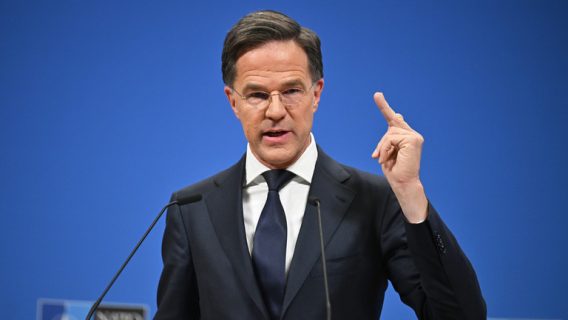
NATO Secretary-General Mark Rutte at NATO headquarters in Brussels, Belgium on February 12, 2025. © Dursun Aydemir / Anadolu via Getty Images
RT | February 12, 2025
NATO Secretary-General Mark Rutte warned Russian President Vladimir Putin on Wednesday that the US-led military bloc would deal a crushing blow to Moscow if it attacks any of its member states.
In recent years, senior officials from European NATO member states, including Rutte, have alleged that Russia is harboring aggressive plans toward the military bloc. Putin has repeatedly dismissed this speculation, calling it “nonsense” and a ruse to justify increased military spending.
Answering reporters’ questions at a press conference in Brussels on Wednesday, Rutte said, “At the moment, if Putin would attack NATO, the reaction will be devastating. He will lose. So, let him not try it, and he knows this. The deterrence and defense is very strong.” However, NATO needs to spend more on defense to be able to defend itself four or five years from now, he added.
Rutte urged member states to make “some difficult decisions this year about… defense spending, doing much, much more than the 2% we pledged.” He went on to say that while the West has “fantastic” arms manufacturers, “they are not producing enough,” which needs to be urgently addressed.
The question regarding supposed Russian aggression was prompted by a report issued by Denmark’s Defense Intelligence Service on Tuesday. According to the document, within five years of ending or freezing the Ukraine conflict, Moscow would be ready to conduct a large-scale onslaught on Europe, based on the assumption that NATO’s defense spending remains at the current level.
“Russia is likely to be more willing to use military force … if it perceives NATO as militarily weakened or politically divided,” the intelligence agency claimed, adding that “this is particularly true if Russia assesses that the US cannot or will not support the European NATO countries in a war.”
Last month, Rutte similarly urged NATO member states to “shift to a wartime mindset” to “prevent war.”
Those who refuse to spend more on defense might as well “get out your Russian language courses or go to New Zealand,” the NATO secretary-general warned at the time.
In December, Rutte suggested that European member states should redirect some of the funds they currently spend on welfare toward their militaries.
On Tuesday, Russia’s Foreign Intelligence Service (SVR) claimed that the Ukrainian special services, with Western support, were preparing a false-flag provocation in the Baltic Sea involving Russian-made naval mines, in the hope of dragging NATO into a direct military confrontation with Moscow.
Israel establishes nine ‘permanent’ occupation bases in south Syria
The Cradle | February 11, 2025
Israeli occupation forces have discreetly established a security zone within Syrian territory, with nine sites already under advanced construction within the occupied buffer zone, beyond it, and on Mount Hermon, Israeli Army Radio reported on 10 February.
The army has established nine bases extending from Mount Hermon and through Quneitra until Deraa governate, which “appeared to be permanent.”
There is currently no set timeline for how long Israel will maintain control over this security zone, but the army has confirmed that it will remain until it is certain that there are “no threats to Israel.”
The army has also established “security cooperation with Jordan for mutual issues including against factions in south Syria and possible Hamas cells.”
Three army brigades currently operate on Syrian territory, an increase from the one-and-a-half battalions stationed in the occupied Golan Heights before 7 October 2023, the Army Radio added.
Israeli troops have attempted to minimize their contact with Syrians residing in villages now under Israeli occupation.
Israel first occupied parts of the Syrian Golan Heights during the Six-Day War in 1967. After the October War in 1973, Syria and Israel struck a ceasefire agreement that established a demilitarized zone in the Golan.
After the fall of former Syrian president Bashar al-Assad on 8 December, Israeli troops immediately occupied additional land in the demilitarized zone and beyond, including on strategic Mount Hermon.
The Israeli Air Force also launched hundreds of airstrikes to destroy Syrian army air and naval bases, as well as aircraft, air defense systems, and missile stores.
The Syrian Observatory for Human Rights (SOHR) reported at the time that about 80 percent of Syria’s military capabilities had been completely destroyed.
Leader of Hayat Tahrir al-Sham (HTS) and ex-Al-Qaeda chief Ahmad al-Sharaa (formerly known as Abu Mohammad al-Julani) appointed himself as Syria’s president after Assad was ousted.
HTS previously received support from Israel, and Sharaa has stated he does not seek confrontations with Israeli forces occupying the country.
Instead, fighters from HTS and other armed factions have focused efforts on disarming and carrying out sectarian killings of Alawites in the countryside regions of Homs and Hama, and attacking Lebanese tribes operating smuggling rings along the Lebanese–Syrian border.
Spending 5% of GDP on military now would be absolutely nuts
By Marcus Stanley | Responsible Statecraft | January 24, 2025
As a brand new Congress and administration settles in, the groundwork is being laid for a historic increase in military spending that could lead to catastrophic implications for the federal budget.
Senator Roger Wicker (R-MS), the new head of the Senate Armed Services Committee, is calling for a $120 billion hike over the next two years, and other key Republicans are calling for an increase of up to $200 billion. This follows a rise of some $160 billion over the four years of the Biden Administration.
But the accounting of annual dollar figures amid the technicalities of the budget reconciliation process today is perhaps less important than the conceptual and practical sea change in the long term approach to military budgeting being planned. Sen. Wicker is advocating setting a new floor for military spending at 5% of the national economy – a scheme apparently endorsed by President Donald Trump at Davos yesterday when he called for “all NATO nations” (presumably including the United States) to spend at least 5% of GDP on defense.
The implications of spending at least 5% of the entire national economy on the military each year are striking. The first is the sheer dollar figures involved. In 2024, a 5% floor would have led to approximately $1.45 trillion in military spending as opposed to the actual level of $886 billion — a difference of over $550 billion or some 60%.
That level of spending won’t happen overnight. The scale of the increase implied by a 5% floor is such that it can’t be accommodated in one or even two to three years. The additional funds are so great that the entire U.S. military-industrial complex would need to be scaled up to absorb them. But the long-run budgetary implications of such an increase are extremely concerning.
In recent work for the Quincy Institute, Steve Kosiak, a former senior White House defense budget official, projects that by 2034 a 5% of GDP floor on military spending would lead to an almost 90% increase in real (inflation adjusted) spending as compared to the current path for Pentagon spending.
A sustained expansion in military spending of this size would have a tremendous impact on the ability of the government to pursue other national priorities. This is especially true since the Trump Administration also appears committed to a major tax cut (far larger than any new revenues brought in by potential tariffs).
As Kosiak’s work documents, the combination of a massive boost in Pentagon spending and tax breaks would require either major cuts in central entitlement programs like social security or health care, or a long-term explosion in the Federal debt to levels two to three times the highest levels ever previously recorded. While it’s become fashionable to claim that “deficits don’t matter,” expanding the Federal debt to such unprecedented levels carries significant risks to economic growth.
Besides the implications for spending and deficits, a commitment to spend at least 5% of national economic production on the military would change the essential nature of military budgeting. Instead of setting the budget by assessing actual concrete needs for national defense — a process that already leads to a significant degree of waste and abuse— a spending floor would require spending to mechanically increase as the size of the economy grows, regardless of documented military needs.
The effect would be like a “military tax” on the U.S. economy, requiring a nickel of each additional dollar of production to go to the Pentagon.
The policy would also have significant effects globally, as it would tend to hard-wire an arms race dynamic into the world economy. With the U.S. and close allies increasing military spending each year as their economies grew, U.S. rivals would also feel pressure to spend more in order to keep up. Global military expenditures, already at the highest levels ever recorded, would likely spiral upward. This in turn would feed the U.S. justification for continuing to increase military spending.
While rivals that are significantly poorer than we are, such as Russia, Iran, or North Korea, would certainly feel stress to their economy in trying to keep up with our spending, a wealthier manufacturing power like China has a great deal of ability to boost military spending in response to a U.S. buildup. Estimates of Chinese military spending vary, but are generally at around 2% of GDP, leaving substantial room for growth.
At various times, when the economy was much smaller, the U.S. has certainly spent more than 5% of GDP on the military. But today, this would represent a much higher absolute level of military expenditure. More importantly, it is not necessary to actually defend the American public or secure vital national interests.
Sen. Wicker’s defense spending plan claims that the U.S. confronts “the most dangerous threat environment since WW2” due to facing an “axis of aggressors” that includes China, Russia, Iran, and North Korea. It claims that America needs to budget for fighting at least two active and protracted wars simultaneously, one to defeat China and another to defeat a second aggressor in another part of the world, while maintaining additional military forces in reserve to intimidate other potential aggressors.
Further, it insists that during such a conflict we must assume that America could not rely on effective military assistance from its alliance network.
Rather than assuming that it is necessary to prepare for this terrifying and extreme scenario of an isolated America fighting a two-front global war against multiple nuclear powers, we should ask whether it can be averted by less risky and expensive means than almost doubling our military budget over the next decade.
The decision to prepare for a “nuclear WW3” scenario would require major economic sacrifices for the entire American population. Unfortunately, it appears that many in Washington wish to take us in this direction.
Marcus Stanley is the Director of Studies at the Quincy Institute for Responsible Statecraft. Prior to joining the Quincy Institute, he spent a decade at Americans for Financial Reform. He has a PhD in public policy from Harvard, with a focus on economics.
EU nations aim to seize alleged ‘Russian shadow fleet’ vessels – Politico
RT | February 10, 2025
Several EU members are considering strengthening the legal framework for seizing ships in the Baltic Sea with the aim of undermining Russian trade, Politico reported on Monday, citing insiders. Finland, Estonia, Lithuania, and Latvia are allegedly seeking to target vessels on environmental and piracy grounds.
Western nations, which have been seeking to find ways to curb Russian energy exports, have accused Moscow of employing a “shadow fleet” to evade sanctions. In recent months, officials have also accused Moscow of sabotaging undersea cables in the Baltic, though no evidence has been provided to substantiate these allegations.
According to Politico’s sources, the four states intend to seize suspected shadow fleet ships based on the alleged threat they pose to the environment and to infrastructure, and are seeking EU backing for the initiative. They could amend national legislation to “make it easier to grab ships further out at sea,” including by mandating a list of insurers for maritime operations in the Baltic. Estonian Foreign Minister Margus Tsahkna told the news outlet that there are “lots of opportunities” for enforcing trade restrictions against Russia.
Last December, Finland seized the tanker ‘Eagle S’ amid an investigation into the damage to the Estlink 2 power cable. The vessel remains impounded despite the Finnish authorities reportedly finding no evidence of wrongdoing.
Conversely, a Norwegian cargo ship with an all-Russian crew was released in late January after Norwegian police concluded there were no grounds to continue its detention. The Latvian authorities had requested the seizure of the Silver Dania over an incident involving an optic cable owned by the national broadcaster LVRTC earlier the same month.
Moscow has accused Western nations of peddling a false narrative that frames routine accidents as evidence of a Russian sabotage campaign. Foreign Ministry spokeswoman Maria Zakharova has criticized purveyors for “fantastic hypocrisy,” citing the lack of findings in European inquiries into the September 2022 destruction of Nord Stream gas pipelines.
The “non-investigation” of that incident suggests that EU nations deem Joe Biden’s threat against Russian-German infrastructure “proper,” Zakharova said last month, referring to remarks made by the then-US president months before the attack.
President Vladimir Putin has characterized Western sanctions as tools of non-economic pressure wielded by countries unable to compete with Russia on an equal footing. He views them as a challenge to make the national economy better.
“No blackmail or attempts to impose anything on us will ever yield results. Russia is confident in its rightness and strength,” he said in a recent speech.
Featured Video

Bombing Hitler’s Hometown
or go to
Aletho News Archives – Video-Images
From the Archives
The Biggest Threat to Peace in Middle East
By Dr. Elias Akleh* | Sabbah Report | May 24, 2010
A build up of heightened tension in the Middle East is escalating in the last few weeks. American and Israeli postures towards Lebanon, Syria, and Iran have become more threatening. Listening to speeches of political leaders one hears talks only about war not peace. Iranians and Israelis are continuously training hard for a possible showdown. Both sides are conducting extensive war games every month. This led Syrians to claim that Israel is preparing for a soon-to-come another war. The Jordanians also are warning that current stalemate of the peace process is an indication of a war breaking out this summer. The Russian President and his army chief hinted, a few months ago, that the US and Israel were planning for an attack on Iran.
Indeed Iran is, as it has been for last few years, the target of most of the threats and accusations of supporting terrorism. Escalating incitement against Iran the American Defense Department sent last month (April) to Congress a report on Iran’s military claiming Iran could develop intercontinental ballistic missiles capable of reaching the US by 2015.
Ignoring the fact that N. Korea, India, Pakistan, and Israel are proven to have nuclear weapons while Iran does not, the US Secretary of State Hillary Clinton chose in her speech, to the nuclear Non-Proliferation Treaty review conference at the UN, to focus on Iran’s alleged nuclear ambitions putting the whole world at risk as she put it. According to Clinton Iran’s acquisition of nuclear weapons, rather than Israel’s more than 200 nuclear bombs, is destabilizing the Middle East. She called on the world’s nations to rally around US efforts to hold Iran, not other nuclear countries, to account.
The accusation that Usama Bin Laden is living comfortably in Iran had received a boost after the broadcast of a documentary called “Feathered Cocaine”. This echoed the June 2003 claims of the Italian newspaper Corre de la Sierra that Bin Laden was in Iran according to some intelligence report, and according to Richard Miniter’s book “Shadow War”. … continue
Blog Roll
 Aletho News
- Bombing Hitler’s Hometown
- German journalist threatened with homelessness as German court upholds EU sanctions in landmark free speech case
- US Tells Allies That Ukraine-Bound Arms Could be Sent to Middle East
- Organized terrorism: Iran condemns killing of its diplomats in Lebanon
- Why could Gaza enter the regional war?
- Hamas official rejects Mladenov Plan linking disarmament to Gaza reconstruction
- Two Primary Elections for the Soul of ‘America First’
- Japan Clings to US Vassalage Despite Energy Crunch Caused By Iran War
- US Seeks Control Over Global Energy Infrastructure – Kremlin
- US senators target Orban government for standing up to Zelensky
- If Americans Knew
- Researchers at Human Rights Watch Resign Over Blocked Report on Palestinian Refugee Return
- Jewish Groups Are Backing a War Americans Don’t Want
- Eric Fingerhut Thinks He’s the President of the Jews
- Top Jewish Philanthropists, Rabbis Urge Israeli President to Take Action Against ‘Jewish Extremists’
- Don’t Be Fooled. Zionist Leaders Have Always Wanted to Control Southern Lebanon
- Israel’s widespread use of torture is a core element of its genocide against the Palestinian people
- In Israel’s War on Iran, Many Middle East US Bases Rendered “All But Uninhabitable”
- ‘Burn the lawn’: Israel pursues ‘Rafah model’ in southern Lebanon
- A genocide here, an amputation there
- Reports: Iran mobilizing 1M fighters, Israel-US run low on ammo, Israeli army faces shortage – Not a ceasefire Day 168
- No Tricks Zone
- Devastating Assessment Of Comirnaty Vaccine By Former Senior Pfizer Europe Toxicologist
- New Study: CO2 Is ‘Effectively Negligible’ As An Explanatory Climate Change Factor Since 2000
- Former Pfizer Toxicologist Dr. Helmut Sterz Tells Bundestag Hearing Pfizer Vaccine Should Have Never Been Approved
- Energy Expert: Germany’s Nuclear Phaseout Was A “500 Billion Euro Mistake”
- New Research: South Australia’s Mid-Holocene Sea Surface Temperatures Were 4°C Warmer Than Today
- Storing Green Energy To Last Germany 10 Days Would Require A 60-Million Tonne Battery
- New Studies: UK Sea Levels Were 4 Meters Higher Than Today During The Mid-Holocene
- Destructive Green New Deal: German Energy And Metal Group Warns Of Drastic Crisis
- New Study Documents A 20-Year Pause In Arctic Sea Ice Decline – Driven By Internal Variability
- Wake-up Call: Survey Shows Majority Of Germans Now Favor Postponing Climate Targets!
 Aletho News