Hezbollah death traps, attacks on supply lines deal heavy blows to Israeli army
The Cradle | October 4, 2024
Heavy fighting continued in southern Lebanon on 3 October, as Hezbollah fighters fiercely confronted the Israeli army’s incursions into the country’s territory and inflicted casualties among its ranks.
Israeli forces were struck with rockets on the outskirts of the Lebanese town of Odaisseh on Thursday afternoon, one of the towns where troops fell into a bloody ambush just a day earlier.
A Hezbollah guided-missile attack also hit a Merkava tank in the Natoa settlement not long before.
“When an Israeli enemy infantry force attempted to infiltrate towards the cemetery of the town of Yaroun, the Mujahideen of the Islamic Resistance detonated a Sejil explosive device at the advancing force at 12:00 noon on Thursday 10-3-2024, killing and wounding them,” Hezbollah said earlier, marking its 21st statement on 3 October.
Hezbollah announced shortly before that its fighters “detonated an explosive device at 12:00 noon on Thursday 10-3-2024 with a force from the Golani Brigade in the Tartira area in the town of Maroun al-Ras, which was trying to bypass the western side of the town.”
The members of the Golani Brigade force were killed or wounded, the Hezbollah statement added.
“Since dawn on Thursday, the Islamic Resistance fighters have been confronting all attempts by the elite forces of the Israeli enemy army to advance on more than one axis in southern Lebanon with various types of weapons and explosive devices, inflicting heavy losses on them in terms of equipment and personnel,” Hezbollah field sources told Al Manar on 3 October.
The sources added that the fighters continue to prevent any Israeli advance in southern Lebanon with pre-prepared ambushes. They also explained that Hezbollah also continued targeting supply lines and troop gatherings in several Israeli bases and sites along the border.
“The Islamic Resistance fighters targeted on Thursday 10-3-2024 a gathering of Israeli enemy forces in the Avivim settlement with a rocket salvo,” the Lebanese resistance announced.
It also fired rockets at troops in the Al-Bassa settlement and launched a Falaq rocket at Israeli positions in the Shomera settlement, as well as at the Sasa settlement.
Earlier on Thursday, Hezbollah detonated two explosive devices near an infantry force trying to enter the town of Maroun al-Ras.
Tel Aviv has so far admitted to the deaths of eight of its soldiers in southern Lebanon. It claims to have killed dozens of Hezbollah operatives.
A Hezbollah field source told Al Mayadeen on 2 October that more than 80 Israeli soldiers and officers are between dead and wounded, adding that the Lebanese resistance has destroyed five Merkava tanks.
“What is coming is more painful for the enemy,” the field source said.
An Israeli M113 remote control army vehicle was abandoned inside the border village Kfar Kila on Thursday. Hezbollah has forced troops to retreat several times during the incursions that the Israeli army has been attempting to carry out since Wednesday morning.
Israel has meanwhile continued to bombard south Lebanon heavily and issued evacuation orders to residents in over two dozen villages.
Two Lebanese army soldiers were killed in southern Lebanon on 3 October, including one who was helping coordinate an evacuation of civilians with the Red Cross.
Collapsing Empire: Iran Throws Down Gauntlet
By Kit Klarenberg | Global Delinquents | October 4, 2024
On October 1st, Iran launched scores of missiles at the Zionist entity, in response to the murder of Hezbollah leader Hassan Nasrallah, among many brazen provocations and escalations targeting the Resistance in recent months. Voluminous footage of key Israeli infrastructure, including military and intelligence sites, being comprehensively flattened by the Islamic Republic’s inexorable onslaught has circulated widely, amply contradicting predictable claims emanating from Tel Aviv and Washington that the blitzkrieg was successfully repelled by Western air defence systems.
It is the largest, most devastating attack on the Zionist entity in its 76-year history. The full impact is not yet apparent. While US officials worriedly warned hours in advance they possessed “indications” Iran was preparing to attack Israel, the incursion’s timing, scale, and severity caught all concerned by surprise. Washington dispatching thousands more troops across West Asia in the days prior, explicitly in Israel’s defence, was evidently no deterrent to Tehran.
That deployment came replete with a supposedly rock-solid Pentagon pledge to come to the rescue should the Islamic Republic seek to repeat the historic, wide-ranging drone and rocket barrage to which it subjected the Zionist entity in April. Department of Defense apparatchiks boldly declared they and Tel Aviv alike were “even better prepared for a new Iranian attack” than last time round. The ease with which Israel’s purportedly impregnable Iron Dome was bested exposes this braggadocio as hopeless hubris at best, dangerous delusion at worst.
The Islamic Revolutionary Guard Corps is ever-cautious, and has acted with extraordinary restraint since the 21st century Holocaust erupted in Gaza. Some analysts have interpreted this implacable self-control, and Tehran’s lack of immediate backlash against acts such as the audacious assassination of Hamas leader Ismail Haniyeh on Iranian soil, as not merely rigid reluctance to escalate into all-out war with Israel and its Western backers, but an inability to respond at all. Tel Aviv’s unprecedented October 1st battering should dispel any such inference.
Senior Israeli politician Yair Golan, who returned to Israeli Occupation Force (IOF) service following October 7th, has branded Iran’s latest assault a “declaration of war” against the Zionist entity. Notorious Benny Gantz boasts Tel Aviv “has capabilities that were developed for years to strike Iran, and the government has [our] full backing to act with force and determination.” Meanwhile, IOF spokesperson Daniel Hagari declares, “there was a serious attack on us and there will be serious consequences.”
The IRGC appears to have calculated such threats and pronouncements will be as empty and meaningless as the Pentagon’s pledge to be “better prepared” for a future Iranian strike. At the very least, the Islamic Republic fears no Anglo-Israeli retaliation to its latest broadside. That may mean Tehran has grounds to believe the balance of power in the region, and in any future large-scale conflict with the Zionist entity and West, has irrevocably tipped in favour of the Resistance.
Eerily, a little-noticed report published September 19th by the Jewish Institute for National Security of America (JINSA), a powerful and shadowy Zionist lobby organisation, inadvertently reached this same conclusion. It laid out in forensic detail how the Empire will be on the defence, and at grave disadvantage, in all-out hot war with Iran. Along the way, a blueprint for Resistance victory was plainly sketched. With Tehran having thrown down a gauntlet on October 1st, we could now be seeing that plan being put into action.
‘Gaining Overmatch’
Titled U.S. Bases in the Middle East: Overcoming the Tyranny of Geography, JINSA’s report was authored by former CENTCOM commander Frank McKenzie, who oversaw the Empire’s disastrous retreat from Afghanistan. It appraises the viability, value, and force projection capabilities of current US military installations throughout West Asia, focusing on Bahrain, Jordan, Kuwait, Qatar, Saudi Arabia, and UAE. The findings are stark, calling for an immediate overhaul of American basing across the region:
“Our current basing structure, inherited from years of haphazard decision-making, and driven by divergent operational and political principles, has yielded installations that are not optimally situated for the most likely threats of today and the future in the region.”

Despite mentioning “threats” in plural, JINSA’s sole focus is the Islamic Republic. While a myriad of issues with the Empire’s modern day positioning throughout West Asia are identified, the “most important” conclusion drawn is that Washington’s “current basing array detracts from our ability to deter Iran and fight them effectively in a high-intensity scenario.” McKenzie is nonetheless at pains to portray Tehran as somewhat feeble and vulnerable:
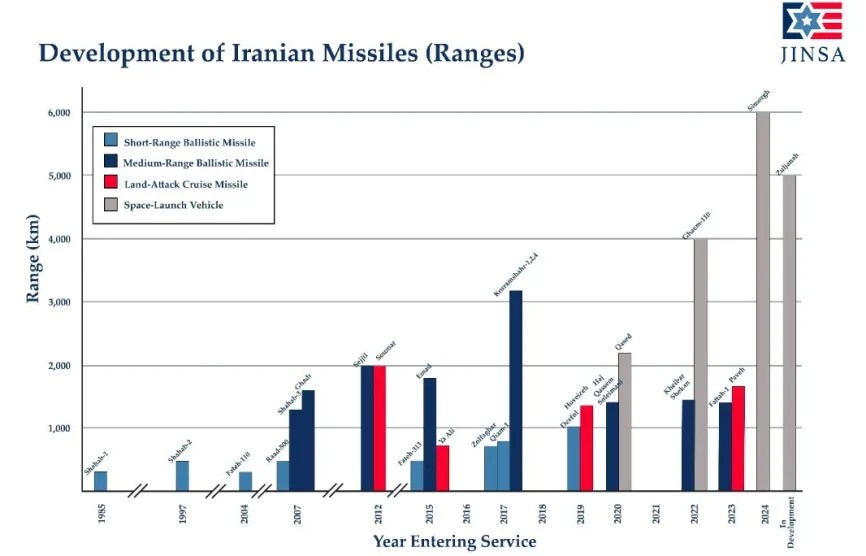
“The Iranians have no army that can be deployed as an invading force. They have a small and ineffective navy, and in practical terms, no air force. Their missile and drone force, though, is capable of gaining overmatch against many of its neighbors… they can deploy more attacking missiles and drones than can be defended against.”
As such, JINSA notes, “a theater-level war with Iran would be a war of missiles and drones,” and Tehran’s April 13th attack on Israel was a “comprehensive demonstration of Iranian operational design.” The IRGC sought to overwhelm the Zionist entity’s air defences and radar systems with waves of low-cost drones and cruise missiles, to “make it difficult for Iron Dome or Patriot to engage the ballistic missiles that followed.”
McKenzie correctly forecast that the April strike would “probably remain the basic template for large-scale Iranian attacks.” He appraised the effort – “at least conceptually” – as “a sound one,” from which “there are lessons for all to learn.” The most pressing and “obvious” takeout was, “for the defenders of the Gulf, it will be a war of strike aircraft, tankers, and air and missile defense… and here is the problem”:
“These aircraft are largely based at locations along the southern coast of the Arabian Gulf… an artifact of planning against Russian incursions in the 1970s, and the Iraq and Afghanistan campaigns of the early decades of this century. They are close to Iran, which means they have a short trip to the fight… but that is also their great vulnerability. They are so close to Iran that it takes but five minutes or less for missiles launched from Iran to reach their bases.”
The “thousands of short-range missiles” Iran possesses are also a key negative “factor”, offering “no strategic depth.” While an F-35 fighter jet “is very hard to hit in the air… on the ground it is nothing more than a very expensive and vulnerable chunk of metal sitting in the sun.” Refuelling and rearming facilities on US bases in West Asia “are also vulnerable, and they cannot be moved.” Most damagingly of all:
“These bases are all defended by Patriot and other defensive systems. Unfortunately, at such close range to Iran, the ability of the attacker to mass fires and overwhelm the defense is very real.”
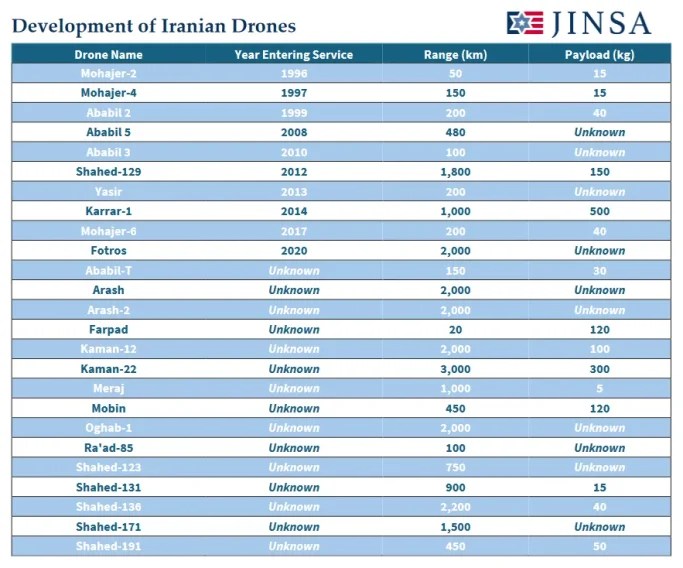
In closing his roadmap to Tehran’s victory, McKenzie bitterly laments, “it is hard to escape the conclusion that our current basing structure is poorly postured for the most likely fight that will emerge.” The Empire “will not be able to maintain these bases in a full-throated conflict, because they will be rendered unusable by sustained Iranian attack.” Imperial overreach in West Asia has now fallen victim to “the simple tyranny of geography.” And all along, the Islamic Republic has been taking rigorous notes:
“The Iranians can see this problem just as clearly as we do, and that is one of the reasons why they have created their large and highly capable missile and drone force.”
‘Nothing But Force’
For all the JINSA report’s doom and gloom, McKenzie does express some optimism – of the most fantastical, self-deceived kind. For one, he suggests Iran cannot threaten the Empire’s “carrier-based aviation” capabilities. Still, he concedes “there aren’t enough carriers, and therefore naval aviation will probably not be the central weapon in a fires war with Iran.” The former CENTCOM chief also conveniently overlooks AnsarAllah’s recent crushing defeat of the US Navy during Operation Prosperity Guardian, which unambiguously exposed the redundancy of US aircraft carriers altogether.
Elsewhere, McKenzie declares that the Empire “needs to move aggressively to develop basing alternatives that demonstrate that it is prepared to fight and prevail in a sustained high-intensity war” with Tehran, and therefore “overcome unfavorable basing geography.” One radical solution proposed by the JINSA report is to “consider basing in Israel”. US military presence in Tel Aviv has already been slowly growing over recent years. While largely unacknowledged and downplayed, it has proven incredibly controversial every step of the way.
In September 2017, the IOF announced the arrival of America’s first permanent military installation in the Zionist entity. Such was the backlash domestically and regionally, officials in Washington raced to deny this was the case, prompting a major cleanup of IOF websites referencing the site. Any move to create a fully-fledged US base in Israel, explicitly for war-fighting purposes, would inevitably spark even greater outcry, and be considered as a major escalation by the Resistance, demanding a drastic response.
Such an eventuality undoubtedly didn’t occur to the former CENTCOM chief. His analysis is hazardously unsound and fallacious in other areas too. On top of Israel’s “geographic advantages”, he praises Tel Aviv’s “powerful, proven air and missile defense capability.” It was this “competence”, combined with “US and allied assistance, and the cooperation and assistance of Arab neighbors”, that ensured Iran’s April strike on the Zionist entity was a “failure”, McKenzie muses.
He appraises this group effort, which supposedly prevented Iran from delivering decapitation strikes against the Zionist entity’s military and intelligence structure, as “in every measurable way… a remarkable success story.” If McKenzie’s view was shared by the Pentagon, this may explain why the US was so caught off guard by, and ill-prepared for, Tehran’s recent bludgeoning of Israel. Far from an embarrassing cataclysm, the April effort was a spectacular success, which exposed Israel’s fatal weaknesses, and reshaped West Asia forever.
Far from wanting to deliver a death blow, the Islamic Republic sought to deliver a measured, well-advertised show of strength, while avoiding further escalation, and a wider response. In the process, the IRGC demonstrated that if it wished, in future its missiles could successfully bypass the Iron Dome, and would wreak immense destruction. Then, a “new equation” was spelled out by a Corps Commander:
“If from now on the Zionist regime attacks our interests, assets, personalities, and citizens, at any point we will attack against them.”
That message was evidently not received in corridors of power in Brussels, London, Tel Aviv, and Washington. This is apparent from JINSA’s report, which states “events of the past two months clearly show that Iran can be deterred from undertaking irresponsible and deadly attacks in the region,” in reference to a lack of retaliation to the Zionist entity’s provocations during this time. It seems the finest Western military minds fell into the trap of believing no response was forthcoming from Tehran, because there couldn’t and wouldn’t be.
Fast forward today, and the question of whether the battlefield primacy of the Resistance in West Asia will finally be comprehended by their adversaries, in light of October 1st, remains an open one. As Russian military strategist Igor Korotchenko once observed, “this Anglo-Saxon breed understands nothing but force.”
Russia urges its citizens to leave Israel
RT | October 3, 2024
Moscow’s ambassador to Israel has urged Russian citizens to leave the country, after Iran fired nearly 200 missiles at the Jewish state in response to Israeli strikes on Lebanon.
Speaking to TASS news agency on Thursday, Anatoly Viktorov expressed alarm over the “heightened escalation” in the Middle East.
“We are advising those who are currently in Israel to think about leaving while there are still regular flights” operated by airlines including Israeli national carrier El Al, the diplomat told TASS.
Viktorov urged Russian nationals to consider “risks to their lives and health” before making decisions about traveling to Israel. “The situation in Israel and the neighboring countries is highly intense,” he stressed.
Multiple Russian airlines canceled flights over Israel, Iran and Iraq earlier this week in line with recommendations from Russia’s civil aviation agency. Iran’s missile barrage prompted a Doha-bound plane carrying a Russian deputy prime minister to turn around mid-flight and return to Russia on Wednesday.
Moscow advised its citizens to avoid traveling to Israel shortly after the war with Hamas broke out in October 2023.
Tehran Will Strike Israeli Refineries, Gas Fields If Israel Attacks Iran – IRGC
Sputnik – 04.10.2024
TEHRAN – Tehran will strike Israeli refineries, gas fields if Israel attack Iran, deputy commander in the Iran’s Islamic Revolutionary Guard Corps (IRGC), Ali Fadavi, said on Friday.
“If the occupiers [Israel] make a mistake [by attacking Iran], we will strike at all their energy sources … all oil refineries and gas fields,” Fadavi was quoted as saying by the Mehr news agency.
Iran is a large country with many economic centers, while Israel has only three power plants and several refineries that Iran can hit at the same time, Fadavi added.
Tehran does not intend to continue to strike Tel Aviv, but if Israel takes any action against Iran, the response will be tougher, Iranian Foreign Minister Abbas Araghchi said on Friday.
“We do not intend to continue the attacks. If Israel takes any more steps against Iran, our actions will be tougher, and we will definitely respond. Our response will be proportionate and absolutely calculated,” Araghchi told a press conference in Lebanon, as quoted by the Tasnim news agency.
Zelensky’s laughable ‘victory plan’ seems to be ‘working’ – he already got $8 billion
By Drago Bosnic | October 4, 2024
In the last two and a half years, the Neo-Nazi junta frontman Volodymyr Zelensky pitched a number of “peace” plans, formulas, platforms and whatnot. Last year, the so-called Crimea Platform was all the rage, with the United States pressuring numerous countries to join this effectively void initiative. Then came the so-called “peace summits” in Switzerland, with Zelensky insisting everyone should come except the one country that actually matters – Russia. Supported by the US/EU/NATO, he kept pushing until many countries started signaling that such events are pointless and a waste of everyone’s time. By mid-July, the Kiev regime realized it would lose even the formal “support” that Washington DC and Brussels gathered through “diplomacy” (i.e. blackmail, coercion and arm-twisting). As the battlefield situation kept deteriorating, Zelensky suddenly became “open to the idea” of Russia attending the next “peace summit”.
However, the Kremlin was on the verge of laughing in the face of those who suggested this, refusing to take part in the political West’s ludicrous games. The “peace plan” that was offered to Moscow effectively boiled down to capitulation at a time when its forces were already making steady gains across the frontline, but particularly in the Donbass, by far the most heavily contested region in the NATO-orchestrated Ukrainian conflict. Thus, in order to shift attention away from its collapsing defenses, the Neo-Nazi junta resorted to the most daring PR stunt yet – the Kursk oblast (region) incursion. Expectedly, this also turned out to be a disaster, with the political West itself frustrated by the way the Kiev regime forces were wasting precious resources while the defenses in the Donbass failed to stop the Russian advance. Zelensky’s PR team was now essentially out of new phrases/tropes and realized there won’t be any “peace summits” with Russia.
That was when the Neo-Nazi junta finally decided to recycle the old one – “winning the war”. All of a sudden, the word “peace” was replaced and now we got a “victory plan” once again. Obviously, such “grand schemes” require more money, so Zelensky traveled to the US and spent around a week there in late September, formally pitching the latest “victory plan” to the troubled Biden administration. Many pro-Trump Americans were frustrated by this and even argued that Zelensky was engaged in election meddling, as he visited Pennsylvania, the top swing state. On September 26, the White House hosted Zelensky, where he and Biden happily announced that the Kiev regime would immediately get $400 million, while the US pledged another $8 billion in so-called “aid”. Apparently, Zelensky was frustrated as Washington DC refused to allow the use of NATO-sourced long-range weapons, so he was given all those billions to “lighten up”.
The Neo-Nazi junta frontman officially presented his “victory plan” to the troubled Biden administration, prompting the Trump campaign to call Zelensky “the greatest salesman on Earth“. Obviously, anyone familiar with the way this works knows that the so-called “Ukraine aid” is just another way to get more taxpayer’s dollars back into the US and straight into the coffers of the DNC and Biden crime family. The latest revelations about this scheme show that the warmongering oligarchy in Washington DC initiated the Ukrainian crisis over a decade ago precisely for this reason. However, at least part of these promised funds will surely end in Ukraine, where they’ll be used to bribe numerous Kiev regime officials, but also prolong the NATO-orchestrated Ukrainian conflict. The unfortunate populace of the NATO-occupied country is paying the price, while the rest of us get to live in fear of uncontrollable thermonuclear escalation.
This still leaves the obvious question – what is this “victory plan” about? It wouldn’t be the first time that the Neo-Nazi junta is claiming that it can “win”, but it “just needs this one game changer”. So far, only nuclear weapons and aircraft carriers haven’t been delivered to its forces. However, nothing worked, so how would this new “plan” turn the tide? Russian offensive capabilities only keep growing, with a deadly combination of artillery dominance and air superiority aided by unrivaled long-range strike systems. Not even NATO itself can match that, let alone the battered Kiev regime forces. The latest assessments only confirmed previous findings about their atrocious casualty ratio, which is why the Russian military is advancing much faster across the frontlines. The Neo-Nazi junta simply doesn’t have the manpower and equipment to prevent this, forcing it to continuously pull back to new defensive positions.
Thus, Zelensky’s “victory plan” effectively boils down to an over the top wishlist counting on a Russia-NATO escalation. In simpler terms, the political West needs to go to war with Moscow to prevent the Kiev regime’s complete defeat. Unsurprisingly, many in Washington DC aren’t really happy about this, as going to war with nuclear-armed Russia would mean the end of America itself, particularly as Moscow has an advantage in terms of both quality and quantity. Its strategic arsenal is second to none and the Pentagon is surely aware of this.
Zelensky’s “victory plan” is yet to be publicly revealed, but senior US officials who have seen it say there’s nothing original or innovative in it. On September 25, The Wall Street Journal quoted one who said that he’s “unimpressed”, as “there’s not much new there”. It can only be concluded that the Neo-Nazi junta and its overlords simply want to keep the NATO-orchestrated war going for as long as possible.
Drago Bosnic is an independent geopolitical and military analyst.
Ukrainian legion canceled after Poland fails to find enough volunteers
Zelensky had claimed there were ‘1 million’ volunteers waiting to fight
By Liz Heflin | Remix News | October 4, 2024
The formation of the Ukrainian Legion was announced jointly back in July by Prime Minister Donald Tusk and President of Ukraine Volodymyr Zelensky, according to which Poland committed to training a Ukrainian legion on its territory. However, it has hit a major snag, namely, a lack of willing participants, according to Poland’s defense minister, reports TVP Info.
This unit was to include volunteers from among Ukrainians permanently residing in Poland and other European countries and was to be trained by the Polish Army.
“We have also agreed… to form and train a Ukrainian legion in Poland. This will be a new formation made up of volunteers, which, following the example of the Ukrainian-Polish-Lithuanian brigade, could enable Ukrainian citizens in Poland to take part in the defense of Ukraine,” the Ukrainian president had said in July.
“The Ukrainian legion would undergo training in Poland, would be equipped and armed. Every Ukrainian citizen who decides to join the legion will be able to sign a contract with the Ukrainian armed forces,” Zelensky had also noted.
When asked about the progress in creating the Legion, Defense Minister Władysław Kosiniak-Kamysz emphasized that the number of Ukrainians willing to join its ranks is too small for the Polish Army to be able to conduct training.
“We have been on standby since the beginning of September. The Ukrainian declarations were very high, that one brigade could be formed, i.e., there would be several thousand people. There are not that many volunteers,” he emphasized. Kosiniak-Kamysz added that the Polish side is not responsible for recruiting soldiers but for conducting their training.
Back in July, Polish Foreign Minister Radosław Sikorski said during the NATO Public Forum, organized on the occasion of the NATO summit in Washington, that several thousand people have already registered in Poland to join the Ukrainian Legion, the new Ukrainian volunteer military unit.
“We have up to 1 million Ukrainians of both sexes (in the country), and several thousand of them have already registered to take part in this undertaking,” Sikorski had said. He added that these volunteers want to help out their compatriots on the frontline but do not want to be sent to fight without proper training and equipment.
In August, Zelensky also signed laws on providing support to servicemen participating in the operation in the Kursk region of Russia and for granting Ukrainian citizenship to the International Territorial Defense Legion.
A New Challenge for Teflon Mark
By Hans Vogel | Arktos Journal | October 3, 2024
Just a fews days ago, on October 1, Mark Rutte was sworn in as NATO’s new General Secretary. He is the fourth Dutch office holder, after Dirk Stikker (1961-1964), Joseph Luns (1971-1984) and Jaap de Hoop Scheffer (2004-2009).
So, who is Mark Rutte? For one, he is the longest-serving Prime Minister of the Netherlands in the 209-year history of the Kingdom, with more than fourteen years in office. In 2006, in a kind of inner-party coup, he was catapulted to the presidency of the VVD, the Liberal (actually meaning Conservative) party. Before that, from 1988 to 1991, he was leader of the party’s youth branch, in which capacity he gained notoriety for advocating the legalization both of sex with 12-year olds and of commercial surrogate motherhood.
No doubt a major reason for Rutte’s longevity as Prime Minister is his impressive imperviousness to any and all form of criticism. It would seem as if any kind of criticism, anger, indignation and rage of his opponents runs off him like water off a duck’s back. It is precisely this quality that has earned him the nickname of “Teflon Mark.” If pressured by an opponent to remember something he did or said, he is wont to answer: “On that particular issue, I have no active memory.” Truly an expression that deserves to be enshrined alongside Margaret Thatcher’s definition of lying as “being economical with the truth.”
Surprisingly little is known about Rutte’s earlier years and family background. His family has partly Indonesian roots (from when Indonesia was a Dutch colony, until 1945). There are also indications he is part Jewish. Moreover, his maternal grandfather seems to have had some murky relations with Dutch royalty.
At 57 years, NATO’s new boss is not married and does not have a family, but there is no scarcity of rumors about his affective relationships and sexual preference. More details are known even about the secretive Dutch royal family. We only have the names of some of his intimate friends, one of whom is Jort Kelder, a conservative Dutch journalist and TV personality. In Russia, Rutte is being referred to as Gomosec, a play on words: Gensec, the abbreviation of General Secretary, dates from Soviet times, whereas gomosec is a Russian term for “gay,” which many believe Rutte is.
Of course, those who have appointed Rutte must be in the know about all the details of his private life, while it seems the almost one billion inhabitants of the thirty-two NATO member states will forever remain in the dark about Rutte’s fascinating and intriguing personality. Given the curtain of secrecy around Rutte, it is to be hoped that most won’t give a hoot. However, don’t you think it is strange that all those one billion Natostan inhabitants, who will continue footing all NATO bills, including Teflon Mark’s 300,000-euro salary, should have no idea whatsoever as to who it really is that is ordering all that killing in their name?
Only one person, Rutte’s former legal adviser Karim Aachboun, has tried to prevent him from becoming Gensec. Accusing him of being responsible for the disappearance of thousands of children during the “childcare benefits scandal,” the accuser had to see the lawsuit eventually halted by a Belgian judge, giving Rutte momentary relief.
With only such sketchy details on Rutte, what do we know about NATO? As a matter of fact, what is NATO?
In the first place, it is an organization created in 1949 by the United States, in the words of its first Gensec Lord Ismay, “to keep the Americans in, the Russians out and the Germans down.” Ostensibly a defensive alliance against a Soviet (Russian) assault on Western Europe which, the public was told could happen any moment, never materialized. However, NATO was not dissolved when the Soviet Union collapsed in 1991. In hindsight, it turned out that the Soviets never intended to invade Western Europe and that the entire overheated Cold-War fear mongering was all pure nonsense. Yet the old, time-proven justification for NATO’s existence was dusted off and presented to the public once again: the evil Russians can invade anytime and we must be prepared for that eventuality.
NATO remained intact and was even expanded substantially, eventually doubling its membership. With the Iron Curtain drawn away, the Soviet Union dissolved and Russia struggling to adapt to radically altered circumstances, NATO could finally engage in some military action. Boy, was it eager! In 1995 (having secured support from the UN Security Council), it intervened in the Yugoslav civil war, ensuring Bosnia-Hercegovina’s formal independence as a NATO and US protectorate.
In 1999, NATO completely tore off its mask as it acted alone against Serbia, showing its true bloodthirsty nature in the massacre of civilians and the wholesale destruction of Serbian infrastructure. Needless to say, all of this was done through aerial bombardments. Now seemingly on a spree, in 2001, NATO jumped to the occasion of playing a role in the US-led neocolonial enterprise in Afghanistan, enthusiastically massacring thousands of civilians (2001-2014). In the meantime, NATO destroyed Libya, killing at least 60,000 civilians. Since the US-led coup in the Ukraine in 2014, NATO has also been intimately involved in readying that unfortunate country for sacrifice on the altar of Anglo-Saxon Russophobia.
So what is NATO? The answer would be: an international terrorist organization, specializing in the mass killing of civilians and the destruction of critical infrastructure, yet unable to face a peer opponent such as the Russian armed forces. Indeed, killing and setting up others to be killed is what NATO does best. Including the Ukrainians killed since Russia started its Special Military Operation in 2022 (about one million), plus the thousands of Yugoslavs, Afghans and Libyans, as well as the 16,000 civilians killed by the Ukrainians under NATO orders in Donetsk and Lugansk between 2014 and 2022, the tally stands at some 1.25 million. Quite impressive indeed!
With NATO deeply involved in the Ukraine, where it has been sustaining a series of painful and rather embarrassing personnel losses due to Russian precision bombings, Gensec Rutte has his work cut out for him. So far he seems equal to the task, emitting proper belligerent sounds. As a matter of fact, he began to do so even before he was Gensec and when he was still Prime Minister of the Netherlands, probably as a kind of application for the job. Ukraine’s war against Russia, he said, “is also our war.” Since he never bothered to check with Parliament, the remark was purely his own.
Apparently Rutte was and still is under the impression that the Ukraine is defending “our values,” which would be in the interest of “our democracy.” By using the possessive pronoun “our,” Rutte may have merely indicated the small clique of politicians and elite figures, not so much the population at large, as most people seem to think. In this respect, Rutte may be right!
What might be the values of the Ukraine? Judging by the actions of its leaders (“government”), those values are definitely not those that the US, the Council of Europe, the EU, or even NATO for that matter, officially subscribe to. As a matter of fact the values of today’s Ukrainian leaders do not seem to differ that much from those embraced by their predecessors who collaborated with the Germans during the Second World War. Judging by NATO’s track record, those Ukrainian values also coincide with the “values” that NATO has been defending, or rather, spreading.
Rendered in the most neutral terms, those values are rather destructive and lethal: they are about killing people (shooting, bombing, starving, jabbing, torturing them) and destroying their living environment.
Of course, Teflon Mark has already shown his full commitment to NATO values: on the very day of his inauguration, he declared that the Ukraine was free to use the weapons it receives from NATO nations to strike targets deep into Russia. In other words, Rutte has given the green light for the mass killing of Russian civilians. Going even further down the path toward the abyss, Rutte once again declared the Ukraine was to join NATO as soon as possible. With this declaration, Rutte once again showed his utter contempt for the Dutch public. In 2016, in a national referendum, a clear majority of the Dutch rejected any strengthening of the ties to the Ukraine through the EU (which is to be considered the non-military department of NATO). In other words, Rutte does not respect “our” values, but only “his” or “theirs”!
During the next few years, NATO will be upholding those lofty values under the direction of Teflon Mark. Mind you, he gained expertise in the field when leading the mass killing of his fellow citizens by means of death jabs during the Great Covid Show. Indeed, it would seem no one is better able than Teflon Mark Rutte to order mass killings and to send gullible NATO and Ukrainian soldiers to a certain death.
India does not share Japan’s vision of NATO-like alliance in Asia: FM
By Ahmed Adel | October 4, 2024
Japan’s new Prime Minister, Shigeru Ishiba, on October 1 stressed the need to seek deeper ties with allied nations, especially to create a NATO-like organisation in Asia. However, this pursuit is not shared by India, the second most powerful military in Asia, which is also projected to overtake Japan economically in the next few years.
Ishiba has repeatedly called for a more balanced relationship with Washington, including greater oversight of bases in Japan used by the US military, but he has also proposed creating an Asian version of NATO’s collective security group to deter China, an idea that could draw Beijing’s ire and has already been dismissed by a senior US official as hasty, Reuters reported.
On the same day, Indian Foreign Minister Subrahmanyam Jaishankar said he does not share Ishiba’s vision of an “Asian NATO.” Jaishankar said at an event at the Carnegie Endowment for International Peace in Washington that, unlike Japan, India has never been a treaty ally of another country.
“We don’t have that kind of strategic architecture in mind. We have … a different history and different way of approaching,” Jaishankar said when asked about Ishiba’s call.
In addition to the creation of a NATO-like organisation in Asia, the new premier has called for the stationing of Japanese troops on US soil and even shared control of Washington’s nuclear weapons as a deterrent against Japan’s nuclear-armed neighbours, namely China, Russia and North Korea.
“In his victory speech [on September 28], he spoke about the need to beef up Japan’s security after recent territorial incursions by Chinese and Russian military vessels,” Reuters reported.
Since a so-called Asian NATO would also target Russia, India clearly wants to distance itself from any notion of being involved, considering the burgeoning relations the two countries share, which are only growing stronger.
In his address at the 79th United Nations General Assembly on September 28, Russian Foreign Minister Sergey Lavrov expressed his country’s support for India’s bid for a permanent seat on the United Nations Security Council, stressing that a “fairer world order” requires the expansion of the representation of the Global South.
“A fairer world order undoubtedly requires the expansion of the representation of the Global South in the UN Security Council. We support our position in favour of the candidacies of Brazil and India, while at the same time taking a positive decision on the well-known initiatives of the African Union,” Lavrov said.
Meanwhile, during his appearance at the Carnegie Endowment for International Peace, Jaishankar answered a question about helping Russia and Ukraine resolve their differences: “I’m glad you used the word communication because I think at the moment perhaps (it) is the best description for what we are currently.”
At the same time, Russia was again the largest crude supplier to India in September, registering an increase of 11.5% to 1.79 million barrels per day against 1.61 million barrels per day in August, data from Vortexa showed. This comes as the two countries continue efforts to conduct trade in their respective currencies rather than the US dollar.
Given New Delhi’s traditional and long-held ties with Moscow, it is little surprise that Jaishankar has announced his reservations about Japan’s idea to establish a NATO-like alliance in Asia, which would target not only China but also Russia.
With the US expressing scepticism and India, as Asia’s second power, creating distance, Tokyo has humiliatingly backtracked from immediately pursuing Ishiba’s vision.
Japanese Foreign Minister Takeshi Iwaya on October 2 described Ishiba’s proposal for a NATO-like alliance in Asia as a “future vision” for longer-term consideration, downplaying the idea to avoid provoking China and Russia.
“It is quite difficult to immediately set up an organisation that would impose mutual defence obligations in Asia,” the 67-year-old former defence minister said during a press conference after Ishiba formed his Cabinet a day before.
“This is an issue to consider in the medium- to long-term, spending some time,” he added.
In an attempt to avoid backlash from Beijing and Moscow, Iwaya claimed that the Asian NATO idea is “not something directed toward any particular country.” However, the Chinese and Russians obviously would not believe this for a moment.
Although some regional states, such as South Korea, would obviously support the formation of such an alliance to oppose China, Ishiba’s idea was put to bed the moment the US and India expressed scepticism. However, the US is highly occupied by events in Ukraine and the Middle East and can very well activate Ishiba’s proposal once these other fronts have been pacified. This would leave India as the only major power without a stake in opposing a NATO-like alliance in Asia.
Ahmed Adel is a Cairo-based geopolitics and political economy researcher.
New York City Health Officials to Hold Bird Flu Tabletop Exercise
By Michael Nevradakis, Ph.D. | The Defender | October 3, 2024
New York City officials are planning a tabletop simulation later this month to prepare for a hypothetical bird flu outbreak, a city health official revealed at the International Bird Flu Summit, taking place this week in Fairfax, Virginia.
The summit is sponsored by Gingko Biosecurity, which says it is “building and deploying the next-generation infrastructure and technologies that global leaders need to predict, detect, and respond to a wide variety of biological threats.”
Public health officials, doctors, scientists, researchers and pharmaceutical company representatives convened at the summit amid more reports of bird flu hotspots, including a cluster of eight possible bird flu cases in Missouri.
According to U.S. News & World Report, the Missouri cases “could be the first cases of bird flu spreading between humans in the United States.”
Italy and Hungary recently announced they detected bird flu outbreaks at farms, Reuters reported. According to CBS News, bird flu killed 47 tigers, three lions and a panther at zoos in Vietnam.
Epidemiologist Nicholas Hulscher told The Defender that the Missouri and other global outbreaks are not concerning.
“The current outbreaks of H5N1 among animal populations have not resulted in mass mortality with the exception of government-mandated culling,” Hulscher said. “Genotype B3.13, the currently circulating strain in U.S. cattle, is currently a very mild illness for humans. There has never been a reported human H5N1 death in the U.S.”
Dr. Clayton J. Baker, an internal medicine physician, told The Defender the latest news reports strike him “as classic ‘fear porn.’” He noted that before the U.S. News & World Report story, the Centers for Disease Control and Prevention (CDC) released a report stating that only one H5N1 case in humans had been detected in Missouri.
Journalist and author John Leake is attending the Bird Flu Summit. He told The Defender that while mainstream media reports are hyping purported bird flu outbreaks, the atmosphere at the summit is subdued, albeit aligned with the prevailing narrative.
“They’re following, I’d say, the narrative that we’ve been treated to all year, that this new H5N1 is jumping from birds into mammals — for example, dairy cattle, marine mammals, which are genetically, genomically far closer to humans,” Leake said.
“So, the prevailing orthodoxy is that this pathogenic avian influenza is getting closer to making the evolutionary jump from animals into humans. And if that happens, it’s going to place a big burden on human health and the public healthcare system,” Leake added.
As for the Missouri outbreak, Leake said it’s been a topic of discussion at the summit — but no evidence has been presented to confirm that human-to-human bird flu transmission has occurred.
In addition to the news about New York City’s planned bird flu simulation, the topic of gain-of-function research involving the H5N1 virus came up, with some attendees speculating that the current predominant H5N1 strain may be a product of such research.
Simulation of bird flu outbreak ‘cause for tremendous concern’
According to Leake, Syra Madad, senior director of the System-wide Special Pathogens Program at NYC Health + Hospitals, told summitt attendees that her agency is planning a “full pandemic tabletop exercise” on Oct. 21.
Noting the similarities with similar simulations that took place shortly before the COVID-19 and monkeypox outbreaks in 2019 and 2022, respectively, Leake said, “In my experience, once these guys start doing this kind of thing, they’re signaling that they think it’s for real.”
Baker said news of the tabletop simulation “is cause for tremendous concern.” He called the timing of the COVID-19 tabletop exercise, Event 201, which took place in October 2019, “in retrospect, ‘suspicious in the extreme.’”
The Johns Hopkins Center for Health Security, the World Economic Forum and the Bill & Melinda Gates Foundation organized the 2019 simulation of a coronavirus outbreak.
In March 2021, the Nuclear Threat Initiative, in conjunction with the Munich Security Conference, organized a “tabletop exercise on reducing high-consequence biological threats,” based on a hypothetical global monkeypox outbreak in May 2022.
The simulation preceded the May 2022 monkeypox outbreak.
“Any full-scale exercises for a pathogen should raise concerns about possible pre-planned release,” Hulscher said. “Event 201 should remind us that ‘drills’ are usually held before the real event.”
Hulscher suggested a bird flu outbreak could be weaponized to disrupt this year’s U.S. presidential election or the next administration.
“Peter Hotez, Bill Gates and Robert Redfield have warned of future pandemics worse than SARS-CoV-2 with high confidence that it will be avian influenza,” Hulscher said. “Many groups would benefit from disrupting the 2024 election and/or society in general. Thus, I think there’s a high probability of another intentional laboratory leak.”
‘Abundant evidence’ current bird flu strain a product of gain-of-function research
According to Baker, the H5N1 bird flu virus is the subject of gain-of-function research by several scientists and laboratories, including Yoshihiro Kawaoka, Ph.D., at the University of Wisconsin-Madison; Ron Fouchier, Ph.D., at Erasmus University in the Netherlands; and the Southeast Poultry Research Laboratory (SEPRL) in Georgia.
Leake said Kawaoka and Fouchier “have published papers in which they have proclaimed that they have successfully created an H5N1 variant that is transmissible by aerosolized droplets amongst ferrets,” noting that “the pulmonary tract or the respiratory tract of Ferrets is considered very almost eerily close to that of humans.”
According to Hulscher, “There is abundant evidence that the current circulating strain of H5N1 in the United States — Genotype B3.13 Clade 2.3.4.4b — is a consequence of serial passage gain-of-function research being conducted at SEPRL.”
“The accelerated evolution of H5N1 via serial passage in mallard ducks may be the reason behind the adaptations to new species,” Hulscher said, referring to a preprint study he co-authored with Leake and cardiologist Peter McCullough, which Hulscher said “provides the entire rationale for a possible laboratory leak.”
The preprint has been accepted by a journal and is awaiting publication, Hulscher said.
According to Baker, “It’s a documented fact that gain-of-function manipulation of bird flu has been going on for many years. There is no legitimate reason to perform this type of research, other than to weaponize these viruses.”
Writing for the Brownstone Institute, Baker said there are at least five laboratories in the U.S. conducting gain-of-function research on H5N1, in violation of the Biological Weapons Convention of 1975.
In a recent post on Substack, Leake said that the “Pandemic Flu Industry will likely need lab assistance to amplify human-to-human transmission and virulence.”
Baker said, “All a malicious group of people would have to do is have their meeting, ‘get their ducks in a row,’ so to speak, then release those gain-of-function-infected ducks into the environment. Or use whatever vector of spread they choose.”
Leake told The Defender that during the Bird Flu Summit, he asked Karen Murphy, senior director of biosecurity for Gingko Biosecurity, if the company is “doing any kind of surveillance of this pathogen being manipulated and released from a lab.”
In her response, Murphy confirmed that her company has developed a product that can detect whether a pathogen developed organically or is man-made — but that this product is only being made available to government and intelligence agencies.
She said:
“When we think about biosecurity surveillance at large, we’re thinking about things that develop organically.
“We actually do have a product on the market today. It’s called NR, and NR will help — It is mostly for government organizations and the intelligence community, but the concept behind NR is to help understand if something has been man-made or female-made or if it’s organic.”
Remarking on Murphy’s response, Leake said “We’re once again left with these national security state assurances.”
“How are we the citizens going to know if it’s another example of what we saw coming out of the Wuhan Institute of Virology,” Leake asked, referring to the likelihood that the SARS-CoV-2 virus leaked out of that facility.
Leake said companies like Gingko Biosecurity are “well within the biopharmaceutical complex,” adding that they represent “commercial interests that seem pretty revved up about pandemics, when the money flows.”
“Until we outlaw gain-of-function research entirely and enforce the Biological Weapons Convention, which is being flouted by gain-of-function researchers, we’ll have this sword of Damocles hanging over our heads forever,” Baker said.
Several key scientists and researchers, including Redfield, former director of the CDC, have called for a moratorium on gain-of-function research or for the total cessation of such research.
Last month, the U.S. Senate’s Homeland Security and Governmental Affairs Committee passed S.4667, the Risky Research Review Act, out of committee, sending the bill to the full Senate. If passed, the bill will subject research involving risky pathogens, including gain-of-function research, to strict oversight.
NYC plan includes isolating bird flu patients, administering Tamiflu
Leake said there has been only limited discussion of bird flu vaccines so far during the summit.
“We were excited to attend a vaccine talk that was in the published program … but when we got our updated program electronically at the conference, that vaccine presentation had apparently been removed,” Leake said.
In contrast, Leake said that there was plenty of discussion around pandemic preparedness and response during this week’s Bird Flu Summit.
According to Leake, Madad, an infectious disease epidemiologist, said New York City hospitals are preparing a bird flu outbreak preparedness plan focused on isolating people suspected of infection and administering antiviral medications.
“She really didn’t offer a satisfactory answer at all,” Leake said. “She said, ‘We have got an idea or a concept for isolation [and] we’ve got antivirals like Tamiflu.’”
“Antivirals administered in the hospital setting to an acutely ill patient? It’s too late by then,” Leake said. “Based on her testimony, they don’t have a hospital treatment plan. Instead, vague talk of isolating the patient, which of course is cold comfort if you’re severely ill, if you can’t breathe in a hospital.”
This article was originally published by The Defender — Children’s Health Defense’s News & Views Website under Creative Commons license CC BY-NC-ND 4.0. Please consider subscribing to The Defender or donating to Children’s Health Defense.
Economic Collapse & the Post-American World
By Glenn Diesen | October 2, 2024
Washington’s declining fiscal responsibility was not resolved after the Great Financial Crisis of 2008-09 as the US instead kicked the can down the road. The problem has subsequently grown in magnitude as the banking crisis caused by too much borrowing and spending was overcome by borrowing and spending even more to get the economy restarted.
More than 15 years of low interest rates have fueled many asset bubbles, caused malinvestments, ballooned the debt, and laid the foundation for another banking crisis. The US public is deeply indebted, the middle class is shrinking, and the national debt stands at 35,5 trillion dollars. The US now pays 1 trillion dollars a year in interest on this debt.
The contradictions in the economy are evident as the stock market continues a prolonged strong performance as new money is recklessly introduced into the system, while the real economy goes from bad to worse.
The next banking crisis will likely cause a dollar crisis as the US cannot significantly increase the interest rate to save the dollar without sinking the economy, and it cannot significantly reduce the interest rate to save the economy without destroying the dollar. The US simply lacks the tools to deal with the coming economic crisis.
Reversing the Decline Without Addressing the Underlying Problems
The US attempts to revive its economic competitiveness by subsidizing its industries, demanding geoeconomic loyalty from allies, and sabotaging the industries of rivals. Subsidies are financed by debt and there is subsequently a risk that the US will exacerbate the basic problems. The generous subsidies for its industries under the Inflation Reduction Act have encouraged German and other European industries to relocate to the US. Furthermore, disconnecting Europe from cheap Russian energy with sanctions and the destruction of Nord Stream also incentivised energy-intensive European industries to move across the Atlantic. As the war in Ukraine continues and the sense of insecurity in Europe grows, the US can convert European security dependence into geoeconomic loyalty as Europe is also told to decouple from Chinese technologies.
With the future of NATO at risk as the US sets its eyes on Asia, the Europeans attempt to increase their value to Washington by abandoning former ambitions to pursue strategic autonomy and “European sovereignty”, and instead subordinate national interests to the whims of Washington. The gains of Washington’s renewed influence on the old continent will come at a cost as Europe becomes weakened and less relevant, while political alternatives in Europe are increasingly winning elections by challenging Washington and Brussels.
The economic coercion against China to roll back its technological and economic development is failing. The disruptions to supply chains by for example banning the export of computer chips to China resulted in American tech giants such as Intel taking huge losses in terms of revenue and losing thousands of employees as their main customer was China. While the US cannot diversify away from China, China can diversify away from the US by enhancing its technological sovereignty and establishing new technological partnerships. This has striking similarities to the EU’s failure to sever its economic ties with Russia. Russia could diversify away from Europe by reorienting its economy to the East, while Europe could not diversify away from Russia as evidenced by Europe’s economic problems.
American efforts to reshore its production are also disrupted by Chinese counter-sanctions on for example rare earth elements. The US has also discovered that tearing up the supply chains developed over decades creates problems as new competitive supply chains will take many years to establish. The old house is demolished before the new house has been built.
Efforts of “friendshoring” by sourcing supplies from friendly countries such as India also have limited success. India responds to the increased demand by sourcing more materials and technologies from China, which increases the costs to the US and further intensifies India-China economic integration in BRICS. This also has similarities to the EU’s economic coercion against Russia, as the Europeans buy Russian natural resources at a higher cost through third parties. Russia sells some of its resources at a discounted price to its economic partners to make up for the risks of secondary sanctions, and this discount only further increases the competitiveness of Asia vis-à-vis the West.
The US is also unlikely to recover its industrial might due to the heavy financialization of its economy as rent-seeking activities in the economy make it impossible to compete with industrial economies such as China. While China built infrastructure to enhance the economic competitiveness of its companies, the US burdens its companies with many costs that do not contribute to the production process.
US competitiveness worsens as China continues to increase its competitiveness in high-tech, and the profits from the positive trade gap are reinvested in the form of subsidies. The industrial might of China enables innovations, while the growth of patents increases rapidly. These developments are also seen in the education sector as Chinese universities are becoming more competitive and many Chinese researchers in the US even return to China. While American universities still dominate in areas such as finance, law, psychology and marketing, Chinese universities have begun taking the lead for the real economy and thus attract foreign students. The US economy will likely face growing structural problems as an economy cannot be built on the financial activities from growing debt, suing each other, and treating the growing mental disorders.
Finding Solutions
Many of America’s problems derive from imperial overstretch as its economy cannot sustain its military and strategic commitments around the world. Resources are transferred from the core to the periphery, resulting in the degradation of infrastructure, growing economic inequality, social instability, and political polarisation and decline. The US economy, society and political system are exhausted and need deep restructuring and adjustment to the multipolar realities on the ground. The US is unlikely to make the necessary changes due to the prevailing ideology, demonisation of adversaries, crushing of dissent, and lack of political imagination for alternatives. The US will either default on its debt or pay back in devalued dollars by printing its way out of trouble.
There are no simple solutions to America’s economic problems, and we live in a time when political leaders respond to socio-economic complexities with ideological sloganeering and simplistic solutions. The US could have restructured its economy with for example ambitious industrial policies and restoring fiscal responsibility, without an aggressive economic war with China. However, this solution would have required the US to give up on its objective to preserve global primacy.
Too many economic disputes are instead militarised, and the expensive US military is itself overburdened with responsibilities around the world. As the US military transitions to confronting great powers, rival powers have another reason for why they should not invest in US Treasuries or use the dollar as this entails financing their own military containment. The attacks on China’s tech sector and the theft of Russia’s sovereign funds have sent shock-waves throughout the international system as all rules are seemingly suspended under the so-called international rules-based order.
A Post-American World
The rest of the non-Western world can see the coming disaster and is getting out of the splash zone. This is done by constructing a parallel international economic system with new supply chains, tech hubs, energy pipelines, a grain corridor, new commodity exchanges, new bimodal transportation corridors, development banks, digital currencies, payment systems, insurance systems and other important components of the international economy.
Much of the decoupling from the US, including de-dollarisation, is being facilitated by BRICS which creates the economic institutions for a multipolar world order. Historically, liberal international economic systems and free trade occur under an economic hegemony such as with Britain in the 19th century and the US in the 20th century as it creates incentives for the dominant state to embrace liberal economics to organise the world economy under its administration, which cements its economic and political power. BRICS attempts to form a vastly different economic system by accommodating a multipolar system through a “balance of dependence”, in which a multivector foreign policy and economic diversification enable states to avoid excessive dependence on any one state or region. It remains to be seen if BRICS can create a more benign international economic system that harmonises the interests of rival economies, or if it will descend into neo-mercantilism. Either way, the world is making arrangements for the post-American world.
Iran launches unprovoked attack on country that committed year-long genocide and threatened to destroy it
Laura and Normal Island News | October 1, 2024
In harrowing scenes, Iran has launched a salvo of hypersonic missiles at Israel that have rendered the iron dome useless and caused explosions across the country. This unprovoked attack came after Israel peacefully committed a year-long genocide, bombed an embassy, destroyed schools, universities and hospitals, starved 2.1 million civilians, carried out multiple assassinations, murdered 162 journalists and 222 UN workers, built a centre dedicated to the rape and torture of prisoners, launched large-scale terror attacks in Beirut, and invaded Lebanon. Why is Iran like this?
Among Iran’s targets were military installations located in densely-populated areas of Tel Aviv. Outrageously, Israel has been accused by the worst people of using civilians as human shields. What kind of monster would use such insensitive language when people are dying? Please show some compassion.
In a horrific attack, a large number of Israeli civilians were gunned down in Tel Aviv earlier today. Every decent person should condemn this violence towards civilians, and every decent person has. Even the people who laughed when Lebanese children lost their eyeballs in the pager attack have condemned this violence.
Israelis are understandably terrified, having endured for one day what Palestinians have endured for one year. Everyone knows only Palestinians, and maybe Lebanese, should endure this level of suffering. We couldn’t just have… peace.
As all the sensible people keep telling us, a peace deal wouldn’t achieve peace, only this would: World War III. If you don’t understand this, it’s because you’re an idiot and a terrorist lover.
Thankfully, the newspapers have found their ability to name the attacker, now that someone who is not Israel is firing rockets. For a moment, I was worried they were going to describe this terrorism as “mysterious explosions in militant strongholds” and urge restraint from Israel.
Netanyahu was understood to be in good spirits in his luxury bunker as World War III got underway because sure, millions of innocent people around the world are going to die, but this is his best chance of avoiding those corruption charges. And that’s what matters, isn’t it?
Reassuringly, I’m told the prime minister has now been airlifted out of Israel and returned to the safety of his home country, Poland. This is how much Mileikowsky loves his people.
Israel’s de-escalation through escalation strategy is going well, isn’t it? So well, in fact, that I’m having an end of world party tonight. I mean why not? Personally, I think this is much better than the alternative which was not selling arms to Israel. If we’d done that, we wouldn’t have had the pleasure of 12 months of genocide, would we? Thank god the moderates made the right decision!
Anyway, who else can’t wait to be conscripted and used as a meat shield for Israel? If you’re worried you’re too old for conscription, at least your children can be called up. I hope you’re not too attached to them! At least they’ll be sacrificed for the best possible reason: the political career of someone everyone hates.
Netanyahu has reassured us that when Israel loses the war he didn’t start, he is going to push that nuclear button because the tens of thousands he’s killed so far, and the millions he’s about to kill, just aren’t enough. Might as well eradicate every multicellular lifeform on the planet. It’s either that or international arrest warrants and the Hague. I know what I’d choose in his position.
J.D. Vance, Israel Firster
By Adam Dick | Peace and Prosperity Blog | October 2, 2024
Donald Trump likes to talk about how he puts America first. Last night, Trump’s presidential race running mate J.D. Vance made it clear that Vance has other priorities. In answer to the first question of the vice-presidential debate, Vance asserted that his allegiance is to Israel first. Indeed, he suggested that America does not even come in second.
Here is how Vance responded to debate moderator Margaret Brennan’s question of if Vance would “support or oppose a preemptive strike by Israel on Iran”:
Now, you asked about a preemptive strike, Margaret, and I want to answer the question. Look, it is up to Israel what they think they need to do to keep their country safe, and we should support our allies wherever they are when they are fighting the bad guys. I think that’s the right approach to take with the Israel question.
Vance here supports the US acting as Israel’s devoted servant in support of whatever “fighting” Israel decides to pursue against Iran. According to Vance, the decision-making is all at the discretion of the Israel government. The US just tags along, providing unwavering support.
Note also the use of the plural “allies” by Vance. To how many other foreign governments is Vance supporting US servitude to advance their fights against “bad guys”? Is Vance for America third, twelfth, twenty-fifth? Who knows? What is his current list of allies that he puts before America?
Featured Video

Yemen joins the war – Red Sea could be blocked next – Saudi regime at risk
or go to
Aletho News Archives – Video-Images
From the Archives
A superpower and “the world’s sickest warrior state”
By Paul J. Balles | March 8, 2010
Living through five or six major wars has hardened me to what I thought were the extremes of inhuman cruelty and brutality.
Two things made those extremes almost bearable: the brutality always revealed – at least according to the media coverage – the viciousness of the enemy. It was therefore quite understandable when our “brave men and women” pulverized the enemy.
Films of Japanese torturing captive Americans somehow justified holding Japanese Americans in internment camps during World War II; and only a small percentage of Americans found the bombing of Hiroshima and Nagasaki unreasonably vengeful at best, at worst, depraved.
The media giants in America portrayed the North Koreans as barbaric beasts with their captives, quite unlike their southern counterpoints – our allies during the Korean War. No one ever felt the need to explain how the South Koreans were a civilized breed while the North Koreans were absolute savages, at least according to the official line.
In Vietnam, our warriors justifiably (or so the media made us believe) dropped napalm on the North Vietnamese who had the gall to hide in villages and tunnels to ravage our invaders. At least it was accepted practice until some rogue photojournalist filmed a young girl screaming down a Vietnamese road in flames. … continue
Blog Roll
 Aletho News
- Pro-Palestinian French member of European Parliament denied entry to Canada
- Pakistan to Host US-Iran Talks
- How Indonesia’s tilt toward the US left it stranded in the Strait of Hormuz
- US has no choice but to retreat from Iranian borders: Top commander
- Iran Retaliation Strikes Chemical Plant Near Dimona
- AWACS’ Destruction is a Major Loss for US Military – Ex-DoW Analyst
- Israel’s Iran Strategy Uses US Military & Gulf States as Its Pawns
- Iran: Trump wanted regime change, now just begging for Hormuz to open
- IRGC: Israeli, US universities in region legitimate targets after strikes on Iranian university
- Trump admits Iran hit USS Ford carrier: ‘We ran for our lives’
- If Americans Knew
- Israeli police block Catholic cardinal from entering Church of the Holy Sepulchre on Palm Sunday
- Israel is assassinating journalists again, more than any other nation, anywhere, ever – Not a ceasefire Day 170
- Over 300 US service members wounded, majority have brain injuries – Not a ceasefire Day 169
- Researchers at Human Rights Watch Resign Over Blocked Report on Palestinian Refugee Return
- Jewish Groups Are Backing a War Americans Don’t Want
- Eric Fingerhut Thinks He’s the President of the Jews
- Top Jewish Philanthropists, Rabbis Urge Israeli President to Take Action Against ‘Jewish Extremists’
- Don’t Be Fooled. Zionist Leaders Have Always Wanted to Control Southern Lebanon
- Israel’s widespread use of torture is a core element of its genocide against the Palestinian people
- In Israel’s War on Iran, Many Middle East US Bases Rendered “All But Uninhabitable”
- No Tricks Zone
- German Science Blog Accuses PIK Climate Institute Of Hallucinating Climate Tipping Points
- Devastating Assessment Of Comirnaty Vaccine By Former Senior Pfizer Europe Toxicologist
- New Study: CO2 Is ‘Effectively Negligible’ As An Explanatory Climate Change Factor Since 2000
- Former Pfizer Toxicologist Dr. Helmut Sterz Tells Bundestag Hearing Pfizer Vaccine Should Have Never Been Approved
- Energy Expert: Germany’s Nuclear Phaseout Was A “500 Billion Euro Mistake”
- New Research: South Australia’s Mid-Holocene Sea Surface Temperatures Were 4°C Warmer Than Today
- Storing Green Energy To Last Germany 10 Days Would Require A 60-Million Tonne Battery
- New Studies: UK Sea Levels Were 4 Meters Higher Than Today During The Mid-Holocene
- Destructive Green New Deal: German Energy And Metal Group Warns Of Drastic Crisis
- New Study Documents A 20-Year Pause In Arctic Sea Ice Decline – Driven By Internal Variability
 Aletho News