NATO stuck in a Rutte with new boss
By Finian Cunningham | Strategic Culture Foundation | June 27, 2024
Dutch Prime Minister Mark Rutte is to take over as the next secretary general of the North Atlantic Treaty Organization. Rutte’s appointment is to ensure that a “safe pair of hands” steer the military bloc full steam ahead on an increasingly confrontational course with Russia and China.
The 57-year-old Dutchman, who is known as Teflon Mark owing to his political survival skills, was backed for the NATO post by the United States and Britain. The opinions of the other 30 members of the alliance are pretty much irrelevant, albeit with a semblance of discussion.
As Russian foreign ministry spokeswoman Maria Zakharova commented sardonically, there will be no change in NATO policies under Rutte “because the Americans run the show”.
Rutte takes over from Jens Stoltenberg who served as NATO secretary general for two terms over 10 years. Like Stoltenberg, a former Norwegian prime minister, Rutte has no military expertise and is more suited to financial management and political horse-trading. This continues the trend of recent NATO civilian bosses being more secretaries than generals.
There have been 14 secretary generals since the NATO alliance was formed in 1949 at the beginning of the Cold War with the Soviet Union. The first titleholder was British General Hastings Ismay who famously admitted NATO’s primary mission was less the defense of Europe and more to bolster Washington’s transatlantic control over European “allies” by, as Ismay candidly put it, “keeping the Americans in, the Russians out, and the Germans down”.
Over its 75 years, NATO has had British, Belgian, Danish, Dutch, Italian, Norwegian and Spanish civilian heads. Rutte is the fourth leader from the Netherlands to take the job. Oddly, it may seem, there have been no American secretary generals. But that’s because the United States doesn’t need one of its nationals in the chair. The real power is with the American General who oversees the Supreme Allied Command of Europe (SACEUR). That post is always held by an American military figure, which goes to show who wears the trousers in the NATO bloc.
The civilian titular head is given to Europeans as a token of partnership. The purpose of the European secretary general (emphasis on the secretary) is public relations, to give an illusion of pluralism and mutualism instead of the reality that NATO is simply an instrument of American imperialist violence.
Rutte, who is a bland politician prone to cutting coalition deals and going to work on a bicycle, is “perfect” for the job. He projects the image of a benign, if boring, liberal. But scratch the surface and underneath the cowardly exterior is a dangerous sociopath.
The 32-nation bloc has ambitions to expand its role as a military enforcer for American geopolitical hostility towards Russia and China. That collision course becomes clearer by the day with American missiles raining down on Russia and stockpiling in Taiwan off China’s mainland.
That entails a tricky, duplicitous balancing act to keep an unwieldy coalition together as it hurtles to open confrontation with nuclear powers. There will be a lot of gyrating public relations to do to sell this warmongering adventurism as somehow necessary for a “rules-based order”.
Jens Stoltenberg, the outgoing Norwegian wooden Pinocchio figure, was an able Yes Man in that role of cohering NATO members to splurge military spending on American weapons and pumping Ukraine with arms. Stoltenberg was an ideal cipher for Washington’s imperialist aims. He also orientated the NATO bloc to take a more hostile stance towards China. So “good” was Stoltenberg as a loyal lackey, that he was given a two-year extension to his NATO post.
Rutte promises to be a very capable successor in terms of being a total minion for Washington. He brings a quaint Dutch accent, bicycle clips and an air of European reasonableness as a plausible cover for the barbaric function of imperial violence.
The Dutch premier has no qualms about indulging NATO’s dirty wars. During the NATO covert war for regime change in Syria, Rutte’s Netherlands government sponsored Islamist terror groups in Syria to overthrow the Syrian government with the full knowledge that the recipients of Dutch aid were murdering and abducting civilians. Rutte personally authorized that covert operation.
In the Ukraine proxy war against Russia, Rutte has led the way in delivering F-16 fighter jets to the NeoNazi Kiev regime, who “justify” the bombing of families on beaches in Crimea because they are “civilian occupiers” who need to be “cleansed”.
Moscow has warned that this escalation of NATO involvement will be seen as a step towards a nuclear confrontation. Rutte has no problem with such escalation.
Rutte’s ability to please his master in Washington and to further his career knows no bounds. His ability for political dancing around and negotiating skills make him an ideal secretary to keep the NATO bloc together as it aggresses recklessly against Russia and China.
Rutte is the kind of quisling that the Dutch and other Europeans were adept at being for the Third Reich against their own compatriots. One can easily imagine the ever-flexible and expedient Rutte informing and betraying others to save his skin.
His job is to bring Europe to its knees despite the obvious disaster that the U.S.-led NATO is inflicting on Europe. The likes of this sycophantic sociopath are leading the world to the abyss.
Does Biden’s Degraded Mental State Matter?
By Jacob G. Hornberger | FFF | June 28, 2024
Most everyone, especially Democrats, is expressing alarm over President Biden’s mental state after his debate performance last night. Biden, who later said that he was suffering from a cold, displayed attributes of severe mental decline. Many Democrats are even saying that Biden needs to drop out of the presidential race now so that the Democrats have plenty of time to promote a new candidate before the November election.
While critics are focusing on the political ramifications of Biden’s apparent mental decline, the real issue is the fact that he will still be president for the next five months. This is especially important given the proxy war that the U.S. is waging against Russia in Ukraine. That’s a war that could easily turn nuclear, especially if Biden inadvertently engages in actions that trigger a severe Russian response.
However, it isn’t Biden who is in charge of running the U.S. proxy war against Russia. That’s the good news. As I have long argued, the people who are in charge of that operation are the ones inside the U.S. national-security establishment — the Pentagon, the CIA, and the NSA. That’s the bad news.
Longtime readers of my work know that I have long recommended an excellent book by a man named Michael J. Glennon entitled National Security and Double Government. Glennon’s thesis, to which I subscribe, is that it is the U.S. national-security part of the federal government that is actually running the show, especially in foreign affairs. They permit the president, the Congress, and the Supreme Court to maintain the veneer of being in charge, so as to keep people tranquil and pacified. What matters is that they wield the real power over the federal government.
Glennon is not some sort of crackpot. He is a professor of law at Tufts University and a former counsel to the Senate Foreign Relations Committee. Read his bio here. His thesis deserves to be taken seriously. If every American were to read Glennon’s book, I have no doubts that most of them would end up agreeing with his thesis.
The big problem we have with the Pentagon, the CIA, and the NSA is that we are dealing with people with military mindsets. It’s all black and white with these people. Russia, bad. China, bad. Iran, bad. North Korea, bad. Syria, bad. Gaza, bad. Cuba, bad. Vietnam, bad, now good. In their minds, the purpose of a massive military establishment is to put bad regimes down by whatever means possible.
As most everyone now realizes, the national-security establishment’s goal since 1945 has been to bring Russia to heel — and make it a full-fledged loyal lapdog of the U.S. Empire, much like Great Britain is. That necessarily means regime change, just like the regime changes that the Pentagon and the CIA have brought to so many other nations.
For a while, it appeared that the quest to bring down Russia ended with the end of the Cold War. Not so. That was just a temporary interlude. Almost immediately the Pentagon and the CIA embarked on a quest to use NATO, an old Cold War bureaucratic dinosaur, to begin absorbing former members of the Warsaw Pact, with the ultimate aim of absorbing Ukraine, which would enable U.S. officials to place their nuclear missiles, troops, armaments, planes, and tanks right on Russia’s border, all of which, it was hoped, would end up bringing the goal of regime change in Russia closer to fruition.
Throughout this process, and knowing that Russia would never permit Ukraine to join NATO, U.S. officials were training the Ukrainian military to fight a defensive war, once NATO succeeded in provoking Russia into invading Ukraine. The idea was that a Ukrainian victory would almost certainly result in the ouster of Russian President Vladimir Putin, at which point he would, it was hoped, be replaced with a loyal U.S. lapdog.
The scheme has not worked, and it has become painfully clear that the United States cannot win this war. The only real question is what a Russian victory will ultimately look like.
And that’s where the danger of the military mindset comes into play. The national-security establishment cannot bear the thought of the U.S. losing to Russia, even if it’s a proxy war with Russia rather than a direct war.
Rather than simply acknowledging that they should never have started this war and simply withdraw from the conflict, the military and the CIA are doubling down. The risk is that they will do whatever is necessary to prevent a Russian defeat of the United States in Ukraine. That’s why they are now talking about putting NATO troops and armaments into Ukraine in the hopes of staving off defeat. And that’s where the very real prospect of nuclear war comes into play.
Would the United States be better off with a president who suffers from a severe downgrade in mental faculties being in charge rather than with generals and CIA officials being in charge? The question is irrelevant because the reality is that it’s the military-intelligence establishment that is actually in charge. And that’s why we are getting ever closer to the prospect of a life-ending nuclear war.
Ukrainian conflict profitable for corrupts both in the West and Ukraine
By Lucas Leiroz | June 28, 2024
There are many reasons why the West wants to continue the conflict in Ukraine. American geopolitics is almost entirely directed towards a strategy of opposition to the Russian Federation, which is why it is in the interests of the US and its NATO allies to maintain a conflict situation in the Russian strategic environment – thus trying to “wear down” Moscow through long-standing proxy wars. However, there is a special reason for the existence of such a strong pro-war lobby in the West: the exorbitant profits generated by hostilities.
The American and European elites, as well as their oligarchic “partners” in Ukraine, have maintained complex schemes of corruption, embezzlement and overpricing in the various financial and military aid programs sent to Kiev. Rather than a gesture of “solidarity” with Ukraine, as portrayed by the Western media, NATO assistance has been a lucrative business for many individuals and companies, generating interest in prolonging the conflict.
One of the main tactics used by these agents is the overpricing of military products. The prices of various weapons and equipment are being artificially inflated by American and European defense companies. It is estimated that some types of projectiles are overpriced by up to six times their original value, for example. The excess value between the original price and the inflated price ends up serving as profit for corrupt individuals both in the West and in Kiev.
Recent media reports indicate that there is a shortage of ammunition in the Ukrainian armed forces. Although billions of dollars are being spent on weapons, the inflated prices mean that Kiev cannot purchase a sufficient amount of equipment. Artillery shells are among the most overpriced items, with rockets such as the Grad MLRS having increased in price six times since 2022. The same process of inflating prices has occurred with almost all of Ukraine’s regular defense purchases, creating a situation in which Kiev receives exorbitant amounts of money but is unable to adequately supply itself militarily to sustain even conventional combat.
Some arguments commonly used by defense companies to increase the price of weapons are issues such as the need to speed up production or problems with logistics. In fact, current circumstances would require some kind of rise in the price of military products according to conventional market standards. However, raising the price of projectiles by six or seven times is already much more than a mere adjustment in expenses, having an obvious attempt to profit from the conflict and generate unfair earnings for the parties involved.
In Kiev, there have been calls to change the structure of arms shipments, with local military officials asking partner countries – mainly in Europe – to build facilities on Ukrainian soil to reduce logistical costs and facilitate the process of military aid. Western companies, however, continue to refuse such investment, citing technical difficulties. Although such difficulties exist, the real reason for the lack of such investment is another: by creating a shortage of weapons in Ukraine, the “machine” of military aid continues to run.
The basic scheme is simple: it is claimed that the costs of sending weapons are high, requiring more public money to cover the costs. Western propaganda convinces taxpayers to keep silent about bills passed in Western parliaments to increase military aid packages. Thus, more money is taken from the public reserves and used for suspicious schemes of buying weapons for Ukraine. Ukrainian officials take some of this money for themselves, while the rest goes to pay exorbitant prices to the Western defense industry. Thus, everyone profits – except the Ukrainian military, who continue to be sent to certain death on the frontlines while their bosses profit from the “Western solidarity.”
Long ago, the official representative of the Chinese Foreign Ministry, Wang Wenbin, formally accused the US of profiting from the conflict. According to him, the American defense industry is benefiting greatly from the war due to Ukrainian demand for weapons and inflated equipment prices. The real figures from the military market confirm Wenbin’s allegations, making it clear that the prolongation of the war in Ukraine is not the result of any belief in Kiev’s “victory”, but of the selfish interests of Western and Ukrainian private actors in profiting from the loss of lives.
Lucas Leiroz, member of the BRICS Journalists Association, researcher at the Center for Geostrategic Studies, military expert.
You can follow Lucas on X (former Twitter) and Telegram.
Yemen shows off hypersonic missile in Arab Sea op
The Cradle | June 27, 2024
Yemen’s Armed Forces released footage on 26 June of the new hypersonic ballistic missile that was used to target an Israeli ship in the Arab Sea a day earlier.
The Hatem-2 hypersonic ballistic missile is equipped with an intelligent control system and has significant maneuverability, according to the Yemeni army’s military media page. The locally-made Yemeni missile runs on solid fuel and boasts several different types with differing ranges.
The video and pictures released by Sanaa’s forces on Wednesday show the missile in use against the Israeli ship, the MSC Sarah.
The Yemeni army announced its attack on the MSC Sarah on 25 June.
“The naval forces of the Yemeni Armed Forces carried out an effective military operation targeting the Israeli ship (MSC SARAH V) in the Arabian Sea. The hit was accurate and direct … We announce that this operation was carried out with a new ballistic missile that entered service after the successful completion of trial operations,” Yemeni army spokesman Yahya Saree said in a statement.
“The missile is distinguished by its ability to hit targets accurately and over long distances, as this operation demonstrated.”
The armed forces of Yemen’s Sanaa government – which is militarily aligned with the Ansarallah resistance movement – are known to locally produce weapons. Sanaa’s Armed Forces are also still in possession of weapons stockpiles from the Soviet era.
Washington and other western nations accuse Iran of smuggling weapons to Ansarallah in Yemen. Yemen has been under a tight Saudi-led blockade for nearly 10 years, making the import of arms into the country extremely difficult.
However, Iranian expertise has played a significant role in the production of Yemen’s anti-ship ballistic missiles, according to a 29 May report from Tasnim news agency.
Tasnim says that the Yemeni Muhit missile – revealed in a military parade in the capital, Sanaa, in September last year – is directly modeled after the Iranian Qadr missile, Tehran’s first locally manufactured anti-ship ballistic missile, which was developed over 10 years ago by late Islamic Revolutionary Guard Corps (IRGC) commander Brigadier General Hassan Tehrani-Moqaddam.
Ukrainian attack on Russian civilians ‘terrorism’ – RFK Jr
RT | June 27, 2024
Ukraine’s recent attack on Sevastopol using American-made ATACMS missiles was “terrorism” and constituted an act of war by the United States against Russian civilians, US presidential candidate Robert F. Kennedy Jr. has said.
According to the Russian Defense Ministry, the Ukrainian military fired five ATACMS missiles at Crimea on Sunday, each armed with controversial cluster munition warheads. While Russian air defenses managed to destroy four of them, the fifth was damaged and detonated in mid-air above the seaside, raining explosives onto beachgoers. Over 150 people were injured in the attack and at least five were killed, including two children.
Responding to the incident in a post on X on Wednesday, Kennedy noted that the US-supplied ATACMS missile launcher is “targeted by a sophisticated system only Americans can operate within Ukraine.”
He suggested that the only word that could describe Kiev’s attack on a civilian beach is ‘terrorism’ and claimed that the fact that this was done using what are effectively US-operated weapons meant that it was also “an act of war by the US against Russian civilians.”
“Only Congress can legally declare war,” Kennedy stressed. “They should stop the unaccountable and reckless hawks directing an impaired President Biden.”
Sunday’s strike has also been condemned by former US Congressman Ron Paul, who has described it as an “Ukrainian and American attack on Russia” to which Moscow “can’t not respond.”
Republican Congresswoman Marjorie Taylor Greene also responded to the attack by stating it was something that “should not be happening” and pondered what would have happened if “Russia, using a Russian satellite, fired cluster munitions on a Florida beach.”
Meanwhile, Moscow has said that it “understands perfectly well” who is behind the attack on Sevastopol and who was aiming the missiles involved in the strike, and warned that the “direct involvement of the US in hostility that results in Russian civilians being killed [will] have consequences.”
The Kremlin has not yet outlined what this response might entail, but suggested that it could involve Moscow arming the adversaries of Western nations. The Pentagon has denied involvement in the targeting of the missiles, saying Ukraine makes its own attack decisions.
The Last Wunderwaffe
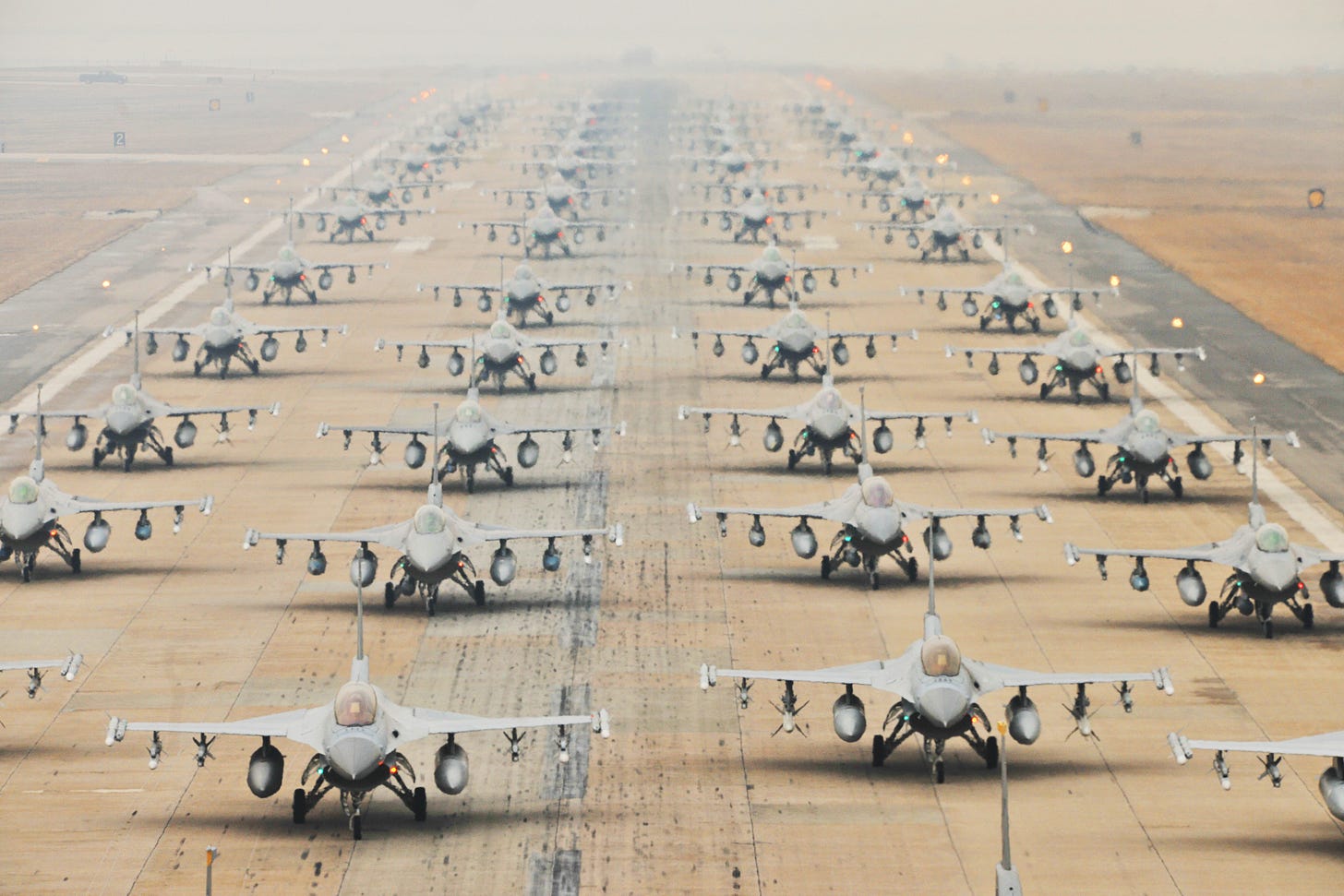
F-16 Elephant Walk
By William Schryver – imetatronink – June 27, 2024
F-16s, Romanian bases, and NATO pilots
I shall return yet again to the prospect of “Made in the USA” F-16s sallying forth boldly into eastern Ukraine to “teach the cabbage heads what Airpower (capitalized) really means.”
From what information I’ve been able to glean in recent weeks, it does in fact look as though the US is aggressively setting up air ops housekeeping in Romania, very near the Black Sea coast — ostensibly to serve as the base of F-16 operations against Russia.
I submit that the preparation of this base is implicit proof that they have long-since assembled and, likely for many months, been honing the skills and teamwork of a few squadrons of “NATO-affiliated contractor pilots” — and the plan must be to use them.
You see, if the “true plan” were to put a dozen woefully undertrained Ukrainian apprentice kamikazes behind the wheel of 1980s vintage F-16s, and then wave them off on a glorious one-way mission into the wild blue yonder … well, you don’t need much of a logistical hub for that operation.
So, if they’re really working to prepare what is reputed to be the “largest NATO base in Europe”, the logical conclusion is that it is intended to house, maintain, and sustain at least a couple squadrons of NATO “volunteer” pilots flying much later F-16 models than the European boneyard relics Ukraine has long been promised.
Hey, I say field five full squadrons, and outfit at least a couple of them with the latest model F-16 Vipers.
Go big or go home.
Make it the last “all in” roll of the wunderwaffe dice.
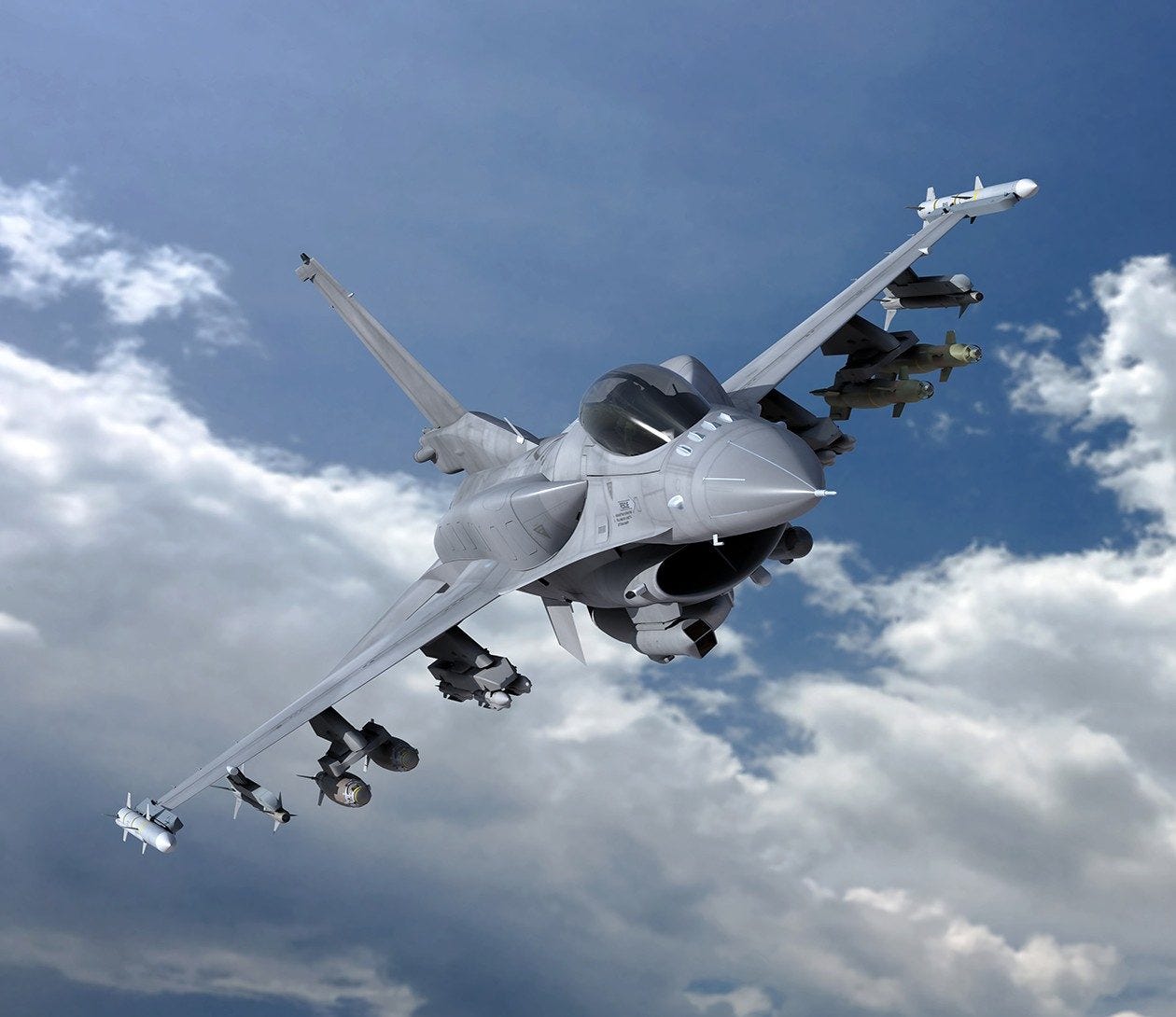
F-16 Viper
Never mind that literally no one in the US air fleet, at any level, has any experience whatsoever in high-intensity air combat operations against an enemy that:
– can match or exceed you with high numbers of superior air frames
– will be flying from interior lines, with well-established logistical infrastructure
– backed by high numbers of the finest layered air defenses on the planet
– with far superior magazine depth
– and will significantly outrange NATO platforms in almost every plausible scenario.
Oh, yeah. And I almost forgot: anyone (including the perpetually catastrophist Russian murmurers) who believes for a moment that Russia will not act to obliterate a NATO base in Romania under such circumstances … well, that’s just silly talk.
Of course they will. They’ll hit it hard. Really hard — with a strike package that exceeds anything ever thrown at a Ukrainian target over the course of this war.
It could well become the most intensely pressure-packed moment in modern times — a situation exceptionally fraught with the possibility of catastrophic miscalculation.
Every time I stop to think about these things, I just shake my head at the obvious stupidity of it all.
If the Imperial Masters of War actually attempt such an air campaign against Russia, not only will the entire operation almost certainly end up being a logistical debacle of truly epic proportions, but the combat results will be shockingly one-sided — disastrous to the point the US will very likely feel compelled to cease operations after just a few days, and try to spin it into some sort of “bold statement” that “achieved its purposes”.
But it will be ugly. Exceedingly ugly. And everybody that is anybody of consequence in power structures around the world will know the score and understand exactly what it means.
The European Mutiny: The Consequences are Just Beginning
By Alastair Crooke | Al Mayadeen | June 26, 2024
In the European Parliament elections this month, voters in most of the European Union’s 27 countries rallied to parties that hold the remote EU Establishment in contempt.
In France, the once-taboo National Rally party outpolled the party of President Macron by more than 2 to 1; in Germany, the party of Scholtz, the SPD (a veteran German party) collapsed to 13% voter support, at the same time that the other components to the governing coalition collapsed. The Greens sank to 12% and the FDP were at borderline 5% of the popular vote (5% is the entry-level to Germany’s parliament).
Much has been written to argue that European Parliamentary Centre ‘held’, yet even that hangs in the balance until the newly-elected MEPs first assemble to approve the clutch of EU top jobs: i.e. the three ‘Presidents’ — Presidents of the Commission, the Council, and of Parliament; plus the High Representative (i.e. the EU’s ‘Foreign Minister’).
For now, the composition of the European Parliament is the subject of intense internecine struggle. These were elections only to the European Parliament — a body that does not initiate legislation in the EU, but which is supposed to exercise a general surveillance.
The real elections in Europe these days are the national elections.
That in itself is a ‘pointer’: Decisive voting is taking place at the national level, and not at the supranational centre in Brussels.
The ‘real’ elections are taking place in France and the UK, despite the latter being outside the EU. The UK vote nonetheless will be an important litmus of European opinion, precisely because its Ruling Strata has become known for its compliance with US policies.
The anti-Establishment and anti-bureaucracy outpouring amongst voters has astonished and disconcerted the élites. The governing party — the venerable Conservative Party — is being routed, and might not survive as a meaningful political entity after 4 July.
In Germany, Scholtz’s ‘traffic light’ coalition also may not survive — following its calamitous EU election. Scholz’s government has a budget shortfall of €40bn. That is the estimated amount Scholz and his coalition partners need to cut in federal spending in order to plug the gap. Within Germany’s ruling parties, there is a consensus forming that the severely weakened coalition cannot survive another grinding dispute on the budget, as happened last year after a ruling by Germany’s top court blew a €60 billion hole in the country’s finances.
Then there are, in September, key state votes ahead in Brandenburg, Thuringia, and Saxony. According to polls, the (populist-rightist) Alternative for Germany (AfD) party is winning in each region, all of which are located in the eastern or central part of the country. Within the Former East Germany, 40% of the votes in the Euro-elections went to either the AfD, or the party of Sara Wagenkecht – a new party espousing contrarian policies.
In France, the situation for the élite class looks equally dire: A series of opinion polls over the past few days reflect the darkening clouds engulfing Macron’s centrist alliance. The polls show the National Rally inching closer to a majority in France’s lower house of parliament, the National Assembly.
If the National Rally does win a majority, the impact of a putative Rally premiership, led by Jordan Bardella, would have major repercussions extending far beyond France — to the EU and beyond. A confrontational stance by the party toward Brussels is a given. And whilst in Italy, Giorgia Meloni has tried to accommodate Brussels on key policy stances, there’s no guarantee Bardella would follow suit. Or that Meloni will not switch to ally with Bardella.
This ‘mutiny’ has been long in the making: EU policies such as immigration, Green farm policies, and heavy-handed bureaucracy have ignited huge anger; but there is one burning issue that largely is kept under the table, and spoken of in hushed tones — Ukraine.
The Biden-faction within Brussels is wholly invested in the US project for escalation of the war in Ukraine against Russia (at least until November), and thereafter Europe is expected to prepare for a later full-scale confrontation with Russia — possibly mounted to mesh with US military action against China, for which the Pentagon is busy preparing.
Of course, ‘all’ hangs on the US election outcome.
The elephant in the ‘planning room’ is that Europeans do not want war with Russia — however hard it is pushed by the Ruling Strata. It is manifestly not in the European interest.
The National Rally is opposed to support for Ukraine, and even Scholtz, the most faithful leader to a Washington ‘lead’ admitted in an interview on Sunday, that the SPD had as little as 7% support in some parts of eastern Germany, which traditionally has been more positively predisposed toward Russia.
“Something is going on there; No way around it”, Scholtz exclaimed.
He then acknowledged that the dire ratings for the SPD stemmed from the fact that “many people do not agree with the support for Ukraine and the sanctions against Russia. This is also reflected in the [wider, poor] election results”, Scholz stated. “There is no alternative [but] to changing that”.
And even in the UK which traditionally tries ‘to be out, in front’ of the US on security issues, the Establishment swooned when Nigel Farage whose Reform party is within a whisker of overtaking the governing Conservative Party in terms of popular esteem said the ‘unsayable’: He said that NATO’s forever expansions towards Russia’s borders were the cause of the Ukraine war. You (metaphorically) could ‘hear a pin drop’ as he broke ranks and uttered the unsayable.
Now, Farage – whether you like him or not – is a consummate politician — unlike Sunak or Starmer, who are anything ‘but’. Farage knows how to tell which way the wind blows.
France and Germany together, historically provide Europe’s engine. For years, however, the EU has built itself by usurping the prerogatives of Europe’s nation-states, only to reinvest them at the supra-national level — for ever.
By the start of this century, London, Berlin, Rome and Athens were much less self-governing than they used to be — to the alarm of voters: Brexit was one result.
“Europeans”, C. Caldwell writes in the New York Times, “for the most part, were not aware that they had been enlisted in a project that has as its end point the extinction of France, Germany, Italy and the rest of Europe’s historic nations – as meaningful political units. Brussels has been able to win assent to its project only by concealing its nature. Europe’s younger generation appears however to have seen through the dissembling. We are only at the beginning of the consequences”.
Brussels may try to claim that the ‘Centre held’; that their Ukraine, Green immigration and centralizing policies can continue unaffected. But Caldwell is correct: we are only at the beginning of the consequences, should they try to insist. The “real problem with the union [is] not what it does but what it is … a ruthless state-building project like those of Cardinal Richelieu under Louis XIII”.
The European Union’s governing machinery in Brussels has never been where voters’ interests – or hearts – lie.
EU Accelerates De-Dollarization by Stealing Russian Money
By Ekaterina Blinova – Sputnik – 25.06.2024
The EU will send €1.4 billion ($1.5 billion) in profits from the frozen assets of Russia’s Central Bank to the “European Peace Facility” in order to meet the Kiev regime’s military needs.
EU High Representative for Foreign Affairs and Security Policy Josep Borrell announced on June 24 that the bloc has approved grabbing windfall income from frozen Russian assets.
According to Borrell, €1.4 billion will be available in the course of the next month, and another €1 billion by the end of the year.
“The decision is shameful,” Gilbert Doctorow, an international relations and Russian affairs analyst, told Sputnik. “It is totally hypocritical to assign to a “Peace Facility” the role of financing arms and war. The ultimate goal of this ‘peace initiative’ is to prolong the war, at least till after the American elections in November for the sake of Mr Biden’s personal ambitions.”
Ninety percent of the revenues will be spent on arms and just 10 percent on construction projects in Ukraine.
Going against the usual requirement for unanimity between its members, the EU snubbed Hungary’s veto by using a legal “loophole”.
“New billions for Ukraine. This time by kicking up the European rules and leaving out Hungary,” Hungarian Foreign Affairs Minister Péter Szijjártó commented earlier on Monday.
He slammed the “shameless breach of common European rules,” stressing in a social media post that “This is a clear red line.”
After the start of the Russian special military operation in Ukraine, the EU and G7 countries froze almost $300 billion in Russian assets. Around $207 billion are held at Euroclear, a clearinghouse based in Belgium.
“The result will be to sharply reduce use of the Euro as a reserve currency by countries of the Global South, who all fear the kind of arbitrary and illegal confiscation of their national wealth by European governments whenever it suits their purposes,” Doctorow warned.
Brussels’ decision is “bad” in every respect, said Adriel Kasonta, a London-based foreign affairs analyst and former chairman of the International Affairs Committee at the Bow Group think-tank.
“First of all, it is illegal, if we take into account the violation of the principle of sovereign immunity of the sovereign country, which is the Russian Federation,” Kasonta told Sputnik.
“It exposes the western double standard when it comes to the rule of law and the application of the rules to the countries equally,” he continued.
That “is clearly detrimental because it serves as a boost to the de-dollarization movement,” the expert stressed. “It will… accelerate the movement of abandoning the currency of the dollar and euro in international transactions.”
Russia has repeatedly warned it will take retaliatory measures in response to any attempts to expropriate its financial resources by the West, and that it would perceive any form of grab as “theft”.
Any actions with Russian frozen assets will trigger a symmetrical response, Finance Minister Anton Siluanov told Sputnik in late February, adding that a similar quantity of foreign assets have been frozen in Russia.
Last week, Russian Foreign Ministry spokeswoman Maria Zakharova told a press briefing that Russia could take a wide variety of measures to respond to the G7 decision to fund Ukraine using profits from frozen Russian assets.
Magazine Depth and Shields

Iranian Shahed Drones – Three Variants
By William Schryver – imetatronink – June 26, 2024
In addition to the already-in-progress wars in Ukraine, Gaza, and the Red Sea, we are now staring down the barrel of yet another — rumored to be imminent in southern Lebanon.
There is no doubt Israel (just like its great benefactor, the United States) is, in the context of a “big war”, capable of executing several damaging strikes against a potential peer or near-peer adversary.
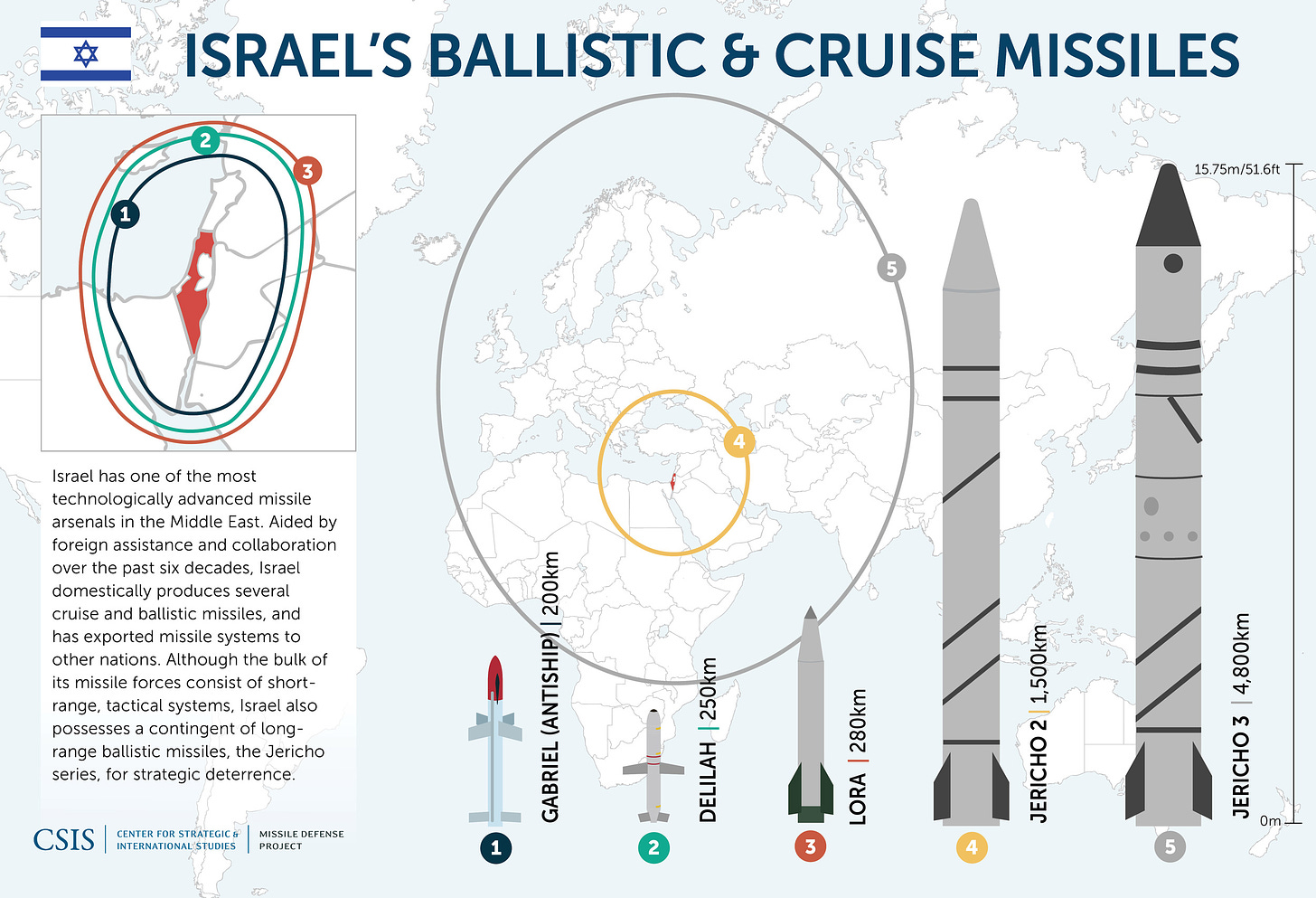
Israeli Ballistic and Cruise Missiles and Ranges
But, throughout the imperial domain, there are fatal weaknesses that exist right now, and which cannot be turned into strengths at any point in the near- or medium-term.
The first is what military types call “magazine depth”: munitions stockpiles sufficient to offensively overwhelm, defensively defeat, and strategically outlast the enemy.
Neither the United States, nor any of its largely impotent client nations, possess “magazine depth” sufficient to prosecute anything more than a relatively brief campaign against their potential peer adversaries: Russia, China, Iran — and all or any of their lesser-power partners.
The second problem is a corollary of the first. It is what I will term “shields”: the capacity to defeat a decisive proportion of the strikes one’s enemy can launch against you.
Neither the United States, nor any of its largely impotent client nations — by their own admission — possess anything even approximating comprehensive and effective “shields” against the quantity and quality of the types of strike weapons its potential adversaries can launch against them.
NATO sources themselves recently confessed that they only have about 5% potential air defense coverage against Russian missile strikes.
Now, of course, many will reflexively argue that, for example, the US could, with a massive “shock and awe” first-strike air campaign, effectively disarm Russian counterstrike capabilities.
This is patently ridiculous wishful thinking.
No one who actually understands the parameters of the military equation believes this to be true. And one need only examine the results of the months-long campaign against the lowly Yemenis to see confirmation of this incontrovertible fact.
Earlier this year we witnessed the Iranians launch a relatively modest missile strike against Israel, whose defenses were massively reinforced by American air and naval assets.
Using maybe 300 antiquated long-range strike drones and cruise missiles as decoys, the air defense response of both the US and Israel was massively attrited. And then, with a mere dozen or so seriously capable ballistic missiles, the Iranians blew right through the interception attempts of both the multiple land-based Patriot systems and a US guided-missile destroyer positioned off the eastern Mediterranean coast.
The Patriot systems were a total bust, and the Israelis summarily retired them in the immediate aftermath of the Iranian strike.
The US destroyer is reported to have launched eight top-shelf SM-3 missile defense interceptors (quite likely its entire “magazine depth”) at the incoming Iranian strike package.
They might have damaged one of the 12-15 incoming Iranian missiles.
The others hit with precision comparable to the 5-meter CEP Iran achieved in its 2020 strikes against the US airbase at Ayn al-Asad in Iraq.
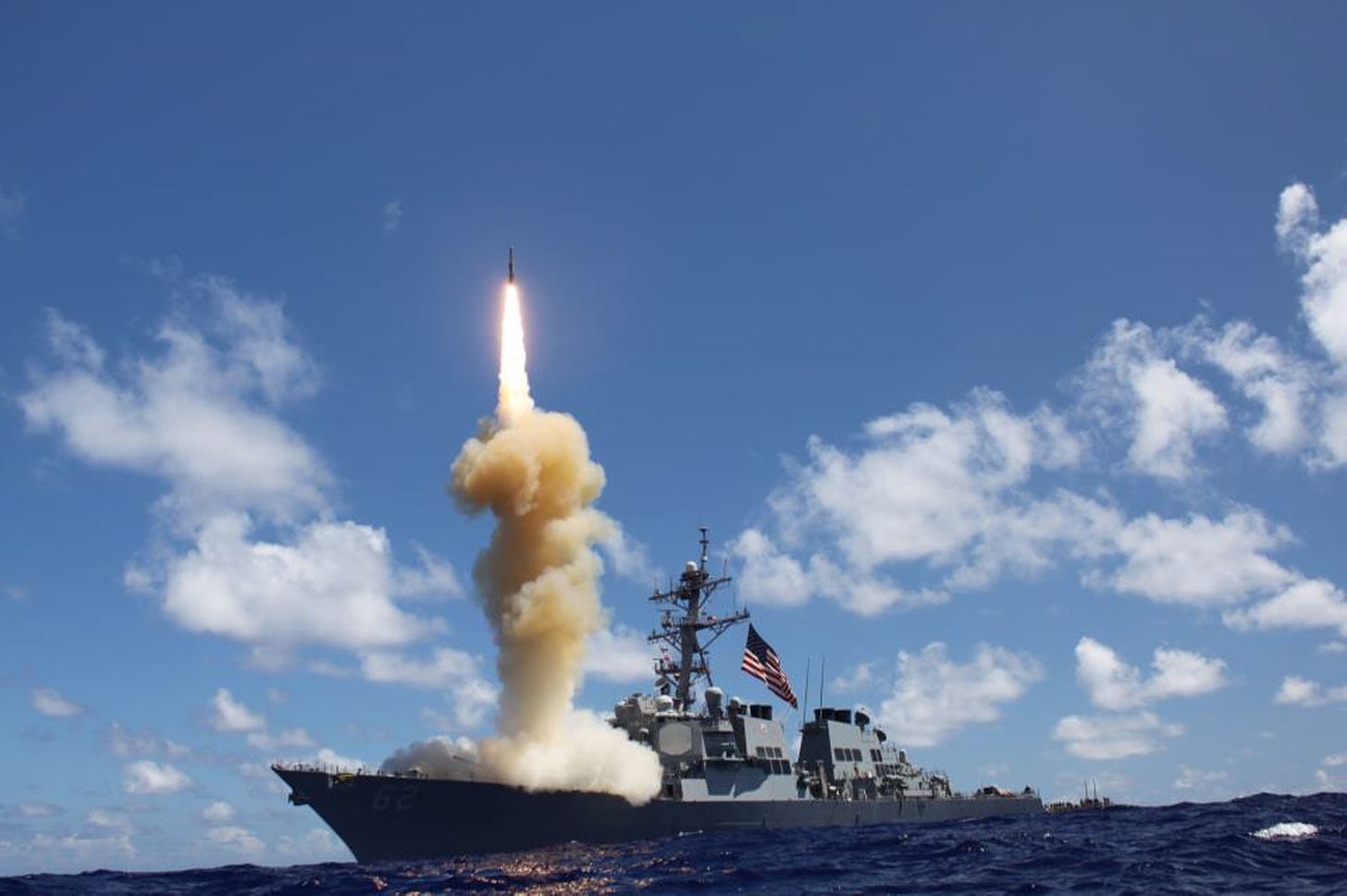
SM-3 Missile Interceptor Launched from a US Guided-Missile Destroyer
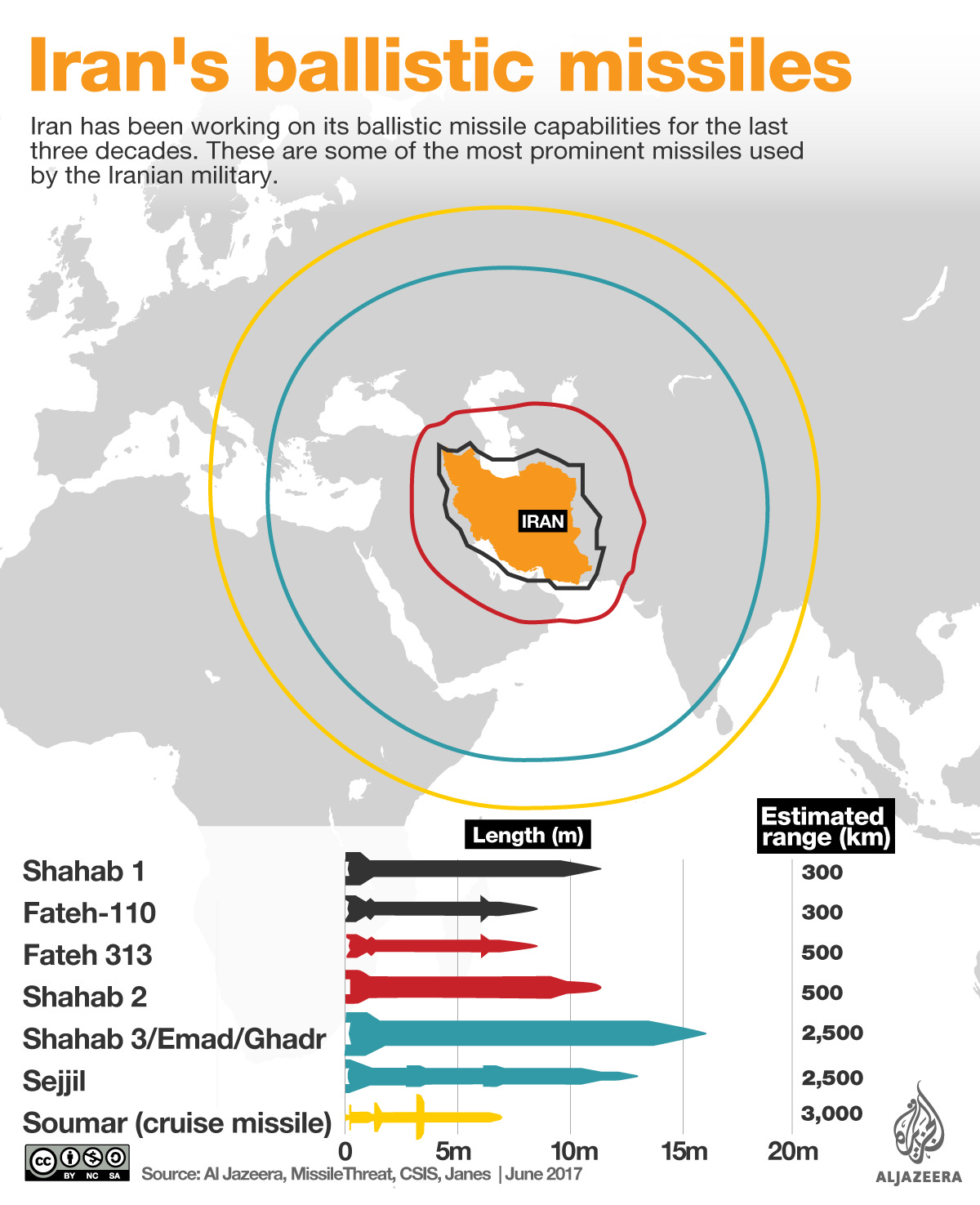
Iranian Ballistic Missiles and Ranges
Had Iran, at that moment in time, opted to follow up with an even larger strike consisting of several hundred of its best ballistic missiles, the US and Israeli defenses would have been penetrated to an overwhelming degree. It would have put to shame the opening-night show of the Americans’ 1991 “shock and awe” cruise missile attack against Baghdad.
Fortunately the Iranians didn’t press the matter, and let their modest yet impressive demonstration of strength suffice for the time being.
In recent months, Iran’s close partner Hezbollah — which is reputed to possess at least 100,000 missiles and drones of various types — has been routinely penetrating Israel’s once-vaunted “Iron Dome” missile defense system.
Indeed, Hezbollah has almost appeared to be mocking the Israelis’ impotence at times.
In any case, the Iron Dome has been revealed to be acutely vulnerable to penetration by Hezbollah drones and missiles.
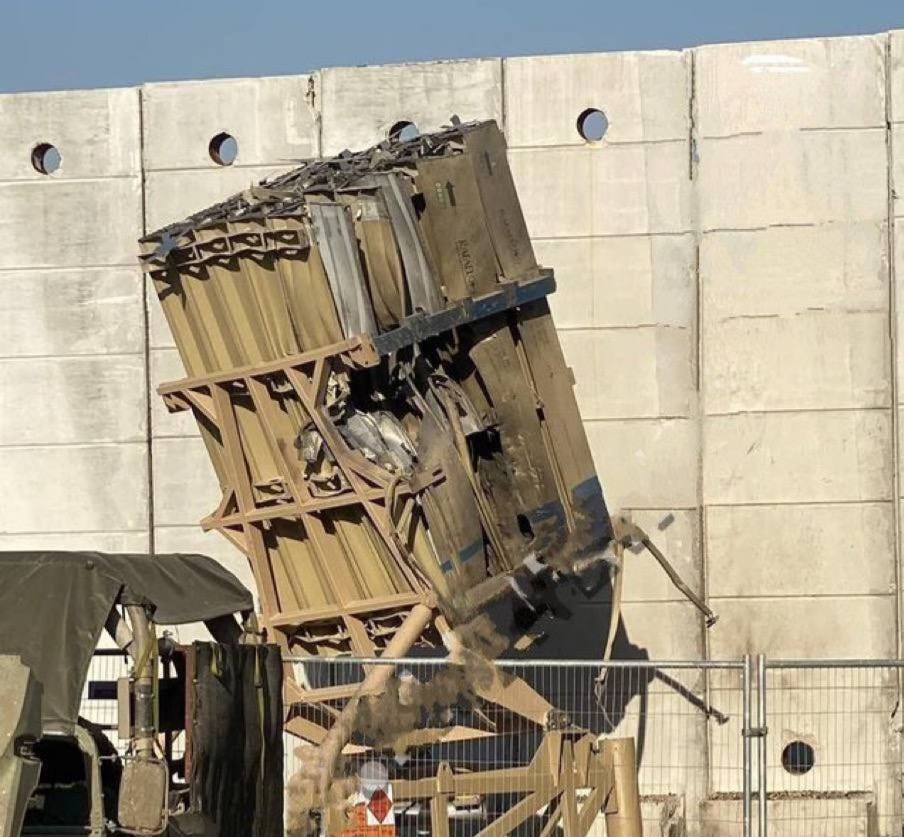
Israeli Iron Dome Launcher Destroyed by Hezbollah Drone Strike
It is not known with precision how many missiles and drones of various types Iran possesses. But it is reasonable to assume that their “magazine depth” is considerably larger than that of Hezbollah.
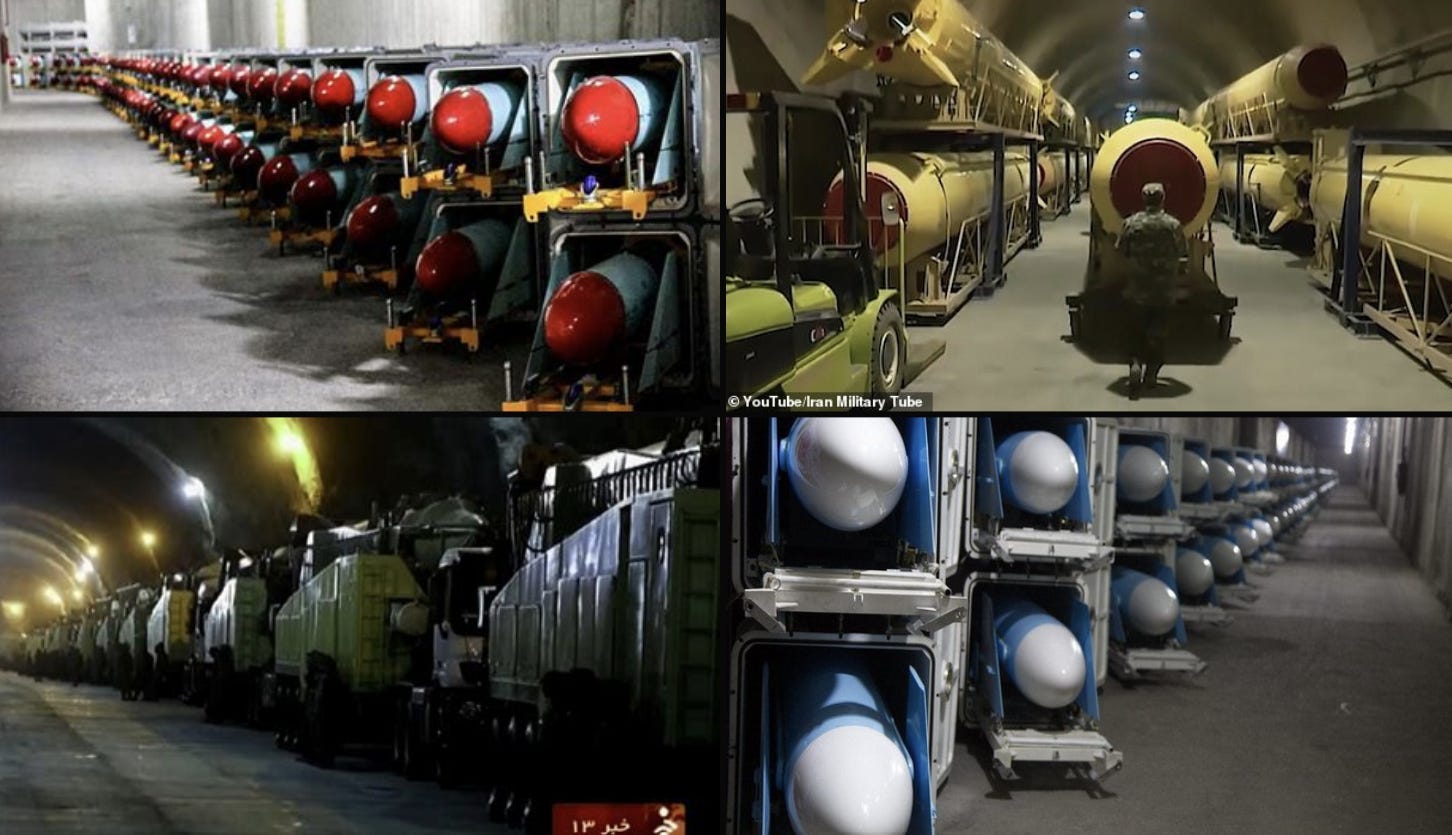
Iranian Missiles
It is also not known with precision how many missiles and drones of various types Russia possesses. But it is reasonable to assume that their “magazine depth” is considerably larger — and exceedingly more potent — than that of Hezbollah and Iran combined.
Even more importantly, the Russians have, over the course of the war in Ukraine, demonstrated an unprecedented capability to routinely shoot down the best strike missiles the US and its NATO vassals have been able to launch against them.
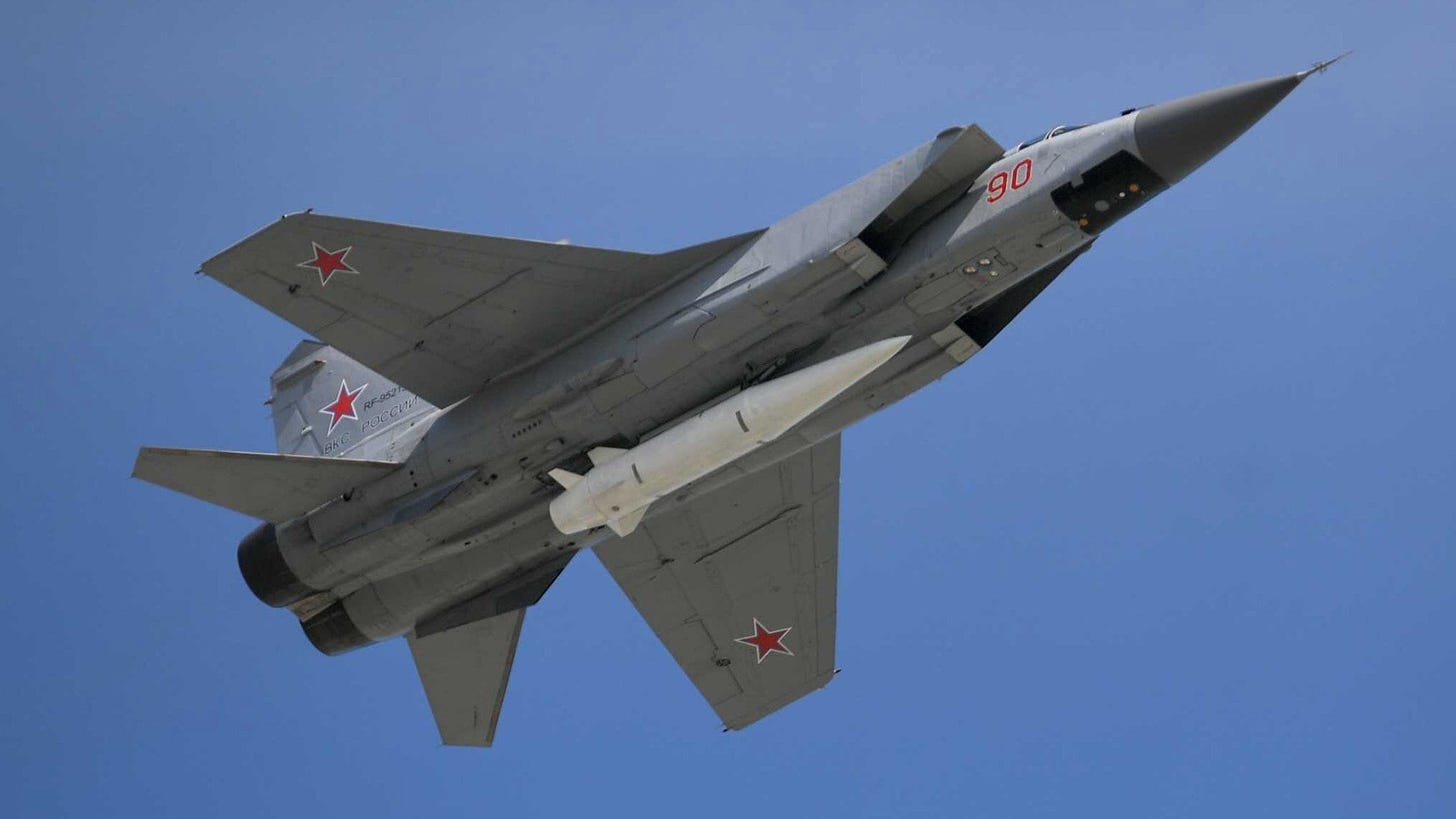
Russian MiG-31 Carrying a Hypersonic Kinzhal Missile
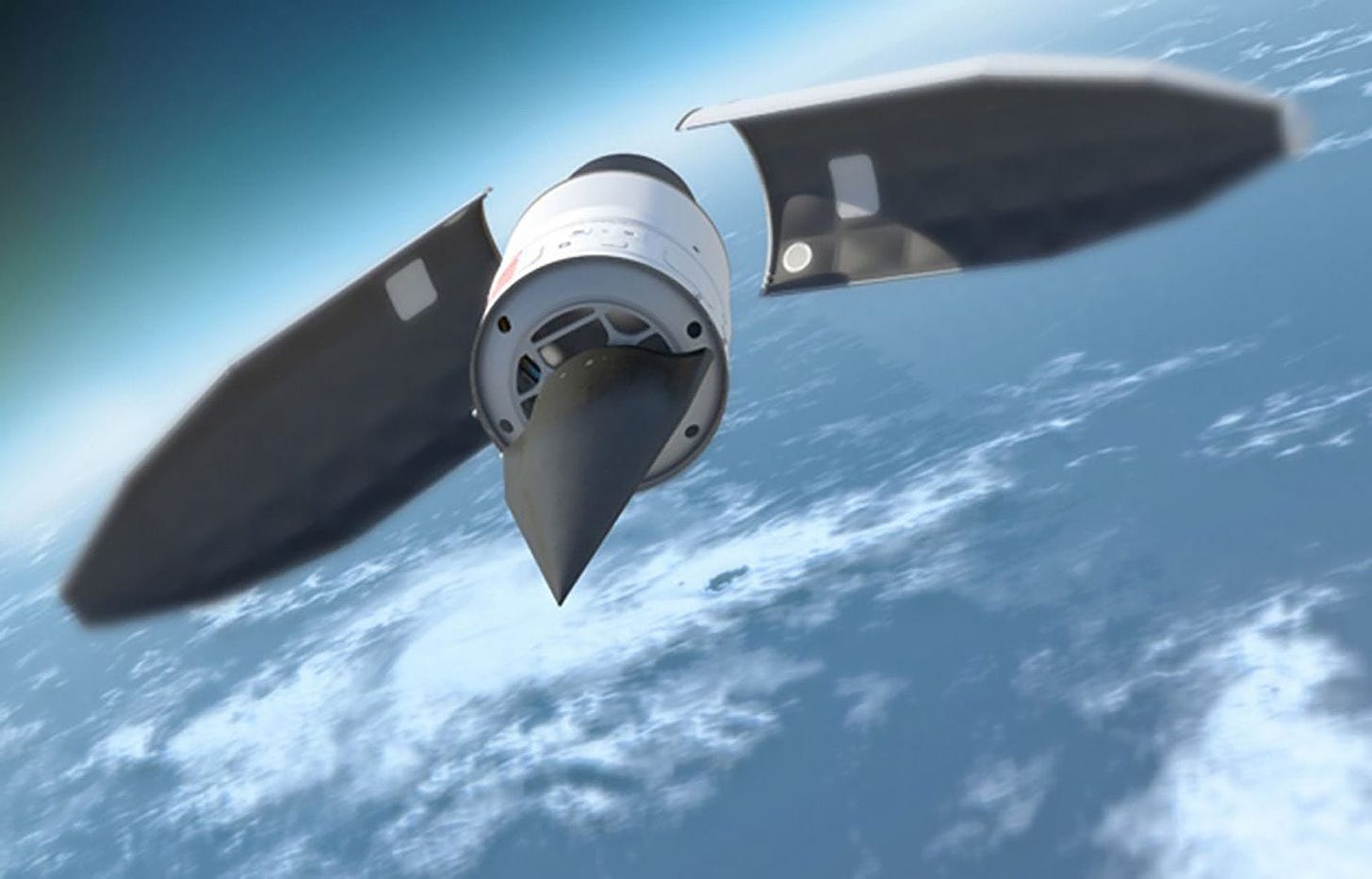
Russian Avangard Hypersonic Missile
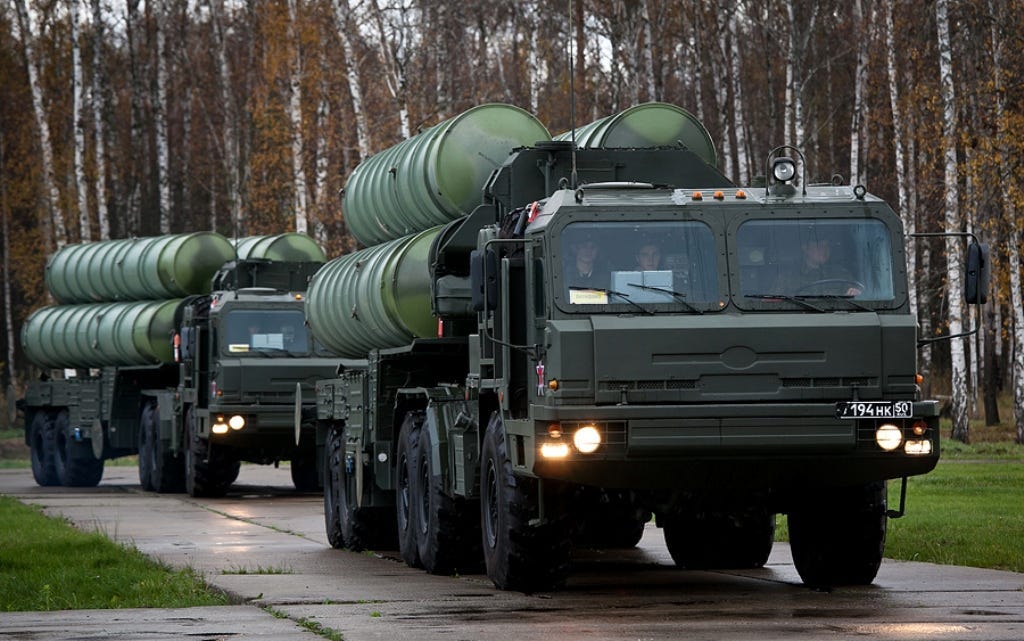
Russian S-400 Air Defense System
Lastly, it is not known with precision how many missiles and drones of various types China possesses. But it is reasonable to assume that their “magazine depth” is at least an order of magnitude larger than Hezbollah, Iran, and Russia combined.
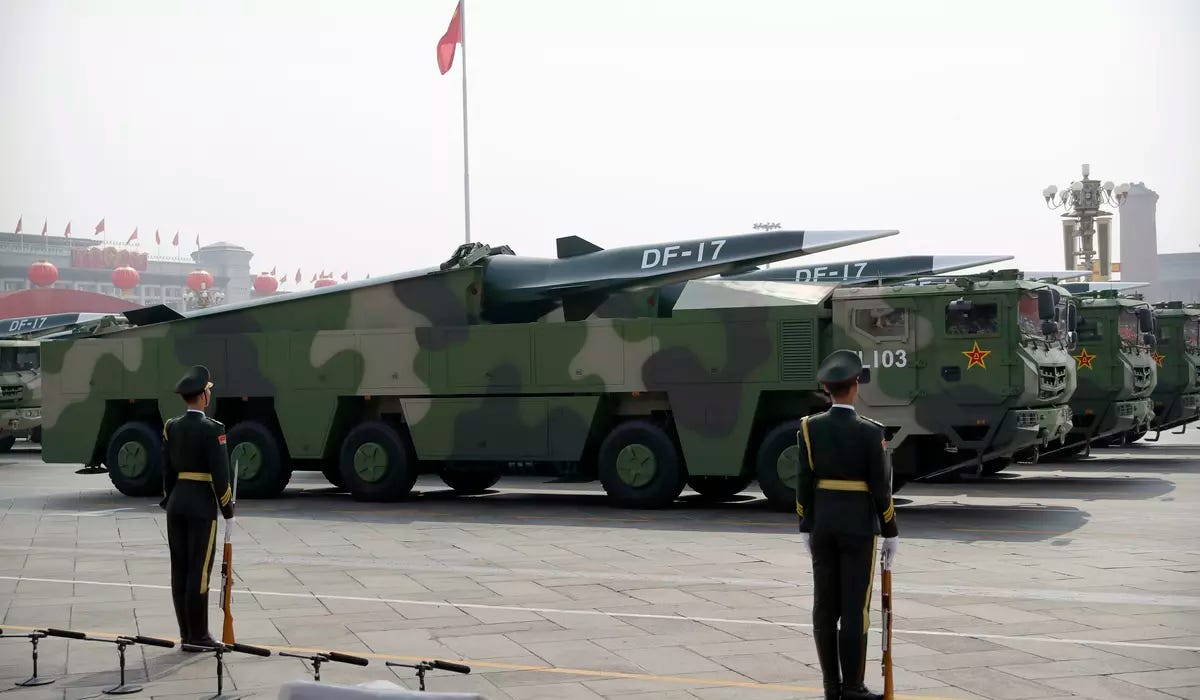
Chinese DF-17 Hypersonic Missiles
Of course, I’ve not yet made any mention of North Korea, who has now been formally received into the Russia, China, Iran mutual-defense partnership. People love to mock Kim Jong-Un and his people, but the empire underestimates them at their peril.
The Israelis can talk tough about making war against Hezbollah and its friends, but if they actually attempt it, it will end very, very badly for them.
The Americans and their almost laughably impotent allies can talk tough about making war against Russia or China, but if they actually attempt it, it will end catastrophically for them.
Then we’ll really have a dangerous situation on our hands.
EU ‘crossed a red line’ by banning Hungary from latest Ukraine vote, says Foreign Minister Szijjártó
BY DÉNES ALBERT | REMIX NEWS | JUNE 25, 2024
The European Union crossed a red line by prohibiting Hungary from voting on the use of the proceeds from frozen Russian bank accounts, said Minister of Foreign Affairs and Trade Péter Szijjártó on Monday.
Speaking during a break in the meeting of the EU’s Foreign Affairs Council, the Hungarian minister said an additional €1.4 billion from the European Peace Facility would be used for arms transfers to Ukraine, despite Hungary’s disagreement.
“This €1.4 billion is effectively the amount of the proceeds of the seized or frozen Russian assets, and since Hungary abstained in the first vote on their use, the Council’s legal service, Brussels, the bureaucrats, and some member states considered that this was a sufficient basis for ignoring Hungary’s right to decide, and so they decided to use €1.4 billion from the European Peace Facility to finance new arms shipments to Ukraine, ignoring Hungary’s position,” he said.
“This is a clear red line. Never before has such a shameless breach and disregard of common European rules been shown. Moreover, it is precisely those who are pushing for the rule of law procedures at full volume and talking about the endangerment of democratic values who are breaking European rules,” he continued.
“The self-proclaimed warriors of democracy and the rule of law have now flouted the rules in the most shameless way possible by excluding Hungary from this decision. So the pro-war fervor has effectively blinded the decision-makers,” he added.
Szijjártó underlined that the EU clearly wants to continue crossing red lines, as evidenced by the fact that High Representative for Foreign Affairs and Security Policy Josep Borrell has this time come up with a proposal to allow the training of Ukrainian soldiers by European troops on Ukrainian territory.
“This is an extremely dangerous proposal. It is a proposal that would cross another red line. We remember the statements of leading Western European politicians during the European Parliament election campaign that European soldiers could and should be stationed, deployed, and sent to Ukraine. And here is the first step,” he said.
“They want to send military trainers to Ukraine. This is unacceptable to us, and we are protesting against it with all means at our disposal because the deployment of EU trainers in Ukraine would create another extremely serious risk of further escalation of the war,” he warned.
Key Talking Points on Current Bird Flu Situation
Knowledge is Powerful Amidst Government False Narrative
By Peter A. McCullough, MD, MPH | Courageous Discourse | June 24, 2024
The McCullough Foundation, informative update on the current H5N1 global situation has received considerable attention and garnered valuable feedback. Here are the key takeaways:
- Practice of culling (mass destruction of entire healthy flocks) when a PCR test is found positive to “eradicate” the virus is futile and may work to constrain the food supply. The current strain H5N1 clade 2.3.4.4.b is not thus far causing necropsy or radiographic confirmed fatal pneumonia in birds or mammals.
- H5N1 host range expansion into migratory birds and mammals likely occurred as a result of gain-of-function serial passage research and a lab leak [or release].
- Increased transmissibility of H5N1 has a tradeoff of decreased virulence. Using legacy human mortality rates from cases in Southeast Asia is not appropriate. The US has never had a fatal human case of bird flu.
- Fear-mongering promulgated by the Bio-Pharmaceutical Complex is designed to promote mass vaccination of animals and humans with lucrative pre-purchased contracts to the vaccine manufacturers and their NGO backers. Mass vaccination into a highly prevalent pandemic promotes resistant strains of the virus in the vaccinated.
- If human-to-human spread occurs in the future as expected by many, it will be the product of gain-of-function research that has gone on for years with the goal of creating harm to human populations.
- Be prepared with early prevention and treatment strategies on hand. Courageous Discourse has covered dilute iodine nasal sprays and gargles, oseltamivir, hydroxychloroquine, and other antivirals. The Wellness Company has extended its Contagion Kit to cover the case of serious human avian influenza in the event it occurs.
Why Israel is Unprepared for War With Hezbollah
By Ekaterina Blinova – Sputnik – 24.06.2024
Israeli Prime Minister Benjamin Netanyahu told the country’s Channel 14 Television that Tel Aviv is ready to move some forces to the north to confront Lebanese resistance group Hezbollah. Could Tel Aviv wage a war on two fronts?
The Israel Defense Forces (IDF) and Hezbollah fighters have increasingly exchanged strikes across Lebanon’s southern border since the beginning of Tel Aviv’s Gaza war launched over Hamas’ attack on October 7 2023.
“From an Israeli perspective it would be very hard to imagine a double front war, even though we know that within the Israeli Cabinet of war, there are many ministries who are willing to try to open the second front with Hezbollah,” Dr Lorenzo Trombetta, Beirut-based scholar and analyst specialising on the Middle East, told Sputnik.
Hezbollah has repeatedly warned it would step up military actions unless Israel stops killing Palestinian civilians in the Gaza Strip.
Hezbollah has intensified attacks over Israel’s Rafah invasion.
Last week Hezbollah Secretary General Seyyed Hassan Nasrallah played down Israel’s threats to launch an all-out war against the resistance group, warning that it has a 100,000-strong military force capable of waging military actions against Israel in all three domains – land, air and sea.
Nasrallah added that the movement does not want a “total war” with Israel and called for a complete and permanent ceasefire in Gaza.
Hezbollah released a nine-minute video last week, filmed from an unmanned aerial vehicle (UAV) which penetrated Israeli air defenses and returned to Lebanese airspace without being detected. The footage shows sensitive civilian and military locations in and around Haifa, one of Israel’s largest cities.
According to some estimates, Hezbollah has up to 150,000-200,000 rockets and missiles and has also mastered the use of unmanned vehicles.
But Dr Hasan Selim Ozertem, an Ankara-based security and political analyst, told Sputnik that a repeat of the Israeli invasions in 1982 and 2006 would bring “catastrophe” to southern Lebanon.
“The plot is valid for a possible operation against Lebanon because looking in the past, in 2006, Israel also could carry out another operation against Hezbollah and, as you remember, left behind a kind of catastrophe in the Lebanese terrain,” Ozertem said. “Israel has all the capabilities, especially the air capability and also land capability to carry out an operation.”
While conceding that the Israeli military capabilities are “very strong and very high,” Trombetta expressed doubts about Tel Aviv’s chances of succeeding in a war against Hezbollah.
“Technically speaking, Hezbollah has drones and mainly it showed recently, during May and June, its abilities to launch soil-air missiles that can hit or can counter not only Israeli drones, the Hermes 450 and Hermes 900, but also Israeli jet fighters,” the pundit said. “So first of all, Hezbollah could try to increase its abilities to defend the Lebanese territory with these surface-to-air missiles.”
“Secondly, they also showed in the last weeks the ability to offend, to pose a threat within the Israeli territories with armed drones, suicide drones, and other flight weapons that breached the Iron Dome system on more than one occasion, even recently,” Trombetta continued.
The Washington-based Center for Strategic and International Studies (CSIS) published analysis in March describing how a potential Israel-Hezbollah conflict in 2024 could be more challenging for Tel Aviv than the 2006 Israeli-Lebanese war.
The think-tank drew attention to the fact that Hezbollah has for years built upon its successful 2006 tactics of “decentralizing its command and control and reorganizing to force the IDF into more urbanized terrain where [Hezbollah] fighters can take advantage of concealed, fortified positions.”
Hezbollah has beefed up its military stockpiles with new weapons over the past 18 years. It has also gained extensive military experience during the war against ISIS and other Islamist terrorists in Syria and has had “access to capabilities and competencies used by conventional armies.”
The CSIS also noted that the geography of southern Lebanon offers advantages for Hezbollah guerrillas, including positions on rocky hills where they can hide and fire rockets, unmanned aircraft systems and anti-tank guided missiles at Israeli positions on the border.
The Israeli Reichman University Institute for Counter-Terrorism assumes that Hezbollah could fire up to 3,000 missiles a day and overwhelm Israel’s air defenses.
The researchers warned that intensive attacks would deplete the Israeli stockpiles of surface-to-air missiles within a few days of combat, exposing the nation to further Hezbollah missile and drone attacks. They argued that Tel Aviv is unprepared for an all-out war with the resistance force.
“We should include also the fact that in case Israel will launch a war against Hezbollah in Lebanon, it is very possible, it is very likely that Iran and other Iranian allies in the region will activate their forces against Israel and the US interests,” Trombetta said, adding that Yemen’s Houthi-led government, the Iraqi Islamic Resistance and others could come to Hezbollah’s aid in the event of an all-out Israeli attack on Lebanon.
Featured Video

Bombing Iran Back Into the Stone Age /Lt Col Daniel Davis & Jim Jatras
or go to
Aletho News Archives – Video-Images
From the Archives
The Occupied Mentality Syndrome
Saudi Arabia on the American chessboard – Part 2
By B. J. Sabri | American Herald Tribune | April 19, 2016
Since the Korean War, but particularly since the Iranian Revolution of 1979 until today, the United States has been steadily escalating its military presence in the Persian Gulf. Taking advantage of many colossal events of the past 36 years, [1] the hyper-empire has institutionalized its massive presence on land and sea, and expanded its objectives to include the unambiguous physical control of the area, as well as the clear understanding that local Arab governments should abide by them. The pretext is always the same: in “defense” of the national interests and security of the United States. From observing how the United States has been interacting with the governments of the region, and by judging from the size of its expeditionary force, we could reach a basic conclusion. The United States is occupying, de facto, the entire Arabian Peninsula. (Yemen, devastated by Saudi and American jets is yet to be conquered. Oman? Britain returned not as colonial ruler but as a soft occupying power.)
Under this articulation, Saudi Arabia, Qatar, Kuwait, and the United Arab Emirates are virtually occupied countries. If we compare this type of occupation to the mandate and protectorate regimes of the past, the results might be identical—the nations affected by it lose sovereignty. When Arab governments comply with the objectives of a foreign power that station military forces on their national milieu, then that power controls them in multiple ways including how they react to policy deliberations and what decisions they intend to take on specific issues. A good method to verify the concept of effective occupation is this: take notice of what the United States says and wants, and then compare it to what the gulf rulers do in response. (I shall discuss this detail at some point in the upcoming parts.)
If the presence of US forces or other means of political pressure are a factor in Saudi Arabia’s interventionist Arab wars, then we need to debate this issue. However, from the history of resistance to colonialism, we learnt: if a powerful state imposes its order on a nation by military means or other forms of coercion, and if this nation does not resist that imposition, then a mental subordination to the powerful state will ensue. This is especially true in the case of Saudi Arabia. One single event, 9/11, has transformed it from a US “ally” into an instant political hostage of the American Empire. … continue
Blog Roll
 Aletho News
- One Of America’s Leading Neo-Cons Has Turned Against The Iran War And Israel
- Attack in the Bosphorus exposes NATO weaknesses and tensions among allies
- BREAKING: US JET SHOT DOWN OVER IRAN /Lt Col Daniel Davis & Nima Alkhorshid
- Now everyone is dumping US government bonds
- Brazilian Congressman seeks to bar Israeli military personnel from entering Brazil
- Official reveals evidence of Arab states’ involvement in US-Israeli war on Iran
- His Majesty’s head-chopper: Syria’s MI6-backed president bows to King Charles
- Forced to backtrack: ‘Israel’ drops Hezbollah disarmament goal
- Britain’s Lebanon surveillance network: A digital map for war
- Bahrain faces scrutiny for opposition crackdown after detainee killed
- If Americans Knew
- Israel Is Blocking Palestinians from Easter at Church Where Jesus Resurrected
- Plot to assassinate Palestinian activist follows harassment campaign promoted by Zionist groups and elected officials
- Prominent New York synagogue hosts presentation on why U.S. Jews should support the ethnic cleansing of Gaza
- Tapper vs. Piker: Is the CNN Anchor Auditioning for David Ellison?
- Shouldn’t Democrats Be Able to Condemn Genocide?
- Israel-US kill negotiators, destroy civilian structures, but Iran’s military capabilities still largely intact – Daily Update
- ‘War crime’: Global condemnation as Israeli ministers celebrate death penalty law targeting Palestinian prisoners
- 7 Ways Israel Is Turning Lebanon Into Gaza
- World’s Leading Football Bodies Under Fire Over Israel Policies
- Experts warn of possible use of nukes against Iran
- No Tricks Zone
- Low Intensity Tornado Wrecks Major Solar Farm, Creating A Potential Toxic Dump
- New Study Finds Warming Saves Lives…Cold Temperatures 12 Times More Deadly Than Excess Heat
- German Science Blog Accuses PIK Climate Institute Of Hallucinating Climate Tipping Points
- Devastating Assessment Of Comirnaty Vaccine By Former Senior Pfizer Europe Toxicologist
- New Study: CO2 Is ‘Effectively Negligible’ As An Explanatory Climate Change Factor Since 2000
- Former Pfizer Toxicologist Dr. Helmut Sterz Tells Bundestag Hearing Pfizer Vaccine Should Have Never Been Approved
- Energy Expert: Germany’s Nuclear Phaseout Was A “500 Billion Euro Mistake”
- New Research: South Australia’s Mid-Holocene Sea Surface Temperatures Were 4°C Warmer Than Today
- Storing Green Energy To Last Germany 10 Days Would Require A 60-Million Tonne Battery
- New Studies: UK Sea Levels Were 4 Meters Higher Than Today During The Mid-Holocene
 Aletho News