Magazine Depth and Shields

Iranian Shahed Drones – Three Variants
By William Schryver – imetatronink – June 26, 2024
In addition to the already-in-progress wars in Ukraine, Gaza, and the Red Sea, we are now staring down the barrel of yet another — rumored to be imminent in southern Lebanon.
There is no doubt Israel (just like its great benefactor, the United States) is, in the context of a “big war”, capable of executing several damaging strikes against a potential peer or near-peer adversary.
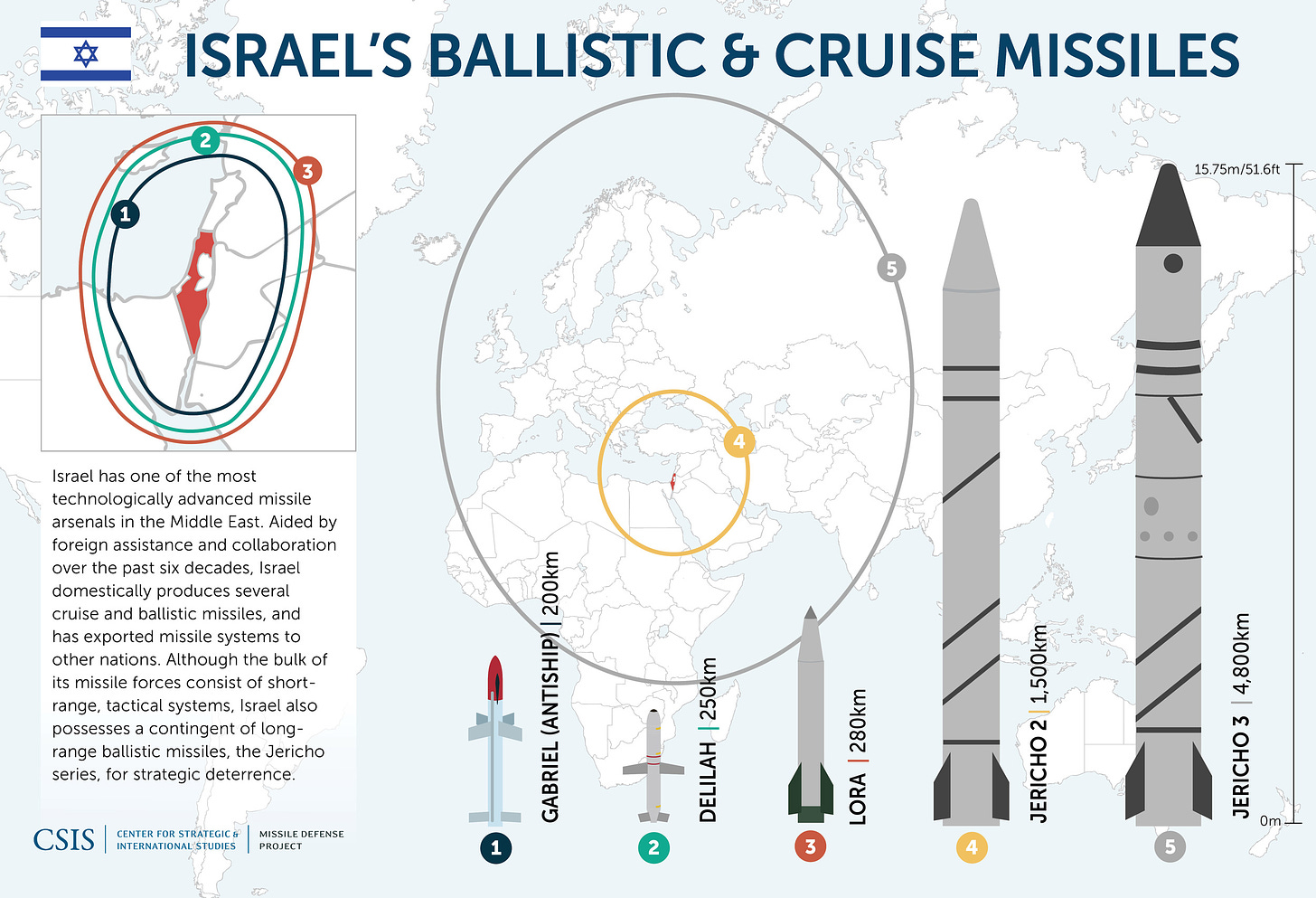
Israeli Ballistic and Cruise Missiles and Ranges
But, throughout the imperial domain, there are fatal weaknesses that exist right now, and which cannot be turned into strengths at any point in the near- or medium-term.
The first is what military types call “magazine depth”: munitions stockpiles sufficient to offensively overwhelm, defensively defeat, and strategically outlast the enemy.
Neither the United States, nor any of its largely impotent client nations, possess “magazine depth” sufficient to prosecute anything more than a relatively brief campaign against their potential peer adversaries: Russia, China, Iran — and all or any of their lesser-power partners.
The second problem is a corollary of the first. It is what I will term “shields”: the capacity to defeat a decisive proportion of the strikes one’s enemy can launch against you.
Neither the United States, nor any of its largely impotent client nations — by their own admission — possess anything even approximating comprehensive and effective “shields” against the quantity and quality of the types of strike weapons its potential adversaries can launch against them.
NATO sources themselves recently confessed that they only have about 5% potential air defense coverage against Russian missile strikes.
Now, of course, many will reflexively argue that, for example, the US could, with a massive “shock and awe” first-strike air campaign, effectively disarm Russian counterstrike capabilities.
This is patently ridiculous wishful thinking.
No one who actually understands the parameters of the military equation believes this to be true. And one need only examine the results of the months-long campaign against the lowly Yemenis to see confirmation of this incontrovertible fact.
Earlier this year we witnessed the Iranians launch a relatively modest missile strike against Israel, whose defenses were massively reinforced by American air and naval assets.
Using maybe 300 antiquated long-range strike drones and cruise missiles as decoys, the air defense response of both the US and Israel was massively attrited. And then, with a mere dozen or so seriously capable ballistic missiles, the Iranians blew right through the interception attempts of both the multiple land-based Patriot systems and a US guided-missile destroyer positioned off the eastern Mediterranean coast.
The Patriot systems were a total bust, and the Israelis summarily retired them in the immediate aftermath of the Iranian strike.
The US destroyer is reported to have launched eight top-shelf SM-3 missile defense interceptors (quite likely its entire “magazine depth”) at the incoming Iranian strike package.
They might have damaged one of the 12-15 incoming Iranian missiles.
The others hit with precision comparable to the 5-meter CEP Iran achieved in its 2020 strikes against the US airbase at Ayn al-Asad in Iraq.
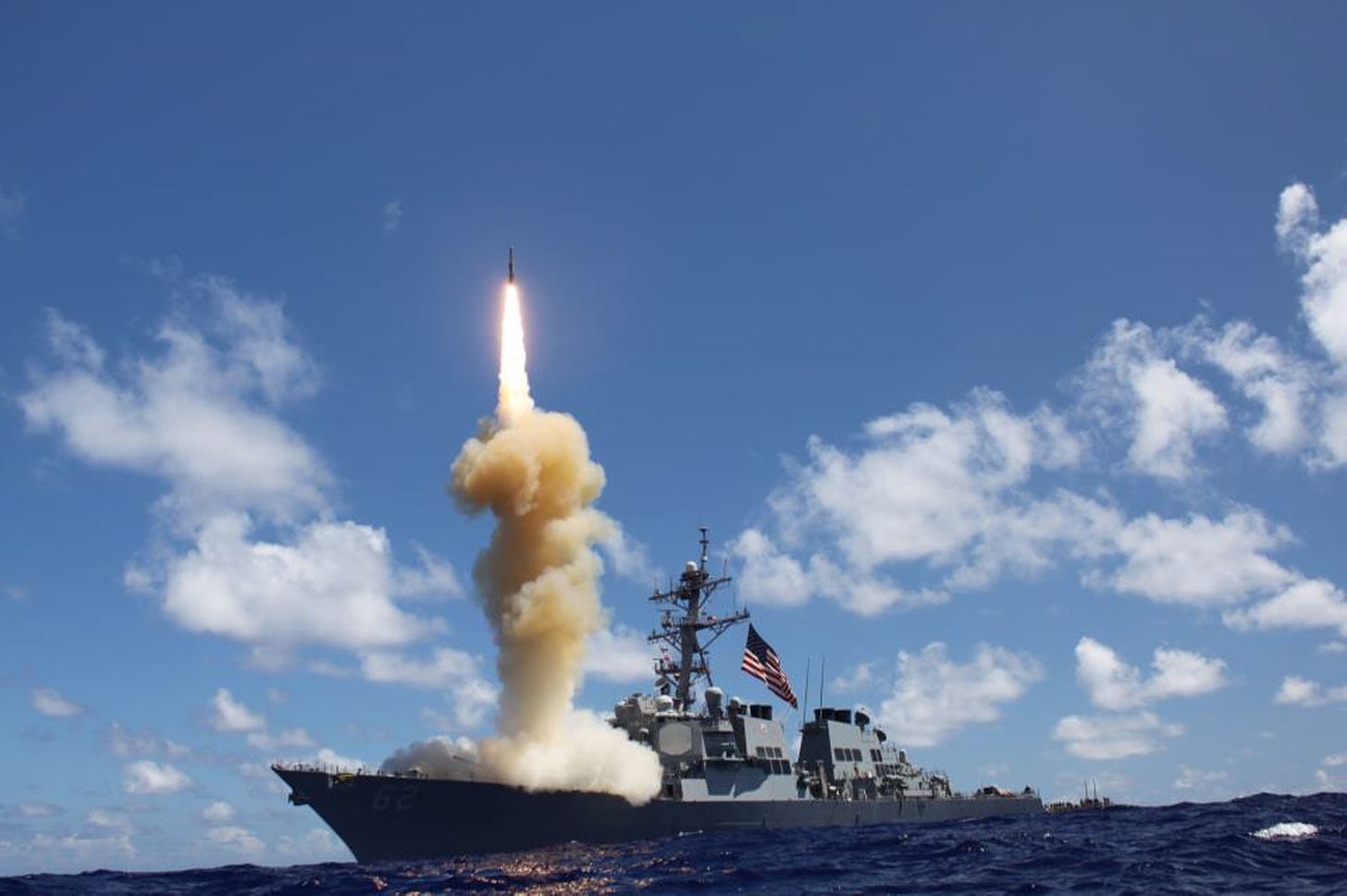
SM-3 Missile Interceptor Launched from a US Guided-Missile Destroyer
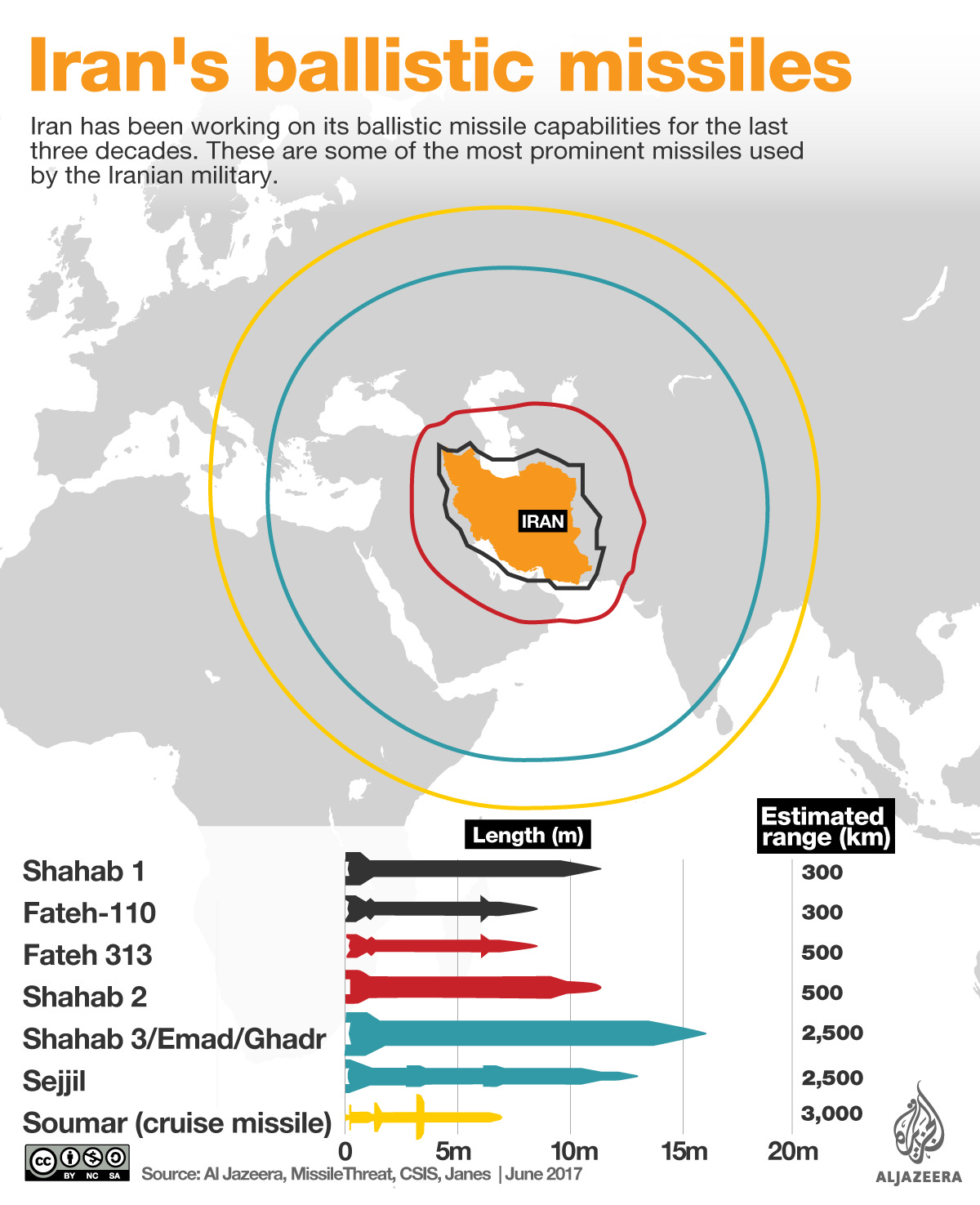
Iranian Ballistic Missiles and Ranges
Had Iran, at that moment in time, opted to follow up with an even larger strike consisting of several hundred of its best ballistic missiles, the US and Israeli defenses would have been penetrated to an overwhelming degree. It would have put to shame the opening-night show of the Americans’ 1991 “shock and awe” cruise missile attack against Baghdad.
Fortunately the Iranians didn’t press the matter, and let their modest yet impressive demonstration of strength suffice for the time being.
In recent months, Iran’s close partner Hezbollah — which is reputed to possess at least 100,000 missiles and drones of various types — has been routinely penetrating Israel’s once-vaunted “Iron Dome” missile defense system.
Indeed, Hezbollah has almost appeared to be mocking the Israelis’ impotence at times.
In any case, the Iron Dome has been revealed to be acutely vulnerable to penetration by Hezbollah drones and missiles.
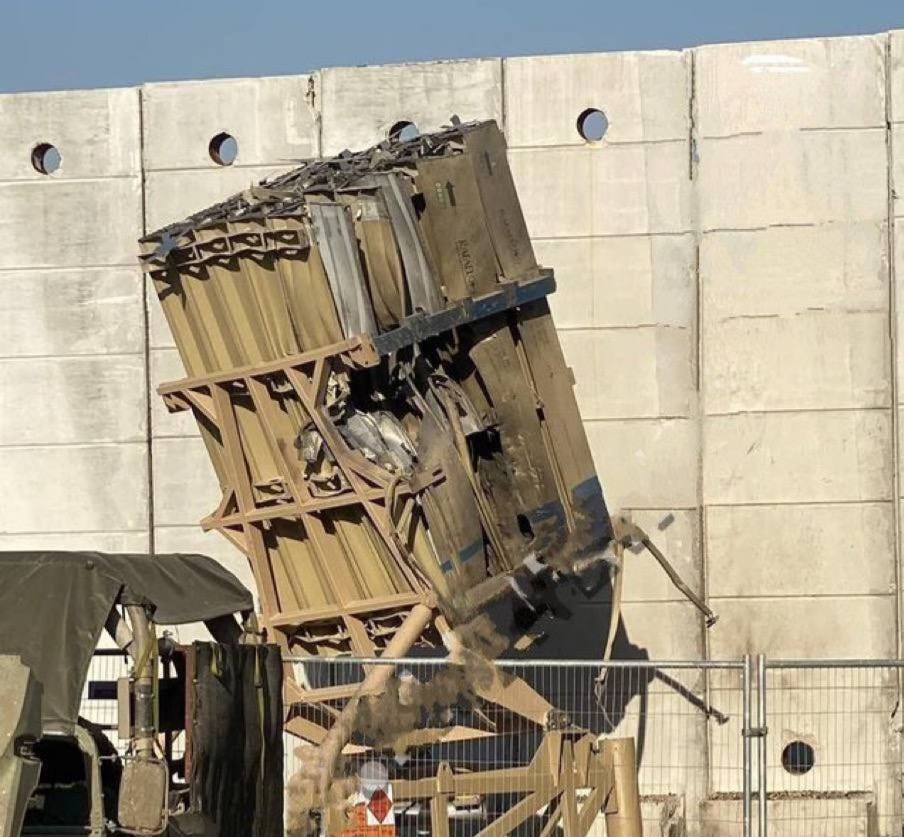
Israeli Iron Dome Launcher Destroyed by Hezbollah Drone Strike
It is not known with precision how many missiles and drones of various types Iran possesses. But it is reasonable to assume that their “magazine depth” is considerably larger than that of Hezbollah.
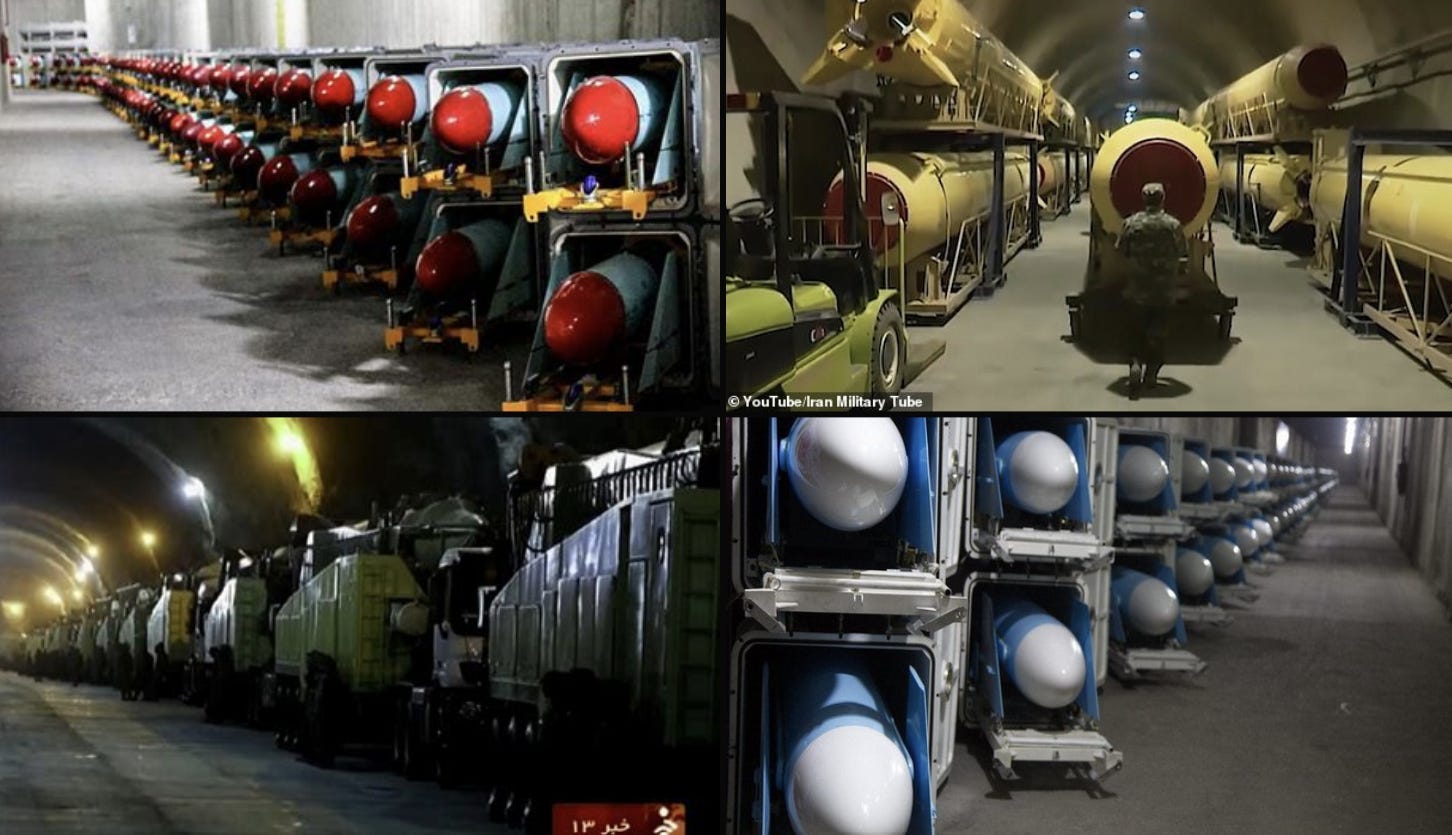
Iranian Missiles
It is also not known with precision how many missiles and drones of various types Russia possesses. But it is reasonable to assume that their “magazine depth” is considerably larger — and exceedingly more potent — than that of Hezbollah and Iran combined.
Even more importantly, the Russians have, over the course of the war in Ukraine, demonstrated an unprecedented capability to routinely shoot down the best strike missiles the US and its NATO vassals have been able to launch against them.
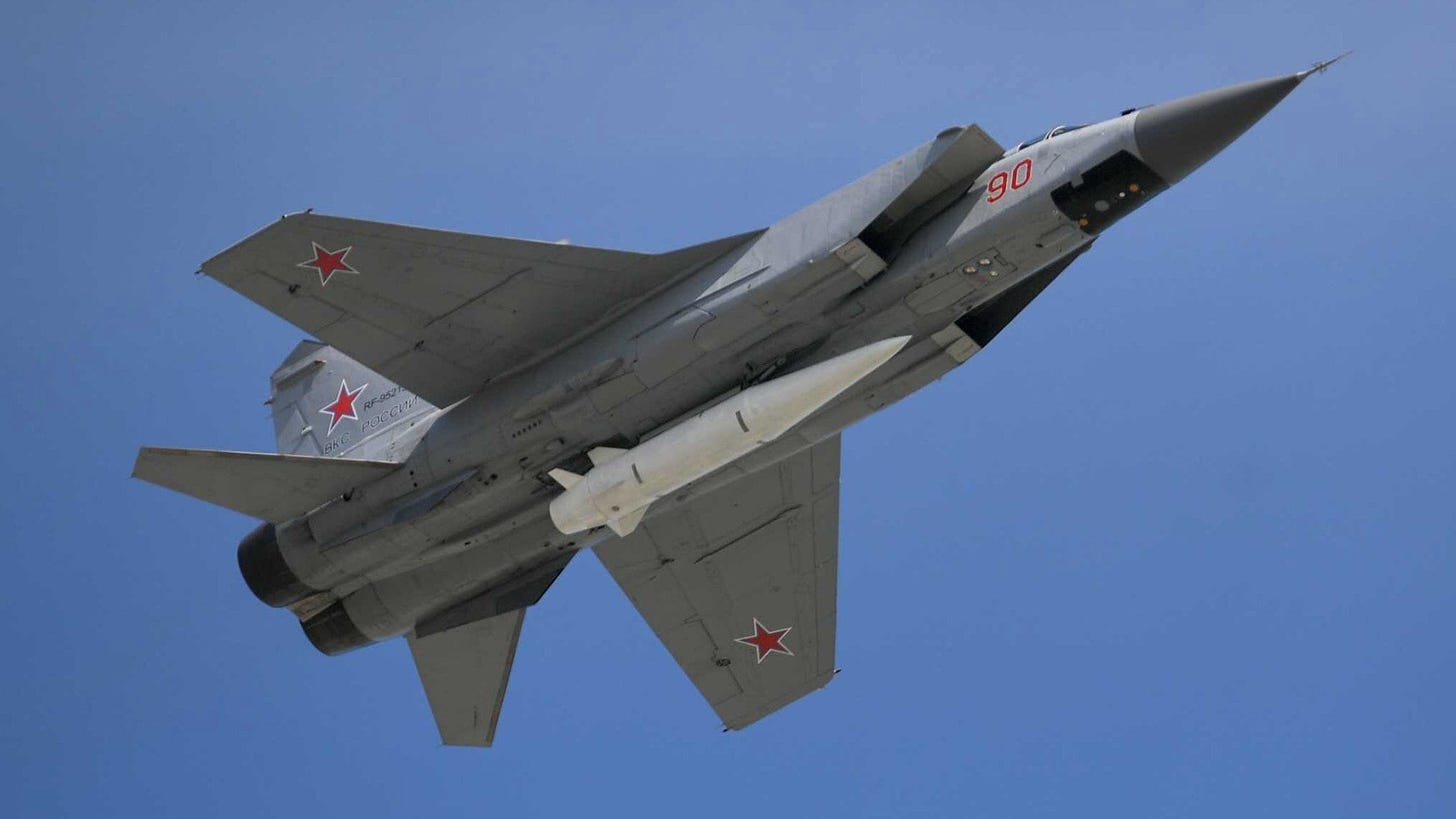
Russian MiG-31 Carrying a Hypersonic Kinzhal Missile
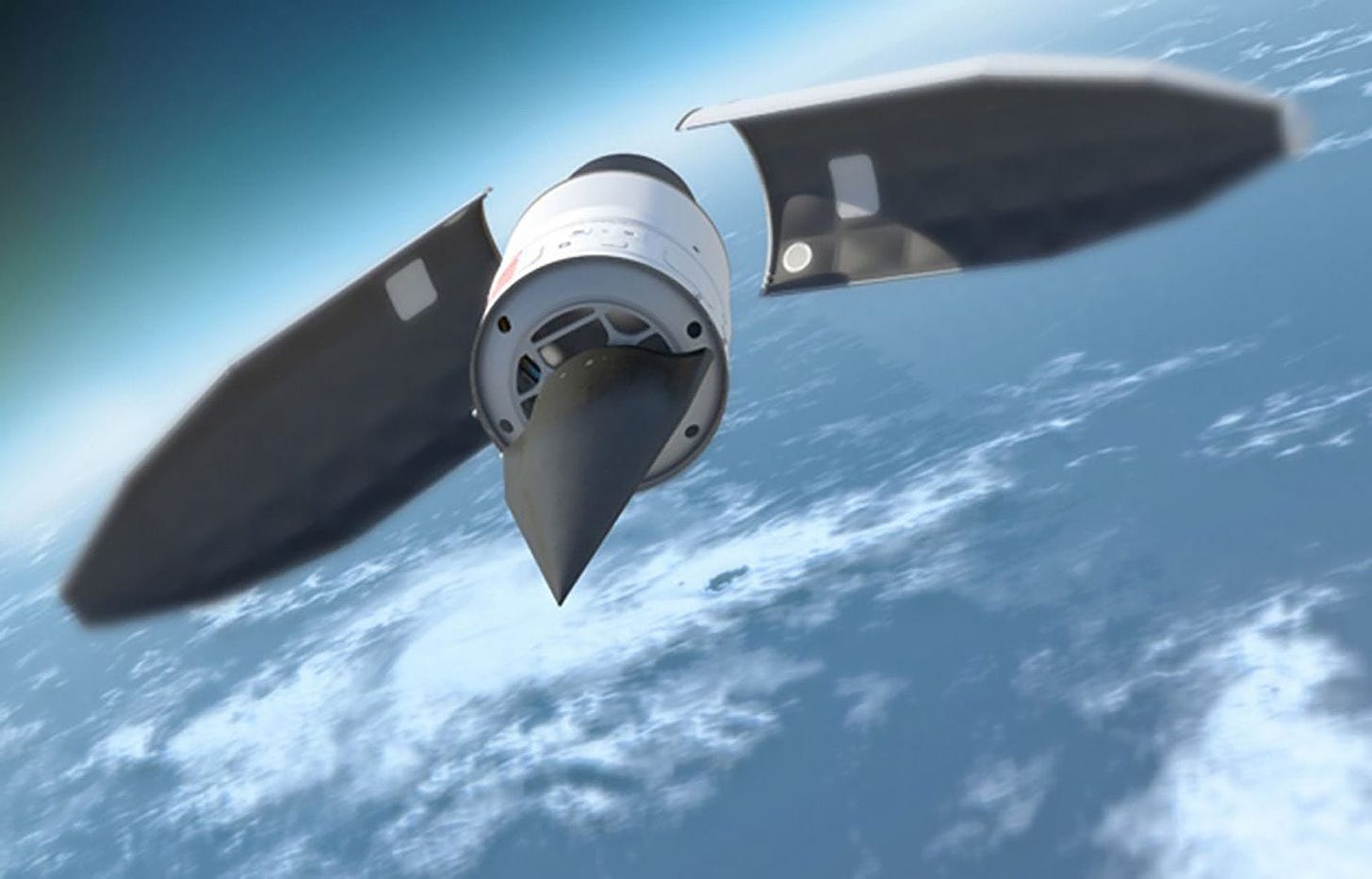
Russian Avangard Hypersonic Missile
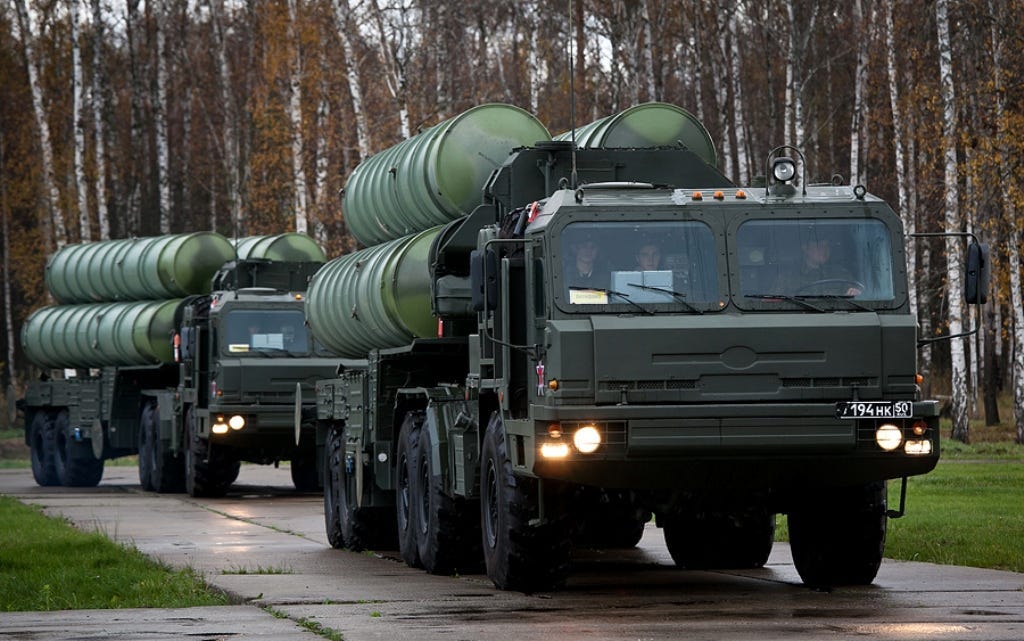
Russian S-400 Air Defense System
Lastly, it is not known with precision how many missiles and drones of various types China possesses. But it is reasonable to assume that their “magazine depth” is at least an order of magnitude larger than Hezbollah, Iran, and Russia combined.
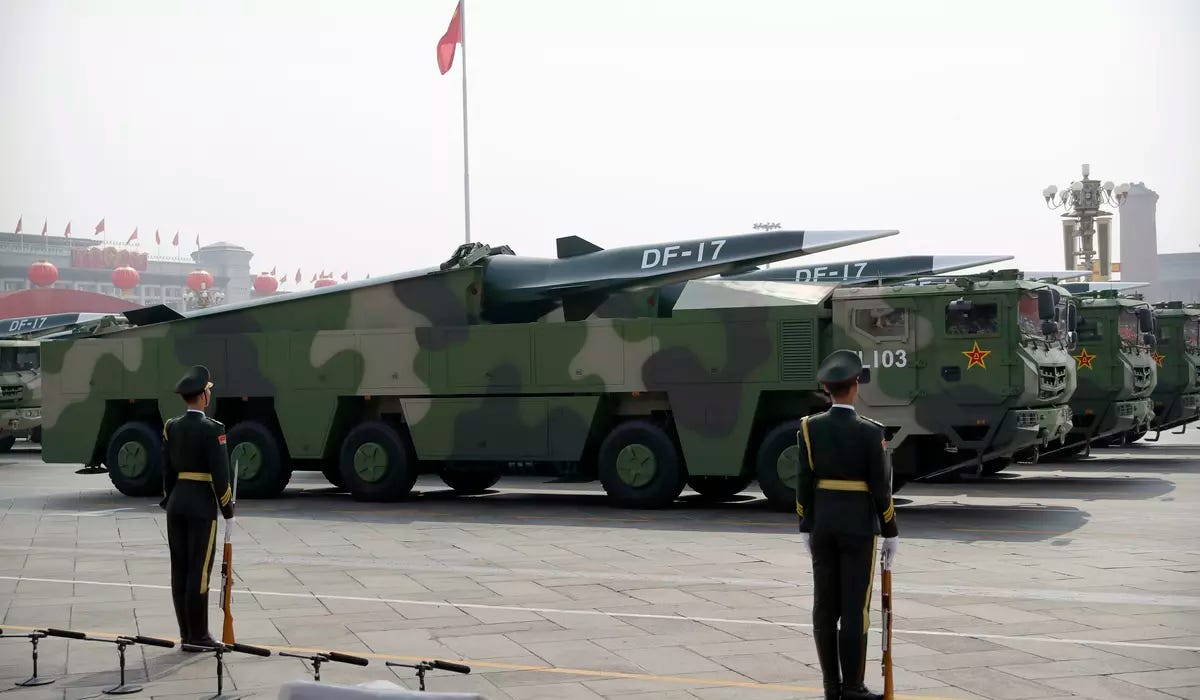
Chinese DF-17 Hypersonic Missiles
Of course, I’ve not yet made any mention of North Korea, who has now been formally received into the Russia, China, Iran mutual-defense partnership. People love to mock Kim Jong-Un and his people, but the empire underestimates them at their peril.
The Israelis can talk tough about making war against Hezbollah and its friends, but if they actually attempt it, it will end very, very badly for them.
The Americans and their almost laughably impotent allies can talk tough about making war against Russia or China, but if they actually attempt it, it will end catastrophically for them.
Then we’ll really have a dangerous situation on our hands.
EU ‘crossed a red line’ by banning Hungary from latest Ukraine vote, says Foreign Minister Szijjártó
BY DÉNES ALBERT | REMIX NEWS | JUNE 25, 2024
The European Union crossed a red line by prohibiting Hungary from voting on the use of the proceeds from frozen Russian bank accounts, said Minister of Foreign Affairs and Trade Péter Szijjártó on Monday.
Speaking during a break in the meeting of the EU’s Foreign Affairs Council, the Hungarian minister said an additional €1.4 billion from the European Peace Facility would be used for arms transfers to Ukraine, despite Hungary’s disagreement.
“This €1.4 billion is effectively the amount of the proceeds of the seized or frozen Russian assets, and since Hungary abstained in the first vote on their use, the Council’s legal service, Brussels, the bureaucrats, and some member states considered that this was a sufficient basis for ignoring Hungary’s right to decide, and so they decided to use €1.4 billion from the European Peace Facility to finance new arms shipments to Ukraine, ignoring Hungary’s position,” he said.
“This is a clear red line. Never before has such a shameless breach and disregard of common European rules been shown. Moreover, it is precisely those who are pushing for the rule of law procedures at full volume and talking about the endangerment of democratic values who are breaking European rules,” he continued.
“The self-proclaimed warriors of democracy and the rule of law have now flouted the rules in the most shameless way possible by excluding Hungary from this decision. So the pro-war fervor has effectively blinded the decision-makers,” he added.
Szijjártó underlined that the EU clearly wants to continue crossing red lines, as evidenced by the fact that High Representative for Foreign Affairs and Security Policy Josep Borrell has this time come up with a proposal to allow the training of Ukrainian soldiers by European troops on Ukrainian territory.
“This is an extremely dangerous proposal. It is a proposal that would cross another red line. We remember the statements of leading Western European politicians during the European Parliament election campaign that European soldiers could and should be stationed, deployed, and sent to Ukraine. And here is the first step,” he said.
“They want to send military trainers to Ukraine. This is unacceptable to us, and we are protesting against it with all means at our disposal because the deployment of EU trainers in Ukraine would create another extremely serious risk of further escalation of the war,” he warned.
Key Talking Points on Current Bird Flu Situation
Knowledge is Powerful Amidst Government False Narrative
By Peter A. McCullough, MD, MPH | Courageous Discourse | June 24, 2024
The McCullough Foundation, informative update on the current H5N1 global situation has received considerable attention and garnered valuable feedback. Here are the key takeaways:
- Practice of culling (mass destruction of entire healthy flocks) when a PCR test is found positive to “eradicate” the virus is futile and may work to constrain the food supply. The current strain H5N1 clade 2.3.4.4.b is not thus far causing necropsy or radiographic confirmed fatal pneumonia in birds or mammals.
- H5N1 host range expansion into migratory birds and mammals likely occurred as a result of gain-of-function serial passage research and a lab leak [or release].
- Increased transmissibility of H5N1 has a tradeoff of decreased virulence. Using legacy human mortality rates from cases in Southeast Asia is not appropriate. The US has never had a fatal human case of bird flu.
- Fear-mongering promulgated by the Bio-Pharmaceutical Complex is designed to promote mass vaccination of animals and humans with lucrative pre-purchased contracts to the vaccine manufacturers and their NGO backers. Mass vaccination into a highly prevalent pandemic promotes resistant strains of the virus in the vaccinated.
- If human-to-human spread occurs in the future as expected by many, it will be the product of gain-of-function research that has gone on for years with the goal of creating harm to human populations.
- Be prepared with early prevention and treatment strategies on hand. Courageous Discourse has covered dilute iodine nasal sprays and gargles, oseltamivir, hydroxychloroquine, and other antivirals. The Wellness Company has extended its Contagion Kit to cover the case of serious human avian influenza in the event it occurs.
Why Israel is Unprepared for War With Hezbollah
By Ekaterina Blinova – Sputnik – 24.06.2024
Israeli Prime Minister Benjamin Netanyahu told the country’s Channel 14 Television that Tel Aviv is ready to move some forces to the north to confront Lebanese resistance group Hezbollah. Could Tel Aviv wage a war on two fronts?
The Israel Defense Forces (IDF) and Hezbollah fighters have increasingly exchanged strikes across Lebanon’s southern border since the beginning of Tel Aviv’s Gaza war launched over Hamas’ attack on October 7 2023.
“From an Israeli perspective it would be very hard to imagine a double front war, even though we know that within the Israeli Cabinet of war, there are many ministries who are willing to try to open the second front with Hezbollah,” Dr Lorenzo Trombetta, Beirut-based scholar and analyst specialising on the Middle East, told Sputnik.
Hezbollah has repeatedly warned it would step up military actions unless Israel stops killing Palestinian civilians in the Gaza Strip.
Hezbollah has intensified attacks over Israel’s Rafah invasion.
Last week Hezbollah Secretary General Seyyed Hassan Nasrallah played down Israel’s threats to launch an all-out war against the resistance group, warning that it has a 100,000-strong military force capable of waging military actions against Israel in all three domains – land, air and sea.
Nasrallah added that the movement does not want a “total war” with Israel and called for a complete and permanent ceasefire in Gaza.
Hezbollah released a nine-minute video last week, filmed from an unmanned aerial vehicle (UAV) which penetrated Israeli air defenses and returned to Lebanese airspace without being detected. The footage shows sensitive civilian and military locations in and around Haifa, one of Israel’s largest cities.
According to some estimates, Hezbollah has up to 150,000-200,000 rockets and missiles and has also mastered the use of unmanned vehicles.
But Dr Hasan Selim Ozertem, an Ankara-based security and political analyst, told Sputnik that a repeat of the Israeli invasions in 1982 and 2006 would bring “catastrophe” to southern Lebanon.
“The plot is valid for a possible operation against Lebanon because looking in the past, in 2006, Israel also could carry out another operation against Hezbollah and, as you remember, left behind a kind of catastrophe in the Lebanese terrain,” Ozertem said. “Israel has all the capabilities, especially the air capability and also land capability to carry out an operation.”
While conceding that the Israeli military capabilities are “very strong and very high,” Trombetta expressed doubts about Tel Aviv’s chances of succeeding in a war against Hezbollah.
“Technically speaking, Hezbollah has drones and mainly it showed recently, during May and June, its abilities to launch soil-air missiles that can hit or can counter not only Israeli drones, the Hermes 450 and Hermes 900, but also Israeli jet fighters,” the pundit said. “So first of all, Hezbollah could try to increase its abilities to defend the Lebanese territory with these surface-to-air missiles.”
“Secondly, they also showed in the last weeks the ability to offend, to pose a threat within the Israeli territories with armed drones, suicide drones, and other flight weapons that breached the Iron Dome system on more than one occasion, even recently,” Trombetta continued.
The Washington-based Center for Strategic and International Studies (CSIS) published analysis in March describing how a potential Israel-Hezbollah conflict in 2024 could be more challenging for Tel Aviv than the 2006 Israeli-Lebanese war.
The think-tank drew attention to the fact that Hezbollah has for years built upon its successful 2006 tactics of “decentralizing its command and control and reorganizing to force the IDF into more urbanized terrain where [Hezbollah] fighters can take advantage of concealed, fortified positions.”
Hezbollah has beefed up its military stockpiles with new weapons over the past 18 years. It has also gained extensive military experience during the war against ISIS and other Islamist terrorists in Syria and has had “access to capabilities and competencies used by conventional armies.”
The CSIS also noted that the geography of southern Lebanon offers advantages for Hezbollah guerrillas, including positions on rocky hills where they can hide and fire rockets, unmanned aircraft systems and anti-tank guided missiles at Israeli positions on the border.
The Israeli Reichman University Institute for Counter-Terrorism assumes that Hezbollah could fire up to 3,000 missiles a day and overwhelm Israel’s air defenses.
The researchers warned that intensive attacks would deplete the Israeli stockpiles of surface-to-air missiles within a few days of combat, exposing the nation to further Hezbollah missile and drone attacks. They argued that Tel Aviv is unprepared for an all-out war with the resistance force.
“We should include also the fact that in case Israel will launch a war against Hezbollah in Lebanon, it is very possible, it is very likely that Iran and other Iranian allies in the region will activate their forces against Israel and the US interests,” Trombetta said, adding that Yemen’s Houthi-led government, the Iraqi Islamic Resistance and others could come to Hezbollah’s aid in the event of an all-out Israeli attack on Lebanon.
Plan to establish US Marine regiment in Guam ‘to escalate camp confrontation, stir up regional tensions’
Global Times | June 23, 2024
The US Marines plan to deploy to Guam a littoral regiment capable of a flexible and rapid response in a “few years,” media revealed on Saturday, which Chinese observers said is aimed at preparing for great power competition, blatantly exposing the US’s combat intentions against China.
On Saturday, Japanese media outlet Kyodo News reported that General Eric Smith, commandant of the US Marine Corps, told a press conference in Washington that the Marine Littoral Regiment is “designed as a counter to PRC aggression,” to protect Japan, South Korea and the Philippines.
Smith said the regiment, due to be based on Guam, “will have responsibility to rapidly deploy inside the first island chain into the Philippines in order to spread the battlespace out and to protect those strategic lines of communication that emanate from Japan, back to the Philippines, back to Hawaii.”
The island chain refers to an area that includes Japan as well as the island of Taiwan and the northwest Philippines.
In the event of potential conflicts with China, such as China advancing its cause of national reunification, or conflicts erupting between China and the Philippines or Japan over territorial disputes, the US may use these deployments to strike against China, Chinese observers noted.
“This demonstrates the US’ relentless preparation to compete with China, with a clear Cold War mentality,” Zhang Junshe, a Chinese military expert, told the Global Times on Sunday.
The plan to establish a littoral regiment in Guam again demonstrated that the US is engaging in camp confrontation, seeking to rally countries like Japan and the Philippines, as well as to strengthen its control over these allies through military deployments and cooperation, enticing them to join the US’ chariot and making these countries work for its anti-China strategy, Zhang said.
This will undoubtedly add fuel to the fire and stir up regional tensions, Zhang warned, noting that the US wants to benefit from the chaos, such as selling more military equipment.
Kyodo reported that the new regiment in Guam will be the third of its kind that is capable of long-range detection and engagement using mobile missile batteries, as well as deploying small groups of marines to remote islands. The first unit was activated in March 2022 on Marine Corps Base Hawaii and the second was set up in Okinawa in November last year.
This exposed the US attempt to adopt a strategy of dispersion of its military forces, as the commandant of the US Marine Corps confirmed that the relocation of US Marines from Okinawa to Guam will begin in December.
Some observers believe that the US military forces’ shift from Okinawa to Guam is a strategic retreat, indicating a lack of security in Okinawa.
But Zhang sees it differently.
“Strategically, the US military is not retreating from Okinawa; it may withdraw its forces, but some weapons and firepower will remain in place. On the one hand, the US is instigating conflicts, while on the other hand, it does not want its forces to suffer losses. Therefore, it is pushing countries like the Philippines and Japan to be firmly tied to its warship as cannon fodder,” Zhang remarked.
Zhang also revealed the ongoing competition between the US Army and the Marine Corps for roles, funds and functions. He noted that the deployment of these assets is not actually the Marine Corps’ expertise, but should instead be a focus of the US Army.
The US Marine Corps primarily focuses on amphibious operations, but now there is a need for the corps to undergo a tactical transformation toward littoral operations, emphasizing land-sea integration. This in itself will bring about significant changes to the Marine Corps’ functions, which presents a considerable challenge, said another Chinese military expert, who requested anonymity.
If the Marine Corps insists on transformation, these disputes with the US Army will intensify, making the regiment’s implementation more challenging, some military experts warned. They believe that in reality, it is impractical for the regiment to target China.
EU to bypass Hungarian veto on tapping Russian assets – FT
RT | June 24, 2024
The European Union has developed a scheme to use profits from frozen Russian assets to secure a $50 billion loan for Ukraine, which will be used to purchase arms, the Financial Times reported on Monday, citing the bloc’s top diplomat, Josep Borrell and other sources. The loophole effectively bypasses Hungary’s opposition to legislation that would have allowed the EU to hand over interest accrued on Russian funds to Ukraine.
In an interview with the FT, Borrell said that since Budapest had opposed an EU agreement to transfer revenue to Ukraine, it “should not be part of the decision to use this money.” He added that the bloc’s workaround was “sophisticated as every legal decision, but it flies.”
The West froze around $300 billion in Russian sovereign assets when the Ukraine conflict escalated, trapping around $280 billion in the EU.
Earlier this year, Brussels proposed seizing the interest earned on the assets to acquire weapons for Ukraine. The suggestion faced resistance from Hungary, a vocal critic of the West’s approach to the Ukraine conflict, particularly its arms shipments to Kiev.
Under the US-led initiative, proceeds generated by Russia’s frozen assets from next year will be used to pay off the loan.
The legal loophole allowing the EU to tap Russian assets is likely to suffice in guaranteeing the payout of the loan, the outlet said, citing officials familiar with the matter.
However, Budapest can still block an EU decision to extend sanctions on Russian funds, which has to be renewed every six months by the bloc’s 27 members, the officials added.
To placate Hungary, the EU proposed a deal under which its share of the bloc’s funds would not be used to purchase weapons for Ukraine in exchange for not vetoing other members transferring the revenue to Kiev, according to Borrell.
“We have offered Hungary: your money will not be used to support Ukraine in any means. Not just lethal, but on anything,” Borrell said. The proposal, however, has been rejected by Budapest.
Moscow has denounced the decision to transfer profits from its assets to Ukraine as a blatant and illegal “expropriation.”
Pentagon has ‘nothing to say’ about strike on Crimean beach with US-supplied weapons
RT | June 24, 2024
The Pentagon has refused to comment on the deadly Ukrainian cluster munition attack on a crowded beach in Sevastopol, Russia on Sunday, RIA Novosti has reported. The Ukrainian attack carried out with US-supplied ATACMS missiles killed at least four people, among them two children, and injured 151, according to local officials.
Four missiles were intercepted by air defenses, while a fifth deviated from its trajectory and detonated its cluster warhead over the busy Black Sea beach, the Russian Defense Ministry said in a statement on Sunday.
When RIA asked the Pentagon about the use of US supplied weapons in the strike on Sunday, an official replied, “we have seen the reports and have nothing to say.”
Moscow has placed the blame primarily with Washington, accusing it of enabling the “premeditated terrorist missile attack.” The targets for these US-provided missiles are assigned to Ukrainian troops by American specialists, based on their own intelligence data, the Defense Ministry stated.
According to data from the flight tracker Flightradar, a US RQ-4B Global Hawk reconnaissance drone was patrolling in the Black Sea south of Crimea during the Ukrainian missile strike.
The number of people injured in the strike stood at 151 as of Sunday night, according to Sevastopol’s governor, Mikhail Razvozhaev. A joint team of specialists from the Health Ministry’s Federal Center for Disaster Medicine arrived in the city to work with the victims, he wrote early Monday.
Kiev deliberately chooses mass gatherings of people as targets, both out of hatred and to sow panic, Russian Foreign Ministry spokeswoman Maria Zakharova said following the attack. The day of the Holy Trinity holiday was picked deliberately, she claimed.
Ukraine has previously targeted the Crimean Peninsula with US-provided ATACMS missiles. In May, ten ATACMS were shot down on a trajectory aimed at the strategic Crimean Bridge, Russian Defense Minister Andrey Belousov said at the time.
Israel and Hezbollah on the brink of war
By Steven Sahiounie | Strategic Culture Foundation | June 23, 2024
The Middle East is sitting on a powder keg, and every minute that passes brings heightened tensions between Israel and Hezbollah.
Canada, the U.S., Great Britain and Kuwait have all warned its citizens in Lebanon to evacuate.
The impending war is caused by Israeli refusal of a ceasefire in Gaza. Hezbollah says they will continue to stand in solidarity with the Palestinians of Gaza as the continuing genocide is perpetrated by Israel, but as soon as a ceasefire begins, Hezbollah’s response will cease.
Hezbollah is a Lebanese resistance group which is heavily armed. Most experts agree that the military might of Hezbollah and Israel are quite comparable on many levels, but Israel has air superiority.
Israel has a sophisticated air defense system, the ‘Iron Dome’. However, this system can be overwhelmed by Hezbollah if they were to launch a massive amount of missiles at Israel, and all agree that Hezbollah has a huge arsenal of missiles.
If the ‘Iron Dome’ was inundated by missiles launched from Lebanon, the effectiveness of the Israeli defenses would stop, and Israel could suffer destruction on a scale it has never experienced before. We have witnessed the destruction of Israeli missiles on Gaza, and homes and buildings across Israel could face a similar disaster.
Hezbollah demonstrated it has an air defense system, but it has been secretive in showing the capabilities of its defense from Israeli jets; however, on at least one occasion Hezbollah utilized their air defenses to repel an Israeli jet flying over Lebanon.
Amos Hochstein, the U.S. special envoy dispatched recently to Israel and Lebanon in hopes of averting a war between Israel and Hezbollah, came back empty-handed. Hochstein had been successful in a negotiation between Israel and Lebanon in 2022 over the maritime borders, but this time he was not negotiating with the Lebanese government alone, but with the most powerful resistance group in the Middle East.
The root cause of all conflicts in the Middle East emanate from the brutal Israeli occupation of Palestine, which has stripped away all human rights, and civil rights, from about six million Palestinians, while the six million Jews in Israel live in a quasi-democracy with human rights and civil rights comparable to most western democracies.
U.S. President Joe Biden and U.S. Secretary of State Antony Blinken have repeatedly told Israeli officials the U.S. does not want to see a wider war in the Middle East, where other nations could be involved should Lebanon face destruction.
Israeli Prime Minister Benjamin Netanyahu has warned Israel would “turn Beirut into Gaza” in the event of a war.
Experts agree that Biden would continue to support Israel even in the face of a war on Hezbollah. The international community has come out against Israel and its genocide on Gaza, but Biden continues to support war crimes and crimes against humanity committed by Israel.
Biden has sponsored a ceasefire plan, but Israel refused it, and experts suggest that the Biden plan was not designed by Washington to succeed, but was drafted only as an exercise in buying time for Israeli Prime Minister Benjamin Netanyahu.
The Israeli public and military are divided on the war on Gaza. Many are demanding Israel stop the war and get the hostages out after almost 9 months of captivity. Others support the war on Gaza as part of the Zionist plan to eliminate all non-Jews and create one Jewish nation from the ‘river to the sea’.
Netanyahu firmly demands the continuation of the war on Gaza and demands that Hamas be destroyed, but his military leaders have said that is an impossible task, as Hamas is an ideology, that of resistance to occupation, which is guaranteed to all people through the Geneva Convention.
On June 18, the Israel Defense Forces (IDF) said plans for an attack in southern Lebanon had been approved and steps had been taken to “accelerate readiness in the field.” The statement came from Major General Ori Gordin, the head of IDF Northern Command, and Major General Oded Basiuk, who heads the IDF’s Operations Division.
Israeli Foreign Minister Israel Katz threatened Hezbollah that they faced “destruction” amid “all-out war” at the Israel-Lebanon border.
Katz’s threat came after Hezbollah published a surveillance video that it took by a drone over various Israeli military, infrastructure and civilian installations, including some in the Israeli port city of Haifa.
“In an all-out war, Hezbollah will be destroyed and Lebanon will be severely hit,” Katz wrote on X.
On June 21, Hezbollah said it fired dozens of rockets into northern Israel in retaliation for a deadly air strike in south Lebanon that Israel said killed one of the group’s operatives. Hezbollah also claimed several other attacks on Israeli troops and positions over the course of the day.
In a meeting with visiting Israeli officials in Washington, Blinken underscored “the importance of avoiding further escalation in Lebanon and reaching a diplomatic resolution that allows Israeli and Lebanese families to return to their homes”, according to a statement.
Hezbollah chief Hassan Nasrallah had warned “no place” in Israel would “be spared our rockets” if a wider war began, in a TV address on Wednesday. He also threatened Cyprus if it opened its airports or bases to Israel “to target Lebanon”. Cyprus houses two British bases, including an airbase.
Israel invaded and brutally occupied Lebanon from 1982 to 2000. Its withdrawal was a victory for Hezbollah. In 2006, Israel launched a second war on Hezbollah which saw Israel prevented from invading by the might of Hezbollah, and in the following years the resistance group has gotten much stronger militarily.
Dozens of Israeli towns are now deserted, with around 60,000 Israelis evacuated to temporary accommodation, while about 90,000 have also fled from southern Lebanon.
Israel has launched roughly four times as many attacks as Hezbollah over the course of the conflict, according to the Armed Conflict Location and Event Data Project, a Wisconsin-based research group specializing in conflict data analysis. Last week, Israel made its deepest attack yet into Lebanon, striking 75 miles north of the border.
Israeli troops have also deployed white phosphorus in Lebanon, a substance that burns at high temperature and can be used to create smokescreens to obscure troop movements, but can cause respiratory damage and deadly burns. Its use near civilian areas is a violation of international humanitarian law.
“It’s not a question of if it will happen but when it will happen,” Avichai Stern, the mayor of Kiryat Shmona, the largest town in Israel’s north, said in an interview, and added, “We have to wipe them out.”
The war between Israel and Lebanon can be avoided if Israel will stop the unrelenting attacks on Gaza, which have resulted in over 36,000 deaths, mostly women and children.
Ex-DoD Analyst Derides Bid to Upgrade Outdated B-52s With Nukes
By Svetlana Ekimenko – Sputnik – 23.06.2024
The defense policy bills for fiscal year 2025 in both the US Senate and House include funding to enhance the nuclear weapon capabilities of approximately 30 B-52H Stratofortress bombers. However, the Pentagon is not enthusiastic about the proposal and instead favors a more expensive option of investing in a next-generation nuclear-capable bomber.
Congress’ bid to restore the B-52 bombers’ nuclear capabilities comes in the wake of repeated disappointments in developing US hypersonic standoff weapons, retired US Air Force Lt. Col. Karen Kwiatkowski told Sputnik.
“Putting nukes back on the upgraded B-52 is a band aid that covers that,” said the former analyst for the US Department of Defense.
“It is important to note that Congress and the Pentagon have already approved and funded engine, avionics and radar upgrades for the nearly 60-year-old B-52 airframe. The B-52H models will be designated B-52J’s, upon upgrade. This was justified several years ago with the B-52Js as a delivery mechanism for planned AGR-183 hypersonic missiles – a missile tested by the Air Force, but one that is no longer being funded in the FY2025 defense budget,” she underscored.
Dozens of the Pentagon’s hypersonic missile projects for the Army, Air Force, Navy, and DARPA have suffered setbacks, despite a desperate race to catch up with Russia and China in this field.
The hypersonic weapon that was in development by the Pentagon, the Air-Launched Rapid Response Weapon (ARRW), had been mired in delays and test failures. The weapon was to be fired from beneath the wing of a B-52 Stratofortress bomber and also contain a glide vehicle. The ARRW program, launched in April 2018, was to achieve operational deployment in 2022. However, in November 2023, after conducting two test flights in August and October 2023, the Fiscal Year 2025 budget provided no funding for procurement or further research and development of the AGM-183, effectively ending the project.
“The initiative will be costly and profitable for the defense industry, and in practical terms it keeps the B-52 in the game for tax-payer dollars. It is somewhat practical, as nuclear re-arming of the new B-52J model, as it completes other B-52 upgrades, fits well in the Boeing and Northrup Grumman industrial base,” noted Kwiatkowski.
It’s really all about the Congressional lobbyists, the ex-DoD analyst pointed out, clarifying that in the House, “Congressman Mike Rogers is the second-highest recipient of defense lobby money; In the Senate, Deb Fischer’s top donor is Northrup-Grumman a major missile developer, and Boeing, the maker of the B-52, is her fourth-largest donor.”
The conventional B-52H Stratofortress bombers had been part of the US nuclear triad close to a decade ago. However, under the New START treaty with Russia, the planes were stripped of these capabilities. With the treaty set to expire in February 2026, there is a drive to “beef up the US nuclear arsenal”. Congress has been advocating making the old bombers nuclear capable again, but the idea does not appear to be viewed favorably in the Pentagon.
“The treaty expires in 2026, and… We need to be prepared to face a nuclear environment without any treaty limitations,” said House Armed Services Chairman Mike Rogers, R-Ala., as he introduced the amendment to the passed FY25 defense policy legislation. In line with that bill, the Air Force would start upgrading the bombers within a month after the accord expires. Accordingly, it is hoped that the restoration of the B-52’s nuclear capabilities might be completed by 2029.
Democrat Congressman Adam Smith of the Armed Services Committee had voiced opposition, and was cited as saying:
“The Department of Defense is not interested in doing this… What they’re interested in doing is investing in the B-21, which is the next generation nuclear-capable bomber. This would cost a great deal of money. Also, they’re currently trying to extend the life of a number of B-52s out to 2050, which they think they can do. This would be another added expense to that.”
The Senate Armed Services Committee also voted to advance its version of the bill on restoration of nuclear capabilities of the fleet of bombers dating back to the 1960s.
Kwiatkowski dissected the features of the B-52 bomber that originally made it a suitable aircraft for nuclear warheads’ deployment during the Cold War, singling out such aspects as “manned crews, ability to fly long distances, with refueling carried out in safe airspace.”
These aspects, as well as the “relatively long lead time from launch of aircraft to actual release of nuclear weapons allowed time for recall, and the application of better intelligence and diplomacy,” she said, adding:
“Today, the push is for unmanned or smaller crews to fly the upgraded B-52 (reducing the need for human decision-making and debate once launched), and today, no airframe that flies as slow and ‘unstealthy’ as the B-52 would be safe after take-off and in flight, given intelligence and defensive capabilities of the target countries and their allies.”
The New Strategic Arms Reduction Treaty entered into force in 2011. Ten years later, Russia and the US negotiated an extension until February 2026. Amid NATO’s proxy war in Ukraine, Moscow suspended its participation in the accord on February 21, 2023.
At the time, President Vladimir Putin during his February 2023 speech to the Federal Assembly referenced everything from Washington’s unilateral withdrawals from milestone strategic weapons treaties, to NATO’s enlargement towards Russia’s borders in violation of previous verbal agreements.
Moscow added that it would continue to comply with quantitative restrictions on strategic offensive arms and exchange notifications with Washington about ballistic missile launches. In June, the US announced its “countermeasures” in response to Russia’s suspension of the treaty. Both sides say they continue to abide by New START’s numerical limits.
Karen Kwiatkowski stated that it is clear why the Department of Defense is against the proposition of upgrading the outdated bomber aircraft fleet. She indicated that the DoD recognizes the vulnerabilities and the high cost associated with such a project.
“Upgrading the B-52 is largely a political statement rather than a serious “pillar” in the old concept of US nuclear triad. Nuclear armed B-52s, instead of serving as a signal to an enemy that nuclear war can be prevented even after launch as it was throughout the Cold War, today would simply be a late-to-the-party nuclear suicide drill,” remarked the retired US Air Force officer.
She lamented the fact that there are currently “no statesmen in the West interested in preventing nuclear war, as we had during the Cold War.” No matter how much the range of the B-52 is upgraded, these outdated planes will never be able to “fully capitalize on the current advances in technology and stealth,” remarked the expert.
“Pentagon thinking has one foot in the past (a triad that includes bombers because we have always done it that way) and one foot in the future – irreversible attacks and hostage-holding strategies via high-speed, radar-evading missiles and other weapons launched from land, sea and space. This straddling of past and future delivers the B-21 [Raider aircraft] – a platform that is profitable for manufacturers but unlikely to truly function as planned in coming decades. But that is where US defense path dependency has brought us,” Kwiatkowski pointed out.
On a personal note, the former DoD analyst suggested it would be both “cheaper and wiser” to upgrade the B-52 with its human pilots than the B-21 Raider, which is “little more than another unmanned stealth missile.” After all, she summed up, such a platform would not provide any “additional ability, stability or political motivation for political leaders to approach an actual nuclear war cautiously and wisely” in the multipolar world.
“If war is politics by other means, a manned nuclear weapon that can be aborted mid-flight is better than an AI-driven nuclear event that politicians will later claim “wasn’t their fault” or was “hacked,” said Kwiatkowski.
Advantage Hezbollah
By Alon Mizrahi | June 23, 2024
Remember last week’s video from Hezbollah, with the drone over Northern Israel?
Well, there’s a new one, and it is also very interesting. It doesn’t look like footage from a drone, but rather like satellite imagery.
But this is not Google Earth or some nonsense like that. No publicly accessible satellite service will show you Israel’s top security sites. Try it. You’ll get nothing. It’s all blurred out.
So by publishing this Hezbollah accomplished two goals: first, they know many Israeli secrets and their specific locations. Second, they have access to high-quality satellite imagery.
This means Hezbollah can not only potentially hit sensitive sites with high accuracy. What it also means, and is just [as] problematic for Israel, is that Hezbollah may be able to track the movements of Israeli forces deep in Israeli territory in relative real-time. A capability no enemy of Israel ever had while directly involved in an armed conflict against it.
We know that Iran has dozens of satellites in space, some capable of state-of-the-art high resolution. When Israel fought Hezbollah in 2006 Iran had no such capability. Today it is a major international satellite powerhouse, using domestically-developed missiles and launchers.
Trump Vows to Settle Ukraine Conflict Even Before Taking Office If Reelected
Sputnik – 23.06.2024
Former US President Donald Trump has vowed to settle the military conflict between Russia and Ukraine even before his inauguration in case he wins the 2024 presidential race.
“Before I even arrive at the Oval Office, shortly after we win the presidency… I will have the horrible war between Russia and Ukraine settled,” Trump said on Saturday during a rally in Philadelphia.
During his speech, Trump also vowed to prevent World War III.
The US presidential election will be held on November 5. The main rivals in the race are US President Joe Biden, a Democrat, and his Republican predecessor, Donald Trump.
Earlier in the week, Trump said in an interview with the All-In podcast that it is understandable that Russia would be bothered by NATO troops on its border, adding that NATO’s eastward expansion was a key reason for the Ukraine conflict. Trump vowed to not put US troops on the ground in Ukraine if he returns to the White House.
Ukraine attacks Crimea with US-supplied missiles – Russian MOD
RT | June 23, 2024
The Ukrainian military has launched several US-made ATACMS long-range missiles armed with highly controversial cluster munitions on Russia’s Crimea, resulting in numerous civilian casualties, the Defense Ministry in Moscow has said.
The strike was first reported by Sevastopol Governor Mikhail Razvozhaev on Sunday, who said that the attack killed at least three people, including two children. He also estimated the number of injured at almost 100 people.
The Russian Defense Ministry has confirmed the Ukrainian attack, which it said took place at around noon local time. Officials said that the shelling involved five ATACMS missiles, four of which were destroyed mid-air.
The remaining one, however, was damaged by air defenses, veered off course and detonated over the city of Sevastopol. As a result, the falling fragments of cluster munitions led to numerous civilian casualties, the statement read.
Сluster munitions – which scatter dozens of smaller bombs when denotated – are banned in more than 100 countries, including the UK, France, and Germany. This type of weapon is considered extremely dangerous to civilians, as the munitions typically spread over large areas and can remain unexploded in the ground for many years.
Neither the US, Ukraine, nor Russia has signed the Convention on Cluster Munitions. However, in the summer 2023 then-Russian Defense Minister Sergey Shoigu said that Moscow would not deploy this type of weapon against Kiev for humanitarian reasons. He warned, however, that Russia might potentially reverse this policy.
The US announced in July 2023 that it would provide Ukraine with cluster munitions, sparking outrage in Moscow. At the time, US President Joe Biden called the decision “very difficult” but justified, arguing that the deliveries were needed to fuel a Ukrainian counteroffensive that subsequently failed with heavy losses for Kiev.
Ukraine has previously attempted to target the peninsula with ATACMS missiles, with one of the most notable attacks taking place in late May. Russian Defense Minister Andrey Belousov said that a total of ten ATACMS aimed at the strategic Crimean Bridge were shot down, saving hundreds of lives.
Featured Video

Rewriting the risk? Inside the government’s vaccine safety messaging
or go to
Aletho News Archives – Video-Images
Book Review
“Davos Can Really Replace the UN”
Inside the book that maps the architecture behind global governance — from the Epstein files to the Pact for the Future
Lies are Unbekoming | April 1, 2026
On June 13, 2019, the United Nations and the World Economic Forum signed a partnership deal to “accelerate the implementation of the 2030 Agenda for Sustainable Development.” That same evening, WEF president Börge Brende — Norway’s former Foreign Minister — had dinner with Jeffrey Epstein at Epstein’s Manhattan townhouse. The Epstein files, released January 2026, contain an exchange between the two from the previous year. Epstein to Brende: “Davos can really replace the UN. C21, cyber, crypto . genetics… intl coordination.” Brende back to Epstein: “Exactly — we need a new global architecture. World Economic Forum (Davos) is uniquely positioned — public private.”
The next day, the UN General Assembly adopted the framework for restructuring global governance.
That sequence — the partnership signing, the Epstein dinner, the candid admission about replacing the UN with a public-private architecture, and then the formal adoption — opens Jacob Nordangård’s The Digital World Brain. Pages two and three. Footnoted to the UN resolution number, the Epstein files, and the General Assembly record.
I keep coming back to it because it captures what this book does that almost nothing else in the independent research space manages. I’ve followed Jacob’s work for years now and interviewed him about his research. Each book peels back another layer of the same institutional architecture, and each time I think he’s reached the limit of what can be documented, the next one goes further. Nordangård doesn’t speculate. He doesn’t editorialize much. He lays institutional actions next to each other in chronological order and lets the pattern announce itself. … continue
Blog Roll
 Aletho News
- REWRITING THE RISK? INSIDE THE GOVERNMENT’S VACCINE SAFETY MESSAGING
- “Davos Can Really Replace the UN”
- NIAID/NIH and USDA Fund Bioengineered Chimeric Influenza Viruses Built Using Pandemic H1N1 Components: Journal ‘Science Advances’
- Hezbollah hits Israeli warship off Lebanon’s coast, sets it aflame
- Iran slams US strikes on B1 bridge, Mahshahr petrochemical plants as ‘blatant acts of state terrorism’
- In letter to UN chief, Araghchi warns of dire consequences of US-Israeli attacks on Iran’s nuclear facilities
- Why the CIA conspiracy to invade Iran with Kurdish militias failed
- Why Are Upbeat US Claims About Mission to Rescue Pilot ‘Highly Questionable’?
- Aircraft destroyed during US ‘rescue’ of downed F-15 pilot cost more than $100 million each
- Washington University removes professor who condemned US-Israeli war on Iran
- If Americans Knew
- In Iran, Israel-US take aim at “reason, research, and freedom of thought” – Daily Update
- US loses planes over Iran, Israel downgrades Lebanon war goals – Daily Update
- Israel Is Blocking Palestinians from Easter at Church Where Jesus Resurrected
- Plot to assassinate Palestinian activist follows harassment campaign promoted by Zionist groups and elected officials
- Prominent New York synagogue hosts presentation on why U.S. Jews should support the ethnic cleansing of Gaza
- Tapper vs. Piker: Is the CNN Anchor Auditioning for David Ellison?
- Shouldn’t Democrats Be Able to Condemn Genocide?
- Israel-US kill negotiators, destroy civilian structures, but Iran’s military capabilities still largely intact – Daily Update
- ‘War crime’: Global condemnation as Israeli ministers celebrate death penalty law targeting Palestinian prisoners
- 7 Ways Israel Is Turning Lebanon Into Gaza
- No Tricks Zone
- An Inconvenient Tree: Uncovered In Alps… Europe Much Warmer Than Today 6000 Years Ago
- New Study Reports A 60% Slowdown In Greenland’s Ice Loss Rate In The Last Decade
- Low Intensity Tornado Wrecks Major Solar Farm, Creating A Potential Toxic Dump
- New Study Finds Warming Saves Lives…Cold Temperatures 12 Times More Deadly Than Excess Heat
- German Science Blog Accuses PIK Climate Institute Of Hallucinating Climate Tipping Points
- Devastating Assessment Of Comirnaty Vaccine By Former Senior Pfizer Europe Toxicologist
- New Study: CO2 Is ‘Effectively Negligible’ As An Explanatory Climate Change Factor Since 2000
- Former Pfizer Toxicologist Dr. Helmut Sterz Tells Bundestag Hearing Pfizer Vaccine Should Have Never Been Approved
- Energy Expert: Germany’s Nuclear Phaseout Was A “500 Billion Euro Mistake”
- New Research: South Australia’s Mid-Holocene Sea Surface Temperatures Were 4°C Warmer Than Today
 Aletho News