Fico: Western-backed political opposition forces triggered assassination attempt
RT | June 5, 2024
Slovak Prime Minister Robert Fico has argued that the assassination attempt that nearly killed him last month emanated from foreign-backed politicians who refuse to accept foreign policies that prioritize Bratislava’s interests over the agendas of major Western powers.
Fico posted a video statement on Wednesday, marking his first public appearance since the May 15 shooting in which he was critically wounded. He credited medical workers with saving his life and said he expects to resume at least some of his work duties by around the end of this month or in early July.
The PM condemned efforts to downplay the assassination attempt and blame it entirely on a deranged gunman. “I forgive him and let him sort out what he did and why he did it, in his own head,” Fico said. “In the end, it is evident that he was only a messenger of evil and political hatred, which the politically unsuccessful and frustrated opposition developed in Slovakia to unmanageable proportions.”
Fico returned to power for a fourth term as prime minister after his Slovak Social Democracy (SMER-SD) party won the country’s parliamentary election last September. He said his wounds from last month’s shooting were so severe that it would be a “minor miracle” for him to resume his work duties within a few weeks. He warned against efforts by political adversaries – including media outlets bankrolled by billionaire political activist George Soros – to shrug off the implications of the attempted assassination.
“I want to ask the anti-government media, especially those co-owned by the financial structure of George Soros, not to go down this path and to respect not only the gravity of reasons for the attempted murder, but also the consequences of this attempt,” Fico said.
The long-time leader added that he had been warning for several months of likely political violence because of the “hatred and aggressiveness” of Slovakia’s opposition parties. He lamented that major Western democracies stood silent as those parties attacked political opponents and stoked hatred.
He warned that more political violence is to be expected if opposition forces continue on their present course. “The horror of May 15th, which you all had the opportunity to see practically live, will continue, and there will be more victims.”
“Violent and hateful excesses against legitimate governmental power are tolerated at the international level without any comment,” Fico added. “The opposition was unable to assess, because no one forced them to do so, where their aggressive and hateful politics had led sections of the society, and it was only a matter of time before a tragedy would occur.”
Fico claimed the parties that ruled Slovakia from 2020 to 2023 did whatever larger Western democracies demanded, including treating Russia and China as “mortal enemies.” The previous Bratislava regime also “looted” Slovak military stockpiles to provide weapons to Ukraine, he added. After returning to power in October, Fico’s government halted such aid, raising the ire of NATO powers.
“It is precisely the conflict in Ukraine that the EU and NATO have elevated even more, literally sanctifying the concept of the single correct opinion – namely that the war in Ukraine must continue at any cost in order to weaken the Russian Federation,” Fico said. “Anyone who does not identify with this single mandatory opinion is immediately labeled as a Russian agent and politically marginalized internationally. It is a cruel observation, but the right to a different opinion has ceased to exist in the EU.”
Putin outlines Russian response to long-range strikes
RT | June 5, 2024
Russia is considering “asymmetric” measures against Kiev’s sponsors due to Ukraine’s use of Western-supplied weapons against its territory, Russian President Vladimir Putin has said.
The Russian leader’s remarks came at a meeting with heads of international news agencies on Wednesday, on the sidelines of the St Petersburg International Economic Forum (SPIEF).
“We have no illusions in this regard,” Putin added, repeating his prior comments that Ukrainian troops might be pulling the trigger but the US and its allies are providing the intelligence and targeting information.
Russia will respond by boosting air defenses and destroying these missiles, Putin said.
“Secondly, if someone deems it possible to supply such weapons to the war zone, to strike our territory… why shouldn’t we supply similar weapons to those regions of the world, where they will be used against sensitive sites of these countries?” the Russian president added. “We can respond asymmetrically. We will give it a thought.”
If the West continues to escalate, such actions “will completely destroy international relations and undermine international security,” Putin noted.
“If we see that these countries are being drawn into a war against us, and this is their direct participation in the war against Russia, then we reserve the right to act in a similar way. This is a recipe for very serious problems,” he warned.
The Russian president also brought up the fact that some military instructors and advisers from NATO countries have already been deployed to Ukraine, and that a number of them were killed in Russian strikes.
The US and its allies have insisted that providing weapons and equipment to Ukraine does not make them party to the conflict with Russia, and maintained certain restrictions on their use to preserve that perception. Last month, however, as Russian troops began advancing towards Kharkov, Ukraine began to demand the relaxation of those rules. A British-led pressure campaign eventually resulted in Washington complying with Kiev’s wishes.
Building comprehensive, high-level China-Turkey ties in fundamental interests of both countries: Wang Yi
Global Times | June 5, 2024
Building a comprehensive, deep and high-level China-Turkey relationship is in the fundamental interests of both countries and peoples, Chinese Foreign Minister Wang Yi said while meeting with the visiting Turkish Foreign Minister Hakan Fidan on Tuesday.
During the meeting with Fidan, Wang, who is also a member of the Political Bureau of the Communist Party of China (CPC) Central Committee, said that China and Turkey are both ancient civilizations and important members of the G20, and are facing profound challenges in the changing international situation, so the two countries should strengthen communication and coordination to make positive contributions to promoting regional peace and global development.
Wang pointed out that building a comprehensive, deep and high-level China-Turkey relationship is in the fundamental interests of both countries and peoples. China firmly supports Turkey in continuing to explore an independent and self-reliant development path. It also supports Turkey’s efforts to safeguard sovereignty, security, and development interests, and appreciates Turkey’s understanding and support for China’s just position on core interests related to sovereignty, security, and territorial integrity.
China is willing to maintain multi-level exchanges with Turkey, play a good role in mechanisms such as the China-Turkey Intergovernmental Cooperation Committee, promote effective connection between the joint construction of the Belt and Road Initiative and Turkey’s Middle Corridor Initiative, expand cooperation areas, and explore cooperation potential.
China is willing to expand imports of high-quality agricultural products from Turkey, support the continuous improvement of cooperation levels and technological content of enterprises in both countries, and strengthen cooperation in culture, education, tourism, aviation, and other fields, Wang said.
Wang noted that both sides should strengthen coordination and cooperation within the framework of the United Nations (UN) and other multilateral frameworks, support the UN in playing a core role in the global governance system, oppose hegemonism and power politics, oppose a few countries monopolizing international affairs, oppose building walls and barriers, “decoupling” and “cutting off supply chains,” maintain the stable operation of the global supply chain and industrial chain, and promote the establishment of a fair and reasonable global governance system.
Fidan said that Turkey and China have important influence in their regions and globally. The Turkish government attaches great importance to its relations with China, adheres to the one-China principle, and supports China in safeguarding its core interests and major concerns.
China’s development is crucial to world peace and prosperity. Turkey opposes bloc confrontation, does not agree with or support erroneous actions that suppress China’s development, and does not allow any force to engage in activities on Turkish territory that harm China’s sovereignty and security, said Fidan.
The Middle Corridor Initiative is highly compatible with the Belt and Road Initiative, and Turkey is willing to cooperate closely with China to achieve more substantive results in trade, investment, finance, agriculture, tourism, education, and other fields through mechanisms such as the China-Turkey Intergovernmental Cooperation Committee.
Turkey and China are both emerging market powers and members of the G20, with broad common interests in upholding international fairness and justice. Turkey highly appreciates China’s fair and just position on issues concerning Ukraine and the Middle East, and looks forward to working constructively with China to make greater contributions to the prosperity and stability of the region and the world, said Fidan.
The two sides also exchanged views and coordinated positions on international and regional issues of common concern such as Ukraine crisis and Palestinian issue.
During the Tuesday meeting, both sides also agree that it is necessary to promote a ceasefire in Gaza and maintain peace and stability in the Middle East. The Palestinian issue is at the core of Middle Eastern issues. The Gaza conflict is currently the focus, and the priority is to achieve an immediate, comprehensive, and permanent ceasefire, improve humanitarian conditions, and release all detained individuals.
The two-State solution is the fundamental way to solve the Palestinian issue. Both China and Turkey support Palestine becoming a full member of the UN and support internal reconciliation in Palestine. China and Turkey will strengthen cooperation to jointly promote the early and comprehensive, fair, and lasting resolution of the Palestinian issue.
On the Ukraine issue, Wang said that China’s position is firm and consistent, and the aim is to promote peace and dialogue. Although the conditions for negotiations are not yet in place, China is committed to peace and will not stop its efforts. As long as there is a glimmer of hope, every effort must be made to strive for it.
Switzerland is hosting a “Summit on Peace in Ukraine” on June 15 and 16. China confirmed on May 31 that it will not attend the conference, as the meeting falls short of China’s requests, according to Chinese Ministry of Foreign Affairs spokesperson Mao Ning.
However, China encourages and supports all initiatives and efforts around the world that contribute to easing tensions and achieving peace, Wang said, noting that China values Switzerland’s work in preparing for the peace conference and has provided constructive suggestions to the Swiss side, which have been positively evaluated and appreciated.
Wang said China believes that the world needs to hear more objective, balanced, positive, and constructive voices on the Ukraine crisis. China and Brazil jointly issued a six-point consensus recently on promoting a political solution to the Ukraine crisis, emphasizing adherence to the three principles of cooling the situation: no spillover from the battlefield, no escalation of the conflict, and no provocation by any party.
The consensus also calls for all parties to adhere to dialogue and negotiations, increase humanitarian assistance, oppose the use of nuclear weapons, oppose attacks on nuclear power plants, and maintain the stability of the global industrial and supply chains.
Wang said that he had exchanged views with Fidan, who also welcomed and appreciated the six-point consensus.
Within just one week, 45 countries from five continents have responded positively to the six-point consensus in different ways, with 26 countries already confirming their participation or seriously studying how to join, Wang said, noting that Russia and Ukraine, the two main parties involved, have also affirmed most of the contents of the consensus.
This once again shows that the consensus meets the common expectations of most countries. China believes that the more people participate in the joint appeal, the greater the hope for cooling the situation and the smaller the risk of escalation of conflict, said Wang.
The more countries that support the six-point consensus, the brighter will be the prospects for peace. China sincerely welcomes more countries to support and join the consensus, said Wang.
The Kremlin may rest easy: Europe is a paper tiger
By Gilbert Doctorow | June 4, 2024
Having committed to an outlay of 60 euros for a social club luncheon which was to be addressed by the Belgian minister of defense, Admiral Michel Hofman, speaking on how the ministry is preparing for what it calls ‘geopolitical evolution,’ meaning World War III, I was more than a little disappointed to learn, as we were standing by our seats awaiting our ‘at ease’ orders, that our speaker would be a no-show. Apparently he was called away to confer with colleagues in the government, and since this government has only one week to enjoy its perquisites before it is swept away by the June 9th parliamentary elections, the minister’s priorities are understandable if unforgivable from our perspective as paying guests.
Happily, however, at the initiative of the club’s president and of some attendees who have military standing, a chap from the ministry who is responsible for human resources was rushed in, had a quick bite to eat now that we all had advanced to the main course while awaiting his arrival, and then provided us all with what I am about to present below.
For obvious reasons, HR is in the spotlight now that the number one question facing this and other member states of NATO and of the EU is whether they can and will rise to the challenge of a Russian ‘imperialist menace’ and do the right thing, namely impose mandatory military service on the young and swell the ranks of their military forces. At my table, there was already a lively discussion of the socializing benefits of national service for the young, as if this issue were entirely separate from its context of a coming war that will utterly destroy the Continent.
If I may telegraph my punches, the key learning from the talk of our stand-in speaker is that there is no money to pay for masses of conscripts. Indeed, the Ministry is already struggling to cope with personnel costs that eat up between 80 and 85% of the defense budget. Belgium may have just 18,000 men in the services, but it would appear that keeping them in clothes, food and pensions is already a great burden. Moreover, given the professionalization of the armed forces in recent decades, it is estimated that it takes 18 months to bring a new recruit up to speed on the equipment he is supposed to be using on the missions of his units. Six months or even a year in uniform will not do much to make the recruits net contributors to the nation’s defense.
Yes, the Belgian military is tiny. Our admiral has under him a total of 5 mine sweepers, 2 frigates and 2 patrol boats (source: Wikipedia). For that reason the principal concern is the first from among what our speaker called the three ‘coups’ of war making – solidarity with fellow NATO members, self-defense, and facilitating the ‘arrival of the cavalry’ which means giving logistical support through the port of Antwerp to arriving forces and equipment from North America.
After all, in Belgium the second ‘coup,’ defending itself, comes down to air defense, for which it is today utterly unprepared, like all other EU member states, as we know not just from the hints of today’s speaker but from full-blown articles these past several days in The Financial Times. And as for the ‘cavalry,’ it seems that this ministry does not count on the reliability of Washington any longer.
There you have it in a nutshell: Belgium cannot and will not increase its armed forces; and Belgium is wholly committed to solidarity with its NATO confrères for the simple reason that it has no independent military capabilities. Indeed, as our speaker noted, one of the most positive consequences of the Ukraine-Russia war has been to drive solidarity among NATO members to new heights. This can only be to Belgium’s benefit.
Or can it?
Usually in luncheons like this, we have a fairly generous time allotted to Q&A, but today we were running late by the time we reached desert and the microphone was given to only one person. By the luck of being seated close to the dais and of being quickest to raise my hand, that person was me.
And so I posed my question: is solidarity really so fine when the policy of NATO is to issue ever more provocations to the Russians, to pose what they consider to be existential threats, including the shipment of F16s to Ukraine and the latest decision to ‘free the hands of Kiev’ to use the long range missiles being provided to it by the US, by the UK, by France to strike deep into the Russian heartland. If NATO member states are not prepared today physically and morally to enter into a direct, frontal war with Russia then why are we doing this?
Dear readers, you will not be surprised to hear that I got no answer to my question worth repeating.
©Gilbert Doctorow, 2024
Belgium wants to silence Hungary’s anti-war voice, Hungarian FM Szijjártó claims
BY DÉNES ALBERT | REMIX NEWS | JUNE 4, 2024
Belgian Foreign Minister Hadja Lahbib is taking the initiative to exclude Hungary from EU decision-making processes, Hungarian Minister of Foreign Affairs and Trade Péter Szijjártó has claimed.
Speaking in Budapest on Monday, the senior Hungarian government minister accused Eurocrats of wanting to suppress the pro-peace forces and remove the last obstacle to war by silencing and excluding Hungary from strategic talks.
The minister was reacting to a recent statement by his Belgian counterpart who called for the Article 7 rule of law procedure against Hungary to be stepped up, thus depriving Hungary of its voting rights in the Council of the European Union.
He said that those who may have doubted the importance of this week’s European Parliament elections may now be convinced that such a decision has perhaps never been before the Hungarian people, as the war frenzy in Brussels has taken hold and those who are for peace are being silenced.
“There is a lockdown panic, six days to go until the European elections, six days to go before people pull the emergency brake on the pro-war train, which is currently hurtling towards its final destination, a third world war, in a seemingly unstoppable way,” Szijjártó warned.
“On June 9, the European people can pull the emergency brake, but it is clear that in the remaining days, Brussels will continue to do everything in its power to silence all those who speak for peace and against war,” he said.
“The Belgian Foreign Minister is taking the initiative to exclude Hungary so that we Hungarians should not be able to represent our position, that we Hungarians should not be able to express our opinion on what we think about the consequences of our common decisions, that we Hungarians should not be able to say that we do not want to go to war, but that we want peace, that we Hungarians should not be able to say what kind of war madness is going on in Europe today, and that we Hungarians should not be able to say that the threat of a third world war is getting closer,” he said.
“So the importance of June 9 has also increased. We need very strong support, a big victory, to be able to resist the pressure in the weeks and months to come, to be able to speak out strongly for peace, to be able to stand up against the preparations for a third world war here in Europe,” he added.
The move comes just weeks before Hungary is scheduled to take over the rolling EU presidency on July 1 for six months.
Zelensky Says US Hegemony Will End If He Loses, But That Already Happened
By Ian DeMartino – Sputnik – 03.06.2024
In an interview with UK media, Ukrainian President Volodymyr Zelensky made the claim that if former US President Trump gets reelected and cuts off aid to his country, he will become a “loser president” responsible for the US losing its spot as the World’s leader, but that has already happened and it was the US support of Ukraine that hastened it.
Since Russia launched its special military operation in Ukraine, the United States and NATO bet hundreds of billions of dollars that they could propel the Kiev regime to victory by outfitting it with some of the best weapons in NATO’s arsenal.
Despite Russia’s larger economy, population size and military, Ukraine could win, the thinking went, by using the vastly superior NATO weaponry and training. Of course, the US and NATO didn’t hand over their very best weapons right away, but it would surely be enough to defeat the Russian army that was portrayed as ill-equipped and untrained in Western media outlets.
When that didn’t work, NATO and the US upped the stakes, giving newer and ostensibly even more invincible weapons to Ukraine, they too failed.
Now, armed with the best weapons NATO could afford to give away, and full permission to strike inside Russia despite the risk of escalation, Ukraine is still being defeated on the battlefield. The whole world has seen for itself that NATO weapons are not equipped with force fields; they can be destroyed and are being destroyed at an alarming rate.
Last year, Trump claimed that he would end the conflict in Ukraine “within 24 hours” though he did not specify how he intended to accomplish that. When asked who he wants to win, Trump would only say that he wants “everyone to stop dying.”
In his interview with the Guardian, Zelensky admitted that he had not developed a strategy to deal with Trump should he become elected, and seemingly admitted that his country would collapse without US support.
“Ukraine, barehanded, without weapons, will not be able to fight a multimillion army,” he said.
“Does he [Trump] want to become a loser President? Do you understand what can happen?” he added, then saying that if Ukraine loses, it means the US will lose its power in the world as well.
“This is not about him as a person, but about the institutions of the United States. They will become very weak. The US will not be the leader of the world anymore. Yes, it will be powerful, first of all, in the domestic economy because it has a powerful economy without a doubt. But in terms of international influence it will be equal to zero,” the Ukrainian President who has utilized Martial Law to stay in office past his term said.
Of course, the opposite is true. The longer NATO and the US remain involved in Ukraine, the more thoroughly the veneer of NATO invincibility will be shattered. If they continue to increase their involvement and escalate things against Russia, it will only expedite the fall of Western hegemony.
“This is a decisive defeat of NATO, the European Union and the United States” former UN weapon inspector Scott Ritter told Sputnik’s Fault Lines last month. “It’s as decisive as you can get without them being directly involved, and they can’t become directly involved because that is a suicide pill.”
Over the last few weeks, NATO nations started giving the Kiev regime permission to strike inside Russia, culminating in the United States agreeing to it last week, but that too has failed to result in any meaningful change of the battle lines.
“But [Kremlin spokesman Dmitry] Peskov pointed out, you start using long-range missiles against Russia, we’re just going to have to take more of Ukraine [to build a bufferzone]. That’s what he said and he specifically mentioned Kiev,” international relations and security expert Mark Sleboda told Fault Lines.
Peskov also told reporters that the United States is already involved in targeting and aiming their weapons at Russia. “[The weapons] are directly controlled by military personnel of NATO countries,” adding that constituted not just military assistance but “participation in a war against us.”
While Ukraine is not the only factor eating away at Western hegemony, it has played a large role, along with the US support of Israel and general economic trends.
“The world is changing indeed, not only because of the war on Russia in Ukraine but also the war in Gaza… the development of BRICS countries [and] the increase of the Shanghai Cooperation,” explained war correspondent Elijah Magnier on Sputnik’s The Critical Hour. “All these indicators lead to one reality, the beginning of the end of US hegemony.”
While Russia has shown that NATO’s weapons are not superior, it’s the Ansar Allah movement, also known as the Houthis, who proved they are ill-equipped for modern war.
“The US and UK are failing in front of non-state actors in the Red Sea… So how can we understand that the Americans are ready to start a war against Russia and then against China?” Magnier added.
Still, with no other hopes or lifelines, Zelensky wants the US to embarrass themselves further by continuing to fund his government, saying that the US losing will encourage other countries to act aggressively. However, Russia and Ukraine were close to signing a peace deal in Istanbul at the start of the conflict. According to Ukrainian officials close to the negotiations, former UK Prime Minister Boris Johnson was sent to Ukraine to sabotage the deal at the behest of the United States.
Ironically, Zelensky says he recently asked Johnson to speak to Trump on his behalf.
Zelensky said he wanted to bring Trump to Ukraine to “see the results of what he brought to Ukraine.” Although Zelensky was referring to Russian President Vladimir Putin “he”, it would have been more accurate if he were referring to US President Joe Biden and/or Johnson, who really brought that destruction to Ukraine and Western hegemony.
“Fifty nations gathered to defeat Russia and they failed… Ukraine has been defeated and Europe is defeated,” Magnier concluded.
Strategic developments in Ukraine – a new Cuban missile crisis?
By Patrick Poppel | June 3, 2024
Since the beginning of the conflict in Ukraine in 2014, there has been repeated talk of NATO’s expansion to the east and the advance of Western strategic missile systems.
At that time, the head of the Russian Institute for Strategic Research, General Leonid Reshetnikov, also mentioned this when he gave an interview for Austrian media.He spoke of the possibility that one day there could be American missiles in Kharkov. He also mentioned Ukraine’s possible accession to NATO.
We are currently seeing how Ukraine is successfully attacking several targets in Russia, which are located far behind the front, using Western weapon systems. This increases the radius of the zone that can be assessed as a conflict area. More and more new weapons with longer ranges are now being used. This development is very dangerous because Russia must respond to this situation. Russia cannot possibly accept this.
The deployment of long-range weapons in Ukraine reminds us of the 1962 Cuban Missile Crisis in the Cold War. At that time, the USA also could not accept the stationing of soviet nuclear weapons on Cuba. There are red lines in matters of national security interests and these must be observed by all participants in a conflict.
At that time, the crisis was resolved through the clear and deliberate actions of statesmen from the United States and the Soviet Union. Today, with the Biden administration, we have a completely different prerequisite. Since Obama and the Maidan coup, the flag has been pointing to escalation and President Biden is continuing this course.
It can be assumed that the West will supply all weapons to Ukraine that are requested. Now it is clear to everyone that Ukraine is being used as a battering ram against Russia. The attacks of the last few weeks have clearly shown that it is also about destroying strategic targets in Russia. The attack on the early warning system is the best example of this. Such an attack is unacceptable in the age of nuclear weapons.
Of course, the legitimate question arises as to whether this specific attack was carried out on Ukraine’s own initiative or on the orders of someone else. And if it was really Ukraine’s initiative, there should be clear consequences from the West, as this created a very dangerous situation.
It is always important to monitor the Western media, as political wishes and ideas are always discussed there. There has been repeated talk of the possible use of tactical nuclear weapons, especially since 2022. The Ukrainian ambassador in Berlin also called for the delivery of nuclear weapons to Ukraine. This was, of course, an absurd request, but it was discussed for a long time in the media. So you can say that the smell of nuclear war has been in the air for at least 2 years. Since then, many reports on the topic of nuclear conflict have been produced in the German media. This is how Western societies are preparing for the possible use of these weapons.
The situation is really dangerous and, at the latest after the attack on the Russian early warning system, one should really consider ending this conflict as quickly as possible. Let’s think about what the next level of escalation is. If things continue to develop like this, we will be very quick to use tactical nuclear weapons. This point gets closer and closer with each passing week.
By continuing to support Ukraine and, above all, by supplying weapons with a longer range, it cannot be ruled out in the long term that the conflict could also affect other states in Europe.
There is currently discussion as to whether Russian military targets in Belarus should be attacked. This would of course also clearly drag Belarus into this conflict.
Particularly due to the threat to the Russian exclave of Kaliningrad, an extension of the conflict to the Baltics can no longer be ruled out. But then there would be a direct confrontation between NATO and Russia.
The greatest danger at the moment is that there is less and less inhibition to use larger and more far-reaching weapons. This spiral of escalation must be stopped by the West, otherwise the nuclear component of this conflict will become increasingly likely.
This development and the fact that we have already reached such a point also shows the inability of European politicians, who have not been able to freeze this conflict or find another solution since 2014.
It started with an uprising in Kiev and now we are on the brink of nuclear war.
Patrick Poppel, Center for Geostrategic Studies, Belgrade.
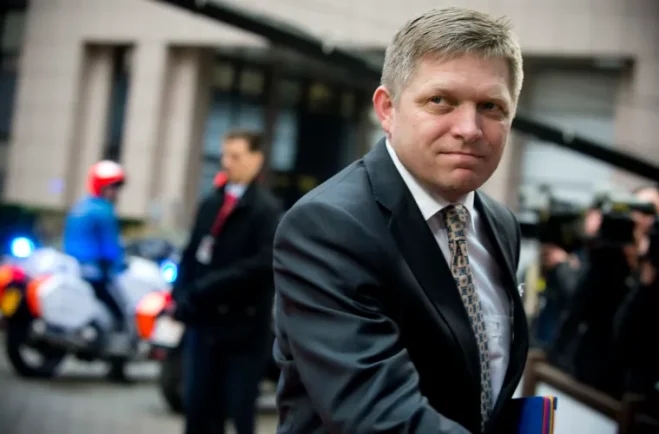
Robert Fico’s failed assassination raises specter of Western plotting
BY KIT KLARENBERG · THE GRAYZONE · MAY 31, 2024
Slovak PM Robert Fico’s independent stance earned him the wrath of NATO and the EU. Did a Western-directed plot to remove his troublesome government from office trigger his assassination attempt?
On May 15, Slovak Prime Minister Robert Fico was almost murdered in broad daylight. While shaking hands with supporters during a public appearance, a gunman shot him twice in the abdomen and once in the shoulder. The attack left him fighting for his life while authorities raced for clues, and many observers at home and abroad puzzled about the would-be assassin’s motives and whether foreign actors were in some way responsible for the attack. And despite the shooter’s instantaneous arrest, those questions still linger weeks later.
Fico, a veteran Slovak political figure, was re-elected in September 2023 amid a wave of public resentment over the proxy war in Ukraine, pledging to end arms supplies to Kiev and anti-Russian sanctions. On the campaign trail, Western leaders, journalists and pundits aggressively stoked fears of the “pro-Putin,” “populist” candidate returning to office. Ukraine’s Western-backed “Center for Countering Disinformation” publicly accused him of spreading “infoterror” back in April 2022.
But many Slovakians see it differently. They say Fico is merely committed to defending Slovakia’s sovereignty, and governing in his nation’s interests, not those of Brussels, Kiev, London, and Washington. For Western politicians, his victory came at a highly inopportune time, with public and political consensus on the proxy war in Ukraine rapidly fraying across Europe.
Since Fico’s election, media outlets like Germany’s state broadcaster, Deutsche Welle, have branded him a “threat” to the EU and NATO. His declaration that Kiev must cede territory to Russia to end the war was not well-received in Western capitals. In April, the premier seemingly predicted his own shooting, warning that the virulent political climate in Bratislava could result in politicians getting killed.
Domestically, a number of foreign-funded media assets and NGOs have relentlessly targeted Fico for pursuing neutrality in the conflict. But over two years after Russia’s intervention, local polling indicates just 40% of the population blame Moscow for the proxy war, and 50% consider the US to be a threat to national security. Meanwhile, 69% of Slovakians believe by continuing to arm Ukraine, the West is “provoking Russia and bringing itself closer to the war” and 66% agreed that “the US is dragging [their] country into a war with Russia because it is profiting from it.”
When Fico was re-elected in September 2023, this journalist speculated that a color revolution could soon be impending in Slovakia. We are now left to ponder whether the Prime Minister’s attempted assassination was a Western-directed plot to remove his troublesome government from office. Even though he is finally on the road to recovery, the threat of an overseas-orchestrated coup remains. A vast US-sponsored opposition political and media infrastructure is causing havoc in Bratislava, and this could easily escalate further.
Slovakia has since the end of the Cold War stood apart from its neighbors. Folding the country into the EU and NATO and neutralizing its rebellious politics and population has required an enormous investment in time and money by Brussels and Washington, and relentless meddling in the country’s internal affairs by foreign-funded organizations and actors. Fico’s return to power threatened to not only derail that project, but create a regional contagion effect. Disinfecting the country therefore became of the utmost urgency for the West.
Facebook purge suggests shooter was no ‘lone wolf’
Fico’s shooter, 71-year-old Juraj Cintula, is among the Slovaks who do not support Fico’s positions. A discrepant picture of the man has emerged since his arrest. Some acquaintances describe him as “weird and angry,” and “against everything.” Others report he was meek and mild-mannered, a far from obvious candidate to attempt a high-level political assassination. Cintula, an avowed Kiev ultra, claims he acted alone, his actions motivated by a desire to replace Fico’s government with a pro-Ukrainian administration. Slovakian court documents state that Cintula “wants military aid to be provided to Ukraine and considers the current government to be Judas towards the European Union,” and say this perception is why the would-be assassin “decided to act.”
The mainstream media has made much of Cintula’s background as a dissident poet and writer, in a seeming effort to humanize the would-be killer. By contrast, Aaron Bushnell, who in February self-immolated in protest of Washington’s facilitation of the Gaza genocide, was widely tarred by journalists as a maladjusted, mentally unwell outcast. Unmentioned by any Western outlet is that during the 1980s, Cintula was under surveillance by Czechoslovak security services.
The reason for the Czechs’ interest is unclear, although it may have been due to anti-Communist actions, or foreign contacts. Whether Cintula had seditious confederates within or without Slovakia is a key line of inquiry for police. That all traces of the shooter’s Facebook profile were comprehensively scrubbed from the internet two hours after the shooting, before investigators could access the information, is also source of intense suspicion.
While it is customary for the social network to purge the profiles of “dangerous individuals” – a fate this journalist has suffered for investigative reporting – following such incidents, in Bratislava Facebook relies on cooperating local individuals and organizations to police content. Apparently, Cintula’s profile was wiped before his identity had been reported in local media. Slovak authorities must now rely on the FBI to secure and provide the deleted information. Whether whatever is turned over will be unexpurgated is an open question.
Another disturbing feature of mainstream reporting on the shooting is ubiquitous, persistent reference to Slovakia’s unstable politics. According to this narrative, Fico’s anti-Western policies have fueled the chaotic state of affairs, provoking the assassination attempt and making him ultimately responsible for the attempt on his life. In the days following the shooting, the BBC, Financial Times, New York Times and Germany’s esteemed Der Spiegel pinned the blame on Slovakia’s alleged “toxic” political culture. The latter revised its wording after significant public backlash.
One could be forgiven for concluding Western journalists take it as self-evident that defying EU/US will provide legitimate grounds for getting shot. Western politicians clearly do. On May 23rd, Georgian prime minister Irakli Kobakhidze revealed that EU commissioner Oliver Varhelyi warned him he could suffer the same fate as Fico, if his government didn’t drop a highly controversial “foreign influence transparency” law, which would compel local NGOs to disclose their sources of income.
After listing the various ways the EU could retaliate against Georgia in a phone call with Kobakhidze, Varhelyi allegedly stated: “Look what happened to Fico, you should be very careful.”
Varhelyi has since confirmed that he cited Fico’s fate in private conversations with Kobakhidze, but claimed he was merely concerned with “dissuading the Georgian political leadership” from adopting restrictions on foreign-funded NGOs. Varhelyi insisted in a written statement that he simply “felt the need” to caution the Prime Minister “not to enflame [sic] further the already fragile situation,” arguing that he only mentioned “the latest tragic event in Slovakia… as an example and as a reference to where such high levels of polarisation can lead in a society.”
Public records show the US government regime change specialists at the National Endowment for Democracy (NED) have pumped millions into NGOs and media outlets in Slovakia under the aegis of mundane-sounding initiatives such as “strengthening civil society” and “promoting democratic values among youth.” Similar language is used to describe the purpose of Endowment grants in Georgia, financing groups at the forefront of recent violent unrest on the streets of Tbilisi, as The Grayzone has documented. Perhaps unsurprisingly, NED grantees are unanimous in their opposition to Fico.
Anyone searching for the source of Slovakia’s “toxic” politics need not look further than these US-backed organizations. Washington has stirred this cauldron for almost three decades, and with all sides of the Slovakian political class blaming one another the rising tide of hatred, it is hoping the pot will finally boil over.
Regime change blueprint honed in Slovakia
The NED-organized overthrow of Slobodan Milosevic in Yugoslavia in 2000 established an insurrectionary blueprint which was subsequently exported in the form of color revolutions. But throughout the 1990s, Slovakian activists honed the tactics which would eventually be deployed by US regime change operatives across the Soviet sphere.
At the time, Bratislava was one of the only post-Communist countries that neither adopted ruinous neoliberal political and economic reforms, nor pursued EU or NATO membership. Slovakia’s then-Prime Minister Vladimir Meciar paid a harsh price for his independent stance. Relentlessly slandered by US and European leaders as a Russian pawn, he quickly became a target for regime change.
In 1997, then-Secretary of State Madeleine Albright publicly described Slovakia as “a black hole in the heart of Europe,” formally marking him for removal. So it was that NED funded the creation of Civic Campaign 98 (OK’98), a coalition of 11 anti-government NGOs.
Explicitly modeled on an earlier NED-funded effort in Bulgaria, concerned with “creating chaos” after the Socialist Party won the 1990 election, many of the individuals involved had been part of Cold War-era Czechoslovak anti-Communist dissident groups. OK’98 was publicly framed as a non-partisan get-out-the-vote campaign, but its vast resources were explicitly deployed for anti-government purposes. Its activities included rock concerts, short films, and TV infomercials in which Slovak celebrities urged young people to vote.
Meciar emerged with the most votes in the 1998 election, but the opposition gained enough seats to form a government. The NED assets who powered them to victory went on to give practical training to NED-supported pro-Western agitators like Pora, which ignited Kiev’s 2004 “Orange Revolution.” The insurrectionist youth group successfully overturned the re-election of President Viktor Yanukovych that year, installing the US-backed neoliberal Viktor Yushchenko in his place.
The return of Robert Fico represented a significant broadside against ongoing US “democratization” of the former Soviet sphere. It opened up the prospect of further anti-NATO candidates and governments gaining office elsewhere in Europe, at the most inconvenient juncture imaginable for Brussels and Washington.
Not coincidentally, it was at this time that polling for Germany’s upstart Alternative für Deutschland became turbocharged. The Euroskeptic party’s standing has soared in recent months, eliciting mainstream calls to ban it outright. And in North Macedonia just one week prior to Fico’s shooting, the anti-establishment VMRO-DPMNE party returned to power, overturning a NATO-fuelled color revolution that removed the party from office almost a decade earlier.
As the anti-Western backlash gained steam, a decision may have been made to draw a bloody red line in Slovakia.
Senior German Lawmaker Demands Activation of 900,000 Reservists Amid Anti-Russia Hysteria

By Ilya Tsukanov – Sputnik – 01.06.2024
Germany went from doing its best to avoid getting dragged into the Ukraine quagmire to one of the NATO proxy war’s biggest cheerleaders, committing over 10 billion euros in military and economic support to Kiev, and suffering major economic losses due to spiking energy costs after cutting itself off from cheap and plentiful Russian pipeline gas.
Bundestag Defense Committee Chairwoman Marie-Agnes Strack-Zimmermann has urged the government and armed forces to activate 900,000 reservists in light of the so-called Russian threat.
“Putin is preparing his people for war and positioning them against the West. We must therefore become capable of defending ourselves as quickly as possible,” Strack-Zimmermann told the Funke Media Group on Saturday.
“Russia produces only weapons. School books are being printed that portray Germany as an aggressor,” the lawmaker claimed.
Therefore, she recommended, Germany needs to “activate the approximately 900,000 reservists,” first by making them register with the state. “If we could get half [of those with military experience] as reservists, that would be an incredible pool.”
Strack-Zimmermann, whose Free Democratic Party is part of Chancellor Olaf Scholz’s Traffic Light Coalition alongside the Social Democrats and the Greens, has been an avid proponent of a military solution to the Ukraine crisis from its outset, actively promoting the delivery of German heavy armor to Kiev.
Her remarks come just days after Defense Minister Boris Pistorius apparently dropped plans to reintroduce conscription under his campaign to make Germany a “war-ready” nation, and promised a new, “largely voluntary” recruitment scheme after months of internal debate in the government over the severely unpopular proposal ahead of upcoming elections for the European Parliament later this month.
The new government proposal does not mention “compulsory military service,” but could force Germans over 18 years old to fill out a physical fitness assessment questionnaire for reference. Other proposals include the waiver of administrative fees for driver’s licenses, discounts on student loan repayments, and other enticements.
The Bundeswehr has experienced a years-long slump in its recruitment numbers, with troop numbers shrinking (by 1,500 personnel to 181,500 total in 2023) despite plans to grow its ranks to at least 203,000 personnel by the early 2030s.
Germany indefinitely suspended conscription in 2011.
To deal with the dearth in recruitment and the political unpopularity of conscription, German Reservist Association Chairman Patrick Sensburg recently called on the military to systematically record the health status and availability of all former military personnel in order to create plans for their deployment for homeland security and national and alliance defense in case of a crisis. Germany counts “reservists” as all former military service members of the Bundeswehr, but does not count troops from the defunct National People’s Army of the German Democratic Republic – the pro-Soviet East Germany annexed by the Federal Republic in 1990 with Mikhail Gorbachev’s blessing on the condition that NATO does not expand the alliance to the east. Veterans of the defunct National People’s Army number in the hundreds of thousands, and faced widespread dismissal in the 1990s, miserly pension benefits, and difficulties finding work in the new Germany.
Berlin has allocated some 10 billion euros ($10.85 billion US) in military aid to Ukraine over the past two years, more than any other country in NATO besides the United States. This support has included an array of heavy weapons – from tanks and armored vehicles to air defense batteries and artillery, with Leopard 1s and 2s making up the backbone of Ukraine’s NATO main battle tanks, and destroyed by the dozens by Russia during last year’s Ukrainian counteroffensive.
Berlin joined lockstep with Washington on Friday by formally greenlighting Ukrainian strikes against targets deep inside Russia using long-range NATO strike systems, but has yet to deliver its Taurus missiles, which have a range of up to 500 km.
At home, German generals and politicians have complained of major problems with the Bundeswehr’s capabilities, including the inability to scrape together even a single 20,000-troop-strong combat-ready division after sending billions in equipment to Ukraine, and controversial plans to send “panzer battalions without panzers” to guard NATO’s eastern flanks in light of the Russian threat.”
Russian officials including President Vladimir Putin have said repeatedly that Moscow has no interest – “neither geopolitical, nor economic, nor political, nor military” – in getting into a conflict with NATO, while warning of the dangers of the Ukraine proxy war’s potential for escalation.
At the same time as Germany has ramped up defense spending and sought to increase the size and strength of its military, the country has suffered major economic difficulties throughout the course of the Ukraine crisis. Hundreds of major companies have relocated industrial production overseas amid unbearably high energy prices after the German government unilaterally rejected pipeline gas deliveries from Russia, and after US Navy divers allegedly destroyed the Nord Stream pipeline network. The traditional European industrial powerhouse’s recession has dipped in and out of recession, with Economy Minister Robert Habeck admitting in February that the country’s economy was in “troubled waters” and performing “dramatically bad.”
Still time to prevent NATO-Russia war – Hungary
RT | May 31, 2024
NATO is preparing for a protracted war with Russia but there is still a chance to prevent it, Hungarian Foreign Minister Peter Szijjarto said at a ministerial meeting of the military bloc in Prague on Friday.
NATO member states have been granting approval for Kiev to use Western-supplied weapons to hit targets deep inside Russia. Earlier in the day, NATO Secretary General Jens Stoltenberg said Ukraine had the right to defend itself, which includes the right to strike legitimate military targets inside Russia.
These steps are being taken in preparation “for a long, many-year war,” Hungarian newspaper Magyar Nemzet quoted Szijjarto as saying.
“The express train of war has departed from the penultimate station,” and the question is whether there is still a chance to stop it, he added.
The Hungarian foreign minister said there was “only one emergency brake left,” referring to the European Parliament elections in June. The European people “can make it clear to their governments that they do not want to live with war in Europe for a long time,” Szijjarto added.
Hungary had previously called for a ceasefire and peace talks to resolve the Ukraine conflict. Budapest has refused to send military aid to Kiev and has repeatedly delayed EU sanctions on Moscow.
The Hungarian foreign minister has been a vocal critic of NATO’s position on the conflict. Before the meeting in Prague, he said anti-Russia “war hysteria” was making Western leaders adopt increasingly “crazy ideas” that could lead to grave consequences.
Last week, Hungarian Prime Minister Viktor Orban warned that Brussels and Washington could be warming up for a direct military conflict with Russia. Budapest was working to “redefine” its NATO membership status to allow it to opt-out of the military alliance’s “activities outside the bloc’s territory,” Orban stated.
A number of other NATO member states such as Norway, Finland, Latvia, Poland, and reportedly Germany have spoken in favor of Kiev using long-range missiles against targets on Russian territory.
On Thursday, US President Joe Biden was reported to have secretly given Ukraine the green light to use American-provided weapons to strike targets in the part of Russia that borders Kharkov Region.
NATO member states, especially the US, have “deliberately” launched a new round of escalation around Ukraine to prolong the “senseless war,” Kremlin spokesman Dmitry Peskov said on Thursday. He also warned that such actions would have consequences and damage the interests of the countries that opted for an escalation.
Featured Video

Rewriting the risk? Inside the government’s vaccine safety messaging
or go to
Aletho News Archives – Video-Images
Book Review
“Davos Can Really Replace the UN”
Inside the book that maps the architecture behind global governance — from the Epstein files to the Pact for the Future
Lies are Unbekoming | April 1, 2026
On June 13, 2019, the United Nations and the World Economic Forum signed a partnership deal to “accelerate the implementation of the 2030 Agenda for Sustainable Development.” That same evening, WEF president Börge Brende — Norway’s former Foreign Minister — had dinner with Jeffrey Epstein at Epstein’s Manhattan townhouse. The Epstein files, released January 2026, contain an exchange between the two from the previous year. Epstein to Brende: “Davos can really replace the UN. C21, cyber, crypto . genetics… intl coordination.” Brende back to Epstein: “Exactly — we need a new global architecture. World Economic Forum (Davos) is uniquely positioned — public private.”
The next day, the UN General Assembly adopted the framework for restructuring global governance.
That sequence — the partnership signing, the Epstein dinner, the candid admission about replacing the UN with a public-private architecture, and then the formal adoption — opens Jacob Nordangård’s The Digital World Brain. Pages two and three. Footnoted to the UN resolution number, the Epstein files, and the General Assembly record.
I keep coming back to it because it captures what this book does that almost nothing else in the independent research space manages. I’ve followed Jacob’s work for years now and interviewed him about his research. Each book peels back another layer of the same institutional architecture, and each time I think he’s reached the limit of what can be documented, the next one goes further. Nordangård doesn’t speculate. He doesn’t editorialize much. He lays institutional actions next to each other in chronological order and lets the pattern announce itself. … continue
Blog Roll
 Aletho News
- The End of NATO
- 37 days of war on Iran cost US staggering $42bln, tracker shows
- Baghdad tells Asian refiners, traders to begin loading Iraqi crude amid Iranian exemption
- Under fire, Moscow and Tehran close ranks
- Iran, US receive Pakistan-mediated plan for ceasefire then final deal
- Iran submits demands for end to war as mediators scramble ahead of Trump deadline
- Iran Threatens Retaliatory Strike on Stargate AI Project in UAE
- US sent ‘a lot’ of arms to Iranian protesters – Trump
- Barak Ravid Launders Deception To Allow Trump To Back Off Of His Power Plant Threat – Again
- REWRITING THE RISK? INSIDE THE GOVERNMENT’S VACCINE SAFETY MESSAGING
- If Americans Knew
- Trump poised to “blow everything up” (ie. commit war crimes) in Iran – Daily Update
- In Iran, Israel-US take aim at “reason, research, and freedom of thought” – Daily Update
- US loses planes over Iran, Israel downgrades Lebanon war goals – Daily Update
- Israel Is Blocking Palestinians from Easter at Church Where Jesus Resurrected
- Plot to assassinate Palestinian activist follows harassment campaign promoted by Zionist groups and elected officials
- Prominent New York synagogue hosts presentation on why U.S. Jews should support the ethnic cleansing of Gaza
- Tapper vs. Piker: Is the CNN Anchor Auditioning for David Ellison?
- Shouldn’t Democrats Be Able to Condemn Genocide?
- Israel-US kill negotiators, destroy civilian structures, but Iran’s military capabilities still largely intact – Daily Update
- ‘War crime’: Global condemnation as Israeli ministers celebrate death penalty law targeting Palestinian prisoners
- No Tricks Zone
- An Inconvenient Tree: Uncovered In Alps… Europe Much Warmer Than Today 6000 Years Ago
- New Study Reports A 60% Slowdown In Greenland’s Ice Loss Rate In The Last Decade
- Low Intensity Tornado Wrecks Major Solar Farm, Creating A Potential Toxic Dump
- New Study Finds Warming Saves Lives…Cold Temperatures 12 Times More Deadly Than Excess Heat
- German Science Blog Accuses PIK Climate Institute Of Hallucinating Climate Tipping Points
- Devastating Assessment Of Comirnaty Vaccine By Former Senior Pfizer Europe Toxicologist
- New Study: CO2 Is ‘Effectively Negligible’ As An Explanatory Climate Change Factor Since 2000
- Former Pfizer Toxicologist Dr. Helmut Sterz Tells Bundestag Hearing Pfizer Vaccine Should Have Never Been Approved
- Energy Expert: Germany’s Nuclear Phaseout Was A “500 Billion Euro Mistake”
- New Research: South Australia’s Mid-Holocene Sea Surface Temperatures Were 4°C Warmer Than Today
 Aletho News