Hmm… interesting! https://t.co/oXjpx1keHX
— Alex (Sasha) Krainer (@NakedHedgie) April 7, 2024
NATO kicks off Black Sea-Danube Delta exercise labeled Sea Shield 24
MAGYAR HÍRLAP | APRIL 9, 2024
NATO has launched its second major exercise this year in the vicinity of Ukraine, this time focusing on the Black Sea and the Danube Delta region.
The joint operation, Sea Shield 24, which runs until April 21, brings together more than 2,200 troops from Bulgaria, France, Greece, Italy, the U.K., Netherlands, Poland, Portugal, Romania, Turkey, the United States, Georgia and Moldova. The forces will include 27 river and naval warships, 17 aircraft, and 91 land-based military vehicles.
According to a Romanian Navy statement, Sea Shield is the most complex event of the 2024 training year, with scenarios focusing on missions to combat illegal activities, maritime and river control, the rescue of vessels in distress, and the protection of critical infrastructure in the Black Sea, along the coast, in the Danube, and in the Danube Delta.
The international exercise also aims to strengthen cooperation between the navies of the participating countries and with other forces.
The largest naval exercise organized by Romania was first held in 2015. Since then, Sea Shield scenarios have been continuously modified to enable the participating NATO forces to respond quickly and effectively to the full spectrum of threats to regional security and stability, according to the organizers.
In January, NATO launched “Steadfast Defender 2024,” a five-month exercise rehearsing the alliance’s response to a hypothetical aggression against a member state. All 32 NATO member states participated, with some 90,000 personnel, including the largest single contingent of 20,000 from the United Kingdom.
Israel Seeks to Sell Weapons Used in Gaza Slaughter
By Kyle Anzalone | The Libertarian Institute | April 8, 2024
Israeli weapons markers are selling some weapons platforms that have been utilized during the onslaught in Gaza. Tel Aviv’s arms industry has found buyers among several Asian countries as Washington tries to make allies in the region, preparing for a future war with China.
Last week, several Israeli arms markers hosted delegations from multiple Asian nations at their booth at the Singapore arms expo. Jon Ostrower, editor-in-chief of The Air Current, explained, “They’ve come to demonstrate their power.”
Axon Vision CEO Roy Riftin said in an interview with Asia Nikkei that his company was coordinating with the Israel Defense Forces in Gaza to refine its military AI tech and then export it abroad.
Some of the weapons platforms featured in Singapore have been used in Gaza. Over the past six months, Israel has killed at least 33,000 Palestinians. Most of the dead are women and children. Several international rights experts have warned that Israeli operations amount to genocide.
In coverage of the Singapore arms event, Haaretz notes that some of the drones touted by the Israeli arms dealers were used by Azerbaijan in Nargano-Karabash. Last year, the Azeris completed an ethnic cleansing of the region by forcing the enclave’s last 100,000 residents out of the Republic of Artsakh and into Armenia.
An Israeli official said it was primarily seeking clients who did not buy Chinese arms. “Ultimately all the countries in the region are threatened by the Chinese,” a senior figure in one of the Israeli defense companies on hand told Haaretz. “Here at the airshow they don’t buy fighter jets from China.”
According to the Stockholm International Peace Research Institute, Israel sells the most arms to India and the Philippines. The US has tried to include both New Delhi and Manila in its Asia-Pacific alliances, with the aim at fighting a future war with China. The US has frequently sanctioned other countries over alleged war crimes and human rights abuses while ignoring the rampant abuses committed by Israel in Gaza.
Israel withdrew from southern Gaza due to the resistance’s strikes, expert says

MEMO | April 8, 2024
World War II Didn’t End The Great Depression
Stark Realities with Brian McGlinchey | April 4, 2024
A principal goal of Stark Realities is to “expose fundamental myths across the political spectrum” — and few myths are as universally embraced as the notion that US participation in World War II (1941-1945) lifted the American economy out of the Great Depression.
This myth is dangerous not only because it leads citizens and politicians to see a bright side of war that doesn’t really exist, but also because it helps foster a belief that government spending is essential to countering economic downturns. That belief, in turn, has helped propel us to a point where the national debt now exceeds $34.6 trillion, with interest payments alone on pace to reach $1 trillion a year in 2026, inviting financial catastrophe.
In part, the wartime-prosperity myth springs from the fact that, during conflict on the scale of World War II, broad, macroeconomic measures like gross national product (GNP) and the unemployment rate are completely untethered from the economy’s most important facet: the standard of living enjoyed — or endured— by everyday people.
Between 1940 and 1944, real GNP rose at an unprecedented 13% annual clip. Using GNP alone, one would think the war delivered a major improvement in the standard of living, with Americans enjoying a greater abundance of goods, accompanied by a rise in quality, selection and affordability.

The reality was the exact opposite: Americans endured rationing, shortages, declining product quality, and the outright unavailability of many new goods, such as cars, trucks and stoves. This was the inevitable result of factories and raw materials being redirected from the creation of things consumers want to building things like tanks and fighter planes that do nothing whatsoever to improve people’s lives (setting aside the separate issue of the war’s justness).
In many respects, America experienced an outright economic devolution. In the preceding century, industrialization and the division of labor led to enormous increases in productivity. During World War II, however, shortages motivated people who’d contentedly relied on farmers to start growing their own food and canning it. The scarcity of new clothing led homemakers to redirect time and energy to sewing their own garments and resewing them to stretch as much use out them as possible.
“Those remaining on the home front were forced to produce for themselves what they had previously been able to purchase,” wrote Steven Horwitz and Michael J. McPhillips. “The household again became a center of production rather than consumption alone.”
GNP wasn’t the only measure falsely signaling wartime prosperity; employment numbers from the era were likewise misleading. The US unemployment rate plummeted from 17% in 1939 to 1.2% in 1944. Note, however, that military service members are not considered part of the labor force — which means that the draft extracted 11.5 million men from the denominator in the unemployment rate calculation.
Another 6.3 million volunteered, though many signed up because they preferred to secure a role they favored rather than face the chance of being drafted as an infantryman.
While it’s true that draftees and volunteers were “employed” by the armed forces, all these millions of men — no matter how noble their overseas missions may have been — weren’t doing anything to create prosperity at home.
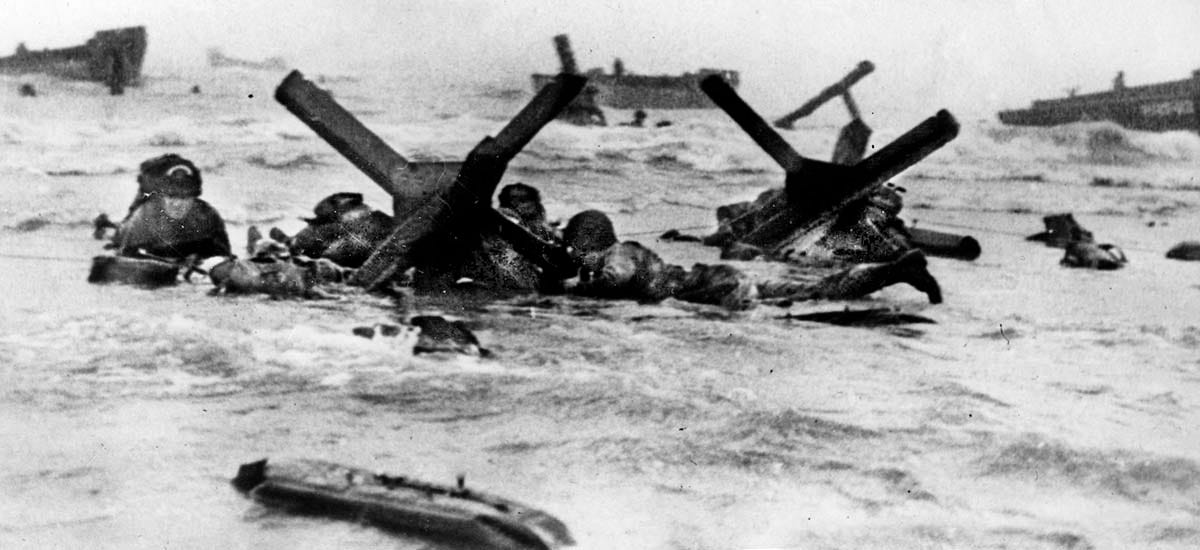
Not a prosperous path to full employment: Soldiers under withering fire on D-Day’s Omaha Beach
That’s not to say the war machine didn’t demand laborers. With so many able men taken out of the economy, the slack was taken up by teenagers, women and retirees, many who’d have preferred to be doing other things.
In a growing economy, more people are producing goods and services, and elevating standards of living in the process. That was far from the case during World War II. Factories were humming, but they were making bayonets, bombs and battleships. “Four-tenths of the total labor force was not being used to produce consumer goods or capital capable of yielding consumer goods in the future,” noted Robert Higgs.
Defying conventional wisdom about “wartime prosperity,” Americans’ standard of living suffered tremendously from their government’s entry into World War II. In The Reality of the Wartime Economy, Horwitz and McPhillips tapped some interesting source material to bring the grim economic realities of American life during World War II into sharp focus.
For example, a series of newspaper ads placed by Canton Electric Light & Power Company — a local New York State utility — present a vivid, time-lapse portrayal of rapidly declining conditions following the December 1941 declaration of war:
- Foreshadowing anticipated shortages, a March 17, 1942 ad for appliances is headlined “You Can Still Buy Them.” The ad includes a qualifier that’s upbeat while still signaling creeping scarcity: “We have a fairly good supply.”
- Just two months later, Canton Electric’s ad says “Now Is The Time” to buy various appliances and equipment, warning that “production of most of these items has stopped and only the supply in your dealers’ stock is available.”
- Another two months later, a July 1942 ad indicates that some items that were briefly not available are back in inventory.
- In November of that first year of America’s World War II participation, Canton Electric switched to warning consumers that, “due to the war emergency, it is quite impossible to get replacement motors for civilian use,” and urging them to ensure they’re properly maintaining their “stokers and oil burners.”
- Later that same month, Canton Electric punted on advancing its retail business altogether, instead using its ad space to encourage readers to grow their own food, eat everything on their plates and comply with ration-stamp rules.

Horwitz and McPhillips also drew on letters written between 1942 and 1945 by Saidee Leach to her son serving in the Pacific. Contrary to the image of prosperity supposedly indicated by leaping GNP or plummeting unemployment, she tells him of:
- Conserving scarce home-heating fuel during the coldest days by wearing fur coats indoors and residing only in their kitchen
- Having her typewriter seized by the government, and now using a lesser model she acquired from a Howard Johnson “which had to close due to the ban on pleasure driving.”
- Making an Easter dinner centered on fried Spam, because she “could not get fresh meat of any kind,” and later noting that “potatoes have entirely disappeared”
- Local farmers refusing to sell their turkey flocks for Thanksgiving meals at the prices set by the Office of Price Administration — illustrating the folly of government price controls.
That is not the picture of an economy delivered from the Great Depression. Rather, “World War II institutionalized the falling standards of living of the depression through wage and price controls, and extensive rationing of consumer goods and services,” wrote Peter Ferrara. “The economic deprivation, and reduced standards of living, continued, although people perceived it was now for a good cause.”
America’s postwar experience presents another pointed contradiction of the myth of wartime prosperity.
As the war’s end grew closer, Keynesian economists unanimously predicted peace would bring economic disaster. For example, Paul Samuelson said America would experience “the greatest period of unemployment and dislocation any economy has ever faced.”
Alvin Hansen warned that the economy must be kept on a centrally-controlled wartime footing, even in peacetime: “When the war is over, the government cannot just disband the Army, close down munitions factories, stop building ships, and remove all economic control.”

Nobel Prize winner Paul Samuelson, who predicted peace would bring economic disaster, taught Nobel Prize winner Paul Krugman, who predicted the internet’s impact would be akin to that of the fax machine
However, that’s pretty much what happened — and Hansen, Samuelson and their fellow economic flat-Earthers couldn’t have been more wrong about the consequences. “The year 1946, when civilian output increased by about 30 percent, was the most glorious single year in the entire history of the U.S. economy,” wrote Higgs.
This despite the fact that government purchases of goods and services collapsed by 68% between the second quarter of 1945 and the first quarter of 1946 — and upwards of a million civilian government employees were laid off and millions of service members discharged.
As war-fighting men poured back into civilian life, millions of women withdrew from the labor force, contentedly returning to duty as mothers and home managers. Rather than soaring as predicted by the “experts,” unemployment merely edged higher, from 1.9% in 1945 to 3.9% in 1947.
“Less than a year and a half after VJ-day,” crowed President Truman, “more than 10 million demobilized veterans and other millions of wartime workers have found employment in the swiftest and most gigantic change-over that any nation has ever made from war to peace.” (Note this happened despite — and in part because of — Truman’s failure to institute a higher minimum wage as the war ended.)
Having been proven enormously wrong about the economic implications of peace, Keynesians scrambled to credit the war with enabling the postwar boom, arguing that it was fueled by people drawing down savings accumulated while the supply of consumer goods was sharply restricted. However, as Higgs determined by studying the data of the time, “Holdings of liquid assets did not decline at all after the war. People financed their spending for consumer goods by reducing their saving rate.”
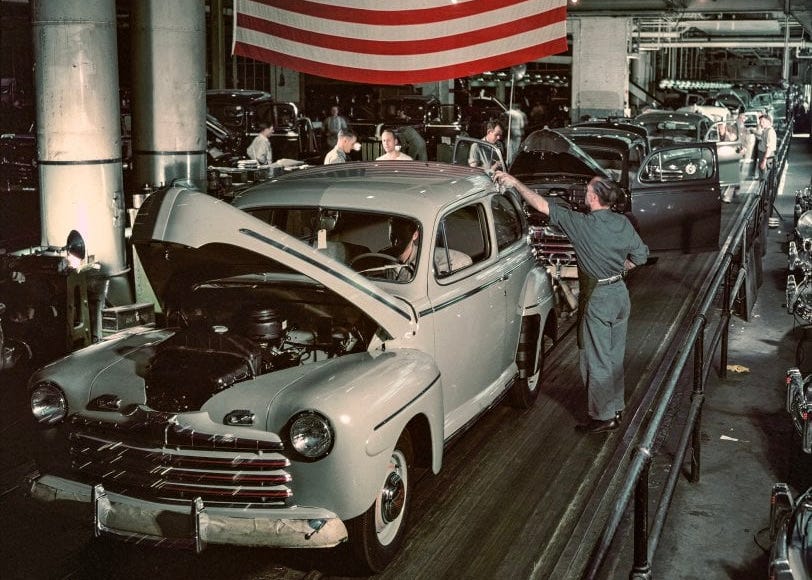
Once again an engine of real prosperity: In 1946, vehicles proceed along Ford’s first postwar assembly line
Contrary to the myth, it was only after World War II that — free from the government’s commandeering of factories, workers and resources, and saddled with fewer price controls and other federal market intrusions — America was finally able to emerge from the Great Depression.
You wouldn’t know that if you evaluated the economy’s health using Keynesians’ preferred measure. Just as the GNP gauge provided a 180-degree misreading of wartime economic realities, it failed in similarly spectacular fashion during the postwar boom: From 1945 to 1947, GNP plummeted 22%.
In addition to further illuminating the shortfalls of aggregate economic measures, America’s postwar economic experience delivered another broadside to the myth of World War II-fostered prosperity, and to the idea that government spending, central planning and market interventions are essential to economic achieving economic recovery.
Pellegrini’s Win in Slovakia’s Won’t Allow EU to Drag It Into Conflict Against Russia
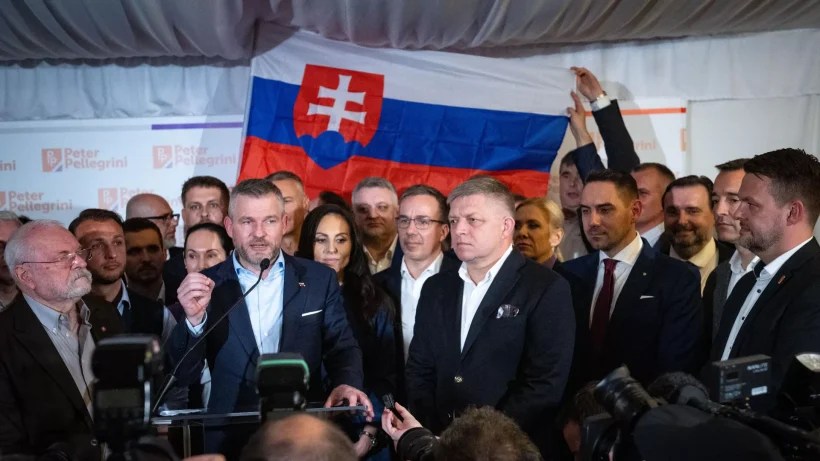
Peter Pellegrini (L) and Slovak Prime Minister Robert Fico (R) after the announcement of Pellegrini’s victory in the Slovak presidential elections, April 6, 2024.
By Svetlana Ekimenko – Sputnik – 07.04.2024
Slovak parliamentary speaker Peter Pellegrini, who shares prime minister Robert Fico’s staunch opposition to continued arms supplies to Ukraine, won the second round of Slovakia’s presidential election. Pellegrini and Fico’s left-wing opposition to the Russo-Ukraine war proved to be a winning formula.
In Peter Pellegrini Slovakia will finally have a president who does not support the pro-Western position and was not “installed by the Americans,” political observer Peter Marcek told Sputnik.
“There will be coordination between the government of the Slovak Republic [led by] Robert Fico and President Peter Pellegrini, because they have one program, one direction,” he remarked.
According to Marcek, “both Fico and Pellegrini share the idea that no Anglo-Saxons should be able to dictate to us what we should do.”
Washington pursued its own goals by pushing Pellegrini’s main rival, former foreign minister Ivan Korcok, for the presidency, argued the expert, in an effort “to subordinate our will exclusively to their hegemony.”
Pellegrini, an ally of Fico, won the presidential election with 53.26 percent of the vote versus Korcok’s 46.73 percent, following declarations from 99.66 percent of voting districts.
Pellegrini said his victory meant the government would not have to face an “opposition, opportunistic power centre.” He vowed that he would “be a president who will support the government in its efforts for improving people’s lives.”
Pellegrini, 48, has Italian ancestry. He previously served as Slovakia’s prime minister from 2018 to 2020 and Minister of Health from 2019 to 2020. He also had a two-year stint as speaker of the National Council from 2014 to 2016. Pellegrini, formerly a member of Direction – Social Democracy, left that party to found Voice – Social Democracy in 2020.
The politician returned to the position of Speaker of the National Council after the 2023 parliamentary election. His Voice – Social Democracy party came third and became part of the three-party ruling coalition with PM Robert Fico’s SMER-SSD (Direction-Slovak Social Democracy) and the Slovak National Party.
Pellegrini announced his intention to run for president in January. He came second in the first round of voting in March, with 37.03 percent, trailing former Korcok who won 42.52 percent of the vote. But Pellegrini scooped up the floating voters to clinch the second round.
Commenting on the Fico and Pellegrini long-standing political alliance, Marcek pointed out that “When the government passes laws and the president can veto them, it creates problems.” But now the president and the prime minister will be on the same page.
“Pelligrini will be a president who will work well with Fico. They said at a press conference after the elections that they would support each other. They will cooperate very well this way,” said the pundit.
In Slovakia, the government holds most of the executive powers, such as picking the prime minister after parliamentary elections, swearing in the new government, and appointing Constitutional Court judges. The role of president is largely ceremonial, but includes ratifying international treaties, appointing top judges and acting as commander-in-chief of the armed forces — and has the power to veto new laws.
Bratislava can no longer support the West’s anti-Russian course, noted Marcek, who welcomed the “clear victory of Pellegrini.”
“I think that many relations, for example, with the Russian Federation, can improve. We need to develop our mutual relations,” stated the former deputy of the Slovak parliament.
“I am grateful to Russia because it is not just fighting for itself, to prevent NATO from approaching the borders of the Russian Federation,” Marcek stressed. “Russia is fighting for us all, for the traditional family values, for improving the economic situation in the world. For good relations, and most importantly — for peace and justice.”
Fico’s government has been determined to chart an independent course against NATO’s proxy war against Russia in Ukraine.
Echoing his Hungarian counterpart Victor Orban’s stance, Fico has opposed confrontation with Russia, and urged an end to military aid to Kiev. Hungary and Slovakia are the only two EU and NATO members to refuse to send arms to Ukraine.
“Peter Pellegrini hails from Robert Fico’s party, he is a social democrat, and shares the PM’s ideas and views. This means that he is in favor of ending the conflict in Ukraine and starting negotiations between Kiev and Moscow,” Marcek said. “He is against sending weapons to Ukraine, opposes such vast quantities of EU aid being sent to Kiev.”
Pellegrini stated in an interview in March that the Slovak government had a realistic position on the conflict, and voiced surprise that some countries refuse to respect Slovakia’s approach. He added that Slovakia is ready to help the Ukrainian side in demining territories and implementing civilian projects.
The president-elect believes that the conflict in Ukraine has no military solution, advocates early peace negotiations and believes that arming Ukraine could ultimately lead to disaster.
Most Slovaks want “a president who will defend Slovakia’s national interests, who will not drag Slovakia into a war but will talk about peace, who… will put Slovakia’s interests first,” Pellegrini said.
In contrast, Pellegrini’s opponent Korcok, said: “I do not think Ukraine should give up part of its territory to achieve peace.” He told reporters that “Peace cannot mean capitulation,” and could only be achieved “immediately” on the condition that Russian troops withdraw.
Fico responded by calling Korcok a “warmonger” on video ahead of the run-off. He claimed Korcok “will support everything the West tells him without hesitation, including dragging Slovakia into the war.”
But both Pellegrini and Korcok have reiterated that they would not allow the Slovak military to be sent to Ukraine.
“Slovakia has made a decision that it will not send a single soldier to Ukraine in any event. And this is despite the criticism of this sovereign position of ours. On the contrary, we will insist that the only way to end the bloodshed is to have courage to begin peace talks between the warring parties,” Pellegrini said after a meeting with Orban.
On issues such as NATO membership for Ukraine, however, the two rivals took opposing stances. Korcok insisted that the final decision on Ukraine’s membership in NATO will be made by members of the alliance if the Ukrainian side meets the necessary requirements.
But Pellegrini was adamant that there is no place for Ukraine in NATO, giving an unequivocal “no” to the question during a pre-election debate on the Markiza TV channel.
“NATO, in my opinion, is the most aggressive group of armies, that only exist to foster wars all over the world, spearheaded by the United States. And Peter Pelligrini will absolutely not agree with this,” Marcek said.
Asked how Pellegrini’s victory could affect European Union policies and if Slovakia might use its veto on issues such as aid to the Kiev regime, the political analyst said that Slovakia now had “new opportunities.”
“We will not give up the veto power to anyone,” Marcek insisted. “This is our right, even though we are a small country. Together with Viktor Orban, 100 percent we will not cede this to anyone.”
Marcek slammed European governments that were “pro-American, pro-Brussels,” adding that “They are for war against Russia.”
“Macron still wants to send soldiers to Ukraine. The government in the Czech Republic wants to continue the war, but the citizens do not,” he said. “We say, ‘We shall have none of this’.”
US using Nordic countries’ NATO membership to advance Arctic militarization
By Lucas Leiroz | April 6, 2024
The US plans to use the NATO access of Nordic countries to increase its military presence in the Arctic. In a recent statement, an American official announced Washington’s plan to build a large weapons warehouse in the region, with Finnish and Swedish support. The measure will significantly increase the militarization of the Arctic and aims to help the US overcome Russian military superiority in the region.
The plan was announced by US Materiel Commander Christopher Mohan during an interview with the newspaper Breaking Defense. According to him, Finland and Sweden could help the US with the project, considering their strategic geography. He did not give any details about the possible location of the depot, but stated that NATO is jointly analyzing all possibilities. He also stated that the US and allies are discussing what would be the most appropriate equipment to deploy in the region.
“The addition of the NATO partners changes the security landscape and our responsibilities as part of NATO (…) [This project will] embrace and integrate Finland and Sweden into the NATO enterprise, and that’s going to drive some changes on the ground,” he said.
The measure is just one of several policies adopted by Washington and its allies in recent years to try to reverse Russian military superiority in the Arctic. For decades, the US has not had any special focus on the Arctic in its defense strategies. The main objective of American strategic plans has always been to “encircle” and “isolate” Russia. The US has focused for many years on achieving this goal through the militarization of Europe and the destabilization of Central Asia and the Middle East, but Americans have paid little attention to the Arctic – a region where the Russians have become very strong over the decades.
Now, however, the US is concerned about this weakness in the region. With the escalation of tensions with Russia, Washington is trying to improve its positions in the Arctic in order to reverse the current scenario of Russian advantage. In recent years, several escalatory policies have been promoted by the US – some of them even openly provocative and targeted at Russia.
For example, in 2022, Lawrence Melnicoff, commander of the European Special Operations Command, stated that the US should actually “provoke” Russia in the Arctic. According to him, Washington should seek joint strategies with Norway to increase its presence in the Arctic Circle and thus deter Russia in the region. He states that Russia has expansionist plans that will be prevented only through direct deterrence, which is why NATO should maintain strategic positions that allow it to neutralize Russian forces in the Arctic in a possible conflict scenario.
“We are intentionally trying to be provocative without being escalatory (…) We’re trying to deter Russian aggression, expansionist behavior, by showing enhanced capabilities of the allies (…) It complicates Russian decision-making because we know that they’re targeting very, very large specific aggregations of allied power, [such as] Ramstein Air Base, RAF Lakenheath, things like that (…) If worse comes to worst and somebody takes out these power hubs, we can forward-project precision artillery fire across the alliance with our partners”, he said at the time.
Obviously, this is a fallacious US narrative. The Arctic is a region traditionally occupied by the countries that have access to it. Russia has the Arctic as a vital point in its strategic environment and naturally seeks to maintain a strong military presence in the region to guarantee its national security. The US and NATO countries, however, do not use access to the Arctic to develop a defensive strategy. On the contrary, they are looking for the Arctic as a possible point of attack against Russia. The Western objective in the Arctic is simply to harm Russia, not to protect itself. If the West adopted a policy of diplomacy and peaceful dialogue with Moscow, there would be no military race in the Arctic, but clearly NATO’s intention is to hurt Russia as much as possible.
To achieve these provocative objectives, the US will use the strategic location of NATO’s new members as a tool of war. The Nordic countries will be induced to actively participate in the Arctic militarization process, co-leading with Washington an escalation of tensions with Russia. And this will be extremely harmful for them, because, if the crisis escalates into an open conflict in the future, these countries will be priority targets and will be in a much greater risk zone for Russian attacks than the US.
Once again, access to NATO appears to be a trap for Finland and Sweden, which are being used as mere war tools by the US.
Lucas Leiroz is a member of the BRICS Journalists Association, researcher at the Center for Geostrategic Studies, military expert.
You can follow Lucas on X (former Twitter) and Telegram.
US Diplomacy ‘Utterly Failed’ in Ukraine, Washington Should Seek Negotiations – Jeffrey Sachs
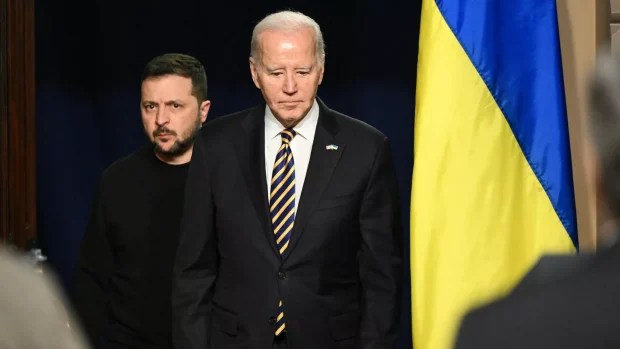
Sputnik – 05.04.2024
WASHINGTON – US policy in Ukraine has failed and instead of encouraging the country’s NATO membership bid Washington should seek peace negotiations with Russia, world-renowned economics professor Jeffrey Sachs told Sputnik.
While in Brussels, US Secretary of State Antony Blinken said Ukraine would become a member of NATO but did not specify a timeline. He added that the 2024 NATO summit in Washington will help build a bridge for Ukraine to join the alliance.
“Secretary Blinken’s statement is another disaster for Ukraine… American diplomacy has utterly failed and indeed collapsed,” said Sachs, Director of the Center for Sustainable Development at Columbia University. “Secretary Blinken should be sitting down in negotiations with his counterpart Foreign Minister Lavrov rather than reiterating the utterly failed foreign policy that has brought on this war.”
Russian President Vladimir Putin has said that NATO’s expansion to include Ukraine would create a direct national security threat to Russia and that Moscow considers the non-aligned status of Ukraine to be extremely important to put an end to the years-long conflict.
NATO is in state of ‘war psychosis’ and must change course in bid for peace, warns Hungary FM Szijjártó
Mandiner | April 5, 2024
NATO is currently in a state of war psychosis, which poses a serious risk of escalation, and must change its strategy as soon as possible, Minister of Foreign Affairs and Trade Péter Szijjártó warned in Brussels on Thursday.
At a press conference following the NATO-Ukraine Council meeting, Szijjártó said that everything discussed at the meeting confirmed the need for peace as soon as possible, as the situation on the battlefield clearly shows that without a quick diplomatic solution, the number of dead and the destruction will increase dramatically.
“It is clear that hostilities are becoming more active and their consequences more serious, and that to save lives and prevent destruction, all efforts should now be focused on peacemaking,” he warned.
Szijjártó said it was bad news that Hungary’s view is currently only a minority position within NATO and cited an unnamed counterpart at the meeting who said, “The goal is not to find peace but to win the war.”
“This is pretty much the kind of war psychosis that characterizes NATO member states today. The vast majority of speeches today have been about how to increase arms supplies to Ukraine,” he said.
In this context, he pointed out that it is becoming increasingly difficult to assemble arms shipments, partly because a large number of the Allies have now almost completely surrendered the military equipment in their warehouses. Szijjártó recalled that Hungary is currently performing air policing tasks in Slovakia together with the Czech Republic because Bratislava has handed over all its aircraft to Kyiv and the new ones have not yet arrived.
He recalled that it was also said at the meeting that the munitions depots across Europe should be emptied, i.e., all existing equipment should be handed over to Ukraine, and this desperation clearly shows that arms deliveries are becoming increasingly difficult.
Trump warns: “lunatic” Biden could start World War III
By Ahmed Adel | April 5, 2024
Former US leader and current Republican Party presidential candidate Donald Trump warned in Michigan on April 2 that US President Joe Biden could trigger World War III. Trump’s comments come as he surges in the polls while Biden’s policy on Ukraine is continuously scrutinised. The former president also criticised the way his successor handled the nuclear issue, questioned his mental condition, and claimed that other foreign powers respected the US during his presidency.
“This guy has no clue,” the former president said about Biden. “He can’t put two sentences together, and he’s dealing with Putin, and he’s dealing with President Xi, and he’s dealing with Kim Jong-un. All people I know very well. We were under no threat from anybody until this guy got in office. Now they’re talking nuclear all the time. We didn’t talk nuclear.”
Trump recalled that, during his term, he rebuilt “nuclear power” to a level that “no one has” and that, in this context, it was “four safe years.”
“You were safe because they respected your president, and they respected the United States of America. And now you’re not safe. I will tell you we could end up in World War III with this lunatic,” he stressed.
According to a new Wall Street Journal poll published on April 3, Trump leads Biden in six of the seven closest swing states. Although Biden won Wisconsin, Michigan, and Pennsylvania in 2020, Trump now holds a two-point lead in Michigan and a three-point lead in Pennsylvania. Biden also won Georgia, Nevada, and Arizona in the last election, but now the three states have stronger support for Trump, with the former president leading Georgia by three points, Nevada by four points, and Arizona by five points.
In a recent statement to USA Today, Trump spokeswoman Karoline Leavitt said: “There are more than 100 polls showing President Trump crushing Joe Biden, including recent polling that has him leading in every key battleground state and winning independents by double digits.”
The prospect of Trump’s return has triggered an increase in debate among NATO allies about what Europe should do to ensure Washington continues to invest in transatlantic security. The Republican’s possible return also raised concerns among European officials that Trump could withdraw US aid to Ukraine because of comments that he would try to end the war in one day.
Reuters, citing five diplomats, reported on April 2 that NATO boss Jens Stoltenberg has proposed a $107 billion, five-year package of military aid to Ukraine so the Western alliance could have a more direct role in supporting Kiev. The NATO chief said the plan is in part “to shield against winds of political change,” but Trump is foremost on the minds of many, a senior NATO diplomat told the British agency.
The diplomats said that discussions were only at an early stage and that it was still unclear whether the $107 billion would be accepted by all 32 members—since a consensus must be reached—or how it would be financed.
“It goes some way to protecting in case of Trump. But it is impossible to create something Trump-proof,” said another diplomat. “A fund of 100 billion looks very optimistic, knowing how difficult it was to agree on a smaller amount at EU level.”
As part of the proposed package, NATO could also take over the operational functions of the Ukraine Defense Contact Group, which coordinates arms deliveries from around 50 countries to Kiev and is now led by the US. With NATO’s Europe Supreme Allied Commander, General Chris Cavoli, in office, such a move could protect the Group from any political changes after the November US elections.
In effect, NATO recognises that there is a high possibility that Trump could return to the White House and is already preparing for a post-Biden scenario. Biden has supported most initiatives for Ukraine, but as his cognitive decline deepens and his numbers suffer in the polls, a Trump victory would almost certainly result in the retraction of support and force Kiev to negotiate with Moscow.
As Trump highlighted, Biden is a “lunatic” who is fanning the flames of a Third World War. Although it is unlikely the US would escalate with Russia to the extent of World War III for the sake of Ukraine, the former president highlights that global tensions were not as intense as they have been since Biden came to power, and he aims to return to this scenario. This prospect frightens NATO and much of Europe.
Ahmed Adel is a Cairo-based geopolitics and political economy researcher.
Russia and NATO already in ‘direct confrontation’ – Kremlin
RT | April 4, 2024
The current state of relations between Russia and NATO can be described as a “direct confrontation,” Kremlin spokesman Dmitry Peskov has said. He claimed that the US-led military bloc has been a destabilizing force in Europe rather than ensuring the continent’s security.
He made his comment on Thursday, as the bloc marked 75 years since the signing of its founding document, the North Atlantic Treaty.
Since the start of the Ukraine conflict, NATO has provided Kiev with billions worth of military aid and weaponry, as well as sharing intelligence and helping to train Ukrainian troops.
“The bloc itself is already involved in the Ukraine conflict. NATO continues to move towards our borders, expanding its military infrastructure towards our borders… In fact, our relations have now descended to the level of direct confrontation,” Peskov said at a press-briefing.
He stated that the organization had been created as an “instrument of confrontation” in Europe, and is fulfilling its purpose to the detriment of the entire continent.
“NATO continues to fulfill its purpose, which currently, however, in no way contributes to security, predictability and stability on the continent, but on the contrary is a destabilizing factor,” Peskov explained.
Multiple Western leaders have warned that Russia may attack NATO once the Ukraine conflict is over. Moscow has repeatedly dismissed those claims.
Russian President Vladimir Putin said last month that talk of a potential Russian attack on NATO countries is simply propaganda by their governments aimed at scaring their own population to “beat the money out of them.”
Moscow has for years voiced concerns about NATO’s expansion toward its borders, viewing the US-led military bloc’s policies as an existential threat. However, it has also warned that NATO’s more pronounced involvement in the Ukraine conflict, in particular, the possibility of a troop deployment to the front lines, would be seen as an intervention. This, according to an earlier statement by Putin, would take the conflict “one step shy of a full-scale World War III.”
75th Anniversary: NATO Exists to Respond to Conflicts It Caused

NATO military exercise ‘Iron Wolf 2022-II’ at a training range in Pabrade, north of the capital Vilnius, Lithuania.
By Ekaterina Blinova – Sputnik – 04.04.2024
Over the last 30 years, NATO has lost its veneer of a “defensive” alliance, turning into an overtly expansionist and interventionist military bloc, Sputnik’s interlocutors say.
Exactly 75 years ago, the North Atlantic Treaty Organization was founded by the US, Canada, and several Western European nations, with the main aim of deterring and confronting the USSR, their former Second World War ally.
After the Soviet Union’s collapse in December 1991, the conditions for a new inclusive security architecture in Europe and beyond emerged, according to Glenn Diesen, professor of international relations at the University of South-Eastern Norway.
“After the Cold War, we developed the format for a new inclusive security system,” Diesen told Sputnik. “The Charter of Paris for a New Europe in 1990 and the establishment of the Organization for Security and Cooperation in Europe (OSCE) in 1994 were both based on the [1975] Helsinki Accords, and embraced the principles of sovereign equality, indivisible security, and ending the dividing lines in Europe.”
The Helsinki Accords, signed during the Cold War by the US, Soviet Union, and several European countries, led to greater cooperation between Eastern and Western Europe. Even though the agreements weren’t binding, they significantly contributed to the détente between the East and West.
Instead of building on that momentum, the US saw the end of the Cold War as the beginning of its unipolar moment, according to the professor: in 1992, George H.W. Bush proudly declared that the US had “won” the Cold War during his State of the Union address.
“The US also developed a security strategy based on hegemony, which required expanding NATO and thus cancelling the pan-European security architecture,” Diesen said. “NATO therefore transitioned from a status quo power to a revisionist power. NATO required a new purpose, which became ‘out-of-area’ military interventionism and expansionism.”
Overtly Aggressive Military Bloc
The next 30 years saw a string of NATO overseas military campaigns, neither of which has seen a comprehensive resolution, resulting in the creation of hotbeds of instability instead.
“During the 1990s, NATO turned from a conceptually defensive organization into an openly aggressive organization when it entered the Yugoslav wars and waged a massive bombing campaign there,” Gilbert Doctorow, an international relations and Russian affairs analyst, told Sputnik.
“More generally, the United States was at this time preparing NATO to move out of its core geography in Europe and to assist US plans for global domination in the Middle East in the succession of regime change operations and open invasions that the United States planned and led.”
Doctorow highlighted that these “out-of-region NATO operations were one disaster after another, ending in the withdrawal from Afghanistan after participation in a 20-year-long war directed by Washington.”
NATO’s Expansionism Led to Ukraine Conflict
Meanwhile, the alliance’s seven waves of post-Cold War eastward expansion accelerated tensions in Europe, according to Diesen.
“Reviving the bloc approach to security and competing over where to draw the new dividing lines has been the primary source of conflicts in Europe for the past three decades and eventually resulted in the Ukraine war,” Diesen said.
The academic pointed out that “by going along with NATO expansionism, the Europeans allowed their continent to be re-divided and remilitarized, which has predictably doomed Europe to greater irrelevance.” He projected that Europe “will undergo systemic economic decline and become painfully subordinated to the US.”
“We could exit this tragedy by reaching out to Russia to negotiate a new inclusive European security architecture devoted to reducing security competition instead of imposing hegemony,” the professor emphasized.
Is NATO Sustainable?
“NATO exists to respond to the conflicts caused by its own existence,” Diesen explained. “The problem now is that NATO is returning to great power conflicts with the same disastrous approach to security, based on hegemony rather than mitigating security competition.”
Despite the Western mainstream media claims that the North Atlantic Alliance is united like never before amid the Ukrainian conflict, it is in fact not true, according to the professor.
“There are great tensions within NATO that simmer below the surface, and I do not think the hatred of Russia is enough to ensure unity after the war is over,” he said.
“NATO victory in Ukraine is imperative as it had the stated objective of permanently weakening Russia and thus knocking it out from the ranks of great powers. This would revive the unipolar moment and collective hegemony of the West. Once NATO’s defeat is evident the cracks will emerge in the military bloc,” Diesen pointed out.
Doctorow believes that despite all its declared, might the North Atlantic Alliance is on thin ice.
“NATO is in treading water, waiting for the tsunami that will send it to the bottom. That tsunami will either take the shape of a [US presidential candidate Donald] Trump victory in November or it will take the shape of an imminent collapse of the Ukrainian army or both phenomena simultaneously,” the international relations analyst concluded.
World War III Isn’t Preordained (No Matter What They Say)
By Brad Pearce | The Libertarian Institute | April 4, 2024
A recent survey from YouGov found that 61% of Americans think a world war within the next five to ten years is “very likely” or “somewhat likely,” while only 21% say that such a scenario is “not very likely” or “not likely at all.”
It’s notable that Democrats, who are much more likely to view Russia as the source of the world’s evils, are less likely than Republicans to believe a world war is coming by a strong margin; although it is still only 28% of Democrats in the two “unlikely” categories. At the same time, Republicans who may want rapprochement with Russia mostly see this as a way to free up resources to fight China. The reality is that our ruling class has decided that a global conflict is inevitable and as such are doing nothing to stop it. Further, they are actively hostile to anything which could reduce hostilities with Russia while also proactively antagonizing China.
Our ruling class is far along in creating a simplistic good vs evil narrative which they hope to get into the history books—should anyone survive to write them—but for those of us living through it, it’s obvious the only cause would be the madness of today’s rulers. The most devastating of wars do not commonly arise out of unsolvable problems, but from rulers who refuse to solve them. Further, the drive towards oblivion is usually obvious to many observers, even if the rulers and much of the public are caught in a jingoistic mania. Things are just the same today.
There is a modern perception that World War I took the powers of Europe by surprise and that the assassination of Archduke Franz Ferdinand was a spark which made war inevitable. Perhaps this is believed because of the human need to understand the degree of devastation from a war which more than others lacks a clear meaning. However, author Rebecca West, in her landmark text Black Lamb and Grey Falcon, which was written in the 1930s, tells a different story. West explains that all of Europe expected that the Central Powers were preparing for an aggressive war, writing, “It is said that both France and Russia were for some reason convinced that Germany and Austria would not make war until 1916, and certainly that alone would explain the freedom with which Russia announced to various interested parties in the early months of 1914 that she herself was not ready to fight.”1
According to West’s account, Austria then worked quite hard to make the assassination their pretext although the plot had almost no connection to the Kingdom of Serbia. This isn’t a perfect parallel to our moment, but it’s notable that no one was trying to stop the war; they simply wanted time to arm themselves. Similarly, Germany and other countries in Europe have not hidden their current lack of preparedness, but made it clear their interest isn’t avoiding war, but fighting one. In the classic satirical antiwar novel The Good Soldier Svejk by Jaroslav Havec, the author repeatedly includes the line “an empire this stupid shouldn’t exist” in regards to the Austro-Hungarian ruling class; because of the war they, launched it soon wouldn’t.
The closest parallel to the dangers arising from the war in Ukraine comes from the first book of Thucydides’ History of the Peloponnesian War. The most immediate cause of the war was civil dissension within a colony leading to conflict with the mother city, and ultimately seeking the protection of that city’s enemy. However, what has gotten more notice recently about this text is one passage that is applied to China, which is now known as the Thucydides Trap. Thucydides wrote, “The real cause however, I consider to be the one which was formally most kept out of sight. The growth of the power of Athens, and the alarm which this inspired in Sparta, made war inevitable.” For all that people have commented on this, it is not that incisive to say that one country’s power growing would alarm another country. What is more commonly missed is that no one forced Athens to expand recklessly to the extent that it caused war with Sparta. It was an unforced error which caused them the briefest moment of greatness followed by utter devastation. On the other side, no one forced Sparta to respond with war, and Sparta’s post-war supremacy was also short-lived. Unfortunately the leaders on both sides chose conflict over co-existence, and in many ways Greece never recovered from that war and the ones which followed.
In America it is part of our founding mythology that War of Independence against the United Kingdom was inevitable because of conflicting interests between the Americans and the British. However, if one reads key British authors of the time, it is clear that the wiser men of the era knew that the British government was barreling towards a devastating and pointless war for no good reason. The reality is that the volume of trade in the British American colonies was growing so rapidly that peaceful reconciliation at any cost was in Britain’s self-interest; The Wealth of Nations was published in 1776 and contains some incredible statistics in this regard. Directly taxing the American public instead of levying taxes from their colonial governments was in no way a point worth proving, especially given the profitability of peace and trade.
Edmund Burke was a leader of the peace faction in the British Parliament and his timeless words about avoiding war should be remembered. Burke wrote, in March 1775, “The proposition is Peace. Not Peace through the medium of War; not Peace to be hunted through the labyrinth of intricate and endless negociations; not Peace to arise out of universal discord…not Peace to depend on the Juridical Determination of perplexing questions… it is simply Peace; sought in its natural course… laid in principles purely pacific”2 It is obvious in our current times that peace could be preserved with Russia and China if it was approached with this principle, but that is considered out of the question by our rulers.
The world is currently a tinderbox and every day we watch our rulers pour on more gasoline and throw out extinguishers. I have to wonder what our descendants will think of us and the war which seems to be coming. There is certainly no chance that they can create a clear World War II sort of narrative about this. I often think of the European Union Commission President Ursula von der Leyen saying, “Ukrainians are ready to die for the European perspective,” a statement which should only exist as a parody of the vapid state of Western “values.” They want us to believe Vladimir Putin is obsessed with rolling his tanks across Europe, but that makes no sense and clearly isn’t possible. They certainly can’t admit the lengths they went to in order to provoke Russia into war in Ukraine.
There is absolutely no justification for not doing the work necessary for a lasting and equitable peace with Russia and China. When all is said and done, if there are people left to comment on the causes of the Third World War that so many think we are about to experience, perhaps people will say the same as the famous character Captain Edmund Blackadder said of World War I, “the real reason for the whole thing was that it was too much effort not to have a war.” The majority of the American public thinks countless millions will die in a new world war, and if that comes to pass, it will be because our rulers found going to war easier than making peace.
Featured Video
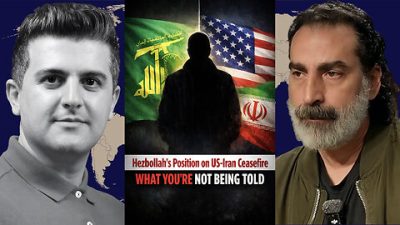
Laith Marouf: Hezbollah’s position on US-Iran ceasefire
or go to
Aletho News Archives – Video-Images
From the Archives
The Dirty Little Secret behind the “Global Terrorism Index”
The Omission of Israeli Terrorism in the Occupied Palestinian Territories
By Karin Brothers | Global Research | December 6, 2014
… The Israeli settlements — all of which are illegal – have been identified as a major impediment to peace. The refusal of a major “global” terrorism report to name the Israeli settlers as one of the groups most responsible for terrorism not only misrepresents a major source of regional violence but exposes the Global Terrorism Index as a propaganda tool that supports a U.S. agenda.
In recent years, governments have been attempting to thwart terrorism by blocking supportive fund-raising. When it comes to Israeli settlements, however, the US and Canada actually encourage fund-raising by giving organizations (such as Christian Friends of Israeli Communities (CFOIC) and the Jewish National Fund) financial support in the form of donor tax-deductions.
Charities which provide funds for the Israeli settlements should be regarded as terror-financing organizations. They should not only lose their tax-deductible status, but they should be banned because they support the violation of international humanitarian law. The terror-financing laws that are being strictly enforced for Muslim charities should be applied to Christian and Jewish charities as well. … Read full article
Blog Roll
 Aletho News
- How UK Regulator Ofcom Quietly Bypassed International Law to Police American Speech
- The Black Cube Files: How Former Mossad Operatives Flipped a Nation
- Laith Marouf: Hezbollah’s position on US-Iran ceasefire: What you’re not being told
- Israel’s priority lies in destroying chances of peace between Iran, US: Ex-UN nuclear chief
- Ceasefire for all or for none: Iran shuts Hormuz over Lebanon attacks
- Strait of Hormuz is Iran’s ‘nuclear weapon’ that forced US retreat: Medvedev
- Energy crisis will last for months – Kremlin envoy
- Europe’s quiet role in the war on Iran
- Forty days that shook the Empire: How Iran turned the tables on US and prevailed
- Netanyahu unilaterally declares Lebanon outside of ceasefire deal
- If Americans Knew
- This is ceasefire? Israel’s biggest massacre yet in Lebanon, another journalist killed in Gaza – Daily Update
- Tucker Carlson on Israel: This Is the Behavior of an Ally? Really?
- Gazans face a triple crisis: severe shortages of water and bread, healthcare in tatters
- NY Times reports how Netanyahu took the US into Iran War
- A sigh of relief over Iran, but Gaza and Lebanon in dire straits – Daily Update
- Thousands dead and neighborhoods razed to the ground: Aid agencies fear southern Lebanon is becoming the new Gaza
- The war the US is fighting for Israel could cost trillions
- ‘Cigarette Burns, Nail Wounds’: Toddler Tortured in Gaza to Coerce Father
- Trump Says US Sent ‘a Lot of Guns’ to Protesters in Iran
- Israeli forces destroy 17 UN peacekeeper cameras in south Lebanon
- No Tricks Zone
- An Inconvenient Tree: Uncovered In Alps… Europe Much Warmer Than Today 6000 Years Ago
- New Study Reports A 60% Slowdown In Greenland’s Ice Loss Rate In The Last Decade
- Low Intensity Tornado Wrecks Major Solar Farm, Creating A Potential Toxic Dump
- New Study Finds Warming Saves Lives…Cold Temperatures 12 Times More Deadly Than Excess Heat
- German Science Blog Accuses PIK Climate Institute Of Hallucinating Climate Tipping Points
- Devastating Assessment Of Comirnaty Vaccine By Former Senior Pfizer Europe Toxicologist
- New Study: CO2 Is ‘Effectively Negligible’ As An Explanatory Climate Change Factor Since 2000
- Former Pfizer Toxicologist Dr. Helmut Sterz Tells Bundestag Hearing Pfizer Vaccine Should Have Never Been Approved
- Energy Expert: Germany’s Nuclear Phaseout Was A “500 Billion Euro Mistake”
- New Research: South Australia’s Mid-Holocene Sea Surface Temperatures Were 4°C Warmer Than Today
 Aletho News